CGN Power: China's Nuclear Empire and the Atomic Grid
I. Introduction & Narrative Thesis
On the morning of April 20, 2026, a control room in Huidong County, Guangdong Province, logged a number that had taken China roughly forty years to earn. Unit 1 of the 太平岭 Taipingling nuclear power station — a 华龙一号 Hualong One reactor built by a subsidiary of 中国广核集团 China General Nuclear Power Group (CGN Group) — completed a 168-hour continuous full-load run and entered commercial operation, the first Hualong One in the Guangdong–Hong Kong–Macao Greater Bay Area.13 The site sits perhaps 100 kilometres up the coast from 大亚湾核电站 Daya Bay, where in the 1980s Chinese engineers had watched French and British contractors build a reactor they were not yet capable of building themselves.
That distance — a hundred kilometres of coastline, four decades of engineering — is the story of 中国广核电力股份有限公司 CGN Power Co., Ltd. (003816.SZ / 1816.HK). It is the listed vehicle that owns CGN Group's operating nuclear fleet, and it is the largest nuclear generator in the world's largest nuclear construction programme. At the end of 2025 it managed 28 operating units totalling 31,838 MW, plus 20 units under construction (four of them managed on the parent's behalf).1 Its managed fleet delivered 232,648 GWh to the grid in 2025 — 53.0% of all electricity that China's 59 commercial reactors sent to the grid that year.2 Its principal rival, 中国核电 China National Nuclear Power (CNNP), generated 200.8 billion kWh from its nuclear units over the same period.3 Two companies, roughly nineteen-twentieths of a national industry. That is not a competitive market. It is an administered duopoly with a construction queue.
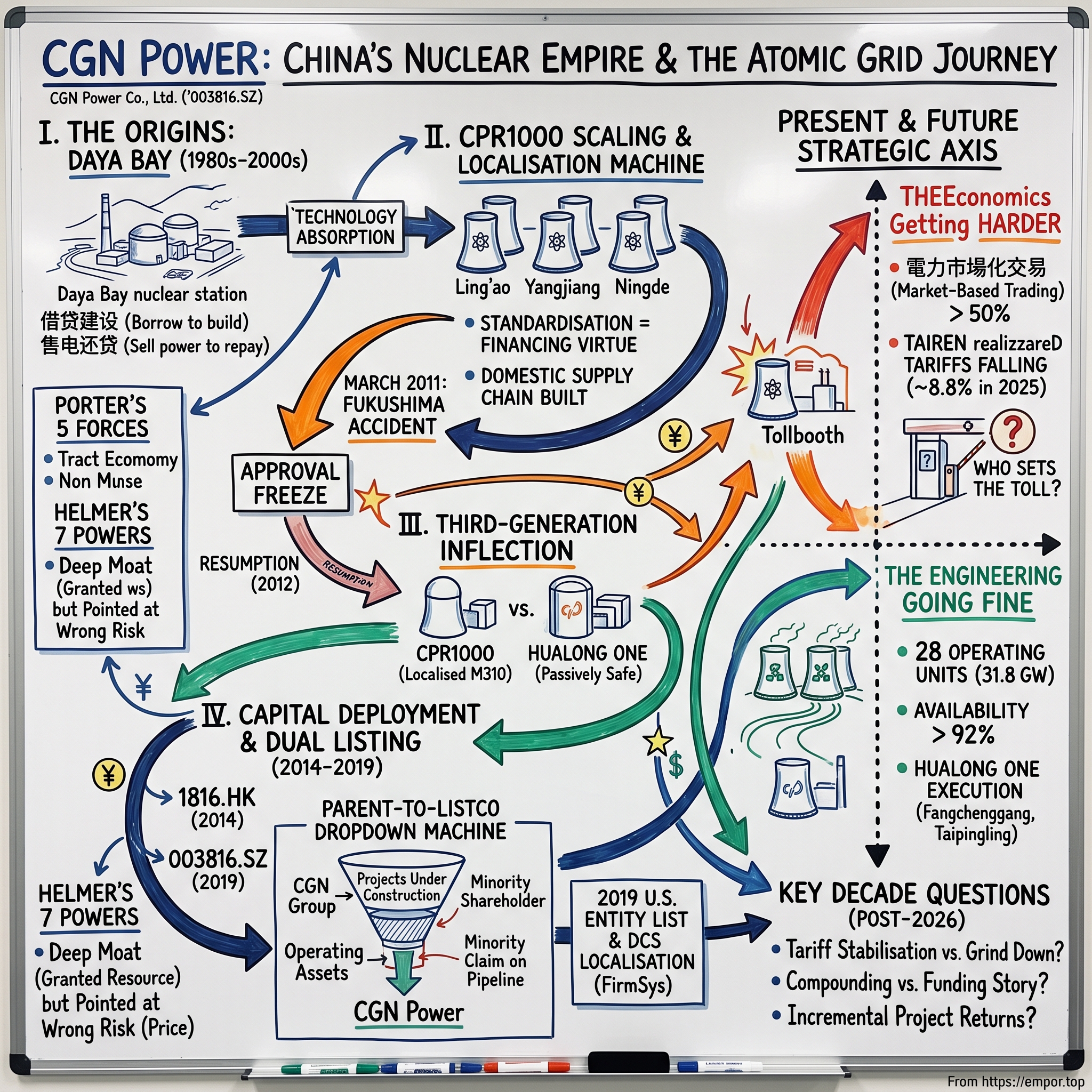
And yet the interesting thing about CGN Power in mid-2026 is not the engineering. It is that the engineering is going fine while the economics are getting harder. In 2025 the company pushed 2.36% more electricity onto the grid than in 2024 — and reported lower revenue, RMB75.70 billion, down 4.1%, and net profit attributable to shareholders of RMB9.77 billion, down 9.9%.1 In the first quarter of 2026 revenue fell 13.25% and profit 9.33%.4 The reason, stated plainly by the company itself, is price: the average market-based tariff it settled at in 2025 fell about 8.8% against 2024.1
This is the spine of the investment story, and it is worth stating without decoration. For most of CGN Power's listed life, the bull case was arithmetic: reactors come online, each one sells a near-fixed number of kilowatt-hours at a near-fixed administered tariff, therefore earnings compound.
China's electricity market reform has broken the second half of that sentence. More than half of CGN Power's on-grid volume — 56.2% in 2025, up 5.3 percentage points year on year — now clears through 电力市场化交易 market-based electricity trading rather than at a government-approved rate.1 In 2026 all 24 of its participating nuclear units are trading in provincial markets.1
The tollbooth still stands. Somebody else now sets the toll.
Both share classes have registered the change. The A-shares traded around RMB4.02 in late July 2026 against a 52-week high of RMB4.94; the H-shares around HK$2.88 against a high of HK$3.77 — a roughly RMB200 billion market capitalisation on the A-line, and a persistent 30%-plus discount on the Hong Kong line.
It is worth being precise about why this matters more for nuclear than for any other generation technology. A coal plant's economics are dominated by the price of coal; if power prices fall, fuel costs usually fall with them, and the margin partially self-corrects. A nuclear plant has almost no such shock absorber. Its costs are overwhelmingly the servicing and depreciation of concrete, steel and forgings that were paid for years ago, plus a fuel bill that is small and only loosely linked to spot uranium. That structure is a magnificent thing to own when prices are fixed and inflation is running — and a punishing one when the selling price is drifting downward and the cost base cannot follow.
Nuclear generators are, financially speaking, closer to toll roads than to factories. Which is exactly why the identity of whoever sets the toll is the central question in this business.
Five questions organise what follows. How did a Guangdong provincial venture, financed by borrowing against future Hong Kong electricity bills, become the operator of half of China's nuclear output? What did the post-Fukushima approval freeze force CGN to become? How does the parent-to-listco asset dropdown machine actually work, and who does it favour? What did the Taishan EPR episode reveal about how this company handles bad news? And finally: with 19.4 GW of its own capacity under construction, tariffs falling, leverage rising, and operating cash flow now smaller than capital expenditure, is the next decade a compounding story or a funding story?
One clarification before going further, because the CGN family tree confuses people. CGN Power is not the whole of CGN. The listed company is the group's exclusive platform for nuclear power generation — building, operating and managing nuclear stations and selling their electricity, plus the associated design, engineering and research work.1 It is not the group's uranium mining arm, not its wind and solar business, and not its overseas project vehicle. When headlines report that "CGN" has taken a stake in a Kazakh uranium company or won a renewables contract, that is usually the parent or a sibling, not the entity whose shares trade under 003816. This distinction matters constantly when assessing what the listed shareholder actually owns.
Nothing in this account requires a view on whether nuclear power is good policy. China has already made that decision, repeatedly and at scale. The question for an investor is narrower and more tractable: whether the specific listed entity through which foreign and domestic minorities access that build-out is being paid appropriately for the capital it deploys. That question has a different answer in 2026 than it had in 2019, and the change is measurable.
 Subscribe on LinkedIn
II. The Origins: Daya Bay, French Technology, and the Birth of China's Nuclear Industry (1980s–2000s)
Picture Guangdong in 1983. Factories are going up faster than transmission lines. Blackouts are routine enough to be scheduled. Across the border, Hong Kong is booming and burning imported oil and coal. And in Beijing, a decision has been taken that a province short of coal and long on ambition should build China's first commercial nuclear power station — using foreign technology, foreign money, and a repayment mechanism that did not exist anywhere else in the Chinese economy.
The decision came from the top. 邓小平 Deng Xiaoping's reform programme had opened the door to foreign capital and foreign technology, and nuclear power was among the most demanding tests of whether that opening could be made to work in heavy industry. A reactor is not a garment factory. It requires a regulator, a licensing regime, a quality culture, and a supply chain that did not exist — and it requires them before the first concrete is poured, not after.
The Daya Bay agreement was signed on January 18, 1985, in the Great Hall of the People. Total investment came to roughly US$4 billion — an amount equivalent to something on the order of a third of China's foreign exchange reserves at the time.7 China could not simply write that cheque. So the project's architects invented a structure that has since become a case study in emerging-market project finance, summarised in Chinese by four brisk phrases: borrow to build, sell power to repay, operate as a joint venture.7
The mechanics were elegant. Guangdong Nuclear Power Joint Venture Company was formed with Guangdong Nuclear Investment holding 75% and Hong Kong Nuclear Investment, a CLP Group vehicle, holding 25%.6 Framatome supplied two three-loop French pressurised water reactors of the M310 design; GEC-Alstom supplied the turbines; Électricité de France managed construction, which began in August 1987.6
Then came the clever part. The debt was foreign-currency debt, so the revenue that serviced it had to be foreign currency too — and roughly 70% of Daya Bay's output was contracted for export to CLP's Hong Kong system, paid in Hong Kong dollars.6 The two units entered commercial operation in February and May 1994.6 A Chinese power station was, in effect, underwritten by Hong Kong's electricity bills.
Strip away the diplomacy and what happened at Daya Bay was a leveraged buyout of a technology. China bought a working reactor with money it did not have, secured against an offshore hard-currency receivable, and got a trained workforce thrown in.
The plant has since sent more than 320 billion kWh of carbon-free electricity across the border.7 The engineers it trained became the founding cadre of an industry. And the deal established a template CGN would use again and again: find a counterparty who wants the output badly enough to underwrite the asset, then build the asset.
It was not an easy sell politically. Construction had barely begun when the Chernobyl accident in April 1986 turned Hong Kong opinion sharply against a reactor being built fifty kilometres from the territory's population centres, and a mass petition campaign followed. The project proceeded anyway, with an unusual concession to public anxiety: a permanent radiation monitoring regime around the site and, over time, a level of routine emission disclosure that Chinese industrial projects of that era rarely offered. That is a small detail with a long shadow. CGN grew up under scrutiny from a jurisdiction with a free press and an organised civil society, and the granular effluent and safety disclosure in its annual reports today is, in part, an inheritance from that founding condition.
The second act mattered more than the first. A country that imports one power station has a power station. A country that learns to build the next one has an industry. At 岭澳 Ling'ao, the follow-on site adjacent to Daya Bay, CGN's predecessors began substituting domestic content for imported equipment — and then, crucially, standardised what they had learned into a design of their own: the CPR1000, an evolution of the French M310 with a Chinese supply chain behind it. This is a less glamorous achievement than inventing a reactor, and a more valuable one. A bespoke reactor is a science project. A repeatable reactor is a manufacturing business.
Worth pausing on what "localisation" actually means here, because the phrase gets used loosely. It is not primarily about intellectual property. It is about the ability to source a reactor pressure vessel, a set of steam generators, a main coolant pump, and tens of thousands of qualified valves, cables and instruments from suppliers who can certify them to nuclear standards, on a schedule, at a price. Each of those components requires a manufacturer willing to invest in nuclear-grade quality systems, which only happens if there is a credible order book.
The single most important thing the Chinese state did for its nuclear industry was not funding a laboratory. It was guaranteeing enough repeat orders that a domestic heavy-forging industry found it worth building capacity. Everything CGN later achieved on cost and schedule rests on that supplier base existing.
The corporate architecture followed the engineering. CGN Group emerged as a central state-owned enterprise supervised by 国务院国有资产监督管理委员会 the State-owned Assets Supervision and Administration Commission (SASAC), with a portfolio spanning construction, operations, design, research, fuel and — later — overseas uranium.1 CGN Power Co., Ltd. was incorporated on March 25, 2014 as the group's exclusive platform for nuclear power generation, the entity into which operating assets would eventually be dropped and against which public capital would eventually be raised.1
Two structural features of the Daya Bay era survive into the 2026 investment case, and investors should hold onto both.
First, CGN never owned its technology outright at the start, which is precisely why it became obsessive about localisation later — a reflex that paid off unexpectedly when Washington intervened in 2019.
Second, CGN's economics were shaped from birth by a contracted offtake with a creditworthy buyer at a negotiated price. The company has spent its entire existence selling into administered pricing. Every commercial instinct in the organisation — how it plans, how it finances, how it forecasts — was formed under a regime where the price was a given and the only variable worth optimising was volume. That is the arrangement now dissolving, and it is fair to ask whether an organisation with forty years of muscle memory in regulated tariffs is well-equipped for a merchant market.
Before that question could arrive, though, CGN had to survive a different one — the moment when the entire industry stopped, overnight, because of an earthquake off the coast of Japan.
III. The CPR1000 Scaling Machine & The Post-Fukushima Inflection (2000s–2012)
The decade before 2011 was the closest thing China's nuclear industry has had to a gold rush. Having proven at Ling'ao that it could build to schedule with domestic content, CGN set about doing the same thing at multiple sites simultaneously: Yangjiang in western Guangdong, Ningde in Fujian, Hongyanhe in Liaoning, Fangchenggang in Guangxi. The CPR1000 was the product being manufactured; the coastline was the assembly line.
The logic was industrial rather than scientific. Every repetition of the same design compressed the learning curve: the same civil drawings, the same forgings from the same suppliers, the same commissioning sequence, the same trained crews moving from one site to the next. Construction schedules shortened. Equipment costs fell as domestic suppliers scaled. A supply chain that had barely existed in 1990 became, by the late 2000s, capable of producing reactor pressure vessels, steam generators and main coolant pumps within China.
One number captures why repetition matters so much in this industry. A nuclear plant's electricity is expensive or cheap almost entirely as a function of what it cost to build and how long the money was tied up before the plant earned anything. Shave a year off a seven-year construction schedule and you have removed a year of interest accruing on tens of billions of renminbi with no revenue against it. Standardisation is therefore not primarily an engineering virtue — it is a financing virtue. Every schedule improvement flows straight through to the levelised cost of the electricity the plant will sell for the next six decades.
Site selection followed a deliberate geography that still shapes the company's revenue exposure today. Nuclear plants need enormous volumes of cooling water, so China's fleet hugs the coast — but CGN's choices were also about matching supply to the country's most electricity-hungry provinces. Yangjiang and the Daya Bay cluster feed Guangdong, the manufacturing heartland. Ningde serves Fujian. Fangchenggang anchors Guangxi. Hongyanhe, in the northeast, serves Liaoning. Four provincial markets, four different demand profiles, four different provincial energy bureaus — a structure that looked like sensible diversification under a national tariff regime and turns out, under provincial market reform, to mean four separate pricing negotiations with four separate outcomes.
Then, on March 16, 2011 — five days after the Fukushima Daiichi accident — the State Council suspended approvals for all new nuclear power stations and ordered comprehensive safety inspections of every operating and under-construction plant in the country. Four projects already cleared to begin construction that year were halted, and a policy decision was taken against inland nuclear plants. Approvals did not resume until a new national nuclear safety plan was accepted by the State Council in October 2012.6
For a company whose entire growth model was "start another unit," this was an existential interruption. What is instructive is how CGN absorbed it, because the episode reveals the underlying financial physics of nuclear generation.
Consider what a freeze on approvals does and does not do. It does not stop reactors already running from running. Existing units kept producing electricity at high margins, and that cash flow kept funding the units already under construction.
Nuclear's cost structure — enormous upfront capital, very low variable cost, revenue independent of fuel prices — makes an operating fleet remarkably indifferent to the policy weather. The freeze hit the growth option, not the base business. Any investor tempted to model a future nuclear moratorium as catastrophic for CGN Power should study 2011–2014: the shock lands on the pipeline and the terminal value, not on next year's cash flow. That asymmetry is one of the most durable and least appreciated features of this asset class.
The second consequence was technological, and more consequential. Beijing's post-Fukushima verdict was that second-generation designs — the CPR1000 family included — would no longer be approved for new projects. Future units would have to be third-generation: passive safety systems that cool the core without pumps or operator action, and containment structures capable of withstanding an aircraft impact. Everything CGN had spent fifteen years industrialising was, for new-build purposes, obsolete.
It is worth explaining what "third generation" actually buys, in plain language, because the distinction drives billions of renminbi of capital cost. A conventional pressurised water reactor keeps its core cool by pumping water through it. Pumps need electricity. Fukushima's core damage happened because the tsunami destroyed both the grid connection and the backup diesel generators, so the pumps stopped while the fuel was still generating decay heat.
Passive safety inverts that dependency: the plant is designed so that if everything fails — no grid, no diesels, no operators — gravity, natural convection and stored water keep the core cool for days without anyone doing anything. Think of it as the difference between a building that needs a working fire pump and one that has a water tank on the roof. The second is more expensive to build and considerably harder to defeat.
CGN's answer was to accelerate its own third-generation programme, the ACPR1000+, which under state direction was eventually merged with 中国核工业集团 China National Nuclear Corporation's competing ACP1000 to produce a single national platform: Hualong One. The politics of that merger were not gentle — two rival state groups were told to combine their flagship designs — but the industrial logic was sound. A country building dozens of reactors cannot afford two incompatible supply chains, and an export programme cannot market two competing national champions to the same customer.
There is a governance observation buried in that episode that investors should register. The design CGN builds today was not chosen by CGN. Neither was the timing of its adoption, nor the retirement of the design CGN had spent fifteen years perfecting.
In a normal industrial company, technology strategy is management's core responsibility and a primary source of differentiation. Here it is set above the company. That removes a category of capital-misallocation risk — CGN cannot bet the balance sheet on an idiosyncratic reactor design — while also removing a category of upside. When assessing this management team's record, it is only fair to hold them accountable for the decisions they actually control: construction execution, outage management, financing cost, and increasingly, market pricing strategy.
The strategic lesson is one worth carrying forward, because it recurs in this story. CGN's advantages have rarely come from being first with an idea. They have come from being the organisation that turns a mandated design into a repeatable industrial process faster than anyone else. That is a real capability, and it is testable — we will test it in Section V against how the Hualong One fleet is actually performing.
The freeze also created something else: a backlog of capital needs, and a state parent carrying construction risk it wanted off its own balance sheet. Which is how CGN Power ended up in Hong Kong.
IV. Capital Deployment, Corporate Restructuring & Dual Listings (2014–2019)
Hong Kong's retail investors are not usually described as romantics about baseload infrastructure. In December 2014 they were. CGN Power's initial public offering was oversubscribed 287.3 times, priced at the top of its range at HK$2.78 per share, and raised HK$23.8 billion — the second-largest Hong Kong listing of the year, behind only HK Electric Investments.8 The company took the unusual step of allocating heavily to retail buyers taking minimum 1,000-share lots, squeezing institutional and private-banking allocations.8 Trading began on December 10, 2014.8
The pitch was clean, and it was true at the time: here was the only listed pure-play nuclear generator in the world, in the only country building nuclear at scale, selling into government-set tariffs. What investors were actually buying, though, was not just a fleet. It was a claim on a pipeline held by someone else.
This is the mechanism that defines CGN Power's corporate structure and deserves close attention, because it is where minority shareholders' interests and the parent's interests meet.
CGN Group develops nuclear projects: it wins the site approvals, carries the pre-construction risk, absorbs the regulatory overhead, and takes the multi-year hit of building a reactor that earns nothing until it is finished. As projects mature, the parent sells them into the listed company. CGN Power gets producing or near-producing assets; the parent recycles capital into the next tranche of development. Think of the listed company as a permanent, pre-committed buyer of its parent's completed inventory.
For the parent, this is capital recycling: development capital returns from the listed vehicle and funds the next project, so CGN Group can run a far larger pipeline than its own balance sheet would support. For minority shareholders in CGN Power, the arrangement has a genuine benefit and a genuine cost. The benefit is that the riskiest years of a nuclear project — site approval, first concrete, the middle of a seven-year build — are financed elsewhere, and the listed company buys assets when much of the uncertainty has been resolved. The cost is that the listed company is a price-taker in every one of these transactions, negotiating with an entity that controls 58.9% of its own votes.
The mechanism ran continuously through 2025. In January of that year CGN Power acquired 100% of Taishan Second Nuclear from the parent for approximately RMB1.20 billion, booking a revaluation gain of about RMB3.9 million. In October it acquired 82% of Huizhou Nuclear and 100% each of Huizhou Second Nuclear, Huizhou Third Nuclear and Zhanjiang Nuclear for approximately RMB9.38 billion, with revaluation gains of roughly RMB1.49 billion and RMB126 million on the two Huizhou entities.1 Then, on January 5, 2026, a concerted-party agreement with 中国大唐 China Datang's nuclear arm handed CGN Power control of Ningde Second Nuclear without buying another share — a joint venture converted into a consolidated subsidiary by contract.1
Two observations a careful investor should make here. The first is an accounting one that is easy to miss and materially affects how you read the numbers: because these are business combinations under common control, prior-period comparatives get restated as though the acquired entities had always been part of the group. CGN Power's 2024 figures in the 2025 accounts are restated;1 its Q1 2025 comparatives were restated again in the Q1 2026 report, moving reported revenue for that quarter from RMB20.03 billion to RMB18.81 billion.4 Reported growth rates in this company are therefore not always comparing what they appear to compare. That is not an irregularity — it is required accounting — but it does mean headline year-on-year percentages deserve a second look.
There is also a benchmarking problem worth naming. The natural comparison for these transfers would be what CNNP pays its own parent for equivalent assets, but the two groups disclose acquisition consideration without the underlying capacity, construction cost or expected return data that would make a like-for-like comparison possible. Absent that, the most an outside investor can do is check whether the acquired entities' subsequent contribution matches what was implied — which the restatement mechanics make awkward. Investors should treat "the dropdowns have been fair" as an inference supported by the absence of contrary evidence, not as a demonstrated fact.
The second observation is about fairness. The dropdown price is set under SASAC valuation rules and, for a Hong Kong-listed issuer, connected-transaction disclosure applies. Those are real constraints. They are not the same thing as a competitive auction, and a minority shareholder is trusting a valuation process controlled by the counterparty's ultimate owner.
The honest verdict is that there is no public evidence of abusive pricing — the revaluation gains booked on these transfers suggest assets came in below fair value rather than above — but the structure permanently requires trust rather than delivering proof. That is a permanent feature of owning a Chinese state-owned listed subsidiary, and it belongs in the discount rate rather than in a debate.
The second listing came in August 2019, and its timing was remarkable. CGN Power issued 5.05 billion A-shares on the Shenzhen Stock Exchange at RMB2.49, raising about RMB12.57 billion — the largest A-share IPO of that year. Eight strategic investors, mostly state-owned enterprises and national investment funds, took roughly half the new shares. The stock closed its first day at RMB3.59, up 44.18%.9
The composition of that share register is worth noting. Roughly half the new shares went to eight strategic investors — largely state-owned enterprises and national investment funds — which is a very different shareholder base from the retail-heavy Hong Kong offering five years earlier.9 It gave the A-line a stable domestic anchor at the cost of a smaller genuinely free float, and it is one reason the two share classes have traded so far apart ever since.
Days earlier, on August 14, 2019, the U.S. Department of Commerce's Bureau of Industry and Security had added CGN Group and three affiliates to the Entity List, alleging efforts to obtain advanced U.S. nuclear technology for military end-uses in China, with a presumption of denial for licence applications.10
The market's reaction — a 44% first-day pop for a company whose parent had just been cut off from U.S. technology — tells you how thoroughly domestic Chinese investors had concluded the business did not depend on American supply. They had a point, and the reason traces directly back to the localisation reflex formed at Daya Bay. The most sensitive system in a nuclear plant is its digital instrumentation and control platform — the "central nervous system" that monitors and controls plant operations. CGN's subsidiary China Techenergy launched 和睦系统 FirmSys in 2010 after five years of development, China's first nuclear-grade safety DCS with independent intellectual property, designed to remove reliance on imports from the United States, France and Japan and to cut roughly RMB300 million from reactor cost versus international competitors.11 By the time Washington acted, CGN had already spent a decade building the thing sanctions would have denied it.
That is a genuinely instructive sequence, and it should temper how investors read geopolitical risk here — a point Section IX returns to with the residual exposures that localisation does not solve.
One more consequence of the dual listing deserves a mention, because it has persisted for seven years and shows no sign of closing. The same company, the same dividend per share, the same underlying reactors, trades at roughly RMB4.02 in Shenzhen and roughly HK$2.88 in Hong Kong — a gap of about 30% once currency is accounted for. Capital controls, differing investor bases, and the reluctance of global institutional money to own Chinese state-owned nuclear all contribute.
The practical implication is that any statement about CGN Power's valuation or dividend yield is meaningless without specifying the share class, and that the company's cost of equity is materially different depending on which market it issues into. It has consistently chosen to raise new equity-linked capital onshore, where the price is better — the 2025 convertible being the most recent example.
V. Third-Generation Tech Execution: Hualong One & Taishan EPR
There is a photograph that circulates in Chinese nuclear circles of the Taishan site around 2015: two enormous double-shelled containment buildings rising on the Guangdong coast, the first European Pressurized Reactors anywhere in the world to reach that stage of construction. France had started building one at Flamanville in 2007. Finland had started at Olkiluoto in 2005. Both were years late and billions over budget. CGN, in partnership with EDF, started later and finished first: Taishan Unit 1 entered commercial operation in December 2018, making it the first operational EPR on the planet.
For a while this was CGN's proudest talking point. Then it became its most instructive problem.
In June 2021, midway through Taishan 1's second fuel cycle, operators detected rising concentrations of noble gases in the primary circuit. The cause was damage to fuel rod cladding. China's 国家核安全局 National Nuclear Safety Administration estimated that of more than 60,000 fuel rods in the core, roughly five had cladding damage; a whistleblower at a French nuclear company alleged the true figure was far higher. CGN took the unit offline on July 30, 2021 to investigate and replace the defective fuel. It stayed offline for more than a year, returning to the grid on August 15, 2022.[^14]
How an investor reads that episode depends on which question is being asked. On safety, the answer is reassuring: nothing was released, the regulator was engaged, and the operator chose a year of lost output over continued operation with a known defect.
On operating economics, it is a reminder that a first-of-a-kind reactor is a first-of-a-kind reactor regardless of who builds it, and that CGN's EPR fleet remains the weakest performer in its portfolio. In 2025, Taishan Unit 1 recorded a capacity factor of 68.80%, down from 90.50% in 2024, and utilisation of 5,951 hours against a fleet average of 7,767 — because the plant's refuelling outages in 2025 ran longer than in 2024. Taishan's on-grid generation fell 3.49% for the year, the worst result of any CGN site.1
A word on why refuelling outages dominate this company's operating story, since they recur throughout the numbers. A pressurised water reactor cannot be refuelled while running — the core sits inside a sealed pressure vessel under enormous pressure, so adding fuel means shutting down, depressurising and opening the vessel under water. CGN's units are designed on an 18-month cycle, with major equipment inspections mandated every ten years, and those ten-year outages take considerably longer than routine ones.1 Outage length is therefore the single operational variable management most directly controls, and shortening it is worth real money: every day saved across a 1,000 MW unit is roughly 24 million kWh of additional saleable output.
There is a broader industry lesson in the EPR programme that applies well beyond CGN. The EPR was designed to be the safest and most powerful commercial reactor ever built, and at roughly 1,750 MW per unit it remains the largest. It was also so complex that its Western builders spent well over a decade failing to complete it on budget. CGN got its two units finished and running because it had something Flamanville and Olkiluoto did not: a state that could mobilise labour and supply chain at will, and a workforce that had already built more than a dozen reactors that decade. But CGN has not ordered another EPR. Its entire forward programme is Hualong One. The company's revealed preference — build the design you can build fifty times, not the design that wins on paper — is the single clearest statement of strategy in this story, and it was made with its wallet rather than in a presentation.
Against that, the standardised platform is the real story. Hualong One is a 1,000 MW-class three-loop PWR combining active and passive safety systems inside a double containment, designed for a 60-year life. CGN's first two units are at Fangchenggang in Guangxi: Unit 3 entered commercial operation in 2023[^12] and Unit 4 was started up in 2024, reaching commercial operation on May 25 of that year.[^13]1 Taipingling Unit 1 at Huizhou followed in April 2026, capable of more than 9 billion kWh a year.13 Cangnan Unit 1, in Zhejiang, entered commercial operation on April 29, 2026.5
Now the honest scorecard. In 2025, CGN's mature CPR1000-derived units routinely posted capacity factors above 92% — Ling'ao Unit 2 at 99.99%, Yangjiang Unit 6 at 99.99%, Ningde Unit 1 at 99.99%. The two Hualong Ones at Fangchenggang posted 84.06% and 81.10%.1
Some of that gap is the initial outage that follows a unit's first year, and some is simply the seasoning period every new design goes through. But it means the claim that Hualong One standardisation immediately delivers fleet-grade availability is not yet evidenced. It is a reasonable expectation, not an established fact, and 2026–2028 output data from Fangchenggang 3 and 4, Taipingling 1 and Cangnan 1 will settle it. Investors should hold management to that comparison rather than to the commissioning announcements.
What is evidenced is the industrialisation effort behind it. CGN established a dedicated fleet excellence team for Hualong One outages, completed 20 pilot optimisation projects — containment pressure test drainage, electric actuator maintenance cycles, low-voltage switchgear testing — and applied them during Fangchenggang Unit 4's first outage.1 Construction has moved to modular rebar cage assembly, domestically manufactured welding equipment for main coolant pipes, integrated insulation modules for reactor pressure vessels, and a full-plant 3D underground design model first used at Huizhou Phase II.1 In the operating fleet, CGN's in-house "Wukong" inspection robots eliminate generator rotor extraction, and remote machining and automated welding tools shortened the critical path of Yangjiang Unit 2's outage by 120 hours.1 Across 2025 the company ran 20 refuelling outages totalling roughly 655 days.1
That is what industrial process power looks like in practice: not a breakthrough, but a hundred hours shaved here and a shorter outage there, compounding across 28 units.
The aggregate result was a genuinely good operating year. Fleet-wide, average utilisation rose from 7,710 hours in 2024 to 7,767 in 2025, and capacity factor from 91.91% to 92.65%.1 Against the international benchmark, 286 of 336 WANO performance indicators — 85.12% — ranked in the world's top quartile, though that was marginally below 2024's 290 indicators and 86.31%.1 A fleet of this size holding availability above 92% while absorbing two ten-year outages and one initial outage is an operator performing at the top of its industry.
Which sets up the uncomfortable question. If the machines are running better than ever, why did earnings fall?
VI. Business Segments, Tariff Dynamics & Financial Anatomy
Every eighteen months or so, each of CGN Power's reactors shuts down. Fuel assemblies are lifted out under water, fresh ones go in, and while the core is open the plant's engineers attack a maintenance list they have been building for a year and a half. Twenty of these refuelling outages ran across the fleet in 2025, consuming roughly 655 outage-days in total.1 Every one of those days is a day a reactor earns nothing while its depreciation, interest and staff costs run exactly as before.
That is the cleanest way into this company's economics. CGN Power's income statement is essentially a function of two things: how many hours its reactors run, and what price it gets for the electricity they produce while running. Everything else is detail.
One business, one appendage
Strip CGN Power to its economic core and you find one business with a small appendage attached.
Electricity sales generated RMB61.76 billion of revenue in 2025 — 81.6% of the total — against RMB38.60 billion of cost, a gross margin of roughly 37.5%.1 Construction, installation and design services contributed RMB11.34 billion of revenue against RMB11.09 billion of cost.1 That is a gross margin of about 2.2%. Read that again, because it reframes the segment: the engineering arm is not a second profit engine. It is a cost-recovery vehicle through which CGN Power builds reactors — its own and the parent's — at close to breakeven. Investors modelling it as a diversifying earnings stream are modelling a rounding error. Everything else — technical services, goods, rentals — added under RMB1.2 billion combined.1
The emerging businesses deserve the same proportionality. CGN's nuclear district heating demonstration project at Hongyanhe completed its fourth heating season in 2025; a Shandong nuclear heating project is being built to come online with its unit; industrial steam demand has been "preliminarily identified" in parts of Guangxi and Fujian; and the company is conducting early studies on energy storage, seawater desalination and a "nuclear power plus computing centre" model.1
These are real options with real strategic logic — a reactor that can sell heat and steam is less exposed to electricity price alone — but as of mid-2026 they are studies and demonstrations, not earnings. Treat them as optionality, priced at approximately zero, and revisit if the disclosure changes.
So the company is a fleet of reactors selling kilowatt-hours. Which makes tariff the whole game.
How the price is actually set
Here is how Chinese nuclear pricing actually works, in plain terms. Historically each unit was assigned an approved on-grid tariff — the price the local grid company pays per kilowatt-hour, set by government. CGN's legacy Guangdong units sit around RMB0.4143–0.4153 per kWh including VAT; Daya Bay at RMB0.4056; Taishan, the most expensive to build, at RMB0.4350; Fangchenggang at RMB0.4063.1 Increasingly, however, units sell into provincial markets where price is negotiated or cleared competitively — the market-based tariff.
Three facts about that transition matter more than any other numbers in this article. First, scale: market-based volume reached 56.2% of CGN's total on-grid generation in 2025, and in 2026 all 24 participating units have signed annual or quarterly medium- and long-term market contracts.1 Second, direction: average market-based tariffs fell about 8.8% in 2025.1
Third, the national context: 64.0% of all Chinese electricity consumption traded through markets in 2025, spot markets ran continuously in 28 provinces, and on February 11, 2026 the State Council issued implementing opinions targeting a basically complete national unified power market by 2030 and full completion by 2035.1 This is not a cyclical dip. It is a structural regime change with a published timetable.
Notice also what the approved tariffs reveal about new capacity. Ningde Unit 4 is approved at RMB0.3590 and Hongyanhe Units 5 and 6 at RMB0.3749 — meaningfully below the Guangdong legacy fleet.1 In July 2026 the newest units, Cangnan 1 and 2 and Huizhou 1 and 2, were granted RMB0.4153 for non-market volume, pending their entry into competitive trading.14 The pattern is that newer reactors cost more per kilowatt to build and do not command a premium price for what they produce. Capacity growth and earnings growth are not the same variable, and conflating them is the most common error in the bull case.
There is a second-order consequence of market participation that rarely gets discussed and shows up in CGN's structure. Selling into a market requires someone to sell to. CGN Power now runs power sales companies acting as retail agents: in 2025 those subsidiaries recorded actual electricity consumption of roughly 130,847 GWh for agent clients, and 449 retail agent clients accounted for about 25,537 GWh.1 A nuclear generator has, quietly, acquired a customer-facing business it did not previously need. That is an adaptation, but it also introduces a category of risk — counterparty credit, contract shape, volume forecasting error — that a company selling everything to a provincial grid at a fixed rate never carried.
The cost base that cannot flex
Now the cost side, because it explains why the tariff squeeze bites so hard. Of the RMB38.60 billion cost of electricity sales, nuclear fuel was RMB9.66 billion, depreciation of fixed assets RMB11.73 billion, and the provision for spent fuel management RMB4.38 billion — the last rising 7.8% as Yangjiang Unit 6 and Taishan Unit 2 passed five years of commercial operation and began accruing.1
Fuel is roughly a quarter of the cost of generating; depreciation is roughly a third. Both are essentially fixed against volume. A nuclear plant's costs barely move when its price moves, which is wonderful when tariffs rise and brutal when they fall. Every percentage point of realised tariff drops almost intact to operating profit.
The consolidated picture for 2025 follows from that. EBITDA margin fell from 51.5% to 48.9%; net margin from 22.1% to 19.5%; return on equity from 8.7% to 7.8%.1 Note also how much of the profit never reaches the listed shareholder: total net profit was RMB14.73 billion, of which RMB4.97 billion — 34% — went to non-controlling interests in the project companies.1 CGN Power is a holding structure with substantial minority partners at the asset level, and headline fleet statistics overstate the economics attributable to the shares you can buy.
Two items in the accounts deserve a diligence flag, not because anything looks wrong but because they involve long-dated management judgement. The first is decommissioning: CGN Power carries a provision of RMB6.57 billion for eventually dismantling its plants, plus RMB936 million for low- and medium-level radioactive waste disposal, both stated as discounted best estimates of costs that will be incurred decades from now.1 Small changes in the assumed cost or discount rate move that number materially, and no Chinese commercial reactor has yet been decommissioned to provide a real-world benchmark. The second is government support: other gains rose 20.4% to RMB2.04 billion in 2025, driven principally by VAT refunds, and government grants contributed RMB470 million of non-recurring income.1 Roughly RMB2.5 billion of pre-tax income therefore depends on fiscal policy rather than on operations — worth watching, since it flattered a year in which operating performance weakened. The accounts themselves carry an unqualified opinion from KPMG Huazhen, with no changes in accounting policies or estimates during 2025.1
Where the cash actually goes
The balance sheet is where the strain shows most clearly, and this is the part that deserves an unsentimental read. Total borrowings reached RMB271.94 billion at end-2025, up 15.7%.1 The asset-liability ratio rose from 61.2% to 65.2%; net debt to equity from 119.5% to 142.6%; interest coverage slipped from 3.7 to 3.5 times.1
Meanwhile operating cash inflow fell 20.1% to RMB29.97 billion, while fixed-asset investment rose 6.9% to RMB35.98 billion.1 The company spent roughly RMB6 billion more on capital projects than its operations generated — before paying a dividend of RMB4.79 billion in respect of 2024.1 The gap is bridged with debt.
Then look at where the asset base sits. Construction in progress grew from RMB85.05 billion to RMB113.93 billion while net fixed assets fell from RMB263.05 billion to RMB252.43 billion.1 The operating fleet is depreciating faster than it is being replaced, and the replacement is not yet earning anything.
That last pair of numbers quietly demolishes one of the most popular arguments about nuclear utilities: that as reactors reach the end of their 30-year accounting life while continuing to run for 60, margins expand and the business becomes a cash machine. The mechanism is real. But it only delivers to shareholders if the company stops rebuilding the fleet. CGN Power is doing the opposite — rolling depreciated capital straight into new construction in progress. The fully-depreciated windfall is perpetually deferred as long as the build programme runs, and management has given no indication it intends to stop.
2026 has so far continued the pattern. First-quarter on-grid generation fell 10.11% to 50.96 billion kWh on extended outages, revenue fell 13.25% to RMB16.32 billion, and profit attributable to shareholders fell 9.33% to RMB2.74 billion — again attributed to lower output at certain subsidiaries and lower market tariffs.4 The second quarter recovered as Taipingling 1 and Cangnan 1 came online: first-half generation finished at 117.77 billion kWh, down 2.12%, with on-grid volume of 109.60 billion kWh, down 3.32%.5 Full-year 2026 output will depend heavily on outage execution — the plan calls for 19 refuelling outages including six ten-year outages, a heavier maintenance year than 2025.1
For investors, the anatomy resolves to this: a high-quality operating asset with a deteriorating price, an engineering segment that is economically neutral, an expansion programme that consumes more cash than the business produces, and a balance sheet absorbing the difference.
None of that is fatal. All of it is a change from the story sold in 2014. And it raises the obvious next question — who is making these choices, and how are they being judged?
VII. Current Management, Corporate Governance & Capital Allocation
The people running CGN Power are not celebrity operators, and the system is designed to ensure they never become any. That is a feature of state ownership worth understanding rather than lamenting.
At the end of 2025 the company changed presidents. 高立刚 Gao Ligang, a career nuclear operator who had run the Daya Bay operating company before rising through the group, reached retirement age and stepped down. 庞松涛 Pang Songtao — a non-executive director since 2023, born in 1971, a researcher-grade senior engineer with more than three decades in the nuclear industry — was re-designated as an executive director and appointed president in December 2025. As of the 2026 first-quarter report, Pang is the board's sole executive director, alongside four non-executive directors including chairman 杨长利 Yang Changli and three independent non-executive directors.4
The résumés tell you what this organisation values. Gao spent his career inside plants — the Daya Bay operating company, then the group's operating arm — and was known internally for outage discipline, which is the nuclear industry's equivalent of inventory turns. Pang arrived with more than thirty years in the same industry and a researcher-grade engineering title, having sat on the board for two years before taking the executive seat. Neither man is a financier, a dealmaker or a public personality. Nobody has been parachuted in from banking or consulting. When you look at who runs the largest nuclear generator on earth, you find nuclear engineers who have been promoted slowly, and that is almost certainly the correct answer for a business where the worst-case outcome is measured in decades rather than quarters. It is a less useful answer for the specific problem CGN Power now faces, which is commercial rather than technical.
Two things follow from that composition. Three independents out of eight is thin by the standards a Hong Kong-listed issuer is measured against, and the company disclosed that it complied with all applicable corporate governance code provisions in 2025 except for "Selection of Lead Independent Director."1 CGN's defence is structural: it has established a nuclear safety committee under the board specifically to strengthen oversight of the thing that could destroy the company.1 That is a substantive and industry-appropriate answer to a governance gap, but it is an answer to a different question than the one the code provision asks.
Ownership is unambiguous. CGN Group holds 29.18 billion domestic shares and 560 million H-shares out of 50.50 billion shares outstanding — approximately 58.9%.1 Guangdong Hengjian Investment Holding holds about 6.79%, and — a detail worth pausing on — CNNC, the state group that owns CGN Power's principal competitor, holds approximately 3.32%.4 In most jurisdictions a direct competitor holding 3% of your equity would be an antitrust conversation. In China's nuclear sector it is simply how the family is arranged, and it is a useful reminder that "competition" between CGN and CNNP operates under a common ultimate owner.
On incentives, investors should be clear-eyed. There is no meaningful equity-linked compensation driving this management team. Total employee cost across 22,928 staff was RMB12.90 billion in 2025.1 Executives are appraised within the SASAC framework — safety performance, output, capital discipline, state-mandated economic value metrics — and their careers run through the state nuclear apparatus rather than the market for CEOs.
The practical implication cuts both ways. CGN Power's management will almost never take an aggressive, shareholder-value-maximising risk, and will almost never fail to prioritise safety over quarterly output. In a business where one severe accident ends the industry, that alignment is arguably worth more than options would be. But it also means minority shareholders should not expect advocacy: nobody in the building is paid to worry about the H-share discount, and nobody's bonus improves if the company negotiates harder on tariffs than the state would prefer.
On disclosure practice, the company does more than the minimum and less than an investor would ideally want. It publishes quarterly operating data through both exchanges, files a first-quarter report, and discloses generation by station and by unit. It does not, however, hold the kind of open earnings call with analyst Q&A that Western utilities run, so there is no live record of management being pressed on the difficult questions — no transcript in which someone asks what happens to the capital programme if market tariffs fall another 10%. The absence of that forum is itself a governance fact. It means the analytical work has to be done from filings, and that management's explanations cannot be tested by cross-examination in public.
Capital allocation shows discipline in financing and expansion in commitment. The debt book is roughly 94.9% bank and institutional borrowings, 1.8% A-share convertible bonds, 1.8% medium-term notes and 1.5% SASAC special bonds for stabilising growth, kept predominantly RMB-denominated and long-dated.1
The company issued RMB2.40 billion of medium-term notes in March 2025, registered a multi-type interbank debt financing programme with capacity of up to RMB25.20 billion, holds unutilised general banking lines of about RMB432.23 billion, and carries a AAA domestic rating from China Chengxin reaffirmed with stable outlook in September 2025.1 Foreign-currency exposure has been deliberately run down through forwards, debt swaps and early repayment.1 For a company adding RMB37 billion of gross debt in a year, that is competent treasury work.
Equity funding returned in July 2025 in the form of RMB4.90 billion of A-share convertible bonds, listed on July 25, with a conversion price of RMB3.67 and a coupon rising from 0.20% in year one to 2.00% in year six, maturing July 2031; net proceeds replaced self-raised funds already invested in Lufeng Units 5 and 6.1 Borrowing at an initial 0.2% is exceptionally cheap money — but with the A-shares near RMB4.02, the conversion option is in the money and the dilution is live. Basic EPS for 2025 was RMB0.193 against diluted RMB0.192; by the first quarter of 2026 the gap had widened to RMB0.054 basic versus RMB0.052 diluted.14 The cheap coupon is being paid for in shares.
On dividends, the record is consistent and the current yield is more modest than the sector's reputation suggests. The board proposed a final dividend of RMB0.086 per share for 2025 — RMB4.34 billion in total, a payout ratio of 44.47%, against RMB0.095 and 44.36% for 2024.1 Cumulative dividends since the 2014 listing have reached RMB36.76 billion.1 The stated floor is not less than 30% of attributable net profit.1
Holding the payout ratio steady while profit fell means the dividend fell too — which is honest, consistent policy rather than the "progressive dividend" a yield investor might assume. At the July 2026 A-share price the indicated yield is roughly 2.1%; on the H-shares, closer to 3.3%. Investors who arrived expecting a 4–5% nuclear yield should check which share class and which year produced that figure.
The credibility verdict on this management is therefore mixed in a specific way. On safety and operations, the record is strong and the disclosure is unusually granular — unit-by-unit capacity factors, outage counts, effluent data measured against national limits, and no INES level-2-or-above event in the operating history.1 Few utilities anywhere publish performance at that resolution, and companies with something to hide rarely volunteer per-unit availability.
On the commercial narrative, management has been consistent and forthright. It named the cause of the 2025 shortfall as market tariffs rather than reaching for weather, one-offs or macro conditions, and it repeated the same explanation in the first-quarter 2026 disclosure.14 Narrative consistency across a deteriorating run of results is a genuine credibility marker, and this management has it.
Where the assessment turns critical is on the remedy. The stated 2026 plan for the tariff problem amounts to diversifying the customer base, accessing more favourable types of market trading, striving for better market tariffs, and advocating for long-term policy enabling nuclear participation in markets.1 That is lobbying and marketing, not a mechanism. There is no disclosed contracting structure, hedging programme, or capacity-payment arrangement that would insulate earnings if provincial clearing prices keep falling — and no disclosed threshold at which the capital programme would be moderated in response. Investors are being asked to trust that the state will not let the economics break, which may well be correct, but is a political judgement rather than a financial one.
VIII. Strategic Moat Analysis: Porter's 5 Forces & Hamilton Helmer's 7 Powers
War-game this industry properly and the first thing you notice is that the usual competitive questions barely apply. There is no product differentiation — an electron is an electron. There is no marketing. There is no customer choice in any conventional sense. What there is, is a permission structure, and that is where the power lives.
Cornered resource — the primary power. Building a nuclear plant in China requires State Council approval of the project, an approved coastal site with adequate cooling water, seismic and environmental clearance, and a licensed operator. CGN Power's managed operating and under-construction capacity amounts to 44.48% of the national total.15 Approvals arrive in an annual batch: in April 2025 the State Council, chaired by Premier 李强 Li Qiang, approved five projects and ten reactors — Fangchenggang Phase III, Haiyang Phase III, Sanmen Phase III, Taishan Phase II and Xiapu Phase I — with estimated investment above RMB200 billion, marking the fourth consecutive year of ten-or-more approvals.12 Two of those five belonged to CGN.1 This is the deepest moat in the story, and it has an important property: it was granted, not built. What the State Council allocates, the State Council can reallocate.
Scale economies — secondary, and real. Standardising on Hualong One lets CGN order identical long-lead forgings, reuse civil designs, and move commissioning crews between sites. The outage optimisation work described earlier is scale economics in its purest form: an improvement developed once and applied 28 times.
Process power. Four decades of operating experience, benchmarked externally, produce the fleet availability numbers in Section V. This is the power CGN has most legitimately earned, and it is the hardest for a new entrant to replicate because it cannot be bought — only accumulated through outage cycles.
Counter-positioning. Nuclear delivers firm, dispatchable, zero-carbon output. The 2025 national statistics make the contrast vivid: nuclear averaged 7,809 utilisation hours, thermal 4,147, hydro 3,367, wind 1,979 and solar 1,088.1 A gigawatt of nuclear does roughly seven times the annual work of a gigawatt of solar.
But this power is weakening in a way the framework helps expose. As solar and wind flood daytime supply, they crush spot prices in exactly the hours nuclear also runs. Nuclear's physical advantage over renewables is precisely what markets are currently failing to pay for, because energy-only markets price kilowatt-hours, not firmness. Unless China's market design introduces capacity payments or firm-power products, counter-positioning stays a technical virtue rather than a commercial one.
Running Porter's forces over the same terrain:
Threat of new entrants: negligible. Only a handful of state groups may own and operate reactors. Capital requirements run to tens of billions of renminbi per project, licensing takes years, and the NNSA regulates continuously.
Bargaining power of suppliers: low, and structurally hedged. Domestic manufacturing supplies the heavy components, and the wider CGN group has integrated backwards into fuel: CGN's subsidiary took a 49% stake in Kazatomprom's Ortalyk LLP, whose deposits held roughly 40,413 tonnes of JORC-compliant uranium resources at end-2019, alongside interests in Namibia's Husab mine.16 Note the boundary carefully — those uranium assets sit in the group, not in CGN Power. The listed company benefits from group procurement, but it does not own the mines. Inventories rose 10.2% to RMB22.42 billion in 2025 on higher receipts of fuel components and spares,1 which is a deliberate buffer against supply disruption and a use of working capital.
Bargaining power of buyers: rising, and this is the force that has changed. Historically the grid companies bought at administered rates. Today more than half of CGN's volume is negotiated, spot markets operate in 28 provinces, and a unified national market is legislated for by 2030.1 Buyer power is no longer theoretical; it produced the 8.8% tariff decline that drove 2025's earnings.
Threat of substitutes: low physically, high economically. Nothing substitutes for firm zero-carbon baseload today. But at the margin, cheap solar plus storage increasingly substitutes for nuclear revenue during daylight hours, which is what actually matters to the income statement.
Competitive rivalry: minimal, and effectively administered. CGN and CNNP operate largely distinct geographies, share a national reactor design, and share a controlling owner. The rivalry that matters is not between them — it is between the whole nuclear sector and the renewables build-out for a share of the same provincial demand.
Where the two do compete is for approvals, and that competition is worth watching because it is the only mechanism by which relative position changes. Site allocation determines which company owns the next decade's capacity, and it is decided administratively. A useful discipline for investors is therefore to track the annual approval batch not as an industry statistic but as a market-share event: which projects went to which group, in which provinces, and with what tariff outlook. Over a decade, those decisions compound into a very different competitive balance than the one that exists today — and no amount of operating excellence at either company will override them.
Two of Helmer's seven powers are conspicuously absent, and their absence is instructive. There is no branding power — no buyer of electricity pays more because CGN generated it, and China does not yet run a nuclear green-certificate market comparable to what wind and solar enjoy. There are no switching costs: the grid does not develop loyalty, and a market counterparty renews annually.
In a normal industry, a company with no brand and no switching costs would be fragile. CGN Power survives that because its regulatory and resource powers are so overwhelming. But it means the company has no defence at the customer level at all — every unit of protection it has is upstream, in the permission to build and operate, and none of it is downstream, in the relationship with whoever buys the output. When the pricing regime moved downstream, the company had nothing there.
The synthesis, stated without flattery: CGN Power's moat is genuine, deep, and pointed at the wrong risk. It is superbly protected against competitors and almost entirely unprotected against price. Its scarcest assets — approved sites and operating licences — are granted by the same state that is currently redesigning the market that determines what those assets earn.
IX. Current Risk Radar & Skeptical Investor Stress Test
In 2025, CGN Power ran 577 nuclear emergency drills.1 Five hundred and seventy-seven rehearsals for events that have never happened at any of its sites — a number that captures both the seriousness of the enterprise and the peculiarity of investing in it. Most companies do not organise themselves around a failure mode that would end their industry. This one does, and it does so correctly.
That is also why a risk assessment of CGN Power tends to start in the wrong place. The dramatic risk — a severe accident — is the one everyone thinks about, is comprehensively drilled against, and is not what has been damaging shareholder returns. Take the risks instead in order of what could actually change the numbers.
Tariff erosion is the live risk, not the tail risk. The mechanism is now demonstrated rather than hypothetical: a 5.3-point increase in market-traded share plus an 8.8% decline in market tariffs produced a 6.3% fall in electricity revenue on higher volume, and a 9.9% fall in attributable profit.1 With effectively the entire operating fleet trading in 2026 and provincial spot markets expanding, there is no structural buffer left to consume.
What would falsify the bear case here is a national market design that pays explicitly for firm low-carbon capacity, or green-attribute revenue for nuclear comparable to what renewables receive. Neither exists at scale today. What would confirm it is another year of mid-single-digit tariff decline; the first-quarter 2026 print pointed that way.4
Funding and leverage risk is the second-order consequence. The mechanism is arithmetic: capital expenditure exceeds operating cash flow, the dividend is paid regardless, the gap becomes debt, and the asset-liability ratio climbs — 61.2% to 65.2% in a single year.1 Interest expense of RMB6.33 billion in 2025 was partly capitalised into construction (RMB1.93 billion), which flatters current earnings while building a larger depreciation and interest burden into future ones.1
The mitigants are real: AAA domestic rating, RMB432 billion of unused banking lines, overwhelmingly RMB-denominated long-term debt in a falling domestic rate environment.1 The risk is not a liquidity event. It is a slow compression of returns as an ever-larger asset base earns a falling price.
Execution risk in the construction programme. Twenty units were under construction at end-2025 with completion dates stretching to 2031, and CGN itself lists the hazards: equipment delivery delays, cost inflation, licensing delays, unexpected engineering or geological problems, and changes in localisation ratios or safety requirements.1 The base rate for Chinese nuclear construction is good — but Taishan showed what first-of-a-kind means, and the Hualong One fleet is still in its seasoning years.
Safety and regulatory tail risk. The mechanism is systemic rather than company-specific: a serious accident anywhere in the world freezes approvals and forces retrofits, as 2011 demonstrated. CGN's record is strong — no INES level-2-or-above event in 2025, all effluent discharges far below national limits.1 The 2011 template also shows the shape of the damage: pipeline and terminal value, not near-term cash flow.
Cybersecurity, which is now an operating risk rather than an IT one. The same digitalisation that produced domestic control systems, smart commissioning platforms and intelligent construction management also expands the attack surface of a nuclear operator.1 CGN's design philosophy has been segregation — a control platform with an independently designed operating system and communication network, explicitly built to resist external intrusion and to keep the control layer entirely in domestic hands.11 That is a credible architecture. But safety-critical industrial control systems are a standing target for state-level actors, and it is a category of risk that did not meaningfully exist when this fleet's oldest units were designed.
Geopolitical and technology access. Localisation of instrumentation and control has genuinely defused the most acute dependency. What remains is subtler: specialised metallurgy, advanced turbine components, participation in international fuel-cycle arrangements, and the Entity List's continuing effect on the group's ability to partner abroad. The Taishan project is itself a joint venture with EDF; European engagement in Chinese nuclear is a political variable, not a technical one.
The ESG and waste overhang. This one is less a business risk than a cost-of-capital risk, and it is real. Many European and North American sustainability mandates still exclude nuclear or treat it ambiguously, which narrows the pool of institutional buyers for the H-shares in particular and contributes to the persistent discount to the A-line. The underlying substance is spent fuel: China does not yet operate a permanent deep geological repository, so used fuel accumulates in on-site pools and interim storage while reprocessing capacity is built. CGN accrues for this — the spent fuel management provision now runs at over RMB4 billion a year and rises with every unit that passes five years of operation.1 The financial exposure is therefore recognised and growing rather than hidden. But an investor should be honest that the terminal cost of the nuclear back end in China is an estimate, not an observed number, and that the estimate is made by the same industry that pays it.
The one risk that is fading. It is worth noting where the picture has genuinely improved, because a balanced radar records both directions. Foreign-currency debt exposure, once a meaningful vulnerability for a company that began life servicing hard-currency loans, has been progressively eliminated through forwards, debt swaps and early repayment, leaving a book that is overwhelmingly renminbi.1 The company that was built on a foreign-exchange gamble no longer takes one.
Now the activist's cross-examination — the three questions a sceptical fund would put to management, and what the disclosure actually supports.
"Your dropdowns are related-party transactions priced by your own controlling shareholder. How would minority holders ever know if they overpaid?" They would not, in any conclusive sense. The structural protections are SASAC valuation rules and Hong Kong connected-transaction procedure, and the observable evidence — revaluation gains booked on the 2025 Huizhou and Taishan Second acquisitions1 — is consistent with assets transferring at or below fair value. That is reassuring but not dispositive.
Compounding the difficulty, common-control accounting restates comparatives each time,14 making it harder for an outsider to track whether acquired assets performed as implied. This is a governance structure that requires trust by design, and investors should price that rather than argue about it.
"You are earning a 7.8% return on equity while spending RMB36 billion a year of capital. Why is that acceptable?" The defence is that nuclear returns are long-dated, inflation-resistant and highly visible, that current returns are depressed by an unusually large share of assets earning nothing while under construction, and that terminal cash flows expand as debt amortises. Each point has merit. The rebuttal is that ROE fell from 8.7%, not rose;1 that new units carry lower approved tariffs than legacy units;1 and that the cost of that capital is rising as leverage climbs. A capital programme of this size is only value-creating if incremental projects earn above the cost of capital, and CGN Power does not disclose project-level returns. That is a material disclosure gap, and it is fair to say so.
"Total borrowings exceed RMB270 billion. How exposed are you to rates?" Genuinely not very, in the near term. Around 95% of borrowings are with banks and institutions, the book is predominantly RMB and long-dated, finance costs actually fell 11.9% in 2025 as financing costs declined, and the company has been refinancing into cheaper onshore instruments.1 The exposure is not the interest rate. It is the quantum: tariff collection rights at Lingdong, Fangchenggang, Ningde and Taishan are pledged to banks, and RMB15.95 billion of assets carry restricted ownership.1 That is ordinary project finance, but it means the revenue streams of specific plants are encumbered.
The fair summary is that CGN Power faces no existential threat and one grinding, well-documented, entirely non-hypothetical problem: it is being paid less for each unit of a product it makes better every year.
Which brings the analysis to the question every long-term holder eventually has to answer for themselves.
X. The Investment Story Spine: Bull vs. Bear Case & Key KPIs
There is a version of this company that exists in most investors' heads, and it was accurate for about a decade. Buy the reactors, collect the administered tariff, watch the fleet grow, clip the coupon. It was a bond with a construction programme attached.
That version is gone, and the market has noticed: both share classes sat roughly 20–25% below their twelve-month highs in late July 2026. What replaces it is a genuine disagreement, and every long-term case for CGN Power reduces to one question about the next decade — does China's power market reform stabilise at a price that makes nuclear's economics work, or does it keep grinding down?
The bull case rests on three legs, and each carries a specific piece of evidence.
The first is policy commitment, which is unusually explicit for any industry anywhere. President 习近平 Xi Jinping announced China's 2035 Nationally Determined Contribution targets on September 24, 2025; the Fourth Plenary Session of the 20th CPC Central Committee in October 2025 called for pursuing wind, solar, hydro and nuclear concurrently; the November 2025 NDC report named "active, safe and orderly development of nuclear power" a key part of the energy transition; and the National Energy Administration's December 2025 work conference put nuclear on the 2026 priority list.1 Approvals have run at ten or more reactors annually since 2022.12 For a business whose growth is licensed rather than won, that pipeline visibility is worth a great deal.
The second is capacity growth already funded and under way. Against 31,838 MW operating, CGN Power had 19,376 MW under construction in its own right at end-2025 — capacity under construction roughly doubled in a year — plus 4,846 MW managed for the parent.1 Four units reached commercial operation between May 2024 and April 2026. That is a growth rate few large utilities anywhere can match, and it does not depend on winning customers.
The third is the operational floor. The fleet ran at a 92.65% capacity factor in 2025 with zero unplanned shutdowns and 85% of WANO indicators in the global top quartile,1 generating RMB29.97 billion of operating cash flow even in a bad price year1 and supporting a payout with a disclosed 30% floor.1
The bear case attacks the same three legs.
On growth: capacity is not earnings. New units are approved at lower tariffs than the legacy fleet,1 cost more per kilowatt to build, and enter a market where more than half of output is priced competitively. Five gigawatts of new capacity at a 12% lower realised price is not obviously better than the fleet standing still.
On price: this is the core of it. Market share of volume rose to 56.2% and market tariffs fell 8.8%, and management's stated response is to develop better customers and advocate for supportive policy.1 Advocacy is not a hedge.
On capital and cash: operating cash flow fell 20.1% while capital spending rose 6.9%,1 leaving the company outspending its operations, funding the shortfall with debt, and diluting through an in-the-money convertible. The classic utility endgame — assets fully depreciated, cash gushing — is structurally postponed while construction in progress keeps growing faster than the fleet ages.
And a fourth bear point the outline's framing understates: 34% of group net profit accrues to minority interests at the project level,1 so fleet-level improvements reach the listed shareholder attenuated.
There is also a policy question the bull case rests on more heavily than it usually admits. The 15th Five-Year Plan period began in 2026, and the company's own framing for it emphasises safety standards, project construction, integrated nuclear energy applications, lean operations and "new quality productive forces" — five priorities, none of which is a commitment about pricing.1 The plan documents endorse nuclear's role in the energy system emphatically. They do not promise nuclear a particular return on capital. Investors reading state endorsement as an implicit earnings guarantee are making an inference the documents do not support.
Set against peers, the comparison is instructive rather than flattering. CNNP grew nuclear generation 9.66% in 2025 and total commercial generation 12.98%, helped by a renewables portfolio that grew 31.29% and by new units entering service,3 while CGN Power's volume grew 2.36%.1 CGN Power is the purer nuclear asset — which in a rising nuclear tariff environment would be an advantage, and in the current one concentrates the damage. Investors who want Chinese nuclear exposure with a renewables cushion have a different vehicle available; investors who want unadulterated nuclear are choosing more volatility in realised price, not less.
The myth worth correcting. The consensus story on CGN Power is "regulated utility, government-set tariff, bond-like income, 4–5% yield." Every clause in that sentence is now at least partly wrong. The tariff is majority market-determined. The income has fallen for two consecutive reporting years. The indicated yield on the A-shares at July 2026 prices is closer to 2%, and on the H-shares closer to 3.3%. What CGN Power actually is, as of 2026, is a capital-intensive growth utility with a deteriorating price environment, an exceptional operating record, and a controlling shareholder whose interests are aligned with the state's energy policy rather than with the minority share price. That may still be an attractive asset. It is not the asset the consensus describes.
The three KPIs that matter. Everything above collapses into a small number of observable metrics, and investors should track these rather than headline profit.
First, average realised on-grid tariff and the year-on-year change in market-based tariffs. This is the single variable that has driven every earnings surprise since 2024. CGN discloses the direction and magnitude in its interim and annual reports. If the rate of decline decelerates toward zero, the bear case weakens materially. If it persists at mid-to-high single digits, volume growth cannot offset it.
Second, fleet utilisation hours and capacity factor, with particular attention to Taishan and the Hualong One units. The fleet averaged 7,767 hours in 2025;1 management's own 2026 objective is to hold utilisation at no less than the trailing three-year average.1 The unit-level detail is where the answer lives: whether Taishan Unit 1 recovers from 68.80% and whether Fangchenggang 3 and 4 climb from the low 80s toward the fleet's 92%-plus will tell you whether third-generation reactors deliver second-generation reliability.
Third, operating cash flow minus capital expenditure. In 2025 that figure was roughly negative RMB6 billion before dividends.1 It is the cleanest single measure of whether the expansion programme is self-funding, and it determines whether leverage keeps climbing, whether the dividend stays covered by internally generated cash, and how much further dilution the equity absorbs.
Deliberately excluded from that list: reported net profit, which restatements make hard to track period-to-period; capacity additions, which are already known years in advance and say nothing about profitability; and safety statistics, which matter enormously but are near-binary — they tell you almost nothing in a normal year and everything in a catastrophic one.
Why it wins from here, and what breaks it. Stated as plainly as the evidence allows: CGN Power wins if firm zero-carbon generation eventually gets paid for firmness rather than merely for kilowatt-hours, because it owns more of that attribute than anyone in China and cannot be competed with for it. The case breaks if provincial markets continue to clear at prices set by the cheapest marginal renewable megawatt-hour while CGN keeps adding capacity at rising cost per kilowatt — because then the company is converting shareholder capital into assets that earn a declining real return, funded increasingly with debt. The distinguishing evidence is not in the company's control and will not come from a management presentation. It will come from market design documents and provincial trading outcomes over the next two to three years.
XI. Playbook & Business Lessons
Standardisation beats brilliance, and it compounds quietly. CGN's most valuable engineering decision was not building the world's first EPR. It was turning the CPR1000 — and later Hualong One — into a product that could be manufactured repeatedly. The payoff shows up in unglamorous places: a fleet excellence team applying twenty optimisation projects across units, an inspection robot that removes the need to extract a generator rotor, 120 hours cut from an outage's critical path.1 Investors evaluating any capital-goods or infrastructure business should ask whether the company is building projects or building a process. The second is worth vastly more, and it shows up in availability statistics long before it shows up in a strategy deck.
Technology absorption is a thirty-year strategy that pays off on a random Tuesday. The localisation reflex that began because China lacked foreign exchange in 1985 produced a domestic nuclear-grade control system in 2010 — which meant that when the United States restricted technology exports to CGN in 2019, the most sensitive dependency had already been engineered away.1011 Very few strategic investments have that character: cheap insurance bought decades before the risk materialised, justified at the time on entirely different grounds. When a company invests in capability it does not yet need, the value is optionality, and optionality is systematically underpriced by markets focused on the next four quarters.
There is a corollary that applies well beyond nuclear power. Companies that acquire technology through partnership are usually assumed to be the weaker party in the relationship — the licensee, the junior partner, the one who could not build it alone. Over a long enough horizon, that assumption can invert completely. The party that ends up owning the manufacturing base, the trained workforce and the supply chain is the one that captures the value, and the party that supplied the drawings ends up competing with a customer it created. EDF managed the construction of Daya Bay and later partnered at Taishan; four decades on, the Chinese partner operates twenty-eight reactors and builds its own design, and it is the European nuclear industry that has struggled to complete projects on schedule. Technology transfer is a slow-motion transfer of industrial capability, and the timescale on which it resolves is longer than most investment horizons.
A tollbooth is only as good as the authority that sets the toll. This is the hardest lesson in the CGN story and the one most relevant to how the next decade unfolds. Every structural advantage here — the approved sites, the operating licences, the near-half share of a national industry — was granted by the state. So was the pricing regime that made those advantages profitable. The state is now, deliberately and on a published schedule, replacing that pricing regime with markets. The moat did not weaken; the thing it was protecting changed shape. Investors in regulated infrastructure anywhere should separate the two questions they usually merge: can competitors take my volume? and can anyone take my price? At CGN Power the answer to the first is a confident no. The answer to the second, for the first time in the company's forty-year history, is yes.
References
-
Annual Results Announcement for the Year Ended December 31, 2025 — CGN Power Co., Ltd. / HKEXnews, 2026-03-25 ↩↩↩↩↩↩↩↩↩↩↩↩↩↩↩↩↩↩↩↩↩↩↩↩↩↩↩↩↩↩↩↩↩↩↩↩↩↩↩↩↩↩↩↩↩↩↩↩↩↩↩↩↩↩↩↩↩↩↩↩↩↩↩↩↩↩↩↩↩↩↩↩↩↩↩↩↩↩↩↩↩↩↩↩↩↩↩↩↩↩↩↩↩↩
-
全国核电运行情况(2025年1-12月)— 国家核安全局 National Nuclear Safety Administration, 2026-02-06 ↩
-
中国核能电力股份有限公司2025年全年发电量完成情况及2026年发电计划公告 — 新浪财经 Sina Finance, 2026-01-08 ↩↩
-
2026 First Quarterly Report — CGN Power Co., Ltd. / HKEXnews, 2026-04-28 ↩↩↩↩↩↩↩↩↩
-
中国广核电力股份有限公司关于2026年第二季度运营情况的公告 — 上海证券报 Shanghai Securities News, 2026-07-11 ↩↩
-
Daya Bay Nuclear Power Station: A legacy of innovation, partnership and energy leadership — The Hong Kong Institution of Engineers, 2025-06 ↩↩↩
-
CGN Power raises HK$23.8b in second-biggest IPO of the year — South China Morning Post, 2014-12-10 ↩↩↩
-
CGN shares rise on Shenzhen debut — China Daily, 2019-08-27 ↩↩
-
Addition of Certain Entities to the Entity List — US Federal Register, 2019-08-14 ↩↩
-
CGN sees export boost from FirmSys nuclear control system sales — China Daily, 2016-07-19 ↩↩↩
-
Ten new reactors approved in China — World Nuclear News, 2025-04-28 ↩↩
-
First Hualong One nuclear unit in GBA officially enters commercial operation — Global Times, 2026-04-20 ↩↩
-
CGN Power Secures Benchmark Tariffs for New Nuclear Units in Zhejiang and Guangdong — The Globe and Mail / TipRanks, 2026-07-21 ↩
-
CGN set to take stake in Kazakh uranium mining company — World Nuclear News ↩
 LinkedIn
 WhatsApp
 Reddit
 Hacker News
 Email
Email Kindle
 RSS Feed
 Spotify
 Apple Podcasts
 Amazon Music
 Audible
 YouTube