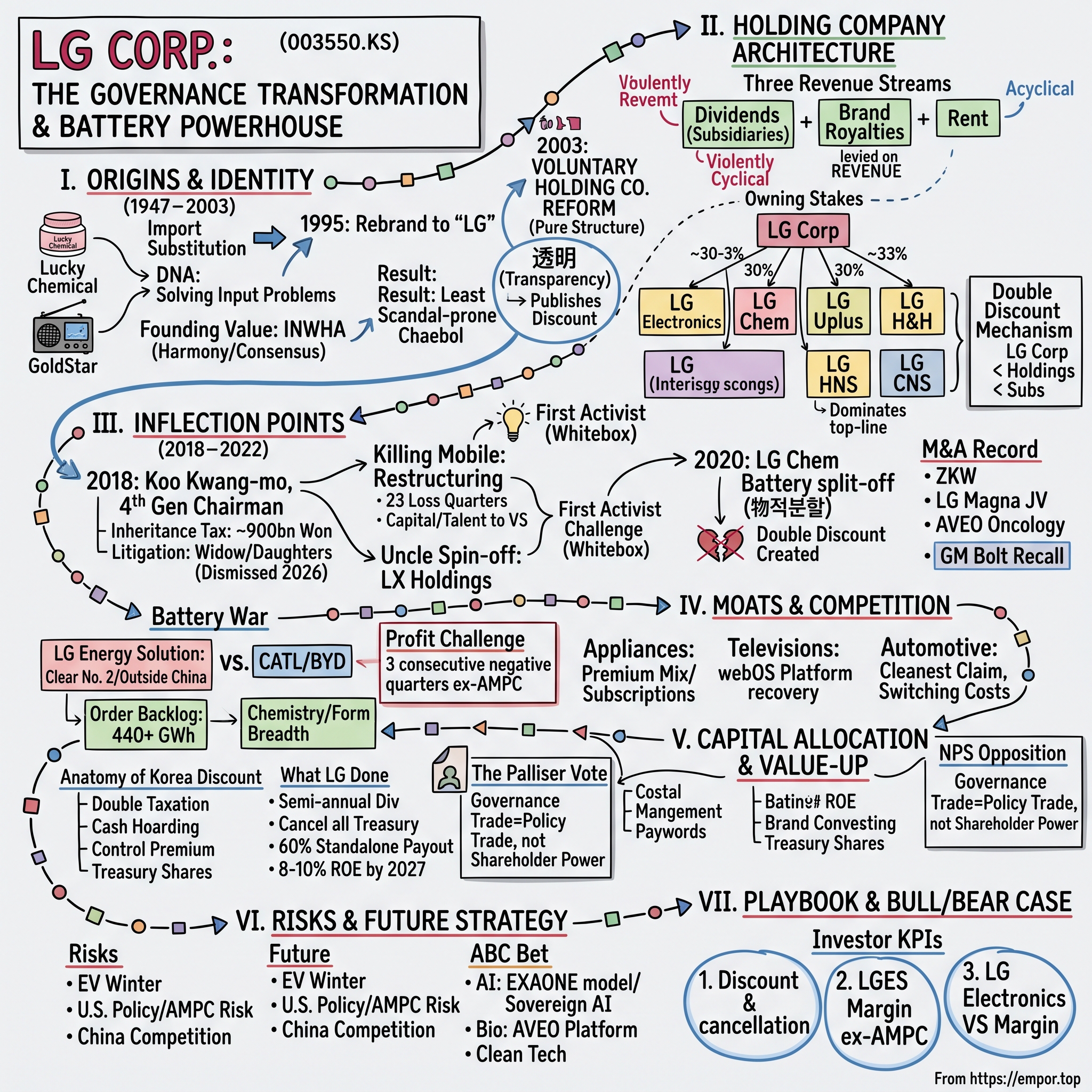
LG Corp.: The Governance Transformation & Battery Powerhouse
I. Introduction & Episode Roadmap
There is a particular kind of frustration that only holding-company investors know, and in the summer of 2026 the Korean market served it up in almost laboratory-pure form.
Consider what happened in Seoul between January and July of this year. The 코스피 KOSPI benchmark crossed 5,000 for the first time on January 22, 2026, closing at 4,952.53 after an intraday high of 5,019.54 — roughly double where it had stood twelve months earlier.1 Then it kept going, racing toward 8,000 in a matter of months on the back of a memory-semiconductor supercycle, before rolling over into bear-market territory by early July.2 For a moment, the most persistent joke in global equities — that Korean companies are worth less than the sum of the assets they own — looked like it might finally have a punchline.
And where was 주식회사 LG LG Corp. (003550.KS), the holding company sitting at the apex of Korea's fourth-largest 재벌 chaebol by assets, through all of this? Owning stakes in the world's largest OLED television business, the largest non-Chinese electric-vehicle battery maker, a top-three global premium appliance franchise, a cash-generative telecom operator, and a newly listed enterprise IT arm — and still trading at a wide discount to the market value of those very holdings. In a research note published after LG's own value-up disclosure, Douglas Research Insights pegged LG Corp's implied net asset value at roughly 16.1 trillion won, or about 102,426 won per share — a figure it calculated as roughly a third above where the stock was then changing hands.3 The gap has narrowed and widened since. It has never closed.
This is the puzzle. LG Corp is not a badly run business hiding behind a cheap multiple. It is a well-run structure that the market refuses to pay for.
The story of how it got here — and whether the fourth-generation chairman now running it can change the arithmetic — is the subject of this piece. The central thesis to test: 구광모 Koo Kwang-mo, who inherited the chairmanship in 2018 at age 40, has spent eight years running an unusually literal experiment in chaebol reform. He shut down a division that had lost money for 23 straight quarters. He spun off an entire sub-conglomerate to an uncle. He presided over the carve-out and separate listing of the group's single most valuable growth asset, and absorbed the shareholder fury that followed. He has cancelled treasury shares, introduced interim dividends, raised the payout ratio, and published a return-on-equity target — the kind of capital-markets vocabulary that Korean holding companies simply did not speak a decade ago.
Whether any of it has worked is a genuinely open question, and the honest answer as of mid-2026 is: partially, unevenly, and less than management's framing implies.
Here is the route. We start with origins — briskly, because 1947 matters mostly as an explanation of LG's cultural DNA and its unusually early governance reform. Then we open the hood on the holding company itself: how a pure 지주회사 holding company actually earns money, which is far less obvious than it sounds. From there into the inflection points of 2018–2022, the period when Koo made almost every consequential decision of his tenure in a four-year window. Then a war-game of the moats — batteries, appliances, automotive electronics — stress-tested against 宁德时代 CATL, 삼성전자 Samsung Electronics, and the rest. Then the capital-allocation fight, where activists, proxy advisers, and Korea's own state pension fund have all placed conflicting bets. Then the primary evidence: what management actually said on the calls, and what analysts actually pushed back on. Then risks, the "ABC" future strategy, the KPIs worth tracking, and the bull and bear cases laid side by side.
One framing note before we begin. LG Corp is a holding company, which means almost nothing you read about "LG" is about LG Corp. When LG Electronics posts a record quarter, LG Corp books a slice of it through equity accounting and receives a dividend cheque months later. The distance between operating reality and holding-company cash flow is the single most important thing to hold in your head — and it is exactly where the discount lives.
 Subscribe on LinkedIn
II. Origins & Cultural Identity: Lucky, GoldStar, and "Inwha" (1947–2003)
Busan in 1947 was not a place where global technology conglomerates began. The Japanese colonial administration had collapsed two years earlier. The peninsula was partitioned, the economy was in ruins, and the Korean War was three years away from flattening what remained.
In that setting, a merchant named 구인회 Koo In-hwoi founded 락희화학공업사 Lucky Chemical Industrial Corporation.4 Its first commercial success was face cream. Lucky Cream sold well enough, but the product taught Koo something more valuable than cosmetics economics: the plastic caps kept cracking. Rather than import better ones, Lucky started manufacturing them — and then combs, toothbrushes, and eventually the raw plastics themselves. Korea's modern chemical industry traces to a leaky jar of moisturiser.
That instinct — solve the input problem yourself, then sell the solution to everyone — became the group's operating grammar. In 1958, Koo founded 금성사 GoldStar Co., Ltd., which over the following decade produced Korea's first domestically made radio, refrigerator, washing machine, and television.4 These were not technological breakthroughs; they were import substitutions built with licensed designs and cheap labour. But they established GoldStar as the company that taught Korean households what appliances were, at exactly the moment Korean households were acquiring the income to buy them.
The culture that came from Busan
What distinguished LG from its peers was less strategic than temperamental. The group codified a founding value it called 인화 inhwa — usually rendered as "harmony," though "consensus" captures the operating reality better. Decisions moved slowly through layers of agreement. Executives were rarely fired dramatically. Family branches were separated by negotiation rather than litigation.
The result was a reputation, sustained across decades, as the least scandal-prone of the major chaebol. Where Samsung and Hyundai founders and heirs cycled through prosecutions, presidential pardons, and slush-fund investigations, LG's chairmen largely stayed out of criminal court. Investors should be careful about over-romanticising this: reputational cleanliness is not the same as shareholder alignment, and LG has had its share of related-party and succession controversies, including the one currently before Korean courts. But the cultural difference was real, and it explains why LG moved first on the structural reform that defines it today.
Two rebranding and restructuring moments compress the rest of the pre-modern history.
In 1995, the group merged the "Lucky" and "GoldStar" identities into the single global "LG" brand.4 This was partly cosmetic and partly existential — Korean exporters in the mid-1990s were discovering that unpronounceable domestic brand names capped their pricing power in Western retail. The two-letter mark, later paired with the "Life's Good" tagline, was an admission that LG intended to compete on brand rather than on price. That decision echoes through everything in this story, right down to the fact that LG Corp today collects a royalty from affiliates for using those two letters.
In 2003, LG did something no other major chaebol had done voluntarily: it dismantled its own 순환출자 circular shareholding web and reorganised into a pure holding-company structure.4
It is worth pausing on what that meant. The classic chaebol control mechanism was a ring: Company A owns B, B owns C, C owns A. A founding family holding perhaps 3% of the total equity could control the entire ring, because every affiliate's shares voted the family's way. It was capital-efficient, legally opaque, and almost impossible for outside investors to value. LG unwound it, creating a single listed parent that held direct, disclosed stakes in operating subsidiaries — and in which the family held its ownership openly.
The reform was genuinely ahead of its time; Korea's regulators would spend the next two decades pressuring other groups toward the same structure. But here is the uncomfortable second-order effect, and it is central to the investment case. A transparent holding company is easy to value — which means the market can price precisely how much it dislikes the structure. LG traded its opacity for measurable disgust. The 순환출자 ring hid the discount. The holding company published it.
Which brings us to the machine itself.
III. Holding Company Architecture & Segment Economics
Walk into the 여의도 Yeouido district of Seoul and you will find the LG Twin Towers, two matching slabs on the Han River that have served as the group's nerve centre for decades. Here is the thing worth knowing about them: for LG Corp shareholders, those towers are not a headquarters expense. They are a revenue line.
Because a pure holding company does not sell anything. It owns things, and it charges for the privilege of being owned.
Three streams, three very different qualities
Dividends from subsidiaries. This is the big one, and it is entirely dependent on decisions made by other companies' boards. LG Corp holds roughly a third of LG Electronics, roughly 30% of LG Chem, and comparable minority-but-controlling positions in LG Uplus and LG Household & Health Care.5 Critically, these stakes sit below 50%, which under Korean accounting means LG Corp does not consolidate its most famous subsidiaries — it accounts for them by the equity method. LG Electronics' 89.2 trillion won of 2025 revenue does not appear on LG Corp's income statement.6 Only a proportional slice of its profit does, and only a cash dividend actually arrives in the bank account.
Brand royalties. Every affiliate using the "LG" mark pays for it. The rate is disclosed in subsidiary filings: LG Display's most recent annual report on Form 20-F describes monthly payments to LG Corp aggregating 0.2% of annual sales after deducting advertising expenses.7 That is a small percentage of a very large number, and it has a property investors should appreciate — it is levied on revenue, not profit. When LG Display loses money, LG Corp still gets paid. Historical filings show the rate has ratcheted upward over time, from 0.1% in earlier agreements.8
Rent. Property income from the group's real estate, including the Yeouido complex, rounds out the picture. Like royalties, it is contractual and largely acyclical.
The analytical point: roughly speaking, LG Corp's own earnings power is a barbell. On one end, a genuinely capital-light, high-margin toll booth — royalties and rent — that arrives whether the group is thriving or struggling. On the other, a large but violently cyclical dividend stream that depends on petrochemical spreads, EV demand, and television margins. Management's ability to pay a stable dividend to its own shareholders rests on the toll booth. Management's ability to grow it rests on the cyclical half.
There is a third element that complicates the picture: LG Corp does consolidate LG CNS, the group's enterprise IT and digital-transformation arm, which is large enough that it dominates LG Corp's reported top line even though it is a modest part of net asset value. Investors reading LG Corp's headline revenue are mostly reading LG CNS. Anyone wanting to verify the ownership arithmetic rather than take it on trust can pull LG Corp's quarterly and annual filings directly from the Financial Supervisory Service's DART repository, where the holding structure and stake percentages are disclosed in full.39
What each stake actually is
LG Chem is the most complicated asset in the portfolio and the most important to understand. It is simultaneously a struggling commodity petrochemicals business, an emerging advanced-materials and cathode supplier, a small life-sciences venture — and the roughly 80%-plus owner of LG Energy Solution, which is worth far more than LG Chem's entire market capitalisation. In 2025, LG Chem reported revenue of 45.93 trillion won, down 5.7%, with operating profit up 35% to 1.18 trillion won.9 Now hold that number against this one: LG Energy Solution, which LG Chem consolidates, earned 1.35 trillion won of operating profit in the same year.9 Subtract, and everything at LG Chem other than batteries was collectively loss-making. The petrochemicals division alone lost 239 billion won in the fourth quarter as Chinese capacity additions crushed spreads.9
LG Electronics is the operating jewel and, in 2026, the group's positive surprise. It closed 2025 with record revenue of 89.2 trillion won but a declining operating profit of 2.48 trillion won — the Media Entertainment (television) unit swung to a 750.9 billion won operating loss as display demand stayed weak and marketing spend rose.6 Then it reversed hard. First-quarter 2026 revenue reached a record 23.73 trillion won with operating profit of 1.67 trillion won, up 32.9% year on year, with the television business back in the black.10 Preliminary second-quarter figures showed revenue of 23.83 trillion won and operating profit of 1.58 trillion won, taking first-half operating profit to 3.25 trillion won — more than the entire prior year — though management flagged that a one-time gain from confirmed U.S. tariff refunds flattered the result.11 Investors should discount that tariff item; the underlying story is premium mix, webOS platform revenue, and cost discipline, which is a genuine improvement but not a 100%-growth business.
LG Uplus is the boring one, and boring is the point. Korea's third mobile operator posted 2025 revenue of 15.45 trillion won and operating profit of 892.1 billion won, up 3.4%, helped by higher-value subscriber lines and a push into AI data centres.12 In a three-player oligopoly with regulated pricing, this is a bond with equity risk — modest growth, reliable dividends, and the main thing LG Corp's own payout leans on when the cyclicals falter.
LG CNS was the group's most-watched liquidity event of the cycle. It debuted on the KOSPI on February 5, 2025 at an IPO price of 61,900 won, valuing it near 6 trillion won — and closed its first day down 9.85%, an outcome the Korean press treated as a verdict on the entire IPO window.13 Macquarie Asset Management, which had bought 35% from LG Corp in 2019–2020 for roughly a trillion won, exited in stages: 5.57% in August 2025, 7.0% in November, and a final 8.3% block on January 28, 2026 at 66,800 won a share, recovering roughly 1.33 trillion won from sales plus about 190 billion won of dividends.14 Macquarie roughly doubled its money over five to six years. LG Corp retained control. Neither outcome was a triumph, and the muted listing is a data point about how the market prices LG assets even when they are growing.
LG Household & Health Care is the portfolio's problem child. Its 2025 revenue fell 6.7% to 6.36 trillion won and operating profit collapsed 62.8% to 170.7 billion won, with the Beauty division swinging to a 97.6 billion won operating loss on a 16.5% revenue decline as it absorbed one-time costs from channel restructuring and voluntary retirements.15 Chinese demand for Korean premium cosmetics has not come back the way management once assumed it would.
Put the pieces together and the holding company's dividend receipts in any given year depend on a chemical cycle, an EV cycle, a television cycle, a cosmetics cycle, and one telecom annuity. That is a lot of variance for a stock whose main appeal to domestic investors is yield.
None of this structure is accidental. It is the residue of decisions made almost entirely in a single four-year stretch — the most consequential window in LG's modern history.
IV. The Inflection Points (2018–2022): Pruning, Carve-Outs, & M&A
In May 2018, 구본무 Koo Bon-moo, LG's third-generation chairman, died of a brain tumour. He was 73. The succession that followed was, by chaebol standards, almost anticlimactically orderly — and it set in motion the most aggressive portfolio surgery in the group's history.
The 40-year-old who inherited a conglomerate
구광모 Koo Kwang-mo was 40 years old, had joined LG Electronics as a rank-and-file employee in 2006, and had worked in relative obscurity across the group's businesses — including a stint at LG's U.S. operations and, later, in LG Electronics' information display division. He was also, in a detail that Western readers consistently find startling, his predecessor's adopted son. Koo Bon-moo had two daughters and no biological son; under the family's traditional male-primogeniture succession rule, he adopted his nephew in 2004. Koo Kwang-mo's biological father is 구본능 Koo Bon-neung.
The adoption was not sentiment. It was governance engineering, designed to keep a single controlling stake intact across a generational handover rather than fragmenting it among heirs. It worked — and it produced litigation.
The inheritance itself was expensive in a way that shaped LG Corp's subsequent capital policy. Koo Kwang-mo and his family faced an inheritance tax bill of roughly 900 billion won, payable in instalments over six years — reported at the time as one of the largest in Korean history.[^16] Under the 2018 settlement, he took 8.76 percentage points of his adoptive father's 11.28% LG Corp stake, bringing his own holding to 15.95%, while the widow 김영식 Kim Young-sik and two daughters received a combined 2.52% plus financial assets, real estate, and art worth roughly 500 billion won out of an estate valued near 2 trillion won.16
Here is the part investors should sit with. A controlling shareholder with a multi-hundred-billion-won tax liability and no easy way to sell shares has a powerful structural incentive to want dividends from the holding company. That incentive happens to align with minority shareholders — LG Corp's rising payout ratio benefits everyone pro rata — but it is worth naming honestly rather than crediting purely to enlightened capital-markets thinking. Alignment by accident is still alignment; it is just less durable than alignment by conviction.
In February 2023, the widow and both daughters sued, seeking to invalidate the 2018 settlement and redistribute the estate under Korea's statutory formula.[^18] They argued they had consented on the belief that a will existed directing all shares to Koo Kwang-mo. On February 12, 2026, the Seoul Western District Court dismissed the suit, finding the settlement lawfully executed with no evidence of deception, and noting the plaintiffs had been repeatedly briefed and had participated directly in negotiations.16 The plaintiffs retain the right to appeal. For now, a three-year overhang on the ownership structure has lifted — but "lifted at first instance" is not the same as resolved, and an appellate reversal would reopen questions about the control bloc itself.
Killing the phone business
By 2020, LG Electronics' Mobile Communications division had become the most-studied value-destruction case study in Korean industry. Once the world's third-largest handset maker, LG had missed the transition to touchscreens, mis-executed on flagship after flagship, and then spent a decade subsidising the wreckage. The division booked 23 consecutive quarterly operating losses totalling roughly 5 trillion won before management finally announced in April 2021 that it would wind the business down entirely.17
Strip away the corporate language and this was the single clearest signal Koo sent in his first three years. Chaebol groups historically did not exit businesses; they cross-subsidised them, because scale and national-champion status were ends in themselves. Shutting down a consumer-facing division carrying the LG brand meant accepting a public admission of defeat — the precise thing 인화 consensus culture is worst at.
The capital and talent released went into vehicle components and automotive software, a bet that has since become the strongest evidence for Koo's strategic judgement. LG Electronics' Vehicle Solution division reported record 2025 revenue of 11.14 trillion won and record operating profit of 559 billion won, its tenth consecutive year of growth.6 Combined with the HVAC-focused Eco Solution unit, LG's B2B operating profit crossed a trillion won for the first time.6 A decade after the mobile disaster, LG's fastest-improving business is one where the customer is a car company, not a consumer.
The uncle, the spin-off, and the American hedge fund
In late 2020, LG announced it would separate a cluster of non-core businesses — LG International, Silicon Works, LG Hausys and others — into a new entity, LX Holdings, to be run by Koo Kwang-mo's uncle 구본준 Koo Bon-joon. This followed LG's traditional practice of giving departing family branches their own businesses rather than leaving competing claimants inside one structure.
The U.S. hedge fund Whitebox Advisors LLC objected publicly, arguing that the spin-off valued the separated assets in a way that transferred value away from LG Corp's minority shareholders in order to smooth family succession.[^20] LG's board and management pushed the vote through with institutional support.
Whether Whitebox was right on the specific valuation is debatable. What is not debatable is the precedent: this was the first time a foreign activist had directly challenged an LG structural transaction, and management's response — proceed, with institutional backing — established a pattern that would repeat.
The carve-out that broke retail trust
Then came the transaction that still shapes how Korean retail investors think about LG.
In September 2020, LG Chem announced a 물적분할 — a "split-off," in which a division is transferred into a wholly owned new subsidiary rather than distributed directly to existing shareholders — for its battery business, followed by a separate listing of that subsidiary as LG Energy Solution.18 LG Chem shareholders who had bought the stock specifically for battery exposure discovered that their claim on the growth asset had been converted into an indirect claim through a parent holding, and that new investors would buy the growth story directly.
The distinction between 물적분할 and 인적분할 (a spin-off where shares go pro rata to existing holders) sounds like accounting trivia. It is not. It determines whether existing shareholders keep direct ownership of the crown jewel or get pushed one layer up the ownership chain — and one layer up is exactly where holding-company discounts get applied.
The economics played out as the sceptics predicted. LG Chem became a holding structure whose value was dominated by a stake in a separately listed subsidiary, and the market applied a discount to that stake. LG Corp shareholders, sitting one further layer above, absorbed a discount on a discount. This is the mechanism behind the "double discount" that any serious analysis of LG Corp must confront: LG Corp trades below its holdings, and one of its largest holdings itself trades below its holdings.
Six years later, this is still live. In February 2026 the UK activist fund Palliser Capital, holding just over 1% of LG Chem, submitted formal AGM proposals arguing the stock traded at a 74% discount to net asset value — a gap of roughly 60 trillion won — and demanding, among other things, that LG Chem reduce its LG Energy Solution stake below 70% and channel proceeds into buybacks.19[^23] More on how that vote went in the capital-allocation section.
The M&A record, judged on results
Koo's tenure has also produced a real acquisition track record, and it is genuinely mixed.
ZKW Group (2018). LG Electronics agreed to acquire the Austrian premium automotive lighting maker for about 1.4 trillion won, then roughly $1.3 billion — the largest acquisition in LG Electronics' history, with 70% taken by LG Electronics and 30% by LG Corp itself.20 ZKW supplied BMW and Mercedes-Benz, which bought LG something it could not build: European Tier-1 credibility and design-win relationships. Automotive lighting is a slow-growth, mid-margin business, and the multiple paid was full by European supplier standards. But as a strategic entry ticket into the automotive supply chain, it looks better in hindsight than it did on announcement.
LG Magna e-Powertrain (2021). LG Electronics and Magna International signed a joint venture in July 2021, headquartered in Incheon, to build electric motors, inverters, on-board chargers, and integrated e-drive systems.21 The structure is instructive: LG brought component and power-electronics capability, Magna brought decades of automaker relationships and program-management discipline. Neither could credibly sell a complete e-drive system alone. It is the rare JV whose logic does not require believing either partner is superior.
AVEO Oncology (2023). LG Chem completed the all-cash acquisition of Boston-based AVEO Oncology on January 20, 2023, at $15.00 per share, valuing the company at roughly $566 million on a fully diluted basis.22 AVEO's asset was FOTIVDA, an FDA-approved kidney cancer therapy — meaning LG bought a commercial-stage oncology platform rather than a pipeline. That was the point: LG Chem wanted a U.S. sales infrastructure it could load future assets onto, alongside a stated plan to invest 2 trillion won in drug R&D through 2027.22 Three years on, LG's life-sciences business remains small relative to the group and has not yet demonstrated it can originate a commercially significant molecule. The jury is out, and investors should treat management's "top 30 global pharma" ambition as aspiration, not guidance.
The GM Bolt recall (2021). The counterexample. Battery cell defects — a torn anode tab and folded separator, manufactured at plants in Korea and Michigan — led General Motors to recall every Chevrolet Bolt ever built. LG agreed to reimburse GM up to roughly $1.9 billion of an estimated $2 billion in costs, and the LG entities booked approximately 1.4 trillion won of charges, split between LG Chem's battery arm and LG Electronics, which assembled cells into modules and packs.23
That episode deserves more analytical weight than it usually gets. It demonstrated that a battery supplier's balance sheet is exposed to field failures years after shipment, and that the customer — not the supplier — sets the remediation scope. For a business whose bull case rests on scale and Western OEM relationships, quality escapes are the single most efficient way to destroy both at once.
Which raises the question the next section has to answer: after all that surgery, what does LG actually have that competitors cannot replicate?
V. Deep Dive: Core Moats, Industry Structure, & Competition
Here is a useful way to think about a battery cell. It is not a widget; it is a chemical process running inside a sealed can, and the entire business is about how consistently you can make that process behave across billions of identical units. Yield — the percentage of cells that emerge within specification — is the whole game. A one-point yield improvement across a gigafactory is worth more than most product launches.
That framing explains why the global EV battery industry has consolidated into a handful of players and why the competitive dynamics are so brutal.
The battery war, honestly assessed
LG Energy Solution's position is best described as "clear number two in the world, and number one outside China." Its principal rivals are 宁德时代 CATL and 比亚迪 BYD, both Chinese, both scaled, and both operating with structural cost advantages in lithium iron phosphate (LFP) chemistry; Panasonic, deeply tied to Tesla; and 에스케이온 SK On, the battery arm of 에스케이이노베이션 SK Innovation.
LG's differentiation has been chemistry and form-factor breadth: pouch cells for the OEMs that want packaging flexibility, and increasingly the 46-series large cylindrical cells that several automakers have standardised on. The commercial evidence is real. LG Energy Solution won over 100 GWh of new 46-series orders in the first quarter of 2026 alone, taking total order backlog above 440 GWh as of the end of April — up from above 300 GWh at the end of 2025.2425
Now the honest counterweight. A backlog is a schedule of intentions, not a contract to buy at a fixed margin, and the financial results tell a harder story. LG Energy Solution's 2025 revenue fell 7.6% to 23.7 trillion won, even as operating profit more than doubled to 1.3 trillion won.25 The profit was heavily assisted by the U.S. Advanced Manufacturing Production Credit under the Inflation Reduction Act — the fourth quarter of 2025 included 332.8 billion won of that credit and still produced a 122 billion won operating loss.25 The first quarter of 2026 posted a 207.8 billion won operating loss including 189.8 billion won of credit.24 The second quarter of 2026 returned 113.3 billion won of operating profit on revenue of 7.56 trillion won — revenue up about 25% year on year, but operating profit down 77%, and, excluding the production credit, a third consecutive quarter of underlying operating losses.26
Read that sequence carefully, because it is the most important set of numbers in this entire story. Strip out a U.S. tax subsidy and the world's second-largest battery maker has not made money at the operating line for three quarters running. That is not a moat producing excess returns. That is a capital-intensive commodity business in a downcycle, being kept above water by industrial policy.
The credit rating agencies noticed. S&P Global Ratings cut LG Chem and LG Energy Solution to BBB from BBB+ in March 2025, citing heavy capital expenditure and difficult conditions in both chemicals and EV batteries.27 In March 2026 it revised the outlook on both to negative, pointing to petrochemical oversupply — much of it from new Chinese capacity — pushing margins to historic lows.28 A negative outlook at BBB is a meaningful constraint: it raises the cost of the capital that gigafactories consume, at precisely the moment cash flow is weakest.
There is a genuine second act taking shape, and it deserves credit. Energy storage systems — grid-scale batteries for utilities and data centres rather than cars — grew to the mid-20% range of LG Energy Solution's revenue by the first quarter of 2026, with a North American production network of three standalone plants and two joint ventures targeting more than 50 GWh of ESS capacity by year-end and a next-generation product promising roughly 15% cost reduction versus current LFP offerings from 2028.24 The ESS pivot is the most convincing strategic response to the EV slowdown that any Western-aligned cell maker has produced. But it introduced its own problem: the second-quarter 2026 miss was attributed partly to a bottleneck in that very ESS ramp.26 Pivots create execution risk even when the destination is correct.
Appliances and televisions: a moat made of mix
The consumer businesses are the opposite case — less glamorous, better returns.
LG's Home Appliance division generated 26.13 trillion won of revenue and 1.28 trillion won of operating profit in 2025, its tenth consecutive year of growth.6 Against Samsung, Whirlpool, and an intensifying Chinese cohort, LG's advantage is not technological. It is the combination of premium brand positioning at the top of the range, a distribution and service footprint built over forty years, and — increasingly — subscription and platform revenue attached to installed hardware.
The television business shows the limits. Media Entertainment lost 750.9 billion won at the operating line in 2025 despite 19.43 trillion won of revenue.6 LG has led the premium OLED TV market for over a decade, supported by affiliate LG Display's panel manufacturing, and it still could not hold profitability when demand stalled and Chinese competitors escalated. The recovery in 2026 — 372 billion won of operating profit in the first quarter — came less from selling more televisions than from selling around them: webOS platform advertising revenue, subscription services, and marketing-cost discipline.10
That is the genuine insight in LG's consumer strategy, and it is under-appreciated. LG is trying to convert a hardware business with commoditising economics into a services business with an installed base. Every LG television is a distribution endpoint for advertising inventory. If that works at scale, it changes the margin profile of the segment permanently. If it does not, LG is a hardware manufacturer competing with Chinese manufacturers on cost, which is not a fight it wins.
Automotive electronics: the strongest claim
The Vehicle Solution division is where LG's competitive case is cleanest. Its order backlog crossed 100 trillion won by the end of 2023, spanning telematics, digital cockpits, infotainment, and e-powertrain systems.[^33]
The switching-cost mechanism here is worth spelling out in plain terms. When an automaker selects an infotainment or cockpit supplier, it is not buying a box. It is committing its software architecture, its validation process, its supplier-quality audits, and its five-to-seven-year vehicle program to that supplier. Changing mid-cycle means re-homologating the vehicle. This is why automotive electronics revenue arrives late and slowly but then persists — and why the 2025 results (record revenue, record profit, ten straight growth years) are more meaningful than a comparable growth rate elsewhere would be.6
Running the frameworks
Through Hamilton Helmer's 7 Powers, LG's position resolves as follows.
Scale economies are real in batteries, where gigafactory capital intensity is a genuine barrier — but they are shared with CATL and BYD at larger scale and lower cost, which makes them a barrier to new entrants rather than an advantage over incumbents.
Process power is the most defensible claim. Cell yield optimisation and OLED panel fabrication are accumulated, tacit, hard-to-transfer manufacturing knowledge. It is also exactly what the Bolt recall showed can fail.
Switching costs are strongest in automotive, weak-to-nonexistent in appliances and televisions, and moderate in batteries — where design-in creates stickiness within a vehicle program but not across generations.
Counter-positioning, which LG partisans invoke for the early pouch-cell commitment, is the weakest claim. Counter-positioning requires that incumbents cannot respond without damaging their existing business. Nothing prevented competitors from building pouch cells; they chose other form factors. That is a strategic bet, not a power.
Branding deserves more credit than it usually gets — the "LG" mark supports genuine price premiums in appliances, and it is literally monetised as a royalty at the holding-company level. Cornered resource and network economies are largely absent.
Through Porter's Five Forces, the picture is sobering. Buyer power is high and rising: a handful of global automakers negotiate battery and component contracts, and they have demonstrated willingness to dual-source and to push cost reductions down the chain. Supplier power in raw materials is volatile and concentrated in Chinese refining capacity. Rivalry is intense in every segment LG operates in. Substitute threats include LFP chemistry displacing nickel-rich cells and sodium-ion technology in stationary storage. Barriers to entry are high in capital terms but have not prevented Chinese entrants from scaling faster than incumbents.
The synthesis: LG's businesses are structurally good rather than structurally advantaged. They generate returns above cost of capital in favourable conditions and below it in unfavourable ones. That is a meaningfully different investment proposition from a business with pricing power — and it is the operating reason, distinct from the structural one, that the holding company's shares carry a discount.
Structural reasons, however, are what management has actually chosen to attack.
VI. Capital Allocation & The Value-Up Stress Test
In November 2024, LG Corp published something that would have been unthinkable a decade earlier: a document telling public shareholders what it intended to do with its own capital, on a timetable.
The commitments were specific. LG Corp would cancel roughly 500 billion won of treasury shares — around 6.1 million shares repurchased under its 2022 buyback programme — by 2026. It would introduce a semi-annual dividend. And it would concentrate investment in artificial intelligence, biotechnology, and clean technology.29 Four other LG affiliates published their own value-up plans simultaneously.29
To understand why this mattered, you need to understand what the 코리아 디스카운트 Korea Discount actually is.
Anatomy of a discount
It is not one thing. It is at least five, stacked.
First, double taxation of dividends. Cash travelling from an operating subsidiary to a holding company to a shareholder can be taxed at more than one stop. Every won of dividend is worth less to a holding-company shareholder than to a direct shareholder.
Second, the conglomerate discount proper. Investors who want battery exposure can buy LG Energy Solution directly. Buying it through LG Chem through LG Corp means accepting appliance, telecom, and cosmetics exposure they did not ask for, plus two layers of governance risk.
Third, cash hoarding. Korean holding companies historically retained cash for opportunistic group investment. Idle cash at a low-return parent mathematically drags consolidated return on equity below the cost of equity — and a business earning below its cost of capital is worth less than its book value by construction.
Fourth, control-premium suspicion. Minority shareholders have priced the risk that structural decisions will favour the controlling family. The 물적분할 episode was not a theoretical concern; it was a demonstration.
Fifth, treasury shares as a governance instrument. Korean companies have historically held treasury stock indefinitely, where it can be deployed to friendly parties in a control contest rather than cancelled to benefit all shareholders. Which is exactly why cancellation, not buyback, is the metric that matters.
What LG has actually done
Track the execution rather than the announcements.
On September 4, 2025, LG Corp retired 3.03 million shares — 1.93% of outstanding — acquired at an average 82,520 won, worth about 250 billion won. Simultaneously it declared its first-ever interim dividend of 1,000 won per common and preferred share, payable September 26 to holders of record September 12, totalling 154.2 billion won. And it raised its dividend payout target from 50% to 60% of standalone annual net profit.[^35] The stock rose 4.9% that day against a flat KOSPI.[^35]
Then in May 2026, LG went further than the original plan: it announced it would cancel all 3,029,581 remaining treasury common shares held within distributable profits, worth roughly 350 billion won, and published a consolidated return-on-equity target of 8–10% by 2027 — framing itself as a holding company centred on high-value-added businesses while accelerating "ABC" investment.30
Assess this fairly. On the shareholder-return axis, LG has done what it said, roughly on schedule, and then extended the commitment. Full treasury cancellation removes an entrenchment tool permanently. A published payout ratio tied to standalone net profit is auditable. Interim dividends reduce the duration of shareholder cash flows. Measured against Korean holding-company norms of 2018, this is real behavioural change, and management deserves to be scored on delivery rather than rhetoric.
Now the sceptic's case, which is also strong.
The absolute amounts are small. Cancelling 250 billion won and then 350 billion won of stock at a company whose implied net asset value has been estimated around 16 trillion won is a rounding error against the discount.3 LG Corp has run a substantial net cash position at the holding level for years. An activist would argue that a genuine attack on the discount requires buying back and cancelling a materially larger share of the float, funded by monetising non-core stakes — not by trimming the edges.
Payout ratios tied to standalone net profit are cyclical, not committed. Sixty percent of a smaller number is a smaller dividend. When petrochemical and battery earnings compress, so does the holding company's dividend income, and so does the payout. The policy transfers cyclicality to shareholders rather than absorbing it. LG's own fourth quarter of 2025 was a loss-making quarter at the holding level once equity-method charges flowed through — a reminder that the denominator can go negative.
An 8–10% ROE target by 2027 is not obviously achievable through the actions described. A holding company's ROE is mostly the weighted ROE of its underlying assets. If petrochemicals lose money and batteries earn their profit from tax credits, no amount of parent-level treasury cancellation gets consolidated ROE to 10%. Cancelling shares shrinks equity, which mechanically helps — but the honest way to hit that target is for LG Chem and LG Energy Solution to earn substantially more, which is not within LG Corp's control. Investors should treat the target as a statement of ambition contingent on a cyclical recovery, and ask on future calls exactly which components management expects to deliver it.
And the group has not conceded the governance argument. Which brings us to the most revealing episode of this cycle.
The Palliser vote and what it revealed
Palliser Capital's LG Chem campaign was not a raid. Its proposals were modest by activist standards: let shareholders holding at least 0.5% for six months submit non-binding advisory resolutions; disclose the discount to net asset value quarterly; appoint a lead independent director; tie executive pay to capital efficiency and valuation metrics; and accelerate monetisation of the LG Energy Solution stake below the existing 70% target, with proceeds to buybacks.19[^23] Palliser's public complaint was as much about process as substance — that management had been unresponsive to dialogue.[^23]
Both major proxy advisers, Institutional Shareholder Services and Glass Lewis, recommended shareholders vote in favour.31 At the March 2026 annual meeting, shareholders rejected the proposals — with 국민연금공단 the National Pension Service, LG Chem's second-largest shareholder, voting against on the grounds that they could infringe on board authority.32
That outcome is the single most important governance datapoint in this story, and it cuts against the reform narrative. Korea's own state pension fund — the institution most often cited as the engine of the Value-Up programme — sided with an incumbent board against proposals endorsed by both independent proxy advisers. The legislative architecture had also shifted in activists' favour: Korea's National Assembly passed Commercial Act amendments in 2025 expanding directors' fiduciary duty to include shareholders explicitly, requiring fair and equal treatment of all shareholders, and mandating electronic shareholder meetings, alongside cumulative voting provisions.33[^40] The rules changed. The votes did not.
The investable conclusion is uncomfortable but clear: the Korean governance reform trade is a policy trade, not yet a shareholder-power trade. Regulation has moved faster than the domestic institutional voting base. Anyone underwriting LG Corp's discount closing on governance grounds is underwriting a change in how Korean institutions vote, not merely a change in Korean law.
Management credibility, on the record
Eight years in, an honest scorecard on Koo Kwang-mo reads roughly as follows.
High marks on exit discipline. Shutting mobile, separating LX, letting LG Display's LCD business shrink, monetising 15% of the Indian subsidiary through an October 2025 IPO that priced at ₹1,140 per share, valued the unit near ₹774 billion, was subscribed 54 times, and traded up sharply on debut.34 Note the structure: it was entirely an offer for sale, meaning the proceeds went to the Korean parent, not the Indian business — a clean, if unglamorous, act of asset monetisation.
Reasonable marks on strategic direction. The pivot from B2C hardware toward automotive, HVAC, and platform revenue has produced measurable results, and the timing was earlier than most peers.
Mixed marks on shareholder returns. Real, incremental, and small relative to the problem.
Weak marks on the parent-subsidiary governance question. The 물적분할 precedent has never been remediated, LG Chem's discount has widened rather than narrowed, and management's response to a credible, proxy-adviser-endorsed activist campaign was to defeat it rather than negotiate. LG Chem has said it plans to monetise its LG Energy Solution stake gradually while balancing returns against financial stability.[^23] "Gradually" is doing a lot of work in that sentence.
To hear the tone rather than the tally, it helps to go to the transcripts.
VII. Primary Evidence: Earnings Calls & Conference Transcripts
Earnings calls are where corporate language stops being edited. The gap between prepared remarks and the Q&A that follows is often the most useful signal a public company involuntarily emits.
April 2021: explaining a shutdown
When LG Electronics management fronted the market after deciding to close Mobile Communications, the prepared framing was about focus and reallocation — R&D engineers moving to automotive software, capital redeployed to growth businesses.17 The analyst questions were narrower and more useful: what were the actual cash costs of restructuring, what happened to warranty and service obligations on phones already sold, and how much of the freed R&D headcount was genuinely transferable to automotive software rather than being handset-specific.
That last question was the sharp one, and it was largely answered in the years since. LG's Vehicle Solution division's steady march to record profitability suggests the talent transfer was real rather than cosmetic.6 It is one of the few cases where a restructuring narrative can be checked against a decade of subsequent segment data and holds up.
2020–2022: defending the split-off
The LG Chem battery carve-out generated the most hostile investor relations sessions in the group's modern history. Management's position was consistent: the battery business needed to raise very large amounts of capital, and doing so at a listed subsidiary was cheaper and faster than issuing equity at the parent, whose petrochemical exposure would drag the valuation.18
That argument was not wrong on its own terms. Capital was needed, and it was raised. What management could not answer convincingly was the distributional question: why the existing shareholders who had funded the battery business's development should be the ones diluted out of direct ownership. Analysts pressed on whether a 인적분할 structure — pro rata distribution — had been seriously considered. The answers stayed at the level of "structural efficiency."
Six years of evidence now bears on that exchange. LG Chem's persistent discount, quantified at 74% by an activist and never publicly rebutted with an alternative figure, is the market's answer to the question management deflected.19
2024–2026: learning to speak capital markets
The most recent cycle of LG Corp disclosure sounds like a different company. Prepared remarks now include payout ratios, treasury cancellation timetables, and an explicit return-on-equity target.2930 That shift in vocabulary — from group strategy and national contribution toward capital efficiency and shareholder returns — is itself the evidence of change, and it is consistent across the November 2024 plan, the August 2025 execution announcement, and the May 2026 extension.29[^35]30 Narrative consistency across three separate disclosures, with actual execution in between, is the strongest form of management credibility available to public-market investors.
The pressure points in the Q&A have moved accordingly. Analysts now ask about the deployment of holding-company net cash: specifically, why it is not being used for larger buybacks, and what return threshold new "ABC" investments must clear. They ask about dividend sustainability if the EV downturn persists — a fair question given how much of LG Corp's dividend income traces to LG Chem, whose ex-battery operations were loss-making in 2025.9 And they ask about the sequencing of asset monetisation, particularly after the LG CNS listing removed the most obvious near-term source of parent-level liquidity.
On the battery side, the tone shift has been sharper still. LG Energy Solution's recent commentary has reorganised around four priorities — cash flow improvement through EBITDA growth and capital-expenditure discipline, customer responsiveness, supply-chain stabilisation, and product competitiveness through system-integration software and next-generation technologies including solid-state cells.24 Read the first item again: capital-expenditure discipline, from a company that spent the prior five years telling investors that capacity was the constraint. That is not a small change in message. It is the language of a management team that has accepted the growth phase is paused.
Sceptics should note what the calls consistently do not provide. There is no quarterly disclosure of net asset value or the discount to it — precisely what Palliser requested and shareholders declined to require.19 There is no unit-economics disclosure for battery cells that would let outsiders assess yield or per-kilowatt-hour margin independent of tax credits. And guidance on when petrochemicals recovers has been consistently vaguer than guidance on when batteries recovers, which is a reasonable proxy for how little visibility management genuinely has.
That opacity is itself a risk, and it belongs on the radar.
VIII. Material Risk Radar & The "ABC" Future
Risk lists are usually where analysis goes to die. So let us restrict this to mechanisms that plausibly change LG Corp's dividend receipts or the discount applied to them.
The EV winter, and why it is not obviously ending. The most concrete evidence is the earnings sequence already laid out: three consecutive quarters through mid-2026 in which LG Energy Solution's operating result was negative before U.S. production credits.26 The mechanism connecting that to LG Corp is two links long. LG Energy Solution's earnings determine most of LG Chem's consolidated profit; LG Chem's profit determines its dividend; that dividend is one of LG Corp's largest cash inflows. When a Korean battery maker misses, a Korean holding company's payout ratio does the absorbing. Compounding this, battery contracts typically pass raw-material costs through to customers with a lag — which means falling lithium and nickel prices mechanically shrink reported revenue even when volumes hold.
U.S. policy risk, which is the load-bearing assumption. LG Energy Solution's reported profitability currently depends on the Advanced Manufacturing Production Credit. Quantify it: 332.8 billion won in the fourth quarter of 2025 against a 122 billion won operating loss; 189.8 billion won in the first quarter of 2026 against a 207.8 billion won loss.2425 Remove or materially reduce that credit and the business does not have a margin problem — it has a solvency-of-the-business-model problem. This is a legislated subsidy in a jurisdiction where trade and industrial policy has proven changeable, and no amount of operational excellence hedges it. Simultaneously, Chinese LFP capacity continues to expand, exporting deflation into every market where LG competes without a tariff wall.
Consumer demand and Chinese competition in the core. LG Electronics' 2026 recovery has been genuine but assisted — the first-half operating profit record included a one-time U.S. tariff refund gain.11 Underneath, the television business remains structurally exposed to Chinese panel and set manufacturers with lower cost bases, and appliances face the same pressure a tier down. The platform and subscription strategy is the hedge; it is early.
The discount itself, as a standalone risk. This is the risk that everything in Section VI turns out to be sincere but insufficient — that Korean holding companies remain structurally cheap because the underlying causes (double taxation, controlling-family dynamics, domestic institutional voting behaviour) are slower to change than the regulations addressing them. The Palliser vote outcome is direct evidence for this scenario, not against it.32
A quieter cluster worth watching. The credit outlook at LG Chem and LG Energy Solution is negative at BBB, which raises the marginal cost of the capital that battery expansion consumes.28 LG Household & Health Care's collapse in profitability came with one-time restructuring and voluntary-retirement charges, and investors should watch whether "one-time" repeats.15 The inheritance litigation, dismissed at first instance, remains appealable.16 And LG Corp's equity-method accounting means impairment charges at associates can appear in the holding company's earnings without any cash changing hands — a legitimate accounting judgement, but one that makes reported holding-company net income a noisy basis for a payout ratio pegged to it.
The "ABC" bet
Against this, management has committed capital to three areas — AI, Bio, and Clean Tech — and the AI leg is the furthest along by a distance.
AI. LG AI Research has built the EXAONE family of foundation models, with EXAONE 4.5 released in 2026 adding multimodal text-and-image reasoning; LG's internal benchmarking claimed an edge over several frontier competitors on a visual-reasoning evaluation, a claim investors should treat with the scepticism appropriate to any vendor-run benchmark.35 The strategically interesting part is not the leaderboard. It is that K-EXAONE has been selected into Korea's sovereign AI programme — a Ministry of Science and ICT initiative directing roughly 530 billion won of public-private funding toward domestically developed foundation models through 2027 — and that LG has formed a consortium to deliver it as a managed, API-accessible platform to Korean organisations, alongside an expanded alliance with Nvidia announced in April 2026 to integrate EXAONE with Nvidia's Nemotron stack.3637 At ICML 2026 in Seoul in July, LG AI Research presented fourteen papers and, more usefully for investors, showed what the models are actually being used for: EXAONE Discovery screening over 420,000 chemical compounds in a single day to identify new materials including a hair-loss care ingredient, an EXAONE business-intelligence system analysing roughly 8,000 listed companies daily to generate predictive scores, and a data-generation tool LG claims lifts dataset productivity by orders of magnitude.38
Why this could matter commercially: LG has something most model developers lack — captive industrial demand. Compound discovery for a chemicals business, smart-factory optimisation, appliance interfaces, and LG CNS's enterprise client base are all internal deployment surfaces, and LG CNS is the natural channel to sell the capability outward. That is a more plausible path to monetisation than competing for consumer chatbot share, and it is genuinely differentiated: a Korean chemicals group screening its own compound space is doing something OpenAI cannot. Why it might not: none of these deployments has yet been shown to generate disclosed external revenue, national-champion AI programmes have a poor global track record of producing commercially durable models, and being seventh on a global ranking is not a moat.
Bio. The AVEO platform gives LG Chem a U.S. commercial oncology footprint. Three years in, the business is small, and the "top 30 global pharma" ambition remains unevidenced by pipeline outcomes.
Clean Tech. Battery recycling joint ventures, biodegradable plastics such as PBAT and PLA, and next-generation cathode materials. These are real investments in businesses that are, as of 2026, sub-scale and in several cases economically dependent on regulation rather than customer willingness to pay a premium.
The honest read on ABC: it is a credible allocation of a holding company's discretionary capital, and it is nowhere near large enough to move LG Corp's earnings this decade. It should be evaluated as optionality, not as a growth engine.
IX. Playbook & Core Investor KPIs
Strip away the specifics and LG's transformation offers a handful of lessons that generalise well beyond Korea.
Pruning beats pride, and the market notices. Twenty-three consecutive quarters of losses and roughly 5 trillion won of accumulated damage is what it cost LG to learn that a brand's presence in a category is not the same as a business.17 The instructive part is what happened after: the freed engineering capacity went into a division that has now compounded for ten straight years.6 Exit discipline is not merely defensive. It is how a mature company funds its next business.
Holding-company value is created by distribution rules, not by cleverness. There is no strategic insight that closes a net-asset-value discount. There are only payout ratios, cancellation commitments, and the credibility built by hitting them repeatedly. LG's incremental improvements — interim dividends, a raised payout target, full treasury cancellation — are individually unremarkable and cumulatively the only thing that has demonstrably moved the stock on announcement days.[^35]
The governance cost of carving out crown jewels is permanent and larger than the capital raised. LG Chem raised the money it needed for batteries. It also created a discount that an activist quantified at 74% and that has persisted for six years.19 Any management team contemplating a subsidiary listing of its best growth asset should price the structural discount it is creating against the cost of capital it is saving. On LG's evidence, the trade was worse than it looked.
A consumer brand can become a B2B supplier, but the transition takes a decade. LG's automotive business did not arrive; it accumulated, through an acquisition in 2018, a joint venture in 2021, and ten years of order-book conversion.2021[^33] Investors underwriting similar pivots elsewhere should calibrate to that timescale.
Succession can be handled without destroying value — but it will be litigated anyway. LG's family branches separated by negotiation rather than warfare, and the inheritance tax was paid rather than engineered around.[^16] Three family members still sued, and won nothing at first instance.16 Clean process reduces the probability of catastrophe; it does not eliminate dispute.
The three KPIs that matter
Everything above collapses into three things worth tracking quarter by quarter. The reader can calculate each; the point is knowing where to look.
1. LG Corp's discount to net asset value, alongside actual treasury cancellation. The discount is the entire investment thesis in one number, and it is observable: value the listed stakes at market, add an estimate for unlisted holdings and net cash, compare to market capitalisation. Then check it against delivery — LG has committed to cancelling all remaining treasury shares and to a 60% standalone payout ratio.[^35]30 Announcements are cheap; cancellation is registered with the exchange, and the resulting change in outstanding shares is visible in Korea Exchange market data.40 Watch whether the discount responds at all to execution, because if it does not, the thesis rests on something management cannot control.
2. LG Energy Solution's operating margin excluding the U.S. production credit. Not revenue. Not backlog. The single number that reveals whether the battery business has a viable independent economic model is operating profit with the AMPC stripped out. Three consecutive negative quarters through mid-2026 is the baseline.26 Sustained positive territory would be the most important fundamental change available to this story; continued negatives would mean the group's largest growth asset is a policy-dependent business.
3. LG Electronics' Vehicle Solution operating margin. Revenue growth in automotive components is easy to buy with aggressive bidding; margin is the proof that LG is winning on capability rather than price. The 2025 record of 559 billion won on 11.14 trillion won of revenue sets the bar at roughly 5%.6 Tier-1 suppliers with genuine technical differentiation earn more than that. Watch the trajectory, because it is the cleanest available test of whether the post-mobile pivot created a durably better business or just a bigger one.
X. Bull vs. Bear Case & Epilogue
The bull case
The bull case does not require heroic assumptions, which is what makes it interesting.
It starts with the discount. If LG Corp's implied net asset value is anywhere near the mid-teens of trillions of won, and the shares trade materially below that, then closing even part of the gap produces returns without any operating improvement whatsoever.3 The catalysts are identifiable rather than hypothetical: full treasury cancellation, a 60% payout ratio, semi-annual dividends, and Korea's Commercial Act amendments explicitly extending directors' fiduciary duty to shareholders.[^35]3033 The Korean market has already demonstrated it can re-rate violently when sentiment shifts — the index doubled inside a year.12 Holding companies are the most obviously mispriced part of that market.
Layer on operating recovery. LG Electronics' first half of 2026 produced more operating profit than all of 2025, driven by premium mix, platform revenue, and cost control alongside the tariff windfall.11 The Vehicle Solution and Eco Solution businesses have crossed a trillion won of combined operating profit and are still compounding.6 LG Energy Solution's ESS pivot has produced a real second market with a North American manufacturing footprint and a cost-reduction roadmap.24 If EV demand re-accelerates against a 440 GWh backlog, the operating leverage in a business currently running below break-even ex-subsidy is substantial.24
And the family's incentives, whatever their origin, now point the same direction as minority shareholders': toward cash distribution from the holding company.
The bear case
The bear case is simpler and, on current evidence, better supported.
The core problem is that LG Corp's largest growth asset does not currently earn money without a U.S. tax credit.26 Everything else follows. LG Chem's ex-battery operations were loss-making in 2025 with petrochemicals deep in the red.9 S&P has both entities on negative outlook at BBB while they fund capital-intensive expansion.28 The holding company's dividend income is therefore levered to a chemical cycle with Chinese oversupply and a battery cycle with Chinese cost leadership — and its own payout ratio is pegged to a net profit figure that includes equity-method charges from those same businesses.
On governance, the bear case has a specific piece of evidence that the bull case has to explain away: in March 2026, with both ISS and Glass Lewis recommending in favour of modest transparency and board-independence proposals at LG Chem, shareholders voted them down, with Korea's National Pension Service opposing.3132 If the state pension fund will not vote for quarterly NAV disclosure, the reform narrative is thinner than the headlines suggest. The 물적분할 precedent stands unremediated, and LG Chem's stated approach to monetising its battery stake remains "gradual."[^23]
Meanwhile, the competitive picture in the consumer businesses continues to deteriorate at the margin. Chinese manufacturers are taking share in televisions and appliances with cost structures LG cannot match, and LG's answer — platform and subscription revenue — is promising but unproven at the scale needed to offset hardware margin compression.610
Where the frameworks land
Running the two frameworks against each other produces the sharpest summary of the whole case.
Porter says LG operates in industries with powerful buyers, volatile and geographically concentrated suppliers, intense rivalry, live substitution threats, and capital barriers that have failed to keep new entrants out. Helmer says LG's most defensible power is process — accumulated manufacturing know-how in cells and panels — supported by real switching costs in automotive and a genuine brand premium in appliances, with the counter-positioning claim not surviving scrutiny.
Neither framework describes a company with pricing power. Both describe a competent operator in structurally difficult industries. That is precisely why the capital-allocation question dominates the investment case: when the operating businesses cannot reliably generate excess returns, what the parent does with the cash they distribute becomes the main variable an investor can actually underwrite.
Epilogue
There is a symmetry worth noting as this story closes.
In 1947, Koo In-hwoi solved a problem with a leaking jar of face cream by deciding to make the caps himself — and in doing so built a chemical company, then an electronics company, then a conglomerate that taught a country what modern appliances were. The instinct was integration: own the input, control the outcome.
Eighty years later, his great-grandson is running the opposite programme. Sell the Indian subsidiary's shares. List the IT arm. Hand the trading and materials businesses to an uncle. Shut the phone division. Carve out the batteries. Cancel the treasury stock. Pay it out. The instinct now is disaggregation — proving value by separating it rather than by combining it.
Both instincts were responses to the same underlying constraint: the cost of capital. In 1947, capital was so scarce that owning the whole chain was the only way to get anything built. In 2026, capital is abundant but demands proof of return, and the market's judgement is that LG's combined structure destroys more value than it creates.
What makes LG Corp genuinely interesting is that this is a testable proposition with a running scoreboard. Management has published its targets: full treasury cancellation, a 60% payout ratio, 8–10% consolidated return on equity by 2027.[^35]30 The battery business has published its backlog. The automotive division has published its margins. The activists have published their valuation gaps, and Korea's institutions have published their votes.
Whether the discount closes is not, at this point, a question about strategy. It is a question about whether a Korean holding company can persuade the market that the cash generated inside its subsidiaries genuinely belongs to the people who own its shares. Eight years into the experiment, the evidence is real, partial, and not yet conclusive — which is exactly why the next several quarters are worth watching closely.
References
-
Kospi tops 5,000, raising hopes Korea discount is easing — The Korea Herald, 2026-01-22 ↩↩
-
Why the world's best-performing stock market this year fell into bear territory — CNBC, 2026-07-09 ↩↩
-
LG Corp: Key Highlights From Its Corporate Value Up Plan — Douglas Research Insights, 2024-11 ↩↩↩
-
LG Corp Investor Relations and Company History — LG Corp ↩↩↩↩
-
LG Corp stock (KR7003550001): holding company behind LG Group's electronics and battery push — ad-hoc-news ↩
-
LG Electronics Releases Fourth-Quarter and Full-Year 2025 Financial Results — LG Corp, 2026-01 ↩↩↩↩↩↩↩↩↩↩↩↩
-
LG Display Co., Ltd. Annual Report on Form 20-F for FY2025 — U.S. Securities and Exchange Commission ↩
-
LG.Philips LCD Co., Ltd. Form 424B4 — U.S. Securities and Exchange Commission, 2005 ↩
-
LG Chem posts operating loss in Q4 but logs 35% profit jump for 2025 — AJU Press, 2026-01-29 ↩↩↩↩↩
-
LG Electronics Releases First-Quarter 2026 Financial Results — LG Electronics, 2026-04 ↩↩↩
-
LG Electronics Releases Preliminary Earnings for Second-Quarter 2026 — LG Corp, 2026-07 ↩↩↩
-
LG Uplus posts 2025 operating profit of 892.1 billion won, up 3.4 percent — Digital Today, 2026-02 ↩
-
LG CNS makes W6tr Kospi debut — The Korea Herald, 2025-02-05 ↩
-
Macquarie sells remaining 8.3% stake in LG CNS — The Korea Herald, 2026-01-28 ↩
-
LG Household & Health Care Reports 2025 Operating Profit Down 62.8% — AJU Press, 2026-01-28 ↩↩
-
Court backs Koo Kwang-mo in LG succession dispute — The Korea Herald, 2026-02-12 ↩↩↩↩
-
LG Electronics to exit loss-making smartphone business — Reuters, 2021-04-05 ↩↩↩
-
LG Chem battery split-off triggers retail shareholder backlash — The Korea Times, 2020-09-17 ↩↩
-
Palliser Capital Submits Proposal for LG Chem AGM to Address its Deep Discount and Governance Shortcomings — Business Wire, 2026-02-09 ↩↩↩↩↩
-
LG Acquires Global Premium Automotive Lighting Company ZKW Group — LG Electronics / PR Newswire, 2018-04-26 ↩↩
-
LG and Magna Sign Joint Venture Agreement and Announce Leadership Team — Magna International, 2021-07-28 ↩↩
-
LG Chem Completes Acquisition of AVEO Oncology — GlobeNewswire, 2023-01-19 ↩↩
-
LG to pay up to $1.9 billion to GM over Bolt EV battery fires — CNBC, 2021-10-12 ↩
-
LG Energy Solution Releases 2026 First-Quarter Financial Results — PR Newswire, 2026-04-30 ↩↩↩↩↩↩↩
-
LG Energy Solution Releases 2025 Financial Results — PR Newswire, 2026-01-28 ↩↩↩↩
-
LG Energy Solution Q2 operating profit plunges 77% on EV slowdown — Korea JoongAng Daily, 2026-07 ↩↩↩↩↩
-
LG Chem, LG Energy Solution Downgraded To 'BBB' — S&P Global Ratings, 2025-03 ↩
-
LG Chem, LG Energy Solution Outlook Revised To Negative — S&P Global Ratings, 2026-03 ↩↩↩
-
LG Corp. to cancel W500 bil. of own shares by 2026 to enhance corporate value — The Korea Times, 2024-11-22 ↩↩↩↩
-
LG Corp. to Cancel All 350 Billion Won Treasury Shares, Targets 10% ROE by 2027 — Seoul Economic Daily, 2026-05-22 ↩↩↩↩↩↩
-
ISS and Glass Lewis Recommend Shareholders Vote FOR Palliser Proposals at LG Chem's AGM — The AI Journal, 2026-03 ↩↩
-
LG Chem shareholders reject governance proposals from British activist fund Palliser — The Korea Times, 2026-03-31 ↩↩↩
-
Assembly passes bill to expand corporate board's fiduciary duty to shareholders — The Korea Herald, 2025 ↩↩
-
LG Electronics India shares surge on market debut after bumper IPO — CNBC, 2025-10-14 ↩
-
LG Unveils K-EXAONE, Claims Performance Edge Over Global AI Rivals — KoreaTechToday, 2026 ↩
-
Korea Moves Sovereign AI From Model Race to Deployment — Elice Joins LG Consortium to Operationalize K-EXAONE — KoreaTechDesk, 2026 ↩
-
LG AI Research's K-EXAONE Ranks 7th Worldwide in 2026 — SecZine, 2026-01 ↩
-
LG AI Research showcases real-world EXAONE AI applications at ICML 2026 — The Korea Times, 2026-07-08 ↩
 LinkedIn
 WhatsApp
 Reddit
 Hacker News
 Email
Email Kindle
 RSS Feed
 Spotify
 Apple Podcasts
 Amazon Music
 Audible
 YouTube