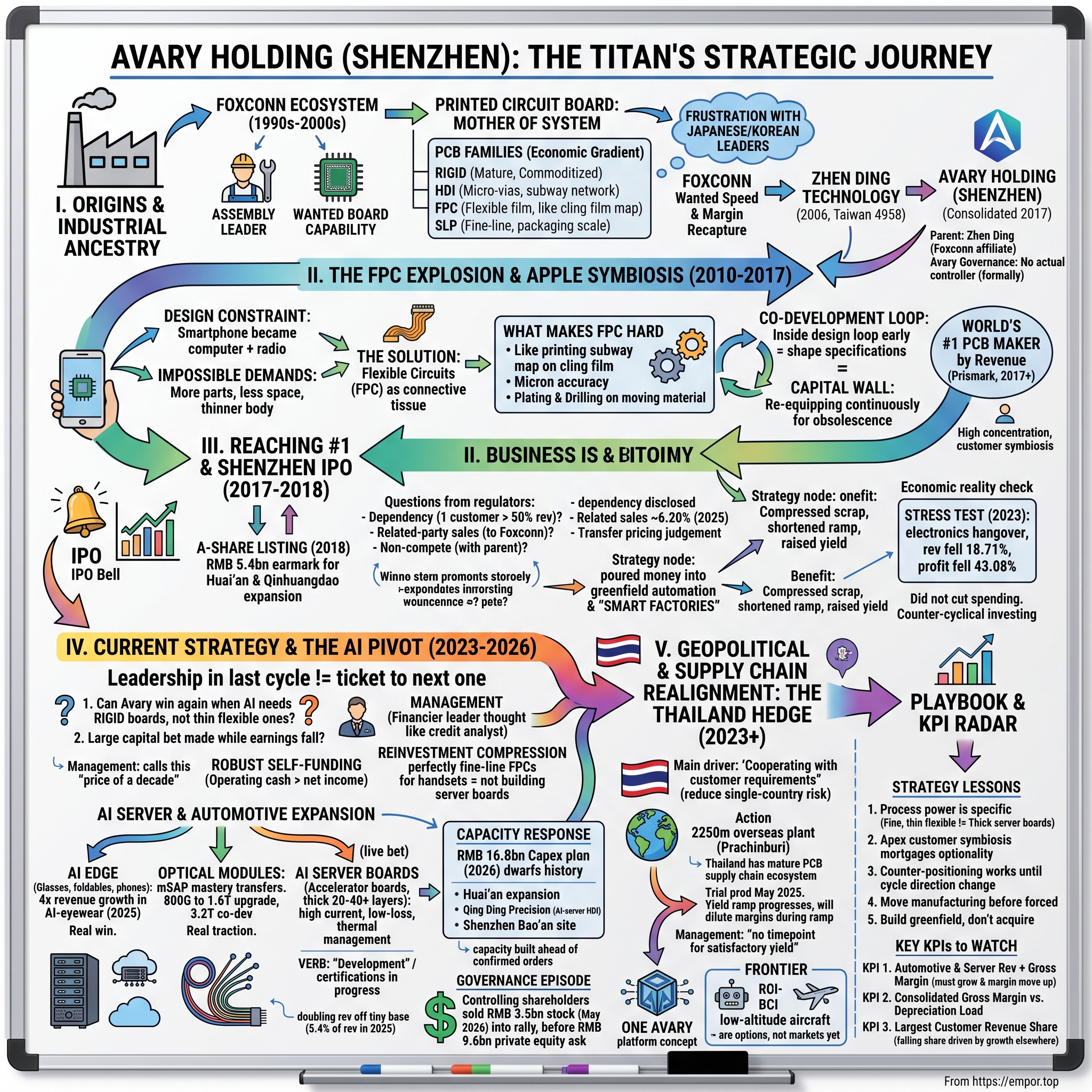
Avary Holding: The Invisible Titan of the Electronics Revolution
I. Introduction & Episode Roadmap
Pick up the phone in your pocket. Somewhere under the display, folded around the battery, threaded past the camera stack and the haptic engine, is a ribbon of amber-coloured plastic maybe a tenth of a millimetre thick, carrying copper traces narrower than a red blood cell. It bends every time the phone is assembled, flexes when the case is squeezed, and carries signals fast enough that the physics of the copper matters more than the logic running on it. There are dozens of these things inside a modern smartphone. They are the connective tissue of the device — and there is a good chance most of them were made by a company almost no Western consumer has ever heard of.
That company is 鹏鼎控股 Avary Holding (Shenzhen) Co., Limited, listed on the 深圳证券交易所 Shenzhen Stock Exchange under the code 002938. It is, by revenue, the largest printed circuit board manufacturer on earth, and it has been for nine consecutive years — 2017 through 2025 — according to the annual global rankings compiled by the industry research firm Prismark.12 In 2025 it turned over RMB 39.15 billion, roughly $5.4 billion, and earned RMB 3.74 billion in net profit attributable to shareholders.1
It is also one of the most concentrated large-cap manufacturers in the world. In 2025, a single customer accounted for RMB 31.18 billion of sales — 79.65% of everything the company sold. The top five customers together took 89.45%.1
Avary does not name that customer in its filings. It does not have to. When a company's revenue calendar peaks violently in the September and December quarters, when its product roadmap tracks foldables and smartwatches and spatial-computing headsets, and when it built an entire generation of process technology around a manufacturing method introduced in the iPhone X, the identity is not exactly a state secret.
The central question. This is a story about a business that solved one of the hardest micro-engineering problems in consumer electronics, became the global leader by doing it, and then discovered that leadership in the last computing cycle is not a ticket to the next one. Avary is a spin-out of Taiwan's 臻鼎科技 Zhen Ding Technology and, at one further remove, of the 鸿海精密 Hon Hai Precision — Foxconn — industrial complex.3 It won by becoming indispensable to the most demanding customer in hardware. The question now is whether the same organisation can win a second time in a market where its historic customer is not the buyer at all: the AI data centre, where the boards are thick and rigid rather than thin and flexible, where the specifications come from cloud operators and GPU designers, and where a Chinese competitor half Avary's size overtook it in market value in a single summer.15
There is a second question layered underneath, and it is arguably the more interesting one for a long-term investor. Avary announced capital expenditure plans in 2026 that dwarf anything in its history — RMB 16.8 billion for the year, against RMB 7.38 billion actually spent in 2025, which was itself more than double 2024.146 It is spending this money into a demand signal — AI compute — that it does not yet meaningfully serve, and it is spending it while its earnings are falling. In the first quarter of 2026, revenue slipped 1.25% and net profit fell 5.21%; profit excluding non-recurring items dropped nearly 32%.16 Management calls this the price of a decade. A sceptic would call it a large, undiversified, capital-intensive bet placed at the top of a cycle by a company whose controlling shareholder was simultaneously selling stock.17
The roadmap. We start with the industrial lineage — how a Foxconn-adjacent components maker in 深圳 Shenzhen became a standalone giant, and why Foxconn wanted the board business in the first place. Then the flexible-circuit revolution and the customer symbiosis that made Avary the world's number one. Then the 2018 A-share listing and what the company did with the money. Then the management, the governance structure, and the capital-allocation record — including the parts that do not flatter. Then the AI pivot and the automotive push. Then Thailand, and what "China plus one" actually costs when you have to move a chemical process, not just an assembly line. And finally the strategic analysis: where the moat is real, where it is thinner than the narrative suggests, and the small number of things worth actually watching.
 Subscribe on LinkedIn
II. Origins & Industrial Ancestry: The Foxconn Ecosystem
To understand why Avary exists, you have to understand a frustration that Foxconn's engineers lived with for most of the 2000s. Foxconn assembled the world's electronics. It did not, for the most part, make the electronics. A phone would arrive at a Shenzhen line as a bill of materials sourced from Japan, Korea, Taiwan and America, and Foxconn would put it together for a few percentage points of margin while the component makers upstream captured the value. The single largest line item Foxconn did not control was the circuit board — the substrate onto which every other component is soldered.
Why the board is the mother of the system. A printed circuit board is the nervous system and skeleton of a device at once. It is a laminate of glass fibre and resin, with layers of copper foil etched into pathways, stacked and pressed together, drilled through with microscopic holes that are then plated with copper so signals can travel between layers. Get it wrong and nothing else works: the chip may be flawless, but if the board cannot deliver clean power or carry a high-frequency signal without distortion, the product fails.
The industry splits into a few families that matter for this story.
Rigid PCBs are the familiar green boards — cheap, mature, and commoditised. HDI, or high-density interconnect, boards squeeze far more circuitry into the same area using laser-drilled microscopic vias rather than mechanical drills; think of it as moving from a highway system to a subway network with many more, much smaller tunnels.
FPCs, flexible printed circuits, replace the rigid glass-fibre base with polyimide film — a plastic that survives soldering temperatures and can be folded thousands of times. And SLP, substrate-like PCB, is the most demanding of the lot: a mainboard built with the fine-line techniques normally used for semiconductor packaging, allowing trace widths and spacings down towards 20 micrometres and below, which is roughly a quarter the width of a human hair.
The economic gradient across those families is steep and it explains most of what follows. Rigid boards are made by hundreds of companies. Advanced HDI is made by dozens. The flexible circuits and substrate-like boards that go into a flagship phone are made, at the required precision and volume, by a handful. Value in this industry does not accrue to the biggest factory; it accrues to whoever can hold the tightest tolerance at scale.
The incumbents Foxconn wanted to displace. In the late 2000s, the flexible circuit business was not a Chinese industry. It was a Japanese one, with a Taiwanese and Korean fringe. 日本メクトロン Nippon Mektron was the global leader in flexible circuits by a wide margin. 住友電工 Sumitomo Electric was a serious force. イビデン Ibiden and 新光電気工業 Shinko Electric owned the high end of package substrates. These were superb companies with decades of materials science behind them — and they were structurally slow. Their capital cycles were measured against Japanese cost of capital and domestic labour, their capacity decisions went through committee, and their customers were diversified enough that no single account could force them to re-tool on a twelve-month cadence.
That combination — technically excellent, strategically deliberate — is exactly what a fast, brutally capitalised challenger preys on. Foxconn's insight was not that it could make a better flexible circuit than Nippon Mektron. It was that a supplier sitting physically inside the assembly ecosystem, willing to spend at a rate no Japanese board would approve, could out-iterate one that did not. The strategic imperative was margin recapture, but the mechanism was speed.
Foxconn's answer to the frustration was to build its own board capability, and in 2006 it organised that effort into 臻鼎科技 Zhen Ding Technology, which later listed on the Taiwan Stock Exchange under the ticker 4958.20 The mainland manufacturing core was an older entity: a Shenzhen precision-components company founded on 29 April 1999. In 2016 Zhen Ding consolidated its various mainland PCB subsidiaries into that vehicle; in 2017 it was converted into a joint-stock company and renamed Avary Holding (Shenzhen).13
The plumbing of ownership matters, because it is unusual and it persists to this day. Avary's shares are held through a chain of offshore vehicles — 美港实业 Meigang Industrial and 集辉国际 Jihui International — both wholly controlled by Zhen Ding, which in turn counts a Foxconn subsidiary as its largest shareholder.13 At the end of 2025 those two entities together held 71.90% of Avary.1 Critically, Avary's own filings state that because Zhen Ding itself has no controlling person, Avary has no actual controller — a governance fact that a Western investor should sit with for a moment. There is a dominant shareholder bloc with more than two-thirds of the votes, and no identified party legally accountable as the controller.
Why does that structure matter to someone buying the shares today? Because a company with a dominant parent and no legally accountable controller is governed by convention rather than by a single identifiable interest. When the parent's incentives and the listed company's incentives align, nothing is visible. When they diverge — over dividend policy, over transfer pricing, over who funds the next capital cycle — there is no mechanism inside the structure that arbitrates in favour of minority holders. That tension does not appear in the numbers for years at a time. It appeared, arguably, in 2026.
The manufacturing geography. Avary built its production around three mainland hubs: Shenzhen, where the company is headquartered and where the highest-mix flexible work sits; 淮安 Huai'an in Jiangsu, which became the growth campus; and 秦皇岛 Qinhuangdao in Hebei.3 More recently it has added 高雄 Kaohsiung in Taiwan and the Thailand complex.7 The pattern is worth noting because it is deliberate: Avary has almost never bought its way into a new capability. It builds greenfield, transfers process knowledge from an existing plant, and ramps. That choice has costs — greenfield ramps are slow and depreciation-heavy — but it avoids the integration failures that have wrecked so many cross-border electronics acquisitions.
The man who ran it. 沈庆芳 Shen Qingfang is not the engineer you would expect to find at the top of a process-manufacturing company. Born in 1952 in Taoyuan, Taiwan, he studied business administration at Chinese Culture University and then spent nearly two decades in finance — a long stint at Taiwan's Export-Import Bank through the 1980s, then senior roles at Asia Securities, Chung Shing Bank, Pacific Securities and a financial advisory firm through the mid-1990s. He came to circuit boards in his mid-forties, from the capital markets, not the clean room.
That background explains a great deal about how Avary is run. A financier who takes over a capital-intensive factory business tends to think in terms of asset turns, balance-sheet capacity and the cost of being wrong — and Avary's operating signature has consistently been low leverage, heavy self-funding and a refusal to chase volume that does not pay. Shen's own framing of longevity, published by the company, is characteristically systemic rather than heroic: ten years of business can be sustained by an individual's willpower, fifty years requires institutions and strategy, and a hundred years requires culture.4 It is a useful lens for reading everything that follows, including the parts where the institutions arguably served the parent better than the minority shareholders.
The cultural framework Shen has articulated publicly rests on four unglamorous pillars: conduct you can sleep with at night, diligence paired with personal accountability, team cohesion with zero tolerance for factional politics or graft, and rewards that follow contribution.4 Read cynically, this is boilerplate; every Asian industrial group publishes something like it. Read against the operating record, it is more interesting than that, because the specific failure modes it targets — internal patronage, procurement corruption, and the political manoeuvring that afflicts large mainland factory organisations — are precisely the ones that destroy yield discipline. A plant where the maintenance budget is allocated by relationship rather than by data does not hold a plating bath stable. Whatever one thinks of the language, the operating outcomes suggest the institution works.
What is conspicuously absent from Shen's public record is the founder-mythology that usually accompanies Chinese industrial success stories. There is no origin anecdote, no famous crisis speech, no personality cult. He has run Avary and its Taiwanese parent simultaneously for years, in his seventies, without an obvious designated successor named in the filings. For a company whose competitive advantage is largely institutional knowledge rather than a single person's judgement, that is less alarming than it would be elsewhere. It is still a gap in the disclosure, and succession planning is not a topic on which the company has said much.
By the end of the 2000s, then, the pieces were assembled: a Taiwanese parent with Foxconn behind it, a mainland manufacturing base with real scale, and a leader who thought about factories the way a credit analyst thinks about a borrower. What was missing was a reason for the world's most valuable customer to bet its product roadmap on them.
III. The FPC Explosion & The Apple Symbiosis (2010–2017)
The reason arrived in the form of a design constraint that could not be engineered around.
In 2010, the smartphone stopped being a communications device with a computer inside and became a computer with a radio inside. The physical consequence was immediate. A phone released that year was thinner than its predecessor, carried a far denser display, added a second camera, and still had to hold a battery that lasted a day. Something had to give, and what gave was the wiring.
Every generation of smartphone after 2010 asked for the same impossible thing: more components, more battery, more antennas, in less space. The internal volume of a flagship phone is essentially fixed by what a human hand will tolerate. Everything the product team wants to add has to come out of somewhere else — and one of the few places left to harvest space was the wiring. Rigid boards and conventional connectors are volumetrically expensive. Flexible printed circuits are not: they fold into the gaps, wrap around the battery, and turn dead space into signal path.
What makes an FPC hard. Explaining this to a non-engineer is easiest by analogy. Making a rigid circuit board is like printing on cardboard: the substrate holds still, and the process can be violent.
Making a fine-pitch flexible circuit is like printing a subway map onto cling film, at micron accuracy, then chemically plating copper onto it in a bath, then laser-drilling holes through it without burning the plastic, then doing all of that on a roll that runs continuously through a factory — and then flexing the result a hundred thousand times without a single trace cracking.
Polyimide, the base film, is chosen because it tolerates soldering heat. It also expands and contracts with humidity and temperature, which means the material is quietly moving while you are trying to align layers to a few microns. Every step in the process is a chance to lose the part, and the parts are lost invisibly — a hairline crack that passes optical inspection and fails in a customer's hand eleven months later.
This is why yield, not price, is the currency of the flexible board industry. In a business where a large share of the cost is incurred before the defect is discovered, the difference between a plant running in the low 90s and one running in the mid 70s is not a few points of gross margin — it is the difference between a viable supplier and one that loses money on every award. Avary does not disclose plant-level yield figures, and no credible public source does either, so precise comparisons are not available. But the structural point survives without the numbers: the company's segment economics, its ability to absorb annual price-downs from a monopsonist customer, and its consistent presence at the top of the industry ranking are only explicable if its process yield is meaningfully better than the field.
It is worth dwelling on the economics, because they are counter-intuitive. Consider a board that costs a hundred units to produce and sells for a hundred and twenty-five. At 95% yield, the effective cost per good board is about a hundred and five, and the supplier earns sixteen percent. At 80% yield, the effective cost is a hundred and twenty-five, and the supplier earns nothing. The revenue line is identical in both cases. The entire difference between an excellent business and a worthless one sits inside a process variable the customer never sees and the income statement never itemises. This is why an outsider reading PCB financials often misreads them: two companies quoting the same price to the same customer can have completely different economics, and the only visible trace of it is the gross margin line.
It also explains why the industry consolidates upward rather than sideways. A supplier that wins a difficult programme runs it at scale, learns faster than a supplier running the same process at a tenth of the volume, and therefore bids the next programme from a lower effective cost. Volume buys learning; learning buys volume. Once that flywheel starts, the challenger's problem is not that it lacks the machines — it is that it lacks the defect history.
The co-development loop. The other half of the moat is timing. Boards for a flagship device are not tendered like commodities; they are designed alongside the product, well over a year before launch, in a loop where the customer's mechanical engineers and the supplier's process engineers argue about what is physically manufacturable. A supplier inside that loop learns the roadmap first, tools for it first, and shapes the specification towards processes it already owns. A supplier outside it bids on a finished drawing against three others.
Avary's transformation from a large FPC maker into the global number one came from being inside that loop when the architecture changed. The introduction of substrate-like mainboards in 2017's flagship phones moved smartphone motherboards from conventional subtractive etching — where you coat the board in copper and etch away what you do not want — to modified semi-additive process, or mSAP, where you grow the copper traces only where they belong. It is the difference between carving a sculpture and printing one. mSAP allows dramatically finer lines, which allows a smaller mainboard, which frees volume for battery. It also requires a completely different set of chemistry, equipment and process control, and it arrived at a moment when Avary was already investing at a scale most competitors could not match.
There is a subtlety in this that matters for the later chapters of the story. Being inside the design loop is not a permanent status; it is renewed programme by programme, and it is renewed on the basis of what the supplier can already do. A board maker earns its seat by having invested, unprompted, in the process the customer is about to need. Avary earned repeated seats through the 2010s because it kept guessing right about where miniaturisation was heading — thinner stacks, finer lines, more layers in flexible form. That is a real skill. It is also a skill exercised in one direction, and the muscle it builds is the muscle for reading that customer's roadmap.
The capital wall. This is the part of the story most easily under-appreciated. Staying qualified at the top tier of consumer electronics requires re-equipping continuously — laser drills, exposure systems, plating lines, automated optical inspection — for products that will be obsolete in twenty-four months.
The customer does not fund it. The supplier does, out of cash flow, in advance of the award. A competitor with a smaller balance sheet faces a brutal asymmetry: it must spend at scale to be considered, without knowing whether it will be chosen. That asymmetry is what quietly eliminated most of the field.
Avary's ability to self-fund that spending, generation after generation, is what converted a technical lead into a structural one. By 2017, its largest customer alone contributed roughly RMB 15.1 billion, more than 63% of that year's revenue, and Avary had reached the top of the global PCB ranking for the first time.31
What it cost. The symbiosis was never free. Being the preferred supplier to a customer that represents most of your revenue means the customer sets the price, sets the timeline, and can — in principle — dual-source you at any renewal. Avary's disclosed receivables ballooned as the relationship deepened, roughly doubling between 2015 and 2016 in the run-up to the listing.3 The company's answer, then and now, has been to make replacement operationally frightening for the customer rather than contractually impossible: to be so deeply woven into a launch schedule that switching means risking a product cycle. That is a real defence. It is not the same thing as pricing power, and the distinction shows up in the margins.
Which raises the obvious question a Taiwanese parent would have been asking around 2017: if this business is now the largest of its kind in the world, why is it sitting inside a Taiwan-listed holding company rather than in front of mainland investors?
IV. Reaching #1 & The Shenzhen A-Share Listing (2017–2018)
On 10 July 2018, Avary's application went before the issuance examination committee of the 中国证券监督管理委员会 CSRC, roughly ten months after it had been filed.3 The prospectus asked for RMB 5.4 billion, earmarked for PCB expansion projects at Huai'an and Qinhuangdao.3
The regulator's interest was not in whether the company could build factories. It was in three structural questions that go to the heart of what Avary is.
The dependency question. Chinese listing review treats a single customer above 50% of revenue as a presumption of dependency requiring explanation. Avary was well past that line and moving further past it every year.3
The company's argument — that the relationship was technical rather than commercial, embedded through years of co-development rather than a renewable contract — is the same argument it makes today. It was accepted, but it is worth noting that acceptance is not evidence. The regulator did not conclude the risk was small; it concluded it was disclosed. Those are different findings, and the distinction has not gone away in the eight years since.
The related-party question. Avary sits inside the Foxconn ecosystem and sells into it. In 2025, related-party sales — principally to 鸿海精密 Hon Hai Precision and its subsidiaries — accounted for 6.20% of revenue, making the Hon Hai group Avary's second-largest customer.1 That is not trivial, and it means a slice of the company's demand is priced within a family rather than at arm's length in an open market. It is disclosed and quantified, which is the right treatment, but it belongs in any honest reading of the revenue base.
The competition question. Avary and its Taiwan-listed parent are in the same industry. Non-compete arrangements between a listed subsidiary and its controlling group are a perennial source of A-share governance friction, because they are enforceable only to the extent the controller wants them enforced — and Avary, remember, formally has no actual controller.
There is a related accounting judgement embedded in all of this that deserves a sentence. When a listed company buys from and sells to entities within its parent's group, the reported gross margin depends on where the group chooses to book the value. Avary's disclosures quantify related-party sales, and its auditors have issued clean opinions — the 2025 report carried a standard unqualified audit opinion.1 But quantification is not the same as independent price-setting, and transfer pricing inside a group structure is a judgement, not a fact. It is the kind of thing that matters little in normal times and a great deal if the relationship ever comes under strain.
The listing went ahead on 18 September 2018, at RMB 16.00 per share for roughly 231 million shares.5 The company raised less than it had planned, in a market that was punishing new issues that year.3
What it did with the money — and this is the more revealing part. Avary poured it into greenfield capacity at Huai'an and Qinhuangdao, built around heavy automation, automated optical inspection and machine-vision defect classification.
There were no headline acquisitions. There was no diversification into adjacent businesses. Between 2018 and 2024 the company essentially did one thing repeatedly: generate cash from mature flexible-circuit programmes and reinvest it in the next process node of the same business.
What the smart factories actually bought. The automation programme was not decoration. In a process with dozens of sequential steps and a defect population that is largely invisible to the human eye, the binding constraint on yield improvement is the speed of the feedback loop: how quickly a plant detects that a parameter has drifted and connects it to the step that caused it. Avary's response was to build inspection and data capture into the line from the design stage rather than bolting it on — the annual report describes new plants as being planned around a closed loop of detection, prediction and decision, with the group-level ambition of raising output per employee.1 The commercial translation is straightforward: automated inspection lets you catch a drifting process in hours rather than at final test, which compresses scrap and shortens the ramp on every subsequent new product. For a company whose whole edge is yield, this is the highest-return capital it can spend.
The stress test nobody planned. The model got audited by reality in 2023. The post-pandemic electronics hangover hit hard: first-half revenue fell 18.71% to RMB 11.54 billion, and net profit dropped 43.08% to RMB 812 million.12 Profit fell more than twice as fast as revenue — the arithmetic signature of a business with heavy fixed costs and a customer that does not renegotiate price upward when volumes fall. That asymmetry is a permanent feature of Avary's economics, and it is the single most useful thing to remember when reading its good years. On the way up, operating leverage flatters the numbers. On the way down, it does the opposite, quickly.
What the company did during that downturn is more revealing than what happened to it. It did not cut capital spending. It announced a $250 million overseas plant.12 Whether that was courage or over-confidence depends on the next five years, but it establishes a behavioural pattern worth noting: this management team spends counter-cyclically, and does not treat a weak quarter as a reason to defer capacity.
For a long time that looked like exemplary discipline. Operating cash flow ran consistently ahead of net income — RMB 7.29 billion of operating cash against RMB 3.74 billion of net profit in 2025, and a similar shape in the two prior years.1 The balance sheet stayed conservative: RMB 12.03 billion of cash at the end of 2025 against a total liabilities-to-assets ratio of 28.86%, with receivables turning in 56 days and inventory in 43.1 Very few Chinese industrial companies of this size run this cleanly.
But the same discipline has a shadow side that only became visible later. A company that reinvests almost exclusively in the technology its largest customer needs is compounding its concentration, not diluting it.
Every yuan spent perfecting fine-line flexible circuits for handsets was a yuan not spent learning how to build twenty-layer rigid boards with low-loss materials for servers. In 2018 that was obviously the right trade. By 2024, when the demand curve for computing hardware bent sharply upwards in a direction Avary had not been building towards, the accumulated cost of that focus came due — and it came due in the stock price before it came due in the accounts.
V. Current Management, Corporate Governance & Capital Allocation
There is a moment in the third-quarter 2025 investor briefing that captures how Avary's management communicates. An analyst asked, plainly, when the new Thailand plant would reach a satisfactory yield. The answer, recorded in the company's own filing: it is not currently possible to specify a timepoint, but the company is treating the improvement of Thailand's technical and production capability as a priority and is directing group-wide resources at it.7
That is not evasion, exactly. It is a refusal to guide on something the company genuinely cannot forecast, from a management team that has consistently declined to promise things it cannot control. Read across several years of Avary's disclosures, the pattern holds: the company does not issue formal revenue guidance, does not comment on individual customers — asked directly about server board sampling progress, management said it does not evaluate the products of any single customer7 — and tends to explain misses mechanically rather than atmospherically.
Credibility, tested against the record. The useful test of a management team is not whether its narrative is attractive but whether it is stable and whether it explains its own bad quarters. On both counts Avary scores reasonably well. When third-quarter 2025 gross margin fell about a percentage point year on year, management attributed it to two specific, quantified causes: depreciation up by more than RMB 60 million in the quarter, and certification and sampling costs at new plants.7 When administrative expenses jumped, it named office-building depreciation and peak-season hiring.7 When full-year 2025 net profit grew only 3.25% on 11.40% revenue growth, the annual report was explicit about the mechanism — rising raw material prices, sharper currency volatility, and the depreciation drag from accelerated capital spending.1 A foreign-exchange loss of roughly RMB 170 million ran through the 2025 accounts.19
These are honest explanations. They are also, notably, explanations of the same problem recurring: Avary is a company whose revenue grows faster than its profit because its cost base is expanding ahead of the revenue it is meant to serve. In 2025 the reported gross margin actually improved by 0.74 percentage points to 21.50%, and the company points to that, fairly, as evidence of cost control in a year when copper and laminate prices rose.1 But net profit excluding non-recurring items was essentially flat, up 0.08%.1 The underlying earnings power of the business did not grow at all in 2025. That is the number that matters, and it is the one the headline growth rate conceals.
Alignment, and what is not disclosed. The outline of a well-governed A-share company usually includes an employee share scheme with hard performance hurdles — return on equity floors, net profit gates, multi-year vesting. Avary's public filings do not disclose a management equity incentive programme tied to specific ROE or profit targets, and no such scheme is described in the 2025 annual report summary.1 Nor is there disclosed direct equity ownership by the chairman in the listed entity; the economic interest runs through the Taiwanese parent. This is not a scandal, and it is common for subsidiaries of listed foreign groups. But it does mean that the usual mechanism aligning senior management with minority shareholders of this company is absent, and that the compensation architecture is opaque from the outside. An investor relying on incentive design to constrain behaviour has nothing to rely on here.
The engine room. What Avary does disclose in detail is where the technical effort goes. Research and development absorbed RMB 2.46 billion in 2025, 6.28% of revenue and up 5.79% on the prior year, supported by 7,881 R&D staff — about one in six employees — with 2,801 patent applications filed and 1,647 granted during the year.16 For a contract manufacturer, one in six people working on development is a high ratio, and it reflects a business where "R&D" mostly means process engineering rather than product invention: the work of getting a customer's design to actually come out of a factory at an acceptable yield.
The working-capital record supports the same picture. Receivables and inventory turned faster in 2025 than in 2024 — receivable days improved from a comparable period the year before, and by year end the company was collecting in 56 days and turning inventory in 43.17 In a business where the customer dictates payment terms, improving collection while growing revenue at double digits is a genuine operating achievement rather than an accounting one.
Return on capital, across four technology waves. The cleanest long-run judgement on a capital-intensive manufacturer is what it earns on the money it retains. Avary's weighted average return on equity was 11.38% in 2023, 11.73% in 2024 and 11.42% in 2025.1 That is a remarkably stable band — and stability at roughly eleven percent is the important message, not the small movements within it.
Eleven percent is a respectable return for a heavy manufacturer with almost no leverage. It is not the kind of return that compounds shareholder wealth dramatically, and it tells you something structural: through the 4G build-out, the 5G cycle and now the AI cycle, the economics of being the world's largest board maker have been consistent, moderate, and capped by the buyer. Investors hoping the AI wave lifts Avary into a fundamentally different return profile are betting against a decade of evidence — unless the mix genuinely shifts towards products where Avary, not its customer, sets the price.
Capital allocation — the pivot from discipline to aggression. For most of its listed life Avary spent roughly in line with its depreciation and returned a modest share of profit to shareholders. That changed abruptly. Capital expenditure reached RMB 7.38 billion in 2025, more than double the prior year,6 with RMB 4.97 billion of it spent in the first nine months alone — an increase of nearly RMB 3 billion year on year.7 For 2026 the company has planned RMB 16.8 billion, a figure that ran well ahead of what analysts had modelled.14
To put that in perspective: Avary intends to spend more on capital projects in 2026 than it earned in net profit across the last four years combined. It is funding this from a starting cash position of RMB 12.03 billion, operating cash flow of roughly RMB 7 billion a year, a balance sheet with almost no financial leverage — and, for the first time, external equity. In July 2026 the board approved a private placement of up to RMB 9.6 billion to no more than 35 qualified investors, the entire proceeds directed at a single project.8
Alongside this, the company raised its dividend. The 2025 distribution proposal was RMB 10 per ten shares — RMB 1.00 per share on a base of 2.318 billion shares, roughly RMB 2.32 billion, against earnings per share of RMB 1.61.1 That is a payout ratio above 60%, materially higher than the roughly 30–40% range the company had historically run. Paying out more than 60% of earnings while announcing the largest capital programme in company history and raising fresh equity is an unusual combination. The charitable reading is that management is signalling confidence in cash generation. The sceptical reading is that a company raising RMB 9.6 billion from new investors while distributing RMB 2.3 billion to existing ones is, in net terms, asking the market to fund the dividend.
The governance episode that deserves scrutiny. On 25 April 2026, Avary's controlling shareholders disclosed a plan to sell up to 40 million shares between 21 May and 20 August, at a floor price of RMB 50.17 They executed the entire plan in the first five trading days — 21 to 25 May — selling 39.9999 million shares, 1.73% of the company, at an average of RMB 86.94 for total proceeds of RMB 3.478 billion.17 The sale coincided with a violent rally that took the shares to RMB 114.32 and the market capitalisation to roughly RMB 265 billion.17 The combined stake fell from 71.90% to 70.17%.17
Nothing here appears improper: the plan was pre-announced under the rules, and executing at RMB 87 against a stated floor of RMB 50 is simply good timing.
But the sequencing is worth stating plainly, because a sceptical investor would. Within roughly ten weeks, the parent group took RMB 3.5 billion of cash out of the stock, the company proposed a RMB 2.3 billion dividend that flows majority-wise to that same parent, and then asked outside investors for RMB 9.6 billion of new equity to fund AI capacity.
Each step is defensible in isolation. Together they describe a capital structure in which the controlling shareholder monetises the AI narrative in the market while minority investors fund the assets that are supposed to deliver it. That is not an accusation of wrongdoing. It is a description of where the risk sits.
Customer concentration, revisited honestly. Management's answer to the concentration question has always been to argue that the same capability set serves new sockets — wearables, headsets, smart glasses, vehicles, servers — so the customer mix will broaden without the company changing what it is good at.
There is genuine evidence for this. Revenue from AI-eyewear products grew more than fourfold in 2025, and the company claims to be the world's largest PCB supplier to that category.1 That is a real, verifiable diversification win in a category that barely existed three years ago.
But the arithmetic of the concentration barely moved. At 79.65% of 2025 revenue, the largest customer's share is higher than the 63% disclosed at the time of the IPO.13 Eight years of diversification effort have coincided with a business that became more concentrated, not less. That is the single most important fact in this section, and no amount of segment reclassification changes it.
The place where the concentration might genuinely break is not in phones. It is in the racks.
VI. Segment Deep-Dive: The AI Server & Automotive Expansion (2023–2026)
Avary reports in three buckets, and the shape of them tells you exactly where the company is and where it is trying to go.
Communications boards — flexible circuits, rigid boards, HDI and SLP for handsets, routers and switches — generated RMB 25.44 billion in 2025, up 4.95%, at a gross margin of 19.03%.1
This is the historic core: enormous, cash-generative, growing at roughly the rate of global smartphone content inflation, and carrying the lowest margin in the portfolio. It is also where the customer concentration lives. A 5% growth rate on a base this size still adds more absolute revenue in a year than the entire automotive-and-server segment generates in total — which is worth holding in mind when reading the excitement about the other lines.
Consumer electronics and computing boards — tablets, notebooks, wearables, games consoles, smart home devices, and increasingly AI wearables — reached RMB 11.29 billion, up 15.72%, at a 27.15% gross margin.1
This is the quiet outperformer. It grew three times faster than the core, and it earns eight percentage points more margin. The driver management points to is the smart-eyewear category, where the requirements — very high layer counts and precision in a flexible board that must be light enough to sit on a face and slim enough to look like ordinary glasses — play directly to Avary's process strengths.17
On the Q3 2025 call, management said it expected demand to rise substantially as more customers entered the category and the product ecosystem matured, and flagged both flexible boards and high-end rigid boards as beneficiaries over the following two years.7 Of all the growth stories Avary tells, this is the one with the most supporting evidence in the actual accounts — which is notable, because it is also the one the market pays the least attention to.
Automotive, server and other boards is the segment everyone is watching and the smallest by a distance: RMB 2.12 billion in 2025, up 106.67%, at a 21.55% gross margin.1 It doubled. It is also 5.4% of revenue.16 Through the first three quarters of 2025 it ran at RMB 1.39 billion, up 91%.7 AI-server products specifically more than doubled year on year, and the company expects continued strong growth in 2026.1
A word about seasonality, because it distorts everything. Avary's year is violently back-loaded. In 2025, the two halves were almost unrecognisable as the same company: RMB 8.09 billion of revenue in the first quarter and RMB 8.29 billion in the second, against RMB 10.48 billion in the third and RMB 12.29 billion in the fourth.1 Profit was more extreme still — the fourth quarter alone earned nearly three times the first.1 This is the fingerprint of a consumer electronics supply chain that builds inventory ahead of an autumn product launch and a holiday quarter.
The practical consequence for an investor is that first-half results carry very little information about the year, and that a soft first quarter — like the one Avary reported in 2026 — is a weak signal in isolation. The corollary is less comfortable: it also means the company cannot smooth a bad autumn. If a flagship programme slips or a volume forecast is cut, there is no second bite.
Why AI boards are a different craft. It is tempting to assume that a company which can make a twenty-micron flexible circuit can trivially make a server board. It cannot, and the reason is instructive. A GPU accelerator board is thick — twenty to forty or more copper layers pressed into a single laminate — because it must carry enormous current to power-hungry silicon while simultaneously routing thousands of high-speed differential pairs. At the data rates modern accelerators use, copper behaves less like a wire and more like a waveguide: signals lose energy into the surrounding resin, so the laminate itself must be a low-loss material, and the stubs left behind by drilled vias must be back-drilled away to stop them acting as antennas. Thermal management, warpage control across a large panel, and impedance consistency across forty layers are the binding constraints. Avary's filings list precisely these capabilities — high-order HDI supporting GPU modules and high-speed interfaces, embedded components and embedded traces, low-loss material development, back-drill stub control — as areas of active development.1
Note the verb. Development. The 2025 annual report says the company is working with customers on platform products two to three generations ahead, and that relevant products "have been and are being" certified.1 Certification is not revenue. In the optical module segment the position is more advanced: Avary's lead in high-order mSAP translates directly, it is shipping into the 800G-to-1.6T upgrade, and it is co-developing 3.2T solutions with customers.1 On the Q3 2025 call, management described the optical business as having achieved a major breakthrough versus the prior year, currently addressing mainly 1.6T demand.7
The capacity answer. Avary's response to being late has been to buy its way into the queue with concrete and equipment, at a pace that is difficult to overstate.
In August 2025 it committed RMB 8 billion to expand high-end PCB capacity at the Huai'an campus between the second half of 2025 and 2028, with the stated goal of doubling advanced HDI and HLC capacity there by the end of 2026.1 In early 2026 it signed an agreement with the Huai'an economic development zone contemplating a further RMB 11 billion high-end PCB base.1
In July 2026 the private placement crystallised part of that plan: RMB 9.6 billion of a RMB 12.73 billion total project cost, for an AI-server and high-speed optical-module HDI project at wholly-owned subsidiary 庆鼎精密 Qing Ding Precision, adding 655,600 square metres of annual high-end HDI capacity.8 Days later, on 23 July 2026, the board approved a further RMB 10 billion for a Shenzhen site in Bao'an district — land acquired that May — to build AI high-end substrates and flexible circuits, with construction running through to 2033.9 Chinese financial media counted RMB 22.7 billion of announced PCB projects in 2026 alone.10
The scale invites an obvious question, and it is the right one to ask: capacity of this magnitude is normally built against contracted volume, and no such contracts have been disclosed. What the company has disclosed is certification progress and joint development with customers on platforms two to three generations out.1 Those are encouraging leading indicators. They are not orders.
Automotive, and a rare acquisition. The car story is simpler and slower. Vehicle electrification replaces copper wiring harnesses with flexible circuits in battery packs, where an FPC can carry sensing and balancing signals across hundreds of cells at a fraction of the weight; autonomous-driving domain controllers need high-layer-count boards that tolerate heat and vibration, and Avary has developed HDI products specifically for those conditions.1 Alongside its Q3 2025 results the company disclosed something it almost never does: an acquisition. It agreed to pay RMB 357 million in cash for 53.68% of 华阳科技 Huayang Technology, a 2002-vintage specialist in automotive modules and smart sensors spanning pressure, torque, displacement, angle and temperature-humidity sensing.7 It is a small deal — roughly 3% of one year's capex — and it buys customer relationships and sensor know-how rather than board capacity. Read as a signal, it suggests management sees automotive as a systems business it cannot enter with boards alone.
The "One Avary" framing, and the frontier list. Management describes its strategy through a platform concept it calls One Avary — the argument that having every PCB product family under one roof (flexible, rigid, rigid-flex, HDI, SLP, substrate-like) lets it serve any customer requirement from a single technical base, and that this breadth is itself the competitive asset.1 The company then maps that platform onto what it calls the AI "cloud–pipe–edge" architecture: servers and accelerators in the cloud, optical modules in the pipe, and phones, glasses and robots at the edge.110
It is a coherent story, and the frontier list attached to it is long: AR and VR spatial computing, smart cockpits, autonomous driving modules, edge computing, low-altitude aviation platforms, embodied-intelligence robots, even brain–computer interface modules.1 For humanoid robots specifically, the company has described developing boards for control systems, sensor modules, power management and joint actuation, and says it has established cooperation with several domestic and international robotics customers for development and sampling.1
An investor should hold two thoughts about this simultaneously. The first is that the breadth is real and unusual — very few board makers can credibly quote every product family, and in a period when customers are consolidating supplier lists, breadth wins share. The second is that a frontier list this long is also a warning sign. Brain–computer interfaces and low-altitude aircraft are not markets; they are options, and options disclosed alongside concrete capital commitments invite the question of whether the capital is chasing the option or the option is decorating the capital.
What the evidence actually supports. Avary has demonstrated it can win in AI at the edge — glasses, foldables, AI handsets — where the product is a thin, folded, precision flexible circuit and its incumbency is genuine. It has demonstrated real traction in optical modules, where its mSAP process is directly transferable. In AI server boards, the largest and most lucrative prize, it has a doubling revenue base off a very small number, certifications in progress, and an enormous amount of concrete being poured ahead of confirmed orders. That is a bet, not yet an achievement, and the company's own framing — capacity built to serve customers' next-generation platforms — concedes as much.
Building that capacity in Jiangsu and Guangdong solves the technology problem. It does not solve the other one.
VII. Geopolitical & Supply Chain Realignment: The Thailand Hedge
In August 2023, Avary was having a genuinely bad year. First-half revenue had fallen 18.71% to RMB 11.54 billion and net profit had dropped 43.08% to RMB 812 million, as the post-pandemic consumer electronics hangover worked through the channel.12 It was, in other words, the least comfortable possible moment to announce a $250 million overseas construction programme. Avary announced one anyway — approximately RMB 1.82 billion for a new production base in Thailand, with the stated rationale of cooperating with customer requirements and completing the company's global layout.12
The phrase "cooperating with customer requirements" is doing significant work in that sentence. Avary did not wake up one morning wanting to learn to run a chemical plating operation in Southeast Asia. Its customers — under tariff pressure, under political pressure, and under their own board-level mandates to reduce single-country manufacturing risk — asked their suppliers to establish capacity outside mainland China. For a supplier with roughly 80% of revenue riding on one such customer, that request has the force of an instruction.
Why Thailand and not Vietnam or India. Management's reasoning, disclosed in investor materials at the time, was ecosystem rather than cost: Japanese, Korean and Taiwanese PCB makers already had Thai production bases, so the supporting industrial chain — chemicals, laminates, equipment service, trained technicians — was comparatively mature.12
This is a genuinely important point that gets lost in "China plus one" commentary. A PCB plant is not an assembly line you can drop anywhere with a workforce and a roof. It consumes specialised copper foil and laminate, runs continuous electroplating chemistry with tight bath control, generates regulated effluent that requires permits and treatment infrastructure, and depends on technicians who can diagnose a drifting process before it produces a week of scrap.
You cannot localise that in eighteen months by hiring. Which is why the map of global board manufacturing is far more concentrated than the map of electronics assembly — and why a customer asking for non-China board capacity is asking for something genuinely difficult, not merely expensive.
The build. On 7 December 2023, Avary's Thai subsidiary — 鹏晟科技 Peng Sheng Technology (Thailand), incorporated that September with local partner Saha Pathana Inter-Holding taking a 9% stake — signed an agreement to buy 409,784.8 square metres of industrial land in the SAHA industrial park in ปราจีนบุรี Prachinburi province for 896.4 million Thai baht, about RMB 182 million.13 Construction began that month. The first plant entered trial production in May 2025, making high-order IHDI, HLC and optical module products.1
The ramp, honestly assessed. By the 2025 annual report the company said volume ramp was progressing smoothly, that several customers had certified the plant, and that additional global leaders in servers and optical communications were in active certification.1 Plants two, three and five, plus a mechanical drilling centre, were under simultaneous construction.1 In December 2025 the board approved a further RMB 4.297 billion for the Thai park in 2026, adding high-order HDI including SLP, and HLC capacity, aimed at servers, edge AI devices and low-orbit satellite applications.11
What automation can and cannot solve. Pressed on whether Thai lines would be more automated than mainland ones, management gave an answer that is more revealing than it first appears: automation levels are set by product type, not geography. A high-volume single-product line can be pushed towards a fully automated "lights-out" configuration; a line running small volumes of many variants can actually be made less efficient by over-automation.7 Overall, they said, new lines are built with very strong automation capability.7
Read as an investor rather than an engineer, that answer says something important about the Thailand economics. Automation substitutes for labour, and labour is not Thailand's problem — process maturity is. You can install the same robots in Prachinburi that you installed in Huai'an, and you will still lose material for a year while the local team learns which parameter to adjust when the copper thickness drifts. Capital cannot buy that; only time and scrap can. Which is precisely why management would not commit to a date.
Set against that, the Q3 2025 investor call is more informative than the annual report, because analysts pushed. Asked what actually drives Thailand's cost disadvantage versus mainland lines — the heavier depreciation from new equipment, or labour efficiency and yield — management answered that in the short term it is primarily production efficiency and yield, and that the gap should narrow over time as the local supply ecosystem develops and the workforce is trained.7 Asked when yields would reach a satisfactory level, the answer was that no timepoint could be given.7 Asked about the first phase specifically, management said lines had entered debugging in May, products were progressing through customer certification, and it expected the production rhythm to reach a good state in the first half of 2026.7
Strip out the diplomacy and the picture is clear enough. Thailand is a strategically necessary asset being built ahead of demand, at a cost the company is willing to name in categories but not in numbers, with a yield curve that management will not forecast. It will dilute margins during ramp — that is arithmetic, not opinion — and it is one of the identifiable drivers of the depreciation drag now visible in earnings. The pay-off is not a cost saving. It is the right to keep serving customers who have decided they need non-China options, and to be the incumbent when server and optical volumes move offshore.
The quieter third leg. Thailand gets the attention, but Avary has also been adding capacity in 高雄 Kaohsiung, Taiwan, alongside Huai'an and the Thai park.7 Taken together, the company is now running simultaneous greenfield programmes across mainland China, Taiwan and Southeast Asia — three regulatory regimes, three labour markets, three supply ecosystems, all ramping at once, and all depreciating from the day they are commissioned. Execution risk in a manufacturer is rarely about whether a single plant works. It is about whether an organisation can run four difficult ramps concurrently without degrading the plants that are already working. That is the real test of the next three years, and it is not one that shows up in any single disclosed metric.
Whether that is worth several billion renminbi depends entirely on whether the customers follow through. And that judgement — spend heavily now on a capability whose returns depend on someone else's decision — is the recurring theme of Avary's entire history.
VIII. Playbook: Business & Strategy Lessons
Strip away the specifics of copper and polyimide and Avary is a case study in a general problem: what happens to a company that becomes the best in the world at something, and then the world changes what it wants. Five lessons run through this story, and each of them cuts both ways.
1. Process power is real, but it is specific. Anyone can buy a laser drill. The machines are sold openly by a handful of German and Japanese suppliers, and the equipment list of a modern PCB plant is not a secret. What cannot be bought is the accumulated knowledge of how to hold a plating bath stable across seasons, why a particular lamination cycle warps one stack-up and not another, and which of four hundred process parameters to change when yield drifts by two points. That knowledge is tacit, it lives in the heads of engineers who have seen the failure modes, and it takes years to accumulate.
The correction to the received version of this lesson is that process power does not travel. Avary's mastery is in fine, thin, flexible — the physics of polyimide and micron-scale additive copper. A twenty-eight-layer low-loss server board is a different physics problem: thick-stack pressing, drilling aspect ratios, warpage across a large panel, signal integrity engineering. Some of the underlying discipline transfers; much of the specific knowledge does not. This is exactly why a company that has been the world's largest board maker for nine years is currently spending tens of billions of renminbi to buy its way into a segment it does not lead. Process power is a moat around a particular castle, not around the whole kingdom.
2. Symbiosis with an apex customer forges excellence and mortgages optionality. Serving a customer that demands the impossible on an annual cadence is the fastest known way to build a world-class manufacturing organisation. It is also the fastest way to build one shaped entirely around that customer's problems. Avary's concentration rose from roughly 63% at listing to 79.65% in 2025 — not through neglect, but because succeeding at the hard thing generated more of the hard thing.13 The lesson for investors is not "avoid concentrated suppliers." It is that concentration determines which future you are able to compete for, and that the cost of it usually appears one technology cycle later than the benefit.
3. Counter-positioning through capital intensity works until the cycle changes direction. Avary's classic play was to use cash from mature programmes to over-invest in the next process node, raising the qualification bar beyond what regional competitors could clear. It worked repeatedly. What it does not do is protect against a new demand curve that rewards a different asset base — and here the counter-positioning ran the other way. 胜宏科技 Victory Giant Technology, a Huizhou board maker with roughly half Avary's revenue, oriented itself towards AI accelerator boards and overtook Avary's market capitalisation on 22 August 2025.15 沪电股份 WUS Printed Circuit and 深南电路 Shennan Circuits have announced their own multi-billion-renminbi expansions.16 The capital wall Avary built kept out challengers in flexible circuits. It offered no protection at all in a segment Avary had not entered.
4. Move manufacturing before you are forced to. Avary committed to Thailand in the worst half-year it had experienced in a decade, roughly eighteen months before its customers' diversification demands became acute. That is the right sequencing, and it converted a geopolitical threat into a retention argument. The honest qualifier is that a first-mover advantage in a new geography is only an advantage if the ramp works — and the company has been notably unwilling to forecast when it will.
There is a subtler version of this lesson that applies well beyond electronics. When a customer asks a supplier to make an expensive, low-return investment for the customer's own risk-management reasons, the supplier's only real defence is to move first and be the one whose plant is already qualified when the volume shifts. Being second in that queue is worse than being nowhere, because you carry the cost without the incumbency.
5. Build the organisation to greenfield, not to acquire. Almost uniquely among manufacturers of its scale, Avary has grown by pouring concrete rather than by buying competitors. The single acquisition of consequence in its listed history was a small, capability-driven purchase in automotive sensing.7 That choice avoided the integration disasters that litter the cross-border electronics sector — but it also means the company has no institutional experience of buying its way into a technology it lacks.
That constraint is now binding. Faced with a segment where it is behind, Avary's only available instrument is to build, which takes years, and to build ahead of demand, which is expensive. A company with an acquisition muscle would have had a second option. Capability, in other words, is also a form of path dependence.
A fifth lesson, unstated in the playbook but visible throughout: watch what the controlling shareholder does, not what the company says. Avary's parent group sold RMB 3.5 billion of stock into strength in May 2026, weeks before the company asked outside investors for RMB 9.6 billion.178 Both actions were disclosed and lawful. Read together, they are a data point about who bears the risk of the AI bet and who has already taken chips off the table.
IX. Strategic Analysis, Risk Radar, & Bull vs. Bear Stress Test
Before the frameworks, it is worth clearing away three widely repeated claims about this company, because each one is either wrong or importantly incomplete.
Myth: Avary is "the Apple PCB company," and that is the whole story. Partly true and increasingly misleading. The concentration is real and got worse. But the fastest-growing part of the business in 2025 was the consumer and computing segment, driven by a category — AI eyewear — where the customer set is broadening well beyond any single brand.1 The correct framing is not "Apple supplier" but "supplier of the hardest flexible circuits in consumer hardware, whose largest buyer happens to dominate that category." The distinction matters because it determines whether new form factors are an opportunity or an irrelevance.
Myth: being the world's largest PCB maker means Avary leads in AI boards. False, and the market worked this out before the sell-side did. Global revenue leadership is an aggregate of a portfolio dominated by flexible circuits for handsets. In high-layer-count rigid boards for accelerators, Avary entered late and is currently buying its way in. The clearest evidence is the market's own verdict in August 2025: a company does not get repriced beneath a rival half its size by accident.
Myth: the balance sheet makes the expansion low-risk. Half true. Avary genuinely does have one of the cleanest balance sheets in the sector — high cash, low leverage, fast working capital turns.1 But financial risk and economic risk are different things. The danger in this expansion is not insolvency; it is a permanently lower return on a much larger capital base. A company can fund a bad investment comfortably and still destroy value doing it, and low leverage arguably makes that outcome more likely, not less, because nothing external forces discipline.
Hamilton Helmer's 7 Powers, applied strictly.
Process Power is Avary's strongest claim and the one best supported by evidence. Nine consecutive years at the top of the global revenue ranking, achieved in a segment where the customer imposes annual price reductions and rejects suppliers who cannot hold yield, is not luck.12 The 2025 result reinforces it: revenue rose 11.40% while cost of sales rose 10.37%, expanding gross margin 0.74 points in a year of rising copper and laminate prices.1 Holding margin against input inflation while a monopsonist customer pushes back on price is about as clean a demonstration of manufacturing capability as the public record allows. The limitation, as established, is that this power is segment-specific.
Scale Economies are real in two specific places. The first is the development budget already described: a competitor at a quarter of Avary's revenue base cannot fund that level of process engineering and remain profitable, which means the gap in accumulated know-how widens rather than closes. The second is less obvious and became visible only in 2025 — access to equipment. When every large board maker expanded simultaneously, tool lead times stretched and upstream capacity tightened; the annual report attributes Avary's ability to keep its expansion on schedule to long-standing supplier relationships, commercial reputation and balance-sheet strength.1 In a capacity race, being first in the queue for drilling and plating equipment is worth more than a price advantage on copper.
Switching Costs exist but are frequently overstated. The genuine friction is schedule risk: requalifying a flexible circuit supplier mid-cycle threatens a launch date. The limit is that this friction protects the incumbent position, not the price. A customer that cannot easily switch can still extract most of the surplus, and the 19.03% gross margin in communications boards — the lowest of Avary's three segments and its largest by far — is what that extraction looks like in the accounts.1
Cornered Resource — no. Avary holds no exclusive access to materials, equipment or IP that competitors cannot obtain. Network Economies — not applicable. Branding — irrelevant in a business-to-business components market. Counter-Positioning — arguable historically, absent today; in AI boards Avary is the challenger, not the incumbent being counter-positioned against.
Porter's Five Forces.
Buyer power: very high, and structurally so. The concentration figures established earlier dominate this entire analysis. They cap margins, dictate geography — Thailand exists because a customer asked — and set the technology roadmap. There is no meaningful counterweight, because a supplier cannot credibly threaten to walk away from four-fifths of its revenue.
Threat of new entrants: low at the top tier, and rising in the middle. Nobody is entering flagship flexible circuits from a standing start; the qualification cycle alone is measured in years and the capital requirement per advanced plant runs into billions of renminbi. But high-end HDI for AI servers is being entered simultaneously by every large Chinese board maker with a balance sheet, which is precisely why the barrier is weaker there.
Rivalry: intense and intensifying. Taiwanese peers 欣興電子 Unimicron, 華通電腦 Compeq and 健鼎科技 Tripod Technology; Japanese specialists イビデン Ibiden and 新光電気工業 Shinko Electric; and a domestic cohort of Victory Giant, WUS, Shennan Circuits, 东山精密 Dongshan Precision and 景旺电子 Kinwong. Industry observers have warned that the high-end capacity now being committed across the sector could arrive in a bunch roughly two years after ramp-up begins — the classic setup for an overcapacity cycle.16
Supplier power: moderate and rising. Copper foil, glass fabric, laminate, gold and specialty chemicals drove input cost pressure through 2025.1 The 2026 constraint has shifted upstream to equipment and specialty materials, where sector-wide expansion has created near-term tightness.16
Substitutes: low near-term, non-trivial long-term. No technology replaces the circuit board. But architecture shifts do redistribute value — advanced packaging that moves interconnect from the board into the chip package is a genuine long-run erosion path for board content, and one worth monitoring rather than dismissing.
The risk radar — only what is material.
Concentration and product architecture risk. If Avary's principal customer redesigns towards fewer, simpler flexible circuits, or dual-sources aggressively to a non-China supplier, there is no offsetting revenue stream anywhere near large enough. At 5.4% of sales, the server business cannot cushion a shock in a segment that is 65%.161
Execution and depreciation risk — currently the live one. This is not hypothetical; it is already visible. First-quarter 2026 revenue fell 1.25% and net profit 5.21%, with profit excluding non-recurring items down 31.85% — a gap between headline and underlying profit that management attributed to foreign exchange losses and increased equipment depreciation.16
The mechanism deserves emphasis because it is the defining financial dynamic of the next three years. Depreciation begins when an asset is commissioned; revenue begins when a customer qualifies the line and places volume. The interval between those two events is measured in quarters, sometimes in years, and during it the income statement absorbs the full cost with none of the benefit. Committed capital spending will therefore push depreciation up through 2028 regardless of whether the AI orders arrive on schedule.146
Overcapacity risk. Every major Chinese board maker is expanding high-end HDI simultaneously.16 If AI infrastructure spending digests rather than compounds, the industry will have added enormous capacity into a flat market — and Avary, as the highest-cost late entrant in that specific product, would be among the more exposed.
Geopolitical risk, in both directions. Tariffs and export controls could impair mainland-produced advanced electronics; equally, Avary's mainland cost base is the reason it is competitive at all, and its Thai hedge is expensive. A related overhang is association: when Chinese authorities investigated Foxconn's tax and land use in October 2023, Avary's shares fell about 3.2% despite the company stating it had received no notice and operated independently.18 Ownership adjacency carries a market beta the company cannot control.
Governance and related-party overhang. No actual controller, a 70% shareholder bloc that has demonstrated willingness to sell into strength, and a mid-single-digit slice of revenue priced within the affiliated Hon Hai group.117 None of this is a red flag on its own; together it means minority shareholders are relying on convention rather than structure.
Input cost and currency. Copper, gold, laminate and glass fabric all moved against the company in 2025, and the currency translation of a largely dollar-denominated revenue base against a renminbi cost base cut both ways within the same year.119 These are manageable, recurring frictions rather than existential risks — but they are the reason a business with 21% gross margins can deliver flat underlying profit on double-digit revenue growth.
The bull case. Avary enters the AI cycle with the industry's best process discipline, a fortress balance sheet, and a demonstrated ability to fund enormous capacity from internal cash. The edge story is already working, with an established position in the fastest-growing consumer AI form factor and the accounts to show for it.1
Optical modules are a genuine adjacency where mSAP mastery transfers directly, with 1.6T ramping now and 3.2T in co-development.1 The server business more than doubled in 2025 and management expects strong growth in 2026, off a base small enough that it can compound for years without straining credibility.1 Thailand, painful today, becomes a structural asset the moment customers move server and optical volume out of China.
Most persuasively, the consumer and computing segment quietly demonstrates the diversification thesis in the accounts rather than in a slide: mid-teens growth at a margin eight points above the core.1 If content per device keeps rising and the new server capacity certifies on schedule, the mix shifts towards higher-margin work and the depreciation that is currently a drag turns into operating leverage.
The bear case. The concentration got worse, not better, over eight years — from 63% to nearly 80%.13 The core segment grows at 5% on a 19% margin, which is the profile of a mature commodity business facing a powerful buyer.1
The company is late to AI servers, is buying its way in at the top of a capital-expenditure cycle alongside every competitor, and its own management will not forecast when the flagship overseas plant reaches acceptable yield.7 Underlying profit was flat in 2025 and fell sharply in the first quarter of 2026.116
Return on equity has been flat in a narrow band for three years, and a capital base about to expand by RMB 9.6 billion of new equity plus retained earnings — against assets that will depreciate for years before generating full revenue — is arithmetically likely to push that lower before it pushes it higher.1 Meanwhile a competitor with half the revenue commands a larger market value, because the market has concluded that the identity of your customer matters more than the size of your factory.15
What would falsify each case. The bull case breaks if the automotive-and-server segment's gross margin falls as its revenue rises — that combination would mean Avary is winning volume by pricing, which is what a late entrant without an advantage does. It also breaks if Thailand is still described in vague terms two annual reports from now.
The bear case breaks if the consumer and computing segment keeps growing at mid-teens rates with a margin near 27%, because that would demonstrate the process advantage genuinely travels to new form factors without a new customer relationship having to be built from scratch. It also breaks if the largest-customer share starts falling for the right reason — growth elsewhere rather than decline at home.
Both cases are testable within about eight quarters, which is unusually short for a thesis about manufacturing.
A note on how the market is pricing this. The shares reached a record in late May 2026, touching RMB 114.32 for a market value near RMB 265 billion, in a rally that had nothing to do with reported earnings — the most recent quarter had shown falling revenue and falling profit.1716 The stock has since traded well off that peak. What moved it was capital-expenditure news, not operating news. That is worth naming plainly: at present this is a security whose price responds to announcements about future capacity rather than to current results, which means an investor here is underwriting a construction programme rather than a run-rate.
The activist's questions. A concentrated investor with a seat at the table would ask four things. First: why is the payout ratio above 60% in the same year you are raising RMB 9.6 billion of equity — is the dividend serving the parent's cash needs rather than the company's capital plan? Second: what is the underwritten return on the RMB 22.7 billion of 2026 projects, and what customer commitments — not certifications, commitments — underpin the 655,600 square metres of new HDI capacity?108 Third: given no actual controller and a 70% bloc, what independent process governs related-party pricing with the Hon Hai group? Fourth: if AI server boards are the strategic priority, why is the operating disclosure around them limited to a combined segment that mixes automotive and server revenue, making it impossible for outside investors to track the very thing management says will transform the company?
That last question is the one that matters most, because it is the one that determines whether an investor can actually monitor this story.
X. Epilogue & Key KPIs to Watch
Stand in front of the Huai'an campus today and you see the physical form of a corporate decision. Cranes, poured slabs, and a construction schedule running to 2028 — RMB 8 billion committed, RMB 11 billion contemplated, RMB 12.73 billion of project cost approved for a single AI-server and optical HDI facility.18 Far to the south in Bao'an, another RMB 10 billion site began work in July 2026 on a timeline that stretches to 2033.9 And across the border in Prachinburi, a first plant runs at less than ideal yield while four more buildings go up around it.1
None of this is a company resting on a nine-year winning streak. It is a company that looked at the shape of the next computing cycle, concluded that being the best in the world at the last one was not sufficient, and decided to spend more in three years than it earned in the previous six. Whether that is vision or vertigo will be settled by execution, not by narrative — and the useful thing about a manufacturing business is that execution shows up in a small number of observable numbers.
There is a version of this story that ends well and a version that ends in a decade of eleven-percent returns on a much bigger asset base, and almost nothing an outsider can read today distinguishes between them. What distinguishes them is whether a factory in Huai'an that has not yet been built produces boards that a cloud operator has not yet ordered, at a yield nobody can currently forecast. Everything else — the ranking, the balance sheet, the nine-year streak — is history, and history is already in the price.
So the discipline for an investor is to ignore almost all of it and watch a very small number of things.
Three things worth tracking, and only three.
KPI 1 — Automotive and server segment revenue, and its gross margin. This is the whole thesis in one line item. It was RMB 2.12 billion in 2025 at a 21.55% gross margin, roughly 5% of revenue.1 For the AI pivot to be real rather than aspirational, this line has to keep roughly doubling while its margin moves up towards the mid-to-high twenties, not down. If revenue grows but margin compresses, Avary is buying share in a commoditising segment with shareholders' money. If it stalls in the mid single digits as a share of revenue while capital spending runs at the levels now committed, the capital has been misallocated.
Watch the margin at least as closely as the growth rate — and note that the company currently reports automotive and server together, which makes the single most important trend in the business impossible to isolate from outside. Any move to disaggregate would itself be informative.
KPI 2 — Consolidated gross margin against the depreciation load. Avary's central operating challenge for the next three years is straightforward: new capacity carries depreciation from day one and revenue from month eighteen. Gross margin was 21.50% in 2025, up 0.74 points despite that drag.1 Holding or improving it through the heaviest capex years would be strong evidence that the process advantage travels into new products and new countries. Sustained erosion would mean the opposite, and would show up here before it shows up anywhere else.
KPI 3 — Largest-customer revenue share. Disclosed annually in the top-five customer table, unambiguous, and the single cleanest measure of whether the diversification story is true. The direction of travel over the listed era has been the wrong one.13
A falling share driven by growth elsewhere rather than decline in the core is the outcome bulls are underwriting. A share that stays near four-fifths means that whatever else changed — new segments, new countries, new form factors — the fundamental risk in this business did not.
A closing thought. Avary Holding is a genuinely exceptional manufacturer attached to a genuinely uncomfortable business model. It makes objects of extraordinary precision that no consumer will ever see, at a scale nobody else matches, for a customer that captures most of the economics. It has been number one in its industry for nine straight years and its stock has spent the last one being outrun by a company a fraction its size.
What makes this a live story rather than a settled one is that Avary knows all of this. The capital programme, the equity raise, the Thai plants, the sensor acquisition — these are the actions of a management team that has read its own risk disclosures and is spending accordingly. The question an investor has to answer is not whether Avary is well run. On the evidence, it is. The question is whether industrial excellence, deployed late and at enormous cost into a market defined by someone else's silicon, produces returns — or simply produces very impressive factories.
References
-
鹏鼎控股(深圳)股份有限公司 2025 年年度报告摘要 (Avary Holding 2025 Annual Report Summary) — CNINFO, 2026-03-31 ↩↩↩↩↩↩↩↩↩↩↩↩↩↩↩↩↩↩↩↩↩↩↩↩↩↩↩↩↩↩↩↩↩↩↩↩↩↩↩↩↩↩↩↩↩↩↩↩↩↩↩↩↩↩↩↩↩↩↩↩↩↩↩↩↩↩↩
-
Prismark World PCB Manufacturer Rankings & Industry Reports — Prismark Partners LLC ↩↩
-
鹏鼎控股冲击IPO 资本市场或将再添新军 (Avary Holding's IPO bid) — 21世纪经济报道 21st Century Business Herald, 2018-07-10 ↩↩↩↩↩↩↩↩↩↩↩↩↩↩
-
沈庆芳:企业经营50年靠制度 (Shen Qingfang: Fifty years of business depends on systems) — Avary Holding ↩↩
-
Shenzhen Stock Exchange Company Information (002938.SZ) — Shenzhen Stock Exchange ↩
-
鹏鼎控股2025年报解读:营收增11.40% 汽车/服务器用板营收翻倍 (Interpreting Avary's 2025 annual report) — 新浪财经 Sina Finance, 2026-03-30 ↩↩↩↩
-
鹏鼎控股(深圳)股份有限公司投资者关系活动记录表 编号:2025-07 (Avary Holding investor relations activity record, Q3 2025 results briefing) — CNINFO, 2025-10-31 ↩↩↩↩↩↩↩↩↩↩↩↩↩↩↩↩↩↩↩↩
-
鹏鼎控股拟定增募资96亿元 加码AI算力筑牢PCB龙头底座 (Avary plans RMB 9.6bn private placement) — 证券时报 Securities Times, 2026-07-03 ↩↩↩↩↩
-
鹏鼎控股大动作!计划投资100亿元加码人工智能 (Avary plans RMB 10bn AI investment) — 证券时报 Securities Times, 2026-07-23 ↩↩
-
加码AI,鹏鼎控股再投100亿,年内两大PCB项目合计227亿 (Avary adds another RMB 10bn to AI) — 新浪财经 Sina Finance, 2026-07-23 ↩↩↩
-
鹏鼎控股:2026年拟向泰国园区投资合计42.97亿元 (Avary to invest RMB 4.297bn in Thailand park in 2026) — 每日经济新闻 National Business Daily, 2025-12-15 ↩
-
500亿电子巨头,砸18亿泰国建厂 (Avary commits RMB 1.8bn to a Thailand plant) — 新浪财经 Sina Finance, 2023-08-16 ↩↩↩↩↩
-
鹏鼎控股(深圳)股份有限公司关于在泰国投资新建生产基地的进展公告 (Progress announcement on Thailand production base) — 新浪财经 Sina Finance, 2023-12-08 ↩
-
鹏鼎控股扩产前景受关注,168亿元资本开支聚焦AI与算力 (Avary's RMB 16.8bn capex focuses on AI and computing) — 经济观察网 Economic Observer, 2026-04-22 ↩↩↩
-
AI时代下的PCB大变局:胜宏科技逆袭鹏鼎控股 (The PCB shake-up in the AI era: Victory Giant overtakes Avary) — 每日经济新闻 National Business Daily, 2025-08-23 ↩↩↩
-
高端PCB卡位战,鹏鼎控股恐"不进则退" (The high-end PCB positioning battle) — 界面新闻 Jiemian News, 2026-07-05 ↩↩↩↩↩↩↩↩↩↩
-
鹏鼎控股两连板市值2650亿创新高 控股股东三天完成减持套现34.78亿 (Controlling shareholder completes RMB 3.478bn share sale in three days) — 新浪财经 Sina Finance, 2026-05-26 ↩↩↩↩↩↩↩↩
-
富士康被查工业富联、鹏鼎控股大跌 双双回应经营正常 (Foxconn probe hits Foxconn Industrial Internet and Avary shares) — 21世纪经济报道 21st Century Business Herald, 2023-10-23 ↩
-
鹏鼎控股公布年报,2025年实现营收391亿元 (Avary publishes 2025 annual report) — 东方财富网 Eastmoney, 2026-04-23 ↩↩
 LinkedIn
 WhatsApp
 Reddit
 Hacker News
 Email
Email Kindle
 RSS Feed
 Spotify
 Apple Podcasts
 Amazon Music
 Audible
 YouTube