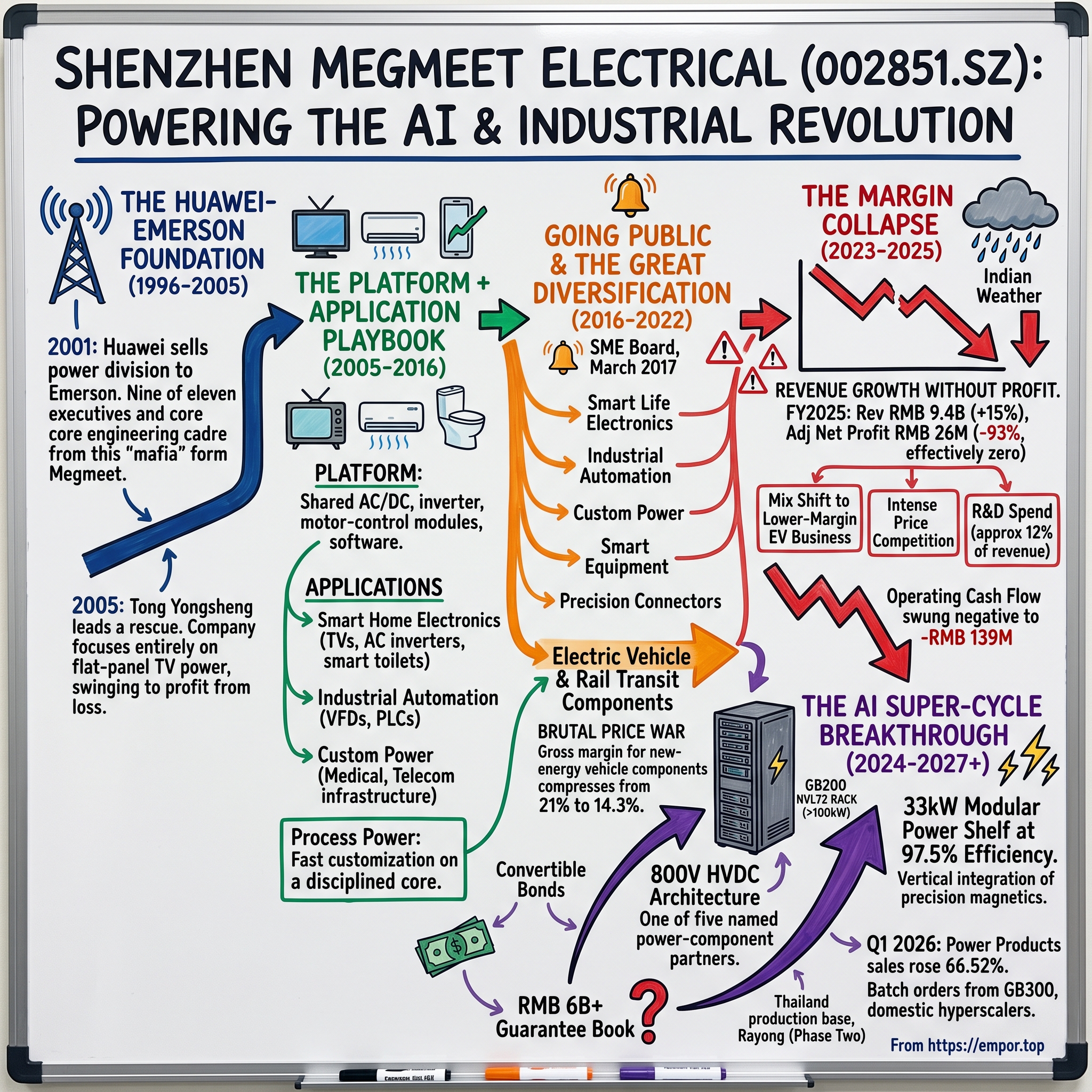
Shenzhen Megmeet Electrical: The Power Behind the AI & Industrial Revolution
I. Introduction & Episode Roadmap
On October 15, 2024, in a convention hall in San Jose, California, 英伟达 NVIDIA unveiled the engineering guts of its GB200 NVL72 rack at the Open Compute Project Global Summit. Buried in the accompanying materials was a list — more than forty component suppliers whose parts would go inside the most consequential computing machine of the decade. Most of the names were the usual suspects: American, Taiwanese, Japanese. But among the three companies named to supply the power shelves — the metal drawers that swallow grid electricity and feed the GPUs — sat a firm almost no Western investor had heard of: 深圳市麦格米特电气股份有限公司 Shenzhen Megmeet Electrical Co., Ltd., listed in Shenzhen under the ticker 002851.SZ.1
Two days later, on the evening of October 17, 2024, Megmeet formally confirmed the relationship in an exchange filing. The stock did what Chinese A-shares do when a small-cap gets attached to the world's most valuable company: it locked limit-up, four sessions in a row.1 Within three months the shares had more than doubled. By June 2026, the stock had risen roughly 560% from its early-2024 level of around RMB 24 to more than RMB 160, a move that briefly made a Shenzhen power-supply manufacturer one of the most expensive industrial stocks in China.2
Here is the uncomfortable part, and the reason this story is worth two hours of your attention. Over the exact period in which the share price rose fivefold, Megmeet's profits collapsed. Revenue did grow — from RMB 6.754 billion in 2023 to RMB 8.172 billion in 2024 to RMB 9.403 billion in 2025.23 But net profit attributable to shareholders fell from RMB 625 million in 2023 to RMB 459 million in 2024 to just RMB 146 million in 2025, a 66.58% decline. Strip out non-recurring items and 2025 profit was RMB 26 million — down 92.96%, effectively zero.45 Operating cash flow swung negative, to minus RMB 139 million.4
So the central question of this episode is not "is Megmeet in NVIDIA's supply chain?" It demonstrably is. The question is whether a company whose economics are currently being destroyed by its own ambition is building a franchise or burning one.
The thesis under examination. Megmeet's management has spent twenty years arguing that power electronics is a horizontal discipline — that the physics of turning messy alternating current into clean, dense direct current is the same whether the load is a television, a variable-frequency air conditioner, a rail traction system, or a 120-kilowatt AI rack. Build the underlying hardware and control-software platforms once, the argument goes, and you can redeploy them into whatever industry the economy happens to be growing next. The company calls this 硬件平台 + 定制化应用 — "hardware platform plus customized application." Whether that is a genuine structural advantage or a rationalization for running six business lines at once is precisely what a sceptical investor has to decide.
There is a version of this story that is pure promotion: Chinese engineering champion breaks into the most exclusive supply chain in technology. There is an equally available version that is pure cynicism: mid-cap industrial company attaches itself to a hot narrative, issues equity into the enthusiasm, and hopes the fundamentals catch up. Neither is quite right, and the interesting work is in the space between them.
What makes Megmeet unusually instructive is that both versions draw on the same set of verified facts. The company really is on NVIDIA's published partner list. Its earnings really did fall by two-thirds. It really has been reinvesting at a rate that would look aggressive for a semiconductor designer, let alone a component manufacturer. And it really did raise money twice in seven months during its weakest operating year in nearly a decade. An investor's job here is not to pick a narrative but to work out which mechanism is doing the most work in the numbers.
The roadmap. We will work through five questions.
First, the lineage: how 任正非 Ren Zhengfei's decision to sell Huawei's power division to 艾默生电气 Emerson Electric in 2001 accidentally seeded an entire generation of Chinese power-electronics companies — and why nine of Megmeet's eleven early executives came out of that single institution.1
Second, the turnaround: how 童永胜 Tong Yongsheng, the man who negotiated that sale from Huawei's side, walked away from a multinational vice-presidency to rescue a tiny startup that had lost roughly RMB 3 million and had no obvious reason to exist.6
Third, the diversification and its bill: post-listing expansion into electric-vehicle components, industrial automation, precision connectors and smart equipment, and what it did to margins.
Fourth, the AI inflection: whether being one of five named power-component partners in NVIDIA's 800-volt direct-current architecture is a durable position or a temporary seat that Delta and Lite-On can take back.
Fifth, the verdict-free stress test: what a hostile investor would attack — the negative operating cash flow, the RMB 6 billion-plus guarantee book, the simultaneous private placement and Hong Kong listing, the 17% of revenue riding on Indian air-conditioner weather.27
One framing device will help throughout. Megmeet has spent its entire existence selling the same physics into different industries. The physics has never been the variable. The variable has always been who the customer is — how many alternatives they have, how long qualification takes, and whether they can renegotiate price every twelve months.
Hold that lens over each chapter and the company's financial history stops looking erratic and starts looking almost mechanical. Every period in which Megmeet sold into fragmented, qualification-heavy markets produced good margins. Every period in which it sold into consolidated, price-driven markets produced volume without profit. The AI opportunity is interesting precisely because it appears — for now — to be the first kind of market.
Let's begin where every Chinese power-electronics story begins: with a winter, and a sale.
 Subscribe on LinkedIn
II. The "Huawei-Emerson Mafia" & Power Electronics Foundations (1996–2005)
In 2000 and 2001, the global telecom equipment market fell off a cliff. Ren Zhengfei, who had spent the late 1990s building 华为 Huawei into a national champion, wrote an internal essay that became famous inside Chinese industry — an argument that the company had to prepare for a long winter and that survival, not growth, was the objective. What he did next was the corporate equivalent of selling the family silver to buy firewood.
Huawei had built a subsidiary, 深圳市华为电气技术有限公司 Huawei Electric — later renamed 安圣电气 Avansys — to make the rectifiers, converters and backup power systems that keep telecom base stations alive. It was good. It was arguably the best power-electronics engineering organization in China. And in 2001, Ren sold it to Emerson Electric of St. Louis for $750 million in cash.6
It is worth sitting with how strange that transaction was at the time. Huawei was not in distress. The unit was not a failing appendage. Ren was selling a healthy business at the top of a cycle to fund the core business through a downturn he correctly predicted. For a Chinese company in 2001, taking three-quarters of a billion American dollars for a division most of the world had never heard of was, in hindsight, one of the better capital-allocation decisions of the era.
The man who ran the deal from the Huawei side was Tong Yongsheng. He had joined Huawei Electric in the 1990s as an ordinary engineer, holding a doctorate and postdoctoral training in power electronics, and had risen to vice president with unusual speed.6 After the sale, he crossed over with the asset, becoming a vice president of what became Emerson Network Power and taking responsibility for overseas operations.6
What Emerson actually taught. It is tempting to describe the Emerson years as a simple technology transfer, but that undersells what changed. Huawei's engineering culture in the late 1990s was fast, improvisational and extraordinarily hard-working — a culture optimized for winning a domestic market against slower state-owned incumbents. What it did not have was the apparatus that a global industrial company builds over a century: formal design reviews with authority to stop a program, statistical process control on the production line, failure-mode analysis performed before rather than after a field return, supplier qualification protocols, and the documentation discipline that lets a design survive the departure of the person who created it.
Emerson brought all of that, and it brought it to engineers who were young enough to absorb it and good enough to see why it mattered. The specific inheritance that shows up in Megmeet's business today is not a circuit topology. It is the willingness to spend eighteen months qualifying a medical power supply for a customer who buys ten thousand units a year, because the discipline required to pass that audit is transferable to every other product the company makes. That is a cultural asset, and cultural assets are the ones that survive competitive attack longest — precisely because a competitor cannot buy them.
The dispersal. What happened next was the accident that made modern Shenzhen. Emerson bought a company; it also bought several hundred of China's best-trained power engineers, and gave them four or five years of exposure to something they had never seen: a Fortune 500 industrial company's quality systems, design-for-manufacturing discipline, and international reliability standards. Then, one by one, they left.
The alumni network that walked out of Avansys and Emerson Network Power founded or led a striking proportion of China's industrial-automation and power-electronics sector. 汇川技术 Inovance Technology — today the dominant domestic force in servo drives and industrial motion control, and a company that would later become one of Megmeet's most direct competitors — came out of the same building. So did a long tail of drive, inverter and power-supply firms clustered in Shenzhen's Nanshan and Bao'an districts. Chinese industry writers have a name for this cohort: the 华为-艾默生创业帮, the Huawei-Emerson entrepreneurial mafia.
Why does a lineage matter to an investor twenty-five years later? Because power electronics is one of the few remaining hardware disciplines where tacit knowledge dominates. The equations for a switching converter are in textbooks. What is not in textbooks is why a particular transformer winding geometry produces acoustic noise at a particular load, how to keep a 97%-efficient converter stable across temperature and line variation, and what a customer's qualification lab will actually test. That knowledge lives in engineers' heads and moves when they move. An organization that inherits fifty such people starts a decade ahead of one that hires fifty fresh graduates.
The unpromising beginning. Megmeet itself was not founded by Tong. In 2003, 张志 Zhang Zhi — a former colleague from Huawei Electric — went to Tong for advice about what business to start. Tong suggested he look at televisions. Flat panels were coming; every one of them would need a power board. Zhang and a small group put up RMB 500,000 and incorporated the company. Tong even supplied the name: MEGMEET, chosen on the reasoning that foreigners would find it easy to pronounce — a small detail that says something about the ambition embedded from day one.6
For two years it went badly. The company scattered its limited engineering across too many product ideas, had no manufacturing scale, and by early 2005 had accumulated losses of roughly RMB 3 million — a trivial sum in absolute terms and a fatal one relative to RMB 500,000 of paid-in capital.6 Zhang went back to Tong, this time not for advice.
April 2005. Tong was, as it happened, restless at Emerson. Running overseas operations for a multinational's network-power division is a good job; it is not the same as owning the outcome. He resigned, put RMB 2.6 million of his own money into the failing startup, and took the roles of chairman and general manager.6 By the end of that same year, the company had swung to a profit of more than RMB 3 million, on the back of a decision to concentrate almost everything on flat-panel television power supplies.6
Two details about Tong's decision are worth noting, because they shaped everything afterwards.
The first is that he did not arrive as a hired manager. He arrived as an investor who had put his own money at risk, which changed the equity structure and gave him the standing to restructure it. Chinese startups of that era frequently died of founder disputes rather than product failure; Megmeet's early re-architecture of ownership around a single decision-maker with technical authority removed a common failure mode before it could occur.
The second is that he arrived with a specific view about what the company should be, formed by watching Emerson from the inside. He had seen what a disciplined multinational could do with a shared engineering base and what it could not do — namely, move fast on customized work for mid-sized customers. The strategy he imposed was, in effect, an attempt to combine Emerson's process with Huawei's speed. Nine of the eleven executives who staffed that attempt came from the same Huawei Electric-Emerson background.1
That reversal — from near-death to profit inside eight months — is the founding myth, and like most founding myths it compresses something more interesting. The turnaround was not a product breakthrough. It was a decision to stop doing five things and do one. That instinct, and the later, gradual abandonment of it, is the tension that runs through the rest of this story.
One more thing about that first product choice deserves emphasis, because it was strategically better than it looked. Television power supplies were a commodity, but they were a commodity produced in enormous volume with punishing cost targets and a new form factor every year. A company that survives in that environment learns, involuntarily, to design cheaply and iterate quickly.
Megmeet did not stay in televisions. What it kept was the metabolism that market forced on it — and it later applied that metabolism to markets where the customers were not nearly so demanding about cost and were far more demanding about everything else.
By 2005 the raw materials were in place: a cadre of Huawei-Emerson engineers, a leader who had seen both a Chinese hypergrowth culture and an American process culture from the inside, and a single profitable product. The next eleven years were about turning one product into a method.
III. The Rescuer & The "Platform + Application" Playbook (2005–2016)
Here is the problem with being a Chinese television power-supply supplier in 2006. Your customer is a consumer-electronics brand under permanent price deflation. Your product is a board. Every year the brand demands a lower price and a new form factor. The moment you build a dedicated team for that customer, you have created a fixed cost that only that customer can pay for — and that customer knows it.
Tong's answer, developed over the following decade, was to refuse to organize the company around customers at all, and to organize it around physics instead.
What "platform plus application" actually means. Strip away the corporate language and a switching power supply does one thing: it chops electricity into very fast pulses, pushes those pulses through a magnetic component, and reassembles them into a smooth output at a different voltage. The engineering variables are always the same four. How fast do you switch — higher frequency means smaller magnetics but more losses and more electromagnetic noise. How do you get the heat out. How efficient is the magnetic path. And what does the digital controller do to keep everything stable when the load or the input jumps around.
Those four problems are essentially identical whether the output feeds a television backlight, a compressor motor in an air conditioner, an X-ray tube, or a rack of accelerators. The application-specific part — the connector, the enclosure, the communication protocol, the safety certification, the customer's particular tolerance requirements — sits on top and is genuinely different every time.
So Megmeet built the bottom layer once. Shared AC/DC conversion topologies. Shared inverter and motor-control modules. A common digital-control software stack running on DSP and, later, FPGA silicon. Then it wrapped thin, fast application teams around that core, one per vertical.
The economics, in plain terms. Three things happen when you do this. First, the non-recurring engineering cost of a new custom design collapses, because 70-80% of the design already exists and has already been through qualification. Second, development cycles shorten — the company's own account has custom programs compressing from something like a year to a single quarter, which in a business where customers launch annual product refreshes is the difference between winning a socket and missing the window. Third, and least discussed, you concentrate purchasing. If every division's converter uses the same family of MOSFETs, diodes and controllers, you buy them in one order rather than six, and a mid-sized Chinese firm suddenly negotiates with 英飞凌 Infineon and STMicroelectronics like a large one.
There is a fourth effect that cuts the other way, and it matters later: a shared platform makes it very cheap to say yes to a new vertical. The marginal cost of entering an adjacent market looks small when the core already exists. That is a feature when the adjacency is real and a trap when it is not.
An analogy worth holding on to. Think of a restaurant group. The amateur version opens an Italian place, then a sushi place, then a steakhouse, and runs three separate kitchens, three supply chains and three chefs. The professional version builds one commissary that produces stocks, sauces and prepped ingredients, and then opens restaurants that draw from it. The second model can open a new concept in weeks rather than years, and its purchasing power grows with every location. But — and this is the part the analogy makes obvious — the commissary does not make a bad restaurant location profitable. It only makes opening one cheap.
Megmeet built the commissary. Whether it consistently picked good locations is the question that dominates the second half of this story.
Where the platform went. Through the decade to 2016, Megmeet pushed the same core into a widening set of end markets.
In smart living electronics, the company moved from television power boards into the control electronics of variable-frequency air conditioners and refrigerators — a much better business, because inverter control is where the appliance's efficiency rating is won and therefore where the brand cannot easily switch suppliers on price alone. It also, unglamorously and very profitably, became a leading supplier of the electronic controls inside smart toilets, a category that grew explosively across Asia.
In industrial automation, it entered variable-frequency drives, programmable logic controllers, and industrial microwave power units. This meant attacking the mid-market held by 西门子 Siemens, 安川電機 Yaskawa and 三菱電機 Mitsubishi Electric — not by matching their top-end performance but by delivering adequate performance at Chinese cost with local application support.
In custom power, it built high-reliability supplies for telecom infrastructure, medical imaging equipment and industrial printers. This is the segment that mattered most in retrospect. Medical and telecom power qualification is slow, painful and expensive — which is exactly why the resulting relationships last, and why an engineering organization that survives those audits accumulates a reliability track record it can point to elsewhere. Two decades later, that track record was the credential Megmeet presented to NVIDIA.
The smart toilet, seriously. It is worth dwelling for a moment on the sanitary-ware business, because it illustrates the platform logic better than the glamorous segments do. A premium electronic bidet seat contains a heating element, a pump, a fan, a seat sensor, a control board and a user interface — which is to say, a small power supply, a motor controller and an embedded system, wrapped in a ceramic fixture. There is almost nothing in it that Megmeet was not already building for air conditioners. Yet the category grew at rates the appliance market never saw, the customers were fragmented enough that no single one could dictate price, and the product had a safety and reliability profile that rewarded a supplier with formal qualification discipline. Megmeet told the Shenzhen exchange years later that its smart bathroom electrical control systems ranked among industry leaders.7
This is what a good adjacency looks like: same core technology, different customer structure, better pricing environment. Compare it with the electric-vehicle business the company would enter a few years later — same core technology, but a customer structure in which a handful of enormous buyers face dozens of qualified suppliers. The technology was equally transferable in both cases. The outcomes were not remotely similar, and the difference had nothing to do with engineering.
The tell in the spending. Throughout this period Megmeet reinvested at a rate that looked excessive for a component supplier — high single-digit to low double-digit percentages of sales going into R&D, funded almost entirely from operating cash rather than external capital, with engineering centres established across Shenzhen, Zhuhai, Hangzhou and Xi'an. By 2025 the R&D organization had reached 3,090 people, roughly 35% of total headcount, with 442 holding advanced degrees.4
What should an investor take from the 2005-2016 stretch? Mainly this: the platform strategy was validated in a low-stakes environment. Redeploying an AC/DC platform from televisions to air conditioners is real engineering leverage, but both markets are high-volume, low-mix, cost-driven and forgiving of a two-week slip. The strategy had not yet been tested against a market where the customer is a hyperscaler, the qualification bar is brutal, and the competitor is a $30 billion Taiwanese incumbent. That test was coming — but first, the company needed public money.
IV. Going Public & The Great Diversification (2016–2022)
Megmeet listed on the 深圳证券交易所 Shenzhen Stock Exchange SME board on March 6, 2017, selling 44.5 million shares at RMB 12.00 each.8 By the standards of what came later it was a small event — a profitable, unfashionable industrial company raising a modest sum in a market obsessed with property and consumer internet.
What the listing changed was not the balance sheet so much as the option set. A private company funding R&D out of cash flow must choose between opportunities. A listed company with a currency and access to convertible bonds can attempt several at once. Megmeet attempted several at once.
The electric-vehicle bet. The obvious adjacency in 2017 was the vehicle. An electric car is, from a component perspective, an unusually pure power-electronics problem: a traction inverter that turns battery DC into three-phase AC for the motor, an on-board charger that turns grid AC into battery DC, and a DC/DC converter that steps the high-voltage pack down to run the 12-volt systems. Megmeet already had inverters, chargers and converters. The platform logic said: go.
So it went — into motor controllers, on-board chargers and DC/DC converters for passenger cars and commercial vehicles, and into rail-transit power components as a slower-moving, higher-reliability sibling business.
The strategic logic was impeccable. The economics were not. China's electric-vehicle market between 2020 and 2022 became the most brutal industrial price war of the modern era. Original equipment manufacturers fighting for volume passed every rupee and yuan of pressure down the supply chain, and component suppliers who had won sockets on the promise of volume discovered that volume had been priced in advance. Megmeet later disclosed the arithmetic in unusually candid terms: the gross margin on its new-energy vehicle components compressed from roughly 21% to 14.3%.3 That is not a cyclical wobble. That is a structurally worse business than the one the company came from.
On acquisitions — the dog that didn't bark. It is worth pausing on what Megmeet did not do, because in Chinese mid-cap industrials of this era the standard playbook was to buy growth. A generation of A-share companies used their listing currency to acquire European and Japanese niche manufacturers at high multiples, booked enormous goodwill, and then spent 2019-2022 writing it back down. Megmeet largely abstained. Expansion came through organic incubation, small bolt-ons and targeted joint ventures — precision magnetic components, medical power subsidiaries, connector operations — rather than transformative deals.
The result is a balance sheet with no goodwill bomb, which is genuinely worth something. But the honest reading is more ambiguous than a straightforward compliment. Megmeet avoided the acquisition trap and walked into a different one: it built the same sprawl internally, at slower speed and with its own engineers' time as the currency. Diversification funded by R&D expense is still diversification. It simply shows up in the income statement instead of the intangibles line.
The rail-transit sibling. Alongside the vehicle push, Megmeet built a rail-transit components business, and the contrast is instructive. Rail traction and auxiliary power is technically harder than automotive — the voltages are higher, the duty cycles longer, the certification regimes more onerous, and the equipment is expected to run for thirty years rather than eight. It is also a market with far fewer qualified suppliers, longer contracts and customers who cannot switch on an annual price negotiation. It grew more slowly. It also did not destroy margin. When management later disclosed that its rail products carried gross margins above comparable listed peers, the reason was structural rather than clever.7
The pattern is consistent across Megmeet's history: the businesses where qualification is painful are the businesses where the returns are good. That is not a coincidence, and it is arguably the single most useful lens for evaluating what the company does next.
Six businesses. By 2022 the company was running six distinct lines: smart home appliance controls, power products, new energy and rail transit components, industrial automation, smart equipment, and precision connectors.4 Revenue that year was RMB 5.478 billion.7 The top line was compounding at roughly 21% a year — an impressive number for an industrial company, and one that Megmeet's management would later cite when asked why profits weren't following.7
They weren't following because the mix was deteriorating. The 2016-2022 diversification loaded the revenue base with two categories of business — electric-vehicle components and commodity appliance controls — where the customer holds the pricing power and the supplier holds the inventory. Copper and semiconductor input costs rose. Chinese OEMs cut prices. And the platform advantage that had made entry cheap did nothing at all to make the resulting business profitable, because a shared converter design does not give you leverage over a customer who has three other qualified sources.
The convertible-bond era. One further capital-markets detail belongs here, because it echoes later. Post-listing, Megmeet made repeated use of convertible bonds — instruments that raise money cheaply on the promise of future equity, and that convert into shares when the stock performs. The most visible consequence appeared years afterwards, when conversion of the "麦米转2" issue contributed to the dilution of the founder's stake.15 Convertible financing is entirely standard for A-share industrials, and it is materially cheaper than straight equity at the point of issuance. It is also a way of running a capital-hungry expansion without confronting shareholders with a dilution decision until the dilution has already occurred.
None of this was hidden or improper. It is simply worth registering that Megmeet's expansion from 2017 onward was financed by a steady drip of external capital rather than by the operating cash flow that had funded the first decade — and that the composition of that financing has grown more equity-like over time.
This is the most important analytical point in the middle of Megmeet's story, and it generalizes beyond this company. Platform economics reduce your cost of entering a market. They say nothing about the structure of the market you enter. A firm with genuine engineering leverage and no discipline about which doors to walk through will convert that leverage into revenue rather than into profit — which is very close to a description of what Megmeet's income statement did over the following three years.
The company was about to find out whether the same platform could open a door where the economics were better.
V. Segment Economics & Financial Anatomy: The RMB 8B Engine (2023–2024)
If you want to understand what happened to Megmeet, the cleanest way in is to line up three years of results and notice that two of the three lines move in opposite directions.
Revenue: RMB 6.754 billion in 2023, RMB 8.172 billion in 2024, RMB 9.403 billion in 2025 — compound growth around 18%.2 Net profit attributable to shareholders: RMB 625 million, then RMB 459 million, then RMB 146 million.24 In 2024 alone, profit fell 26.62% while revenue rose 21%.7 In 2025 it fell 66.58% while revenue rose 15.05%.4 The fourth quarter of 2025 produced an outright net loss of RMB 67 million.2
The stripped-out number is worse and more revealing. Non-recurring-adjusted profit fell from RMB 366 million in 2024 to RMB 26 million in 2025 — a 92.96% decline.74 The gap between reported and adjusted profit tells you that what little earnings survived in 2025 came substantially from items outside the operating business. On an operating basis, a company doing RMB 9.4 billion of revenue made almost nothing.
Where the money actually comes from. The FY2025 segment disclosure is the map:4
Smart home appliance controls remained the largest business at RMB 3.559 billion, but it shrank 4.79% — the only declining segment. Power products, which includes communications and data-centre supplies, medical power, industrial DIN-rail power, photovoltaic and storage components and LED display power, reached RMB 2.680 billion, up 13.88%, or 28.5% of the company.9 New energy and rail transit components more than doubled to RMB 1.145 billion, up 108.65%. Industrial automation grew 39.85% to RMB 877 million. Smart equipment grew 30.89% to RMB 605 million. Precision connectors grew 17.85% to RMB 449 million.4
Read that list twice and the profit collapse explains itself. The one segment that shrank was the largest and one of the more profitable. The segment that grew fastest — more than doubling — was new-energy vehicle components, the one with margins in the mid-teens. Megmeet did not have a demand problem in 2025. It had a mix problem, and it engineered the mix problem itself by pushing hardest into its worst business.
The three costs of the transition. Management, pressed by the Shenzhen exchange in a formal inquiry letter answered in November 2025, laid out three drivers of "revenue growth without profit growth."7
The first was research spending. R&D expense grew at an average 24.4% a year over the period, reaching RMB 984 million in 2024 — an R&D intensity of 12.04%, against roughly 8% for comparable listed peers — and RMB 1.122 billion in 2025, or 11.94% of revenue.74 Megmeet was, in effect, running a company with the cost structure of a semiconductor designer and the revenue mix of a contract manufacturer.
The second was price competition. Blended gross margin, which had climbed steadily from 23.57% in 2022 to 24.54% in 2023 to 25.07% in 2024, fell to 22.29% in 2025.710 The appliance-control and vehicle-component markets both entered aggressive price cycles simultaneously.
The third was the weather in India — which requires explanation, because it is the most underappreciated fact about this company. Overseas revenue reached RMB 2.667 billion in 2024, or 32.88% of the total, and rose to 38.50% in the first nine months of 2025.7 India was by far the largest overseas market, contributing 68.68% of foreign revenue in 2024 — meaning something close to a fifth to a sixth of the entire company, sold largely into Indian air-conditioner and smart-bathroom manufacturers including Voltas and Havells.72 United States exposure, by contrast, was 2.51% of 2024 revenue.7 So when an unusually mild Indian summer suppressed air-conditioner demand, a Shenzhen power-electronics company missed its numbers.
That is a genuinely useful thing for an investor to know, and it complicates the tidy narrative. Megmeet is often discussed as an AI-infrastructure stock. In 2025 it was, in cash-flow terms, closer to a leveraged bet on Indian summer temperatures and Chinese appliance pricing, with an AI option attached.
Myth versus reality, briefly. Three consensus statements about Megmeet deserve correction at this point in the story.
Myth: Megmeet is an AI power company. Reality: in 2025, power products of all kinds — telecom rectifiers, medical supplies, DIN-rail industrial power, photovoltaic and storage components, LED display power, and data-centre supplies — together made up 28.5% of revenue, and data-centre power was a small fraction of that.9 The company that reported those results was, overwhelmingly, an appliance-controls and industrial-components manufacturer.
Myth: the profit collapse was caused by AI investment. Reality: R&D grew 14.05% in 2025 while profit fell 66.58%.4 Rising research spending contributed, but the larger movers were a 4.79% decline in the biggest and better-margin segment, a doubling of the worst-margin segment, and blended gross margin falling nearly three points.410 Mix and price did more damage than investment did.
Myth: management over-promised on the NVIDIA relationship. Reality: the record shows the opposite. The company told investors through 2025 that most requirements were still in R&D and testing and that revenue impact would not be material that year.10 The over-promising, such as it was, happened in the market rather than in the filings.
Distinguishing these matters because they imply different recovery paths. An investment-driven margin trough self-corrects when the investment matures. A mix-driven trough only corrects if the mix changes — which requires the smaller, better business to outgrow the larger, worse one for several consecutive years.
The cash statement. Operating cash flow turned negative in 2025, at minus RMB 139 million, a 201% swing from the prior year.4 Investing outflows ran to RMB 872 million and financing inflows to RMB 554 million.4 Accounts receivable at the nine-month mark stood at RMB 2.479 billion, up 7.99%.10 A business that grows revenue 15%, spends 12% of sales on R&D, builds factories in two countries, and produces no operating cash is by definition financing its growth externally. That is not automatically wrong. It is, however, exactly the pattern that requires management to be right about the payoff.
A note on customers. The Shenzhen exchange response also disclosed the shape of the customer base, and it is more reassuring than the margin trajectory would suggest. Named relationships include Panasonic, Philips and 吉利汽车 Geely — the kind of blue-chip roster that only accumulates through successful multi-year qualification.7 The top five overseas customers accounted for 47.41% of overseas sales, which management characterized as reasonable concentration.7
Read carefully, that figure cuts both ways. Roughly half of a business that represents nearly two-fifths of the company sits with five buyers. In a segment where the customer holds pricing power — Indian and Southeast Asian appliance brands — that is a genuine vulnerability, and the 2025 revenue decline in appliance controls is what it looks like when those buyers pull back simultaneously for a shared reason.
The counter-argument is that concentration among qualified customers is different from concentration among commodity customers. A brand that has certified a supplier's control board across a product line does not switch casually; it switches when the price gap becomes large enough to justify a re-qualification programme. Megmeet's appliance business declined by 4.79% rather than collapsing, which is consistent with pricing pressure rather than displacement.4
Which brings us to what the money was being spent on.
VI. The AI Super-Cycle: Breakthrough in 800V HVDC & NVIDIA GB200 Power Shelves
Start with the physical problem, because it is the whole story and it is not complicated.
A traditional cloud server rack draws maybe 10 to 20 kilowatts. An NVIDIA GB200 NVL72 rack — seventy-two Blackwell GPUs wired into a single coherent machine — draws well north of 100 kilowatts, and the architectures now on the roadmap are designed for racks of 1 megawatt and beyond.11 That is roughly the electrical load of a small apartment building, delivered into a cabinet the size of a wardrobe.
Now the physics. Power equals voltage times current. If you deliver a megawatt at the traditional rack-level voltage of 54 volts, you need current in the tens of thousands of amps. Copper resists current, and the heat generated rises with the square of the current — double the amps and you quadruple the wasted heat. The only way to carry that much current is to use enormous amounts of copper. NVIDIA's own engineering documentation puts it at up to 200 kilograms of copper busbar per megawatt rack; a gigawatt-scale facility would need 200,000 kilograms.11 At some point you are no longer building a data centre, you are building a copper mine with servers attached.
The fix is the same one the electricity grid figured out in the 1890s: raise the voltage, drop the current. NVIDIA's answer is an 800-volt DC architecture, converting grid alternating current directly to high-voltage DC at the facility perimeter and distributing it at 800 volts, eliminating the redundant conversion stages that a conventional design stacks up. The company claims the change improves end-to-end efficiency by up to 5% while collapsing copper requirements.11 Five percent of a gigawatt is 50 megawatts — an entire mid-sized data centre's worth of power, recovered from wiring.
The power shelf. In the intermediate architecture already shipping, the conversion happens in a power shelf: a rack-mounted drawer full of high-density AC/DC modules that feeds a common DC bus to the compute and switch trays above and below it. A GB200 NVL72 or GB300 NVL72 rack carries up to eight of them. This is where Megmeet enters.
The product Megmeet described for the MGX platform was a 1U modular solution: six power modules of 5,500 watts each, delivering 33 kilowatts total at 97.5% efficiency.1 Two of those numbers deserve emphasis. 33 kilowatts out of a single rack unit is a power density that would have been considered implausible a decade ago. And 97.5% efficiency means that of every 1,000 watts entering the shelf, 25 are lost as heat — a figure that separates companies that can do this from companies that cannot, because the last percentage point of efficiency is where the magnetics design, the switching topology and the control loop all have to be right simultaneously.
Why this is genuinely hard. A reasonable sceptic asks: it's a power supply, how difficult can it be? The answer is that at this density, three constraints fight each other and there is very little room left between them.
The first is heat. A 5,500-watt module losing 2.5% of its throughput is dissipating roughly 140 watts inside a package a few centimetres thick, with air moving through it at high velocity and a noise budget the customer specifies. Every watt of loss you fail to eliminate has to be removed mechanically, and mechanical removal costs volume you do not have.
The second is the magnetics. The transformer and inductor set the size of the module, and shrinking them means switching faster, which increases losses in the semiconductors and generates electromagnetic interference that the customer's compliance lab will find. Designing the magnetic component and the switching topology together — rather than buying a transformer from a catalogue and designing around it — is one of the few remaining places where vertical integration produces a measurable performance advantage rather than just a cost advantage.
The third is that the whole thing has to be boring. A hyperscaler is installing tens of thousands of these units in facilities where a failure takes an entire multi-million-dollar rack offline. The qualification programme is therefore closer to aerospace than to consumer electronics, and the supplier's field-failure history over prior products is part of the evaluation. This is exactly the credential a company accumulates by spending twenty years doing medical and telecom power, and exactly the credential a newly-motivated entrant cannot manufacture quickly.
Named, then named again. Megmeet's inclusion among the forty-plus GB200 component suppliers in October 2024 was the first signal.1 The more meaningful confirmation came later: in NVIDIA's published 800 VDC ecosystem, Megmeet appears in the "power system components" partner category alongside Delta, Flex Power, Lead Wealth and LiteOn — the only mainland Chinese firm on that list — while the silicon layer is populated by Analog Devices, Infineon, Innoscience, MPS, Navitas, onsemi, Renesas, ROHM, STMicroelectronics and Texas Instruments, and the facility-level layer by Eaton, Schneider Electric and Vertiv.11
Why Megmeet got the seat. Three explanations hold up under scrutiny. The heritage argument is real: telecom rectifier design is the closest existing analogue to data-centre power, and Megmeet's engineering core has been doing it since Avansys. The vertical-integration argument is also real: the company designs and manufactures its own precision magnetic components, and in a power shelf the transformer and inductor are the density bottleneck — outsourcing them means designing around someone else's constraints. The third argument is the one management makes most often and the one that fits the counter-positioning story: speed on custom work. A supplier willing to iterate a bespoke 33-kilowatt shelf on a hyperscaler's timeline is doing something structurally different from a supplier optimized for million-unit standardized runs.
Now the discipline. Being on a list is not revenue. In the third quarter of 2025, more than a year after the announcement, management was still telling investors that most customer requirements remained in R&D and testing, that only small-batch orders had been received, and that there would be no material impact on 2025 results.10 That is a straightforward admission, and it is consistent with the reported numbers: power products grew 13.88% for the full year — respectable, but nowhere near what a genuine AI ramp looks like.9
The turn showed up in the first quarter of 2026. Revenue reached RMB 2.788 billion, up 20.35%, and power products sales rose 66.52% to RMB 817 million.122 On the April 2026 investor call, management drew a clean generational distinction: first-generation GB200 power supplies produced limited order volume; GB300 achieved batch orders that showed up in Q1; and the next-generation Vera Rubin platform remained in testing with North American cloud providers.2 The company also disclosed that it had entered the supply chains of 字节跳动 ByteDance, 阿里巴巴 Alibaba and 腾讯 Tencent domestically.12
But the same quarter showed the other half of the picture. Net profit rose only 6.93% to RMB 115 million, and adjusted profit fell 56.23%, driven substantially by US dollar and Indian rupee currency movements.122 Revenue up a fifth, power products up two-thirds, and the earnings line barely moved.
Two honest caveats. First, timing. Full-scale 800 VDC production is tied to NVIDIA's Kyber rack systems in 2027, not 2026.11 Independent Chinese analysis of Megmeet's own capital plans concluded that high-voltage module volume waits until late 2026 or 2027, with the industry inflection arriving when megawatt-class single-cabinet architectures land.13 An investor buying the AI story in 2026 is buying roughly two years of waiting.
Second, architecture risk. The industry has not settled on a winner. Conventional AC/DC pathways, the "Panama power" shelf format that Delta and Megmeet have both adopted, and solid-state transformers — widely regarded as the eventual endpoint but lacking standards, with only a handful of players attempting demonstrations — are all live.13 Megmeet has committed capital to one of three formats in a market that has not chosen.
And in January 2025, the market got a preview of how fragile a supply-chain position can feel. A rumour circulated that Lite-On had resolved quality issues and would resume large-scale supply, potentially compressing Megmeet's NVIDIA share. The stock touched limit-down intraday before closing off 4.19% at RMB 66.80 on turnover of RMB 3.659 billion. The company's response — that it was aware of the rumour, did not know its source, and that customer cooperation was proceeding normally — was accurate and completely unfalsifiable.14 That is the structural problem with a single-customer allocation story: the supplier cannot prove its position, and every rumour is unrebuttable.
Third, and most fundamental: nobody can reliably size this market yet. One Chinese analysis attempting the exercise used Delta's power-shelf pricing of RMB 4-5 per watt against roughly 47 gigawatts of global data-centre IT power growth over 2023-2026, of which some 40 gigawatts is AI-driven, and arrived at a three-year replacement opportunity somewhere in the range of RMB 16-20 billion — under RMB 7 billion a year, split among at least five named suppliers.13 That is a real market. It is not, on those assumptions, a market that transforms a RMB 9.4 billion revenue company by itself. Investors should treat any confident total-addressable-market figure for rack-level HVDC in 2026 with suspicion, including that one.
Geographic hedging. Megmeet's production bases in Rayong Province, Thailand and in Hangzhou commenced operation in 2024 — the Thai facility serving Southeast Asia and Europe, and functioning as the non-mainland manufacturing option that Western customers increasingly require.27 Phase two of the Thai base is one of the two largest items in the company's recent capital programme, which signals genuine commitment rather than a nameplate presence.
But the strategic logic deserves scrutiny rather than acceptance. A Thai factory solves a tariff and country-of-origin problem. It does not by itself solve a customer-confidence problem, because the design authority, the supply chain for critical components, and the engineering organization all remain in China. Western hyperscalers evaluating supply-chain risk are increasingly interested in where the intellectual property and the sub-tier suppliers sit, not only where final assembly happens. Whether Rayong becomes the vehicle for direct Western hyperscaler business, or remains an appliance-and-Southeast-Asia plant with an AI label attached, is the open question — and the disclosure that would answer it is a geographic breakdown of overseas revenue that the company does not currently provide in that form.
VII. Playbook & Strategic Powers: Process Power, Counter-Positioning, & Capital Allocation
Let's war-game this properly, because the interesting question is not whether Megmeet has advantages — every surviving industrial company has some — but whether they are the kind that persist when a much larger competitor decides to contest them.
Applying Hamilton Helmer's framework. Of the seven powers, three are arguable here and four are not.
Process power is the strongest claim. The combination of the shared platform architecture, an integrated product development process inherited from the Huawei-Emerson lineage, and twenty years of accumulated design libraries is genuinely hard to copy, because it was accumulated rather than purchased. The evidence for it is indirect but real: the company told the Shenzhen exchange that its gross margins in appliance controls, new-energy vehicle components and rail transit exceed comparable listed peers, and specifically that its vehicle electrical-control modules run 5 to 8 percentage points above Inovance and INVT.7 Out-earning Inovance in a product category Inovance dominates is a meaningful data point — though it also invites the question of why blended margins are nonetheless falling, and the answer is mix, not per-product competitiveness.
Counter-positioning is the more elegant argument. Delta Electronics and Lite-On built their businesses on enormous, standardized production runs for tier-one IT OEMs. That model is superbly profitable at scale and structurally hostile to medium-volume, heavily customized work — the fixed cost of a bespoke program is only justified by a very large order. Megmeet built the opposite organization: one designed to take complex, medium-volume, highly customized industrial, medical and now AI applications. When rack-scale AI forced customization on a market that had been standardized for twenty years, Megmeet's shape suddenly fit.
The honest caveat: counter-positioning only holds if the incumbent cannot or will not respond. Delta held roughly 18% of the relevant market in 2024 and Lite-On around 12%, and both have every incentive to build customization capability now that customization is where the money is.2 Nothing about Megmeet's position prevents them from doing so — it merely means they have to reorganize to do it, and reorganizing a high-volume manufacturer is slow.
Cornered resource is the weakest of the three. The concentration of elite power-electronics talent is real, and 3,090 R&D staff with 442 advanced-degree holders is a substantial engineering asset.4 But engineers are not a cornered resource in the Helmer sense; they are hireable. What is closer to cornered is the combination of that talent with the design library and the qualification track record — which is really just process power described again.
There is no meaningful scale economy here (Delta is far larger), no network economy, no switching cost worth the name outside individual qualified sockets, and no branding power.
The competitive set, honestly assessed. It is worth naming who Megmeet actually fights, because the answer differs by segment and the company is in a materially different position in each.
Against Delta Electronics, Megmeet is a fraction of the size, with a fraction of the manufacturing footprint and a far shorter history in server power. Delta's advantages are scale, incumbency with every major ODM, and a components business that reaches deeper into the bill of materials. Megmeet's advantages are cost position, speed on customization, and — in the Chinese domestic market — the structural preference of 字节跳动 ByteDance, 阿里巴巴 Alibaba and 腾讯 Tencent for local suppliers.12 Against Lite-On, the gap is narrower but the same logic applies.
Against Inovance in industrial automation, the position reverses: Megmeet is the smaller, more specialized player attacking a domestic leader, and it competes by taking the applications that require customization rather than the volume sockets. Its own disclosure claims a 5-8 point margin advantage in vehicle electrical control against Inovance and INVT, which suggests the specialization is producing economics rather than just differentiation.7
Against Vertiv and the facility-level power incumbents, Megmeet is not really a competitor at all — it sits one layer down, inside the rack, while Vertiv sells the room. That distinction matters for anyone comparing valuations across the AI power complex, because the two businesses have different customers, different sales cycles and different margin structures despite being lumped together in the same thematic basket.
Porter, briefly, where it matters. Supplier power is moderate and directional: silicon carbide MOSFETs, gallium nitride devices and digital controllers come from a concentrated set of Western and Japanese suppliers, partially offset by Megmeet's internal magnetics. Buyer power is the crux — extreme in Chinese vehicle and appliance supply chains, where the customer has multiple qualified sources and negotiates annually, but materially lower in AI power, where a hyperscaler will pay for reliability and efficiency because a shelf failure takes a $3 million rack offline. Threat of substitutes is low in the useful sense: you cannot software-emulate the conversion of grid AC into clean DC. Competitive rivalry is severe on every front — Delta and Lite-On above, Inovance and Vertiv alongside, and a long tail of Chinese power-supply firms below.
The strategic read, then, is that Megmeet's advantages are real but concentrated in exactly one segment, and that segment was 28.5% of revenue in 2025.9 The other 71.5% operates in markets where the company has no structural defence and is competing on cost and responsiveness.
Management credibility — the behavioural audit. Tong Yongsheng, 62 as of 2026, remains chairman and controlling shareholder. After the effects of the 2025 share placement, convertible bond conversion and some share sales, he and his concert party held 23.20% as of February 5, 2026 — down from 28.68% — with Tong holding 98.66 million shares (16.97%) and 王平 Wang Ping 36.24 million (6.23%).15 He has bought as well as sold: between January and July 2024, before the NVIDIA announcement, he added roughly 1.577 million shares for about RMB 37.62 million.1 Buying ahead of the news is a positive signal about conviction; it is also the kind of timing that invites scrutiny, and investors should note the dilution direction of the overall stake.
On the disclosure question, the record is better than average. Management did not bury the 2025 collapse. When the Shenzhen exchange sent a formal inquiry letter, the November 2025 response was specific: it named R&D intensity, named the price wars, named the mix shift toward lower-margin vehicle components, and named Indian weather — and it quantified each.7 It also disclosed three outstanding lawsuits each exceeding RMB 10 million, stating minimal expected operational impact.7 That is more granular than many Chinese mid-caps offer under pressure, and it is the single strongest argument for taking management's forward statements seriously.
The narrative has also stayed consistent under temptation, which is rarer. Through a period when the stock quintupled on AI enthusiasm, the company repeatedly told investors that data-centre power was an emerging business with long introduction cycles and no material near-term revenue.710 A management team optimizing for the share price would have said something else. Megmeet's public statements have been, if anything, more conservative than its market capitalization.
There is a counterweight worth naming. Consistent conservatism in public statements sits alongside a decidedly unconservative balance-sheet posture — heavy capital commitments, two equity raises, an expanding guarantee book. A management team can be honest about the present and still be making an enormous, unhedged wager about the future. Credibility in disclosure is not the same as credibility in judgment, and investors should assess the two separately. On the first, Megmeet scores well. On the second, the evidence is not yet in.
It is also worth noting what has not happened: there has been no unexplained strategy reversal, no change of auditor under awkward circumstances, no restatement, and no pattern of quietly withdrawn targets. The company has been doing roughly the same thing, for roughly the same stated reasons, for two decades. That consistency is itself information — it makes the current capital programme more legible as an extension of a long-standing philosophy than as an opportunistic pivot into a hot theme.
Capital allocation — where the argument gets harder. In late 2025 Megmeet secured Shenzhen exchange approval for a private placement of up to RMB 2.663 billion.13 The allocation: RMB 828 million to phase two of the Changsha production centre, RMB 836 million to phase two of the Thailand base, RMB 188 million to an R&D centre and smart power test facility, RMB 178 million to the Zhuzhou base, and RMB 770 million to working capital.13 The total investment scale of those projects approaches the company's entire fixed asset base as of the third quarter of 2025.13
Then, on June 9, 2026, the board approved a plan to issue H-shares and list in Hong Kong, and the application was submitted to the exchange on June 26, 2026 with Huatai International and Citigroup as joint sponsors.162 Proceeds are earmarked for R&D, manufacturing expansion, global marketing and working capital.2
Set those two events side by side and a pattern emerges: a company with negative operating cash flow and near-zero adjusted earnings raising equity twice in seven months to fund capacity for a technology transition whose format is unsettled and whose volume inflection is at least a year away. Independent analysis of the placement projected a three-year construction period with full productivity requiring roughly eight years, and modelled full-capacity revenue of RMB 6 billion generating perhaps RMB 300-600 million of net profit.13 That is a defensible industrial return. It is not the return implied by the share price, and it takes the better part of a decade to arrive.
None of this is evidence of bad faith. It is evidence that Megmeet has chosen maximum aggression at the moment of maximum uncertainty — funding a build-out against an opportunity it cannot yet size, using shareholders' money, having just delivered its worst operating year since 2018. That is a legitimate strategy. It is also precisely the strategy that a sceptical investor should stress-test hardest.
VIII. Bull vs. Bear Case, Activist Stress Test, & Key KPIs to Watch
On July 20, 2026 — eight days before this was written — Megmeet's shares fell the daily 10% limit to RMB 122.93, taking the market capitalization to roughly RMB 71.9 billion on turnover of RMB 3.02 billion.17 The proximate triggers cited were three: the 2025 earnings deterioration, uncertainty around the H-share issuance and its dilution, and a guarantee book that had drawn attention. Nothing new had been announced. The market simply re-weighted facts it already had — which is a reasonable description of where this investment case sits.
The bull case, stated properly.
The first pillar is a genuine mix shift rather than a hoped-for one. Power products grew 66.52% in the first quarter of 2026 against a company average of 20.35%, and management attributed the acceleration specifically to GB300 batch orders.122 If that rate persists, the segment that carries the company's structural advantage becomes its largest within two to three years, and blended gross margin mechanically improves without anything else changing. One brokerage projected Megmeet's share of NVIDIA cabinet power could reach 10% or above in 2026, with batch deliveries underway.12
The second pillar is that the drag is finite. The appliance-control business that shrank 4.79% in 2025 was hit by an identifiable, non-structural event — Indian weather — layered on top of price competition.47 The vehicle business is margin-dilutive, but management has been explicit about pivoting toward commercial vehicles, overseas OEMs and higher-voltage silicon-carbide platforms where the pricing is better.
The third pillar is the option nobody prices correctly: 800 VDC is not a data-centre-only technology. If megawatt-scale DC distribution becomes the standard architecture for AI facilities, the same platform touches industrial power, grid-scale storage and charging infrastructure — markets where Megmeet already has products and customers.
The bear case, stated at equal strength.
The first and heaviest objection is that the AI position is real but not defensible. Megmeet is one of five named power-component partners, and the two largest hold a combined 30% of the market.112 Allocation among qualified suppliers is a decision NVIDIA and its ODM partners — Foxconn, Quanta, Wistron — make each generation, and the January 2025 rumour episode demonstrated how little visibility outsiders have into that decision.14 A yield problem or a schedule slip at the Thai plant is a re-allocation event, not a negotiation.
The second objection is that the core business is deflating faster than the new one is inflating. Blended gross margin fell 3.83 percentage points over the first nine months of 2025 and third-quarter margin ran at 21.31%.10 Q1 2026 showed both gross and net margins still falling year-on-year.2 Power products can grow 66% and still not offset a 71.5% revenue base under pressure.
The third objection is financial. Operating cash flow was negative RMB 139 million in 2025 with adjusted profit at RMB 26 million.4 Receivables were growing.10 Against that, the company is funding a capital programme approaching its entire existing fixed asset base and has gone to equity markets twice.1316 If the AI ramp slips a year, the financing requirement does not slip with it.
The activist stress test. Four items would appear in a short thesis.
The guarantee book. Analysis accompanying the July 2026 selloff flagged projected total guarantees exceeding RMB 6 billion — more than half of net assets — with roughly 78% extended to subsidiaries carrying debt-to-asset ratios above 70%.17 Intra-group guarantees are normal for a multi-subsidiary Chinese industrial. Guarantees at that proportion of net assets, concentrated in the most levered entities, are the kind of off-balance-sheet-adjacent exposure that becomes visible only when something breaks. This deserves more disclosure than it currently receives.
Portfolio complexity. Six operating segments at RMB 9.4 billion of revenue means an average segment of RMB 1.6 billion. Three of the six generated under RMB 900 million each in 2025.4 The management expense line grew 32.73% in 2025, well ahead of revenue.4 A sceptic would argue the platform thesis is being used to justify a conglomerate structure, and that the correct move is to divest two or three lines and concentrate capital where the advantage is provable.
The India concentration. A single overseas market representing roughly 17% of 2025 revenue, driven by air-conditioner demand, is a weather-and-currency exposure sitting inside what the market values as an AI stock.2 Q1 2026 adjusted profit fell 56% substantially on rupee and dollar movement — the exposure is not theoretical.122
Serial equity issuance. Two raises in seven months, into a share price up 79% year-to-date in 2026, funding assets that reach full productivity in roughly eight years.213 The bull frames this as opportunistically financing a generational shift at a favourable cost of capital. The bear frames it as a company that has learned its equity is currently the cheapest thing it owns.
What would falsify each case. It is worth being explicit about the evidence that would settle the argument, because both sides currently rely on projections.
The bull case breaks if power products growth decelerates back toward the corporate average while segment gross margin stays flat or falls. That combination would indicate Megmeet is winning volume by pricing, which is the same trap it walked into in vehicles — and it would mean the AI business is structurally no better than the businesses it was supposed to replace.
The bear case breaks if the segment sustains outsized growth with expanding margin for three or four consecutive quarters while operating cash flow returns to positive. At that point the mix shift becomes arithmetic rather than argument, and the current earnings base stops being the relevant anchor.
Notice that both tests use the same two disclosures. That is not a coincidence; it is why the KPI list below is short.
Risk radar. Three exposures are material and mechanistic rather than generic. Geopolitical: US restrictions on Chinese components in Western AI data centres would not damage Megmeet's Chinese business, but would eliminate the part of the thesis that justifies the valuation — the Thai facility is a partial hedge whose sufficiency is untested. Architecture: a shift to solid-state transformers or to power topologies integrated with immersion cooling would strand the shelf-format investment.13 Working capital: continued negative operating cash flow with rising receivables and inventory in a scaling server business is the mechanism by which a growth story becomes a financing story.
Second-layer diligence, briefly. A few items sit below the headline analysis but would appear in any serious diligence file.
On ownership: the founder's stake has moved from 28.68% to 23.20% through a combination of placement subscription, convertible conversion and some selling.15 He remains controlling shareholder and actual controller, so this is dilution rather than exit — but the direction of travel over the next raise is worth monitoring, since a Hong Kong issuance dilutes further.
On litigation: three unresolved suits each above RMB 10 million, with the company stating minimal expected operational impact.7 Small in absolute terms against a RMB 9.4 billion revenue base, and disclosed rather than buried, but a reminder that a business selling into automotive and appliance supply chains carries product-liability tail risk.
On working capital quality: receivables growth of 7.99% ran below revenue growth in the first nine months of 2025, which is a mildly good sign — the negative operating cash flow appears driven more by inventory build and payables timing than by deteriorating collection.10 That distinction matters: an inventory build ahead of a server ramp is an investment; a receivables build is a warning.
On capacity: management guided that high-voltage module volume waits until late 2026 or 2027, and the capital projects run to a three-year construction period.13 Any investor sizing 2026 earnings off the AI narrative is working ahead of the company's own stated schedule.
Primary evidence worth reading. Three documents do most of the work. The November 2025 response to the Shenzhen Stock Exchange inquiry letter is the single most information-dense disclosure the company has produced — it contains the segment margin comparisons against Inovance and INVT, the overseas revenue geography, the customer concentration figures showing top-five overseas customers at 47.41% of overseas sales, and named relationships including Panasonic, Philips and Geely.7 The Hong Kong listing application filed on June 26, 2026 is the second, because a prospectus forces disclosure that A-share annual reports do not.2 And Delta Electronics' own earnings commentary is the third, as the only practical way to test Megmeet's implied share claims against the incumbent's account of capacity allocation.18
One structural asymmetry the bears should acknowledge. For all the pressure on the reported numbers, Megmeet enters this transition with a balance sheet that is not distressed and a capital structure that is not dependent on the AI outcome. Financing inflows of RMB 554 million in 2025 against investing outflows of RMB 872 million describe a company funding expansion, not plugging a hole.4 The traditional businesses, deflating as they are, still generate the volume that keeps factories loaded and component purchasing leveraged.
That is a meaningfully different position from a pure-play entrant betting the company on one architecture. Megmeet can be wrong about 800 VDC and remain a going concern. It cannot be wrong about 800 VDC and justify its current valuation — but those are different propositions, and conflating them is the most common error in the bear commentary.
The three KPIs. Everything above reduces to three things worth tracking, and no more.
Power products segment revenue growth and its gross margin, reported together. Growth alone is not the signal — Megmeet has proven it can grow revenue without profit. The segment's margin trajectory alongside its growth rate is the single measurement that tells you whether the AI mix shift is arriving as a re-rating or as more low-margin volume.
Operating cash flow relative to net profit. The 2025 negative reading is the most concrete evidence that growth is currently consuming rather than producing capital. A return to operating cash generation exceeding reported profit would indicate the working-capital build has peaked and the ramp is converting.
Overseas revenue split by geography. Total overseas percentage is now a misleading headline, because it blends the Indian appliance business with Western data-centre business. The disclosure worth watching is the composition — specifically, whether North American and European revenue rises as a share of the overseas total. That is the number that would confirm the Thai facility and the hyperscaler relationships are producing revenue rather than press releases.
IX. Epilogue & Lessons for Founders and Investors
Twenty-five years after Ren Zhengfei sold a healthy business to survive a winter, the engineers who were sold along with it have built a meaningful share of China's power-electronics industry. That is the largest and least intentional consequence of a $750 million transaction, and it is worth remembering when evaluating any acquisition: you can buy assets and processes, but the people walk out eventually, and what they build next may compete with what you bought.
There is a second-order lesson in that transaction too. Ren sold at the top of a cycle to fund a business he understood better than the one he was selling. Megmeet, twenty-five years later, is doing something close to the inverse — raising capital at the top of a cycle to fund a business it understands less well than the one it already has. Neither approach is obviously right. But the asymmetry is worth sitting with, because it is the difference between financing conviction and financing hope, and only time separates them.
Three lessons survive the specifics.
Technical heritage compounds where documentation does not. Megmeet's real inheritance from Huawei Electric and Emerson was not a product line but a method — how to run a development process, how to design for a qualification lab, how to think about reliability as an engineering budget rather than a marketing claim. That kind of knowledge does not appear on a balance sheet and cannot be acquired quickly, which is why it is the most defensible thing the company owns and the reason a Shenzhen firm was in the room when NVIDIA picked power partners.
Horizontal platforms are a real advantage and an incomplete one. Building a shared technical foundation genuinely let Megmeet move from televisions to air conditioners to vehicles to AI racks without rebuilding its engineering base each time. But the platform reduces the cost of entering a market; it does nothing about the structure of that market. Megmeet's 2023-2025 results are what happens when a company with excellent redeployment capability redeploys into markets where the customer holds all the pricing power. The lesson is not that platforms are overrated. It is that platform economics must be paired with brutal selectivity about which doors to walk through — and that selectivity is a discipline, not a capability.
Capital discipline is not the same as capital caution. Megmeet avoided the goodwill-destroying acquisition spree that consumed many of its listed peers, and that abstention has genuine value. But it then funded a comparable amount of diversification internally, through the income statement, and is now funding a large capacity build through two equity raises during its weakest operating year in nearly a decade. Whether that is admirable long-term positioning or an expensive bet placed before the technology standard is set will not be knowable for several years — and the honest position, today, is that both readings fit the evidence.
A fourth lesson belongs to investors specifically, and it is about the relationship between narrative and disclosure. Megmeet's share price and Megmeet's income statement told opposite stories for eighteen consecutive months. The market was pricing a business that did not yet exist; the filings were describing a business that did. Both were accurate about different things. What resolved the tension was not commentary or speculation but a single segment line item — power products, up 66.52% in one quarter — that finally moved.122
The general principle is that when a thematic narrative and a reported number diverge, the resolution almost always arrives in a specific disclosure rather than in the aggregate. Investors who spent 2025 arguing about whether Megmeet was "an AI stock" learned less than investors who simply waited for the segment breakdown.
The company's next chapter will be written in Hong Kong, in Rayong, and in whatever NVIDIA decides about power allocation for the Vera Rubin generation. For now, Megmeet is the rare case of a business whose narrative and whose numbers are pointing in opposite directions, and where resolving that contradiction requires watching the segment disclosures rather than the headlines.
References
-
成全球最强芯片供应商之一,麦格米特华为基因"征服"英伟达? — Tencent News, 2024-10-20 ↩↩↩↩↩↩↩
-
麦格米特递表港股:转型AI算力电源,股价3年暴涨560% — 21st Century Business Herald, 2026-06-29 ↩↩↩↩↩↩↩↩↩↩↩↩↩↩↩↩↩↩↩↩↩↩
-
给英伟达等供货年入94亿,华为副总裁离职后携麦格米特闯关IPO — Tencent News, 2026-07-18 ↩↩
-
麦格米特2025年报解读:营收增15.05% 扣非净利润大降92.96% — Sina Finance, 2026-04-29 ↩↩↩↩↩↩↩↩↩↩↩↩↩↩↩↩↩↩↩↩↩
-
财报快递|麦格米特(002851)2025年度增收不增利,净利骤降66.58%,扣非净利暴跌92.96% — Stockstar, 2026-05-01 ↩
-
麦格米特回复深交所问询函:收入持续增长但净利润下滑 部分产品毛利率高于同行 — Sina Finance, 2025-11-24 ↩↩↩↩↩↩↩↩↩↩↩↩↩↩↩↩↩↩↩↩↩↩↩↩
-
麦格米特的进击与困局:"乘风"英伟达意外遭遇盈利滑铁卢 — 21st Century Business Herald, 2025-11-05 ↩↩↩↩↩↩↩↩↩
-
NVIDIA 800 VDC Architecture Will Power the Next Generation of AI Factories — NVIDIA Technical Blog ↩↩↩↩↩↩
-
麦格米特发布2025年报及2026一季报 AI电源业务成增长引擎 — Economic Observer ↩↩↩↩↩↩↩↩
-
麦格米特定增26.6亿:重金投入HVDC赛道 行业技术格局尚不明确 产品放量或要等到2027年 — Sina Finance, 2025-12-18 ↩↩↩↩↩↩↩↩↩↩↩
-
盘中触及跌停,麦格米特回应市场传闻:有关注到但不清楚消息源 — 21st Century Business Herald, 2025-01-15 ↩↩
-
"AI电源龙头"麦格米特增收不增利背后:业绩兑现为何滞后于股价? — Sina Finance, 2026-06-12 ↩↩
 LinkedIn
 WhatsApp
 Reddit
 Hacker News
 Email
Email Kindle
 RSS Feed
 Spotify
 Apple Podcasts
 Amazon Music
 Audible
 YouTube