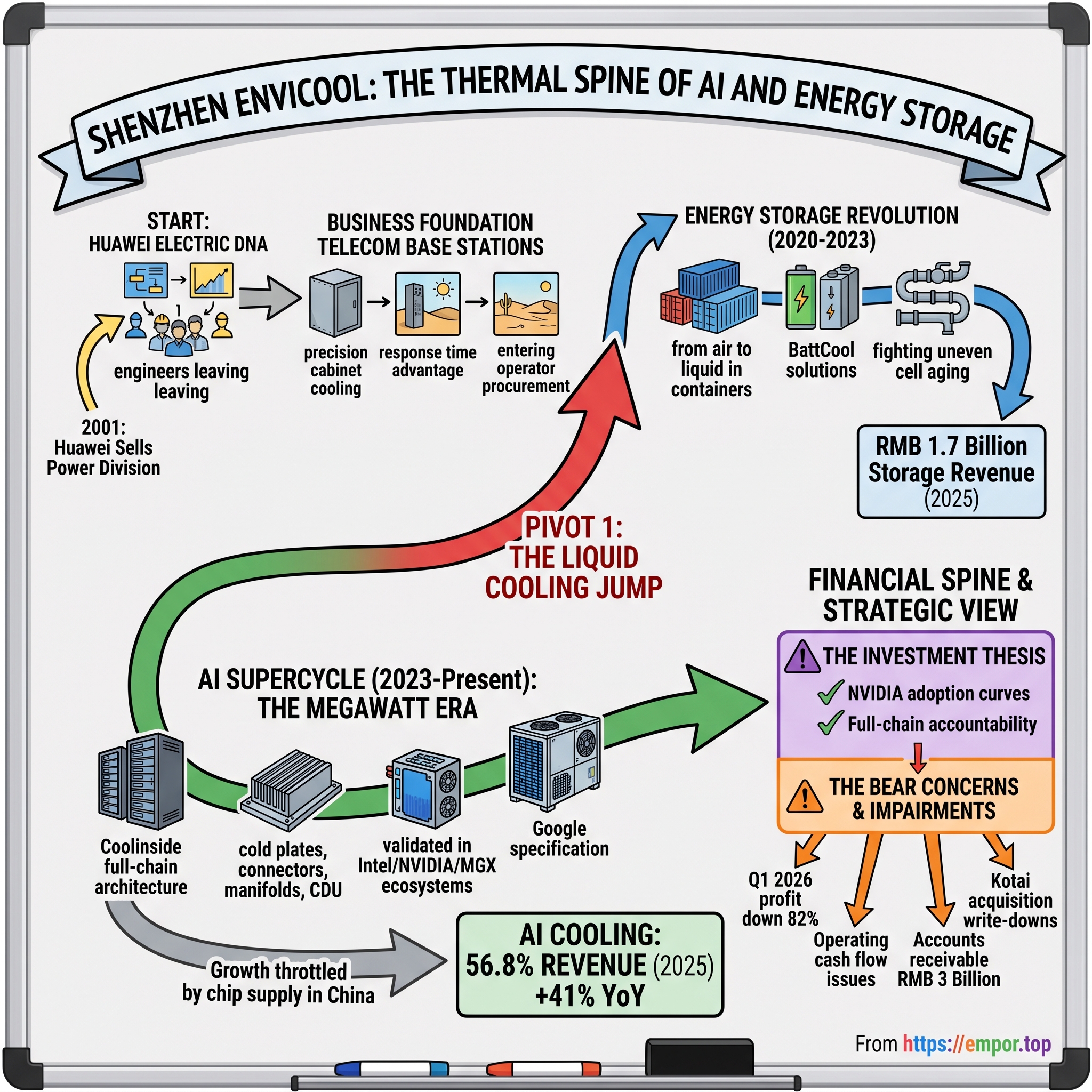
Shenzhen Envicool: The Thermal Spine of AI and Energy Storage
I. Introduction & Episode Roadmap
On the morning of April 21, 2026, forty-four sell-side analysts filed into a new industrial campus in Shenzhen — Envicool's South China headquarters base, parts of which had only just come online. Goldman Sachs was there. So were Morgan Stanley, J.P. Morgan, UBS, Bernstein, Nomura, Macquarie, BNP Paribas, and most of the Chinese brokerage establishment.2 They had come to hear the management of one of the best-performing industrial stocks in China explain a number that had landed the previous evening like a dropped wrench.
The number was RMB 8.66 million. That was Envicool's first-quarter net profit attributable to shareholders — down 81.97% year over year, on revenue that had actually grown 26.03% to RMB 1.175 billion.11 A company valued at over RMB 100 billion at its December peak had earned, in three months, roughly the price of a mid-size apartment building.5 The stock went limit-down.3
That collision — spectacular top-line growth colliding with collapsing earnings quality — is the reason this story is worth telling now rather than six months ago, when the narrative was cleaner and the share price was higher.
The physics underneath. For thirty years, computers were cooled by moving air. Fans pushed cold air across hot chips; big air conditioners chilled the room. This worked because chips were, by today's standards, not very hot. A standard server rack in 2010 dissipated three to five kilowatts — about the heat output of a few hair dryers. Air handles that fine.
An NVIDIA GB200 NVL72 rack dissipates well north of a hundred kilowatts. Air does not handle that. Water carries roughly three to four thousand times more heat per unit volume than air, which is why every serious AI datacenter now runs coolant through pipes to a metal plate sitting directly on top of the GPU. This is not a preference. It is thermodynamics, and it arrived on the industry's doorstep faster than the supply chain that serves it.
The same physics arrived, from a completely different direction, in batteries. A gigawatt-hour-scale energy storage container packed with lithium-iron-phosphate cells has a narrow temperature band it must live inside. Let cells drift apart in temperature and the pack degrades unevenly; let one run away and the container can burn. Air cooling ran out of headroom there too.
The company. 深圳市英维克科技股份有限公司 Shenzhen Envicool Technology Co., Ltd. (002837.SZ) sells the equipment that removes that heat. It was founded in 2005 by engineers who had come out of 华为电气 Huawei Electric — the power and thermal division that 华为 Huawei sold to Emerson Electric — and who believed that Chinese telecom operators were badly overpaying foreign vendors for precision cooling.4
Twenty-one years later, Envicool's 2025 revenue reached RMB 6.068 billion, up 32.23%, with net profit attributable to shareholders of RMB 521.9 million, up 15.30%.1 Data centre and computing-room cooling alone contributed RMB 3.449 billion of that, growing 41.28%.2 The company's cold plates sit inside Intel's Xeon 6 reference designs, its universal quick disconnects appear in NVIDIA's MGX ecosystem partner list, and at the 2025 OCP Global Summit it publicly displayed a coolant distribution unit built to Google's Deschutes 5 specification.1
The thesis, and the tension. The bull argument is straightforward: Envicool sells the full chain — cold plate, quick disconnect, manifold, CDU, coolant, piping, outdoor heat rejection — at a moment when the world's largest capital-spending programme needs exactly that, and when buyers are unwilling to split liability for a leak across five vendors.
The bear argument is written in Envicool's own cash flow statement. Operating cash flow for all of 2025 was RMB 157 million against net profit of RMB 522 million.1 Accounts receivable reached RMB 3.054 billion — half a year of revenue sitting in other people's payment cycles.2 Then the first quarter of 2026 delivered negative RMB 386 million of operating cash flow and a near-zero profit.11 A company can grow into greatness or grow into a receivables crisis, and from the outside, in the early innings, the two look uncomfortably similar.
What follows. We start with the corporate bloodline — a 2001 divestiture that seeded a generation of Chinese hardware companies. We trace the unglamorous decade spent cooling base station cabinets in the Xinjiang desert. We examine an acquisition that looked smart and has since been written down twice. We follow the pivot into battery containers, then into AI racks. We take the financials apart properly, test management's credibility against its own prior statements, war-game the competitive structure, and finish with the small number of things an outside investor can actually watch.
It begins with a phone call Ren Zhengfei made in 2001.
 Subscribe on LinkedIn
II. The "Huawei Electric" DNA: The Huangpu Academy of Thermal Engineering (2001–2005)
In the autumn of 2001, the global telecom industry was in freefall. Nortel was collapsing, Lucent was shedding tens of thousands of jobs, and the capital that had funded the fibre boom had evaporated. 任正非 Ren Zhengfei, running a Huawei that was still a decade from global prominence, wrote an internal essay titled "华为的冬天" — Huawei's Winter — warning his staff that failure was not merely possible but likely.
Then he sold the family silver. On October 22, 2001, Emerson Electric announced it was acquiring Huawei's power-supply subsidiary, Shenzhen Avansys Power — 华为电气 Huawei Electric — for $750 million in cash.7 Emerson filed the transaction with the SEC as its entry into China's networking power market, and described it at the time as the largest private acquisition made in China by a foreign company.8
For Huawei, the logic was cold and correct: the sale converted a non-core hardware division into a war chest that carried the company through the downturn and funded the 3G push that made it a global carrier vendor.
For Chinese industry, the second-order consequences were larger than the cheque. Huawei Electric had assembled several thousand engineers who understood power electronics, thermodynamics, and — crucially — what it takes to ship hardware into telecom networks, where a failure at three in the morning in a cabinet nobody can reach is a career-ending event. When ownership passed to a foreign multinational, a large fraction of those engineers concluded that their upside now lived somewhere else.
What followed has become a piece of Chinese industrial folklore: the Huawei Electric alumni network, which seeded 汇川技术 Inovance Technology, 麦格米特 Megmeet, and a long tail of power and automation firms. Shenzhen's Longgang and Longhua districts filled with companies founded by people who had shared a canteen.
The engineer who left
齐勇 Qi Yong was one of them. He had led technology at Huawei Electric and moved across to Emerson with the business.4 By any conventional measure this was a good outcome — a senior technical role at an American industrial giant, in a country where such jobs carried enormous prestige. He walked away from it in 2005, taking a handful of colleagues with him, to start a precision cooling company in Shenzhen.4
The market he was walking into was not obviously attractive. Precision temperature control for telecom rooms and equipment cabinets was dominated by foreign brands — Emerson's own Liebert line, Schneider's APC, Germany's Stulz. Chinese operators paid import-level prices, waited import-level lead times, and accepted whatever configuration the vendor's global catalogue offered.
Qi Yong's insight was not technological. It was structural. The foreign incumbents sold products; Chinese customers, building out networks at a pace no Western operator had ever attempted, needed responses. They needed a cabinet air conditioner reshaped for an odd enclosure in six weeks, not a change-request routed through a European product committee.
That distinction — product vendor versus response engine — is the through-line of everything Envicool has done since. It shows up two decades later in the company's own language on liquid cooling, where management describes proprietary R&D, proprietary production, proprietary delivery, and proprietary service as the mechanism that guarantees zero-risk operation.1 The vocabulary is different; the instinct is identical.
It is worth pausing on what this culture is not. Envicool has never been a research house chasing exotic physics. It is a hardware company whose competitive weapon is cycle time — the speed at which a customer's awkward, specific, urgent thermal problem becomes a manufactured object on a truck. Frugality is part of the same package. The company kept overheads low, kept sheet metal and heat exchanger work in-house, and priced against foreign incumbents whose China cost structures carried expatriate overhead.
The senior team still reflects that lineage. Vice presidents 陈川 Chen Chuan and 陈涛 Chen Tao both came through Huawei Electric or Emerson before joining, and board secretary 欧贤华 Ou Xianhua followed the same path.9 Two decades on, the executive bench is still substantially the group that walked out of Emerson's Shenzhen offices — a continuity that cuts both ways, as we will see when we get to governance.
For investors, the takeaway from the origin story is narrow but real: Envicool's founding advantage was never a patent. It was a cost position and a response time, aimed at a foreign-dominated niche. Advantages of that kind are genuine, but they are also the kind that a determined domestic competitor can eventually copy — which is precisely the question the AI boom now poses.
The company's first proof that the model worked came not from a datacenter, but from a steel box bolted to a pole in the desert.
III. Telecom Base Stations to Cloud Data Centers: Finding the High-Density Niche (2005–2016)
Consider the problem of a 3G base station in Xinjiang. Inside a sealed metal cabinet, perhaps a cubic metre of volume, sit radio units generating heat continuously. Outside, the ambient temperature swings from minus thirty in January to plus forty-five in July, with sand in the air that will destroy a filter in weeks. The cabinet has no maintenance staff. The nearest engineer may be four hours away. It must work for a decade.
Now multiply by hundreds of thousands of sites, because China Mobile, China Telecom, and China Unicom were building the largest wireless networks in human history simultaneously. And note the constraint that made the problem interesting: every watt spent on cooling was a watt not spent on transmitting. Operators measured cooling as pure overhead, and pushed vendors relentlessly on energy consumption.
Envicool's answer was to attack the compressor. A conventional air conditioner runs a vapour-compression cycle whenever the box is hot, regardless of what the weather outside is doing — which is absurd when the outside air is already at minus ten. The company built heat exchangers and heat-pipe systems that simply move heat from inside the cabinet to outside using the temperature difference, with no compressor running at all, plus hybrid units that switch modes as conditions change.
The commercial breakthrough came fast. In 2006 — the company's second year — Envicool won what was then the single largest domestic base-station energy-saving thermal contract, a 400-unit heat-exchange system order, and separately shipped 800 outdoor cabinet cooling units to an overseas customer.4 In 2008 its EC-series products entered China Mobile's central procurement, the tender system through which the world's largest mobile operator buys equipment by the tens of thousands.4
Getting into central procurement is the hard part of Chinese industrial selling. It requires audited reliability data, factory inspections, and a track record measured in years. Once inside, a supplier gets scale and — as important — a reference that other buyers accept without re-testing.
Becoming a supplier to the people who taught you
By 2011 and 2012 Envicool had become a tier-one supplier to Huawei itself, later a core supplier, and had won orders from Japan's SoftBank and America's Sprint.4 There is a certain symmetry in a company founded by Huawei Electric alumni selling thermal equipment back to Huawei — but it also tells you something the marketing does not. Huawei's supplier qualification process is notoriously brutal. Passing it is a costly, multi-year piece of evidence, and it is the kind of evidence that matters more than any market-share statistic.
Meanwhile, a second market was forming. As 腾讯 Tencent, 阿里巴巴 Alibaba, and 百度 Baidu built out hyperscale facilities in the early 2010s, rack power densities climbed from three to five kilowatts toward eight to ten. That does not sound dramatic. In practice it broke the old model of blowing cold air into a raised floor and hoping it found the servers.
The industry's answer was to move the cooling closer to the heat. Envicool built row-based precision air conditioners that sit between rows of racks rather than at the room perimeter, micro-module datacenter systems that ship as pre-integrated pods, and evaporative and pump-circulated free-cooling systems that exploit cold outdoor air. The product family that exists today — CyberMate room units, iFreecooling pump-circulated natural cooling, XRow inter-row units, XFlex indirect evaporative modules, XStorm wall-type cooling, XSpace micro-modules — grew out of that decade.1
The strategic significance is easy to miss. Envicool did not enter datacenters by out-engineering Vertiv on the room air conditioner, the incumbent's home turf. It entered where the architecture was changing, because that is where incumbency counts for least. When a customer is buying the same product they bought last year, the incumbent wins by default. When the customer is buying a new architecture, everyone starts closer to level.
That pattern — win the new format, not the old one — repeats at every subsequent inflection in this story.
The customer list from those years persists today: ByteDance, Tencent, Alibaba, 秦淮数据 Chindata, 万国数据 GDS, 数据港 Sinnet, China Mobile, and China Telecom all appear in Envicool's current disclosures as datacenter customers, served directly or through system integrators.1 These are not gentle counterparties. They run competitive tenders, they know their cost structures, and they have the volume to demand price. Envicool's gross margins have always reflected that: this is a company that has lived in the high twenties to mid thirties, never in software territory.
By 2016, revenue had reached RMB 518 million.5 Respectable, profitable, and far too small to fund the manufacturing capacity that the next decade would demand. That constraint is what took Envicool to the capital markets.
IV. Capital Markets & M&A Discipline: Building the Industrial Multi-Pillar (2016–2020)
Envicool listed on the 深圳证券交易所 Shenzhen Stock Exchange on December 29, 2016, pricing at RMB 18.00 per share and raising roughly RMB 300 million.4 The offering behaved the way Chinese small-cap IPOs behaved in that era: the stock rose 44% on debut, then ran eight consecutive limit-up sessions, travelling from RMB 25.92 to RMB 55.57.4
Strip away the price action and the IPO was modest. Three hundred million yuan is not transformational capital for a manufacturer. What listing genuinely bought was different: a currency. A listed company can issue shares to acquire things, and it can pledge its equity. Envicool used both within eighteen months.
The Kotai bet
The target was 上海科泰运输制冷设备有限公司 Shanghai Kotai Transport Refrigeration, a specialist in air conditioning for rail transit vehicles — metro trains. Envicool agreed to acquire 95.0987% of the company for total consideration of RMB 314.53 million, structured as roughly 91% newly issued shares and 9% cash, with the shares priced at RMB 22.85.1413 The business registration transferred on May 4, 2018, and the new shares listed on June 8, 2018.13 Kotai subsequently became a wholly owned subsidiary.1
The strategic case was defensible on paper. Metro train air conditioning is a qualified-supplier business: you sell to rolling stock manufacturers like 中车长客 CRRC Changchun and 中车浦镇 CRRC Puzhen, who sell to metro operating companies, and nobody gets in without years of certification.1 Kotai brought that qualification, leading share positions on the Shanghai and Suzhou metro systems, and one of China's largest platforms for the periodic overhaul and maintenance of metro air conditioning units — a genuine annuity attached to trains that must be serviced whether or not anyone is buying new ones.1
Envicool paid with paper at a moment when its paper was expensive, which is the textbook way to do it. And by acquiring qualifications rather than capacity, it bought the thing that money alone cannot manufacture: time.
What actually happened
Eight years on, the honest verdict is that Kotai has been the weakest capital allocation decision in the company's history.
Chinese metro construction went into a prolonged trough as macro tightening and local government fiscal stress slowed approved projects. In 2025 Envicool disclosed that rail transit train air conditioning and service revenue fell significantly, and that bus air conditioning — including coach units and refrigeration for cold-chain vehicles — also declined year over year.12
The accounting caught up. The company recorded a goodwill impairment of RMB 46.13 million in 2024, taking cumulative goodwill impairment to RMB 137.34 million, and then wrote down a further RMB 51.24 million in 2025 — cumulative goodwill impairment of roughly RMB 189 million against a purchase price of RMB 315 million.210 Well over half the premium paid for Kotai has now been written off.
This deserves to be stated plainly, because it complicates the tidy version of Envicool's story. Management's own filings flag continued goodwill impairment risk at Kotai from macro conditions, market conditions, and customer demand.10 Two consecutive years of write-downs is not a one-off adjustment; it is a business that is not earning its acquisition price.
There is a defence, and it is partly valid. Kotai was bought largely with shares, in a segment that now represents a small share of a company four times larger. The dilution has been swamped by growth elsewhere. Nobody who owns Envicool today owns it for metro trains.
But the second-layer read matters more than the arithmetic. The deal was justified on the logic that adjacent thermal markets share engineering DNA and therefore travel well. That logic held up poorly against a demand cycle nobody controlled. Investors evaluating the company's current expansion — into overseas manufacturing, into electronics cooling, into new vehicle categories — are entitled to ask whether the same reasoning is being applied, and whether "we understand heat" is a strategy or a rationalisation.
The charitable and probably accurate summary: Envicool's M&A has been small, cheap in cash terms, and mostly harmless, but it has not created value. The value has come entirely from organic engineering. Which is a useful thing to know about a management team, and it sets the frame for the pivot that did work — one the company built itself, from scratch, out of a product line originally designed for telecom cabinets.
V. The Energy Storage Revolution: Air to Liquid Cooling in Battery Containers (2020–2023)
To understand why energy storage became Envicool's second business, you have to understand what a battery container actually is.
Picture a shipping container. Inside, stacked in racks, sit thousands of lithium-iron-phosphate cells wired into modules and packs. When a solar farm overproduces at midday, current pours in; when the grid needs power at dusk, it pours out. Every one of those cells has internal resistance, and every ampere passing through generates heat.
Here is the property that makes this a thermal engineering problem rather than an HVAC problem. Battery cells age as a function of temperature — and they age unevenly if their temperatures differ. Let one corner of a pack run warmer than another, and after a few thousand cycles those cells have lost more capacity than their neighbours. Since a pack performs like its weakest member, the whole asset degrades faster than its warranty assumed. Push further and you reach thermal runaway: a cell venting, igniting, and propagating to its neighbours. Battery fires are not fires you extinguish. They are fires you contain and wait out.
So the specification for battery thermal management is not "keep it cool." It is "keep every cell within a couple of degrees of every other cell, for twenty years, in a steel box sitting in a Nevada desert or a Xinjiang winter, with no one watching."
From cabinet air conditioners to BattCool
Envicool arrived here through the side door. Its cabinet cooling business — built for base stations, power grid switchgear, and EV charging piles — was already about sealed outdoor enclosures in hostile environments. Battery containers were the same problem with a more demanding tolerance. The company says it was among the first to work on electrochemical storage thermal management and describes itself as holding a leadership position in the segment.1
The technical trajectory ran roughly as follows. Air cooling first: fans and ducting circulating chilled air through the container. Then, as cell energy density and charge rates rose, air ran out of headroom — the same wall the datacenter industry hit, arriving from a different direction. In 2020 Envicool launched water-cooled units and began deploying them in storage applications at home and abroad.1
In November 2022 came BattCool 2.0, the company's full-chain storage liquid cooling solution.1 In March 2023 it released its own SoluKing 2.0 coolant, which matters more than it sounds — the fluid is a consumable that determines corrosion behaviour and service life, and owning it converts a one-time equipment sale into a relationship. October 2023 brought 3D-TVC, a zero-power phase-change technology, and in January 2024 a combined Pack+PCS liquid cooling unit that lets the power conversion system run at 45°C ambient without derating while improving heat removal by 30%.1
Also in January 2024, Envicool delivered what it describes as the industry's first thermal management for 5MWh high-density storage systems, integrating variable-frequency free-cooling for an annual energy efficiency ratio more than 30% better than the prior generation.1 In an industry where developers model returns over twenty years, parasitic load — power the cooling system consumes that could otherwise be sold — is a real line item.
The economics, and the ceiling
Revenue from energy storage applications reached approximately RMB 1.7 billion in 2025.1 That is a substantial business by any standard. But the growth rate tells the more useful story: roughly 14% year over year — respectable, and dramatically slower than the 41.28% posted by the datacenter segment.2
Management's explanation, given to analysts in April 2026, is worth taking seriously because it is specific rather than evasive: as the mix of demand shifts toward long-duration storage, thermal management demand grows more slowly than battery demand.2 The mechanism is intuitive. A long-duration system holds more energy relative to its power rating, so it charges and discharges more gently, generating less heat per unit of capacity installed. Envicool's addressable content per gigawatt-hour falls even as the gigawatt-hours boom.
That is an important and underappreciated point. Energy storage thermal management is not a simple derivative of battery shipments. It is a derivative of battery heat, and the two are diverging.
The moat here is nonetheless real, and it is worth naming precisely. Thermal design in a storage container is co-engineered with the pack: cold plate geometry, flow paths, and manifold routing are frozen into the mechanical design a year or more before mass production, and the whole assembly carries safety certifications. Swapping the thermal supplier late is not a procurement decision; it is a re-engineering and re-certification decision. That is what genuine switching cost looks like — not loyalty, but the cost of undoing a design.
Envicool has kept extending the product range to defend it: in 2025 it launched a 6.X full-chain storage liquid cooling solution, ultra-thin door-mounted CubeCool units for commercial and industrial storage, direct-cooling variants, a 6MWh-plus solution, a quiet enclosure for commercial installations, and a high-temperature unit designed specifically for Middle Eastern conditions.12 That last item is a tell — it is a product built for export markets, and export is where this segment's next chapter lies.
But by 2025, storage had become the second story. The first was happening inside server racks, and it was moving faster than anything the company had experienced.
VI. The AI Supercycle: "Coolinside" and the Megawatt GPU Rack Era
At the 2024 OCP Global Summit, NVIDIA published details of its Blackwell GB200 system development on its own website — and Envicool's universal quick disconnect appeared on the MGX ecosystem partner list.1 MGX is NVIDIA's modular reference architecture — a set of standardised mechanical, power, and cooling specifications that lets system builders assemble compatible AI servers and racks, which makes inclusion on its partner list a form of pre-qualification for the entire ecosystem downstream.[^15] A year later, at OCP 2025, both its UQD and MQD products were listed, and the company put on public display something more revealing: a coolant distribution unit developed to Google's Deschutes 5 specification.1
For a Chinese thermal equipment maker, being visible inside the reference architecture of the world's most valuable semiconductor company is a genuinely different position from selling room air conditioners to Chinese IDC operators. It is also, as we will discuss, a position with geopolitical fragility built in.
What actually has to happen inside a liquid-cooled rack
The plumbing deserves explanation, because the investment case rests on it.
Start at the chip. A cold plate is a flat metal block — copper or aluminium — with microscopic channels machined or brazed inside it, bolted directly onto the GPU package. Coolant flows through the channels and carries heat away by conduction. The engineering difficulty is not the concept; it is manufacturing thousands of these with identical flow characteristics, zero leaks, and thermal performance that holds after years of thermal cycling.
Coolant reaches the plate through hoses that must be connectable and disconnectable by a technician replacing a server, without spilling fluid onto a rack containing several million dollars of silicon. That is the quick disconnect — the UQD. It is a small, unglamorous, precision-machined valve, and it is arguably the highest-stakes component in the chain, because a dripping connector in an energised rack is a catastrophe.
The hoses connect to a manifold running vertically up the rack, distributing flow to each server. The manifold connects to a CDU — coolant distribution unit — which is the system's heart: a pumped loop with a heat exchanger that transfers heat from the clean, controlled "technology cooling system" loop touching the chips into the building's facility water loop, plus instrumentation monitoring flow, pressure, temperature, and leaks.
Finally, heat leaves the building through dry coolers or chillers on the roof.
Envicool builds all of it. Its Coolinside architecture spans cold plate, quick connector, manifold, CDU, cabinet, SoluKing long-life coolant, piping, and heat source — what management calls end-to-end coverage — and extends into integrated liquid cooling server test equipment, XSpace 6S liquid-cooled computing pods, fully prefabricated skid-mounted datacenters, and pump-driven two-phase cold plate systems.1
The company frames this as "factory to field" delivery: the same vendor equips the server manufacturing line where liquid-cooled machines are built and tested, and the datacenter where they eventually run.1 In 2026 management extended the framing again, to "三全" — full chain, full scenario, full lifecycle — adding operations, maintenance, and service across the asset's life.2
Why the full chain is a commercial argument, not just a product catalogue
Ask a datacenter operator what terrifies them about liquid cooling and the answer is not efficiency. It is liability. If coolant reaches a GPU tray, who pays? The cold plate vendor blames the connector supplier; the connector supplier blames installation; the CDU vendor points at pressure settings; the integrator points at everyone. Meanwhile a cluster worth tens of millions of dollars is offline.
Selling the whole chain collapses that argument into a single accountable party. Management makes exactly this case, arguing that controlling every link allows the company to understand and manage each link's effects, and that this has won broad recognition from domestic and overseas customers.2
That is a real advantage. It is also, we should note, an advantage that competitors can attack by assembling alliances or by having a hyperscaler take integration in-house — and the largest buyers are precisely the organisations with the engineering depth to do that.
The validation trail
The evidence that this is more than a pitch deck lies in third-party qualifications, which are slow, expensive, and hard to fake. Envicool's cold plates entered Intel's Eagle Stream server Design Guide in 2023.1 As the first partner in Intel's China datacenter liquid cooling innovation acceleration programme, its BHS-AP platform cold plate, UQD04 quick connector, manifold, and rack-mounted CDU passed Intel testing and validation, making it the first cold plate liquid cooling solution integrator on the Xeon 6 platform.12
The product scope keeps widening. Cold plates now address not just CPUs, GPUs, and computing and switching ASICs, but memory, SSDs, and optical modules — the components that account for the residual heat once processors are liquid-cooled, and which must be handled to reach genuinely 100% liquid-cooled equipment.2 The company has also developed two-phase and jet-impingement cold plates for localised extreme heat flux — chips whose hot spots exceed what a conventional micro-channel design can handle.1
The numbers, and their shape
Computing-room thermal management revenue reached RMB 3.449 billion in 2025, 56.83% of total revenue, growing 41.28%.2 Envicool also took the largest total share across three packages in China Mobile's 2025–2026 centralised procurement of air-cooled units — a reminder that the legacy air business is still winning tenders and still funding the transition.2
Two details in that segment matter more than the headline. First, growth in the second half of 2025 slowed relative to the first half.1 Second, overseas revenue in the computing-room business rose significantly in the second half, and segment gross margin improved markedly year over year.1 Export mix is carrying the margin.
Management's own diagnosis of the domestic slowdown, offered to analysts, was that chip supply constraints have affected the pace of computing-room construction in China, while Southeast Asian demand is strong — absorbing both local requirements and spillover from other regions, including China — and US demand is rising as traditional cloud providers accelerate capital spending and "Neo Cloud" operators add new demand.2
That is a candid account, and it contains an uncomfortable implication: the China AI datacenter build, Envicool's home market, is being throttled by something entirely outside the company's control.
The industry backdrop turned again in June 2026, when NVIDIA disclosed that its Rubin platform would be 100% liquid-cooled — its first computing system to abandon fans entirely — collapsing an adoption timeline the market had assumed would take years.6 Envicool's shares responded, closing at RMB 82.86 on June 24, 2026, restoring a market capitalisation above RMB 100 billion.6 Chinese media have reported various supply-chain positions for the company in the Rubin ecosystem, but Envicool itself does not confirm end-customer identities, citing confidentiality obligations.2 For an outside investor, that distinction between reported and disclosed is not pedantry — it is the difference between a fact and a rumour with a stock chart attached.
Which brings us to the part of the story that is fully disclosed, audited, and considerably less exciting.
VII. Segment Economics, Financial Mechanics, & Capital Deployment
Envicool's 2025 income statement reads like a company doing extremely well. Its cash flow statement reads like a company under strain. Both are accurate, and reconciling them is the central analytical task for anyone looking at this business.
The revenue architecture
The company reports along product lines rather than end markets, which requires a little translation. Computing-room thermal management — the datacenter and telecom room business — generated RMB 3.449 billion, 56.83% of revenue.2 Cabinet thermal management, which houses energy storage alongside base stations, grid equipment, EV chargers, and industrial applications, generated RMB 1.977 billion, 32.59% of revenue, up 15.30%, with energy storage accounting for roughly RMB 1.7 billion of it.2 The residual — around RMB 277 million of non-storage cabinet products — covers a long tail including a drone-airport air conditioner, which is exactly the kind of product a company like this ends up making.
Bus air conditioning and rail transit fell.1 Electronics cooling — cold plates and connectors sold as components to server and equipment makers rather than as systems — is reported inside "other," which means investors cannot yet size the business Envicool considers most strategically important. Management said in April 2026 that its growth rate would accelerate in 2026 and that gross margins vary widely by customer and product category.2 For a segment repeatedly described as central to the future, that disclosure is thinner than it should be.
Consolidated gross margin for 2025 was 27.86%, down 0.89 percentage points.2 The composition is instructive: computing-room margin rose significantly, while cabinet margin fell on regional revenue mix.12 The AI business is currently subsidising the rest.
Where the profit went
Revenue grew 32.23% and net profit grew 15.30%.1 The gap is explained almost entirely below the gross profit line.
Operating expenses grew faster than revenue in one place that should please investors and one that should not. Research and development spending reached RMB 446 million, up 27.51% — roughly RMB 100 million more than the prior year — and the patent portfolio expanded by 368 grants during the year, including 24 invention patents.2 At about 7.3% of revenue, that is genuine industrial R&D intensity, well above the level at which a hardware company can claim to be technology-led.
The unpleasant line is impairments. Envicool booked asset impairment of RMB 73.18 million and credit impairment of RMB 93.62 million, against RMB 48.69 million of credit impairment the prior year.2 The full provisioning announcement totalled RMB 166.80 million across bad debt allowances on receivables, contract assets, inventory write-downs, and the Kotai goodwill, reducing 2025 net profit by approximately RMB 150.8 million.10
Put differently: absent those provisions, net profit would have grown roughly in line with revenue. The provisions are the story.
The cash flow problem
Operating cash flow for 2025 was RMB 157 million, down 21.30%, against RMB 522 million of accounting profit.1 The conversion ratio — cash from operations versus reported earnings — was about 30%. For an industrial equipment maker in a boom, that is weak.
The quarterly pattern shows why. Operating cash flow was negative in each of the first three quarters of 2025 — RMB -171 million, RMB -63 million, and RMB -85 million — before a RMB 476 million inflow in the fourth quarter as customers settled at year-end.1 This is normal for Chinese industrial businesses selling into infrastructure projects, where collection concentrates around year-end. It is also fragile, because it means a full year's cash generation depends on one quarter's collections.
The balance sheet shows where the cash is parked. Accounts receivable rose 25.76% to RMB 3.054 billion; contract assets — revenue recognised but not yet billable — rose 75.37% to RMB 229 million; inventory reached RMB 983 million, including RMB 425 million of goods already shipped but not yet recognised.2 Total assets grew 28.81% to RMB 7.747 billion.1
Receivables of RMB 3.054 billion against RMB 6.068 billion of revenue means roughly six months of sales are outstanding. In a business selling to state-owned telecom operators and large IDC developers, long terms are structural. But the direction of travel is what matters, and the direction has been unfavourable for two consecutive years.
Capital deployment
Capital expenditure has stepped up. Construction in progress rose to RMB 268 million from RMB 164 million, with the South China headquarters base and the Central Plains base partly in production and remaining phases scheduled for handover through 2026.2 Domestic manufacturing spans Shenzhen, Suzhou, Zhongshan, Hebei, Shanghai, and Zhengzhou; overseas, the company operates production bases in Thailand and the United States.2 Right-of-use assets rose to RMB 122 million from RMB 46 million and lease liabilities to RMB 93 million from RMB 24 million — leased facilities scaling quickly, most plausibly overseas.2
Asked directly whether capacity was a bottleneck, management said it was not, describing capacity as a dynamic balance and stating that after several months of expansion and optimisation, capacity no longer constrains the business.2 Asked why capex had risen, the answer was that overseas demand required larger asset investment including specialised equipment, and that building new capability to the latest process standards constitutes a "late-mover advantage."2 That phrase is doing a lot of work. A more neutral reading is that serving Western hyperscalers requires quality systems and delivery capability Envicool did not previously need, and that this costs money before it earns any.
Shareholder returns have been maintained but modest: for 2025 the board proposed RMB 1.70 per ten shares in cash, plus a three-for-ten capitalisation from reserves, on a base of 977,440,581 shares.1 That is roughly RMB 166 million of cash — around 32% of net profit. The capitalisation issue transfers reserves to share capital and changes nothing economically.
Then the first quarter happened
Q1 2026 revenue rose 26.03% to RMB 1.175 billion, but gross margin fell 2.16 points to 24.29%, and net profit attributable to shareholders came in at RMB 8.66 million, down 81.97%.112 Operating cash flow was negative RMB 386 million, a 126.25% deterioration.2
Management gave analysts three causes. Finance costs rose because some overseas projects settle in local currencies and renminbi appreciation produced exchange losses, compounded by higher borrowing and interest expense. Credit impairment rose because domestic IDC construction slowed, extending project timelines, settlement cycles, and collection cycles, driving larger bad debt provisions. Gross margin fell on revenue mix. And, notably, management stated that orders in the quarter were plentiful but the company was unable to achieve higher shipments and revenue recognition.2
Each explanation is coherent. Together they describe a business whose growth is currently outrunning its financial infrastructure — currency exposure on a newly global revenue base, working capital funded by an expanding balance sheet, and a domestic customer base paying more slowly. That is the mechanism investors should hold in their heads: Envicool is not failing to sell. It is failing, so far, to convert selling into cash.
VIII. Management Credibility, Governance, & Incentive Alignment
The most useful way to assess a management team is not to read what they say about the future. It is to read what they said about the future three years ago, then check.
The founder
Qi Yong remains chairman, general manager, legal representative, convenor of the strategy committee, and a member of the nomination committee.9 He controls the company through 深圳市英维克投资有限公司 Shenzhen Envicool Investment, which held 25.08% at the end of 2025, plus 5.64% held directly — 55.12 million shares, of which 41.34 million are restricted.1
Two disclosures in that shareholding merit attention. The holding vehicle had 26.42 million shares pledged, and Qi Yong personally had 1.69 million pledged.1 Share pledging by controlling shareholders is common in China and not inherently alarming at these ratios — roughly 11% of the vehicle's stake — but it is a channel through which share price weakness can transmit into corporate stress, and it belongs on any diligence checklist for a Chinese listed company.
The combination of chairman and general manager in one person, with committee seats attached, concentrates authority to a degree that Western governance codes would flag. Envicool also eliminated its supervisory board in 2025, with the former supervisory chair 刘军 Liu Jun — who holds 20.9 million shares and 1.19% of the controlling vehicle — remaining in other roles.9 This followed China's revised Company Law, which allows the audit committee to absorb the supervisory board's functions, so it is a compliance change rather than a unilateral one. The audit committee is chaired by an independent director with accounting credentials and staffed by directors who are not senior management.9 Adequate on paper; concentrated in practice.
The bench
The fifth board, elected in September 2025, comprises nine directors: six non-independent including one employee representative, and three independent.9 Senior management consists of Qi Yong as general manager, vice presidents 陈川 Chen Chuan, 王铁旺 Wang Tiewang, 游国波 You Guobo, and 欧贤华 Ou Xianhua, with 叶桂梁 Ye Guiliang as finance head and Ou Xianhua doubling as board secretary.9
The striking feature is stability. This is substantially the team that has run the company for over a decade, several of them tracing back to Huawei Electric and Emerson. In an industry where competitors poach thermal engineers aggressively, low turnover at the top is an asset. It also means there has been no external challenge to the founder's strategic judgement in twenty-one years.
Incentives, and the trap the company has set for itself
Envicool has run repeated equity incentive programmes, including plans in 2022 and 2024, which cost RMB 13.74 million in share-based payment expense in 2025 and reduced net profit by RMB 11.68 million after tax.2
The 2024 stock option plan granted 9.16 million options to 305 core management and technical staff — 1.61% of share capital, deliberately broad rather than executive-only.12 Its performance conditions are unusually legible: using 2023 net profit as the base, net profit growth of at least 15% for 2024, at least 32% for 2025, and at least 52% for 2026, measured on audited net profit attributable to shareholders excluding share-based payment costs.12
The 2024 hurdle was cleared comfortably — net profit rose 31.59% to RMB 452.66 million against a 15% requirement.12 The 2025 hurdle was cleared too, and the board confirmed on April 18, 2026 that the second exercise period conditions had been met, allowing 267 grantees to exercise 7.098 million options at an adjusted price of RMB 11.332.12
Now do the arithmetic on 2026. A 52% increase on 2023's RMB 344 million requires roughly RMB 523 million of net profit — essentially flat against 2025's RMB 522 million. After a first quarter contributing RMB 8.66 million, the remaining nine months must deliver approximately RMB 514 million, against RMB 474 million in the comparable period of 2025.111
That is a demanding but not impossible task, and it creates a tension worth watching. Incentive plans tied to net profit, in a year when net profit is being suppressed by discretionary items — bad debt provisions, inventory write-downs, goodwill tests — create pressure at exactly the point where management judgement determines the number. This is not an allegation; provisioning in 2025 was aggressive rather than lenient, which cuts the other way. But it is the correct place for a sceptical investor to focus attention when the 2026 accounts are published.
How management handles pressure
The April 2026 analyst meeting is a fair test, because it took place the day the stock went limit-down.
The tone was notably unpromotional. Management quantified the damage precisely rather than deflecting, named renminbi appreciation and slower domestic IDC collection as causes, and admitted that the quarter's shipments lagged its order book.2 On the question analysts most wanted answered — which overseas customers are buying — management said cooperation spans CPU, GPU, ASIC, and optical module applications but that confidentiality obligations prevent naming customers.2
Is that discretion or evasion? Genuinely both. Hyperscaler supply agreements do carry non-disclosure obligations, and a supplier that leaked customer names would lose them. But the effect is that the most valuable part of the investment case — the durability and size of Western hyperscaler business — is unverifiable from outside, while Chinese media freely publish unconfirmed order figures that move the share price.
One answer stood out for its specificity. Asked whether liquid cooling revenue would ramp gradually or inflect, management said growth had so far come mainly from China and Southeast Asia, that it is tracking new overseas customer demand that could concentrate from the third quarter of 2026, and that the outcome may be affected by various factors.2 That is a datable, falsifiable statement. Investors will know by the third-quarter results whether it was accurate — and management's willingness to make it, on a day when caution would have been easier, is a modest credibility marker.
The narrative has also been consistent. The full-chain framing predates the AI boom, appearing in storage products in 2022 before liquid cooling became a headline. What has changed is the addition of "full lifecycle" service, which is a genuine strategic extension rather than a rebrand.12
The verdict a fair-minded investor should reach: competent operators, honest about bad news, weak at segment disclosure, exposed on governance concentration, and carrying an M&A record that does not support expansion into new adjacencies on faith. Which raises the real question — what, exactly, protects this business from everyone else who has noticed the same opportunity?
IX. The Strategic Moat: Helmer's 7 Powers & Porter's 5 Forces
Every thermal engineer in Asia knows the AI cooling opportunity exists. Taiwan's 奇鋐科技 AVC and 双鸿科技 Auras have been making thermal modules for decades. 申菱环境 Shenling Environmental and 同飞股份 Tongfei Controls compete directly in China. 三花智控 Sanhua Intelligent Controls brings automotive thermal scale. 曙光数创 Sugon Datenergy has pushed immersion cooling. Vertiv — the direct corporate descendant of the Emerson Network Power business Qi Yong left, now listed in New York and reporting a datacenter infrastructure order book of its own — remains the global incumbent.15 Delta Electronics has power and thermal expertise.
So what does Envicool actually have that these firms do not?
Applying Helmer
Process Power is the strongest candidate. Helmer defines it as an advantage embedded in organisational routines that cannot be replicated by hiring or purchasing — it must be accumulated. Manufacturing a UQD that will not drip across thousands of mate-demate cycles, or brazing micro-channel cold plates whose flow characteristics are identical unit to unit, is not a design problem. It is a process control problem solved over years of scrap, field failure, and iteration. Envicool's twenty-one years of shipping sealed thermal systems into unattended telecom cabinets is the relevant experience base, and third-party validation trails — Intel's design guide, MGX ecosystem listing — are external evidence that the process meets standards set by others.
The honest caveat: process power is real but not permanent. Taiwanese thermal module makers have their own decades of process depth and are moving fast.
Switching Costs are real and mechanically specific. In storage, thermal design is frozen into pack architecture and carries safety certification. In datacenters, once a CDU's control firmware, hydraulic operating points, and cold plate geometry are integrated into a server design, switching means re-qualification. But note the limit: switching costs protect installed programmes, not new ones. Every new server generation is a fresh competition, and AI hardware refreshes roughly annually. This is closer to a design-win business than an annuity.
Scale Economies are moderate. Envicool buys copper, aluminium, compressors, pumps, and fans at greater volume than domestic specialists, and its investment in automated testing rigs and specialised equipment raises the fixed-cost bar for smaller entrants.2 But it is a fraction of the size of Vertiv or Delta globally, so this is a domestic advantage, not a worldwide one.
Counter-Positioning applied historically — Envicool pushed full-chain liquid cooling while incumbents had installed bases of air conditioning to defend — but it has largely expired. Vertiv, Delta, and every serious competitor now sell liquid cooling. Nobody is being held back by a legacy business model any more.
Cornered Resource, Branding, and Network Economies do not meaningfully apply. There is no scarce input Envicool controls, no pricing premium from brand with buyers this sophisticated, and no network effect in cooling hardware.
The composite picture: one strong power, one real but time-limited power, one moderate power, and one expired power. That is a defensible business — not an unassailable one.
Applying Porter
Rivalry: high and intensifying. Every category of competitor — Chinese peers, Taiwanese thermal specialists, global incumbents, and increasingly the server OEMs and hyperscalers themselves — is investing. Envicool's own consolidated gross margin fell in 2025 and again in Q1 2026, which is what intensifying rivalry looks like in the accounts before it appears in press releases.2
Buyer power: high. Envicool's customer roster consists of Chinese internet giants, telecom operators, IDC developers, battery makers, and server OEMs — all large, all sophisticated, all running competitive tenders. Buyer power shows up in the receivables balance as much as in price: these customers dictate payment terms, and Q1 2026's credit impairment was the direct consequence.2
Supplier power: low. Copper, aluminium, pumps, valves, fans, and compressors are commodity inputs with multiple sources. Input cost inflation — copper particularly — is a margin risk, but not a bargaining-power problem.
Threat of substitutes: low within high-density AI, but not zero. Direct-to-chip cold plate cooling is the mainstream architecture for racks in the fifty to one hundred twenty kilowatt range. Immersion cooling — submerging servers in dielectric fluid — remains awkward to service and demands facility redesign. But two-phase and jet-impingement approaches are emerging, and Envicool is developing both, which is the correct hedge.1
Threat of new entrants: asymmetric. Anyone with a CNC machine can make a cold plate. Very few organisations can deliver a full-chain system with zero-leak guarantees, field service across continents, and the balance sheet to stand behind a warranty on a cluster worth hundreds of millions. The barrier is not the component; it is the accountability.
Which is precisely why the most serious competitive threat is not another cooling company at all. It is a hyperscaler or server OEM deciding that integration is a capability worth owning — and that is where the bear case begins.
X. The Investment Spine: Bull vs. Bear Case & Activist Stress Test
Why Envicool wins from here
The bull case rests on three mechanisms, each with observable evidence behind it.
First, the adoption curve is being set by NVIDIA, not by datacenter operators. When Rubin ships as a fanless, fully liquid-cooled platform, liquid cooling stops being a choice.6 Anyone deploying the newest AI hardware inherits the thermal architecture that comes with it. Demand for the components in Envicool's Coolinside chain becomes a function of AI capital expenditure rather than of datacenter operators' willingness to adopt new technology — a far better place for a supplier to sit.
Second, the full-chain position addresses a liability problem that buyers genuinely have. This is not marketing. Management's willingness to own every link, and the validation trail through Intel and the MGX ecosystem, are the concrete evidence.12
Third, geography is now working in Envicool's favour rather than against it. The company's overseas computing-room revenue rose materially in the second half of 2025, and segment gross margin improved.1 Manufacturing bases in Thailand and the United States, alongside domestic capacity, position the company to serve Southeast Asian demand — which management identifies as strong, absorbing both local and spillover requirements — and North American demand from cloud providers and Neo Cloud operators.2 For a Chinese equipment manufacturer, having overseas capacity already in operation rather than in planning is a meaningful head start if trade barriers rise.
A fourth, quieter support: the storage business remains a real profit contributor, the legacy air-cooling business still wins central procurement tenders, and both fund the transition.2
Why it may not
The margin structure is under visible pressure. Consolidated gross margin fell to 27.86% in 2025 and to 24.29% in Q1 2026.2 Management attributes the decline to mix, which is plausible. But the alternative reading — that liquid cooling components are commoditising as capacity floods in — cannot be ruled out from outside, and the domestic gross margin deterioration disclosed in the first half of 2025 supports the more pessimistic view.4 If cold plates and connectors follow the historical path of Chinese hardware components, the trajectory is downward.
Vertical integration by customers is the structural threat. Server OEMs and hyperscalers have both the engineering capability and the volume to bring cooling integration in-house. A company that co-develops a custom CDU with a hyperscaler is also teaching that hyperscaler exactly how to specify one.
Working capital could become the binding constraint. This is not hypothetical. Cash conversion of roughly 30% in 2025, negative RMB 386 million in Q1 2026, receivables of RMB 3.054 billion, and credit impairment rising sharply because domestic IDC projects are settling more slowly — that is a chain of evidence, not a worry.12 Growth of this kind consumes cash. Consuming cash requires borrowing. Borrowing raises interest expense, which is one of the reasons Q1 profit collapsed.2
Currency and geopolitics cut both ways. Renminbi appreciation produced exchange losses on locally-settled overseas contracts in Q1 2026.2 More fundamentally, a Chinese supplier embedded in American AI infrastructure carries policy risk that no operating excellence can hedge. Overseas plants mitigate tariffs; they do not mitigate a decision that Chinese-origin equipment is unwelcome in sensitive facilities.
Reputational tail risk is asymmetric. One serious coolant leak destroying an expensive GPU cluster would do damage disproportionate to any single contract. This is unquantifiable and therefore easy to ignore, which is exactly why it belongs in the analysis.
The activist's questions
A sceptical investor with a large position and a willingness to be unpopular would ask five things.
On working capital: Why did operating cash flow amount to under a third of net profit in a boom year, and what is the ageing profile of RMB 3.054 billion of receivables?12 Management has identified slower domestic IDC settlement as the cause, which is an honest answer but also an admission that the company has limited control over the outcome.
On the fourth-quarter dependency: Three consecutive quarters of negative operating cash flow rescued by one quarter of collections is a structurally fragile pattern.1 What happens in a year when the fourth quarter disappoints?
On acquisitions: Cumulative goodwill impairment of roughly RMB 189 million against a RMB 315 million purchase price, across two consecutive write-down years, is a poor record.210 What is the plan for the rail and bus businesses — fix, hold, or sell? The filings do not say.
On disclosure: Electronics cooling is described as strategically central yet reported within "other," with no revenue figure and no margin.2 Investors are being asked to underwrite a business they cannot see.
On ownership behaviour: Public fund holdings reportedly fell from 15.75% to 7.11% during the first quarter of 2026, and northbound holdings via Hong Kong Connect declined over 2025, with the Hong Kong Securities Clearing position at 4.18% at year-end.61 Meanwhile retail shareholder count rose from 148,788 at year-end 2025 to 210,379 a month before the annual report.1 Institutions selling into retail buying is not a valuation argument, but it is a fact about who is holding the risk.
There is no verdict to render here, and none is offered. The bull and bear cases are both supported by real evidence, and which one dominates will be settled by observable data over the next several quarters — which is precisely why the metrics matter more than the narrative.
XI. Critical Operating KPIs & Earnings Call Playbook
Most of what is written about Envicool concerns things an outside investor cannot verify: which hyperscaler is testing which CDU, how many cabinets shipped for which platform. Those claims move the share price and are almost entirely unconfirmable. Three things are both disclosed and decisive.
KPI one: operating cash flow relative to net profit. This is the single most important number in the file. It is where the receivables problem, the inventory build, the collection cycle, and the credit quality of the customer base all converge into one figure. The 2025 ratio was roughly 30%; Q1 2026 was negative.111 A business scaling healthily should trend toward parity as it industrialises. A business financing growth through customer credit will not. Watch the full-year figure, and watch whether the fourth-quarter collection surge remains as load-bearing as it was in 2025.
KPI two: consolidated gross margin, quarter by quarter. The 2025 figure of 27.86% and the Q1 2026 figure of 24.29% establish the trend line.2 Management attributes softness to mix; the market's fear is commoditisation. Only sequential margin data distinguishes them. Pair it with the overseas-versus-domestic split whenever disclosed, since the export mix has been carrying margin and any convergence between the two would signal that pricing pressure has followed Envicool abroad.
KPI three: computing-room segment revenue growth, with the overseas share. The segment grew 41.28% in 2025 but slowed in the second half.12 Given management's statement that new overseas customer demand could concentrate from the third quarter of 2026, this is the metric that tests whether the AI thesis is converting into shipments or remaining a design-win narrative.2
Deliberately excluded: order announcements, ecosystem certifications, and platform partnerships. They are leading indicators of opportunity, not of profit, and Envicool's 2025 results demonstrate exactly how far apart those two can be.
Where to look
The primary sources are the annual and interim reports on 巨潮资讯网 Cninfo and the Shenzhen Stock Exchange disclosure portal, supplemented by the investor relations activity records the company files after analyst meetings.1316 These records are more valuable than a Western-style earnings transcript, because they are formal filings — dated, attributed, and disclosable. The April 21, 2026 record runs to a full question-and-answer section and is the single most informative document the company has published in the past year.2 The 深交所互动易 SZSE investor interactive platform captures retail questions and management's replies in near real time.17
In prepared sections, the signals worth tracking are the overseas revenue commentary within computing-room thermal management, capacity commissioning at the South China and Central Plains bases, progress at the Thailand and US plants, and any decision to break out electronics cooling as a reportable segment.
In the Q&A, the questions worth reading twice are those on receivables ageing and provisioning policy, on gross margin by geography, on whether capacity is being built ahead of contracted demand, and on the status of the 2024 option plan's 2026 performance condition. Answers that shift from specific numbers to general framing on those topics would be informative in themselves.
XII. Playbook Lessons & Epilogue
There is a photograph, of a kind, in the middle of this story: a group of senior engineers walking out of a comfortable multinational in 2005 to compete against that same multinational's product line, in a market where every established buyer already had a preferred vendor. Two decades later, the successor to the business they left — Vertiv — competes with them for the same AI datacenter contracts.
Several lessons generalise.
Find the bottleneck that physics creates, not the one marketing creates. Envicool's two great expansions both came from a hard physical limit: air cannot remove enough heat from a hundred-kilowatt rack, and lithium cells cannot tolerate temperature spread. Non-discretionary transitions are the best possible demand environment, because the customer's alternative is not "buy later" but "do not build."
Win the new format, not the old one. Envicool never displaced incumbents in room air conditioning. It won inter-row cooling when densities rose, storage liquid cooling when air ran out, and full-chain direct-to-chip when GPUs crossed the threshold. Incumbency is strongest where the specification is stable.
Integration is a liability product as much as a technical one. The reason customers pay for a full chain is not elegance. It is that a single vendor absorbs the risk of a leak in a rack full of expensive silicon. Understanding what a customer is actually buying — accountability, not components — is what allows a hardware company to defend margin against commoditisation. Whether Envicool holds that line is the open question in its accounts.
Adjacency is not a strategy. The Kotai acquisition was justified on shared engineering DNA and produced two rounds of goodwill impairment.210 Thermal expertise did not protect it from a construction cycle. When a company argues that its capabilities travel, the burden of proof sits with the argument, not against it.
Growth consumes cash, and the consumption is not optional. The most instructive fact about Envicool in 2025 is that its best year of revenue growth was its worst year of cash conversion.1 Industrial businesses that sell into infrastructure projects fund their customers' timelines. Ignoring that mechanism because the growth rate is exciting is how investors get surprised by a quarter like the first of 2026.
Where things stand
As of late July 2026, Envicool is a company with three simultaneous identities. It is a mature Chinese thermal equipment maker with a legacy telecom and storage business generating steady, slowing revenue. It is an emerging global AI infrastructure supplier with validated components inside Intel and NVIDIA reference architectures and manufacturing on three continents.12 And it is a business whose earnings quality deteriorated sharply in the most recent quarter for reasons that are explainable but not yet resolved.11
The market has been pricing the second identity while the accounts have been reporting the first and third. That gap is the entire investment question. It will be settled by whether overseas AI orders convert to shipments from the third quarter of 2026 as management indicated, whether gross margin stabilises, and whether cash begins following profit.2
Twenty-one years ago the bet was that Chinese engineers could build a better cabinet air conditioner than a multinational. That bet was won decisively. The current bet is considerably larger: that a company built to serve Chinese telecom operators can meet the quality, delivery, and service standards of the most demanding infrastructure buyers on earth, at a moment when its cash cycle is stretched and its home market is throttled by chip supply.
The evidence so far is genuinely mixed, and anyone claiming otherwise is reading only half the file.
References
-
深圳市英维克科技股份有限公司 2025 年年度报告摘要 (2025 Annual Report Summary) — Cninfo, 2026-04-21 ↩↩↩↩↩↩↩↩↩↩↩↩↩↩↩↩↩↩↩↩↩↩↩↩↩↩↩↩↩↩↩↩↩↩↩↩↩↩↩↩↩↩↩↩↩↩↩↩↩
-
深圳市英维克科技股份有限公司投资者关系活动记录表 编号:2026-001 (Investor Relations Activity Record, analyst meeting) — Envicool / Eastmoney disclosure, 2026-04-21 ↩↩↩↩↩↩↩↩↩↩↩↩↩↩↩↩↩↩↩↩↩↩↩↩↩↩↩↩↩↩↩↩↩↩↩↩↩↩↩↩↩↩↩↩↩↩↩↩↩↩↩↩↩↩↩↩↩
-
Emerson Electric Co. Form 8-K — U.S. Securities and Exchange Commission, 2001-10-21 ↩
-
关于董事会完成换届选举及聘任高级管理人员及相关人员的公告 (公告编号:2025-052) — Cninfo, 2025-09-13 ↩↩↩↩↩↩
-
英维克:关于2025年度计提资产减值准备的公告 — 新浪财经 / Cninfo disclosure, 2026-04-21 ↩↩↩↩↩
-
深圳市英维克科技股份有限公司 2026 年第一季度报告 — Shenzhen Stock Exchange, 2026-04-21 ↩↩↩↩↩↩
-
关于2024年股票期权激励计划第二个行权期采用自主行权模式的提示性公告 (公告编号:2026-017) — 同花顺 disclosure archive, 2026 ↩↩↩↩
-
Shenzhen Envicool (002837) Disclosure Announcements Hub — Cninfo ↩↩↩
-
Shenzhen Envicool Technology Co., Ltd. Investor Relations — Envicool Official Website ↩
-
Shenzhen Envicool (002837) Investor Interactive Platform — SZSE EasyIR ↩
 LinkedIn
 WhatsApp
 Reddit
 Hacker News
 Email
Email Kindle
 RSS Feed
 Spotify
 Apple Podcasts
 Amazon Music
 Audible
 YouTube