Asymchem: The Order Book After the Boom
I. The fourth-quarter promise
At eight o'clock on the morning of October 23, 2026, more than five hundred fund managers and analysts dialled into a call with 凯莱英 Asymchem, the Tianjin-based company that makes the chemistry of other people's medicines work at scale.1 On the line for the company were 张达 Zhang Da, its chief operating officer, and the board secretary 徐向科 Xu Xiangke. The roster on the other side read like a directory of Chinese and global money: CICC, Huatai and CITIC Securities among the brokers; China Asset Management, Fullgoal, China Merchants Fund and China Europe among the fund houses; and CLSA and JPMorgan from abroad.1 They all wanted an answer to the same question, and the first analyst asked it almost directly. How good are the orders, really, and how much growth will they buy?
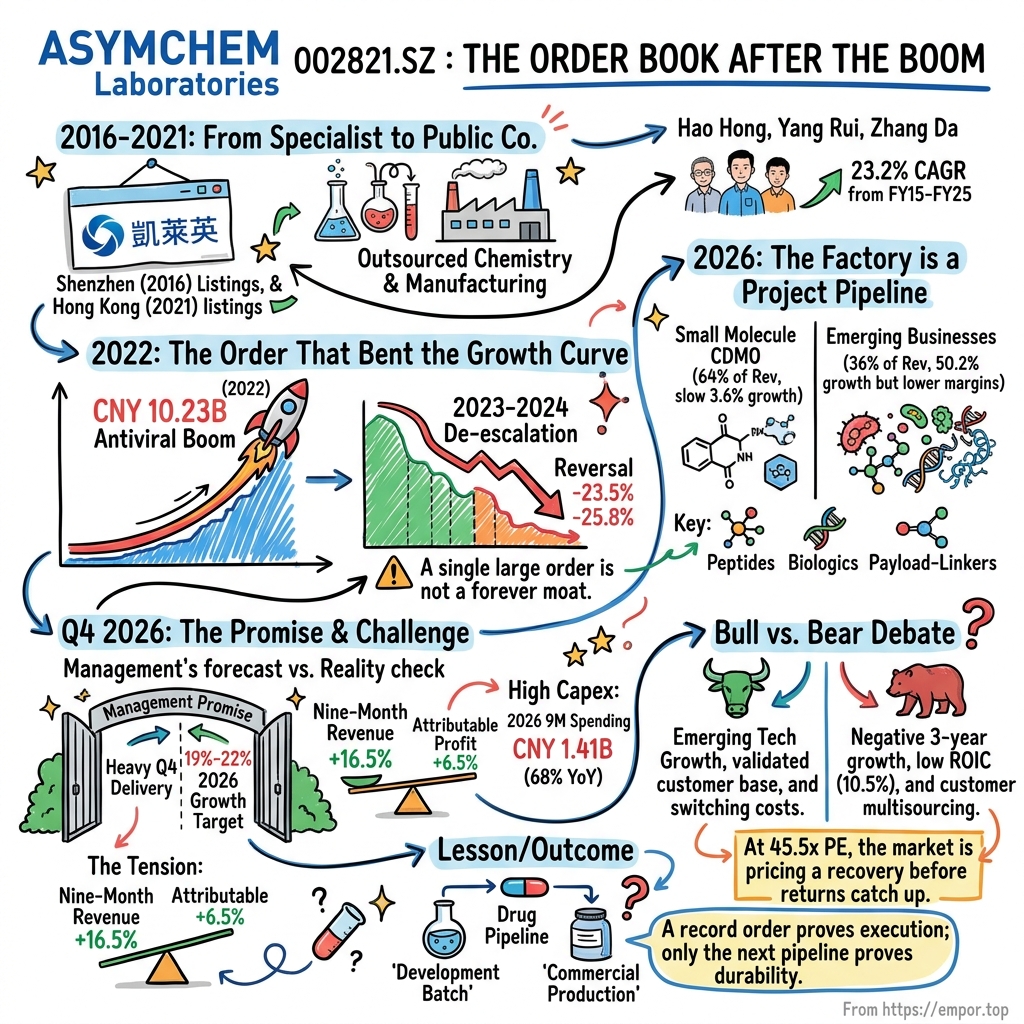
Management's answer was confident and specific. New orders signed in the third quarter had grown at a double-digit pace, around 30% against a demanding comparison from the year before.1 Then came the line that framed everything that followed. Judging by the orders already in hand and waiting to ship, the company said, the fourth quarter's delivery load was "非常重", very heavy, and "确实挑战不小", genuinely no small challenge.1 The company would go all out to deliver, and it was confident of hitting its full-year target of 19% to 22% revenue growth. Looking further out, it expected revenue growth in 2027 to be faster still.1
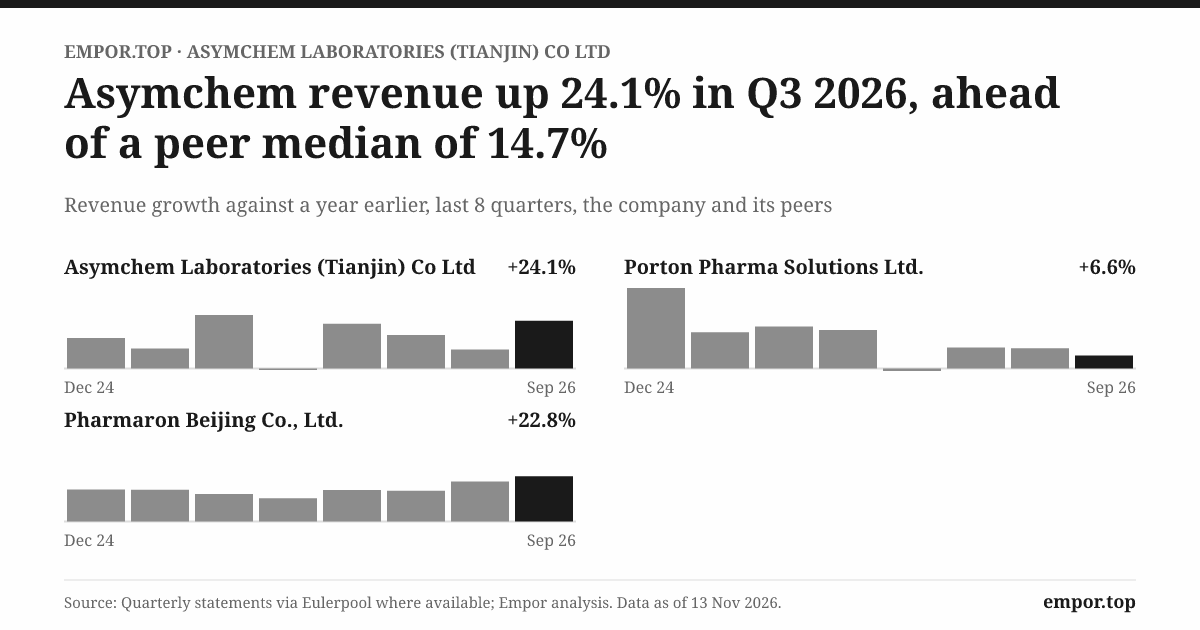
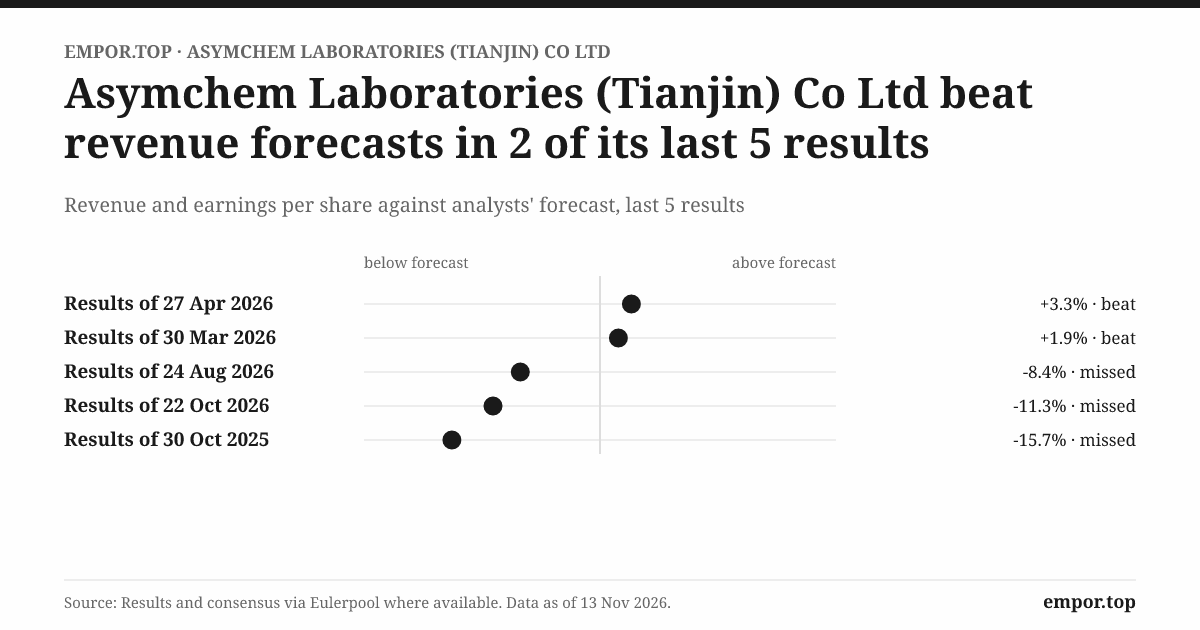
Those are the words of a management team that believes it has turned a corner. The numbers released the same morning tell a more complicated story. Over the first nine months of 2026, revenue rose about 16.5% to roughly CNY5.39 billion.2 Net profit attributable to shareholders rose only about 6.5%, to around CNY850 million.2 Revenue was recovering. Profit was following at less than half the pace.
The arithmetic of the promise is worth doing because it shows how much rides on a few weeks of shipping. Asymchem's 2026 quarters had settled into a remarkably even rhythm of about CNY1.8 billion each, as management itself pointed out on the call.1 Growing full-year revenue by 19% to 22% from 2025's base of about CNY6.67 billion means landing somewhere around CNY7.9 billion to CNY8.1 billion.3 Subtract what has already been booked and the fourth quarter has to deliver something like CNY2.5 billion to CNY2.7 billion, roughly half again as much as any quarter so far this year. A business that has spent nine months producing like a metronome now has to produce like a sprinter.
That is not impossible, and it is not even unusual for this company. Asymchem has been a fourth-quarter business for as long as it has been public, because pharmaceutical customers tend to schedule their large shipments for the end of the year.4 But it does change what an investor should be watching. The question is not whether management sounds confident. It is whether the inventory piled up in the warehouses converts into accepted deliveries, invoices and cash, and at what margin.
There is a second gap hiding inside the first. The company explained that profit lagged revenue mainly because of currency swings, and that "adjusted" net profit, which strips out exchange effects and other items management regards as noise, grew about 22%.2 That explanation is partly fair: the renminbi's moves turned a financial credit in 2025 into a charge of about CNY176 million in the first nine months of 2026, which the company attributed to exchange losses.2 Yet the cleanest measure of the core business, profit excluding one-off items under Chinese accounting rules, was essentially flat over the nine months, rising by a rounding error of 0.04%.2 The third quarter's eye-catching 81% jump in attributable profit leaned on about CNY121 million of fair-value and investment gains booked in that single quarter.2 The recovery in orders and revenue is real. The recovery in earnings power is, so far, a claim waiting for its proof.
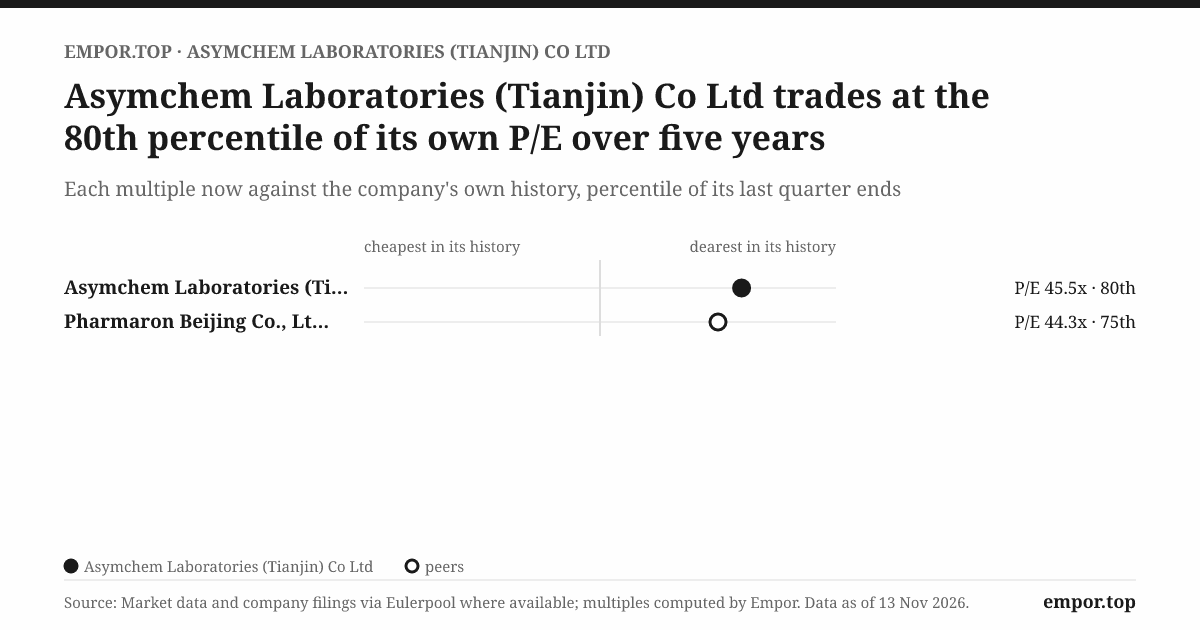
The stakes are larger than one quarter. Asymchem is a company that tripled its profit in 2022 on the back of an extraordinary surge in orders, then watched revenue and profit fall for two straight years as those orders rolled off.3 It has since spent heavily on new factories for newer kinds of drugs, and the stock market prices it at about 45 times trailing earnings, far above its own five-year median of about 29 times.3 Three questions sit underneath that valuation. Can Asymchem return to profitable growth after the post-2022 contraction? Can the new capacity earn its cost? And can a business that lives project by project, molecule by molecule, deserve the kind of premium multiple usually reserved for compounding franchises?
One clarification before the story begins. Asymchem's largest shareholder is an American-incorporated holding company called Asymchem Laboratories, Incorporated, usually shortened to ALAB, which holds a little under a third of the shares and is itself controlled by the founder.23 ALAB is a control link, not an operating business: since a 2010 reorganisation it has been a pure holding company.5 Everything that follows is about the listed group's own economics, its plants, customers and cash.
So keep three tests in mind through the whole episode: delivered work, cash collected, and returns on the assets built to serve it. To see why those tests matter so much here, it helps to go back to how a chemist from Sichuan built a contract manufacturer that big pharma trusted, long before a pandemic made its growth look extraordinary.
 Subscribe on LinkedIn
II. From a specialist to a public company
The founder's résumé reads like a map of how China's pharmaceutical services industry was born. 洪浩 Hao Hong trained as a doctor at Sichuan Medical College, now part of West China Hospital, graduating in 1982. He took a master's degree in medicine in Beijing, then a doctorate in medicinal chemistry from the Chinese Academy of Medical Sciences in 1988.5 Like many of the brightest Chinese scientists of his generation, he went to the United States, working as a post-doctoral researcher at North Carolina State University.5 In November 1995 he founded ALAB in the United States, which initially sold pharmaceutical intermediates to overseas customers.5 In October 1998 he set up a company in Tianjin called Chirachem Laboratories, the predecessor of today's listed group.5
The logic was a classic arbitrage of talent and trust. Western drugmakers needed complex chemistry done reliably, to the exacting quality standards regulators demand, and they were beginning to outsource it. China had large numbers of well-trained chemists and lower costs. What it lacked was a supplier that a Merck or a Bristol-Myers Squibb would trust with a molecule worth billions. Hao Hong's bet was that a company run by someone who had lived inside the American scientific system could bridge that gap. Over time the business focus moved entirely to the Chinese operations under his management.5
The bet paid. By the time Asymchem prepared to list in Shenzhen in 2016, its prospectus could claim that its customers included 11 of the world's top 15 multinational drugmakers.4 The company named its traditional core customers: Merck, Bristol-Myers Squibb, Eli Lilly, Vertex and Novartis.4 Revenue was overwhelmingly from abroad, with North America alone contributing more than three-quarters of core revenue in 2013.4
The same prospectus contains a warning that reads, in hindsight, like the plot summary of this whole story. Look at what happened to individual customers year to year. Revenue from Merck rose about a third in 2014 and then fell by more than 40% in 2015; revenue from Bristol-Myers Squibb fell by about a quarter in 2014 and then more than doubled the next year.4 Asymchem's total grew steadily, but underneath it the big customers were swinging wildly as their own drug programmes moved through development, succeeded, failed or changed suppliers. The company itself spelled out the mechanism. Clinical-stage projects, it wrote, are inherently unsustainable individually and small in scale, so the company needs to accumulate a large number of them. Commercial-stage projects bring stable revenue, but a single drug can disappoint in the market, and the customer can reduce outsourcing.4 It also explained why its receivables looked heavy: customers wanted their deliveries concentrated in the fourth quarter.4 The October 2026 delivery crunch, in other words, is not a new phenomenon. It is the company's oldest habit.
The Shenzhen listing came in late 2016, raising capital for the existing business.4 Five years later, in December 2021, Asymchem went to Hong Kong as well. It sought up to about $968 million, offering 18.4 million H shares at up to HK$410 each, in the middle of a Hong Kong listing boom.65 The use-of-proceeds plan is the most revealing document for understanding today's capacity bet. At the midpoint of the price range, the company expected net proceeds of about HK$6.7 billion. Only about a fifth was earmarked for the core small-molecule business, mainly a second phase of a site in Zhenjiang. About 35% went to "emerging services": oligonucleotides, peptides, antibodies, antibody-drug conjugates, biosynthesis, drug products and even cell and gene therapy. Another fifth went to research and development.5 The new shares slipped on their first day of trading.7 That detail matters less than what the money was for: the 2021 offering was a down payment on the newer businesses that management is now asking investors to believe in.
The longer record shows a genuine operating business. In renminbi, revenue grew about 23% a year from 2015 to 2025, and net profit about 22% a year.3 That decade-long compounding is real. But a single number hides the shape of the curve: years of steady growth around 25% to 35%, one explosive spike, and a sharp reversal. Treat the spike as the new normal and every forecast built on it breaks.
The people steering the company today are largely the people who built it. Hao Hong remains chairman and chief executive.3 He was 65 at the time of the Hong Kong listing, which makes him one of the longest-serving founder-CEOs in the global contract manufacturing industry.5 Beside him is co-CEO 杨蕊 Yang Rui, a career-long insider who joined in April 1999, straight out of an engineering degree at the Tianjin Institute of Light Industry, and worked her way through administration, import-export and accounting into the executive suite.5 She later took an EMBA from Peking University and was named a Tianjin Model Worker in 2020.5 Zhang Da, the chief operating officer and chief financial officer, brings a very different background. He spent eight years at the China Securities Regulatory Commission, from 2006, then served as a director and board secretary at an internet company before joining Asymchem as CFO in August 2018.5 A founder-scientist, a lifer operator and a former securities regulator: it is a team built for continuity, with one member who knows exactly how capital markets read a company.
The ownership structure keeps power concentrated. ALAB held about 31.9% of the shares at the end of 2025, and the annual report identifies Hao Hong as ALAB's controlling shareholder and the group's actual controller.8 He also holds about 3.9% directly.2 The company runs employee share schemes and has repurchased its own shares, and in the first nine months of 2026 the treasury-share account grew by about CNY300 million while employees paid in about CNY365 million to subscribe for incentive shares.2 Those programmes give the team a stake in the share price. They do not guarantee good per-share outcomes, and in a controlled company the minority investor's protection is the quality of the decisions, not the vote.
Which brings us to the decision point that defines the modern Asymchem: what it did when the biggest order in its history arrived.
III. The order that bent the growth curve
In early 2023, Asymchem stood in front of investors with a slide that would have been unimaginable a few years earlier. For the first time in its history, revenue had passed CNY10 billion.9 The headline figure for 2022 was about CNY10.23 billion, up roughly 121%. Net profit attributable to shareholders rose about 209%, to roughly CNY3.3 billion.9 Free cash flow turned positive for the first time in three years.9 The slide's title was honest about why: "Driven by Large Orders in 2022, Our Revenues have Surpassed RMB10bn for the First Time in our Corporate History."9
The large orders were commercial-stage projects for antiviral drugs.9 The company did not name the customer in its presentation, and the details of the contracts are not public. What it did disclose is their scale. The high-quality delivery of large orders, management said, generated revenue of about CNY5.91 billion in 2022.9 Pause on that. More than half of the record year's revenue came from a handful of pandemic-era antiviral projects. Commercial-stage revenue as a whole tripled to about CNY7.6 billion, at a gross margin of about 50%.9
This was a genuine execution achievement and should be credited as one. Making an active pharmaceutical ingredient or its intermediates at that volume, on that timetable, to the quality standards of a global drugmaker under emergency conditions, is exactly the capability a contract development and manufacturing organisation, or CDMO, exists to sell. Few companies in the world could have done it. Asymchem won the work because its customers already trusted its process chemistry and its plants.
But a capability proven once is not the same as demand that recurs. The pandemic orders were, by nature, a one-time surge, and the company knew it. In its 2023 interim presentation, the slide title had shifted to "Strive to Maintain a Strong Position after Securing Large Orders."10 The arithmetic in that deck is the clearest window into how lopsided the business had become. In the first half of 2023, small-molecule CDMO revenue was about CNY4.06 billion, but excluding large orders it was about CNY2.13 billion.10 Commercial-stage revenue was about CNY3.21 billion, of which only about CNY1.28 billion came from ordinary work.10 Nearly half the core business was still the tail of the antiviral surge.
Then the tail ran out. Revenue fell by about 23.5% in 2023 and by another 25.8% in 2024, bottoming at roughly CNY5.8 billion.3 Net profit fell harder, by about 31% and then 58%, to under CNY1 billion in 2024.3 The operating margin, which had been in the low 30s during the boom, sank to under 19%.3 Return on equity, above 21% in 2022, dropped to under 6%.3 The company did not shrink back to its pre-pandemic size; 2024 revenue was still well above 2021's. But the investor who had extrapolated 2022 got roughly a third of the profit they had paid for.
Did management separate the surge from the underlying trend clearly at the time? In fairness, largely yes. The 2022 and 2023 decks consistently broke out "excluding large orders" figures and named the antiviral projects as the source.910 The problem was less disclosure than what happened to the underlying business once the large orders were gone. Small-molecule demand from biotech customers was also entering a funding winter, and the 2024 annual-results presentation showed commercial-stage revenue excluding large orders growing only modestly, while emerging-business revenue was nearly flat that year.11 The extraordinary peak hid an ordinary slowdown beneath it.
Seen over the full decade, the episode does two things to the investment case. It confirms that Asymchem can execute at scale for the world's largest drugmakers, which is a real asset. And it falsifies the idea that order momentum, by itself, is evidence of a moat or a forecast. The biggest order book in the company's history produced its sharpest contraction. Management now promises faster growth in 2027 on the strength of new orders.1 That promise has to be earned through a broader pipeline of repeatable projects and timely commercial deliveries, not the return of one exceptional customer.
Revenue returned to growth in 2025, up about 15%, and profit rose about 19%.3 The recovery story centres on the newer modalities that the Hong Kong money was raised to build. Which leads to the question that defines the rest of this story: can those businesses become durable revenue at attractive economics, or are they a fresh source of volatile demand that requires even more capital? To answer that, it helps to understand what Asymchem actually sells, and why a good year for drug development can still produce bumpy results.
IV. The factory is really a project pipeline
Imagine a biotech company in Boston or Shanghai with a promising molecule. In the laboratory, its chemists made a few grams through a route that worked once, on a bench, with expensive reagents and steps no factory would tolerate. Now the molecule is heading into human trials, and the company needs kilograms, made consistently, documented to regulators' satisfaction. If the trials succeed, it will need tonnes.
That journey is Asymchem's business. Its chemists redesign the route so it can be run safely and cheaply at scale, a craft called process development. Its plants then make the material for clinical trials. If the drug is approved, the same process, now locked in and validated, moves into commercial manufacturing. Think of it as the difference between a chef's recipe and a food factory's production line. The recipe tells you the dish can be made. The production line tells you it can be made ten thousand times, identically, at a price someone will pay. Asymchem sells the translation from one to the other.
The commercial rhythm follows from that. Early-stage projects are numerous, small and often die with the molecule. Late-stage and commercial projects are fewer but far larger, with longer execution cycles and heavier planning. The company says such projects typically ship in concentrated batches in the second half of the year.2 There is no subscription here, no seat licence and no standard minimum commitment; Asymchem discloses no group-wide share of recurring revenue and no standard contract length.32 Revenue arrives when a customer's programme reaches a point where it needs material and accepts what was delivered.
The balance between those two kinds of work has always moved the numbers. In the years before the Shenzhen listing, clinical-stage projects made up roughly half of Asymchem's core revenue, and commercial-stage projects slightly less; in 2015, clinical work was about 56% and commercial about 39%. By the first half of 2016, the commercial share had jumped to about 65%.4 Neither half was stable on its own. The company's growth came from keeping enough clinical projects in the funnel that some would graduate into commercial supply, and that funnel logic is still the model a decade later. The difference now is that the funnel runs through several kinds of chemistry and biology at once, each with its own plants.
The funnel's shape explains why patience is built into the model. In 2022, the boom year, Asymchem counted about 297 pre-clinical and early clinical small-molecule projects, 62 in phase III and 40 at the commercial stage.9 Two years earlier, the comparable counts had been about 147, 42 and 32.9 The wide mouth of the funnel nearly doubled; the narrow end, where the money is, grew by a quarter. That ratio is not a failing. It is how drug development works: most molecules never reach the market, and a CDMO's long-term revenue depends on how many of its projects survive and how many of the survivors stay with it. It also means that today's surge in early peptide, oligonucleotide and ADC work will take years to show up as commercial revenue, and only a fraction of it will.
On the October 2026 call, management gave two reasons for the heavy fourth quarter. A large share of small-molecule revenue now comes from late-stage clinical and commercial projects, whose shipping schedules drive when revenue is recognised. And the newer businesses in peptides and biologics have longer delivery cycles; in particular, peptide process-validation projects, known as PPQ batches, were concentrated in the fourth quarter.1 A PPQ run is the dress rehearsal before commercial launch: consecutive batches that prove to regulators that the process works reliably at full scale.
The business now has two halves. In the first nine months of 2026, the small-molecule CDMO business, Asymchem's historic core, generated about CNY3.47 billion, roughly 64% of revenue, up only about 3.6%.2 The "emerging" businesses generated about CNY1.92 billion, roughly 36% of revenue, up about 50%.2 Emerging is a catch-all for chemical macromolecules such as peptides and oligonucleotides, biological macromolecules such as antibodies and antibody-drug conjugates, and drug-product services, where Asymchem makes the finished dosage form rather than just the active ingredient.2 The company said growth there was strongest in exactly those three areas.2
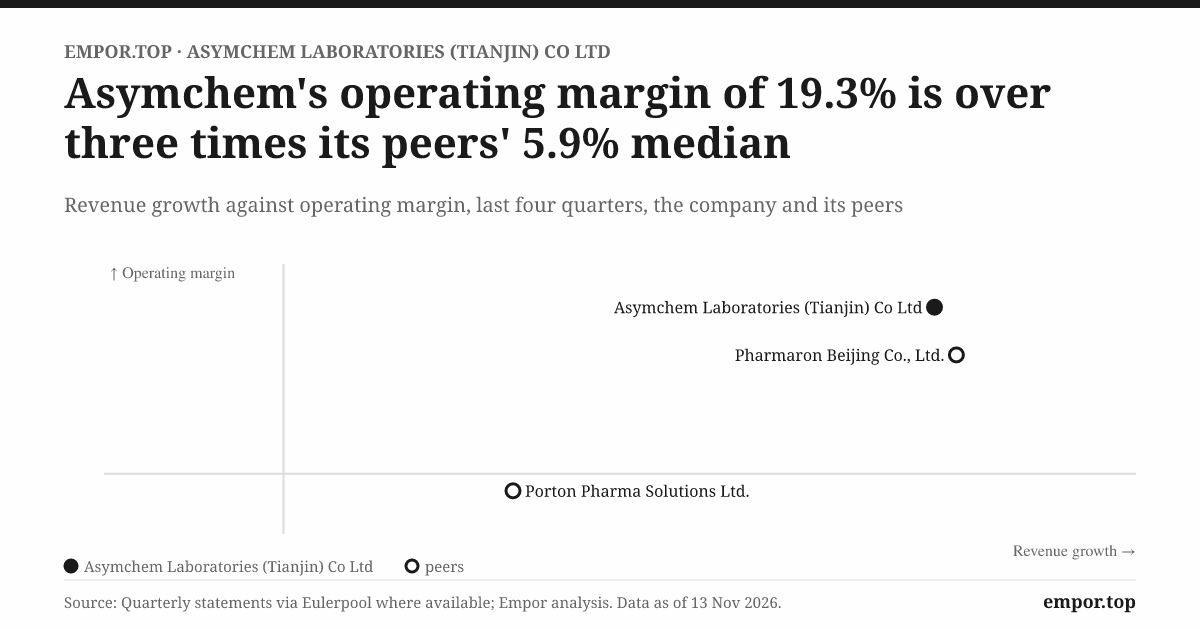
The headline mix shift sounds like a straightforward upgrade, but growth is not the same as profit contribution. The 2024 presentation put the emerging businesses' gross margin at only around 20%, against roughly 48% for small molecules.11 The newer businesses have improved since. In the first nine months of 2026, small-molecule gross margin was about 48%, and emerging-business gross margin about 31%.2 That is a meaningful step up for the newer lines. But it still means that every yuan of revenue shifting from small molecules to emerging services, at today's margins, earns about two-thirds as much gross profit. A rising emerging share can therefore lift revenue growth while diluting the group's average margin. The group's gross margin for the nine months was about 41.9%.2 For the mix shift to improve returns, the emerging margin has to keep closing the gap as new plants fill up, which is precisely what management is promising. On the call, it said emerging-business margins would rise further as capacity ramps and as late-stage and overseas projects grow as a share of work.1
The October call also offered the most concrete operational detail management has given in a while. Capacity utilisation, it said, had been broadly stable across the first three quarters.1 The existing peptide capacity will run at a relatively high utilisation rate in 2027, and the company is planning new peptide capacity. Payload-linker capacity, the chemistry that attaches a toxic payload to an antibody in an antibody-drug conjugate, was "非常紧张", very tight, and new capacity was being built at speed.1 Antibody and fusion-protein orders had grown rapidly, especially in the third quarter. Asymchem passed a pre-approval inspection, or PAI, during the quarter on an integrated ADC project, which management said means commercial production will begin next year, and it expects biologics capacity to remain short for the next two years.1 In sterile drug products, the company has added commercial capacity in cartridges, pre-filled syringes and blow-fill-seal containers over the past two years and has begun to take on later-stage projects.1 More than half of ADC orders now come from overseas.1
There was a broader claim too. Asked whether Chinese rivals were overbuilding in ADCs and oligonucleotides, management argued that these businesses demand higher technical barriers, more complex processes and stronger quality systems than small molecules, and that Asymchem had already earned its "船票", its ticket aboard the ship, in these fields. Such tickets, it said, are scarce globally, and supply will lag demand growth for the next few years.1
It is worth keeping technical milestones and commercial proof in separate boxes. A passed PAI inspection, a PPQ campaign or a new facility shows readiness. Utilisation, repeat orders and segment margins show whether customers are paying enough to support the asset. The 2022 story already demonstrated that Asymchem can execute. The open question for the newer modalities is whether each new line becomes a stream of repeat commercial work like the best small-molecule relationships, or a series of one-off projects that keep the plants busy for a year and then leave them waiting.
The small-molecule core has its own question. Management described it candidly as still "处于调整阶段", in a period of adjustment, and said it would emerge from that adjustment next year, with 2027 performance clearly better than 2026 based on orders.1 Growth in the third quarter came from both commercial and clinical projects, with clinical work growing faster.1 An even more forward-looking bet sits in oral cyclic peptides, which management called a key focus area and possibly the next blockbuster category after peptide weight-loss drugs, with orders from domestic, overseas and out-licensed Chinese programmes.1 That is a management view of where the market is going, not yet a revenue line.
The research engine behind all this is large. Asymchem spent about CNY593 million on research and development in 2025, slightly less than in 2024, and research intensity fell to just under 9% of revenue from about 10.6%.312 Its research staff grew to about 5,240 from about 4,650.12 That combination is consistent with a company leaning on its technical people for process improvement while holding spending flat as revenue recovered.
So Asymchem's product is a pipeline of projects, and its factory is the place where those projects become revenue. That raises the next question, the one every CDMO investor eventually has to answer. Once a drugmaker has its process running at Asymchem, why would it stay? And how much bargaining power does the customer keep?
V. The moat has to survive a second source
Picture the moment of decision from the sponsor's side. A drugmaker's molecule has cleared its pivotal trial. Its chemistry runs in Asymchem's reactors, documented in batch records that regulators have reviewed. Moving it now would mean transferring the process to a new plant, re-running validation batches, filing changes with regulators and accepting the risk that something goes wrong in a scale-up that worked fine the first time. Most sponsors, at that moment, stay put.
That is the essence of the CDMO moat, and it is genuine. Validated processes, quality history and the cost of requalifying a supplier make late-stage relationships sticky. The deeper Asymchem is in a programme when it reaches commercial scale, the harder it is to dislodge. The company's long-standing customer list, which already included most of the world's largest drugmakers at its 2016 listing, suggests that this trust has been built and sustained over decades.4 At that listing, Asymchem described two of those multinationals as long-term strategic partners and said five treated it as a preferred supplier.4 It also disclosed something more concrete than a label: a long-term cGMP supply agreement with a subsidiary of Merck, the kind of contract that turns a project relationship into a recurring one.4 Preferred-supplier status matters in this industry because big drugmakers keep short lists, and a company on the list gets the first call when a new molecule needs a home.
There is a useful way to think about what a sponsor is really buying. It is not tonnes of chemistry; it is the absence of surprises. A failed batch at commercial scale can delay a launch, and a delayed launch for a blockbuster drug can cost its owner far more each week than a year of manufacturing fees. That asymmetry is why sponsors pay for track record, and why reliability, more than price alone, tends to decide who gets the work. The 2022 antiviral campaign was a public demonstration of that capability.
But stickiness at one project is not the same as power over the customer. The industry map shows why. Asymchem competes with China's giant, 药明康德 WuXi AppTec, which reported about CNY45.5 billion of revenue in 2025, roughly seven times Asymchem's.13 It competes with 康龙化成 Pharmaron, with 博腾股份 Porton Pharma, and with large Western and Indian CDMOs. WuXi's business mix differs and its scale includes discovery and testing services Asymchem does not offer, so the comparison is a sense of size, not a like-for-like margin test. The point is that Asymchem is a major player in a crowded field, not a monopolist in a niche.
Buyers know this. A drugmaker can use multiple vendors on the same molecule, qualify a second source for security of supply and send its next project elsewhere. The customer base has broadened since the antiviral boom: by mid-2025 Asymchem reported more than 150 CDMO customers, with large pharma contributing about 47% of first-half revenue and small and mid-sized pharma about 53%.[^14] In the first nine months of 2026, revenue from large pharma grew about 22% while revenue from small and mid-sized drugmakers grew about 12%.2 Yet concentration remains. At the end of 2025, the single largest customer accounted for about 12% of trade receivables and contract assets, and the top five for nearly 39%.3 Asymchem does not disclose those customers' share of revenue, but a receivables book that concentrated tells you that a handful of relationships still carry outsized weight.
The prospectus history offers the strongest internal evidence on how customers behave. Asymchem's largest customers' volumes swung sharply from year to year, even in long-standing relationships.4 That is exactly what you would expect if switching costs protect individual projects without guaranteeing the flow of new ones. The antiviral surge offered a more dramatic example: enormous volume arrived and left with the life cycle of a single class of drugs.9
So what does the moat look like when tested properly? The strongest plausible source of power, in Hamilton Helmer's terms, is switching costs from validated processes and execution history. Scale may also help on complex late-stage projects, where customers want a supplier that can handle large volumes and multiple modalities. But Asymchem does not publish the data that would show these advantages compounding: no retention series for customers, no win-and-loss record for late-stage projects, no price-realisation trend and no market-share history. Customer counts and order growth are encouraging, yet they are inputs, not proof. The honest verdict is that the moat is narrower than the 2022 numbers implied: real at the level of the individual validated project, unproven at the level of the customer relationship and the pipeline.
The bear mechanism is easy to describe. Customers multi-source, expand their approved-vendor lists, or push work to competitors that offer lower prices or more capacity. The result would be lower utilisation, weaker pricing or lost late-stage projects, and it would show up first in the newer modalities, where many Chinese rivals are adding capacity at once. Management's answer is that technical barriers and quality systems limit how many suppliers can actually serve big customers in peptides, ADCs and oligonucleotides.1 That may well be true today. The evidence that would confirm it is project conversion, repeat orders from the same customers and stable or rising emerging-business margins as rival capacity comes online.
Geopolitics deserves a precise rather than a sweeping treatment. Asymchem's overseas customers are its main source of demand: in the first nine months of 2026, overseas customers generated about CNY3.6 billion of revenue, about two-thirds of the total.2 That access is an advantage and a risk. In early 2024, American legislators moved to restrict federal dealings with certain Chinese biotech companies, and the named targets included WuXi AppTec.14 WuXi's shares later rallied on hopes that sanctions would be less severe than feared.15 Asymchem was not the focus of those headlines, and its own filings do not report a measurable direct effect on its business. The right conclusion is not that policy risk is irrelevant, but that it operates through customer procurement decisions: if American sponsors decide to diversify away from Chinese suppliers in general, Asymchem's overseas order book would feel it regardless of what any statute names. Recent evidence points the other way for now, with overseas revenue growing about 12% at constant currency in the first nine months of 2026.2 Management has also described ADC orders as heavily international.1
Meanwhile, domestic revenue grew about 43%, to roughly CNY1.8 billion, which management attributed to the emerging businesses and a broad recovery in demand from Chinese innovative-drug developers.21 That diversification is a hedge against Western policy risk, though domestic biotech funding is itself cyclical.
The moat, then, has to survive a second source. Switching costs protect the projects Asymchem already runs. They do not protect the next project from going elsewhere. To win the next wave of work, Asymchem has to have the right capacity in the right modality at the right moment. That is exactly where it is spending.
VI. The capacity bet moves from small molecules to new modalities
Factories built for drugs that have not yet been approved are bets with long fuses. You pour concrete, install reactors and clean rooms, hire the people and train them, and only then, often years later, find out whether the customer's molecule succeeded and whether the work will repeat. In October 2026, management described capacity constraints in the newer businesses it has been building.1
The spending is accelerating to match. In the first nine months of 2026, Asymchem paid about CNY1.41 billion for fixed assets, intangibles and other long-term assets, up about 68% on the same period a year earlier, and more than the CNY1.27 billion it spent in the whole of 2025.23 The company said new buildings and equipment drove the increase.2 Prepayments for equipment and construction rose by about half, and payables to equipment suppliers and contractors rose too.2 Management said on the call that it had raised its capital-spending plan for the year, and that spending is tilted mainly toward the emerging businesses.1 A new small-molecule base in 泰兴 Taixing is at an early stage, and most of its capital spending will fall next year.1
Put the growth vector in proportion. The emerging businesses are already about 36% of revenue and growing fast, which makes them financially material.2 The small-molecule core still produces most revenue and most of the gross profit. The capacity bet is therefore not a side project. It is the company's main use of capital, aimed at the faster-growing but lower-margin half of the business.
Now set the investment against the returns. In 2025, return on equity was about 6.4% and return on invested capital about 10.5%, compared with peaks above 21% and 33% respectively in 2022.3 Return on capital employed, a measure of operating profit against the long-term capital in the business, was under 7%.3 Over the last twelve months to September 2026, those measures barely moved: ROE about 6.6%, ROIC about 10.8%.2 Asset turnover, the revenue each yuan of assets produces, fell from 0.56 in 2022 to about 0.33 in 2025.3 The picture is a company that kept building through the downturn while its existing asset base earned much less than it once did.
Management's capacity claims are concrete enough to test, and each new facility has its own commercial exam. For payload-linkers, the test is whether the new capacity runs as full as the old one and whether integrated ADC projects keep converting from development into commercial supply. For peptides, it is whether the PPQ batches due this quarter lead to commercial orders and repeat production next year. For biologics, it is whether the project that passed its inspection actually launches and whether more follow it. For drug products, it is whether the new sterile lines are filled by later-stage projects rather than early ones. Utilisation, margins and repeat orders will tell the story long before any management statement does.
The capital-allocation record helps calibrate how much confidence those tests deserve. Over the past decade, Asymchem funded its expansion mainly with equity: the 2016 Shenzhen listing, a 2020 private placement and the 2021 Hong Kong offering.5 Shareholders' equity grew about 35% a year over the decade, much faster than profits.3 That expansion did buy real growth, and the company never needed significant debt. But it also explains part of the decline in returns: a much larger equity base now has to earn its keep, and in 2024 and 2025 it did not do so at anything like the boom-year rate.
Acquisitions have been a sideshow by comparison. The most notable was GoalGen, a Tianjin clinical research organisation founded in 2007. Asymchem announced the acquisition of all of it in September 2020, paying about CNY30 million in instalments, with the last settled in May 2021.5 GoalGen's revenue for 2019 had been about CNY53 million, and its net profit about CNY4 million.5 On those historical figures, the price was roughly 0.6 times sales and about 7 times profit. That looks modest, but a single year's numbers for a small clinical-services firm are not enough to call it cheap or dear; what matters is whether it fed clinical projects into Asymchem's manufacturing, as management intended.5 The company also took a minority stake in Snapdragon Chemistry, an American flow-chemistry specialist, for about $7 million in 2020.5 These were capability purchases measured in tens of millions, a rounding error next to the billions going into plants. The capital-allocation question is overwhelmingly a capex question.
The Hong Kong prospectus showed how long this capacity story has been told. In 2021, management earmarked about 35% of the offering's net proceeds for emerging services, including facilities for oligonucleotides, peptides, antibodies and ADCs, and another 5% for cell and gene therapy.5 Five years later, peptides, ADCs and biologics are the growth engines, while cell and gene therapy barely appears in the current conversation. That is a reasonable record of picking the right modalities, with one bet that has so far not become a material revenue line. It is also a reminder that the conversion from capacity to profit takes years, not quarters.
A skeptical investor would put the challenge bluntly. Why keep building ahead of demand when ROIC is around 10%, free cash flow is negative and the last great order surge reversed within two years? Management's answer, implicit in the October call, is that this time the demand is broader: many customers, several modalities, a larger domestic base and orders growing about 30%.1 The difference from 2022 is plausible. The 2022 orders were a few giant projects for one class of drugs; today's growth spans many smaller ones. But the burden of proof sits with utilisation and margins, and the record so far shows emerging-business margins still well below the core.
The expansion responds to specific, reported demand and capacity constraints. It also raises the bar: orders must become production at margins high enough to cover depreciation and the cost of the capital tied up. The best evidence that the bar is being cleared will not come from the factories at all. It will come from the cash flow statement.
VII. The cash is real, but it has a job
A late-stage manufacturing campaign is a cash machine in reverse before it becomes a cash machine. Asymchem buys raw materials, runs batches for weeks, holds the finished material while the customer's quality team tests it, ships it, waits for acceptance and then waits again for payment. Every step ties up money. Only at the end does the cash come back, with a margin on top.
Over the long run, that cycle has worked. From 2014 to 2025, Asymchem's cumulative operating cash flow was about CNY12.1 billion against cumulative net profit of about CNY11.3 billion, a conversion rate of about 107%.3 That is reassuring: the reported profits were real, and they turned into cash. There is no sign of a business booking revenue it never collects.
But operating cash is not free cash. Over the same twelve years, free cash flow after capital spending totalled only about CNY1.8 billion, while dividends paid came to about CNY2.5 billion.3 In other words, the company has paid out more in dividends than its operations generated after investment, and it has been able to do so because of the capital it raised in the equity markets and the interest and gains on the cash it held. That is not reckless; Asymchem has carried almost no debt. But it means the dividend has been supported by the balance sheet, not funded entirely by the business, and every yuan of new capex now competes with that payout.
The annual picture swings hard with working capital. In 2025, operating cash flow was about CNY1.41 billion against attributable profit of about CNY1.13 billion, a healthy ratio. Underneath, inventory absorbed about CNY336 million and receivables about CNY266 million, partly offset by about CNY341 million from higher payables.3 In 2026 the swing has turned the other way. Operating cash flow in the first nine months fell about 47%, to around CNY605 million, while inventory jumped about 65% from the year-end, to roughly CNY2.43 billion, which the company attributed to the delivery cycle of its orders.2 Spending on fixed assets that same period was more than twice operating cash flow.2 Free cash flow for the nine months was therefore deeply negative, about minus CNY800 million.
There is a positive signal hiding in the balance sheet, too. Contract liabilities, which mostly represent customer prepayments, rose about 66% to about CNY420 million.2 Customers paying in advance is a sign that they want their place in the queue. Combine that with the inventory build and the heavy-fourth-quarter guidance, and the most likely explanation is the one management gives: material is being built for deliveries that will be recognised late in the year. The test is simple and arrives soon. If inventory falls and receivables rise in the fourth quarter, followed by collections early in 2027, the build was a timing effect. If inventory stays high, it will need explaining.
Receivables quality deserves attention because of the concentration already noted. Debtor days were about 114 in 2025, down from a peak of 145 in 2021.3 Ordinary credit terms run up to 90 days, the company holds no collateral against them, and at mid-2025 about CNY118 million of receivables were aged between one and three years, against total impairment allowances of about CNY134 million.16 By September 2026, net receivables had edged up to about CNY2.08 billion from about CNY1.95 billion at the year-end.2 Asymchem does not identify any specific overdue customer or customer failure in its disclosures, and the provisioning appears to cover the older balances. The year-end ageing will show whether the fourth-quarter deliveries add to the long tail.
The treasury picture needs separating from the operating one. At the end of 2025, Asymchem held about CNY5.8 billion of cash and bank balances, plus about CNY1.5 billion of short-term financial assets at fair value; of the cash, about CNY2.4 billion was in time deposits longer than three months and about CNY540 million was restricted or similar.3 By September 2026, cash had fallen by about a third to roughly CNY4.2 billion, while trading financial assets, mainly bank wealth-management products, more than doubled to about CNY2.5 billion.2 Total liquid resources remain large, but less of them sit in plain cash, and some yield-seeking products carry fair-value movements that flow through profit. The company also took on CNY320 million of long-term bank loans; management said the borrowing was for liquidity management and currency-conversion reasons rather than fundraising, and that funds remained ample.21 Against liquid assets of several billion, the debt is small, and there is no sign of solvency pressure. It is, however, the first bank borrowing of note in years, and it arrived alongside rising capex.
Then there is the noise between operating profit and net profit, which this year has been unusually loud. In 2025, other income of about CNY85 million came mostly from government subsidies, and investment income was about CNY89 million, against profit before tax of about CNY1.29 billion.3 Those items mattered but did not make up the bulk of earnings. The bigger swing factor is currency. Asymchem earns mostly in dollars and holds large dollar balances; at the end of 2025 it had about CNY3.7 billion equivalent of dollar cash and about CNY1.5 billion of dollar receivables.3 Finance expense was a net credit of about CNY331 million in 2024 and about CNY66 million in 2025, both flattered by exchange gains.3 In the first nine months of 2026, it became a charge of about CNY176 million, mostly exchange losses, and the currency effect on cash was about minus CNY195 million.2 The company uses some derivatives, but it does not disclose a group-wide hedging ratio.3
Consider what that means for the earnings an investor is paying for. In 2024, currency gains propped up a weak year. In 2026, currency losses are disguising a better one. Neither is the core business. The cleanest guide remains operating profit, adjusted for those swings, and the cash that comes in from customers.
The verdict on cash is mixed but not alarming. A decade of cash conversion is reassuring. The current inventory build, currency losses and investment needs require a full-year reconciliation before anyone can say the recovery is converting into spendable cash. And the people who will be judged on that reconciliation are the same managers who promised the fourth quarter.
VIII. The management test is delivery, not confidence
Back on the October call, the analysts' questions moved in a telling sequence. First, how strong are orders? Then, how full are the plants? Then, why is the fourth quarter so heavy? Then, why are profits rising more slowly than revenue? Then, finally, why has the company raised its capex plan and borrowed money?1 It was the investor's version of following the cash, and each answer was specific enough to be checked later.
That specificity is a credit to management. Zhang Da and his colleagues answered the questions with specific operational detail, including the bottlenecks and borrowing rationale.1 The prepared quarterly report and the call told the same story on orders and guidance.21 The narrative is consistent.
Consistency is not the same as delivery. The right way to judge this management team is through its behaviour across the cycle, and the cycle has been brutal. During the boom, management was clear that the large orders were extraordinary and broke them out separately.910 It then had to live through two years of contraction, and the profit decline was steeper than revenue, as costs built for a larger business stayed in place. The company eventually changed its tone. In 2026, it described its focus as moving from cost-cutting and efficiency gains to "控本提效", controlling costs while lifting efficiency, aimed at improving business margins and competitiveness.2 The small-molecule margin rose about one percentage point in the first nine months, and nearly three points at constant currency, which suggests some of that effort is showing.2 Asked how much of the margin gain came from cost measures rather than utilisation, management said small-molecule margins improve slowly through operations and mostly through process technology, while the emerging businesses have more room for operational gains.1 That is a candid answer. It is also not a number.
The record on targets is the essential context. A full-year revenue target of 19% to 22% after nine months at 16.5% is ambitious but not reckless, given the company's long history of fourth-quarter concentration and the inventory already built. The more important promise is the 2027 acceleration, which rests on orders and capacity still being commissioned. Investors have seen what happens when growth is extrapolated from an order book: the 2022 peak was followed by a 2024 trough with profit down by about two-thirds.3 Management's guidance deserves weight. It deserves more weight once it is matched by profit and cash, not just revenue.
Incentives and alignment are real but bounded. ALAB's stake of about 31.8% at September 2026, plus Hao Hong's direct holding of about 3.9%, means the controlling family's wealth rises and falls with the share price.2 Employee share schemes extend that stake to key staff, and the company has been buying back stock: its repurchases cost about CNY378 million in cash in the first nine months of 2026, while employees paid in about CNY365 million for incentive shares.2 Put those numbers together and the buyback, for now, largely offsets the new incentive stock rather than shrinking the share count meaningfully. Per-share growth will therefore depend on profit growth, not financial engineering. Asymchem discloses director and senior-management pay in its annual report, but it does not publish a consistent multi-year series that ties executive bonuses to profit or return targets.3 A minority investor can see the alignment from ownership. The link from pay to returns on capital is harder to see.
Governance is clean on the formal tests. The 2025 financial statements and internal controls both received standard unqualified opinions from EY Hua Ming, dated March 30, 2026.3 At the annual general meeting in June 2026, the resolution approving the annual report passed with about 99.8% support.17 Litigation is small: the company disclosed three cases as plaintiff and four as defendant, all below its threshold for major litigation, with about CNY257 million at issue in the defendant cases. One of those, worth about CNY161 million, had been won by the time of the annual report, one was awaiting trial, one was on appeal and one had settled; the company recorded no provision and assessed no material impact.3 Those signals rule out the worst governance fears. They do not substitute for judging capital allocation and minority-holder economics, which is where a controlled company's governance actually shows.
Related-party activity, often a worry in founder-controlled Chinese companies, appears minor here. In the first half of 2025, sales to a related company were well under CNY1 million and purchases under CNY2 million. The one large balance, about CNY114 million owed to ALAB, was a dividend that was paid in July 2025.16 The 2025 annual report showed no related-party operating transactions or debt balances at year-end.3 ALAB charges no royalty or management fee in the disclosed accounts.163 The controlling shareholder deserves monitoring, as any controller does, but related-party sales do not drive this business.
The management record, in sum, is mixed but testable. This team built a scaled business, earned the trust of the world's largest drugmakers, executed the biggest order in the company's history and has now described concrete capacity bottlenecks in detail. It also oversaw a peak-to-trough decline that shows how quickly confident guidance can be overtaken by demand. The answer to whether they deserve confidence will arrive in the numbers for the fourth quarter and then 2027. The market, however, has not waited.
IX. Analysis & Bear vs. Bull Case
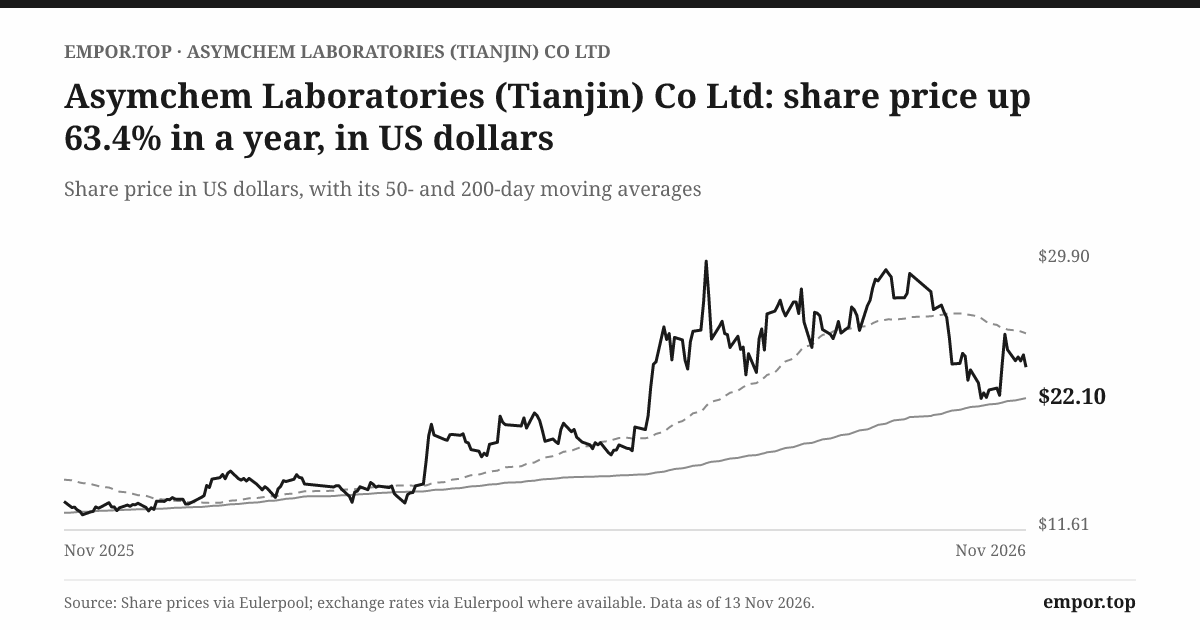
On November 13, 2026, Asymchem's Shenzhen shares closed at about CNY147, giving the company a market value of about CNY54 billion. The stock stood almost 25% below its 52-week high and well above its 52-week low; in a year, it had swung through a range where the high was more than twice the low. Yet even after that fall from the peak, the price was about 45.5 times trailing earnings, compared with a five-year median of about 28.7 times. Enterprise value, which strips out the company's net cash, was about 29.5 times EBITDA, and the earnings yield was only about 2.2%.32 Over the past three years, revenue had fallen about 13% a year and net profit about 30% a year.
That is a strange pattern: a multiple far above the company's own history while its trailing growth record is negative. The market is clearly not paying for what Asymchem has done over three years. It is paying for what it expects the next three to look like. For context only, around the same date, third-party market data showed WuXi AppTec at about 20 times trailing earnings and about 14 times EBITDA, and Pharmaron at about 34 times EBITDA.[^19][^20] Their business mixes and accounting differ, so these are rough reference points. But they show that Asymchem is priced well above the sector's largest player and closer to a company the market treats as a recovery story.
The bull case starts from substance. The small-molecule business is a large, profitable base with gross margins near 48% and decades of relationships with major drugmakers.24 The emerging businesses grew about 50% in the first nine months of 2026 and are now more than a third of revenue.2 Orders grew about 30% in the third quarter, prepayments are rising, and management tied specific capacity shortages to specific modalities and milestones.12 The trailing earnings also understate the business: currency losses depressed reported profit, and adjusted net profit grew about 22%.2 If the fourth quarter lands and 2027 accelerates as promised, today's multiple of trailing earnings could compress quickly as earnings rise.
The bear case is grounded in the company's own history. Revenue and profit contracted sharply after 2022, demonstrating that volume can disappear faster than the asset base built to serve it.3 Profit excluding one-off items was flat in the first nine months of 2026 even as revenue grew.2 Emerging-business margins, though improving, remain far below the core, so the faster the mix shifts, the harder the group margin has to work.2 Capex is rising, free cash flow is negative, inventory is swelling and currency swings can wipe out much of the operating improvement in any given year.2 On this reading, the stock is pricing in a return to boom-like returns before the company has shown it can earn them.
Holding both together requires the industry structure. Run through Michael Porter's five forces and the picture is clear. Buyer power is substantial: customers are large, sophisticated, multi-source when they can, and a few of them hold a big share of the receivables book.3 Supplier power is modest; chemical inputs are mostly commodities, though skilled scientists are scarce and wages rise. The threat of substitution is low in a literal sense, because drugmakers will keep outsourcing complex chemistry, but in-sourcing is always an option for the largest. Rivalry is intense, particularly in the newer modalities where many Chinese companies are building at once, as the analysts on the October call pointed out.1 The threat of new entrants is real at the low end and lower at the top, where regulatory track record and quality systems take years to build.
In Helmer's seven powers terms, the most credible power is switching costs: validated processes, regulatory filings and the risk of moving a commercial process tie a project to its supplier. Process power, the accumulated know-how in route design and scale-up, is plausible given the company's history and research staff, but it is hard to separate from the industry's general competence. Scale economies exist in the ability to run large campaigns and multiple modalities under one quality system, though WuXi AppTec's scale is several times larger.13 There is no network effect, no brand power in the consumer sense, no cornered resource and no counter-positioning that rivals cannot copy. The moat argued here is a real but narrow one: strong inside a validated project, much weaker across the next project decision.
Why could Asymchem win from here? Because its record of executing large commercial campaigns for global drugmakers is proven, because the newer modalities it chose in 2021 have turned out to be the right ones, and because a broader, more diversified order base is a better foundation than the concentrated orders of 2022. If its integrated ADC, peptide and biologics projects convert into commercial supply, the switching-cost moat will extend into businesses with higher growth.
Why might it not? Because customers retain vendor choice, because new capacity is expensive and is being built across the industry, and because technical qualification does not guarantee enough paid production. The 2022 order peak is direct evidence that volume can reverse faster than fixed assets. If emerging-business margins stall in the low 30s while capacity keeps expanding, the mix shift could raise revenue and lower returns at the same time.
The skeptical investor's challenge, then, comes down to one question for management: why build ahead of demand when ROIC is about 10.5% and the free cash flow yield is negative?3 The answer has to be visible in the numbers, not in the commentary. Three measures will show it. The first is revenue and gross margin by segment, where small molecules grew about 3.6% at a margin of about 48% and the emerging businesses grew about 50% at a margin of about 31% in the first nine months of 2026; the direction to watch is whether emerging margins keep closing the gap.2 The second is how orders turn into delivered revenue and utilisation, by modality, starting with the fourth quarter that management has called very heavy; utilisation was broadly stable through the year by management's account.1 The third is operating cash flow after working capital and capex, which fell about 47% in the first nine months while capex rose about 68%.2 When those three move together in the right direction, the bull case will have its evidence. When they diverge, the bear case will.
The valuation, in the end, is a statement about the future that the past does not yet support. Above its own history despite three years of negative growth, the multiple assumes that this recovery is durable and that the new assets will earn far more than the existing ones do today. That is possible. It is not yet proven.
X. Business & Investing Lessons
Put two images side by side. In one, it is 2022, and Asymchem's plants are running flat out on antiviral campaigns that produced more than half the year's revenue.9 In the other, it is late 2026, and new buildings for peptides, payload-linkers and biologics are rising as the company spends heavily on capacity.2 The first image is a surge of orders. The second is steel and concrete waiting for repeat work. Between them sits the whole lesson of this company.
The first lesson comes from the antiviral boom. The company executed brilliantly, as the earlier boom showed.9 Then came the reversal, with revenue falling for two years and profit dropping sharply.3 The success proved the capability; it said nothing about the next year's demand. For founders building service businesses on other people's product cycles, the trap is to treat a record customer win as a new baseline. For investors, the trap is to pay for it as one. A record order can prove execution; only the next pipeline proves durability.
The second lesson comes from the capacity build. In October 2026, management described tight capacity and rising orders.1 Every one of those is a reason to build. None of them is a return. The company's returns remained well below boom-year levels even as it kept adding plants.3 The lesson for any capital-intensive service business is that orders tell you the assets will be used; only margins and cash tell you they will pay. A full order book is a promise to use assets, not yet a return on them.
The third lesson is written in the cash flow statement. Over the long run, Asymchem converted profit into operating cash, but capex left free cash flow short of dividends.3 In 2026, working capital absorbed more cash ahead of the expected fourth-quarter rush.2 Profit is an accounting conclusion; cash is a timing fact. In a business where customers pay months after a batch is made and the biggest shipments cluster at year-end, the gap between the two is where the risk lives. Profits matter; the working capital between shipment and collection decides when they become spendable.
There is a fourth lesson, quieter but just as specific to Asymchem. Its prospectus history showed individual customers could swing sharply from year to year even as total revenue grew.4 The company has always been a portfolio of other people's drug programmes. That is its strength, because a portfolio diversifies, and its limitation, because a portfolio is only as durable as the pipelines underneath it. A CDMO does not own its customers' success; it rents a share of it, one batch at a time.
XI. Epilogue
Tonight, Asymchem stands in the middle of the most consequential quarter it has faced since the antiviral orders ended. The inventory build and customer prepayments,2 alongside management’s fourth-quarter promise,1 have made delivery the open question.
The first moment of truth arrives with the 2026 annual report, likely in the spring of 2027. It will show whether the fourth quarter hit the target, and more importantly, what came with it. If revenue lands in the range and operating profit rises faster than revenue as the new plants absorb their fixed costs, the recovery will have moved from a revenue story to an earnings story. If revenue lands but margins slip because the heavy quarter was weighted toward lower-margin emerging work or required price concessions, the market will have to reconsider what it is paying for. If revenue falls short, the investors who bought the October promise will remember 2022.
The cash statement will answer the second question: whether the working-capital build unwinds as expected, and whether the year-end ageing shows timely collection. Currency will add its usual noise, and the reconciliation of operating profit to net profit, separating exchange movements, fair-value gains and core earnings, will show what the business actually earned.
Then comes 2027 itself, the year management says growth will accelerate. That will be the year to watch peptide utilisation after this quarter's validation batches and the first commercial production from the biologics project that passed its inspection, alongside the ramp-up of payload-linker and sterile drug-product capacity.1 It will also be the year the small-molecule business, by management's account, leaves its period of adjustment.1 Each can test the company's diversification claim.
Beneath all of it sits the question that the last four years posed and have not yet answered. Can Asymchem turn order growth into durable profit without needing another exceptional order? The fourth quarter will not settle it. But it will show whether the company is on the right road.
XII. Outro
Go back to where this story began: not in a boardroom, but in a reactor.
That handoff, from lab scale to commercial batch, is what Hao Hong set out to sell when he left North Carolina for Tianjin nearly three decades ago. It is what made the 2022 surge possible. And it is what the new peptide, ADC and biologics plants are built to repeat.
The fourth-quarter deliveries are the bridge between a growing order book and a credible new earnings curve. Somewhere in Asymchem's plants tonight, a batch is waiting for its customer's sign-off. The question that will define the next chapter is not whether the factory can make it. It is whether, once the exceptional orders are gone, the factory stays busy enough, and paid well enough, to be worth what it cost to build.
References
-
2026 Third-Quarter Investor Meeting Record — Asymchem/CNINFO, 2026-10-23 ↩↩↩↩↩↩↩↩↩↩↩↩↩↩↩↩↩↩↩↩↩↩↩↩↩↩↩↩↩↩↩↩↩↩↩↩↩
-
2026 Third-Quarter Report — Asymchem/CNINFO, 2026-10-23 ↩↩↩↩↩↩↩↩↩↩↩↩↩↩↩↩↩↩↩↩↩↩↩↩↩↩↩↩↩↩↩↩↩↩↩↩↩↩↩↩↩↩↩↩↩↩↩↩↩↩↩
-
2025 Annual Report — Asymchem/CNINFO, 2026-03-31 ↩↩↩↩↩↩↩↩↩↩↩↩↩↩↩↩↩↩↩↩↩↩↩↩↩↩↩↩↩↩↩↩↩↩↩↩↩↩↩↩↩
-
2016 A-Share IPO Prospectus Summary — Asymchem/CNINFO, 2016-10-31 ↩↩↩↩↩↩↩↩↩↩↩↩↩↩↩
-
2021 Hong Kong Global Offering Prospectus — Asymchem/HKEX, 2021-11-30 ↩↩↩↩↩↩↩↩↩↩↩↩↩↩↩↩↩↩
-
The Hong Kong IPO Boom and Asymchem's Offering — Bloomberg Law, 2021-11-30 ↩
-
Asymchem's 2021 Hong Kong Trading Debut — Bloomberg, 2021-12-10 ↩
-
US Rivalry with China Expands to Biotech — Associated Press, 2024-02-19 ↩
-
China's WuXi Shares Rise on Hopes of Less Severe US Sanctions — Reuters via Investing.com, 2024-12-09 ↩
 LinkedIn
 WhatsApp
 Reddit
 Hacker News
 Email
 Kindle
 RSS Feed
 Spotify
 Apple Podcasts
 Amazon Music
 Audible
 YouTube