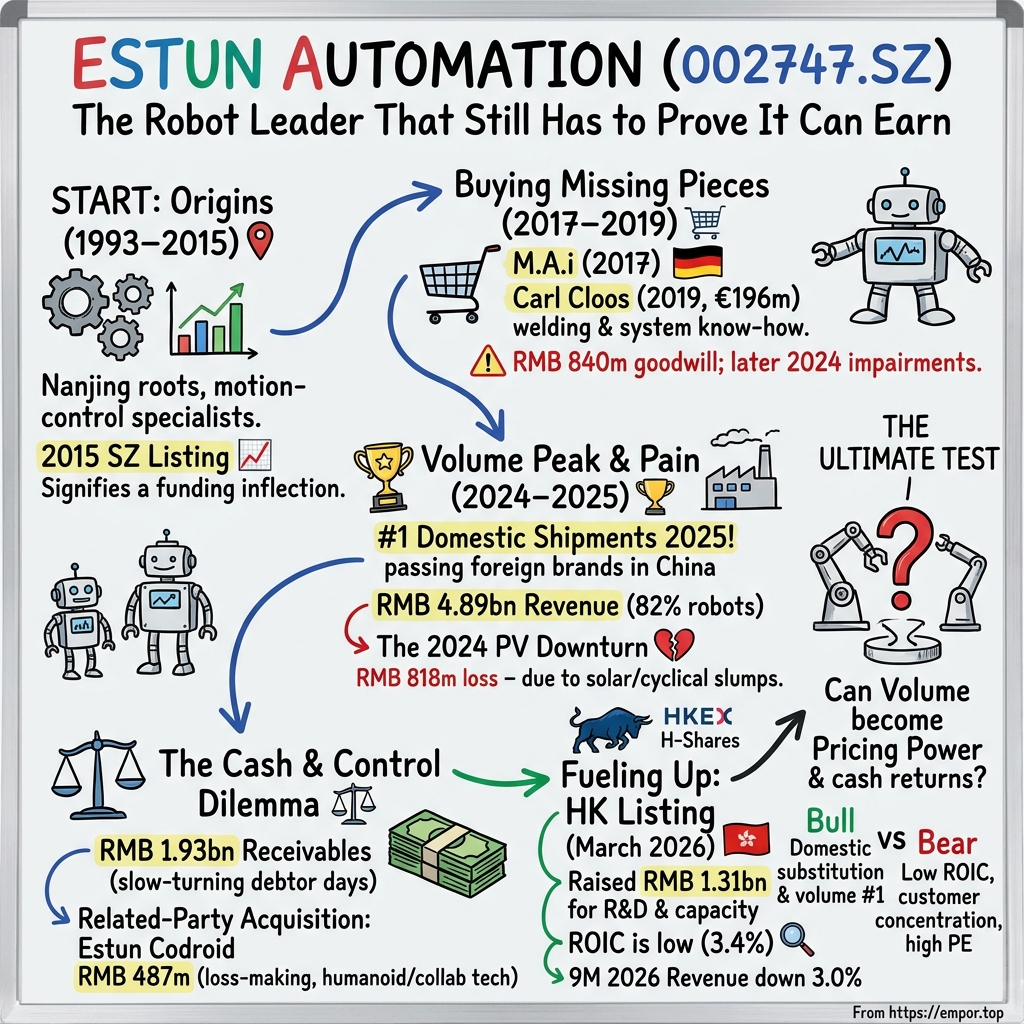
Estun Automation: The Robot Leader That Still Has to Prove It Can Earn
I. The Leader With Two Scoreboards
For most of the history of China's factory-robot market, one fact never changed: the country's biggest buyer of industrial robots bought most of them from foreigners. The familiar arms of FANUC, ABB, KUKA and Yaskawa lined the car-body shops and electronics plants of the Yangtze River Delta, while Chinese brands fought over the cheaper, simpler jobs. Then, in its results for 2025, a company from Nanjing claimed the record had changed. Citing MIR, a Chinese industry research firm, 南京埃斯顿自动化 Estun Automation said its industrial robot shipments had passed those of foreign brands in the domestic market for the first time, making it the first Chinese robot brand to top the country's industrial robot market.1 Its own revenue from Estun-branded robots, it added, had grown by nearly half in a year.1
That is the first scoreboard, and on it Estun is winning. It is a real milestone. A domestic manufacturer moving from also-ran to unit leader in the world's largest robot market changes how a Chinese factory owner feels about buying a local arm: it is no longer a brave choice, just a normal one.
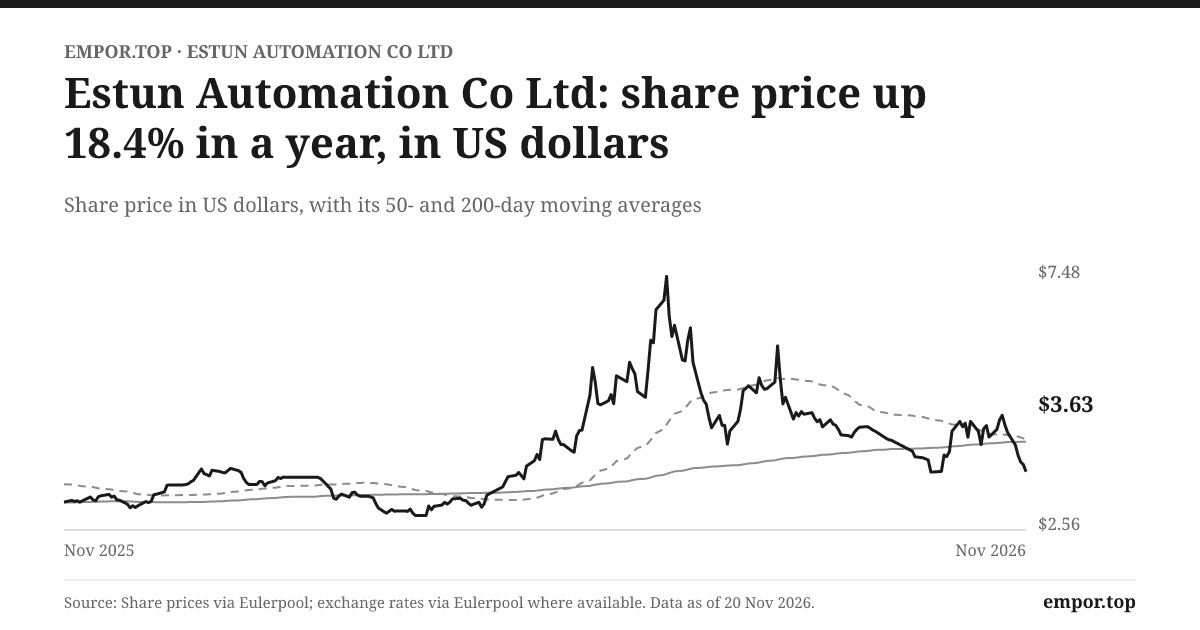
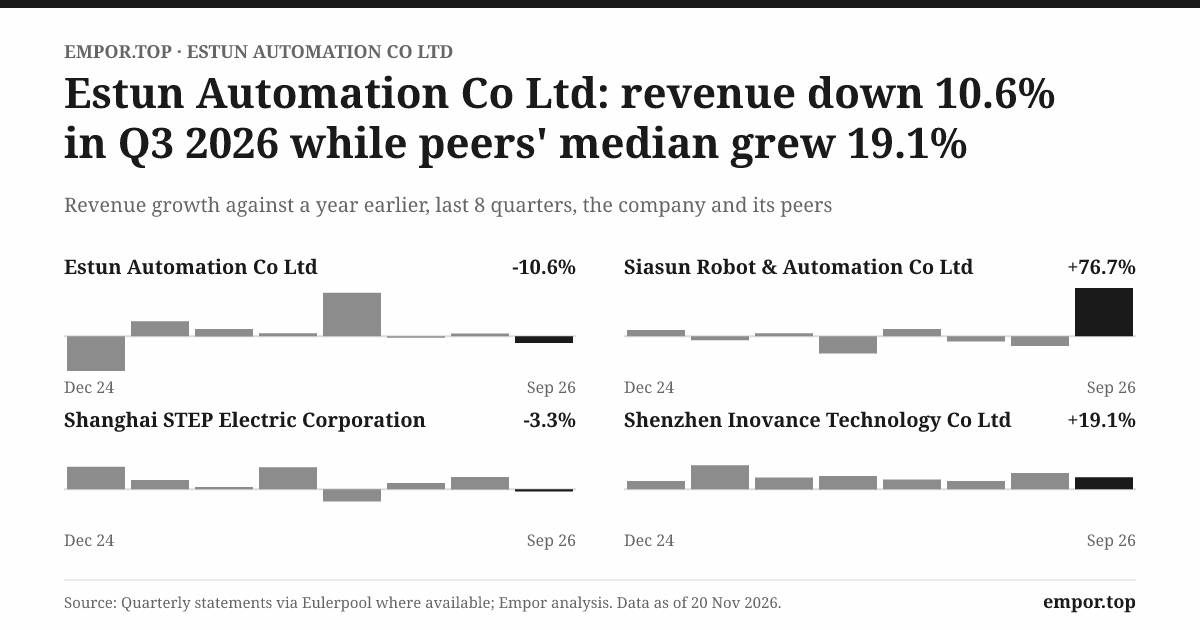
The second scoreboard is the one an owner of the business reads, and it tells a harder story. In the same year that Estun reached the top of the shipment table, it sold RMB4.89bn of goods and services, up about 22% on the year before, and still kept only about RMB41m of profit for its shareholders.1 That came straight after a 2024 in which it lost about RMB818m.1 By the first nine months of 2026, revenue was falling again, down 3.0% against the prior year and down 12.4% in the third quarter alone, measured against prior-year figures restated for an acquisition.2 On 20 November 2026 the A shares closed at RMB24.25, about half their 52-week high of RMB49.00. Across the last twelve reported months, the company earned roughly 3.4 cents of after-tax operating profit for each yuan of capital invested in it.
So which scoreboard is the truth? Both are, and that is the story. There is a genuine improvement buried in the 2026 numbers that a headline about falling sales hides. Over the first nine months, gross margin rose to about 32% from about 28.5% a year earlier, and operating profit was many times larger than in the same period of 2025.2 Sales shrank while each sale became more profitable. That could be the sign of a company that has stopped buying volume with price cuts. It could also be one good stretch of product mix in a cooling market. The difference matters a great deal to anyone paying today's price.
The business at stake is mostly one thing now. Industrial robots, robot workstations and intelligent manufacturing systems, meaning the arms themselves, the cells built around them and whole automated lines, made up about 82% of 2025 sales.1 The older business that gave Estun its start, the servo drives, motors and motion controllers that make machines move precisely, is the smaller remainder. The story here covers the listed Nanjing company and its consolidated subsidiaries, including the German welding specialist Cloos, the British motion-control maker Trio and, from September 2026, the collaborative-robot start-up Estun Codroid. What those businesses earn matters only as it reaches Estun's own accounts.
Three questions run under everything that follows. Can a Chinese robot maker turn domestic substitution, the national push to replace imported equipment with local equivalents, into pricing power and cash rather than just units? Can the string of acquisitions Estun made to assemble its product range earn back what they cost? And can a company controlled by its founder's family, run day to day by the founder's son, convince outside shareholders that their capital is being put to work for them too? The next piece of evidence will not be another ranking. It will be the full-year 2026 accounts: revenue, margins, cash collected from customers and what the money raised and spent in recent years has actually returned.
To see why those questions are hard, it helps to go back to a teacher who became a machinery trader, and to the motion controllers he started building in Nanjing.
 Subscribe on LinkedIn
II. From Motion Controllers to a Robot Maker
吴波 Wu Bo did not start out as an industrialist. He studied mechanical manufacturing at Southeast University in Nanjing, then called the Nanjing Institute of Technology, graduating in 1980, and then taught at Nanjing Forestry University for four years.3 He went back to Southeast for a master's degree in mechanical manufacturing, finished in 1987, and spent the next six years as an officer at the Jiangsu Machinery and Equipment Import and Export Corporation.3 That job matters to the story. A state trading house in late-1980s Jiangsu was where a young engineer could see, contract by contract, which foreign machines Chinese factories had to import and what they paid for the privilege. In March 1993, Wu founded Nanjing Estun Industrial Automation, the business from which today's company traces its history.3 He is now 71, chairman of the board and the company's chief strategic officer.3
What Estun built first was not a robot. It was the nervous system of a machine. In 2001 it launched its first servo drive, the electronics that tell a motor exactly how far and how fast to turn.3 Think of a robot arm as a body: the steel links are bones, the servo motors are muscles, and the drives and motion controller are the nerves and the part of the brain that coordinates movement. A Chinese company that could make the nerves had a credible path to making the whole body, because the hardest part of a robot to copy is not the casting but the control. The roots still show: Estun's motion-control and robot business remains strong in sheet-metal work, where it ranked first among domestic makers of bending robots in 2024 with about 7.8% of the market.3
The present listed company was incorporated in February 2002 and became a joint-stock company in 2011.3 Its first industrial robot model arrived in 2010.3 From there the strategic bet became legible. If Estun could supply the drives, the motors, the controllers, the arms and eventually the software and the cell around them, it could sell a factory owner more of the automation stack and keep more of each project's value in-house. It is an appealing logic. It is also a capital-hungry one, because each layer of the stack needs its own engineers, factories and working capital.
The listing in March 2015 on the Shenzhen Stock Exchange, under the code 002747, was the hinge.3 Before it, Estun was a modest regional controls company. After it, Estun had a public currency and access to equity that it used repeatedly. It issued new shares in non-public placements to outside investors in September 2016 and again in July 2021, and it ran two large bonus-share issues in 2016 and 2017 that multiplied the share count without raising cash.3 It used the stronger balance sheet to buy companies, beginning almost immediately. The growth that followed should not be read as purely organic. A meaningful part of it was purchased.
The money also built things. In 2018 Estun opened a robotic industrial park in Nanjing, where the company says robots build robots on China's first intelligent production line.3 The phrase is marketing, but the logic behind it is serious: a robot maker that automates its own assembly lowers its cost per arm and proves its product on its own floor before a customer ever sees it. By 2021 Estun's annual shipments of industrial robots had passed 10,000 units for the first time.3 Within a decade of listing, a company that had shipped its first robot model in 2010 had become a volume manufacturer, and it had done so by spending, on plant, on people and on other companies.
Measured over a long span, the growth is impressive. Revenue compounded at about 26% a year over the ten years to 2025.4 But the rate has been slowing for a while. Over the five years to 2025 it was about 14% a year, and over the three years to 2025 about 8%.4 Profit tells a less flattering story still. Net profit in 2025 was lower than in 2015, despite revenue several times larger, and return on equity, which was around 15% in 2014, has spent most of the decade in single digits.4
That gap between growth and return is the investor question this story keeps coming back to. A long record of rising sales proves Estun can win orders. It does not prove the orders are worth having at the price the company paid to win them, in engineers, factories, acquisitions and customer credit. The real test began when Estun stopped building its pieces one at a time and started buying them.
III. Buying the Missing Pieces
In the autumn of 2019, a century-old German welding company went up for sale in a competitive auction. Carl Cloos Schweisstechnik, based in Haiger in Hesse, traced its roots to 1919 and had built a reputation in one of welding's hardest corners: robotic welding of thick and medium steel plate, the kind used in construction machinery, rail and heavy equipment.5 For a Chinese robot maker that wanted to move up from simple handling jobs into demanding process applications, Cloos was close to a dream asset. It had the welding know-how, the international customers and a brand that opened doors in Europe.
Estun had already been shopping. In 2016 it bought Estun Intelligent, a Chinese automation-equipment maker, for RMB38m.5 In 2017 it bought Trio Motion Technology, a British maker of motion controllers, for £15.5m.5 In August 2017 it paid about €8.9m for a 50.011% stake in M.A.i, a German automation-systems integrator, which brought it into automotive, medical and semiconductor integration work.5 It also bought Prex in 2016 and took a 68% stake in Yangzhou Shuguang in 2017.3 Each purchase filled a gap: Trio deepened the control technology, M.A.i brought line-building, the domestic deals added applications and customers. None of these were large. Cloos was different.
There is a detail in how those smaller deals were done that matters later. When China's securities regulator reviewed Estun's 2021 share placement, it asked the company to explain why it had bought Estun Intelligent, Prex, Trio and M.A.i without engaging independent valuers and without any promises from the sellers about future profits.5 Each deal was small relative to the company, and Estun answered the questions. But four of its early acquisitions were made on management's own judgement of value, without the external checks that become important once deals grow larger and once insiders sit on the selling side.
The deal that went through the founder's pocket first
The price for 100% of Cloos was about €194.5m, plus €1.55m for a high-bay warehouse, or roughly €196m in all, and the deal closed on 31 October 2019.5 In yuan that was about RMB1.59bn.5 Estun's entire revenue in 2019 was roughly the same amount.4 A company that earned about RMB60m of net profit that year was buying a foreign business worth a full year of its own sales.
It did not do so directly. Because the auction demanded certainty of funding, Wu Bo's holding company, 派雷斯特 Nanjing Primest, set up a special-purpose vehicle with the listed company, Primest holding 51% and Estun 49%.5 An outside fund formed specifically for the deal, Nanjing Lede, came in alongside to share the cost and, the company said, to bring relationships with Chinese welding customers.5 Then, in April 2020, the listed company bought out Primest's 51% for cash, about RMB409m.5 That price was set not by a fresh valuation but by what Primest had spent: its capital contribution plus interest, currency-hedging costs and about RMB39m of advisers' and due-diligence fees.5 It sat about 5% above an independent income-based valuation of the stake.5 Primest also promised that the Cloos vehicle would earn at least €8.8m, €9.5m and €11.5m in 2020, 2021 and 2022, excluding acquisition accounting and deal-loan costs.5
China's securities regulator asked Estun to explain exactly this sequence, why a controlling shareholder bought an asset and then sold it to the listed company within months, when Estun sought approval for its 2021 share placement.5 The company's answer was that the founder's vehicle gave the bid certainty and financing, and the transfer then removed any competition between the controlling shareholder and the listed company.5 It is a coherent explanation. It also set a pattern worth remembering: the family took an asset first, and the listed company bought it from the family later at a price the family helped shape. That pattern returned in 2026.
What the purchase left on the balance sheet
Under acquisition accounting, whatever a buyer pays above the fair value of the assets it gets is booked as goodwill, an intangible line that says, in effect, "we expect this business to earn more than its parts are worth". Cloos's identifiable net assets were valued at about RMB577m, so roughly RMB1bn of the price landed as goodwill.5 Across all its deals, Estun carried about RMB1.49bn of goodwill at the end of 2022 and 2023.3 Goodwill is a promise about future cash. Every year an auditor asks whether the promise still holds.
In 2024 parts of it did not. Estun recognised RMB360m of impairment losses on goodwill and intangible assets, blaming weaker demand in certain downstream sectors for the underperformance of Prex, Trio, Cloos and Yangzhou Shuguang.3 About RMB204m of the charge related to the Cloos cash-generating unit, and about RMB58m to Yangzhou Shuguang.63 Prex's goodwill was written off entirely.3 The impairment does not prove Cloos was a failure. It proves the forecasts that justified the price were too optimistic, at least for the years when Estun's main markets turned down.
Cloos remains the single largest bet on the balance sheet. At the end of 2025 its goodwill stood at about RMB840m, up from RMB767m a year earlier, mainly because a stronger euro raised the yuan value of a euro-denominated asset.1 No goodwill impairment was booked in 2025.1 But the margin of safety is thin. Estun's own test put Cloos's recoverable value only about RMB227m above its carrying amount, and found that a rise of just over one percentage point in the discount rate, or a cut of a little over four points in the assumed annual revenue growth, would wipe that cushion out.1 The forecast assumes Cloos grows revenue between 3% and about 15% a year over five years, down from a range that reached 27% in the previous year's test.1 The forecast became more modest, which is healthy. It still has to be delivered.
The portfolio has also been pruned. In June 2025 Estun sold down Yangzhou Shuguang, turning it from a subsidiary into an associate, and later disposed of its whole 68% stake.3 About RMB158m of goodwill left the books with it.1 Selling an underperforming asset is sensible. It also records, in hard numbers, the cost of an assumption made in 2017.
What did all this buying actually deliver? The honest answer is that the filings make it hard to separate. Estun describes Cloos as the key that let it combine a premium global welding brand with Chinese supply-chain costs, and M.A.i and Trio as sources of systems and control know-how.3 About a third of the group's employees now work outside China, mainly in Germany, Poland, Britain and the United States, which shows how much of the company's footprint the deals created.6 But Estun does not publish Cloos's revenue, margin or cash flow as a separate line, nor whether the founder's 2020 to 2022 profit promise was met. Without that, an investor can judge the deal only by what shows up at group level: an impairment, a thin goodwill cushion and a group return on capital that has stayed low. Cloos brought a capability. Whether it brought a return remains unproven.
The acquisitions explain what Estun can sell. The next question is whether it can sell it at a price that pays for everything it took to get there.
IV. The Robot Business Behind the Ranking
Picture the buyer. A plant manager at a lithium-battery maker, or a tier-one supplier to an electric-vehicle company, is planning a new line. She needs dozens of six-axis arms to move cells and modules, a few heavy-payload robots to lift battery packs and perhaps a set of welding cells. She can ask FANUC or ABB, whose robots her engineers already know. She can ask Estun, which will offer a robot, a workstation built around it, and if she wants, the whole line. Or she can call one of a dozen hungrier domestic suppliers that will undercut both. Estun's whole business case is decided in conversations like that one.
What actually gets sold
Most of what Estun sells is equipment and projects, not subscriptions. During the track record in its Hong Kong prospectus, covering 2022 to the first nine months of 2025, about 90% to 93% of revenue came from direct sales to customers rather than through distributors.3 Most revenue is recognised at a point in time, when the equipment is delivered or accepted, rather than spread over a contract.7 The company does not disclose prices per robot or per project, the length of its contracts or how much of its revenue recurs from service. Management talks about a "products plus services" strategy and expects aftermarket service to become a new profit source as the installed base ages.1 That is a hope, not yet a reported revenue stream. For now, Estun's sales rise and fall with its customers' capital spending.
Inside the main segment, the economics differ sharply by product. In 2025 the robots-and-systems business generated about RMB4.0bn, up about 32%, at a gross margin of about 28.8%.16 Bare industrial robots earned about 27.4%, a big step up from about 22.9% a year earlier, because heavier, higher-value robots made up more of the mix.6 Robot workstations, where Estun designs a working cell around its arm, earned the most, about 38%.6 Whole intelligent manufacturing systems earned the least, about 21.6%, down from about 24.7%.6 The pattern is worth holding onto. The further Estun goes toward full turnkey lines, the more it looks like a project contractor, with all of a contractor's margin pressure.
The older components business, servo systems, motion-control solutions and controllers, brought in about RMB889m in 2025, down about 9%, at a gross margin just under 30%.16 Management blamed industry fluctuations, competition, a stronger euro that raised the cost of imported parts, and the disposal of subsidiaries.1 This segment still matters strategically, because it is how Estun can make its own robot controllers and drives instead of buying them. It is not where group value is currently being created. Inside it, the pieces moved in opposite directions. Motion-control solutions, hit by the dearer euro and by spending to develop proprietary sheet-metal products, saw their gross margin slip to about 28% from about 30%, while motion-control systems jumped to about 41% from about 28%, because Estun turned away low-margin orders and focused on higher-value customers.63 That is a small but telling clue. Where Estun has walked away from cheap business, its margins have responded quickly.
Geography carries a similar clue. In 2024, when the mainland margin was being squeezed, Estun's gross margin on overseas sales actually rose to about 32%, because more of what it sold abroad was robots and systems made in China.3 Selling a Chinese-built robot into Europe, often through the Cloos and M.A.i channels, earned more per yuan than selling the same machine to a battery maker in Jiangsu. That is the economic case for the Polish factory and the international management team the company built in 2025.1 It is also a reminder that the most profitable growth may not be the domestic substitution story that dominates the headlines.
Where Estun stands, measured honestly
The ranking claim needs to be read carefully, because different measures give very different pictures. Frost & Sullivan, cited in Estun's own prospectus, ranked it second in China's industrial-robot solutions market in 2024, with about 9.5% of units, and first in the first half of 2025.3 Estun said, citing MIR, that it ranked first for the full year in 2025.1 By revenue, the picture is smaller: Estun ranked sixth in China in 2024 with about 2.0% of the market, and sixth globally with about 1.7%.3 The gap between roughly a tenth of the units and about a fiftieth of the revenue says something important. Estun's leadership is in volume, and much of that volume sits in robots and applications where each unit sells for less than the premium foreign machines.
The rival set has two layers. At the top are the global incumbents ABB, FANUC, Yaskawa and KUKA, still dominant in the most demanding automotive and precision work. Alongside Estun are domestic challengers such as 汇川技术 Inovance, a much larger and broader automation group that also sells robots, 新松机器人 Siasun and 埃夫特 Efort. The market itself is crowded and getting more so. China's industrial robot sales exceeded 300,000 units in 2025, up more than 13%, according to MIR, while the National Bureau of Statistics counted output of 773,000 robots, up 28%.6 Estun warned that output growth had outpaced installations, that overcapacity was emerging and that price competition had intensified.6 Domestic brands held more than 54% of the market in 2025.6 Domestic substitution is happening. The question is who keeps the profit from it.
Who holds the power in the transaction
The bargaining position is visible in the customer list. Estun's five largest customers accounted for about 33% of 2025 revenue, and two unnamed customers each took more than 10%, at about 15% and 13%.4 In the first nine months of 2025 the top five reached about 37%, linked by the company to large, capital-intensive end markets.3 Big battery and automotive buyers run competitive tenders, split orders between suppliers and can switch the next line to a rival. Suppliers have less leverage: the top five accounted for about 18% of purchases, and the prospectus reports no material shortages.43 The pressure on Estun's returns comes mostly from the buyer's side of the table.
The company's own disclosures show that pressure working. Estun's gross margin on mainland Chinese sales fell from about 34% in 2022 to about 26% in 2024, which it attributed to "strategic price adjustments" to attract key account customers with large demand, and to higher depreciation from new factories.3 In the first nine months of 2025 it offered favourable pricing to selected lithium-battery customers to win penetration, cutting the margin on intelligent manufacturing systems.3 That is what winning share looks like when buyers have power: you pay for it in price.
Does Estun have anything that stops a customer from walking? The proof would be repeat orders, retention rates, service attachment, win rates or stable prices on renewal. Estun publishes none of these. What it does publish is product evidence. Its 700kg ultra-heavy-duty robot was included in a national catalogue of first-of-a-kind major equipment, and the company says it has developed a 1,200kg model.6 Heavy-payload robots have historically been a foreign stronghold, and the 2025 margin gain on robots came from exactly that heavier mix.6 That is a real signal. But a catalogue entry is not a revenue stream, and the company does not say how many of these machines it sells.
The newest category needs to be kept in proportion. Humanoid and "embodied intelligence" robots, machines that can perceive and act in less structured environments, have become the most exciting phrase in Chinese industry. Estun's exposure came through Estun Codroid, whose 2025 revenue was about RMB50m, against a net loss of about RMB53m.8 That is roughly 1% of group revenue, losing more than it sold. It is an option, not a business yet.
So the core business has breadth, a big domestic shipment base and real recent growth in robots. What it does not yet have is evidence that customers would pay more to stay. The 2024 downturn showed what happens when they will not.
V. The Price of Growing Through the Cycle
In 2023 China's solar manufacturers were building factories as fast as equipment could be delivered. By 2024 the industry was drowning in its own capacity, prices of solar modules collapsed and capital spending dried up. For suppliers like Estun, which had sold robots and layout systems into photovoltaic plants and won recognition as a niche champion for its solar robots, the turn was abrupt.6 Customers stopped ordering, and some stopped paying.
Revenue in 2024 fell about 14% to RMB4.01bn.1 Estun attributed the fall to weaker photovoltaic demand and price adjustments made amid competition.3 They need to be kept apart, because they mean different things. The first is a demand shock that a cyclical equipment maker has to absorb. The second was a choice, Estun cutting prices to keep its biggest accounts and protect volume. A shock passes. A pricing habit, once customers learn it, is harder to reverse.
How an RMB818m loss was built
The headline loss of about RMB818m for 2024 is easy to blame on the RMB360m goodwill and intangible write-down, and that was the largest single item.1 But it was not the whole story. Gross profit fell with revenue and margin. Administrative costs rose to about RMB550m, as Estun hired for overseas expansion and paid more to keep experienced managers.13 The company attributed the jump in impairments on receivables and contract assets to about RMB63m to slow payments by some solar customers and long payment cycles at one fast-growing automotive key account.13 Finance costs were about RMB154m.1 Put simply, Estun had built a cost base for a growing company, and in 2024 it was not one.
A rebound with a footnote
2025 looked like a clean recovery. Revenue rose about 22% to RMB4.89bn, driven by new-energy vehicles, lithium batteries and electronics.1 Gross margin edged up to about 29%.1 Administrative expenses fell by about a fifth, as the company trimmed teams and cut procurement and lease costs.1 Operating profit was about RMB243m.1 Then the cost of the balance sheet arrived. Finance costs rose to about RMB166m because of extra borrowing, eating roughly two-thirds of operating profit, and profit before tax ended at about RMB74m.1 After tax, about RMB41m was left for shareholders.1
There is a second footnote. Estun's "other net income" in 2025 was about RMB126m, larger than its entire pre-tax profit.1 That line was not one thing. About RMB46m came from value-added-tax refunds that China grants to software and high-tech products, about RMB23m from government grants, about RMB35m from gains on wealth-management products and other financial assets, and the rest from interest and smaller items.1 The Shenzhen accounts, which present things differently, report about RMB70m of government grants spread across several income-statement lines.4 These are two views of overlapping money, not two separate pots. The VAT refund is fairly recurring for a company of this type. The investment gains are not. Either way, the conclusion holds: in 2025, Estun's operations, after paying its lenders, earned very little, and public support plus treasury gains made the difference between a thin profit and close to nothing.
2026: fewer sales, better sales
The first nine months of 2026 flipped the pattern. Revenue fell about 3% to RMB3.70bn, and the third quarter was down about 12%.2 The comparisons are against restated figures, because the Codroid purchase counted as a combination under common control, so prior periods were adjusted as if the two had always been together.2 Yet gross margin rose to about 32.4% from about 28.5%.2 Interest expense fell to about RMB88m from RMB114m as Hong Kong listing proceeds reduced short-term debt.2 Operating profit came to about RMB201m against about RMB18m a year earlier.2 Almost all of the improvement came from the gross line. Gross profit rose by roughly RMB110m even as revenue fell by about RMB113m, which means cost of sales fell by almost twice as much as sales did.2 Selling, administrative and research costs were each slightly lower than a year earlier, by between about 1% and 7%, so cost-cutting helped, but at the margin rather than at the core.2 R&D spending was essentially flat, at about RMB337m for nine months, which suggests the company protected its product programme while trimming elsewhere.2 Impairments moved the wrong way: after small reversals in 2025, the first nine months of 2026 carried about RMB11m of credit losses and about RMB18m of asset impairments.2 Those are modest sums, but they are a reminder that the clean 2025 impairment line was not guaranteed to repeat.
Peel back one layer and the picture is still good, though less dramatic. About RMB77m of that operating profit was fair-value gains on financial assets, not robots.2 Excluding non-recurring items, the company's own measure of profit attributable to shareholders was about RMB116m for nine months, against roughly RMB2m a year earlier.2 In the third quarter alone, that adjusted profit more than doubled to about RMB46m even as reported profit was just under RMB19m, dragged down by a fair-value loss.2 The core business is earning more on each yuan of sales than it has in years.
There was also a quieter positive. In 2025 impairment on receivables and contract assets fell to about RMB2m from about RMB63m, which management attributed to better collection of long-aged photovoltaic balances.1 Customers that had stopped paying in 2024 started paying again.
The tension is plain. If Estun is choosing higher-quality orders over volume, the next reports should show the margin gains holding as revenue stabilises, and cash arriving, not just a single favourable quarter of mix. The cash is where this story gets most interesting.
VI. The Receivables Test
Follow one invoice. Estun ships a robot cell to a battery maker in, say, March. The customer installs it, runs acceptance tests and signs off, and Estun books the revenue at that point.7 But the money does not move on the same day. Big industrial buyers in China often pay in stages and stretch the final payments for months, sometimes settling with commercial bills, promissory notes that the supplier can hold, discount at a bank or sell. Revenue travels on the invoice. Cash travels on the customer's schedule.
That gap is where Estun's balance sheet has been stretched for a decade. In 2014, receivables equalled about 116 days of revenue.4 By 2019 the figure had reached about 287 days, meaning Estun was waiting roughly nine and a half months, on average, to collect a year's sales.4 It improved to about 202 days by 2025.4 That is real progress from the peak, but it is still close to twice where the company was before its acquisitions and turnkey-line ambitions took off.
A big book with a few big names
At the end of 2025, net trade and bill receivables measured at amortised cost were about RMB1.93bn, after an allowance for bad debts of about RMB131m.9 One customer accounted for about 26% of trade receivables, and the five largest for about 44%.9 That concentration is the hidden risk in a business whose largest buyers are capital-intensive manufacturers in cyclical industries. If one major account slows payments, as a key automotive customer and solar producers did in 2024, Estun's working capital takes the strain.3
Estun also sells some of its receivables. The 2025 accounts record bill and receivables factoring, including about RMB540m of non-recourse factoring, meaning the buyer of the receivable, usually a bank, takes the credit risk if the customer does not pay.9 Non-recourse factoring genuinely moves risk off Estun's books. It also flatters the receivable balance and operating cash flow at the moment of sale, and it costs money. An investor tracking whether collections are really improving needs to watch how much is being factored, not just how much remains.
The 2025 turnaround in operating cash flow was the year's best news. After a cash outflow of about RMB104m in 2024, operations generated about RMB505m in 2025.1 Management credited two things: shortening some customers' payment cycles and collecting old balances, and running more build-to-order production so less cash was tied up in finished robots.1 The fixes it described were mostly about process rather than pricing: a customer credit-rating system, tighter contract management, revised collection procedures and incentives for staff who bring cash in.1 The prospectus adds a dedicated team that monitors collections every month and follows up directly with late payers, and closer screening of the risk in newly signed contracts.3 None of that is glamorous. It is, though, exactly what an equipment maker selling to cyclical customers needs, and the sharp fall in bad-debt charges suggests it worked in its first year. The harder test is whether those disciplines survive a year in which sales are falling and the sales force is tempted to offer longer terms to win orders.
Twelve years of cash, in one sentence
The long view is more mixed than the 2025 rebound suggests. Add up the twelve years from 2014 to 2025, and Estun reported about RMB203m of cumulative net profit but about RMB1.2bn of cumulative operating cash flow.4 That sounds reassuring, until the other side is added. Over the same years, after capital spending, free cash flow totalled about minus RMB1.2bn, while the company still paid about RMB1.1bn in dividends.4 And cash and short-term investments rose by about RMB943m.4 Put those together and the only way the arithmetic works is that the gap, and more, was financed by new shares and new borrowing. Estun has been paying dividends out of money it raised, not money its business threw off. That is a relationship across years, not a judgement on any single one, but it explains why borrowings rose so far.
The dividend habit has now paused. Estun paid a dividend of RMB0.06 a share in 2024 in respect of 2023, then proposed nothing for 2024 or 2025.1 Given the cash record, that is the more sensible policy.
Where the 2026 numbers point
The latest update is less encouraging than 2025. Operating cash flow for the first nine months of 2026 was about RMB202m, down about 17% on the restated prior period.2 Accounts receivable rose to about RMB2.11bn at the end of September from about RMB1.92bn at the start of the year, even as sales fell.2 Some of that is seasonal, because Chinese industrial companies tend to collect heavily in the fourth quarter. Bills receivable also roughly doubled over the nine months, to about RMB55m, as more customers paid with commercial acceptance bills, which are promises of later payment backed by the customer's own credit rather than a bank's.2 A commercial bill is better than an open invoice, because it fixes a date. It is not cash, and its quality depends entirely on who signed it. It still needs watching. The next annual report should show the age profile of the receivables, the cash received after year-end, factoring volumes and the bad-debt allowance moving the right way.
Working-capital discipline matters for one more reason. Estun is trying to fund a capital-hungry growth plan with debt and returns that are still low. Every yuan stuck in a customer's payables is a yuan the company has to borrow, at interest, from someone else. Who decides how that money is spent brings the story back to Nanjing, and to the founder's son.
VII. The Son, the Shareholder and the New Acquisition
吴侃 Wu Kan joined the family business from an unusual direction for an engineer's son. He studied automation and control engineering at Southeast University, his father's alma mater, graduating in 2005, then took an MBA at the University of Missouri in 2007 and spent three years as an associate at PricewaterhouseCoopers.3 He became a director in July 2020 and is now vice chairman and general manager, responsible for setting and executing the group's strategy and running its operations.3 At 41, he is the face of Estun to customers and investors, while his father, at 71, chairs the board and holds the title of chief strategic officer.3 The finance function has also changed hands. He Lingjun, a former KPMG senior manager who served as financial director and sat on the board at the time of the Hong Kong listing, no longer appears among the directors, and the third-quarter 2026 report is signed by Zhu Zhangxing as the executive in charge of accounting.3210
The family's control is substantial. At the end of 2025, Wu Bo and parties acting with him held about 42% of the voting rights.3 After the Hong Kong share issue enlarged the share base, the third-quarter 2026 report showed Primest with about 26.3%, Wu Bo directly with about 11.5% and Wu Kan with about 0.1%, together about 37.9% of the company.2 Against them stand 185,583 ordinary shareholders on the register.2 Three of nine directors are independent.10 That kind of control can be a strength. A family that owns more than a third of the company feels its mistakes in its own wealth, and it can take decade-long bets that a fund manager would not. It also means that when the family sits on both sides of a deal, outside shareholders have to rely on process and disclosure rather than votes.
Codroid: the second time the family sold Estun an asset
In August 2026 the founders' holding company sold the listed company another business. Estun Codroid, in Chinese 埃斯顿酷卓, was incorporated in July 2022 to develop and sell collaborative robots, lighter arms designed to work safely alongside people with payloads of 3kg to 35kg, plus embodied-intelligence robots and their components.8 On 4 August 2026, two of Estun's wholly owned subsidiaries agreed to buy all of Codroid for a total of RMB487.1m in cash, paid from unused Hong Kong listing proceeds and internal resources.8 The board approved it the same day, the deal passed an extraordinary general meeting on 31 August, and the company announced completion on 7 September.11
The ownership tells the story. Before the deal, Primest held about 39% of Codroid; two state-linked investment funds held about 30% between them; the listed company already held about 14%; and three employee partnerships, with Primest as general partner and Wu Kan himself as a limited partner in one, held about 17%.8 Primest received about RMB190m for its stake, which it had acquired for about RMB21m.8 The three partnerships, which cost about RMB10.8m, received about RMB82m.8 The partnerships were not simply employee vehicles at arm's length from the family: in one of them, Wu Kan held almost 98% of the partnership interest, worth about RMB27m in the deal.8 Primest itself is owned about 97% by Wu Bo and 3% by Wu Kan.8 Excluding the stake Estun already owned and transferred between its own subsidiaries, the listed company paid outsiders and insiders about RMB419m.8
Those original costs are not proof of overpayment. Early backers of a start-up pay little because they take the most risk. But the scale of the step-up is a fact outside shareholders deserve to weigh. The price was set by an independent appraiser, Zhejiang Zhonglian, using a market approach based on prices of comparable companies; the asset-based method valued Codroid's equity at only about RMB142m, and the income approach was rejected because the robot industry is "still at an early stage".8 In plain terms, the valuation depended on what investors are currently paying for collaborative and humanoid robot companies, not on what Codroid earns. Codroid's revenue was about RMB11m in 2024 and RMB50m in 2025, with net losses of about RMB36m and RMB53m.8 The price was close to ten times its 2025 revenue for a company losing more than it sells. Because it loses money, a sales multiple is the only one that works, and no directly comparable set of transactions appears in the filings.
The best feature of the deal is its conditions. The partnership sellers, in effect the Wu-family vehicle and the employee platforms, promised that Codroid's revenue would reach at least RMB70m for the last eight months of 2026, then RMB120m, RMB180m and RMB250m in 2027, 2028 and 2029, or RMB620m in total.8 They also promised that the collaborative-robot segment would earn at least RMB5m, RMB15m, RMB20m and RMB26m in those periods, after stripping out non-recurring items.8 Shortfalls trigger compensation calculated against the deal price, and about 70% of the money due to Primest and the partnerships is paid in instalments that depend on each year's audited results.8 That structure puts real money behind the promise. It also treated the two kinds of seller differently. The two state-linked funds and the listed company's own stake were paid in full, about RMB215m, within two trading days of shareholder approval.8 Primest and the partnerships received only a first instalment of about RMB82m, with the rest released year by year only after the auditor signs off each set of accounts and the targets are met.8 The two outside funds, whose ultimate owners include China's Ministry of Finance and other state-owned investors, were described as independent of Estun and sold at the same valuation as the family.8 Independent sellers accepting the same price is some evidence the valuation was not a family-only number, although sellers, unlike buyers, have every reason to welcome a high price. It also defines the test: Codroid has to roughly quintuple its 2025 revenue by 2029, and turn a large loss into a modest profit in its collaborative-robot business, starting this year.
The governance record around the deal was formally correct. Wu Bo and Wu Kan abstained from the board vote because they own Primest, and under Shenzhen rules the acquisition required approval by independent shareholders.8 The independent directors backed the terms as fair and reasonable.8 Estun has not, however, published a comparable full record of how independent shareholders voted, or how many dissented, on its material decisions. Silence on that point is not assurance.
Pay, incentives and what management says when it misses
The pay itself is not lavish. Fourteen key managers received about RMB8.6m in aggregate in 2025, up from RMB7.6m.4 Equity incentives carry more weight. Estun runs restricted-share and share-option schemes, and its 2025 schemes show they are enforced: in August 2026 the board moved to cancel about 8% of the restricted shares granted under the 2025 scheme, because ten participants had left and eleven had received a "B" performance grade.8 A new 2026 A-share restricted-share incentive scheme, with its own vesting conditions, goes to shareholders at an extraordinary general meeting on 26 November 2026.10
On credibility, the record is mixed rather than bad. Management has explained its misses specifically: it named the solar downturn, strategic price cuts, overseas hiring and goodwill impairments, and described collection teams and inventory measures as fixes.31 It has promised to reduce interest-bearing debt and improve cash flow, and the 2025 cash rebound and the 2026 interest savings are evidence it acted.12 Against that, the language around strategy has drifted from domestic substitution and factory robots toward embodied intelligence and global expansion, and the Codroid purchase put shareholders' new money into the family's own venture within six months of raising it. Control alignment is real here. So is the need for outside shareholders to check the work.
That brings the story to the money itself: how much Estun raised, what it has bought and whether any of it is earning its keep.
VIII. The H-Share Proceeds and the Return Problem
On 9 March 2026 Estun rang the bell in Hong Kong. It sold 96.78m new H shares, about a tenth of its enlarged share capital, after offering them at up to HK$17 apiece.38 The cash-flow statement for the first nine months of 2026 shows about RMB1.31bn of proceeds from the issue.2 It was the company's second home market, and its biggest equity raise since the 2015 IPO launched it in Shenzhen.
What the money was for
The prospectus laid out a plan for the money. About a quarter would expand global production capacity; another quarter would go to strategic alliances, investments and acquisitions up and down the robot value chain; about a fifth to research into next-generation robots; and the remaining 30% split equally between service and digital systems, repaying loans and working capital.3 Only a tenth was earmarked for debt. Half was meant for growth that still has to earn a return: new factories and new deals.
Some of that has already been spent. The Codroid purchase drew on the unused proceeds.8 The new factory in Blonie, Poland, designed to produce 15,000 industrial robots and welding systems a year with an estimated €30m of capital commitments, was due to be commissioned in June 2026, funded by internal resources and the offering.3 The balance sheet changed quickly. By the end of September 2026, cash had risen to about RMB1.50bn from about RMB0.90bn at the start of the year, shareholders' equity had jumped by almost half to about RMB2.92bn, and short-term borrowings had fallen to about RMB0.97bn from RMB1.28bn.2 Long-term borrowings rose at the same time, to about RMB1.55bn from RMB1.22bn.2 The company swapped some short-dated debt for longer money and raised a cushion of equity. It did not de-lever by much.The company swapped some short-dated debt for longer money and raised a cushion of equity. It did not de-lever by much.
For existing A-share holders, the raise came at a cost and a benefit. The cost was dilution: the share count grew by about 11%, from about 871m A shares to about 968m shares in total.8 The benefit was resilience. Before the listing, Estun's interest bill took most of its operating profit; in the first nine months of 2026, interest expense of about RMB88m was covered more than twice by operating profit, or about 1.4 times once fair-value gains on investments are stripped out.2 The equity bought breathing room. Breathing room is valuable only if it is used to earn more than the dilution cost.
A decade of spending
Estun has spent heavily for years, and the spending is easing. Research and development cost about RMB442m in 2024, about 11% of revenue, and about RMB419m in 2025, about 8.6%, partly because the company streamlined its R&D team and cut personnel costs.4 By the company's own broader measure, including capitalised work, R&D investment in 2025 was about RMB464m, or 9.5% of revenue.6 Capital purchases of property, equipment, leased assets and intangibles ran at about RMB189m in 2022, RMB300m in 2023 and RMB282m in 2024, then RMB172m in the first nine months of 2025.3 The company held 634 authorised patents at the end of 2025, and nearly a third of its 3,261 employees worked in R&D and engineering.6 The filings tie the spending to new controllers, software and heavy robots. They do not show what return it has generated. The international build-out adds its own costs. More than a thousand of Estun's employees were based outside China at the end of 2025, mainly in Germany, Poland, Britain and the United States, and the 2024 rise in administrative expenses was driven in part by hiring to support that expansion.63 European labour and plant are more expensive than Chinese ones, which is the whole point of a "Local for Global" model that pairs Chinese supply chains with local assembly near customers.1 Whether that pairing produces higher returns than simply exporting from Nanjing is a question the next few years of segment and regional margins will answer.
That return has been low. Borrowings rose from almost nothing in 2016 to about RMB2.5bn by the end of 2025, and debt-to-equity reached about 1.3 times, after peaking at about 1.8 times in 2024 when the loss shrank equity.4 Directors reported no material covenant breaches or defaults through the prospectus date, and the founders' personal guarantees on about RMB208m of loans were released after those loans were repaid in October 2025.3 Estun has no bonds outstanding and no published credit rating.4 Lenders are not pressing. But with return on invested capital at about 3.4% over the last twelve reported months, and interest absorbing most of 2025's operating profit, each new yuan of borrowed or raised money has to earn more than the old ones did.
The record of past deployments
Set the full-stack ambition beside what happened to the capital already deployed and a pattern appears. The Cloos purchase left goodwill that was partly written down in 2024 and still rests on a thin cushion. Yangzhou Shuguang was impaired and then sold. Prex's goodwill was written off completely. Codroid, bought with new money, has not yet turned a profit. These events differ in size and cause, and Trio and M.A.i still carry their goodwill without impairment in 2025.1 Together, though, they argue for judging each deployment by the cash it returns, not the capability it adds. Estun's total goodwill has fallen from about RMB1.49bn to about RMB1.03bn in three years, partly through write-downs and partly through disposal.31
An activist reading the record would ask a pointed question. At a 3.4% return on capital, would an outside owner rather see the next RMB500m go to debt repayment, to dividends, to organic capacity or to more acquisitions? Estun's answer, in the use-of-proceeds plan, is mostly the last two. Its dividend has been suspended for two years. Its stated commitment is to repay loans and lower interest-bearing debt.1 Both can be true at once only if the new factories and deals earn their keep quickly.
Three measures will say whether they do. The first is growth and gross margin in robots and systems, where the latest reading is about 32% revenue growth and a 28.8% gross margin for 2025, with group margins rising in 2026 as sales fell.12 The second is debtor days and operating cash conversion, where debtor days stood at about 202 at the end of 2025 and nine-month 2026 operating cash flow was down about 17%.42 The third is return on invested capital, about 3.4% in the latest twelve months.4 Each currently points in a different direction. That is what the market is being asked to price.
IX. Analysis & Bear vs. Bull Case
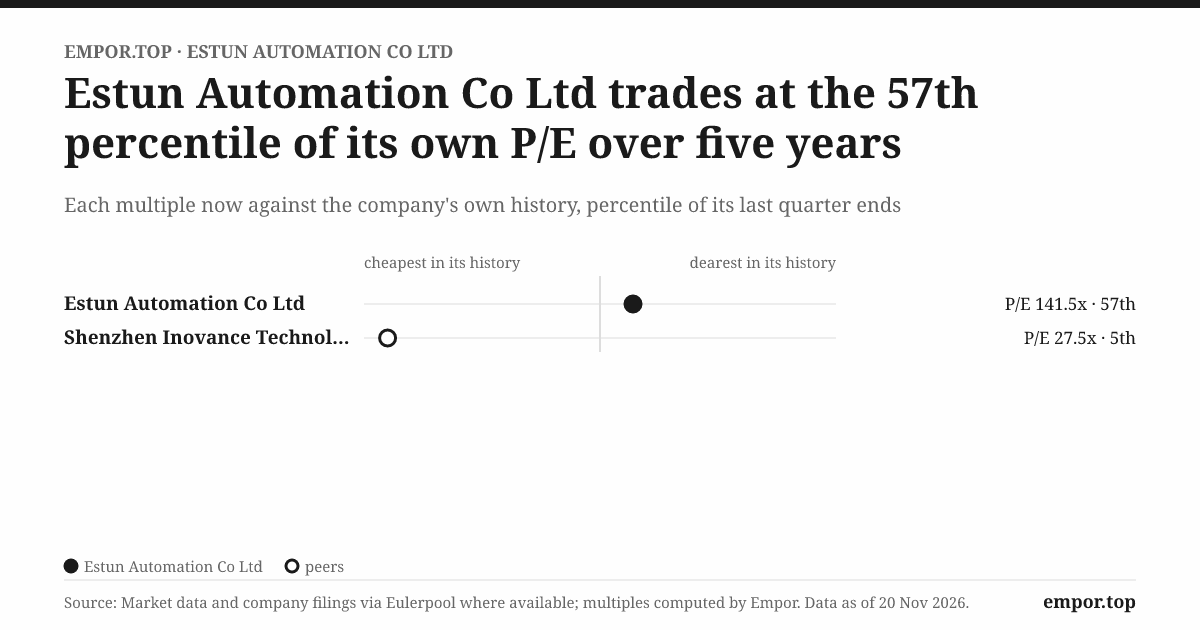
On 20 November 2026, an investor buying Estun's A shares paid about RMB24.25 each, valuing the company at about RMB26bn. The stock was down about half from its 52-week high, and still priced at about 141 times trailing earnings, above its own five-year median of about 134 times. Enterprise value was about 63 times EBITDA. The free-cash-flow yield was under 1%. Return on equity was about 6% and return on invested capital about 3.4%. The market, in other words, is still paying for a future very different from the present.
It is worth being clear about what those multiples do and do not mean. A trailing P/E of 141 is partly an artefact of a depressed profit base. If Estun's nine-month 2026 adjusted earnings were to continue, the multiple would fall quickly. Yet the arithmetic is sobering even then. Annualise the roughly RMB116m of profit excluding one-off items that Estun earned in the first nine months of 2026, and the company would make about RMB155m a year; at a market value of about RMB26bn, that is still close to 170 times earnings.2 Put another way, the share price assumes that profits multiply several times over from their best recent run-rate, not merely that they recover. Even generous assumptions about recovery leave a valuation that needs years of growth at much higher returns than the company has ever sustained. The company's own history is the clearest benchmark: it has rarely earned more than about 5% on invested capital in any year of the past decade.4 These numbers are not a forecast. They are a measure of expectation.
The case for
The bull case starts with the market. China bought more than 300,000 industrial robots in 2025, domestic brands now hold more than half of that market, and policy explicitly favours local supply.6 The company says it went from second to first by units, its own-brand robot revenue grew by about half in 2025, and robots-and-systems revenue grew by about a third.1 Its push into heavy-payload robots is lifting margins in exactly the category where foreign brands were strongest.6 The 2026 margin recovery, with gross margin up about four points on falling sales, is the first sign that Estun may be able to choose its orders.2 Add Cloos's welding know-how, the Polish factory as a base for Europe, and full-stack components that let Estun make its own controllers, and the bull can imagine a company that converts scale into a return.
The case against
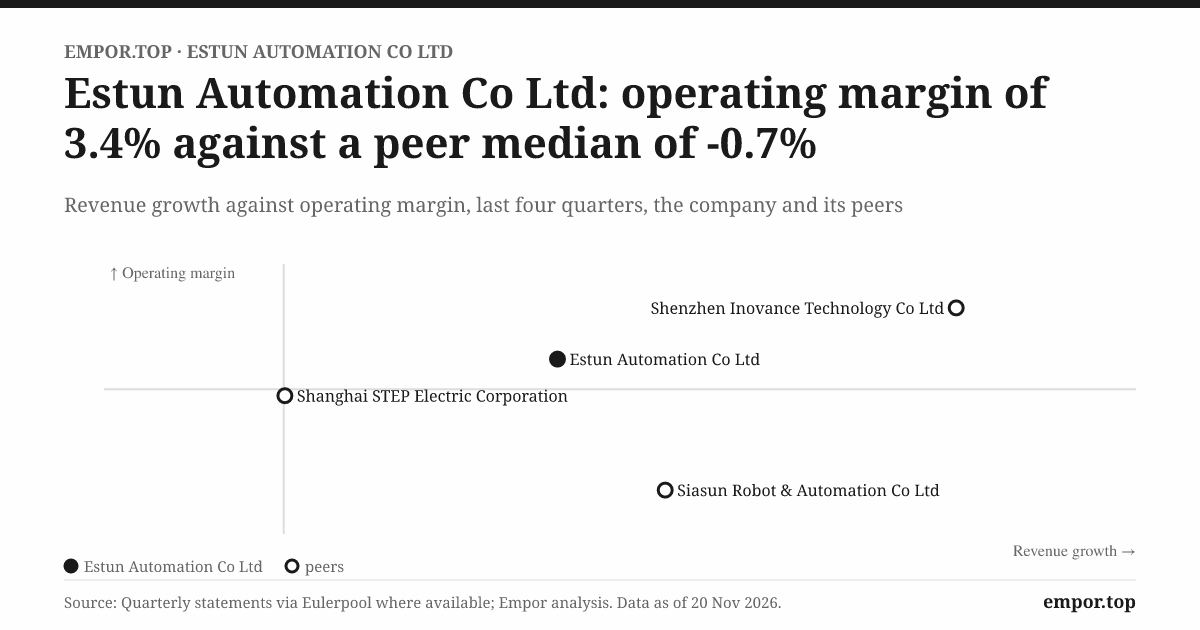
The bear case starts with the same numbers read differently. A shipment lead is not pricing power. Estun's roughly 2% share of China's robot market by revenue in 2024 shows how much of its volume sits at the lower-priced end.3 Its mainland gross margin fell about eight points in two years as it bought share with price.3 Customers multi-source, the largest five take a third of sales and nearly half of receivables, and 2026 revenue is shrinking.492 Years of acquisitions have not prevented impairments or a huge 2024 loss. Codroid adds a related-party, loss-making bet at almost ten times sales.8 And at a 3.4% return on capital, every additional yuan of growth destroys value unless returns rise.
Testing the moat
Michael Porter's five forces explain why returns are hard to earn here. Buyer power is high: concentrated, sophisticated manufacturers run tenders and split orders. Rivalry is intense and rising, with capacity growing faster than demand and more than a dozen credible domestic suppliers.6 Supplier power is modest, since Estun's top suppliers take less than a fifth of purchases and the company makes many of its own core components.4 Substitutes are limited for automation as a whole, but within it, one robot brand substitutes easily for another. New entrants keep coming, attracted by policy support and the humanoid boom. This is a structurally tough industry.
Hamilton Helmer's 7 Powers framework asks which durable advantage, if any, Estun has. Scale economies are the strongest candidate: as the largest domestic shipper with in-house drives and controllers, Estun should have a cost edge in components. The rise in robot margins in 2025 is evidence for it, and the margins of foreign incumbents would be the test of how large it is. Switching costs exist in principle, because a factory that standardises its programming and maintenance on one brand finds it costly to change, but Estun discloses no retention or repeat-order data, and the price cuts it has made to keep key accounts suggest these costs are not high enough to protect price. Network economies, branding and cornered resources are weak or absent; Cloos's brand matters in premium welding, but it is a niche. Counter-positioning against foreign incumbents, offering local service and lower prices they will not match, has worked, but every domestic rival can do the same. The honest conclusion is that Estun has a scale advantage that is real but unproven in returns, and a moat that its own pricing history narrows to something smaller than its ranking implies.
The risks that matter
The material risks run through specific mechanisms. A slowdown in manufacturing capital spending, especially in batteries and electric vehicles, cuts orders directly, and the third quarter's 12% revenue fall is a reminder of how quickly that can happen.2 Customer concentration and long receivable days mean a single slow payer hits cash flow. Price competition, which the company itself has warned about, can consume margins faster than cost cuts can rebuild them.6 Currency matters more than it looks: a 5% move in the yuan against the dollar and euro would shift 2025 net profit by about RMB19.5m, or nearly half of that year's attributable profit.4 Debt and interest raise the hurdle for every investment. Humanoid and embodied-intelligence robots are, for now, unproven optionality, with Codroid's losses attached.
What would change the view? Sustained growth in robots and systems with margins holding near 2026's levels; receivables that fall in amount, age and concentration, confirmed by cash; and evidence, starting with Codroid's 2026 targets and Cloos's goodwill test, that acquired businesses earn more than their cost of capital. Each is observable. None is yet in hand.
X. Playbook: Business & Investing Lessons
The company that began in a Nanjing trading officer's head as a maker of servo drives now sells complete robot lines, owns a German welding house with a hundred years of history and has bought a stake in the humanoid future. The journey carries lessons that belong to Estun and nobody else.
The first is that a shipment lead is an opening, not a moat. Estun reached the top of China's unit tables even as its margins and revenue share stayed thin. Rankings measure how many customers said yes, not what they paid. For founders in crowded hardware markets, the warning is that being chosen most often can coexist with being paid least. Winning the unit is the beginning; keeping the margin is the business.
The second is that a customer's signature is not a cash receipt. Estun learned it in 2024, when solar customers that had signed for robots stopped paying, and relearned the reverse in 2025, when chasing those old balances turned an operating cash outflow into an inflow. Point-in-time revenue recognition makes growth look immediate. Investors in equipment makers should always read the receivables note before the revenue line. Revenue travels on the invoice; trust travels when the money arrives.
The third is that an acquisition thesis lives in the years after closing. Cloos was a genuine capability bought at a full price, and its goodwill has since been partly written down. Codroid arrives with performance promises that run to 2029. The lesson for acquirers is that the purchase price is only the first instalment of the bet. The deal closes on one day; the return is earned every year after.
The fourth is that a bigger balance sheet raises the hurdle. The Hong Kong raise gave Estun RMB1.31bn of new equity while returns on existing capital remained low. New capital, once spent on factories and deals, has to clear a higher bar, not a lower one, because shareholders now have more at stake. Capital is not a strategy until it compounds.
The fifth is that control can support patience and concentrate risk at the same time. Wu Bo's family has stayed in charge for more than three decades, and that continuity let Estun make long bets on robots when foreign brands owned the market. The same family has twice bought assets before selling them to the listed company. For outside investors, the lesson is to price in the process, not just the people. Long-term ownership earns trust when outside shareholders can check the work.
XI. Epilogue
Tonight, Estun stands at an odd point in its story. It is the largest domestic shipper of industrial robots in the world's largest robot market, its margins are the best they have been in years, it has fresh equity from Hong Kong and a full product range from tiny collaborative arms to robots that lift 700kg. It is also a company whose sales are shrinking this year, whose return on capital is in low single digits, and whose shares, even after halving, price in a much more profitable future.
The next moments are already on the calendar. On 26 November, shareholders vote on the 2026 restricted-share scheme, which will tie management's equity to new targets.10 Early in 2027, Estun's full-year results will show whether the nine-month margin gain held through the fourth quarter, the season when Chinese industrial companies traditionally book many of their sales and collect most of their cash. If revenue stabilises with gross margin near 2026's levels, the claim that Estun has stopped buying share with price becomes credible. If margins slip back as the company chases volume, the 2026 gain will look like a pause, not a turn.
The annual report that follows will carry three more verdicts. The receivables note will show whether the collection gains have held. The goodwill test will show whether Cloos's cushion has changed. And Codroid's audited results for the last eight months of 2026 will show whether it met the first of the promises that justify its price.8 A miss would also tell investors something about how the family values its own ventures.
Beyond that lies the question that has run through every chapter: does the incremental yuan, whether raised in Hong Kong, borrowed from a bank or kept from shareholders as an unpaid dividend, earn more than it costs? The Polish factory, the new robots and the embodied-intelligence bet will each answer it in time. For now, market position has improved faster than capital returns. The coming disclosures can strengthen either side, and the tension between the two scoreboards remains unresolved.
XII. Outro
Go back to that factory line in the Yangtze River Delta. A decade ago, the arm swinging a battery pack into place would almost certainly have been Japanese, Swiss or German. Today, increasingly, it is Estun's. That is a real achievement for a company built by a former teacher.
But the arm is not the measure. The measure is whether the plant manager comes back for the next line, pays the invoice on time and accepts a price that leaves Estun a return on everything it spent to win her. Estun has crossed the threshold of being chosen. Its next threshold is proving that being chosen can pay. The arm can move the factory; the cash has to move the story.
References
-
Annual Results Announcement for the Year Ended 31 December 2025 — Estun Automation / HKEX, 2026-03-30 ↩↩↩↩↩↩↩↩↩↩↩↩↩↩↩↩↩↩↩↩↩↩↩↩↩↩↩↩↩↩↩↩↩↩↩↩↩↩↩↩↩↩
-
2026 Third Quarterly Report — Estun Automation / Shenzhen Stock Exchange, 2026-10-30 ↩↩↩↩↩↩↩↩↩↩↩↩↩↩↩↩↩↩↩↩↩↩↩↩↩↩↩↩↩↩↩
-
Global Offering Prospectus — Estun Automation / HKEX, 2026-02-27 ↩↩↩↩↩↩↩↩↩↩↩↩↩↩↩↩↩↩↩↩↩↩↩↩↩↩↩↩↩↩↩↩↩↩↩↩↩↩↩↩↩↩↩↩↩↩↩↩
-
2025 Annual Report — Estun Automation / CNINFO, 2026-03-31 ↩↩↩↩↩↩↩↩↩↩↩↩↩↩↩↩↩↩↩↩↩↩↩
-
Reply to CSRC Letter on Non-Public Share Issuance, including Acquisition of Cloos and Related Transactions — Estun Automation / CNINFO, 2021-04-21 ↩↩↩↩↩↩↩↩↩↩↩↩↩↩↩↩
-
2025 Annual Report — Estun Automation / HKEX, 2026-04-24 ↩↩↩↩↩↩↩↩↩↩↩↩↩↩↩↩↩↩↩↩↩
-
2026 Interim Report — Estun Automation / HKEX, 2026-08-21 ↩↩
-
Letter from the Board: Connected Transaction in Relation to the Proposed Acquisition of Estun Codroid — Estun Automation / HKEX, 2026-08-11 ↩↩↩↩↩↩↩↩↩↩↩↩↩↩↩↩↩↩↩↩↩↩↩↩↩
-
2025 Annual Report, Notes on Receivables and Factoring — Estun Automation, 2026 ↩↩↩↩
-
Notice of Extraordinary General Meeting: 2026 A Share Restricted Share Incentive Scheme — Estun Automation / HKEX, 2026-11-05 ↩↩↩↩
-
Announcement on Completion of Acquisition of Estun Codroid — Estun Automation / CNINFO, 2026-09-07 ↩
 LinkedIn
 WhatsApp
 Reddit
 Hacker News
 Email
 Kindle
 RSS Feed
 Spotify
 Apple Podcasts
 Amazon Music
 Audible
 YouTube