Haisco Pharmaceutical Group: China's Anesthesia Disruptor & Global Biopharma Out-Licensing Titan
I. Introduction & Episode Roadmap
On the morning of June 1, 2026, a press release moved across the wires with a headline that would have sounded absurd to almost anyone in the global pharmaceutical industry fifteen years earlier: the U.S. Food and Drug Administration had approved an intravenous general anesthetic discovered, synthesized, and clinically developed in Chengdu, China.1
The drug is called cipepofol. In China it is known as 环泊酚, transliterated in most of the early scientific literature as "ciprofol," and sold under the brand 思舒宁. In the United States it now carries the trade name Cypsedo.16 It is a molecule designed to do one thing: replace propofol, the milky white sedative that has put patients to sleep in operating theatres around the world since the mid-1980s, and which remains one of the most widely administered drugs in hospital medicine.
Displacing propofol is not a modest ambition. Propofol is cheap, generic, universally stocked, and universally understood. Anesthesiologists have three decades of muscle memory with it. To take share from a drug like that, a challenger cannot simply be different — it has to be better in ways clinicians feel in the room, on the monitor, in the recovery bay.
That is the story at the centre of this episode. But it is not the whole story, and arguably it is no longer even the most interesting part.
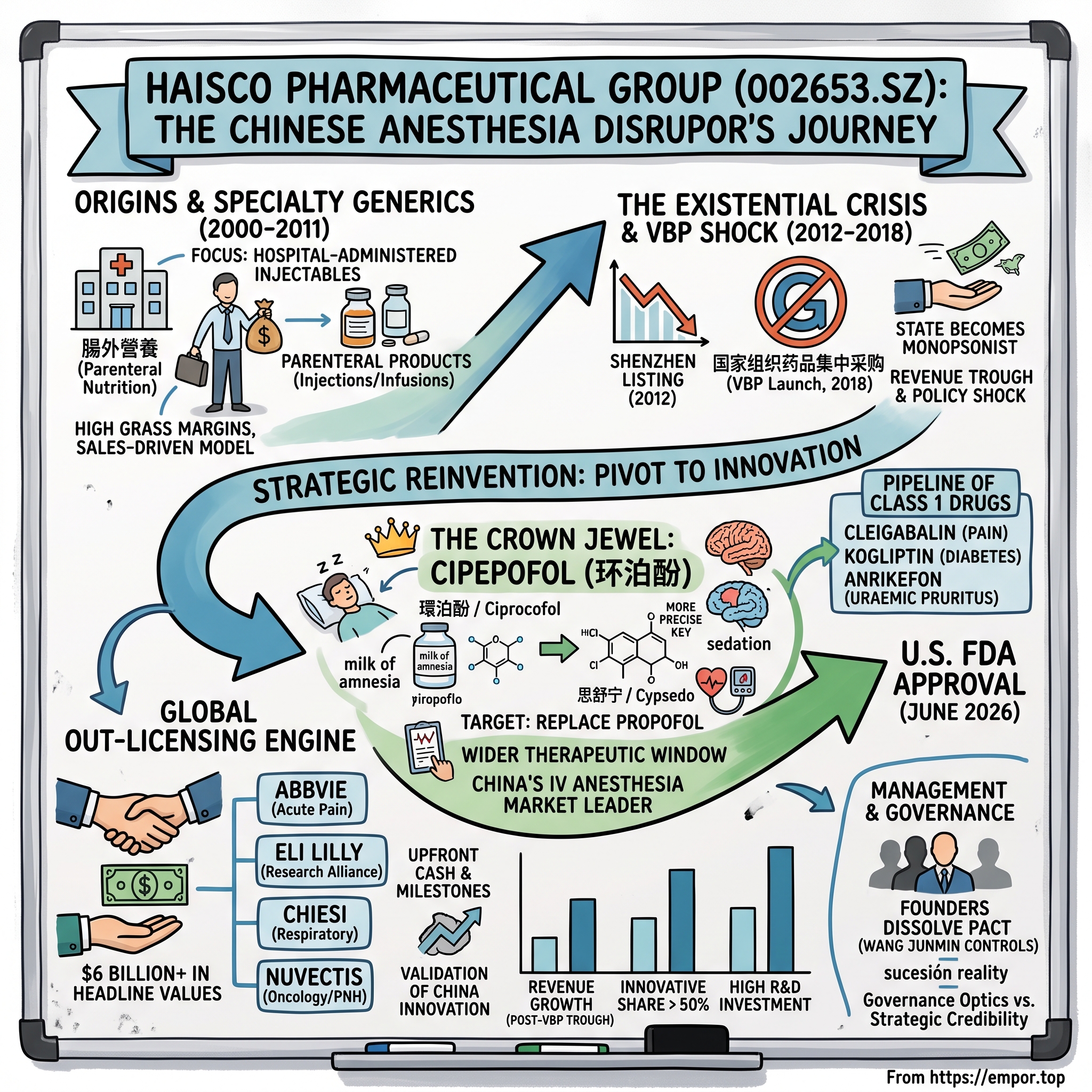
The core thesis. 海思科 Haisco Pharmaceutical Group (002653.SZ) is one of the more complete strategic reinventions in Chinese pharma. The company spent its first decade and a half building a profitable, sales-driven specialty generics business selling injectable products into Chinese hospitals — a model that generated gross margins most Western generic firms would envy, and which China's healthcare regulators then systematically dismantled. Faced with that, management reallocated an escalating share of revenue into Class 1.1 novel chemical entity research and rebuilt the company around proprietary small molecules in anesthesia, analgesia, metabolic disease, and respiratory inflammation.
By 2025, research and development investment reached RMB 1.085 billion, or 24.72% of revenue — a ratio that would be unremarkable for a Boston biotech and is extraordinary for a Shenzhen-listed company that was, not long ago, a distributor of lipid emulsions.5
The pivot worked. Whether it has yet produced a durable business is a separate question, and it is the question this piece is built to test.
The tension. In the first half of 2026 alone, Haisco signed four ex-China out-licensing agreements with headline values totalling more than $6 billion, including a five-programme research alliance with Eli Lilly worth up to $3.054 billion.2 Its guided first-half net profit rose somewhere between 513% and 575% year over year.8 The stock reached record highs.
And yet in the full year immediately preceding that boom, 2025, Haisco's net profit attributable to shareholders fell 34.36% to RMB 260 million, even as revenue rose 17.91% to RMB 4.388 billion.5 Four commercialised Class 1 innovative drugs, an FDA approval, a global partner list that reads like a JPMorgan Healthcare Conference invitation — and a bottom line of roughly $36 million.
That gap between narrative and earnings is the thing worth understanding. The bull case says the earnings will follow the narrative. The bear case says the narrative is being financed by selling the pipeline.
Roadmap. We start in Tibet and Sichuan, where a pharmaceutical salesman from Shenyang built a high-margin hospital business in a corner of the market nobody was fighting over. We move through the regulatory earthquake of volume-based procurement, which destroyed the economics of that business and forced the pivot. We spend real time on cipepofol — the chemistry, the clinical argument, the commercial execution, and the American approval. We deconstruct the out-licensing engine deal by deal, and ask what it actually monetises. We examine the financial mechanics, a governance episode involving the dissolution of a sixteen-year-old control agreement, the competitive structure of Chinese anesthesia, and finally the small number of metrics that will tell an outside investor whether this transformation compounds or stalls.
It begins with a decision to sell drugs nobody else wanted to sell.
 Subscribe on LinkedIn
II. Sichuan Origins & The Specialty Generic Cash Cow (2000–2011)
王俊民 Wang Junmin was born in 1968 in Shenyang, in China's industrial northeast, and trained at 沈阳药科大学 Shenyang Pharmaceutical University — one of the country's two serious pharmacy schools, an institution that has supplied a remarkable share of the Chinese drug industry's founding class. His first job of consequence was not in a laboratory. He worked as a sales manager at the pharmaceutical factory attached to 华西医科大学 West China Medical University in Chengdu.
That detail matters more than any credential. Wang learned the Chinese drug business from the demand side — from inside hospital procurement, where the buyer is not a patient and not an insurer but a department head with a formulary, a budget, and strong opinions about which sales representative returns their calls. Almost everything Haisco did for its first fifteen years flowed from that vantage point.
The company that became Haisco was established in 2000, and the group's registered home was placed in 山南 Shannan, in 西藏 Tibet, at No. 17 Sanxiang Avenue in Zetang.29 It traded as Xizang Haisco Pharmaceutical Group until March 2016, when it adopted the current name.29 The Tibet registration was not sentiment. Through the 2000s, China's western development programme offered materially reduced enterprise income tax rates to companies domiciled in Tibet and other frontier regions — an incentive structure that a number of ambitious mainland firms used, and which meaningfully improved the after-tax economics of an already high-margin business. Operations, research, and manufacturing sat in Chengdu and elsewhere; the tax residence sat in Shannan.
Choosing the fight nobody wanted
The strategic choice that defined the early company was negative rather than positive: Haisco decided what not to sell.
Chinese generic pharmaceuticals in the 2000s were a bloodbath in oral solid dosage forms — antibiotics, cardiovascular tablets, primary-care staples where hundreds of manufacturers produced chemically identical product and competed almost entirely on price and channel. Haisco avoided that entirely. It went instead to hospital-administered parenteral products: injections and infusions that a nurse hangs on a pole, not pills a patient buys at a pharmacy counter.
The portfolio clustered around 肠外营养 parenteral nutrition — fat emulsions and amino acid preparations for patients who cannot eat — alongside hepatobiliary and digestive-system agents including 多烯磷脂酰胆碱 polyene phosphatidylcholine for liver disease, and vasoactive products such as 前列地尔 alprostadil.
Three structural features made this attractive. First, sterile injectables are harder to manufacture than tablets; the regulatory and capital barriers thinned the competitor field before anyone sold a vial. Second, the buying decision sat with hospital clinicians, which meant the winning capability was a trained specialty salesforce rather than a low-cost plant. Third, and most importantly, these products were priced by the state as "non-essential" hospital consumables at levels that had never been aggressively benchmarked — because nobody in Beijing was looking at them.
The result was a business with gross margins far above what "generic drug company" implies to a Western investor, and a cost structure dominated by selling expense rather than cost of goods. It was, in effect, a distribution and detailing machine wrapped around a modest manufacturing base.
The flywheel, and its hidden fragility
Through the back half of the 2000s that machine compounded. Revenue in 2016 was RMB 1.436 billion, and the company had already been listed for four years by then; the profit profile was consistent and the balance sheet accumulated cash without heavy capital expenditure. Management was building manufacturing footprint in Chengdu, Shenyang, and Meishan, but the enterprise did not require much capital to grow — new revenue came from adding sales representatives and hospital accounts, not from adding capacity.
What is worth naming plainly, because it explains everything that followed, is where the profit actually came from. It did not come from science. It came from a pricing environment that the buyer had not yet chosen to contest, defended by a salesforce that knew the accounts. That is a real advantage while it lasts and a completely undefendable one when the buyer changes its mind.
In 2000s China, the buyer was fragmented across thousands of hospitals. In the 2010s, the state consolidated itself into a single buyer. Haisco's founding advantage was, structurally, a bet that this would not happen.
It happened.
III. Going Public & The VBP Shockwave: The Existential Crisis (2012–2018)
Haisco listed on the Shenzhen Stock Exchange on January 17, 2012, trading as 002653.SZ.29 The raise was modest — roughly RMB 800 million, and notably it remains the company's only completed public equity raise in its listed history to date.22 For a firm that would later spend more than that annually on research, the restraint is worth registering early: Haisco funded its transformation overwhelmingly from operating cash flow, not from repeatedly returning to the equity market.
The listing proceeds went into GMP manufacturing capacity. For several years afterward the story was straightforwardly good. Revenue roughly tripled between 2016 and 2019, reaching RMB 3.937 billion, and net profit in 2019 was RMB 494 million. If you had drawn the trend line at the end of 2019, you would have drawn it up and to the right.
You would have been wrong, and the reason had nothing to do with Haisco's execution.
The state becomes a monopsonist
In late 2018, China's newly created 国家医保局 National Healthcare Security Administration launched 国家组织药品集中采购 state-organised volume-based procurement — universally shortened to 集采 VBP. The mechanism is elegant and brutal. For a given molecule, the state aggregates the procurement volume of public hospitals across participating regions into a single tender, then invites qualified manufacturers to bid. Winners receive a guaranteed, enormous volume. Losers are effectively excluded from the public hospital channel.
Because the volume is guaranteed, rational bidders strip their price to something close to marginal cost. Across successive national rounds, winning bids commonly landed 70% to 90% below prior list prices. In parallel, the NHSA ran annual negotiations for inclusion in the 医保目录 National Reimbursement Drug List, where the state traded reimbursement access for steep, negotiated price cuts on branded and innovative products.
Together these two instruments did something historically unusual: they converted a fragmented, relationship-driven, high-margin market into a single-buyer commodity auction, in the space of about three years.
For Haisco this was not a headwind. It was a direct hit on the exact assets the company had built its identity around. Every attribute that had made the legacy portfolio attractive — hospital-channel products, high list prices that had never been benchmarked, margins protected by detailing rather than by patents — was precisely what VBP was engineered to eliminate.
The damage shows up unmistakably in the numbers. Revenue peaked in 2019 at RMB 3.937 billion, then fell to RMB 3.330 billion in 2020 and collapsed to RMB 2.773 billion in 2021, a decline of 16.71% in a single year. Net profit fell 45.80% that year to RMB 345 million. Management attributed the deterioration to national reimbursement price negotiations, centralised procurement, intensifying competition, and its own strategic repositioning.22 A specific casualty was 甲磺酸多拉司琼 dolasetron mesylate injection, an exclusive anti-emetic that had been a genuine blockbuster for the company and whose revenue was gutted by a negotiated NRDL price cut.22
It took Haisco until 2023 — four years — to get revenue back above the 2019 level. That is what a policy shock looks like when it lands on your core.
The decision that actually mattered
Here is the part of the story that separates Haisco from a long list of Chinese pharma companies that experienced the same shock and did not survive it intact.
The pivot did not begin in 2021, when the pain arrived. It began earlier. From 2018 onward, Haisco's R&D spending on innovative drugs exceeded its spending on generics — a crossover that occurred before the company's own revenue rolled over. R&D expense in 2018 was RMB 204 million against RMB 3.427 billion of revenue; by 2021, with revenue down more than a billion RMB from its peak, R&D expense had more than doubled to RMB 434 million. In other words, management increased absolute research spending by 113% during a period in which its top line contracted 19%.
That is a genuinely uncomfortable thing for a listed company to do. Every incremental research yuan came directly out of reported earnings in years when earnings were already falling and shareholders were already unhappy. The alternative paths available — lobbying for policy relief, cutting cost to defend margin, chasing VBP tenders at destroyed prices to hold volume — were all easier to explain on a results call.
Alongside the money, Haisco built the institutional apparatus: dedicated research operations in Chengdu and Shanghai, and a U.S. presence that would later matter enormously for FDA engagement. The therapeutic focus narrowed deliberately onto anesthesia and analgesia, metabolic disease, and later respiratory and autoimmune indications — areas where the company's existing hospital salesforce would still be the right distribution channel for whatever came out the other end.
The strategic logic was sound and the timing was right. Neither guaranteed that the chemistry would work. For that, everything depended on one molecule.
IV. The Crown Jewel: Ciprofol (环泊酚) & Re-Engineering Propofol
Every anesthesiologist knows the ritual. The syringe of propofol is unmistakable — opaque, white, an oil-in-water emulsion that looks more like cream than medicine. It is nicknamed "milk of amnesia," and it has been the default induction agent for general anesthesia globally since the late 1980s.
It is also, in specific and well-documented ways, an imperfect drug.
What is actually wrong with propofol
Three problems recur in the clinical literature and in every operating theatre.
The first is injection pain. Propofol burns going in — a sharp, sometimes severe pain at the injection site, which is why clinicians frequently pre-administer lidocaine simply to blunt it. This is a patient-experience issue, and in an elective procedure market it is not trivial.
The second is respiratory depression. Propofol suppresses the drive to breathe, and it does so steeply. The dose that reliably sedates and the dose that causes a patient to stop breathing are uncomfortably close together. In a fully staffed operating room with an intubated patient this is managed routinely. In a gastroenterology suite, where a patient undergoing an endoscopy is sedated but not intubated, it is a real and constant hazard.
The third is hemodynamic instability — propofol tends to drop blood pressure, which matters most in the patients least able to tolerate it: the elderly, the cardiovascularly compromised, the critically ill.
Put simply, propofol has a narrow therapeutic window. Think of it as a dimmer switch with very little travel between "comfortably asleep" and "not breathing." Everything downstream in Haisco's clinical strategy follows from trying to widen that travel.
The chemistry, in plain language
Propofol's molecular structure is simple: a phenol ring with two isopropyl groups flanking the hydroxyl. It works by binding the GABA-A receptor, the brain's principal inhibitory switch, and amplifying its effect — a positive allosteric modulator, in the jargon. GABA is the neurotransmitter that tells neurons to quiet down; propofol makes that instruction louder.
Haisco's medicinal chemists did not invent a new mechanism. They modified the existing one. Cipepofol is a structurally related phenolic GABA-A positive allosteric modulator with additional steric bulk introduced around the active site — a bulkier, differently shaped molecule engaging the same receptor.
The useful analogy is a key and a lock. Propofol is a key that opens the lock but rattles, catching on adjacent tumblers. Cipepofol is a key cut to sit more precisely in that lock. The consequence is potency: cipepofol achieves comparable anesthetic depth at a substantially lower dose. Lower dose means less total drug in circulation, which is the mechanistic basis for the claimed reductions in respiratory and cardiovascular side effects.
The FDA-approved U.S. label and the supporting global Phase III programme reflect these claims. Haisco's own summary of the approval cites reduced incidence of intraoperative respiratory depression, fewer cardiovascular adverse reactions, and less injection pain relative to existing options, with the U.S. registration covering induction of general anesthesia in adults.116
A necessary caveat for investors: "fewer adverse events in a controlled trial" and "clinicians change a thirty-year habit" are different propositions. The first is a regulatory fact. The second is a commercial hypothesis. In China, that hypothesis has been substantially validated. In the United States, it has not been tested at all.
The Chinese commercial run
The NMPA approved cipepofol in December 2020 for sedation and anesthesia in non-intubated procedures — deliberately starting where propofol's respiratory liability is most acute, the endoscopy suite. Indication expansion followed: induction and maintenance of general anesthesia, sedation of mechanically ventilated ICU patients, and in September 2025 a paediatric and adolescent indication.1
Inclusion in the NRDL came in 2021. That decision deserves to be understood as a strategic trade rather than a regulatory formality. Entering the reimbursement list requires accepting a negotiated price well below the launch price. In exchange, the drug becomes reimbursable across the public hospital system, removing the single largest barrier to physician adoption — the patient's out-of-pocket cost. Haisco traded price per vial for access, betting that volume would more than compensate.
The bet paid. Cipepofol has been adopted by more than 3,300 medical institutions and cumulatively administered across more than 40 million patient visits.1 Revenue climbed past RMB 1.2 billion in 2024 and exceeded RMB 1.7 billion in 2025, holding the number one share position in China's intravenous anesthesia market. In the first half of 2025 the product generated roughly RMB 800 million, up about 55% year on year, at a gross margin of 91.93%.
That gross margin is the most informative number in the entire Haisco story. It is not a generic drug margin. It is not even a typical branded hospital-injectable margin. It is what a patent-protected molecule with genuine clinical differentiation earns — and it tells you exactly why management was willing to endure four years of falling profits to get here.
A second signal, easily overlooked: cipepofol has been incorporated into China's 14th Five-Year Plan higher-education medical textbooks.1 Anesthesiology is a discipline learned through apprenticeship and repetition; a resident trained on cipepofol as a standard agent carries that default for a career. Textbook inclusion is the closest thing this category has to a switching cost, and it accrues slowly and invisibly.
The American approval
The U.S. path was unusually efficient. Haisco secured FDA clearance to begin clinical work in 2021, obtained a waiver of Phase II — meaning the agency accepted the existing dose-ranging evidence and permitted a direct move to registrational trials — and completed all U.S. studies in 2024. The New Drug Application was accepted in July 2025 and approved on June 1, 2026, filed through the company's subsidiary Haisco-USA Pharmaceuticals.116 The Phase III programme was run head-to-head against propofol and reported superior blood pressure stability alongside rapid onset and recovery.16
The symbolic weight is real: this is the first China-originated innovative intravenous anesthetic approved for the U.S. market.1 For a decade the standard critique of Chinese pharmaceutical innovation was that it produced fast-follower molecules for a protected domestic market and could not clear a Western regulator on its own evidence. This clears that bar.
The commercial weight is far less certain, and the analysis should not conflate the two. Generic propofol in the United States sells for a few dollars per vial through hospital group purchasing organisations that exist specifically to commoditise exactly this kind of product. A novel branded anesthetic entering that channel must persuade a pharmacy and therapeutics committee that a materially higher unit price is justified by outcomes that translate into cost — shorter recovery times, fewer rescue interventions, reduced monitoring burden. That case can be made. It has not yet been made at scale, and Haisco is an unknown brand to American hospital administrators.
Which raises the obvious question about a company whose flagship product accounted for well under half of 2025 revenue: what else is in the building?
V. Beyond Anesthesia: Pain, Diabetes, & The Innovative Pipeline
There is a particular moment in a research-stage pharmaceutical company's life when the question shifts from "can you discover a drug?" to "can you discover drugs?" — from a singular event to a repeatable process. Haisco reached that moment in the middle of 2024, when two more self-developed Class 1 molecules cleared the NMPA within weeks of each other.
Cleigabalin besylate (苯磺酸克利加巴林 / HSK16149)
Neuropathic pain is a category where the standard of care is genuinely unsatisfying. Diabetic peripheral neuropathic pain — the burning, electric discomfort in the feet and hands that arrives after years of poorly controlled blood sugar — and postherpetic neuralgia, the lingering nerve pain that follows shingles, are both typically treated with pregabalin or gabapentin. These bind the alpha-2-delta subunit of voltage-gated calcium channels, dialling down the excessive neuronal firing that the nervous system misinterprets as pain. They work moderately well, and they cause sedation, dizziness, and weight gain at rates that drive many patients to stop taking them.
Cleigabalin is a next-generation alpha-2-delta ligand with higher binding affinity, engineered to deliver the analgesic effect at lower systemic exposure. It was approved by the NMPA in May 2024 for adult diabetic peripheral neuropathic pain — the first Class 1 new drug approved in China for that specific indication — with postherpetic neuralgia following in June 2024.12 Notably, China was the first market in the world to launch it.
Kogliptin (考格列汀 / HSK7653)
Approved in June 2024, kogliptin is an ultra-long-acting DPP-4 inhibitor for glycaemic control in adult type 2 diabetes.13 The mechanistic idea is old — DPP-4 inhibitors block the enzyme that degrades the body's own incretin hormones, so those hormones stimulate insulin release for longer. What is new is the duration. Standard DPP-4 inhibitors are taken daily; kogliptin is dosed once every two weeks.
The commercial logic here is adherence, not efficacy. A patient with type 2 diabetes managing a multi-drug regimen misses doses; twenty-six doses a year is a fundamentally different behavioural ask than three hundred and sixty-five. Whether that converts into pricing power is the open question — DPP-4 inhibitors as a class are heavily genericised and have been under severe VBP pressure in China, and the entire diabetes category is being reshaped by GLP-1 receptor agonists that offer weight loss alongside glucose control. Kogliptin is competing in a category the market is walking away from.
Both drugs were successfully negotiated into the 2024 NRDL in November of that year — the same access-for-price trade that worked for cipepofol.14
Anrikefon (安瑞克芬 / HSK21542)
The most scientifically elegant asset in the portfolio is a peripherally restricted kappa opioid receptor agonist. The premise: opioid receptors that mediate pain and itch exist both in the brain and in peripheral nerves, but the addiction, sedation, and dysphoria that make opioids dangerous are all central nervous system effects. Build a molecule potent at the receptor but chemically unable to cross the blood-brain barrier, and you can theoretically capture the therapeutic benefit while leaving the liability behind.
Anrikefon's preclinical characterisation reported a brain-to-plasma concentration ratio of 0.001 — roughly one one-thousandth of the drug reaching the brain relative to circulation — confirming genuine peripheral restriction, with potency exceeding the reference comparator CR845.18 A multicentre, double-blind, randomised, placebo-controlled Phase III trial screened 652 patients across 50 Chinese centres between June 2022 and June 2024, randomising 545 haemodialysis patients with pruritus to anrikefon or placebo three times weekly for twelve weeks. It reported meaningful reductions in itch intensity and improved itch-related quality of life, with a low incidence of central opioid adverse reactions.17
Uraemic pruritus is an underappreciated condition — the relentless itching experienced by a large share of dialysis patients, which degrades sleep and quality of life and has almost no good treatment. The drug is now approved in China alongside postoperative pain applications.
The respiratory and complement programmes
Two further assets deserve mention because both became out-licensing currency. HSK31858 is an oral, reversible DPP1 inhibitor for non-cystic-fibrosis bronchiectasis — a chronic lung disease where neutrophils flood the airways and release destructive enzymes; DPP1 is the enzyme that activates those destructive enzymes, so inhibiting it aims to disarm the inflammatory cascade rather than suppress immunity broadly.9 HSK39004 is an inhaled PDE3/4 dual inhibitor for COPD, combining bronchodilation and anti-inflammatory effect in a single molecule, developed in both suspension and dry-powder formats.10
And in July 2026 — days before this writing — the NMPA approved ciprocopan succinate tablets (HSK39297), described as the world's first once-daily oral complement factor B inhibitor, for complement-inhibitor-naïve adults with paroxysmal nocturnal haemoglobinuria.15 PNH is a rare disorder in which the complement system, part of innate immunity, destroys the patient's own red blood cells; existing therapies are largely infused antibodies. An oral once-daily alternative is a genuine convenience advance in a category with high per-patient pricing globally.
What this collection demonstrates is breadth of chemistry capability across at least six distinct target classes. What it does not yet demonstrate is commercial breadth. Cipepofol is proven at scale; the second wave — cleigabalin, kogliptin, anrikefon — remains in ramp-up, and independent Chinese analysis has flagged precisely this as the vulnerability: a single validated commercial asset carrying a portfolio.21
Which is exactly why the licensing desk became as important as the laboratory.
VI. The Global BD Engine: Licensing To AbbVie, Eli Lilly, Chiesi, & Nuvectis
Between January and June of 2026, Haisco signed four ex-China licensing agreements with aggregate headline value exceeding $6 billion. For a company with roughly $600 million of annual revenue, that is a startling ratio — and it demands a clear-eyed reading of what those headline numbers actually represent.
Why out-license at all
Consider the arithmetic Haisco faced. Running a registrational Phase III programme in the United States and Europe costs hundreds of millions of dollars per indication. Building a Western specialty salesforce costs hundreds of millions more, takes years, and requires competencies — payer negotiation, GPO contracting, medical affairs infrastructure — that no amount of Chinese hospital experience transfers into.
Haisco's entire annual R&D budget in 2025 was RMB 1.085 billion, about $150 million.5 Self-commercialising even one asset globally would have consumed the whole research organisation's funding for years.
The alternative is to sell geography. Keep Greater China, where the company already has 3,300 hospital relationships and a functioning commercial engine, and license everything else to a partner who already has the infrastructure. The partner absorbs the development cost and the failure risk; Haisco takes cash upfront, milestone payments as the asset advances, and a royalty if it reaches market.
This is a rational trade for a company in Haisco's position. It is also, unavoidably, a decision to accept a small fraction of the value of any asset that succeeds.
The four deals
Chiesi (November 20, 2023). The first significant validation came from the Italian family-owned respiratory specialist Chiesi Farmaceutici, which licensed HSK31858 for development, manufacture, and commercialisation outside Greater China. Chiesi agreed to an upfront payment, contingent milestones, and royalties.9 The company did not disclose terms in its press release; Chinese financial media reported the upfront at approximately $13 million.20 The asset was in Phase 2 in China at signing. This was a small deal by later standards, and its significance was categorical rather than financial: a respected European specialty pharma had underwritten Chinese-originated respiratory chemistry.
AirNexis (January 9, 2026). Haisco granted the U.S. biotech AirNexis global rights outside Greater China to HSK39004. Total potential value reached $1.063 billion, comprising a $108 million upfront — structured as $40 million cash and $68 million in AirNexis equity — up to $955 million in development, regulatory, and commercial milestones, and tiered royalties reaching the mid-teens.1027
The equity component deserves scrutiny. Sixty-three percent of that headline upfront was not money; it was a stake in a private biotech, whose value depends entirely on AirNexis succeeding with the very asset Haisco just handed over. It is a reasonable structure — it preserves upside and conserves the partner's cash — but investors reading "$108 million upfront" should understand that only $40 million was cash.
AbbVie (April 2026). AbbVie licensed a NaV1.8 pain portfolio: HSK55718, an intravenous candidate in Phase 1 in China, and HSK51155, an oral preclinical compound. Terms were $30 million upfront and up to $715 million in development, regulatory, and commercial milestones, plus tiered royalties, covering rights outside mainland China, Hong Kong, and Macau.3
NaV1.8 is one of the most consequential targets in modern pain medicine. Voltage-gated sodium channel 1.8 sits almost exclusively on pain-sensing neurons — block it and you interrupt the pain signal at its origin, without touching opioid receptors and therefore without addiction risk. The category was validated commercially when the first NaV1.8 inhibitor reached the U.S. market, and every large pharma with a pain franchise has been shopping for assets since.
But notice the structure. Thirty million dollars of cash for a Phase 1 asset and a preclinical asset is a modest, appropriately risk-adjusted price. The $745 million headline is what Haisco receives if everything works, over a decade or more. The gap between $30 million and $745 million is the risk.
Eli Lilly (May 29, 2026). The largest and most structurally different agreement. Haisco took responsibility for discovering and identifying up to five innovative target programmes; Lilly leads IND-enabling studies, clinical development, and commercialisation. Lilly obtains exclusive worldwide rights to certain programmes and exclusive rights outside the Haisco Territory — mainland China, Hong Kong, Macau, and Taiwan — for others, with Haisco retaining those retained-territory rights. Financially: up to $87 million in upfront and near-term payments, up to $2.967 billion in remaining downstream milestones, and single-digit tiered royalties.2
This is not an asset sale. It is the sale of research capacity — Lilly paying for access to Haisco's medicinal chemistry engine as a discovery function. Industry coverage noted that the specific targets were not disclosed, which is unusual and limits any outside assessment of the deal's real economic content.28 Single-digit royalties on programmes that do not yet have named targets is, in candour, an option on an option.
Nuvectis Pharma (June 2026). Haisco licensed HSK42360, a BRAF "paradox breaker" inhibitor in Phase 1 in China, globally outside Greater China, and HSK39297 — the complement factor B programme — globally outside Greater China, Southeast Asia, and India. Terms: $40 million in upfront and near-term milestone payments, plus up to $1.421 billion in additional milestones.4
A brief note on why counterparty quality varies here. AbbVie and Lilly are among the largest and best-capitalised pharmaceutical companies in the world; a milestone owed by either is highly likely to be paid if earned. Nuvectis is a small-cap Nasdaq-listed biotech, and AirNexis is a private company. Milestones owed by smaller counterparties carry both development risk and financing risk — the partner must survive and fund the trial to reach the milestone at all. Aggregating $6 billion of headline value across counterparties of very different balance sheet strength obscures a genuine quality difference.
What the cash actually does
The near-term financial effect has been dramatic. Haisco guided first-half 2026 net profit attributable to shareholders of RMB 790–870 million, growth of 513.25% to 575.35%, attributing it explicitly to accelerating domestic innovative drug sales and upfront payments received from multiple licensing transactions.8 First-quarter net profit alone was RMB 555 million, implying second-quarter profit of RMB 235–315 million — a sequential decline of roughly 43% to 57%.8
That sequential shape is the most honest single data point about the BD engine. Upfront payments are lumpy, non-recurring, and land in whichever quarter the contract is signed. A business whose quarterly profit halves because it did not sign a mega-deal in the second quarter has not yet demonstrated earnings power; it has demonstrated deal-making capability, which is valuable but is a different asset class.
Chinese commentators have been notably direct on this. One widely read analysis argued that BD transactions are fundamentally asset liquidation rather than value creation, noted that Haisco's shares opened higher and closed lower on the AirNexis announcement, and observed that capital now reserves premium valuations for companies demonstrating self-commercialisation at scale rather than serial out-licensing.21 That is a fair characterisation of what the market is actually pricing.
The strongest defence of the strategy is not that the deals are lucrative — most are modestly priced in cash terms. It is that they are non-dilutive validation. Five independent, sophisticated counterparties conducted due diligence on Haisco's chemistry and paid to access it. That is external evidence about research quality that no management presentation can substitute for. Whether it becomes external evidence about earnings depends on milestones that mostly lie years ahead.
Which brings us to what the accounts look like once the deal announcements stop.
VII. Financial Mechanics, Segment Breakdown, & Capital Allocation
Strip out the headlines and Haisco's income statement tells a more sober story than the stock chart.
The revenue trajectory
Revenue recovered from the VBP trough of RMB 2.773 billion in 2021 to RMB 3.015 billion in 2022, RMB 3.355 billion in 2023, RMB 3.721 billion in 2024, and RMB 4.388 billion in 2025 — growth of 17.91% in the most recent full year.5 Roughly $610 million at current exchange rates. Chinese sell-side consensus for 2026 clusters around RMB 5.4 billion, implying about 23% growth.
The mix has shifted decisively. Four commercialised Class 1 innovative drugs collectively grew sales more than 50% year on year in 2025, and management expects innovative products to exceed half of total revenue during 2026.20 The legacy generic and specialty formulation business has stabilised after absorbing the full force of procurement and reimbursement reform — no longer growing, but no longer collapsing, and still generating the operating cash flow that funds the research organisation.
That is the underlying business: a declining-relevance cash cow, a fast-growing innovative franchise led by one large product, and a lumpy licensing line item on top.
The 2025 profit problem
Now the part that requires attention. In 2025, revenue rose 17.91% and net profit attributable to shareholders fell 34.36% to RMB 260 million.5 The company declared a dividend of RMB 2.67 per ten shares.25
The decomposition matters. Non-recurring gains fell sharply — RMB 92.57 million in 2025 against RMB 263 million in 2024 — with government subsidies dropping from RMB 195 million to RMB 124 million, a 36% decline.67 Selling expenses rose 20.68% to RMB 1.643 billion. R&D expense rose 28.87% to RMB 804 million, with total R&D investment including capitalised amounts reaching RMB 1.085 billion, or 24.72% of revenue.57 The company also absorbed investment losses from an affiliate, 海保人寿 Haibao Life Insurance.7
Excluding non-recurring items, net profit was RMB 167 million, up 26.33% year on year, and operating cash flow rose 77.81%.56
Three analytical conclusions follow.
First, the headline decline was substantially a subsidy and non-operating story rather than an operating deterioration. Adjusted profit grew and cash generation improved markedly.
Second, and less comfortably, the absolute level of adjusted profit is small. RMB 167 million of core earnings against a market capitalisation in the tens of billions of RMB means the equity is priced almost entirely on future rather than current cash generation. That is a legitimate way to value a research company, but it leaves no margin for pipeline disappointment.
Third, government subsidies at RMB 124 million remain roughly three-quarters the size of adjusted net profit. Chinese local and provincial governments subsidise pharmaceutical R&D and manufacturing investment substantially, and these flows are discretionary and policy-dependent. An investor modelling this business should treat them as a separate, non-durable line rather than as earnings.
The selling expense line is the other item worth watching. At RMB 1.643 billion against RMB 4.388 billion of revenue, Haisco spends roughly 37 fen of every revenue yuan on selling — heavier than its research spending by a factor of two. That reflects the reality of Chinese hospital pharmaceutical commercialisation, where physician education and account coverage are expensive. It also means that the "innovative drug company" framing should not obscure that this remains, operationally, a salesforce-intensive business.
Capital allocation
On balance, the record is disciplined in the ways that matter most.
Haisco has not pursued acquisitive growth. There is no history of the large, dilutive, poorly-integrated deals that have destroyed value at a number of Chinese pharmaceutical companies attempting the same generic-to-innovative transition. Capital has gone into internal research and into manufacturing capacity, funded predominantly from operating cash flow.
The equity record supports this: a single IPO raise of roughly RMB 800 million in 2012, and no completed follow-on in the fourteen years since.22 Against that, the company financed a research programme that has now produced five approved Class 1 molecules. Measured as capital efficiency, that is a strong outcome — five approvals for what a single Western Phase III programme typically costs.
The exception is the pending private placement. Haisco proposed raising up to RMB 1.365 billion — RMB 965 million for new drug research projects and RMB 400 million for working capital. The plan cleared exchange review in January 2026 and awaits issuance.723 Given the licensing cash arriving in 2026, the necessity of that raise is a fair question for shareholders to press, and it connects directly to a governance episode we will come to shortly.
The dividend, meanwhile, is a signal of a certain kind of temperament — a company that pays out even while running a 25%-of-revenue research budget, which suggests management is not treating shareholder returns as fully subordinate to reinvestment.
Capital allocation, though, is ultimately a statement about the people making the decisions. And on that front, 2025 produced something genuinely unexpected.
VIII. Management, Governance, & Insider Ownership
On March 31, 2025, Haisco filed a disclosure notice that received far less attention than the licensing deals but says more about the company's future than any of them. The three founders had dissolved the agreement that bound them together.11
The end of the triumvirate
王俊民 Wang Junmin, 范秀莲 Fan Xiulian, and 郑伟 Zheng Wei had signed a concert-party agreement in 2009 — three years before the IPO — under which they voted their shares as a bloc. Combined, that bloc controlled voting rights equal to 73.27% of total share capital, one of the more absolute founder control positions on the Shenzhen exchange.11
In March 2025 they terminated it. Zheng Wei had retired in February 2024, held no position at the company thereafter, and took no part in its management.11 Following dissolution, Wang Junmin alone became the controlling shareholder and actual controller, holding with his spouse 申萍 Shen Ping voting rights equal to 40.11% of share capital.11
The reading is genuinely two-sided.
The constructive interpretation: a founding bloc formalises a succession reality. Zheng had retired; a control agreement binding a retired founder is an artefact. Consolidating control in the active chairman clarifies accountability, and 40.11% remains a commanding position — enough to control any ordinary resolution and to sustain the long-horizon research spending that a dispersed shareholder base would likely have resisted through the 2021 trough.
The sceptical interpretation: control just fell from 73% to 40%, and two founding families are now free to sell without the coordination constraints of a concert-party arrangement. For minority shareholders, the practical question is whether the remaining founders' economic interests are still aligned or are being monetised.
The evidence available on that question is not flattering.
The selling
During 2025, Shen Ping — Wang Junmin's spouse and part of the controlling group — reduced holdings by close to RMB 700 million, at prices substantially above the reference pricing of the concurrent private placement.7 Separately, shareholders holding above the 5% threshold, identified in Chinese reporting as 郝聪梅 Hao Congmei and 杨飞 Yang Fei acting in concert, announced a reduction plan on February 3 and completed it by April 7.7
Chinese financial media characterised the pattern bluntly as "前脚融资、后脚套现" — financing with one hand, cashing out with the other.7 The criticism is that a company asking outside investors for RMB 1.365 billion of new equity while insiders sell roughly RMB 700 million of existing equity into a rising market is sending contradictory signals about where insiders think value sits.
To be precise about what this is and is not: it is not an allegation of impropriety, and diversification by founders after two decades is normal and expected. But the sequencing — insider selling above placement pricing, alongside a capital raise justified by research funding needs, at a moment when licensing upfronts were already flooding the balance sheet — is exactly the sort of thing an activist investor would put on a slide. It belongs in the analysis.
Reading management's behaviour over time
Set the governance question aside and assess management the way one should: against its own prior statements and against outcomes.
The strongest evidence for credibility is the 2018–2021 period. Management said it would reallocate capital from generics to novel chemical entities, and then did so through four years of falling revenue and falling profit — increasing R&D spending 113% while revenue contracted 19%. Companies that talk about transformation and companies that fund transformation through their own worst years are different companies. The narrative has also been consistent: the same therapeutic focus areas named in the late 2010s — anesthesia and analgesia, metabolic disease, respiratory — are the areas that produced the approved products and the licensed assets. There is no history of strategy drift, no pivot into unrelated categories, no acquisition spree dressed as vision.
Management has also articulated a coherent and unusually demanding project-selection standard. In public remarks reported in 2024, the leadership framed its internal bar as developing only drugs capable of being globally leading, on the reasoning that anything less has no realistic path overseas.26 The subsequent deal flow with Lilly, AbbVie, and Chiesi is at least circumstantially consistent with that standard being applied rather than merely stated.
The weaker evidence concerns compensation and disclosure. Management remuneration rose 54.73% to RMB 11.34 million in 2025, with the chairman's pay up 52.78% to RMB 2.68 million, in a year when net profit fell 34%.24 The absolute amounts are modest by international standards, but the direction of travel against the year's earnings is a legitimate accountability question.
Incentive design across the group ties employee equity schemes to clinical development milestones — IND and NDA approvals — and to innovative drug revenue targets. That is directionally correct for a research-stage business, where a purely earnings-linked scheme would perversely discourage the R&D spending that creates value. It also means the incentive system rewards reaching regulatory milestones, which correlates imperfectly with reaching commercial ones.
The honest summary: strong strategic credibility, demonstrated through costly action; unresolved governance optics around insider selling and a capital raise; and an incentive structure that pays for pipeline progress in a company whose central open question is commercial conversion.
That question is best answered by examining the competitive board Haisco actually plays on.
IX. Strategic Frameworks: 7 Powers & Porter's 5 Forces
Frameworks are only useful when they force uncomfortable conclusions. Applied honestly to Haisco, they do.
Hamilton Helmer's 7 Powers
Cornered Resource — genuinely strong, and time-limited. Haisco's composition-of-matter patents on cipepofol and its successor molecules are real, defensible, and the source of the 91.93% product gross margin observed in 2025. This is the company's single clearest power. The essential caveat is that pharmaceutical cornered resources have expiry dates. Patent protection is a depreciating asset, and the value of the franchise depends on refilling it faster than it erodes — which is precisely why the research engine, not the current product, is the thing to underwrite.
Counter-Positioning — real and currently the most interesting power. Haisco operates a medicinal chemistry organisation capable of producing clinical-stage novel chemical entities at a small fraction of Western cost, with a total 2025 research budget of about $150 million supporting a pipeline that has generated five approved molecules and five out-licensing deals. A large-cap Western pharma cannot replicate this cost structure — its own overhead, trial infrastructure, and salary base make the incumbent business model actively hostile to matching it. That is the textbook shape of counter-positioning: the incumbent sees the strategy clearly and rationally declines to copy it, choosing instead to buy the output. The Lilly and AbbVie agreements are that dynamic made explicit.
The limitation is that counter-positioning here is not proprietary to Haisco. Dozens of Chinese biopharma companies are executing the same arbitrage, and Western pharma has been buying Chinese assets at an accelerating pace. Haisco is competing within a favourable structural position, not owning it.
Scale Economies — moderate. The 3,300-institution hospital network means each new Chinese product launch carries lower incremental distribution cost than a standalone launch would. Cleigabalin and anrikefon reach anesthesiologists, pain specialists, and nephrologists through infrastructure cipepofol already paid for. But scale here is bounded: a RMB 1.6 billion selling expense base against RMB 4.4 billion of revenue does not suggest a network with dramatic operating leverage.
Process Power — moderate, and partly borrowed. Haisco has executed clinical development quickly, including securing a Phase II waiver from the FDA. Some of that speed is organisational capability; a considerable amount is the favourable regulatory environment created by NMPA reform and by China's large, accessible trial-recruitment population. Advantages that derive from your regulator are not the same as advantages that derive from you.
Switching Costs — weak but non-zero. Anesthesiology has no network effects and minimal brand power. What exists is clinical habit: a physician who has induced ten thousand patients with a specific agent, knows its onset curve and its haemodynamic behaviour, has a real reluctance to change. Textbook incorporation deepens this over a professional generation. It is a soft, slow-accruing moat, and it works against Haisco in the United States exactly as it works for Haisco in China.
Brand and Network Effects — absent. No meaningful power in either.
Porter's Five Forces
Buyer power — extreme, and the defining feature of the industry. The NHSA is a monopsonist with statutory authority over both procurement volume and reimbursement pricing for essentially the entire Chinese hospital market. It has already demonstrated willingness to cut prices by 70–90% on genericised molecules and to demand steep concessions for NRDL inclusion on innovative ones. NRDL prices are renegotiated periodically. Any model of Haisco's Chinese economics must assume cipepofol's unit price declines over time and that volume must grow faster than price falls. This is not a tail risk; it is the base case, and it is the mechanism that destroyed the company's first business model.
Rivalry — high. China's general anesthesia market was approximately RMB 10.43 billion in 2023, of which intravenous agents accounted for 67.1%; propofol, sevoflurane, etomidate, and cipepofol together represented close to 90% of the total.19 The incumbents are formidable: 人福医药 Humanwell Healthcare, 恩华药业 Enhua Pharmaceutical, and 恒瑞医药 Hengrui Medicine held roughly half the domestic anesthesia market between them in 2023, with Humanwell alone near 27%.19 Hengrui's remimazolam tosilate was approved in December 2019 and Humanwell's remimazolam besylate in July 2020, with Hengrui holding around 70% of remimazolam volume in 2022 sample-hospital data.19 Fresenius Kabi and other multinationals hold established positions in the underlying propofol market.
The strategically important point is that anesthesia agents have themselves entered VBP tenders. A category the state has begun to auction is a category where innovation windows close faster than they used to.
Threat of new entrants — low to moderate. Developing a novel intravenous anesthetic requires medicinal chemistry capability, registrational trials in a therapeutic area where the safety bar is unforgiving, and sterile injectable manufacturing. That is a real barrier. It is not an insurmountable one for a well-funded competitor, and China has many.
Threat of substitutes — moderate to high. Generic propofol is the substitute, it is extremely cheap, and it is clinically adequate for the large majority of procedures. Midazolam, etomidate, and the remimazolam franchises all compete for overlapping use cases. Cipepofol's share gains have been real, but they are gains against an incumbent that will never be priced out of the market.
Supplier power — low. Standard APIs and synthesis reagents, competitively supplied. Not a material factor.
The synthesis. Haisco holds one strong power over a depreciating asset, one genuine structural advantage it shares with an entire national cohort, and operates in an industry with the most powerful buyer in global pharmaceuticals. The investment case cannot rest on the durability of the current position. It rests entirely on whether the research engine reloads faster than the buyer erodes.
Which is precisely where a sceptical investor would press hardest.
X. Activist / Skeptical Investor Stress Test & Risk Radar
Imagine the short thesis presented at an investment conference. It would run roughly as follows.
The single-asset critique
Haisco is a one-product company wearing a portfolio's clothing. Cipepofol generated more than RMB 1.7 billion in 2025 against total revenue of RMB 4.388 billion — the single largest identified product line by a wide margin, and the only innovative asset proven at commercial scale. Cleigabalin, kogliptin, and anrikefon are all in ramp-up, and independent Chinese analysis has explicitly identified the second wave's unproven status as the central vulnerability.21
Each of the follow-on products has a specific commercial problem. Cleigabalin competes against pregabalin, which is genericised and cheap; superior tolerability must be worth paying for in a market where the state sets the price. Kogliptin enters a DPP-4 category under simultaneous pressure from VBP and from GLP-1 substitution. Anrikefon addresses a genuine unmet need but in nephrology and dialysis — a call point where Haisco's anesthesiology salesforce has no existing relationships and must build from zero.
The rebuttal is that a company producing five approved Class 1 molecules in six years is demonstrating a repeatable discovery process, and that repeatability is the asset. The rebuttal's weakness is that discovery repeatability and commercial repeatability are different capabilities, and Haisco has demonstrated the first far more convincingly than the second.
The lumpy earnings critique
This is the sharpest attack. The 2026 profit surge is substantially a function of licensing upfronts that will not recur in the same form. The quarterly pattern already visible within 2026 — RMB 555 million of first-quarter profit against RMB 235–315 million implied for the second — shows how directly earnings track deal signing rather than product sales.8
More fundamentally, the deals monetise the pipeline's future, not its present. Roughly $305 million of upfront and near-term consideration across the four 2026 agreements — and a meaningful portion of that in AirNexis equity rather than cash — was exchanged for the ex-China rights to five assets and up to five undisclosed discovery programmes. If any of those assets becomes a genuine global drug, Haisco will have sold it for a fraction of its value. If none does, the milestones never arrive and 2026 marks a profit peak, not a base.
There is no way to resolve this ambiguity today. It is the central uncertainty in the equity.
The U.S. commercialisation critique
Haisco holds an FDA approval for a branded intravenous anesthetic and, as of this writing, has not disclosed a named U.S. commercial partner; the regulatory holder is its own subsidiary, Haisco-USA Pharmaceuticals.116
An American hospital pharmacy and therapeutics committee will ask one question: what does this cost relative to generic propofol, and what does the delta buy? Group purchasing organisations exist to drive exactly this comparison toward the cheapest adequate option. Winning requires health-economic evidence that improved haemodynamic stability and faster emergence reduce total cost of care — evidence which takes years to generate and which the Phase III programme was not primarily designed to produce.
The realistic read is that the FDA approval is worth a great deal as validation and rather less, near-term, as revenue. Investors should be cautious about any model that assumes rapid U.S. uptake.
The governance critique
Covered above, but an activist would sharpen it into a single question: why raise RMB 1.365 billion of new equity while insiders sold roughly RMB 700 million and licensing upfronts flowed in? Management has not, in public disclosure available for this analysis, addressed that juxtaposition directly.
Current risk radar
NRDL and VBP price erosion. The single most probable material negative. Every Haisco innovative product depends on NRDL inclusion for volume, and NRDL inclusion means periodic renegotiation with a monopsonist that has never renegotiated upward. Cipepofol's revenue growth must therefore come from volume — more hospitals, more procedures, more indications — running ahead of unit price decline. That is a treadmill, and it accelerates.
Partner-dependent clinical failure. Haisco no longer controls the development of most of its licensed assets. A Phase 2 failure at Chiesi, a strategic deprioritisation at AbbVie, a financing failure at a smaller partner — none of these are events Haisco can influence, and each would extinguish a milestone stream that the market has partly capitalised.
Geopolitical and cross-border regulatory exposure. The transfer of Chinese-originated pharmaceutical intellectual property to U.S. companies has attracted political attention in Washington, with legislative proposals touching biotechnology relationships between the two countries. Haisco's model is unusually exposed to this: its out-licensing engine requires that Western pharmaceutical companies remain willing and legally able to license Chinese assets. Any restriction on that channel would remove the mechanism the company currently uses to monetise its research. This risk is not currently binding, and it is not quantifiable, but it is structural rather than incidental.
Concentration in non-recurring income. Government subsidies of RMB 124 million against adjusted net profit of RMB 167 million.67 Investors should be alert to the possibility that a subsidy programme change materially alters reported profitability without any change in the business.
Commercial execution in new therapeutic areas. Building nephrology and endocrinology field forces from an anesthesiology base is a real organisational challenge, and selling expense already runs at roughly 37% of revenue before that build-out.
Related-party and affiliate exposure. The investment losses attributed to Haibao Life Insurance in 2025 are a reminder that the group holds non-core financial interests whose performance is unrelated to pharmaceuticals and outside management's operating competence.7 Minor in scale, but worth monitoring as a "diworsification" signal.
Against all of this sits a set of lessons that are unusually transferable.
XI. Playbook: Business & Investing Lessons
1. Reallocate capital before the crisis, not during it. The single most consequential fact in this story is a timing fact: Haisco's innovative-drug research spending overtook its generic research spending in 2018 — the year VBP launched, and roughly three years before the company's own revenue collapsed. By the time the damage was fully visible in the 2021 accounts, the pipeline that would rescue the company was already in the clinic.
The general principle is that transformation has a lead time longer than the crisis that necessitates it. A company that begins reallocating capital when margins disappear has already lost the years it needed. This is why the most useful diagnostic for a business facing structural disruption is not "are they responding?" but "when did they start, and what did they give up to do it?" Haisco gave up 113% growth in research spending against a 19% revenue decline — measurable, painful, and paid in advance.
2. You do not need new biology to create a blockbuster. Cipepofol targets the same receptor as propofol through the same mechanism. What changed was molecular geometry — enough steric modification to raise potency and thereby narrow the side-effect profile of a known, validated drug class.
This is a systematically underrated value-creation strategy. Novel biology carries enormous probability-of-failure risk: the target may not be druggable, the biology may not translate from mouse to human, the effect may not be clinically meaningful. Re-engineering a validated mechanism eliminates most of that risk. The target is known to work; the only question is whether the improvement is real and clinically felt. The probability of technical success is far higher, the development path is shorter, and — as the 91.93% gross margin demonstrates — the pricing outcome can be indistinguishable from a first-in-class drug.
The corollary for investors: when evaluating a pipeline, distinguish sharply between "novel target" risk and "novel molecule against a known target" risk. They are priced similarly and are not similar.
3. Selling geography is a legitimate strategy — at a legitimate price. Haisco's out-licensing model correctly recognised that global Phase III development and Western commercialisation are capabilities the company does not have and could not affordably build. Trading ex-China rights for upfront cash, milestones, and royalties de-risks the balance sheet and provides third-party validation without dilution.
But the discipline required is to read what is actually being sold. Across the 2026 deals, roughly $305 million of upfront and near-term consideration — some of it in partner equity rather than cash — bought the ex-China rights to a portfolio that, if successful, would be worth many multiples of that. Out-licensing converts a large, uncertain, distant payoff into a small, certain, immediate one. That is the right trade for a company that cannot fund the alternative. It is a poor trade for a company that can. Investors should watch closely for the moment Haisco could self-commercialise abroad and chooses not to, because that will reveal whether out-licensing is a strategy or a habit.
4. Concentrated founder ownership enables long horizons — until it doesn't. A 73.27% control bloc allowed management to spend four years destroying reported earnings in service of an unproven pipeline. No professionally managed company with dispersed ownership and quarterly accountability would have found that easy.
The other side arrived in March 2025. Concentrated ownership is a governance structure whose benefits accrue while founders are building and whose risks appear when founders begin monetising. The dissolution of the concert agreement, the reduction from 73% to 40% control, and the pattern of insider sales alongside a capital raise are all consequences of the same structure that produced the transformation. Investors buying founder-controlled companies should underwrite both phases, not just the first.
5. Watch what the buyer does, not what the seller says. The most reliable external evidence in this entire story is not any statement by Haisco. It is that Eli Lilly, AbbVie, and Chiesi — organisations with deep chemistry expertise and every incentive to be sceptical — each conducted diligence and paid to access Haisco's molecules. That is meaningfully harder evidence than any management presentation. It is also, on its own, insufficient: sophisticated buyers write many small option cheques, and only some pay off.
XII. Epilogue & Key KPIs
Twenty-six years after a pharmaceutical salesman from Shenyang set up a company in Tibet to sell fat emulsions into Sichuan hospitals, Haisco holds an FDA approval, five approved Class 1 molecules, and licensing agreements with three of the largest pharmaceutical companies in Europe and the United States.
That is a genuine achievement, and it is worth stating plainly because the analytical scepticism above should not obscure it. Very few companies survive a regulatory shock that destroys their core economics. Fewer still emerge with a fundamentally different and better business.
But the transformation is incomplete in a specific way. Haisco has proven it can discover drugs. It has proven it can commercialise one drug at scale in China. It has proven that sophisticated Western partners will pay for its chemistry. It has not yet proven that it can convert a research engine into durable, recurring, self-generated earnings — and the 2025 results, where a 34% profit decline sat underneath a 50%-plus growth rate in innovative drug sales, are the evidence that this conversion is still in progress.
The two futures are clear. In one, cipepofol's Chinese volume compounds through indication expansion while cleigabalin and anrikefon each reach several hundred million RMB, milestone payments arrive on schedule from partners with strong balance sheets, and recurring product profit grows into the valuation. In the other, NRDL renegotiation erodes cipepofol's unit economics faster than volume compensates, the second-wave products underperform, partner programmes stall, and 2026 stands as a licensing-driven peak that later years are measured against unfavourably.
Distinguishing between those requires watching a small number of things closely.
KPI 1 — Innovative drug revenue as a percentage of total revenue, and its absolute growth rate. This is the transformation itself, expressed as a single number. Management expects it to pass 50% during 2026. The critical refinement is to track it excluding licensing income — product sales of cipepofol, cleigabalin, kogliptin, anrikefon and successors, divided by total revenue. Licensing income inflates the ratio without proving commercial capability. If the ex-licensing innovative share keeps climbing while the absolute figure compounds, the business is genuinely converting. If the ratio rises mainly because legacy generics shrink, it is not.
KPI 2 — Cipepofol revenue growth alongside institutional penetration. The two must be read together, because the relationship between them reveals what is actually happening to price. Rising institution count with proportionally rising revenue means healthy volume-led growth. Rising institution count with flat or lagging revenue means NRDL price erosion is consuming the volume gain — the treadmill accelerating. This is the single most diagnostic pair of numbers for the Chinese business, and it applies equally to whatever U.S. disclosure eventually emerges for Cypsedo.
KPI 3 — Milestone cash actually received, versus milestone value announced. Headline deal values are announcements; milestone receipts are facts. Tracking the cash Haisco actually collects from Chiesi, AirNexis, AbbVie, Nuvectis, and Lilly against the milestones those contracts specify is the only way to know whether the licensing engine is a recurring revenue source or a series of one-time upfronts. A partner advancing an asset into Phase 2 and triggering a payment tells you the science held up. Silence tells you it may not have.
Everything else — quarterly profit swings, deal headlines, the stock's response to press releases — is noise layered over those three signals.
References
-
China's Original Innovative Drug Cipepofol Approved for Marketing by the U.S. FDA — PR Newswire, 2026-06-01 ↩↩↩↩↩↩↩↩
-
Haisco Announces Licensing and Research Collaboration Agreement with Lilly to Develop Innovative Medicines Across Multiple Therapeutic Areas — PR Newswire, 2026-05-29 ↩↩
-
AbbVie inks $745M deal with Chinese biotech Haisco for two acute pain assets — Fierce Biotech, 2026-04 ↩
-
Haisco Enters into Exclusive License Agreement with Nuvectis for Two Drug Candidates in Oncology and Complement Indications — PR Newswire, 2026-06-23 ↩
-
海思科2025年报解读:归母净利润降34.36% 经营现金流增77.81% — 新浪财经, 2026-04-12 ↩↩↩
-
海思科:预计上半年净利同比增长513%-575% 创新药国内销售持续快速增长多个产品对外授权交易收到首付款 — 财联社, 2026-07-08 ↩↩↩↩
-
Chiesi Group signed a License Agreement with Haisco Pharmaceutical to develop, manufacture, and commercialise a novel, reversible dipeptidyl peptidase 1 inhibitor for bronchiectasis — Chiesi Farmaceutici, 2023-11-20 ↩↩
-
Haisco Grants Global Rights of Innovative Drug HSK39004 to AirNexis in Deal Exceeding USD 1 Billion — PR Newswire, 2026-01-09 ↩↩
-
海思科医药集团股份有限公司关于相关股东解除一致行动关系暨控股股东、实际控制人变更的提示性公告 — 新浪财经, 2025-03-31 ↩↩↩↩
-
Haisco's Class 1 Innovative Drug Ciprocopan Succinate Tablets Approved in China, Offering a New Treatment Option for Patients With PNH — PR Newswire, 2026-07-23 ↩
-
FDA Approves Cypsedo (cipepofol) for General Anesthesia — Drugs.com, 2026-06 ↩↩↩↩↩
-
Efficacy and safety of anrikefon in patients with pruritus undergoing haemodialysis: multicentre, double blind, randomised placebo controlled phase 3 trial — PubMed Central, 2025 ↩
-
Antinociceptive and Antipruritic Effects of HSK21542, a Peripherally-Restricted Kappa Opioid Receptor Agonist, in Animal Models of Pain and Itch — PubMed Central, 2021 ↩
-
海思科2025年增收不增利 管理层涨薪54.73%至1134.37万 董事长王俊民涨薪52.78%至267.75万 — 东方财富网, 2026-04-14 ↩
-
Haisco Pharmaceutical signs exclusive licensing agreement with U.S.-based AirNexis, with total deal value reaching $1.063 billion — VCBeat, 2026-01 ↩
-
Lilly bets $3B+ to add China's Haisco to growing list of partners in five-program pact — BioSpace, 2026-05-29 ↩
-
Haisco Pharmaceutical Group Co., Ltd. (002653.SZ) Company Profile — Reuters ↩↩↩
 LinkedIn
 WhatsApp
 Reddit
 Hacker News
 Email
Email Kindle
 RSS Feed
 Spotify
 Apple Podcasts
 Amazon Music
 Audible
 YouTube