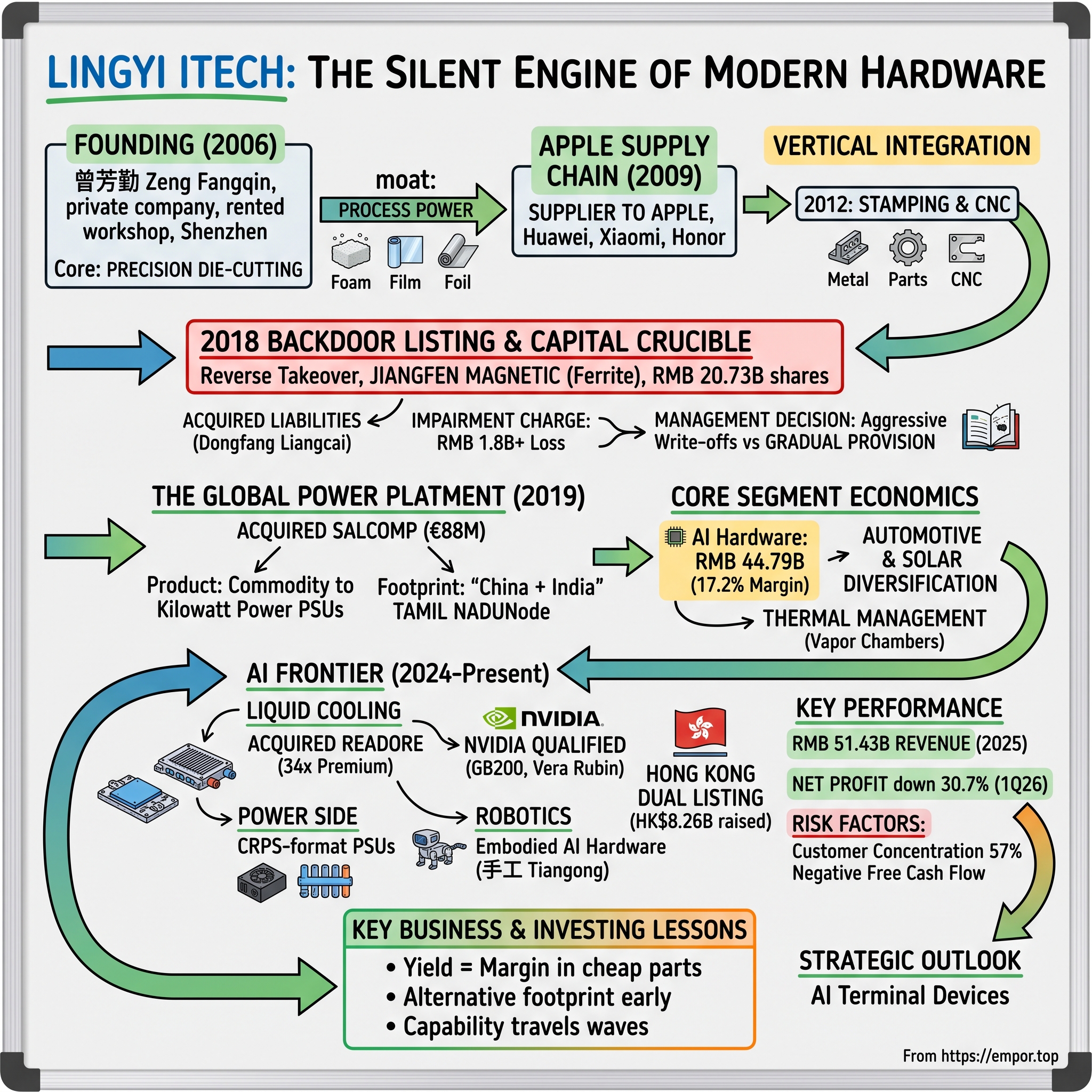
Lingyi iTech: The Silent Engine of Modern Hardware
I. Introduction & Episode Roadmap
Pick up the phone in your pocket. Feel its weight, the way the frame meets the glass, the faint warmth on the back when you shoot video for a few minutes. Now imagine peeling it open — not the theatrical teardown of a YouTube video, but the slow, forensic disassembly an engineer performs with tweezers and a heat gun. Past the screen there is a landscape almost nobody thinks about: black foam gaskets shaped like puzzle pieces, whisper-thin sheets of graphite that wick heat sideways, copper-mesh shields that stop one chip from whispering electrical noise into another, stamped metal brackets holding the camera module in place to a tolerance finer than a human hair, and a vapor chamber the thickness of a business card that moves heat by boiling and condensing a few drops of liquid.
None of it has a brand name. All of it has to work perfectly, a billion times over.
A large share of those parts, across a large share of the world's premium consumer electronics, comes from one company in Guangdong: 广东领益智造股份有限公司 Lingyi iTech (Guangdong) Company, listed in Shenzhen under ticker 002600.SZ and, since June 2026, in Hong Kong as well.1 In the year ended December 2025 it reported revenue of RMB 51.43 billion — roughly $7.2 billion — up 16.2%, with net profit attributable to shareholders of RMB 2.29 billion, up 30.3%.2 Market capitalisation as of late July 2026 sits around RMB 90 billion.3
The unsung hardware core
The interesting thing about Lingyi is not its size. It is what the size is made of. This is a business built almost entirely out of parts that cost cents, sold to customers who count those cents obsessively, and it has compounded into a top-tier supplier to Apple, 华为 Huawei, 小米 Xiaomi, 荣耀 Honor, and — increasingly — the builders of AI data centres. According to Frost & Sullivan data cited in the company's Hong Kong listing materials, Lingyi ranked first globally in high-precision components for AI terminal devices by 2025 revenue, and third globally among AI-terminal intelligent manufacturing platforms.1
Those rankings deserve a raised eyebrow rather than applause — commissioned market-research superlatives are a genre, and the category definitions are conveniently narrow. But strip away the framing and something real remains: a company that has moved from die-cut foam to stamped metal to power adapters to server cold plates without ever holding a consumer brand, a proprietary chip, or a piece of software anyone would pay for.
The central thesis
Here is what we want to test across this episode. Founder 曾芳勤 Zeng Fangqin built Lingyi out of a rented Shenzhen workshop into a manufacturer that controls both the structural interior and the external power delivery of flagship electronics.4 Management's argument today is that this same capability stack — micro-tolerance tooling, high-yield process control, and the willingness to industrialise something fast — transfers cleanly into AI server liquid cooling, kilowatt-class power supplies, and humanoid robot hardware.
That is a genuinely testable claim, and the evidence is mixed in a way that makes it worth arguing about. On one side: a controlled subsidiary that is a certified NVIDIA liquid-cooling supplier shipping into the GB200 and Vera Rubin platforms.56 On the other: first-quarter 2026 net profit down 30.7% year over year, short-term borrowings that exploded ahead of the Hong Kong listing, top-five customer concentration climbing toward 57%, and an acquisition done at a valuation premium of more than 3,400% over audited book equity.789
Episode roadmap
We start with the founding and the physics of high-yield micro-precision manufacturing — why a business that die-cuts foam is harder than it sounds. Then the 2018 backdoor listing that nearly broke the company in its first year as a public entity. Then the 2019 acquisition of Finnish charger maker Salcomp and what it bought beyond chargers. Then the core segment economics and the uncomfortable arithmetic of selling to Apple. Then the diversification years — EV parts, solar, thermal. Then the AI pivot, the Hong Kong IPO, and the robotics ambition. Then a hard look at management credibility and capital allocation, the strategic frameworks, and the bull and bear cases.
It begins, as these stories often do, with someone walking away from a comfortable job.
 Subscribe on LinkedIn
II. Founding Context & The Precision Die-Cutting Breakthrough (2006–2017)
In 2006, a 41-year-old executive named Zeng Fangqin quit a well-paid job running the China operations of a foreign precision-manufacturing company, rented a small factory building in Shenzhen, and started making die-cut parts.4 By the arithmetic of career risk, this was a terrible idea. She had already done the hard part of a Chinese professional life of that generation — studied abroad in the United States during the 1980s wave, worked as an executive at a technology company in Silicon Valley, come home, and landed a general manager's title at a multinational.4 Most people who reach that rung stay on it.
She did not. The company she founded was called 领胜电子 Lingsheng Electronics, and its business was cutting shapes out of sheets of material.
What die-cutting actually is, and why it is not simple
Start with the physical problem. Inside a phone, dozens of tiny components have to be held apart, held together, cushioned, sealed, grounded, or thermally connected. The parts that do this are made by laminating layers of material — foam, adhesive, polyimide film, copper foil, graphite — into a stack, and then cutting that stack into precise shapes, the way a cookie cutter cuts dough. Hence "die-cutting": a hardened steel die presses through the laminate and produces the part.
Described that way it sounds like a craft trade. The reason it is not is scale and tolerance. A flagship phone might use forty to sixty distinct die-cut parts. A single model ships in tens of millions of units. The shapes have sub-millimetre features and must sit within tolerances measured in hundredths of a millimetre, because a gasket that is 50 microns too thick will bow a display, and a shield that is 50 microns off-centre will short against a neighbouring pad.
Now add the brutal part: yield. If your scrap rate on a laminated stack is 3% instead of 0.5%, you have destroyed your margin, because the expensive input is the material, not the labour. And because these are laminates, a defect can come from anywhere — adhesive that cures unevenly in humidity, a die that dulls after a hundred thousand strokes, a roll of graphite from a new supplier lot that delaminates.
The moat, in other words, is not the machine. Anyone can buy the machine. The moat is the accumulated body of knowledge about how to keep a hundred machines producing parts within tolerance, shift after shift, while a customer changes the design three times during ramp-up. That knowledge lives in tooling design, in fixture engineering, in the specific parameters an operator dials in when the ambient temperature shifts. It is not patentable, it is not visible in a filing, and it takes years to accumulate. Hamilton Helmer would call it Process Power, and it is the least glamorous and most underrated form of advantage in hardware.
Cracking Apple
Lingsheng's break came in 2009, when it began supplying components for Mac products and entered the Apple supply chain, later expanding across iPhone, iPad, and Apple Watch programmes.4 By 2012, the company was, by revenue, the largest supplier of handset die-cut parts in the world, and Zeng founded 领益科技 Lingyi Technology to push beyond die-cutting into stamping and CNC machining.4
The competitive story here matters, because it explains the shape of the business today. The incumbents in functional materials were Japanese and American: 日東電工 Nitto Denko, 3M, and a cluster of specialty materials houses with decades of chemistry behind them. They made superb material. What they were structurally bad at was the thing Chinese consumer electronics required — turning a design change into a new tool and a validated production line in days rather than months, at a unit price that assumed the part was a commodity.
Lingyi attacked exactly that seam. Rapid tool turnaround. Engineers co-located near the customer's product development teams in Dongguan and Shenzhen. Custom automation lines built in-house rather than bought. And prices that reflected a Chinese cost base rather than a Japanese one.
The result was a role change that is easy to miss. A supplier who quotes to a drawing is a vendor. A supplier whose engineers sit in the room while the drawing is being argued over is something else — they start suggesting that if the bracket moves 0.3mm, the part becomes twenty percent cheaper to make and ten percent more reliable. Lingyi made that transition, and it is the reason the company was able to keep adding part categories to the same customer relationship rather than defending a single one.
What this era says about the business
For an investor, the founding decade establishes two things that still matter. First, the advantage is process-based, not product-based, which means it is real but invisible and impossible to verify from the outside except through yield-driven margins and customer retention. Second, the advantage was won by being faster and cheaper than incumbents — a position that works beautifully when you are the insurgent and becomes uncomfortable when someone newer is faster and cheaper than you.
By 2017, Lingyi Technology was a profitable, fast-growing private company with a marquee customer list and no listed currency to fund the next leg. Which brings us to a decision that would define the company's second act — and very nearly wreck it.
III. The Backdoor Listing & The Capital Structure Crucible (2017–2018)
On 25 July 2017, a Shenzhen-listed ferrite magnet maker called 江粉磁材 Jiangfen Magnetic Material announced it would acquire 100% of Lingyi Technology for RMB 20.73 billion in shares.10 In substance this was not an acquisition at all. It was a reverse takeover — Zeng Fangqin's private business climbing into a public shell, with Zeng emerging as controlling shareholder of the combined entity. The restructuring completed in March 2018, and the listed company was renamed Lingyi iTech.11
The market loved it. The shell's shares went limit-up repeatedly through the announcement period.10 What the market had not fully priced was what else was inside the shell.
The mess in the basement
Jiangfen was not an empty vehicle. It came with an operating magnetics business, and — more consequentially — with acquisitions of its own. In 2016 it had bought a company called 东方亮彩 Dongfang Liangcai for RMB 1.75 billion in a share-and-cash deal.12 Dongfang Liangcai hit its earnings commitments in 2015 and 2016, then missed badly: a loss of about RMB 90 million in 2017 and a loss of RMB 216 million in the first half of 2018 alone.12
Worse was a prepayment problem. Roughly RMB 1.1 billion of prepayments made by the legacy business proved difficult or impossible to recover, and Lingyi iTech ended up in litigation against the shell company's own founder over the affair.13
The 2018 accounts absorbed the damage all at once. The company recorded asset impairments exceeding RMB 1.8 billion and reported a net loss attributable to shareholders of RMB 680 million for the year — its first and, to date, only annual loss as a listed entity.12 Revenue that year was RMB 22.5 billion; a business that generated RMB 4.3 billion of gross profit reported an operating loss, because more than RMB 2.6 billion of other charges ran through the income statement.
Skeptics at the time asked the obvious question: had Zeng traded a clean private company for a listed one carrying liabilities nobody had fully sized? Was the underlying operating business as good as the pre-deal numbers suggested, or was the shell's rot going to keep leaking into results for years?
The course correction
What happened next is the most useful single data point we have on how this management team behaves under stress, and it is worth being precise about it rather than romantic.
Lingyi did not amortise the pain across several years. It took the write-offs and bad-debt provisions aggressively in 2018, in one hit, and simultaneously pursued recovery through the courts.13 That is a choice. The alternative — provisioning gradually, protecting reported earnings, hoping recoveries arrive — is common and is usually a tell that management is managing the share price rather than the business. Taking the loss in year one is the harder, cleaner option.
The second data point is the earnout. Reverse mergers in China come with a Valuation Adjustment Mechanism — a binding profit commitment from the injected asset's owners, with compensation owed if targets are missed. Lingyi Technology's commitments were substantial and escalating: adjusted net profit of roughly RMB 1.15 billion for 2017, RMB 1.49 billion for 2018, RMB 1.86 billion for 2019, and RMB 2.24 billion for 2020.11 The operating business cleared those hurdles — 2018 adjusted net profit came in around RMB 1.94 billion against a RMB 1.49 billion commitment, a completion rate of roughly 130%.11
The important analytical point is the split. In the same year the consolidated company reported a headline loss, the injected operating business beat its earnings commitment by thirty percent. The core machine was working. The wreckage was inherited. That distinction was invisible in the headline EPS and visible only to anyone willing to read the segment and commitment disclosures — which is a decent argument for why this kind of company rewards actual filing-reading.
The industrial payoff nobody focused on
Lost in the noise was the reason a die-cutting company might genuinely want a ferrite magnet maker. Soft magnetic materials — ferrites, rare-earth magnetic powders — are the physical heart of wireless charging coils, haptic vibration motors, and power transformers. Owning that upstream capability meant Lingyi could later supply a wireless charging module rather than a piece of a wireless charging module, and could control the cost and availability of a material input rather than buying it at a market price.
That vertical logic — buy the material, sell the module — recurs throughout this story. It is also the strategic rationale that will be used to justify a great deal of subsequent M&A, some of it convincingly and some of it less so.
For investors, the 2018 crucible established a pattern worth holding onto: this is a management team that has demonstrated it will absorb a large loss quickly when the facts demand it, and that has, at least once, delivered against a hard, externally-verified profit commitment. Whether that discipline survives a much larger and more speculative capital-allocation programme is the question the rest of this episode circles.
Having cleaned the balance sheet, Zeng went shopping — this time in Finland.
IV. The Salcomp Gambit: Turnaround M&A & The "China + India" Footprint (2019–2022)
Salo is a town of about 25,000 people in southwestern Finland. For a generation it was a Nokia town — the mobile phone plant there was the beating heart of the local economy until Nokia's collapse hollowed it out. Salcomp, founded in 1973 and headquartered in Salo, was part of that ecosystem: it made the chargers and power adapters that came in the box with the phones.14
By 2019 Salcomp was owned by Nordic private equity — Nordstjernan holding 55% and Sjätte AP-fonden, a Swedish state pension fund, holding 45% — and it was for sale.
The deal
On 3 June 2019, Lingyi iTech agreed to acquire Salcomp Plc for €88 million, roughly $99 million.1516 The transaction was all cash, part of which went to retiring Salcomp's bank debt, and it closed on 27 August 2019.17 Lingyi's legal advisers were King & Wood Mallesons alongside Finnish firm Borenius; White & Case advised Salcomp.1618 The path was not entirely smooth — Lingyi postponed the shareholder meeting required to approve the deal, which briefly rattled the market.19
Did Lingyi overpay?
Consider the asymmetry. Lingyi paid under $100 million for a business that, four years later, was targeting $2–3 billion of annual revenue from its Indian operations alone.20 On the face of it, that is an extraordinary purchase multiple.
But that framing flatters the buyer, and the honest version is more interesting. The price was low because the business was, at the time, worth roughly that. Salcomp carried the classic profile of a distressed contract manufacturer: legacy cost structures built for a customer that no longer existed, European overhead attached to a product whose value had collapsed into commodity territory, and operating margins in the low single digits. Power adapters are an unforgiving category. The bill of materials is dominated by copper, transformers, and semiconductors; the customer specifies almost everything; and the only lever the manufacturer controls is conversion cost.
So the accurate statement is not "Lingyi got a bargain." It is "Lingyi bought a real operational turnaround risk at a price that reflected that risk." What Lingyi brought was not capital. It was a manufacturing operating system — lean automation, in-house line building, and procurement leverage, including on the magnetic cores that go inside every transformer, which Lingyi could now source from its own upstream magnetics business.
What Salcomp actually became
The turnaround took years and is still, in parts, incomplete — the company has repeatedly told investors that overseas operations would "gradually achieve profitability," language that is itself an admission they had not.21
But the product scope moved decisively upmarket. Salcomp went from basic wall chargers to high-wattage fast charging, USB-C power delivery modules, and smart home power units, and by 2024 was producing kilowatt-class high-power products in volume at overseas bases.21 The battery and power segment generated RMB 6.48 billion of revenue in 2024, around 15–16% of group sales, growing to RMB 7.58 billion in 2025, up 16.9%.2122 Salcomp today makes chargers and adapters for Apple, Huawei, and Xiaomi among others.21
That progression — commodity charger to high-wattage power engineering — turns out to matter enormously later, because a company that has learned to design and mass-produce kilowatt power electronics is not starting from zero when the market asks for a 5.5-kilowatt AI server power supply.
The India node
The strategically decisive piece of Salcomp was not in Finland. It was in Tamil Nadu.
In 2019 Salcomp reached an agreement to take over a facility in Chennai formerly owned by Nokia, launching commercial operations in 2020.20 By early 2023 the Chennai complex employed around 12,000 people, about 85% of them women, and management announced plans to roughly double the Indian workforce to 25,000 over the following two to three years, alongside a housing complex for some 15,000 workers.2023 The company also expanded into Vietnam, Brazil, and Mexico for power production, and into Turkey.21
Think about the timing. Lingyi acquired a large, established Indian manufacturing base in 2019 — before the pandemic, before the sharpest phase of US-China trade friction, and before Apple's "Make in India" push accelerated in earnest. When anchor customers began demanding non-China capacity, Lingyi was not scrambling to build it. It already had it, staffed and running, with the local licences, labour relationships, and logistics networks that take years to establish and cannot be bought quickly at any price.
This is the "China + N" playbook executed early rather than reactively, and it converted a geopolitical risk into a commercial asset. It also, less comfortably, added a permanent layer of complexity: multi-country working capital, currency exposure, and the operational drag of running plants across four continents. Both things are true, and the second one will show up in the numbers later.
With a cleaned balance sheet, an upstream materials business, and a global power platform, Lingyi entered the 2020s with a genuinely different shape. The question was whether the core business — the one that actually made the money — could keep growing under the weight of its largest customer.
V. Core Business Deep-Dive: Segment Economics, Apple Dependence, & Peer Rivalry
Every supplier to Apple lives with the same private arithmetic. Winning the socket makes your year. Keeping it makes your decade. And the moment you have optimised your factory around it, the customer's procurement team knows exactly what your cost structure looks like and prices accordingly.
Lingyi's reported segments tell the story of a company trying to widen out of that trap while remaining, at heart, a consumer electronics parts maker.
The segment picture
In 2025 the company reported its business as three buckets. AI hardware — essentially the consumer electronics and computing components franchise — generated RMB 44.79 billion, up 9.8%, at a gross margin of 17.2%.2 Automotive and the low-altitude economy contributed RMB 2.95 billion, up 39.6%, with gross margin improving roughly 7.9 percentage points year over year.2 Other business contributed RMB 3.68 billion.2
Inside the AI hardware bucket, two lines are worth separating out because they are the strategic ones. Thermal products generated RMB 5.13 billion, up 24.8%. Battery and power generated RMB 7.58 billion, up 16.9%.2 Both grew meaningfully faster than the segment as a whole, which means the traditional structural and functional parts business — still the largest single block of revenue — grew slower than the headline.
That is the first analytically important observation. The company's growth is increasingly coming from the newer, more capital-intensive lines, while the historic core is closer to flat-to-modestly-growing. That is what a maturing anchor market looks like.
The second observation concerns margins. A blended gross margin in the high teens is a long way from the 25%-plus that pure functional-parts businesses used to earn. Power supplies structurally carry lower gross margins than die-cut precision parts, so mix alone explains part of it. But mix is not a defence; it is a description of where the business is heading.
The dollar content question
Management and sell-side analysts frequently talk about "content value per device" — the total dollar value of Lingyi parts inside a given phone or laptop. The company does not disclose this figure, and any specific number quoted for it should be treated as an estimate rather than a fact.
What we can say from disclosed data is directional: the number of part categories Lingyi supplies has expanded from die-cut functional parts into stamped and CNC structural components, thermal modules including heat pipes and vapor chambers, magnetics, and in-box and out-of-box power products. Each addition raises content per device without requiring a new customer relationship. That is the single most capital-efficient growth mechanism available to a component supplier, and it is the one Lingyi has executed best.
Who Lingyi is actually fighting
The Chinese consumer electronics supply chain is not one competitive arena but several overlapping ones, and Lingyi occupies an unusual position in the middle.
立讯精密 Luxshare Precision is the giant — the interconnect and final assembly champion that has moved from connectors into building entire products. Luxshare competes with Lingyi at the edges but is playing a different game: system integration, where scale and assembly discipline dominate.
蓝思科技 Lens Technology owns cover glass and increasingly metal-and-glass structural assemblies. It is the closest analogue in business model — a materials-and-process company with heavy Apple exposure — but its physics are glass and ceramics, not multi-material laminates and stamping.
歌尔股份 Goertek and 瑞声科技 AAC Technologies are the acoustics and optics specialists. They compete for the same customer's BOM dollars but not usually for the same parts.
The more uncomfortable competitors are 鴻海精密 Foxconn (Hon Hai Precision) and 比亚迪电子 BYD Electronic. These are system assemblers, which makes them simultaneously customers, channel, and potential insourcers. If an assembler decides to make structural enclosures in-house, a supplier like Lingyi loses content without losing a customer relationship — the worst kind of erosion, because it is quiet.
This is not hypothetical. Pre-IPO disclosure showed that "Customer A," a Taiwan-listed EMS provider, consistently accounted for around 20% of Lingyi's revenue.7 Read that carefully: Lingyi's single largest revenue relationship is with an assembler, not with the brand. The brand specifies the part; the assembler buys it. Lingyi's commercial position therefore depends on remaining specified by a company that does not pay it, while being paid by a company that could theoretically make the part itself.
The squeeze, and the defence
Apple's standard practice — dual-sourcing every part it can — is designed precisely to prevent suppliers from accumulating pricing power. Annual cost-down expectations are a structural feature, not an occasional negotiation.
Lingyi's defence is not commercial leverage. It is switching friction during ramp. When a flagship product is ramping from zero to millions of units a month, the constraint is not price; it is yield. A supplier whose tools are already validated, whose scrap rates are known, and whose engineers are physically embedded in the launch is worth more than a cheaper alternative that might work. Swapping suppliers mid-cycle risks the launch, and launches are the only thing that matters.
That defence is real but bounded. It protects the incumbent within a product generation. It does not protect the incumbent at the start of the next one, when everything is re-quoted.
The evidence on whether that defence is holding is genuinely ambiguous, and the concentration numbers point the wrong way. Top-five customer revenue concentration rose from 49.1% in 2022 to 56.4% for the first nine months of 2025, and was cited at 57.5% in subsequent analysis.724 A company diversifying successfully should show falling concentration. Lingyi's is rising — because the new businesses, including AI servers, are themselves sold to a small number of very large buyers. Diversifying by end-market while concentrating by customer is a real strategic pattern, and it is not obviously an improvement.
There is one further disclosure that deserves a flag rather than an accusation. In 2022, Lingyi's top five customers and top five suppliers reportedly overlapped completely, and related-party purchases reached roughly RMB 6.7 billion in 2024, about 24% of total procurement.7 Customer-supplier overlap is normal in electronics — an assembler sells you components and buys your sub-assemblies — but it complicates revenue quality analysis, because gross flows can look larger than the underlying economic activity. Anyone underwriting this business should read the related-party notes rather than the headline revenue line.
The company's answer to concentration was to go looking for entirely different customers. That search started with cars.
VI. Diversification: EV, Solar, & Early Thermal Management (2021–2024)
There is a specific kind of anxiety that sets in at a components company when the smartphone market stops growing. Unit volumes plateau. The anchor customer's annual cost-down does not plateau. And every incremental year of revenue has to be earned by taking share or adding content rather than riding the tide.
Lingyi's management named the problem publicly. In a 2021 interview, Zeng Fangqin discussed the search for a "second growth curve" and the deliberate widening of the company's industrial boundaries beyond the consumer electronics chain.25
Why cars and solar, specifically
The logic was capability-first rather than market-first, which is the more defensible way to diversify. Ask what a high-speed metal stamping line and a die-cutting operation are physically good at, and the answer is: producing large volumes of precise metal and laminate parts cheaply. Then ask which growing industries need exactly that.
Electric vehicle battery packs need busbars — the flat copper or aluminium conductors that carry current between cells — plus cell housings, flexible connectors, and structural components. These are stamped and formed parts with tight tolerances and enormous volumes. Solar inverters need structural enclosures and thermal interfaces. Neither requires Lingyi to learn a new physics; both require it to learn new customers and new qualification regimes.
The move up the supply chain matters here too. Lingyi has been described as completing a transition from Tier 2 to Tier 1 status in automotive — meaning it sells directly to vehicle manufacturers rather than through an intermediate supplier.24 Tier 1 status is a meaningful upgrade: better margins, direct design involvement, and stickier relationships. It is also a harder operating standard, with automotive quality systems and liability exposure that consumer electronics does not impose.
The early results were not good, then got better
It is worth being blunt about the trajectory, because it illustrates how expensive diversification actually is. The automotive and low-altitude economy segment ran at negative gross margins in early 2024 before improving through 2025.7 By full-year 2025 the segment grew 39.6% with gross margin up roughly 7.9 percentage points.2
That arc — negative margins during qualification, improving as volumes scale — is the normal shape of entering a new industrial market. It is also a reminder that the first several years of a diversification programme destroy value before they create any, and that a company doing this across multiple end-markets simultaneously is absorbing several such J-curves at once.
The thermal foundation
The quieter and, in hindsight, more consequential development of this period was thermal.
Here is the physics in plain terms. Chips produce heat. As phones got thinner and chips got faster, simply attaching a metal plate stopped working. The industry moved to heat pipes and then vapor chambers: sealed, flattened metal enclosures containing a wick structure and a small amount of fluid. Heat at the hot end boils the fluid; the vapour rushes to the cooler end and condenses, releasing the heat; the wick draws the liquid back. It is a heat engine with no moving parts, and it moves heat sideways dozens of times more effectively than solid copper.
Making an ultrathin vapor chamber is genuinely hard. You are welding a sealed cavity thinner than a credit card, evacuating it, dosing an exact quantity of fluid, and guaranteeing it will not leak for years. The yield problem is severe.
Lingyi scaled this capability for slim laptops, gaming handhelds, and 5G smartphones through the early 2020s, and thermal grew into a RMB 5.13 billion line by 2025.2
At the time, this looked like a sensible consumer electronics content play. In retrospect it was the single most important capability the company built in that decade — because two-phase heat transfer, sealed liquid loops, precision-welded metal cavities, and leak-free manufacturing are exactly the skills that data centre liquid cooling requires. Whether by foresight or luck, Lingyi spent the smartphone years training for a race it did not yet know it would enter.
That race arrived with a suddenness that has reordered the company's entire investment case.
VII. The AI Frontier: Liquid Cooling, PSUs, & Humanoid Robotics (2024–Present)
In March 2026, at NVIDIA's GTC conference, a subsidiary called Readore — Chinese name 立敏达 — displayed a set of products that would have meant nothing to a consumer and everything to a data centre engineer: an inner manifold for the Vera Rubin NVL72 tray, and a family of UQD and MQD quick-disconnect couplings.626
Six months earlier, almost nobody outside the industry had heard of the company. Lingyi had not yet bought it.
Why liquid cooling, and why now
The physics is unforgiving. Air cooling works by blowing air across a heatsink; the amount of heat you can remove is limited by air's poor heat capacity and by how much air you can physically move through a rack. As accelerator power consumption pushed past a kilowatt per socket and rack densities climbed toward a hundred kilowatts, air cooling ran into a wall that no amount of engineering cleverness gets around.
Liquid cooling replaces the air with water or a coolant. A cold plate — a machined metal block with internal channels — bolts directly onto the chip. Coolant flows through it, absorbs heat, and carries it to a heat exchanger. Manifolds distribute the coolant across a rack. Quick disconnects let a technician pull a server out without draining the loop or spraying conductive fluid across a million dollars of hardware.
The critical engineering requirement is that none of it leaks, ever, while being connected and disconnected thousands of times over a system's life. This is precision metalworking, sealing, and validated manufacturing — which is to say, it is Lingyi's home turf described in different words.
NVIDIA's Vera Rubin platform, launched at GTC 2026, made liquid cooling standard rather than optional, which marks the point at which this stops being a niche and becomes the default architecture of AI infrastructure.26
Buying the ticket
Lingyi did not build this capability from scratch. In January 2026 it acquired a 35% stake in Dongguan-based Readore for RMB 875 million, structuring the deal to secure 52.78% of voting rights and therefore consolidation.927
The valuation is where the story gets uncomfortable. As of 30 September 2025, Readore's audited shareholders' equity was RMB 712.7 million. The income-approach valuation used for the transaction put total shareholder equity at RMB 2.51 billion — a premium of approximately 3,421.81%, or more than 34 times book.928
Lingyi's justification is that it was buying qualification, not assets. Readore held AVL and RVL certifications with NVIDIA — approved and recommended vendor status — covering liquid cooling plates, manifolds, and quick disconnects for the GB200 and GB300 series and subsequently the Vera Rubin architecture.156 Those qualifications take years to earn and cannot be bought at book value. When institutions pressed the company on whether Readore's direct or indirect customers included NVIDIA, Meta, or Google, Lingyi confirmed only that the target served "leading overseas AI computing customers," citing confidentiality agreements.9
The bull reading: Lingyi paid RMB 875 million for a position in the fastest-growing hardware category on earth, a price that will look trivial if the volumes materialise. The bear reading: it paid 34 times book for a business whose entire value rests on a certification with one customer, and booked a large slug of goodwill in the process — group goodwill rose from RMB 1.17 billion at end-2024 to RMB 2.70 billion at end-2025.29 If the AI capex cycle cools, or if NVIDIA qualifies three more cold-plate suppliers, that goodwill is exposed. This is precisely the kind of asset that produces impairment charges in a downturn, and Lingyi has taken exactly that kind of charge before.
The operating evidence so far leans positive. Readore shipped more than 100,000 manifolds and cold plates in 2025, with capacity targeted above one million units in 2026, and by April 2026 chairman Zeng described it as a core supplier to leading North American computing customers conducting batch deliveries.30 In May 2026, Lingyi provided a guarantee of up to $130 million for Readore in connection with a server customer relationship — a concrete, if indirect, signal about the scale of business being underwritten.8
Management's framing on the 22 July 2026 institutional call was aggressive: an AI server thermal market reaching $33 billion by 2029, compounding at 47.1% from 2025.31 That is a third-party forecast being relayed by an interested party, and should be treated as such. The more checkable statements from that call were that optical module liquid cooling products were targeted for mass production in the third or fourth quarter of 2026, and that the company was shipping GPU cooling modules as a core supplier to AMD.31
The power side
The second AI leg is the one Salcomp built. Kilowatt-class power engineering learned on fast chargers translates upward into AI server power supply units and high-density rack chassis, and Lingyi has presented CRPS-format power solutions aimed at AI computing infrastructure.32
This leg is less proven publicly than liquid cooling, and it is worth noting that server power supplies are a market with entrenched Taiwanese incumbents who have been doing this for decades. Being good at phone chargers is a starting point, not a qualification.
Physical AI
In June 2025, Lingyi held a robotics strategy launch, positioning itself to become a leading global manufacturer of embodied AI hardware — supplying core components, developing systems, and assembling complete units.33 The company has since described serving more than 20 robotics clients globally, operating five manufacturing bases in Dongguan, Chengdu, Zhengzhou, Beijing, and overseas, and running a Beijing "embodied intelligence super factory" associated with the 天工 Tiangong humanoid robot.131
The capability argument is coherent: humanoid robots need precision gearboxes, micro-motors, stamped structural frames, and dexterous hand components — parts that sit squarely inside Lingyi's stamping, CNC, MIM, and die-casting toolkit. The commercial argument is entirely unproven. Humanoid robots ship in the thousands, not the millions, and no one has yet demonstrated a business model that consumes hardware at consumer-electronics volumes. Investors should treat this segment as option value with a currently negligible revenue contribution, not as a near-term earnings driver.
The capital event
On 25 June 2026, twenty years after Zeng rented that first Shenzhen workshop, Lingyi completed a dual primary listing on the Main Board of the Hong Kong Stock Exchange under code 1688.HK.1 The offering comprised 811.8 million shares priced at HK$10.18 — the top of the marketed range — raising approximately HK$8.26 billion, or about $1.06 billion.13435
Nineteen cornerstone investors took $406.9 million, about 38.6% of the deal, including GF Fund Management, KKR's investment vehicle, Morgan Stanley's principal investment arm, HK Greenwoods, 3W Fund, Qube Research & Technologies, Value Partners, Sunny Optical's capital arm, Honor, and Victory Giant Technology's international vehicle.136 The mix is telling — a cluster of industrial and customer-adjacent investors alongside financial ones, which is a form of commercial validation that a purely financial book would not provide.
Roughly 37.6% of proceeds, about HK$3.07 billion, was earmarked for expanding production capacity and upgrading core manufacturing processes, with the balance directed toward AI server liquid cooling, humanoid robot manufacturing facilities, and advanced precision manufacturing R&D.3536
This was, notably, Lingyi's second attempt at a Hong Kong listing; an earlier effort in 2021 did not proceed.7 The company got the deal done this time on the strength of an AI narrative — which raises the fair question of whether the capital is being raised because the opportunity demands it or because the window was open.
VIII. Management Credibility, Capital Allocation, & Earnings Q&A Audit
The most revealing number in Lingyi's recent history is not in the annual report. It is the gap between what the first quarter of 2026 showed and what the share price did afterwards.
Revenue for the quarter came in at RMB 12.64 billion, up 10.0%. Net profit attributable to shareholders fell 30.7% to RMB 392 million. Gross margin was 16.54%, and the balance sheet carried a 55.74% liability ratio.3731 Financial expenses rose 532.45% year over year, driven by currency movements; R&D spending rose about 33%; and copper and aluminium input costs increased.3824
The market's initial reaction was to look through it. Analysts argued the decline was composed of non-recurring and investment-related items rather than core deterioration, and the shares re-rated toward a market capitalisation near RMB 100 billion on a forward multiple of 33–34 times, versus roughly 23 times for Luxshare and 18 times for Goertek.24 By late July 2026, the shares had come back to RMB 12.40, roughly 18% below their 50-day average and well off a 52-week high of RMB 18.83.3
That round trip is the whole governance question in miniature: is this a company being re-rated on a genuine capability transfer, or one being marked up on an AI narrative and then marked back down when the earnings do not arrive?
The founder
Zeng Fangqin, born in 1965, controls 58.64% of the company through direct holdings and Lingsheng Investment.7 That is an unusually concentrated position for a company of this size, and it cuts both ways. It permits genuinely long-horizon, counter-cyclical decision-making — the Salcomp purchase during a distressed period, the Readore purchase before liquid cooling was consensus. It also means minority shareholders have essentially no mechanism to challenge capital allocation.
Her track record has real wins in it: the 2018 clean-up, the Salcomp turnaround, the early India footprint, and the thermal capability that turned out to be the on-ramp to AI. It also has a pattern worth naming — a strong and persistent preference for acquisition over organic build.
The acquisition ledger
Since the reverse merger, the company has bought: Salcomp in 2019; capacity from a Flex facility in Zhuhai and other assets in the following years; 浙江向隆 Zhejiang Xianglong in October 2025 for RMB 2.404 billion in cash for 96.15%, an automotive constant-velocity driveshaft maker with 2024 revenue of RMB 1.99 billion and net profit of RMB 127 million, carrying profit commitments of RMB 175 million, RMB 200 million, and RMB 225 million for 2025 through 2027, cumulatively at least RMB 600 million, with payments staged 67% up front and the rest tied to audited results; and Readore in January 2026.39409
Two observations. First, the Xianglong deal structure is disciplined — staged payments tied to verified earnings, which is exactly the mechanism that protects a buyer from the Dongfang Liangcai outcome. That is evidence of institutional learning from 2018. Second, the pace and breadth are aggressive. Driveshafts, liquid cooling, robotics, and power electronics are four different industries with four different customer bases, and integrating them simultaneously is a management bandwidth question that no amount of capital solves.
The activist stress test
A skeptical investor would build the case on four pillars, and each one is grounded in disclosed data.
Working capital. Days of sales outstanding stretched to about 110 in 2025 from roughly 100 the prior year, and the cash conversion cycle lengthened to around 65 days from 57.29 Receivables reached roughly RMB 14.5 billion at the end of the third quarter of 2025, about 29% of annualised revenue, against payables of about RMB 13.8 billion.7 Multi-country manufacturing across China, India, Vietnam, and Latin America structurally consumes working capital. Growth that requires ever more working capital is lower-quality growth than growth that does not.
Leverage and timing. Short-term borrowings jumped 129.4% to RMB 7.33 billion at the end of September 2025, from RMB 3.20 billion at the prior year end, against available cash of about RMB 7.24 billion — while the company simultaneously committed RMB 2.40 billion to the Xianglong acquisition.7 On the full-year balance sheet, total debt reached RMB 16.64 billion with net debt of RMB 10.45 billion.29 The uncomfortable read: the Hong Kong listing was not purely offensive capital. A material portion of it repaired a balance sheet that had been stretched by an acquisition programme.
Capex versus cash generation. Capital expenditure ran at roughly 9.4% of revenue in 2025 — around RMB 4.8 billion — exceeding operating cash flow of RMB 4.43 billion and producing negative free cash flow for the year.2930 Return on equity was approximately 9.5%.29 A business earning single-digit returns on equity while outspending its cash generation is, by definition, funding growth with external capital. That works while the growth arrives. It is unforgiving if it does not.
Related-party complexity. The customer-supplier overlap and the RMB 6.7 billion of related-party purchases in 2024 create analytical opacity that a skeptic would probe hard.7
Does management explain itself?
Across the 2026 disclosures, the pattern is reasonably consistent. The company attributed the first-quarter profit decline to specific, named causes — currency, commodity inputs, higher R&D, lower non-recurring gains — rather than to vague macro conditions, and it did so promptly.3841 On the July institutional call, management gave concrete product milestones with dates attached, including the third-to-fourth-quarter target for optical module liquid cooling production.31 Dated, falsifiable commitments are the useful kind; they can be checked against later.
Where the disclosure is weaker is on the questions investors most want answered. Customer identities in the AI business are withheld under confidentiality — legitimate, but it means the entire liquid cooling thesis rests on statements the company cannot substantiate publicly.9 And there is no disclosed content-per-device metric, which leaves the central bull argument about BOM expansion unverifiable from filings.
On the shareholder-return side, the company declared a dividend of RMB 0.2 per 10 shares for 2025 — a token payout against RMB 2.29 billion of earnings — and announced a share buyback of up to RMB 400 million.242 Neither is material relative to the capital being deployed. This is a company that intends to reinvest, and investors should underwrite it on that basis rather than expecting cash back.
IX. Playbook: Key Business & Investing Lessons
Strip away the specific company and four transferable lessons remain — the kind that apply well beyond one Guangdong manufacturer.
Lesson 1: In cheap parts, margin comes from yield, not price
The instinct in hardware investing is to look for pricing power. Lingyi's history says something different: in low-unit-cost components, the profit pool is created by scrap rate, not by price. A part that sells for thirty cents and costs twenty-two to make earns a decent margin; the same part at a 4% scrap rate instead of 0.5% earns nothing. The competitive battle happens entirely inside the factory, invisibly, and it is won by accumulated process knowledge that no competitor can buy and no analyst can inspect.
The corollary is uncomfortable for investors: you cannot verify this advantage directly. You can only infer it from sustained margins, customer retention across product generations, and the ability to keep winning new part categories from the same buyer. When those inference signals weaken — as concentration rises and blended margins compress — you should update, even if management's story has not changed.
Lesson 2: Owning both ends of a module beats owning the middle
The strategic logic that ran from the magnetics business through to power modules is worth naming precisely. If you own the magnetic material and you own the module assembly, you capture the margin at both ends and you control your own input costs. A pure assembler owns neither and is squeezed from both sides.
This is why the Jiangfen merger, which looked like a disaster in 2018, contained genuine industrial value that took years to surface. It is also why the Readore purchase is defensible on strategy even if the price is debatable — Lingyi already made precision metal parts and vapor chambers; what it lacked was the qualification and the system-level design position. Buying the missing end of a value chain is different from buying an unrelated business, and investors should be tougher on the second kind than the first.
Lesson 3: Build the alternative footprint before anyone demands it
The India lesson generalises. Salcomp's Chennai complex existed and was staffed before Apple's supply chain diversification became urgent. When the demand arrived, Lingyi was a supplier of scarce non-China capacity rather than a company promising to build some.
The general principle: geopolitical realignment converts from risk to advantage only for companies that moved early, because the assets involved — licences, trained workforces, local logistics, regulatory relationships — cannot be created on the timeline that a crisis imposes. Every competitor announcing an India strategy in 2023 was five years late.
The counter-lesson is equally real. Multi-country manufacturing is permanently more expensive to run, more complex to finance, and more exposed to currency swings. Lingyi's own stretched working capital and its 532% jump in financial expenses are the bill for that footprint. Early movers get the advantage; they also carry the cost forever.
Lesson 4: Precision capability travels across technology waves — sometimes
The most seductive story in this episode is that smartphone thermal expertise became AI server liquid cooling expertise. It is genuinely true at the physics level: two-phase heat transfer, precision-welded sealed cavities, and leak-free volume manufacturing are the same discipline whether the heat source is a phone chip or a GPU.
But the transfer is not automatic, and investors should be precise about what actually carried over versus what had to be purchased. Lingyi had the manufacturing capability. It did not have the customer qualification, the system-level design position, or the connector engineering — which is exactly why it paid 34 times book for Readore rather than building the business itself.
The honest lesson is therefore narrower than the marketing version: manufacturing capability transfers across technology waves; market position does not. A company can be perfectly capable of making a product and still have to buy its way into the market for it. When management tells you that its existing skills position it to win a new category, the right question is not "can you make it?" but "who has already qualified you to sell it?"
X. Strategic Analysis: Helmer's 7 Powers, Porter's 5 Forces, & Bull vs. Bear Case
Let us war-game this properly.
Hamilton Helmer's 7 Powers
Process Power — the strongest claim, and the least verifiable. Two decades of tooling design, custom automation, and scrap-reduction technique across die-cutting, stamping, CNC, metal injection moulding, and die casting constitute genuine accumulated advantage. It is durable because it is tacit and cannot be hired away wholesale. The caveat is that it is only worth something in categories where yield is the binding constraint. In power supplies, where the BOM dominates, process excellence matters far less.
Scale Economies — moderate to strong. Being among the largest global buyers of specialty alloys, polyimide films, graphite, adhesives, and magnetic powders confers real purchasing advantage, and fixed R&D and tooling costs spread across enormous volumes. But scale in this industry is not unique — Luxshare, Lens, and Foxconn all have it. Scale here prevents disadvantage more than it creates advantage.
Switching Costs — moderate, and time-bounded. Co-engineered tooling embedded in a customer's production line makes mid-cycle supplier swaps genuinely risky. That protects revenue within a product generation. It does not protect it at the next design cycle, when everything is re-tendered. Call it a one-to-two-year moat that must be re-won continuously.
Cornered Resource — narrow but real, and recently purchased. Readore's AVL and RVL status with NVIDIA is a cornered resource in the strict sense: a preferential access to a scarce input, in this case a qualification slot in the highest-value hardware supply chain in the world.56 Its durability depends entirely on whether NVIDIA broadens its vendor list, which is outside Lingyi's control.
Branding, Network Economies, Counter-Positioning — essentially absent. Component suppliers do not have brands that end customers value, there are no network effects in stamped metal, and Lingyi's business model is a faster, cheaper version of what incumbents did rather than a structurally different one they cannot copy.
Net assessment: this is a Process Power and Scale business with a recently acquired Cornered Resource in one high-value niche. That is a real but modest set of powers, and it is consistent with the mid-single-digit to low-double-digit returns on equity the company actually earns.
Porter's 5 Forces
Buyer power — high, and rising. Top-five concentration around 57% with a single EMS relationship near 20% is the defining structural feature of this business.724 Buyers are larger than the supplier, dual-source deliberately, and impose annual cost-downs. This single force explains most of the margin history.
Supplier power — low to moderate. Copper, aluminium, polymers, and magnetic materials come from fragmented markets. But "fragmented" does not mean "cheap" — 2026 demonstrated that commodity price moves flow straight through to profit when the customer will not absorb them.38 Lingyi's upstream magnetics ownership helps at the margin.
Threat of new entrants — low for the core, higher than it looks in AI. Nobody is going to challenge Lingyi in phone die-cutting; the capital, the yield curve, and the qualification barriers are prohibitive. Liquid cooling is a different matter. It is a young category with fast-expanding demand, which attracts entrants from thermal, connector, and precision machining backgrounds worldwide. Lingyi's position there is a qualification, not a fortress.
Threat of substitutes — low. Physical devices need physical structure, shielding, and heat removal. As power density rises, this becomes more necessary, not less. This is the most comfortable force on the board.
Rivalry — high and intensifying. Luxshare, Lens, BYD Electronic, Goertek, and the assemblers themselves all compete for adjacent BOM dollars, and every one of them is simultaneously pursuing the same AI server and robotics diversification. The Chinese hardware supply chain is currently executing the same strategic pivot in unison, which is precisely the condition under which returns get competed away.
The current risk radar
The material risks, mechanism first rather than as a checklist:
Customer concentration. Concentration is rising, not falling, and a single product cycle miss at a top customer translates directly into a revenue hole with high fixed costs underneath it.
Input cost and currency. Already demonstrated. Copper and aluminium inflation plus currency movement cut first-quarter 2026 profit by roughly a third on 10% revenue growth.3837 In a business with mid-teens gross margins and long production lead times, there is very little buffer.
Geopolitical and tariff friction. The India footprint that de-risks China exposure creates its own exposure to India-China bilateral policy, Indian regulatory change, and cross-border trade measures. Diversification of manufacturing geography is not the same as elimination of geopolitical risk; it is a different distribution of it.
AI execution and impairment. If hyperscaler liquid cooling adoption favours established thermal incumbents, or if qualification cycles stretch, the RMB 2.70 billion of goodwill on the balance sheet becomes a live impairment question.29 This company has taken a large impairment charge once before.
Financing. Net debt of RMB 10.45 billion, a 55.7% liability ratio, negative free cash flow, and an acquisition programme that continues are a combination that works while capital markets stay open and stops working quickly if they do not.2931
The three metrics that actually matter
Everything above collapses into a small number of things worth tracking quarter by quarter. Not calculations to perform — observations to make.
1. Non-consumer revenue contribution. Specifically, the combined share of group revenue from AI servers and computing infrastructure, automotive, and robotics. This is the single cleanest test of whether the diversification thesis is real. If it is not visibly climbing toward and past twenty percent of revenue over the next several years, the company is a smartphone parts supplier with expensive side projects.
2. Blended gross margin alongside the cash conversion cycle. These two together answer whether growth is profitable and whether it is being funded by the balance sheet. Margin tells you about pricing and mix; the cash cycle tells you whether revenue is turning into cash. A company whose margin is stable but whose cash cycle keeps lengthening is quietly deteriorating.
3. Top-five customer concentration. Disclosed periodically, and the most direct measure of negotiating position. Falling concentration alongside rising revenue is the outcome the strategy is supposed to produce. Rising concentration means the new businesses are simply new dependencies.
The bull case
The bull argument runs as follows. AI-capable phones and PCs require more thermal management, more shielding, more structural rigidity, and more power delivery per device than their predecessors, which expands Lingyi's content per unit without requiring a single new customer. Simultaneously, the liquid cooling business is qualified into the highest-growth hardware platform in the world, and is scaling from 100,000 units in 2025 toward a million-unit capacity target in 2026.30 The power business, built on Salcomp's kilowatt-class engineering, addresses AI server PSUs. The automotive segment has completed its Tier 1 transition and turned margin-positive. And a global manufacturing footprint that competitors are only now building lets Lingyi take share from single-region rivals as customers demand geographic redundancy. In that world, a company earning single-digit returns on equity today is investing through a transition into a mix with structurally higher returns.
The bear case
The bear argument is equally coherent, and it does not require anything to go dramatically wrong.
The core consumer electronics business grows at high single digits at a gross margin below 18%, while the customer takes cost down every year. The new businesses are real but small, capital-hungry, and sold to a customer base that is even more concentrated than the old one. Working capital absorbs an increasing share of operating cash flow. Free cash flow stays negative. The 34-times-book premium paid for Readore turns into an impairment when NVIDIA broadens its cold-plate vendor list, which is what large customers always eventually do. Meanwhile, every major Chinese hardware supplier is pivoting into liquid cooling and robotics at once, so the category earns component economics rather than scarcity economics. Copper and currency keep taking bites out of a thin margin. And the shares, which traded at 33–34 times forward earnings against peers at 18–23 times, were priced for the bull case.24
The falsifiable version of the bear case is simple: watch whether liquid cooling and robotics revenue shows up in the segment disclosure at scale, and whether it arrives at a margin above the group average. If it arrives large and dilutive to margin, the bulls were right about the market and wrong about the economics — which is the most likely of the failure modes, and the one that hurts most.
XI. Epilogue & What to Watch
Twenty years separate the rented Shenzhen workshop from the Hong Kong Stock Exchange trading floor. In that span, a company that started by cutting shapes out of foam became a supplier of the physical substrate of modern computing — and then bet more than a billion dollars of fresh capital that the same hands can build the cooling loops and power systems of the AI era.
That bet is not yet resolved, and the honest position for an investor is that it cannot be resolved from where we currently stand. The evidence for the capability transfer is real: NVIDIA qualification, batch deliveries, an AMD relationship, a robotics factory that is producing units. The evidence against is equally real: a first quarter in which profit fell by a third, negative free cash flow, rising customer concentration, a stretched balance sheet, and a goodwill balance that assumes the AI cycle continues.
What to watch from here
The proceeds from the June 2026 listing will be deployed over the coming quarters into liquid cooling capacity, robotics manufacturing, and process upgrades.35 The first checkable milestone is whether the optical module liquid cooling products management targeted for the third or fourth quarter of 2026 actually enter mass production on that schedule.31 Dated commitments are the ones worth keeping score on.
Beyond that: whether Readore's stated capacity expansion toward a million units converts into disclosed revenue rather than remaining a capacity claim; whether humanoid robot deliveries move from single-digit customer counts to volume that registers in the segment reporting; whether the power business wins named AI server PSU programmes against entrenched Taiwanese incumbents; and whether the Salcomp overseas operations finally deliver the profitability that management has been describing as imminent for several years.
And in the background, the least glamorous and most predictive question of all: does the cash conversion cycle start shortening, or does it keep stretching?
Lingyi iTech is a useful case study precisely because it is unglamorous. It has no brand, no chip, no software, no consumer relationship. What it has is two decades of knowing how to make small things accurately, cheaply, and at enormous scale — and a founder who has repeatedly bet the company's capital that this knowledge is portable across whatever the next technology wave turns out to be. Sometimes she has been right. The current bet is the largest one yet, and the market has already priced a good deal of it in.
References
-
Two Decades of Precision: Lingyi iTech Marks 20th Anniversary with Landmark Hong Kong Listing (1688.HK) to Anchor Its Global AI Leadership — PR Newswire, 2026-06-25 ↩↩↩↩↩↩↩
-
领益智造(002600.SZ)发布2025年度业绩,归母净利润22.88亿元,同比增长30.34% — 新浪财经 Sina Finance, 2026-03-27 ↩↩↩↩↩↩↩↩
-
Lingyi iTech (Guangdong) Company — Market Quote and Company Data, Financial Modeling Prep, 2026-07 ↩↩
-
领益智造登陆港股,"果链女王"以AI智造再闯资本新局 — 21世纪经济报道 21st Century Business Herald, 2026-06-26 ↩↩↩↩↩
-
领益智造控股子公司立敏达成为英伟达Vera Rubin架构供应商 — 证券时报 Securities Times, 2026 ↩↩↩↩
-
60岁江门首富曾芳勤掌舵,领益智造IPO前短债翻倍 — 腾讯新闻 Tencent News, 2025-12-16 ↩↩↩↩↩↩↩↩↩↩↩
-
领益智造高溢价收购引关注 本周获超百家机构调研 — 证券时报 Securities Times, 2026 ↩↩↩↩↩↩
-
领益科技作价207亿借壳 江粉磁材再度涨停 — 中国证券报 China Securities Journal, 2017-08-14 ↩↩
-
江粉磁材发行股份购买领益科技 — 中国投资者网 China Investor Network Case Study, 2018-04-16 ↩↩↩
-
百亿女富豪也踩雷!这家公司业绩变脸市值缩水150亿,11亿预付款去向成迷 — 每日经济新闻 National Business Daily, 2018-08-27 ↩↩↩
-
领益智造状告创始人背后:11亿预付款难收回 — 每日经济新闻 National Business Daily, 2019-04-28 ↩↩
-
China's Lingyi iTech to Buy Finnish Component Maker Salcomp — Yicai Global, 2019 ↩
-
White & Case Advises Lingyi iTech on Salcomp Group Acquisition — White & Case LLP, 2019-06-11 ↩↩
-
Lingyi iTech Company completed the acquisition of Salcomp Plc — MarketScreener, 2019-08-27 ↩
-
Borenius, together with King & Wood Mallesons, advised Lingyi iTech (Guangdong) in the acquisition of Salcomp Plc — Borenius, 2019 ↩
-
Lingyi iTech Delays EGM Needed to Seal USD99 Million Takeover of Finland's Salcomp — Yicai Global, 2019 ↩
-
Apple Supplier Salcomp to Double India Workforce in 3 Years — Reuters, 2023-02-13 ↩↩↩
-
赛尔康母公司领益智造2024年报分析,营收高增长创历史新高 — 充电头网 Chongdiantou, 2025 ↩↩↩↩↩
-
领益智造2024年财报:营收442.11亿元,AI终端和汽车业务的快速增长 — 新浪科技 Sina Tech, 2025-03-30 ↩
-
Apple Supplier Salcomp To Double India Workforce, Eyes $2 Bn-$3 Bn Revenue By 2025 — Inc42, 2023-02-13 ↩
-
领益智造净利降30%股价却回千亿,市场在为何定价? — 凤凰网财经 Ifeng Finance, 2026 ↩↩↩↩↩↩
-
21专访丨不断拓宽产业链边界,"苹果"背后的女人曾芳勤详解领益智造第二增长曲线 — 21世纪经济报道 21st Century Business Herald, 2021-12-11 ↩
-
领益智造子公司Readore(立敏达)液冷产品亮相英伟达GTC 2026 — 同花顺财经 10jqka, 2026-03-17 ↩↩
-
Lingyi iTech (Guangdong) Company — Annual Financial Statements and Key Metrics FY2016–FY2025, Financial Modeling Prep ↩↩↩↩↩↩↩
-
领益智造:与北美机器人头部企业达成合作,批量交付AI液冷产品 — 21世纪经济报道 21st Century Business Herald, 2026-04-07 ↩↩↩
-
Apple supplier Lingyi iTech debuts in Hong Kong after $1.06 billion IPO — Investing.com, 2026-06 ↩
-
LINGYI iTECH Announces HK$8.26 Billion IPO — Cooley LLP, 2026-06-26 ↩↩↩
-
China $15 Billion Intelligent Manufacturing Services Company Lingyi iTech Guangdong Hong Kong Secondary Listing IPO — Caproasia, 2026-06-18 ↩↩
-
领益智造一季度归母净利润降30.7%至3.92亿元 — 新浪财经 Sina Finance, 2026-04-30 ↩↩
-
领益智造2026年一季报解读:净利润大降30.70% 财务费用激增532.45% — 新浪财经 Sina Finance, 2026-04-30 ↩↩↩↩
-
领益智造拟24.04亿元收购浙江向隆96.15%股权,深化汽车产业布局 — 证券时报 Securities Times, 2025-10-31 ↩
-
领益智造营收规模连续5季超百亿 拟24亿收购浙江向隆拓展汽车业务 — 新浪财经 Sina Finance, 2025-10-31 ↩
-
领益智造:因大宗原材料价格上涨 一季度净利润同比下降30.7% — 证券之星 Stockstar, 2026-04-29 ↩
-
领益智造2025年收入、利润创历史新高 拟最高4亿元回购股份 — 证券时报 Securities Times, 2026 ↩
 LinkedIn
 WhatsApp
 Reddit
 Hacker News
 Email
Email Kindle
 RSS Feed
 Spotify
 Apple Podcasts
 Amazon Music
 Audible
 YouTube