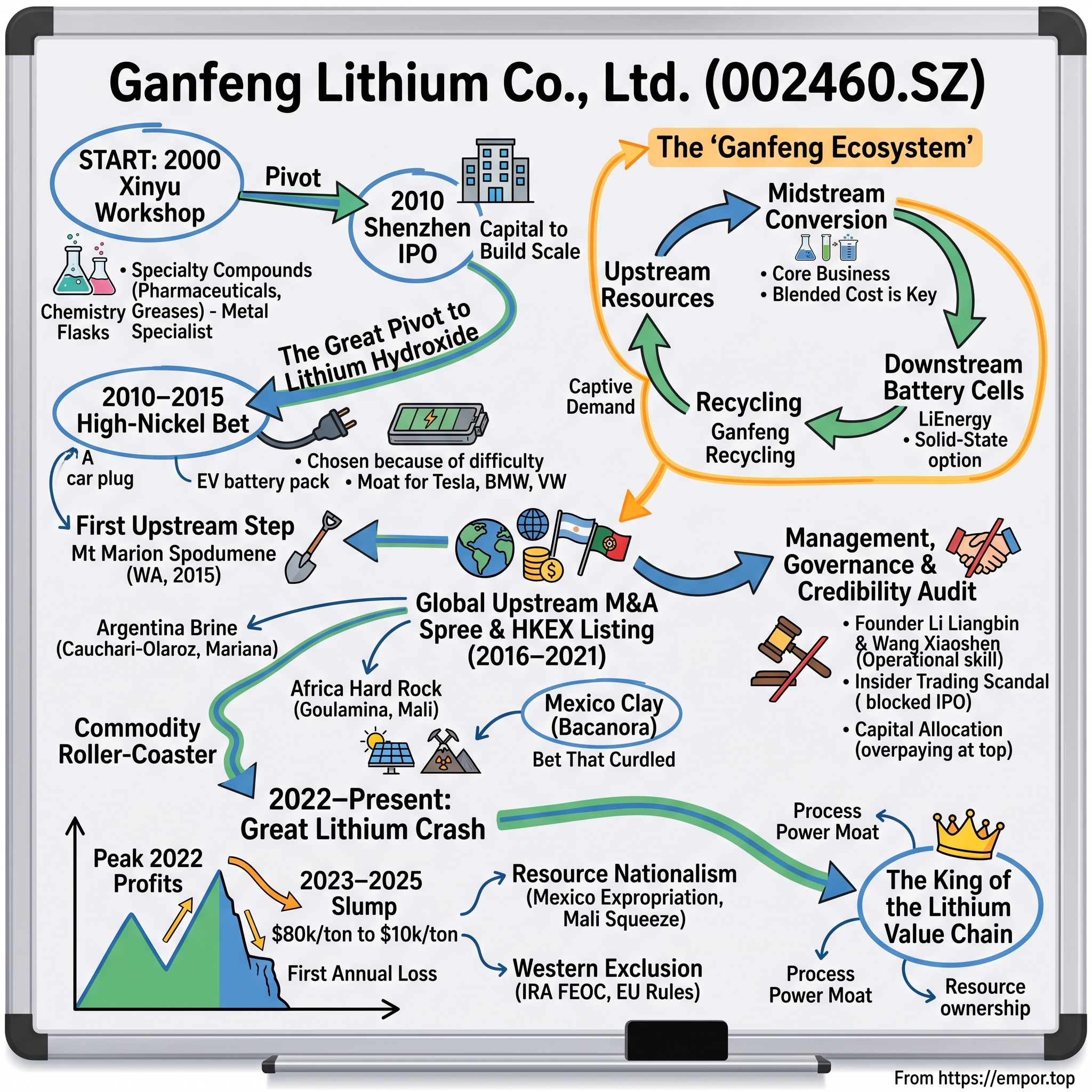
Ganfeng Lithium: The King of the Lithium Value Chain
I. Introduction & Episode Roadmap
Picture a cramped inorganic-chemistry workshop in 新余 Xinyu, a mid-sized industrial city in Jiangxi Province that most people outside China have never heard of. The year is 2000. A former technician from a struggling state-owned lithium salt plant has scraped together roughly ¥3 million—perhaps $400,000 at the time—and set up a modest operation to make specialty lithium compounds: metallic lithium for pharmaceuticals, greases for industrial lubricants, catalysts for chemists.1 There is no mine. There is no famous customer. There is no grand strategy pinned to a wall about electrifying the automobile. There is just a man who understands, at an almost molecular level, how to handle one of the periodic table's most temperamental elements—a silvery-white metal so reactive it will corrode through the wrong container and catch fire in contact with water.
A quarter-century later, that workshop has become 赣锋锂业 Ganfeng Lithium Co., Ltd. (002460.SZ on Shenzhen; 1772.HK in Hong Kong), the world's largest lithium chemical converter and, on some days, a company valued well north of $10 billion.1 It is the story of how you build a critical-minerals empire not by owning the biggest hole in the ground, but by mastering the chemistry that turns rock and brine into the battery-grade powder that Tesla, BMW, and Volkswagen cannot build electric cars without. It is also, less flatteringly, a story about how thoroughly a company can master its craft and still find itself lashed to the mast of a commodity cycle it cannot steer.
The core strategic paradox
That is the central paradox worth sitting with before we go any further: refining process power versus raw resource ownership. Ganfeng's great rivals—天齐锂业 Tianqi Lithium, Chile's SQM, America's Albemarle—largely built their fortunes by betting the balance sheet on owning single monster resources: the Greenbushes hard-rock mine in Western Australia, the brine of the Atacama Desert. Those are enormous, heavily levered wagers on one geological jackpot each. Ganfeng did something stranger and, for a long time, more unfashionable. It conquered the lithium world from the middle of the value chain. First it became the best refiner alive at turning feedstock into high-purity 氢氧化锂 lithium hydroxide. Then, only once that refining machine gave it commercial leverage, it integrated backward into mines and brine lakes across four continents, and forward into battery cells and recycling.
Process power first; resource ownership second. It is the reverse of the intuitive order, and for years it looked like a permanent handicap—a merchant refiner is squeezed from both sides, buying feedstock at the market's mercy and selling product into the market's mood. Whether that sequencing turned out to be genius or merely a different flavor of risk is a question this entire story will keep interrogating, because the honest answer is: some of both.
The commodity roller-coaster
And what a stress test the last four years have delivered. Ganfeng rode the most violent commodity cycle in modern energy history. From the euphoric 2022 peak, when battery-grade 碳酸锂 lithium carbonate blew past ¥500,000 per ton—roughly $80,000—the price plunged straight into a brutal 2023–2025 slump that dragged it down toward $10,000–$12,000, below the cash cost of many marginal producers. The company that printed record profits of more than ¥20 billion in 2022 posted its first-ever annual loss just two years later, then swung back toward profit in the first half of 2026 as prices rebounded.161721 Few businesses illustrate the physics of operating leverage in a commodity chemical so cleanly: when the selling price runs ahead of feedstock cost, margins explode; when it collapses, the same machinery manufactures losses and inventory write-downs. If you want to understand what it actually feels like to own a critical-minerals champion, rather than what a glossy investor deck claims it feels like, Ganfeng is the case study.
Why should a global investor with no particular interest in Chinese chemicals care about any of this? Because lithium is the irreplaceable element at the center of the energy transition, and Ganfeng is one of a small handful of firms that sit at the chokepoint between the raw earth and the finished battery. Roughly speaking, an electric car cannot be built, and a grid cannot be cheaply stored, without battery-grade lithium salts, and a disproportionate share of the world's conversion capacity for those salts sits in China, with Ganfeng at or near the top of global lithium-hydroxide supply.24 That makes the company simultaneously a pure-play proxy on electrification, a case study in commodity-cycle survival, and a live experiment in how a Chinese national champion navigates a world that is increasingly wary of Chinese control over critical inputs. Whichever of those three lenses interests you, the same company sits in the frame.
The roadmap ahead
Here is the road. We start in Xinyu with the metal specialists and the founding chemistry. We trace the audacious 2010 pivot to lithium hydroxide when almost nobody else in China believed in it, and the early move to lock down Australian feedstock. We follow the globe-spanning M&A spree—Argentina's salt lakes, Mali's hard rock, Mexico's clay—that turned a refiner into a resource owner and, in one case, into a claimant against a sovereign government. We dissect the ecosystem segment by segment, weigh management's credibility after a genuine insider-trading scandal that has since escalated toward criminal prosecution, run the business through Hamilton Helmer's 7 Powers and Porter's Five Forces, and lay out the bull and bear cases without pretending to know how the cycle ends. Throughout, the posture is that of an independent analyst, not a member of the fan club: where management says it will win, we ask what evidence supports the claim and what could falsify it. Let's begin where all of it began—with the chemistry.
 Subscribe on LinkedIn
II. Founding & Chemical Origins: The Metal Specialist (2000–2009)
The founding of Ganfeng is not a Silicon Valley garage myth. It is closer to a metallurgist's slow apprenticeship, and the difference matters, because it explains the company's temperament for the next twenty-five years. On March 2, 2000, 李良彬 Li Liangbin registered the company on Longteng Road in the Xinyu Economic Development Zone in Jiangxi Province.1 He was not a financier or a returnee with a Stanford MBA. He was a shop-floor man who had worked his way up through a local state-owned lithium salt operation—someone who knew, from years of practice, exactly how corrosive, reactive, and unforgiving lithium chemistry can be, and who had watched a state enterprise struggle with the very processes he believed he could run better.
The founders
Alongside Li stood co-founder 李华彪 Li Huabiao, and, crucially, 王晓申 Wang Xiaoshen, the outward-facing dealmaker who spoke fluent English and would eventually become the vice chairman and president and the principal architect of Ganfeng's global expansion.1 The pairing is worth pausing on, because founder chemistry often shapes a company more than any strategy document. If Li Liangbin was the craftsman—patient, operationally obsessed, oriented toward yield and purity and the long horizon—Wang Xiaoshen was the ambassador who could sit across a table from Australian miners, Argentine provincial governments, and German automotive procurement teams and speak their language, literally and commercially. Li built the machine; Wang built the map of where to point it. A domestic Chinese chemicals firm that ends up owning brine in the Andes and hard rock in West Africa does not get there without someone like Wang, and it does not survive the journey without someone like Li minding the process.
Why metal, and why not mining
Why start with lithium metal and specialty salts rather than batteries or mining? Because in 2000, the mass-market electric-vehicle industry did not meaningfully exist, and mining required capital Ganfeng simply did not have. What lithium did have was a small but real industrial demand: 金属锂 lithium metal for pharmaceutical synthesis, lithium compounds for high-performance greases and specialty glass, catalysts for chemical plants. This was a niche, high-difficulty corner of the chemicals industry—precisely the kind of place where deep process knowledge, rather than deep pockets, could win. Li's insight, if you can call it that, was almost conservative: get extraordinarily good at the hard chemistry, and stay out of the capital-intensive parts of the value chain until you have earned the right to enter them. In an industry that would later be defined by billion-dollar mine acquisitions, Ganfeng began by deliberately refusing to be a miner.
Pouring the moat before the castle existed
The genuinely important thing that happened in these quiet years cannot be seen on any balance sheet. Ganfeng developed proprietary techniques for extracting metallic lithium from chloride feedstocks and for handling high-purity lithium compounds without contaminating them—work that made it, by the late 2000s, China's leading producer of lithium metal. That may sound like a trivia-quiz fact. It is not. Producing battery-grade material is fundamentally a game of removing impurities measured first in parts per million and, eventually, parts per billion; a few stray atoms of iron or sodium in the wrong place can ruin a cathode. The muscle memory Ganfeng built purifying lithium metal for pharmaceutical customers—among the fussiest, most specification-obsessed buyers on earth—was the exact muscle it would later flex to qualify for Tesla and BMW. The moat was being poured a full decade before anyone knew there was a castle to defend.
The habits that stuck
Two habits from this era deserve emphasis because they echo through the entire story. The first is capital discipline: Ganfeng ran lean, carried little debt, and reinvested know-how rather than borrowed money. The second is a chemistry-first identity. Li Liangbin did not think of himself as a mining magnate or a battery mogul; he thought of himself as a man who could convert ugly lithium-bearing inputs into pristine outputs better than anyone else. For a long stretch, that identity was Ganfeng's entire competitive advantage—and also its ceiling.
It is worth dwelling for a moment on the man himself, because Ganfeng is, to an unusual degree even by Chinese-enterprise standards, the lengthened shadow of Li Liangbin. He is not a public showman in the mold of some of China's consumer-tech founders; he rarely courts the spotlight, and the company's public communications skew technical and operational rather than visionary. What colleagues and the trade press have long described is a leader temperamentally suited to a slow, compounding business: patient, detail-obsessed, more comfortable discussing conversion yields and reagent chemistry than quarterly share-price targets. That temperament is an asset in a commodity where the winners are usually the lowest-cost, longest-surviving operators rather than the flashiest. It is also, as Section VII will show, no guarantee against a serious lapse in judgment—operational discipline and governance discipline are not the same virtue, and Ganfeng embodies the gap between them. Wang Xiaoshen, for his part, functioned as the company's window onto the wider world: the executive who understood that a Chinese lithium firm's future customers and future mines would both be found abroad, and who spent years building the relationships that made the later acquisition spree even conceivable.
Here is the vulnerability that identity concealed. A merchant refiner with no upstream resource is a price-taker on both ends of its business. It buys feedstock—spodumene concentrate, lithium brine—at whatever the open market demands, and it sells finished lithium salts into whatever price the market happens to be offering. When feedstock is scarce and product is cheap, its margin can vanish entirely, through no fault of its own operations. The safety of the asset-light model was real, but so was its structural fragility. To break out of that trap, Ganfeng needed two things: capital to build scale, and eventually its own resources to stabilize its costs. In 2010, it went and got the first of the two.
III. The Shenzhen IPO & The Great Pivot to High-Nickel EV Batteries (2010–2015)
In 2010, Ganfeng listed on the Shenzhen Stock Exchange under the ticker 002460.SZ, marketing itself, with a flourish, as A股锂业第一股—"China's first listed lithium stock," and beginning the long public disclosure record now housed in the exchange's CNINFO system.14 The label was more than vanity. It gave Ganfeng a public currency, a public profile, and a capital base at the precise moment it needed to make an expensive, contrarian, and—at the time—far-from-obvious bet on the future of energy. Going public also imposed a discipline the private company had never faced: quarterly scrutiny, a share price that reacted to every lithium tick, and a shareholder register that would one day include some of the world's largest automakers as commercial partners.
The two grades of flour
To understand the bet Ganfeng was about to make, you have to understand a fork in the chemistry that most investors gloss over. Lithium reaches a battery in one of two salt forms: lithium carbonate or lithium hydroxide. Think of them as two grades of the same flour. Carbonate is the workhorse—cheaper to make, easier to handle, good enough for consumer electronics and for 磷酸铁锂 LFP (lithium iron phosphate) batteries, the durable, inexpensive chemistry that dominates lower-cost EVs and grid storage. Hydroxide is the specialty flour: harder to produce, more corrosive, more temperamental to keep pure, and with a shorter shelf life. Most Chinese refiners in the early 2010s pointed their capacity at carbonate, because that is where the volume and the easy money plainly were.
The contrarian hydroxide bet
Ganfeng zagged. It poured investment into battery-grade 氢氧化锂 lithium hydroxide. The reasoning was a wager on where premium battery chemistry was heading, made before the destination was obvious. High-nickel cathodes—the NCM 811 and NCA formulations that pack more energy into each kilogram and therefore give an electric car more range—are manufactured at lower temperatures, and at those temperatures lithium carbonate does not sinter properly into the cathode structure. Hydroxide does. So if you believed, as Ganfeng apparently did well before it became consensus, that the world's premium automakers would relentlessly chase energy density and long range, then you believed hydroxide demand would eventually explode.
The catch—and this is the part that later becomes a moat—is that hydroxide is genuinely hard. It demands tighter corrosion control, more exacting purification, dedicated equipment, and, above all, patience: a fussy automaker will put a new supplier's material through an 18-to-24-month qualification cycle before letting a single kilogram near its production line.7 Ganfeng was, in effect, volunteering for the hardest exam in the building precisely because it was the hardest—the difficulty was the point, because difficulty is what keeps competitors out. A rival cannot simply decide to become a qualified hydroxide supplier to BMW next quarter; it has to spend the years first.
To make the technical divide concrete for the non-chemist: lithium hydroxide is a bit like fresh cream where carbonate is like powdered milk. Carbonate is stable, forgiving, and long-lived; you can store it, ship it, and it stays put. Hydroxide is hygroscopic—it eagerly pulls moisture and carbon dioxide out of the very air around it, slowly reverting toward carbonate if it is not sealed, dried, and handled with discipline. That reactivity is why hydroxide plants need tighter environmental control, specialized packaging, and more careful logistics, and it is why a customer qualifying a hydroxide supplier is really qualifying an entire operating culture, not just a chemical spec. A refiner that can reliably deliver consistent, ultra-pure hydroxide, batch after batch, has demonstrated something about its whole organization that is genuinely hard to fake or rush. Ganfeng's willingness to build that culture early is a large part of why the world's automakers eventually came knocking.
The early conviction on electric mobility
It is worth being precise about the timing of the conviction, because it speaks to management's read of the market. This was the era of the first Tesla Roadster and the early rise of 比亚迪 BYD from battery maker to carmaker—a moment when electric vehicles were still a rounding error in global auto sales and most industrial planners treated them as a curiosity. Ganfeng, sitting in Jiangxi making lithium metal, was placing capital behind the thesis that consumer electronics and then electric vehicles would create structural, secular demand for battery-grade lithium of a kind the industrial-lubricant market never could. Being early is not the same as being right, but in this case the direction of travel was correct, and Ganfeng had committed real money to the correct direction while it was still cheap and unfashionable to do so.
The first step upstream
There was still the price-taker problem to solve. A refiner buying spodumene on the open market has its margins whipsawed every time concentrate prices move, and as EV demand grew, that feedstock was only going to get scarcer and dearer. So in 2015, Ganfeng took an anchor equity-and-offtake position in the Mt Marion 锂辉石 spodumene mine in Western Australia, partnering with Mineral Resources in what became a 50/50 ownership structure, and securing a low-cost stream of concentrate to feed its Jiangxi converters.8 Mining at Mt Marion began in 2016.8 It was the first real step from pure refiner toward integrated producer—a toe dipped in the upstream water before the full plunge that would follow.
The strategic lesson of this era is subtle but essential for judging the business today. Ganfeng did not invent a breakthrough technology; it made a directional call on chemistry and then did the unglamorous, multi-year work of qualifying for it. That is a fundamentally different kind of edge than owning a rare orebody. It is earned, cumulative, and hard to copy quickly—but it is also, in principle, catchable by any well-capitalized rival willing to spend the same years and money. Whether Ganfeng's hydroxide lead is a durable moat or merely a head start that competitors can eventually close is a question we will test explicitly later. For now, the bet was enough to attract the attention of the world's carmakers—and to give Li and Wang the confidence to go shopping on a truly global scale.
IV. The Global Upstream M&A Spree & HKEX Listing (2016–2021)
If the 2010 Shenzhen IPO was Ganfeng buying a bigger car, the 2018 Hong Kong listing was Ganfeng buying a passport. On November 11, 2018, the company completed a dual listing on the HKEX under 1772.HK, raising roughly HK$3.3 billion (about US$424 million) in what was billed as the first lithium IPO on the Hong Kong exchange, and opening the running stream of market announcements it now files through HKEXnews.2[^4] The point was not merely prestige. It was access to international capital in a currency and a market that global mining counterparties, investment banks, and institutional investors understood and trusted. A Shenzhen-only listing is a domestic instrument; a Hong Kong listing is a global one. Armed with that, Ganfeng embarked on one of the most aggressive cross-border critical-minerals acquisition sprees in corporate history—and, in the process, quietly rewrote its own identity from converter to resource company.
Argentina: the brine jackpot
Start with Argentina, because that is where Ganfeng made its most consequential upstream bet. It partnered with Lithium Americas to fund and build Cauchari-Olaroz, a top-tier salt-lake brine project high in the Andes of Jujuy Province. The economics of brine are the reason this mattered so much. Instead of digging, blasting, and crushing hard rock, brine producers pump lithium-rich underground water into vast evaporation ponds and let the intense high-altitude sun do the concentrating over many months—which is why South American brine consistently sits at the low end of the global lithium cost curve. It is, in a sense, solar-powered mining.
Cauchari-Olaroz produced its first lithium carbonate in June 2023, ramping toward a nameplate capacity of 40,000 tonnes a year over a decades-long mine life, with Ganfeng holding the largest single stake—around 46.7%—in the operating entity Minera Exar.910 Ganfeng also acquired full control of the Mariana brine project on the high, remote Salar de Llullaillaco, a solar-powered operation that deepened its Argentine footprint and its exposure to the lowest-cost end of the curve. Benchmarked against SQM and Albemarle in the neighboring Atacama, these were the kind of structurally cheap resources that had made Ganfeng's Chilean and American rivals so profitable—and Ganfeng now had a claim on them.
Africa: the Goulamina gamble
Then Africa. Ganfeng backed the Goulamina hard-rock deposit in Mali—one of the premier spodumene resources on the continent—partnering with the Australian developer Firefinch and its spinout Leo Lithium. Over time, Ganfeng moved from partner to controlling owner, ultimately agreeing to buy out Leo Lithium's remaining 40% interest, a staged transaction reported at up to $342.7 million, and taking operatorship of the project.14 The first commercial shipment of Goulamina concentrate left Mali in August 2025.15 The strategic logic was, once again, consistent and rational: own the feedstock that feeds your own converters, and you transform a volatile purchased input into an internal transfer whose cost you control. Every ton mined at a project you operate is a ton you are not buying from a competitor at spot.
Mexico: the bet that curdled
And then Mexico—the bet that would curdle spectacularly, and in doing so teach the whole industry a lesson. Ganfeng took control of UK-listed Bacanora Lithium in 2021, and with it the Sonora lithium clay deposit, an enormous but technically unproven resource.12 This was a double gamble stacked on top of itself. Clay extraction is neither evaporation nor spodumene roasting; it is a harder, less-mature, less-proven process that no one had yet run at world scale, so the technical risk was real. And it was sitting inside a country whose politics were about to turn sharply against foreign resource ownership. Both halves of the bet would go wrong, as Section VI recounts in full—but at the time, in the euphoria of a rising lithium market, controlling a giant deposit looked like exactly the kind of bold, forward-leaning move the moment rewarded.
Turning process power into customers, and customers into resources
The through-line of the entire spree is that Ganfeng was buying resources to serve customers it had already won. Because it had spent years qualifying its hydroxide with the world's premium OEMs, it could point suppliers and financiers to real, contracted, blue-chip demand. In November 2021, Tesla signed a three-year agreement for battery-grade product running from 2022 through 2024.56 BMW had earlier committed to a multi-year lithium hydroxide supply arrangement reported at around €540 million.7 Volkswagen, LG Energy Solution, and Samsung SDI joined the roster of counterparties.
And here the refining strategy pays a second, compounding dividend. Because each automaker qualifies a supplier's material to its own parts-per-billion impurity tolerances over those grueling multi-year cycles, swapping refiners is painful, slow, and risky for the buyer—a failed qualification can idle a battery line. Those switching costs handed Ganfeng volume visibility and negotiating leverage that a pure miner selling an undifferentiated concentrate never enjoys. Notice the elegant flywheel management had constructed on paper: process power earned the customers; the customers justified owning the resources; the resources lowered the cost of serving the customers. On paper, the machine was complete and self-reinforcing. The obvious next question is what that machine actually looked like on the inside—and whether every part of it earned its keep.
V. Segment-Level Anatomy & The Full "Ganfeng Ecosystem"
Strip away the M&A headlines and Ganfeng resolves into a deliberately engineered chain—赣锋全产业链生态, the "full-value-chain ecosystem" in the company's own language—that runs from rock and brine at one end to recycled black mass at the other: Upstream Resources → Midstream Conversion → Downstream Battery Cells → Closed-Loop Recycling. It is worth walking each link, because the entire investment debate ultimately turns on which links actually make money, which merely stabilize the ones that do, and which are, for now, expensive strategic scaffolding.
The core: lithium compounds and metal
The beating heart is still the lithium compounds and lithium metal business—battery-grade hydroxide, carbonate, and metallic lithium. In balanced price environments this segment drives the large majority of consolidated revenue, and when prices spike it delivers the overwhelming share of operating profit, because refining margin expands violently when the product price runs ahead of feedstock cost. That is the blessing and the curse compressed into a single sentence: the core is a leveraged bet on the lithium price. When carbonate was flirting with ¥500,000 a ton, the core printed money at a rate that made Ganfeng briefly look like one of the most profitable chemical companies on earth; when the same product collapsed toward ¥90,000, the identical operating leverage worked in reverse and helped drag the whole group into a loss.1617 Understanding this segment is understanding that Ganfeng, for all its sophistication, is at its foundation a spread business—the spread between what it pays for lithium units and what it sells them for.
Upstream: the self-sufficiency insurance policy
The upstream mining segment is the strategic answer to that volatility. Equity earnings and, more importantly, captive feedstock flow from Mt Marion, Cauchari-Olaroz, Goulamina, and domestic Jiangxi 锂云母 lepidolite reserves clustered around the city of Yichun. The stated ambition, laid out across the company's investor materials and its 2024 annual report, has long been to drive Ganfeng's self-sufficiency ratio—the share of its own lithium needs met by resources it controls—up from roughly 30% toward 50–60% and beyond.322 The mechanism is what matters, and it is worth stating plainly: every ton of internally sourced feedstock replaces a ton that would otherwise be bought at a spot price the company cannot control. That flattens the earnings roller-coaster and lowers the average cost of production. Self-sufficiency is, in effect, Ganfeng buying insurance against the very business model that made it—converting the price-taker's greatest weakness into a manageable variable.
Downstream: the contested battery arm
The downstream battery arm, 赣锋锂电 Ganfeng LiEnergy, is the fastest-growing and most contested piece of the ecosystem. It manufactures energy-storage systems, consumer pouch cells, and—the marquee ambition—solid-state batteries (固态电池), the long-promised technology that replaces a lithium-ion cell's flammable liquid electrolyte with a solid one to improve safety and pack in more energy. During commodity downcycles, LiEnergy can contribute a meaningful slug of group revenue and, just as importantly, act as a captive demand sink that absorbs Ganfeng's own lithium chemicals when the open market goes cold. That internal demand is genuinely useful insurance.
But the skeptic's retort is fair and should not be brushed aside. LiEnergy competes head-on with 宁德时代 CATL and 比亚迪 BYD—giants with vastly greater scale, deeper customer relationships, and stronger balance sheets in cells—and solid-state batteries remain years away from mass commercialization despite a decade of industry promises. This is optionality, not yet an earnings pillar, and it consumes capital while it waits to prove itself. The unit's ambitions also collided directly with the company's governance problems, as we will see, when a planned spin-off listing was blocked.
Recycling: the far-horizon hedge
Recycling, through 赣锋循环 Ganfeng Recycling, sits at the far end of the chain, using hydrometallurgy—chemistry rather than smelting—to recover lithium, nickel, and cobalt from spent EV batteries and production scrap. It is a hedge against future feedstock scarcity, a way to close the loop, and an early nod to tightening European battery-passport rules that will eventually require recycled content and traceability. Today it is small and not a material profit contributor, but in a world where the first big wave of EV batteries is only now beginning to retire, it is the kind of option that costs little to hold and could matter a great deal in a decade.
The cost curve that decides everything
The domestic Chinese piece of the resource base deserves a specific caution, because it is often waved through as simply "more supply." The 锂云母 lepidolite operations around Yichun in Jiangxi are a double-edged asset. On one hand, they sit close to Ganfeng's converters and reduce dependence on seaborne feedstock and foreign jurisdictions—a real advantage in a world of trade friction. On the other, lepidolite is a high-cost, environmentally intensive ore: it yields relatively little lithium per ton of rock and generates large volumes of waste, which has periodically drawn regulatory and environmental scrutiny in Jiangxi. When the lithium price is high, Yichun lepidolite is profitable and strategically comforting; when the price collapses toward $10,000, those same tons become some of the first in the world to fall underwater on cash cost. Domestic supply that looks like resilience at the top of the cycle can look like a stranded liability near the bottom. This whole demand edifice, it is worth remembering, rests ultimately on policy as much as economics—China's 双碳 dual carbon goals, Europe's emissions targets, and the global electrification push are the tailwinds that make any of these tons worth mining, and a shift in that policy backdrop would ripple straight through Ganfeng's cost curve.
The cost curve ties the whole ecosystem together and explains a genuine operational advantage. Roughly speaking, low-cost South American brine sits near the bottom of the industry cost curve (broadly estimated in the $4,000–$6,000-per-ton LCE range), Australian spodumene conversion sits higher (roughly $7,000–$9,000), and domestic Chinese lepidolite sits higher still (often $12,000–$15,000), because lepidolite is a lower-grade, more energy-intensive ore that yields less lithium per ton of rock processed. Ganfeng's converters are deliberately engineered to switch between spodumene- and brine-derived inputs, letting the company chase the cheapest available feed as relative prices shift. Blend in a lot of cheap Argentine brine and the weighted cost falls; lean on expensive domestic lepidolite and it climbs. That blended cost per ton is one of the very few numbers that genuinely predicts whether Ganfeng sails through a downturn comfortably or grinds through it painfully—which is precisely the test the market began administering, without warning, in 2022.
VI. The Great Lithium Crash, Geopolitics, & Stress Test (2022–Present)
For one giddy year, Ganfeng looked invincible. In 2022, lithium carbonate rocketed past ¥500,000 a ton as EV demand outran a supply chain that could not build mines and converters fast enough, and Ganfeng's numbers went vertical: full-year revenue of roughly ¥41.8 billion, up about 275%, and net profit of around ¥20.5 billion—more than a fourfold surge over the prior year.16 The company was, briefly, a money-printing machine. And this is the moment that tests every commodity management team, because the temptation in a euphoric year is always the same: to quietly believe the cycle has been repealed, and to deploy peak-cycle cash flow into peak-cycle assets at peak-cycle prices. Whether Ganfeng fully resisted that temptation is a question the credibility audit takes up directly.
The crash
Because what came next was the hangover, and it was severe. Through 2023, 2024, and into 2025, the lithium price did not merely correct—it collapsed. Aggressive destocking rippled backward through the battery supply chain as buyers who had panic-bought at the top suddenly sat on inventory; China's generous EV purchase subsidies wound down; and a wave of new supply from domestic lepidolite and African spodumene hit the market almost simultaneously. The average lithium carbonate price in China fell to roughly ¥90,500 per ton in 2024, a plunge of about 66% in a single year, dragging spot prices toward the $10,000–$12,000 zone where the highest-cost producers bleed cash on every ton they sell.1723
The operating leverage that had been so intoxicating in 2022 now cut savagely the other way. Ganfeng's 2024 revenue fell about 43% to roughly ¥18.9 billion, and the company reported a net loss of about ¥2.07 billion—its first annual loss since its 2010 listing—weighed down heavily by inventory write-downs, the accounting recognition that the lithium sitting in its warehouses was worth less by the day than what Ganfeng had paid to make it.17 For a business that had never once lost money across its entire public history, this was the moment the phrase "commodity chemical company" stopped being an abstraction and became a lived, audited reality. No amount of process mastery exempts you from selling into a price you do not set.
Crucially, Ganfeng's pain was not a company-specific stumble; it was an industry-wide reckoning, and the peer comparison is clarifying. The downturn dragged nearly the entire lithium sector into losses or steep profit compression—天齐锂业 Tianqi, heavily exposed to spodumene through its Greenbushes stake and to SQM through a levered equity holding, and Western majors alike felt the same vice. That Ganfeng, Tianqi, and the global majors all suffered together tells an investor something important: no producer, however good its assets or its chemistry, escapes a price that falls below the industry's marginal cost. The differentiator in such a period is not who avoids the pain but who has the balance sheet and cost position to endure it longest and emerge with capacity intact—which is precisely why the cost-curve and leverage metrics discussed earlier matter more than any single quarter's headline profit.
Resource nationalism: the Mexico expropriation
Then the geopolitics arrived, and here the story turns from cyclical to structural—from a storm that passes to a change in the climate. Mexico's government, having moved in 2022 to place lithium under state control through legislation championed by then-President Andrés Manuel López Obrador, cancelled Ganfeng's nine Sonora concessions, contending that the company had not met required investment thresholds.11 Ganfeng, which insisted it had complied, took the extraordinary step of filing for international arbitration against the Mexican state at the World Bank's International Centre for Settlement of Investment Disputes (ICSID).1213 The Sonora clay bet—already a technology gamble—had run headlong into 资源民族主义 resource nationalism.
The lesson is brutal in its simplicity: a resource you cannot legally develop is worth close to nothing, regardless of how many tons of lithium the geologists say it contains. The Sonora episode is the cleanest illustration in the whole story that, for critical minerals, sovereign risk is not a peripheral consideration to be footnoted—it is the risk. An investor evaluating any of Ganfeng's overseas assets has to underwrite not just the geology and the chemistry but the durability of a foreign government's word, which the Mexican case demonstrated can be revoked with a stroke of a pen.
Renegotiation: the Mali squeeze
Mali delivered a gentler but instructive version of the same lesson. Under a revised mining code adopted in 2023, the Malian state moved to lift its share of projects on its soil—its stake in Goulamina was reported raised to as much as 35% from 20%—forcing Ganfeng to renegotiate terms to keep the mine operating and its concentrate flowing.15 Different country, same underlying dynamic: the host government reprices the deal after the foreign capital has already been sunk into the ground, when the investor's leverage is at its absolute weakest because walking away means abandoning hundreds of millions of dollars of committed capital. It is a structural feature of frontier resource investing, not a Ganfeng-specific misfortune.
The Western wall: IRA and FEOC
Layered on top of all of this is the Western exclusion problem, which may prove the most durable headwind of the three. The U.S. Inflation Reduction Act's "Foreign Entity of Concern" (FEOC) rules and the EU's Critical Raw Materials Act are explicitly designed to reduce Western dependence on Chinese-controlled critical-mineral supply chains. For a Chinese national champion like Ganfeng, this complicates the ability to feed North American EV production lines directly and pushes the company toward joint ventures, minority structures, and indirect supply routes to remain relevant to Western automakers. This is not a cyclical headwind that a price rebound cures; it is a durable feature of a world that is deliberately bifurcating its supply chains along geopolitical lines, and it structurally caps a portion of Ganfeng's addressable market no matter how good its chemistry becomes.
The rebound—and what it does and doesn't prove
And yet—cycles turn, which is the one thing that can be said with confidence about commodities. In the first half of 2026, with lithium carbonate futures up roughly 30% and demand from the energy-storage sector running strong, Ganfeng guided to a swing back to profit of between ¥3.65 billion and ¥4.6 billion, versus a loss in the same period a year earlier, helped by higher lithium prices, rising battery sales, cost improvements from newly ramped low-cost capacity, and gains from selling down its stake in Australia's Pilbara Minerals.21 Management framed the recovery as vindication of the integrated, self-sufficiency-driven model. An independent observer would offer a more measured reading: the swing certainly demonstrates that the model generates real cash the moment prices cooperate, but a business whose fortunes hinge this completely on the direction of a single commodity price has not escaped its fundamental nature—it has simply caught a favorable swing of the pendulum. Which raises the harder, more important question for a long-term owner: can you trust the people steering the ship?
VII. Management, Governance, & Investor Credibility Audit
Every founder-led commodity company eventually faces the same test: when the founder's personal wealth, the company's long-term strategy, and the minority shareholders' interests point in slightly different directions, whose interest actually wins? At Ganfeng, the starting position looks reassuring. 李良彬 Li Liangbin still holds a large ownership stake—reported in the high-teens to around 20% of equity—which tightly aligns his personal fortune with the long-run share price rather than with short-term trading gains or empire-building for its own sake.1 The executive incentive structure has likewise emphasized volume growth, conversion efficiency, and upstream self-sufficiency over speculative quarter-to-quarter profit. On paper, this is exactly the founder alignment that long-term investors say they want.
The scandal that will not go away
Then there is the scandal, and it is not a rounding error on the governance ledger—it is a stain that has only darkened with time. Between June and July 2020, while Ganfeng was in talks to acquire the troubled 江特电机 Jiangte (Jiangxi Special Electric Motor Co.), the company used its own corporate securities account to buy about 15.68 million shares of the acquisition target and then sold them within days for a profit of roughly ¥1.1 million.18 This is textbook insider trading: trading on material, non-public information about a deal the trader itself was negotiating. The China Securities Regulatory Commission (中国证监会 CSRC) opened a case, and in July 2024 handed down administrative penalties—confiscating the illicit gains, fining the company an additional ¥3.32 million, and issuing Chairman Li Liangbin himself a personal warning and a ¥600,000 fine, with another executive fined as well.18
The monetary sums are trivial for a company that has earned tens of billions of yuan in a good year. The signal is anything but trivial. This was the chairman and the corporate entity itself engaging in conduct that goes to the very heart of market integrity, and it speaks to the company's control environment and governance culture in a way no volume of ESG boilerplate or sustainability reporting can offset. An investor who cares about governance—and in a founder-controlled Chinese company, governance is often the single largest swing factor in the analysis—has to treat this as a genuine, documented character reference, not a one-off clerical error.
How a small trade became a strategic constraint
The consequences compounded in ways that reached straight into the pockets of ordinary shareholders, which is what makes this more than a morality tale. Under CSRC rules, a listed company is barred from spinning off a subsidiary for a separate listing within 36 months of receiving an administrative penalty. The July 2024 sanction therefore blocked the planned IPO of the battery arm, 赣锋锂电 Ganfeng LiEnergy—a listing that had been targeted for completion by the end of 2025 and that outside investors, reportedly including strategic names, had backed with real capital.20 To clear the obstacle, Ganfeng launched a buyback of roughly ¥1.6 billion to repurchase LiEnergy shares from certain investors, a move widely interpreted as cleaning up the mess the penalty had created.20 A ¥1.1 million insider trade had, through the machinery of regulation, metastasized into a hard constraint on the company's single most important growth option.
And it has not ended there. On December 29, 2025, Ganfeng disclosed that it had received a notice of referral for prosecution over the same insider-trading conduct—this time as a corporate criminal offense rather than merely an administrative one—casting a fresh and heavier shadow over the battery unit's listing ambitions and over the chairman's standing.19 A matter that many observers might have assumed was closed with the 2024 fines has instead escalated. For an analyst, the takeaway is not that Ganfeng is uniquely corrupt—it is that the governance overhang is live, unresolved, and directly entangled with the company's strategic roadmap.
A quieter but telling data point sits alongside the headline scandal, the kind of second-layer signal worth noticing. As the battery unit's listing path stalled, a set of prominent strategic investors—reported to include names associated with Xiaomi, Dongfeng Motor, and others—were described as stepping back from 赣锋锂电 Ganfeng LiEnergy.26 Read charitably, that reflects the broader chill across the battery-financing landscape during the downturn and the regulatory limbo created by the CSRC penalty. Read skeptically, sophisticated strategic backers reassessing their commitment to a subsidiary whose flotation has been indefinitely blocked is exactly the sort of behavioral tell a diligent investor should weigh—actions by informed insiders often speak louder than the smoothing language of an earnings call.
Capital allocation under the skeptic's lens
Capital allocation deserves its own hard-nosed pass, because it is where management's judgment shows most clearly. Did Ganfeng overpay at the top of the cycle? The Bacanora/Sonora clay acquisition and the aggressive push into high-cost domestic lepidolite during the 2021–2022 euphoria both look, with the clarity of hindsight, like buying into strength—the very opposite of the counter-cyclical discipline that separates durable resource companies from serial value-destroyers. A committed activist would press hard on several fronts at once: the impairment risk still hanging over the stranded Sonora clay project; the portfolio complexity of simultaneously running mines and brine operations across Argentina, Mali, Australia, and multiple Chinese provinces; the elevated leverage carried into a price trough; and the governance record itself as a reason to demand a valuation discount.
On the earnings calls of the downturn, management's framing has been broadly consistent, if predictably self-serving: emphasize volume growth and self-sufficiency milestones, present inventory write-downs as an unavoidable consequence of falling prices rather than of any operational misjudgment, and hold the long-term integration narrative steady.25 Consistency of narrative across filings and calls is itself a positive credibility signal—Ganfeng has not lurched from one strategic story to another—but consistency is not the same as candor about mistakes. The fairest independent read is this: Ganfeng's operational execution has been genuinely strong, its strategic narrative reasonably steady, and its founder alignment real, but it carries a documented, escalating governance blemish that no shareholder should wave away, and a capital-allocation record that includes at least a couple of expensive top-of-cycle bets. With that mixed ledger laid out, it is worth stepping back to ask what, structurally, actually protects this business from competition.
VIII. Strategic Frameworks: Hamilton Helmer's 7 Powers & Porter's 5 Forces
Strip the story down to its strategic skeleton and run it through Hamilton Helmer's 7 Powers, the framework that refuses the lazy question "is this a good company?" and insists instead on a harder one: "what specifically prevents a competent, well-funded competitor from replicating these returns?" For Ganfeng, four of the seven powers are worth taking seriously, and the disciplined exercise is deciding how durable each really is rather than simply nodding along.
The powers Ganfeng can plausibly claim
The primary claim is Process Power—the accumulated, hard-to-transfer chemical-engineering know-how, built and refined over 25 years, that lets Ganfeng squeeze higher conversion yields, lower energy consumption, and cleaner impurity removal out of hydroxide production than a fresh entrant plausibly could. This is real and it is the company's founding advantage, but investors should hold it at arm's length rather than treat it as permanent: process advantages erode as competitors climb the identical learning curve, and much of the industry's know-how lives not in defensible patents but in the tacit skills of experienced people and long-tuned plant practice—people who can, in principle, be hired away. It is a lead, and leads can shrink.
Scale Economies are more concrete and more defensible: operating world-scale refining complexes spreads fixed overhead across far more tons and confers structural purchasing power over reagents and inputs, a genuine and measurable per-unit cost edge over sub-scale rivals. Switching Costs may be the single most durable power in the set—those parts-per-billion qualification cycles with Tesla, BMW, LG Energy Solution, and the rest, which make swapping refiners slow, costly, and genuinely risky for the customer, whose entire battery line depends on consistent input chemistry.57 A qualified incumbent is hard to dislodge not because of loyalty but because of the buyer's own switching risk.
Finally, Cornered Resource is the emerging and most caveated power. Having gone from owning zero upstream assets to holding controlling or significant stakes in Cauchari-Olaroz, Goulamina, and Mt Marion, Ganfeng is assembling low-cost feedstock that others cannot easily obtain.914 But "emerging" is doing real work in that sentence: the crown-jewel low-cost Argentine brine is held through a partnership rather than owned outright, and the Mexican clay resource proved to be the precise opposite of cornered—a resource can be un-cornered overnight by a sovereign. Ganfeng's resource power is a work in progress, not an accomplished fact.
The five forces bearing down
Now the Five Forces, which map the competitive terrain Ganfeng must fight on. Buyer power is high: its customers are a concentrated set of battery and auto giants—宁德时代 CATL, LG Energy Solution, 比亚迪 BYD, and the major automotive OEMs—who purchase in enormous volume, negotiate ferociously, and, most tellingly, are themselves integrating backward into lithium to reduce their dependence on suppliers like Ganfeng. Competitive rivalry is extremely intense: at home Ganfeng battles 天齐锂业 Tianqi and 盛新锂能 Chengxin, while globally it faces Albemarle, SQM, and Arcadium Lithium, in an industry where the end product is fundamentally a commodity and the decisive swing factor is cost position, not brand or feature differentiation.
Supplier power is moderate and deliberately falling, which is the entire point of the backward-integration strategy—as Ganfeng becomes its own supplier, it neutralizes the pricing power of third-party miners. The threat of substitutes is low for passenger-EV batteries over the medium term, since there is no drop-in replacement for lithium in high-energy-density cells, but it is real and rising in stationary storage, where 钠离子电池 sodium-ion batteries—cheaper and lithium-free—are a credible alternative for cost-sensitive grid applications that do not need lithium's energy density.
War-gaming the competitive field
It helps to game out the rivals directly, because Ganfeng's position is best understood in contrast. Tianqi Lithium made the opposite structural bet: it concentrated its fortunes on a share of the world-class, ultra-low-cost Greenbushes hard-rock mine and a large, debt-financed equity stake in Chile's SQM. When lithium prices soar, Tianqi's cost position and equity gains can make it look more profitable per ton than Ganfeng; but that concentration cuts both ways, and the leverage taken on to acquire the SQM stake left Tianqi more financially exposed when the cycle turned. Albemarle and SQM, the Western majors, own some of the planet's cheapest resources outright—Atacama brine, Greenbushes rock—and enjoy the deep balance sheets and Western jurisdiction that Ganfeng cannot match, but they lack Ganfeng's dominance in the specialty conversion of high-purity hydroxide and its embeddedness in the Chinese battery ecosystem that produces most of the world's cells.
The war-game verdict is that there is no single "best" model, only different bets on where the value and the risk concentrate. Ganfeng chose to be broad and process-led—many assets, many customers, refining at the core—which spreads risk across geographies and chemistries but multiplies operational and political complexity. Its rivals chose to be narrow and resource-led, concentrating on a few superb orebodies, which is simpler and cheaper per ton but hostage to a single asset or a single balance-sheet decision. In a low-price world, the resource-led players with the lowest-cost single assets and the least debt tend to sleep best; in a high-price, demand-scarce world, the broad, customer-embedded converter captures the most spread. Ganfeng is built for the second world and must survive the first.
The honest synthesis
Put the two frameworks together and a balanced verdict emerges that neither the bulls nor the bears will fully love. Ganfeng has assembled a legitimately above-average competitive position for a commodity producer: process skill, scale, sticky pre-qualified customers, and steadily improving cost self-sufficiency. That combination is rare in the lithium industry and should not be dismissed. But it operates inside an industry that is structurally engineered to compete profits away—powerful and vertically integrating buyers, a crowded field of fierce rivals, an undifferentiated end product, and a price ultimately set by global supply and demand rather than by any single firm's cleverness. The powers cushion the cycle; they do not, and cannot, abolish it. That unresolved tension between a genuinely good operator and a genuinely brutal industry is exactly what every prospective owner has to weigh and price.
IX. Bull vs. Bear Case & Key Investor Risk Radar
So, why does Ganfeng win from here—and, just as importantly, what would break the case? Let us take the bull side first, and argue it on its strongest evidence rather than on management's slogans.
The bull case, argued at its best
The bull case rests on three load-bearing legs. First, Ganfeng is the closest thing the industry has to a hydroxide champion: if premium, long-range electric vehicles continue to favor high-nickel cathode chemistries, Ganfeng remains an indispensable, pre-qualified chemical partner with sticky, hard-won customer relationships that competitors cannot quickly replicate. Second, structural cost reduction through self-sufficiency: as low-cost Cauchari-Olaroz brine and Goulamina spodumene ramp toward full commercial output, Ganfeng's blended cash cost per ton should fall meaningfully, and that difference is precisely what separates merely surviving a $10,000 lithium price from staying profitable at it.914 Third, vertical optionality: the battery and recycling arms, even in their current immature state, provide a captive internal demand sink and a potential second act should solid-state technology or circular-economy economics ever inflect in the company's favor. The single strongest proof point for the bulls is the concrete H1 2026 swing back to profit, which demonstrated the model can generate substantial real cash the moment prices cooperate.21
The bear case, argued at its best
The bear case is equally well grounded, and an honest analyst gives it equal airtime. First, a prolonged commodity winter: if global oversupply from Chinese lepidolite and African spodumene keeps prices pinned near marginal cash cost for years, deleveraging stalls and even a low-cost producer earns thin, unsatisfying returns—cost leadership is a wonderful thing, but it does not make a depressed commodity price profitable for anyone in the industry. Second, geopolitical stranding: IRA FEOC rules and EU restrictions may durably lock Ganfeng out of the highest-value Western supply chains, capping its addressable market regardless of how excellent its chemistry becomes. Third, overseas asset impairment: a full write-off of the stranded Sonora clay project remains a live possibility, and Mali has already demonstrated that sovereign risk can reprice a deal after the capital is committed.1115
To those three, an activist short-seller would append the governance overhang as a fourth pillar—the criminal referral tied to the insider-trading case, the consequently blocked battery-unit IPO, and the sheer operational complexity of managing a four-continent asset portfolio—as concrete reasons to attach a persistent valuation discount to the shares.1920 These are not vague worries; they are documented, specific, and current.
The measured verdict
Weighing both sides honestly: Ganfeng is neither the invincible compounder its 2022 numbers seemed to promise nor the broken business its 2024 loss seemed to confirm. It is a well-run, cost-advantaged, founder-aligned commodity chemical company with a genuine process edge and a genuine, unresolved governance blemish, whose ultimate fortunes remain hostage to a price it cannot control. That is not a criticism dressed as analysis—it is simply the correct frame for understanding what an investor would actually be buying, stripped of both the promotional gloss and the reflexive cynicism.
Myth versus reality
A few consensus narratives about Ganfeng deserve a fact-check, because they tend to harden into received wisdom that neither the bulls nor the bears examine closely. The first myth is that Ganfeng is fundamentally a mining company—a rival to SQM or Albemarle for control of the world's best orebodies. The reality is that Ganfeng remains, at its core, a converter: its historical edge, its customer relationships, and the bulk of its capacity all sit in refining, with resource ownership a later bolt-on designed to stabilize costs rather than the foundation of the franchise. Judging Ganfeng purely on the size of its reserves misreads what the company actually is.
The second myth is that Ganfeng was a disciplined counter-cyclical buyer that built its resource base cheaply in the trough. The record is more honest and more human than that: some of its most prominent expansion—Sonora clay and high-cost domestic lepidolite among them—came during the 2021–2022 boom, at prices that later looked heroic in the wrong direction. Ganfeng bought in strength as well as weakness, like most operators swept along by a euphoric market. The third myth is that vertical integration has insulated the company from the commodity cycle. The 2024 loss demolished that comfort: integration cushioned the blow and gave the lithium chemicals somewhere to go, but it did not prevent a first-ever annual loss when the price fell far enough.17 Believing any of these three myths would lead an investor to mis-size both the opportunity and the risk.
The three KPIs that actually matter
For investors who want to track the thesis rather than react to the headlines, three metrics matter above all others, and the reader should keep their own running tally rather than trust any single quarter's spin. First, the lithium resource self-sufficiency ratio—upstream equity LCE output divided by total converter capacity—because it directly measures how much of the cost-advantage story is turning from a promise into a fact. Second, the blended unit cash cost per ton (in USD per ton of LCE), the single number that determines whether Ganfeng makes or loses money at any given spot price, and the clearest gauge of whether the upstream investments are actually paying off. Third, net debt-to-EBITDA together with free-cash-flow conversion, the balance-sheet vital signs that reveal whether the company can fund its ambitious buildout and ride out a trough without financial distress. Track those three across cycles and the noise of any individual quarter's lithium print matters far, far less than the market's mood swings would suggest.
X. Playbook & Key Investing Lessons
Step back from the ticker and the quarterly drama, and Ganfeng offers a genuinely instructive playbook—not a set of guarantees or a formula, but a set of tested propositions about how value is actually built and destroyed in the critical-minerals business.
Lesson one: process moats can rival raw asset ownership
Ganfeng's entire origin story is the counterintuitive claim that mastering the conversion of lithium—the boring, corrosive, parts-per-billion middle of the value chain that no one writes headlines about—could build a more resilient franchise than owning a single trophy mine. And for a long stretch, the claim held: the switching costs and scale economies that flow from being an indispensable, pre-qualified supplier to the world's best automakers proved to be real and durable sources of advantage. The essential caveat, earned across this whole story, is that process leads erode over time and that commodity chemistry, however skillfully practiced, is still commodity chemistry. The moat cushions the cycle; it does not cancel it, and any investor who forgets that distinction will eventually be reminded of it by a price chart.
Lesson two: counter-cyclical M&A is the only sane way to build a resource giant
Assets bought in the euphoria of a price peak—Sonora clay, high-cost domestic lepidolite acquired near the top—carry heavy impairment risk the moment the cycle inevitably turns, while the enduring winners in commodities are almost always those with the discipline and the balance sheet to buy productive capacity in the trough, when weaker competitors are forced sellers. Ganfeng's own record here is decidedly mixed, which is exactly what makes it instructive rather than merely inspirational: even a sophisticated, founder-led operator can get swept up in a boom and pay top-of-cycle prices for assets that later disappoint.
Lesson three: geopolitical risk is critical-mineral risk, full stop
The Mexico expropriation and the Mali renegotiation prove, in different registers, that the sheer physical size of a deposit means nothing if a sovereign government decides to rewrite its mining code, lift its own stake, or cancel a concession outright. In an era of resurgent resource nationalism and a deliberately bifurcating US-China supply chain, jurisdiction is not a footnote to the investment case—it is a central variable, arguably as important as grade or cost. A ton of lithium in a hostile or unstable jurisdiction is worth a fraction of the same ton in a friendly one.
Lesson four: vertical ecosystems cushion volatility, but they are not alchemy
Integrating downstream cell manufacturing and recycling gives a price-taker a captive demand sink and a measure of stability, transforming a pure commodity trader into something that looks more like an end-to-end energy-transition company—and that is a real and worthwhile achievement. But integration also multiplies the capital at risk, the operational complexity, and the number of businesses management must run well simultaneously, and it does not exempt the enterprise from the brutal arithmetic of the underlying lithium price. The wild swing from record profit in 2022 to a first-ever loss in 2024 and back toward profit in 2026 makes that unmistakable.161721 Ganfeng, through a quarter-century of chemistry, capital, and considerable nerve, genuinely built the King of the Lithium Value Chain. The final question for a long-term owner is not whether the crown is real—it is—but how much to pay for a throne that the commodity cycle can flood at any moment, and whether a governance record now entangled with criminal proceedings deserves the benefit of the doubt. The lasting lesson is that the value chain, in the end, still answers to the market—and so, for all his skill, does its king.
References
-
Ganfeng Lithium Co., Ltd. Company Profile & Market Data — Reuters ↩↩↩↩↩↩
-
CRU successfully assisted Ganfeng with HK$3.3 billion IPO listing — CRU Group, 2018 ↩
-
Ganfeng Lithium (002460.SZ) Official CNINFO Disclosure Portal — Shenzhen Stock Exchange ↩
-
Tesla signs three-year lithium supply deal with China's Ganfeng — Reuters, 2021-11-01 ↩↩
-
Tesla signs supply deal with Ganfeng Lithium — electrive.com, 2021-11-02 ↩
-
BMW Group Secures Lithium Supplies For Upcoming Next-Gen Plug-Ins — InsideEVs ↩↩↩
-
Lithium Argentina Cauchari-Olaroz Joint Venture Performance & Production Updates — Lithium Argentina, 2025-01-15 ↩↩↩
-
Lithium Americas begins production at Caucharí-Olaroz — MINING.COM, 2023 ↩
-
Mexico cancels Ganfeng Lithium concessions after nationalization law — Reuters, 2023-09-08 ↩↩
-
Ganfeng sues Mexico over lithium permit cancellation — MINING.COM ↩↩
-
Ganfeng Lithium challenges Mexico concession cancellation at ICSID arbitration — World Bank ICSID, 2024-06-21 ↩
-
Leo Lithium to return $171mn from sale of 40% stake in Mali's Goulamina project to China's Ganfeng — bne IntelliNews ↩↩↩
-
Mali signs agreement with Ganfeng to operate Goulamina lithium mine — MINING.COM ↩↩↩
-
Ganfeng Lithium boasts 274.68% YoY soar in 2022 full-year revenue — Gasgoo ↩↩↩↩
-
Ganfeng Lithium Co Reports Significant Loss in 2024 Annual Results — TipRanks ↩↩↩↩↩↩
-
Gangfeng Lithium Is Hit With Hefty Penalty for Insider Trading; Chairman Gets Fine, Warning — Yicai Global ↩↩
-
Ganfeng faces potential insider trading charges in case dating back 5 years — CnEVPost, 2025-12-30 ↩↩
-
After the spin-off and listing were blocked, Ganfeng Lithium launched a 1.6 billion repurchase plan — Yicai Global, 2025 ↩↩↩
-
China's Lithium Giants Signal Sector Recovery With Profit Surge Forecasts — Caixin Global, 2026-07-16 ↩↩↩↩
-
Ganfeng Lithium Annual Report 2024 & Strategy Outlook — Ganfeng Lithium Group, 2025-03-28 ↩
-
Global Lithium Market Trends & Supply-Demand Dynamics — Financial Times ↩
-
China Critical Minerals & Lithium Hydroxide Supply Chain Overview — BloombergNEF ↩
-
Ganfeng Lithium (002460.SZ) Financial Transcripts & Conference Calls — Quartr ↩
-
Xiaomi, Dongfeng Motor, GoodWe — why did the bigwigs collectively withdraw from Ganfeng Lithium Battery? — Yicai Global, 2025 ↩
 LinkedIn
 WhatsApp
 Reddit
 Hacker News
 Email
Email Kindle
 RSS Feed
 Spotify
 Apple Podcasts
 Amazon Music
 Audible
 YouTube