Sichuan Kelun Pharmaceutical: The Boring Cash Cow That Built China's ADC Powerhouse
I. Introduction & Episode Roadmap
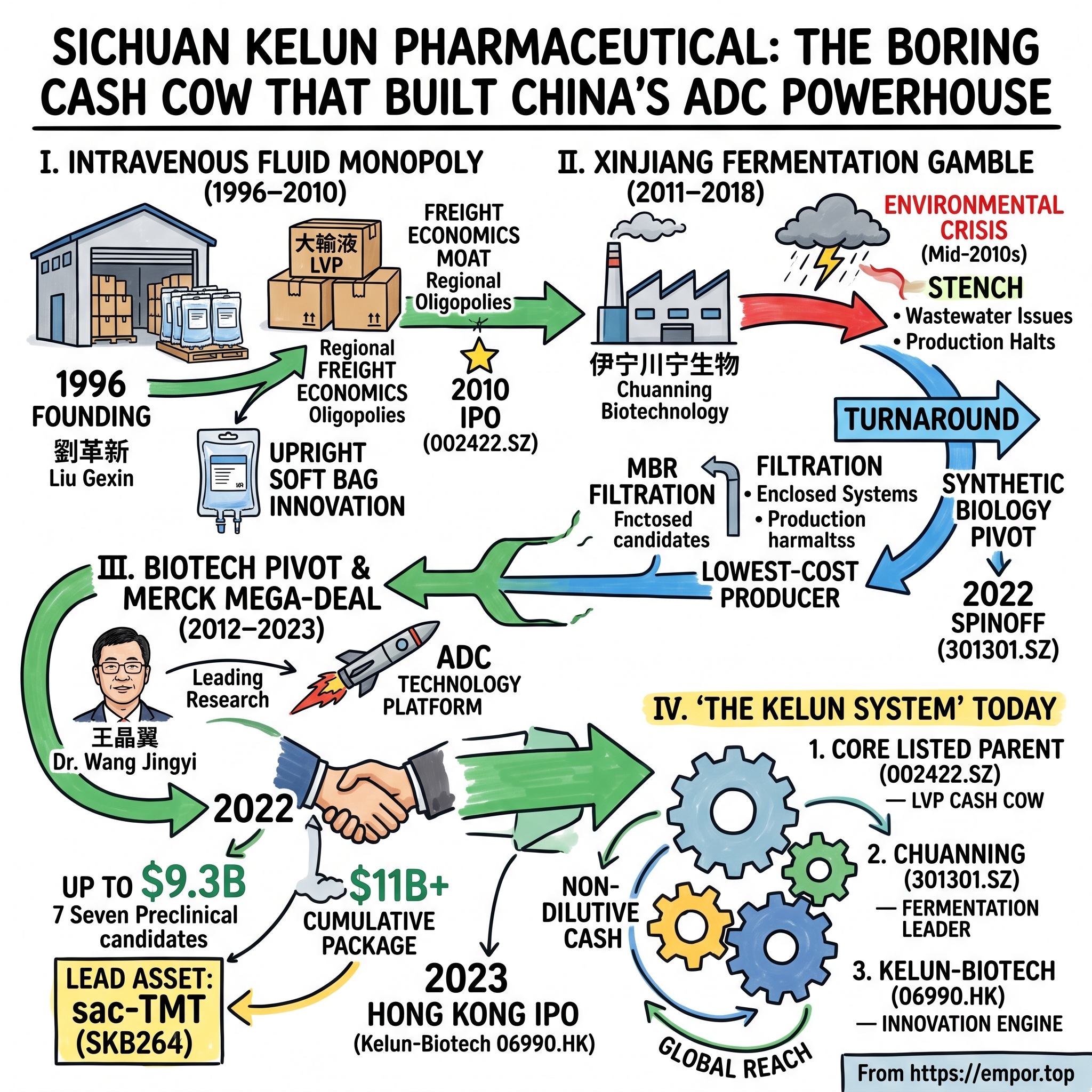
Picture a warehouse on the outskirts of Chengdu in the late 1990s: pallet after pallet of plastic bags filled with nothing more exotic than salt water and sugar water, stacked to the ceiling, waiting for trucks. Each bag sells for pennies. Each bag weighs half a kilogram. And each bag has to be driven, at ruinous fuel cost, to a hospital ward somewhere in Sichuan's endless basin of rice paddies and provincial towns. It is the least glamorous corner of the entire pharmaceutical industry — a business closer to bottled water logistics than to biotechnology.
Now fast-forward. In December 2022, the American pharmaceutical giant 默沙东 Merck (MSD) — known outside the United States by its Chinese name and inside it as MSD — agreed to pay a Chengdu company up to roughly $9.3 billion for the rights to seven cancer drugs that had not yet entered a single human being.1 Add in the earlier 2022 agreements the two signed, and the cumulative headline value of Merck's bets on this one Chinese partner crossed $11 billion — the largest biopharma out-licensing package a Chinese company had ever assembled.2
The company on both ends of that story is the same. 四川科伦药业 Sichuan Kelun Pharmaceutical Co., Ltd. (002422.SZ) is simultaneously the boring salt-water business and the architect of one of the most ambitious antibody-drug-conjugate franchises on earth. That is the central puzzle this episode unpacks: how a maker of intravenous saline bags became the parent of a globally validated oncology platform — and whether the machine that produced that result is a durable compounding engine or a sprawling conglomerate whose best asset is trapped behind a holding-company discount.
The "Kelun System" (科伦系). To understand the company you have to understand its three-headed structure, all of it built by one founder, 刘革新 Liu Gexin:
四川科伦药业 Sichuan Kelun Pharmaceutical(002422.SZ) — the listed parent, China's hospital-injectables champion and the core cash generator.伊宁川宁生物 Yili Chuanning Biotechnology(301301.SZ) — the upstream Xinjiang fermentation monster, now pivoting toward synthetic biology.四川科伦博泰 Kelun-Biotech(06990.HK) — the high-flying antibody-drug-conjugate (ADC) engine and the reason global pharma knows Kelun's name.
The thesis and themes. This is, at its heart, a story about how a low-margin, capital-intensive utility business can fund moonshot innovation — but only when it is shielded by patient, founder-controlled capital that answers to no quarterly whip. It is a story about the physics of heavy liquids, and how freight economics quietly built one of China's most defensible distribution moats. It is a story about a near-death capital-expenditure gamble in the far western region of Xinjiang, where an environmental disaster nearly bankrupted the company before it became a cash machine. And it is a story about three distinct playbooks executed in sequence: surviving China's brutal 国家组织药品集中采购 Volume-Based Procurement (VBP) price wars, building an ADC technology platform, and then arbitraging the gap between Chinese R&D cost and Western commercial reach through licensing.
Throughout, the posture here is neutral. Kelun's management tells a heroic version of this arc, and much of it is genuinely earned. But a heroic narrative is exactly where a skeptical investor should press hardest — because the same structure that let Kelun fund ADCs is also the structure that could strand value, obscure related-party economics, and leave minority shareholders holding the least attractive slice of a three-part empire. Let us start where the cash came from.
 Subscribe on LinkedIn
II. Origins & The Intravenous Fluid Monopoly (1996–2010)
In 1996, a 45-year-old executive named 刘革新 Liu Gexin walked away from a secure, respectable post at a state-owned pharmaceutical factory. In the China of that era, this was not a normal thing to do. A state job — the "iron rice bowl" — was the definition of security for a man of his age with a family. Liu, alongside six partners, took over a defunct capsule workshop in Chengdu and began making the most unglamorous product in medicine: large-volume intravenous fluids.3
Why would a talented man bet his mid-life on salt water? Because Liu understood something about the business that its dullness disguised. Large-volume parenterals — 大输液 LVP in the trade — are consumed by the billion in Chinese hospitals. Every surgery, every fever, every dehydrated child needs them. Demand is enormous, recurring, and utterly non-cyclical. The catch, and the moat, is the physics.
The tyranny of freight. An IV bag is mostly water. Water is heavy, cheap, and sold for a price measured in single-digit yuan. That combination is poison for anyone who has to ship it far. Freight cost per bag rises with distance while the sale price stays fixed, so beyond a radius of roughly 400–500 kilometers the economics simply collapse: you are paying more to move the water than the water is worth. The result is that IV fluids naturally organize into regional oligopolies. Whoever owns the plant nearest the hospitals wins, and no distant competitor — however efficient — can profitably invade. It is the opposite of software. There are no network effects and no zero-marginal-cost magic; there is only the brute, unglamorous arithmetic of trucks and diesel. Liu grasped that if you built enough regional plants, you could stitch those local monopolies into a national one that no single rival could dislodge.
The Kelun Iron Army. Around this insight Liu built a culture he called the "Kelun Iron Army" (科伦铁军) — military-grade execution, obsessive cost control, and hyper-lean manufacturing. In a commodity business where the product is chemically identical across every producer, the only durable edge is being the lowest-cost, most reliable operator. Liu's management style became legendary in Chinese pharma circles for its severity and discipline. This is worth pausing on as an investor: in a molecule-undifferentiated business, culture and cost position are not soft factors — they are the entire competitive advantage.
Climbing the packaging ladder. The one place Kelun could differentiate was the container. The industry's history is a ladder of packaging innovation, and Kelun climbed every rung. Glass bottles came first — heavy, fragile, and requiring an air vent that let unfiltered room air (and contamination) into the fluid. Then PVC plastic bags: lighter, but dogged by concerns that DEHP plasticizer could leach into the solution. Then non-PVC soft bags: a genuinely closed, safe system, but frustratingly limp — they would not stand upright on a clinic pole the way a rigid glass bottle could. Kelun's signature contribution was the 直立式软袋 upright soft bag, a design that married the standability of glass with the safety and light weight of non-PVC film. It sounds trivial. It was not: it let nurses hang and read bags easily while eliminating the contamination and weight problems of the older formats, and it gave Kelun a premium, patent-protected product in a sea of commodity saline.
Rolling up a fragmented nation. Through the 2000s Kelun did what the freight math demanded: it acquired dozens of struggling, sub-scale regional state-owned infusion factories across China, converting each into a node in a national manufacturing-and-logistics web. By stitching together local monopolies, Kelun built toward a commanding share of the domestic LVP market — on the order of 40%-plus — producing billions of bottles and bags a year and becoming, by volume, one of the largest infusion makers on the planet. What the numbers reveal is a company that had turned an un-scalable business into a scaled one, not through technology but through geographic density.
The 2010 IPO. The culmination of Act I came on June 3, 2010, when Sichuan Kelun listed on the Shenzhen Stock Exchange under the ticker 002422.4 The listing raised a substantial war chest — one of the larger A-share raises of its moment — and, crucially, it converted a private cash cow into a public one with the balance sheet to attempt something audacious. Liu now had capital. The question that would define the next decade was what a disciplined saline manufacturer would do with it. His answer was to gamble a large part of it on a fermentation complex in one of the most remote corners of China.
III. The Great Xinjiang Gamble: Chuanning Biotech & The Environmental Crisis (2011–2018)
By 2011, Liu Gexin was looking at his own success and seeing a ceiling. LVP volumes could not grow forever; Chinese healthcare reformers were already signaling that they viewed overuse of intravenous drips as a public-health problem to be curbed, not encouraged. A business that depended on ever-more saline bags was, Liu concluded, a business with a finite runway. His response was a strategy he branded the "Tri-Wheel" (三轮驱动): Wheel #1, the LVP cash cow; Wheel #2, upstream antibiotic intermediates; Wheel #3, innovative biopharmaceuticals. The three wheels were meant to turn in sequence, the boring one funding the risky ones.
Wheel #2 is where the near-death experience lived.
Why Yili, Xinjiang? Kelun decided to integrate backward into the raw building blocks of antibiotics — intermediates with industrial names like 7-ACA, 6-APA, penicillin G, and erythromycin. These are made by fermentation: you feed enormous vats of microbes on starch and sugar and let biology do the chemistry. Fermentation at scale is really a commodity-conversion business, and like all such businesses it lives or dies on input costs. So Kelun went looking for the cheapest possible inputs and landed in Yili, in the far west of Xinjiang: abundant cheap coal and power, cheap local corn and wheat starch to feed the fermenters, a cold climate that slashed the cost of cooling the exothermic fermentation process, and plentiful water. On paper, it was the lowest-cost fermentation site imaginable. Kelun poured billions of yuan into building what was designed to be the world's largest single-site biological fermentation base, operated through its subsidiary 伊宁川宁生物 Yili Chuanning Biotechnology.5
The nightmare. Then reality arrived, and it smelled terrible — literally. Industrial fermentation on this scale produces prodigious quantities of foul-smelling volatile organic compounds and difficult wastewater. The Yili complex became an environmental crisis: residents complained of an overpowering stench, VOC emissions and wastewater management failed to meet standards, and public outcry followed. Local authorities repeatedly halted production. The brutal Xinjiang winters — the same cold that was supposed to be an asset — ruptured equipment. For several years in the mid-2010s the project consumed capital and produced mostly grief. Analysts increasingly described Chuanning as a value-destroying black hole, a capex sink whose losses threatened to drag the profitable parent down with it. For a company built on the reputation of iron discipline, it was a humbling and dangerous moment. This is the part of the Kelun story that management's triumphant retelling tends to compress — and it is exactly the part an investor should study, because it reveals the real risk profile of a founder willing to make enormous, concentrated, illiquid bets.
The turnaround. Liu's response was not to retreat but to double down — a pattern we will see again. Rather than abandon the sunk investment, he poured additional billions into fixing it: advanced membrane bioreactor (MBR) filtration, zero-liquid-discharge water treatment, and fully enclosed systems to trap the odors and emissions. The engineering overhaul worked. Once the environmental problems were contained and the plant ran at full tilt, the very scale that had been a liability became the moat: Chuanning emerged as arguably the world's lowest-cost producer of key antibiotic intermediates, with cost economics that pressured higher-cost competitors in China and abroad to exit the business entirely. The lesson embedded here — one we will return to in the playbook — is that a failed fixed-capital bet and an insurmountable scale moat can be the same asset viewed at two different moments in time. The difference is whether the operator has the balance sheet and the stomach to keep spending through the trough.
The synthetic-biology pivot and the spinoff. With the fermentation infrastructure paid for and humming, Chuanning had a second act of its own. The same vats that grow antibiotic precursors can, with the right engineered microbial strains, grow far higher-value compounds — cosmetic and specialty ingredients like alpha-arbutin, bisabolol, and squalane, plus specialty amino acids. This is the 合成生物学 synthetic biology pivot: reuse the world-class fermentation base to climb the value chain from cheap commodity intermediates toward premium bio-manufactured ingredients. In 2022, Kelun crystallized the value it had created by spinning Chuanning off onto Shenzhen's ChiNext growth board under the ticker 301301, giving the fermentation business its own currency, its own shareholder base, and its own public scrutiny.[^6] Whether the synthetic-biology dream translates into the margins management hopes for remains, as of 2026, an open and much-watched question. But the immediate point is that Wheel #2 had survived and turned. That mattered enormously, because by the time Chuanning stabilized, Liu had already committed to something even more expensive and even less certain: turning a generics company into a genuine drug inventor.
IV. The Biotech Pivot & The $11.8B Merck Mega-Deal (2012–2023)
In 2012, while the Yili plant was still an embarrassment and the ink on the IPO was barely dry, Liu Gexin made a decision that, in hindsight, looks visionary and, at the time, looked reckless. He committed Kelun to reinvesting more than 10% of total corporate revenue into research and development — not incremental generics tinkering, but the pursuit of genuinely novel drugs.6 For a traditional Chinese saline-and-generics manufacturer, this was close to heresy. R&D at that intensity is a bet that pays off, if at all, a decade later, and it comes straight out of the profits shareholders can see today.
Reading the VBP storm early. What drove Liu was foresight about a policy earthquake. China's government was moving toward 国家集采 Volume-Based Procurement — a system in which the state pools demand and forces manufacturers to bid ruthlessly for the right to supply generic drugs, collapsing prices. For a maker of generic chemical injectables, VBP was an extinction-level event, capable of stripping the majority of gross profit out of a product overnight. Liu understood that Kelun's comfortable generics margins were living on borrowed time, and that the only escape was to own drugs that VBP could not commoditize: patented innovations. This is the crucial strategic through-line — Kelun's innovation pivot was not optimism, it was defense.
Hiring the scientist. Ambition needs an operator. Kelun recruited the veteran biopharma R&D leader 王晶翼 Dr. Wang Jingyi to build out research centers across Chengdu, Shanghai, Tianjin, and the United States. Wang became the scientific spine of the enterprise, and the credibility of Kelun's entire innovation story rests substantially on the team he assembled. In 2016, that effort was formalized into a dedicated subsidiary, 四川科伦博泰 Kelun-Biotech, chartered to pursue novel oncology drugs, immunoconjugates, and targeted therapies.
Betting on ADCs. Of all the frontiers in oncology, Kelun-Biotech chose antibody-drug conjugates. The concept is best explained with an analogy: chemotherapy is a carpet bomb — it poisons cancer cells and healthy cells indiscriminately, which is why it makes patients so sick. An ADC is a guided missile. It bolts a potent cell-killing toxin (the payload) onto a monoclonal antibody (the guidance system) that homes in on a protein found mostly on cancer cells, using a chemical tether (the linker) that is supposed to hold the toxin safely in the bloodstream and release it only inside the tumor. The engineering is fiendishly hard: if the linker is too fragile, the poison spills early and harms the patient; too stable, and it never releases where it should. Kelun-Biotech built a proprietary platform — marketed as its OptiDC approach — to optimize exactly these variables: the drug-to-antibody ratio, the hydrophilic linker chemistry, and plasma stability. Whether that platform is genuinely differentiated or merely competent is a question the market has been re-pricing continuously; the validation, when it came, came from the checkbook of a competitor.
The crown jewel: sac-TMT. The lead asset is sac-TMT — sacituzumab tirumotecan, known in development as SKB264 and, under Merck, MK-2870. It targets Trop2, a protein overexpressed in several brutal cancers: non-small-cell lung cancer, triple-negative breast cancer, and endometrial cancer. It entered a field already occupied by Gilead's Trodelvy and the AstraZeneca/第一三共 Daiichi Sankyo drug datopotamab deruxtecan (Dato-DXd), so the entire investment case rested on whether Kelun's molecule offered a better therapeutic window — more tumor-killing per unit of toxicity — than incumbents. That is a scientific claim that only large trials can settle, and it remains the single most important variable in the whole Kelun System.
Merck arrives. The market's verdict came through Merck in stages across 2022. In May 2022, Merck exercised an option for the ex-China rights to SKB264 (sac-TMT), paying roughly $47 million upfront with about $1.36 billion in potential milestones plus royalties.7 A second, smaller agreement followed later in the year, with Merck paying around $35 million upfront for rights to another undisclosed ADC asset.8 Then came the megadeal. On December 22, 2022, Merck and Kelun-Biotech announced an exclusive license and collaboration covering seven investigational preclinical ADC candidates: $175 million upfront, and up to approximately $9.3 billion in development, regulatory, and sales milestones, plus tiered royalties.1 Kelun retained rights for mainland China, Hong Kong, and Macau, while Merck took the rest of the world.1 Stacked together, the 2022 agreements pushed the cumulative headline value of the Merck relationship past $11 billion.2
It is worth being precise about what this validation does and does not prove. A megadeal built mostly of contingent "biobucks" is not $9.3 billion of cash; it is a series of options Merck can walk away from if the science disappoints, and much of the press coverage at the time noted how heavily back-loaded and lopsided the structure was.2 What it does prove is that one of the world's most sophisticated ADC buyers examined Kelun's platform and its preclinical pipeline closely enough to write a $175 million check and stake its own oncology strategy on the outcome. For a company that a decade earlier made salt water, that is an extraordinary external endorsement — even if the ultimate value depends entirely on clinical results that had not yet been delivered.
The Hong Kong IPO. Riding that validation, Kelun-Biotech listed on the Hong Kong Stock Exchange on July 11, 2023, under ticker 06990, raising roughly HK$1.36 billion (about US$174 million) — one of the largest Hong Kong healthcare listings in the preceding two years — with the stock opening around HK$60.60 and rising on debut.910 Merck's involvement extended to an equity stake, aligning the two companies as shareholders as well as partners.[^12] With three listed entities now in place, the Kelun System was fully assembled. The natural next question for an investor is how the money actually flows through it.
V. Segment Economics & The "Kelun System" Today
Strip away the drama and look at the machine as it runs today, and the Kelun System resolves into three businesses with very different personalities living under one consolidated parent. In 2024 that parent reported group revenue of roughly RMB 21.8 billion and net profit of about RMB 2.94 billion, up from RMB 2.46 billion the year before.1112 The composition of that revenue is the whole story.
Wheel #1 — the utility. The core LVP and generic-injectables business remains the largest single slice of group revenue and the steady heart of the enterprise. Injectable drugs alone accounted for well over half of parent-level product sales in 2024.11 This is the utility: predictable, cash-generative, defended by the freight-and-scale moat described earlier, and carrying gross margins healthy for a commodity business but capped by the ever-present threat of VBP price cuts. Investors should think of this segment not as a growth engine but as the balance-sheet foundation — the reason the whole structure can absorb R&D losses and capex shocks without breaking. Its job is to not lose, and by and large it has done that job for two decades.
Wheel #2 — the fermentation cash machine. Chuanning (301301.SZ) contributes a meaningful minority of group revenue, operating at gross margins that reflect its position as a low-cost fermentation leader. What makes Chuanning interesting today is operating leverage: because its cost base is largely fixed infrastructure, swings in antibiotic-intermediate prices flow powerfully to the bottom line, and in strong pricing periods the unit has posted large profit jumps.13 The strategic upside — still unproven at scale — is the migration of that fixed asset base toward higher-margin synthetic-biology products. The bear reading is that Chuanning is fundamentally a commodity chemicals business dressed in biotech language, exposed to the same cyclicality and Chinese oversupply dynamics that plague all commodity producers. Both readings can be partly true, and which dominates in a given year depends heavily on intermediate prices Kelun does not control.
Wheel #3 — the option. Kelun-Biotech (06990.HK) is the smallest by revenue but the largest by imagination. Its economics are utterly different from the other two: instead of freight and fermentation, it runs on upfront licensing fees, milestone payments, and — eventually — royalties and domestic drug sales. Those payments are lumpy and non-recurring by nature, which makes the segment's reported results jump around. The pivotal moment came in the first half of 2024, when milestone payments from Merck of roughly $90 million (about RMB 640 million) helped swing Kelun-Biotech to profitability well ahead of when most loss-making Chinese biotechs turn the corner; half-year revenue rose to about RMB 1.38 billion with adjusted net profit of roughly RMB 390 million.14 Then came the commercial proof point investors had been waiting for: in November 2024, China's NMPA approved sac-TMT for its first indication — heavily pre-treated metastatic triple-negative breast cancer — turning Kelun-Biotech from a pure licensing story into a company with an approved, revenue-generating drug of its own, with additional indications following.15 The distinction matters: milestone income proves a partner believes in you; product approval proves regulators and, ultimately, patients do.
The competitive landscape. In LVP, Kelun's rivals include 石四药 Shijiazhuang No. 4 Pharma (02005.HK), Shandong Hualu, Japan's 大塚製薬 Otsuka, and the diversified 石药集团 CSPC (01093.HK). Kelun's edge over them is not a better molecule — there is no such thing in saline — but its unmatched multi-regional production footprint that minimizes freight, its vertical integration into soft-bag packaging film, and its automated efficiency. In antibiotic intermediates, the comparison set includes Federal Pharmaceutical (00393.HK) and Guobang Pharma (605507.SH); here Kelun's advantage is the sheer scale and input-cost position of the Yili base plus its strain-engineering know-how. In each core business the pattern is the same: Kelun wins on cost and scale, not on differentiation — which is exactly the kind of moat that is durable in commodities but offers little pricing power. That structural reality is what makes the ADC option so strategically important, and it is the tension at the center of how the whole group is governed.
VI. Governance, Management Credibility & The Skeptical Investor Stress Test
Here is the uncomfortable question that hangs over 002422.SZ: if you buy the parent, what exactly are you buying?
The man at the top. Chairman 刘革新 Liu Gexin still controls the enterprise he founded, holding an economic interest reported in the mid-20% range, and he remains the archetypal high-conviction, long-horizon capital allocator. His track record cuts both ways, and a fair scorecard has to hold both sides at once. On the credit side: he kept a decade-long, deeply unpopular R&D promise through the teeth of VBP earnings pressure; he refused to abandon the Yili plant and engineered it into a moat; and he delivered a landmark global licensing deal that few Chinese peers could have imagined. That is a founder who does what he says and thinks in decades — genuinely rare, and genuinely valuable. On the debit side: the same conviction produced years of value-destroying capex, a near-solvency scare, and an organizational structure of daunting complexity. Conviction is an asset when the bets pay off and a hazard when they do not; with a controlling founder, minority holders are simply along for the ride in both directions.
Succession. Day-to-day leadership has increasingly involved Liu's son, 刘思川 Liu Sichuan, alongside the biopharma executive team. Founder-to-heir succession in a family-controlled Chinese pharma group is a genuine governance variable, not a footnote: the market has not yet seen the younger Liu steward the enterprise through a full cycle or a real crisis, and the durability of the "Iron Army" discipline under second-generation leadership is unproven. Investors should watch it, without prejudging it.
The holding-company discount. Now the core stress test. The parent 002422.SZ sits atop majority stakes in two separately listed companies — a controlling interest in Kelun-Biotech (06990.HK) and a majority of Chuanning (301301.SZ). This creates the classic conglomerate dilemma. On one hand, buying the A-share parent arguably offers a discounted, one-ticket entry into two high-growth pure-plays plus a cash-cow utility. On the other hand, markets almost always apply a holding-company discount: the sum of the parts trades above the value the market assigns the parent, because minority holders of the parent cannot directly access the subsidiaries' cash, worry about capital being allocated across entities in ways that don't serve them, and face an extra layer of governance friction. Which effect dominates for Kelun is not a settled fact but a live debate — and it is the single most important thing a prospective parent-company investor has to form a view on.
Related-party plumbing. The three-entity structure also creates continuous intercompany commerce that deserves scrutiny. Chuanning supplies intermediates; the parent makes formulations; Kelun-Biotech shares heritage and, in places, infrastructure with both. Every such transaction is a transfer-pricing question, and in a group with three distinct public shareholder bases, the fairness of arm's-length pricing directly determines how value is split between, say, Chuanning's minority holders and the parent's. There is no public evidence of abuse, but the structure itself is what an activist would probe first: complexity is where value quietly leaks, and the burden is on management to demonstrate — through disclosure — that intercompany terms are fair. As of 2026 that remains an area to monitor rather than an identified problem.
The credibility verdict. Weighing it all, Kelun's management earns real credit for narrative consistency — the innovation strategy articulated around 2012 is recognizably the one being executed in 2026 — and for doing hard things it promised to do. The legitimate concerns are structural rather than integrity-based: heavy historical capex, a complicated multi-entity map, and a dependence on clinical outcomes largely controlled by a partner. That dependence is the sharpest risk of all, and it deserves its own examination — but first, it is worth distilling what the Kelun story teaches.
VII. Playbook: Business & Investing Lessons
Step back from the specifics and the Kelun System yields four transferable lessons — the kind of patterns that recur across business history and are worth carrying to other companies.
1. The boring-cash-cow-to-moonshot playbook. The foundational move was using a high-moat, commoditized, low-margin utility — IV fluids — to throw off non-dilutive cash that financed binary, high-risk, asymmetric innovation in ADCs. This only works under two conditions, and both are instructive. First, the cash cow must be genuinely defended (here, by freight and scale) so its profits are reliable enough to fund a decade of R&D losses. Second, the capital must be patient — which in practice means founder-controlled, insulated from the quarterly pressure that would force a professional CEO to cut R&D to protect near-term earnings. Strip away either condition and the model breaks. The lesson for investors: the moonshot is only as safe as the boredom underneath it.
2. Surviving the near-death capex sink. Yili teaches that a catastrophic fixed-capital investment and an unassailable scale moat can be the same asset at different points in time. When a large capex bet is hit by an external shock, the value-creating move is often not to cut losses but to spend more — to engineer through the problem until fixed liabilities become barriers to entry no rational competitor will try to clear. But this lesson carries a warning label: "double down" is survivorship-biased advice. It worked because Kelun had the parent's cash flow to absorb the additional spend and a founder willing to stake his reputation on it. The same instinct, applied without those backstops, is simply how companies go bankrupt. The discipline is knowing which failing bet is fixable scale and which is a genuine dead end.
3. Cross-border arbitrage in biopharma R&D. The Merck deal is the template for a whole wave of Chinese biotech out-licensing: combine China's fast patient recruitment, lower R&D cost structure, and deep chemistry talent with Big Pharma's global trial machinery and commercial reach. The Chinese partner invents efficiently; the Western partner sells globally; both capture value they could not alone. It is elegant — and, as later sections discuss, increasingly exposed to geopolitics, which is precisely the risk of any arbitrage that depends on two systems staying open to each other.
4. Capital structuring via spinoffs. Finally, Kelun's use of three exchanges — Shenzhen's main board for the cash-cow parent, ChiNext for synthetic biology, and HKEX for international-facing biopharma — is a deliberate exercise in matching each business to the shareholder base that values it most. Spinoffs can unlock value by letting specialized investors price specialized assets. They can also, as the holding-company discussion showed, entrench complexity and strand value at the parent. The tool is neutral; the outcome depends on execution and disclosure. With the lessons drawn, we can now put the group through the two frameworks investors most often reach for.
VIII. Strategic Frameworks: Helmer's 7 Powers & Porter's 5 Forces
Hamilton Helmer's 7 Powers. Helmer's framework asks which durable sources of advantage a company actually possesses — not which it claims. For the Kelun System, several apply, and it is worth being honest about their strength.
- Scale Economies. This is Kelun's most demonstrable power, and it appears twice. In LVP, the national freight-and-plant network delivers per-unit logistics costs no sub-scale entrant can match. In fermentation, the Yili base is among the largest single-site facilities of its kind, spreading fixed costs across volumes rivals cannot reach. These are real, evidenced, and durable — the bedrock of the whole enterprise.
- Process Power. Chuanning's strain-engineering and fermentation yield know-how, and Kelun-Biotech's linker/payload stability chemistry, are process advantages that accrued over years and are hard to copy quickly. The caveat: process power in ADCs is contested territory, with well-funded global players advancing fast, so Kelun-Biotech's version is more "credible contender" than "proven fortress."
- Counter-Positioning. The out-licensing model — handing global commercialization to Merck rather than building a Western sales force from scratch — is a shrewd sidestep of a game Kelun could not win on its own. Whether this is true counter-positioning (a model incumbents can't copy without hurting themselves) or simply a sensible partnership is debatable; it is better read as pragmatic than as a structural power.
- Cornered Resource. The most defensible candidates are Liu Gexin's long-term founder control (a scarce governance asset) and the accumulated ADC platform IP. IP-based cornered resources, however, erode as patents age and the field advances, so this is a wasting asset unless continuously replenished.
Notably absent from Kelun's arsenal: branding (irrelevant in commodity injectables), network economies, and switching costs in its core businesses. Recognizing what a company does not have is as important as cataloguing what it does.
Porter's Five Forces (consolidated group). Porter asks where the profit pool is defended and where it leaks.
- Threat of new entrants — LOW. Environmental permitting for large fermentation in Xinjiang is now extraordinarily difficult, effectively barring new Yili-scale rivals, while LVP's freight economics and thin margins deter new infusion competitors. Kelun's own past environmental ordeal has, ironically, helped raise the drawbridge behind it.
- Bargaining power of buyers — split. In generics it is HIGH: the Chinese state, through VBP, is a monopsony buyer that can crush prices at will. In ADCs it is LOW: a global pharma like Merck pays richly for a validated, scarce asset. This split is the strategic reason Kelun is racing from the first world into the second.
- Bargaining power of suppliers — LOW. Deep vertical integration into intermediates, starch, energy, and packaging leaves Kelun relatively insulated from supplier leverage — one of the clearest payoffs of the Tri-Wheel strategy.
- Threat of substitutes — MODERATE. Oral formulations and clinical caution about drip overuse can displace some IV volume; in oncology, next-generation bispecifics and cell therapies loom as longer-term substitutes for ADCs. Neither is an immediate threat, but both cap terminal-value optimism.
- Competitive rivalry — HIGH in generics, intense in ADCs. Domestic injectable pricing is a knife fight, and the global Trop2 ADC race against AstraZeneca/Daiichi and Gilead is one of the most fiercely contested arenas in oncology. Rivalry is the force most likely to compress Kelun's returns over time.
The frameworks converge on a consistent picture: genuinely strong, cost-based, scale-driven moats in the mature businesses, and a promising-but-contested position in the growth business. That is a solid foundation — but it is also why the specific risks around the growth engine deserve their own radar.
IX. Current Risk Radar & Material Vulnerabilities
Every investment case has a small number of things that, if they broke, would break the thesis. For Kelun there are four worth watching, and they are not equally weighted.
1. Geopolitics and the cross-border decoupling risk. Kelun-Biotech's entire arbitrage model assumes that Chinese-invented drugs can flow to a US partner and that US-run trials generate data acceptable to regulators worldwide. Proposed US measures aimed at Chinese biopharma — of which the US BIOSECURE Act was the most discussed example — signaled a political appetite to restrict exactly these relationships, whether through data-acceptance questions, contract-manufacturing restrictions, or broader trade friction. This is the most existential risk because it attacks the deal structure itself rather than any single molecule. A material hardening of US-China biopharma policy would impair not just Kelun but the entire out-licensing wave — and it is largely outside management's control.
2. VBP and domestic pricing pressure. The force Liu foresaw in 2012 has not gone away. Continued VBP erosion on generic injectables steadily grinds down the cash cow's profitability, and there is a newer worry: China's 国家医保局 National Healthcare Security Administration (NHSA) negotiates hard even on innovative oncology drugs to include them in national insurance, meaning domestic pricing for sac-TMT itself will be pressured. The mechanism to watch is the race between generic profit erosion (a headwind that is certain) and biopharma royalty growth (an upside that is not).
3. Clinical and execution risk in ADCs. The value of the Merck relationship rests on high-stakes global Phase 3 trials for sac-TMT (as MK-2870) that Merck largely controls. Any safety signal, efficacy disappointment, or delay — particularly in head-to-head or combination settings against entrenched competitors like ENHERTU or Trodelvy — flows directly into reduced or forfeited milestones and thinner royalties. Encouragingly, several late-stage readouts have been positive, including a first-line NSCLC combination study and first-line TNBC data reported through 2025 and into 2026.16 But biobucks are contingent by design, and a single pivotal miss can erase a large share of the headline deal value. Concentration in one lead asset and one partner is the sharpest company-specific risk in the story.
4. Environmental and energy cost pressure in Xinjiang. Chuanning's cost advantage depends on cheap coal, cheap power, and permissive water and emissions quotas. Tighter environmental rules, an energy-price spike, or water-usage limits would attack the very foundation of its moat. Having nearly died once from environmental failure, Chuanning remains structurally exposed to the environmental and energy policy of a single sensitive region. These risks set up the final question: which forces are likely to win, and what should an investor actually track?
X. Bull vs. Bear Case & Key KPIs
The bull case. In the optimistic scenario, Kelun is an emerging biopharma royalty machine sitting on a fortress balance sheet. Sac-TMT, carried by Merck's global reach and its potential to combine with the world's best-selling drug, Keytruda, becomes a multi-indication blockbuster, throwing off high-margin royalty streams to Kelun-Biotech for a decade. Chuanning successfully monetizes non-antibiotic synthetic-biology products and re-rates from commodity multiple toward specialty. And beneath both, the LVP utility keeps generating dependable cash, providing genuine downside protection that pure-play biotechs lack. In this world, the market eventually looks through the holding-company structure and pays up for a rare combination: defensive cash flow plus a validated innovation option.
The bear case. In the pessimistic scenario, the contingencies bite. Merck rationalizes its sprawling ADC pipeline — it licensed seven preclinical candidates, and Big Pharma routinely culls such portfolios after trial misses or toxicity findings — slashing future milestone expectations and revealing how much of the "$11.8 billion" was always optional. The A-share parent remains chronically discounted, its conglomerate complexity and related-party opacity deterring investors who would rather own the pure-plays directly in Hong Kong or on ChiNext. And VBP grinds generic profits down faster than royalties scale up, so the cash cow shrinks before the moonshot fully lands. In this world Kelun is a perpetually "cheap for a reason" holding company whose best asset enriches its Hong Kong-listed subsidiary's shareholders more than the parent's.
The synthesis. The honest read is that both cases are live, and the outcome hinges on things not yet knowable in 2026: the durability of sac-TMT's clinical wins, the stability of US-China biopharma relations, and whether management ever narrows the holding-company discount through clearer disclosure or structural simplification. This is not a settled compounder; it is a company at the hinge between two very different futures.
The KPIs that actually matter. Rather than track everything, a focused investor should watch three signals:
- Kelun-Biotech milestone and royalty realization plus sac-TMT Phase 3 progress. This is the master variable. Cumulative cash actually received from Merck, additional NMPA and (eventually) FDA approvals, and the outcomes of pivotal NSCLC and breast-cancer trials will do more to move the enterprise's value than anything else. Watch whether contingent "biobucks" convert into real cash.
- High-value LVP product mix. Within the cash cow, the share of volume in premium formats — upright soft bags and multi-chamber
多腔袋infusion bags — is the cleanest gauge of whether Kelun can defend LVP profitability against VBP by trading up rather than merely down. Mix, not volume, is the tell. - Chuanning's non-antibiotic revenue contribution. The growth rate and gross-margin profile of synthetic-biology products will reveal whether Wheel #2 is genuinely climbing the value chain or remains a cyclical commodity business in biotech clothing.
Track those three, and you are tracking the three wheels themselves — the utility that funds everything, the fermentation engine reinventing itself, and the option that turned a saline-bag maker into a name Merck was willing to bet billions on.
References
-
Merck and Kelun-Biotech Announce Exclusive License and Collaboration Agreement for Seven Investigational Antibody-drug Conjugate Candidates for the Treatment of Cancer — Merck.com, 2022-12-22 ↩↩↩
-
Merck puts eye-popping $9.3B on the line in lopsided ADC deal with Kelun-Biotech — Fierce Biotech, 2022-12-22 ↩↩↩
-
Sichuan Kelun Pharmaceutical Co., Ltd. (002422.SZ) — company profile and Shenzhen listing, MarketScreener ↩
-
Yili Chuanning Biotechnology Co., Ltd. (301301) company profile — MarketScreener ↩
-
Sichuan Kelun-Biotech Biopharmaceutical Co., Ltd. — About Us / R&D history ↩
-
Merck snaps up cancer drug from China's Kelun in $1.4bn deal — pharmaphorum ↩
-
Merck strikes 2nd ADC deal with Kelun-Biotech, paying $35M for rights to unnamed asset — Fierce Biotech ↩
-
Kelun-Biotech raises $174M in Hong Kong IPO to race in ADC market — BioWorld ↩
-
Kelun-Biotech Makes Landmark Debut on Hong Kong Stock Exchange, Sets IPO Record — EqualOcean, 2023-07-12 ↩
-
Sichuan Kelun Pharmaceutical Co., Ltd. Reports Earnings Results for the Full Year Ended December 31, 2024 — MarketScreener ↩↩
-
Chuanning Biotech (301301.SZ) first-half net income growth guidance — Futu News ↩
-
Precision cancer drugs show promise for Kelun-Biotech — Bamboo Works ↩
-
Kelun-Biotech's TROP2 ADC Sacituzumab Tirumotecan (sac-TMT) Approved for Marketing by NMPA of China for 2L+ Advanced or Metastatic TNBC — PR Newswire, 2024-11 ↩
-
Kelun-Biotech Announces Phase III Study of Sacituzumab Tirumotecan (sac-TMT) in Combination with Pembrolizumab as First-Line Treatment for PD-L1-Negative Non-Squamous NSCLC Met Primary Endpoint — PR Newswire ↩
 LinkedIn
 WhatsApp
 Reddit
 Hacker News
 Email
Email Kindle
 RSS Feed
 Spotify
 Apple Podcasts
 Amazon Music
 Audible
 YouTube