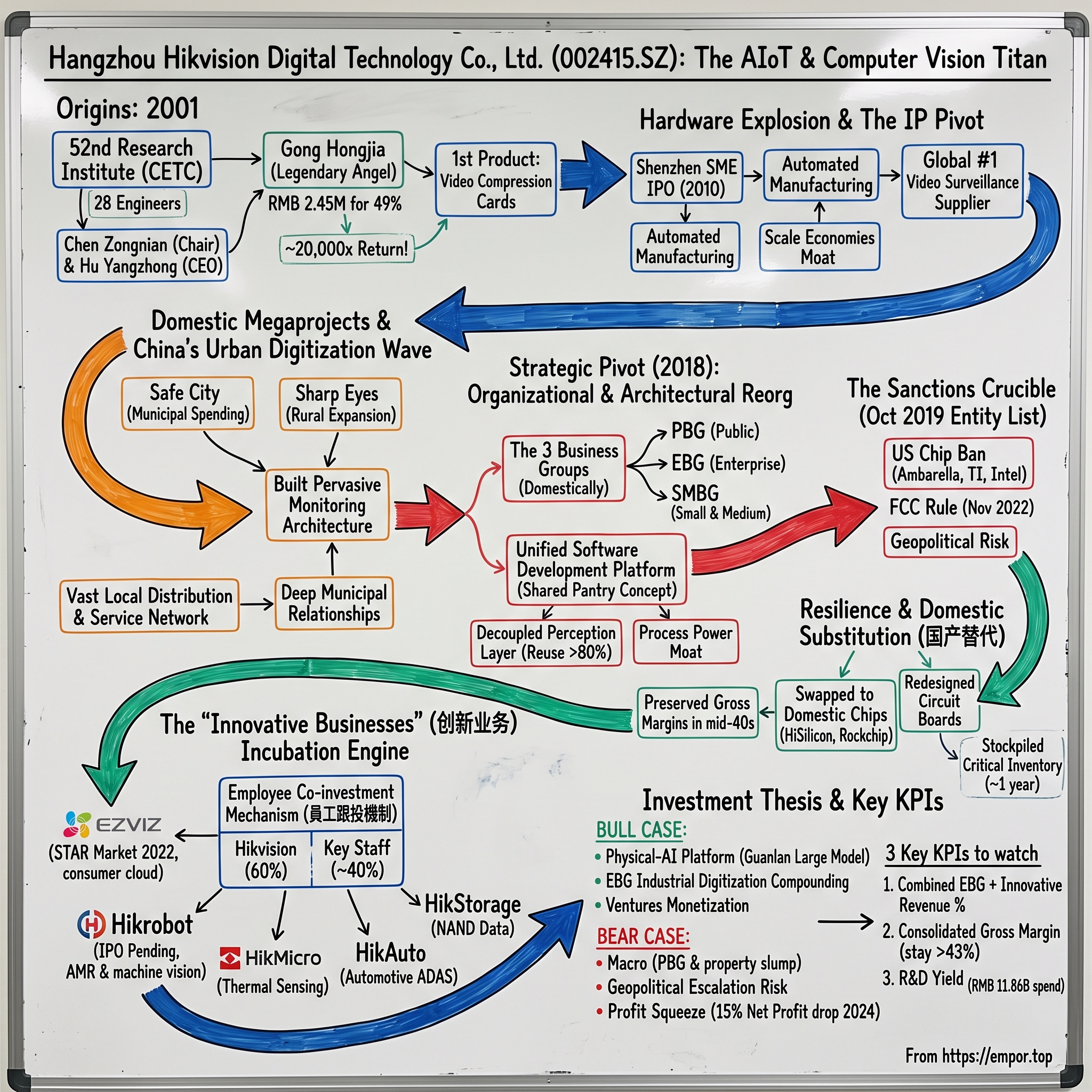
Hangzhou Hikvision Digital Technology Co., Ltd.: The AIoT & Computer Vision Titan
I. Introduction & The AIoT Video Titan
Somewhere in a Chinese city right now, a traffic-management center glows with a wall of live video feeds. A camera reads a license plate in the rain; another counts the queue length at a toll gate; a thermal sensor flags an overheating bearing on a factory conveyor before it seizes. The odds that a meaningful share of those eyes were manufactured by a single company in Hangzhou are, frankly, high. That company is 杭州海康威视数字技术股份有限公司 Hangzhou Hikvision Digital Technology Co., Ltd., ticker 002415.SZ, and it is the largest maker of video surveillance equipment on the planet.
The numbers are big, but the more interesting fact is what they represent. In 2024 Hikvision reported revenue of roughly RMB 92.5 billion — call it more than $13 billion — up a modest 3.53% for the year, while net profit attributable to shareholders fell 15.1% to RMB 11.98 billion.1 That divergence — flat-ish sales, shrinking profit — is the whole story of this company in miniature, and we will spend a lot of this episode unpacking why.
Here is the thesis we want to test. Hikvision is not, at its core, a camera company. A camera is the visible tip; the actual business is a physical-world sensing layer stitched into the plumbing of Chinese cities, factories, mines, highways, and warehouses. The company's defensible edge — if it has one — is not any single lens or chip. It is the ability to absorb extreme, messy, real-world customization across tens of thousands of use cases without drowning in its own complexity, delivered through a software platform, a distribution network that reaches down to county-level integrators, and an unusual venture-incubation model bolted onto a state-owned skeleton.
That last phrase — state-owned skeleton — is where the geopolitics enters. Hikvision was placed on the U.S. Commerce Department's Entity List in October 2019, later swept into investment-banning executive orders, and in November 2022 hit with a Federal Communications Commission rule barring authorization of its new equipment for the U.S. market.34 Overnight it became a test case for whether a Chinese hardware champion could rip American silicon out of its own products and survive. It is one of the cleanest natural experiments in tech decoupling we have.
So the roadmap: we start with a 28-person research team and one of the great angel investments in Asian history, move through the hardware explosion that dethroned the Western security establishment, walk into the megaproject boom that built the moat, watch the 2018 reorganization that turned chaos into operating leverage, live through the sanctions crucible, meet the incubated "innovative businesses" that are now the growth engine, and finish with the cold-eyed bull and bear cases. Let's begin at the beginning — with a spinoff nobody expected to matter.
 Subscribe on LinkedIn
II. Origins: The 52nd Research Institute & The Legendary Angel Bet
Picture Hangzhou in 2001. Not yet the glittering headquarters city of Alibaba, still a provincial capital known for its lake and its silk. Inside a state research institute, a handful of engineers were doing unglamorous work on video compression — the deeply technical, deeply boring problem of squeezing analog security-camera footage down small enough to store on the pitifully small hard drives of the era. That institute was the 52nd Research Institute (中国电科五十二所) of 中国电子科技集团有限公司 CETC (China Electronics Technology Group Corporation), a pillar of the Chinese defense-electronics establishment. In November 2001, twenty-eight of those people were carved out into a new company.
The two men who would run it for the next quarter-century were already there. 陈宗年 Chen Zongnian, the chairman, was the institutional navigator — the person who understood how to keep a company owned ultimately by a defense conglomerate aligned with state priorities without letting bureaucracy strangle it. 胡扬忠 Hu Yangzhong, the general manager and de facto CEO, was the engineer's engineer: pragmatic, execution-obsessed, allergic to hype, the architect of both the product and the culture. Together they represented a division of labor that has proven remarkably durable — one man facing the state, the other facing the market and the codebase.
But the person who makes this an origin myth rather than a corporate memo is 龚虹嘉 Gong Hongjia, a Hong Kong-based entrepreneur and angel investor who put in RMB 2.45 million for a 49% stake, with the 52nd Institute holding the other 51%.2 Sit with that ratio for a moment. A state defense institute handed nearly half of a company to a private outside investor at the moment of founding — an arrangement that would become almost unthinkable in later, more nationalized decades. Gong's stake, monetized gradually over twenty years as the company compounded, is often cited as one of the most lucrative angel bets in Asian history, reportedly returning on the order of twenty-thousand-fold.2 The instructive part is not the multiple; it is that Gong mostly sold slowly and stayed aligned with Hu and Chen rather than agitating, which is a large part of why the leadership was left alone to build.
What were they actually building? MPEG-4 and then H.264 video compression cards for digital video recorders. In plain terms: in the early 2000s, if you ran a bank or a parking garage or a police station, your CCTV system generated a firehose of analog video and you had nowhere to put it. Hikvision's boards took that firehose and compressed it — think of shrinking a wall of paper into a filing cabinet — without turning the footage into unusable mush. That single bottleneck, solved well and cheaply, was the wedge. It got Hikvision's technology inside the recorders sold by dozens of other brands, foreign and domestic, before anyone thought of Hikvision as a brand at all. The company was, at first, an ingredient. The decision to stop being an ingredient is where the real money began.
III. The Hardware Explosion: From Compression Cards to Global #1
There is a moment in the life of every component supplier when it looks at the OEM stamping its own logo on the finished box and thinks: why am I letting them capture that margin? For Hikvision, that thought arrived between 2003 and 2009. Rather than keep selling compression boards to the companies that assembled the recorders, Hikvision started building the whole recorder itself — standalone DVRs, and then, as the industry pivoted, Network Video Recorders (NVRs) and full IP camera systems.
The IP transition is worth dwelling on, because it is the kind of technology migration that quietly reshuffles an entire industry's leaderboard. Analog cameras sent a fuzzy video signal down a coax cable to a recorder. IP cameras are, essentially, small networked computers with a lens — they digitize the image at the edge, put it on a standard network, and let software do the rest. This shift favored companies that could do silicon, optics, and software together, and it stranded incumbents who were really just good at analog electronics. Hikvision, still young and unburdened by a legacy analog business it needed to protect, sprinted into IP while Western incumbents hesitated.
The capital to industrialize that sprint came in May 2010, when Hikvision listed on the Shenzhen Stock Exchange's SME board under the ticker 002415.SZ. The IPO funded something less glamorous than a product and more important: enormous, highly automated manufacturing bases in Hangzhou and nearby Tonglu. This is the part that Western competitors underestimated. By pouring gross profit back into automation, optics R&D, and custom chip integration, Hikvision drove its unit costs below those of established names like Axis Communications, Bosch Security, and Honeywell — companies that had invented much of the category.
The result showed up in the rankings fast. By 2011–2012, Hikvision had climbed to the top of the global video-surveillance market share tables compiled by IMS Research, later absorbed into Omdia — displacing the Western security establishment to become the world's number-one supplier. The mechanism here is the one Hamilton Helmer calls scale economies, and it is worth naming plainly because we will keep meeting it: once you are the largest-volume buyer of image sensors and the largest-volume producer of lenses and enclosures, your fixed costs — the R&D, the tooling, the ASIC design — spread across more units than anyone else's. A competitor trying to match your price does so at a loss. For an investor, the takeaway from this era is that Hikvision's early dominance was not a branding win or a technology miracle; it was a cost-structure win, compounded. That is a more durable thing to own — but, as we will see, it is also the thing sanctions and price wars would later attack. First, though, the demand side of the story exploded, and the Chinese state was the buyer.
IV. Domestic Megaprojects & China's Urban Digitization Wave
If the 2010s had a soundtrack for Chinese urban infrastructure, it was the hum of camera installation crews. Two state programs turned Hikvision's cost advantage into a firehose of demand. The first was 平安城市 Safe City, a municipal spending wave to digitize public security, traffic enforcement, and emergency response across Chinese cities from the glittering tier-1s down to prefecture towns most outsiders have never heard of. The second, 雪亮工程 Sharp Eyes, pushed the same idea into the countryside — county and township networks, the "eyes" of the program being, quite literally, video monitoring extended to rural China.
We should be candid about what these programs were. They were, in large part, a build-out of the domestic surveillance state, and Western analysts including the Center for Strategic and International Studies have documented how Safe City and Sharp Eyes formed the architecture of pervasive monitoring.[^11] That reality is inseparable from Hikvision's growth and inseparable from why the U.S. government later acted. For an investor, the analytical point is that a very large slice of Hikvision's foundational demand came from government fiscal budgets tied to a political project — which is wonderful when budgets are flush and a structural vulnerability when they are not. We will return to that vulnerability; it is arguably the single most important swing factor in the company's recent numbers.
The subtler moat built in this period was distribution. Winning a municipal contract in a country of China's scale is not a matter of a slick sales deck; it is a matter of having local people who can specify, install, service, and hand-hold the system in Kunming and Harbin and a thousand places in between. Hikvision built out hundreds of domestic branch offices and technical-support hubs and cultivated relationships with tens of thousands of local system integrators, municipal contractors, and grid operators. This is unsexy, expensive, and extraordinarily hard to replicate — a new entrant can copy a camera far more easily than it can copy a decade of relationships with county procurement officials.
That same machine turned outward. Through localized sales teams and aggressive price-performance positioning, Hikvision scaled across Europe, North America, Southeast Asia, Latin America, and the Middle East, growing international revenue toward roughly 30% of the group. By 2024 the overseas main business reached RMB 25.99 billion, about 28.1% of total revenue and still growing 8.4% even as parts of the Western market closed to it.1 The strategic lesson embedded there is that a distribution network built to conquer a fragmented home market turned out to be exportable. But conquering fragmentation created a problem of its own — a sprawling catalog that threatened to collapse under its own weight. Solving that is the next chapter.
V. The Strategic Pivot: The 3 Business Groups & Software Decoupling
By the mid-2010s Hikvision had a champagne problem that tasted like poison. Serving everyone had produced a catalog of more than 10,000 active SKUs. Consider why. The camera that watches a traffic intersection needs different optics, different edge analytics, and different software logic than the camera in a coal mine, which is different again from an oil refinery, a hospital corridor, or a convenience store. Each vertical wanted something bespoke. Left unmanaged, that demand for customization metastasizes into R&D bloat: thousands of slightly different products, each needing its own engineering, each a little snowflake of cost and complexity.
The response, in 2018, was an organizational and architectural pivot that is the real intellectual core of this company. Domestically, Hikvision reorganized around three Business Groups aimed at fundamentally different customers. 公共服务事业群 PBG (Public Business Group) served government — public security, traffic, municipal management — high-margin work but chained to fiscal budgets. 企事业事业群 EBG (Enterprise Business Group) served large corporates: energy, manufacturing, logistics, healthcare, education — the cash-generative engine riding industrial digitization. And 中小企业事业群 SMBG (Small & Medium Business Group) served small merchants and community networks through standardized distributor channels, a higher-volume, more commoditized game.
Reorganizing the sales force was the easy half. The hard, clever half was underneath it: the 统一软件开发平台 Unified Software Development Platform. Here is the concept in plain language. Imagine you run a restaurant chain and every location insists on a custom menu. You could hire a separate chef to invent every dish from scratch — ruinous — or you could build a shared pantry of prepped ingredients and standard techniques that any location can assemble into its own menu. The Unified Software Development Platform is that shared pantry. It decouples the low-level stuff — device drivers, the AI perception algorithms that actually recognize a person or a vehicle — from the top-level application software that a specific customer sees. Build the hard perception layer once; reuse it everywhere.
The claimed payoff was that Hikvision could reuse well over 80% of its core software modules across thousands of tailored solutions. Treat that figure as a management assertion rather than an audited fact, but the direction is visible in the financials: it is what let a hardware company earn something closer to software-like operating leverage, because incremental verticals stopped requiring proportional incremental engineering. For an investor, this is the mechanism Helmer would call process power — an advantage embedded in how the company organizes work, not in a single patent, and therefore hard for a rival to buy or copy quickly. It is also the capability that, a year later, would let Hikvision do something far more dramatic than serve a new vertical: re-architect its entire silicon supply chain under fire.
VI. The Sanctions Crucible: Entity List, De-Americanization, & Resilience
On October 7, 2019, the U.S. Department of Commerce added Hikvision — along with 27 other Chinese entities — to the Entity List, citing human-rights concerns connected to surveillance in Xinjiang.3 For a company whose recorders and cameras ran on American brains — Ambarella vision processors, Texas Instruments and Intel silicon, Xilinx FPGAs — this was not a diplomatic inconvenience. It was a threat to the bill of materials of nearly every product it shipped. The screws kept turning: executive orders barring U.S. investors from holding the stock, and in November 2022 an FCC rule prohibiting authorization of new Hikvision communications equipment for U.S. sale, effectively closing the American market to new devices.4 Reuters reported in 2022 that Washington was even weighing harsher financial sanctions.5
What happened next is the most analytically interesting episode in the company's history, because it tested whether the process power we just described could be turned inward on the company's own supply chain. Management had, by its own account, seen the restrictions coming and stockpiled — reportedly accumulating roughly a year to a year and a half of critical U.S. chip inventory before enforcement bit. Inventory buys time; it does not solve the problem. The real work was redesigning circuit boards and system-on-chip architectures to swap out Ambarella and TI for domestic vendors — the likes of HiSilicon, SigmaStar, Ingenic, and Rockchip — under the banner of 国产替代 domestic substitution. Bloomberg reported in 2021 that Hikvision said it had already replaced U.S. components after the sanctions.6
Let us be neutral about what this proves and what it does not. Redesigning a product to run on a different processor is genuinely hard — it is not swapping a battery; it is closer to rebuilding a car around a different engine while the car is being driven. That Hikvision did this across a broad product line, replacing not just chips but also elements of its EDA software and database stack, is real evidence of engineering depth. The counter-fact an investor must hold alongside it: domestic Chinese chips at the leading edge still lag the best American and Taiwanese silicon, so substitution can preserve function while quietly costing performance, margin, or both. And the profit line tells us something happened — revenue held in the roughly RMB 80–92 billion range through the sanctions years while net profit came under visible pressure.
So did Hikvision "survive" sanctions? On the top line, largely yes: gross margins stayed in a resilient mid-40s band, and domestic industrial demand plus Belt-and-Road-flavored export growth offset the lost Western government business.1 The honest verdict is that exclusion from Five Eyes government markets was painful but absorbable for a company whose center of gravity was always domestic. What sanctions could not be blamed for was the profit squeeze of 2023–2024 — that came mostly from home, from a fiscal and property downturn, and we will get there. First, the part of the company that is supposed to be its future.
VII. The "Innovative Businesses" (创新业务) Incubation Engine
Every large company eventually confronts the same enemy: itself. Scale breeds bureaucracy, bureaucracy repels the ambitious young engineer, and the ambitious young engineer leaves to found a startup that eats your lunch a decade later. Hikvision's answer — and it is a genuinely distinctive one for a state-affiliated firm — was to manufacture startups inside the mothership. The vehicle is the 员工跟投机制 employee co-investment mechanism: for a new venture, Hikvision typically holds around 60% while core management and technical staff co-invest for up to roughly 40% of the equity. The engineers get real ownership and real upside; Hikvision keeps control and lends its perception technology and distribution.
The gating criteria matter, because they explain why these ventures cohere rather than sprawl. A seeded business had to lean on Hikvision's core sensing competencies — optical, thermal, millimeter-wave radar — and its channels, and aim at a large, fast-growing market. In practice that produced a portfolio worth knowing by name. 杭州萤石网络股份有限公司 EZVIZ Network Co., Ltd. (688475.SH), the consumer smart-home and security-cloud arm, was spun off and listed on Shanghai's STAR Market in December 2022 — the model's proof-of-concept, complete with recurring cloud revenue that behaves more like software than hardware.[^8] 杭州海康机器人股份有限公司 Hikrobot Co., Ltd. builds industrial mobile robots (AMRs and AGVs) and machine-vision systems for smart factories; Hikvision announced plans to spin it off for a mainland listing and, as of mid-2026, it remained in the IPO pipeline targeting Shenzhen's Growth Enterprise Market with Hikvision retaining roughly a 60% controlling stake.7
Then there is 杭州海康微影传感器技术有限公司 HikMicro, in thermal infrared sensing and uncooled thermal cameras — strategically potent because thermal imaging touches defense, industrial inspection, and automotive vision, and because the underlying sensor technology is exactly the kind of thing export controls make scarce. 海康汽车电子 HikAuto pushes into automotive vision, ADAS smart cameras, and digital-cockpit electronics, chasing the enormous Chinese EV supply chain. And 海康存储 HikStorage sells high-reliability NAND storage — a natural adjacency, since surveillance is one of the world's great generators of data that must be written somewhere reliable.
The financial reality is that this is no longer a science project. In 2024 the innovative businesses generated RMB 22.48 billion in revenue — north of a fifth of the consolidated total — and grew far faster than the mature core.1 That is the optionality bull case in one number: a set of higher-growth, separately-financeable franchises inside a company the market still prices largely as a camera maker. The skeptic's footnote, which we will sharpen later, is that spinning these out can dilute the parent's claim on their upside and multiply related-party transactions. But directionally, the incubation engine has done what it was designed to do — kept the talent and produced growth the legacy business alone could not. Which brings us to the ledger where all of this nets out.
VIII. Financial Breakdown, Capital Allocation, & Current Management
Numbers tell stories only if you translate them, so let's translate. Hikvision's 2024 consolidated revenue of RMB 92.50 billion grew just 3.53%, while net profit attributable to shareholders fell 15.10% to RMB 11.98 billion.1 Gross margin held in the mid-40s. The plain-English reading: the company sold a bit more but earned meaningfully less, which almost always means either mix shifted toward lower-margin business, costs rose, or the company kept spending through a soft patch. Here, it was mostly the last two. Hikvision kept its R&D spend high — RMB 11.86 billion in 2024, an eye-catching 12.83% of revenue supporting a research organization of tens of thousands of engineers — and did not slash investment to flatter a weak year.1 That is a defensible choice for a technology franchise, but it is a choice, and it is why the profit line sagged.
The segment story is where the causation lives. PBG, the government business, ran into the hardest wall: local Chinese governments, squeezed by debt restructuring and a property-linked revenue slump, simply spent less on the discretionary security projects that once flowed freely. SMBG, the small-business segment, was cyclically depressed by the same commercial-real-estate weakness that has haunted the whole Chinese economy, forcing channel inventory to be cleared. Holding the company up were EBG — enterprise digitization in energy, manufacturing, and industrial safety, the durable engine — and the overseas and innovative businesses. In other words, the parts of Hikvision tied to Chinese fiscal and property cycles dragged, and the parts tied to industrial upgrading and exports carried. For an investor, that is the single most important structural fact about the current earnings mix.
On governance and management, the striking feature is continuity: Chen Zongnian and Hu Yangzhong have run this company together for more than two decades — a rarity anywhere, let alone in a state-affiliated enterprise. Hu's reputation among long-term onshore investors rests on a specific pattern of behavior worth crediting: pragmatic execution, low personal flash, and a consistent refusal to chase whatever technology hype cycle is fashionable. When AI became the only word anyone in tech would say, Hikvision's messaging stayed notably product-and-margin-focused rather than promotional. That behavioral consistency across many years of filings and calls is the kind of thing that earns a management team the benefit of the doubt — though it should never be mistaken for immunity from the macro forces above.
Capital allocation reinforces the picture. Hikvision has run a high cumulative dividend payout — historically well above half of net profit returned to shareholders — alongside disciplined domestic buybacks and light reliance on debt, funding its ventures through the co-investment model rather than dilutive raises. A skeptic will note that generous dividends from a company whose controlling shareholder is ultimately a state conglomerate also conveniently funnel cash to that shareholder; both things can be true. The behavior over time, though, reads as disciplined rather than empire-building. Whether that discipline is a genuine competitive advantage — or merely good housekeeping — is a question best answered by putting Hikvision through the strategy frameworks.
IX. Strategic Frameworks: Porter's 5 Forces & Helmer's 7 Powers
Strip away the narrative and ask the structural question: why, mechanically, does Hikvision earn what it earns, and what could take it away? Hamilton Helmer's 7 Powers is a useful scalpel. The primary power, as we have seen, is scale economies — the largest-volume producer of image sensors, lenses, and enclosures amortizes fixed R&D and tooling across more units than anyone can match, so a rival matching its price bleeds. Running a close second is process power, embodied in the Unified Software Development Platform: the organizational ability to customize software for thousands of verticals with minimal incremental engineering. That one is especially valuable because it is tacit — a competitor cannot license it; it would have to rebuild the same decade of accumulated tooling and know-how.
Two more powers show up in weaker form. Switching costs are real but not absolute: once Hikvision's systems are woven into a city's command-and-control center or a factory's automation stack, ripping them out is expensive and risky, which lengthens customer relationships — but a determined buyer with a political mandate (say, a Western government) can and did switch. And there is a genuine cornered-resource flavor to the employee co-investment mechanism, which functions as a talent magnet: it offers startup-style equity upside inside a state-affiliated structure, helping Hikvision retain the exact engineers who would otherwise defect. Notably absent from the list is network effects — Hikvision's products do not get more valuable to each customer as other customers join, and it is important not to pretend a moat exists where it doesn't.
Now Porter's five forces, which frame the competitive weather rather than the firm's own powers. The threat of new entrants is very low: the capital intensity, channel depth, supply-chain integration, and software maturity required to compete at scale form a formidable wall. Supplier power has actually fallen — the forced move to multi-sourced domestic silicon, painful as it was, reduced Hikvision's dependence on any single vendor. Buyer power is uneven: low-to-high in PBG depending on how flush the municipal customer is, and moderate in the more commoditized SMBG. The threat of substitutes is low in a deep sense — computer vision is the fundamental non-contact way for machines to sense the physical world, and nothing else does that job.
The force that actually bites is competitive rivalry, and it is fierce. At home, 浙江大华技术股份有限公司 Dahua Technology (002236.SZ) is a capable, similarly-sanctioned direct rival; 浙江宇视科技有限公司 Uniview fights hard in the mid-market; and AI-native players like 商汤科技 SenseTime (0020.HK) attack from the algorithm side.9 The result is relentless price competition in commodity hardware, which is precisely why margins can only be defended by climbing toward software-enabled, higher-value installations. So the framework verdict is nuanced: Hikvision's moats around cost and process are real and wide, but they sit in an arena of brutal rivalry and government-budget dependence — which is exactly the tension the investment debate has to resolve.
X. Investment Thesis: The Bull vs. Bear Case & Key KPIs
Start with the stress test a sharp short-seller or activist would run, because it sharpens everything. Their first target would be ownership: ultimate control rests with CETC, a state defense conglomerate, and that raises the permanent question of whether decisions will ever be made for national industrial policy rather than minority shareholders. Their second would be portfolio complexity: as EZVIZ, Hikrobot, and the other ventures list separately, the parent's economic claim on its own best growth gets diluted, and intra-group transactions multiply into a thicket that is hard to audit from the outside. These are legitimate concerns, not paranoia, and an honest bull has to answer them rather than wave them away.
The bear case builds from there in three moves. First, macro: if Chinese local-government fiscal stress and property weakness prove structural rather than cyclical, PBG and SMBG demand may not merely dip but reset permanently lower — and we have already watched that pressure carve 15% out of net profit in a single year.1 Second, geopolitics: the tail risk that a short-seller would price is escalation from the Entity List to a Specially Designated Nationals designation, which would sever Hikvision from dollar-clearing globally and hit the overseas business that has been a bright spot.5 Third, margins: commodity price wars at the low end plus rising domestic engineering talent costs could grind operating margins down even as revenue grows.
The bull case is not the mirror image; it is a different bet entirely. Its first pillar is the transformation from CCTV vendor to physical-AI platform, crystallized in the 观澜大模型 Guanlan Large Model, which Hikvision launched on April 29, 2025 — a three-tier architecture of foundation, industry, and task models meant to push multimodal perception into cameras, thermal systems, and factory logic.8 Whether Guanlan is a genuine capability or a marketing rebrand of existing analytics is exactly the kind of claim an investor should demand proof for; the early product proof points the company cites, such as sharply reduced false alarms, are suggestive but management-sourced. The second pillar is EBG and industrial digitization compounding regardless of the property cycle; the third is monetization of the ventures — successful listings of Hikrobot and HikMicro surfacing value the market currently buries inside the parent.
Which of these you believe should be settled by data, not vibes, so watch three KPIs and let the numbers arbitrate. First, the combined revenue share of EBG plus the innovative businesses — the honest gauge of whether Hikvision is truly weaning itself off government PBG dependency. Second, consolidated gross margin: as long as it holds above roughly 43%, the software-enabled pricing story is intact; if it breaks down, the commodity-hardware bears are winning. Third, R&D yield — the revenue Hikvision converts from its RMB 11-billion-plus annual research spend, the ultimate test of whether all that investment compounds into advantage or merely into cost. Track those three and the bull-versus-bear argument largely resolves itself over time, without needing a verdict today.
XI. Playbook: Business & Investing Lessons
Step back from the ticker and Hikvision offers four transferable lessons, each earned the hard way. The first is about managing fragmentation at scale: when a thousand customers each demand something custom, the losing move is to proliferate bespoke products until the catalog collapses under its own weight. The winning move — Hikvision's move — is to build modular software architecture early so the underlying stack stays standardized while the surface flexes. The Unified Software Development Platform is the case study every industrial company drowning in SKUs should study.
The second lesson concerns supply-chain resilience, and it is more radical than the usual "keep safety stock" advice. Inventory buffers only buy time; true resilience under sanctions required the capability to redesign products at the silicon, board, and software layers. The uncomfortable corollary for investors is that this capability is expensive and partly invisible — it shows up as margin drag and heavy R&D long before it shows up as survival, which is why cheap-looking companies without it can be value traps when geopolitics turns.
Third: intrapreneurship inside rigid structures. The employee co-investment model is the most exportable idea here — a mechanism by which a legacy or state-owned giant can hand its best engineers startup-grade upside without surrendering control of core assets, defusing the talent leakage that kills incumbents slowly. Whether it survives contact with the more nationalized, control-tightening China of the 2020s is an open question, but as a design it is elegant. And fourth, the deepest one: in physical industries, software power is inert without a hardware footprint to run on. Hikvision's software margins exist because its cameras are already bolted to ten million walls. The installed base is the distribution; the software is the value capture. Get the metal in the field first, then harvest.
XII. Epilogue & What to Watch
Return, at the end, to that glowing wall of video feeds we opened with, and imagine it five years on. The cameras are still there, but increasingly they are not merely recording — they are reasoning, running slices of the Guanlan models at the edge, coordinating with autonomous mobile robots on a factory floor and thermal sensors on a substation. That is the future Hikvision is selling: physical computer vision evolving into embodied, multimodal AI woven through the industrial and urban world. Whether it arrives on the company's timeline, and whether Hikvision rather than a rival captures the value, is the question the next several years of filings will answer.
There is a larger story here too, and it is worth stating plainly without romanticizing it. A 28-person spinoff from an obscure defense research institute became the world's largest maker of the machines that watch us, became the emblem of a surveillance apparatus, became a primary target of American technology sanctions, and then re-engineered its own guts to keep running without American parts. That arc — dominance, censure, decoupling, adaptation — is one of the defining case studies of modern Chinese industrial technology, admirable and troubling at once depending on where you stand. For the long-term investor, the task is not to resolve that moral tension but to watch the three numbers that reveal whether the adaptation is compounding into durable advantage or merely postponing a reckoning. The cameras will keep watching. The interesting question is who is watching the cameras' income statement.
References
-
Hikvision releases 2024 full-year and 2025 first-quarter financial results — Hikvision Newsroom, 2025 ↩↩↩↩↩↩↩
-
Gong Hongjia: The Low-Profile Investor Behind China's Security Tech Boom — Financial Times, 2020-11-12 ↩↩
-
Addition of Certain Entities to the Entity List — U.S. Department of Commerce Press Release, 2019-10-07 ↩↩
-
FCC Adopts New Rules Prohibiting Communications Equipment Deemed National Security Threat — Federal Communications Commission, 2022-11-25 ↩↩
-
China's Surveillance Giant Hikvision Faces U.S. Sanctions Escalation Risks — Reuters, 2022-05-04 ↩↩
-
Hikvision Says It Has Replaced US Components After Sanctions — Bloomberg News, 2021-09-15 ↩
-
Chinese Security Firm Hikvision to Spin Off Robotics Unit for Mainland IPO — Yicai Global, 2025 ↩
-
Hikvision unveils Guanlan Large-Scale AI Models to power next-gen AIoT products and applications — Hikvision Newsroom, 2025-04-29 ↩
-
Dahua Technology Investor Relations & Peer Benchmarking — Dahua Security, 2024-04-26 ↩
 LinkedIn
 WhatsApp
 Reddit
 Hacker News
 Email
Email Kindle
 RSS Feed
 Spotify
 Apple Podcasts
 Amazon Music
 Audible
 YouTube