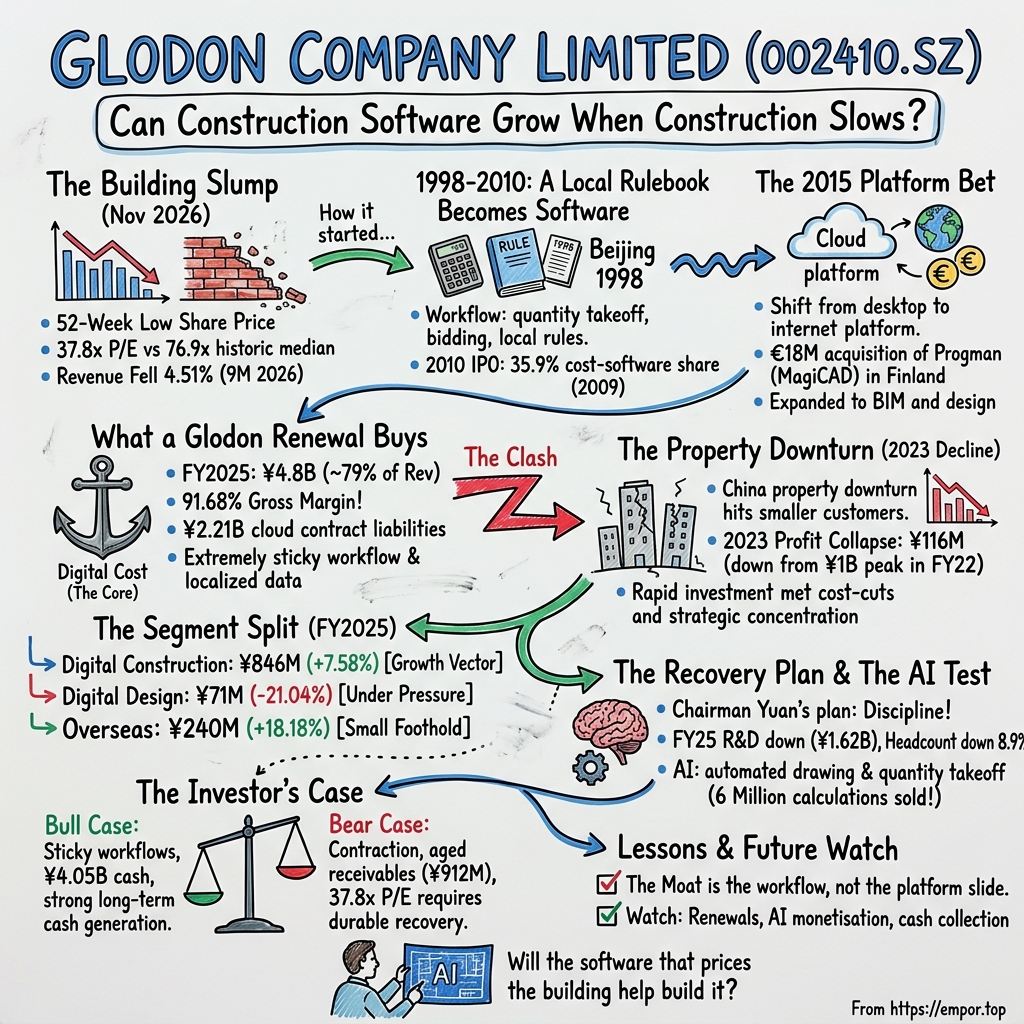
Glodon Company Limited: Can Construction Software Grow When Construction Slows?
I. The Software Company in a Building Slump
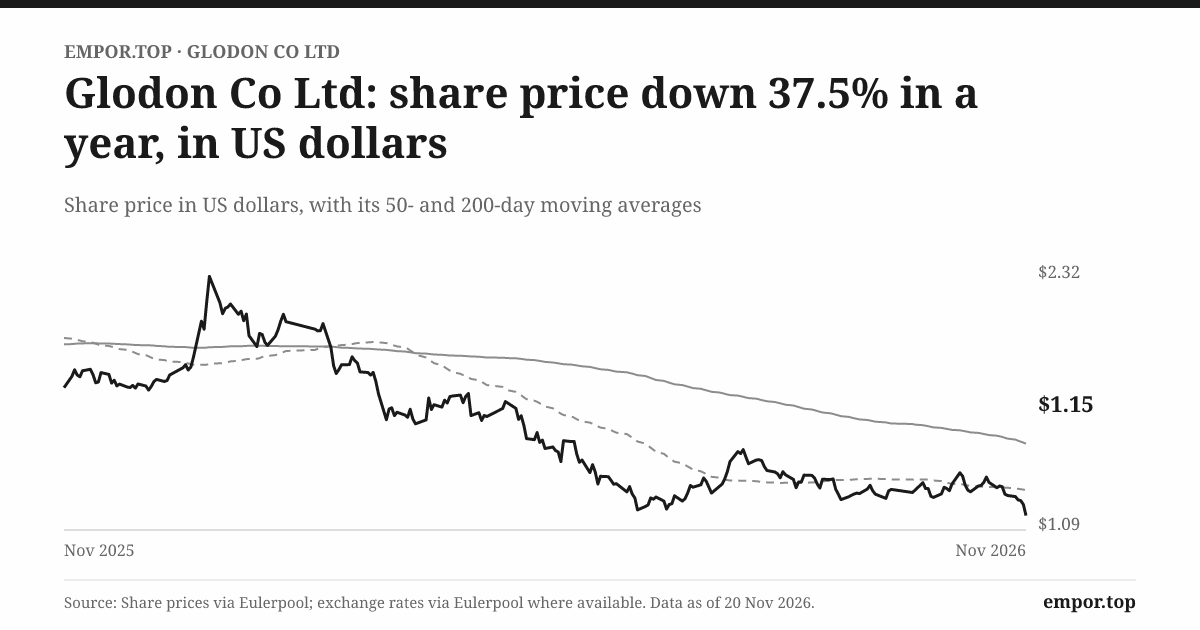
On November 20, 2026, a share of 广联达 Glodon closed at ¥7.70. Its 52-week low was the same ¥7.70. Twelve months earlier the stock had traded as high as ¥15.68, so anyone who bought at the top had lost about half their money in a year.1 Investors were not selling a failing company. They were selling a company whose customers had stopped building.
Glodon makes the software Chinese construction professionals use to measure, price, plan and manage buildings. For two decades that was one of the better places to stand in the Chinese economy, because every tower, metro line and industrial park had to be quantified and costed before anyone poured concrete. Then the property market broke, construction investment weakened, and the people who buy Glodon's software found themselves with fewer projects, thinner margins and less patience for new tools.
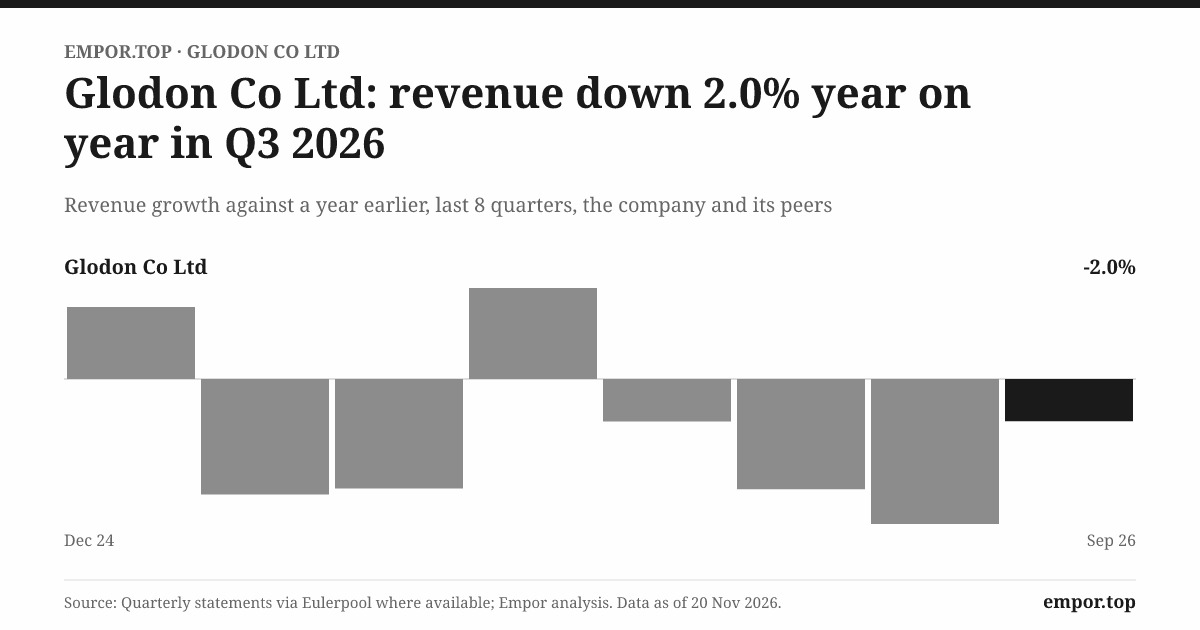
The numbers show a company under pressure from outside. Revenue fell about 5% in the first nine months of 2026 compared with a year earlier.1 That followed a 2% decline in 2025, a year in which attributable profit still rose 62%, to about ¥405 million.2 Sales going down while profit goes up sounds like good news until you ask where the profit came from. A company can earn more by selling more, or by spending less. Glodon in 2025 did the second.
Management's pitch, meanwhile, sounded like a company on offence. At its 2026 interim investor session, executives described stable renewals among the cost-estimation customers who form the heart of the business, a new pay-for-results model for construction-management software, and artificial intelligence that reads construction drawings and calculates quantities, sold by the drawing rather than by the seat.3 The message was that Glodon's software is essential precisely when construction is hard, because a squeezed contractor needs to know its costs more accurately, not less.
Both stories can be true at once, and that is what makes Glodon interesting. Its core cost-estimation business is large, highly profitable and woven into how Chinese construction professionals do their jobs. In 2025 that business produced roughly four of every five yuan of group revenue, at a gross margin above 91%.2 A franchise like that does not vanish because the market has a bad few years. But it also cannot grow much faster than the market it serves, and Glodon spent the decade after 2015 promising to become far more than a cost-estimation company. The question now is whether the rest of the platform, the construction-management tools, the design software, the overseas push and the AI products, can make up for a shrinking market.
Three tests run through this story. The first is whether cloud renewals in the core business can hold revenue steady while customers pull back. The second is whether the profit recovery of 2025 reflects a better business or merely a leaner one that has cut its way back to respectability. The third is whether AI and international expansion can become real businesses rather than slide-deck promises.
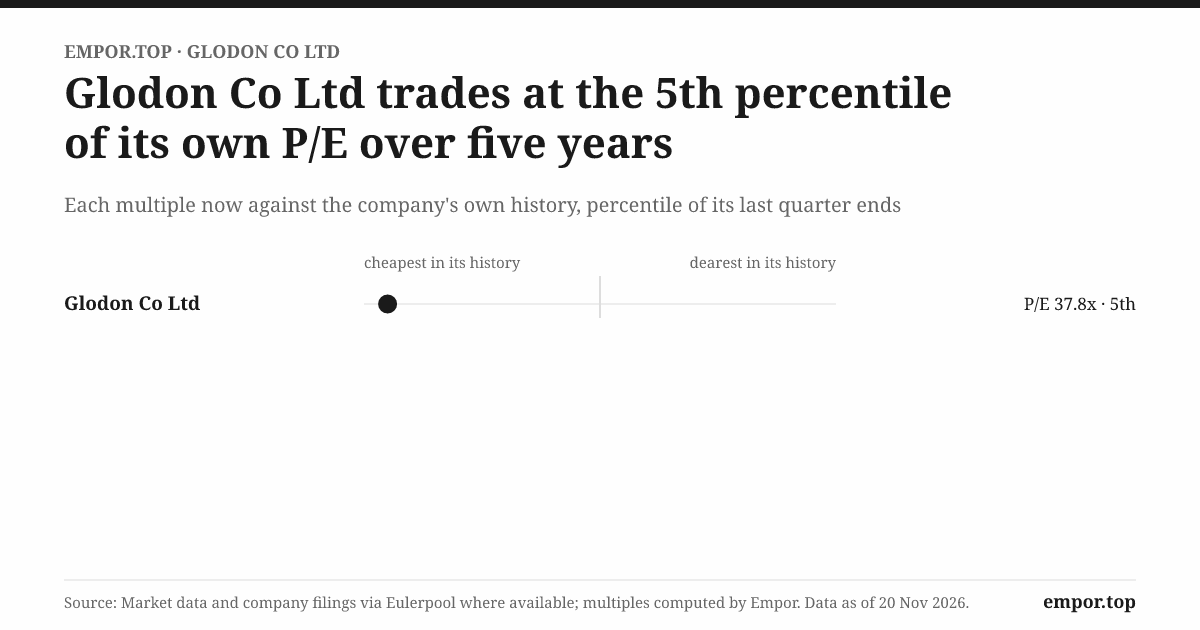
The market has already offered a provisional answer, and it is not flattering. At ¥7.70, Glodon traded at about 37.8 times trailing earnings, against a five-year median of about 76.9 times.14 That looks cheap only in comparison with the company's own history, and that history was priced for growth that has since disappeared. Earnings over the last twelve months were still well below the 2022 peak of roughly ¥1 billion.5 A stock that has halved and still trades at almost 38 times earnings is not obviously a bargain. It is a bet that the earnings will return.
The cash record complicates the gloomy reading. Over the twelve years from 2014 through 2025, Glodon generated about ¥11.0 billion of operating cash flow against about ¥5.1 billion of net profit, more than two yuan of cash for every yuan of reported earnings.2 Customers who pay in advance for software they will use over the coming year create that pattern, and it is a hallmark of a business with real customer commitment. But cash generation tells you about the past relationship with customers. It does not prove the growth engine has restarted.
To judge whether it can, it helps to start where Glodon started: with a stack of drawings, a local rulebook and a cost estimator who needed an answer before the bid deadline.
 Subscribe on LinkedIn
II. A Local Rulebook Becomes Software
In 1998, in Beijing, 刁志中 Diao Zhizhong founded the company that became Glodon.6 The problem it set out to solve was not glamorous. It was arithmetic, of a very particular and very Chinese kind.
Every construction project in China has to be priced, and for decades the pricing followed rules set by government construction authorities. These are the 定额 quota norms: detailed schedules saying how much labour, material and machine time a given unit of work should take, from a cubic metre of reinforced concrete to a square metre of plastering. On top of the quotas sit local price lists, regional adjustments and, increasingly after the early 2000s, bill-of-quantities pricing under the 工程量清单 system. An estimator's job is to read the drawings, measure every quantity, map each item to the right rule for the right province in the right year, apply the right prices and produce a number that the client, the contractor and eventually the auditor will accept.
Think of it as doing your taxes, except that the tax code changes by province, the forms are hundreds of pages long, the numbers involved can run to hundreds of millions of yuan, and every line will later be checked by someone with an interest in finding a mistake. Done by hand, this is weeks of work with a calculator and a ruler. A missed column or a wrong regional coefficient can cost a contractor its margin or its bid. That is the gap Glodon filled. Its software let estimators build a model of the quantities and then apply the local pricing rules automatically, with the rulebooks for each region built into the product and updated as authorities changed them.
The important point is that this was never a generic calculator. A spreadsheet can multiply. It cannot know that a particular province changed its labour coefficients last spring, or that a particular kind of formwork is measured differently under one standard than another. Glodon's value lay in encoding thousands of such local rules, keeping them current, and making them fit how estimators actually worked. Cost software also touches more than the first estimate. The same numbers flow into tender documents, then into variations when the design changes mid-project, and finally into settlement, the negotiation at the end where contractor and owner agree what was actually built and what it should cost. A tool that sits at all those moments becomes part of the professional's daily language.
By the time Glodon went public on the Shenzhen Stock Exchange's small and medium enterprise board in May 2010, that position was well established.7 Glodon reported about 33,000 professional users and a 35.9% share of China's 2009 engineering-cost software market.8 Its domestic rivals included 鲁班软件 Luban Software, 神机妙算 Shiji Miaosuan and PKPM, the structural-design software family with deep roots in Chinese building research, among others.8 International names such as Autodesk and Bentley were relevant in design and later in building information modelling, but they were not really playing the same game. Their products were built for global design workflows, not for the specifics of Chinese quota pricing.
It is worth pausing on what that 35.9% figure does and does not prove. It came from Glodon's own listing document, measured a narrowly defined market in a single year, and is now seventeen years old. It shows that Glodon had a leading position when it listed. It cannot tell anyone today whether Glodon still holds that share, whether it can raise prices, or whether its customers would leave if a cheaper tool appeared.
A more recent data point covers a different and broader category. IDC estimated that in 2022 Glodon ranked first in China's digital-construction market, with a 22.3% share, against 3.2% for Autodesk and 1.6% for 品茗股份 Pinming.910 That is a striking lead in a fragmented market: Glodon's share was roughly seven times that of the next player named. But "digital construction" lumps together cost estimation, project management, design, collaboration and other categories. Leadership across that wide basket is a sign of breadth. It is not the same as a cornered market in any one product, and it says nothing about whether Glodon earns more per customer this year than last.
So the founding story leaves a clear but bounded verdict. Glodon built a real competitive position around specialist workflow knowledge and localized data. Estimators learned its tools, their firms built project histories in its formats, and regional rulebooks gave a local specialist a structural edge over foreign generalists. That is the stuff switching costs are made of. What the record does not show, at least from anything Glodon publishes, is how strong those switching costs are in money terms: how many customers renew, at what price, and how often they leave.
That missing measure matters more than it might seem, because by the middle of the 2010s Glodon decided that being the best cost-estimation company in China was not enough. It wanted to become the platform for the entire construction industry.
III. The 2015 Platform Bet
In May 2015, Glodon announced that it would transform itself into an internet-platform service provider for the construction industry.11 It is hard to overstate how fashionable that sentence was in China at the time. The phrase "互联网+ Internet Plus" had just entered official policy vocabulary, the stock market was in a speculative boom, and companies in every industry were recasting themselves as platforms. For a software vendor with tens of thousands of professional users, the logic was seductive.
The pitch ran like this. Glodon's applications already sat on the desks of the people who priced and managed construction projects. If those applications moved online, Glodon would see the projects, the quantities, the materials and the participants. That data could support new services: procurement marketplaces for building materials, industry price data, and even financial services for contractors who needed working capital.11 The software would become the front door, and the platform would be the house.
There was a fair case for this. A company embedded in estimating workflows really does sit at a junction where owners, contractors, subcontractors and suppliers meet. Software that connects them could, in principle, capture more value than a one-time licence fee. Western software companies had spent fifteen years chasing a similar dream of moving from tools to platforms, and some of them had succeeded.
The transition had a price, and the first bill arrived quickly. Glodon's revenue fell 12.53% in 2015, even as the company said new products and businesses contributed 51% of revenue and as it devoted more resources to the platform strategy.116 Revenue had grown about 26% the year before, so the swing was abrupt.5 Some of the decline reflected a weak construction market and the shift in how software was sold. Some reflected a company pouring effort into new things before they earned much.
That 51% figure deserves care. "New products and businesses" is a category the company defined, and it lumps together newer software, newer services and newer experiments. It is not the same thing as recurring software revenue, and it says nothing about which of those new businesses made money. A listener hearing that half of revenue came from new things might imagine a company that had already reinvented itself. The record is more ordinary: Glodon was still, overwhelmingly, a construction-software company, and its finance and procurement ambitions would never become the main event.
It is also worth noticing what the company did not change. The cost-estimation software kept paying the bills through the entire platform period. Every new venture was funded, directly or indirectly, by estimators renewing their tools. That is a common pattern in software: a cash-generating core finances a portfolio of adjacent bets, and the bets are judged generously because the core makes the group look profitable overall. The danger is that the core's strength hides the bets' weakness for years, until an external shock squeezes the core and the true cost of the portfolio becomes visible all at once. For Glodon, that shock would take eight years to arrive.
The more legible move of that era came a year earlier, and it went abroad. In March 2014, Glodon agreed to buy Finland's Progman Oy, along with related business Cadcom, for €18 million.12 Progman's main product was MagiCAD, software for designing the mechanical, electrical and plumbing systems inside buildings: the ducts, pipes, cables and sprinklers that engineers call MEP. MagiCAD had an established base among European building-services engineers and worked inside the design programs those engineers already used. The deal gave Glodon a credible design product, a European customer base and an engineering team that knew how to sell software outside China.
Was €18 million a good price? The honest answer is that nobody outside the company can say with confidence. Glodon did not publish a detailed earnings bridge for the business it bought, and there is no clean public set of comparable deals for small European MEP software companies at the time. What can be said is that it was a modest purchase for a group of Glodon's size, that MagiCAD survived and remained part of the group more than a decade later, and that it became the vehicle for later moves.6 One of those came in 2023, when MagiCAD added EQUA, a Swedish developer of building-performance simulation software.6 Glodon did not disclose the price. Its 2025 accounts include goodwill impairment of about ¥122 million, but the company does not allocate that charge in a way that would let an outsider pin it on EQUA or any single acquisition.213
The 2015 bet therefore leaves a mixed inheritance. It expanded Glodon's ambitions beyond cost estimation and brought a real international design product into the group. It also pushed the company into adjacent businesses, procurement, data and finance, whose financial contribution was never large enough to change the economics of the group. The platform rhetoric outran the platform revenue.
The deeper question the bet left behind was simple to state and hard to answer. Did the platform produce durable recurring revenue, or did it mostly add cost and complexity around an original franchise that was already very good? The best place to look for an answer is not the new businesses. It is the old one, and what happened when Glodon asked its oldest customers to start paying every year.
IV. What a Glodon Renewal Buys
Picture a cost estimator at a mid-sized contractor somewhere in Jiangsu. For years she worked with a Glodon desktop licence, bought once and protected by a hardware key plugged into her computer. Each time the local pricing rules changed, she or her firm paid for an update. Then Glodon moved her to the cloud. Now she pays a fee each year per user. In return she gets the software, the regional rulebooks kept current, access to engineering data, cloud storage for her projects and support. If her firm stops paying, the tool stops working.
That shift, which Glodon pushed across its cost-estimation customers through the second half of the 2010s, is the economic core of the company today. It turned a transaction into a relationship. And it is the reason the cash numbers look the way they do: customers pay up front for a year of service, the cash arrives immediately, and the revenue is recognized month by month over the following year.
Glodon sells in several ways. It offers perpetual or time-limited software licences, subscriptions priced per user and per period, project solutions, custom development and some software and hardware sales. For subscriptions, the licence and the support are bundled into an annual or monthly price per user, and revenue is recognized over the service period. A perpetual licence, once delivered, is recognized at once.14 The difference matters for anyone reading the income statement: a business shifting from perpetual sales to subscriptions will often see revenue dip during the shift, because cash that once arrived as a lump now trickles in.
The cloud transition has left a visible footprint on the balance sheet. At the end of 2025, Glodon carried about ¥2.43 billion of contract liabilities, essentially money customers had paid for services not yet delivered, and about ¥2.21 billion of that related to its cloud-transition business.14 Put that next to group revenue of roughly ¥6.1 billion and it represents about four months of total sales already paid for and waiting to be earned.2 That is genuine evidence of contracted future service. It is not, however, a disclosed recurring-revenue figure. Glodon does not publish what share of group revenue is recurring, nor a standard contract length or minimum commitment.14
The segment that carries all this is called Digital Cost, and its scale dominates everything else in the group. In 2025 it generated about ¥4.8 billion of revenue, roughly 79% of the total, at a gross margin of about 92%.2 In other words, for each ¥100 a customer paid, Glodon spent only about ¥8 on the direct cost of delivering it. Most of the real cost of the business sits further down the income statement, in research and development, sales and administration. Around the core estimating tools, Glodon has added engineering-data services and tendering products designed to make the subscription worth more than quantity takeoff and pricing alone.2
The strongest reason to believe in the franchise is the workflow itself. Glodon's established formats and localized data create real friction in switching, and provincial differences raise the bar for any newcomer trying to cover the whole country.
Customer evidence fits that picture in one respect. Glodon's five largest customers accounted for only about 3% of 2025 sales, and the single largest for about 1%.2 No one customer can hold the company to ransom. But dispersion cuts both ways. A business with thousands of small and mid-sized buyers has to earn its renewals one firm at a time, and those firms are precisely the ones a property downturn squeezes hardest. Many small buyers rarely have bargaining power individually, but collectively they are price-sensitive, and a contractor fighting for survival might drop a seat or two, delay an upgrade or hunt for cheaper regional alternatives.
On renewals, Glodon's language is consistent but qualitative. In its 2025 annual report and again at the 2026 interim investor session, management described renewal rates in the cost business as stable.23 It has not published a precise renewal rate, a net revenue retention figure, or a measure of price realization, the evidence that would show whether customers are paying the same, more or less per seat than before. For a company whose investment case rests on the stickiness of a subscription, that is the most important number it does not disclose.
That silence is more striking because Glodon once did publish the numbers, at the height of the transition. Go back to the spring of 2021, when the company reported its 2020 results. By then, 25 regional markets had moved into the cloud model. In the ten regions that converted in 2019, more than 80% of the product base had switched to the cloud and the renewal rate was 88%. In the eleven regions that had converted before 2019, both the conversion rate and the renewal rate were above 85%.15 Cloud revenue had reached about ¥1.62 billion, up 76% in a year and already 58% of the cost business, and cloud-related contract liabilities stood at about ¥1.51 billion.15
Those were the figures of a company proud of its retention, and rightly so. A renewal rate in the high eighties for professional software sold to a fragmented base of small firms is a strong result, roughly the range where a subscription business compounds instead of leaking. The figures also allow a rough test of what has happened since. Cloud-related contract liabilities grew from about ¥1.51 billion at the end of 2020 to about ¥2.21 billion at the end of 2025, an increase of roughly 47% over five years.1514 Digital Cost revenue, meanwhile, grew from about ¥2.79 billion to about ¥4.8 billion over the same span.152 Most of that growth arrived in the early years as remaining regions converted and perpetual-licence customers moved onto annual fees. Once the conversion was largely complete, the cost business became what it now is: a subscription base whose growth depends on seats, prices and the health of the customers who buy them.
Why would a company stop quantifying its best number? There are innocent explanations. Once the transition was finished, the region-by-region conversion and renewal tables stopped being a useful progress report, and "stable" may simply mean "unchanged". But the absence leaves outsiders unable to tell stable at 88% from stable at 80%, and in a downturn that difference is the whole investment case. The historical record therefore supports the moat as it stood in 2020. It cannot confirm that the moat has held its strength through three years in which customers' businesses shrank.
How much of the competitive landscape still matters? The domestic rivals named in Glodon's listing-era account remain part of the field, along with regional providers that know particular provinces well.8 IDC's broad 2022 ranking, already noted, put Glodon far ahead in China's digital-construction market.10 That is evidence that no competitor has achieved anything like Glodon's breadth. It is not proof that each of Glodon's product lines faces no meaningful rival, and it is certainly not a current measure of share in cost software specifically.
The conclusion on the core moat is therefore real but bounded. Workflow depth, localized rule data and extraordinary gross margins point to a franchise that customers find hard to replace, and the cloud balances show those customers are still paying in advance. The history does not reject the moat. It narrows it to a smaller claim than the platform rhetoric implies: Glodon owns a very good tool for a specific professional job. What remains unproven is whether that tool has pricing power, the ability to charge more each year, because the company does not publish the retention and pricing data that would settle it.
That distinction became painfully relevant in 2023, when the platform met the property downturn and the profit line fell off a cliff.
V. The Platform Meets the Property Downturn
The 2023 accounts read like a puzzle with a missing piece. Revenue that year was about ¥6.53 billion, barely below the roughly ¥6.59 billion peak of 2022.5 A business that loses less than 1% of its sales usually loses a little profit. Glodon lost almost all of it. Attributable profit fell from about ¥1 billion in 2022 to roughly ¥116 million in 2023.5 The fourth quarter of 2023 was an outright operating loss.5
The customers explain part of it. China's property sector was in its third year of contraction. National property sales fell 8.5% in 2023 and investment in real estate kept declining.16 Developers who had once borrowed freely to start new projects were instead trying to finish old ones, avoid default or simply survive. That pain flowed downhill to the contractors, design institutes and consultants who buy Glodon's software. Purchasing decisions took longer. Smaller customers, the long tail on which Glodon's dispersed revenue depends, were hit hardest. New products that required a customer to invest in change, such as project-management systems, became harder to sell.
But the market alone does not explain a near-flat revenue line paired with an 89% fall in profit. That gap points inside the company. Glodon had spent the boom years building out the platform: more product lines, more regions, more salespeople, more engineers. In its 2023 annual report, management acknowledged that rapid external change and significant resource investment had raised costs and sharply reduced profit, and it set out a response: concentrate resources on core products, core regions and core customers.5 Put plainly, the company had built a cost structure for a market that was supposed to keep growing, and the market did not cooperate.
That makes 2023 a useful falsification point for the platform thesis. If the wider platform had been generating strong economics of its own, it should have cushioned the core when construction slowed. Instead, the platform's costs were part of what crushed earnings. That does not mean every new business was a mistake. It means that, at the moment of stress, the businesses outside Digital Cost were consuming more than they returned.
The longer record shows how deep the hole was. Over the three years from 2022 to 2025, Glodon's revenue declined about 2.6% a year and net profit about 24.7% a year.25 Over ten years, revenue still grew about 14.7% a year, so the recent decline is a break from a long growth pattern, not a permanent description of the business. Yet the profit record is less impressive even over the long run: net profit grew only about 5.3% a year over the decade, much more slowly than revenue.2 Glodon's growth has consistently been more generous to its revenue line than to its shareholders.
There is a natural temptation to treat 2023 as a one-off: a bad market, a few too many hires, a lesson learned. The record before 2023 makes that harder, though it also contains an important caveat. Profit fell sharply in 2015, the first year of the platform transformation.11 It fell again in 2019, when attributable profit dropped to roughly ¥235 million.15 Part of that second dip was accounting rather than economics. When a customer who used to pay for a perpetual licence up front switches to an annual subscription, the company books less revenue in the year of the switch, even though the relationship may be worth more over time. Glodon made exactly this argument in 2020: its reported revenue of about ¥4.0 billion and profit of about ¥330 million would have been about ¥4.6 billion and ¥886 million had the cloud transition not deferred recognition.15 The transition years were a deliberate, temporary trough.
The 2023 collapse cannot be explained that way. By then the cost business had largely finished its conversion, so there was no large deferral effect hiding the profit. Revenue held up and earnings still vanished, which points squarely at the cost base. The 2015 and 2019 episodes taught investors to forgive weak reported profits during a transition; 2023 showed what happens when a company carries the spending habits of an investment phase into a market that has stopped growing.
The forecasts of the time show how complete the surprise was. When Glodon reported its 2020 results, 国元证券 Guoyuan Securities projected revenue of about ¥7.29 billion and attributable profit of about ¥1.25 billion for 2023.15 The outcome was revenue of about ¥6.53 billion and profit of about ¥116 million.5 Revenue missed by about a tenth; profit missed by more than nine-tenths. That forecast was not company guidance, but it captured the consensus mood of the moment: in March 2021, the market valued Glodon at about ¥77.5 billion.15 At the November 2026 close, it was valued at about ¥13.8 billion.1 Most of the destruction of value came not from the core business shrinking, which it barely did, but from the disappearance of the profit growth investors had assumed would follow the cloud transition.
The cash record remains an important counterweight.2 Even in 2023, the business generated positive operating cash. In 2025, operating cash flow was about ¥1.06 billion, well over twice attributable profit of about ¥405 million.2 That is what subscriptions paid in advance look like.
But cash and profit diverged in 2025 for reasons that should make investors cautious about reading cash as proof of hidden earnings. The 2025 cash-flow reconciliation added back about ¥217 million of asset and credit impairment, about ¥346 million of intangible-asset amortization and roughly ¥150 million of depreciation of fixed and right-of-use assets, all non-cash charges.2 Amortization at that scale partly reflects past capitalized development and acquisitions; it is a real economic cost that happens to have been paid in earlier years. The cumulative cash conversion is a genuine strength. It does not settle whether current earnings are sustainable.
What 2023 left behind was a clean test for the recovery that followed. If the rebound came mostly from cutting heads and comparing against a year loaded with impairment, then revenue and operating profit should diverge again whenever the cuts run out. If customers are renewing and buying higher-value products, the business should show it in segment growth and in collections. By 2025, profit had recovered to about ¥405 million while revenue was still shrinking.2 The cost cut was proven. The demand was not.
That brought the spotlight onto the businesses that were supposed to deliver the growth: the construction-management, design and overseas operations that make Glodon more than a cost-software house.
VI. The Smaller Businesses Must Earn Their Place
Glodon likes to describe itself as a platform for the full lifecycle of a construction project: design at the start, cost through the middle, construction management on site, and data that ties it all together. Open the 2025 segment accounts and the lifecycle looks less like a circle and more like a mountain with a few hills beside it.
Digital Cost, the mountain, has already been measured. Beside it, three businesses compete for attention and capital.
The largest of them is Digital Construction, which sells project-management and enterprise-management software to contractors: tools to track progress, safety, quality, labour and materials on site, and systems that let a construction group manage a portfolio of projects. In 2025, Digital Construction generated about ¥846 million of revenue, up about 8%, with a gross margin of about 58%.2 Those are real numbers. Growth in a year when group revenue fell, and a gross margin that most hardware-heavy industrial businesses would envy, suggest a product that customers value. The segment's margin also improved during the year, which suggests the business was moving away from low-margin implementation work.2
Then set that figure against the segment's own past. In 2020, Glodon reported Digital Construction revenue of about ¥943 million, up about 10.5%, with project-level products deployed on a cumulative 38,000 projects for 3,400 customers, and the 15,000 projects and 1,700 customers added that year alone.15 At the time, analysts described construction management as a blue-ocean market larger than cost estimation, likely to grow quickly for years.15 Five years later, on the company's current segment reporting, the business was smaller than it had been in 2020. Segment boundaries can shift, and in 2020 Glodon was deliberately tightening credit terms on construction customers to collect receivables, so the comparison is not perfectly clean.15 But the direction is hard to miss. The growth vector of 2020 spent the following half-decade going sideways to backwards, and the 7.58% growth of 2025 is a recovery from a lower base, not the continuation of a boom.
That history narrows the bull case for Digital Construction without rejecting it. The business is real, it has paying customers on tens of thousands of projects, and its margin is improving. What the record rejects is the idea that construction management would naturally outgrow the cost business once the market discovered it. By 2025 it had not, and the property downturn means it will have to prove the case in the hardest market of its life.
The margin, too, is far below Digital Cost's, and that gap tells the story of the business. Selling project-management software to a contractor is not like selling a subscription to an estimator. It often means configuring systems for a particular company, installing devices on site, training staff and adapting workflows. Every project can look like a small consulting engagement. The challenge for Digital Construction is to prove that it can scale beyond implementations and pilots into repeatable software that customers renew without heavy custom work.
Management's answer for 2026 is a pricing model it described at the interim session as "no savings, no payment": customers pay for construction-management products only when the tools deliver measurable savings.3 It is a bold pitch in a downturn, because it shifts risk from a cash-strapped contractor onto Glodon. If it works, it could make the product easier to sell and harder to cancel. It could also lengthen the time between delivering work and recognizing revenue, and it makes Glodon's income depend on how savings are measured. A results-based contract is only as good as the agreed baseline.
Digital Design is the smallest of the three and the one closest to the platform's original ambition of owning the project from its first line on a drawing. It includes BIM and engineering-design software and the MagiCAD family. Glodon pushed hard here at the start of the decade. In September 2020 it launched BIMMAKE, a modelling tool for construction design, which it said added more than 30,000 users that year, and in October 2020 it bought 洛阳鸿业信息科技 Luoyang Hongye Information Technology to strengthen its design channels and market reach.15 Five years after those moves, in 2025, the segment generated only about ¥71 million of revenue, down about 21%.2 Thirty thousand new users of a modelling tool did not become a meaningful revenue line, which is worth remembering when the same company counts AI drawing calculations in the millions. At roughly 1% of group revenue, Digital Design is not a second earnings engine. Newer products such as the NOVADesign platform and infrastructure-design tools are options on a future in which Chinese designers shift away from foreign design software, a possibility encouraged by Beijing's push for domestic substitution in industrial software. An option, though, is not a business until someone pays for it at scale, and the 2025 decline shows that Glodon's design business shrank even as the policy winds favoured it.
Overseas is the third adjacent bet. International revenue grew about 18% in 2025, to about ¥240 million.2 Growth at that rate in a year when the domestic market shrank is encouraging. The base, though, is still under 4% of group revenue. MagiCAD gives Glodon a tangible European foothold; elsewhere, the company has been targeting markets in Southeast Asia and beyond with cost and construction products adapted to local standards.3
That adaptation is the whole difficulty. Glodon's domestic moat rests on encoding Chinese rules. Outside China, the rules are different, the incumbents are different, and the customers have no history with Glodon's formats. The company's 2026 launch of QuantifAI in Malaysia, an AI-assisted quantity-takeoff product aimed at a wider international market, is a sensible test of whether drawing-reading technology can travel more easily than rulebooks.3 But a product launch is not evidence of commercial scale, and Glodon has not disclosed overseas profitability, so no outsider can yet tell whether international growth is adding to group earnings or consuming them.
Put the three side by side and the verdict is clear. Digital Construction is a plausible growth vector with enough revenue and margin to matter, though it is about a sixth the size of Digital Cost. Design and overseas are strategically relevant but too small to carry the investment case for years.
That raises the capital-allocation question that has shadowed Glodon since 2015. Can these smaller businesses grow without repeating the platform-era pattern, in which costs ran far ahead of durable revenue? The answer depends heavily on the people now running the company, and on whether the discipline they showed in 2025 is a strategy or just a phase.
VII. Yuan's Recovery Plan, and the AI Test
In the spring of 2023, after 25 years at the helm, Diao Zhizhong stepped back, and a board resolution passed the chairmanship to 袁正刚 Yuan Zhenggang.17 Yuan took the top seat at a company heading into its worst year as a listed business.2 He already knew it intimately: he was the company's president, and he held both titles, chairman and president, when he took over.17 In an interview that summer he said he had defined his career, early and almost emotionally, as getting the digitization of the construction industry right, and he called digital transformation the main theme of Chinese construction.17
That framing matters for judging him. Yuan is not an outside turnaround specialist brought in to cut. He is an insider from the leadership that ran the platform era, and a believer in the very digital-construction idea whose costs had just overwhelmed its revenue. That gives him credibility with engineers and customers, and it also raises the question every insider successor faces: can the person who built the plan be the one to shrink it? The 2023 annual report offered his answer: a concentration on core products, regions and customers. The next two years would test whether it was sincere.5
The founder, Diao Zhizhong, remained the actual controller, holding 15.44% of the shares at the end of September 2026, with an acting-in-concert affiliate holding a further 0.12% at the end of 2025.12 Yuan's job, in effect, was to repair the business on behalf of a founder who still owned the largest stake.
Yuan's 2026 plan, as set out in the 2025 annual report and at the interim investor session, rests on two ideas. The first is concentration: put resources behind core products, core regions and core customers, and stop funding everything at once. The second is AI applied to the workflows Glodon already owns, rather than AI as a separate product line chasing a trend.23
The best way to judge a turnaround plan is to watch where resources actually move. On that test, the 2025 record is unusually clear. Research and development spending fell to about ¥1.63 billion, from about ¥1.81 billion in 2024, and dropped from about 29% to about 27% of revenue.218 The company also capitalized less of it, about 14% of R&D spending compared with about 16% a year earlier, which means less of the cost was pushed onto the balance sheet to be expensed later.2 Total headcount fell 8.9% to 7,676, and R&D staff fell by the same proportion to 3,273, still more than four in ten employees.2
This combination looks like a real course correction rather than a retreat. A company harvesting its franchise would cut R&D far more deeply. Glodon still spends more than a quarter of its revenue on research, an intensity most software companies would consider aggressive. It is simply spending less than before and, by its own account, shifting that spending toward AI.3 The lower capitalization rate is a small but meaningful sign of accounting conservatism.
The recovery still has to be untangled. Profit in 2025 rose on lower costs, a better mix and comparison with a weak prior year. How much came from each is a question the company's own reporting does not fully answer. Profit for the first nine months of 2026 was a little lower than a year earlier, and quarterly profit fell in the second quarter before holding flat in the third, which suggests the easy gains from cost-cutting are behind it.1
Pay is another way to test alignment. Total compensation for directors and senior executives rose to about ¥21.26 million in 2025, from about ¥12.05 million in 2024, as attributable profit increased from about ¥250 million to about ¥405 million.218 Yuan's own pay rose to about ¥3.52 million from about ¥2.37 million.2 In 2023, the year profit collapsed to about ¥116 million, executive pay was about ¥18.85 million.18 Pay therefore did rise with profit, but it also stayed high when profit fell. Investors should judge it in proportion: about ¥9 million of extra executive pay is small against a ¥155 million profit increase, but it arrived in a year when revenue fell and thousands of staff left. The company also launched a stock-option plan in 2025, and its performance conditions and vesting will be one of the clearer signals of what management is being paid to deliver.2
AI is where the future of the business, and the risk to it, meet. AI could automate the drawing-reading and quantity-measurement work already described, compressing days of work into minutes.
Glodon's bet is that it is best placed to build that software, because it owns the rulebooks, the formats and decades of project data in which drawings and quantities are already linked. At the 2026 interim session, management said it had sold more than six million industrial-installation drawing calculations under a new usage-based model, priced by drawing rather than by user seat, which it called "work as a service".3
That is a genuinely interesting change in the unit of value. Under seats, Glodon is paid for access to a tool. Under drawings, it is paid for work done. If AI makes an estimator three times as productive, a seat-based vendor might lose seats; a work-based vendor might gain revenue.
The six-million figure, though, is a count of units, not a measure of money. Glodon has not disclosed the paid contract value behind those calculations, the revenue recognized from them, the rate at which customers come back, or the profit they produce.3 Product launches and usage counts show technical execution and some customer interest. They do not yet establish a new profit pool. Glodon's own history is the relevant base rate here: the 2015 platform also generated impressive early adoption metrics in new categories, but the finance and procurement services built around it never became material earnings contributors.
The risks around this strategy follow directly from how the business makes money. Weak construction demand reduces software purchases and stretches customer payment cycles. Receivables that age can delay the conversion of revenue into cash. And AI threatens the seat model itself: if automation shrinks the number of estimators a contractor needs faster than Glodon can reprice its products by drawing or by outcome, the core subscription base could erode even while Glodon's AI tools succeed.
The management test, then, is not whether Yuan's strategy sounds right. It is whether the company's statements about renewals, cost discipline, AI sales and overseas margins hold up when the numbers arrive. Across the 2025 annual report and the 2026 interim session, the narrative was consistent: stable renewals, focused investment, AI as a core multiplier.23 What was absent in both was quantification. An investor weighing the current price has to decide how much to pay for a story that has been told consistently but measured only partially.
VIII. The Investor's Case: What Has to Be True?
Imagine an investor looking at Glodon on the evening of November 20, 2026. The price had fallen about 51% from its 52-week high. The market value was about ¥13.8 billion; after subtracting the cash and investments the company held, the enterprise value was about ¥10.2 billion.1 The stock traded at about 37.8 times trailing earnings, below half its five-year median, and offered a dividend yield of about 3%.4 The investor's question is not whether Glodon is a good company. It is what has to be true for this price to make sense.
The case for a depressed leader
The bull case is straightforward. Glodon owns a sticky cost-estimation workflow with gross margins above 90%. It leads China's broad digital-construction software market by a wide margin. It has a long record of turning profit into cash, carries almost no debt and still generates enough to pay a meaningful dividend. Its construction-management business is growing, and AI could make its data and workflow expertise more valuable, not less. If construction stabilizes and customers seek productivity, a leaner Glodon could rebuild operating margins and resume growth from a lower cost base.
The bear case is equally plain. Revenue has contracted for three straight years. Profit, even after the 2025 recovery, remains less than half its 2022 level. Digital Cost dominates the group, so Glodon's growth is still chained to the volume of Chinese construction work, and the new businesses have not offset weakness in the old one. The operating margin was only about 9.6% in 2025, and return on equity over the last twelve months was about 6.2%, low numbers for a software company and no better than many ordinary industrial businesses.1
To weigh them, it helps to put the moat through a structured examination once. Start with competitive forces. Buyer power is fragmented, as the about 3% top-five customer share shows, but the buyers themselves are under severe financial strain, and that makes them price-sensitive and slow to pay.2 Supplier power is low: the top five suppliers took about 11% of purchases, and a software company's main input is its own engineers.2 The threat of new entrants is moderated by regional rulebooks and accumulated data, which a newcomer would need years to replicate. Rivalry from named domestic competitors such as Luban, Shiji Miaosuan and PKPM persists, and regional providers know their provinces well. The most serious force may be substitution, and specifically substitution by AI. A tool that reads drawings and calculates quantities without a trained operator could reduce demand for the very seats Glodon sells, whether or not Glodon builds it.
Through the lens of Hamilton Helmer's seven powers, Glodon's clearest power is switching costs: workflow familiarity, project archives and interoperability with other project participants. There is a case for a modest cornered resource in its proprietary, continuously updated regional cost rules and project data, which no competitor has at comparable breadth. Scale economies exist in the sense that Glodon can spread the cost of maintaining rulebooks across more users than any rival. Network effects are weaker than the platform era promised; Glodon's tools are more valuable when collaborators use them, but the procurement and finance marketplaces that would have created strong network effects never became material. Brand helps in a conservative professional market but is secondary. Counter-positioning and process power are not clearly evident.
That analysis supports a real franchise. The weakness in the case is evidence, not logic. Low customer concentration and very high Digital Cost margins support a durable core. Glodon does not publish company-wide renewal, net retention or price-realization measures, and old market-share data cannot substitute for current share or pricing evidence. The moat is intact but its strength in money terms is unproven.
The balance sheet and the price
Capital allocation offers a mixed record. The MagiCAD purchase was modest and survived. But the platform era as a whole consumed resources that did not translate into proportionate profits, and goodwill impairment in 2025 shows that some acquired value has been written down.2 In 2025, Glodon repurchased about 8.7 million shares for about ¥122 million, intended for equity incentives or an employee share plan rather than cancellation, and paid out about 61% of profit as dividends.2 Those returns signal confidence, but they should be judged against the need for future product investment, not assumed to be proof of discipline. Buybacks used for employee incentives offset dilution rather than reduce the share count.
The 2025 earnings rebound needs careful reading. Profit rose about 62% while revenue fell. Impairment of about ¥217 million, including roughly ¥122 million of goodwill, was still recorded, alongside lower R&D spending and headcount.2 The auditor, BDO, gave an unqualified opinion but named revenue recognition and goodwill impairment, with about ¥840 million of goodwill on the books, as key audit matters, the areas where management's judgment most affects reported numbers.13 Until the 2026 audited accounts show how much recovery came from lasting efficiency rather than comparisons and mix, the earnings base is uncertain.
The balance sheet is a genuine strength, but it deserves scrutiny rather than a glance. At the end of 2025, Glodon held about ¥4.05 billion of cash, while borrowings were small: a ¥39 million long-term bank loan and a few million yuan of discounted supply-chain bills, with no outstanding bonds.2 Refinancing risk was negligible. By September 2026, though, cash had fallen to about ¥2.93 billion while trading financial assets had risen to about ¥755 million.1 Some of the shift reflects dividends, buybacks and the company's normal seasonal pattern, in which customers pay heavily late in the year. Some reflects a move into short-term investments. The point is not that the money has vanished but that investors should track what kind of asset the liquidity sits in, not treat every current asset as cash.
The trend in cash generation deserves the same care as its level. In 2020, the year the cloud transition hit its stride and Glodon deliberately pushed construction customers to pay what they owed, operating cash flow reached about ¥1.88 billion.15 By 2025 it was about ¥1.06 billion, down by more than 40% over five years even though revenue was higher than in 2020.2 Some of the 2020 figure was a one-time harvest: converting a region to subscriptions pulls a year of prepayments forward, and collecting old receivables releases cash that will not recur. But the decline also shows that the cash engine, like the profit engine, has been running at lower revenue growth and a heavier cost base. A business that once generated nearly half its revenue in operating cash now generates about a sixth. That is still healthy for a software company. It is not the cash profile the market paid ¥77.5 billion for in 2021.
Receivables are the other place to look. Gross trade receivables were about ¥912 million at the end of 2025, of which about ¥222 million was more than a year old.14 By September 2026, receivables had risen to about ¥1.10 billion.1 Some of that is seasonal, since Glodon's collections cluster in the fourth quarter. But a software company selling to stressed contractors needs to show that customers are paying, not just signing.
Governance adds a smaller question. Diao Zhizhong's pledged shares rose from about 51.65 million at the end of 2025 to about 74.6 million by September 2026, about 4.52% of the company's shares.12 Pledging is common among Chinese founders and does not by itself indicate trouble, but a rising pledge at a halved share price is worth watching. Related-party dealings appear small, the largest being ¥80 million owed to affiliates of the controller from their exit from a subsidiary through a capital reduction, repaid during 2025.1920
A skeptical activist reading the same accounts would press on three points. The first is portfolio complexity: a group that earns nearly four-fifths of its revenue and almost all of its gross profit from one business still carries design, overseas, data and construction operations whose individual profitability it does not disclose, so shareholders cannot see which bets earn their cost of capital. The second is disclosure itself: a company that published renewal and conversion rates region by region in 2020 now offers the word "stable", and an activist would ask for the number back. The third is the use of cash. With roughly ¥4 billion of liquidity at the end of 2025 and almost no debt, Glodon holds far more than a subscription business with prepaying customers needs to operate, and a shareholder could reasonably ask whether buybacks that merely feed employee incentive plans are the best use of the surplus. None of these points suggests anything is wrong. Each describes a place where management could make the investment case easier to verify, and has chosen not to.
For investors who want to follow the case without drowning in figures, three measures matter most. The first is Digital Cost revenue and its renewal trend: about ¥4.8 billion in 2025, described as stable but not quantified.2 The second is Digital Construction revenue and gross margin, about ¥846 million and 58% in 2025, both moving in the right direction.2 The third is receivables ageing and cash conversion, where the end-2025 reading showed about a quarter of gross receivables older than a year. For AI, ask for paid revenue and repeat usage alongside unit counts.
That leaves the valuation question. A price-to-earnings ratio below its own historical median does not automatically signal a bargain. It can equally reflect a business whose growth and returns are lower than they used to be. At about 38 times earnings and an earnings yield near 2.6%, the market was still paying for a recovery. The multiple must be weighed against the path back to stronger operating margins, and that path runs through the evidence Glodon has so far declined to publish.
IX. Business & Investing Lessons
Set three documents side by side. The first is Glodon's 2010 prospectus, describing an estimator's local rulebook turned into software used by tens of thousands of professionals.8 The second is the 2015 announcement, promising an internet platform for the whole construction industry.11 The third is the 2023 annual report, explaining that heavy investment and a changing market had wiped out most of the profit and that the company would now concentrate on core products and customers.5 Together they read like a parable about what specialist software can and cannot become.
The first lesson: a rulebook embedded in a daily workflow can be a moat; a platform slide cannot. Glodon's durable power came from the dull, specific work of encoding regional cost rules and keeping them current for people who used them every day. The grand vision of procurement, finance and data marketplaces never matched that power, and the core franchise carried the company through the downturn the platform helped make worse. Founders who own a workflow should be suspicious of any strategy that promises to own the industry instead. Even so, the core moat has never been measured in public, which means investors have to trust the shape of the advantage without seeing its price.
The second lesson: a customer's project data is an asset only when it improves the next estimate. The cloud transition's annual payments and contract liabilities are evidence of a promise, not a profit.14 Its value depends on whether the data and service bundled into the subscription make the next year's work faster and more accurate. Data that merely sits in Glodon's cloud is storage; data that sharpens the estimate is a reason to renew.
The third lesson: a product milestone is not a business until customers pay again. The six million AI drawing calculations, like the platform-era adoption figures, are not proof of a profit pool.3 The difference between a technical success and a profit pool is the second invoice, the one the customer pays after the novelty wears off. Glodon's history of converting new-product enthusiasm into durable earnings is mixed, which is why its AI claims deserve patience rather than either dismissal or applause.
The fourth lesson: a transition trough buys forgiveness only once. Glodon's cloud transition once gave investors a reason to look through deferred earnings; the 2023 collapse did not.15 Every software company that moves to subscriptions earns a period in which weak reported earnings are a feature rather than a flaw. The discipline is to know when that period has ended, and to stop spending as though it has not.
The fifth lesson: a correction is credible when resources move and the next results show what improved. Glodon moved resources in 2025, and profit recovered.2 But cost cuts can create a profit recovery on their own. The credibility of a turnaround is settled not by the cuts but by what comes after them: whether revenue stabilizes, whether the products that survived the pruning grow, and whether management can show which part of the improvement was efficiency and which was demand. Investors should give management credit for moving money, and withhold final judgment until the money shows a return.
X. Epilogue
Tonight, Glodon stands as a cash-generative, lightly indebted, highly profitable core business attached to a set of smaller businesses that have not yet proved they can carry the group. Its stock sits at its 52-week low. Its customers are still building less than they were. And its management is betting that AI and pay-for-results pricing can turn a mature franchise back into a growing one.
The next decisive moment is the 2026 annual report, due in the spring of 2027, which will deliver the first full-year read on Yuan's concentration plan. It will show whether Digital Cost revenue stopped falling, and whether management is willing to put a number on the renewals it calls stable. A quantified renewal rate, holding steady while revenue stops declining, would be the strongest confirmation of the core moat since the listing. Continued revenue declines alongside "stable renewals" would suggest customers are staying but buying less, a quieter kind of erosion.
The same report will show whether Digital Construction has converted "no savings, no payment" into scalable revenue from its 2025 base of about ¥846 million, and whether its margin held as deployments expanded.2 Growth with improving margin would make it a credible second engine. Growth with falling margin would point back toward the implementation-heavy pattern of the platform years.
The AI test will come in what management chooses to disclose. Six million drawing calculations is the opening bid. Paid contract value, repeat use and recognized revenue would turn it into evidence. If the next set of results offers only bigger unit counts, investors will have learned something about the business from what it chose not to say.
Then there is the cash. Glodon's year has a rhythm: the first quarter is the weakest for revenue and the fourth is the strongest, as customers renew and settle at year-end.2 That makes the fourth quarter Glodon's annual proof of customer commitment, the moment when a stated renewal rate either turns into money or does not. Watch whether the receivables that swelled to about ¥1.10 billion by September come down, whether older balances shrink, and how the liquidity divides between cash and structured or trading financial assets.1
Finally, overseas. Revenue of about ¥240 million in 2025 was growing quickly from a small base.2 For it to matter, it needs to become large enough to move group results, which means real paying customers in Southeast Asia and Europe, not just launches.
Beyond the company's own reports sits the market it cannot control. Chinese policymakers have spent three years trying to stabilize property, and every estimator in the country is waiting to see whether new starts recover or whether the industry settles into a smaller size, with more renovation, infrastructure maintenance and industrial work and fewer residential towers. Glodon's products can follow some of that shift, since quantities have to be measured whether the job is a tower or a factory retrofit. But a smaller construction industry means fewer estimators, and fewer estimators means fewer seats, unless Glodon can charge for work done rather than heads counted.
Each outcome maps to a different company. Stable core, growing construction business and monetized AI would describe a franchise resuming compounding from a leaner base. Stable core with stalled adjacencies would describe a strong but mature franchise defending its ground, fairly valued at a lower multiple than its history. A slipping core would mean the downturn and AI had begun to erode the moat itself. The evidence for choosing among them arrives over the next few results days, and until it does, the tension at the heart of Glodon remains unresolved.
XI. Outro
Go back to the estimator at her desk. In 1998, she worked with a ruler, a calculator and a thick book of provincial quota rules, and Glodon's first gift to her was to put the rulebook inside the software. Today she still checks the quantities against a local rulebook, but on her screen sits a tool that offers to read the drawing for her and do the measuring itself.
That single image holds the whole company. Glodon became valuable by learning the rules of how Chinese buildings are priced, better and in more places than anyone else. Its future depends on whether the software that learned to price the building can become the system that helps build it, and whether it can automate more of the estimator's work without automating away the value of the seat she pays for every year.
References
-
2026 Third Quarter Report — Glodon/CNINFO, 2026-10-23 ↩↩↩↩↩↩↩↩↩↩↩↩
-
Annual Report 2025 — Glodon/CNINFO, 2026-03-24 ↩↩↩↩↩↩↩↩↩↩↩↩↩↩↩↩↩↩↩↩↩↩↩↩↩↩↩↩↩↩↩↩↩↩↩↩↩↩↩↩↩↩↩↩
-
2026 H1 Investor Relations Activity Record — Glodon, 2026-08-25 ↩↩↩↩↩↩↩↩↩↩↩
-
IDC: Glodon Leads China Digital Construction Market in 2022 — Glodon, 2023-11-15 ↩
-
IDC Report on China's Digital Construction Market Share, 2022 — Economic Reference News/Xinhua, 2023-10-24 ↩↩
-
2015 Platform Transformation Announcement — Glodon, 2015-05-19 ↩↩↩↩↩
-
Annual Report 2025 Financial Statement Notes — Glodon/CNINFO, 2026-03-24 ↩↩↩↩↩↩
-
广联达 2020 年年度报告点评:云转型推进顺利,现金流大幅增长 — Guoyuan Securities, 2021-03-30 ↩↩↩↩↩↩↩↩↩↩↩↩↩↩
-
China Property Sales Fell 8.5% in 2023 as Investment Declined — Reuters, 2024-01-17 ↩
-
2025 Related-Party Transactions — Shenzhen Stock Exchange, 2026-03-24 ↩
-
2025 Related Funds Occupation Schedule — Glodon/Sina Finance, 2026-03-20 ↩
 LinkedIn
 WhatsApp
 Reddit
 Hacker News
 Email
 Kindle
 RSS Feed
 Spotify
 Apple Podcasts
 Amazon Music
 Audible
 YouTube