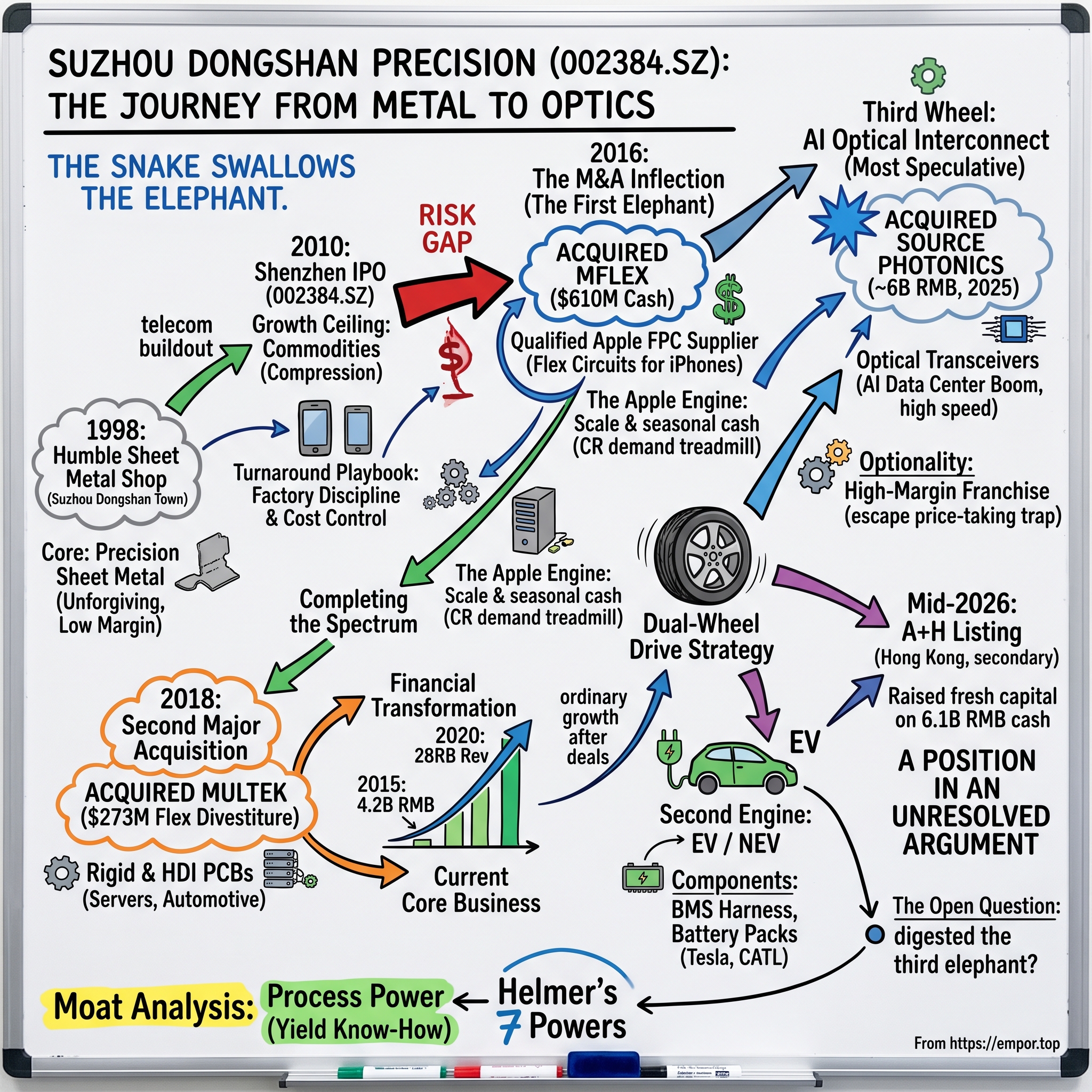
Suzhou Dongshan Precision (002384.SZ): The Snake That Swallowed the Elephant
I. Introduction & The "Snake Swallows Elephant" Hook
The teaser: a low ceiling and a bold answer
Picture the scene inside a manufacturing park in Wuzhong District, Suzhou, in the mid-2010s. The core business is precision sheet metal — flat, gray, unglamorous. Workers stamp and bend steel into enclosures and structural frames for telecom base stations and industrial equipment. Margins are thin. Growth is single-digit. And the founders, the Yuan family, have looked at the numbers and reached an uncomfortable conclusion: precision metal, no matter how precise, will never carry a company to a multi-billion-dollar valuation. The ceiling is visible, and it is low.
So they did something that, in hindsight, defines the entire company: they refused to accept the ceiling. Instead of grinding out incremental improvements in a commodity business, DSBJ went hunting for a different business entirely — one with higher technology, higher margins, and a customer roster that read like the front page of a consumer-electronics annual report. The hunt led to Multi-Fineline Electronix, Inc. MFLEX, a California-headquartered pioneer in flexible printed circuits and a trusted Apple supplier, which DSBJ agreed to acquire in 2016 for roughly $610 million.1 Two years later it completed the set by buying 伟创力 Flex's rigid PCB division, Multek, out of Zhuhai.4
The central paradox
The central paradox of DSBJ is stitched into those two deals. On one hand, the company vaulted itself into the world's most demanding electronics supply chain, gaining scale and cash flow that a metal stamper could only dream of. On the other, it inherited that supply chain's curse: brutal capital intensity, relentless annual price-down demands, and a dependence on a handful of enormous customers who can reroute a design — and a factory's worth of revenue — with a single sourcing decision. Guaranteed volume, precarious pricing power. That tension never resolves in this story; it only changes shape.
It is tempting, from the outside, to file DSBJ under "Chinese contract manufacturer" and move on — another anonymous supplier riding the coattails of Western brands. That framing misses what is genuinely unusual here. Most contract manufacturers grow organically, adding capacity as their customers grow, forever one step behind the technology curve. DSBJ did the opposite. It repeatedly bought its way ahead of its own capabilities — acquiring companies that knew things it did not, then teaching those companies to run at a cost structure they never could have achieved on their own. That is a specific and rare corporate metabolism, and it is the thread that connects a 1998 sheet-metal shop to a 2026 bidder for an optical-transceiver maker. The company is less a manufacturer than a manufacturing acquirer — a serial integrator that happens to make circuits.
The three threads
This article traces three intertwined threads. The first is the manufacturing-upgrade playbook — the deliberate climb from low-margin metal stamping to FPCs (flexible printed circuits), HDI (high-density interconnect) boards, and now optical modules. It is a specific and repeatable method: identify a higher-value adjacent product, acquire or build the capability to make it, then apply relentless cost discipline until the new product's economics bend in DSBJ's favor.
The second thread is the Apple paradox — how the same customer concentration that makes DSBJ formidable also makes it fragile. Being Apple's supplier confers scale, credibility with every other customer on earth, and a firehose of seasonal cash; it also means living under an annual price-down regime and the ever-present risk that a single design socket moves to a rival. Scale and vulnerability arrive in the same contract.
The third thread is the "dual-wheel drive" strategy — management's attempt to bolt a second and third engine onto the business: NEVs (new energy vehicles) and, most recently and most speculatively, AI optical infrastructure via the acquisition of 索尔思光电 Source Photonics.[^7] The recurring pattern across all three threads is the same: DSBJ keeps trying to buy its way out of the low-pricing-power trap, and the trap keeps reappearing in a new end market. Whether the optical bet finally breaks that cycle is the open question the rest of this piece exists to test.
By mid-2026 the stakes are unusually high. DSBJ's shares had run roughly eleven-fold over three years on the strength of the AI-optical narrative,8 and in May 2026 the company filed for a secondary listing in Hong Kong, seeking to raise fresh capital on top of the roughly 6.1 billion RMB of cash already on its balance sheet.7 A skeptic would note that the same three years that delivered the share-price fireworks also contained a near-halving of net profit in 2024.5 The gap between the market's enthusiasm and the income statement's volatility is exactly where an independent analysis has to live.
Consider the two numbers side by side, because they frame everything that follows. The market, as of mid-2026, valued DSBJ's equity in the neighborhood of 360 billion RMB. The company's net profit for 2024 was roughly 1.1 billion RMB, recovering to something under 1.4 billion RMB in 2025.5 Whatever multiple you attach to that, the market is not paying for the earnings DSBJ has produced; it is paying for the earnings it believes the optical business will produce. That is the definition of a story stock — not a criticism, but a fact that should discipline how we read every management claim in this piece. When a company's valuation is dominated by a bet that has not yet shown up in the profit line, the analyst's job is to interrogate the bet, not to admire the chart. Before we can weigh either, we have to go back to the metal.
 Subscribe on LinkedIn
II. Founding Roots & The Sheet Metal Era (1998–2010)
The founding context
Every industrial fortune has a humble object at its origin, and DSBJ's is a sheet of steel. The company was founded in 1998 in Dongshan Town, in the Wuzhong District of Suzhou, by 袁富根 Yuan Fugen — a first-generation entrepreneur of the type that populated the Yangtze River Delta as China's private economy came roaring to life in the late 1990s.[^12] The name itself is a fossil record of the origin: Dongshan, the town; Precision, the ambition; Manufacturing, the trade. There was no software, no platform, no brand. There was a workshop, some presses, and orders for precision sheet-metal parts, metal stampings, and structural enclosures destined for industrial machinery and local equipment makers.
It is worth dwelling on how unforgiving that starting point is, because it shapes everything DSBJ later became. Precision sheet metal is a business of tenths of a millimeter and pennies of margin. You win orders by being cheaper, faster, and more reliable than the shop down the road, and you keep them by never missing a delivery. There is no moat in a bending brake. What the trade does teach — and what would later prove to be DSBJ's most durable asset — is a religion of cost control, yield, and factory-floor discipline. The company learned to squeeze money out of physical processes long before it ever touched a circuit board.
Geography helped. Suzhou sits in the heart of the Yangtze River Delta, arguably the densest advanced-manufacturing cluster on the planet, a short drive from Shanghai and surrounded by the supply chains, tooling shops, and skilled labor that a precision manufacturer needs. A sheet-metal firm founded in Anhui or inland Sichuan in 1998 might have stayed a sheet-metal firm forever, starved of the ecosystem required to move up the value chain. DSBJ was born in exactly the place where an ambitious manufacturer could plausibly reach for electronics — close enough to the customers, the talent, and eventually the acquired assets it would need. Location is not destiny, but it lowered the activation energy for everything that followed.
There is also a cultural point embedded in the founding that matters for the investment case. Yuan Fugen built DSBJ in the classic mold of the Delta private entrepreneur: frugal, hands-on, obsessed with the factory floor, deeply reluctant to spend a yuan that did not earn its keep. That temperament is precisely what makes the later behavior so striking. The same family DNA that counted every screw would, within two decades, sign off on cross-border leveraged buyouts denominated in hundreds of millions of dollars. The bridge between those two personalities — the parsimonious stamper and the swashbuckling acquirer — is the second generation, and holding both in view is essential to judging how much of DSBJ's risk appetite is discipline and how much is ambition.
The telecom and LED expansion
The first real tailwind arrived with China's telecommunications buildout. As the country wired itself for 2G and then 3G, demand exploded for the unglamorous hardware that holds a network up: structural components, housings, and the metal antennas bolted to base stations. DSBJ became a component and base-station antenna supplier to global telecom equipment makers,12 and for the first time the company was riding a genuine growth wave rather than merely competing for scraps.
The telecom era taught DSBJ two lessons it would never unlearn. The first was that riding an infrastructure boom is exhilarating and finite — base-station demand surges when a country builds out a network generation and then falls off a cliff once coverage saturates. A supplier tied to a single buildout cycle is a supplier waiting to be stranded. The second lesson was subtler and more useful: proximity to a technology gives you a call option on the next technology. Making antennas taught DSBJ about radio-frequency structures; making housings taught it about thermal management; both were adjacencies to the electronics that would eventually matter far more than the metal.
It also began diversifying laterally — into LED packaging and touch-display components — planting the seeds of what would later be reported as its photoelectric-display segment. The LED foray in particular is instructive in hindsight: it was an early attempt to climb into higher-technology products, it enjoyed a boom, and it eventually commoditized and faded, becoming a segment management would later let shrink to near-irrelevance. That full arc — enter a hot new product, ride it up, watch it commoditize, redeploy capital elsewhere — is a rehearsal for the far larger version of the same story DSBJ would run with PCBs, EVs, and optics. None of these early moves were yet high-technology franchises, but they moved DSBJ one rung up the ladder, from pure metal-bashing toward the optics-and-electronics adjacencies where the real money lived.
The 2010 IPO and the growth ceiling
In April 2010, DSBJ listed on the SME Board of the 深圳证券交易所 Shenzhen Stock Exchange under the ticker 002384.11 The IPO was, in the arc of this story, less a triumph than a fundraising event — a way to convert years of grinding factory work into public equity and, crucially, into acquisition currency. Because within a few years of listing, the growth math turned hostile. By 2014–2015, traditional metal stamping and base-station components were running into the wall every commodity supplier eventually hits: margin compression from competition and single-digit revenue growth. Around 2015 the group's revenue sat at roughly 4.2 billion RMB, and management could see that no amount of operational excellence in metal would lift that number by an order of magnitude.[^12]
Here is the analytical takeaway that sets up the entire rest of the company's history: DSBJ's leadership correctly diagnosed that they were running a good operator inside a bad industry structure. The skills were valuable; the market was not. That diagnosis — clear-eyed, unsentimental about legacy businesses — is the single most important act of capital allocation the Yuan family ever performed, because it licensed everything that came next. They decided the company would not die a respectable death as a metal stamper. It would use the balance sheet, the listing, and its operational muscle to buy its way into a better business. The only thing missing was a target. In early 2016, they found one on the other side of the Pacific.
III. The M&A Inflection Points: MFLEX & Multek Megadeals (2015–2020)
Inflection Point 1: Buying the Elephant (MFLEX, 2016)
On February 4, 2016, the press release crossed the wires and the American PCB industry did a double-take. Multi-Fineline Electronix — MFLEX, a top-tier flexible-circuit supplier headquartered in Anaheim, California, with deep roots in the Apple supply chain — had agreed to be acquired by a Chinese sheet-metal company most of its own engineers had never heard of. The price was $23.95 per share in cash, valuing MFLEX's equity at approximately $610 million and representing a premium of roughly 41% over the prior day's close.1 The deal completed on July 27, 2016.2
To understand why this was audacious rather than merely large, you have to understand what a flexible printed circuit actually is, and why Apple cared. A rigid PCB is the familiar green board inside a desktop computer. A flexible printed circuit — an FPC — is that same interconnect technology printed onto a thin, bendable film of polyimide, so it can fold, curl, and snake through the impossibly tight interior of a smartphone. As phones got thinner and denser, FPCs became the connective tissue that let engineers pack a camera, a display, a battery, and a logic board into a slab of aluminum a few millimeters thick. MFLEX was one of a small handful of companies on earth qualified to make these to Apple's tolerances. That qualification — years of audits, yield data, and trust — was the real asset DSBJ was buying. You cannot stamp your way to it; you have to be granted it.
The financial structure is what earned the "snake swallows the elephant" label. DSBJ was a company whose entire revenue base was a few billion RMB acquiring a target for roughly 4 billion RMB, funded through a combination of cash, bank debt, and equity placement.13 By the multiples of the day, the entry price was defensible — well under one times sales and a high-single-digit multiple of EBITDA — precisely because MFLEX was a struggling Tier-1 supplier, weighed down by U.S. corporate overhead and a high-cost manufacturing footprint. DSBJ was not paying for a healthy business. It was paying for a sick one with a priceless customer relationship, and betting it could fix the sickness.
That bet is where DSBJ's metal-era DNA finally paid off. The turnaround playbook was pure factory-floor discipline applied to a company that had forgotten it: slash corporate overhead, migrate assembly lines into lower-cost facilities in Suzhou, grind up SMT (surface-mount technology) yield rates, and localize raw-material sourcing so margin stopped leaking to intermediaries. The company that had spent fifteen years extracting pennies from bent steel now extracted them from circuit yields instead. Within roughly two years, MFLEX flipped from a low-single-digit-margin drag into DSBJ's core profit engine. The analytical point is not that DSBJ got lucky — it is that the acquisition rationale and the acquirer's actual skill set were unusually well matched. DSBJ did not need to be a better technologist than MFLEX's California engineers; it needed to be a better operator, and that it demonstrably was.
Pause on the mechanics of the financing, because this is where "snake swallows elephant" stops being a metaphor and becomes a balance-sheet reality. A company acquiring a target of comparable size to its own revenue base cannot simply write a check. DSBJ funded the deal through a stack of cash, bank borrowings, and equity issuance,13 which meant that on the day the deal closed, the company's leverage and share count both jumped and its ability to survive depended entirely on MFLEX's cash flows arriving as projected. There was no margin for a botched integration. Had the turnaround stalled — had yields not improved, had a key Apple program slipped to a rival during the transition — DSBJ would have been a small metal stamper crushed under the debt of a large American acquisition. The reason the deal is celebrated is that it worked; the reason it should still make an investor's palms sweat is that the downside case was existential. This is the recurring signature of DSBJ's strategy: enormous asymmetric bets that have, so far, all landed. "So far" is doing a great deal of work in that sentence, and any honest reading of the company has to keep it in view.
There is a second, quieter lesson in the MFLEX integration that matters for the AI-optical bet to come. DSBJ's edge was cost and yield in high-volume, mature manufacturing — taking a known product and making it cheaper and better. That is a fundamentally different skill from inventing a next-generation product at the technological frontier. MFLEX was already a qualified Apple supplier with proven products; DSBJ's job was to run those products more efficiently, not to leapfrog the state of the art. Keep that distinction filed away. It will be the sharpest question hanging over the Source Photonics acquisition, where the challenge is not to run a mature product cheaply but to win at the bleeding edge of optical technology against incumbents who have been there for years.
Inflection Point 2: Completing the Board (Multek, 2018)
If MFLEX gave DSBJ the flexible half of the printed-circuit universe, the company was still missing the rigid half — the high-layer-count, HDI boards that go into servers, telecom gear, and automotive systems. In March 2018, the opportunity arrived from an unlikely seller: 伟创力 Flex, the U.S.-listed contract manufacturing giant, announced it would divest the China operations of its Multek rigid-PCB unit to MFLEX (by then a DSBJ subsidiary).3 The transaction closed in July 2018 for approximately $273 million.4
Multek was a different kind of asset from MFLEX. Where MFLEX was a struggling specialist, Multek was a sprawling, capital-heavy campus — 1.6 million square feet in Zhuhai, capable of everything from simple low-layer boards to complex 46-layer PCBs, HDI, and rigid-flex.4 Flex was a motivated seller shedding a capital-intensive, low-return unit; DSBJ was a motivated buyer acquiring exactly the rigid-board and HDI capability it lacked, at what amounted to a distressed valuation for the physical plant alone. The strategic logic was completing a spectrum: with MFLEX (flex) and Multek (rigid and rigid-flex) under one roof, DSBJ could now cross-sell the full range of interconnect technologies into telecom, automotive, and — the prize that would matter most a few years later — servers.
It is worth appreciating the pattern-recognition on display in the Multek purchase, because it reveals a repeatable thesis rather than a one-off opportunity. Both MFLEX and Multek were assets that a Western owner had concluded were not worth the capital and management attention they demanded — a struggling public company in one case, a non-core divestiture in the other. DSBJ's insight was that "not worth it to Flex" and "not worth it to DSBJ" are entirely different calculations. What is a low-return, high-hassle unit inside a sprawling American multinational can be a crown-jewel capability inside a focused Chinese operator with a lower cost of capital, a lower cost structure, and a willingness to run the asset hard. DSBJ was, in effect, arbitraging the different value that the same factory holds in different hands. That is a genuine and durable source of deal flow — as long as Western owners keep divesting advanced manufacturing and the geopolitical door stays open enough to let a Chinese buyer through it. Both of those conditions, as we will see, are now less certain than they were in 2018.
The financial transformation these two deals produced is the hinge of the whole DSBJ story. Group revenue climbed from roughly 4.2 billion RMB in 2015 to over 28 billion RMB by 2020 — a more-than-sixfold expansion in five years, overwhelmingly acquired rather than organic.15 In the process DSBJ went from an anonymous metal stamper to one of the world's largest FPC manufacturers and a top-tier global PCB conglomerate.
Notice, though, the shape of the growth in the years after the deals closed. From roughly 28 billion RMB in 2020, revenue crept to about 31.8 billion in 2021, essentially flat at 31.6 billion in 2022, 33.7 billion in 2023, 36.8 billion in 2024, and roughly 40 billion in 2025.155 That is respectable growth, but it is ordinary growth — high single digits — a world away from the sixfold acquisition-driven leap of the prior five years. The message is unambiguous: DSBJ's step-changes come from deals, and between deals it grows like the cyclical, competitive components business it is. This is why the company cannot simply stop acquiring and coast. Its entire history says that organic compounding alone will not satisfy the growth expectations baked into its valuation. The engine of the equity story is M&A, and an engine that must keep firing is an engine that eventually misfires.
But it is worth being precise about what was and was not proven. What DSBJ proved was that it could buy scale and operate acquired assets better than their previous owners. What it had not yet proven — and what the rest of this story stress-tests — was whether a business built by leverage and integration could generate durable, growing profit through a full cycle, or whether it had simply assembled a larger version of the low-pricing-power trap it started in. The 2024 profit collapse, which we will come to, is the single most important piece of evidence on that question, and it does not flatter the bull case. The answer runs through the family that made every one of these bets.
IV. Management, Control, & Capital Allocation Track Record
Chinese manufacturing has produced a recognizable archetype: the first-generation founder who bends metal and hoards cash, and the second-generation heir who studied abroad, thinks in dollars and layers of debt, and is comfortable buying an American company before lunch. DSBJ contains both, and the handoff between them is central to understanding the company's risk appetite.
Shareholding and family control
At the top sits the Yuan family. Founder 袁富根 Yuan Fugen remains the patriarch, but operational control has passed to the next generation: his sons 袁永刚 Yuan Yonggang, who serves as chairman, and 袁永峰 Yuan Yongfeng, who has held senior executive and director roles.[^12] The family's combined shareholding has historically sat in the range of roughly a quarter to a third of the company — enough for tight insider control and, importantly, enough that the family's personal wealth rises and falls with the stock. This is the classic double edge of founder control: alignment on the upside, but also the concentration of decision-making power that lets a company make company-betting acquisitions without the friction a more diffuse shareholder base might impose.
The second-generation bet
Yuan Yonggang, in particular, embodies the second-generation profile. The MFLEX and Multek deals were not the moves of a cautious custodian; they were the moves of a leader comfortable with cross-border M&A, high leverage, and aggressive capex. The generous reading — and the one supported by the results — is that this is a management team that has genuinely earned the right to be trusted with a balance sheet. They executed two debt-funded, cross-border acquisitions in an industry littered with failed integrations, paid down debt through operating cash flow and disciplined equity raises, and turned two under-managed assets into the profit center of the group. That is a real capital-allocation track record, not a slide-deck claim.
It is worth pausing on how rare that is. The graveyard of cross-border manufacturing M&A is crowded, and it is crowded specifically with Chinese acquirers who bought Western assets in the 2010s and then discovered that owning a factory in California or a brand in Germany is not the same as being able to run it. Culture clashes, retained-management flight, and the sheer difficulty of transplanting a cost structure across an ocean have sunk many deals that looked strategically brilliant on paper. DSBJ's integrations worked because the value-creation thesis did not depend on preserving the acquired culture — it depended on replacing the acquired cost structure with DSBJ's own. That is a harsher but more reliable integration model: you are not betting that two cultures will blend, you are betting that yours is simply better at the one thing that matters, cost and yield. For a low-margin components business, that bet was correct.
But an independent view has to hold the skeptical reading alongside it. The same profile that produced MFLEX and Multek also produces a permanent temptation toward the next big deal — and by 2024–2025 that temptation had a name: Source Photonics. A management culture built on "buy it, fix it, bet again" is superb at climbing technology curves and dangerous at knowing when to stop. The behavioral tell to watch is whether the discipline that characterized the debt paydown after 2018 survives the excitement of the AI-optical story. The pattern of relentless cost control, high asset turnover, and willingness to shrink declining segments — DSBJ has been unsentimental about downsizing standalone LED packaging, for instance, as that business shrank6 — suggests a genuinely disciplined operator. The pattern of layering a new multi-billion-RMB acquisition onto a balance sheet already described by outside analysts as debt-heavy13 suggests the appetite for the elephant has never really gone away.
A governance-minded investor would add one more item to the ledger: related-party and disclosure risk. Founder-controlled Chinese manufacturers, with concentrated family ownership and a web of subsidiaries and acquisition vehicles, require closer scrutiny of related-party transactions, guarantees, and off-balance-sheet arrangements than a widely held Western company would. Nothing in the public record flagged here suggests impropriety, but the structure — tight family control, serial acquisitions, and a debt-funded balance sheet — is exactly the structure where an activist or short-seller would go digging first. The forthcoming Hong Kong prospectus, which subjects the company to HKEX disclosure standards and international underwriters' due diligence, will be a useful independent check on how clean that structure really is.8
The fairest verdict at this point in the story is a split one. On execution and operations, the Yuan family has a demonstrated, above-average record. On the size and frequency of the bets, they have never been tested by a deal that went badly wrong — and a track record without a real failure is a track record that hasn't been fully priced. Which is why the next thing to understand is what, exactly, they are betting the company on: the core business itself.
V. Core Business Deep Dive & Segment Economics
Inside the yield business
Walk onto a modern FPC line and the first thing that strikes you is how little bending of metal is involved anymore. The rooms are clean, the air is filtered, and the value is measured not in tonnage but in yield — the percentage of circuits that come off the line without a fatal defect. DSBJ today is, at its heart, a yield business. Understanding how its revenue and profit stack up is a matter of understanding which of its factories are winning that yield game.
The four segments, and where the money actually is
By the company's own 2024 reporting, the revenue mix breaks down roughly as follows. Electronic circuits — the PCB and FPC franchise built on MFLEX and Multek — accounted for about 67% of revenue and grew around 7% year-over-year.6 This is the engine: high-density, fine-pitch flexible circuits for smartphones, tablets, and wearables, plus the rigid and HDI boards for servers and telecom. It also throws off the overwhelming majority of group gross profit, because it is the only segment with genuine technical differentiation.
The second-largest line is touch panels and LCMs (liquid-crystal display modules), at roughly 17% of revenue and — notably — the fastest grower in 2024 at about 31%.6 This is the photoelectric-display business, expanded through DSBJ's move into automotive display modules, including its investment in the display-module operations associated with 晶端显示 JDM, a business with lineage to Japan Display's automotive unit. Third comes precision components — the modernized descendant of the old sheet-metal business, now making metal structural parts, battery-cell tabs, busbars, and liquid-cooling plates — at roughly 12% of revenue and steady high-single-digit growth.6 Trailing everything is the legacy LED display business, down to about 2% of revenue and shrinking fast — a segment management is visibly allowing to wither.6
The analytical read on this mix is straightforward: DSBJ is one franchise (electronic circuits) plus three supporting acts. The health of the whole company is, to a first approximation, the health of its PCB/FPC business — which means the health of that business's largest customer.
The segment structure also quietly reveals management's capital-allocation instincts in real time. Watch which segments they feed and which they starve. LED display, once a growth story, is being allowed to atrophy toward 2% of revenue — a clean example of the "willingness to pivot capital away from declining legacy segments" the company likes to cite about itself, and to its credit, actually practices.6 Meanwhile touch panels and LCMs, boosted by the automotive-display push, were the fastest-growing line in 2024. This is not a company that clings sentimentally to yesterday's products; it reallocates. Whether that reallocation creates value or simply chases the next hot end market — the "diworsification" risk that haunts every serial acquirer — is a judgment that depends on returns, not activity, and returns are exactly what the 2024 numbers put under pressure.
The Apple engine, and its price
苹果 Apple is reported to account for a very large share of group revenue — the kind of concentration that shows up in DSBJ's own risk disclosures as a top-five-customer figure exceeding 60% of revenue.7 DSBJ's subsidiaries have appeared on Apple's published supplier list, formalizing what the revenue concentration already implies: this is one of the anchor tenants of the iPhone's flexible-circuit supply base.14 The economics of being an Apple FPC supplier are a study in extremes. During the peak build cycle ahead of a new iPhone launch, roughly the second half of the calendar year, the lines run hot, complex multi-layer FPCs command healthy gross margins, and cash pours in. Then the cycle turns, volumes collapse into the spring, and the same lines sit underutilized. On top of that seasonal whipsaw sits the defining feature of Apple's supply chain: the annual CR — cost reduction — demand, in which suppliers are expected to deliver the same or better parts for less money every single year. Apple guarantees volume; it does not guarantee margin, and it uses its position to transfer the benefit of every efficiency gain back to Cupertino.
This is where an honest assessment has to resist the promotional framing. Being in Apple's supply chain is often described as a moat. It is more accurately a toll road that Apple owns. DSBJ collects real cash for the privilege of driving on it, but Apple sets the toll, and can add a second lane for a competitor whenever it likes. Those competitors are formidable: 臻鼎科技 / 鹏鼎控股 Avary Holding (Zhen Ding Tech), the world's largest FPC maker; Japan's 旗胜 Nippon Mektron; Korea's Interflex; and the vertically integrating juggernaut 立讯精密 Luxshare Precision. In flexible circuits specifically, this is a knife-fight among a small number of extremely capable players. Industry data from the Chinese circuit-board association underscores how much of the global PCB and FPC capacity has migrated to mainland China and the surrounding region, which is both DSBJ's opportunity — it sits at the center of that gravity — and its problem, because the same migration has concentrated a dozen hungry, well-capitalized rivals within a few hundred kilometers of one another.16
So how does DSBJ actually win share in that fight? The credible answer is operational, not magical: superior yield management on ultra-fine-line circuits where line widths shrink below thirty microns (a human hair is roughly seventy), fast SMT capacity to take on assembly work, and a cost structure — labor and overhead in eastern China — that lets it accept Apple's price-downs and still make money where higher-cost rivals cannot. That is a real edge, but notice its nature: it is a cost-and-execution edge, not a pricing-power edge. DSBJ wins by being the low-cost, high-yield option, which is exactly why every good year has to be re-won the following year.
The seasonality deserves one more beat, because it is easy to underappreciate how much it whips the financials around. An Apple-heavy FPC supplier books a wildly disproportionate share of its profit in the second half of the calendar year, as suppliers ramp for the autumn iPhone launch and the holiday build. The first half, by contrast, can be brutal — lines idle, fixed costs unabsorbed, margins thin or negative on an underutilized base. This is why looking at any single quarter of DSBJ in isolation is close to meaningless, and why the company's full-year margins can swing sharply on relatively small changes in the peak-season order book or the timing of an Apple ramp. A supplier with pricing power could smooth this. A cost-and-yield supplier simply has to endure it, sizing its capacity for the peak and eating the cost of that capacity in the trough.
It is a treadmill, and the company has simply learned to run faster than most. But treadmills have a cruel property: running faster does not get you anywhere new, it merely keeps you from falling off. Every efficiency gain DSBJ banks is, over time, competed away or handed back to Apple through the annual cost-down. The obvious strategic response to a treadmill is to find growth that isn't attached to it — a business where DSBJ, and not its customer, holds the whip on price. That search is precisely what the "second act" was supposed to be.
VI. The Second Act: NEVs & The AI / Optical Interconnect Pivot
Dual-wheel drive: the EV bet
By 2021, DSBJ's management had internalized a lesson that customer concentration teaches every supplier eventually: a business that lives and dies by one customer's product cycle needs a second life. The chosen second life was the electric vehicle. As China's NEV transition accelerated, DSBJ pointed its precision-manufacturing and circuit capabilities at the car, anchoring supply relationships with 特斯拉 Tesla, 比亚迪 BYD, and battery giant 宁德时代 CATL.12
The product logic here is genuinely elegant, because it repurposes skills DSBJ already had rather than requiring it to become something new. A modern EV battery pack is, in engineering terms, a giant electrical-interconnect-and-thermal-management problem — which is exactly the problem DSBJ solves for phones, only bigger. So the company began selling FPC harnesses for battery management systems (the nervous system that monitors each cell), high-voltage aluminum busbars (the thick conductors that move serious current), structural battery-pack frames (metal — the old core competency), and liquid-cooling cold plates (keeping the pack from overheating). Every one of those products is a lateral extension of a capability the company already possessed. The result was material: EV-related component revenue grew from under 1 billion RMB in 2020 to several billion by the mid-2020s, becoming a credible second growth engine rather than a science project.
Take the BMS harness as a concrete illustration of why this was a smart adjacency rather than a random diversification. In a smartphone, an FPC threads through a cramped enclosure carrying signals between components; in an EV battery pack, an FPC harness (sometimes called a "cell contact system") snakes across dozens or hundreds of individual cells, carrying the voltage and temperature signals that let the battery-management computer keep every cell balanced and safe. The manufacturing challenge — printing reliable flexible circuits at scale, with high yield, that survive years of vibration and thermal cycling — is a close cousin of the smartphone problem DSBJ had already mastered through MFLEX. The company was not learning a new trade; it was pointing an existing trade at a new, enormous, and structurally growing end market. That is close to the ideal shape for a diversification: adjacent enough to be credible, large enough to matter.
But the "dual-wheel drive" story arrived with its own headwind, and 2024 exposed it. The Chinese EV market descended into a vicious price war, and price wars roll downhill onto suppliers. Combined with foreign-exchange headwinds and the ramp-up costs of new production lines, the pressure helped drive DSBJ's net profit down roughly 45% in 2024, to about 1.09 billion RMB, even as revenue grew.5 That single data point is the most important reality check in the entire company: DSBJ can grow its top line, diversify its customers, and still watch profit nearly halve when two of its end markets — consumer electronics and EVs — squeeze pricing at the same time. Diversification reduced dependence on Apple; it did not, on its own, buy pricing power. For that, management reached for a third wheel.
The optical bet: Source Photonics and the AI story
The third wheel is the one the stock market fell in love with. Beginning in 2024, DSBJ moved to acquire 索尔思光电 Source Photonics, a maker of optical transceivers — the components that convert electrical signals into pulses of light and back, allowing data to move between servers at the speeds an AI data center demands. The deal, structured to acquire the business from financial owners including ACE Equity Partners and Aberdeen for a consideration reported at no more than roughly 6 billion RMB, closed around mid-2025, with Source Photonics consolidated into DSBJ's financials from late 2025.[^7] The company simultaneously signaled an aggressive capacity build, floating investment on the order of $1.2 billion to expand optical-chip and optical-module production.10
The identity of the sellers is itself a useful diligence signal. DSBJ was buying Source Photonics not from a strategic owner reluctantly parting with a crown jewel, but from private-equity holders — financial owners whose entire purpose is to buy, hold, and sell at the right moment. Private-equity vendors are professional sellers; they tend to exit when they judge the price is good and the growth ahead is more uncertain than the multiple implies. That does not make the asset bad — plenty of excellent businesses change hands between financial sponsors — but it does mean DSBJ was the buyer on the other side of a sophisticated seller's timing decision, at the peak of AI-optical enthusiasm. An independent analyst files that under "reasons to scrutinize the price paid," not "reasons to celebrate the strategic fit." The strategic fit can be genuine and the entry price can still be rich; both can be true at once, and the market's eleven-fold reaction suggests it weighed only the former.
Why did this send the shares up eleven-fold over three years?8 Because it plugged DSBJ into the single most powerful narrative in technology. To understand the mechanism, picture what an AI data center actually is: tens of thousands of GPUs that must behave as one enormous computer, which means they must constantly shovel data to one another at speeds that copper wire simply cannot sustain over any meaningful distance. The solution is to convert the electrical signals into light and send them down optical fiber — and the device that performs that conversion, thousands of times over in a single facility, is the optical transceiver. As models scale, the required speed per module climbs from 400G to 800G to 1.6 terabits per second, and each generation is harder to build than the last. Source Photonics makes exactly these devices. That is the door DSBJ was trying to walk through.[^7]
The synergy story then writes itself, at least on a whiteboard. A high-speed optical module is not just the optics; it sits on and around ultra-high-density printed circuit boards of precisely the kind Multek was built to make. So DSBJ could pitch itself as a rare one-stop supplier — server-grade PCBs from Multek, optical packaging from Source Photonics, assembly and cost discipline from the mothership — positioned in the same arena as Chinese optical and high-end PCB champions like 深南电路 Shennan Circuits and 沪电股份 Wus Printed Circuit. On top of the acquisition, management signaled it would spend on the order of $1.2 billion building out optical-chip and module capacity, a statement of intent sized to the ambition.10 To a market desperate for Chinese proxies on the AI infrastructure boom, this was catnip, and the stock re-rated accordingly.
An independent read has to separate the optionality from the certainty. The optionality is real and large: if DSBJ can actually manufacture competitive 800G/1.6T modules at scale, it has bought itself a genuinely high-margin franchise decoupled from Apple's toll road and the EV price war. But several cautions belong on the record.
First, DSBJ is a newcomer to optical modules, entering a field with entrenched, technically deep incumbents — the established transceiver makers and the vertically integrating hyperscaler suppliers who have been iterating on this technology for years. Buying a business is not the same as winning in it, and optics is a domain where a half-generation lag in technology can mean losing an entire product cycle. Second, the acquisition triggered national-security scrutiny, particularly around Source Photonics' Taiwan-based R&D and manufacturing, injecting geopolitical risk directly into the thesis.9 Third — and most simply — the market has already paid for a great deal of success that has not yet shown up in the profit line. The eleven-fold, three-year share move discounts a future in which the optical business becomes a large, high-margin franchise; if that future arrives slower or smaller than hoped, the derating could be as violent as the rerating was exhilarating.
There is also the question of cyclicality, which the AI narrative tends to paper over. Data-center capex is not a permanent escalator; it is a cycle, driven by the capital-spending appetite of a handful of hyperscalers. DSBJ is committing an enormous, largely fixed capital investment — the $1.2 billion optical buildout and the roughly 6-billion-RMB acquisition — into a demand environment that could plateau or contract with little warning if AI-infrastructure spending pauses.10[^7] The company would then be left carrying the fixed cost of frontier optical capacity into a downturn, the same structural bind that whipsaws its FPC business, only with a newer and less-proven product. The AI-optical bet may prove to be the smartest thing DSBJ ever did after MFLEX. It may also be the moment the snake, having successfully swallowed two elephants, reaches for a third that it cannot digest before the AI capex cycle turns. Which of those it becomes depends on the durability of the moat the whole company is built on.
VII. Moat Analysis: Porter's 5 Forces & Hamilton Helmer's 7 Powers
Strip away the narrative energy and ask the cold question a long-term investor has to ask: what, precisely, stops a competitor from doing to DSBJ what DSBJ did to its own legacy metal business? To answer it, run the company through two frameworks — Hamilton Helmer's 7 Powers and Porter's 5 Forces — and be honest about where the moat is real and where it is thin.
Helmer's 7 Powers
Process Power is DSBJ's primary and most defensible advantage. In high-volume FPC manufacturing, the entire game is yield on microscopic, fine-pitch, multi-layer circuits — and yield is not something you buy off a shelf. It is accumulated, tacit, factory-specific know-how built over years of running lines and diagnosing defects. Here the arithmetic is genuinely brutal in DSBJ's favor: at the volumes an Apple program runs, a couple of points of yield advantage translates into tens of millions of RMB of profit variance, because the cost of a scrapped circuit is nearly all sunk by the time it fails. This is the one power where DSBJ can plausibly claim to be structurally advantaged rather than merely competent.
Scale Economies are a secondary, real-but-shared moat. The automated SMT lines and high-end electroplating that modern FPC and HDI production demand require multi-billion-RMB annual capex, which walls out the long tail of small PCB shops entirely. The catch is that this power is shared with a handful of equally large rivals — Avary, Luxshare, and others clear the same bar — so scale protects DSBJ from minnows but not from whales.
Switching Costs cut in DSBJ's favor at the customer level: qualifying a new FPC supplier for a flagship phone or an EV battery pack takes twelve to twenty-four months of design audits, thermal and stress testing, and line certification. Once DSBJ is designed in, it is sticky — for that product generation. But the switching cost is on the component, not the company: at each new design cycle the incumbent's advantage resets, and the customer can and does re-shop. This is why the moat feels wide within a program and narrow across programs.
What DSBJ conspicuously lacks are the powers that generate real pricing power. It has no Branding power (Apple's end customers have never heard of it), no Network Economies, and no Cornered Resource. The absence of these is the whole reason the business runs on a treadmill: its advantages let it win the low-cost, high-yield mandate, but none of them let it raise prices.
This is the frame within which to understand the optical bet's strategic logic. The one power DSBJ has never possessed — anything resembling pricing power — is precisely what a leadership position in cutting-edge optical modules could, in principle, confer. At the frontier of 800G and 1.6T, supply is scarce, qualification is brutal, and customers (the hyperscalers and AI-server builders) are desperate for capacity. A supplier that can actually deliver at the frontier commands margins that an FPC subcontractor can only envy. In Helmer's terms, DSBJ is trying to acquire a Cornered-Resource-and-Process-Power position it could never build in its legacy business. That is the real intellectual case for Source Photonics — not "AI is hot" but "AI optics is one of the few places a company like this could escape its own pricing-power ceiling." Whether it can actually hold that position against entrenched optical incumbents is the entire question, and the honest answer is that it is unproven.
Porter's 5 Forces
The five forces confirm the picture. Bargaining power of buyers is very high — concentration in Apple and Tesla hands the customer the whip on price, and the annual CR ritual is that whip in action. Threat of new entrants is low, protected by the capital intensity and multi-year qualification walls described above. Bargaining power of suppliers is moderate — the key raw materials (copper foil, FCCL polyimide film, epoxy resins) are commodity-priced and exposed to input-cost swings, but they are not single-sourced. Competitive rivalry is high, an intense, price-driven brawl among top-tier Taiwanese, Japanese, Korean, and mainland Chinese PCB players.
War-gaming the rivals
To make the rivalry concrete, war-game DSBJ against its two most instructive competitors. Against 臻鼎科技 / 鹏鼎控股 Avary Holding, the FPC volume leader, DSBJ is the smaller, scrappier challenger — it competes on cost, yield, and responsiveness rather than sheer scale, which means it can win share at the margin but rarely dictates terms. Against 立讯精密 Luxshare Precision, the dynamic is different and more threatening: Luxshare is vertically integrating up and down the Apple supply chain, assembling everything from connectors to whole modules, and its ambition is to own more of the bill of materials, not less. A supplier of a single component category — flexible circuits — is exactly the kind of link a vertical integrator eventually eyes for absorption or displacement. DSBJ's defense against that is its process depth in FPCs specifically, a niche hard enough that even a well-capitalized integrator cannot casually replicate it. But the strategic direction of travel in this supply chain — toward fewer, larger, more integrated suppliers — is not obviously DSBJ's friend, and it is part of why the company is so motivated to plant a flag in optics, where the competitive map is still being drawn.
Net the forces together and you get the defining structural truth of DSBJ as an investment: it sits in a good competitive position inside a punishing industry structure. It is a strong operator that has climbed to the top of a business where the customers hold the pricing power and the rivals are relentless. That is not a criticism of management — it may be the best achievable outcome in this industry — but it is the reason the numbers are as volatile as they are. And volatility is exactly what the earnings calls have been dominated by.
VIII. Earnings Call Insights, Risks Radar, & Skeptical Stress Test
The tone of DSBJ's investor communications through 2024 and 2025 tells you which way the wind was blowing. When a management team spends its prepared remarks on margin recovery, you know margins are where the pain has been. Across recent disclosures and investor interactions, three themes recurred: recovering profitability after the 2024 trough, expanding the dollar content DSBJ captures per vehicle in the EV business (management has framed a target in the low hundreds of dollars per car across FPC, thermal, and structural parts), and building overseas capacity to answer customer pressure on geography.17
The gap between prepared remarks and analyst pushback is, as always, where the real information lives. On the analyst side, the questioning has clustered on two hard issues. The first is the 2024 margin collapse — the roughly 45% profit decline — which management has attributed to a combination of the EV price war, FX headwinds, and start-up costs on new lines.5 That explanation is plausible and largely supported by the segment data, but an independent listener should note what it also reveals: DSBJ's profit is highly sensitive to factors it does not control (customer pricing, exchange rates) and to its own expansion pace (new-line ramp costs). A company that is perpetually building new capacity to chase the next wave will perpetually carry ramp costs. The second recurring challenge is supply-chain decoupling — the "China + 1" pressure from Apple and Western OEMs to build capacity in Thailand, Vietnam, and elsewhere, which forces DSBJ into capital-heavy overseas construction that dilutes its eastern-China cost advantage.
There is a useful test of management credibility hiding in the shift of emphasis across DSBJ's own disclosures over time. In the 2016–2020 window, the story was about integration and the FPC franchise. By 2021–2023 it was about "dual-wheel drive" and the EV ramp. By 2024–2026 the spotlight had swung again, hard, toward optics and the AI data center. Now, a rotating headline is not by itself a red flag — a good operator should redeploy toward the best available opportunity. But it does raise the fair question of whether DSBJ tells investors the story the market wants to hear at any given moment, or whether each pivot is grounded in durable economics. The most reassuring evidence would be consistency between what management promised about a segment and what that segment later delivered. The EV business broadly delivered on revenue but disappointed on margin; the optical business has, so far, delivered a share-price move and an acquisition but not yet a track record of profit. The forthcoming Hong Kong prospectus — a document produced under international underwriting scrutiny rather than a promotional press release — will be the cleanest opportunity yet to check the narrative against audited detail.8
The risk radar
Three risks dominate, and they are not generic macro boilerplate — each has a specific business mechanism.
Customer concentration is the first and largest. With the top five customers exceeding 60% of revenue and Apple the anchor,7 a single lost design socket in an iPhone or iPad cycle removes a factory's worth of revenue in one stroke. This is not a tail risk; it is the central structural exposure, and no amount of diversification has yet neutralized it.
The EV price-war squeeze is the second: aggressive price cuts by Chinese automakers flow straight downhill to structural-component suppliers, which is precisely what turned the EV "second engine" into a margin drag in 2024. The very market DSBJ diversified into imported a new version of the pricing pressure it was trying to escape.
Geopolitical and tariff risk is the third, and it now cuts two ways. On the traditional side, potential U.S. tariffs on Chinese-made components force the expensive Southeast Asia buildout. On the new side, the Source Photonics acquisition dragged DSBJ into the crosshairs of technology-security politics, given the target's Taiwan footprint.9 For a company whose entire strategy is buying advanced capability across borders, a world that is closing those borders is a structural headwind.
This last point deserves emphasis because it represents a genuine regime change in DSBJ's operating environment. The MFLEX and Multek deals were done in the mid-2010s, in a globalized world that welcomed — or at least tolerated — a Chinese company buying American and U.S.-owned assets. The 2016 MFLEX transaction cleared U.S. regulatory review; a comparable deal attempted today would face a far harsher CFIUS climate, and outbound-investment and technology-transfer politics now run in both directions. The Source Photonics review — with alarms raised specifically over its Taiwan R&D and manufacturing — is a preview of the constraint.9 The uncomfortable implication for the bull case is that DSBJ's single proven competency, cross-border acquisition of advanced capability, is precisely the activity that the geopolitical environment is increasingly designed to prevent. The playbook that built the company may be partially foreclosed going forward.
A fourth risk belongs on the radar even if it is quieter: refinancing and cost-of-capital risk. DSBJ carries meaningful debt, funds capital-intensive expansion, and has repeatedly turned to capital markets — bank debt, domestic equity placements, and now a Hong Kong listing — to feed the machine.138 In a low-rate, risk-on environment that is manageable; in a world of higher-for-longer rates or a sudden loss of market appetite for a story stock mid-build, the cost and availability of that capital become a real vulnerability. The company's decision to raise fresh equity in Hong Kong while sitting on roughly 6.1 billion RMB of cash is best read through this lens: management is choosing to over-capitalize ahead of a large capex cycle, which is prudent if the optical buildout is real and dilutive if it disappoints.7
The activist stress test
What would a skeptical long/short investor or an activist attack? The sharpest line of attack is capital allocation discipline versus the balance sheet. DSBJ is a serial acquirer that outside analysts have flagged as debt-heavy,13 and it followed a profit trough (2024) not with retrenchment but with its largest and most speculative acquisition yet (Source Photonics) — funded, in part, by then filing to raise fresh equity in Hong Kong in 2026.8 An activist would ask a pointed question: is this a disciplined operator recycling cash into high-return franchises, or a company that must keep acquiring and raising capital to keep the growth story — and the eleven-fold stock — alive? The company holds roughly 6.1 billion RMB of cash and is simultaneously raising more;7 a skeptic would want to know why. The honest answer is that both readings are currently consistent with the evidence, and the Hong Kong listing will be the test: what the proceeds fund, and on what terms, will reveal which DSBJ the market is really holding.
A second line of activist attack targets the quality of earnings, not just their level. In a capital-intensive business that is perpetually building new lines, reported profit and actual free cash flow can diverge sharply, because heavy depreciation, working-capital swings tied to the Apple seasonal build, and continuous capex all sit between the two. A rigorous long/short investor would look past net income to cash conversion: how much of DSBJ's accounting profit actually turns into cash after the capex bill is paid, across a full cycle rather than a single strong year. A company that grows revenue and reports profit but consistently consumes cash to fund the next capacity wave is running a treadmill in the financial statements as well as the factory. This is not an allegation — it is the specific diligence question that DSBJ's business model invites, and the one the Hong Kong prospectus's cash-flow disclosures will help answer. For a serial acquirer funded partly by debt and equity issuance, cash conversion is the number that separates a compounding machine from a capital-hungry one.
IX. Bull vs. Bear Case & Playbook Lessons
The bear case
The bearish reading of DSBJ is that, for all its climbing, it never actually left the trap it started in. It remains a high-capex, low-pricing-power subcontractor wedged between Apple's cost-down demands on one side and the EV price war on the other — a company that must spend billions in capex just to stand still, and whose best year can be undone by its customers' worst mood. The 2024 profit collapse is Exhibit A: proof that scale and diversification did not buy resilience. Layer on the pressure to relocate capacity to India and Vietnam — which dilutes the eastern-China cost edge that is DSBJ's core weapon — and a debt load carried into an ever-larger acquisition (Source Photonics), and the bear sees a company one AI-capex slowdown away from an earnings-dilutive surprise. In this reading, the eleven-fold share move is a story stock that has front-run financial results which may never fully arrive.
The bull case
The bullish reading gives management the credit its history arguably earns. DSBJ has a proven, repeatable skill that most companies only claim to have: it buys under-managed assets in a demanding industry and operationally transforms them into cash generators. MFLEX and Multek are not slideware; they are completed, integrated, profit-generating proof points. On that foundation, the "dual-wheel drive" is genuinely working at the revenue level — NEV content has become a real second engine, reducing the pure-Apple dependence that defined the company a decade ago. And the third wheel, AI optical interconnects married to Multek's server-PCB capability, offers the one thing DSBJ has never had: a shot at a structurally high-margin franchise with pricing power, riding the biggest capex wave in modern computing. If even part of the Source Photonics optionality converts, the profit base re-rates.
A patient bull would add a point about time horizon that the 2024 wobble tends to obscure. DSBJ's history is a series of investments that looked expensive and risky in the year they were made and obvious in hindsight three years later. The MFLEX deal looked reckless in 2016 and looked brilliant by 2019. The pattern of the company is to absorb near-term margin pain — integration costs, ramp costs, price wars — in exchange for a structurally larger and more advanced business on the other side. If that pattern holds for optics, the 2024 profit trough and the 2025–2026 ramp costs are the price of admission to a materially different company by the end of the decade. The bull is not arguing that the numbers look good now; the bull is arguing that DSBJ has repeatedly been right to trade present earnings for future capability, and has earned the benefit of the doubt on doing it again.
The intellectually honest position sits in the tension between these, and the frameworks above tell you why: DSBJ's process power is real, its execution record is real, but its industry structure is punishing and its newest bet is unproven. The bull case is a bet on management's demonstrated ability to keep climbing curves. The bear case is a bet that the curves themselves are getting steeper and the balance sheet thinner. Both are respectable. Neither is settled.
Myth versus reality
Three consensus narratives about DSBJ deserve a fact-check, because each contains a half-truth that can mislead.
Myth one: "DSBJ is an AI optical play." Reality: as of the periods discussed here, DSBJ is still overwhelmingly a PCB/FPC company whose largest single dependency is Apple, with optical only newly consolidated from late 2025.[^7] The AI-optical business is an option, potentially a valuable one, but the market has priced it as a reality well ahead of the financials. An investor buying DSBJ today is buying a components manufacturer with an optical call option attached, not an optical company.
Myth two: "The MFLEX turnaround proves DSBJ can win at anything it buys." Reality: MFLEX was a mature-product turnaround where the value lever was cost and yield — DSBJ's home turf. Source Photonics is a frontier-technology bet where the value lever is staying ahead of the state of the art. These require different muscles, and DSBJ's proven muscle is the former, not the latter. Past success in one does not underwrite the other.
Myth three: "Diversification has de-risked the Apple concentration." Reality: revenue diversification is real, but 2024 showed that adding a second cyclical, low-pricing-power end market (EVs) did not de-risk profit — it added a new source of margin pressure that happened to hit at the same time as the first.5 Diversification of revenue is not the same as diversification of risk when every new market shares the same structural weakness: powerful buyers and price competition.
The KPIs that actually matter
For a company this complex, most metrics are noise. Three signals cut through it, and a long-term holder should track exactly these:
-
Non-Apple revenue share. The single cleanest gauge of whether "dual-wheel drive" is genuinely reducing structural fragility. Progress toward pushing the top customer's share down and lifting non-Apple revenue is the difference between a diversified platform and a dressed-up Apple supplier. The number to watch is directional: is the concentration falling year over year, or is Apple's share sticky because the growth in EVs and optics is merely keeping pace with the growth in Apple orders? A diversification that never actually moves the concentration ratio is diversification in press releases only. The honest read as of the latest disclosures is that the top five customers still exceeded 60% of revenue,7 so this KPI has a long way to travel before the fragility is meaningfully lower.
-
Electronic-circuits gross margin. Because this segment drives the vast majority of group profit, its margin — especially through the seasonal peak — is the truest read on whether DSBJ's yield and cost edge is holding against Apple's price-downs, or eroding. This is the number that most directly captures the treadmill: if the margin holds or improves through the annual cost-down cycle, DSBJ's process power is winning; if it grinds lower, the company is running to stand still. It is worth watching the peak-quarter margin specifically, because that is when utilization is highest and the underlying economics are least flattered or hurt by seasonal idle capacity.
-
AI/optical revenue and margin contribution. The Source Photonics thesis is either converting into real, high-margin revenue or it isn't. Watching the optical business's actual contribution to the profit line — not the order announcements — is how an investor separates the AI narrative from AI economics. The tell is the margin the optical segment earns, not just its revenue: if DSBJ is genuinely winning at the frontier, optical margins should sit structurally above the company's FPC economics; if the segment grows but at commodity margins, it means DSBJ bought volume, not pricing power, and the entire strategic rationale for the acquisition weakens. This is the metric that will ultimately prove or disprove the eleven-fold re-rating.
The "why win / why not" spine
Strip the story to its load-bearing beams and the investment case rests on a single question: can operational excellence substitute for pricing power indefinitely?
The case for DSBJ winning from here is concrete and evidence-backed. Its process power in high-volume FPC manufacturing is real and rare, validated by two decades of Apple qualification and by the fact that a handful of the world's most demanding customers keep coming back. Its integration machine has a genuine, completed track record — not a promise but a pair of turnarounds that any peer would envy. Its EV adjacency is a logical, large, and growing extension of existing capability. And its optical bet, if it lands, is the first door the company has ever found to a business with structural pricing power rather than structural price-taking. A bull is buying a proven operator with a credible shot at finally escaping its own ceiling.
The case for the thesis breaking is equally concrete. The 2024 profit collapse is hard evidence that scale and diversification have not bought resilience — that DSBJ can still be squeezed to a near-halving of earnings by forces it does not control. The industry structure is genuinely punishing, and no amount of yield excellence rewrites Porter's forces. The geopolitical environment is turning against the exact cross-border acquisition strategy that built the company. The balance sheet is being stretched, deliberately, into the largest and least-proven bet in the company's history, at a valuation that has already priced in the bet's success. And a business that must keep acquiring to grow is a business permanently one bad deal away from a very different story.
The evidence does not resolve cleanly to either side, and an honest analyst should resist the urge to force it. What the evidence does say is that this is a high-quality operator inside a low-quality industry, making a high-conviction bet to change the industry it competes in. The bet is legible, the downside is real, and the outcome is genuinely uncertain — which is exactly why the KPIs, not the narrative, are where a long-term holder should keep their eyes.
The playbook lesson for founders and operators is the one DSBJ has been teaching since 2016: operational excellence is portable. A team that can extract yield from bent steel can, if it is disciplined and unsentimental, extract it from flexible circuits, from EV busbars, and perhaps from optical modules. The open question — the one this company has not yet definitively answered — is whether that skill can outrun the industry structure it keeps choosing to compete in.
X. Outro & Epilogue
Final reflections
Return, finally, to the sheet of steel. In 1998 it was the entire company. By 2026 it is a rounding error inside a group that makes the circuits in your phone, the harnesses in an electric car, and — if the newest bet pays off — the optics that carry the traffic of artificial intelligence between servers. That trajectory, from a stamping workshop in Dongshan Town to a roughly 40-billion-RMB-revenue global manufacturer preparing an "A+H" dual listing, is the quintessential story of modern Chinese advanced manufacturing: start humble, take enormous capital risks to swallow global market leaders, and reinvent the business one wave ahead of where the last one crested.7
The stock chart of the last three years captures the market's verdict better than any narrative could — and its volatility captures the uncertainty just as well. A share that ran roughly eleven-fold, then wobbled hard around every twist in the AI-optical and 2024-margin stories, is a share whose price is a live referendum on a bet still being settled.8 The wide swing between the stock's recent lows and highs is not noise; it is the market repricing, in real time, the probability that the optical thesis converts. An investor who buys DSBJ is not buying a settled compounder. They are buying a position in an unresolved argument.
What the story teaches
For founders and operators, DSBJ offers a compact set of lessons that are worth separating from the noise of the share price. The first is that a mediocre industry position can be escaped, but usually only by buying your way out, and only if you bring a genuine operating advantage to what you buy. DSBJ did not wish its way from metal to circuits; it paid for the capability and then applied a cost discipline the sellers lacked. The second is that speed of integration is itself a competitive weapon: the reason the MFLEX turnaround worked was not a clever thesis but the ruthlessness and pace with which DSBJ rebuilt the acquired cost structure. The third, and most double-edged, is that a company organized around serial reinvention never gets to rest. The same appetite that produced two brilliant deals produces the permanent temptation of a third, and the discipline to size and price those bets correctly is the whole game.
For investors, the lesson is about where to place trust and where to withhold it. DSBJ has earned trust on operations and integration — that part of the record is real and repeatedly demonstrated. It has not yet earned trust on frontier technology leadership or on the price paid for its newest bet, because those chapters are still being written. Holding those two judgments apart — crediting the proven skill without extending it automatically to the unproven one — is the entire discipline of analyzing a company like this. The market, in bidding the shares up eleven-fold, arguably blurred that line; an independent investor's job is to keep it sharp.
What makes DSBJ worth studying is not that the story is finished — it emphatically is not — but that it so cleanly poses the central question of this kind of company. Operational genius is real and demonstrated; the MFLEX and Multek turnarounds prove it. Pricing power is absent and structural; the 2024 profit collapse proves that too. DSBJ has spent a quarter-century converting the first into growth while never escaping the gravity of the second. The Source Photonics bet, and the Hong Kong capital raise behind it, are the next chapter of that same contest — the snake reaching, once more, for something larger than itself, wagering that the skill which digested two elephants will digest a third before the market's patience, or the AI capex cycle, runs out. Whether it succeeds is not yet knowable. What is knowable is that a company built on buying, fixing, and betting again will keep doing exactly that — and that the discipline of watching non-Apple share, circuit margins, and real optical economics is how an investor tells the transformation from the trap.
References
-
MFLEX Enters Into Definitive Merger Agreement To Be Acquired By Suzhou Dongshan Precision Manufacturing Co., Ltd. For $23.95 Per Share — PR Newswire, 2016-02-04 ↩↩
-
MFLEX Announces Completion Of Acquisition By Suzhou Dongshan Precision Manufacturing Co., Ltd. — PR Newswire, 2016-07-27 ↩
-
Flex to Divest Multek's China Operations to Multi-Fineline Electronix Inc. ("MFLEX") — PR Newswire, 2018-03 ↩
-
Multek Announces Completion of Acquisition by Suzhou Dongshan Precision Manufacturing (DSBJ) — Business Wire, 2018-07-27 ↩↩↩
-
东山精密递交香港IPO招股书(瑞银、海通国际、广发证券、中信证券联席保荐) — 新浪财经, 2026-05-20 ↩↩↩↩↩↩↩
-
China's Dongshan Precision moves to buy Taiwan's Source Photonics, triggering tech security alarms — DIGITIMES, 2025-07-02 ↩↩↩
-
Dongshan Precision to Invest $1.2 Billion to Expand Optical Chip and Optical Module Production Capacity — C114通信网, 2025 ↩↩↩
-
Shenzhen Stock Exchange Company Disclosure Portal — SZSE 002384 ↩
-
Dongshan Precision offers investors an acquisitive, but debt heavy, tech component play — Bamboo Works, 2025 ↩↩↩↩↩
-
Suzhou Dongshan Precision Manufacturing Annual Report 2023 — Eastmoney Choice, 2024-04-20 ↩↩
-
China Printed Circuit Association (CPCA) Industry Report — CPCA, 2024 ↩
-
Shenzhen Stock Exchange Investor Interactive Platform (irm.cninfo.com.cn) — SZSE 002384 Q&A ↩
 LinkedIn
 WhatsApp
 Reddit
 Hacker News
 Email
Email Kindle
 RSS Feed
 Spotify
 Apple Podcasts
 Amazon Music
 Audible
 YouTube