Shandong Hongchuang Aluminum: The Making of an A-Share Metal Giant
I. Introduction & Episode Roadmap (00:00 – 00:07)
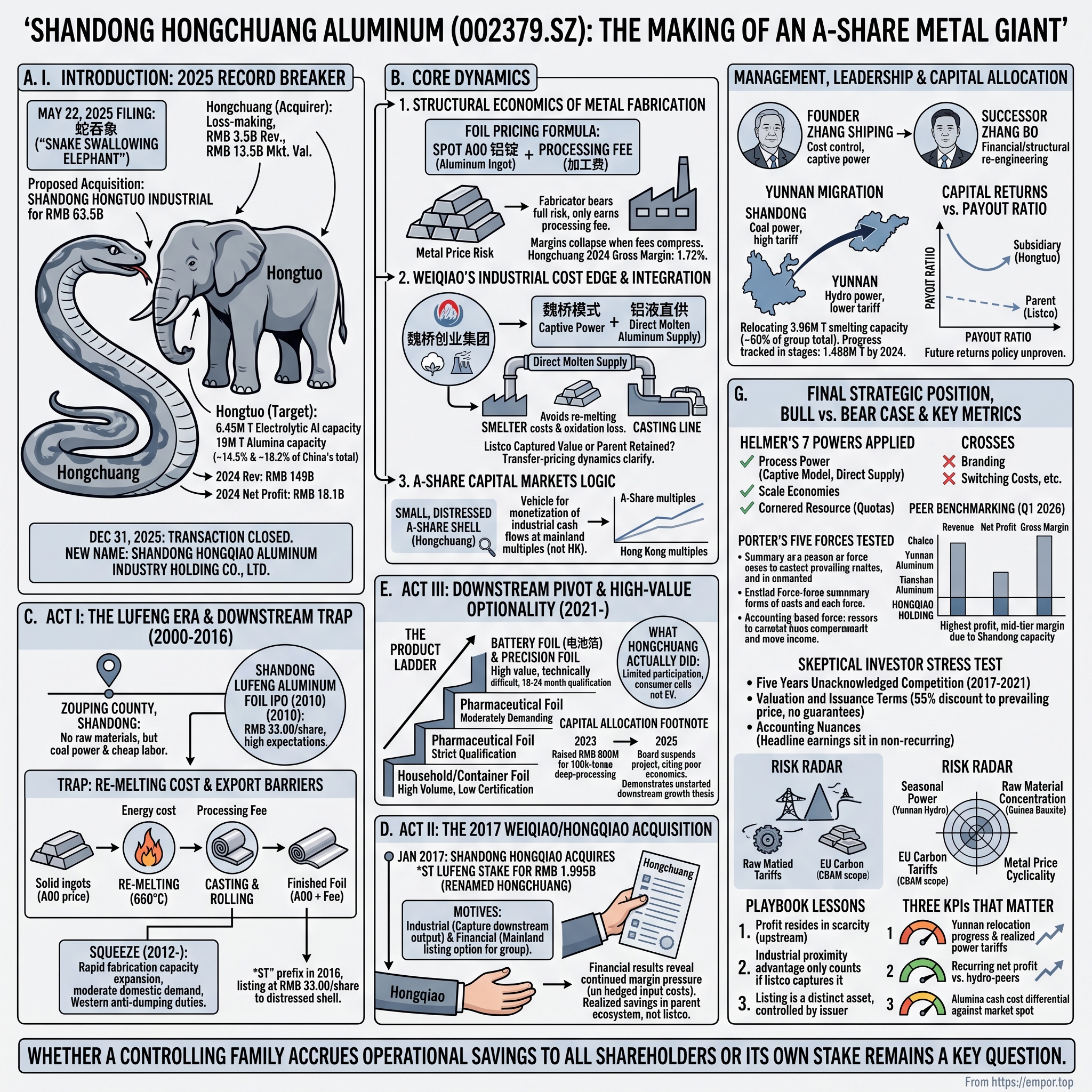
On the evening of May 22, 2025, a company almost nobody outside Shandong province had thought about in years filed a document with the Shenzhen Stock Exchange that broke an A-share record. The filer was 山东宏创铝业控股股份有限公司 Shandong Hongchuang Aluminum Industry Holding Company Limited (ticker 002379.SZ) — a loss-making aluminum foil roller with roughly RMB 3.5 billion in annual revenue and a market value of about RMB 13.5 billion. The filing proposed that this company issue new shares to acquire 山东宏拓实业有限公司 Shandong Hongtuo Industrial Co., Ltd. for RMB 63.518 billion.1
To illustrate the scale of the transaction: Hongchuang planned to issue roughly 11.895 billion new shares — about 10.5 times its entire existing share count — at RMB 5.34 apiece.1 The target, Hongtuo, owned 6.459 million tonnes of annual electrolytic aluminum capacity and 19 million tonnes of alumina capacity, representing roughly 14.5% and 18.2% of China's national totals, respectively. In 2024, Hongtuo generated RMB 149.3 billion in revenue and RMB 18.1 billion in net profit.1 By contrast, the acquirer had posted net losses in each of the two prior years.
The Chinese term for this arrangement is 蛇吞象 — the snake swallowing the elephant. It describes a corporate structure in which the legal acquirer is a minor fraction of the entity it absorbs.
The transaction closed on December 31, 2025. The new shares listed on January 13, 2026, expanding the total share count to 13,031,118,202 and granting 山东魏桥铝电有限公司 Shandong Weiqiao Aluminum & Electricity Co., Ltd. an 86.98% stake.2 In late January, the listed company changed its name from Hongchuang to 山东宏桥铝业控股股份有限公司 Shandong Hongqiao Aluminum Industry Holding Company Limited, switching its ticker abbreviation to 宏桥控股 on January 30, 2026.14 For full-year 2025, the restated entity reported RMB 156.72 billion in revenue and RMB 17.86 billion in net profit attributable to shareholders.3
That headline transaction forms the backdrop; the core story lies in the underlying industrial and financial dynamics.
What this story is actually about. Three primary threads define this narrative:
The first is the structural economics of metal fabrication. Aluminum foil is priced on a cost-plus formula: the spot price of A00铝锭 (A00 primary aluminum ingot) plus a processing fee (加工费). The fabricator carries the entire metal price risk on its balance sheet while earning only the processing fee. When fees compress, margins vanish. Hongchuang's gross margin in 2024 stood at just 1.72%.6
The second is the industrial cost edge built by the 魏桥创业集团 Weiqiao Venture Group around low-cost captive power and 铝液直供 (direct molten aluminum supply) — piping liquid metal straight from a smelter into an adjacent casting line rather than casting ingots to re-melt later. The physical advantage is clear: avoiding both the double payment for latent heat of fusion and oxidation loss (烧损). A central question is whether the listed entity captured that economic value or whether the parent group retained it.
The third is the operational logic of A-share capital markets: how a small, distressed listed shell becomes a primary vehicle for a private conglomerate by providing a license to monetize industrial cash flows at mainland equity multiples rather than Hong Kong valuations.
How the narrative unfolds. The analysis begins with Lufeng's 2010 IPO and its subsequent operational decline. It examines the 2017 Weiqiao takeover, the actual performance of direct molten supply, and the downstream expansion — including the battery foil boom that the company largely missed. It then details the asset injection, followed by an evaluation of management, capital allocation, and the production shift to Yunnan. Finally, it addresses competitive positioning, the bear case, and the key metrics long-term investors should track.
One framing note at the outset: while the bullish case rests on world-scale capacity, captive hydropower, and rising EV demand, a rigorous assessment requires examining the execution details behind those claims.
 Subscribe on LinkedIn
II. Act I: The Lufeng Era & The Downstream Fabrication Trap (2000–2016) (00:07 – 00:20)
Zouping County sits in 滨州 Binzhou prefecture, on the flat alluvial plain where the Yellow River finishes its run to the Bohai Sea. It is not a natural home for heavy industry: there is no bauxite, no hydropower, and no deep-water port. What Shandong possessed in the early 2000s was coal-fired electricity, cheap labor, and a supportive municipal government. Out of that environment emerged a major industrial cluster, with a single county eventually producing more electrolytic aluminum than many sovereign nations.
山东鲁丰铝箔股份有限公司 Shandong Lufeng Aluminum Foil Co., Ltd. was a beneficiary of this regional cluster. Lufeng produced rolled aluminum products, including household foil, takeaway food containers, pharmaceutical blister packaging, and cold-rolled coil for downstream converters. In the mid-2000s, this was a steady commodity business driven by rising Chinese packaged food consumption, growing export sales to Western retailers, and domestic construction activity.
The listing. Lufeng listed on the Shenzhen Stock Exchange on March 31, 2010, pricing its IPO at RMB 33.00 per share through lead underwriter 国信证券 Guosen Securities.19 The valuation reflected high market expectations for growth and pricing power rather than the standard economics of a metal converter. The investment thesis relied on expanding Chinese per-capita foil consumption toward developed-market levels, supported by Lufeng's new rolling capacity coming online.
While domestic foil consumption expanded as projected, value capture proved problematic for standalone converters.
Why standalone re-rolling is a trap. The core mechanics of a standalone foil mill explain why profitability eroded. A re-roller purchases solid primary aluminum ingots at the prevailing A00 benchmark price. It melts them—requiring substantial energy inputs to reach aluminum's melting point of 660°C—and casts and rolls the metal into sheets thinner than a human hair. The finished foil is then sold at the same A00 benchmark price plus a processing fee.
Under this cost-plus structure, raw metal passes through the income statement at cost. It contributes nothing to gross margin while driving working capital requirements and exposing the firm to metal price volatility. At an aluminum price of RMB 20,000 per tonne, the mill must tie up RMB 20,000 in working capital per tonne of inventory, typically funded through short-term bank debt. If metal prices decline between purchase and sale, the fabricator absorbs the inventory loss. Profitability depends entirely on the processing fee, which fluctuates based on competitive capacity in the market.
The operating model functions like a toll road where the operator must purchase the underlying pavement at spot market prices every day.
Re-melting creates a secondary thermal cost. Liquefying solid metal demands continuous energy, while each melt cycle loses a fraction of the metal to oxidation. In a business where processing fees represent the total margin, several hundred yuan per tonne in avoidable melting costs directly reduces operating income.
The squeeze arrives. Beginning around 2012, three market forces converged. Domestic fabrication capacity expanded rapidly as new rolling mills entered the market. Chinese industrial demand growth moderated from post-stimulus highs. Meanwhile, Western trade authorities began applying anti-dumping and countervailing duties to Chinese aluminum foil, restricting export channels just as domestic competition intensified.
Lacking primary smelting assets, Lufeng attempted to pivot. The listed entity renamed itself 鲁丰环保科技股份有限公司 Lufeng Environmental Protection Science and Technology Co., Ltd., introducing an environmental technology narrative to supplement its core fabrication business.
The strategic shift failed to restore profitability. By 2016, the company received the *ST prefix on the Shenzhen Stock Exchange, signaling delisting risk following consecutive annual net losses. A business that listed at RMB 33.00 per share six years earlier had become a distressed shell seeking a buyer.5
The anatomy of the distress. The operational breakdown of a standalone foil mill follows a standard pattern. Revenue often remains stable or grows because volume represents the primary mechanism to absorb plant overhead. However, operating margins compress when processing fees drop below fixed facility and debt-servicing costs. Rolling mills, annealing furnaces, and slitters carry high fixed depreciation costs regardless of utilization levels, while labor costs remain largely sticky.
Balance sheet mechanics further compound operating distress. Working capital requirements scale directly with primary aluminum prices because fabricators pre-fund inventory at full market value. Consequently, rising primary metal prices increase short-term debt requirements and interest expense. Conversely, falling metal prices result in realized inventory write-downs. As a result, fabricators frequently record margin compression during primary commodity price rallies.
Trade measures removed the traditional higher-margin outlet. Export markets historically commanded higher processing fees than domestic sales; even in 2023, export sales at the successor company carried gross margins several times higher than domestic sales.7 As Western trade barriers expanded during the 2010s, fabricators without overseas production bases redirected volume back into the domestic market, accelerating fee compression.
What an investor should take from Act I. Lufeng's distress was not driven by a collapse in end-market demand, as domestic foil consumption grew throughout the period. Instead, the firm occupied a vulnerable position in the supply chain characterized by unhedged input costs, undifferentiated output, limited scale advantages, and capital-intensive inventory financing. In a commoditized fabrication sector operating on thin processing spreads, broader demand growth often attracts new rolling capacity rather than driving sustainable margin expansion.
That structural lesson was already understood by Lufeng's eventual acquirer, located forty kilometers away in Zouping.
III. Act II: The 2017 Weiqiao/Hongqiao Acquisition & Direct Supply Revolution (00:20 – 00:36)
To understand Lufeng's 2017 transaction, one must examine 张士平 Zhang Shiping, the industrialist who built the corporate ecosystem that acquired it.
Zhang began his career as a laborer and later factory director at a county cotton-ginning plant in Zouping during the 1960s. He was known for a rigorous work ethic cited frequently in industry profiles.16 From that ginning facility, he built 魏桥创业集团 Weiqiao Venture Group into the world's largest cotton textile manufacturer. Recognizing that power costs represented his primary operational constraint, Zhang constructed captive power plants and subsequently leveraged low-cost self-generated electricity to enter primary aluminum smelting.
That approach—the 魏桥模式 Weiqiao model of self-supplied power feeding energy-intensive smelting—formed the group's core cost advantage.21 Because electricity accounts for roughly 45% of the cash cost of producing a tonne of primary aluminum, self-generated power without grid transmission surcharges created a structural cost edge.13 By the 2010s, the group's aluminum subsidiary, listed in Hong Kong as 中国宏桥集团 China Hongqiao Group (1378.HK), had become the world's largest primary aluminum producer, earning Zhang the nickname "Aluminum King" in Chinese business media.20
Why buy a broken foil mill? In January 2017, 山东宏桥新型材料有限公司 Shandong Hongqiao New Material Co., Ltd.—a Hongqiao subsidiary—agreed to acquire a 28.18% controlling stake in *ST Lufeng from its controlling shareholder for approximately RMB 1.995 billion. That price represented an increase of roughly RMB 1 billion over an initial arrangement negotiated the previous August, reflecting a sharp rise in transaction valuation over six months.54 On June 1, 2017, the listed company was renamed Shandong Hongchuang Aluminum Industry Holding Company Limited, abandoning its environmental technology pivot.
Two motives drove the transaction: one industrial, the other financial.
The stated motive was operational integration. Hongqiao produced massive volumes of molten primary aluminum in Binzhou. A nearby downstream fabricator offered a captive outlet—allowing liquid metal to be delivered directly without the expense of solidifying ingots, shipping them, and re-melting them at a third-party facility. This formed the logic behind 铝液直供 (direct molten supply).
The unstated motive was capital allocation. While Hongqiao's Hong Kong listing provided access to international capital, it offered no path to mainland A-share equity markets, where domestic investors routinely awarded higher valuation multiples to industrial assets. A controlled A-share shell functioned as an option for future listing activities and equity market access.
Benchmarking the price. Paying RMB 1.995 billion for control of an unprofitable foil fabricator was expensive relative to trailing earnings. However, the valuation appeared more defensible on asset-based and market benchmarks. Against replacement cost, the purchase secured operating rolling lines, casting capacity, and an established industrial footprint in Shandong. Compared with private-market transactions of that era—where mid-cycle aluminum fabrication assets traded at 8 to 10 times EV/EBITDA—Hongchuang offered limited immediate cash flow but substantial strategic optionality. Furthermore, relative to the prevailing cost of clean A-share shell companies in 2016–2017, Hongqiao effectively paid a controlling premium for a mainland listing platform while acquiring an operating foil business in the process.
The molten metal mechanism, properly explained. The physical mechanics of direct molten supply are straightforward. Insulated ladle trucks transport liquid metal at roughly 700°C directly from a primary smelter's casthouse to an adjacent fabricator's holding furnace. By bypassing the ingot casting stage, fabricators avoid both the thermal energy needed to re-melt solid metal and the metal oxidation losses inherent in double melting.
Industry practitioners estimate the resulting savings at several hundred yuan per tonne. While Hongchuang has not disclosed company-specific figures, the physical efficiency is real and geographically defensible, as molten aluminum cannot be transported across long distances.
And yet. Financial disclosures reveal that direct molten supply failed to generate durable margin expansion for the listed entity. In the first half of 2023, Hongchuang's aluminum foil products yielded a gross margin of 2.67%, cold-rolled coil managed 0.45%, and cast-rolled coil posted a negative 0.19% margin, leaving export sales at 6.02% as the sole profitable segment.7 For full-year 2024—despite rising volumes and primary metal prices—company-wide gross margin reached just 1.72% (up from 0.97% in 2023) on revenue of RMB 3.486 billion, producing a net loss of RMB 68.98 million.6
Transfer-pricing dynamics clarify why these cost savings did not accrue to the listed company. In 2024, related-party purchases accounted for 52.96% of Hongchuang's cost of sales, while related-party sales represented just 0.60% of revenue.6 Because Hongchuang purchased more than half of its raw materials from its controlling shareholder's network while selling almost all finished output to third parties, the transfer price of molten aluminum remained an internal policy decision rather than an arm's-length market price. The operational savings of direct supply were realized within the parent ecosystem rather than captured by the listed subsidiary.
Segment alignment. Following the 2017 acquisition, the listed company organized its operations around three core product lines: 铝板带 (aluminum sheet and strip), 铸轧卷 (cast-rolled coil), and 铝箔 (precision aluminum foil). Production volumes grew steadily, reaching 171,000 tonnes of processed products in 2024, up 24% year-over-year.6 Yet expanding volume failed to drive operating profitability.
For investors, Act II highlights the central structural conflict of Hongchuang's business model prior to its 2025 reorganization. While the broader Weiqiao ecosystem maintained one of the lowest-cost primary aluminum positions globally, holding shares in 002379.SZ provided exposure only to an uncompetitive downstream fabrication link. Whether the 2025 asset injection fundamentally reshapes that dynamic forms the focus of the subsequent analysis.
IV. Act III: Downstream Pivot & High-Value Optionality: Battery Foil & Precision Foil (00:36 – 00:52)
Around 2021, Chinese aluminum foil producers increasingly turned their attention toward rising lithium-ion battery demand. Every cell required a cathode current collector made of aluminum foil—a sheet typically 10 to 13 microns thick (roughly one-eighth the thickness of a human hair) rolled to tolerances that standard household foil lines could not achieve. Battery foil (电池箔) was the same metal as household wrap, refined through precision manufacturing into a product commanding a substantial premium over standard processing fees during a period of market shortage. The resulting rush for capacity proved instructive, particularly because Hongchuang's involvement remained quite limited.
The product ladder. Aluminum fabrication functions as a ladder of certification barriers rather than exotic metallurgy.
At the base sits household and container foil—high-volume, highly commoditized, and competing primarily on price. A new entrant can typically achieve competitiveness within a year of commissioning a mill. This segment represented Hongchuang's core: household foil, container foil, alongside cast-rolled and cold-rolled coil sold for food packaging and building decoration.
One step higher is pharmaceutical foil (药用箔) for blister packs. While the metallurgy is only moderately more demanding, customer qualification requirements are strict because pharmaceutical regulators list packaging suppliers in drug filings. Changing suppliers requires extensive re-qualification and regulatory paperwork, creating customer stickiness that supports higher processing fees. Hongchuang maintained an established position in this segment dating back to its Lufeng period.
At the top sits battery foil, where technical specifications compound: precise thickness uniformity across a two-meter-wide web, near-zero pinhole defects, controlled surface tension for carbon-coating adhesion, and burr-free slitting to prevent internal electrical shorts. Producing battery foil reliably demands high-precision rolling mills, strict thermal control, and clean-room finishing facilities. Qualifying with a tier-one battery manufacturer typically requires 18 to 24 months of sample cycles and audits.
What Hongchuang actually did. Official disclosures clarify the company's actual market position. In November 2021, responding on the Shenzhen Stock Exchange's investor interaction platform, Hongchuang stated that while its battery foil could be used in lithium battery production, the majority went into consumer batteries—such as laptops, mobile phones, and power tools—rather than electric vehicle (EV) traction packs, adding that it would work to expand capacity.9
That disclosure highlighted an important distinction. Consumer-cell foil serves smaller battery formats with less demanding width and defect specifications, commanding lower pricing and smaller volume commitments than qualification with major EV battery manufacturers requires. Consequently, Hongchuang participated at the periphery of the battery foil market rather than at its core.
Meanwhile, the main EV market saw intense competition among dedicated specialists. Dingsheng New Materials (603876.SH) established itself as the domestic battery foil market leader, while Mingtai Aluminum (601677.SH) and Nanshan Aluminum (600219.SH) expanded their high-value flat-rolled capacity. Across the industry, announced battery foil projects reached several million tonnes of annual planned capacity, far outpacing actual demand growth.
The bust. A severe market adjustment followed. By 2023 and 2024, battery foil processing fees collapsed from their shortage-era highs. Financial results from market leaders reflected the downturn: at Dingsheng, processing fee compression at its Wuxing Aluminum (五星铝业) subsidiary contributed to a 60.88% year-on-year drop in that unit's 2024 net profit.15 When the category leader experienced a two-thirds profit decline due to fee compression, marginal entrants faced severe margin erosion or operating losses.
The cycle highlighted broader industry mechanics. High processing fees in 2021 and 2022 reflected temporary supply bottlenecks rather than durable competitive moats. While certification requirements delayed new market entrants by approximately 18 months, significant capital inflows eventually produced widespread oversupply.
The capital allocation footnote that matters most. During this period, Hongchuang sought equity capital for downstream expansion. In a private placement completed in mid-2023, the company issued 209,973,753 new shares at RMB 3.81 per share, raising approximately RMB 800 million, with the new shares listing on August 4, 2023. The stated objective was constructing a 100,000-tonne annual capacity facility for high-precision, deep-processed aluminum utilizing recycled metal.
However, on March 12, 2025, the board voted to re-evaluate and suspend the project, citing global economic volatility, heightened industry competition, and declining processing fees in downstream aluminum fabrication. Subsequent restructuring disclosures in May noted that the deep-processing project funded in 2023 remained unstarted.10
This decision illustrates the company's strategic positioning before its major reorganization. Although management raised capital for a downstream value-add initiative, it halted investment after observing 18 months of deteriorating market economics—avoiding capital deployment into an oversupplied market. At the same time, the suspension demonstrated that the downstream growth thesis failed to materialize under prevailing market conditions.
Did parent backing insulate it? Parent support provided partial insulation. Hongchuang's net losses narrowed from RMB 145 million in 2023 to RMB 68.98 million in 2024, while its adjusted net loss excluding non-recurring items improved from roughly RMB 147 million to RMB 86 million.6 Access to group metal supplies and a related-party cost structure enabled the business to navigate a challenging downcycle that severely impacted independent converters. Nevertheless, across eight years under Weiqiao's control, the listed entity failed to generate returns that covered its cost of capital.
This persistent underperformance set the stage for strategic realignment. With downstream fabrication struggling to achieve standalone profitability while upstream smelting generated substantial cash flows, the rationale for keeping the two businesses on opposite sides of a listing boundary increasingly diminished.
V. Act IV: The Mega Asset Restructuring — Transmuting into an Integrated Empire (00:52 – 01:10)
The initial signal arrived on January 7, 2025. Hongchuang announced a proposal to acquire 100% of Hongtuo Industrial by issuing new equity to Weiqiao Aluminum & Electricity and associated shareholders. The preliminary scale was striking: as of September 2024, Hongtuo carried total assets of roughly RMB 113.95 billion and net assets of about RMB 48.6 billion, compared to Hongchuang's net assets of approximately RMB 2 billion. Over the first nine months of 2024, Hongchuang generated RMB 2.559 billion in revenue while remaining unprofitable.4
The transaction required the small, loss-making listed vehicle to absorb an asset roughly twenty-four times its own net asset base.
The final terms. On May 22, 2025, Hongchuang released the formal transaction draft. Hongtuo was valued at RMB 63.518 billion—a 48.62% appraisal premium over the valuation implied by its December 2023 strategic investment round. Payment was structured entirely in stock, issuing approximately 11.895 billion new shares at RMB 5.34 per share.110
The core economic conflict rested in that issue price.
The RMB 5.34 issue price was tied to a benchmark date of January 6, 2025—the final trading day before the initial announcement, when the stock remained uninfluenced by restructuring expectations. By the time the formal draft appeared on May 22, 2025, Hongchuang's shares had climbed to RMB 11.92. Consequently, the agreed issue price represented a roughly 55% discount to the prevailing market price.10 The newly issued shares would represent 91.28% of the enlarged share capital, expanding the existing 1.136 billion share count by a factor of 10.47.10
Market reaction underscored the dilution risk for existing public shareholders. Upon resuming trading, Hongchuang's shares dropped 9.8% to RMB 10.80, reducing its market capitalization to roughly RMB 13.5 billion, whereas Hong Kong-listed parent China Hongqiao experienced minimal share price movement.11
That price divergence reflected the transaction's core transfer mechanics: while the injected asset brought high-margin primary capacity, the issuance terms concentrated equity ownership heavily in favor of the parent company.
The structural mechanics. Two additional structural details warrant examination.
First, the deal contained no performance commitment (业绩承诺) or impairment compensation arrangement.10 In major A-share restructurings, vendors frequently guarantee minimum target earnings for two to three years, agreeing to compensate the listed company in cash or stock if targets are missed. Here, the vendor—who also served as the controlling shareholder setting the valuation—provided no such guarantee. Although Chinese regulatory rules do not mandate profit guarantees for every transaction structure, its absence exposed public minority shareholders to the full operational risks of an RMB 63.5 billion asset without downside compensation.
Second, balance sheet leverage increased substantially. Combined asset-liability ratios were projected to rise from Hongchuang's stand-alone 37.33% to 58.62%, reflecting Hongtuo's 59.31% leverage ratio—a figure noticeably higher than lower-leveraged industry peers.10 An equity issuance was the only viable structure, as Hongchuang held less than RMB 500 million in cash at year-end 2024 against the RMB 63.5 billion transaction value.6
Approval and completion. The M&A review committee of the Shenzhen Stock Exchange cleared the restructuring plan in December 2025. The China Securities Regulatory Commission (CSRC) granted registration approval on December 31, 2025, and Hongtuo's equity was transferred to Hongchuang that same day, establishing Hongtuo as a wholly owned subsidiary.14 The new shares began trading on January 13, 2026. Based on the January 9, 2026 closing price of RMB 27.70, the combined entity's implied market capitalization reached approximately RMB 361 billion.2
The resulting ownership structure consolidated parent control: Weiqiao Aluminum & Electricity secured 11,335,057,116 shares (86.98%), Shandong Hongqiao held an additional 2%, and Hong Kong-listed China Hongqiao ultimately controlled an 88.98% stake in the mainland listed vehicle.2 Public minority shareholders held the remaining float.
Why do this now, and why this way? Three strategic objectives drove the restructuring.
The primary operational rationale was eliminating related-party friction. Integrating smelting, refining, and downstream fabrication within a single entity transformed the extensive related-party purchases that previously dominated Hongchuang's cost base into internal eliminations. This structural shift improved financial reporting transparency and resolved historical horizontal competition issues within the parent ecosystem.
The second driver was valuation arbitrage. While parent China Hongqiao traded at offshore Hong Kong multiples, mainland A-share markets historically awarded higher valuation multiples to domestic industrial assets. Securing an A-share listing for primary smelting cash flows established a higher-valued equity currency without forfeiting managerial control.
The third factor was future capital access. An A-share listing platform with substantial market capitalization provided the group with an expanded vehicle to issue equity, deploy convertible debt, or fund acquisitions—a financing channel unavailable through the original downstream shell.
What the combined company now is. Post-restructuring, the company's financial core shifted decisively upstream. Primary aluminum and alumina production now drive the vast majority of consolidated earnings, reducing the original downstream fabrication business to a minor operational component. Financial results from 2024 demonstrate the underlying economics: Hongtuo's electrolytic aluminum gross margin expanded from 10.52% to 17.75% as realized selling prices rose 6.4% against a 2.2% decline in unit costs, while its alumina gross margin expanded from 3.36% to 27.22%. On a stand-alone basis, Hongtuo's revenue grew 15.77% and net profit rose 168.91%.1
These profit margins reflect primary commodity production rather than downstream re-rolling economics, demonstrating the shift from processing fee margins to primary metal ownership.
This transformation also highlights a critical operational detail that emerged two months after transaction completion.
VI. Management, Leadership & Capital Allocation (01:10 – 01:22)
On September 26, 2018, the national enterprise registry recorded a corporate leadership transition at Weiqiao Venture Group: founder 张士平 Zhang Shiping, then 72, was succeeded as chairman and legal representative by his son 张波 Zhang Bo, then 48.16 Eight months later, on May 23, 2019, Zhang Shiping died. The succession had been arranged with minimal advance notice, consistent with many Chinese family-controlled conglomerates.
The second generation. Zhang Bo graduated from Shandong Radio and Television University in 1996 with a degree in financial accounting and joined his father's business immediately. He became deputy general manager within two years, and by March 1999, at age 29, assumed the roles of chairman and general manager at Weiqiao Textile.16 He subsequently led the aluminum and power division and served as executive director and chief executive of China Hongqiao. His sister 张红霞 Zhang Hongxia took charge of textile operations, while a second sister, 张艳红 Zhang Yanhong, assumed a supporting management role that included oversight of the Weihai industrial park.16 All three siblings are designated as the actual controllers of the listed A-share company today.
The generational shift marks a clear strategic transition. Zhang Shiping built the business through relentless cost control and an aggressive expansion into self-supplied power generation—an unconventional move for a textile producer at the time. By contrast, Zhang Bo's leadership over the past decade has focused on financial and structural re-engineering: physically relocating heavy smelting assets to comply with environmental policies, building cross-border raw material supply chains, and restructuring the group's public listing vehicles. While the founder established a low-cost production base under a permissive regulatory framework, his successor has had to defend that advantage as state policy tightened around coal-fired power.
The Yunnan migration. The central capital allocation initiative of Zhang Bo's tenure is the physical relocation of primary smelting capacity.
Shandong relies predominantly on coal-fired electricity, whereas Yunnan in southwestern China offers abundant hydropower. As national industrial policy tightened controls on energy intensity and carbon emissions while encouraging aluminum capacity to move toward renewable energy sources, Weiqiao committed to relocating 3.96 million tonnes of annual electrolytic aluminum capacity—more than 60% of the group's total—from Shandong to Yunnan.12
The operational complexity of this move is substantial. Electrolytic aluminum is produced in reduction cells that operate continuously at roughly 960°C. A modern potline spans kilometer-long facilities with equipment that is capital-intensive to build and disruptive to interrupt. Moving 3.96 million tonnes of capacity over two thousand kilometers requires shutting down Shandong potlines in controlled phases while commissioning new capacity in Yunnan to maintain continuous production, alongside transferring official capacity quotas to ensure regulatory compliance.
Relocation progress has proceeded in planned stages: 1.488 million tonnes had been transferred by the end of 2024,13 reaching 1.729 million tonnes by June 2025. Additional transfers of 448,000 tonnes, 241,000 tonnes, and 831,000 tonnes were scheduled across 2025, 2026, and 2027, respectively.12 Management informed regulators that no external deadline was imposed, enabling the sequencing to be managed for operational continuity.13 Meanwhile, alumina refining operations—representing 19 million tonnes of annual capacity—remain stationed in Shandong.12
The arithmetic that justifies it. Power cost differentials provide the primary financial rationale for the migration. In 2024, the injected assets purchased electricity in Yunnan at RMB 0.40 per kilowatt-hour, compared to RMB 0.51 per kilowatt-hour in Shandong—a 21.6% cost advantage.13 By June 2025, the grid tariff gap had widened further to RMB 0.37 per kilowatt-hour in Yunnan versus RMB 0.57 per kilowatt-hour in Shandong.12 Smelting one tonne of primary aluminum requires approximately 13,000 to 13,500 kilowatt-hours of power, with national regulations mandating alternating-current power consumption at or below 13,000 kilowatt-hours per tonne for new facilities.23 An 11-fen tariff differential yields approximately RMB 1,485 in power savings per tonne of aluminum. At the wider 20-fen differential observed in mid-2025, the cost savings reach roughly RMB 2,700 per tonne.
To put that figure in perspective, the per-tonne power savings from relocation exceed the entire gross profit that legacy Hongchuang earned per tonne of rolled aluminum foil.
The costs management has disclosed. Regulatory filings provide visibility into the financial and human costs of the migration. By the end of 2024, the company recorded RMB 3.484 billion in fixed-asset impairment provisions against idled Shandong capacity. Relocation capital expenditures were projected at RMB 5.663 billion over three years, representing approximately 22% of 2024 operating cash flow of RMB 25.427 billion. Among the 3,750 affected workers, 3,292 (87.79%) were redeployed within Shandong operations, while 458 (12.21%) relocated to Yunnan.13
Disclosing a RMB 3.5 billion asset impairment alongside a detailed workforce transition plan demonstrates transparency regarding the financial impact of the restructuring, acknowledging that the capacity migration entails substantial upfront costs.
Vertical integration abroad. A second pillar of capital allocation centers on raw material security. Through the SMB-Winning consortium, the group participates in Guinea's largest bauxite production and logistics network. This includes a 125-kilometer railway connecting Dapilon to Santou, constructed for approximately US$1.2 billion and inaugurated in June 2021.22 The partnership framework extends into iron ore development: Winning Consortium Simandou—owned 51% by Winning International Group alongside Shandong Weiqiao and China Hongqiao interests, and 49% by Baowu Resources—holds a 42.5% stake in Compagnie du TransGuinéen, which manages the shared rail and port infrastructure for the Simandou project that began operations on November 11, 2025.17
Securing imported bauxite addresses a key operational vulnerability for Chinese alumina refiners, as domestic bauxite reserves suffer from low grades and depletion. Owning stakes in overseas mining, rail, and port infrastructure mitigates raw material supply risks for alumina refining, though it concentrates supply chain exposure within a single West African jurisdiction.
Capital returns. Prior to the asset injection, Hongtuo distributed RMB 15.212 billion in dividends for 2024, representing a 61.07% payout ratio of net profit. Management justified this distribution to exchange regulators by citing strong operational cash generation and alignment with parent group dividend policies.13 Following the transaction, the listed A-share entity adopted a more conservative distribution, proposing RMB 2.50 per 10 shares for 2025—an estimated payout ratio of 18.3%.3
The reduction from a 61% payout ratio at the operational subsidiary to 18% at the parent level warrants close tracking by public shareholders. This conservative distribution may reflect capital preservation during an intensive asset migration, or a preference for retaining cash within an entity where public minority shareholders hold approximately 13% of equity. Management has not yet established a formal multi-year dividend framework for the A-share company, leaving its long-term capital return policy unproven.
Evaluating management credibility. Because the company does not conduct Western-style quarterly earnings calls or interactive analyst Q&A sessions, investors must assess management credibility primarily through regulatory filings, exchange disclosures, and operational execution against public commitments. Three key data points illustrate the track record.
First, the Yunnan capacity relocation has proceeded in accordance with schedules submitted to exchange regulators, with progress metrics consistently updated in public filings.1213 Second, management opted to suspend the RMB 800 million deep-processing project prior to construction rather than deploying capital into an oversupplied downstream market—a decision that preserved capital despite altering previously stated expansion plans.
Conversely, official records show five consecutive years of annual reports that failed to disclose horizontal competition from affiliated group entities. Additionally, company investor relations communications between 2021 and 2024 emphasized growth opportunities in battery foil and high-precision deep processing as growth narratives,[^23] during the same period when capital allocation to those downstream initiatives was being delayed and ultimately halted. These disclosures underscore the importance of evaluating audited filings and capital deployments rather than promotional narrative themes.
Looking ahead, management's execution will be tested on two main commitments: completing the Yunnan capacity migration according to its published timetable, and converting the vertically integrated business structure into sustained operational cash flows. Progress on both fronts will be measurable through regular quarterly disclosures.
Which leads directly to how this business actually competes.
VII. Industry Structure, Competitive Benchmarking & Economic Moats (01:22 – 01:34)
Strip away the corporate history, and the primary aluminum industry reduces to a brutally simple framework: rank every smelter globally by cash cost per tonne, draw the line where supply meets demand, and every producer to the left makes money while those to the right struggle to survive. There is no brand loyalty, no switching cost, and no proprietary customer relationship. A tonne of A00 primary ingot is entirely interchangeable. Position on the global cost curve is the entire competitive strategy.
By that metric, the company occupies a strong position. However, that structural advantage is more specific—and more contingent—than headline promotional claims suggest.
Hamilton Helmer's 7 Powers, applied.
Process Power represents the company's most defensible advantage. The Weiqiao model—captive power generation feeding co-located smelters, direct transfer of liquid metal into casting lines without re-melting, and in-house alumina refining backed by consortium-controlled bauxite—forms an integrated operational footprint built over three decades. Because it relies on physical geography and infrastructure, competitors cannot easily replicate it.
Scale Economies are real but narrower than aggregate capacity figures imply. Operating as a major buyer of bauxite, caustic soda, anodes, and freight provides procurement leverage and logistics efficiency. However, scale does not confer a technological edge in smelting, where potline efficiency remains broadly comparable across modern operators.
Cornered Resource requires careful distinction between regulatory permits and operational inputs. The primary candidate is capacity quotas: under China's policy framework, the roughly 45-million-tonne national ceiling on electrolytic aluminum means new capacity requires equivalent or reduced-quantity replacement of retired capacity.23 Existing permits are scarce, tradable assets that represent substantial economic value, even if they do not appear at fair market value on the balance sheet. The second candidate—access to low-cost hydropower in Yunnan—is an operational contract tied to location rather than a permanent property right, and carries a seasonal supply liability attached.
Counter-Positioning, Switching Costs, Network Economies, and Branding are absent. Commodity metal producers do not possess these drivers, and assuming otherwise misjudges the sector's economics.
Porter's Five Forces, tested rather than asserted.
Threat of new entrants: low. This structural barrier is a regulatory constraint rather than a market-driven one. Since the 2017 supply-side reform established the national ceiling, domestic primary aluminum output has operated near capacity—at roughly 44.8 million tonnes against the ~45 million tonne cap.23 Constructing a new smelter in China requires purchasing retired quota from an incumbent. This policy environment transformed an industry historically prone to capacity overbuilding into one where incumbent assets are protected by law.
Supplier power: low upstream. Vertical integration through alumina self-sufficiency and consortium-controlled bauxite insulates the company from price swings dictated by external refiners. The 2025–2026 alumina price collapse illustrates this dynamic: alumina prices declined sharply as new global refining capacity came online,15 benefiting smelters purchasing input materials while compressing refiners' margins. Integrated operations naturally hedge these fluctuations, balancing gains in smelting against lower profitability in refining.
Buyer power: moderate. Primary ingot buyers face zero switching costs. Meanwhile, the downstream fabrication division sells into a fragmented customer base with abundant alternative suppliers, as evidenced by eight consecutive years of sub-2% gross margins.
Substitutes: low. Alternative materials present clear trade-offs: copper and steel carry weight penalties, while plastics lack electrical conductivity. Aluminum's role in energy storage, transmission conductors, packaging, and vehicle lightweighting remains structurally secure over the long term.
Rivalry: bifurcated. Upstream, the capacity cap shifts competition from market-share expansion to cost-curve positioning, favoring low-cost producers. Downstream, fabrication remains highly competitive and unregulated, with minimal barriers to adding rolling capacity.
Peer benchmarking, using the newest data. First-quarter 2026 financial results provided the first comprehensive performance benchmark for the combined company against listed peers, revealing a nuanced operational picture.
Revenue reached RMB 40.933 billion, up 3.21% year-over-year, while net profit attributable to shareholders rose 37.56% to RMB 6.758 billion—the highest absolute profit among China's 27 listed A-share aluminum companies, with revenue second only to 中国铝业 Chalco (601600.SH).15
However, consolidated gross margin stood at 24.03%, ranking sixth within the peer group. Competitors including 天山铝业 Tianshan Aluminum (002532.SZ), 神火股份 Shenhuo, and 云铝股份 Yunnan Aluminum (000807.SZ) all achieved gross margins exceeding 31%. This margin gap reflected higher electricity procurement costs for the company's remaining Shandong capacity, alongside segment losses in alumina following a 29.3% drop in realized prices. Revenue growth of 3.21% ranked 22nd out of 27 peers, with eight competitors recording growth above 20%, prompting market commentary that the divergence between industry-leading net profit and trailing revenue growth reflected product mix or volume constraints.15
These metrics illustrate the operational reality behind the company's cost position. While generating the largest absolute profit in its domestic peer group due to its asset base, the company operates at a mid-tier margin because a majority of its smelting capacity still relies on coal-fired power in Shandong, whereas hydro-based peers like Yunnan Aluminum complete their operations without ongoing relocation burdens.
The structural cost advantage remains an active transition—moving potline by potline across two thousand kilometers.
War-gaming the peer set. Evaluating the competitive landscape requires examining three distinct peer comparisons.
Against 中国铝业 Chalco (601600.SH / 2600.HK), the dynamic pits a state-owned enterprise against a private conglomerate. Chalco maintains superior bauxite reserves, state backing, and a lower cost of capital. Conversely, Weiqiao's historic edge lies in operational lean-cost discipline and captive power infrastructure. The private entity's primary advantage is operational agility and cost control, whereas Chalco operates without the related-party oversight friction inherent in private-controlled parent-subsidiary structures.
Against 云铝股份 Yunnan Aluminum (000807.SZ), the comparison directly highlights the transition cost. Yunnan Aluminum has operated entirely on Yunnan hydropower for years without incurring asset write-downs from moving capacity. Consequently, its gross margin exceeds 31%, compared to the combined entity's 24%.15 The investment thesis rests on closing this margin gap as capacity relocation finishes, making Yunnan Aluminum's operating performance a key benchmark for tracking strategic execution.
Against 天山铝业 Tianshan Aluminum (002532.SZ), the comparison highlights the value of vertical integration. Tianshan established an integrated coal, power, alumina, and high-purity aluminum network in Xinjiang. Its margin performance demonstrates that tight supply-chain integration, rather than total volume alone, drives structural returns.
Against downstream fabricators such as Dingsheng, Mingtai, and Nanshan, the comparison is increasingly secondary, given that fabrication now represents a small fraction of total profit. As dedicated fabricators experience margin recovery alongside stabilizing processing fees,15 the company's fabrication unit should see incremental improvement, though its overall impact on consolidated earnings remains limited.
Over the next three years, competitive differentiation will depend on two execution factors: securing low-cost power inputs and completing the physical relocation of smelting assets.
VIII. Skeptical Investor Stress Test & Current Risk Radar (01:34 – 01:44)
An activist investor examining the corporate disclosure record would look past short-term aluminum prices and begin with official exchange filings.
Exhibit A: Five years of unacknowledged horizontal competition. From 2017 through 2021, Hongchuang's annual reports stated that no horizontal competition (同业竞争) existed with its controlling shareholder. In reality, 滨州宏展铝业科技有限公司 Binzhou Hongzhan Aluminum Technology Co., Ltd.—controlled by Shandong Hongqiao—produced overlapping cold-rolled, cast-rolled, and aluminum foil products. The company only acknowledged the overlap in July 2022. On November 7, 2023, the Shandong bureau of the CSRC issued a warning letter, followed by a Shenzhen Stock Exchange regulatory letter on November 8, 2023, naming the former chairman, several former general managers, and the former board secretary.8
At the time, the company carried a market capitalization of RMB 5.057 billion.8 While the sanction was administrative rather than financial and the executives involved had largely rotated out, the disclosure record remains relevant. A controlled listed vehicle misrepresented the extent of its parent's competing operations in five consecutive audited annual reports. When that same controlling shareholder subsequently set the terms to inject RMB 63.5 billion of its own assets into the vehicle, minority shareholders had little basis to assume the process was structured in their favor.
Exhibit B: Valuation and issuance terms. The pricing of the asset injection illustrates the dilution inherent in the transaction. The benchmark valuation date was set immediately before the initial proposal was announced—prior to any market re-rating. Consequently, the RMB 5.34 issue price sat 55% below Hongchuang's trading price when the formal transaction draft appeared, and roughly 81% below its share price when the new shares listed in January 2026.102 Furthermore, the transaction included no performance commitment to protect minority investors if target earnings missed expectations, while the vendor secured an 86.98% controlling stake.
While fully legal and disclosed, the issuance terms dramatically reallocated equity. A minority investor holding 1% of Hongchuang on January 6, 2025 held approximately 0.09% of the enlarged, integrated entity thirteen months later. Although owning 0.09% of an integrated primary aluminum major may offer greater long-term fundamental value than 1% of an unprofitable foil fabricator, public shareholders had no mechanism to negotiate the exchange ratio.
Exhibit C: Accounting mechanics behind headline earnings. The 2025 financial report contains a critical accounting nuance. For full-year 2025, the restated entity reported RMB 17.864 billion in net profit attributable to shareholders, alongside an adjusted net loss of RMB 369 million excluding non-recurring items—a 327.93% deterioration from the restated prior year.3
This divergence stems from common-control accounting rules. Because Hongchuang and Hongtuo belonged to the same parent ecosystem, Chinese standards treat the transaction as a pooling of interests. Prior periods are restated as if the companies were combined all along, and net profit generated by the acquired asset prior to the December 31 closing date flows into consolidated income as a non-recurring item. As a result, almost the entire RMB 18 billion headline net profit sits in the non-recurring column, while the negative recurring result reflects the legacy fabrication operations of the original listed shell.14
While fully compliant with accounting standards, the structure means headline 2025 figures do not represent normalized ongoing operations. The 2026 annual report will serve as the first clean full-year baseline for the combined entity. In the interim, quarterly performance—such as the RMB 6.758 billion net profit posted in Q1 2026—provides a clearer measure of underlying earning power.
Exhibit D: Restricted public float and trading liquidity. With 86.98% of equity held by Weiqiao Aluminum & Electricity and an additional 2% held by an affiliate, the tradeable public float accounts for roughly one-tenth of a company valued at hundreds of billions of yuan. A constrained float amplifies share price volatility, complicates institutional index inclusion, and concentrates price discovery within a relatively small pool of active capital rather than reflecting broad institutional trading in primary metals.
Exhibit E: Persistent parent-subsidiary governance dynamics. While absorbing Hongtuo eliminated the raw-material related-party purchases that previously accounted for 53% of Hongchuang's cost of sales, it did not alter the overarching corporate architecture. Hong Kong-listed China Hongqiao continues to control the A-share entity, with group financing, shared logistics, and sales channels spanning the two listed vehicles. Shareholders in 002379.SZ remain investors in a controlled subsidiary, where future intercompany arrangements will be determined by a parent entity operating on both sides of the transaction.
The current risk radar.
Yunnan's seasonal power constraints. Hydropower relocation introduces seasonal operational exposure. Yunnan's river flows peak during the summer wet season and decline significantly from November through April. During dry years, provincial authorities have imposed power rationing on energy-intensive industrial users (枯水期限电), forcing aluminum smelters to curtail potlines. Because restarting reduction cells entails high operational costs and lengthy downtime, power interruptions directly affect unit economics. As management acknowledged in regulatory submissions, the cost advantages of the relocation remain dependent on the stability and pricing of Yunnan's electrical grid.15
Bauxite supply concentration in Guinea. Upstream raw material security relies heavily on bauxite imports from Guinea, a jurisdiction with a history of political volatility and shifting mining fiscal regulations. While the SMB-Winning consortium's investment in dedicated rail and port infrastructure reduces local logistics bottlenecks, it also increases fixed capital exposure in a single West African region, concentrating primary raw material sourcing within one international supply chain.
European carbon regulations and CBAM scope. The European Union's Carbon Border Adjustment Mechanism (CBAM) entered its definitive phase on January 1, 2026, imposing financial compliance obligations on imported aluminum.18 Proponents argue that shifting capacity to hydropower will enable the company to satisfy European low-carbon standards ahead of coal-reliant domestic peers. However, under current regulatory guidelines, CBAM applies exclusively to direct process emissions from smelting, excluding indirect emissions from electricity generation.18 Because the emissions differential between coal-fired and hydro-powered smelting resides in power generation, current CBAM rules offer limited immediate premium for hydro-aluminum. Market analysts note that expanding CBAM to cover indirect scope-two emissions could increase aluminum import compliance costs by 500% to 800%, which would mark the point at which hydro-based production commands a substantial regulatory advantage.18
Ongoing downstream fee compression. Processing fees for packaging and battery foil remain under pressure due to industry-wide fabrication overcapacity. While downstream fabrication now represents only a small fraction of consolidated group profit following the asset injection, persistent fee compression limits margin recovery in the legacy rolling division.
Primary metal price cyclicality. The 37.56% year-over-year profit increase reported in Q1 2026 was driven largely by elevated primary aluminum prices rather than structural volume expansion.15 Primary metal prices reached four-year highs in March 2026, with three-month LME aluminum trading near $3,372 per tonne and the Shanghai front-month contract exceeding RMB 24,800 per tonne.24 Because earnings remain highly sensitive to prevailing metal prices, market downturns or price retracements will directly compress operating margins.
Post-restructuring balance sheet leverage and cash flows. First-quarter 2026 financial results generated RMB 9.238 billion in operating cash flow alongside RMB 9.822 billion in financing outflows and a 12% decline in monetary funds.15 Given the higher leverage ratio following the asset injection and ongoing capital commitments for the Yunnan capacity migration, maintaining liquidity and debt service capacity represents an essential operational discipline.
IX. Playbook & Business/Investing Lessons (01:44 – 01:50)
Three transferable lessons emerge from this corporate trajectory, two of which directly challenge how the restructuring was marketed.
Lesson 1: In commodity supply chains, the profit pool resides where scarcity exists—and that scarcity is rarely downstream. For eight years, Hongchuang operated as a competent fabricator with direct access to primary metal and expanding shipment volumes, yet it failed to sustain a 2% gross margin. This underperformance resulted not from managerial failure, but from structural economics: rolling metal is a service that any well-capitalized competitor can provide, whereas primary smelting in China requires capacity quotas bounded by a strict national ceiling.
The generalizable principle: before underwriting a high-margin downstream expansion thesis, investors must evaluate what prevents a competitor from building an identical production line. If the barrier consists merely of capital and eighteen months of construction, there is no structural moat—only a queue of future entrants. China's regulated 45-million-tonne ceiling on upstream capacity holds far greater economic value than downstream certification barriers, a reality clearly demonstrated in the margin data.
Lesson 2: Physical proximity provides a structural cost advantage that financial engineering cannot replicate—yet proximity alone does not dictate who captures the gain. Direct molten metal transport offers an un-arbitrageable physical efficiency. Liquid metal cannot be outsourced, digitized, or shipped long distances across borders. In a commodity sector determined by position on the cost curve, co-located liquid transfer represents a genuine operational edge.
The critical qualification lies in corporate ownership boundaries. From 2017 through 2024, that physical advantage existed, yet the listed vehicle captured virtually none of it because it sat on the purchasing side of a related-party transaction that it did not price. The broader lesson is not that industrial proximity fails to generate value, but that a company's position relative to the transfer price determines whether it captures the economic gain or merely operates alongside it. Minority shareholders in controlled subsidiaries must assume that operational savings accrue to the controlling entity setting intercompany prices until financial disclosures demonstrate otherwise.
Lesson 3: A public listing platform is a distinct corporate asset—and its ultimate value depends on who controls the terms of issuance. The most significant financial takeaway from the transaction is not the headline RMB 63.5 billion purchase price. Rather, it is how a controlling shareholder converted private industrial assets into an 86.98% equity stake in an integrated producer with an implied market valuation of roughly RMB 361 billion at the January 2026 reference price,2 by issuing new stock at a price anchored to a pre-announcement benchmark date.
For controlling shareholders, the strategic playbook is established and fully compliant with regulations: maintain a public shell, control the timing of disclosures, execute asset injections at historical benchmark valuations, and capture the subsequent market re-rating. For minority investors, the lesson is the structural inverse: in a subsidiary controlled by a parent conglomerate, the pricing and dilutive terms of future asset injections represent a material valuation risk that operates outside the income statement and seldom receives prominent placement in risk disclosures. Before investing in a conglomerate-controlled subsidiary, public market participants must evaluate how equity ownership would be reallocated if the parent entity chooses to reorganize.
X. Strategic Position, Bull vs. Bear Case & Key KPIs (01:50 – 01:58)
Myth versus reality: four consensus claims, tested.
Before evaluating the bull and bear cases, it is worth examining four statements that frequently appear in commentary on the company, as two do not withstand scrutiny against regulatory filings.
Myth: "The A-share entity is a green-aluminum play positioned to win under EU carbon tariffs." Reality: the majority of its smelting still relies on Shandong coal-fired power, which is precisely why its gross margin trails pure-play hydro-powered competitors,15 while the EU carbon mechanism currently assesses aluminum on direct process emissions only, leaving the coal-versus-hydro electricity differential outside the calculation.18 A green premium remains a potential future option contingent on completing the capacity relocation and changing regulatory frameworks, rather than a present-day earnings driver.
Myth: "Direct molten aluminum supply gave the listed company a structural margin advantage." Reality: during the eight years this advantage supposedly applied, the listed entity's gross margin never exceeded low single digits.67 While physical energy savings are real, the economic value was captured upstream of the listing boundary. Only now, with both operations consolidated within a single entity, do these operational savings accrue to public shareholders.
Reality confirmed: "The capacity ceiling is a genuine structural moat." This assessment holds. China's capacity ceiling is strictly enforced, has remained in place for nearly a decade, keeps national output near the national cap, and mandates capacity replacement as the sole legal path to new projects.23 This policy constraint represents the most durable structural source of returns across the industry, though it protects all incumbent smelters rather than this company exclusively.
Reality confirmed, with a caveat: "The 2025 results show a transformed company." While the operational transformation is genuine, the 2025 income statement obscures it because common-control accounting classifies virtually all reported net profit in the non-recurring column.3 Normalized financial performance will only become visible in the full-year 2026 financial results.
The bull case, stated at its strongest.
The structural bull thesis begins with supply discipline. China's primary aluminum capacity ceiling has held firm since 2017, keeping national production within a few percent of the cap, while the policy framework—reinforced by the metal industry's high-quality development plan for 2025–2027—mandates capacity replacement rather than net expansion for new projects.23 In a commodity sector where unconstrained capital investment historically eroded returns, this regulatory ceiling provides a structural floor. While demand can expand, domestic primary supply cannot. Over a full commodity cycle, this framework supports higher average capacity utilization, firm pricing, and extended cycle peaks.
The company's scale compounds this structural edge. It controls approximately 14.5% of national smelting capacity and 18.2% of national alumina refining,1 processes raw material sourced through partially owned mining interests in Guinea, transports bauxite across consortium-owned rail and port infrastructure,2217 and is executing a multi-year migration of majority smelting capacity to Yunnan hydropower offering 20% to 35% lower electricity tariffs.1312 Operating metrics from the injected assets in 2024—where electrolytic aluminum gross margins expanded from 10.5% to 17.8% and alumina margins rose from 3.4% to 27.2%1—demonstrate the earning power of this integrated footprint during favorable market cycles.
Near-term execution supports this outlook, evidenced by first-quarter 2026 net profit of RMB 6.76 billion—a 37.56% year-over-year increase that generated the highest absolute quarterly net income in China's A-share aluminum sector.15 Unpriced optionality remains in completing the Yunnan relocation, which offers potential to narrow the gross margin gap with pure-play hydro competitors, alongside long-term upside if international carbon accounting expands to cover indirect power-generation emissions where the company's structural advantage resides.
The bear case, stated at its strongest.
The bear case starts with commodity price sensitivity. First-quarter 2026 profit expansion was driven primarily by elevated primary aluminum prices rather than volume growth.15 Chinese aluminum consumption remains heavily tied to property construction, power infrastructure, and automotive manufacturing. A broader macroeconomic slowdown or property contraction would depress both realized prices and demand volumes, exposing a producer operating one-seventh of China's primary capacity directly to commodity downcycles.
Second, the green-aluminum narrative carries execution risks. Relocating smelting assets involves substantial upfront capital—requiring RMB 5.663 billion in projected capital expenditures alongside RMB 3.484 billion in recognized asset impairments against idled Shandong capacity13—while shifting operational dependency to Yunnan's hydro-based power grid. Yunnan's seasonal rainfall variations expose smelters to winter power rationing, turning a theoretical tariff advantage into lost production during peak pricing periods. Furthermore, regulatory benefits under Europe's carbon border tariff remain premature, as CBAM's definitive phase currently excludes indirect Scope 2 electricity emissions.18
Third, operational concentration creates supply-chain vulnerabilities. Raw material security relies heavily on Guinean bauxite sourcing, energy costs depend on seasonal rainfall in a single Chinese province, and alumina profitability—a critical driver across 19 million tonnes of refining capacity—remains exposed to global refining dynamics, where expanding supply drove spot alumina prices down nearly 30% year-over-year in the first quarter of 2026.15
Finally, governance structure introduces a persistent valuation discount. Public minority investors hold roughly one-tenth of total equity in a business where the controlling shareholder previously failed to disclose horizontal competition in five annual filings,8 structured a transformational asset acquisition at a 55% discount to prevailing market prices without performance guarantees,10 and reduced payout ratios at the listed entity without establishing a formal multi-year dividend framework. These governance factors lead institutional investors to demand a higher cost of capital than an equivalent enterprise with independent ownership.
The synthesis.
The combined enterprise represents a high-quality upstream commodity producer operating within a corporate structure controlled by a single industrial family. These operational and governance dynamics coexist. While integrated assets and low-cost energy support strong operating fundamentals, parent-subsidiary governance arrangements justify a persistent valuation discount relative to standalone peer multiples. Investors operating as minority partners within a family-controlled group must weigh world-scale industrial efficiency against the ownership realities of a controlled subsidiary.
The three KPIs that matter.
One: Yunnan capacity relocation progress and realized power tariffs per tonne. This represents the primary operational variable driving margin expansion. Investors should track cumulative tonnage transferred against the 3.96 million tonne target alongside the published relocation timetable,12 while monitoring realized electricity costs in Yunnan. The power tariff differential between Shandong and Yunnan forms the foundation of the cost-reduction thesis;13 any delays in potline commissioning or narrowing tariff spreads would directly weaken projected margin gains.
Two: recurring net profit excluding non-recurring items and gross margin comparisons against hydro-powered peers. Due to common-control accounting rules, headline 2025 results obscure ongoing operational profitability. Recurring net profit—which registered a loss in 20253—provides the true measure of core earnings power. Comparing consolidated gross margin against hydro-based peers like Yunnan Aluminum, Tianshan Aluminum, and Shenhuo will demonstrate whether operational competitiveness is improving. Although the company generated the sector's highest absolute net income in the first quarter of 2026, its gross margin ranked sixth among peers;15 closing this margin gap serves as the key benchmark for strategic execution.
Three: the alumina cash cost differential against prevailing market spot prices. Managing 19 million tonnes of refining capacity means the spread between internal production costs—supported by Guinean bauxite transported on captive infrastructure—and spot alumina market prices determines whether vertical integration expands consolidated earnings or compresses them. When market alumina prices decline, refining operations transition from a profit driver to an earnings drag, as demonstrated in first-quarter 2026 results.15 This spread remains the most volatile earnings component across the integrated structure.
Secondary variables—including downstream foil processing fees, battery foil demand, and electric vehicle adoption—now represent too small a portion of consolidated profit to materially impact group earnings.
XI. Epilogue (01:58 – 02:02)
There is a version of this story told as a triumph: a struggling county foil mill, rescued by an industrialist, transformed over eight patient years into a primary aluminum producer listed in Shenzhen with a market value in the hundreds of billions of yuan.
The regulatory filings tell a more nuanced story. The foil business was never truly rescued; it remained marginally unprofitable throughout those eight years, and its sole funded expansion project was shelved before breaking ground. What was actually preserved through that period was not an operating turnaround, but an A-share listing license—maintained, kept compliant, and deployed when the strategic moment arrived. The underlying industrial achievement is real, belonging to the primary smelters, the Guinean railway, the Yunnan potlines, and the three-decade cost position built around captive power. The corporate achievement belongs to whoever determined in 2017 that paying an extra billion yuan for a distressed shell in Zouping was worth the price.
What emerged on January 13, 2026, is a major industrial producer with a distinct structural cost advantage, still in the middle of the capacity migration that will determine whether that edge is fully realized or merely described. The coming years will settle the outcome: potlines commissioned in the southwest, seasonal rainfall in Yunnan reservoirs, bauxite loaded at Santou, and whether a controlling family holding nearly 87% of the equity chooses to manage the company for all of its shareholders or primarily for its own controlling stake.
In commodities, the low-cost producer survives every cycle. Whether minority shareholders participate proportionally in that survival remains a separate question—and one that aluminum prices alone will never answer.
References
-
002379,重大资产重组,超600亿重磅收购! — Securities Times (STCN), 2025-05-22 ↩↩↩↩↩↩↩
-
重组完美收官!宏创控股635亿并购核心资产1月13日股份上市,中国宏桥A股再添新势力 — Securities Times (STCN), 2026-01 ↩↩↩↩↩
-
宏桥控股(002379.SZ)发布2025年度业绩,归母净利润178.64亿元,增长3.69% — Sina Finance, 2026-03-20 ↩↩↩↩↩
-
486亿元资产回A!宏创控股将吞下"魏桥系"核心铝产品资产,曾连续五年"隐瞒"与控股股东存在同业竞争 — Sina Finance, 2025-01-07 ↩↩
-
山东首富入主*ST鲁丰 收购价半年涨了10亿元 — China Securities Journal (中证网), 2017-01-21 ↩↩
-
【BT财报瞬析】宏创控股2024年报:营收增长下的挑战与机遇并存 — Sina Finance, 2025-03-14 ↩↩↩↩↩↩↩
-
2023年我国铝箔行业领先企业宏创控股业务收入构成情况及优势分析 — 观研报告网 (China Baogao), 2023 ↩↩↩
-
连续五年未披露与控股股东同业竞争 收警示函后,宏创控股再收监管函 — Sina Finance, 2023-11-08 ↩↩↩
-
宏创控股:公司产品电池箔可以用于锂电池生产材料,其中大部分用于消费类电池 — Sohu Finance, 2021-11 ↩
-
折价55%增发10倍股份,宏创控股重组背后"铝王家族"成大赢家 — Tencent News, 2025-05-23 ↩↩↩↩↩↩↩↩
-
China's Hontron Aluminum Sinks on Plan to Issue New Shares at Steep Discount in M&A Deal — Yicai Global ↩
-
魏桥电解铝产能外迁详情披露:迁往云南396万吨,已涉及员工3750人 — The Paper (澎湃新闻) ↩↩↩↩↩↩↩
-
透视宏创控股回复函:396万吨电解铝产能的跨省博弈,如何平衡合规、效益与股东回报? — National Business Daily (每日经济新闻), 2025-09-03 ↩↩↩↩↩↩↩↩↩↩
-
宏桥控股披露2026年一季报:67亿利润领跑A股铝企,营收增速与毛利率双双掉队 — Sina Finance, 2026-05-06 ↩↩↩↩↩↩↩↩↩↩↩↩↩↩↩
-
Simandou partners celebrate start of operations — Rio Tinto, 2025-11-11 ↩↩
-
EU CBAM 2026: What It Means for China-Based Manufacturing — China Briefing ↩↩↩↩↩
-
山东鲁丰铝箔股份有限公司首次公开发行股票上市公告书 — Sina Finance filings archive (002379) ↩
-
China Hongqiao Group Limited official corporate portal — China Hongqiao ↩
-
Shandong Weiqiao Venture Group corporate history and industrial ecosystem — Weiqiao Group ↩
-
SMB Winning Consortium Guinea bauxite and logistics overview — SMB Winning Consortium ↩↩
-
China primary aluminum capacity ceiling and industry high-quality development policy guidelines — Ministry of Industry and Information Technology (MIIT) ↩↩↩↩↩
-
China aluminum and alumina price data and industry analysis — Shanghai Metals Market (SMM) ↩
 LinkedIn
 WhatsApp
 Reddit
 Hacker News
 Email
Email Kindle
 RSS Feed
 Spotify
 Apple Podcasts
 Amazon Music
 Audible
 YouTube