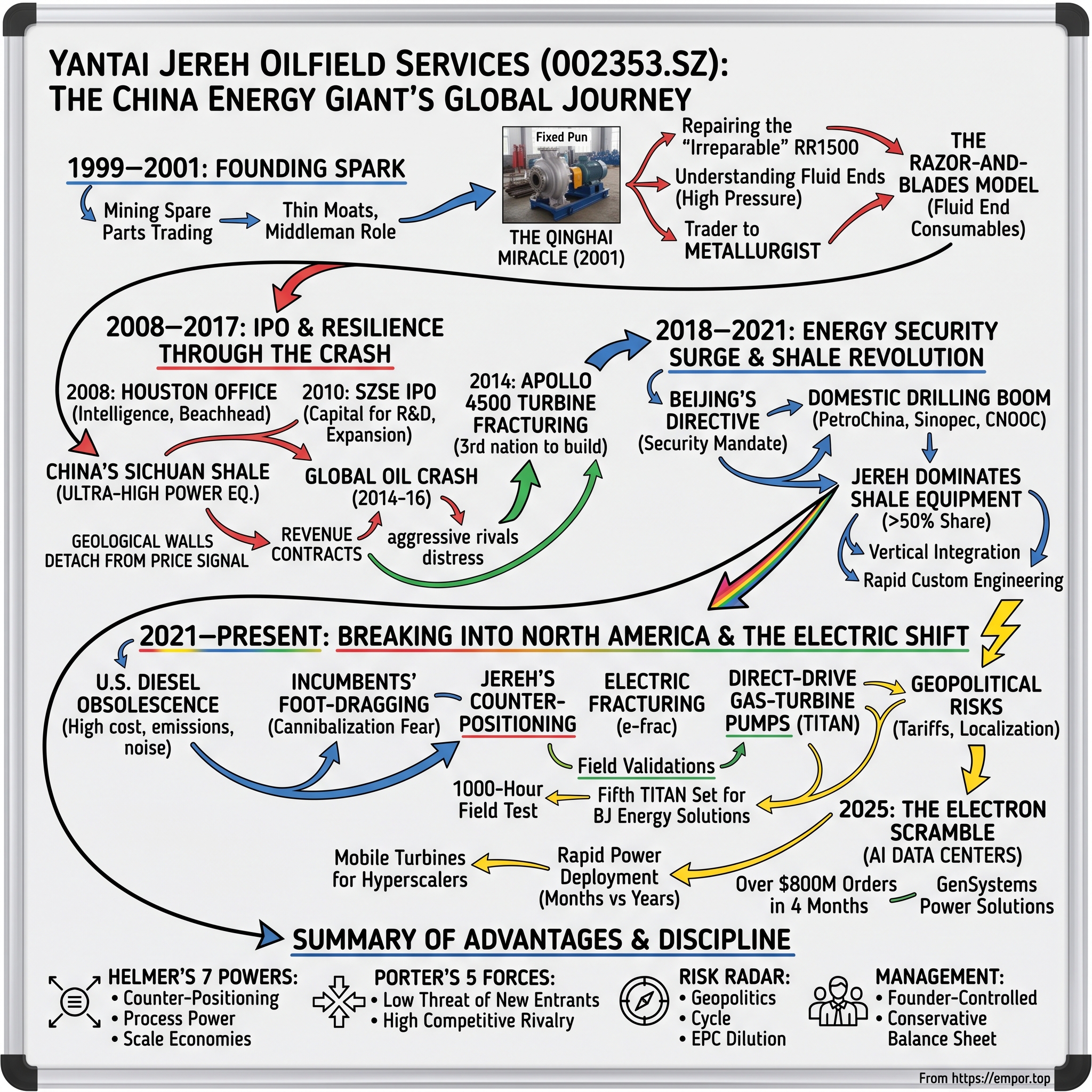
Yantai Jereh Oilfield Services: The China Energy Giant Powering the Global Shale Revolution
I. Introduction & The Core Question
Somewhere in the Permian Basin of West Texas, on a well pad ringed by mesquite and caliche dust, a fracturing crew is pumping sand-laden slurry into shale two miles beneath their boots. The pumps doing the work are not the diesel behemoths that built the American shale boom. They run quietly, well under the noise limit of a suburban lawnmower, burning gas straight from the wellhead. Stencilled on their skids is a name that would have seemed absurd on this ground a decade ago: 烟台杰瑞 Yantai Jereh, a company founded by three men in a coastal Chinese city who started out reselling secondhand parts for mining machinery.
That image captures the paradox at the center of this story. Here is a Chinese oilfield-equipment maker competing—and, on several fronts, winning—inside the heartland of the U.S. energy industry, the birthplace of hydraulic fracturing, selling equipment that is cleaner, cheaper to run, and more power-dense than the incumbents' installed base. And it is doing so while riding, at home, a state-backed campaign for energy self-sufficiency that guarantees it a captive domestic market. Jereh (002353.SZ) sits astride two of the largest capital cycles of the decade: the repowering of the world's fracturing fleets and, more recently, the desperate global scramble for electrons to feed artificial-intelligence data centers.1
The financial shape of the company frames the stakes. In its fiscal 2025 results, filed in spring 2026, Jereh reported revenue of roughly ¥16.2 billion (about $2.3 billion), up 21.5% year over year, and net profit of ¥2.68 billion, up about 2%, with operating cash flow that more than doubled—a combination worth pausing on, because it tells you the growth was real cash, not receivables dressed up as sales.2 The business rests on two core engines. High-end equipment manufacturing—fracturing units, coiled tubing, cementing spreads, turbines—is the higher-margin engine. Oil-and-gas engineering and technical services, the turnkey EPC arm, adds scale and international reach at thinner margins. Geographically the mix is roughly balanced between a domestic Chinese market dominated by state oil majors and a fast-growing international book spanning North America, the Middle East, and North Africa.
To appreciate why any of this is remarkable, you have to understand what hydraulic fracturing actually is, because it is the physical foundation of the entire company. Shale is rock that holds oil and gas in pores too tight for it to flow out on its own. To liberate it, operators drill down and then sideways through the shale layer, and then pump a slurry of water, sand, and chemicals into the wellbore at pressures high enough to crack the rock apart for hundreds of meters in every direction. The sand—called proppant—wedges into those cracks and holds them open so hydrocarbons can seep out. The machine that does the pumping is the fracturing unit, and it is a brutal piece of equipment: it must force abrasive, sand-laden fluid through steel at pressures that would turn a passenger car into a crumpled ball, and it must do so continuously, for hours, without failing. A single modern well pad might deploy a "spread" of a dozen or more such units working in concert. This is the market Jereh chose to master, and it chose the single hardest component within it.
The question this article tries to answer is not whether Jereh is a good company—it plainly builds serious hardware—but whether its advantages are durable or borrowed. Is the North American beachhead a structural counter-position against incumbents who cannot follow, or a temporary arbitrage that a tariff or an export ban could erase overnight? Is the domestic moat a competitive achievement or a policy subsidy? And is the sudden pivot into data-center power a disciplined extension of a real capability, or the kind of narrative that reliably shows up near the top of a cycle? The company's own materials, unsurprisingly, tell the triumphant version; the SZSE filings and the earnings-call Q&A tell a more textured one, and the international trade press tells a third.14[^17] Reconciling those is the work of the next eight sections. To begin, we have to go back to a broken pump in the Qinghai desert—and to three men who had no business fixing it.
 Subscribe on LinkedIn
II. The Founding Spark: Mining Spare Parts & The Qinghai Miracle (1999–2007)
Yantai is a mid-sized port city on the Shandong Peninsula, better known for apples, wine, and Sino-foreign joint ventures than for heavy industry. It was here, in 1999, that Sun Weijie (孙伟杰), Wang Kunxiao (王坤晓), and Liu Zhenfeng (刘贞峰) founded Yantai Jereh Equipment Co., Ltd.1 The founding business was about as unglamorous as industrial commerce gets: buying imported spare parts for mining and heavy machinery and reselling them to Chinese operators who lacked the connections or the foreign exchange to source them directly. It was a trading company—a middleman—with all the structural fragility that implies. Margins were thin, the moat was nonexistent, and the value added was mostly logistics and relationships.3
It is worth dwelling on the men, because the culture they built still governs the company. Sun Weijie, who would become the group's driving strategist, was by temperament an engineer's entrepreneur—drawn to the hardest technical problems and, by the account of the company's own history, personally involved in the early product development that turned Jereh from trader to manufacturer.13 The trio came of age in the China of the late 1990s, a period when the country's industrial base was hungry for imported technology it could not yet make itself, and when a small firm that could bridge that gap—first by importing, then by copying, then by out-engineering—could ride the entire arc of Chinese industrialization upward. What distinguished them from the thousands of other trading firms born in that moment was a refusal to stay traders. The instinct, again and again, was to move toward the harder, more defensible thing, even when the easier margin was sitting right there. That instinct is the through-line of everything that follows.
The pivot came in 2001, and like most origin myths worth retelling, it came from a problem nobody else would touch. At the Qinghai Oilfield on the high, cold Tibetan Plateau—one of China's most remote and punishing operating environments, where the air is thin and the logistics chain stretches for hundreds of kilometers—an imported RR1500 fracturing pumper had been beaten to death by field service and declared irreparable by its Western maker. In the calculus of a foreign OEM, condemning the unit made perfect sense: it was cheaper to sell the customer a new one than to dispatch specialists across the world to nurse an old workhorse back to life. For the oilfield operator, though, that was an expensive dead end. For a scrappy Shandong trading firm looking for a way to matter, it was an opening.
Jereh's young engineers took the contract anyway. Over roughly three months they tore the unit down, studied the high-pressure fluid end and plunger-pump assembly until they understood not just how it was built but why it was built that way, and rebuilt it in the field.1 The unit worked. In an industry where reputation travels by word of mouth among a small fraternity of field hands and procurement managers, the story of the Chinese upstart who resurrected a dead pump on the roof of the world spread quickly. It was the kind of proof no advertisement could buy: not a claim about capability, but a demonstration of it, delivered on the customer's own well pad.
From trader to metallurgist
It is tempting to romanticize this as a lucky repair job. The more important reading is strategic. A trading company had just discovered that the scarcest, most defensible skill in the oilfield was not sourcing parts but understanding the physics of the one component that fails most catastrophically: the fluid end, the block of forged steel that must contain sand-laden slurry at pressures north of 15,000 PSI—roughly a thousand times atmospheric pressure—cycle after cycle, without cracking from metal fatigue. Think of it as the difference between selling water pumps and mastering the metallurgy of a component that must survive a jackhammer of abrasive grit hammering it thousands of times a minute. That is a skill you cannot buy off a shelf, and once you own it, customers keep coming back.
Why is the fluid end such a chokepoint? Because it lives at the intersection of three enemies of steel: extreme pressure, cyclic loading, and abrasion. High pressure alone is manageable—engineers have contained it for a century. But high pressure that pulses on and off thousands of times an hour introduces metal fatigue, the same phenomenon that snaps a paperclip you bend back and forth. Layer on top of that a slurry carrying millions of grains of sharp sand scouring the internal surfaces, and you have a component that is being simultaneously stretched, hammered, and sandblasted from the inside. Get the alloy, the forging, the internal geometry, or the heat treatment slightly wrong and the part fails—not gracefully, but explosively, at a pressure that can kill a crew. This is why the fluid end is consumable in the industry: it wears out and gets replaced, meaning whoever masters it owns not just an equipment sale but a recurring stream of high-margin replacement parts. Jereh had stumbled onto the razor-and-blades model buried inside heavy industry.
Jereh leaned into the hard part. It stood up an R&D department in 2002, and in 2003 delivered its first in-house product—a single-pump reinjection skid—to the state offshore services firm COSL, followed in 2004 by its first natural-gas compressor unit built for corrosive sour-gas duty.1 Each step marched the company up the value chain, away from commodity trading and toward proprietary, high-pressure fluid handling. By the mid-2000s Jereh was no longer a parts reseller with an oilfield sideline; it was an equipment maker with a repair heritage, which is a very different animal on a balance sheet and in a customer's procurement file.
Building a cult of the frontline
There is one more piece of the early culture worth flagging, because it recurs throughout the story. In 2008 Jereh launched what it calls the "Golden Key" Car Award (奖车仪式), an annual ceremony in which the company hands brand-new cars to standout employees—and pointedly, not just to executives, but to field technicians, machinists, and bench engineers.12 Imagine the scene: a company still years from being a household name, gathering its workforce to watch a machinist who spent the year perfecting a plunger tolerance drive off in a car worth more than his annual salary. In a Chinese labor market where migrant and industrial workers were used to being treated as interchangeable and disposable, the symbolism was deliberate and loud.
It is easy to dismiss as a stunt. It is more useful to read it as a deliberate labor-retention mechanism in an industry where the difference between a good frac job and a blown-out wellhead is the judgment of the person on the pad at 3 a.m. Oilfield service is a knowledge business disguised as a muscle business; the value walks out the door every evening and can walk to a competitor if the door is not worth staying inside. Jereh was buying loyalty and institutional memory before it had the profits to spare, betting that a retained frontline was cheaper than a churning one—and that engineers who felt like owners would solve the hard metallurgical problems rather than clock out at them. Whether that culture still creates value at ten-thousand-plus employees, or has calcified into an expensive tradition, is a fair question we will return to. For now, hold the thought: this was a company that decided early that its people, and its metallurgy, were the assets. Everything else—the trucks, the plants, the international offices—was downstream of those two bets. The next test would be whether either could survive the harsh discipline of the public markets and, right behind it, the worst oil crash in a generation.
III. Going Public, Sichuan Shale, & The Great Oil Crash (2008–2017)
If the first act was about mastering a component, the second was about learning the terrain—two of them at once, on opposite sides of the Pacific. In 2008 Jereh planted a flag in Houston, establishing American Jereh Corporation on a 37-acre site.1 The stated logic was manufacturing and service. The unstated logic was intelligence: Houston is the nervous system of the global oil business, and putting engineers there meant watching the North American shale revolution unfold in real time rather than reading about it a year later in translation. It was a cheap seat at the most important show in the industry.
Two years later, in March 2010, Jereh listed on the 深圳证券交易所 Shenzhen Stock Exchange under the ticker 002353.113 The timing was fortuitous. The listing came as global oil prices were recovering from the 2008–2009 financial crisis and as China's own drilling ambitions were accelerating, giving Jereh a public currency and a war chest exactly when the industry was leaning back into growth. The IPO did what IPOs are supposed to do for a capital-intensive manufacturer: it funded the plant expansion and R&D that a fluid-end business devours, and it converted the founders' private stakes into visible, market-priced wealth that tied their fortunes to the same share price outside investors now held. But it also started a clock on public accountability. From this point forward, every capital-allocation decision would be scrutinized quarterly, and the next five years would test—under the harshest possible conditions—whether the founders' famed conservatism was a genuine philosophy or merely a startup's lack of better options.
The Sichuan problem
China's shale ambitions ran into a geological wall. North American shale is relatively shallow and forgiving—the Marcellus, the Bakken, and much of the Permian sit at depths and pressures that a mature equipment industry had already tamed. The gas-bearing shale of the 四川盆地 Sichuan Basin was a different beast. It sits far deeper—commonly below 3,500 meters, sometimes past 4,500—under mountainous, faulted terrain riddled with hydrogen sulfide and complex stress fields, demanding pumping pressures around 140 MPa (roughly 20,000 PSI) sustained for hours. To put that in perspective, that is meaningfully more extreme than a typical U.S. shale job, and it punishes equipment mercilessly: more pressure means more fatigue, more heat, and more catastrophic potential when something lets go.
Off-the-shelf North American frac spreads were not built for it, and importing them wholesale would have been both expensive and inadequate. Working alongside 中国石油 PetroChina and 中国石化 Sinopec, Jereh engineered ultra-high-horsepower fracturing trucks tuned for Chinese rock—higher-pressure fluid ends, beefier drivetrains, control systems suited to continuous punishing duty in the mountains. This was the decisive strategic gift of geography. Because China's shale was harder to crack than America's, the domestic majors could not simply buy a solution off a foreign shelf; they needed a domestic partner willing to co-develop bespoke equipment, iterate in the field, and stand behind it 24/7. That collaboration hardened into something more valuable than any single order: qualification and institutional trust. Once your fluid ends are proven in a PetroChina shale campaign and your engineers are on a first-name basis with the operator's completions team, a foreign OEM cannot dislodge you with a lower price alone. Switching suppliers on mission-critical, safety-sensitive equipment is a decision measured in risk, not just cost—and Jereh had made itself the low-risk choice at home.
The crash that sorted the survivors
Then came the stress test. Brent crude, above $115 a barrel in mid-2014, collapsed to under $30 by early 2016 as OPEC opened the taps to crush the American shale boom and global supply overwhelmed demand. It was a deliberate price war, and its shrapnel hit everyone who sold equipment into the drilling industry. Exploration-and-production budgets were slashed worldwide; frac fleets were stacked and idled; and oilfield-equipment demand fell off a cliff. For a company that had just built its identity around selling fracturing hardware into a booming market, the timing could not have been crueler. Jereh was not spared—revenue and profit contracted sharply as orders evaporated across the industry.
The interesting question, from an investor's standpoint, is not whether the downturn hurt. Every cyclical bleeds in a bust; that is the definition of cyclical. The revealing question is what management did while bleeding, because a downturn is the truth serum of corporate character. Cheap money and a rising market let weak capital allocators look like geniuses; only a crash separates the disciplined from the reckless. Here the behavioral evidence matters more than any slogan. Jereh entered and exited the crash without blowing itself up—no debt-fueled land grab, no value-destroying acquisition binge, and, critically, no gutting of R&D. Contrast that with the fate of aggressive domestic rivals of the era, some of which chased high-interest debt and speculative property bets into distress. A skeptic should not simply take the tidy survival narrative at face value—every company that lives tells a story about discipline afterward—but the falsifiable test is what the company built at the trough, and here the record is concrete. In 2014, at the very moment peers were retrenching, Jereh launched the Apollo 4500 turbine fracturing pumper, delivering 4,500 hydraulic horsepower from a single unit and breaking the prior 3,115-HHP record, making China the third country—after the United States and Russia—able to build turbine-driven frac equipment.4[^5] The Apollo mated a ~5,600-horsepower turbine engine to Jereh's own JR5000 plunger pump in a package a fraction the size and weight of the diesel spreads it replaced.4
Why a turbine at all, and why did it matter so much? A conventional frac unit is driven by a large diesel engine—effectively a truck engine scaled up—which is heavy, thirsty, emissions-heavy, and limited in the horsepower it can pack into a given footprint. A gas turbine is a different class of machine, closer to a jet engine: it produces enormous power from a compact, lightweight package and can burn a range of fuels, including the gas coming straight out of the well. The Apollo squeezed the output of two diesel frac units into a single package a fraction of the size and weight, which on a crowded well pad is transformative—fewer units, less fuel logistics, smaller crews.4 It was, in effect, a preview of where the entire global industry would eventually head.
Investing in your most ambitious product during the worst market in a generation is either recklessness or conviction, and the way to tell them apart is what happens on the other side. Apollo's first field operation came in early 2015, on wells in North China, where it ran on multiple fuel types and demonstrated the footprint, labor, and fuel savings that would later become Jereh's core sales pitch abroad.4 The bet was straightforward and long-dated: when the industry eventually repowered—away from diesel, toward turbines and electricity—Jereh would already own field-proven technology while competitors were starting from a standstill. That is the essence of counter-positioning, and it is a bet you can only place years before the payoff, when it looks least sensible. It would take the better part of a decade to vindicate, and its first big catalyst arrived not from a market but from a mandate—courtesy of the Chinese state.
IV. The Energy Security Surge & China's Shale Revolution (2018–2021)
Picture the anxiety inside Beijing's energy planning apparatus in 2018. China had become the world's largest crude importer, buying well over two-thirds of the oil it burned from abroad, much of it routed through maritime chokepoints a rival navy could close. Energy dependence had gone from an economic line item to a national-security vulnerability. The response was a directive to the three state majors—PetroChina, Sinopec, and 中国海油 CNOOC—to reverse years of declining domestic output and drill at home, hard, under a multiyear action plan pushing production growth through the first half of the 2020s.
For a domestic completion-equipment specialist, this was the equivalent of a government mandating demand for your exact product. When the state tells its three largest oil companies to drill more regardless of the near-term economics—because barrels in the ground at home are worth more strategically than barrels bought from abroad—it detaches domestic activity from the global price signal that governs everyone else. A U.S. frac company lives and dies by whether the next well clears its cost of capital; a Chinese major drilling under a security mandate has a different, more forgiving objective function. E&P capital flooded into Sichuan tight gas, the deep oil of the Tarim Basin, and Bohai Bay offshore. Someone had to supply the fracturing trucks, sand blenders, hydration units, and coiled-tubing spreads to complete all those wells, and Jereh—having spent the crash years building rather than retrenching—was the domestic champion best positioned to do it. The company that had invested through the trough now met a wave of demand with product on the shelf and relationships already in place.
Owning the home market
Industry and company sources commonly credit Jereh with commanding more than half of the domestic market for shale-gas completion equipment through this period—a dominant position, though one an independent analyst should treat as an estimate rather than an audited figure, since precise fracturing-fleet market share is not cleanly disclosed. The more defensible point is the mechanism behind the share. Jereh manufactures the hardest parts of the spread in-house—the high-pressure pumps, the fluid ends, the automated control systems—rather than assembling bought-in components. That vertical integration is what lets the equipment business earn markedly richer gross margins than the services and EPC work, because the margin lives in the metallurgy and the controls, not in bending sheet metal. When a company keeps the scarce, hard-to-replicate step inside its own four walls and outsources the commodity steps, that is usually where pricing power hides.
War-gaming the competition
Why did Jereh win at home rather than one of the obvious giants? The instructive comparison is 三一重工 Sany Heavy Industry, a formidable construction-machinery maker that pushed into oilfield gear. Sany could build big diesel engines and heavy chassis all day, but pressure-pumping is not earth-moving; it lives or dies on fluid-end metallurgy and completion know-how that Sany did not have twenty years to accumulate. State-owned suppliers such as 宝鸡石油机械 BOMCO had scale and captive customers but moved at the pace of an SOE, with slower product cycles and less appetite for bespoke, fast-turn engineering. Aggressive private rivals like 科瑞石油 Kerui competed hard on price but lacked the balance-sheet discipline to compound through cycles. Jereh's edge was the intersection: specialized vertical integration, rapid custom engineering for punishing Chinese geology, and a 24/7 field-service presence that state suppliers rarely matched.
There is a subtler dimension to the domestic win worth drawing out, because it explains the margin structure that carries through the rest of the story. In equipment manufacturing, the value is captured by whoever controls the parts that are hard to make and dangerous to get wrong. By insourcing the fluid ends, plunger pumps, and control software, Jereh keeps for itself the steps where expertise commands a premium and hands off only the commoditized fabrication where anyone can compete. This is why the equipment segment throws off materially richer gross margins than the services and EPC work—the profit is concentrated in the proprietary internals, not in the assembled truck. It is the same logic that lets a chipmaker earn more than a laptop assembler: own the scarce step, outsource the rest.
The honest caveat for an investor is that a moat partly built on a national mandate is also partly exposed to it. Demand that policy created, policy can slow; a home-market position underwritten by state majors is a position at the mercy of state procurement and priorities, and one where pricing is negotiated with counterparties who answer to Beijing as much as to their own income statements. If the security mandate eases, or if the state decides to spread orders across suppliers for its own reasons, Jereh's home base looks less impregnable than the market-share figure suggests. That risk sat quietly in the background as long as domestic drilling boomed. It becomes far more visible when you ask the harder question Jereh started answering around 2019: could it win where no mandate protected it, where no one had to buy Chinese and every incumbent had a home-field advantage—in Texas, against Halliburton, on price and physics alone?
V. Breaking into the Permian: E-Frac, Turbines, & US Technology Arbitrage (2021–Present)
By the early 2020s the American shale patch had a problem it could no longer ignore. The Permian and Bakken ran on a vast installed base of diesel frac fleets—tens of thousands of engines—burning expensive fuel, throwing off carbon and noise, and aging toward retirement. Diesel prices bit into margins; investors and regulators pressed on emissions; and operators wanted more pumping power on ever-smaller pads. The fleet needed to be repowered. The only question was who would supply the replacement.
Counter-positioning, textbook grade
This is where Hamilton Helmer's idea of counter-positioning stops being jargon and becomes a live case study. The incumbents best placed to build electric and turbine frac equipment—Halliburton, Baker Hughes, Caterpillar—were also the ones with the most to lose by killing diesel. Every electric spread sold cannibalizes an installed base of diesel engines, service contracts, and parts revenue that those firms spent decades building. A dominant incumbent rationally drags its feet on the very product that would obsolete its own cash cow. That hesitation is not stupidity; it is the predictable behavior of a business protecting its profit pool—and it is exactly the opening a challenger with nothing to cannibalize walks through.
There is a nuance here that separates a lazy counter-positioning story from a rigorous one. Incumbents did not do nothing—Halliburton and others developed their own electric offerings. The point is not that they ignored the future but that they were structurally slower and more conflicted about embracing it, because every dollar of new-technology sales came at the expense of a profitable legacy franchise they were reluctant to disrupt. A challenger with no legacy diesel base to protect could move faster, price more aggressively, and treat the transition as pure upside. That asymmetry of incentives—not a difference in engineering talent—is the real source of the opening, and it is exactly what Helmer's framework predicts.
Jereh had spent the diesel-downturn years building the alternative. Its fully electric fracturing (e-frac) skids and direct-drive gas-turbine pumpers—the commercial descendants of Apollo—do the same job as diesel spreads while, on Jereh's own field data, cutting fuel costs by up to 80% when running on cheap wellhead gas, slashing CO₂, and shrinking the pad footprint and noise profile enough to meet North American limits below 85 decibels.10[^6] To explain the electric version in plain terms: instead of a dedicated diesel engine bolted to every pump, you generate electricity centrally—from the grid or a mobile turbine—and run the pumps on electric motors, the same reason an electric car is quieter, simpler, and cheaper to fuel than a fleet of small gasoline generators. The economics are compelling where they work: an operator sitting on a well producing associated gas can burn that otherwise-flared gas to power the very fracs completing the next wells, turning a waste stream and an emissions liability into free fuel. When a technology lets a customer cut both cost and carbon at once, adoption tends to be a question of when, not whether.
From demonstration to delivery
The tell that this is more than a marketing brochure is repeat commercial orders from sophisticated American buyers who have no political reason to favor a Chinese supplier and every reason to be ruthless about equipment that fails. Jereh's third-generation turbine fracturing pump completed a 1,000-hour field trial in North America—an endurance test, not a photo op—validating multi-fuel operation on LNG, CNG, and field gas and demonstrating that the pump could eliminate wasteful idling during non-pumping periods.10 A thousand hours in the field is the kind of milestone that matters to a hard-nosed completions engineer far more than any horsepower spec sheet, because it speaks to reliability, the single trait that determines whether a fleet makes money or bleeds it on non-productive time.
More telling still, BJ Energy Solutions took delivery of its fifth set of TITAN natural-gas direct-drive turbine fracturing units built by Jereh in March 2025, lifting BJES's total offering to roughly 400,000 hydraulic horsepower across the Montney/Duvernay, Haynesville, Anadarko, Eagle Ford, and Permian basins.9 The word to focus on is fifth. In capital equipment, the first sale can be won on price or novelty or a persuasive salesperson; the fifth is earned only by hardware that showed up, worked, and made the customer money four times before. A satisfied pressure-pumper repeatedly re-upping is the strongest possible independent verification of a product, worth more than any amount of company-issued data. Alongside the pumps, Jereh's 35-megawatt mobile turbine "Power2Go" package ran e-frac operations in the Permian, supplying over 350 hours of continuous power at 20 megawatts to drive a 50,000-horsepower fleet.11 That deployment quietly foreshadowed the next act, because a mobile turbine that can power a frac fleet can, with little modification, power anything else hungry for electricity in a hurry. These are the proof points that separate a real product from a press release—and they are precisely the KPIs a diligent investor should keep counting.
The tariff tightrope
None of this happens in a geopolitical vacuum, and an honest account has to weigh the bear case built into the model. Chinese-made energy equipment sold into the United States faces Section 301 tariffs, foreign-investment scrutiny, and the standing risk that a policy shift could raise the cost of—or simply bar—the whole trade. Jereh's mitigation is to localize: assemble, test, and service through its Houston and Midland, Texas operations while manufacturing lower-cost components in Yantai, preserving a hardware cost advantage often estimated around 30% against Western rivals.9 It is a clever structure, but investors should size the risk honestly: the North American thesis rests on an arbitrage—cheap Chinese engineering meeting expensive Western demand—that exists at the sufferance of trade policy. The company can localize final steps, but it cannot localize its way out of a determined political decision to shut the door. That fragility is the price of the whole opportunity, and it will not go away. It also explains why Jereh has been so eager to find a second act for its turbines—one that a hyperscaler in Texas wants badly enough to fight for. Which brings us to the segments.
VI. Segment Economics & Sizing the "Hidden / New" Bets
Strip away the narrative and Jereh is, in cash terms, still an oilfield-equipment company with two dominant engines and a cluster of smaller bets whose importance is more strategic than financial. The rough shape looks like this: the core—high-end equipment manufacturing plus oil-and-gas engineering and services—generates the large majority of revenue and the overwhelming majority of profit, while the emerging businesses in power generation and environmental technology are still a modest slice of the top line. Keeping that proportion in mind is the single best defense against the most common error in reading a story stock: mistaking the exciting new bet for the thing that actually pays the bills.
Core Pillar 1: High-end equipment manufacturing
This is the crown jewel—fracturing units in every flavor (diesel, electric, turbine), coiled tubing, cementing spreads, and automated sand-mixing systems. It is the highest-return, highest-margin pillar precisely because Jereh builds the scarce internals itself, the advantage described earlier. When management is pressed on why the company can keep winning against both Western giants and domestic upstarts, the answer always routes back through this segment's vertical integration. It is the engine, and everything else is either upstream of it (services that pull equipment through) or a call option built on its technology.
The segment also has a hidden virtue that dry margin tables miss: it is a razor-and-blades business. Every fracturing spread Jereh sells becomes an annuity of consumable fluid ends, pumps, and spare parts that wear out and must be replaced—recurring, high-margin revenue that keeps flowing long after the initial equipment sale and grows as the global installed base of Jereh iron expands. This is the quiet compounding underneath the headline equipment orders, and it is the part of the business least sensitive to the drama of any single year's capex cycle. An investor evaluating Jereh should think of the installed fleet not just as past sales but as a growing base of future aftermarket demand.
Core Pillar 2: Oil & gas engineering and technical services (EPC)
The second pillar is turnkey engineering, procurement, and construction—gas-processing plants, field digitalization, drilling services—and it plays a very different financial role. EPC wins are enormous in headline value but thin in margin. The landmark example is the $855 million contract Sonatrach awarded Jereh in July 2025 to build a gas compression station and modernize pipeline infrastructure at Algeria's Rhourde Nouss field, one of the country's largest, running from late 2025 through 2028.5 It followed Jereh's earlier EPC breakthrough in Algeria's ROD/BRN fields in 2021 and, in the Gulf, a roughly $920 million digitalization contract tied to Abu Dhabi's ADNOC.61
Here is where independent analysis has to push back on the growth story. EPC revenue is real and it internationalizes the company, but it dilutes group margins and consumes working capital and execution bandwidth. A billion-dollar desert construction project carries schedule risk, currency risk, and counterparty risk that a frac-unit sale does not. The right way to read the EPC book is as scale and geopolitical foothold purchased at the cost of return quality—useful, but not to be confused with the equipment engine's economics. Management's own framing on investor calls—that the high-margin equipment business subsidizes the expansion of lower-margin EPC—is candid, but it is also an admission that the two are pulling group ROIC in opposite directions.
The fast-growing bet: data-center and gas-turbine power
The genuinely new engine, and the reason the stock re-rated, is power generation. The logic is elegant enough that it almost sells itself. AI data centers need vast amounts of electricity, immediately, and the traditional path—requesting a grid connection from a utility—can take years, because transmission queues in the United States have backed up under the weight of the AI build-out. A hyperscaler that has spent billions on chips cannot let them sit idle waiting for a substation. Jereh's answer is the same mobile gas turbine it perfected for the oilfield, trucked to the site and switched on to provide prime power in months rather than years—bridging the gap until grid power arrives, or serving as primary power where the grid never will. Jereh took an asset it already built at scale and pointed it at the one customer on Earth more desperate for electrons than a frac crew.
The order flow has been striking, and fast. Through its U.S. subsidiary GenSystems Power Solutions, Jereh booked a $341 million gas-turbine generator order for North American data centers, announced March 31, 2026, with delivery scheduled by the end of 2027—its fifth U.S. order since November 2025—following a $182 million deal in February 2026, roughly $212 million combined in late 2025, and an order above $100 million in January 2026, adding up to more than ¥5.7 billion (over $800 million) of such orders in about four months.78[^18] The $341 million order alone equated to roughly 18% of the company's 2024 revenue—a single contract worth nearly a fifth of the prior year's entire top line, which explains why the shares moved on the news.7 To house and scale the effort, Jereh stood up a dedicated energy business unit in 2025.7
The bull reading is obvious: a field-proven asset finds a booming new market with grid interconnection queues stretching years, and turbines you can truck in and switch on look like magic. The skeptic's questions are just as obvious and deserve equal airtime. These orders are barely months old; the company itself notes that data-center power orders only began in late 2025, with only limited turbine sales in 2021 and 2023 before that, so there is no multiyear track record of delivery, uptime, or repeat purchasing in this specific application.7 Backlog is not revenue until it is delivered and paid, and a rush of orders is exactly what you would expect both from a genuine boom and from the frothy top of a hype cycle—the two look identical until the deliveries and reorders come through. Concentration is high—a handful of clients, some unnamed, one of them accounting for multiple orders. And the entire thesis is tethered to an AI-capex supercycle whose durability is itself the subject of fierce debate; if hyperscaler spending pauses, the data-center turbine order book could cool as abruptly as it heated. This is a promising option, not yet a proven annuity, and a disciplined investor should value it as the former—an exciting call option layered on top of the oilfield cash engine, not a new certainty.
The speculative sliver: environmental and battery recycling
Finally, the smallest bets: oil-sludge treatment (油泥处理), a Yibin anode-material plant, and Hungarian battery recycling, folded in under the 2021 push into new energy.1 Sized honestly, this is a low-single-digit slice of revenue—a speculative call option on the circular economy, not a pillar. It earns a sentence, not a chapter, and any analysis that inflates it is selling a story the numbers do not support. The people deciding how much to pour into these bets, and how much to return to shareholders, are the subject of the next section.
VII. Current Management, Governance, & Capital Allocation
Twenty-five years after three traders pooled their capital in Yantai, the founding trio still sits at the center of the company. Sun Weijie (孙伟杰) remains the strategic principal and public face, the visionary of the group, alongside co-founders Wang Kunxiao and Liu Zhenfeng; the founders collectively retain a large equity stake, which is the most important governance fact about the business.3 It means the people setting strategy are wealthy or poor alongside outside shareholders, on the same shares, rather than optimizing a bonus untethered from the stock. Founder-owners with real skin in the game tend to think in decades and resist the quarterly-earnings games that erode industrial companies from within—which is consistent with the through-the-cycle behavior described earlier.
Day-to-day international scaling and supply-chain execution fall to a professional-manager cohort led by president Li Zhiyong (李志勇), whose remit—globalizing a Chinese heavy-industrial firm across the U.S., the Gulf, and North Africa simultaneously—is one of the harder operating jobs in the sector, given the tariff, logistics, and localization complexity involved. The governance question an outside investor should keep live is the standard founder-control tradeoff: durable long-term vision and fast, unconflicted decision-making on one side; concentrated power, limited external check, and key-person risk on the other. Jereh's future is unusually dependent on a small founding group continuing to make good calls and, eventually, on whether they can institutionalize their judgment into a bench deep enough to outlast them. Succession, in other words, is a real and under-discussed risk in a company still so identified with its founders.
Incentives and culture
Jereh's cultural machinery is more elaborate than the car ceremony alone. Its "Partner Plan" (事业合伙人) extends multi-tiered equity ownership to well over a thousand key technical and managerial staff, a serious attempt to make the people who design the fluid ends and win the field contracts think like owners. The Golden Key Car Award, meanwhile, has run for over a decade and a half; by the company's accounting it has covered 524 employees with cars worth more than $11.8 million cumulatively, including 37 vehicles handed out at the January 2025 ceremony.12 Read generously, this is a coherent, well-funded retention strategy in a business where human judgment on the pad is a genuine asset. Read skeptically, spectacle has a way of substituting for governance, and an outside shareholder should want evidence that the incentive plans track hard performance rather than tenure or loyalty. The two readings are not mutually exclusive.
Capital allocation
On the numbers, the capital-allocation record is where the "disciplined founder" narrative earns the most credit. Jereh has run a conservative balance sheet—a consistent net-cash position and modest leverage—rather than the debt-fueled expansion that felled rivals in the last downturn. In a violently cyclical industry, a net-cash balance sheet is not timidity; it is optionality. It is what lets a company keep spending on R&D and keep its best engineers through a bust—exactly the Apollo playbook—while over-leveraged competitors are forced to cut, sell assets, or fold. The balance sheet is the mechanism that turns a downturn from an existential threat into a market-share opportunity.
Jereh has also grown through organic, greenfield expansion in Yantai and Houston rather than overpriced acquisitions, the pattern that so often destroys value in cyclical industrials chasing scale at the top of a cycle. Building capacity yourself is slower and less glamorous than a splashy deal, but it avoids the goodwill write-downs and integration disasters that litter the sector's history. And it has returned cash: the fiscal 2025 dividend payout worked out to roughly a third of net profit, consistent with prior years, while operating cash flow more than doubled.2 For a company simultaneously funding a hardware-heavy growth story, a data-center power build-out, and a real dividend, that is a defensible balance—neither hoarding cash to no purpose nor starving the business to over-distribute. The pattern across two decades is coherent: spend counter-cyclically, avoid leverage and empire-building M&A, and share the proceeds. That is the profile of a management team whose stated discipline is corroborated by its behavior, which is the only kind of credibility that counts.
Reading the calls
Management's credibility is best judged by how it behaves under questioning, and Jereh's SZSE investor Q&A and quarterly disclosures give a live read. The recurring analyst pressure points are exactly the two an independent observer would zero in on: U.S. tariff exposure and EPC margin dilution. To management's credit, the responses have tended toward the concrete—specific North American e-frac and turbine unit-shipment figures, explicit framing of how equipment margins cross-subsidize EPC growth—rather than vague reassurance. There is an important distinction, familiar to anyone who reads a lot of transcripts, between prepared remarks and the live Q&A. Prepared remarks are choreographed and can make any quarter sound like a triumph; the Q&A is where management is forced off-script, and where evasion or specificity actually shows. A team that answers a pointed question about tariff exposure with an exact shipment count and a clear explanation of its localization strategy is behaving differently from one that retreats into slogans about "strategic partnerships" and "long-term confidence."
Concrete, falsifiable answers are a good sign; they let outsiders check the next quarter against this one, which is the entire point of listening to calls. The test going forward is consistency across time: whether the narrative on tariffs, margins, and data-center durability holds from call to call, or quietly shifts when a number disappoints—because unexplained strategy pivots and disappearing metrics are the clearest early warnings a diligent investor gets. So far the record reads as reasonably disciplined, but the data-center business is new enough that its real test—how management explains the first quarter those orders slip or a client pauses—still lies ahead. That is the discipline the rest of this analysis will hold Jereh to, and it feeds directly into the competitive framework that decides whether any of this adds up to a durable advantage.
VIII. Hamilton Helmer's 7 Powers & Porter's 5 Forces Analysis
Strategy frameworks are only useful if they survive contact with a skeptic, so run Jereh through two of them and stress each claimed advantage against the evidence rather than the pitch.
Helmer's 7 Powers
Helmer's framework is useful precisely because it forces you to name the mechanism behind an advantage rather than gesture at "a great company." Of the seven powers, Jereh can credibly claim three, and it is worth being explicit about which three and why the others do not apply.
Counter-Positioning. This is Jereh's strongest and most defensible power, examined at length above: it pioneered electric and direct-drive turbine fracturing in North America precisely while legacy Western OEMs were structurally reluctant to obsolete their own diesel installed base. The advantage is real because the incumbents' hesitation is rational and self-inflicted—the surest sign of genuine counter-positioning is that the incumbent can see exactly what you are doing and still cannot bring itself to respond in kind, because responding would cannibalize its own profits. Its limit is that counter-positioning against a competitor's business model offers no protection against a government's trade policy—the moat holds against Halliburton, not against Washington. It is also, by nature, a temporary power: once the whole industry has repowered and diesel is dead, the incumbents' conflict of interest disappears and they compete freely on the new technology. Counter-positioning wins the transition; it does not win the steady state.
Process Power. Two decades of proprietary metallurgy and machining know-how for fluid ends, plungers, and manifolds that must survive 15,000-PSI sand erosion is a slow-accreting, hard-to-copy capability—the closest thing Jereh has to a trade secret compounded over time. This is the most durable of the powers because it is embedded in people and process, not in a patent that expires or a price that can be matched.
Scale Economies. China's domestic energy mandate handed Jereh manufacturing volume that translates into a hardware cost edge—commonly estimated near 30%—over Western competitors.9 The honest asterisk: this scale is partly a gift of policy-driven domestic demand, so it is a real advantage today but a partly borrowed one, contingent on the home market staying large and open to its own champion.
Notably, the powers Jereh does not obviously hold matter too. There is little switching-cost lock-in or network effect in selling frac units; buyers requalify suppliers, and a satisfied customer is not a captive one. The moat is cost and technology, not customer capture—which is a shorter moat than a subscription business enjoys.
Porter's 5 Forces
Threat of new entrants — Low. Capital intensity, brutal reliability requirements (a fluid-end failure at 15,000 PSI is a safety event, not an inconvenience), and multiyear qualification cycles with PetroChina, Sinopec, and ADNOC keep casual entrants out.
Bargaining power of buyers — Moderate to high. Jereh sells to some of the most powerful counterparties on the planet: state oil majors and large pressure pumpers who buy in size and negotiate hard. Its proprietary turbine and e-frac technology is the counterweight that keeps it from being a pure price-taker, but concentration among a few giant buyers is a genuine source of pricing pressure.
Bargaining power of suppliers — Low to moderate. In-house manufacture of core hydraulic components blunts supplier leverage, but Jereh still depends on specialized third parties for certain gas-turbine power units, a dependency that matters as the power-generation business scales.
Threat of substitutes — Low in the medium term. Geothermal and nuclear are long-dated alternatives; for now, gas and shale completions remain baseload-critical, and the energy transition arguably increases near-term demand for the gas turbines Jereh sells.
Competitive rivalry — High. Jereh fights on two fronts at once—Sany, Kerui, and BOMCO at home; Halliburton, Baker Hughes, and Caterpillar abroad—which forces relentless reinvestment in power density and fuel flexibility. Intense rivalry is a permanent tax on margins, and it is the force most likely to erode Jereh's cost lead over time.
The composite picture: genuinely strong powers in technology and cost, a real but policy-contingent scale edge, and no customer lock-in—a company that has to keep out-engineering the field to stay ahead. Put differently, Jereh's moat is offensive rather than defensive. It does not trap customers or collect rents from a captured position; it earns its place every cycle by being cheaper and more advanced, which is a demanding way to compound but an honest one. Businesses like this reward relentless reinvestment and punish complacency, and the day Jereh stops out-innovating is the day the moat starts draining. That framing sets up the investment spine—the explicit case for why the company wins from here, and the specific developments that would prove the bulls wrong.
IX. Strategic Position & Investment Spine: Bull vs. Bear Case
Every fundamental thesis reduces to a spine: why this company wins from here, and what would break it. Jereh's is unusually crisp because its advantages and its vulnerabilities spring from the same roots.
Myth versus reality
Before the cases, it is worth puncturing three lazy consensus narratives that attach to a story like this one. The first myth is that Jereh is "just a cheap Chinese knockoff manufacturer competing on price." The repeat orders from BJ Energy Solutions and the thousand-hour field validations argue otherwise; you do not requalify a safety-critical supplier five times over on price alone, and turbine fracturing is technology only three countries could build when Jereh entered it.910 The reality is a genuine engineering franchise that also happens to enjoy a cost advantage. The second myth, its mirror image, is that Jereh has "beaten the Western majors." It has not; it has found a specific, structurally protected opening—the diesel-to-electric transition—and exploited it, while Halliburton and Baker Hughes remain vastly larger and dominant across most of the value chain. Winning a beachhead is not winning the war. The third myth is that the data-center pivot has "de-risked" the company from oil. In cash terms Jereh remains an oilfield-equipment business with a promising sideline; the turbine-for-AI order book is months old and could prove either a durable new leg or a cyclical spike. Holding those three corrections in mind is the precondition for an honest bull-versus-bear debate.
The bull case
A global fleet-repowering super-cycle. The transition from diesel to electric and turbine frac fleets across North America and, increasingly, the Middle East is a multiyear capital cycle, and Jereh holds a genuine technical lead validated by repeat orders, not just brochures.910 If the repowering runs for years, Jereh's early head start compounds.
An unshakable—if policy-linked—domestic base. China's energy-security mandate underwrites baseline demand and a steady stream of high-margin replacement orders from the state majors, giving Jereh a cash engine at home to fund its riskier international and power bets.
Data-center power optionality. The turbine-for-AI business is the fastest-growing story in the company, tapping a global electricity shortage with an asset Jereh already builds well.7 Even valued conservatively as an option, it adds a growth vector uncorrelated with the oil price.
The bear case
Geopolitics and tariffs. The single largest risk is that the U.S. market—the highest-margin, highest-visibility part of the growth story—gets throttled by higher Section 301 tariffs, investment restrictions, or an outright bar on Chinese energy-infrastructure equipment. Localization softens this; it does not neutralize it.
Crude-price cyclicality. Jereh remains, at its core, geared to oil-and-gas capex. A sharp, prolonged fall in crude—say Brent durably below $50—would freeze E&P budgets and push fleet-upgrade decisions to the right, exactly as the 2014–2016 crash did. The domestic security mandate cushions this at home, and the aftermarket parts annuity provides some ballast, but the international equipment and EPC book is fully exposed to the oil price like any oilfield-services franchise. Investors attracted by the data-center growth story should not forget that they are still, underneath it all, buying a cyclical tied to the most volatile commodity on Earth.
EPC margin dilution and complexity. The land-grab for billion-dollar Middle Eastern and North African EPC contracts scales revenue while diluting return on capital and importing execution risk, the classic way an industrial's quality of earnings quietly deteriorates even as the top line impresses.
An activist skeptic would add a fourth: portfolio sprawl. A company simultaneously making frac pumps, building desert gas plants, powering data centers, refining anode materials, and recycling batteries in Hungary invites the question of whether it is compounding a core competence or drifting toward "diworsification"—the value-destroying habit of bolting on unrelated businesses that dilute focus and returns. The counter is that turbines and high-pressure fluid handling are the genuine common thread running through the equipment, EPC, and power segments; those are not random diversifications but adjacent applications of the same core engineering. The environmental and battery ventures are harder to defend on that logic, and they are precisely where a skeptical investor should press: do the anode plant and the recycling operation earn their cost of capital, or are they subscale science projects consuming cash and management attention that the oilfield engine has to subsidize? Sized at a low-single-digit share of revenue, they are too small to sink the thesis today, but they are exactly the kind of optionality that quietly turns into orphaned distraction if no one enforces the discipline of shutting down what does not work.
The same activist would scrutinize disclosure and governance through a China-specific lens. Segment-margin granularity, related-party dealings, the true concentration of the data-center order book, and the checks on a founder-controlled board are all areas where an outside investor is relying more on trust and less on the forensic disclosure a U.S.-listed peer would be forced to provide. None of that is evidence of a problem; it is a reminder that the information asymmetry is larger here, and that the appropriate response is to weight verifiable operating proof—unit shipments, repeat orders, cash conversion—over management narrative wherever the two might diverge.
The risk radar
Beyond the three headline bears, a few second-order risks belong on the radar because they touch the specific mechanics of this business. Supply-chain dependency is one: Jereh insources its hydraulic core but still relies on specialized third parties for certain gas-turbine components, and the data-center push multiplies that turbine demand at exactly the moment global turbine supply is stretched by the same AI boom—if Jereh cannot secure turbines, the order book cannot convert. Currency and cross-border payment risk is another, magnified by a rapidly internationalizing revenue base spanning U.S. dollars, dinars, and dirhams against a yuan cost structure. Execution risk in the EPC book is a third—billion-dollar desert construction runs on schedule and cost discipline that a manufacturer of frac units does not natively possess. And there is the ever-present geopolitical tail: a serious escalation in U.S.–China tensions could restrict not just Jereh's sales into America but the flow of components, engineers, and capital in both directions. None of these is disqualifying; together they define the risk texture beneath a genuinely attractive growth story.
The KPIs that actually matter
An investor cannot track everything, so narrow it to three signals that would confirm or break the thesis fastest:
- International revenue share and overseas order intake. The whole growth story is internationalization; the percentage of revenue earned abroad and the trajectory of the overseas order book (the FY2025 report emphasized record overseas orders) is the cleanest read on whether it is working.2
- High-end equipment gross margin. This is the company's economic heart. If hardware margins hold up as EPC and power scale, the cross-subsidy story is intact; if they compress, the quality of the whole franchise is eroding.
- E-frac and gas-turbine unit shipments. Physical delivery counts into North America, the Middle East, and now data centers are the ground truth behind every narrative—harder to spin than a revenue line, and the first place execution problems would show.
Watch those three across successive filings and calls, and the bull-versus-bear debate largely resolves itself in the data.
X. Outro & Lessons for Investors
Step back from the frac pumps and the turbine orders, and Jereh's arc offers a few durable lessons that outlast any single quarter.
The first is the power of mastering the hardest physical bottleneck. Jereh did not win by being cheap or by being Chinese; it won by understanding, better than almost anyone, the metallurgy of a component that must survive a jackhammer of grit at 15,000 PSI. Owning the hardest problem in a value chain—the part that fails catastrophically if you get it wrong—is a more durable moat than owning the biggest factory or the lowest headline price. Scale can be built and prices can be matched; two decades of accumulated process knowledge cannot be, at least not quickly.
The second is the counter-intuitive value of investing through the trough. Jereh built Apollo, and the electric and turbine platforms that followed, during the worst oil market in a generation, when the disciplined-sounding move was to cut. That timing is why it arrived at the North American repowering cycle with a finished product while incumbents were still deciding whether to cannibalize themselves. Counter-positioning is not just a strategy you choose; it is a bet you fund when it is least comfortable to do so.
The third lesson is cultural, and the most contestable. Jereh's car awards and partner plans align the frontline in a way that pure hierarchy does not—a form of capital allocation aimed at retention rather than assets. In a knowledge business masquerading as a metal-bending one, keeping the people who hold two decades of accumulated fluid-end know-how may be the single highest-return use of capital available, more valuable than any building. Whether that culture is a genuine competitive edge or an expensive habit that outlived its usefulness is a question the numbers will keep testing, and an honest analyst holds both possibilities open. It sits alongside the harder questions this analysis has tried to keep in view: a moat partly leased from the Chinese state, a growth engine partly exposed to American trade policy, an EPC book that buys scale with margin, and a data-center bet that is thrilling and unproven in equal measure.
A fourth lesson, quieter than the others, is about the discipline of proportion. Jereh's own story tempts you to lead with the two most exciting things—Texas and AI data centers—when the truth is that an oilfield-equipment engine, anchored by a domestic base and a growing aftermarket annuity, still pays for everything. The most common way investors lose money on companies like this is by paying for the option and ignoring the core, or by mistaking a months-old order surge for a permanent new business. The correct posture is to size each piece to its actual economic weight, count the physical proof points quarter by quarter, and let the exciting parts be upside rather than the whole thesis.
Yantai Jereh's evolution—from three men reselling mining parts in a Shandong port to a company powering fracturing crews in Texas and, perhaps, the data centers training the next generation of AI—is a genuinely remarkable industrial story. The task for a long-term investor is to hold the admiration and the skepticism at once: to see the real engineering advantage clearly, and to keep asking, filing after filing, which parts of the moat Jereh built and which parts it merely borrowed.
References
-
Yantai Jereh Oilfield Services Group: Revenue up 21.48%, net profit at ¥2.68B, strong cash flow, and record overseas orders — TradingView / Quartr, 2026 ↩↩↩
-
Jereh Apollo 4500 Turbine Frac Pumper Finishes Successful Field Operation in China — PR Newswire, 2015 ↩↩↩↩
-
Sonatrach Awards $855 Million Gas Infrastructure Contract to China's Jereh Group — DzairTube, 2025-07-16 ↩
-
Jereh awarded EPC Contract for Gas Debottlenecking Project in Algeria — Jereh Group, 2021-06-04 ↩
-
China's Jereh Rises After Landing USD341 Million Gas Turbine Generator Order for US Data Centers — Yicai Global, 2026-03-31 ↩↩↩↩↩
-
China's Jereh wins $341 million North America data center power order — Jiemian Global, 2026 ↩
-
BJ Energy Solutions, LLC takes delivery of fifth set of TITAN Hydraulic Fracturing Units from Jereh Energy Equipment and Technologies Corporation — PR Newswire, 2025-03-13 ↩↩↩↩↩
-
Jereh Turbine Fracturing Pump Completes 1000-Hour Field Test in North America — Jereh Group ↩↩↩↩
-
Jereh 35MW Mobile Gas Turbine Package Offers Superior Power Delivery in the Permian Basin — Jereh Group ↩
-
Yantai Jereh Oilfield Services Group Co Ltd (002353.SZ) Company Profile — Reuters ↩
-
SZSE Public Disclosure Page for Yantai Jereh (002353.SZ) — CNINFO ↩
 LinkedIn
 WhatsApp
 Reddit
 Hacker News
 Email
Email Kindle
 RSS Feed
 Spotify
 Apple Podcasts
 Amazon Music
 Audible
 YouTube