S.F. Holding Co., Ltd. (002352.SZ / 6936.HK): The FedEx of China and the Battle for High-End Logistics
I. Introduction & Episode Roadmap
Picture a young man in the early 1990s, standing in the crush of the Lo Wu border crossing between Hong Kong and Shenzhen, a battered suitcase in each hand. Inside those cases are not clothes or contraband in the usual sense, but garment samples, signed contracts, and legal documents belonging to factory bosses in the Pearl River Delta who need them across the border today, not next week. He walks them through customs himself, hands them to a colleague on the other side, and turns around to do it again. His name is 王卫 Wang Wei, and he has just invented, more or less by accident, the business that would become 顺丰控股 S.F. Holding Co., Ltd.
Three decades later, that suitcase operation has metamorphosed into something almost unrecognizable. In the financial year 2025, S.F. Holding reported revenue of RMB 308.2 billion, up 8.4% year over year, and net profit attributable to owners of RMB 11.1 billion.1 It moved 16.6 billion parcels in a single year.1 It owns and flies the largest all-cargo freighter fleet in Asia through 顺丰航空 SF Airlines, which crossed 90 aircraft in March 2025.3 And it anchors 鄂州花湖国际机场 Ezhou Huahu International Airport in Hubei province, Asia's first purpose-built cargo hub airport, modeled with almost reverent precision on FedEx's Memphis SuperHub.2
Here is the strategic paradox that makes S.F. one of the most interesting companies in global logistics. The Chinese express industry was built on a very specific idea: that parcel delivery is a commodity, that the winning move is to be the cheapest, and that the way to be cheapest is to be asset-light. The dominant players—the 通达系 Tongda Gang, meaning 中通 ZTO Express, 圆通 YTO Express, 申通 STO Express, and 韵达 Yunda Holding—all ran franchise networks. They owned very little. Local entrepreneurs bought the trucks, hired the couriers, and ran the sorting sheds; the brand collected a toll on every package. It was a machine for converting China's e-commerce explosion into volume at rock-bottom prices.
Wang Wei did the opposite of all of it. He bought the trucks. He bought the airplanes. He built the sorting hubs. He put every one of his hundreds of thousands of couriers in a company uniform under a 100% 直营模式 direct-operated model. Where the industry chased volume, he chased speed and reliability and charged a premium of three to five times for it. For most of the 2000s and 2010s, that looked like genius. Then, for one brutal quarter in 2021, it looked like a catastrophe.
Scale-check that "juggernaut" word, because it is not hyperbole. By 2024, S.F. was the largest integrated logistics service provider in China and across Asia, and the fourth-largest logistics company in the world by revenue.14 In the first nine months of 2024 alone, S.F. earned more revenue than its four largest domestic express rivals—STO, YTO, Yunda, and 德邦 Deppon—combined, a gap that tells you the company is not really competing in the same weight class as the Tongda networks even though the outside world lumps them together.14 The franchise players win on parcel count; S.F. wins on parcel value. That distinction—volume versus value—is the thread that runs through every chapter that follows, and it is the single most important thing to hold in your head while reading the rest of this story.
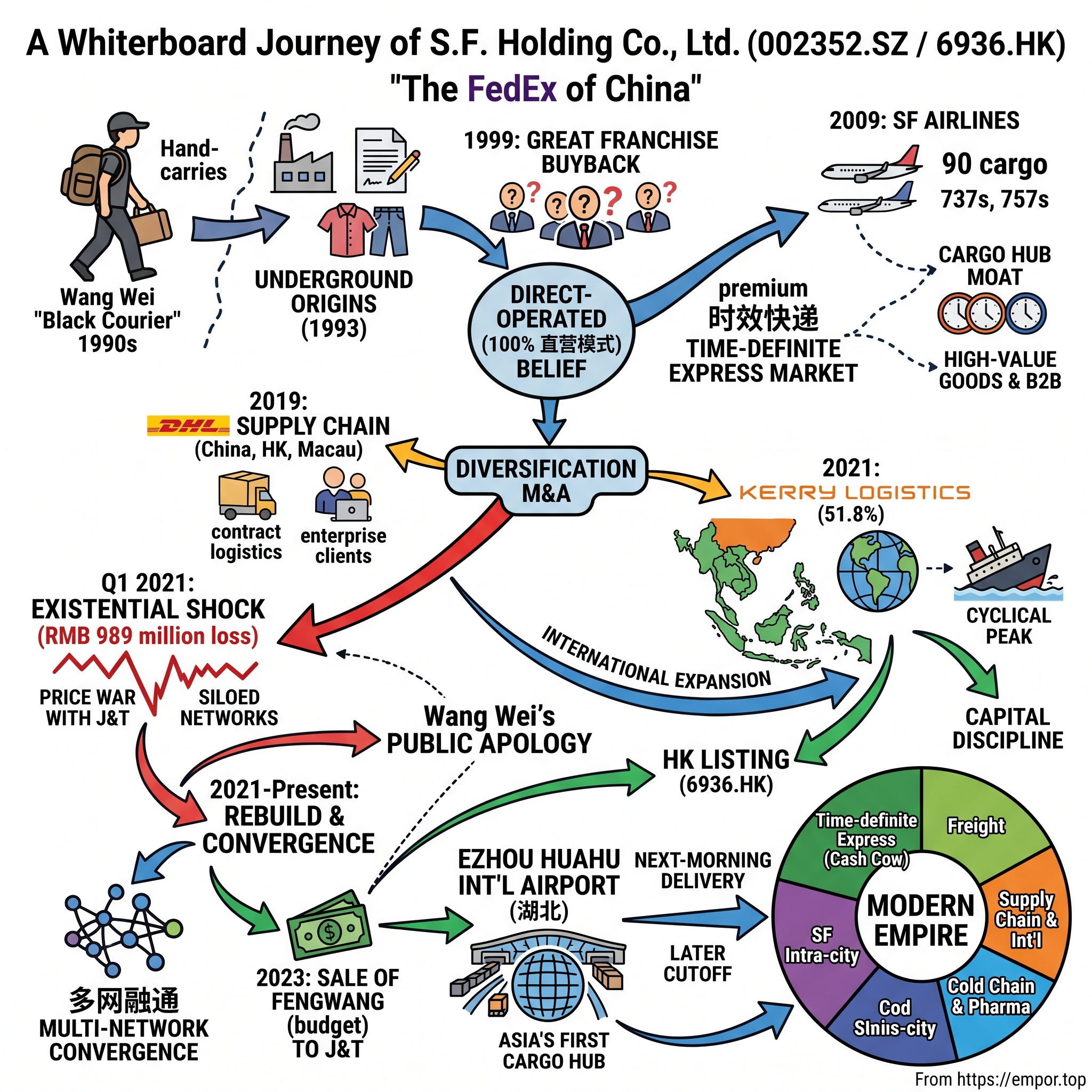
This is the story of how that bet was made, nearly unmade, and rebuilt. Part I traces the underground "black courier" origins and the counter-intuitive 1999 decision to buy back the franchisees. Part II covers the building of SF Airlines and the ownership of the premium 时效快递 time-definite express market. Part III is the M&A spree—DHL's China supply-chain business and the 嘉里物流 Kerry Logistics mega-deal. Part IV is the Q1 2021 existential shock: an RMB 989 million loss, the price war with 极兔速递 J&T Express, and Wang Wei's historic public apology. Part V is Ezhou, 多网融通 multi-network convergence, and the shape of the modern empire. Part VI runs the analytical frameworks—Hamilton Helmer's 7 Powers, Porter's Five Forces, and a skeptic's stress test. Part VII closes with the playbook, the bull and bear cases, and the handful of numbers that actually matter from here.
A note on posture before we begin. Empor tells the stories of top companies; it is not S.F.'s investor-relations department. Where management says it will win, we will ask what evidence supports the claim and what would prove it wrong. S.F. has earned genuine admiration and made genuine mistakes, sometimes in the same year. Both belong in the story.
 Subscribe on LinkedIn
II. Underground Origins: Wang Wei & The "Black Courier" Era (1993–1999)
To understand Wang Wei, start with the fact that he was, by the standards of the men who would later build China's tech and logistics fortunes, an unlikely candidate. He was born in Shanghai in 1970 and moved to Hong Kong as a child. His father had been a Soviet-language interpreter for the People's Liberation Army Air Force; the family's circumstances in Hong Kong were modest. Wang Wei was not an academic star. He finished high school and, instead of university, drifted into the garment trade of the Pearl River Delta, dyeing and printing fabric, learning the rhythms of the export factories that were, in that exact moment, turning Guangdong into the workshop of the world.
That timing was everything. This was the China of 邓小平 Deng Xiaoping's Southern Tour, the early-1990s moment when the reform-era manufacturing boom in Shenzhen and Shunde went vertical. Factories in the Delta were producing for buyers in Hong Kong and beyond, and the single greatest friction in that trade was not making the goods—it was moving the paper. A garment sample that had to reach a Hong Kong buyer to close an order, a contract that needed a signature across the border, a customs document that gated a shipment: all of these crawled through a system that was never designed for speed. 中国邮政 China Post, the state monopoly, could take days. In a business where a lost day could lose an order, days were unacceptable.
Wang Wei saw the arbitrage before he had any of the vocabulary for it. In 1993, with roughly RMB 100,000 borrowed from his father, he registered 顺丰速运 SF Express in Shunde and started doing the one thing the state system could not: sub-24-hour, hand-carried delivery across the Hong Kong–Shenzhen border, at roughly half of what the alternatives charged. He and a handful of co-workers were, in the almost affectionate slang of the era, running a 地下黑快递—an underground "black courier," operating in the regulatory shadow where private express delivery was not yet clearly legal. The suitcases-across-the-border image is not marketing myth; it is roughly how the early network moved.
It is worth pausing on the man himself, because Wang Wei is one of the strangest CEOs of his generation—strange in that he behaves almost nothing like his peers. Where 马云 Jack Ma and 马化腾 Pony Ma (Ma Huateng) courted the spotlight, Wang Wei became famous for refusing it. For years he gave virtually no interviews, avoided the billionaire-conference circuit, and ran S.F. as a private fiefdom whose numbers the outside world could only guess at. When he does surface, it is usually because something has touched a nerve about how his people are treated. In April 2016, after a video circulated of a Beijing driver repeatedly slapping an S.F. courier following a minor traffic scrape, the reclusive Wang Wei posted publicly on WeChat—one of only two posts he made all year—declaring that if he did not pursue justice for the courier he was not worthy of leading the company.13 The episode became a national talking point precisely because it was so out of character for a man who otherwise said nothing, and it revealed the thing that makes S.F.'s culture unusual in an industry of subcontracted, disposable labor: the couriers are employees, they wear the uniform, and the founder treats an insult to one of them as an insult to the firm. That instinct—control the people, own the experience—is not sentimentality. It is the same instinct that would soon lead him to blow up his own franchise model.
What is worth pausing on here is the shape of the opportunity, because it explains everything S.F. later became. This was never a consumer business at the start. It was a business-to-business service for people whose time was worth far more than the postage. The customer was a factory owner or a trading house, and the value proposition was not "cheap"—it was "certain, and fast." That is a fundamentally different psychology from the one that would later drive the e-commerce parcel wars, where the buyer is a consumer who has already been trained to expect free or near-free shipping. Wang Wei's first customers taught him that some people will pay a large premium for reliability. He would spend the next thirty years building a company around that single insight, even when the entire rest of his industry was betting the other way.
But insight does not scale by itself, and here the young S.F. made a very ordinary decision that would nearly break it. To expand out of the Delta and up into the Yangtze River Delta and beyond, S.F. did what every fast-growing Chinese network did: it franchised. The 加盟模式 franchise model let local entrepreneurs plant an SF-branded branch in their city, put up their own capital, and share the profits. It was cheap growth, and in the mid-1990s it worked—SF's coverage expanded far faster than Wang Wei could have funded on his own balance sheet. For a few years, the founder who would become famous for owning everything was, in fact, running a franchise.
That contradiction could not hold. By the end of the decade, the very mechanism that had let SF grow was quietly destroying the one thing it was selling. And the decision Wang Wei made in response is the reason there is a company to write about at all.
III. The Great Franchise Buyback & The Direct-Operated Bet (1999–2008)
The problem with a franchise network is that the brand and the franchisee want different things. The brand wants every parcel handled identically, every promise kept, every customer treated as if the founder were watching. The franchisee wants to maximize the cash coming out of a territory he controls. In a service where the entire product is trust, those goals diverge fast.
By 1999, that divergence had become an emergency inside S.F. Local franchise bosses in Guangdong, grown wealthy and territorial, were behaving like feudal lords. Some skimmed cash. Some quietly moonlighted, using SF's network to run their own side businesses. Some hoarded the client relationships, so that the customer belonged to the local boss rather than to S.F., which meant a boss could walk out the door and take the book of business with him. Service quality—the reliability that was the entire reason a customer paid three times China Post's rate—became a lottery that depended on which territory your parcel happened to pass through. Wang Wei had built a premium brand on top of a network that could not guarantee the premium.
His response was the defining strategic decision of his career, and it was genuinely radical. Rather than tighten the franchise contracts or add oversight, he decided to end the franchise model entirely and buy back operational control of the whole network, converting S.F. into a single, wholly company-owned, 直营模式 direct-operated business. This was the corporate equivalent of amputation. It meant confronting the same enriched local bosses who had every incentive to resist, and the folklore around this period—physical threats, tense standoffs with franchise operators reluctant to hand back territories some of which had triad connections—points to just how ugly it got. Over roughly three years, Wang Wei systematically bought them out or cut them off, absorbing the cost and the conflict, until S.F. emerged as the only major Chinese express company running a 100% direct-operated network.
Now sit with how contrarian this was. At the exact moment S.F. was pouring capital into owning its network, the rest of the industry was sprinting in the opposite direction—and getting rich doing it. The rise of 阿里巴巴 Alibaba's 淘宝 Taobao marketplace in the mid-2000s created a tidal wave of low-value e-commerce parcels, and the franchise model was perfectly, beautifully suited to ride it. STO, YTO, and the other Tongda players could add capacity almost for free by signing up more franchisees, and they could price parcels at pennies because the marginal cost sat on someone else's balance sheet. They were building the cheapest mass-market delivery machine in the history of commerce, and it was working.
Wang Wei chose not to fight there. This is the move Helmer's framework would later call counter-positioning: S.F. deliberately ceded the low-margin e-commerce parcel to the Tongda Gang and planted its flag at the high end—B2B documents, commercial contracts, high-value electronics, and later luxury retail—where customers would pay a large premium for a guaranteed next-morning delivery and where the incumbents' cheap-and-cheerful franchise networks could not follow without cannibalizing their own economics. The genius of counter-positioning is precisely that the incumbent cannot copy you without hurting itself. A franchise network built for one-yuan parcels cannot suddenly promise white-glove reliability, because reliability requires the very direct control the franchise model gave away.
To see why this is more than a slogan, look at the two business models as machines. A franchise network is a toll road. The headquarters sets standards and collects a fee per parcel, but the capital—the vans, the sorting sheds, the labor—sits on the franchisees' books, and the franchisee's only real lever for making money is throughput: move more boxes, cheaper. That is a wonderful design for riding a volume boom and a terrible design for guaranteeing a service level, because no one in the chain is compensated for reliability, only for volume. S.F.'s direct model is the opposite machine: every asset and every worker sits on the company's own balance sheet, which makes it heavy and expensive, but it also means headquarters can dictate exactly how a parcel is handled from pickup to doorstep. The trade-off is stark—the franchise model has structurally lower cost and structurally lower quality; the direct model has structurally higher cost and structurally higher quality. There is no arbitrage between them. You pick a customer, and the customer picks the model.
The competitive stakes of that choice grew larger when Alibaba formalized the franchise ecosystem into a data platform. In 2013 it launched 菜鸟 Cainiao, a logistics-data layer that sat on top of the Tongda networks, orchestrating their capacity for Taobao and 天猫 Tmall without owning the trucks—an asset-light coordinator for an asset-light industry. Cainiao made the low-cost e-commerce parcel even cheaper and even more tightly integrated with China's dominant marketplaces, which is exactly the terrain S.F. had walked away from. The upside for S.F. was that it remained the one large network Alibaba did not control; the risk was that the entire center of gravity of Chinese logistics volume was consolidating around an ecosystem it had chosen to sit outside. Wang Wei was betting that the premium tier would remain a distinct, defensible market rather than a rounding error in Cainiao's world—a bet that has mostly held, but one that is tested a little harder every year.
Then came the accelerant no one could have planned. When the SARS epidemic swept China in 2003, civil aviation collapsed as people stopped flying, and belly-hold cargo capacity—the space in passenger jets that most freight rode in—evaporated. Wang Wei chartered aircraft to keep S.F.'s time-sensitive parcels moving while competitors were grounded. The lesson he drew was permanent: in time-definite delivery, whoever controls the air controls the outcome. If the moat of the premium business was speed, then the deepest, least-copyable form of speed was flying your own planes on your own schedule. That conviction would define the next chapter—and require the kind of capital that only a much larger, more formalized S.F. could raise.
IV. Wings Over China: SF Airlines & Building the Express Moat (2009–2016)
For most of the world's express companies, owning an airline is a decision you inherit from history—FedEx and UPS grew up around aircraft. For a Chinese private company in the late 2000s, owning an airline was closer to heresy. Chinese airspace is among the most tightly controlled in the world, civil aviation was dominated by state carriers, and the idea of a privately owned courier operating its own cargo fleet ran against decades of institutional instinct.
Wang Wei did it anyway. In 2009, S.F. secured approval from the Civil Aviation Administration of China to launch 顺丰航空 SF Airlines, becoming the first privately owned Chinese express company to buy and fly its own dedicated cargo aircraft, starting modestly with a handful of Boeing 757s and 737s. It is hard to overstate how much of a step-change in capital intensity this represented. The Tongda players were spending as little as possible on fixed assets; S.F. was buying airplanes. Every jet was a bet that enough customers cared about overnight certainty to pay for the fixed cost of flying it.
There is a second layer of difficulty here that outsiders routinely miss, and it is the reason the airline is such a durable advantage. Chinese airspace is not open the way American airspace is. A large majority of it is controlled by the military, civilian flight corridors are narrow and congested, and China has for years had some of the world's worst flight-delay statistics because there simply is not enough usable sky. In that environment, the scarce resources are not aircraft—anyone with money can buy a 757—but the approvals: the operating certificate, the route rights, the airport slots at the right hours, the cargo-terminal access. S.F. spent years accumulating those permissions when almost no other private courier could get them. That is what turns a fleet of planes from a commodity into a moat: the metal is buyable, the permission to fly it profitably on the routes that matter is not. Every year S.F. operated its airline while rivals were locked out of the sky, the gap widened.
The strategic logic, though, was airtight, and it compounded in a way that pure ground networks could not. By owning aircraft, controlling airport slots, and running the trucks and sorting hubs at both ends, S.F. built something closer to a closed, engineered system than a loose network. It did not have to beg for space in the belly of a passenger jet or accept the passenger airline's schedule; it flew its own metal, on its own timetable, tuned to the specific problem of getting a document from a tower in Shenzhen to an office in Beijing before the next morning's meeting. Competitors relying on belly-hold cargo were, by definition, riding schedules designed for people, not parcels. S.F. was designing the schedule around the parcel.
This is where two of Helmer's powers begin to stack. There is scale economy: in the dense tier-1 and tier-2 business corridors, more volume means denser pickup and delivery routes, which lowers the marginal cost of each additional parcel and lets S.F. run its expensive assets closer to full. And there is process power—the accumulated, hard-to-copy know-how of running a fully direct network at national scale, from routing algorithms to sorting automation to the management of a courier workforce that would eventually number in the hundreds of thousands. Neither of these can be bought off a shelf. They are the residue of years of doing the thing.
The financial world took formal notice in 2017, when S.F. finally became a public company—though not through the front door. Rather than run the slow gauntlet of a traditional IPO, S.F. executed a reverse merger into a Shenzhen-listed shell, the rare-earth and new-materials company Maanshan Dingtai, which was renamed S.F. Holding in February 2017 and began trading under the ticker 002352.SZ.12 The choice of a backdoor listing was itself a very Chinese piece of financial engineering: a conventional A-share IPO meant joining a regulatory queue that could take years, at the mercy of a securities regulator that periodically froze new listings altogether. Reverse-merging into an existing listed shell let S.F. jump the line and get its shares—and its acquisition currency—far faster. The deal valued S.F. at roughly RMB 43.3 billion, and because Wang Wei held around 64.6% of the merged company through an entity he almost wholly owned, the listing crystallized a paper fortune that briefly made him one of the richest people in China, ranked alongside the founders of 腾讯 Tencent and Alibaba.12 It also, less romantically, handed him a publicly traded stock he could now use to buy other companies—a capability he was about to use with great ambition and mixed results.
Overnight, S.F. was a national champion with a public share price, a currency for acquisitions, and a market that would now scrutinize every quarter. That scrutiny would matter enormously, because the premium express business that had carried S.F. this far was about to hit a ceiling—and Wang Wei's answer would be the most aggressive, and most questioned, chapter of the company's history.
V. The M&A Blitz & Strategic Diversification (2018–2021)
Every great growth story eventually collides with the mathematics of maturity, and S.F.'s came dressed as good news. The premium time-definite business had been built on the movement of urgent physical documents and high-value B2B shipments. But the world was digitizing. Contracts moved to e-signature, invoices became data, and the sheer volume of paper that needed to cross a city overnight stopped growing the way it once had. The high-margin core was not dying, but it was maturing, and a company valued for growth cannot simply harvest a mature core. Wang Wei's answer was to stop being an express courier and become an integrated, end-to-end supply-chain company—which is a polite way of saying he went shopping.
The first major purchase was strategic and, in hindsight, well-timed. In October 2018, S.F. agreed to acquire Deutsche Post DHL's supply-chain operations in mainland China, Hong Kong, and Macau for RMB 5.5 billion, roughly EUR 700 million, with the deal concluding in February 2019.7 What S.F. bought was not just warehouses and trucks; it was DHL's blue-chip contract logistics book—the Fortune 500 automotive, technology, and healthcare multinationals that trust their inbound and outbound supply chains to a global name—plus a ten-year co-branding arrangement and the training, trademark license, and customer referrals that came with it.7 The business was rebranded SF DHL Supply Chain China. At around one-and-a-half times sales, S.F. paid a full multinational multiple, but it bought something it could not have built organically in a decade: instant credibility with the exact enterprise customers it wanted to serve.7 Contract logistics—running a client's warehousing, inventory, and distribution as an outsourced service—is a fundamentally stickier business than parcel delivery. Once a manufacturer wires its production and distribution systems into a logistics partner's warehouses, switching means re-plumbing its entire supply chain, so contracts run for years and relationships compound. That stickiness is exactly what S.F.'s transactional express business lacked, and it is the strategic prize the DHL deal was really about: not the warehouses, but the durable enterprise relationships and the operating playbook of a world-class contract logistics operator. Judged years later, the DHL acquisition looks like the more disciplined of S.F.'s two big diversification bets—bought at a sensible multiple, for capabilities rather than cyclical earnings—which makes the contrast with the Kerry deal that followed all the sharper.
The second purchase was an order of magnitude larger, and this is where the analytical story gets uncomfortable. In February 2021, S.F. announced a HK$17.6 billion (about US$2.3 billion) offer for a 51.8% controlling stake in HKEX-listed 嘉里物流 Kerry Logistics, at HK$18.8 per share, in a partial cash offer that kept Kerry listed.4 Kerry, controlled by the Malaysian-Chinese tycoon Robert Kuok, was a genuine prize: a pan-Asian freight-forwarding and contract-logistics network with deep roots across Southeast Asia and global trade lanes—the international leg S.F. conspicuously lacked. The strategic fit was real. Kerry gave S.F., in one stroke, a cross-border footprint it would have needed a generation to assemble.
The problem was the price and the timing. S.F. was buying a freight-forwarding business at the absolute crest of the post-COVID shipping super-cycle, when container and air-freight rates had spiked to historic highs and forwarders were minting money that no sober analyst believed was sustainable. Buying cyclical earnings at a cyclical peak is one of the oldest ways to overpay in finance, and S.F. walked straight into it. When global freight rates collapsed—spot container rates fell more than 80% across 2022 and 2023 as pandemic distortions unwound—Kerry's revenues and operating profits contracted hard, dragging on S.F.'s consolidated margins for years afterward. The honest verdict is a split one: measured against normalized mid-cycle earnings, S.F. overpaid, and the timing was poor; measured strategically, it acquired an international network that is now difficult to replicate and central to its long-term thesis. Both things are true, and a neutral observer should resist the temptation to collapse them into a single tidy judgment.
The structure of the Kerry deal deserves a second look, because it complicates the picture in ways an activist would seize on. Before S.F. took control, Kerry carved out and sold some of its most valuable warehouse assets to its parent for HK$13.5 billion and its Taiwan business separately, then paid a special dividend to existing shareholders—so what S.F. actually bought was a Kerry that had been partly stripped of its prime real estate before the deal closed.4 And because S.F. took only a 51.8% controlling stake and left Kerry listed in Hong Kong, it inherited a permanently consolidated subsidiary with public minority shareholders, its own board, and its own disclosure—a structural complexity that makes the group harder to analyze and creates the standing potential for related-party friction between parent and listed child. Integrating a century-old, Kuok-family-built, English-speaking multinational freight forwarder into a Shenzhen express company is, culturally and operationally, nothing like bolting on another Chinese trucking depot. The strategic map S.F. drew—Chinese brands going abroad, riding S.F.'s domestic reach out to Kerry's global lanes—is genuinely attractive. Whether the two organizations can be fused tightly enough to deliver that cross-sell, rather than simply co-existing under one ticker, remains the open question hanging over the entire international segment.
Amid these headline deals, S.F. was also spinning off pieces of itself. In December 2021 it listed its on-demand instant-delivery arm, 顺丰同城 SF Intra-city, on the Hong Kong exchange under 9699.HK, raising around HK$2 billion in an IPO that slid nearly 12% on its debut.11 The listing created a dedicated, separately capitalized vehicle to fight 美团 Meituan and 饿了么 Ele.me in the brutal on-demand local-delivery market—a business with very different economics from time-definite express, and one whose weak trading debut was an early signal that the market was growing wary of S.F.'s sprawling ambitions. That wariness was about to be vindicated in the most dramatic way possible.
VI. The Q1 2021 Existential Shock & The Course Correction
On the evening of April 8, 2021, S.F. Holding issued a profit warning that landed on China's capital markets like a thunderclap. The company that had been the blue-chip, quality-at-a-premium darling of Chinese logistics told investors it expected to report a net loss of between RMB 900 million and RMB 1.1 billion for the first quarter—against a RMB 907 million profit in the same quarter a year earlier.5 When the numbers were finalized, the loss came in at RMB 989 million, even as operating revenue actually grew more than 27% to RMB 42.6 billion.5 The market's reaction was violent: the stock hit its downward limit, and something on the order of RMB 37 billion in market value evaporated almost at once.5
Read that combination again, because it is the whole story in one line: revenue up sharply, profit gone. This was not a demand problem. Customers were still shipping. This was a self-inflicted wound—a failure of operational and capital discipline—and it had three intertwined causes.
The first was uncoordinated capital expenditure. S.F. had been building out separate, siloed infrastructure networks for its different businesses—time-definite express, heavy freight, cold chain, economy express—each with its own sorting centers, its own trucks, its own routes, none of them sharing capacity. It was, in effect, constructing four logistics companies inside one, and paying four times for overlapping infrastructure. In a period of heavy simultaneous investment, that duplication turned into a wall of fixed cost with nothing like the volume needed to absorb it.
The second cause was the price war. A ferocious new entrant, 极兔速递 J&T Express—founded by executives from the 步步高 BBK/OPPO ecosystem and battle-hardened building a delivery network in Indonesia before turning back toward home—had crashed into the Chinese e-commerce parcel market and, in the merchant heartland of 义乌 Yiwu, driven per-parcel prices below one yuan. Yiwu matters here because it is the physical epicenter of China's small-commodities export trade: thousands of merchants shipping enormous volumes of cheap goods, the single densest concentration of price-sensitive parcel demand on earth, and therefore the arena where a new entrant can buy market share fastest by simply selling delivery below cost. J&T did exactly that, subsidizing sub-one-yuan parcels to force its way into the network, and the incumbents were dragged into matching. S.F., through its budget e-commerce experiment 丰网速运 Fengwang, had chosen to fight in exactly this arena, and Fengwang bled cash trying to match prices in a race to the bottom that S.F.'s premium cost structure was never built to win. It was a strategic contradiction: the company whose entire identity was not competing on price was now competing on price, in the one battlefield where its cost structure was worst suited, and losing. The deeper lesson, which S.F. learned the hard way, is that a premium operator that ventures into a subsidy war does not merely lose money—it also confuses its own organization about what business it is in.
The third cause was simple operating leverage running in reverse. Redundant sorting investments and heavy subsidies to retain workers through the Chinese New Year holiday, when much of the migrant workforce goes home, stacked cost on top of cost precisely when the network was least efficient.
What happened next is genuinely unusual in Chinese corporate life, and it is the reason the 2021 shock reads, in retrospect, as an inflection rather than a decline. At the annual shareholders' meeting that April, Wang Wei stood up and apologized. "First of all, I need to make an apology to all the shareholders, because I think I have underachieved in my job for the past quarter," he told them, taking personal responsibility and pledging that this kind of loss would not happen again.5 Founders rarely bow. Fewer still name their own mismanagement as the cause when the easy move is to blame the macro environment or the price war. The apology was, at minimum, a signal that the person with absolute control of the company understood exactly what had gone wrong.
Before turning to the fix, it is worth naming what the 2021 loss really taught, because the surface story—"a courier company had a bad quarter"—misses the point. The deeper diagnosis is that S.F. had fallen into a trap that afflicts many admired operators: it confused adding businesses with building scale. Every new vertical—cold chain, heavy freight, economy, the Fengwang budget experiment—had been launched as its own vertically integrated stack, on the theory that a great operator can run many parallel networks. But parallel networks do not share fixed costs; they multiply them. Two half-empty trucks running the same route for two different business units cost twice as much as one full truck, and produce worse service. The Q1 2021 loss was the moment that hidden tax on complexity became visible all at once.
The more important question for an investor is whether the words were followed by structure, and here the answer is largely yes. The strategic fix was branded 多网融通 multi-network convergence: the deliberate merging of the redundant networks Wang Wei had allowed to proliferate. Sorting facilities were consolidated, transport routes across heavy freight and express were unified so a single truck could carry mixed freight, and billions of yuan of duplicated capacity were stripped out. Management pivoted hard from chasing market share to defending margins and returning capital. And in the cleanest signal of all, S.F. simply exited the low-end war it should never have joined: in May 2023 it sold Fengwang to J&T Express for RMB 1.18 billion, walking away from the sub-one-yuan parcel entirely.8 The company had looked into the abyss of becoming just another cheap network, and stepped back.
VII. The Modern Empire: Ezhou Hub & Business Segment Breakdown (2022–Present)
If you want to see the physical embodiment of everything S.F. believes about logistics, drive to a spit of land in Ezhou, Hubei province, near the geographic center of China, and look at 鄂州花湖国际机场 Ezhou Huahu International Airport. It opened on July 17, 2022, as Asia's first purpose-built cargo hub airport—two runways, a cargo terminal, and a freight transit center of nearly 700,000 square meters—and it was designed, explicitly and unapologetically, as China's answer to FedEx's Memphis SuperHub.2 S.F. is to Ezhou what FedEx is to Memphis: the anchor tenant around which the entire airport is organized.2
The reason a dedicated hub matters is worth explaining plainly, because it is the crux of S.F.'s cost story for the next decade. A point-to-point air network—the kind S.F. ran for years, flying parcels directly between city pairs—is flexible but expensive, because you can only fill a plane if there happens to be enough demand between those two specific cities on that specific night. A hub-and-spoke network flips the logic: every plane flies to one central point, parcels are re-sorted, and they fly out again. Because everything converges, aircraft fly fuller, sorting is centralized and automated, and, crucially, the last order-cutoff time of the night can be pushed later while still promising next-morning delivery. Ezhou sits within roughly a 1.5-hour flight of cities accounting for the vast majority of China's economic output, which is exactly why the geography was chosen. The prize is lower unit cost per flown parcel and a velocity advantage that a rival without a comparable hub simply cannot match.
Make the customer benefit concrete. A pharmaceutical distributor in Chengdu or an electronics maker in Chongqing can hand S.F. a shipment late in the evening and still have it arrive across the country the next morning, because a later cutoff time is exactly what a centralized night-sort hub produces. That extended cutoff is not a minor convenience—for time-sensitive, high-value goods it is the difference between winning and losing the account, and it is very hard for a rival without a comparable hub to match. This is why Ezhou is designed to do more than move parcels: a dedicated cargo hub becomes a magnet, pulling high-tech manufacturing, pharmaceutical, and cross-border e-commerce operations to cluster physically around it to capture that speed advantage, much as Memphis grew a medical-devices and electronics ecosystem around FedEx. If that clustering takes hold, Ezhou compounds from a cost-saving hub into a genuine economic gravity well—a far more valuable thing.
That is the theory, and it is a credible one. The appropriate investor caution is that a hub is a fixed-cost machine: it only delivers its promised unit economics if it runs at high tonnage and high utilization. Below a certain volume threshold, all that fixed infrastructure becomes a drag rather than an advantage. Ezhou's payoff is therefore not automatic; it is contingent on S.F. filling it, year after year. S.F. has not disclosed granular Ezhou-specific utilization economics, and the honest reader should treat the hub as a high-conviction bet whose returns are still being proven rather than a settled fact.
The rest of the modern empire is best understood as a portfolio rather than a monolith. The core remains time-definite express—the high-margin cash cow of documents, electronics, and premium retail—which in FY2025 generated RMB 131.1 billion in revenue, up 7.2%, the profit engine that funds everything else.1 Around it sit several other businesses. Supply chain and international, the Kerry-plus-DHL franchise, brought in RMB 72.9 billion in FY2025 but grew only 3.5%, a reminder of how exposed it remains to volatile global trade rates.1 Freight, the industrial less-than-truckload business, reached RMB 42.1 billion, up 11.9%.1 Economy express, the mass-market ground product that survives now that the ruinous Fengwang experiment is gone, grew 17.6% to RMB 32.1 billion.1 And SF Intra-city, the on-demand arm, was the fastest grower of all, up 43.4% to RMB 12.7 billion as it finally reached the scale where its economics began to work.1
Two smaller pieces of the portfolio are worth understanding because they punch above their revenue weight. The cold-chain and pharmaceutical business is small in absolute terms but strategically prized: moving temperature-controlled food and, especially, regulated medicines requires licenses, validated cold-storage infrastructure, and an unbroken chain of custody that most couriers cannot legally or physically provide. That regulatory and infrastructural barrier makes it a higher-moat, higher-margin niche—the kind of specialized business where reliability is not a premium feature but a legal requirement, which is precisely the terrain S.F. was built for. The other piece, SF Intra-city, is the most interesting strategic puzzle. On-demand local delivery—getting a coffee or a phone charger across town in under an hour—is a brutally competitive market dominated by the food-delivery superapps 美团 Meituan and 饿了么 Ele.me, which control the demand. Rather than fight them head-on for consumers, SF Intra-city positioned itself as the neutral third-party fulfillment layer that any merchant or platform can plug into, and in a revealing move it partnered with Meituan in 2023 to carry deliveries rather than purely compete for them.11 Its FY2025 swing to real profitability and 43% revenue growth suggests the neutral-platform bet is working, but it is optionality on the edge of the empire, not a core pillar.
Two numbers from FY2025 deserve to be held side by side, because together they capture exactly where S.F. sits today. Parcel volume grew 25.4% to 16.6 billion, but net profit attributable to owners grew only 9.3% to RMB 11.1 billion, and in the third quarter of 2025, profit actually fell 8.5% even as revenue rose.19 The read-through is that S.F. is once again winning enormous volume in the value tiers of the market, and that volume comes at thin margins that dilute the premium mix. This is not the 2021 catastrophe—the company is comfortably profitable and generating real cash—but it is a live tension that management has to manage rather than a problem it has solved.
On capital, the post-2021 discipline has held. In FY2025, S.F. generated operating cash flow of RMB 27.6 billion and free cash flow of RMB 17.9 billion against capital expenditure held to RMB 9.6 billion—a capex-to-revenue ratio that has fallen dramatically from the pre-2021 splurge—and it maintained a 40% dividend payout ratio while expanding buyback programs.1 The company also completed the second act of its capital-markets story: in November 2024 it listed H-shares in Hong Kong under 6936.HK at HK$34.30 per share, raising roughly HK$5.8 billion (about US$732.5 million) to fund international expansion, build an offshore financing platform, and give itself a hard-currency balance sheet to pay down higher-cost mainland debt and finance overseas network nodes.6 A second-layer point for the credit-minded: giving an internationalizing group access to Hong Kong equity and offshore financing lowers its blended cost of capital and reduces the currency mismatch between where it earns foreign revenue and where it carries debt—a quiet but real benefit that has nothing to do with the headline growth story. The debut itself, though, was notably flat amid tepid market sentiment.6 That flat reception is itself a data point—the market liked the discipline but was not yet paying up for the international dream.
One force sits behind much of the recent international momentum and deserves to be named as both tailwind and risk: the explosion of cross-border e-commerce. The rise of ultra-low-price global marketplaces run out of China—the 拼多多 Pinduoduo-affiliated Temu, and the fast-fashion giant 希音 Shein—turned a firehose of small parcels into the international air-cargo system, and S.F.'s freighters and Ezhou hub are natural beneficiaries of that flow. But the same dependence is a vulnerability. Much of that volume rode on low-value import exemptions in Western markets, and as the United States and European Union have moved to tighten those thresholds and raise tariffs on small parcels, the economics of the cheapest cross-border flows have come under pressure. A logistics provider levered to cross-border e-commerce is, whether it likes it or not, levered to trade policy set in Washington and Brussels—an exposure entirely outside management's control and one that can shift with a single regulatory announcement.
The most recent strategic move closes a loop that began with Fengwang. In January 2026, S.F. and its former price-war antagonist J&T Express agreed to swap shares in a deal worth about HK$8.3 billion, with S.F. taking a 10% stake in J&T and J&T taking a 4.3% stake in S.F., explicitly to pool S.F.'s premium and air-cargo strengths with J&T's last-mile and Southeast Asian network as both push into Europe and the United States.9 The company that once tried to beat J&T at its own game and lost has now decided that the smarter move is to partner with it—a quietly revealing admission about the limits of even S.F.'s formidable network, and a hedge that lets it ride J&T's cheap-parcel and emerging-market strengths without having to rebuild them itself.
VIII. Helmer's 7 Powers & Porter's 5 Forces Analysis
Strip away the narrative and ask the only question that matters for a long-term owner: does S.F. have durable competitive advantage, or does it merely have scale and a good brand? Two frameworks help pressure-test the answer.
Start with Hamilton Helmer's 7 Powers. S.F.'s strongest claim is to a cornered resource. Its ownership of SF Airlines—more than 90 freighters, the largest all-cargo fleet in Asia—combined with its anchor-tenant integration at Ezhou is genuinely hard to replicate, not because rivals lack money but because Chinese airspace, airport slots, and cargo-hub approvals are scarce, politically gated, and not for sale in the quantities a challenger would need.32 This is the closest thing S.F. has to an unfair, structural advantage. Its second real power is process power: decades of accumulated operating know-how in running a 100% direct network across a workforce numbering in the hundreds of thousands, with proprietary sorting automation and, since 2021, unified multi-network routing. Process power is slow to build and slow to erode, which cuts both ways—it protected S.F.'s reliability edge for years, but it is also why the company could not simply flip a switch and become a low-cost operator when it needed to.
S.F. also enjoys scale economies in dense tier-1 and tier-2 corridors, where route density lowers marginal delivery cost, and it was the textbook practitioner of counter-positioning in its formative decades, building a capital-heavy direct model that the franchise incumbents could not copy without wrecking their own economics. But note the tense: counter-positioning is largely a historical power here. Today's rivals—particularly 京东物流 JD Logistics, which was born with the same asset-heavy, service-first DNA—are positioned to compete directly, not structurally locked out. S.F. has no obvious network economies of the winner-take-all kind, no switching costs strong enough to trap enterprise customers who can and do multi-source, and no branding power in the pricing-premium sense that would let it raise prices at will. The brand is trusted; it is not 贵州茅台 Kweichow Moutai.
Now Porter's Five Forces. Threat of new entrants is very low: the capital and regulatory barriers to building an integrated air-and-ground direct network with owned hubs are close to prohibitive, which is precisely why J&T attacked the cheap end rather than S.F.'s premium fortress. Bargaining power of buyers is moderate to high: in standardized freight, enterprise customers have real leverage and many options, but for guaranteed cross-provincial time-definite delivery, the alternatives thin out considerably. Bargaining power of suppliers is low to moderate: Boeing and jet-fuel prices impose real input costs, but S.F.'s scale gives it hedging and fleet-financing leverage most rivals lack. Threat of substitutes is low but not zero: 高铁快运 high-speed rail cargo is fast and cheap for certain lanes but lacks integrated door-to-door courier service. And competitive rivalry is high and intensifying: JD Logistics presses hard in premium B2C and B2B, 菜鸟 Cainiao and the Tongda networks dominate e-commerce volume, and the whole industry lives under chronic price pressure.
Now war-game the specific rivals, because "high rivalry" is too abstract to be useful. The most dangerous competitor is 京东物流 JD Logistics, the logistics arm spun out of the e-commerce group 京东 JD.com. JD is dangerous precisely because it shares S.F.'s DNA—it was built asset-heavy and service-first, running its own warehouses and delivery staff to guarantee reliability for JD.com's own customers—and it has the capital and the ambition to build out air cargo. Where the Tongda players cannot follow S.F. upmarket without breaking their franchise economics, JD can, because it never adopted the franchise model in the first place. The second threat comes from the opposite direction: ZTO and the stronger Tongda networks slowly moving up, adding premium tiers and better service to defend against margin compression at the bottom. And overhanging everything is Cainiao, whose orchestration of the e-commerce parcel flood keeps structural price pressure on the whole industry. S.F. sits between a well-capitalized peer coming at its premium fortress from above and a swarm of low-cost networks trying to climb up from below—a defensible position, but not a comfortable one.
It is worth pausing here to fact-check the consensus narrative, because the shorthand "the FedEx of China" both illuminates and misleads. It is true that S.F. copied FedEx's core insight—own the planes, build the hub, sell reliability—and Ezhou is a near-literal homage to Memphis. But the analogy oversells the moat. FedEx and UPS operate as a rational duopoly in a market where consumers were never trained to expect free next-day shipping as a baseline; S.F. operates in the most price-competitive parcel market on the planet, against rivals subsidized by the world's largest e-commerce ecosystems, with no comparable duopoly comfort. A second myth worth puncturing is that S.F.'s premium moat makes it a pricing-power machine. The FY2025 numbers say otherwise: its premium core grows at mid-single digits and its ASP has stabilized rather than climbed.1 S.F. defends its pricing; it does not dictate it. Reading S.F. as an unassailable toll-collector on Chinese logistics is the single most common analytical error made about the company.
The synthesis is this. S.F.'s moat is real but asymmetric. It is deep and durable in the air-integrated, time-definite premium tier, thin and contested everywhere else. The bull case rests on that fortress holding and Ezhou widening it; the bear case rests on the observation that S.F.'s growth increasingly comes from the contested tiers, where its advantages are weakest.
IX. Management Credibility & Skeptical Investor Stress Test
Management credibility is best judged not by what leaders say in good times but by what they do when things break, and S.F. offers an unusually clean test case. Begin with the ownership structure, because it shapes everything else. Wang Wei retains absolute control through Shenzhen Mingde Holding Development, holding roughly half of S.F.'s shares, and the overwhelming majority of his personal fortune is tied up in S.F. equity.10 Alignment between the controlling shareholder and outside investors is, on paper, about as high as it gets—Wang Wei's wealth rises and falls with the same share price the minority owner holds.
Alignment, however, is not the same as infallibility, and a skeptic should look hard at the capital-allocation record, which splits cleanly into two eras. The pre-2021 Wang Wei was an aggressive, sometimes undisciplined allocator: he let four parallel networks proliferate without shared capacity, he plunged into a price war his cost structure could not survive, and he bought Kerry Logistics at the peak of the freight cycle. That is a real track record of value-destructive decisions, and it should temper any tendency to treat the founder as an oracle. The post-2021 Wang Wei looks like a different manager: capex slashed as a share of revenue, free cash flow turned strongly positive, a 40% dividend payout maintained, buyback programs expanded, and the loss-making Fengwang experiment cut loose.18 The apology was backed by structural change, which is the highest form of credibility a management team can offer—not a promise, but a corrected behavior.
A governance-minded skeptic would flag the flip side of Wang Wei's near-total control. Alignment is high, but so is concentration: with the founder holding roughly half the company through 明德控股 Mingde Holding, there is no realistic external check on his strategy, and the pre-2021 record shows what unchecked founder conviction can cost when it goes wrong.10 The group is also structurally complex—a Shenzhen-listed parent, a separately listed intra-city subsidiary in Hong Kong (9699.HK), a separately listed and consolidated Kerry Logistics, and, since late 2024, the company's own dual listing in Hong Kong—a web of related listed entities that raises the standing questions activists always ask about such structures: are minority shareholders in the subsidiaries fairly treated, are inter-company dealings at arm's length, and is the sprawl creating value or merely optionality that management likes to keep. To S.F.'s credit, disclosure has improved markedly since the opaque pre-2017 private era, and the 2024 Hong Kong listing subjects it to a second, demanding regulator. But complexity is itself a risk: the more listed boxes a group operates, the harder it is for any outside investor to see the whole picture clearly.
The right way to hold this is with calibrated skepticism. Management has earned credit for the turn, but the turn is recent, and the FY2025 pattern—huge volume growth, only modest profit growth, a Q3 profit decline—shows the same underlying temptation (chase volume in low-margin tiers) that got the company into trouble before, now being managed rather than eliminated.19 An activist would press two questions in particular.
Is the Supply Chain & International segment a value-destroying distraction dragging down corporate returns? The bear points to Kerry's cyclical collapse, its 3.5% FY2025 growth, and the complexity of consolidating a sprawling freight-forwarder into a Chinese express company.1 Management's answer, consistent across recent communications, is that Kerry provides the essential international leg for the 出海 "going global" wave of Chinese brands—EV makers, electronics firms, fast-fashion players expanding into Southeast Asia, the Middle East, and Europe—and that cross-selling domestic enterprise clients into Kerry's global network builds switching costs over time. That is a coherent thesis, and the January 2026 J&T tie-up, aimed squarely at Europe and the U.S., is consistent with it.9 But it remains a thesis about the future, not a demonstrated return, and the segment's low margins are a present-tense fact.
Can S.F. defend its pricing as JD Logistics builds out air cargo and ZTO moves upmarket? Here management can point to something concrete: time-definite express ASP has stabilized rather than collapsed, and Ezhou's unit-cost reductions are meant to protect gross margins even in a deflationary domestic shipping environment.1 The evidence is real but partial—stabilized pricing in a fiercely competitive market is an achievement, but it is not the same as expanding pricing power, and the segment's mid-single-digit revenue growth suggests the premium core is defending its turf, not conquering new ground.
X. Playbook: Key Business & Investing Lessons
Step back from S.F.'s specifics and four transferable lessons emerge, each of them a little sharper for having been paid for in real losses rather than theorized in a business-school case.
First, counter-positioning is most powerful precisely when the whole industry is running the other way. When Chinese logistics sprinted to build asset-light franchise networks for Taobao's parcel flood, S.F. bought planes and owned its network. The reason this worked is not that owning assets is inherently superior—it is that S.F. found a customer segment (premium, time-sensitive, reliability-obsessed) whose needs the franchise incumbents structurally could not serve, and the cash from that high-margin fortress funded the air fleet that deepened the moat. The lesson is not "be capital-heavy." It is "find the position your competitors cannot copy without destroying their own economics, then compound the advantage it throws off."
Second, beware network-duplication syndrome. S.F.'s near-death experience in 2021 came not from an external enemy but from growing through a proliferation of siloed business units—express, freight, cold chain, economy—each building its own isolated infrastructure. Growth by proliferation looks like scale but often manufactures hidden operating friction and duplicated capital. True scale economies emerged only when the networks were forced to converge and share capacity. Any conglomerating operator should ask, ruthlessly, whether its "diversification" is sharing infrastructure or merely multiplying it.
Third, M&A at cyclical peaks is one of the most reliable ways to destroy capital. The Kerry Logistics acquisition is a textbook case: a strategically sound target bought when cyclical freight earnings were at an unsustainable high, so that the price paid embedded a level of profitability that promptly evaporated. Cyclical earnings must be normalized to mid-cycle before any acquisition premium is layered on top. Strategic logic does not excuse a peak-cycle entry price; it just makes the mistake more expensive because you convince yourself it was worth it.
Fourth, founder accountability can convert a crisis into an inflection. A controlling founder who publicly owns his own operational failure, halts the reckless spending, and follows the apology with structural change—consolidated networks, restored capital discipline, an exit from the war he should never have entered—can turn the worst quarter in a company's history into the moment its long-term value creation restarted. The apology matters only because the behavior changed; words without the follow-through would have been theater.
XI. The Bull vs. Bear Case & What to Watch
Assemble the pieces and the investment debate over S.F. comes down to a single question: is this a widening infrastructure moat compounding toward higher returns, or a capital-intensive business whose growth is migrating into its least-profitable tiers?
The bull case rests on three legs. First, the Ezhou hub delivers a structural cost-and-velocity advantage over JD Logistics and Cainiao that would take rivals the better part of a decade and a fortune in regulatory capital to match—a genuine cornered resource in the making. Second, the 企业出海 "Chinese brands going global" wave gives the Kerry-plus-DHL international network a long runway, positioning S.F. as the national logistics champion for cross-border supply chains just as China's manufacturers push into ASEAN, the Middle East, and Europe—a thesis the January 2026 J&T alliance reinforces.9 Third, the shift from heavy capex to harvest mode is generating expanding free cash flow, a recovering return profile, and rising cash returns to shareholders, all underpinned by a founder whose interests are almost perfectly aligned with minority owners.1
The bear case is equally coherent. Domestic macro compression—any sustained slowdown in Chinese corporate activity—hits the high-margin time-definite core, where B2B documents and premium e-commerce volumes live, and that core is already growing only mid-single digits.1 International freight is structurally volatile: geopolitical friction, tariffs, and sluggish global trade can depress Kerry's forwarding margins for years at a stretch, as 2022–2023 painfully demonstrated. And Ezhou's own economics cut both ways—the hub's high fixed cost demands consistently high tonnage, so any volume shortfall turns the moat into a millstone. Underneath it all sits the FY2025 signature: 25% volume growth converting into single-digit profit growth and an outright Q3 profit decline, evidence that S.F.'s expansion is being bought with margin.19
Weighing the frameworks, the neutral read is that S.F. possesses a real, defensible advantage in a narrowing but valuable slice of logistics—the air-integrated premium tier—surrounded by contested businesses where its edge is thinner and its growth is coming at the cost of mix. The bull needs the premium fortress to hold and the international bet to pay off and Ezhou to fill. The bear needs only one of those to disappoint. Which is why the case is best not asserted but watched, through a small number of specific metrics.
Before the three that matter, a word on the metric that matters least: headline parcel volume. It is the number the whole industry trumpets, and for S.F. it is close to meaningless in isolation, because—as FY2025 proved—the company can grow parcels 25% while profit barely moves.1 Volume without mix and margin is vanity. The useful metrics are the ones that reveal whether the premium engine and the cost position are intact.
The three KPIs that matter most. First, time-definite express volume growth and ASP trend—the truest gauge of whether the premium core is defending its pricing power and demand, and therefore whether the cash engine that funds everything else stays intact. Second, Ezhou hub tonnage and sorting-facility utilization—the operational proof of whether the single largest infrastructure bet is achieving the unit-cost reduction that justifies it, and the number most likely to falsify or confirm the moat thesis. Third, free cash flow and the capex-to-revenue ratio—the definitive evidence of whether management's post-2021 capital discipline is a permanent conversion or a temporary detente. Watch those three, and the story tells itself.
XII. Outro
The arc from a six-person contraband courier lugging suitcases across the Shenzhen border in 1993 to a RMB 308 billion, planes-and-hubs logistics power is, on its face, a triumph.1 But the more useful way to hold the S.F. story is as a running argument between two philosophies of how to build a network business: own everything and charge for reliability, or own nothing and win on price. Wang Wei bet his career, twice, on the first answer—once when he bought back the franchises in 1999, and again when he refused, after the 2021 disaster, to become just another cheap carrier. The tension has never fully resolved, and probably never will: the premium fortress throws off the cash, but the growth keeps coming from the contested lowlands, and management's central task is to keep expanding without letting the lowlands swallow the fortress. The January 2026 truce with J&T is the latest sign that Wang Wei would rather partner at the low end than bleed for it again—a wiser man than the one who launched Fengwang.
For founders, S.F. is a lesson in the compounding power of a position competitors cannot copy, and a warning about the hidden costs of growth-by-proliferation and the seduction of peak-cycle acquisitions. For investors, it is a reminder that infrastructure moats are real but expensive, that capital discipline is a behavior to be verified rather than a promise to be believed, and that the most important question about any network business is not how much volume it wins, but how much of that volume it can actually turn into cash.
References
-
SF Holding Announces 2025 Annual Results, Delivering Record Profitability and Enhanced Shareholder Returns — PR Newswire, 2026 ↩↩↩↩↩↩↩↩↩↩↩↩↩↩↩↩↩↩↩
-
China's first cargo-focused airport launches international flights / Ezhou Huahu opens — Air Cargo News, 2022-07 ↩↩↩↩
-
China's SF Airlines expands fleet to 90 freighters — Xinhua, 2025-03-16 ↩↩
-
Slaughter and May on S.F. Holding's HK$17.6BN (US$2.3BN) partial cash offer for Kerry Logistics Network — Slaughter and May, 2021 ↩↩
-
SF chair apologizes over 900m yuan loss — The Standard, 2021-04 ↩↩↩↩
-
Chinese Courier SF Ends Flat After Raising USD732.5 Million in Hong Kong Listing — Yicai Global, 2024-11 ↩↩
-
Deutsche Post DHL Group and S.F. Holding in RMB 5.5 billion landmark supply chain deal — DHL Group, 2018-10-26 ↩↩↩
-
J&T Express and SF Express reach agreement to acquire 100% share rights of Fengwang Express for RMB 1.183 billion — PR Newswire, 2023-05 ↩↩
-
Chinese Logistics Giants SF Holding, J&T Express Ink $1 Billion Share Swap — Caixin Global, 2026-01-15 ↩↩↩↩↩↩
-
Chinese Uber-Like Parcel Service SF Intra-City Plunges Nearly 12% on Debut — Yicai Global, 2021-12 ↩↩
-
SF Express's listing marks founder's rise — China Daily, 2017-03-10 ↩↩
-
SF Express president speaks out for injured courier — People's Daily Online, 2016-04-18 ↩
-
SF Holding Delivered Record High 2024 Financial Results — PR Newswire, 2025-03-31 ↩↩
 LinkedIn
 WhatsApp
 Reddit
 Hacker News
 Email
Email Kindle
 RSS Feed
 Spotify
 Apple Podcasts
 Amazon Music
 Audible
 YouTube