Guangdong Haid Group: The Quiet Titan of Global Aquaculture & Animal Nutrition
I. Introduction & Episode Roadmap
Picture a fish pond in the Pearl River Delta at dawn. The water is still, faintly green, and to the untrained eye it looks like any of the millions of muddy rectangles carved into the alluvial plains of Guangdong. But somewhere beneath that surface, a few million yuan of a farmer's life savings are either thriving or quietly dying. The oxygen might be crashing. A bloom of the wrong algae might be turning the water toxic. The shrimp might be carrying an infection that will not show symptoms until it is far too late to save the harvest. For most of modern Chinese aquaculture's history, the farmer standing at the edge of that pond had almost no way of knowing which of those futures he was living in until he pulled up the nets and counted the survivors.
Now imagine a young agronomist in a company polo shirt kneeling at the pond's edge, running a water sample through a portable test kit, prodding a shrimp to inspect its gut, and telling the farmer — for free — exactly what to feed, when to aerate, and which conditioner to add tonight. That agronomist works for 海大集团 Guangdong Haid Group Co., Limited (002311.SZ), and the sales of the branded feed in the truck parked on the dyke behind him are, in a sense, almost an afterthought. The real product Haid sells is the difference between a farmer who harvests a healthy pond and one who loses everything.
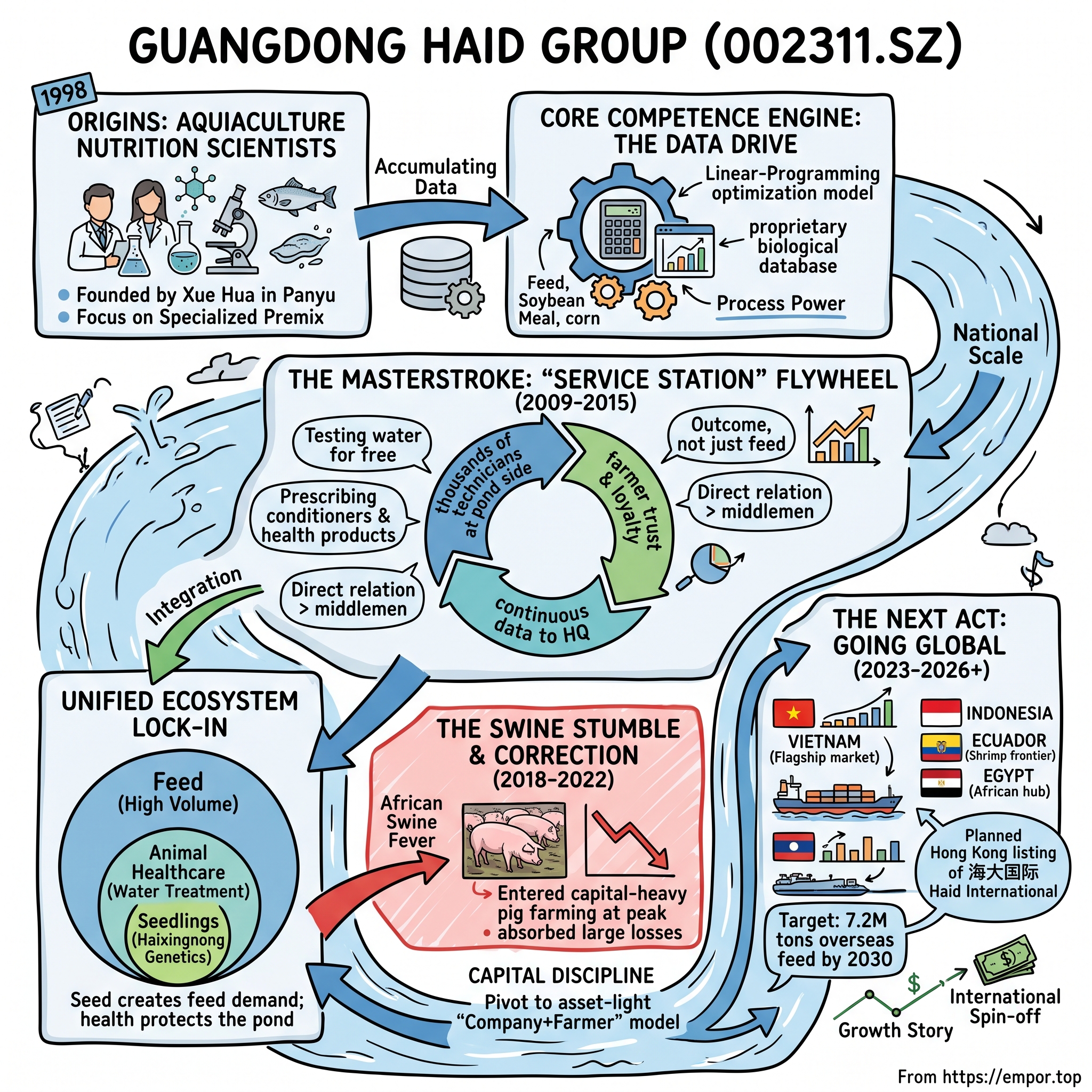
That reframing is the whole story. Haid began in 1998 as a modest premix operation in the Panyu district of Guangzhou, founded by a small team of aquaculture nutritionists.[^1] By 2024 it had grown into the largest feed producer on Earth by volume, selling 26.52 million metric tons of animal feed in a single year, generating operating revenue of roughly ¥114.6 billion RMB and net profit attributable to shareholders of about ¥4.5 billion.1 Its market capitalization has traded in the range of a mid-teens-billion-dollar agribusiness — a scale that puts it in the same conversation as the century-old Western feed and grain incumbents it has been steadily out-growing.2
To grasp the sheer physicality of that number, sit with 26.52 million tons for a moment. That is more than five hundred kilograms of feed for every ton of it moving through mills, trucks, barges, and pond-side hoppers, day after day, across China and a growing arc of the developing world. It is enough feed to convert into a meaningful slice of the animal protein that a billion-plus people eat. Feed is the invisible input layer of the entire protein economy: before anyone eats a farmed fish, a chicken, or a slice of pork, some company has to turn corn and soybean meal into the biology that produces it. Haid sits at the base of that pyramid, and it has quietly become the largest single node in it. Most consumers have never heard the name. Most investors outside China have never modeled it. That obscurity, relative to its scale, is part of what makes it a "quiet titan."
Here is the paradox that makes Haid worth an episode. Animal feed is, on paper, one of the least attractive businesses imaginable. Raw materials — corn, soybean meal, rapeseed meal, wheat, fishmeal — routinely account for 85–90% of the cost of a bag of feed, which means a feed miller is essentially a thin processing spread wrapped around a violently volatile commodity book. Layer on top of that the notorious 猪周期 pig cycle, the boom-and-bust in Chinese hog prices that has bankrupted seasoned operators, and you would expect feed to be a business of razor margins and periodic wipeouts. Yet in normalized years Haid has generated returns on equity in the high-teens to around 20% — the kind of number one associates with software, not soybean meal. How does a company that grinds grain for fish throw off tech-like returns on capital?
The answer, told simply, is that Haid stopped selling a commodity and started selling an outcome — and then wrapped that outcome in a set of reinforcing advantages that are genuinely hard to copy. But "hard to copy" is the kind of phrase a management team loves and an analyst should distrust, so throughout this piece we will keep pulling the thesis apart to see whether it holds. A company can generate a good run of returns for reasons that turn out to be cyclical, temporary, or simply lucky — a favorable stretch in grain prices, a hog cycle that broke the right way, a competitor that stumbled. The task is to separate the parts of Haid's story that are structural and durable from the parts that are merely a good few years, and to be candid about which is which.
This article traces the answer through the arc management itself would tell — and then stress-tests that arc against what a skeptical investor should demand. The threads to follow: how the 海大服务站 "Service Station" model turned distribution from a cost center into a moat by selling pond outcomes instead of commodity feed; how a linear-programming formulation engine turned raw-material volatility from a threat into a weapon; how the company stumbled into asset-heavy pig farming at exactly the wrong moment and what its correction reveals about capital discipline; how the genuinely high-margin businesses — aquatic seed genetics and animal healthcare — hide inside a low-margin feed body; and how Haid is now trying to export its entire China playbook to Vietnam, Indonesia, Ecuador, and Egypt, culminating in a planned Hong Kong listing of 海大国际 Haid International. Each of those is a claim. Our job is to ask what evidence supports it, and what would break it.
A word on the industry backdrop, because it frames everything that follows. China produces and consumes more farmed aquatic protein than the rest of the world combined; aquaculture there is not a niche but a staple food system feeding hundreds of millions. That system runs on feed, and feed runs on the global grain complex — which means Haid sits at the intersection of two enormous, volatile flows: the biology of farmed animals on one side and the commodity markets for corn, soy, and fishmeal on the other. Everything interesting about the company comes from how it has learned to stand in that intersection without being crushed by it. With that stage set, the natural place to start is at the beginning — in a laboratory, not a warehouse.
 Subscribe on LinkedIn
II. Origins: From Sun Yat-Sen University to the Ponds of Panyu (1998–2008)
The founding of Haid does not begin in a grain warehouse. It begins in a laboratory. 薛华 Xue Hua, the man who would build and still runs the company as chairman and chief executive, did not come from the merchant class of grain traders and rural distributors that produced most of China's agricultural entrepreneurs. He trained as a scientist — an aquaculture and zoology specialist out of 中山大学 Sun Yat-Sen University, with a research background tied to the fisheries institutes of the South China coast. That distinction matters more than it sounds. When Xue looked at a bag of fish feed, he did not see a sack of ground-up grain to be bought low and sold high. He saw a biochemical optimization problem: how to convert the cheapest available nitrogen and energy into fish flesh at the lowest feed conversion ratio the animal's digestion would allow.
There is a particular kind of founder who builds a great company by refusing to accept that a problem is unsolvable simply because everyone else has stopped trying to solve it. Xue Hua appears to be that kind. Colleagues and industry accounts describe a chairman who never fully left the laboratory behind — who talks about feed conversion ratios and disease vectors with the fluency of a researcher rather than the gloss of a salesman, and who built an entire corporate culture around the conviction that the pond is a system to be measured and optimized rather than a gamble to be endured. That is an unusual temperament for the head of a company that grinds grain, and it is the closest thing Haid has to a personality. The founder's fingerprints are all over the strategy: every distinctive thing the company later did — the technicians at the pond, the formulation database, the push into seed genetics — is downstream of treating aquaculture as applied science.
To understand why that mindset was radical, you have to understand the state of South China aquaculture in the late 1990s. Rising domestic incomes and export demand had set off an explosion in freshwater and marine farming — tilapia, carp, snakehead, yellow catfish, and increasingly the white-legged shrimp that would become the region's cash crop. But the feed serving those ponds was primitive. Local mills sold cheap, raw-grain-heavy feeds with wildly inconsistent nutritional profiles and poor water stability, meaning much of the feed simply dissolved and fouled the pond before the animals could eat it. Farmers lived with brutal mortality risk from disease and water degradation, and their 饵料系数 feed conversion ratios — the kilograms of feed needed per kilogram of harvested animal — were terrible. In a business where feed is the dominant cost, a bad conversion ratio is the difference between profit and ruin.
Xue's wedge was to attack the single hardest technical corner of the market first. Rather than start with poultry or swine feed — high-volume, low-technology, brutally competitive — Haid began in 1998 with specialized premixes and additives for fish and shrimp, and only built out full-line aquafeed mills in the years that followed.[^1] Aquafeed is the graduate-level version of the feed business. Aquatic species have complex, species-specific digestive requirements; the feed must be extruded or pelleted to survive underwater long enough to be eaten; and the diversity of farmed species — each with a different nutritional profile — multiplies the formulation complexity. A generalist grain miller could not easily copy it. That technical barrier was the point.
Why premix first, and why that choice was cannier than it looks? A premix is the concentrated package of vitamins, minerals, amino acids, and additives that gets blended into the bulk grain to make a complete feed — it is a small fraction of the finished product by weight but a large fraction of its technical value. Selling premix let a small, undercapitalized company compete on knowledge rather than on tonnage; it did not need to out-build the incumbents' mills, only to out-formulate them on the ingredient that actually determined animal performance. It was the highest-margin, lowest-capital, most defensible corner of the business, and it let Haid earn its way toward the capital-intensive full-line mills it built from 2004 onward rather than betting the company on debt-funded capacity before it had proven the product. That sequencing — knowledge first, then capacity — is a discipline many agricultural start-ups skip, usually to their cost.
The early economics were funded the hard way, by reinvesting the fat gross margins that specialized premixes threw off rather than by leaning on outside capital. From its Panyu base the company pushed outward across Guangdong and the broader Pearl River Delta, and in doing so it began accumulating something more durable than mills: raw-material procurement discipline and a growing library of what actually worked in real ponds. Every season of feeding trials, every substitution of one protein source for another, every observation of how a formula performed across different species and water conditions was, in effect, being logged. At the time it looked like ordinary operating experience. In hindsight it was the seed corn of a data advantage that competitors would find almost impossible to reconstruct from scratch.
What should a careful investor take from the origin story rather than simply enjoying it? Two things. First, the founder's scientific framing is not marketing color — it explains why Haid built a genuine formulation capability while rivals treated feed as a trading business, and founder-led scientific cultures are unusually persistent. Second, the deliberate choice to start in the hardest, highest-barrier product category is a repeatable strategic signature; you will see the same instinct — enter where the technical bar is highest and the incumbents weakest — when the company later goes overseas. The origin is not just a nice myth. It is the first data point in a pattern of where this management believes its edge lives. And the moment that edge became a machine was the moment Haid went public and turned a field-service idea into a nationwide flywheel.
III. The IPO & The Masterstroke: The "Service Station" Flywheel (2009–2015)
On November 27, 2009, Haid's shares began trading on the small- and medium-enterprise board of the Shenzhen Stock Exchange under the code 002311.3 The IPO was, in the narrow sense, a capital-raising event to fund a national build-out of feed mills and R&D infrastructure. In the larger sense it was the moment the company could finally scale the one idea that separated it from every other mill in China: the 海大服务站, the Service Station.
To feel why that idea was subversive, start with the model it replaced. In the traditional Chinese feed trade, a mill sold its output to local dealers — middlemen who warehoused the feed, extended credit to farmers, and clipped a healthy margin for the service. Those dealers competed on price and credit terms, not on whether the farmer's fish actually survived. They offered no meaningful technical help because they had none to offer; they were financiers and logistics agents wearing the hat of an advisor. The farmer, the person actually bearing the biological risk of the pond, was left almost entirely alone with it.
Haid's move was to walk around the dealer entirely and put its own people at the pond. The company recruited and trained thousands of aquaculture technicians — many of them agriculture and fisheries graduates — and deployed them into the field not as salesmen but as unpaid consultants. They tested pond water chemistry. They monitored dissolved oxygen, the single most common killer of a stocked pond. They inspected shrimp gut health, advised on stocking density, diagnosed early disease, and prescribed the right water conditioners. All of it was bundled in with the feed, effectively for free. To a farmer accustomed to being sold to and then abandoned, a young technician who showed up, waded in, and told him how to not lose his crop was close to revolutionary.
Think about what this did to the unit economics of a sale. A conventional feed company spends its selling budget on dealer margins and rebates — money that buys distribution but no relationship with the end user and no information about what happens in the pond. Haid redirected that same spend into a salaried technical workforce, and in doing so it bought three things at once: distribution (the technician is also the point of sale), a defensible relationship (the farmer trusts the person, not just the brand), and a continuous stream of ground-truth data about ponds, diseases, and formula performance flowing back to headquarters. One cost line, three assets. The dealer model buys only the first, and rents even that. This is why the Service Station is better understood as an information-and-trust engine wearing the costume of a sales force. The feed sale is the visible transaction; the invisible one is the data and loyalty accumulating with every visit.
There is a labor dimension worth naming, because it is both the strength and the vulnerability of the model. A Service Station network is only as good as the thousands of young technicians staffing it, which makes recruiting, training, and retaining agriculture graduates a core competence rather than an HR footnote. Haid effectively runs a rolling apprenticeship program, turning fresh fisheries graduates into trusted pond-side advisors — a pipeline that is hard for a competitor to stand up quickly but expensive for Haid to maintain and vulnerable to wage inflation and turnover. The moat here is not free; it is paid for every year in payroll. That it still produces superior farmer economics is the evidence that the model works, but an investor should register that this is a high-touch, people-heavy advantage, not a capital-light software one.
Now watch the flywheel turn. Better technical service raised survival rates and lowered feed conversion ratios. Both effects flowed straight to the number the farmer actually cares about: total cost per kilogram of harvested fish or shrimp. A farmer using Haid's feed plus Haid's on-pond service could run a more profitable operation than a neighbor buying nominally cheaper feed from a dealer, because the neighbor was losing animals and wasting feed. The farmer's response was rational and, for Haid, enormously valuable — he became loyal, and he was willing to pay a premium for Haid feed precisely because the feed was the entry ticket to the service that made his whole pond more profitable. In an industry that looks like a pure commodity, Haid had manufactured switching costs out of thin air.
There is a moment in the growth of any great franchise where a good idea becomes a compounding machine, and for Haid it was the realization that the technician's visit could be scaled and templated. Early on, the pond-side service was artisanal — a talented graduate applying judgment. As the network grew, Haid could standardize what the technicians measured, feed their observations into a common database, and push improved protocols back out to the whole field force, so that the ten-thousandth technician arrived at the pond armed with the accumulated lessons of every visit that came before. The service got better as it got bigger, which is the opposite of how most labor-intensive businesses behave; usually quality dilutes with scale. That inversion — scale improving rather than degrading the product — is the tell that something structural is at work rather than mere hustle.
It is worth being precise about what kind of advantage this is, because it is easy to over-romanticize. This is not a technology network effect and it is not brand in the consumer sense. It is a labor-intensive, boots-on-the-dyke service moat: expensive to run, hard to copy quickly, and — crucially — self-reinforcing at scale. The more farmers Haid served, the more pond-level data its technicians gathered, the better its formulation and advice became, and the more valuable the next technician's visit was. Competitors reliant on the dealer channel could not easily match it without cannibalizing the very distributors who moved their volume — a bind we will return to when we war-game the competition. What the Service Station bought Haid was the right to grow volume nationally without collapsing into a pure price war. And volume, at national scale, is what turned the second, quieter engine — the formulation algorithm inside the feed bag — into a genuine cost weapon.
IV. De-Risking the Grain Elevator: Formulation Tech & Commodity Hedging
Every feed company in the world lives with the same terrifying arithmetic. Raw materials — corn, soybean meal, rapeseed meal, wheat, fishmeal — make up the overwhelming majority of the cost of the finished product, on the order of 85–90%. That means a feed miller is not really selling feed; it is selling a thin conversion margin stretched across a commodity book that can lurch violently on weather, harvests, currency, and policy. A single bad move in soybean meal can vaporize a season's gross profit. Most millers respond by passing prices through to farmers with a lag and praying the lag does not catch them wrong-footed. Haid's answer was to turn the commodity problem into an engineering discipline.
The heart of it is the formulation matrix. Over decades, Haid built a proprietary database of raw materials and the nutritional performance of feeds built from them — reportedly testing well over a thousand alternative ingredients and protein sources across dozens of aquatic and livestock species. On top of that database sits a set of linear-programming models: optimization engines that continuously solve for the least-cost feed formula that still hits a precise nutritional specification, given live commodity prices. Strip away the jargon and it is an idea any home cook understands. If beef gets expensive, you make the same stew with chicken and adjust the seasoning so it tastes identical. Haid does that thousands of times a day, at industrial scale, with amino-acid-level precision. When fishmeal or soybean meal spikes, the model automatically leans the formula toward fermented cottonseed meal, DDGS, or amino-acid-supplemented wheat — substituting cheaper inputs without sacrificing the animal's growth rate.
Why is that a durable advantage rather than a spreadsheet any rival can build? Because the optimizer is only as good as the biological data feeding it. Anyone can license a linear-programming solver. Almost no one else has Haid's decades of species-specific feeding-trial results telling the model that this particular substitution, at this inclusion rate, in this species, delivers identical growth. That empirical library — the thing quietly accumulated pond by pond since Panyu — is the moat; the algorithm is just the interface to it. This is what strategists call process power: an advantage embedded in an organization's accumulated know-how that competitors cannot buy off the shelf and cannot replicate without living through the same years of trials.
The subtlety that makes this genuinely hard is that the constraint is not price; it is nutritional equivalence. A naïve optimizer will always tell you to buy the cheapest calories and protein on the market. The problem is that fish and shrimp are not indifferent to where their nutrition comes from — swap in too much of the wrong plant protein and growth slows, disease resistance drops, or the animal simply refuses to eat, and the "savings" evaporate into a worse harvest. The value of Haid's database is that it knows the boundaries: exactly how far it can push each substitution in each species before performance breaks. That knowledge is the fence inside which the algorithm is allowed to hunt for the cheapest formula, and drawing that fence correctly is worth more than the optimization itself. A competitor with the same solver but a thinner dataset will either leave money on the table by being too conservative or blow up farmer results by being too aggressive. Neither error is survivable at scale.
Scale sharpens the weapon further. Buying grain by the tens of millions of tons gives Haid direct sourcing relationships with the global ABCD trading houses and access to domestic state reserves, and a purchasing desk large enough to play suppliers against one another rather than take their price. A dedicated hedging team uses domestic and international futures to lock in the crush margin — the spread between raw-material cost and feed price — rather than to place directional bets on where corn is going. That distinction is the whole philosophy: Haid is trying to be paid for processing, not for guessing the grain market, and hedging is the tool that isolates the one from the other. It is also, for a skeptic, exactly the kind of activity to watch, because a hedging book that drifts from risk management into speculation is how "boring" feed companies occasionally blow up. Nothing in the public record suggests Haid has, but the exposure is real and worth monitoring.
The competitive payoff shows up in the mix. Where a rival such as 通威股份 Tongwei Co., Ltd. historically chased volume in commoditized freshwater fish feed, Haid tilted toward high-value extruded feeds (膨化料) and shrimp feed, where gross profit per ton in specialized aquafeed runs materially above the thin margins of poultry feed. The strategic conclusion is straightforward: formulation agility plus scale purchasing plus a deliberate mix shift toward technically demanding products is how Haid converts an industry-wide vulnerability — input volatility — into relative advantage. It does not make Haid immune to a soybean shock; it makes Haid hurt less than the mill down the road, which in a commodity industry is exactly how you compound share. The one arena where all of that discipline temporarily failed, tellingly, was the one furthest from feed: raising pigs.
V. Navigating the Storm: African Swine Fever, Pig Cycles, and Capital Allocation Lessons (2018–2022)
In August 2018, the first case of 非洲猪瘟 African Swine Fever was confirmed in China, and within roughly a year the disease had torn through the world's largest hog herd, wiping out an estimated 40–50% of the national pig population. For a country where pork is the default protein, this was not an agricultural footnote; it was a supply shock that reordered an entire industry. Backyard pig operations, which had raised a huge share of China's hogs, were devastated and could not come back. The vacuum pulled the sector toward large-scale, biosecure, industrial pig farming — and it sent hog prices to spectacular highs as the surviving supply could not meet demand.
For Haid, ASF created both a threat and a temptation. The threat was to its swine-feed volumes: fewer pigs meant less feed sold. The temptation was the soaring hog price, which made owning the pigs — not just feeding them — look irresistibly profitable. Haid leaned into that temptation. To defend feed volume and capture the fat margins of high hog prices, it committed meaningful capital to direct pig farming (生猪养殖), building and buying breeding and fattening capacity through a stretch of elevated capital expenditure. On the way up, with hog prices near record levels, it looked like smart vertical integration.
Then the cycle did what the cycle always does. As the industry raced to rebuild the herd, supply came roaring back, and by 2021 hog prices had collapsed — falling more than 50% and, for stretches, dropping below the cost of production.4 The pain was industry-wide and severe: China's marquee pork producers, from 正邦科技 Zhengbang to 温氏股份 Wens Foodstuff Group to 新希望 New Hope Liuhe, posted staggering losses, and some were pushed to the edge of insolvency. Haid's own pig-farming segment turned into a drag, posting material operating losses that pulled down consolidated earnings and, predictably, compressed the valuation the market was willing to assign the whole company. A structural complication made it worse: Haid was buying a large share of its piglets on the open market rather than breeding them internally, so when piglet prices were high its fattening costs were squeezed from both ends.4
It helps to understand why the pig cycle is so merciless, because it is the single most important macro force acting on this company's earnings. Pigs breed relatively quickly and every farmer sees the same high price at the same time, so a period of fat margins triggers a synchronized rush to expand the herd. Twelve to eighteen months later that expanded herd all comes to market at once, prices crash below cost, farmers lose money until enough of them capitulate and cull, supply tightens, and prices spike again — restarting the whole loop. It is a hog-driven version of the cobweb that has punished commodity producers for centuries, and African Swine Fever amplified it violently by first destroying the herd and then inviting a frenzied, industrial-scale rebuild. Anyone entering hog farming near the top of that cycle is, almost by definition, buying capacity that will be worth far less by the time it is fully operational.
This is exactly the point where a neutral analysis has to get harder-nosed than a company would about itself. The honest question is whether management fell into the classic empire-building trap — expanding an asset-heavy, cyclical business at a cyclical peak because the recent numbers looked good. The honest answer is: at least partly, yes. Haid deployed capital into hog farming near the top and absorbed losses on the way down, and no amount of narrative about "protecting feed volume" fully excuses buying into the most capital-intensive, lowest-moat part of the value chain at the moment it was most expensive. That is a real mark on the capital-allocation record, and any investor taking management's discipline on faith should sit with it. The most charitable framing — that Haid needed a foot in industrial hog farming to defend its swine-feed franchise as backyard farms disappeared — has some merit, but "strategic hedge" and "buying high" are not mutually exclusive, and here they were both true at once.
What partially redeems the episode is the correction. Rather than doubling down, management pivoted the swine strategy toward an asset-light 公司+农户 "Company + Farmer" model — Haid supplies piglets, feed, and technical protocols while contracted farmers provide the barns and labor, sharing risk and sparing Haid the balance sheet. The logic is the same one that made the feed business great: Haid is better at knowledge and inputs than at owning depreciating physical assets in a commodity market, so it should sell the knowledge and inputs and let someone else own the barns. It ring-fenced and capped pig-farming capex, tightened futures-based price-locking on hogs, and redirected primary capital back to the businesses where its moat actually lives: core feed, seed genetics, animal health, and overseas expansion.
The activist-style stress test to apply here is whether the correction is genuine reform or merely a response to a bad year that will be quietly forgotten when hog prices next spike. A skeptic would demand to see the behavior repeat under temptation — capped hog capex holding firm through a real up-cycle, disclosure that clearly separates the volatile farming P&L from the stable feed P&L so investors can see each on its own terms, and no creeping re-expansion of self-owned herds dressed up in strategic language. The test of whether that discipline is real is behavioral and ongoing — does capex to hog farming stay contained through the next up-cycle, when the temptation returns? That is precisely why hog exposure belongs on any short list of things to monitor. For now, the more encouraging story is that the segments Haid retreated toward are also its most profitable — and quietly, they always were.
VI. The High-Margin Engines: Aquatic Seedlings, Animal Healthcare, & Ecosystem Lock-in
Return to that pond in the Delta, but this time follow the money instead of the water. The farmer's single largest cash outlay is feed, and feed is where Haid does most of its revenue. But feed is also a low-margin business — a few hundred yuan of gross profit per ton in the best specialized aquafeed, far less in poultry. If that were the whole company, Haid would be a well-run commodity processor and nothing more. The reason it earns tech-like returns lies in two much smaller businesses tucked inside the ecosystem, each generating a disproportionate share of profit because each carries gross margins the base feed business can only dream of.
The first is aquatic seed genetics, sold under the 海兴农 Haixingnong brand. This is the business of producing the young animals themselves — specific-pathogen-free Litopenaeus vannamei shrimp postlarvae, tilapia fingerlings, snakehead and higher-value marine species. To grasp why genetics is the leverage point of the entire pond, consider what the seed determines: disease resistance and growth rate, the two variables that decide whether a farmer harvests a healthy crop or watches it die. Shrimp are the sharpest example. A postlarva that carries the wrong pathogen, or simply lacks the genetic robustness to survive a stressful pond, can doom a crop before the farmer has fed a single kilogram. Premium seed sits at the top of the value chain, and it is scarce, technical, and hard to copy — which is why it commands margins far above feed.
There is a deeper reason genetics matters so much to the feed business specifically, and it is worth spelling out because it is the hidden hinge of the whole model. A farmer's total feed purchase over a growing cycle is a function of how many animals survive to eat it. Stock a pond with fragile, disease-prone seed and half the animals die young, taking their future feed demand to the bottom of the pond with them. Stock it with robust, high-survival seed and nearly every animal grows to harvest, eating feed the entire way. In other words, better seed does not just sell seed — it multiplies the feed the same pond will consume. When Haid supplies premium postlarvae, it is quietly enlarging the feed market it then serves. Seed and feed are not two separate products cross-sold to the same customer; they are one system in which the first product manufactures demand for the second.
The second is animal healthcare and water treatment, sold as 海大动保: aquatic vaccines, veterinary pharmaceuticals, probiotic water conditioners, and ecological remediation agents. Here the strategic logic connects directly back to the Service Station. Water quality is the single highest determinant of aquaculture success, and the same technicians who test the pond and diagnose the problem are the natural channel to prescribe and sell the remedy. The healthcare products are not sold cold off a shelf; they are recommended by a trusted advisor who has just measured the exact problem they solve. That is about as frictionless as a sale gets — the diagnosis and the prescription come from the same visit, from the same trusted person, closing the loop between problem and product in a way a pure feed vendor can never match.
Put the pieces together and you see why the ecosystem is so hard to attack. A farmer who buys Haid's seed, Haid's feed, Haid's water conditioners, and Haid's on-pond diagnostics is not a feed customer who can be flipped by a 3% discount on feed. To switch feed suppliers he would have to unpick a bundle that includes the genetics determining his survival rate and the technical relationship that keeps his water alive — and get all of it working together with someone new, at the risk of his entire crop. The rational farmer does not take that bet to save a few percent on the largest-volume, lowest-stakes component. The feed is the commodity; the seed, the health products, and the service are the lock. That is the mechanism behind the switching costs introduced earlier, now made concrete.
The investor conclusion is a nuance that headline financials obscure. Seedlings and animal health together represent only a low-single-digit percentage of Haid's revenue, so a casual reader skims past them. But because their gross margins run so far above the corporate average, they punch well above their revenue weight in net profit, and — more importantly — they are the glue that protects the pricing and loyalty of the enormous feed business around them. The single most important structural question for the bull case is whether this high-margin, high-lock core can keep growing faster than the commodity feed body.
It is worth being precise about the risk lurking inside this pretty picture, because the ecosystem's strength is also a form of concentration. If the seed genetics ever slip — a disease breakthrough that Haid's postlarvae fail to resist, a rival that leapfrogs it on shrimp genetics, a regulatory change that commoditizes the seed market — the loosening of that one component would loosen the whole bundle, because the seed is the piece doing the most work to hold the farmer. The same technicians who make the ecosystem sticky also make it expensive, and a serious competitor with deep pockets could, in principle, attack the model by hiring away technicians and licensing competitive genetics. Nothing suggests that is happening at scale today, but the ecosystem is defended by ongoing execution, not by a patent or a law. The bull should hold the strength and the fragility together: this is a very good mousetrap, not an impregnable one. And the place management is betting it can rebuild that entire mousetrap from scratch is no longer China. It is the emerging aquaculture frontier abroad.
VII. The Next Act: Going Global & HKEX International Spin-Off (2023–2026+)
Stand in a shrimp-farming district outside Ho Chi Minh City today and squint, and you are looking at the Pearl River Delta of twenty years ago: fragmented farmers, primitive feed, high mortality, and no one at the pond to help. That resemblance is the entire overseas thesis. Haid's domestic Chinese aquafeed market is maturing into a consolidated, slower-growth phase where the company is already the leader. But the emerging aquaculture markets of Southeast Asia, South Asia, South America, and Africa look structurally like South China before Haid transformed it — which means the Service Station playbook, the formulation engine, and the seed-plus-health ecosystem all have somewhere new to run.
Vietnam is the flagship and the proof of concept. It is Haid's largest overseas market, where the company has built out substantial feed capacity and captured a commanding position — reported at roughly a 19.2% share of the overall feed market, with rapid growth in shrimp and pangasius feed and hundreds of thousands of tons of local production capacity.5 What makes Vietnam persuasive as a proof point rather than a one-off is that Haid did not win it on price; it won it by transplanting the same package — technical service at the pond, formulation-driven quality, seed and health cross-sell — into a market that looked exactly like the one it had already conquered. If the model were merely a China-specific accident of timing, it would not have reproduced so cleanly in a different country, language, and regulatory regime. That it did is the strongest single piece of evidence that the moat travels.
Indonesia is the next leg, where Haid has reached mid-single-digit aquafeed share and is expanding both mills and hatchery networks.5 Beyond Asia, the company has pushed into Ecuador — the beating heart of the global shrimp-export trade and home to the world's most intensive, most sophisticated shrimp farmers — and into Egypt, which it is using as a tilapia-feed base for the African market. Ecuador is a particularly interesting test, because its shrimp farmers are not the fragmented smallholders of the Delta twenty years ago; they are large, professional, export-oriented operations that already know what they are doing. Winning there means competing on genuine product and cost merit rather than on filling a service vacuum, and it will reveal whether Haid's edge is fundamentally about serving the under-served or about being better at feed, full stop. The pattern in the easier markets is the same one from the origin story: enter where aquaculture is booming and technical service is absent. Ecuador asks whether Haid can win where it is present.
The numbers behind the push are real and fast-growing. Overseas feed sales volume reached roughly 2.36 million tons in 2024, up about 40% year over year, and management has set a medium-term target of 7.2 million tons of overseas feed and an audacious 51.5 million tons of total feed sales by 2030 — nearly double the 2024 base.16 That growth is precisely what makes the capital-markets move that follows so logical.
A brief detour on how these markets even resemble one another, because the "China twenty years ago" line is doing a lot of work and deserves scrutiny. The resemblance is real in the ways that matter to Haid's model: fragmented farmers, immature local feed quality, high mortality, weak technical support, and rapidly rising domestic protein demand. But the differences matter too. Vietnam, Indonesia, Ecuador, and Egypt each have their own currencies, import regimes, disease profiles, and entrenched competitors — including local champions and the same Western multinationals Haid competes with everywhere. The playbook is portable, but it is not a photocopier; each market requires rebuilding the technician network, the hatcheries, and the local formulation data from something closer to scratch. The 40% overseas volume growth suggests the transplant is taking, but growth off a small base is easy, and the harder question is whether Haid can hold margins as the easy early share gives way to trench warfare with incumbents.
In late October 2025, Haid announced plans to spin off its international operations, 海大国际 Haid International, for a separate listing on the main board of the Hong Kong Stock Exchange, and in January 2026 the unit filed its application, backed by underwriters including JPMorgan and CICC.7[^9] The structure is revealing. Haid International sells its feed entirely outside China, which insulates it from the domestic slowdown, and its revenue has been heavily concentrated in Vietnam — as much as about 71% of the total in 2023, deliberately brought down toward the high-50s percent range as Ecuador and Egypt scaled, a diversification the company is keen to show investors.7 The rationale for the spin-off is a familiar one: a Hong Kong listing unlocks international equity capital in hard currency, creates a cleaner vehicle and local incentive structure for overseas managers, and gives Haid an acquisition currency for buying feed mills and genetics assets abroad.
The timing of the move is itself a piece of information. Spinning off the international arm just as it crosses into fast growth, and pricing it in Hong Kong rather than folding the capital raise into the Shenzhen parent, tells you management wants a hard-currency, globally-visible vehicle — one whose shares can be used to buy foreign feed mills and genetics companies, and whose local option pools can retain overseas operators who would not be motivated by A-share incentives. There is a less flattering read available too, which a skeptic should keep on the table: spin-offs are sometimes timed to sell a growth story into a receptive market at a premium multiple while the cyclical, lower-multiple parent retains the mundane bulk of the business. Which interpretation proves correct will depend on the terms — how much of Haid International the parent retains, how related-party transactions between the two are priced, and whether minority investors in the parent are treated as partners or as an afterthought.
A neutral read should note both the opportunity and the questions the spin-off raises. Egypt and the broader African bet illustrate both sides at once. Egypt is one of the world's larger tilapia producers, and Haid's strategy of using it as a low-cost feed and production hub for the region fits the pattern of entering a booming, under-served aquaculture market early. But Africa also concentrates the risks: thinner local supply chains, greater currency and political volatility, and infrastructure that can turn a logistical advantage into a logistical headache. The upside is a genuinely long runway in a continent whose protein demand is only beginning to industrialize; the downside is that the further Haid travels from the dense, mature supply chains of South China and Southeast Asia, the more its execution depends on variables it does not control. That asymmetry — large potential, wide error bars — is the honest shape of the frontier markets in the portfolio.
The opportunity is genuine: the overseas markets are large, under-served, and growing, and Haid is arriving with a playbook it has already proven once. But a separate listing also invites scrutiny. Concentration in Vietnam remains high, and a single country's currency, policy, or disease shock could dominate results. Carving out the international business creates related-party complexity between parent and listco — transfer pricing on shared genetics and formulation, allocation of overhead, competition for capital — that minority investors in either entity will want watched. And the very projections that make the prospectus exciting, like a global aquafeed market growing only in the low-single-digits annually, imply that Haid's overseas ambitions depend on taking share, not riding a rising tide. The global act is the most important growth story Haid has; it is also the one where the least is yet proven. Which brings us to the harder question of exactly how defensible this whole edifice is.
VIII. Moat Analysis: Hamilton Helmer's 7 Powers & Porter's 5 Forces
Strip the narrative away and put Haid on the operating table. Is there a real moat here, or a well-run commodity company enjoying a good stretch? The most useful way to answer is to run the business through two disciplined frameworks — Hamilton Helmer's 7 Powers for the sources of durable advantage, and Porter's 5 Forces for the structure of the industry it competes in — and to be honest about which powers are strong, which are thin, and where the company has no protection at all.
Start with Scale Economies. This one is genuine. Purchasing raw materials by the tens of millions of tons gives Haid volume discounts, freight efficiencies, and direct access to global grain merchants and state reserves that a regional mill simply cannot match. In a business that is 85–90% raw-material cost, even a low-single-digit procurement advantage per ton compounds into a structural edge, because it applies to the largest line in the cost stack. Scale also funds the fixed cost of the R&D database and the technician network, spreading it across enormous volume. This is the most quantifiable of Haid's powers.
Next, Process Power — the accumulated formulation know-how discussed earlier. This is Haid's least visible and possibly most durable advantage, precisely because it cannot be bought. A competitor can hire nutritionists and license an optimizer, but it cannot instantly reproduce decades of species-specific feeding-trial data that tell the model which substitutions actually preserve growth. The caveat is that process power decays if the organization stops learning; it is a moat that must be continuously refilled, not a patent that sits and protects itself.
Then Counter-Positioning, the sharpest strategic point in the whole story. The direct Service Station model is something incumbents structurally could not copy without self-harm. A legacy feed producer whose entire distribution runs through independent dealers cannot suddenly deploy its own free pond-side technicians without competing with — and alienating — the dealers who move its volume. The incumbent is trapped by its own channel. That is textbook counter-positioning: a new model the incumbent declines to adopt not because it is stupid but because adopting it would cannibalize its existing business. This is the cleanest explanation for how Haid grew in a supposedly commoditized market without being crushed on price.
Finally, Switching Costs, examined in depth already: the seed-plus-feed-plus-health-plus-service bundle raises the operational risk of changing suppliers well above the modest savings a price-cutting rival can offer. Worth noting what Haid does not obviously have — meaningful Branding power in the consumer sense, Network Economies in the classic platform sense, or Cornered Resource control over a scarce input. Being clear about the powers a company lacks is as important as celebrating the ones it has.
It is worth pausing on a power Haid is often credited with but does not cleanly possess: a network effect. It is tempting to say the technician data creates a network — more farmers, more data, better formulas, more farmers — and there is a grain of truth in it. But a true network effect makes the product more valuable to each user because other users are on it, the way a telephone or a marketplace works. Haid's data flywheel is really a version of process power and scale economies operating together: more volume funds more R&D and generates more feeding-trial data, which improves the product, which wins more volume. That is a powerful loop, but it is a scale-and-learning loop, not a network. The distinction matters because scale-and-learning advantages can be eroded by a sufficiently large, patient competitor who is willing to spend to catch up on data, whereas genuine network effects tend to tip winner-take-most. Haid's moat is strong, but it is the kind that must be defended by continuous investment, not the kind that defends itself. An honest bull owns that distinction rather than over-claiming.
Now Porter's 5 Forces. Supplier power is moderate: the ABCD grain merchants and fishmeal producers are global oligopolies with real leverage, but Haid's purchasing scale and formulation flexibility — the ability to substitute away from any single overpriced input — let it push back harder than a small buyer could. Buyer power is low to moderate: individual fish and shrimp farmers are highly fragmented and have little pricing leverage, though they are also price-sensitive and can defect if the value proposition slips. Threat of new entrants is very low in Haid's core: replicating a national mill footprint, a proprietary raw-material database, and thousands of trained pond-side technicians is a decade-long, capital-intensive undertaking. Threat of substitutes is low and arguably shrinking: wild-capture fisheries are stagnant to declining globally, so farmed aquaculture is the only real path to meeting rising seafood demand, and farmed animals need feed. Competitive rivalry is the split decision — intense and value-destructive in commoditized poultry and swine feed, where Haid battles 新希望 New Hope, 双胞胎 Twins Group, and 温氏股份 Wens, but far more orderly in high-end aquafeed, a rational duopoly-ish structure dominated by Haid and 通威股份 Tongwei. The investor takeaway from both frameworks is the same: Haid's moat is real but concentrated in aquafeed, seed, and service; in poultry and swine feed it is largely a scale-and-execution player in a commodity brawl. The financials reflect exactly that duality.
IX. Financial Breakdown, Bull vs. Bear Case, & Key Investor KPIs
Before arguing about the future, anchor the present. In 2024 Haid delivered operating revenue of roughly ¥114.6 billion and net profit attributable to shareholders of about ¥4.5 billion on feed volume of 26.52 million tons — a year in which net profit rebounded powerfully, rising on the order of 64% as the pig-farming drag eased and feed volumes and margins recovered, with momentum carrying into a Q1 2025 that saw net profit up roughly 49% year over year.18 More recent trailing figures have shown revenue climbing toward the ¥128 billion range even as reported profit growth turned choppier, a reminder that this remains a cyclical business where a single strong or weak year distorts the trend.[^11] The right way to read Haid's earnings is across cycles, not quarters.
One accounting and disclosure nuance deserves a flag before the debate, because it shapes how the numbers should be read. Haid's consolidated earnings blend a large, relatively stable, moderately-profitable feed business with a small, wildly volatile pig-farming business and a small, very-high-margin seed-and-health business. A single headline net-profit figure smears all three together, which is why the stock can look cheap or expensive depending entirely on where hogs are in their cycle in any given year. The analytically correct move is to mentally decompose the company: value the durable feed-plus-seed-plus-health core on its through-cycle economics, treat the hog business as a volatile option worth little more than its capital, and judge management on how cleanly it lets you see each piece. Companies that resist that transparency — that prefer investors focus on the flattering consolidated number in good years — earn a skeptic's discount. Whether Haid's disclosure improves as it separates the international business into its own listed entity is itself a test of management's respect for minority shareholders.
The bull case rests on three linked claims. First, the overseas runway: if Haid can replicate the service-and-seed flywheel across Vietnam, Indonesia, and South America the way it did across China, it has years of high-growth, structurally higher-margin volume ahead, and the 2030 targets — 7.2 million tons overseas, 51.5 million tons total — become credible rather than promotional.6 Second, mix shift: aquafeed, seedlings, and animal health growing faster than commodity poultry and swine feed would lift consolidated margins over time, because the profit is concentrated in exactly the parts management says it is prioritizing. Third, capital discipline: if the pivot to asset-light 公司+农户 pig farming holds, the core feed franchise is insulated from the swine cycle that has periodically wrecked earnings, and normalized returns on equity can stabilize in the high-teens-to-20% zone that has historically distinguished Haid from its peers.
The bear case attacks each pillar. On inputs, Haid can hedge the crush spread but cannot escape the reality that a genuine black swan — an El Niño gutting the Peruvian anchovy catch and spiking fishmeal, or a soybean-meal shock — narrows everyone's processing margin at once, and Haid's is still a thin margin on a giant revenue base. On biology and weather, the business is exposed to forces no formula can hedge: typhoons and flooding across South China, and shrimp-disease epidemics like AHPND/EMS that can collapse farmer stocking and, with it, feed demand across a whole region in a single season. On the overseas story, the very concentration that makes Vietnam a triumph makes it a risk — currency depreciation, trade barriers, or a disease outbreak in one or two key countries could dominate the international P&L, and the whole expansion depends on out-competing entrenched local and multinational rivals for share in a slow-growing global market. A skeptic would add the governance overlay: the swine misadventure already showed management will chase an asset-heavy, low-moat business at a cyclical peak, and the Haid International spin-off introduces related-party complexity and a fresh temptation to over-build abroad. The bull case is coherent; it is not proven, and the bear points are not hypothetical.
A word on management credibility, judged the only fair way — by behavior over time rather than by the tone of the latest release. The record is genuinely mixed, and an honest assessment says so. On the positive side of the ledger: the founder has run the company for its entire public life, the narrative across filings has been unusually consistent about what the moat is and where it applies, the 2030 targets are specific and quantified rather than hand-wavy, and management demonstrated it will actually reverse a losing strategy rather than defend it to the grave, which is rarer than it should be. On the negative side: the swine expansion showed a willingness to chase an out-of-moat, cyclical business at the worst possible time, and the promised discipline that followed has not yet been fully tested by a fresh up-cycle. The pattern that should reassure a long-term owner is a management team that sets concrete targets, explains its misses in operational rather than excuse-making terms, and course-corrects with capital discipline; the pattern that should worry one is a re-drift into asset-heavy empire-building the moment prices turn. As of mid-2026 the evidence points more toward the former, but the jury on the latter is still out — which is exactly the posture a neutral investor should hold rather than resolving prematurely in either direction.
The rebound years illustrate how quickly the story can flatter or indict. Net profit rose sharply through 2024 and into early 2025 as the pig-farming drag faded and feed volumes climbed, a swing large enough to remind everyone that a single year's earnings say more about where the hog cycle sits than about the health of the core franchise.8[^11] That is precisely why the through-cycle lens matters: a bull who buys after two strong years and a bear who sells after two weak ones are both making the same mistake of mistaking the cycle for the company. The durable question is not "what did Haid earn last year" but "how much aquafeed, seed, and overseas volume is it compounding underneath the cyclical noise."
Which leaves the discipline that actually matters — deciding what to watch, because everything cannot be tracked. Three KPIs carry most of the signal. First, aquafeed volume growth and gross profit per ton, tracked separately from commodity poultry feed — this is the single cleanest read on whether the high-margin core is compounding or being commoditized, and it should not be blurred together with low-margin tonnage. Second, overseas feed tonnage and its margin trajectory — the entire growth thesis and the Hong Kong listing stand or fall on whether international volume keeps climbing at a healthy margin rather than growth bought by dumping cheap feed. Third, hog-farming capex and herd exposure — the direct behavioral test of whether management's promised capital discipline survives contact with the next hog up-cycle. Watch those three and you are watching the real business; watch the headline EPS alone and you will be whipsawed by the cycle. Those metrics are not just numbers — they are the scoreboard for the lessons the company learned the hard way.
X. Playbook & Strategic Lessons
Step back from the ponds and the balance sheet, and Haid's twenty-eight-year arc distills into a handful of transferable ideas — lessons that outlast this company and this industry, which is what makes a business worth studying in the first place.
Solve for the customer's profit, not your product. Haid did not win by selling cheaper feed; it won by making the farmer's whole pond more profitable, through free technical service, better genetics, and healthier water. The feed was the smallest part of the value it delivered and the largest part of what it charged for — an inversion only possible because it anchored its offer to the customer's economics rather than its own catalog. Any commodity supplier that can credibly attach itself to the customer's profit-and-loss instead of just its own price list has found a way out of the commodity trap.
Algorithmize your worst exposure. The thing that should have made feed a terrible business — violent raw-material volatility — became a relative advantage because Haid built the data and the tools to substitute inputs faster and more precisely than rivals. The lesson is not "hedge more." It is that the exposure most likely to kill you is often the one most worth turning into a proprietary capability, because everyone shares the exposure and almost no one does the work to master it.
Know the edge of your moat — and stop there. The pig-farming losses were not bad luck; they were a company wandering out of the territory where its advantages applied — feed, seed, service — and into asset-heavy commodity hog production where it had none, at the worst possible point in the cycle. The correction back to asset-light farming is the more instructive move than the mistake itself, but the lasting lesson is to map exactly where your moat ends and to treat crossing that line as the decision requiring the most skepticism, not the least — especially when recent profits are seducing you across it.
Export the playbook before the home market saturates. Haid is carrying its China-honed capabilities into Vietnam, Indonesia, Ecuador, and Egypt while its domestic market matures rather than after it stalls, and it is doing so where the technical bar is highest and local competition weakest — the same wedge it used in Panyu in 1998. Whether that international bet pays off is, as of mid-2026, the open question that will define the company's next decade. The Hong Kong listing of Haid International will put a public price and a public scoreboard on the answer. For an investor, the discipline is to hold the bull case and the bear case in the same hand: a genuine, unusually well-constructed moat in the core, married to a growth story and a capital-allocation record that still have to prove themselves outside the ponds where it all began.
References
-
Guangdong Haid Group Co., Ltd. 2024 Annual Report (feed volume 26.52M tons; revenue ¥114.6B; net profit ¥4.5B; overseas 2.36M tons) ↩↩↩
-
Top Global Feed Companies: Guangdong Haid Group Profile — Feed Strategy ↩
-
What is Brief History of Guangdong Haid Group Company? (Shenzhen SME board listing, 27 November 2009, code 002311) ↩
-
Guangdong Haid Group Co., Limited 2021 Annual Report (hog price decline >50%; asset-light pig-farming model; externally purchased piglets) ↩↩
-
Chinese firm Haid breaks ground on feed plant in Northern Vietnam — SeafoodSource (Vietnam ~19.2% share; Indonesia ~6.7% aquafeed share; capacity figures) ↩↩
-
Haid Group: Overseas Feed Sales Target for 2030 (7.2M tons overseas; 51.5M tons total) ↩↩
-
Haid Files For Hong Kong IPO Amid Growing Demand For Animal Protein — Sahm Capital, 2026-01-21 (spin-off of Haid International; JPMorgan/CICC; Vietnam ~71% of 2023 revenue, reduced below 60%) ↩↩
-
Haid Group: Net Earnings Rise by 64.30% in 2024 and 48.99% in Q1 2025 Year-on-Year — EFFAMALL ↩↩
 LinkedIn
 WhatsApp
 Reddit
 Hacker News
 Email
Email Kindle
 RSS Feed
 Spotify
 Apple Podcasts
 Amazon Music
 Audible
 YouTube