Goertek Inc. (002241.SZ): The Hardware Kingmaker in Apple's Shadow
I. Introduction & Episode Roadmap
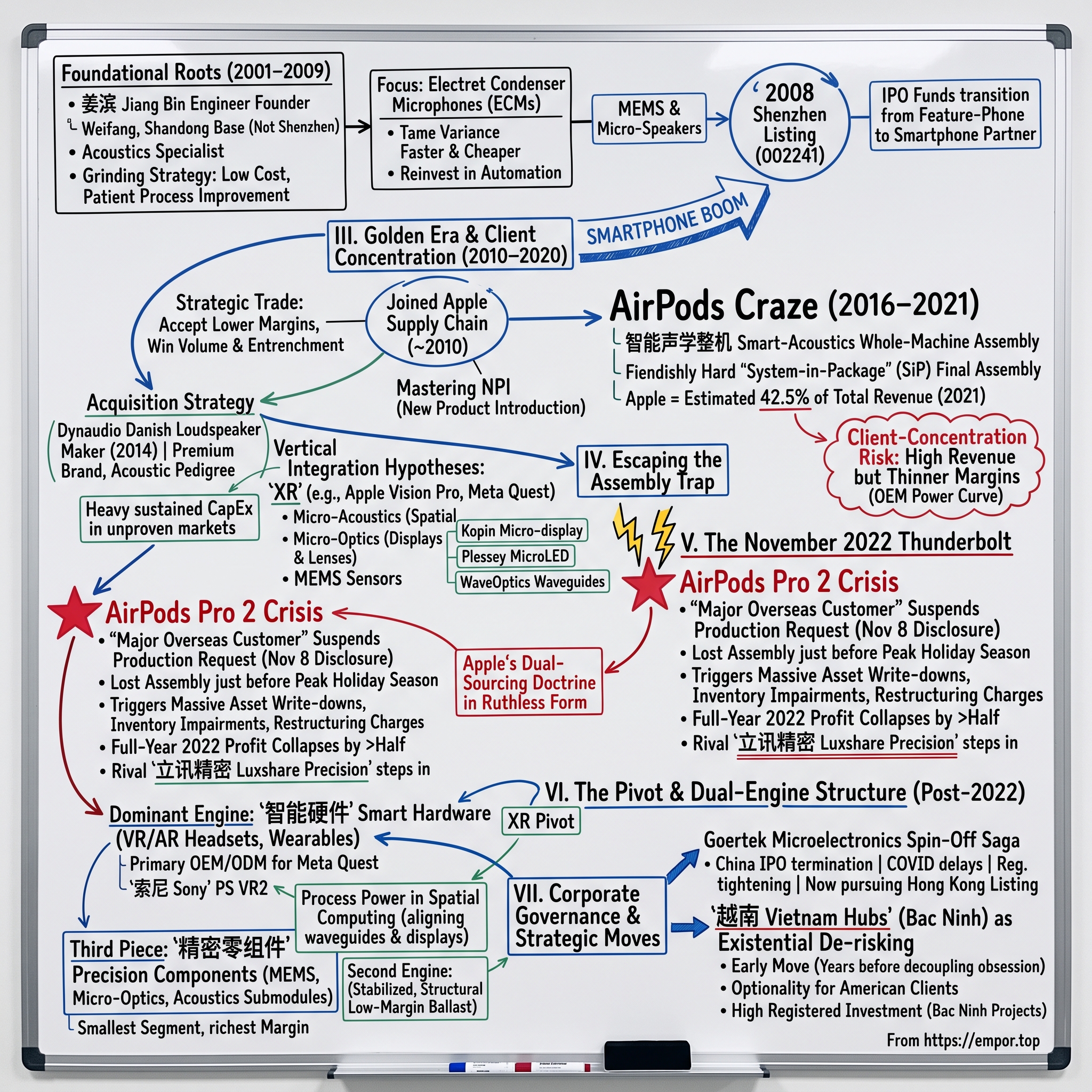
Picture a factory floor in 潍坊 Weifang, an unglamorous industrial city in Shandong province better known for kites than semiconductors. Robotic arms move in choreographed silence. Under microscopes, machines place components smaller than a grain of rice onto circuit boards at a rate of hundreds of thousands of units per day, aligning optical parts to tolerances measured in microns—a fraction of the width of a human hair. There is no famous logo on the door. Almost nobody outside the supply chain knows the name of the company that runs the line. And yet, if you own a pair of Apple AirPods, a Meta Quest headset, or have ever tried on an Apple Vision Pro, there is a very good chance the physical object in your hands was assembled here.
This is 歌尔股份有限公司 Goertek Inc., and it is one of the most important companies most consumers have never heard of. Over roughly two decades, a small acoustic-components startup grew into a global contract-manufacturing and precision-engineering behemoth, crossing RMB 100 billion—more than $13 billion—in annual revenue for the first time in 2024.12 It builds some of the most ubiquitous electronics on earth, and it does so as an invisible partner to the world's most valuable technology brands.
Here is the central paradox that makes Goertek's story worth telling. The company reached the pinnacle of global hardware manufacturing precisely by making itself indispensable to Silicon Valley—and that very indispensability nearly destroyed it. In November 2022, a single decision by one customer, later widely identified as Apple, triggered a catastrophic earnings collapse, wiping out billions in market value in a matter of days and cutting full-year profit by more than half.[^3]3 The company that had ridden the AirPods boom to spectacular heights discovered, in the space of one disclosure, the terrifying downside of a business model built on the goodwill of two or three American giants.
It is worth being precise about what "contract manufacturer" means, because the phrase undersells the difficulty. Goertek does not design the AirPod or the Quest headset; Apple and Meta do that. What Goertek does is figure out how to build those designs at a scale of tens of millions of units, at a cost that leaves the customer a fat margin, at a defect rate low enough that a consumer never notices, and on a timeline dictated by someone else's product launch. That is a species of engineering that receives almost none of the glory and carries almost all of the operational risk. When it goes right, the brand on the box takes the credit. When it goes wrong, the manufacturer takes the loss. Goertek has lived both outcomes, sometimes in the same fiscal year.
What follows is a story about power—who has it, who doesn't, and how a Chinese manufacturer tried to build enough of its own to survive. The narrative arc runs through several themes. First, the OEM/ODM power curve: how Goertek climbed from commodity acoustic components to complex electro-acoustic-optical assembly, and why each rung up that ladder brought more revenue but thinner margins. Second, client-concentration dynamics: the double-edged sword of being welded into the Apple and Meta supply chains. Third, the yield-and-process moat: why manufacturing tens of millions of micro-precise devices at high yield is, in its own way, harder than writing software—and far less forgiving. And fourth, capital allocation: the challenge of pouring heavy investment into optical engines and MEMS sensors while earning single-digit net margins.
These four themes are not independent; they are facets of one underlying tension. Goertek's climb up the manufacturing value chain (theme one) is what created its dependence on a handful of giant customers (theme two). Its process-and-yield moat (theme three) is real but has to be re-earned with every product generation, which is why a single yield stumble can be catastrophic. And its heavy capital allocation (theme four) is the price of trying to build enough irreplaceability to loosen the customers' grip. Understand how these forces push against one another and you understand the whole company. Miss it, and you will mistake either the revenue for strength or the thin margins for weakness, when the truth is a more interesting knot.
Throughout, the posture here is neutral. Goertek's management tells a confident story about spatial computing leadership and margin recovery. Our job is to ask what evidence supports those claims, what could falsify them, and where the company's own history counsels skepticism. This is a business story, not a shareholder letter. It begins, as these stories often do, with two engineers and a bet.
 Subscribe on LinkedIn
II. Foundational Roots: The Weifang Acoustic Engine (2001–2009)
In 2001, 姜滨 Jiang Bin was an engineer with a specialty that sounds narrow until you realize it is everywhere: acoustics—the physics of turning electrical signals into sound and sound back into signals. He had cut his teeth in China's state-factory system, the sprawling apparatus of government-owned enterprises that trained a generation of Chinese industrial talent before the private economy fully bloomed.[^5] Together with his wife, Hu Shuangmei, and later his younger brother 姜龙 Jiang Long, Jiang founded Goertek in Weifang—not Shenzhen, not Shanghai, but a mid-tier Shandong city far from China's coastal tech glamour.[^5]4
Jiang himself became, over the following two decades, one of the wealthiest self-made industrialists in China, his fortune tracking the wild oscillations of Goertek's share price.15 But the man who emerges from the record is less a flamboyant visionary than a relentless operator—an engineer's engineer who built a company in his own image: technically obsessive, allergic to hype, and comfortable making patient bets that would not pay off for years. In an industry where founders often sell the dream, Jiang sold the yield chart. His public communications, even during the darkest stretch of the 2022 crisis, carried the flat, unadorned register of a factory manager reporting numbers rather than a promoter spinning a story. That temperament is double-edged: it lends credibility when things go wrong, but it also means Goertek has never enjoyed the narrative premium that more charismatic founders confer on their stocks. The company is valued, harshly and fairly, on what it earns.
That geography matters more than it first appears. In the early 2000s, the gravitational center of Chinese electronics manufacturing was the Pearl River Delta around Shenzhen and Dongguan, where component ecosystems, migrant labor, and export logistics were already dense. Building an acoustics company in Weifang meant forgoing that ready-made ecosystem in exchange for something less obvious: a stable, lower-cost labor base, cheaper land, local-government goodwill toward a homegrown champion, and a workforce that, once trained, did not churn away to the next factory down the road every quarter. For a business whose entire edge would come from accumulated process knowledge held in the hands of its people, low turnover was not a footnote—it was strategy. Jiang was, in effect, betting that patient institutional memory would beat coastal convenience. It is the kind of contrarian, long-horizon choice that founder-controlled companies can make and professionally managed ones often cannot.
The founding wedge was almost unglamorously specific: electret condenser microphones, or ECMs, the tiny transducers that let a mobile phone pick up your voice. In the early 2000s, the global acoustics business was dominated by Japanese and Western suppliers who held the process know-how and charged accordingly. For a Weifang startup, this was both a barrier and an opening. The barrier was obvious—incumbents had decades of head start. The opening was structural: acoustic components were labor-intensive, tolerance-sensitive, and produced in enormous volume, exactly the kind of manufacturing where a disciplined, low-cost Chinese operation could grind its way in by matching quality at a lower price and improving relentlessly.
Consider what actually goes into an electret condenser microphone, because the humble ECM is the seed of everything that followed. It is a capacitor whose two plates move relative to each other when sound waves hit them, converting the pressure of your voice into a fluctuating electrical charge. Making one that works is easy; making a hundred million of them that all sound identical, survive being dropped, and cost pennies is an exercise in obsessive control over materials, cleanliness, and assembly precision. Tiny variations in a diaphragm's tension or a solder joint's placement, invisible to the eye, show up as audible defects. The Japanese and Western incumbents had spent decades taming that variance. Goertek's task was to tame it faster and cheaper—to industrialize other people's craft.
That grinding was the whole strategy. Goertek did not have a breakthrough technology in 2001; it had a philosophy. Take a component the Japanese made well, learn to make it nearly as well for less, win the order, then reinvest the cash into automation and testing equipment so that next year you make it better and cheaper still. This is the flywheel of process improvement—unglamorous, cumulative, and devilishly hard to copy because so much of the knowledge lives in the hands of line workers and the settings of machines rather than in patents. Each cycle let Goertek climb: from electret microphones toward micro-speakers, and eventually toward MEMS—micro-electro-mechanical systems, which are essentially tiny mechanical devices etched onto silicon chips, the technology that would later make microphones small and cheap enough to put six of them in a single earbud.
Before Apple, there was the feature-phone era, and it schooled Goertek in the discipline of serving demanding global brands. The company supplied acoustic components into the handset and consumer-electronics supply chains that fed the likes of Samsung, Sony, and the Japanese and Korean giants of the pre-smartphone age. Each of these customers taught the same brutal lessons at successively higher intensity: hit the spec exactly, ramp volume on command, absorb annual price cuts, and never, ever be the reason a launch slips. By the time Apple came knocking, Goertek had already been forged in that fire for the better part of a decade. It knew how to be a good supplier before it ever tried to be a great one.
The decisive early milestone came in May 2008, when Goertek listed on the 深圳证券交易所 Shenzhen Stock Exchange under the ticker 002241.5 The timing was, in retrospect, exquisite. The iPhone had launched the previous year. The smartphone revolution was about to detonate demand for exactly the kind of miniaturized, high-performance acoustic subsystems Goertek had spent seven years learning to build. IPO proceeds funded the transition from a feature-phone component supplier into a smartphone acoustic-subsystem partner—a shift from selling a part to owning a piece of the device's sound architecture.
What does this founding chapter tell an investor? Two things worth holding onto. First, Goertek's core advantage was never a single invention; it was an accumulating manufacturing capability, the kind that compounds quietly and shows up as yield and cost rather than headlines. That is a real moat, but a specific kind—one rooted in operational excellence rather than proprietary IP or brand. Second, the company's fortunes were, from the very start, tethered to product cycles it did not control. Goertek rose because the smartphone rose. The question the rest of the story answers is what happens when your benefactor's next product—or your benefactor's mood—changes. It did not take long to find out, because just across the horizon was the biggest customer of them all.
III. The Golden Era: Joining the Fruit Supply Chain & AirPods Craze (2010–2020)
To understand what joining Apple's supply chain meant, you have to understand what kind of customer Apple is. It is the most demanding buyer in consumer electronics: obsessive about tolerances, ruthless about price, willing to dictate which sub-suppliers you use and which machines you buy, and famously willing to split its orders across rivals to keep everyone hungry. Getting in is a coronation. Staying in is a war of nerves.
Goertek got in around 2010, winning orders to supply acoustic components—micro-speakers and microphones—for the iPhone and iPad.6 The reigning acoustic kingpin in the Apple orbit was 瑞声科技 AAC Technologies, a formidable competitor with superior component margins. Goertek's play against AAC was the same one it had run against the Japanese a decade earlier, only at higher stakes: accept lower initial margins in exchange for volume and broader responsibility. Where AAC guarded its lucrative component niche, Goertek volunteered to take on more of the messy, capital-intensive integration work that Apple wanted to outsource. It was a deliberate trade—profitability today for entrenchment tomorrow.
There is a subtle piece of supply-chain sociology worth drawing out here. Apple does not simply want a vendor that can hit a price; it wants a vendor that will co-invest, co-engineer, and shoulder risk during the terrifying period before a new product is proven. That period is called New Product Introduction, and it is where fortunes are made and lost. During NPI, the manufacturer effectively embeds its engineers alongside the customer's, jointly solving the thousand small problems that stand between a working prototype and a factory churning out millions of flawless units. A supplier that excels at NPI becomes sticky in a way a pure component seller never can, because the customer comes to rely on its problem-solving, not just its output. Goertek understood this instinctively. By volunteering for the hardest, least profitable work, it was buying its way into the room where the next generation of products got designed for manufacture. That is the entrenchment it was really paying for.
Then came the product that changed everything. When Apple launched AirPods in late 2016, it created a multi-billion-dollar category more or less overnight—wireless earbuds, or TWS (true wireless stereo), so named because the two buds connect to your phone and each other with no wire at all. Cramming a battery, antennas, sensors, and multiple microphones into something that fits in your ear canal is a genuinely brutal manufacturing problem. Think about the constraints for a moment. The whole device weighs a few grams. Inside it must sit a rechargeable battery, a wireless radio, touch sensors, an optical sensor to detect when it's in your ear, several microphones for voice and noise cancellation, a speaker, and the processing to run all of it—and every one of those components must be packed, connected, and sealed into a volume smaller than a sugar cube, at a defect rate low enough that returns don't eat the margin. This is where a manufacturing technique called System-in-Package earns its keep: rather than mounting components on a conventional circuit board, SiP stacks and integrates multiple chips and passive parts into a single miniaturized module, almost like compressing an entire electronics assembly into one dense block. It is fiendishly hard, and it is exactly the kind of high-value integration work that separates a commodity assembler from an indispensable one. And Goertek, having spent years volunteering for the hard integration work, was positioned to do the hardest version of it: not just supplying parts, but System-in-Package (SiP) assembly and final assembly of the entire earbud—the New Product Introduction, or NPI, role, where the manufacturer works alongside the customer's engineers to figure out how to mass-produce a device that has never existed before.
The financial result was a rocket ride. Goertek's revenue climbed from roughly RMB 19 billion in 2016 to the high tens of billions by 2021, propelled by what the company calls 智能声学整机 smart-acoustics whole-machine assembly.7 By 2021, Apple alone accounted for an estimated 42.5% of Goertek's total revenue—a staggering concentration for a company of its size.8 For a few golden years, Goertek looked like the perfect proxy for the wearables boom: whatever earbuds Apple could sell, Goertek could build.
But read past the top line and a second, less flattering story appears—the one every contract manufacturer eventually learns. As Goertek moved from selling components to assembling whole devices, its gross margin compressed. Component work, where Goertek's process knowledge added obvious value, had historically carried margins in the mid-twenties percent. Final assembly—labor-heavy, capital-heavy, and priced by a customer with all the leverage—dragged blended gross margins down toward the low-teens. This is the OEM/ODM power curve in one sentence: the more of the device you build, the more revenue you book and the less of each dollar you keep. Apple's strict manufacturing and tooling specifications also dictated enormous, purpose-built capital expenditure—factories and equipment tuned to one customer's product, with limited value if that product went away.
It is worth translating that margin compression into plain business language, because the numbers can mislead. A company whose revenue grows fivefold while its gross margin halves has not necessarily become a better business; it has become a bigger one, and possibly a more fragile one. Every additional billion in assembly revenue arrived attached to billions in inventory, receivables, and dedicated plant—working capital and fixed assets that had to be financed and that carried real risk if volumes disappointed. The reported growth was dazzling and the underlying economics were tightening at the same time. For an investor, the lesson embedded in Goertek's golden decade is to distrust top-line euphoria in contract manufacturing and to ask, always, what each incremental dollar of revenue actually earns and what it puts at risk.
So the golden era was real, but it was a gilded trap. Goertek had achieved exactly what it set out to achieve—deep integration into the most prestigious supply chain in technology—and in doing so had made itself a high-volume, thin-margin, single-customer-dependent assembler. The upside of that bargain filled a decade of annual reports. The downside was still theoretical in 2020. It would become terrifyingly concrete two years later. But before the reckoning, management was busy trying to buy and build its way to something more defensible.
IV. M&A, Vertical Integration, & Capital Allocation
If final assembly was a trap, the escape hatch was ownership—of technology, of brand, of the layers of the device that Apple could not easily commoditize. Beginning in the mid-2010s, Goertek went shopping, and the pattern of its deals reveals how management thought about power.
The most emblematic purchase came in 2014, when Goertek acquired a majority stake in Dynaudio, the revered Danish loudspeaker maker whose high-end speakers are a fixture of audiophile listening rooms and premium car cabins.9 The reported terms valued a roughly 83% stake at around $50 million, with Dynaudio's founder retaining a minority holding.9 On a pure financials basis, this was a curious use of capital: Dynaudio's standalone consumer revenues were economically minor next to Goertek's fast-growing component business, and a premium was clearly paid for brand heritage rather than near-term earnings.
But that is to miss the strategic logic. Goertek was a faceless Chinese subcontractor with world-class manufacturing and no consumer prestige whatsoever. Dynaudio offered the one thing money usually can't manufacture: acoustic pedigree and a credible premium brand. The deal gave Goertek genuine engineering synergies in high-end audio and, crucially, a beachhead in automotive and home acoustics under a name that carmakers respected. Years later, that beachhead would matter: 比亚迪 BYD and other Chinese EV makers would partner with the Goertek-Dynaudio operation to upgrade in-car sound.10 Judged as a brand-and-IP acquisition rather than a revenue acquisition, Dynaudio looks less like a vanity buy and more like a cheap option on moving up the value chain.
The integration was handled with unusual restraint, which is itself a strategic signal. Goertek did not gut Dynaudio, relocate its engineering to Weifang, or slap its own name on the products. It kept the Danish operation and its acoustic culture largely intact, opened a European audio research presence, and treated Dynaudio as a capability to be preserved rather than a cost base to be optimized. That is the opposite of how many Chinese acquirers of premium Western brands have behaved, and it reflects a recognition that the asset being purchased—decades of tuning intuition and brand trust—would evaporate under heavy-handed cost-cutting. Whether Goertek fully monetized that patience is debatable, but the discipline of leaving a crown jewel alone says something reassuring about how management thinks about intangible value.
The larger and more consequential bet, though, was on optics. Management's vertical-integration hypothesis went like this: the next generation of computing would not be a flat screen you hold but a headset you wear—XR, the umbrella term covering virtual, augmented, and mixed reality. Building those devices would require a rare combination of skills: micro-acoustics for spatial audio, micro-optics for the tiny displays and lenses that project images inches from your eyes, precision molding for lightweight housings, and sensor modules to track your head and hands. Almost no one had all of these under one roof. Goertek set out to be the company that did.
So it assembled an ecosystem of technology stakes, partnerships, and joint ventures across the exotic frontier of display and optics: relationships with micro-display specialist Kopin, MicroLED developer Plessey Semiconductors, and waveguide developers such as WaveOptics, alongside heavy internal investment in its own optics arm.11 Each of these is a mouthful, so it helps to translate. A micro-display is a screen smaller than a fingernail but packed with enough pixels to fill your vision when magnified—the tiny image source at the heart of a headset. MicroLED is a next-generation display technology that promises extreme brightness and efficiency at microscopic scale, the kind of thing you need to make a see-through display readable in daylight. Waveguides, in plain terms, are the transparent optical layers that pipe a projected image into your field of view so digital objects appear to float in the real world—the core hard problem of any true pair of AR glasses. By stitching together acoustics, optics, and assembly, Goertek was trying to convert its process-power moat, which Apple could always erode, into something more durable: irreplaceability as the one contractor capable of building an entire spatial-computing device.
The deeper strategic insight was about defensibility. Acoustics alone would eventually commoditize—AAC, Luxshare, and a long tail of Chinese and Korean suppliers were all climbing the same curve, and any advantage Goertek held in microphones and speakers had a shelf life. Optics was different. The know-how to align a waveguide or mass-produce a micro-display to sub-micron tolerance was scarce, capital-intensive, and years away from commoditization. If Goertek could marry its existing acoustics-and-assembly muscle to genuinely rare optics capability, it could become the only company on earth able to build an entire spatial-computing device end to end—and that combination, not any single component, was the moat. It was a bid to trade a fading advantage for a durable one.
The bet was intellectually coherent, and it positioned Goertek beautifully for what came next in XR. But it also committed the company to heavy, sustained capital expenditure in technologies whose end markets barely existed yet—a wager on a future that consumers had not yet agreed to want. For a business already earning thin margins, that raised the stakes of execution enormously. There was little room for error. And in late 2022, in a different corner of the business entirely, the error came.
V. The November 2022 Thunderbolt: The AirPods Pro 2 Crisis & Management Reckoning
On November 8, 2022, Goertek filed a disclosure that would become a case study in customer-concentration risk. A "major overseas customer," it said, had requested the suspension of production of one of its smart acoustic products.[^3] The company did not name the customer or the product—it never does—but the market required no help connecting the dots. Respected Apple analyst Ming-Chi Kuo had already flagged that Apple was suspending AirPods Pro 2 assembly at one supplier over potential production issues.12 The customer was Apple. The product was the AirPods Pro 2. And Goertek had just lost it.
The timing made the blow especially cruel. The AirPods Pro 2 had launched only weeks earlier, in September 2022, into the crucial run-up to the Western holiday shopping season—the single most important sales window of the year for a premium consumer gadget. A supplier that loses a flagship product's assembly in September is not losing a distant future contract; it is losing the peak-volume quarter it had staffed up, tooled up, and pre-ordered inventory for. Every warehouse of components bought in anticipation of Christmas demand instantly became a liability rather than an asset. This is the mechanism by which a single lost order metastasizes into write-downs: the physical and financial infrastructure built for a product does not gracefully wind down—it strands.
The stock's reaction was violent and immediate: shares fell by the 10% daily limit imposed on Shenzhen-listed stocks, the maximum decline allowed in a single session, erasing billions in market capitalization and shattering investor confidence.[^3] But the trading loss was the least of it. In the following weeks, Goertek slashed its full-year revenue guidance dramatically—by figures reported at around 60%—as the cancelled order cascaded into asset write-downs, inventory impairments, and restructuring charges.313 Full-year 2022 net profit ultimately collapsed by more than half. Purpose-built assembly lines, tooling, and inventory that existed to serve one product for one customer suddenly had no purpose at all.
Why did it happen? The most credible explanation, echoed by supply-chain analysts, was production yield and quality-control problems during the early volume ramp of a difficult new product—not a collapse in demand.12 There were also swirling rumors of compliance or testing disputes. The precise root cause was never fully disclosed. But the competitive aftermath told its own unambiguous story: rival 立讯精密 Luxshare Precision stepped in to absorb the cancelled volume. This is Apple's dual-sourcing doctrine in its purest, most ruthless form. Apple deliberately qualifies more than one supplier for critical products precisely so that it can punish a stumble instantly, moving volume to a competitor without missing a shipping season. For Goertek, the lesson was seared in: in this relationship, there is no such thing as an irreplaceable contractor. There is only the next quarter's yield report.
Apple's willingness to do this was not new, and that is precisely what should have tempered any investor's complacency beforehand. Cupertino had a long, documented history of qualifying multiple suppliers for critical parts and shifting allocation to discipline underperformers—it is a deliberate architecture of leverage, not an accident of circumstance. A supplier that is 40%-plus dependent on a customer who has institutionalized the practice of playing suppliers against one another is, by definition, holding a hand with enormous concentration risk baked in. The market had chosen to price Goertek as a growth compounder riding the wearables wave; November 2022 forced a repricing around the reality that the wave belonged to Apple, and Goertek merely surfed it at Apple's pleasure.
The most revealing evidence of how management handled the crisis lives in its investor communications on 巨潮资讯网 CNINFO, China's official disclosure platform, and in the earnings calls that followed. Across the Q3 and Q4 2022 and 2023 calls, analysts pushed repeatedly on the questions that mattered: Is the customer relationship stable? When do margins recover? How large are the write-offs? Management's answers were disciplined and measured—and conspicuously constrained. It would not name Apple, citing the strict non-disclosure covenants that bind every member of the supply chain. This is worth pausing on as a governance fact: Goertek's investors were being asked to underwrite a business whose single most important commercial relationship could not even be named in an earnings call. Opacity is not a Goertek choice so much as the price of admission to Apple's world, but the risk it creates for minority shareholders is entirely real.
There is a broader analytical point buried in that opacity, and it cuts against the company. When a business cannot name its most important customer, cannot discuss the terms of the relationship, and cannot forewarn shareholders of a concentration risk that could halve earnings, the ordinary tools of investor scrutiny are blunted. Analysts on those calls were, in effect, trying to assess a black box by watching management's body language and parsing carefully lawyered non-answers. That is not a criticism of Goertek's integrity so much as a description of the structural information asymmetry that afflicts every deep-supply-chain investment. The prudent conclusion is not that management was hiding something, but that shareholders in a company like this are permanently underinformed about the single variable that matters most—and should size their conviction accordingly.
To management's credit, the response was not denial. On subsequent calls and in filings, the company effectively admitted operational over-expansion—it had built too much, too fast, betting on volumes that evaporated. It slashed non-essential capital expenditure, imposed stricter yield controls, and began redirecting idle capacity toward VR/AR assembly and automotive electronics. Whether you read that as decisive course-correction or as a forced retreat dressed in strategic language, the behavior was at least consistent with a management team willing to name its own mistake and act on it—a meaningful signal when so many companies blame the weather. The crisis did more than dent one year's earnings. It reframed the entire investment case around a single question: could Goertek build a second engine large enough that it would never again be one phone call away from disaster?
VI. The XR Pivot & Dual-Engine Revenue Structure
The answer management landed on was to lean into the very future it had been quietly building toward. If the acoustics business had proven how fragile a single-product dependency could be, then the escape was to become so central to spatial computing that Goertek would be the industry, not merely a vendor to it. By the FY2024–FY2025 run-rate, the company's revenue had reorganized into a genuine dual-engine structure, and the segment mix tells the story of the pivot.
The dominant engine is now 智能硬件 smart hardware—the VR/AR headsets, smart wearables, and gaming peripherals that account for the majority of revenue, well over half.2 This is where Goertek's optics-plus-acoustics-plus-assembly bet finally paid off in scale. The company became the primary OEM/ODM assembler for Meta's Quest line—the Quest 2, 3, and 3S—to the point that it has been described as effectively Meta's sole assembly partner for finished Quest devices.14 It also became a significant manufacturing partner for the Apple Vision Pro, 索尼 Sony's PlayStation VR2, and 字节跳动 ByteDance's Pico headsets.14 Reporting has even suggested Meta wants Goertek to take on more of the design of components like lenses and housings—a potential climb from contract assembler toward genuine ODM, where Goertek would design as well as build.14 If that materializes, it would deepen the moat considerably. If it doesn't, Goertek remains a builder of other people's visions.
It is worth appreciating just how dominant Goertek's XR position has become, because it is the closest thing the company has to genuine market power. In VR headsets—a category that barely existed a decade ago—Goertek is not one supplier among many; it is, by most accounts, the near-monopoly assembler of finished Meta Quest devices, the single most important VR platform in the world.14 When one manufacturer builds essentially all of a category leader's hardware, and also serves that leader's principal rivals, it accumulates a kind of horizontal knowledge no customer can easily dislodge: it learns the failure modes, the yield tricks, and the supply-chain quirks of the entire industry at once. This is process power in its most concentrated form, and it is why the XR pivot, whatever its margin limitations, represents a genuinely stronger strategic position than the acoustics business it partly replaced. The vulnerability is symmetrical to the strength: a category that depends on this heavily on one or two Western platforms simply relocates the concentration risk from earbuds to headsets.
The second, more mature engine is the smart-acoustics assembly business—the TWS earbuds and smart speakers, roughly a quarter to a third of revenue.2 This is the segment scarred by 2022, now stabilized but structurally low-margin: the classic final-assembly work where the customer holds the pricing whip. It throws off cash and volume, but nobody should mistake it for a growth story. Its role in the portfolio is ballast, not sail.
Then there is the quietly important third piece: 精密零组件 precision components—the MEMS sensors, acoustic submodules, and micro-optics that Goertek makes for its own assemblies and sells to third parties. This is the smallest segment by revenue but the richest by margin, carrying gross margins meaningfully above the assembly businesses.2 The strategic significance is out of proportion to its size. In a group whose consolidated gross margin sits around the low-twenties percent, the components business is the piece that could lift the whole—and it is the crown jewel behind the spin-off drama we'll come to shortly.1
A word on MEMS sensors, because they are the least visible and most economically interesting part of Goertek. A MEMS device is a mechanical structure—a moving membrane, a vibrating beam—etched into silicon at microscopic scale, so that a physical phenomenon like sound pressure or motion becomes an electrical signal on a chip. MEMS microphones are why a modern earbud can pack six microphones for noise cancellation into a space that once held one; they are smaller, cheaper, more consistent, and more power-efficient than the electret mics Goertek started with two decades ago. The company has shipped these by the billions cumulatively, and the business enjoys the one thing the rest of Goertek's portfolio lacks: pricing that reflects genuine technical differentiation rather than assembly labor.16 That is why management has spent years trying to give it a separate life on the public markets, and why skeptics worry about what that separation does to the value left behind in the parent.
Two emerging businesses sit at the frontier of optionality. The first is AI smart glasses and micro-optics. Goertek has been a manufacturing partner on the 雷朋 Ray-Ban Meta smart glasses—the camera-and-audio glasses that became the first genuine consumer hit in the category—and it is developing the diffractive waveguides needed for true display glasses.14 The materiality note here must be honest: this is a small revenue contributor today. Its value is as a call option. If mass-market AI glasses ever have their iPhone moment, Goertek's operating leverage into that wave could be enormous; if they remain a niche, the optics investment is a drag. Nobody yet knows which, and management's confidence should not be confused with evidence. The one encouraging data point is that Ray-Ban Meta glasses became the first genuinely popular product in the category—proof that consumers will wear camera-and-audio glasses if the design is right and the price is reasonable. But there is a wide chasm between audio glasses, which are technically modest, and true display glasses that overlay images on the world, which require the hardest optics Goertek is investing in. Bridging that chasm at consumer price points and consumer yields is an unsolved problem industrywide. Goertek is positioned to profit enormously if it gets solved and to carry stranded optics investment if it doesn't. That is the definition of an option: asymmetric, unpriced, and entirely dependent on an external event the company cannot control.
The second is automotive electronics and acoustics, where the Dynaudio brand and Goertek's smart-cockpit systems are winning designs with Chinese EV makers like BYD and 理想汽车 Li Auto.10 The automotive logic is elegant. A modern electric vehicle, especially a Chinese one, is increasingly sold on the quality of its cabin experience—the sound system, the voice assistant, the "smart cockpit" that turns a car into a rolling consumer-electronics device. That is a market tailor-made for a company that already owns premium acoustic IP through Dynaudio and knows how to manufacture audio and sensor modules at scale. And critically, the customers are Chinese automakers racing to differentiate, not American tech giants dictating annual price cuts—a fundamentally healthier balance of power for a supplier. Automotive components also tend to carry longer product lifecycles and stickier design-in relationships than consumer gadgets, because requalifying a supplier mid-platform is costly and slow. If Goertek can entrench Dynaudio-branded systems across China's EV boom, it would be trading a portion of its earnings away from the volatile, low-margin, Apple-dependent core toward something steadier and better-priced.
This business has been growing at more than 30% a year off a modest base, and it represents something the acoustics business never could: a real second growth curve with no direct dependence on Apple or Meta. For a company defined by American customer concentration, every renminbi of automotive revenue is a renminbi of diversification—which is precisely why management talks about it so much, and precisely why an investor should watch whether the growth rate holds as the base gets larger. Diversification, however, does not resolve the question of who actually controls Goertek—and that question runs straight through the family at the top and a controversial spin-off.
VII. Corporate Governance, Management Credibility, & Goertek Microelectronics Spin-Off
Every Goertek story eventually returns to the family that built it. Chairman Jiang Bin and his relatives retain effective control of the company through 歌尔集团有限公司 Goertek Group, the holding vehicle that sits atop the listed entity, with combined voting power comfortably above 30%.[^5]15 Jiang has repeatedly ranked among China's wealthier entrepreneurs, his fortune rising and falling with the stock's dramatic swings.15 Family founder-control is common in Chinese manufacturing and carries the usual double edge: it enables long-horizon, contrarian bets—like pouring capital into optics years before the market existed—but it also concentrates power and raises the stakes of governance, especially when the family's private holding company is doing deals adjacent to the public one.
Management's incentive design leans on repeated equity and stock-option plans tied to ambitious revenue and profit milestones—the standard tool for aligning executives with growth. The credibility question is whether those targets have been met, and Goertek's record here is genuinely mixed. The 2022 collapse was a spectacular miss against prior guidance, and management's admission of over-expansion is, in the language of diligence, both a mark against past target-setting and a point in favor of current candor. The subsequent recovery—net profit rebounding sharply in both 2024 and 2025—suggests the course-correction had teeth.313 But investors should weight behavior over time, not the latest good quarter, and Goertek's history counsels that this is a company capable of both disciplined execution and painful overreach.
Nowhere is the governance tension more visible than in the long-running saga of 歌尔微电子 Goertek Microelectronics, the MEMS-sensor subsidiary. The logic of a spin-off was seductive: the components business carries the group's best margins and would likely command a richer valuation multiple as a standalone "chip" company than it does buried inside a low-margin assembler. Goertek pursued a listing on the Shenzhen 创业板 ChiNext board, and the application cleared the ChiNext listing committee's review back in October 2022—only to become entangled in delays, including COVID-era complications, and a tightening regulatory climate for spin-offs under the 中国证券监督管理委员会 CSRC.16 In May 2024, Goertek withdrew the ChiNext application.17
The withdrawal is more revealing than it looks. A spin-off that had already cleared the listing committee's substantive review does not get abandoned lightly; companies do not walk away from a hard-won regulatory approval without a compelling reason. The reasons here were a mix of the technical—COVID-era disruption to the timeline—and the strategic: a mainland IPO market that had cooled, tightening rules on carving subsidiaries out of already-listed parents, and, reading between the lines, a valuation environment that no longer offered the multiple that made the whole exercise worthwhile.1117 When the entire point of a spin-off is to arbitrage a higher standalone multiple, and that multiple compresses, the rationale collapses. That Goertek then pivoted to Hong Kong rather than shelving the idea tells you how badly management wants to unlock the components business's value—and, less charitably, how much it wants a fresh pool of outside capital and a currency of separately traded shares.
Rather than abandon the idea, management redirected it offshore. Goertek Micro filed for a Hong Kong listing in January 2025, refiled after the initial prospectus lapsed in July 2025, and the CSRC pressed the company to explain the pricing and rationale of a series of pre-IPO capital increases and equity transfers—precisely the kind of related-party scrutiny that spin-offs of a controlled subsidiary invite.171819 As of mid-2026, the Hong Kong listing process was still working its way through the pipeline rather than completed.
This is where a skeptical, activist-style investor would plant a flag. Three critiques deserve airing. First, carve-out value leakage: spinning off the highest-margin unit can unlock a multiple, but it can also transfer future value away from the parent's minority shareholders toward whoever holds the pre-IPO shares—hence the CSRC's questions about those capital increases. Second, customer concentration: Goertek's top five customers have accounted for well over 70% of revenue, a dependency the XR pivot has diversified across products but not fundamentally broken—it is still, largely, Apple and Meta.8 Third, returns: during the heavy CapEx expansion cycles, return on invested capital has been unimpressive for a company taking this much technology and execution risk, which is the polite way of asking whether all that optics investment will ever earn its cost of capital.
Management's defense is coherent and, in fairness, partly evidenced. It points to renewed capital discipline after 2022, to the massive global de-risking of its supply chain through factory expansions in northern Vietnam—registered investment across its Bac Ninh projects has run into the high hundreds of millions of dollars—and to a deliberate shift in emphasis from raw revenue scale toward margin preservation, with net profit rebounding roughly 47.8% in 2025.13[^22]20 The Vietnam story deserves its own moment, because it is the rare Goertek bet that looks smarter in hindsight than it did at the time. The company began building in northern Vietnam years before US–China decoupling became a boardroom obsession, treating Southeast Asia initially as a straightforward labor-cost play.[^22]20 By the mid-2020s, that early footprint had metamorphosed into something close to a strategic necessity: American customers, wary of tariff exposure and supply-chain concentration in China, increasingly wanted their devices assembled outside the mainland, and Goertek already had the plants, the trained workforce, and the local relationships to offer exactly that. Cumulative registered investment across its Bac Ninh projects ran into the high hundreds of millions of dollars, and management signaled ambitions to expand the Vietnamese base substantially further.[^22]20 The build-out has not been frictionless—individual projects have been reshuffled and one facility's operations were paused amid shifting plans—but the strategic direction is unmistakable. Geography has become a hedge, and Goertek bought that hedge cheaply by moving early.
The Vietnam build-out is the single most important structural move here, because it simultaneously lowers cost and answers the demand from American customers to de-risk away from mainland China. Whether the sum of these moves adds up to a genuinely re-rated business or merely a better-hedged version of the same thin-margin model is the question that the competitive analysis has to settle.
VIII. Competitive Benchmarking, 7 Powers & Porter's 5 Forces
To war-game Goertek's position, start with the battlefield. The company sits in the middle of a three-way rivalry among Chinese precision manufacturers, each with a different center of gravity. Goertek's core competence is XR assembly and the fusion of electro-acoustics with optics; its anchor customers are Meta, Apple, and Sony; and its blended gross margin runs in the low-teens percent. 立讯精密 Luxshare Precision—the rival that absorbed the cancelled AirPods volume—has built its empire on iPhone final assembly, connectivity, and a fast-growing automotive-wiring business, at comparably thin margins. 瑞声科技 AAC Technologies occupies the higher-margin ground Goertek left behind, focusing on premium acoustic components and haptics—the precise vibration motors that make a phone tap feel like a click—and earning gross margins closer to twenty percent as a result. The pattern is instructive: the further up the assembly ladder a company climbs, the more revenue it commands and the thinner its margins become. Goertek and Luxshare are volume-and-scale players; AAC is a components specialist that kept its pricing power.
Looming over all three is 鸿海精密 Foxconn / Hon Hai, the Taiwanese giant that assembles the iPhone itself and dwarfs the Chinese trio in sheer scale. Foxconn is less a direct competitor in Goertek's core acoustics-and-XR niches than a permanent reminder of how contestable assembly work ultimately is: any customer that wants to move volume has, in Foxconn and Luxshare, credible alternatives with the capital and capability to absorb it. The competitive dynamic among these firms is therefore less a stable oligopoly than a running audition, replayed with every new product generation, in which yesterday's winner must re-earn the work. Goertek's response—specializing in the acousto-optical complexity of XR that Foxconn has not prioritized—is a sensible way to avoid a head-to-head scale war it would lose. But specialization in a small, unproven category is a bet, not a fortress.
Apply Hamilton Helmer's 7 Powers framework and Goertek's edge comes into sharper focus. Its strongest power is Process Power—the decades of accumulated, tacit know-how in ultra-high-precision automated assembly, surface-mount placement, and optical alignment at sub-micron tolerances, all at high yield across volumes running into the tens of millions of units. This is not power you can buy off a shelf or hire in a quarter; it lives in the interaction of trained people, tuned machines, and refined processes, and it is genuinely hard to replicate. It is also, as 2022 proved, not infinite—process power gets you invited to build the hardest new products, but a yield stumble on one of them can hand the business to a rival overnight.
The second real power is Scale Economies: purchasing leverage over chipsets, raw materials, and specialized tooling that comes from buying at 100-million-unit volumes, and the ability to spread enormous fixed costs of automated lines across those volumes. This is real but shared—Luxshare and Foxconn enjoy versions of the same advantage, so it is table stakes among the giants rather than a differentiator against them.
The other powers are conspicuously weaker, and honesty about that is the whole point. Switching Costs are high but only within a product generation: once Goertek is the qualified NPI partner mid-cycle, moving the work is painful for the customer, but every new product generation is a fresh competition Goertek can lose. And Counter-Positioning is essentially absent—the strategic weapon where an incumbent can't copy you without damaging its own business simply doesn't apply, because Goertek is the subordinate party. It cannot counter-position against the very tier-one clients it depends on; it can only serve them well enough not to be replaced. Nor does it enjoy meaningful Branding power in the Helmer sense—consumers do not seek out "Goertek inside," and the one premium brand it owns, Dynaudio, is a niche asset rather than a franchise. Network Economies and Cornered Resource are likewise absent. Strip the framework down and Goertek's durable powers reduce to two—process and scale—one of which it holds more deeply than almost anyone, and one of which it shares with larger rivals.
Porter's Five Forces confirms the uncomfortable diagnosis. The bargaining power of buyers is close to absolute: Apple and Meta dictate specifications, mandate component sourcing, demand annual price reductions, and hold the ultimate weapon of volume reallocation. The threat of rivalry is intense and permanent—Luxshare, 鸿海精密 Foxconn / Hon Hai, 和硕 Pegatron, and 闻泰科技 Wingtech are all circling the same assembly allocations. Supplier power and the threat of new entrants are more moderate, given Goertek's scale, but they hardly offset a structure in which the customer holds nearly every card. The blunt conclusion for investors: Goertek has built a real, if narrow, moat in process and scale, and it has parlayed that into a commanding position in XR manufacturing. But it operates in one of the least attractive structural positions in technology—downstream of buyers with total leverage—and no amount of manufacturing brilliance fully escapes that gravity. That tension is the entire investment debate.
IX. The Investment Story Spine: Bull vs. Bear & Risk Radar
So why might Goertek win from here—and what would break the case? Lay the two stories side by side, because the truth is that both are credible and the future depends on which mechanism dominates.
The bull case rests on three pillars. First, XR leadership: Goertek is, by a wide margin, the world's leading manufacturer of VR headsets and a key partner across Apple Vision Pro and the emerging category of AI smart glasses.14 If spatial computing or smart glasses ever have their iPhone moment—the inflection where a nerdy niche becomes a billion-unit mass market—Goertek is the ultimate picks-and-shovels play, the company that profits regardless of which brand's headset wins. Second, margin recovery and global footprint: operating leverage has been normalizing since the 2022 write-downs, and the maturing Vietnam hubs offer both a cost advantage and a geopolitical hedge that American customers are actively demanding.13[^22] Third, non-Apple optionality: high-margin MEMS sensors through Goertek Micro and premium automotive audio through Dynaudio provide growth drivers that don't depend on the whims of Cupertino.210
The bear case attacks each pillar. First and most fundamentally, customer concentration: with the top five customers still well above 70% of revenue, any future quality slip, order cancellation, or geopolitical sanction could vaporize a year of earnings, exactly as 2022 demonstrated.8 Diversification across products is not the same as diversification across customers. Second, XR adoption risk: VR shipments have already gone through multiple demand lulls, and the honest truth is that consumer appetite for headsets remains unproven at mass scale. If smart glasses stay niche, Goertek's heavy optics CapEx becomes a chronic drag on returns rather than a launchpad. Third, the margin structure itself: as a contract manufacturer with net margins in the mid-single digits, Goertek has almost no buffer against wage inflation, input-cost spikes, or the inventory write-offs that its business periodically inflicts on itself. A company earning four or five cents of net profit on every dollar of revenue is running with almost no shock absorber. A modest miss on yield, a jump in labor cost, a component shortage that forces spot buying—any of these can swing a thin-margin quarter from profit to loss, and the 2022 episode showed the tail is fatter than the average suggests. This is the mathematical reality that no amount of XR excitement erases: the base business converts prodigious revenue into slender earnings, and slender earnings are fragile earnings.
An activist investor stress-testing the equity would press on a related governance question: is the family-controlled structure, with a private holding company transacting around a spin-off of the best subsidiary, fully aligned with minority shareholders? The CSRC's own questions about pre-IPO capital increases suggest the concern is not purely theoretical.18 A short-seller would add that Goertek's returns on invested capital during its CapEx binges have not obviously cleared its cost of capital, and that a business this capital-hungry and this customer-dependent deserves a valuation discount, not a spatial-computing premium. None of these critiques is a verdict; each is a real question the bull case must answer with evidence rather than narrative.
The current risk radar, restricted to what is genuinely material, sharpens the bear points. Geopolitical and tariff risk is not abstract for this company: escalating US–China technology controls or tariffs could disrupt the cross-border component flows that its whole model assumes, which is the deeper reason the Vietnam build-out is existential rather than merely cost-driven. And yield-and-execution risk is arguably the single most important operational variable: the lightweight optical assembly required for AI glasses demands even tighter tolerances than earbuds, and history has shown—expensively—that a yield failure on a marquee new product translates immediately into margin destruction and, potentially, a lost customer. The investment question is not whether Goertek is a capable manufacturer; it plainly is. The question is whether a capable manufacturer, permanently downstream of the most powerful buyers in the world, can convert operational excellence into durable shareholder returns. The company's own history offers evidence on both sides.
X. Playbook: Business & Investing Lessons
Step back from the specifics and Goertek offers a set of lessons that generalize far beyond one Shandong manufacturer.
The first is the double-edged sword of key-customer dependency. Joining a tier-one supply chain—Apple, Meta, or their equivalents in any industry—is the fastest growth accelerant a supplier can find. It also demands total operational perfection, because the same concentration that powers the ascent means a single mistake can erase years of profit in a single disclosure. Goertek lived both halves of that bargain within a decade. For any investor evaluating a supplier, the lesson is to read customer concentration not as a footnote but as the central risk factor it usually is.
The second lesson is that moving up the value chain requires owning more of it. Goertek survived the commoditization of acoustics—the fate that turns yesterday's differentiated component into today's price-competed commodity—by acquiring and building capabilities in optics, sensors, and full-device assembly before its rivals did. The Dynaudio brand grab and the optics ecosystem were, whatever their near-term financial logic, bets on avoiding commoditization by continually climbing toward harder, less contestable work. The strategy is sound; the caution is that each climb, as Goertek's own margin history shows, can trade profitability for entrenchment. The subtler lesson is timing: Goertek repeatedly invested in the next layer of capability—optics, sensors, XR assembly—before the market rewarded it, absorbing years of low returns for the option on future indispensability. That patience is only vindicated if one of those bets eventually pays off at scale. Vertical integration is not a guarantee of margin; it is a bet that some future product cycle will make your accumulated capability scarce and valuable. Sometimes it does. Sometimes you simply own more of a commodity.
The third lesson is CapEx discipline in cyclical hardware. Heavy capital spending at the peak of a demand cycle is how thin-margin manufacturers destroy themselves in the trough—purpose-built capacity becomes stranded cost the moment volumes turn. Goertek's 2022 over-expansion is the cautionary tale; its subsequent willingness to flex CapEx down hard and protect the balance sheet is the corrective. The discipline is only proven across a full cycle, which is why the next downturn, whenever it comes, will be the real test of whether management internalized the lesson or merely survived it.
The fourth lesson is global footprint as strategic defense. Goertek's early move into Southeast Asia—it began building in Vietnam years before it was fashionable—started as ordinary cost reduction and quietly transformed into something far more important: a survival mechanism in an era of decoupling.[^22]20 The firms that built optionality into their manufacturing geography before they needed it now hold a structural advantage over those scrambling to relocate under tariff pressure. In hardware, where you build has become nearly as strategic as what you build.
There is a fifth, unstated lesson threaded through all of these, and it is perhaps the most important for anyone studying the modern supply chain: operational excellence and shareholder value are not the same thing. Goertek is, by almost any measure, an exceptional manufacturer—few companies on earth can match its precision, yield, and scale in the categories it serves. Yet its structural position, downstream of buyers with total leverage, means that much of the value its excellence creates is captured by Apple, Meta, and their consumers rather than by Goertek's owners. Being the best at a hard job is necessary but not sufficient. The returns flow to whoever holds the power in the chain, and for most of Goertek's history, that has not been Goertek.
XI. Epilogue & 3 KPIs to Watch
Goertek is, in the end, the quintessential modern Chinese high-tech manufacturer: battle-tested by Western giants, technologically sophisticated, operationally relentless—and permanently walking a tightrope between customer-concentration risk on one side and genuine spatial-computing leadership on the other. It has done something genuinely difficult, building a defensible position in the hardest corner of hardware manufacturing. It has also failed to escape the structural gravity of being a supplier to buyers who hold nearly all the power. Both things are true at once, and any honest reading of the company has to hold them in tension rather than resolve them prematurely in either direction.
For investors who want to track whether the bull or bear case is winning, three metrics cut through the noise better than any headline.
The first is gross margin by segment, and specifically the spread between smart hardware and precision components. The entire re-rating thesis depends on whether the high-margin optics and sensor businesses can lift the consolidated gross margin durably above the low-teens toward the mid-teens and beyond. If group margins climb, the value-chain strategy is working; if they stall near assembly-level economics, Goertek remains a scale player masquerading as a technology company. Watch the mix, not just the total.
The second is XR and AI smart-glasses unit shipments—the global volumes of Meta Quest, Ray-Ban Meta, Apple Vision Pro, and the coming wave of AI glasses. This is the demand signal that validates or invalidates the single biggest bet on the balance sheet. Goertek's optics CapEx only pays off if these categories move from niche to mass, and the shipment data will show that transition, or its absence, long before the income statement does.
The third is the top-customer concentration ratio—the share of total revenue derived from the largest customer. This is the direct measure of whether the post-2022 de-risking is real or rhetorical. Every point of decline in that ratio is a point of resilience purchased; every year it stays above 70% is a year the company remains one phone call from another November 2022. Diversification is the promise; this number is the scorecard.
A useful way to hold these three together is to see them as a single question asked three ways. Segment margin asks whether Goertek is becoming a better business or just a bigger one. Shipment volumes ask whether the future it has bet the balance sheet on is actually arriving. And customer concentration asks whether it has learned the lesson of November 2022 or is merely one product cycle away from repeating it. When all three move in Goertek's favor at once—margins rising, XR volumes inflecting, concentration falling—the bull case will be doing more than talking. When they diverge, the divergence itself will tell you which story is true.
Everything else an investor might track—quarterly revenue, headline net profit, the drama of the Hong Kong listing, the next Vietnam expansion—is either downstream of these three or noise around them. Record revenue means little if it is thin-margin assembly for a single customer. A profit rebound is encouraging but says nothing about whether the next flagship product ramps cleanly. The three KPIs cut past the narrative to the mechanisms that will actually determine whether Goertek's decades of manufacturing excellence ever translate into durable returns for its owners rather than for the brands it serves.
Track those three, and you will understand Goertek's trajectory better than any quarterly headline about record revenue or plunging profit can tell you. The company crossed RMB 100 billion in sales as an invisible kingmaker in someone else's story. Whether it can ever become the author of its own is the question the next decade will answer.
References
-
Goertek Surges Over 2%, Annual Net Profit Up Nearly 40% Year-on-Year — Futu News, 2026 ↩↩
-
Goertek Inc. Annual Report 2025 — Goertek Inc., 2026-04 ↩↩↩↩↩
-
Goertek Inc.'s Revenue in 2024 Has Surpassed 100 Billion, Net Income Growth of 144.9% — Futu News, 2025 ↩↩↩
-
Goertek Inc. Official Corporate & IR Portal — Goertek Inc. ↩
-
Cninfo Official Shenzhen Stock Exchange Disclosure Platform — Cninfo ↩
-
Loving and Hating Apple, OEM Manufacturing of AI Glasses: Can Goertek Change Its Fate? — 36Kr, 2025 ↩↩↩
-
GoerTek Acquires the Majority Shares of Dynaudio — audioXpress, 2014 ↩↩
-
BYD Teams Up With Loudspeaker Company GoerTek Dynaudio to Improve Smart Cabin Experience — S&P Global AutoTechInsight ↩↩↩
-
Apple Supplier Goertek's Sensor Unit Halts China IPO Over COVID — Nikkei Asia ↩↩
-
Kuo: Apple Suspends AirPods Pro 2 Assembly at One Supplier Due to Potential Production Issues — MacRumors, 2022-11-08 ↩↩
-
Goertek Inc. 2025 Net Profit Up 47.9% Y/Y — Reuters via TradingView, 2026 ↩↩↩↩
-
Why Meta's AR/VR Dreams Need China's Goertek — ChinaTalk ↩↩↩↩↩↩
-
A+H IPO Rush: Goertek Microelectronics and Industry Giants Fast-Track HK Listings — DIGITIMES, 2025-03-04 ↩↩
-
Goertek Microelectronics IPO Journey and Spin-Off Termination — Futu News, 2024 ↩↩↩
-
Goertek Plans Hong Kong Stock IPO; CSRC Requests Explanation on Capital Increases and Equity Transfers — Webull News, 2025 ↩↩
-
AI, Smart Devices Lift Goertek to CNY100B Revenue Milestone in 2024 — DIGITIMES, 2025-03-27 ↩
-
Goertek Announces Major Investment Boost for Bac Ninh — Vietnam Investment Review ↩↩↩↩
 LinkedIn
 WhatsApp
 Reddit
 Hacker News
 Email
Email Kindle
 RSS Feed
 Spotify
 Apple Podcasts
 Amazon Music
 Audible
 YouTube