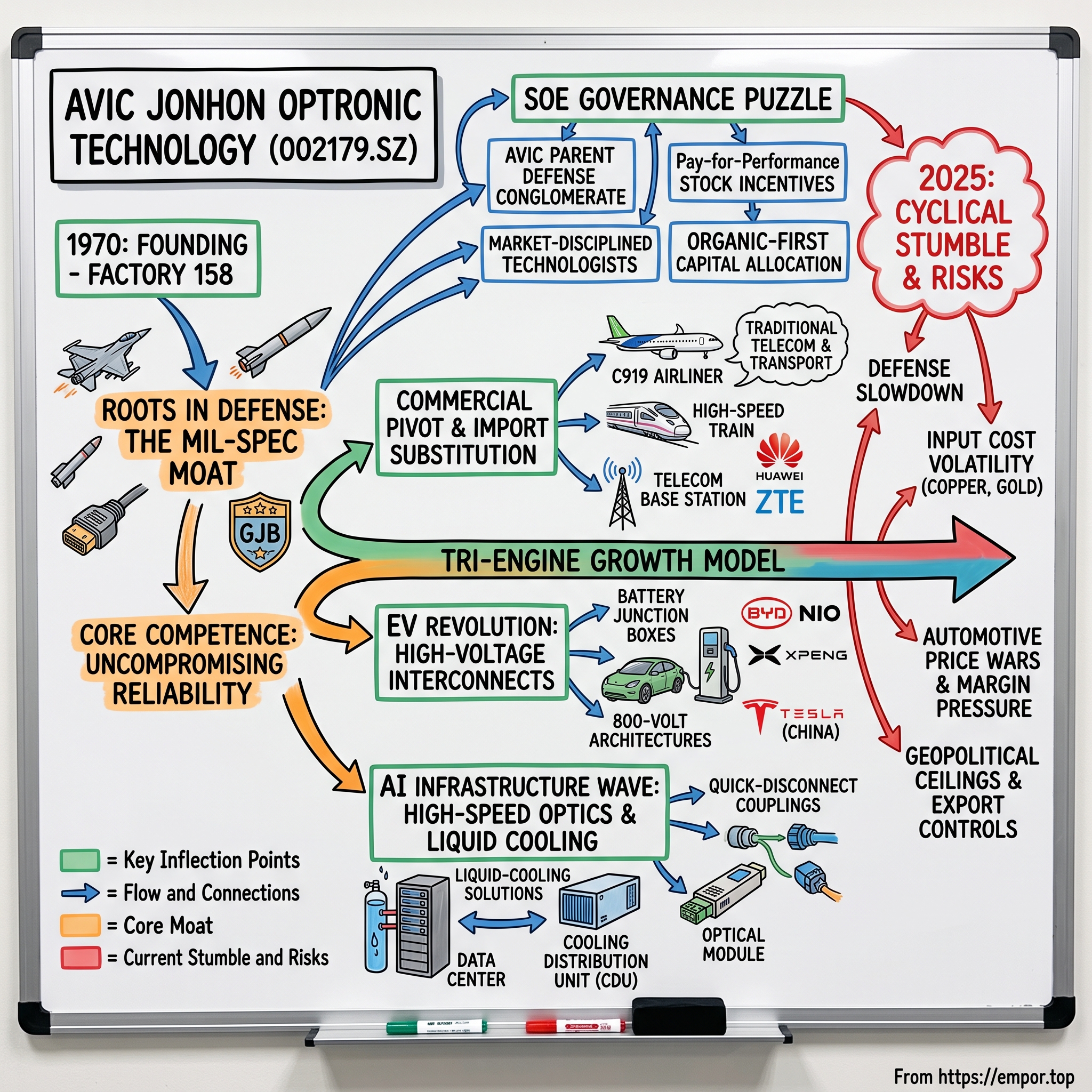
AVIC Jonhon Optronic Technology: China's Interconnect Champion from Fighter Jets to EV Plugs and AI Liquid Cooling
I. Introduction & Episode Roadmap
Pop the hood on almost any piece of hardware that defines the 2020s — a stealth fighter banking over the South China Sea, an 800-volt electric sedan gulping a full charge in fifteen minutes, a rack of AI accelerators glowing at 120 kilowatts inside a data center outside Guiyang — and you will find, buried in the wiring, thousands of small metal-and-polymer objects that almost nobody thinks about. Connectors. The plugs, sockets, backplanes, fiber terminations and, increasingly, the liquid-cooling couplings that carry power, data, and coolant from one component to the next. They are the synapses of modern machines. And in China, the company that makes more of the demanding ones than anyone else is a firm most Western investors have never heard of: 中航光电科技股份有限公司 AVIC Jonhon Optronic Technology Co., Ltd.
Listed on the 深圳证券交易所 Shenzhen Stock Exchange under the ticker 002179.SZ, Jonhon is not a household name even in China, where its products hide inside other companies' famous machines. Yet in 2024 it generated ¥20.69 billion in revenue — roughly $2.9 billion — with a gross margin of 36.6%, the kind of profitability that connector businesses in the West spend decades and dozens of acquisitions trying to reach.1 It employs over 19,000 people and plows around 7% of sales back into research and development every year.1 This is a company that started life as a secret military factory in the mountains of central China and grew into a direct competitor to the global interconnect aristocracy: Amphenol, TE Connectivity, and Aptiv.
To grasp why that margin is remarkable, it helps to understand the industry Jonhon competes in. Connectors are a fragmented, unglamorous, roughly $80-billion global market, and the reason the best players earn premium returns is counterintuitive: the components are cheap, but the cost of one failing is catastrophic. A connector might sell for a few dollars, yet if it fails inside a car's battery system, an aircraft's flight controls, or a data center's cooling loop, the damage runs to thousands or millions. That asymmetry — trivial price, existential consequence — is what lets the qualified, trusted supplier charge for reliability rather than for copper. Amphenol built a roughly $80-billion-plus market capitalization on exactly this insight, compounding for decades. Jonhon is the Chinese answer to the same equation, and it reached elite margins on a fraction of the timeline.
The central question of this story is a governance puzzle dressed up as an engineering one. Jonhon is a state-owned enterprise — its ultimate parent is the sprawling defense conglomerate 中国航空工业集团有限公司 Aviation Industry Corporation of China (AVIC). State ownership in China is more often associated with bloated payrolls, political mandates, and returns on equity that would embarrass a savings account. Jonhon has instead compounded revenue roughly tenfold over two decades while running mid-teens returns on equity, funding market-based stock incentives for its engineers, and refusing — mostly — the temptation to grow by acquisition. How a military research institute became a market-disciplined technology champion is the puzzle we will try to solve.
We will also test it. Because the same 2025 results that Jonhon's boosters wave around contain a warning: net profit fell more than 35% year over year even as revenue edged up, as defense orders slowed, precious-metal input costs surged, and a tougher tax regime bit into earnings.2 A company that looked untouchable in 2023 suddenly looked cyclical. That tension — a structurally advantaged business running through a genuinely bad year — is the reason this is a story worth telling rather than a press release worth reprinting.
Why should a global investor care about a mid-cap Chinese connector maker at all? Because Jonhon is a clean case study in a pattern repeating across Chinese industry: a protected, state-backed incumbent using a defended home base to climb the value chain in markets that Western firms assumed were theirs to keep. The interconnect industry is one of the last quiet corners of the hardware world where American and European champions have enjoyed durable pricing power for decades. Jonhon is the test of whether that corner stays quiet. It is also a window into the physical bottlenecks of the three biggest capital-spending waves of the decade — defense modernization, vehicle electrification, and AI compute — because all three, whatever else they need, need someone to connect the pieces together reliably. Follow the connectors and you are following the money.
Three themes will recur. The first is what we might call the SOE productivity paradox: how a company owned by the Chinese state managed to behave, for long stretches, like a hungry private competitor. The second is the tri-engine growth model — a defensive, high-margin defense business subsidizing two hyper-growth commercial bets, electric-vehicle interconnects and AI data-center liquid cooling — and whether those engines truly reinforce each other or merely dilute one another. The third is the benchmark war: Jonhon's organic, build-it-yourself capital allocation set against Amphenol's legendary buy-it roll-up machine, two opposite philosophies aimed at the same prize.
A word on posture before we begin. This is not a company profile written from management's chair, and it is not a bull note dressed as history. Jonhon tells a genuinely impressive story about itself, and much of it holds up under scrutiny — but the job here is to separate the parts that are proven from the parts that are asserted, to distinguish a real moat from a hopeful one, and to give the bear case as fair a hearing as the bull. The 2025 results make that discipline easy to justify: a company that looked like a compounding machine for a decade just demonstrated, in a single year, exactly how it can be hurt. Keeping both the strength and the fragility in view at once is the whole point. To understand how all three themes began, we have to go back to a mountain valley in Henan in 1970.
 Subscribe on LinkedIn
II. Roots in Defense: Factory 158 & The Mil-Spec Moat (1970–2006)
The founding scene is not a garage or a dorm room. It is a hidden valley in 宜阳 Yiyang County, in the interior province of 河南 Henan, chosen precisely because it was hard to find. The year was 1970, the height of China's Cold War industrial paranoia, when Mao's government was dispersing strategic factories deep into the mountainous interior — the so-called Third Front — so that no single Soviet or American strike could decapitate the country's defense-industrial base. Into that valley the Third Ministry of Machine Building, the arm of the state that ran aviation, planted a new plant with an unglamorous cover name, 国营华川电器厂 State-owned Huachuan Electric Factory, and a secret code number that would follow the company like a birthmark: Factory 158.3
Its mandate was narrow and unforgiving: build the electrical connectors that Chinese military aircraft needed and could not reliably import. In the early years the whole operation turned out only a few hundred thousand yuan of product annually — a rounding error against today's ¥20-billion scale.3 But the work bred a culture, and that culture is the origin of the moat. A connector on a fighter jet cannot fail. It has to survive vibration that would shake a consumer plug apart, temperature swings from Arctic cold to engine-bay heat, salt-fog corrosion, and electromagnetic interference that would scramble a lesser signal. Designing to that standard — China's 国军标 GJB military specifications — is less like making a component than like earning a pilot's license that never expires. The engineering discipline required is the kind that does not transfer easily to a competitor and does not evaporate in a downturn.
It is worth dwelling on what "mil-spec" actually means, because it is the intellectual DNA of everything Jonhon later became. A commercial connector is designed to work; a military connector is designed to never stop working, and the gap between those two goals is enormous and expensive. Consider a single contact — the metal pin that carries current across the join. On a consumer plug it can be a stamped piece of brass. On an aircraft connector it must be plated with a precise micron-thickness of gold over nickel so that after ten thousand mate-and-unmate cycles, after decades of oxidation and vibration, the electrical resistance across the join has barely changed. Multiply that obsessiveness across sealing, shielding, materials, and testing, and you arrive at a component that costs many times its commercial cousin and is worth every fen to a customer who cannot afford failure. Jonhon spent its formative decades learning to manufacture that obsessiveness at scale — a skill that does not appear on a balance sheet but underwrites the entire franchise.
Here is the part investors should sit with, because it is the source of decades of sticky cash flow. Qualifying a connector for a military platform in China is a grueling, multi-year gauntlet of testing and certification. Once a part is designed into a specific airframe, missile, or naval system, ripping it out and re-qualifying a rival's substitute is so costly and risky that almost no program manager will do it. The design win, in other words, locks in revenue for as long as the platform flies or sails — often ten to twenty years. This is the textbook definition of a switching-cost moat, except that in defense it is reinforced by a security-clearance moat and a national-champion moat on top. A foreign supplier is not merely inconvenient; it is disqualified.
The qualification cycle itself — three to five years from first design to approved production for a serious military component — is worth sitting with, because it explains both the stickiness and the barrier to entry in one stroke. A would-be rival cannot simply build a better connector and undercut Jonhon on price; it must first survive years of testing, prove its production consistency across thousands of units, and earn the trust of program managers whose careers depend on nothing failing. By the time a challenger clears that gauntlet, the platform it was targeting may be a decade into its life and locked to the incumbent, and the technology may have moved on. This is why defense franchises, once established, tend to persist across generations of leadership and technology — the moat is made of time and trust, the two things a competitor cannot buy. It is also why the cash flows are so prized: revenue tied to a twenty-year airframe program is about as close to an annuity as manufacturing gets, and it is that annuity, quietly compounding in the background, that has funded every commercial adventure the company has undertaken since.
For most of its first three decades, Factory 158 lived entirely inside that protected world, supplying components across the constellation of Chinese state defense primes — AVIC in aviation, 中国航天科技集团 CASC in space and missiles, 中国电科 CETC in electronics. But a valley in the mountains is a terrible place to run a modern precision-manufacturing business. The logistics were punishing, the talent hard to attract. Across the late 1970s and into the 1990s the plant executed a slow, grinding relocation out of the mountains and into the city of 洛阳 Luoyang, a move not fully completed until 1994.3 Luoyang gave it road, rail, and a labor pool — and, quietly, the option to start selling to civilian customers, an option that would define everything that came later.
The relocation itself deserves a moment, because it foreshadowed a trait that defines the company: a willingness to endure years of grinding, unglamorous execution for a structural payoff. Moving a precision-manufacturing operation out of a mountain valley is not a single event but a decade-long slog of building new plant, retraining workers, and keeping military deliveries flowing the whole time. That the plant did it without losing its qualifications or its customers says something about the operational patience that would later let it build entire new industrial parks from scratch rather than buy its way into new markets.
The corporate machinery to exploit that option arrived in 2002, when AVIC's predecessor group led a restructuring that folded Factory 158 and six affiliated entities into a modern joint-stock company, AVIC Jonhon Optronic.3 The 2007 listing carried a symbolic weight that is easy to underappreciate from outside China. This was, in effect, one of the very first times a genuine military-electronics enterprise had been floated on a mainland A-share exchange — a state deciding that a business born to serve the People's Liberation Army should also answer, in part, to public shareholders. That was a bet by the state as much as by the company: a bet that market discipline would make the defense-industrial base more efficient rather than compromise it. For Jonhon, the practical consequence was profound. Public capital and public scrutiny arrived together, and both pushed in the same direction — toward growth, transparency, and the pursuit of returns that a purely captive supplier would never have needed to chase.
Five years later, on November 1, 2007, that company rang the bell on the Shenzhen Stock Exchange — an event that mattered far beyond the capital it raised.3 For the first time, a Chinese military-electronics business was subject to the discipline of public markets: quarterly disclosure, minority shareholders, an analyst community, and a stock price that would reward growth and punish stagnation. The defense moat had produced a cash machine. The listing gave that machine a reason, and the fuel, to leave the fortress and go compete in the open market. That decision — to weaponize a protected defense base against commercial rivals — is where the modern Jonhon story begins.
III. The Dual-Use Pivot: Civil-Military Synergy & Telecom Boom (2007–2017)
Every defense contractor eventually meets the same enemy, and it is not a foreign army. It is the procurement calendar. Military orders arrive in lumps, timed to five-year plans and budget cycles, and a company that lives only on defense lives at the mercy of those lumps — flush one year, starved the next. Jonhon's leadership, freshly armed with public capital after 2007, made a strategic bet to escape that rhythm. The bet had a name that would become a national policy slogan: 军民融合 civil-military integration — take the hard-won engineering discipline of the defense business and point it at the fastest-growing civilian markets China could offer.
There is a deeper strategic logic to the pivot that is easy to miss if you read it only as diversification. Defense and commercial markets are not just different customers; they run on opposite clocks. Defense rewards patience, secrecy, and reliability at any price, and it moves slowly. Commercial telecom rewards speed, cost, and volume, and it moves at the pace of Moore's Law. A company that can operate in both is forced to keep one foot in a world where the customer will wait years for perfection and the other in a world where the customer will drop you in a quarter for a cheaper part. Learning to live in that tension — to run a patient business and an impatient business under one roof — is itself a rare organizational capability, and it is the hidden engine of the dual-use model. Most defense contractors that try it end up doing commercial badly; most commercial firms that try defense drown in the paperwork. Jonhon's wager was that it could do both, and use each to strengthen the other.
The timing was extraordinary, because China in these years was building out mobile telecommunications infrastructure at a pace no country had ever attempted. Three generations of wireless networks — 3G, then 4G, then the early groundwork for 5G — meant hundreds of thousands of base stations, each stuffed with high-speed backplane connectors, board-to-board interconnects, and weatherproof outdoor fiber links. Jonhon pushed hard to win tier-one supplier status with the two giants at the center of that buildout, 华为 Huawei and 中兴通讯 ZTE. The scale of that buildout is hard to overstate. China rolled out mobile networks to a continent-sized population three times in barely fifteen years, and each generation packed more radios, more antennas, and more data-carrying hardware into every base station than the last. For a connector supplier, each cell site was a small bundle of sockets, backplane connectors, and weatherproof fiber terminations, and there were hundreds of thousands of sites. It was, in effect, a decade-long tailwind at the supplier's back — the kind of secular demand wave that lets a company scale its manufacturing, drive down unit costs, and climb the learning curve fast. Winning a slot in Huawei's supply chain is its own kind of qualification gauntlet — Huawei is famously demanding on cost, quality, and delivery — and clearing it proved that Jonhon's mil-spec pedigree could translate into competitive commercial products rather than gold-plated ones nobody could afford.
The analytical point here is subtle and important. A defense-first company moving into commercial markets usually fails in one of two ways: either its products are over-engineered and priced out, or it cannot hit the volumes and delivery cadences that commercial customers demand. Jonhon's ability to hold tier-one relationships with cost-obsessed telecom OEMs is evidence — not proof, but evidence — that it had solved the harder problem of translating aerospace reliability into commercial economics. That translation ability is the real asset, more durable than any single product line.
The same playbook extended into two other showcase Chinese industrial programs. In commercial aviation, Jonhon became a primary domestic connector vendor for the 中国商飞 COMAC C919, the narrowbody airliner that Beijing built to break the Airbus–Boeing duopoly. And in rail, it supplied the high-speed train sets of 中国中车 CRRC — the 和谐号 Hexie and 复兴号 Fuxing bullet trains that stitched the country together at 300-plus kilometers an hour. Neither program was, on its own, a financial windfall. But both were strategically priceless: they proved Jonhon could serve civilian systems where failure was still not an option, and they tied the company's fortunes to China's most visible industrial-policy ambitions.
There is a pattern in these wins that is central to understanding Jonhon's whole strategy, and it is a pattern of import substitution. The C919 and the high-speed rail program were both, at their core, national projects to build indigenous capability in industries long dominated by Western firms — to make in China what China had been buying from Airbus, Boeing, Siemens, and Alstom. A domestic airliner needs a domestic connector supply chain to be truly indigenous; a bullet train that Beijing can call its own cannot depend on foreign plugs. Jonhon positioned itself as the trusted local answer every time a strategic Chinese program needed to localize its interconnects. That is a powerful place to stand in an era of decoupling and supply-chain nationalism: the more China wants to make its critical systems at home, the more it needs suppliers exactly like Jonhon. The company's growth has, in this sense, been a leveraged bet on the entire project of Chinese industrial self-sufficiency.
The telecom relationships also taught Jonhon something about the direction the whole industry was heading: toward higher speeds and, inevitably, toward light. As data rates climbed, copper began to run out of room — push enough gigabits through a metal trace and the signal degrades, the heat rises, and physics fights back. The answer was optical: moving data as pulses of light through fiber and optical modules rather than as electrons through copper. Jonhon's very name — 光电, "optics-electronics" — signals that it saw this convergence early, positioning itself not merely as a maker of electrical connectors but as a bridge between the electrical and optical worlds. That foresight would matter enormously two decades later, when AI data centers turned high-speed optical interconnects from a niche into a bottleneck.
None of this would have worked without a matching investment in the unglamorous machinery of precision manufacturing. Connectors are deceptively hard to make well at scale — they demand exquisite mold-making, consistent electroplating of precious metals onto tiny contact surfaces, and increasingly automated assembly to hold tolerances across millions of units. Jonhon poured capital into a manufacturing complex in Luoyang and stood up specialized R&D hubs in 西安 Xi'an, 深圳 Shenzhen, and Luoyang, sustaining an R&D reinvestment rate near the high-single-digit percentage of revenue that it maintains to this day.1 The geographic spread of those R&D hubs was itself a strategic statement. Luoyang remained the industrial and defense heartland; Xi'an, another aerospace-and-university city, deepened the high-reliability engineering bench; and Shenzhen — the beating heart of Chinese commercial electronics — put Jonhon's designers next door to the telecom and consumer supply chains they now needed to serve. Planting a research office in Shenzhen was a signal that a Luoyang defense institute understood it could not design commercially competitive products from inside a fortress; it had to sit where the fast-moving customers and talent were. That instinct to co-locate with customers would later drive the decision to build in Dongguan, and it reflects a company learning, deliberately, to think like the private competitors it was chasing.
By the mid-2010s the shape of the modern company was set: a defense core throwing off high-margin cash, a rapidly scaling commercial arm in telecom and transport, and a manufacturing base capable of serving both. What it did not yet have was the one market that would test its capacity like nothing before — the electrification of the automobile.
IV. The EV Revolution: High-Voltage Interconnects & Capacity Scaling (2018–2023)
For a hundred years, the electrical guts of a car were boring by design: a 12-volt system, a lead-acid battery, and wiring harnesses that carried trivial amounts of power. Then the industry decided to move the entire drivetrain onto electricity, and the humble connector suddenly became a safety-critical, high-value component. An electric vehicle's battery pack runs at 400 volts, and the newest architectures push to 800 volts to enable faster charging — voltages high enough that a poorly designed connection can arc, melt, or start a fire. Managing that requires exactly the disciplines Jonhon had spent fifty years perfecting: shielding against interference, preventing arcs, dissipating heat, and guaranteeing a connection that will not fail over a decade of vibration and thermal cycling. The aerospace playbook, it turned out, was almost perfectly suited to the electric car.
It is worth making the physics vivid, because it explains the value migration. In a 12-volt car, a loose or corroded connection is an annoyance — a flickering dome light. In an 800-volt car, the same fault is a potential arc: an electric spark that can jump a gap, sustain itself as a plasma, and reach temperatures that melt metal and ignite fires. Preventing that requires connectors engineered with interlocks that break the circuit before the connector can be unmated, with seals that keep out moisture, with contact designs that manage the inrush of current, and with materials that shrug off heat. A connector on an EV battery is closer, in engineering spirit, to an aerospace component than to anything that existed in a gasoline car. The electrification of the automobile did not just add connectors; it dragged the automotive connector up-market into precisely the reliability regime Jonhon had owned for fifty years. The content value of interconnects per vehicle, in a high-voltage EV, is a large multiple of what it was in an internal-combustion car — which is why a sleepy component category suddenly became a growth market.
This is the clearest example of the civil-military synergy actually paying off rather than merely being asserted. The engineering knowledge that made a fighter-jet connector reliable was directly transferable to a high-voltage EV connector, giving Jonhon a running start against pure-play automotive suppliers who had to learn high-reliability design from scratch. As China's New Energy Vehicle market exploded — from a policy experiment into the largest EV market on earth — Jonhon captured a commanding share of the domestic market for the high-voltage plumbing of electric cars: the connectors, charging inlets, battery junction boxes known as PDUs and BDUs, and the fast-charging gun assemblies at public chargers.
The customer list reads like a roll call of the Chinese auto industry's winners: 比亚迪 BYD, 蔚来 NIO, 小鹏汽车 XPeng, 吉利汽车 Geely, 上汽集团 SAIC, and the local supply chains of international automakers building in China, including Tesla's Shanghai operation. Winning these accounts is not a one-time event; automotive qualification under the 车规 automotive-grade standard IATF 16949 is its own multi-year moat, and once a connector is designed into a vehicle platform, swapping it out means re-engineering and re-validating the whole system. The switching-cost logic that Jonhon had enjoyed in defense now applied, in a milder but still real form, in cars.
But — and this is where the neutral investor has to hold two ideas at once — scale in EVs came at a cost to the company's blended profitability. Automotive is a brutally competitive, volume-driven business where gross margins in the low-to-mid 20s are the norm, well below the mid-to-high 30s that defense commands. By 2024, the electrical-connector-and-integrated-interconnect category — dominated by the auto and industrial businesses — had grown to more than three-quarters of total revenue, at 77.4% of the mix.1 The more the commercial engines grew, the more they diluted the corporate gross margin. Management's bet was that operating leverage — spreading fixed R&D and plant costs across enormous volumes — would more than compensate. For several years, that bet largely held. In 2025 it came under real pressure, as we will see.
There is a second-order risk in the EV concentration that a careful analyst should name. Jonhon's automotive fortunes are lashed to the Chinese NEV market, which is simultaneously the largest and the most cutthroat in the world. Its customers — BYD, NIO, XPeng and the rest — are locked in a price war so severe that several are unprofitable, and a Tier-1 supplier's pricing power erodes exactly when its customers are bleeding. Worse, customer concentration cuts both ways: winning BYD is a triumph, but a supplier that depends on a handful of aggressive OEMs inherits their volatility and their negotiating leverage. The EV engine is real and large, but it is also the lowest-margin, most competitive, and most customer-concentrated of Jonhon's three businesses — a source of growth that must be watched as carefully as it is celebrated.
To feed the volume, Jonhon had to build, and this is where its capital-allocation philosophy shows most clearly. Rather than buy a competitor, it raised roughly ¥3.4 billion in a private placement approved in 2021 and directed the proceeds into hard assets, most visibly the 中航光电华南产业基地 South China High-End Interconnect Industrial Base in 东莞 Dongguan, planted in the heart of the Pearl River Delta's electronics and automotive cluster to sit close to customers.6 It stood up overseas subsidiaries in Germany and Vietnam to support Tier-1 automotive qualification and localized supply. The choice of Dongguan was not incidental. The Pearl River Delta is the densest electronics-manufacturing ecosystem on the planet, home to the supply chains of the telecom, consumer-electronics, and automotive customers Jonhon most wanted to serve, and building there put the company's engineers and production lines within a short drive of the people who design the products its connectors go into. The overseas subsidiaries followed the same customer-proximity logic: a German base to sit near the European automotive Tier-1 world where qualification and just-in-time support are prerequisites, and a Vietnamese operation to plug into the manufacturing capacity migrating out of China into Southeast Asia. These are modest footholds rather than a global empire, and it would be a mistake to read them as evidence of imminent international dominance — a Chinese defense-affiliated supplier faces real ceilings on how far it can expand into Western markets. But they show a company methodically extending its manufacturing and support network toward its customers rather than waiting for customers to come to Luoyang. The pattern is unmistakable: when Jonhon wants capacity or capability, it pours concrete and hires engineers rather than writing an acquisition check. Whether that organic-first instinct is a discipline or a limitation is the debate we will stage later against Amphenol. First, a newer and hotter market arrived — one where the product being connected was not power, but heat itself.
V. The AI Infrastructure Wave: High-Speed Optics & Liquid Cooling (2023–2026)
Walk into a state-of-the-art AI data center in 2026 and the first thing you notice is the plumbing. For seventy years computers were cooled by moving air; fans blew, heat sinks glowed, and that was enough. It is no longer enough. The accelerator chips training large AI models now dissipate 700, 1,000, even more watts each — concentrate enough of them in a rack and you are trying to cool the equivalent of a few dozen space heaters packed into a filing cabinet. Air cannot carry heat away fast enough. So the industry has turned to liquid: coolant piped directly across cold plates bolted to the hottest chips, circulated through manifolds and Cooling Distribution Units, connected and disconnected by blind-mate quick-disconnect couplings that must seal perfectly without spilling a drop onto millions of dollars of electronics.
To appreciate why liquid cooling is a connector opportunity and not just a plumbing one, picture the failure mode. A data-center technician needs to pull a single server out of a live rack for maintenance without shutting down the coolant loop feeding the rest of the machines — the equivalent of changing one cylinder in a running engine. That demands a blind-mate quick-disconnect, or UQD, coupling: a fitting that seals itself the instant it separates, spilling nothing, admitting no air, and re-mating perfectly when the server slides back in, all without a human being able to see the connection point. Get it wrong and coolant sprays across energized electronics. The tolerance for error is roughly zero, which is precisely the regime where a supplier's reliability pedigree becomes a selling point rather than a line item.
Notice what that shopping list requires: fluid connectors that never leak, that mate blind and under pressure, engineered for extreme reliability. It is, once again, uncannily close to what Jonhon has been building for aerospace fuel and hydraulic systems for decades. The company moved to offer a full-stack liquid-cooling — 液冷 — architecture: the quick-disconnects, the cold plates, the manifold distribution blocks, and the CDUs themselves, tailored not just for AI data centers but for supercomputing clusters, 5G-Advanced base stations, and even avionics.9 The other half of the AI opportunity is not about heat but about speed. As AI clusters scale to thousands of accelerators that must talk to one another in near-real time, the interconnect fabric between them has to move staggering volumes of data — the industry is racing from 400-gigabit toward 800-gigabit and 1.6-terabit optical links — and every one of those links terminates in an optical module and a high-frequency connector that must preserve a clean signal at frequencies where the tiniest imperfection causes errors. This is exactly the optics-plus-electronics seam encoded in Jonhon's name, and management has flagged the optical-module precision-components business as one of its fastest-growing lines.9 The same transferability that carried it from jets to cars now carried it from cars to the AI rack.
Here is where a neutral analyst has to separate the exciting story from the current numbers, because the gap is instructive. Liquid cooling is real and growing, but it is still small. In 2025 the "liquid-cooling solutions and other products" category generated ¥1.78 billion in revenue, up 9.3% year over year — healthy, but hardly the vertical rocket the AI narrative implies, and a single-digit slice of a ¥21-billion company.2 On the company's own commentary, management described the optical-module precision-components business as "growing rapidly" and pointed to full order books in power connectors for data centers, while candidly noting that the high-speed and liquid-cooling products remained oriented toward supporting the domestic computing ecosystem rather than winning global hyperscale sockets outright.9 In plain English: the AI opportunity is early, promising, and not yet a needle-mover. Investors buying the stock for AI are buying an option, not a cash flow.
That distinction matters all the more because 2025 was the year the rest of the business stumbled, exposing how much the company still leans on defense. Full-year revenue rose 3.4% to ¥21.39 billion, but net profit attributable to shareholders fell 35.6% to ¥2.16 billion — a jarring divergence.2 The culprits, per the company, were a triple squeeze: defense demand slowed with the industry's cyclical procurement rhythm, the prices of gold, copper, and other raw materials Jonhon plates and stamps into its parts stayed stubbornly high and compressed gross margin from the mid-30s toward roughly 29%, and a tougher tax-enforcement environment — including back-payment of corporate income tax — inflated the tax bill.2 The margin mechanics are worth unpacking because they reveal something structural about the business model. Jonhon's cost of goods is unusually exposed to a few volatile commodities — copper for conductors, gold and silver for the micron-thin plating on contact surfaces — and the company cannot always pass those cost increases through to customers, least of all to auto OEMs contractually committed to annual price reductions. So when metals ran hot in 2025, the squeeze landed almost entirely on Jonhon rather than on its buyers. That is the shadow side of the reliability business: the very customers who value your quality also hold the pricing whip, and in a bad commodity year the supplier absorbs the shock. Gross margin sliding from the mid-30s toward roughly 29% is the quantitative fingerprint of that dynamic.2 The pain continued into early 2026, with first-quarter net profit down again year over year.2
There is also a competitive-honesty point that the AI narrative tends to skip. In the highest-speed optical interconnects and the most advanced liquid-cooling systems, the global frontier is being set by American and Taiwanese suppliers serving Nvidia-class hyperscale platforms, and Chinese firms including Jonhon are, for now, oriented more toward the domestic computing ecosystem than toward winning those global sockets outright.9 That is not a criticism so much as a scoping of the opportunity: the addressable prize for Jonhon is the enormous, policy-supported buildout of Chinese AI and cloud infrastructure, where domestic sourcing is favored and where its trust and reliability advantages travel well. It is a large pond. But it is a different pond from the one Amphenol and its peers are fishing, and conflating the two overstates the near-term reach of the story.
So the AI-and-EV growth story and the defense-and-cost pain story are both true at the same moment, and that is the honest picture. The commercial engines Jonhon spent a decade building are precisely what kept revenue growing while its highest-margin business cooled — validation of the diversification strategy in one sense. But the profit collapse also revealed that the company had not escaped cyclicality or input-cost exposure at all; it had merely spread its bets. The further-out bets follow the same transferable-competence logic that has served the company at every prior transition, and they are worth understanding as optionality rather than forecast. The 低空经济 low-altitude economy — Beijing's term for a future of electric air taxis, delivery drones, and eVTOL aircraft threading through urban airspace — is a market that does not really exist yet at scale, but if it materializes it will demand connectors that marry aerospace reliability with automotive cost and volume, which is the exact seam Jonhon straddles. Commercial satellite constellations need connectors that survive launch vibration and the vacuum and radiation of orbit; deep-sea exploration needs them to survive crushing pressure and salt water. In each case the pitch is the same: extreme-environment interconnects are extreme-environment interconnects, and a company that has been solving that problem since 1970 has a credible claim on the next environment too. The prudent way to value these is as a portfolio of free-ish options — cheap to seed off the existing R&D base, most of which will amount to little, a few of which could become the EV or liquid-cooling story of the 2030s.10 They are seeds, not harvests, and the near-term reality is a company managing a difficult margin cycle while planting for the next decade. Which raises the question of who, exactly, is steering.
VI. Management, SOE Governance, & Capital Allocation
Leadership transitions at state-owned enterprises are usually about as dramatic as a change of shift, and Jonhon's most recent one fit the mold. On January 19, 2026, the board elected 李森 Li Sen as chairman, with a term running to January 2029; his predecessor, veteran leader 郭泽义 Guo Zeyi, stepped away.4 What is notable is not that it happened but how uneventful it was — the kind of orderly handoff that signals institutional depth rather than a personality cult, and a marked contrast to the boardroom drama that periodically convulses Western component makers.
Li Sen is a lifer, and in this context that is a feature. Born in February 1973, he holds a master's degree in industrial engineering from 西北工业大学 Northwestern Polytechnical University — one of China's core defense-affiliated universities — and rose through Jonhon's own ranks: research-institute director and deputy chief engineer, then vice general manager from 2014, then general manager from 2020, before adding the chairmanship.4 This is a technologist who came up through the R&D and manufacturing spine of the company, not a political appointee parachuted in from a ministry. That lineage matters because Jonhon's advantages are engineering advantages; a leader who understands the difference between a good connector and a merely adequate one is more likely to protect the culture that produces them.
The departing chairman, Guo Zeyi, embodied the continuity that Jonhon prizes. A veteran of the same AVIC research ecosystem, he presided over the years in which the company scaled its commercial businesses and pushed into EVs and data centers, and his exit — clean, with no lingering board or subsidiary role disclosed — is the sort of orderly succession that suggests the institution, not any individual, holds the strategy.4 In a founder-led company, the departure of the leader is a genuine risk event; in an SOE with deep technical bench strength, it is closer to a relay handoff. That is a double-edged trait. It buys stability and continuity of strategy, but it also means investors should not expect a charismatic capital allocator to suddenly reshape the company — the system is designed to prevent exactly that kind of single-person swing, for better and for worse.
The more revealing governance story is how Jonhon has tried to solve the classic SOE incentive problem: state employees, however talented, rarely have their personal wealth tied to the enterprise's performance, and so the sharp edge of private-sector motivation gets dulled. Jonhon's answer has been repeated rounds of 限制性股票激励计划 restricted-stock incentive plans, spreading equity across well over a thousand core technical and management staff and — crucially — gating the vesting on hard financial hurdles like compound growth in net profit and returns on equity, so the shares only pay off if the business actually performs.7 The design of these plans is more sophisticated than a simple giveaway, and the details reveal intent. Rather than hand out shares that vest on the calendar, Jonhon has tied unlocking to performance gates — hurdles on net-profit growth and returns on equity that the company must actually clear before the grants convert into wealth.7 It has also, tellingly, been willing to claw back and cancel grants when conditions were not met, treating the incentive as a genuine pay-for-performance instrument rather than a disguised bonus.7 For thousands of engineers and managers, that structure turns an abstract corporate goal into a personal financial stake in hitting real targets — the closest a state enterprise can come to manufacturing the ownership mentality that comes naturally to a startup. For an SOE, structuring meaningful equity upside for engineers is genuinely unusual, and it is one of the more concrete reasons Jonhon has behaved more like a competitor than a bureaucracy.
That said, an independent observer should note where the alignment is thinner than the story suggests. The insider stakes involved are modest in absolute terms. When Li Sen bought shares on the open market in May 2026, it was a purchase of 13,000 shares for about ¥475,000 — a real gesture of confidence at roughly four months of his salary, but a rounding error against a multi-billion-yuan market capitalization, lifting his total holding to around 0.03% of the company.8 Management here does not have founder-scale skin in the game; the incentives are calibrated to motivate, not to make anyone a tycoon. And the ultimate controlling shareholder remains the state, whose objectives — employment, national capability, strategic supply security — will not always align perfectly with a minority shareholder's desire for maximum return on capital. That is a permanent, structural feature of the investment case, not a temporary one.
On capital allocation, the record is the most compelling part of the bull argument and deserves credit. Across most of its public life Jonhon has generated mid-teens returns on equity, converted profits into operating cash, and kept a conservative, low-net-debt balance sheet — funding its expansion through internally generated cash supplemented by occasional, targeted equity placements like the 2021 raise rather than by piling on leverage or overpaying for acquisitions.16 It is the anti-conglomerate: disciplined, organic, and allergic to the empire-building that destroys so much shareholder value.
But the organic-only instinct is not costless, and the fairest way to see its trade-offs is to hold it against the company that mastered the opposite approach. Amphenol, the American connector giant, built one of the great industrial compounding records of the last thirty years primarily through acquisition — a roll-up machine that has absorbed hundreds of bolt-on businesses, entering new niches and geographies by buying the incumbent rather than building a rival from scratch. Done with discipline, as Amphenol has done it, M&A buys speed: instant market share, instant customer relationships, instant engineering teams. Jonhon's build-don't-buy philosophy trades that speed for control and margin — it never overpays for goodwill, never inherits someone else's culture or liabilities, and keeps every yuan of value it creates in-house. The cost is time and reach: organic expansion is slower, it is geographically constrained (a Chinese SOE cannot easily acquire its way into Western markets even if it wanted to), and it forecloses the option of buying a technology it lacks rather than inventing it. Neither model is inherently superior; they are different bets on how to deploy capital. What an investor should watch is whether Jonhon's discipline ever curdles into insularity — whether there comes a moment when a capability is moving too fast to build and can only be bought, and the organic reflex leaves the company a step behind. The obvious counter-question — is organic-only a discipline or a ceiling? — runs straight into the broader competitive position, and it is time to war-game that directly.
VII. Playbook & Strategic Frameworks: 7 Powers & 5 Forces
Imagine the war room of a rival — say a well-funded commercial connector maker plotting to take share from Jonhon across its three markets. Where would the attack even begin? Not in defense: the door there is bolted shut by clearance, qualification, and national-champion status. Not in the process-heavy niches where decades of plating and sealing know-how are baked in. The only soft flank is the open commercial field — autos, telecom, standard data-center hardware — and even there the attacker runs into an opponent that can price aggressively because a defense annuity is paying its overhead. This is the value of running the analysis as a war-game rather than a checklist: it shows immediately that Jonhon's defenses are unevenly distributed, nearly impregnable in some segments and merely strong in others, and that a smart competitor would ignore the fortress and fight only on the open ground.
Strip away the narrative and ask the cold question a competitor's strategist would ask: what actually stops someone from taking Jonhon's business? Hamilton Helmer's 7 Powers framework is a useful scalpel, and Jonhon lights up several of the seven.
The most durable is switching costs, and it operates in two flavors. In defense, a GJB-qualified connector designed into a weapons platform is effectively frozen in place for the ten-to-twenty-year life of that platform, because re-qualifying an alternative is slow, expensive, and risky — a cornered position that produces some of the stickiest cash flow in industrial manufacturing. In automotive, the IATF 16949 qualification and the cost of re-validating a vehicle platform create a milder but real version of the same lock-in. Layered on top is process power: decades of accumulated, hard-to-copy know-how in high-precision molding, precious-metal plating, glass-to-metal hermetic sealing, and high-frequency signal simulation. This is not knowledge you can hire off the street or reverse-engineer from a sample; it is embedded in thousands of engineers and refined processes, and it is the reason a new entrant cannot simply spend its way to parity.
Then there is scale economies, which for Jonhon takes an unusual and powerful form. It amortizes an enormous fixed R&D base across three vast and largely independent end markets — defense, automotive, and AI/telecom — so that a breakthrough in, say, high-reliability sealing developed for aerospace can be redeployed into EV connectors and liquid-cooling couplings at near-zero incremental research cost. Few pure-play competitors get to spread their R&D across three secular growth waves at once. And most provocatively, there is counter-positioning: Jonhon can use the fat, protected cash flow from its defense franchise to price aggressively and invest heavily in commercial segments, absorbing thin early margins in EVs or liquid cooling in a way a pure-play commercial rival — with no defense annuity to lean on — would find hard to match without bleeding.
The two powers Jonhon conspicuously lacks are worth naming, because a balanced scorecard is more useful than a cheerleading one. It has no meaningful network economies — a connector does not get more valuable to one customer because another customer uses it — and no consumer-facing brand power in the way Helmer means it; buyers choose Jonhon for qualification and reliability, not for a logo. Those absences matter because they cap how defensible the commercial businesses can ever become. In autos and data centers, Jonhon competes on engineering and cost, not on any lock-in that transcends the product itself, which is why those segments will always feel more contested than the defense core. The honest read of the 7 Powers is that Jonhon is extraordinarily strong where it inherited its moat — defense switching costs and process power — and merely competitive where it is building new ones.
Run the same position through Porter's Five Forces and the picture sharpens into where Jonhon is strong and where it is genuinely exposed. Rivalry is bifurcated: near-nonexistent in defense, where the field is restricted to a handful of trusted domestic names — chiefly 航天电器 Guizhou Aerospace Appliance (002025.SZ) — but ferocious in commercial connectors, where Jonhon fights 立讯精密 Luxshare Precision, 得润电子 Deren Electronics, 永贵电器 Yonggui Electric, and the global heavyweights TE Connectivity and Amphenol. Buyer power is the force to watch: automotive OEMs demand relentless annual price cuts — 降本, cost-down, is a way of life in the Chinese auto supply chain — and that pressure is a direct threat to the margin mix, while defense buyers demand cost transparency but still prize reliability over the last yuan of price.
The commercial rivalry deserves a closer look, because it is where Jonhon is most tested and where the competitive map is most crowded. Luxshare Precision is the most formidable of the domestic set — a company that grew from a connector maker into a broad electronics-assembly powerhouse and Apple supplier, with scale and consumer-electronics muscle Jonhon does not have. Deren Electronics and Yonggui Electric are more direct connector rivals in autos and rail, fighting Jonhon in exactly the price-sensitive segments where margins are thinnest. And in the highest-value niches, the global incumbents TE Connectivity and Amphenol remain the quality benchmark and the ceiling on Jonhon's international ambitions. The upshot is a company that is nearly untouchable in its protected defense keep and simply one strong player among many in the open commercial field — a distinction that should temper any assumption that its defense-grade margins can be replicated across the whole business.
The remaining three forces mostly favor the incumbent. Supplier power is moderate and, as 2025 painfully demonstrated, concentrated in raw materials — the copper alloys, gold and silver plating, and engineering resins whose price spikes flowed straight through to gross margin.2 The threat of substitutes is very low: physical interconnects and fluid heat transport are fundamental to moving power, data, and heat, and no one is about to replace the physics. And the threat of new entrants is low, guarded by the capital intensity, qualification hurdles, and customer-trust barriers already described. The net read: Jonhon's moat is deep on the defense side and the process side, but it is exposed on two fronts a bull case tends to gloss over — buyer-driven price pressure in autos and input-cost volatility in commodities. Which is the perfect setup for a proper bull-versus-bear stress test.
VIII. Bear vs. Bull Stress Test & Current Risk Radar
Start with the bull case, because it is genuinely strong. Jonhon sits at the intersection of three of the most durable demand curves in the industrial economy. Its defense franchise is backstopped by China's long-run military modernization — a structural, policy-driven tailwind that does not depend on any product cycle. Its commercial arms are levered to two secular waves that are still early: the shift to 800-volt electric-vehicle architectures, and the buildout of AI data-center infrastructure that is dragging liquid cooling from niche to necessity. And through most of its history the company has proven it can hold roughly 30%-plus gross margins and mid-teens returns on equity while fighting in brutally competitive commercial markets — operational discipline that most connector peers would envy.1 The distilled bull thesis: this is a rare business with a protected, cash-generative core funding disciplined expansion into two enormous growth markets, run by engineers with skin in the game.
Now the skeptic's rebuttal, which 2025 made a lot easier to write. Geopolitics and export controls are the tail risk that could become a body blow: an expanding U.S. Entity List or tightening technology sanctions could choke Jonhon's access to advanced materials, EDA software, and high-end manufacturing tools, and could wall it out of overseas markets it hoped to enter. As an AVIC-affiliated defense supplier, Jonhon is exactly the kind of entity that sits in the crosshairs of that policy machinery. The exposure runs in two directions at once, which is what makes it so hard to hedge. On the supply side, Jonhon depends on some inputs — advanced materials, EDA and simulation software, high-end manufacturing equipment — where the leading edge is Western-controlled, and a tightening of controls could raise its costs or slow its technology roadmap. On the demand side, its defense affiliation effectively bars it from the very Western markets its foreign peers take for granted, capping the international growth that might otherwise diversify it away from Chinese-market cyclicality. In a decoupling world, being China's national champion is both the company's greatest asset and its sharpest constraint: the same identity that guarantees its home-market position walls it out of half the globe. Automotive margin compression is not a hypothetical but a live wound — the price war among Chinese EV makers flows directly into Tier-1 component pricing, and the more Jonhon's mix tilts toward autos, the more its blended margin inherits that pressure. Defense procurement lumpiness is the very cyclicality the diversification strategy was meant to escape, yet the 2025 profit collapse showed the defense slowdown can still swing the whole P&L.2 And raw-material volatility in copper and precious metals proved in 2025 that it can vaporize a third of net profit in a single year even as revenue grows.2
The bear case has a structural retort to the bull's favorite claim, and it is worth stating plainly. Bulls argue the three engines diversify risk; the 2025 results argue they mostly correlate to the same input-cost and macro pressures. Defense slowed and metals prices rose and the tax regime tightened, all at once, and there was no engine humming loudly enough to offset the others — commercial growth cushioned revenue but could not rescue profit.2 Diversification protects you when your bets are uncorrelated; it does little when a common shock — commodity inflation, a domestic demand wobble, a policy shift — hits several segments together. Whether 2025 was an unlucky confluence or a preview of how correlated these businesses really are is one of the genuinely open questions in the story, and an honest analyst files it under "unresolved" rather than "priced in."
An activist-minded investor would press two further points. First, disclosure and segment margin transparency: a company running three businesses with radically different economics owes investors a clear, consistent view of segment profitability, and the more the mix shifts, the more that clarity matters for judging whether the commercial growth is value-accretive or merely revenue-accretive. Second, the state-ownership overhang: minority holders ride alongside a controlling shareholder whose strategic priorities — capability, security, employment — may at times outrank return on capital, and there is no mechanism to change that. Neither point is disqualifying; both are permanent features to price rather than ignore.
A third line of attack, and the one a short-seller would probably lead with, concerns the durability of the reported profitability itself. Jonhon's headline margins are the envy of the sector, but they are a blend of a very-high-margin defense annuity and a growing pile of lower-margin commercial revenue, and the blend is deteriorating as the commercial share rises. A skeptic would argue that the elite margins of the past decade were a function of an unusually favorable mix and an unusually generous defense-procurement cycle, and that the trend line — as autos and data centers come to dominate revenue — points structurally downward regardless of any single bad year. The 2025 gross-margin compression, on this reading, is not a one-off shock to be normalized away but the first clear data point in a longer erosion. The bull's rebuttal is that operating leverage and the mix toward higher-value liquid-cooling and optical products will offset the auto drag over time. Both cannot be right, and the resolution will show up, quarter by quarter, in exactly the segment-margin figures worth tracking. That is the honest state of the debate: a genuinely advantaged business whose margin ceiling is being tested in real time, with the outcome undetermined.
Management's own credibility on all this will be judged, over the next several years, by behavior rather than rhetoric. The honest way it attributed the 2025 miss to specific, nameable causes — defense timing, metals prices, tax — rather than vague macro hand-waving is a modest point in its favor; evasive management tends to blur exactly those details.2 The real test is whether the commercial engines can carry the load the next time defense stalls, and whether liquid cooling graduates from an exciting option into a genuine profit center. That points to what actually matters to track. Amid all the moving parts, three KPIs cut through the noise. First, segment gross-margin trajectory — specifically whether defense margins stabilize and whether the auto and data-center mix stops dragging the blended figure down. Second, liquid-cooling and data-center revenue growth — the real-time read on whether the AI option is converting into cash. Third, the R&D-to-revenue ratio held against return on equity — the single best gauge of whether Jonhon is still reinvesting at a high rate without letting returns erode. It is worth being precise about why these three, and not the dozen other metrics a spreadsheet might tempt you toward. Headline revenue growth is nearly useless here in isolation, because 2025 proved revenue can rise while profit collapses — the whole story is in the quality of the growth, not its quantity. Segment gross margin is the single cleanest read on that quality: it captures the mix shift toward lower-margin autos, the pass-through (or not) of commodity costs, and the health of the defense franchise all in one number, which is why watching it beats watching total sales. Liquid-cooling and data-center growth is the forward-looking counterweight — the metric that tells you whether the option investors are paying for is actually ripening or merely being talked about. And the R&D-ratio-against-ROE pairing guards against the two ways a company like this quietly rots: cutting research to flatter near-term margins, or reinvesting heavily into projects that never earn their cost of capital. A company that keeps spending ~7% of revenue on R&D while still earning mid-teens returns is compounding its advantages; one that lets either figure slip is telling you the model is under strain. Watch those three, and you are watching the actual thesis. Everything else is commentary.
IX. Epilogue & Key Takeaways
The enduring lesson of AVIC Jonhon Optronic is that origins are not destiny. A company that began as a hidden military factory in a Henan valley — the kind of enterprise the world associates with inefficiency and political dead weight — built itself into a technology competitor that stands on the same field as Amphenol and TE Connectivity, without abandoning the state ownership that supposedly makes such a thing impossible. That transformation was neither inevitable nor complete, and 2025 was a reminder that the company is cyclical, input-cost-exposed, and geopolitically vulnerable like any other. But the trajectory is real, and it was engineered on purpose.
Three ideas are worth carrying away. The first is the power of genuine dual-use capability: the same reliability engineering that qualifies a connector for a fighter jet turned out to be the foundation for winning in electric vehicles and, now, AI liquid cooling — a portfolio of transferable competence that keeps finding new markets as old ones cool. The second is that incentive design can partly unlock the productivity trapped inside a state-owned enterprise; Jonhon's willingness to hand equity to its engineers, gated on real performance, is a large part of why it behaves the way it does, even if management's absolute stakes remain modest. The third is the oldest lesson in industrial investing: the companies that sit at the physical chokepoints of a technological transition — the connectors, the couplings, the plumbing that every new architecture must route through — often capture value far out of proportion to their visibility. Jonhon sits at three such chokepoints at once. There is a final, more sobering takeaway that the 2025 results force onto the page. A structural advantage is not the same as immunity. Jonhon possesses one of the more genuinely defensible positions in Chinese industrial manufacturing — a protected defense moat, transferable engineering competence, disciplined capital allocation, and aligned engineer-owners — and it still lost more than a third of its profit in a single year to the ordinary hazards of commodity prices, procurement timing, and taxation. The lesson for investors is neither to dismiss the moat nor to mistake it for a guarantee, but to hold both truths at once: this is a high-quality business that is also cyclical, input-cost-exposed, and geopolitically boxed in. The best businesses are not the ones that never have bad years; they are the ones whose bad years do not break the long-run compounding. Whether Jonhon is that kind of business — whether its next decade of EV content growth and AI-infrastructure optionality outweighs the margin cycles and the geopolitical ceiling — is precisely the question the coming years will answer. What is already clear is that a secret military factory from a Henan valley has earned the right to be measured against the best interconnect companies in the world, and to be judged, from here, by whether it converts that position into durable per-share value through a margin cycle and a geopolitical storm. That is the story its next chapter will have to tell.
References
-
AVIC Jonhon Optronic 2024 Annual Report Disclosure — CNINFO, 2025-03-29 ↩↩↩↩↩↩
-
中航光电 (002179) 2025年年报及2026年一季报点评:营收超额达成,液冷业务迈入发展新阶段 — Sina Finance, 2026 ↩↩↩↩↩↩↩↩↩↩↩
-
河南第一大军工企业:年入200亿元,总部设在洛阳(中航光电 Factory 158 history)— Sohu, 2025 ↩↩↩↩↩
-
中航光电:董事长变更(Li Sen elected chairman)— East Money, 2026-01-20 ↩↩↩
-
中航光电科技股份有限公司关于董事会完成换届选举的公告 — Shenzhen Stock Exchange, 2026-01-10 ↩
-
中航光电:目前来看 光模块精密组件业务增长迅速 — Securities Times (STCN), 2026 ↩↩↩↩
-
中航光电:加速布局低空经济产业 2024年实现归母净利润33.61亿元 — China Securities Journal, 2025-01-22 ↩
 LinkedIn
 WhatsApp
 Reddit
 Hacker News
 Email
Email Kindle
 RSS Feed
 Spotify
 Apple Podcasts
 Amazon Music
 Audible
 YouTube