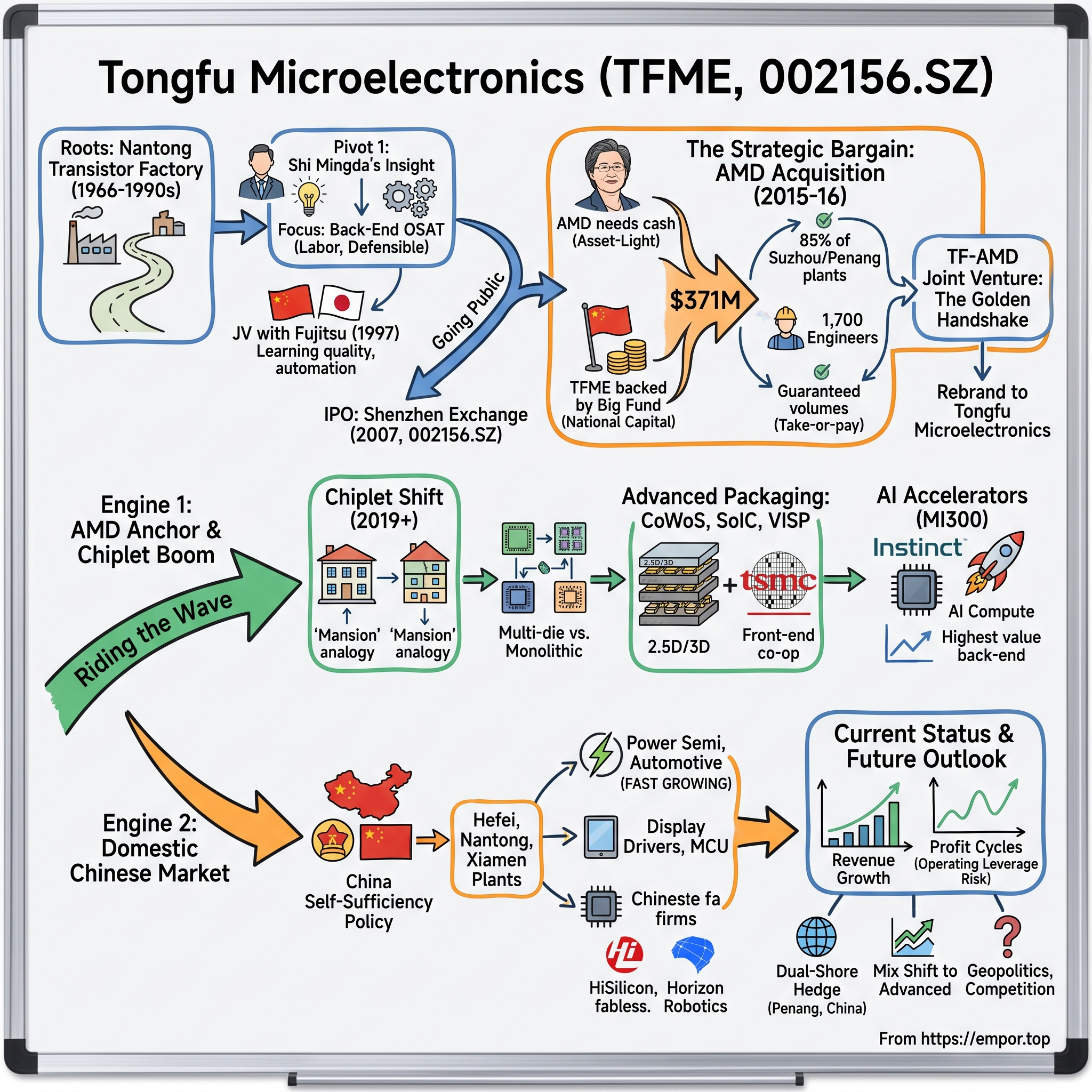
Tongfu Microelectronics: The Story of China's Advanced Packaging & AMD's Chiplet Anchor
I. Introduction & Episode Roadmap
Picture a cleanroom in Suzhou at three in the morning. Under sodium-yellow safety lighting, a robotic arm lowers a slab of silicon roughly the size of a large postage stamp onto a substrate the size of a coaster. Inside that slab sit twenty-odd separate pieces of silicon — compute dies, memory stacks, an interconnect layer — that must be bonded together within microns of tolerance, or the whole assembly, worth more than a mid-range car, becomes scrap. The engineers watching the yield monitors do not work for Advanced Micro Devices, whose logo is stamped on the finished part. They do not work for 台湾积体电路制造公司 TSMC, which etched the transistors. They work for a company most Western investors have never heard of, whose corporate ancestor was a bankrupt transistor factory in a Chinese river town.
That company is 通富微电子股份有限公司 Tongfu Microelectronics Co., Ltd., ticker 002156.SZ, listed on the 深圳证券交易所 Shenzhen Stock Exchange, and known to Chinese investors simply as 通富微电 TFME. In 2025 it generated RMB 27.9 billion in revenue — roughly US$3.9 billion — making it the fourth-largest OSAT (Outsourced Semiconductor Assembly and Test) company on earth and the second-largest in mainland China, trailing only 长电科技 JCET Group.12
A word on what "OSAT" actually means, because the entire business rests on it and the acronym hides more than it reveals. A finished computer chip is not born finished. A foundry like TSMC etches billions of transistors onto a circular silicon wafer, but that wafer is useless as it comes off the line — it has to be sliced into individual dies, each die connected to the outside world through hundreds or thousands of microscopic contacts, encased in a protective package that manages heat and mechanical stress, and then tested exhaustively to weed out the defects before it can be soldered onto a motherboard. That downstream chain — assembly, packaging, and test — is the "AT" in OSAT, and companies that do it for hire, rather than in-house, are the "outsourced" part. For most of the industry's history this was viewed as low-value finishing work, the equivalent of framing and shipping a painting someone else had already painted. The revolution this story tells is how that finishing work became, for a certain class of chip, nearly as strategically decisive as the painting itself.
Here is the paradox worth sitting with. The semiconductor industry's glamour and margin live at the front end — the lithography fabs of Hsinchu and Hillsboro where 台积电 TSMC and Intel wage war over 3-nanometre and 2-nanometre transistors. The back end — the assembly, the packaging, the testing — was for decades treated as commodity grunt work, the janitorial department of the chip world. Yet a formerly state-owned Chinese assembler quietly became the indispensable manufacturing partner for AMD, the company that has done more than any other to knock Intel off its perch. By AMD's own account, TFME's joint venture handles the lion's share of assembly and test for AMD's flagship EPYC server processors, Ryzen desktop chips, and Instinct AI accelerators.[^3] How did a chip janitor end up holding a knife to the throat of one of Silicon Valley's comeback stories — and does that grip actually constitute a moat, or merely a customer that could walk?
This is a story with three threads we will pull on throughout. The first is the strategic bargain: TFME's 2016 purchase of AMD's Suzhou and Penang packaging plants, a deal that reshaped both companies. The second is the chiplet paradigm shift: how the industry's decision to stop building one giant chip and start gluing many small ones together moved value from the front end toward the back — and handed OSATs a growth engine no one saw coming a decade ago. The third is the dual-shore geopolitical bridge: how a Shenzhen-listed company runs a Malaysian factory in Penang alongside Chinese plants in Nantong, Hefei, and Xiamen, straddling the widening fault line of the US-China technology war. Whether that straddle is a durable advantage or an accident waiting to be legislated away is a question we will keep returning to.
 Subscribe on LinkedIn
II. Roots in Nantong: State Enterprise to Joint Venture (1966–2006)
Nantong is not a city that shows up on investor roadshows. It sits on the north bank of the Yangtze where the river finally surrenders to the sea, an hour and a half from Shanghai by modern high-speed rail but a world away in the 1960s. In 1966, in the opening spasm of the Cultural Revolution, a local state-owned works called 南通晶体管厂 the Nantong Transistor Factory began turning out discrete components — diodes, transistors, the humble building blocks of an electronics industry China barely had. It was a planned-economy enterprise in the purest sense: quotas from above, no customers to speak of, no concept of yield economics.
For a quarter century it plodded along. Then the ground moved. As China's reforms accelerated through the late 1980s, the protected cocoon of the planned economy tore open, and enterprises like Nantong's found themselves suddenly exposed to something they had never encountered — competition, and the possibility of failure. By the early 1990s the factory was, in plain terms, dying: obsolete equipment, product no one wanted, debts it could not service, and a workforce whose morale had curdled into resignation. It was one of thousands of Chinese state-owned enterprises facing the same reckoning in that decade, most of which quietly disappeared into bankruptcy or forced mergers. What separates a footnote from a franchise, in these stories, is almost always a single person who refuses to accept the obvious verdict — and who happens to be right about an alternative path.
Into this walked 石明达 Shi Mingda. A Nanjing University graduate who had risen through the factory's own ranks rather than parachuting in from a ministry, Shi was appointed to run the enterprise in 1990.[^4] What he understood — and what makes him the pivotal human figure in this entire story — was a piece of brutal self-knowledge: the factory's own designs were uncompetitive and would remain so. Trying to out-engineer the Japanese and Americans from a standing start in Nantong was a fantasy. The realistic path was to become very good at something the leaders did not want to do themselves. He restructured the entity into a joint-stock company, reorganized it around what became 南通华达微电子集团 Nantong Huada Microelectronics Group, and used equity and operational discipline to convert a demoralized state workforce into something resembling a commercial enterprise.
The choice of assembly-and-test as the beachhead was itself a strategic insight worth pausing on. Shi grasped, decades before it became fashionable, that the back end offered a Chinese firm its most defensible foothold in the global semiconductor chain. It was labor-intensive in a country with abundant skilled labor; it did not require the export-controlled lithography tools that Western governments guarded most jealously; and its know-how could be learned by doing, through partnership, rather than invented from scratch. In an industry where China was hopelessly behind at the front end, the back end was a door that was actually open. That single bet on where a latecomer could realistically win is the through-line connecting every subsequent chapter of this company.
Then came the move that set the DNA for everything after. In 1994 Shi struck a technology-transfer arrangement with Japan's Fujitsu, and in 1997 the two sides formalized it into a joint venture: 南通富士通微电子有限公司 Nantong Fujitsu Microelectronics Co., Ltd., with Huada holding roughly 60% and Fujitsu 40%.[^4] The name mattered — "Nantong Fujitsu" advertised to the world that this was a Japanese-blessed operation, not a provincial state relic. What Fujitsu brought was more valuable than capital: automated assembly lines, the near-religious discipline of Japanese cleanroom and quality control, and entry-level IC packaging capability — the SOP, DIP, and QFN packages that were the bread and butter of the era. What Shi kept was the thing that would matter most: strategic control, and an ambition that refused to settle for being anyone's captive subcontractor.
That is the seed worth remembering. The template that would later make TFME famous — partner with a foreign technology leader, absorb its know-how, insist on keeping the wheel — was not invented for the AMD deal. It was rehearsed on Fujitsu twenty years earlier. A back-end assembler learned, before most of its peers, that in this industry you do not win by inventing the chip; you win by becoming the trusted hands that finish it, and by never letting the partner forget who runs the factory floor. From that patient, unglamorous foundation, the company was about to go public.
III. The IPO & The State Capital Catalyst (2007–2015)
By the mid-2000s the Fujitsu joint venture had a problem that good companies are lucky to have: it needed more money than its cash flow could generate. Packaging is a capital-eating business — every new package type demands new bonders, new testers, new cleanroom space — and Shi Mingda wanted to build modern facilities in Nantong faster than retained earnings would allow. The answer was the public market.
In August 2007, Nantong Fujitsu Microelectronics listed on the Shenzhen Stock Exchange under the code 002156, with registered capital that would eventually anchor a share base of roughly 1.5 billion shares.[^4] The timing was, in hindsight, almost comically bad — within a year the Global Financial Crisis had frozen electronics demand worldwide, and a company still heavily reliant on Japanese OEM orders felt the chill acutely. Management's response tells you something about the operating instinct: rather than simply wait out the storm, they used it to diversify the customer base away from a handful of Japanese patrons and into mobile communications, automotive microcontrollers, and consumer electronics. Concentration risk, then as now, was the recurring anxiety of the business.
There is a quiet irony in noticing that the company spent the years from 2008 onward deliberately reducing its dependence on a single dominant customer relationship — Fujitsu — only to build, less than a decade later, an even larger dependence on a different single customer in AMD. The difference, as we will see, was that the second concentration came with ownership and structural alignment rather than the position of a hired hand. But the pattern is instructive: this is a business whose economics repeatedly pull it toward leaning heavily on one anchor, and whose management has repeatedly had to decide whether that anchor is a lifeline or a liability. It is the central recurring tension of the whole enterprise, and it was already visible in the post-crisis years.
The genuinely transformative event of this era, though, was not corporate at all — it was national. In 2014 Beijing published the National Integrated Circuit Industry Development Guidelines and, alongside it, created the 国家集成电路产业投资基金 China Integrated Circuit Industry Investment Fund — universally nicknamed the 大基金 "Big Fund." This was the moment the Chinese state decided, with real money behind the decision, that semiconductor self-sufficiency was a strategic imperative rather than an aspiration.
The Big Fund's planners made a shrewd, unsentimental bet about where Chinese firms could win first. Building leading-edge fabs to rival TSMC would cost tens of billions and still leave China a generation behind on lithography. But the back end — assembly, packaging, test — was a segment where the technology gap was narrower, the capital intensity lower per dollar of revenue, and global scale genuinely achievable. Packaging, in other words, was the fastest road to parity. That thesis made OSAT a priority recipient of Big Fund capital, and it made Nantong Fujitsu — already the country's most internationally credible assembler — an obvious vehicle. The Big Fund took a strategic equity position, and with it came something more useful than the cash itself: the implicit backing of the state for the kind of transformational, cross-border acquisition that a mid-sized Chinese company would never otherwise dare attempt.
It is worth being precise about what "state capital" does and does not buy, because Western readers often flatten it into a caricature of unlimited subsidy. The Big Fund did not simply hand TFME free money. What it provided was a form of credibility and risk absorption: an anchor institutional shareholder whose presence signaled national priority, which in turn eased access to bank lending on favorable terms and to the grant programs that dot China's semiconductor policy landscape. For a company about to spend hundreds of millions acquiring overseas assets, that lowered cost of capital and that political air cover were the difference between a plan and a fantasy. The flip side, which prudent investors weigh, is that a state-sponsored champion answers to more than its minority shareholders — its capacity decisions, its willingness to prioritize national self-sufficiency goals over near-term returns, and its exposure to the geopolitics of that sponsorship are all shaped by a stakeholder whose objective function is not pure profit. The Big Fund giveth reach; it also complicates the story.
For investors, this is the sub-plot that separates TFME from a normal industrial roll-up. Its balance sheet has, for a decade, carried a silent partner whose motives are only partly commercial — a partner that provides patient capital and policy cover, but whose eventual exit and whose geopolitical baggage are both risks in their own right. That tension between state sponsorship and market discipline runs straight through the deal that came next, and it is the reason the AMD acquisition was even conceivable.
IV. The Masterstroke: The $371M AMD Acquisition (2015–2016)
Rewind to 2015 and look at AMD, and you would not have seen the swaggering share-gainer of today. You would have seen a company fighting for its life. Its stock traded below $2. It was burning cash, losing the x86 server market to Intel in a rout, and years away from the Zen architecture that would eventually rescue it. Into that crisis had walked 苏姿丰 Dr. Lisa Su, appointed CEO in 2014, executing a ruthless triage of the balance sheet. Her logic was asset-light and unromantic: AMD's job was to design world-beating chips, not to own the concrete-and-steel factories that assembled and tested them. Those captive plants tied up capital that a cash-strapped company could not spare.
On the other side of the table sat Shi Mingda's company, flush with the confidence — and the state capital — to do something audacious. On October 15, 2015, the two sides announced a deal: Nantong Fujitsu would acquire an 85% controlling stake in two of AMD's high-volume assembly-and-test facilities, AMD Suzhou in China and AMD Penang in Malaysia, for US$371 million in cash.3[^6] AMD kept 15%. The plants were folded into a joint venture platform, 通富超威 TF-AMD. The transaction closed on April 29, 2016, and later that year the parent company retired the "Nantong Fujitsu" name and rebranded as Tongfu Microelectronics — a symbolic cutting of the umbilical cord to its Japanese founding partner and a signal of what it now intended to be.4
Consider how differently the two parties experienced the same transaction. For AMD, the $371 million was oxygen — a cash infusion at a moment when every dollar of liquidity extended the runway toward Zen, and a chance to shed two capital-hungry plants from a balance sheet that could not afford them. Lisa Su's asset-light doctrine held that owning your own assembly lines was a liability, not a strategic asset, so long as you could secure guaranteed access to them. AMD was, in effect, selling the factory but keeping the keys. For TFME, the same $371 million was a down payment on a decade of relevance. The asymmetry of need is what made the price so favorable to the buyer: AMD was a motivated seller with few alternatives, and TFME, uniquely among potential acquirers, brought both the capital and the operational credibility to run the plants without disruption. Chinese state backing meant TFME could move faster and bear more risk than a purely commercial rival would have countenanced.
Did TFME overpay?
Set the price against what TFME actually bought and the answer is almost certainly no. Against global OSAT peers — ASE, Amkor, JCET — trading at roughly 1.2x to 1.8x enterprise value to sales at the time, the $371 million tag for two plants of this scale implied a strikingly modest multiple, well under 1x sales and low-single-digit EBITDA. But the multiple is the least interesting part. What the cash actually secured was a bundle no amount of greenfield spending could replicate on a comparable timeline: two fully qualified, high-yield flip-chip facilities already producing enterprise-grade product; something on the order of 1,700 experienced engineers who knew AMD's processes intimately; a library of flip-chip and multi-chip-module packaging know-how; and — the crown jewel — a multi-year, take-or-pay supply relationship that plugged TFME directly into AMD's product roadmap.4
Think about what that last point really meant. A normal contract manufacturer competes for every order, quarter after quarter, its margins squeezed from both sides. TFME instead bought its way inside the customer, becoming the majority owner of the very plants AMD depended on. The interests were now welded together: AMD had a 15% stake in its own supplier's success, and TFME had a guaranteed volume floor to justify the reinvestment the business would demand. It is a structure closer to a strategic marriage than a vendor agreement.
And there is a subtler point that separates a good deal from a lucky one. TFME did not merely acquire capacity; it acquired qualification. In the semiconductor world, a packaging line that is certified to produce a specific customer's product to a specific reliability standard is worth vastly more than an equivalent line that is not, because the certification represents months or years of joint engineering, yield tuning, and reliability testing that cannot be shortcut. By buying AMD's own plants, TFME inherited every ounce of that accumulated qualification instantaneously — it started on day one at a level of trust and integration that a greenfield competitor might never reach. That is the real reason the modest headline price understates the value transferred. TFME paid a commodity price for what was, in competitive terms, a nearly irreplaceable position.
The harder half: making it work
Buying the plants was the easy part. The delicate work was cultural and operational — converting two facilities that had spent their lives as internal cost centers of an American company into an independently managed joint venture answering to a Chinese parent, without dropping a single point of yield on server chips where a defective part can crash a data center. Cost centers and profit centers are run differently: a captive plant optimizes for its parent's convenience and cost, while an independent OSAT must optimize for yield, throughput, and the disciplined economics of selling capacity to a customer at arm's length. Making that mental transition — teaching a workforce accustomed to being AMD's internal department to behave like a merchant supplier that happens to have AMD as its largest client — was as much a management challenge as an engineering one. The Penang facility, in particular, had to be upgraded into a top-tier international testing center capable of the near-zero-defect execution that enterprise customers demand. That this integration succeeded — that AMD's yields held and deepened rather than cratering — is the single most important operating fact in TFME's history, because it converted a one-time asset purchase into a compounding relationship. And its timing could not have been better, because within three years AMD would launch the product architecture that turned back-end packaging from a cost line into a growth story.
V. The Chiplet Revolution & Riding the AMD AI Boom (2017–Present)
To understand why TFME's fortunes inflected after 2019, you have to understand a quiet revolution in how chips are built — and it is worth slowing down, because it is the crux of the entire investment case.
For fifty years, the industry followed Moore's Law by cramming ever more transistors onto a single monolithic slab of silicon. But as transistors approached the size of atoms, shrinking them further became astronomically expensive, and building one enormous die became a yield nightmare: a single defect anywhere on a giant chip ruins the whole thing. AMD's answer, commercialized at scale with the Zen 2 architecture and the EPYC Rome server processors in 2019, was to stop building one big chip. Instead, it built several small ones — "chiplets" — each optimized and manufactured separately, then stitched them together onto a shared package with a central input/output die acting as the switchboard.
Here is the analogy. The old way was to build a mansion as a single poured-concrete monolith; one crack and you demolish the house. The chiplet way is to build with high-quality prefabricated rooms — test each room, discard the flawed ones cheaply, then assemble the good rooms into a mansion. The catch is that the assembly itself — connecting those rooms so plumbing, power, and data flow seamlessly across the seams — becomes fantastically difficult and valuable. And assembly is precisely TFME's business.
Why did EPYC Rome make this concrete rather than theoretical? Because it was the first time a company shipped a mainstream, high-volume server processor built this way and won on it. A monolithic server chip built at the cutting edge suffered miserable yields — a single flaw anywhere on a huge die scrapped the whole part, and the bigger the die, the worse the arithmetic. By splitting the processor into eight small compute chiplets manufactured on the expensive leading-edge node plus a larger I/O die on a cheaper mature node, AMD could throw away only the tiny flawed pieces, manufacture the expensive silicon on the smallest possible area, and mix-and-match good dies to build up its product range. The economics were transformative for AMD. But every one of those efficiencies pushed cost, complexity, and value downstream, onto the shoulders of whoever assembled the eight-plus dies into a working package. The chip designer's yield problem became the packaging house's engineering opportunity.
This is the mechanism that transformed the OSAT economics. When a CPU was one die in a simple package, the back-end content was modest. When it became a dozen chiplets on a large substrate demanding micro-bump bonding, thermal management for hundreds of watts, and exacting test coverage, the packaging-and-test value captured per processor multiplied several-fold. The back end stopped being the cheap afterthought and became a genuine driver of computing performance per dollar. TFME did not invent this shift, but through its AMD joint venture it was positioned at the exact epicentre of it.
Put the value uplift in concrete terms, because this is the number that animates the entire bull thesis. Industry estimates hold that moving from a simple single-die package to a complex multi-chiplet one can raise the packaging-and-test content per chip by a factor of three to five. A traditional leadframe package might carry a few dollars of back-end value; a high-end server or AI package built from many dies on a large substrate can carry many multiples of that. For an OSAT, the same physical wafer of customer silicon suddenly generates far more revenue and — in principle — far more profit as it passes through the back end. This is why an assembler that had spent decades scrapping over pennies of margin on commodity packages suddenly found itself with a genuine growth business: not because it shipped more chips, but because each advanced chip it touched was worth far more to finish. The catch, which the bear case will exploit, is the phrase "in principle" — capturing that richer value requires enormous, continuous capital investment, and whether the extra revenue survives as extra profit depends entirely on the industry structure examined later.
The AI accelerator crescendo
If chiplets lit the fuse, AI lit the bomb. AMD's Instinct MI300 series — the MI300A and MI300X launched at the end of 2023 — represents packaging complexity that would have seemed like science fiction a decade earlier. The MI300X crams roughly 153 billion transistors, fabricated on TSMC's 5-nanometre and 6-nanometre processes, into a single package that fuses GPU compute chiplets, I/O dies, and stacks of high-bandwidth memory.[^8]
Here candour matters, because this is exactly the sort of claim where a company's investor-relations gloss and the engineering reality diverge, and a neutral telling has to flag it. The most advanced steps of the MI300 package — the silicon interposer and the hybrid-bonded 3D stacking that AMD markets as SoIC-on-CoWoS — are performed by TSMC in Taiwan, not by TFME.[^8] What TFME's TF-AMD operation does is the substantial back-end work that follows and surrounds that front-end packaging: substrate attach, final assembly, system-level and burn-in testing, and volume qualification.[^9] That is genuinely valuable, high-margin work, and TFME has publicly confirmed its role in MI300 testing.[^9] But an investor should resist the tidy outline-level claim that TFME "packages" AMD's most advanced AI parts end-to-end. On the crown-jewel 2.5D/3D interposer step, TSMC currently holds the pen — a fact that matters enormously when we later stress-test the moat.
Two engines under one roof
Financially, TFME runs on two segments. The larger is the TF-AMD joint venture spanning Suzhou and Penang, which contributes a majority of group revenue and concentrates the high-end flip-chip, multi-chip-module, and 2.5D/3D heterogeneous work for AMD's EPYC, Ryzen, and Radeon lines, plus the Instinct testing described above. The smaller but strategically vital engine is the domestic Chinese OSAT operation — the plants in Nantong, Hefei, and Xiamen — serving power semiconductors, automotive electronics, display drivers, microcontrollers, and a roster of domestic fabless customers including 海思 HiSilicon, 紫光展锐 UNISOC, and 地平线 Horizon Robotics as China builds out its own high-performance and automotive silicon.
The domestic engine is easy to overlook next to the AMD glamour, but it is the part of the business most leveraged to the one force in this story that is unlikely to reverse: China's determination to build a self-contained chip supply chain. As US export controls choke off Chinese access to leading-edge foreign manufacturing, Chinese fabless designers have every incentive to route their assembly and test work to domestic partners, and TFME's Hefei and other mainland plants are natural landing spots for that redirected volume — including work in power devices and automotive chips, categories that are both growing fast and less exposed to the bleeding-edge geopolitics that shadow AI silicon. The strategic value of this segment is not its current margin, which is unremarkable, but its optionality: it is TFME's hedge against the very geopolitical risk that threatens its AMD business, a domestic base that grows precisely when decoupling accelerates. The two engines, in other words, are partly counter-cyclical to each other on the one axis — geopolitics — that matters most.
To keep pace with this shift, TFME has poured capital into the enabling technologies — 2.5D and 3D interposer assembly, wafer-level packaging, fan-out wafer-level packaging that spreads a chip's connections across an area larger than the die itself, and high-density substrate bonding under its in-house VISP platform. This is the unglamorous, balance-sheet-heavy reality behind the AI headlines: staying at the frontier of advanced packaging means buying successive generations of extraordinarily expensive equipment, and doing so before the volume arrives to fill it. That timing gamble is the source of both TFME's optionality and its single biggest financial vulnerability, as the numbers make vivid.
You can read the strategy directly in the financials, and they tell a story of feast interrupted by famine. Revenue climbed from RMB 10.8 billion in 2020 to RMB 15.8 billion in 2021 — a 47% surge as pandemic-era electronics demand and the AMD ramp collided.5 Then came the 2022–2023 semiconductor downcycle, and it was brutal at the bottom line: revenue plateaued around RMB 21–22 billion, but net profit attributable to shareholders collapsed to just RMB 169 million in 2023, a net margin below one percent.5 Revenue recovered to RMB 23.9 billion in 2024 and RMB 27.9 billion in 2025, with net profit rebuilding to roughly RMB 1.2 billion and record results management attributed to AI and automotive demand.46
Sit with the 2023 figure for a moment, because it is the most important number in this article for understanding the risk. Revenue that year was barely below the prior peak, yet net profit fell by roughly two-thirds versus 2022 and stood at less than a hundredth of revenue. How does a company nearly hold its top line and almost lose its entire bottom line? The answer is operating leverage running in reverse. When a business carries billions in depreciation and interest on equipment that must run whether orders are strong or weak, a modest dip in utilization and pricing — the natural consequence of an industry-wide inventory correction — flows almost entirely to the profit line, because the costs are fixed and cannot be shed. The lesson embedded in that whipsaw is one every OSAT investor must internalize: this is a high-fixed-cost, cyclical business where revenue can hold flat while profit evaporates, because the depreciation on all that advanced packaging equipment does not take a holiday when orders soften. It is a wonderful business at the top of the cycle and a frightening one at the bottom. Which brings the story to the people deciding how aggressively to keep buying that equipment.
VI. Current Management, Ownership & Governance
Semiconductor companies are usually run by engineers or by financiers. TFME is run by a family — and understanding that family is central to understanding both the company's discipline and its governance risks.
At the symbolic apex sits 石明达 Shi Mingda, now in an honorary chairman's role, the man who took a bankrupt transistor factory and, across three decades and two continents' worth of joint ventures, turned it into a global OSAT. His value to the company today is less operational than institutional: he is a figure of standing in China's semiconductor policy circles, and that credibility greases the wheels of Big Fund support and national grant programs in a way an outsider CEO never could. In an industry where the state is both customer-of-last-resort and gatekeeper, having a founder who speaks the language of policy is a real, if unquantifiable, asset.
Day-to-day command has passed to his son, 石磊 Shi Lei, chairman and president. Educated in both business and engineering, Shi Lei is the executive who lived through the operational trenches of the AMD joint-venture integration — the delicate work of Section IV — and who now sets strategy. A father-to-son succession is, for investors, a double-edged inheritance. On one hand it delivers continuity, a long-term ownership mindset, and someone who genuinely understands the technology rather than managing it from a spreadsheet. On the other, it concentrates power in a family and raises the perennial questions of dynastic governance: independence of the board, the treatment of minority shareholders, and whether succession was earned or assumed.
On the question of management credibility — which for long-term investors is assessed through behaviour over time, not slogans — the record is genuinely mixed and deserves an honest read. In the company's favour is a decade of narrative consistency: management said in 2016 that it was buying its way into the highest-value packaging work through the AMD relationship, and the subsequent growth in advanced-packaging revenue substantiated that claim rather than contradicting it. Through the AI cycle, management has framed the growth drivers — AI compute, automotive, and overseas demand — in language that has stayed stable across successive annual reports and results commentary rather than lurching from theme to theme, which is a modest but real marker of discipline.6 The debit side is that the company has been more reliable at hitting revenue and capacity ambitions than at converting them into profit, and it has leaned repeatedly on equity issuance to fund expansion — a pattern that dilutes existing holders and that a skeptic reads as a management prioritizing scale and strategic footprint over per-share value. When a company keeps promising operating leverage and keeps delivering thin margins through the cycle, the burden of proof shifts onto management to show the leverage is finally arriving.
Who actually owns TFME
The ownership structure is a study in Chinese industrial capitalism. The controlling shareholder is 南通华达微电子集团 Nantong Huada Microelectronics Group, holding roughly 19.9% of TFME, and Shi Mingda controls Huada through a personal stake of about 39%, giving the family effective control of the listed company through a relatively modest ultimate economic interest — a classic pyramid structure that amplifies control relative to capital at risk.7 The second major holder is the Big Fund, whose position sat around 8.8% in 2025 — and here the recent behaviour is worth flagging as an analytical fact rather than a footnote.8
Through 2025 and into 2026 the Big Fund announced and executed share reductions, trimming its stake via open-market sales and disclosing plans to sell down further.8 Chinese retail investors watched the stock make fresh lows on the news. It is important to read this correctly and without alarmism: state funds recycle capital, and the Big Fund has been reducing mature positions across its entire portfolio to fund newer priorities, so this is not necessarily a verdict on TFME's prospects. But it does remove a pillar of price support and dilutes the "state-backed" narrative that has long buoyed the shares — the patient partner is, at the margin, heading for the exit. As for Fujitsu, the founding Japanese partner has over two decades steadily reduced its holding, completing the company's evolution from Sino-Japanese joint venture to a Chinese-controlled, publicly traded enterprise.
Capital allocation: the ledger, honestly kept
On the credit side of the ledger, the AMD acquisition stands as a genuinely excellent piece of capital allocation — a $371 million outlay that, by any reasonable reckoning of the cash flows it subsequently generated, paid for itself within a handful of years and bought a decade of growth optionality. Management has also reinvested operating cash flow aggressively and consistently into advanced capacity, positioning ahead of the chiplet wave rather than chasing it.
On the debit side, an honest assessment has to confront the profitability profile. Net margins have bounced around a thin 1%–6% band for years, and 2025's roughly 4% net margin sat on a gross margin of only about 15%.6 The culprits are structural: enormous depreciation from all that packaging equipment — 2025 depreciation and amortization ran to roughly RMB 3.5 billion, nearly three times net profit — plus exposure to volatile gold, copper, and substrate input costs that the company can only pass through with a lag.56 Free cash flow has been negative or barely positive for most of the past five years as capex consumed nearly everything operations produced.6 This is the uncomfortable truth beneath the growth story: TFME has been superb at growing revenue and market position, and merely adequate at converting that into shareholder cash. Whether that changes depends entirely on the competitive structure of the industry it operates in.
VII. Competitive Landscape, Industry Structure & Economic Moat
The OSAT industry is a pyramid, and TFME sits in the upper-middle. At the top, in a class of its own, is 日月光 ASE Technology of Taiwan, which booked roughly $18.5 billion in 2024 revenue — nearly half of the entire top-ten OSAT market — with dominance in the Apple supply chain and advanced fan-out packaging.1 Second is America's Amkor Technology at about $6.3 billion, strong in automotive and communications.1 Third is China's own 长电科技 JCET Group at roughly $5.0 billion, the broadest Chinese portfolio, built partly on its earlier acquisition of Singapore's STATS ChipPAC.1 Fourth sits TFME at about $3.3 billion in 2024, holding roughly 8% of the top-ten market — and fifth, further down, 华天科技 Tianshui Huatian, a cost-focused volume player.1
TFME's distinguishing feature within that pack is not size but mix: among the Chinese OSATs, it carries the highest concentration of genuinely advanced server and AI chiplet packaging, a direct inheritance of the AMD relationship. It is the smallest of the four leaders but arguably the one most exposed to the fastest-growing, highest-value corner of the market. That is a blessing and a curse in one, as the next section will press on.
The rankings also reveal the tectonic shift the whole industry is watching. In 2024 the combined revenue of the top ten OSATs grew only about 3%, but the Chinese players inside that group grew at double-digit rates — JCET up roughly 19%, buoyed by AI PCs and mid-range smartphones, and the Chinese cohort collectively taking share from the established order.1 This is not an accident; it is policy made manifest. Beijing's drive for semiconductor self-sufficiency, the same impulse that created the Big Fund, is steadily redirecting domestic chip design work toward domestic packagers, and the Taiwanese and American incumbents feel it as a slow erosion at the base. TFME is both a beneficiary of this current and, through its heavy AMD exposure, less purely a "China self-sufficiency" play than JCET or Huatian — a nuance that cuts both ways depending on whether one fears decoupling or Chinese domestic competition more.
The 7 Powers lens
Applying Hamilton Helmer's framework clarifies what is real and what is wished-for. Process Power is TFME's most credible source of advantage. The accumulated, hard-won operational know-how in bonding and testing complex multi-die packages that dissipate 500-plus watts is not written in any manual; it lives in the muscle memory of engineers and the tuning of production lines, and it took years and AMD's own tutelage to build. This is genuine, but it is worth noting that process power is a relative advantage — TSMC, ASE, and Amkor possess their own, often deeper.
Switching Costs are the second pillar, and they are high but not infinite. For AMD to move EPYC or Instinct assembly away from TF-AMD would mean a 12-to-18-month requalification cycle, fresh yield risk on products where reliability is existential, and significant capital redirection. That friction is precisely what gives TFME pricing durability on existing platforms. But note the asymmetry: those switching costs protect the current generation of products. They do not guarantee that AMD designs the next generation around TFME, and AMD's 15% ownership of the JV cuts both ways — it aligns interests, but it also means AMD sits on the inside with full visibility and leverage.
Scale Economies are, honestly, only moderate for TFME. It has meaningful fixed-cost absorption in its high-volume Penang and Suzhou cleanrooms, but at a third of ASE's revenue it cannot claim the industry's cost-leadership position. Scale, here, belongs to Taiwan.
It clarifies matters to contrast TFME with its nearest domestic rival, JCET, because the two Chinese leaders have pursued different shapes of the same ambition. JCET is larger, more diversified across end markets, and built partly through the acquisition of Singapore's STATS ChipPAC, giving it a broad global footprint and a wide product portfolio spanning smartphones, computing, and automotive. TFME is smaller and far more concentrated — its fortunes bound tightly to AMD and to the high-end computing and AI packaging that relationship anchors. In investing terms, JCET is the diversified index of Chinese OSAT and TFME is the concentrated bet: higher exposure to the single most attractive segment, but with the volatility and single-customer fragility that concentration implies. Neither is strictly better; they are different risk-reward propositions wearing the same national jersey. And both live under the same ceiling — the Taiwanese scale leader above them and the foundries reaching down from an even higher perch.
Porter's five forces: a tough neighbourhood
The structural economics explain those thin margins better than any management commentary. Supplier power is high: TFME depends on TSMC and other foundries for the processed wafers it packages, and on a small club of specialized substrate makers — Japan's Ibiden, Taiwan's Unimicron — for the high-density IC substrates that advanced packages require, substrates that have periodically been supply-constrained industry bottlenecks. The substrate point deserves emphasis because it is an underappreciated choke. The ABF substrates that flip-chip and chiplet packages are built on are made by a handful of predominantly Japanese and Taiwanese firms, and during the 2021–2022 boom their scarcity became a binding constraint on the entire computing supply chain. An OSAT that cannot secure substrate cannot ship, and it has limited leverage over suppliers whose product is irreplaceable and whose capacity expands slowly. That dependence sits upstream of TFME and is largely outside its control. Buyer power is also high, and this is the crux: with a majority of revenue tethered to AMD, the customer holds enormous leverage over pricing and the margin split, and every downturn is an invitation for AMD to renegotiate. Rivalry is intense, a capex arms race among the top five compounded by the ever-present threat that foundries like TSMC pull more packaging in-house. High supplier power, high buyer power, and high rivalry is the textbook recipe for a low-margin industry — which is exactly what the financials have shown. The moat, such as it is, keeps TFME in the game and locked to its anchor customer; it does not confer the fat margins of a business with real pricing power. That distinction is the heart of the bear case, and it is where the skeptics begin.
VIII. Activist / Skeptical Investor Stress Test & Risk Radar
Imagine a long-short investor building the bear thesis on a whiteboard. On one side she writes the bull's three words — "AI," "AMD," "China." On the other she writes a single question under each, and the questions are uncomfortable enough that the whole clean narrative starts to wobble. This is the discipline the story now demands: not to assume the moat, but to attack it and see what survives.
Now let us do what a sharp short-seller would do: try to break the story. TFME's bulls tell a clean tale of AI tailwinds and an unbreakable AMD bond. A skeptic would push on three pressure points, hard.
Pressure point one: the TSMC in-sourcing threat. As we established, TSMC already owns the most advanced step of the MI300 package — the CoWoS interposer and SoIC hybrid bonding. As AMD marches to 3-nanometre and 2-nanometre designs with ever-more-exotic packaging, what stops TSMC from capturing the entire back-end value chain and relegating TFME to commodity testing? This is the existential question. The counter-argument, which has held so far, is one of capacity and economics: TSMC's advanced-packaging capacity has been chronically constrained and is fabulously expensive, so TSMC has a strong incentive to reserve its scarce CoWoS lines for the highest-value front-end interposer work and offload the secondary assembly, final test, and burn-in to trusted partners like TFME. In this reading, TSMC and TFME are complements, not pure substitutes. But a skeptic will rightly note that this is a truce of convenience, not a law of nature. If CoWoS capacity ever becomes abundant, the logic that protects TFME weakens — and the direction of TSMC's enormous packaging investment is toward more capacity, not less.
Pressure point two: customer concentration. Over half of TFME's revenue rides on a single customer. That is a concentration most boards would consider a five-alarm fire, and it makes TFME a leveraged bet on AMD's fortunes in two distinct battles — the x86 server war against Intel and the AI-accelerator war against 英伟达 Nvidia. If AMD stumbles in servers, or if the broader PC market bleeds share to ARM-based designs from Qualcomm and Apple, TFME feels it immediately and disproportionately. The domestic Chinese segment provides some diversification, but it cannot yet offset a serious AMD setback. Concentration has been TFME's making; it could equally be its undoing.
Pressure point three: the geopolitical vice. This is the risk with the widest range of outcomes. TFME's Penang facility is its hedge — a plant on neutral Malaysian soil that lets a Chinese-controlled company serve global customers without tripping supply-chain reshoring anxieties. Penang's expansion for AMD-related work has been the visible expression of that hedge, giving the company a credible non-China manufacturing base at exactly the moment global customers began prizing supply-chain optionality outside both Taiwan and the mainland.[^14] But is Penang truly insulated from US export controls, given its Chinese parent? And on the mainland, can the Suzhou and domestic plants maintain access to the advanced test equipment they depend on — the machines made by America's Teradyne and Japan's Advantest — if the US Bureau of Industry and Security widens its restrictions to cover advanced packaging tools and chiplet design software, as it has periodically signaled it might? A single rule change in Washington could impair either the international bridge or the domestic base. TFME cannot control this variable; it can only diversify around it, which is precisely what the dual-shore model attempts.
Here it is worth confronting a piece of consensus narrative that deserves fact-checking, because uncritical repetition of it inflates the bull case. The tidy story says TFME "is AMD's advanced packaging partner" and therefore rides the AI wave as a near-equal to the foundries. The more accurate picture, established earlier, is that the highest-value 2.5D and 3D interposer steps for AMD's flagship AI parts currently sit with TSMC, while TFME performs the substantial but more contestable back-end assembly and test around them.[^8][^9] The distinction matters for exactly the reason a skeptic cares about: the work most protected by switching costs and process depth is the work TFME does not yet fully own on the most advanced products. Its position on mainstream EPYC and Ryzen is deep and defended; its position on the bleeding-edge AI accelerator package is real but junior to the foundry. An investor who conflates the two overestimates the moat where it is thinnest.
The material risk radar
Beyond those three, the standing risks are: input-cost volatility, where spikes in gold, copper, and specialized resins compress already razor-thin gross margins faster than the company can reprice; and capex depreciation drag, the danger that TFME over-builds 2.5D/3D capacity ahead of actual AI-chip volumes, saddling itself with depreciation on underutilized cleanrooms and depressing returns on invested capital for years. The 2023 profit collapse — revenue flat, net income down by roughly two-thirds — was a live demonstration of exactly how that fixed-cost leverage cuts on the way down. None of these risks is hypothetical; all have already drawn blood at least once. The question for a long-term investor is whether the lessons of this history point to a repeatable playbook.
IX. Playbook: Business & Investing Lessons
The best business stories leave behind more than a company's biography; they leave a set of transferable principles that outlast the particular firm. Strip away the Mandarin names and the packaging jargon, and the TFME saga is a case study in how a latecomer with no technological edge can nonetheless build an enduring position — by choosing the right battle, aligning with a stronger partner, and riding a structural shift others were slow to see. Step back from the ticker and it offers three transferable lessons, each with a caveat that keeps the lesson honest.
One: the carve-out joint venture is an underrated M&A structure. Rather than sign yet another arms-length contract-manufacturing agreement, TFME bought controlling equity in its customer's own captive plants. That single structural choice converted a transactional vendor relationship into an ownership alignment — AMD now profits from TFME's efficiency, and TFME inherited a guaranteed volume floor. When a supplier and customer's incentives are welded by shared equity rather than negotiated quarter to quarter, the relationship tends to survive downturns that would sever an ordinary contract. The caveat: alignment is not permanence. The equity link makes divorce costly, not impossible.
Two: the back end is becoming the new frontier of computing progress. For half a century, performance gains came from shrinking transistors. As that engine sputters and its costs explode, an increasing share of the gains now comes from how you assemble — chiplets, 2.5D interposers, 3D stacking. Value is migrating, at the margin, from the fab to the package. For investors, this reframes the humble OSAT from commodity subcontractor toward something more strategically central. The caveat, and it is a large one: that same logic is exactly why the foundries want the packaging business for themselves, which is what keeps OSAT margins thin even as OSAT importance rises.
Three: geopolitical hedging through dual footprints. By running a serious hub outside China in Penang alongside its domestic plants, TFME can serve global fabless customers who might balk at a purely mainland supply chain, while still enjoying home-market support. In a bifurcating world, the ability to credibly operate on both sides of a fault line is itself a competitive asset. The caveat is that a hedge is only as good as its independence, and a Chinese-controlled Malaysian plant may find its neutrality tested if the export-control regime hardens.
There is a fourth, more sobering lesson threaded through all three, and it is the one most useful to a fundamental investor: strategic positioning and financial returns are not the same thing, and confusing them is how people lose money on great narratives. Everything TFME did strategically was intelligent — the beachhead choice, the Fujitsu apprenticeship, the AMD carve-out, the chiplet timing, the dual-shore hedge — and yet the enterprise has, for most of its public life, converted that strategic brilliance into only modest per-share economics. A company can be admirably run, structurally important, and genuinely well-positioned, and still sit in an industry whose economics refuse to reward those virtues with high returns on capital. Holding both of those truths at once — strategic excellence and financial mediocrity coexisting in the same firm — is the entire analytical challenge of TFME. These lessons frame the forward-looking debate, which comes down to a clean bull-versus-bear split.
X. Bull vs. Bear Case & Key KPIs
Every investment case ultimately collapses into two stories told about the same facts, and TFME's are unusually clean mirror images of each other. Both sides agree on the setup — a fourth-place OSAT with the best AI-adjacent customer relationship in China, thin margins, heavy capex, and a state shareholder heading for the door. They simply draw opposite conclusions about which force wins: positioning or industry structure.
The bull case
The bull case rests on TFME being positioned at the intersection of the two most powerful currents in semiconductors — AI compute and the chiplet transition — through the single best-placed anchor customer a Chinese OSAT could have. If AMD's Instinct accelerators continue taking data-center AI share, and if the MI350 generation and its successors ramp as management hopes, TFME captures rising volumes of the highest-value back-end work in the industry.4 Layer on a second engine — domestic Chinese fabless companies accelerating their shift to local OSATs for high-performance computing and automotive chips as national self-sufficiency policy pushes them onshore — and a third — Penang maturing into a top-tier international hub for non-Chinese customers actively seeking manufacturing outside Taiwan. Three growth vectors, one of them structural policy tailwind, none of them fully priced by skeptics who still think of TFME as a commodity assembler. The strongest version of the bull case is not about any single year's earnings but about a mix shift compounding quietly over a decade: as advanced packaging grows from a slice of revenue toward the majority of it, the argument runs, both growth and eventually margin follow, and a company today valued on thin trailing profits re-rates as the earnings power of that mix finally shows through.
The bear case
The bear case is equally coherent and rests on the margin math this article keeps returning to. TFME can grow revenue impressively and still deliver mediocre returns on capital, because it sits in a structurally low-margin industry squeezed between powerful suppliers and a powerful customer. Gross margins can compress in an instant if gold and substrate costs spike or if AMD, exercising its buyer power, demands price cuts in a soft quarter. The premium AI-packaging value could be captured upstream by TSMC and ASE, leaving TFME with the lower-margin legacy testing. And a hardening US export-control regime could choke the equipment supply to its domestic plants or complicate Penang. In the bear reading, TFME is a capital-intensive, cyclical, customer-concentrated business wearing an AI growth costume — and its thin free cash flow and 2023 profit collapse are evidence for the prosecution, not aberrations.
The sharpest form of the bear argument turns the bull's own logic against it. If back-end packaging is truly becoming as strategically valuable as the bulls claim, then the most powerful players in the industry — the foundries with the deepest pockets and the tightest grip on the leading customers — have every incentive to capture that value themselves rather than leave it to a fourth-place subcontractor. The same rising importance that makes TFME interesting is what puts a target on its back. In this view, TFME occupies a precarious middle: too dependent on a single customer to have real bargaining power, too small to win on scale, and increasingly encroached upon from above by foundries extending down into packaging. The 2023 numbers, the persistently negative free cash flow, and the reliance on equity raises are, to the bear, not a passing cyclical dip but the natural steady-state of a business with structurally weak economics that no amount of AI enthusiasm can permanently repair.
Which case wins is, honestly, unresolved — and a neutral telling should say so rather than pretend otherwise. The bull case is a bet that mix and positioning eventually pull margins up; the bear case is a bet that industry structure keeps them down no matter how good the positioning. Both can point to real evidence.
Synthesizing the frameworks from earlier, the honest verdict is that TFME possesses genuine but bounded power. In Helmer's terms its process power and switching costs are real on its established platforms, which is why it survives downturns and retains its anchor customer; but neither rises to the level of the durable pricing power that produces fat margins, because Porter's forces — powerful suppliers upstream, one powerful buyer downstream, and relentless capex rivalry across — keep the industry's economics tight for everyone but the scale leader in Taiwan. The company's edge, in other words, is real enough to keep it locked into the highest-value corner of a structurally difficult business. It is not obviously strong enough to let it earn outsized returns on the capital that corner demands. Reasonable investors can weigh that same conclusion and land in different places, which is exactly why the KPIs below matter more than any narrative.
The three KPIs that actually matter
For an investor tracking this story over time, most of the noise can be ignored in favour of three signals. The temptation with a company like TFME is to fixate on the quarterly revenue headline and the parade of AI-related announcements, but revenue growth has never been TFME's problem — it has grown its top line nearly threefold across five years. The problem, and therefore the thing worth measuring, is the quality of that growth: whether it is the kind that widens margins and throws off cash, or the kind that merely fills ever-larger and ever-more-expensive factories at the same thin returns. The three KPIs below are chosen precisely because each one tests quality rather than mere scale.
One: advanced-packaging revenue share and its gross margin. The entire bull thesis is that TFME's mix keeps tilting from commodity leadframe packaging toward high-value flip-chip, chiplet, and 2.5D/3D work — and, crucially, that the tilt shows up in a rising gross margin rather than just rising revenue. Growth without margin improvement would vindicate the bears; watch them together, not separately.
Two: the AMD concentration and the TF-AMD joint venture's profitability. Because a majority of the business rides on AMD, the health of the EPYC and Instinct ramps — and the net profit the Suzhou-Penang joint venture actually throws off quarter to quarter — is the closest thing to a master gauge of TFME's fortunes. It is also the risk barometer: the same number that signals boom signals the concentration exposure.
Three: free-cash-flow conversion and the capex-to-sales ratio. This is the discipline test. TFME must keep buying expensive cleanroom equipment to stay in the game, but the question is whether it can eventually fund that reinvestment from its own cash flow rather than perpetually leaning on equity dilution and debt. A sustained move of free cash flow into consistently positive territory would be the single strongest evidence that the growth is finally translating into owner value — and its continued absence would be the strongest evidence that the bears are right about the industry's economics.
XI. Epilogue & Outro
There is a pleasing symmetry to this story. A state-owned transistor factory, born in 1966 in a river town most of the world cannot place on a map, survived near-death by apprenticing itself to a Japanese partner, went public into the teeth of a financial crisis, and then — backed by the deep patience of Chinese state capital — reached across the Pacific to buy the factories of a struggling American chip designer at the precise moment before that designer's greatest comeback. Each of those pivots required TFME to do the same unglamorous thing: attach itself to a technology leader, absorb what it could, and insist on keeping its hands on the wheel.
Notice, too, what each of TFME's foreign partnerships reveals about the shifting balance of the semiconductor world. In 1997 a struggling Chinese factory needed Fujitsu to teach it how to make a package at all — the flow of knowledge ran one way, from the advanced Japanese partner to the aspiring Chinese student. By 2016 the direction had reversed: it was a distressed American designer that needed the Chinese company's capital and manufacturing muscle, selling it the factories and the engineers. In two decades TFME went from apprentice to acquirer. That reversal is a compressed parable of China's broader climb through the technology stack — not by inventing the frontier, but by mastering the essential, unglamorous work of turning designs into physical products at scale, and by being patient enough to buy in when the incumbents grew weak.
The larger point this company illustrates is one the whole industry is still absorbing. For a generation, the story of computing progress was told in the lithography fabs of Hsinchu and Hillsboro, where the transistors get smaller. Increasingly, it is also told in the packaging cleanrooms of Penang and Suzhou, where the finished pieces of silicon get bonded into systems no single wafer could contain. Whether TFME captures a durable share of the value it helps create — or remains the low-margin hands finishing someone else's high-margin design — is the question that will define its next decade. The evidence gathered here cuts both ways, and an honest observer resists the temptation to resolve it prematurely; the numbers to watch have been named, and they will settle the argument in time better than any thesis stated today. For now, at 3 a.m. in a Suzhou cleanroom, the robotic arm keeps lowering silicon onto substrate, one costly, exacting placement at a time.
References
-
Top 10 OSAT Companies of 2024 Revealed—China Players See Double-Digit Growth — TrendForce, 2025-05-13 ↩↩↩↩↩↩
-
Tongfu Microelectronics Co.,Ltd (SHE:002156) Revenue — StockAnalysis, 2026 ↩
-
AMD to sell 85 percent stake in two assembly plants for $371 mln — Reuters, 2015-10-15 ↩
-
Chairman's Letter on Completing the Acquisition of 85% Equity in Two AMD Packaging and Testing Facilities — Tongfu Microelectronics, 2016 ↩↩↩↩
-
Tongfu Microelectronics (002156.SZ) Financial Disclosures — CNINFO / SZSE, 2026-04-15 ↩↩↩
-
Tongfu Microelectronics: Record revenue and profit growth driven by AI and automotive demand, with robust 2026 outlook — Quartr / TradingView, 2026-04-17 ↩↩↩↩↩
-
Tongfu Microelectronics, Shi Mingda and Nantong Huada relationship — Eastmoney, 2025-03-26 ↩
-
Semiconductor packaging leader Tongfu Microelectronics hit by Big Fund reduction, shares at monthly low — Securities Times (STCN), 2025 ↩↩
 LinkedIn
 WhatsApp
 Reddit
 Hacker News
 Email
Email Kindle
 RSS Feed
 Spotify
 Apple Podcasts
 Amazon Music
 Audible
 YouTube