Bank of Ningbo: China's Retail & SME Banking Juggernaut
I. Introduction & Episode Roadmap
Picture a container ship easing out of the Port of Ningbo-Zhoushan, the busiest cargo port on Earth by tonnage, its steel boxes stuffed with auto parts, textiles, lithium batteries, and injection-molded plastics bound for Rotterdam and Long Beach. Somewhere behind that ship sits a factory owner in a nondescript industrial park in Cixi or Yuyao — a man who employs 180 people, runs razor-thin margins, and has never once been able to borrow from one of China's giant state banks because he owns no land worth mortgaging. That factory owner is the reason 宁波银行 Bank of Ningbo exists. And understanding why the big banks wouldn't lend to him — and why a small city lender figured out how to do it profitably for twenty-five years — is the whole story.
Bank of Ningbo (002142.SZ), listed on the 深圳证券交易所 Shenzhen Stock Exchange, is the bank institutional investors point to when they want to argue that not all Chinese banks are the same.1 The thesis is straightforward to state and hard to replicate: this is a regional lender that has out-underwritten the "Big Four" state-owned colossuses in the specific, treacherous niche of small-business credit, and has the numbers to prove it across multiple economic cycles.
Consider the scorecard it carried into 2026. Total assets crossed RMB 3.63 trillion at the end of 2025, up a brisk 16.1% in a single year.1 Net profit attributable to shareholders reached RMB 29.33 billion, up 8.1%.1 The non-performing loan ratio sat at 0.76% — held flat for three consecutive years while much of the Chinese banking system quietly deteriorated.1 Provision coverage, the cushion of reserves stacked against bad loans, stood at 373% — meaning for every yuan of loans it classified as bad, it had set aside more than three and a half yuan to absorb the loss.1 Weighted-average return on equity was 13.1%.1 For context, most of China's mega-banks earn ROEs in the 9%–11% range and carry NPL ratios north of 1.2%.
Here is the core paradox this article will try to explain and, where possible, stress-test. How did an institution that began life in 1997 as a hasty merger of eighteen wobbly urban credit cooperatives in a coastal port city — an entity that inherited bad loans and fragmented risk controls — end up with the cleanest reported balance sheet in the Chinese banking industry and a valuation premium to match? Is the answer a genuine, durable underwriting edge? Or is part of it a fortunate geography, a favorable accounting posture, and a long benign cycle that has not yet been fully tested?
To feel the compounding, rewind to the year of the IPO. In 2007, Bank of Ningbo earned net profit of roughly RMB 0.95 billion; by 2025 that figure was RMB 29.33 billion — very roughly a thirty-fold increase, a compound annual growth rate north of 20% sustained for nearly two decades.19 Very few banks anywhere in the world have compounded earnings at that pace for that long, and fewer still have done it while reducing their reported problem loans. That combination — high growth and improving credit — is the specific pattern that draws sophisticated capital, because in banking those two things usually trade off against each other. Growth is easy if you are willing to lower your standards and lend to anyone; the trick, and the thing worth interrogating, is growing fast while apparently keeping your standards higher than everyone else's. The rest of this article is an attempt to figure out whether that trick is a repeatable skill or a story about to meet a harder test.
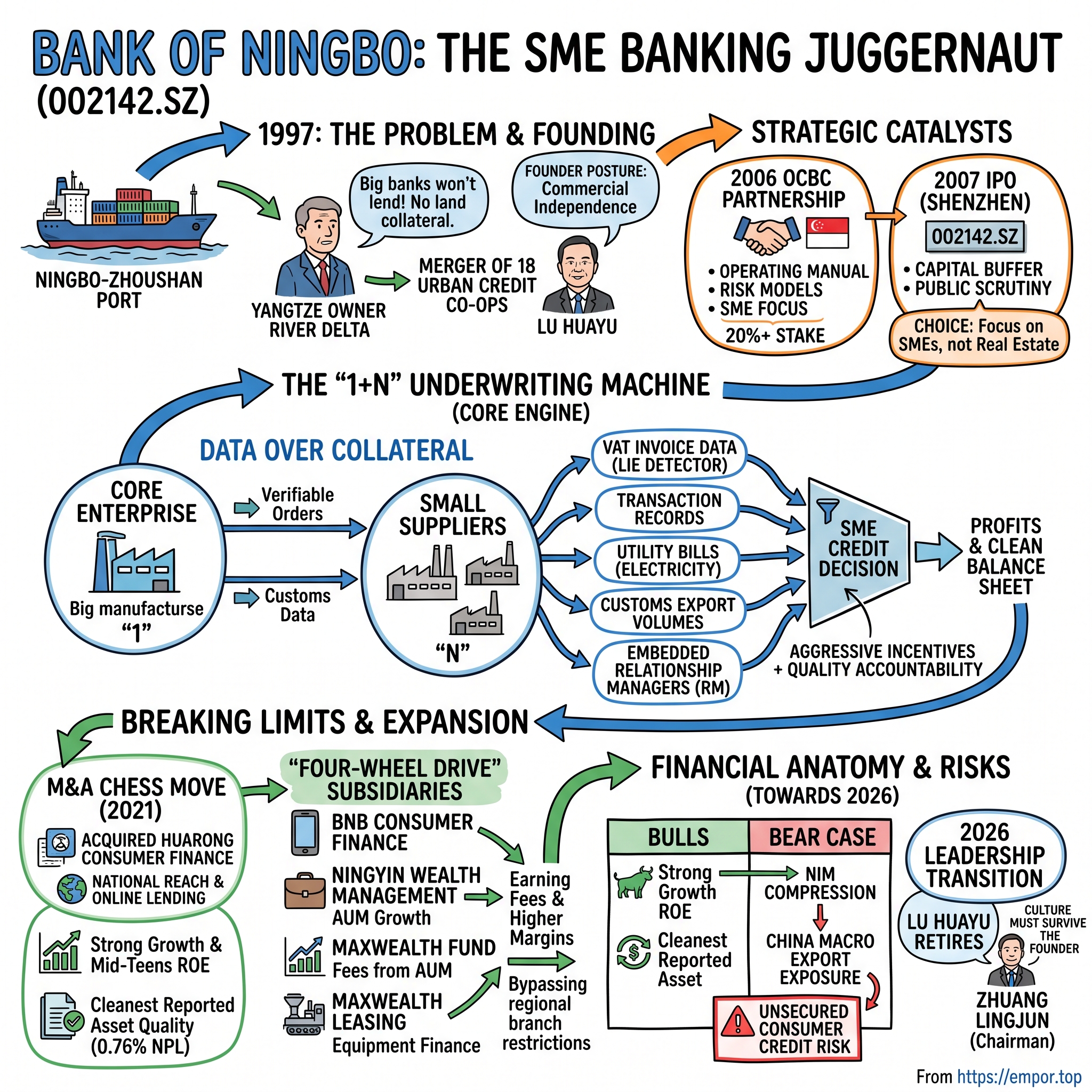
The roadmap: we start in the export workshops of the 长三角 Yangtze River Delta, where the demand for Bank of Ningbo's product was born. We move to the two catalysts that professionalized it — the 2006 arrival of Singapore's 华侨银行 OCBC as a strategic anchor and the 2007 IPO. We dissect the "1+N" underwriting machine that is the supposed secret sauce. We follow the M&A chess move — buying a consumer-finance license to escape geographic branch limits. We open up the financial anatomy, the four-subsidiary "four-wheel drive" structure, and the leadership handover that in February 2026 ended a twenty-one-year chairmanship. And we run it all through Hamilton Helmer's 7 Powers, Porter's 5 Forces, and the questions a short-seller would ask. Let's begin where the money is made.
 Subscribe on LinkedIn
II. Yangtze River Delta Roots & Founding Context
To understand Bank of Ningbo, you first have to understand that it is a creature of one of the most extraordinary economic ecosystems in modern history. Ningbo is not a household name in the West, but it is one of China's oldest continuously operating trading ports — a maritime gateway since the Tang dynasty, and by the 2000s the physical mouth through which a staggering share of "made in Zhejiang" flowed to the world. Zhejiang province, and the broader Yangtze River Delta that fans out around Shanghai, became the beating heart of Chinese private enterprise: not the state-owned steel mills and oil majors of the north, but tens of thousands of family-owned workshops making everything from cigarette lighters and neckties to auto components and pen nibs.
This matters because of a structural mismatch at the core of the Chinese financial system. When Deng Xiaoping's reforms unleashed private manufacturing, the banking system that was supposed to fund it was built for something else entirely. The Big Four state banks — 工商银行 ICBC, 建设银行 China Construction Bank, 农业银行 Agricultural Bank, and 中国银行 Bank of China — were engineered to channel household savings into 国企 state-owned enterprises and grand infrastructure projects. Their credit officers understood how to lend against a government guarantee or a piece of state-owned land. They had no framework, and little appetite, for underwriting a private exporter with volatile cash flows, no political backing, and a factory built on leased ground. The 微小企业 micro and small enterprises that were generating the region's growth and employment were, in banking terms, effectively unbankable. Credit starvation was the default condition of the very firms driving China's export miracle.
Into that gap, in 1997, stepped a new kind of institution. Bank of Ningbo was founded that year — originally as Ningbo Commercial Bank — through the consolidation of eighteen local 城市信用社 urban credit cooperatives.2 These cooperatives had sprung up in the 1980s to serve exactly the small local businesses the big banks ignored, but they were undercapitalized, loosely governed, and riddled with the kind of related-party lending and inherited bad debt that plagued grassroots Chinese finance. Stitching eighteen of them into a single city commercial bank did not magically produce a clean balance sheet. It produced a fragile one: legacy non-performing assets, inconsistent risk policies across the constituent cooperatives, and the ever-present temptation to extend "policy" loans to the local government that partly owned it.
There is a texture to this region that numbers alone miss. Zhejiang's private economy grew from the bottom up, village by village, in what economists came to call the "Wenzhou model" and the broader "Zhejiang model" — clusters of specialized towns where one place made nothing but socks, another only cigarette lighters, a third only low-voltage electrical switches, each town a dense web of family firms subcontracting to one another. This clustering is the hidden foundation of everything Bank of Ningbo later built, because it meant that credit risk was legible to anyone standing inside the cluster and invisible to anyone reading a balance sheet from a distant provincial capital. The banker who drank tea with the anchor manufacturer knew which of its fifty suppliers were reliable. The banker in Beijing did not. That informational asymmetry — local knowledge versus distant paperwork — is the fault line along which the entire competitive contest would be fought, and it favored the local player who chose to invest in being local.
The founding merger, then, was less a triumphant birth than a rescue operation with a promising address. Urban credit cooperatives across China in the 1990s were a supervisory headache: thinly capitalized, prone to insider lending, and frequently insolvent in substance if not on paper. Beijing's policy response was to fold them into consolidated city commercial banks that could be regulated, recapitalized, and held accountable. Bank of Ningbo's eighteen cooperatives brought with them exactly the baggage that description implies. The early institution had to spend years cleaning up inherited assets, imposing uniform credit standards where eighteen different lending cultures had previously coexisted, and resisting the gravitational pull of its local-government shareholders toward soft, politically directed loans. It was, in other words, a turnaround before it was a growth story — and the person who ran that turnaround set the tone for everything after.
The pivotal human variable arrived in 2000. 陆华裕 Lu Huayu joined as president, and in 2005 became chairman — a role he would hold, remarkably, until his retirement in early 2026.6 Lu is the closest thing this story has to a founder-CEO, and his defining contribution was less a product than a posture. In an environment where local officials routinely leaned on their hometown banks to fund pet projects and prop up struggling state firms, Lu drew a hard boundary around commercial independence. The bank would lend on cash flow and repayment capacity, not on political convenience. It would resist the non-commercial local-government lending that would later blow holes in the balance sheets of dozens of Chinese city banks. And it would aim its energy, relentlessly, at the private SME cash flows all around it.
That sounds obvious in hindsight. It was not obvious at the time, and the discipline was not costless — it meant turning away easy volume during boom years and enduring pressure from powerful local stakeholders. But it planted the cultural seed of everything that followed: a bank whose competitive identity was built not on making loans, but on being unusually careful about which loans it made. What that culture still lacked, as the 2000s opened, was the technical machinery to industrialize it. That machinery arrived from an unexpected place — Singapore.
III. The Strategic Catalysts: OCBC Partnership & 2007 IPO
In the mid-2000s, foreign banks were circling Chinese lenders like buyers at an estate sale. China had agreed, as part of its 2001 WTO accession, to open its banking sector, and Western institutions — Bank of America into China Construction Bank, Goldman Sachs into ICBC, RBS into Bank of China — were paying billions for minority stakes, chasing a growth story and, frankly, a pre-IPO markup. Most of these marriages were transactional. When the 2008 financial crisis hit and Western banks needed capital at home, they dumped their Chinese stakes with unsentimental speed.
Bank of Ningbo's foreign partner was different, and the difference is central to the story. In 2006, Singapore's Oversea-Chinese Banking Corporation — 华侨银行 OCBC — acquired a strategic stake of roughly 12.2% in the bank ahead of its listing.3 What OCBC brought was not merely capital; it was a operating manual. OCBC was a conservative, well-run Southeast Asian bank with deep institutional memory of the 1997 Asian Financial Crisis — an institution that had learned, painfully, what undisciplined lending does to a bank. It transferred modern credit-scoring models, retail risk-management frameworks, cross-border trade-finance capabilities, and private-banking product design. Crucially, it brought board-level risk oversight from people who thought like long-term owners rather than quarterly traders.
Why did the marriage take, when so many others failed? Part of the answer is cultural and even sentimental. OCBC was founded in 1932 by the overseas-Chinese business community of Singapore — its very name, 华侨, means "overseas Chinese" — and it had spent generations serving exactly the kind of trading and manufacturing entrepreneurs who populated the Yangtze River Delta. There was a genuine commonality of clientele and mindset: two banks whose natural customer was the merchant who exports, not the ministry that spends. Where an American investment bank saw a Chinese city lender as a financial position to be flipped, OCBC saw an extension of a franchise it had run for the better part of a century. Strategic fit, not just financial arithmetic, is what turned a pre-IPO stake into a two-decade alliance.
And OCBC stayed. Where the Western financial buyers exited China after 2008, OCBC leaned in, raising its holding to roughly 20% by 2014 and signing successive multi-year strategic cooperation agreements.3 Two decades on, OCBC remained the second-largest shareholder: at the end of 2025 it held 18.69% directly plus a further 1.33% through a QFII vehicle, for a combined stake of just over 20% — sitting immediately behind the state-linked 宁波开发投资集团 Ningbo Development & Investment Group at 18.74%.1 This is the rare case of a foreign bank that treated a Chinese minority stake as a twenty-year strategic partnership rather than a trade. For a bank whose entire brand is underwriting discipline, having a disciplined foreign co-owner in the boardroom for two decades is not a footnote — it is part of the machine.
The second catalyst followed in July 2007, when Bank of Ningbo listed on the Shenzhen Stock Exchange, part of the historic first cohort of Chinese 城商行 city commercial banks to go public alongside Bank of Nanjing.2 The IPO did the obvious thing — it raised a capital buffer of roughly RMB 4 billion, converting a locally-owned lender into a publicly-scrutinized one subject to disclosure, analyst coverage, and market discipline.2 But the more revealing decision was what the bank did not do with the money. The years around the listing were the beginning of China's epic real-estate credit boom, when the fast and easy path to growth for any bank was to shovel money into property developers and mortgage speculation. Bank of Ningbo largely declined that invitation, choosing instead to deepen its core industrial-client franchise.
The timing of the listing also deserves a note, because it was almost eerily well-placed. Going public in mid-2007 meant Bank of Ningbo raised its capital cushion at the very top of a global bull market, months before the 2008 financial crisis tore through the world's banking system. A bank that has just fortified its capital base is a bank that can keep lending — and even grow — while wounded competitors retrench. Whether by foresight or fortune, entering the crisis freshly capitalized and lightly exposed to the toxic assets sinking Western banks let Bank of Ningbo treat 2008–2009 as an opportunity rather than an emergency, taking share while others licked their wounds.
Public ownership changed the institution in a subtler way too. A listed bank lives under continuous external scrutiny — quarterly disclosure, analyst questions on the exchange's investor-interaction platform, the cold discipline of a share price that reacts to every asset-quality wobble. For a bank whose whole identity is credibility about credit, that permanent audit is not a burden but a reinforcement: it raises the cost of quietly loosening standards, because the market notices. The listing, in that sense, institutionalized the discipline that Lu Huayu had imposed by force of personality, converting one man's conservatism into a structural feature of the company.
Whether that restraint was pure prescience or partly the luck of a management team that simply didn't have the branch network to chase property nationwide, the outcome compounded for fifteen years: while peers loaded up on the exposures that would later require government bailouts and asset-management-company workouts, Bank of Ningbo kept feeding the underwriting machine it understood. Which brings us to how that machine actually works.
IV. The Core Business: MSME Credit Engine & Risk Underwriting
Here is the problem, stated plainly. Lending to a small manufacturer is a miserable business for a traditional bank. The loans are small, so the fixed cost of underwriting each one eats the margin. The borrowers have thin or unreliable financial statements. They rarely own the pristine collateral — a deed to prime urban land — that a Chinese loan officer is trained to demand. And when the economy turns, small firms fail first and fail hardest. The rational response of a big bank is to not bother, or to demand so much collateral that only the least needy borrowers qualify. This is precisely the vacuum Bank of Ningbo was built to fill, and filling it profitably required solving the underwriting problem rather than avoiding it.
Its answer is a system the bank markets as "1+N" supply-chain finance. The logic is elegant. Instead of assessing a tiny supplier in isolation — where the data is thin and the collateral weak — the bank anchors on a large, creditworthy "1" (a core enterprise, often an established manufacturer or a big buyer) and then extends credit to the "N" of smaller firms woven into that company's supply and distribution network. A parts maker's creditworthiness is inferred not from its meager balance sheet but from the real, verifiable orders flowing to it from the anchor firm. The bank looks at transaction records, value-added-tax invoice data (a powerful, hard-to-fake signal of genuine sales), customs export volumes, and even utility bills to triangulate whether a business is actually operating and actually getting paid — rather than relying purely on a land-mortgage deed.
It is worth dwelling on why VAT invoice data is such a potent signal, because it illuminates something specific about doing this in China. When a Chinese business sells goods, it issues a value-added-tax invoice — a 发票 — that is registered in the tax system. Faking sustained sales means faking a paper trail inside a government database and paying real tax on phantom revenue, which is expensive and self-defeating. So a stream of genuine VAT invoices is close to a lie-detector for a small business: it shows real customers paying real money over time. A bank that learns to read that stream can approve a loan to a firm with an ugly, uninformative balance sheet but a beautiful, verifiable order book — and can decline a firm with the opposite profile that a collateral-first lender might happily fund against its factory deed. Layer on customs data for exporters (showing goods actually shipped) and electricity consumption (a factory running three shifts is busy; a dark factory is a warning), and the bank assembles a real-time, hard-to-forge picture of operating reality that traditional financial statements, filed once a year and easily dressed up, simply cannot match.
This is the intellectual core of the franchise: the substitution of transaction data for hard collateral as the basis of credit. It is a genuinely different way to see a small business, and it lets the bank say yes to good borrowers the big banks reflexively reject, while saying no to bad ones the collateral-obsessed system might wave through. The human layer matters as much as the data layer. Bank of Ningbo runs armies of highly incentivized 客户经理 relationship managers embedded physically in the trade markets and industrial parks of Ningbo, Hangzhou, Suzhou, Wuxi, Shanghai, and Nanjing — people who know which workshop is quietly winning and which is quietly failing, information that never shows up in a financial statement until it is too late.
The incentive design behind the relationship-manager army is worth pausing on, because it is both the engine and a latent hazard. These field officers are compensated heavily on the volume and performance of the loans they originate, which is what drives their relentless hustle through the industrial parks — but aggressive origination incentives are also the classic mechanism by which banks blow themselves up, as loan officers chasing bonuses wave through marginal credits. What keeps the model honest, in theory, is that Bank of Ningbo pairs the origination incentive with accountability for the loan's outcome: an officer who books a loan that later sours feels it in their compensation. This alignment of upside and downside is the cultural counterweight to the growth pressure, and it is a big part of why the bank's field engine has historically produced volume without wrecking quality. It is also, precisely, the mechanism most vulnerable to a new leadership team dialing up the growth targets — turn the volume incentive up and the quality accountability down, and the same machine that built the franchise could quietly degrade it. The design is sound; its calibration is a management choice that must be made correctly every year.
Does it actually work, or is it just a good slide in an investor deck? The honest test is behavior across cycles, and here the evidence is genuinely strong. The bank held its NPL ratio below 1% through the 2008 global financial crisis; through the 2011–2014 Wenzhou private-lending implosion, when Zhejiang's informal shadow-credit networks collapsed and swept away thousands of small firms in Bank of Ningbo's own backyard; and through the grinding 2020–2023 slowdown of COVID and the property downturn. At end-2025 the NPL ratio was 0.76%, essentially flat for three years.1 Surviving the Wenzhou crisis in particular is meaningful — that was a localized stress test aimed squarely at exactly the borrower type and geography Bank of Ningbo specializes in, and its book held.
There is a second-order proof point in how the bank grew through the recent slowdown. Between 2020 and 2025, even as China's property sector cratered and consumer confidence sagged, Bank of Ningbo roughly doubled its balance sheet — total assets climbed from around RMB 1.6 trillion to RMB 3.63 trillion — while the reported NPL ratio barely twitched.19 Growing an asset base that fast without a visible deterioration in credit is either evidence of an unusually good origination and monitoring engine, or evidence that problems are being deferred rather than recognized. The truthful analytical position is that both interpretations remain open, and the way to adjudicate between them over time is to watch not the headline NPL but its leading indicators — the "special mention" loan category (loans not yet bad but flashing yellow) and the pace of write-offs, which reveal how aggressively a bank is clearing problems off its book.
A skeptic should register the caveats. A 0.76% reported NPL ratio that never moves is itself a data point worth interrogating — reported asset quality in China reflects classification choices, write-off pace, and the option to restructure a troubled loan rather than mark it bad. And the loan book has been shifting: in 2025, corporate loans grew a torrid 30% while personal loans actually shrank 4%, a sign the bank is leaning back into its corporate/SME comfort zone as retail credit quality across China softens.1 Still, the weight of two decades of cross-cycle evidence is hard to dismiss as pure accounting. The underwriting edge appears real. The question that has dominated the last five years is a different one: how do you grow a franchise like this when the regulator won't let you open branches outside your home province?
V. M&A & Multi-License Expansion: Breaking Geographic Limits
Every regional bank in China eventually slams into the same wall, and it is a wall the regulator built on purpose. Chinese banking supervisors — today the 国家金融监督管理总局 NFRA, working alongside the central bank — have long restricted city commercial banks from opening ordinary physical branches outside their home provinces.7 The rule exists for sound reasons: it prevents small local banks from ballooning into unmanageable national networks, chasing growth into markets they don't understand, and importing systemic risk. But for a bank as good at its craft as Bank of Ningbo, the rule was a cage. Its underwriting skill was portable; its branch license was not. It could see profitable lending opportunities across China and was legally barred from opening a storefront to pursue them.
The elegant workaround was to buy a different kind of license — one that comes with national reach baked in. In late 2021, Bank of Ningbo agreed to acquire a 70% controlling stake in 华融消费金融 China Huarong Consumer Finance, paying about RMB 1.09 billion.[^5] The seller's identity is part of what made the deal possible, and it is a small parable in itself. 中国华融 China Huarong was one of the four giant state asset-management companies created in 1999 to absorb the bad loans of the Big Four banks — a designated cleaner-up of financial messes. By 2021 Huarong had become a mess of its own: its former chairman had been convicted of taking bribes on a scale that shocked even a jaded public and was executed in early 2021, and the group was forced into a sweeping restructuring that required it to dump non-core subsidiaries to shore up its balance sheet. Its consumer-finance arm was one such asset, put on the block by a distressed seller that needed cash more than it needed a small lending license. Bank of Ningbo, cash-rich and strategically hungry, was the disciplined buyer meeting a forced seller — and it paid a premium of roughly 50% over the appraised value of the stake, a sign of how badly it wanted the prize.10 The willingness to overpay is itself informative: this was not a bargain-hunting expedition but a deliberate purchase of strategic optionality, priced accordingly. The prize was not the small loan book. It was the consumer-finance license itself. A licensed consumer-finance company can issue personal consumer loans to customers anywhere in China, online, without a single physical branch — precisely the cross-provincial reach the branch rules denied.
Having secured the key, the bank turned it. The regulator approved the deal in May 2022, and Bank of Ningbo renamed the entity 浙江宁银消费金融 Zhejiang BNB Consumer Finance — 宁银消金 Ningyin Consumer Finance for short.4 It then poured in capital and bought out other shareholders, steadily lifting its ownership. By March 2025 it had increased Ningyin's registered capital to RMB 3.6 billion and its own holding to 94.17%, turning a sleepy acquired license into a scaling national digital-lending platform.5 This is regulatory arbitrage executed cleanly: rather than lobbying for years to bend the branch rules, the bank simply bought an asset class the rules treated differently. It is a genuinely clever piece of corporate strategy — though, as we will see in the risk section, "we can now lend to consumers nationwide, online" is a capability that cuts both ways.
Ningyin is one spoke of what the bank calls its 四轮驱动 "four-wheel drive" — a portfolio of specialist subsidiaries that let it earn fees and margins the parent bank's license alone could not reach. The second wheel is 永赢基金 Maxwealth Fund, a mutual-fund management arm building AUM in fixed income and equities. The third is 宁银理财 Ningyin Wealth Management, the wealth-management subsidiary that manufactures investment products for the bank's large base of affluent entrepreneur clients across eastern China. The fourth is 永赢金融租赁 Maxwealth Financial Leasing, which finances industrial equipment and machinery for the same manufacturing SMEs the bank already lends to — extending the relationship from working capital into capital expenditure. There is a coherent architecture to the four wheels, and it is worth naming because it is not the usual conglomerate sprawl. Each subsidiary either monetizes a customer relationship the bank already owns or captures a fee stream the parent's banking license cannot. Maxwealth Financial Leasing sells equipment finance to the same manufacturers already borrowing working capital, deepening rather than diversifying the relationship. Ningyin Wealth Management and Maxwealth Fund turn the deposits of wealthy Delta entrepreneurs into fee-generating assets under management, capturing the "other side" of a rich client's balance sheet. Ningyin Consumer Finance extends the credit skill into a new customer class and a national footprint. The connective tissue is that the bank is trying to earn more from customers it can already reach, and to earn it in forms — management fees, leasing spreads — that don't consume its scarce loan capital as heavily as balance-sheet lending does.
That is the bull framing. The bear framing is that "four-wheel drive" is the kind of phrase that precedes 多元化恶化, the Chinese echo of what Peter Lynch called "diworsification" — the temptation for a successful operator to wander into businesses it understands less well, spreading management attention and importing risks that don't show up until a downturn. So far the subsidiaries look disciplined and adjacent rather than sprawling and vain. But the multi-license structure is young, its consumer-finance arm is scaling into a soft economy, and the honest verdict is that it has not yet been tested by a real credit cycle. Whether that diversification is worth the added complexity and risk is a question best answered by opening up the financials.
VI. Financial Anatomy & Segment Economics
Strip a bank down to its essence and you find two questions: how cheaply does it raise money, and how well does it lend that money out without losing it? Everything else is commentary. Bank of Ningbo's 2025 results, filed with the Shenzhen exchange in April 2026, let us interrogate both. Operating income rose 8.0% to RMB 71.97 billion, and net profit to shareholders rose 8.1% to RMB 29.33 billion.1 In a year when many Chinese banks reported flat or shrinking revenue, high-single-digit growth on both lines is a standout result — and worth understanding rather than merely applauding.
Start with the revenue mix, because it explains the resilience. Roughly half of the bank's operating income comes from corporate and MSME banking — the lending engine described earlier, but also, critically, a low-cost deposit machine. The bank's digital transaction-banking products, marketed under names like 宁行云 Ninghang Cloud and 易收宝 Yishoubao, embed the bank into the daily payments and cash management of its business customers. That embedding is the point: a company that runs its payroll, collections, and supplier payments through your platform parks its operating cash with you cheaply and stickily, and that cheap deposit base is the raw material of a healthy margin. Personal banking and wealth management contribute roughly another 30%, spanning mortgages, private banking for wealthy entrepreneurs, and the distribution fees earned selling wealth products. Financial markets and treasury — bond trading, market-making, and asset custody — round out the rest.
Underpinning the margin story is an efficiency story that rarely gets enough attention. Bank of Ningbo's cost-to-income ratio — the share of revenue eaten by operating expenses — ran at 32.7% in 2025.1 For a bank whose specialty is labor-intensive, relationship-heavy small-business lending, that is a strikingly lean figure; the on-the-ground relationship-manager model is expensive to run, yet the bank keeps two-thirds of every revenue yuan before provisions and tax. The explanation is scale and technology working together: as the digital transaction-banking platforms spread the fixed cost of the franchise across a bigger book, and as more of the customer interaction moves online, the human network becomes proportionally cheaper. Efficiency of this order is a quiet competitive weapon — it means the bank can accept a lower loan rate than a less efficient rival and still earn the same return, which is exactly the kind of structural edge that compounds in a price-competitive market.
There is a cautionary note buried in the quarterly cadence, though, and a careful reader should catch it. The bank's net profit attributable to shareholders ran at roughly RMB 7.4 billion in each of the first three quarters of 2025 but dipped to about RMB 6.9 billion in the fourth quarter.1 A single soft quarter is not a trend, and quarter-to-quarter noise in a bank's numbers is normal. But a fourth-quarter dip in a year of margin compression is precisely the kind of thing worth filing away and watching, because it is the sort of early tremor that either fades or, in hindsight, marks the moment the industry-wide squeeze started to bite the sector's best operator too.
The single most important number for any bank right now is the net interest margin, and here the story is nuanced rather than triumphant. NIM is the spread between what a bank earns on assets and pays on funding — a bank's gross profit margin. Bank of Ningbo's NIM compressed to 1.74% in 2025, down from 1.86% the year before and 1.88% in 2023.1 That decline is not a company failure; it is the whole Chinese banking industry being squeezed as the central bank cuts the Loan Prime Rate to support a weak economy, forcing banks to reprice loans downward faster than they can cut deposit costs. What is notable is that Bank of Ningbo's margin, even after compression, remains well above the roughly 1.4%–1.5% margins of the mega-banks — a direct payoff of the higher-yielding SME loan mix and the cheap transactional deposits. The edge is narrowing, but it persists.
The second number a careful reader watches is provisioning, and this is where analysis must get skeptical. Provision coverage fell from 461% in 2023 to 389% in 2024 to 373% in 2025.1 That is still an enormous cushion — more than triple the regulatory minimum of 150%. But the direction matters. A Chinese bank's provision coverage functions as a discreet earnings-smoothing reservoir: in fat years it over-provisions, stashing profit into reserves; in lean years it can release reserves to flatter earnings. The falling coverage ratio, arriving in the same years that margins are compressing and profit growth is holding at 8%, raises a legitimate question we will return to: how much of the smooth earnings line is genuine underwriting performance, and how much is a controlled drawdown of a very large cookie jar? On its own the number proves nothing — 373% is a genuinely strong reserve. But the trend is a thing to watch, not to wave away.
The composition of loan growth in 2025 tells its own strategic story. Corporate loans surged 30% while personal loans contracted 4% and bill discounting jumped 31%.1 Read that together and a picture emerges: with Chinese household credit quality softening and consumers deleveraging, the bank tilted decisively back toward the corporate and SME lending it knows best, and toward short-dated, lower-risk bill financing, rather than pushing retail credit into a weakening consumer. That is a defensive, quality-first allocation — reassuring on asset quality, but also a tacit admission that the much-touted retail growth engine is throttling back exactly when the macro turned. A management team genuinely obsessed with credit quality would make this trade; a management team chasing headline growth would not. On the evidence of 2025, this one made the disciplined choice.
Two more markers complete the anatomy. Capital adequacy stood at 14.30%, with a core Tier 1 ratio of 9.34%, comfortably above regulatory floors but tighter than the mega-banks — a reminder that rapid asset growth of 16% a year consumes capital and helps explain the bank's history of periodic capital raises.1 This is the structural tension at the heart of a fast-growing bank: growth devours capital, because every new loan must be backstopped by a slice of equity, and a bank compounding its balance sheet at 16% a year will periodically need to return to the market for more. Over the years Bank of Ningbo has done exactly that — through share placements and convertible bonds — and each raise has diluted existing holders modestly. The defense is that the capital was reinvested at a mid-teens ROE, so the dilution bought genuinely value-accretive growth rather than merely plugging holes. That is a defensible track record, but it also means shareholders should expect the pattern to continue: this is not a bank that will hand back capital in buybacks; it is one that will keep asking for it to feed the machine. And the board proposed a dividend of RMB 12 per 10 shares for 2025, roughly a quarter of earnings — a consistent but not generous payout, reflecting a management that would rather retain capital to fund growth than maximize the check to shareholders.1 The financials, in sum, describe a genuinely superior operator facing genuine industry headwinds — which makes the people steering it, and the fact that they just changed, unusually important.
VII. Governance, Management Credibility, & Leadership Transition
For twenty-one years, Bank of Ningbo had one answer to the question "who runs this place?" The answer was 陆华裕 Lu Huayu. Born in 1964, Lu took the chairmanship in 2005 and held it until February 2026, presiding over the bank's metamorphosis from a small city lender into a RMB 3.6-trillion institution.16 In a Chinese banking landscape littered with the wreckage of chairmen who chased breakneck growth, made vanity acquisitions, or ended up under corruption investigation, Lu's tenure was defined by an almost monotonous consistency: the same strategy, the same underwriting culture, the same refusal to lend against political pressure, sustained across two decades and multiple economic storms.
The ownership structure surrounding Lu shaped that discipline and deserves a closer look, because it is unusual and, on balance, healthy. Bank of Ningbo does not have a single dominant controller. At the end of 2025 its largest shareholder was the state-linked 宁波开发投资集团 Ningbo Development & Investment Group at 18.74%; its second was OCBC at just over 20% combined; and its third, at 10%, was 雅戈尔 Youngor, one of China's best-known private apparel-and-investment conglomerates and itself a Ningbo institution.1 This is a genuinely mixed cap table — local state capital, a foreign strategic bank, and private domestic enterprise — with no owner able to dictate unilaterally. For a Chinese bank, that pluralism is a feature: it dilutes the single most dangerous force in Chinese regional banking, the local-government shareholder that treats its bank as a piggy bank for political projects. The presence of a large, sophisticated private owner (Youngor) and a disciplined foreign one (OCBC) alongside the state creates a system of mutual checks that helped Lu hold his commercial line.
That consistency is itself the strongest evidence for management credibility, because it can be measured by behavior rather than rhetoric. Consider capital allocation. Lu's Bank of Ningbo raised equity capital repeatedly over the years — a habit that dilutes shareholders and that a lazy analyst reads as a negative. But it deployed that capital into a book that consistently earned a mid-teens ROE and into subsidiaries designed to extend the franchise, while keeping the dividend steady. It resisted the two great temptations that destroyed peer balance sheets: reckless property lending and non-commercial local-government financing. Judged against its own prior promises — to grow within its circle of competence and protect asset quality above all — the record shows a management team that largely did what it said it would do. That is rarer than it sounds.
Then came the handover. In February 2026, Lu Huayu retired upon reaching retirement age, and the bank completed a board transition that had been telegraphed for years.6 The successor was 庄灵君 Zhuang Lingjun, born in 1979, who was promoted from president to chairman — a career insider who had risen through the bank's branch network and, tellingly, its risk-management function.8 Alongside him, 冯培炯 Feng Peijiong, born in 1974, was elevated to president.8 Both required regulatory sign-off from the Ningbo financial authorities before formally taking office, and both are products of the internal talent pipeline rather than external stars parachuted in.
The choice of insiders over outsiders is a deliberate governance signal, and it is one investors should weigh on both sides. The bull reading: promoting a risk-officer-turned-president to chairman is the clearest possible statement that the underwriting culture is meant to survive its founder, and continuity of philosophy is exactly what you want from a bank whose entire value rests on discipline. The bear reading: no successor has ever been tested in the top chair, and the real risk in banking leadership transitions is not a strategy U-turn but a subtle loosening — a new chairman under pressure to prove himself, quietly nudging up growth targets or risk tolerance in ways that only show up in the loan book years later. There is no way to resolve this from the outside today. What can be watched is whether the new team's language on future earnings calls stays consistent with Lu's — the same emphasis on asset quality over volume — or whether it starts to drift toward aggression. The alignment of the ~20% OCBC shareholding, a co-owner with every incentive to police discipline, is a stabilizer here. The credibility of this bank is now, for the first time in over two decades, a live and unproven question.
VIII. Helmer's 7 Powers & Porter's 5 Forces Analysis
Strip away the narrative and ask the hard structural question: does Bank of Ningbo possess durable competitive advantage, or merely a good track record in a good neighborhood? Hamilton Helmer's 7 Powers framework is a useful scalpel, and three of the seven powers apply with real force.
The most important is Counter-Positioning. Bank of Ningbo built its franchise doing something the incumbents structurally could not bring themselves to do: lend to micro and small enterprises on transaction data rather than collateral. For the Big Four, imitating this would have meant tearing up the collateral-based credit culture that made them comfortable, building expensive on-the-ground relationship-manager networks for tiny loans, and accepting that small-business lending is operationally intensive — a wholesale change to their business model that a giant, SOE-focused bank had little incentive to undertake. That is the essence of counter-positioning: an incumbent that declines to copy you because copying would damage its existing, larger business. The second power is Process Power — two decades of accumulated, proprietary underwriting workflow and data that lets the bank make an SME credit decision quickly and accurately. This is not a single patent or secret; it is thousands of small refinements to how loans are sourced, scored, monitored, and collected, embedded in systems and in the tacit knowledge of experienced credit officers, and genuinely hard for a competitor to replicate quickly. The third, more debatable, is a Cornered Resource: deep, hard-to-replicate embeddedness in the Yangtze River Delta — relationships with local tax and industrial-park data ecosystems, and the OCBC cross-border trade-finance channel — that a bank parachuting in from another province cannot easily reproduce.
A crucial question for counter-positioning is whether it is decaying, because counter-positioning advantages have a shelf life — they last only as long as the incumbent's disincentive to copy holds. Two forces are eroding it from opposite directions. From above, the big state banks have been pushed by government policy ("inclusive finance," 普惠金融) to lend more to small enterprises, and they have thrown cheap money and improving technology at the problem; a state bank that can fund itself more cheaply than Bank of Ningbo and is now willing to lend to SMEs is a real competitive threat, even if it underwrites less skillfully. From below, fintech and big-tech lenders — the Ant Groups and their peers — have built data-driven micro-lending machines that attack the small end of the market with a different, and in some ways superior, data set. Bank of Ningbo's edge is not gone, but it is being squeezed from both sides, and the honest analytical stance is that process power built on VAT and supply-chain data is a strong moat, not an impregnable one. It has to be actively re-dug every year.
But intellectual honesty requires naming what is not a durable power. Bank of Ningbo has no meaningful network effect, no switching-cost lock-in comparable to a software platform, and no brand power that lets it charge a premium the way a consumer franchise might. Its advantages are real but they are of the "hard to copy, not impossible" variety, and they are concentrated in a single region — which is a strength in good times and a concentration risk in bad ones.
Porter's 5 Forces sharpens the competitive picture, and the dominant force is rivalry, which is intense. The Yangtze River Delta is the most fought-over banking market in China. Bank of Ningbo competes with national joint-stock powerhouses like 招商银行 China Merchants Bank and 平安银行 Ping An Bank, and with excellent regional peers hunting the same borrowers — 杭州银行 Bank of Hangzhou, 江苏银行 Bank of Jiangsu, and 南京银行 Bank of Nanjing. This is not a sleepy market where a good bank earns easy rents; it is a knife-fight for the best corporate borrowers, and it caps how much pricing power anyone can hold. It is worth being concrete about the peer set, because "best regional bank in China" is a claim that only means something in comparison. 江苏银行 Bank of Jiangsu is larger by total assets and competes for the same Delta corporates. 杭州银行 Bank of Hangzhou is a fellow Zhejiang standout with its own reputation for clean asset quality and is arguably Bank of Ningbo's closest analog. 南京银行 Bank of Nanjing rounds out the elite regional cohort. And looming over all of them is 招商银行 China Merchants Bank, the acknowledged national champion of Chinese retail and wealth banking, whose sophistication in the affluent-customer segment sets the standard Bank of Ningbo's wealth-management ambitions must measure up to. Against this field, Bank of Ningbo's distinction is not that it is the biggest or the most retail-savvy — it is neither — but that it has paired top-tier asset quality with top-tier growth for longer and more consistently than almost any of them. That is a real, if narrow, claim to primacy. The bargaining power of customers is split: large corporate clients are sophisticated and squeeze rates hard, while the small firms that are Bank of Ningbo's specialty have less leverage and will accept a higher rate in exchange for speed and certainty of getting the loan at all — which is exactly where the bank's margin lives. The threat of substitutes is low-to-moderate and rising: the largest corporates can bypass banks entirely by issuing bonds, and fintech platforms nibble at the micro consumer-credit end. New entry is limited by banking licenses, and supplier power (essentially the cost of deposits) is precisely the pressure point the whole industry now feels through NIM compression. The net read: a genuine and defensible edge, operating inside a brutally competitive and cyclically pressured industry. Which is the perfect segue to what could actually break the case.
IX. Current Risk Radar & Skeptical Investor Stress Test
Let's do what a good short-seller does and try to break the story. Four risks are material enough to matter, and they should be understood as mechanisms, not slogans.
The first is macro and export exposure. Bank of Ningbo's fortune is welded to the Yangtze River Delta's export-manufacturing economy — the single greatest source of both its strength and its vulnerability. If tariffs, a global demand slump, or the long migration of low-end manufacturing to Southeast Asia hollow out the region's small exporters, the bank's core borrowers weaken simultaneously and in a correlated way. A geographically diversified bank can absorb regional shocks; a regional champion, by definition, cannot. This concentration is the price of the cornered-resource advantage. The second is systemic NIM compression, the industry-wide squeeze already visible in the drop to 1.74%.1 The mechanism is relentless: as the central bank eases and loans reprice down, the entire sector's core profitability erodes, and no amount of underwriting skill fully offsets a shrinking spread. Bank of Ningbo will hold a better margin than most, but "better than a declining benchmark" is still declining.
The third is property and local-government-financing-vehicle contagion. Bank of Ningbo prudently avoided the worst of the direct property lending — a genuine credit to its discipline. But no Chinese bank is an island. If the broader restructuring of the property sector and of 地方政府融资平台 LGFVs (local government financing vehicles) deepens, second-order effects ripple through the real economy — to suppliers, contractors, and consumers who are the bank's borrowers even if the developers are not. The fourth, and most self-inflicted, is consumer-credit risk at Ningyin Consumer Finance. The very license that unlocked national reach also unlocked national exposure to unsecured consumer lending — often to less-affluent, higher-risk borrowers, frequently sourced through third-party online platforms rather than the bank's own trusted relationship managers. This is a fundamentally different, and historically more volatile, risk than the collateral-adjacent supply-chain lending the bank mastered. Scaling it fast into a weakening Chinese consumer economy is exactly the kind of move that looks brilliant until a credit cycle turns.
A fifth risk is subtler and specific to this bank's model: dependence on data access. The entire underwriting edge rests on the bank's ability to see and use tax-invoice, customs, and transaction data. That access is not a law of nature; it is a privilege that sits inside an evolving regulatory environment. China has tightened data-privacy and data-security rules considerably in recent years, and the terms on which financial institutions can obtain and combine third-party data — especially through the online platforms that source much of Ningyin Consumer Finance's lending — have grown stricter. A meaningful tightening of data-sharing rules, or a shift in how government tax data can be accessed by lenders, would strike directly at the mechanism that makes the "1+N" model work. This is not a headline risk today, but it is the kind of quiet, structural dependency that a thorough diligence process flags precisely because it underpins the moat rather than merely threatening the earnings.
Now the two sharpest questions an activist would put to management. Key-person risk: can Zhuang Lingjun sustain the underwriting discipline of the Lu Huayu era without, consciously or not, importing more aggressive growth targets to make his mark? The honest answer is that we will not know for two or three years, because bad loans written in a boom don't surface until the bust. Provision smoothing: is the steady 8% earnings growth partly manufactured by drawing down that provision-coverage reservoir — 461% to 389% to 373% in two years — to paper over the very NIM pressure described above?1 Management would say the release simply reflects a stable, clean book that no longer needs such heavy reserves, which is a defensible position at 373% coverage. A skeptic would say the timing is convenient. Both can be partly true. The point of the stress test is not to conclude the bank is hiding something — the evidence doesn't support that — but to insist that the smoothest earnings line in Chinese banking deserves the most scrutiny, not the least.
X. Playbook: Business & Investing Lessons
Step back from the specifics, and Bank of Ningbo offers a compact set of lessons that travel well beyond Chinese banking.
First: dominate the best geography before you chase the biggest one. The bank's defining early choice was to go deep, not wide — to make itself indispensable in the wealthiest, most entrepreneurial, most credit-hungry corridor in China before spending a yuan trying to be national. In a business where local knowledge is the actual product, depth in one great market beat breadth across many mediocre ones. The counterintuitive investing insight is that a self-imposed geographic constraint, far from limiting the franchise, concentrated its advantage — though it also concentrated its risk, and the two are inseparable.
Second: turn risk underwriting into an offensive weapon, not a defensive chore. Most banks treat credit risk as a compliance function whose job is to say no. Bank of Ningbo treated it as the core product — the thing it did better than anyone, and therefore the thing it could sell. The "1+N" system exists to say yes to good borrowers others reject, profitably. The lesson for any business: your most defensive, least glamorous function may be your sharpest competitive edge if you invest in making it genuinely excellent rather than merely adequate.
Third: use M&A for regulatory arbitrage, not empire-building. The Huarong Consumer Finance acquisition was tiny in dollar terms and enormous in strategic terms, because it bought not a business but a permission — the right to lend nationwide that the bank's own license denied it. The best acquisitions often aren't about buying revenue; they're about buying an unfair structural advantage or removing a structural constraint. But the same move planted a new risk, a reminder that regulatory keys can open doors you might later wish had stayed shut.
Fourth: build long-term strategic anchors, and treat governance as an asset. The twenty-year partnership with OCBC gave Bank of Ningbo capital, technical capability, and — most durably — a disciplined co-owner in the boardroom through every panic since 2007. In a market notorious for governance failures, importing and retaining a conservative strategic shareholder was itself a competitive advantage. Stability of ownership and philosophy compounds quietly, the way discipline always does.
There is a meta-lesson threading through all four, and it is the one most worth carrying away. Bank of Ningbo's edge was never a single clever product or a proprietary technology that a rival could reverse-engineer. It was an accumulation of unglamorous disciplines — geographic focus, data-driven underwriting, incentive design, governance stability — each modest on its own, but compounding into something genuinely hard to copy when sustained for a quarter-century. This is how durable advantage is usually built in mature, competitive industries: not through one breakthrough, but through the patient refusal to do the easy, value-destroying thing year after year, while competitors succumb to the temptation. The corollary for an investor is sobering, though: an advantage built from discipline can be lost the same way it was won — slowly, quietly, one relaxed standard at a time — which is exactly why a leadership transition at such a company is not a footnote but the whole ballgame. These lessons frame the investment question, which comes down to a simple tension between a proven machine and a pressured environment.
XI. Analysis & Bull vs. Bear Case
The whole investment case can be compressed into three KPIs a long-term owner should track — not because they are the only numbers, but because they are the ones that would break or confirm the thesis first.
The first is asset quality: the NPL ratio (0.76% at end-2025) paired with the provision coverage ratio (373%).1 These two, read together, are the bank's vital signs. A rising NPL ratio would signal the underwriting edge is failing; a rapidly falling provision coverage ratio would signal earnings are being propped up by reserve releases rather than real performance. Watch them as a pair. The second is the net interest margin alongside the deposit-cost ratio — the direct measure of whether the bank can keep funding itself cheaply through its transaction-banking franchise while the industry's spreads compress. The third is wealth-management and fee-income growth — fee and commission income jumped 30% in 2025 — because scaling non-interest revenue through Ningyin Wealth Management and Maxwealth Fund is the primary path to earning through a NIM squeeze rather than merely surviving it.1
Before the two cases, it is worth puncturing a common myth. The consensus narrative — repeated in countless broker notes — is that Bank of Ningbo is a "retail bank" and a "wealth-management growth story." The 2025 numbers complicate that. In the year the macro turned, retail loans shrank, and the growth came overwhelmingly from corporate and SME lending.1 The reality is that this remains, at its core, a corporate and small-business bank that has bolted on a growing but still-secondary retail and wealth franchise — not a retail bank in the mold of China Merchants Bank. That distinction matters for how an investor should think about it: its fate is tied more to the health of Delta manufacturers than to the Chinese consumer, and its most reliable edge is in business credit, not in gathering affluent-household assets. The wealth-management fee growth is real and strategically important, but it is the topping, not the cake. Getting the identity of the business right is the first step to underwriting it honestly.
The bull case is that Bank of Ningbo is simply the best-run bank in China's most resilient economic zone, with a genuine, cross-cycle-proven underwriting advantage (counter-positioning plus process power), a fortress balance sheet with reserves triple the regulatory minimum, a multi-license structure opening national digital-credit and wealth-management growth, and a mid-teens ROE that most large banks cannot approach.1 On this view, the persistent valuation premium the stock has historically carried over peers is the market correctly paying up for quality and durability, and the leadership handover to a risk-trained insider preserves the very thing that makes the franchise special.
The bear case is equally coherent, which is why this is interesting. It holds that the bank's fate is chained to an eastern-Chinese export economy facing structural, not cyclical, decline; that industry-wide NIM compression will grind down earnings growth regardless of skill; that the pristine, never-moving 0.76% NPL and the falling provision coverage together hint at more accounting smoothing than the bulls admit; that the fast push into unsecured consumer finance is importing a new and untested risk at exactly the wrong point in the cycle; and that the post-Lu transition removes the one person whose two-decade discipline the entire thesis rested on. None of these is a smoking gun. All of them are real. The synthesis a fundamental investor is left with is not a verdict but a framed question: is the underwriting edge durable enough, and the geography resilient enough, to outrun a compressing margin and an aging cycle — and will a new chairman protect the discipline or dilute it? The three KPIs above are how you'll know before the market does.
XII. Epilogue & Outro
The container ship we started with is still sailing out of Ningbo, and the factory owner behind it still needs credit no state bank will price correctly. That unmet need — mundane, unglamorous, enormous — is the bedrock the whole enterprise was built on. In under thirty years, a stitched-together union of eighteen credit cooperatives turned the problem of lending to small exporters into a durable craft, and the craft into one of the most respected balance sheets in Chinese finance.
The wider backdrop gives the story its stakes. China's regional banking sector is entering a period of consolidation and stress: hundreds of small city and rural lenders are being merged, restructured, or quietly bailed out as property exposure, local-government debt, and margin compression expose which institutions were disciplined and which were merely lucky in a rising tide. In that sorting, Bank of Ningbo sits at the strong end — a likely consolidator or survivor rather than a casualty. But the same forces thinning the herd are the forces pressing on its own margins and testing its own book, and being the best house in a tightening neighborhood is protection, not immunity. The Chinese banking system is transitioning from an era of balance-sheet expansion, when growth forgave many sins, to an era of balance-sheet quality, when the sins come due. That transition is precisely the environment in which an underwriting-first bank should shine relative to peers — and precisely the environment in which any hidden fragility in even the best operator would finally surface.
What makes Bank of Ningbo worth studying is not that it is guaranteed to keep winning — the compressing margins, the concentrated geography, the untested new chairman, and the smooth-perhaps-too-smooth earnings line are all genuine reasons for a thoughtful investor to withhold certainty. What makes it worth studying is that it is a rare, clean example of a company that built its moat out of the single discipline everyone else found too hard and too tedious: being right about who deserves credit. In banking, that is nearly the whole game. Whether the next generation of leadership guards that discipline as jealously as the last will determine, more than any macro forecast, whether the next chapter reads as durable dominance or slow erosion. For anyone trying to understand what separates a good bank from a great one, that is the question — and Bank of Ningbo is the case study.
References
-
Bank of Ningbo 2025 Annual Report Summary (证券代码 002142) — Shenzhen Stock Exchange / Bank of Ningbo, 2026-04-25 ↩↩↩↩↩↩↩↩↩↩↩↩↩↩↩↩↩↩↩↩↩↩↩↩↩↩↩
-
Bank of Ningbo — company history, 1997 founding and 2007 Shenzhen listing ↩↩↩
-
Bank of Ningbo — OCBC 12.2% stake (2006) raised to ~20% (2014); OCBC investor relations ↩↩
-
Bank of Ningbo Completes Equity Transfer and Renames Huarong Consumer Finance (Ningyin Consumer Finance) — The Paper, 2022-05-07 ↩
-
Ningyin (BNB) Consumer Finance Capital Increase and Retail Financial Strategy — China E-Banking Network, 2022-05-09 ↩
-
Leadership Transition at Bank of Ningbo: Lu Huayu Retires, Zhuang Lingjun Appointed Chairman — Caixin, 2026-02-12 ↩↩↩
-
National Financial Regulatory Administration (NFRA) — regulatory portal and circulars ↩
-
Bank of Ningbo Board Reshuffle Completed: Zhuang Lingjun Elected Chairman, Feng Peijiong President — Sina Finance, 2026-02-26 ↩↩
-
Bank of Ningbo (002142) historical financial disclosures and annual reports — CNINFO (巨潮资讯网) ↩↩
-
Bank Consumer Finance Sector Adds New Member: Bank of Ningbo Takes 70% of Huarong Consumer Finance at ~50% Premium — Securities Daily, 2021-12-30 ↩
 LinkedIn
 WhatsApp
 Reddit
 Hacker News
 Email
Email Kindle
 RSS Feed
 Spotify
 Apple Podcasts
 Amazon Music
 Audible
 YouTube