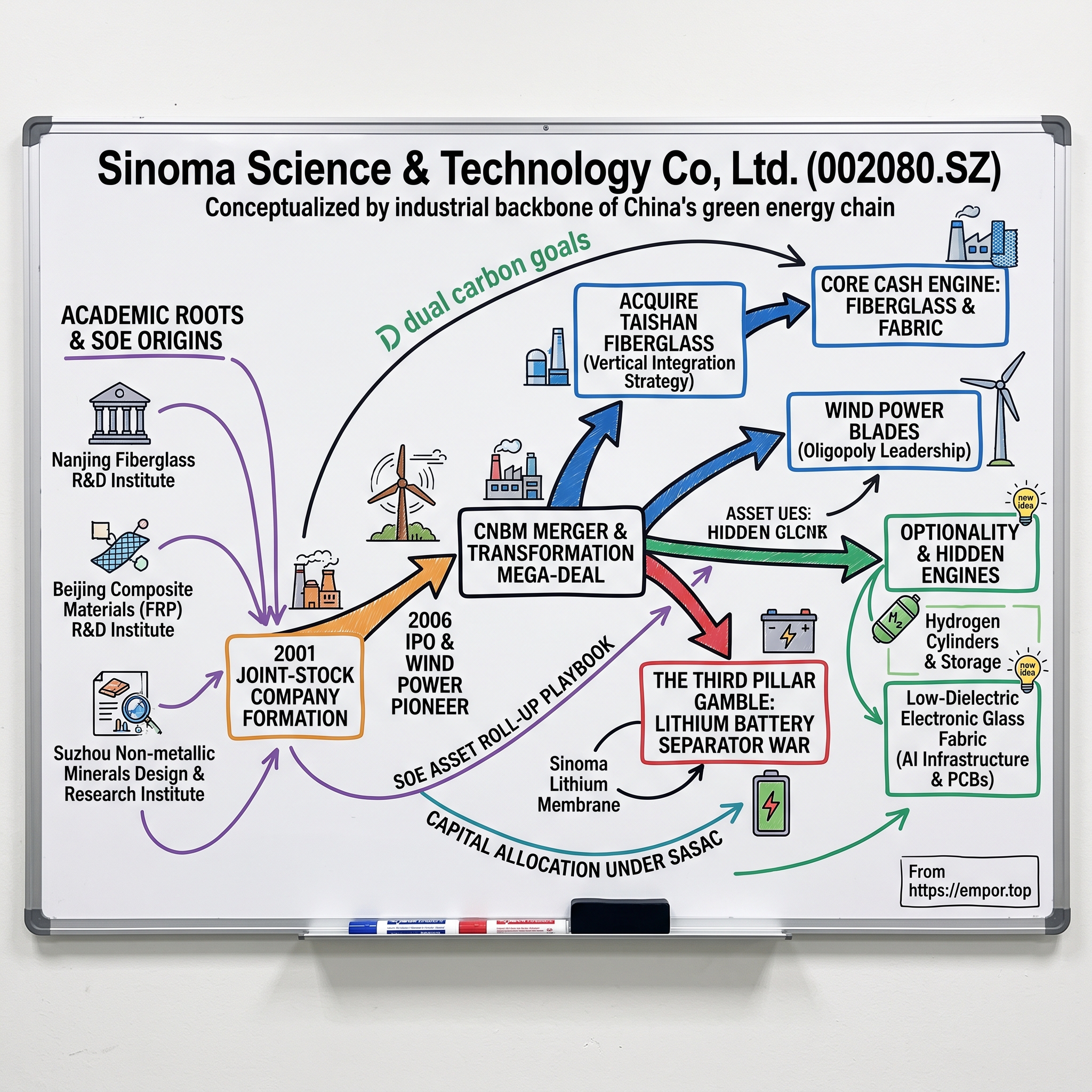
Sinoma Science & Technology: The Industrial Backbone of China's Green Energy Chain
There is a particular kind of Chinese company that almost no Western investor can name, yet whose products sit inside the machines that the entire clean-energy transition depends on. When a 100-meter offshore wind blade sweeps through the air off the coast of Guangdong, there is a decent chance it was molded in a factory owned by 中材科技股份有限公司 Sinoma Science & Technology Co.,Ltd. (002080.SZ). When a circuit board inside an AI server needs glass fabric thin enough to carry a high-frequency signal without distortion, that fabric increasingly comes from the same corporate family. When a lithium battery in a 比亚迪 BYD sedan separates its anode from its cathode with a plastic film thinner than a human hair, one of three companies that could have made that film is, again, this one.
Sinoma Science & Technology is not a household name even in China. It does not sell to consumers. It builds the unglamorous physical substrate of the energy transition—fiberglass, wind blades, battery separators, hydrogen tanks—and it does so as a subsidiary of a state-owned colossus. This is the story of how a cluster of Soviet-era research institutes became a large-cap industrial materials champion operating at the exact and uncomfortable intersection of national strategy and vicious commodity cycles.
I. Introduction & Episode Roadmap
Start with the scale, because the scale is the surprising part. As of mid-2026, Sinoma Science & Technology carried a market capitalization on the order of ¥80–85 billion—roughly US$11–12 billion—though "carried" is a generous verb for a stock that whipsawed between about ¥26 and ¥102 over the preceding twelve months before settling near ¥50.10 That volatility is not an accident of trading; it is the honest signal of a business whose fortunes ride three of the most brutally cyclical supply chains in the industrial economy.
Consider what the company actually is. It is the world's number-one manufacturer of wind turbine blades by volume—24 gigawatts of blades shipped in 2024 alone.1 It is one of the world's top two or three producers of fiberglass, the reinforcing material that goes into everything from car bumpers to boat hulls to the very wind blades the company also makes. And it is one of China's top three makers of wet-process lithium battery separators, the humble but critical membrane at the heart of every EV battery. Three world-class positions, three green-energy supply chains, one roof.
Here is the hook that makes the story worth telling: for the first time in perhaps a decade, all three of those businesses fell into a downturn at once. In 2024, Sinoma's revenue slipped 7.4% to ¥23.98 billion, but that headline understates the damage. Net profit attributable to shareholders collapsed by 59.9% to just ¥892 million, and profit stripped of one-off items fell more than 80%.1 A company that dominates three critical industries earned a net margin under 4%. That paradox—market leadership paired with wafer-thin, collapsing profitability—is the central tension of this episode.
Why should a sophisticated investor care about a Chinese materials company that most global portfolios will never touch directly? Because Sinoma is a near-perfect laboratory for a question that matters far beyond one stock: what happens to the economics of the energy transition when everyone builds the picks and shovels at once? The world needs vastly more wind blades, more lightweight composites, and more battery separators to decarbonize. That demand is real and durable. But demand for a product and profit for its maker are different things, and China's clean-tech supply chains have become the world's most vivid demonstration of how quickly a strategic growth market can turn into a margin-destroying commodity glut. Sinoma sits at the center of that demonstration, and its financials are the transition's economics stripped of the marketing. If you want to understand whether the companies building the green economy will actually make money, this is one of the clearest windows available.
The early signs of a turn are worth flagging without over-reading them: first-quarter 2025 revenue rose more than 24% year over year, a reminder that these cycles bottom and recover, and that a snapshot of the trough is not the same as the through-cycle picture. Whether that marked a genuine inflection or a temporary bounce is exactly the kind of question the segment-level evidence, not the headline, will answer.
The company sits inside 中国建材集团 China National Building Material Group (CNBM), the largest building-materials conglomerate on earth, itself owned by the 国务院国有资产监督管理委员会 State-owned Assets Supervision and Administration Commission (SASAC).3 That parentage is the second theme. Being a flagship central state-owned enterprise (SOE) confers real advantages—cheap capital, political air cover, the ability to keep spending when private rivals must retrench. It also imposes real constraints—capital allocation shaped partly by national industrial targets rather than pure shareholder return, and a mandate to serve 双碳 dual carbon goals even when the economics say wait.
Three themes will recur. First, the SOE asset roll-up playbook: how CNBM used mergers, asset injections, and share swaps to build category-dominating champions out of fragmented state assets. Second, the unit economics of scale-driven materials: in fiberglass and separators, margin is set at the furnace and the coating line, and scale is very nearly the only moat that survives a price war. Third, capital allocation under SASAC: how modern SOE managers navigate high-capex cycles, dividend mandates, 市值管理 market-value management directives, and strategic national objectives all at once. Whether that hybrid produces durable shareholder value, or merely durable market share, is the question the rest of this story tries to answer.
It is worth naming the analytical posture up front, because a company this entangled with the state invites two lazy narratives, and both should be resisted. The first is the promotional one—the national champion riding an unstoppable green tailwind, destined to win because policy wills it. The second is the reflexively cynical one—the state zombie, incinerating capital on political orders, uninvestable by definition. Neither survives contact with the numbers. Sinoma is a real business with real technology, real cost positions, and real customers who audit it ruthlessly; it is also a business whose capital gets deployed with one eye on Beijing's industrial roadmap. The interesting question is not which caricature is true but where, precisely, the state's fingerprints help the shareholder and where they hurt. That distinction—advantage versus obligation, moat versus mandate—is the thread to hold onto through everything that follows.
 Subscribe on LinkedIn
II. Academic Roots & SOE Origins: From Research Institutes to Commercial Spin-Off
Before Sinoma made blades or batteries, it made knowledge. To understand the company, you have to picture the world it came from: the planned-economy research institute, an institution with no real Western equivalent. In the Soviet and Chinese industrial model, applied science lived not inside companies but inside state 研究设计院 research and design institutes—self-contained fiefdoms of engineers, technicians, and patents, funded by ministries and tasked with solving national problems in a specific material or technology.
Sinoma Science & Technology was assembled from three of them. Registered on December 28, 2001, with 中国中材集团 China Sinoma Group as its principal promoter, the new joint-stock company inherited more than fifty years of accumulated core technology and talent from three premier institutes: the 南京玻璃纤维研究设计院 Nanjing Fiberglass Research & Design Institute, the 北京玻璃钢研究设计院 Beijing Composite Materials (FRP) Research & Design Institute, and the 苏州非金属矿工业设计研究院 Suzhou Non-metallic Minerals Industry Design & Research Institute.315 These were not sleepy academic backwaters. Nanjing had been China's national brain trust for glass-fiber science since the 1950s; Beijing's institute was where the country's fiber-reinforced-plastic and composite know-how—much of it originally developed for defense and aerospace—was concentrated; Suzhou owned the non-metallic mineral and filtration expertise.
The genius, and the difficulty, of the origin story is the translation problem. A research institute is judged by papers, patents, and prototypes. A listed company is judged by cash flow. Sinoma's founding bet was that the proprietary intellectual property built up over decades of serving the defense and heavy-industry sectors could be re-pointed at commercial markets—that a formula for a high-performance composite panel developed for a military application could become a filtration membrane, a pressure vessel, or a structural building material sold at a profit. That transition, from cost-plus state R&D to margin-seeking manufacturer, is the connective tissue running through everything the company later became.
What did that heritage actually buy? Three durable things. It bought proprietary process knowledge—glass formulations, fiber-drawing techniques, resin chemistry—that a private start-up could not simply buy off a shelf. It bought national-lab credibility, which in China's system translates into access, standard-setting influence, and a seat at the table when the state plans an industry. And it bought a talent pipeline of professor-level engineers, many of them holders of the State Council special allowance reserved for distinguished technical experts. Those advantages are real, but investors should size them honestly: inherited IP is a head start, not a permanent moat, and in commodity materials the head start erodes the moment a competitor's furnace reaches the same scale.
There is a subtler inheritance too, one that shows up in the culture rather than the balance sheet. Research-institute companies tend to be engineering-led rather than sales-led—proud of what they can make, sometimes slow to price it aggressively, and comfortable with long development horizons that a purely commercial firm might never fund. In some businesses that patience is a superpower: you cannot rush a decade of glass-fiber metallurgy, and the low-dielectric electronic fabric now emerging owes its existence to exactly that kind of unhurried, deep technical investment. In others it is a handicap: an institute mindset can build a technically superb product for a market that then commoditizes faster than the culture can adapt its cost structure. Both tendencies run through Sinoma's later history, and keeping them in view helps explain why the company can be simultaneously a world technology leader and a serial victim of price wars.
The commercial coming-out arrived on November 20, 2006, when Sinoma Science & Technology listed its A-shares on the 深圳证券交易所 Shenzhen Stock Exchange (SZSE).3 The IPO was less a Silicon Valley-style liquidity event than a governance milestone: it converted a state research spin-off into a public company answerable, at least in part, to minority shareholders and market discipline. The listing also gave the company something it had never had—an equity currency. And in the years that followed, that currency would be spent to build the first of its three great franchises, in an industry that in 2006 barely existed in China: wind power.
III. The First Growth Engine: Pioneering Megawatt Wind Blades & The 2006 IPO
In 2006, China installed a rounding-error's worth of wind capacity by today's standards, and almost every large turbine erected on Chinese soil wore imported blades—German, Danish, or licensed designs built by foreign hands. Blades are the part of a turbine that looks simplest and is fiendishly hard: a single blade is a 30-, 50-, later 100-meter hollow composite structure that must be light enough to spin in a light breeze, strong enough to survive a typhoon, and cheap enough to make the electricity competitive. Getting the aerodynamics, the fiber lay-up, and the mold engineering right is a decade-long learning curve.
Sinoma decided to climb it. The company established 中材科技风电叶片股份有限公司 Sinoma Wind Power Blade Co., Ltd.—Sinoma Blade—precisely as China's central government began rolling out its first serious wave of renewable-energy support.17 The timing was deliberate. The 2005 Renewable Energy Law and the subsidy and local-content regime that followed created, almost overnight, a domestic market for turbines and therefore for blades. Sinoma's advantage was that it did not have to invent composite science from scratch; it already owned it, courtesy of the Beijing FRP institute. What it had to learn was manufacturing at scale.
The industrial inflection came in the jump from sub-megawatt to megawatt-class blades. Early Chinese turbines were small—hundreds of kilowatts. As domestic OEMs like 金风科技 Goldwind, 远景能源 Envision, and 明阳智能 Mingyang Smart Energy scaled up their turbine platforms, they needed ever-larger blades, and they needed a domestic supplier who could co-engineer them and deliver on time. Sinoma rode that wave, expanding from a single plant into a national network of blade factories positioned near wind-resource regions—Gansu, Inner Mongolia, the coastal provinces—to cut the brutal logistics cost of shipping objects the length of a football pitch.
Here the first strategic pattern appears, the one that recurs in every chapter of this company's life: out-invest the fragments. China's early wind-blade industry was a scrum of small regional producers, many of them spun up during the subsidy rush by local entrepreneurs and provincial governments chasing the same tailwind. Sinoma, with its listed-company balance sheet and state backing, could build capacity ahead of demand and absorb the losses of the lean years while smaller players simply ran out of money. Scale begat cost advantage, cost advantage begat market share, market share begat more scale. It is the flywheel of every commodity-manufacturing winner, and Sinoma spun it hard.
The benchmark against private peers is instructive. A private blade maker in the 2010s faced a cruel arithmetic: to compete on cost it needed scale, but to build scale it needed capital, and capital in a cyclical, low-margin business was exactly what the lean years denied it. Every downturn thinned the field—undercapitalized producers who had expanded on debt could not survive a stretch of loss-making prices, and their capacity was either shuttered or absorbed. Sinoma's advantage was never that it was the cleverest engineer of blades; several rivals were technically excellent. Its advantage was that it could keep investing through the cycle when others had to stop. That is a real and durable edge in a capital-intensive commodity—but it is worth naming precisely what kind of edge it is. It is an edge of balance-sheet endurance, not of product differentiation, and it delivers market share and survival far more reliably than it delivers high returns on the capital deployed. That distinction is the through-line of the entire Sinoma investment case.
It is worth pausing on how the Chinese wind market actually clears, because it explains the permanent margin pressure the blade business lives under. Chinese wind projects are largely won through competitive auctions in which developers—often state power giants—award turbine contracts to the lowest credible bidder. That forces turbine OEMs into a race to cut prices, and because the turbine makers do not want to absorb the cuts themselves, they push their component suppliers to match. A blade maker in this chain is two steps removed from the electricity price yet feels every downward twitch of it. There is no consumer brand to hide behind, no differentiated end product—just a spec, a delivery date, and a price. That structural reality is why "world's largest blade maker" and "reliably profitable blade maker" are not the same sentence.
The same dynamics taught a lesson written in red ink. Around 2013–2015, China's wind sector hit its first serious subsidy cliff and curtailment crisis—turbines built faster than the grid could absorb their power, followed by policy tightening. Installations stalled, OEMs squeezed their suppliers, and blade prices fell. Sinoma learned the hard way that in a commodity, volume growth without cost leadership is a trap: you can be the biggest and still bleed if your per-unit cost is not the lowest. That scar tissue—the knowledge that scale must be paired with relentless 降本增效 cost reduction and efficiency or it becomes a liability—shaped the far bigger strategic move that came next. If blades taught Sinoma to build scale, the next decade would be about controlling the entire chain around them.
IV. The Transformation Mega-Deal: CNBM Merger & Acquiring Taishan Fiberglass
The largest event in Sinoma Science & Technology's history was not something the company did; it was something done to its parent. In 2016, in one of the signature consolidations of Xi-era SOE reform, 中国中材集团 China Sinoma Group was merged into 中国建材集团 China National Building Material Group (CNBM)—the transaction Chinese media dubbed the 两材重组 "two materials" restructuring.3 Overnight, the combined entity became the largest building-materials conglomerate on the planet, a sprawling SASAC-owned empire spanning cement, glass, engineering, and advanced materials. Sinoma Science & Technology, the listed vehicle, found itself a subsidiary within this much larger structure.
Mergers of state giants are usually described in the language of synergy and rationalization. What they really do is redraw the map of who competes with whom—and, crucially, who can now be combined. Under one owner, two former rivals become two divisions that ought to be merged, and a listed subsidiary becomes the natural vehicle to absorb assets the parent wants professionalized and marked to market. That logic drove the deal that transformed Sinoma from a composites converter into a vertically integrated materials giant: the acquisition of 泰山玻璃纤维有限公司 Taishan Fiberglass Co., Ltd.
Taishan Fiberglass, based in Shandong, was one of China's premier fiberglass producers—a maker of the raw glass fiber that reinforces composites, including the very wind blades Sinoma built.16 Acquiring it was a piece of strategic chess: it turned Sinoma into a company that controlled both an upstream raw material and a downstream finished product built from it. In 2015 Sinoma agreed to acquire Taishan Fiberglass from its parent group, and the transaction completed in March 2016, with the consideration settled largely through the issuance of roughly 241 million new Sinoma shares—a stock-and-asset swap valued at several billion renminbi.4 (Chinese analysts have variously pegged the enterprise value of the injected fiberglass assets in the ¥4–7 billion range depending on what is bundled in; the company settled the headline share consideration at about ¥4.2 billion.4)
Was it a good deal? The honest answer is that it depends entirely on the fiberglass cycle you measure it against, and that is precisely the point. Fiberglass is a capital-intensive, furnace-driven commodity whose margins swing violently. Buy at the top of the cycle and even a strategically perfect asset looks overpriced for years; buy near the bottom and it looks like theft. On the valuation multiples cited around such deals—enterprise value in the region of seven to eight times EBITDA is the range Chinese analysts have used for fiberglass assets of this quality—the price was neither a steal nor obviously egregious for a top-tier producer. The relevant benchmark is the peer set—中国巨石 China Jushi Co., Ltd., the world's largest and lowest-cost fiberglass producer (and, tellingly, another CNBM company), and 重庆国际复合材料 CPIC. Against those comps, Taishan was a solid number-two-in-China asset, not the cost leader. The strategic logic—vertical integration, control of a critical input, becoming a materials platform rather than a converter—was sound. Whether the price created value for minority shareholders is a question the cycle keeps re-answering, usually unkindly.
The vertical-integration logic itself deserves scrutiny rather than applause, because "we control our own raw material" is one of the most over-sold ideas in industrial strategy. Owning the fiberglass that goes into your wind blades sounds like a durable advantage—until you notice that the fiberglass is also sold on a liquid, competitive market at a transparent price, which means the blade unit could have simply bought it. Vertical integration adds value only when it lowers total cost, secures scarce supply, or enables coordination a market transaction cannot. In fiberglass-into-blades, the supply is not scarce and the coordination benefit is modest, so the real prize was less about the blade unit's inputs and more about owning a large, cash-generative fiberglass franchise in its own right, plus the scale and consolidation benefits of folding it into the group. Investors should therefore judge the Taishan deal not on the elegant vertical-integration narrative but on the cold question of whether Sinoma bought a good fiberglass business at a fair price through the cycle. On that test the verdict is genuinely mixed, and it swings with every turn of the glass market.
The consolidation logic did not stop there. In 2023, Sinoma executed the sequel: the absorption of a sister CNBM entity, 中复连众 Zhongfu Lianzhong, into Sinoma Blade. The mechanism was pure SOE engineering. Sinoma Blade issued new shares to acquire the stakes in Zhongfu Lianzhong held by 中国复材 China Composites (China Composite Group) (62.96%) and 中国巨石 China Jushi (32.04%), and paid roughly ¥144 million in cash for the final 5%.56 When the dust settled, Sinoma Science & Technology held 58.48% of Sinoma Blade, with China Composites at 21.51% and China Jushi at 20.01%, and Zhongfu Lianzhong became a wholly owned subsidiary of the blade unit.5
The purpose was to end an absurdity: two CNBM-family companies competing for the same wind-blade orders. Eliminating that internal rivalry lifted Sinoma Blade's domestic market share well above 30% and, by the company's account, improved gross margin and return on equity within the first half-year of integration versus the same assets pre-deal.136 For investors, the Zhongfu Lianzhong deal is a clean illustration of both the promise and the catch of the SOE model. The promise: a parent can hand its listed child dominant scale through a stroke of restructuring that a private company would need a decade and a hostile takeover to achieve. The catch: these are related-party transactions, priced by valuation reports rather than an arm's-length auction, and minority holders must simply trust that the swap ratios were fair. That governance question sits underneath the whole enterprise, and we will return to it.
Step back and the pattern across both deals reveals the CNBM operating philosophy, which is genuinely distinctive. The parent treats its listed subsidiaries as consolidation platforms—clean, market-facing vehicles into which it injects fragmented or overlapping assets from across the group, professionalizing them and marking them to public-market discipline. Cement was consolidated this way at massive scale in the 2010s; fiberglass and wind blades were consolidated the same way inside Sinoma. The logic is that a fragmented industry destroys value through price wars, so the state's job is to engineer scale and rationality. When it works—when the merged entity really does lower cost and behave rationally on pricing—it can lift the returns of an entire industry. The danger for a minority shareholder is that the same machinery can also be used to move assets around the family for reasons that serve the parent's balance sheet or a policy objective more than the listed vehicle's per-share value. Every Sinoma deal must be read through that dual lens: is this consolidation creating value, or merely relocating it within the CNBM empire?
V. Deep Dive: Core Segment Economics & Industry Structure
To see why a three-time market leader can earn a sub-4% net margin, you have to go down to the factory floor of each business and look at where the money is actually made and lost. These are not software businesses with 80% gross margins and winner-take-all dynamics. They are physics businesses, where the cost of a ton of melted glass or a square meter of coated film is set by furnace efficiency, energy prices, and utilization—and where the customer, more often than not, holds the whip.
1. Wind Power Blades (中材叶片 Sinoma Blade) — roughly a third of revenue
Wind blades are a Chinese oligopoly: three or four players of consequence, with Sinoma the largest. In 2024 the unit shipped 24 GW of blades, up 10.9% year over year, for revenue of ¥8.57 billion—about 36% of the company total—while holding its position as the world's number-one blade maker by volume.1 Read that pairing carefully: shipments up double digits, revenue essentially flat to down. That gap is the entire story of the segment. Volume grew; price fell almost as fast.
The economics are unforgiving. Every blade model requires a custom, expensive mold, so the business is capital-intensive and sensitive to product churn—each new turbine platform from an OEM can strand old tooling. Working capital balloons because blade production runs ahead of the seasonal, back-half-weighted rhythm of Chinese wind installations. And the customers are giants: 金风科技 Goldwind and 明阳智能 Mingyang, turbine OEMs who are themselves in a savage price war to win utility auctions and who pass every yuan of that pressure straight up to their blade suppliers. When a turbine maker cuts its bid to win a project, the blade supplier eats the difference.
Sinoma's defense is to move where the price pressure is weakest: the frontier. Ultra-large offshore blades exceeding 100 meters, and carbon-fiber pultrusion technology (a process that pulls carbon-fiber reinforcement through the blade's main spar to make it lighter and stiffer), are harder to make and command better margins than commodity onshore blades. Being the technology leader buys some breathing room. But investors should not mistake breathing room for a moat; offshore volumes are lumpy and policy-driven, and the OEMs are relentless. Blades are a share-leadership business, not a pricing-power business.
There is one more feature of the blade economics worth internalizing, because it is where the working-capital risk hides. Blades are enormous, low-density objects—expensive to store and ruinously expensive to ship far. A single onshore blade can exceed the length of two tractor-trailers, and an offshore blade is longer still. That physical reality forces blade makers to build regionally, near the wind farms, and to produce against forecast rather than firm demand, because a plant cannot economically hold months of finished inventory of objects that size. When installations come in below forecast—as they did in the wind troughs—the blade maker is left with capital tied up in half-built product and idle, model-specific tooling. This is why blade margins can swing so violently on relatively modest changes in installation volume: the operating and working-capital leverage is enormous. For an investor, it means the blade segment's reported profit in any single year is a noisy signal; the trend across a full installation cycle is what matters.
2. Fiberglass & Fabric (泰山玻纤 Taishan Fiberglass) — the primary cash engine
Fiberglass is the segment that, in a normal year, pays the bills. Taishan sold 1.36 million tons of fiberglass and products in 2024, roughly flat in volume, for revenue of ¥7.74 billion, down 7.6%, and segment net profit of ¥370 million, down a punishing 63.3%.1 Once again the volume held and the profit cratered—the fingerprint of a commodity price trough.
The industry structure is a genuine global oligopoly, often described as a triopoly-plus: 中国巨石 China Jushi, Taishan, 重庆国际复合材料 CPIC, and America's Owens Corning together anchor the world market. The unit economics come down to a handful of levers. Furnace yield—a modern fiberglass furnace is a multi-hundred-million-dollar installation that runs continuously for years; the efficiency of that melt is destiny. Platinum-rhodium bushings—the glass is drawn through alloy plates made of precious metal, and how efficiently you use that alloy matters. And energy—natural gas to melt the glass and electricity to run the plant are among the largest cost lines, which is why input-cost inflation hits this business directly.
The tyranny of the model is utilization. A fiberglass furnace cannot be idled cheaply; once lit, it must run near capacity or the fixed cost per ton explodes. Practitioners speak of needing utilization above roughly 95% to make good money. That is why the industry is so violently cyclical: when demand from construction, auto lightweighting, and electronics softens, everyone keeps producing rather than idle their furnaces, inventory piles up, prices collapse, and the whole industry bleeds until the weakest capacity finally shuts. The single purest gauge of Taishan's health is therefore gross profit per ton—the metric that captures price, cost, and utilization in one number—and in 2024 that number was clearly deep in a trough.
It helps to picture the demand side, because fiberglass is a bet on the industrial economy in miniature. The material ends up in three big pools: construction and infrastructure (pipes, panels, insulation, rebar), transportation (auto and truck lightweighting, where every kilogram of steel replaced by composite improves fuel economy or EV range), and electronics (the circuit-board substrates discussed later). Each pool has its own cycle, and in a good year they diversify one another. In 2024 they did not—Chinese construction was weak, auto demand was price-competitive, and even electronics, though structurally growing, could not lift the whole. When all three soften while the industry keeps its furnaces lit, the price of a ton of standard fiberglass roving can fall below the cash cost of the least efficient producer. That is what a fiberglass trough looks like from the inside, and it is exactly the environment in which a low-cost, deep-pocketed player is supposed to gain share while others shut lines.
The strategic response is to climb out of the commodity, and Taishan's route up is electronics-grade glass fabric, which we return to shortly. For now, the takeaway for investors is that fiberglass is Sinoma's ballast: in a good cycle it throws off the cash that funds everything else; in a bad one it drags the whole ship down. The company does not control the cycle. It can only try to be the low-cost survivor when the cycle turns—and on cost, Taishan is very good but not clearly the world's best. That title belongs to its sister company, China Jushi, which is an awkward fact inside one corporate family: two of the world's largest fiberglass producers, both ultimately controlled by CNBM, both selling into the same troughs. Whether common ownership eventually rationalizes that overlap, or whether the two continue to compete on price to the detriment of both, is one of the quieter structural questions in the story.
VI. The Third Pillar Gamble: The Lithium Battery Separator War
If fiberglass and blades were franchises Sinoma inherited and consolidated, the lithium battery separator was a franchise it chose to gamble on—and the timing of that gamble is now being stress-tested in real time. Around 2019–2021, as China's EV boom went vertical, Sinoma consolidated and scaled 中材锂膜有限公司 Sinoma Lithium Membrane Co., Ltd. to chase what looked like an unstoppable market.
A separator is worth understanding because it is deceptively simple and genuinely critical. Inside a lithium-ion cell, the positive and negative electrodes must never touch, or the battery short-circuits and can catch fire. The separator is the ultra-thin porous membrane—for Sinoma's wet-process products, on the order of 3 to 12 microns, a fraction the thickness of household plastic wrap—that keeps them apart while letting lithium ions shuttle through its microscopic pores.7 "Wet process" refers to the manufacturing route (dissolving the polymer, casting a film, then stretching and extracting solvent) that yields the thin, strong, uniform membranes favored for high-energy EV cells. It is a precision-coating and materials-science business dressed up as a plastics business, and qualifying a separator into a battery maker's cell is a long, exacting audit.
Sinoma walked into a knife fight. The market was—and is—dominated by a private monster, 恩捷股份 Yunnan SEMCORP, the runaway global leader, with 星源材质 Shenzhen Starry (Senior Technology Material) and a clutch of others fighting for the rest. To compete, Sinoma did what SOEs do: it out-spent. The company poured tens of billions of renminbi into wet-process production lines across a national footprint—Tengzhou, Nanjing, Pingxiang, Yibin, Hohhot—building toward multi-billion-square-meter annual capacity. By 2024 its installed capacity exceeded 4 billion square meters with over 2 billion more under construction.7
Crucially, it won the proof points that matter. Separators live or die by qualification with tier-one cell makers, and Sinoma secured supply positions with the giants—宁德时代 CATL, 比亚迪 BYD, and 亿纬锂能 EVE Energy among them. Passing a CATL audit is the industry's real barrier to entry; it takes years and cannot be faked. In volume terms the strategy worked: 2024 separator shipments reached 1.9 billion square meters, up 9.4%, and higher-margin coated-separator volumes grew a striking 30.4%.7
And then came the reckoning. The same capacity binge Sinoma joined, the whole industry joined—and demand growth, while strong, could not absorb it. Separator average selling prices collapsed by well over 40% across 2023–2025 as overcapacity turned a growth market into a demolition derby. The result on Sinoma's income statement was stark: separator revenue fell 39.76% in 2024 to ¥1.468 billion, just 5.58% of company sales, even as volume rose.7 Selling 9% more product for 40% less money is the definition of a price war, and it is why a business that management once framed as a growth engine became, for now, a drag.
The mechanics of a separator price war are worth spelling out, because they are unusually brutal. A wet-process separator line is a precision machine costing hundreds of millions of renminbi, and like a fiberglass furnace it wants to run flat-out—idle capacity is pure loss. So when the industry collectively overbuilds, no one blinks first; everyone runs their lines, floods the market, and prices fall until they approach the cash cost of the marginal producer. Unlike fiberglass, though, separators had been a high-margin darling only a couple of years earlier, which means the fall from grace was vertiginous. Producers who had modeled fat, growing margins to justify their capex suddenly faced ASPs down more than 40%, and the coated-separator premium—value added by applying ceramic or polymer coatings that improve safety and performance—became the only place left to make money. Sinoma's 30.4% jump in coated volume is its attempt to run toward that shrinking patch of higher ground.7
Which raises the sharpest question in the whole Sinoma story: can it survive this war better than private peers precisely because it is an SOE? The bull argument is that Sinoma's ultra-low cost of capital lets it fund losses and keep its coating lines running while over-levered private challengers go bankrupt, so that Sinoma emerges from the shakeout with more share and rational pricing. There is logic to that, and the industry has already begun to consolidate as weaker players are absorbed or fold. But it is a thesis about survival, not return—and it quietly concedes that the separator business may destroy capital for years before it vindicates the investment. A skeptical investor is entitled to ask whether the tens of billions sunk into separators would have earned more sitting in the fiberglass business the company already dominates, or simply returned to shareholders. That is the diworsification question, and it hangs over the next chapter too. It also inverts the usual SOE critique in an interesting way: the danger here is not that state capital was too timid, but that it was too patient—willing to fund a loss-making expansion through a glut that a return-focused private board might have paused.
VII. Optionality & Hidden Engines: Hydrogen Cylinders & AI Electronic Glass Fabric
Not every bet has to be big to matter. Tucked inside Sinoma's portfolio are two smaller businesses that investors should watch not for what they contribute today—modestly—but for the optionality they represent, one pointed at hydrogen and one pointed, improbably, at the AI boom.
High-pressure composite cylinders and hydrogen storage are the first. Sized to their economic weight, they are a small slice of revenue—the company sold about 12,000 hydrogen storage cylinders in 2024, holding the number-one position in the domestic market.1 The product is a natural extension of Sinoma's composite heritage: a Type III (metal-lined, composite-wrapped) or Type IV (plastic-lined, composite-wrapped) pressure vessel that stores hydrogen at 70 megapascals—roughly 700 times atmospheric pressure—safely enough to sit under a commercial truck. This is exactly the kind of high-strength, weight-critical composite structure the Beijing FRP institute's descendants know how to make. The business is small because China's hydrogen mobility ecosystem is still nascent; its value is as a cheap call option on the possibility that 氢能产业 the hydrogen energy industry becomes a real market later this decade. If it does, Sinoma already leads. If it doesn't, little was lost.
The more intriguing option is low-dielectric electronic glass fabric, and it connects Taishan Fiberglass directly to the most important technology story of the moment: AI infrastructure. Ordinary fiberglass reinforces buildings and boats. Electronic-grade glass fabric goes into the printed circuit boards (PCBs) and packaging substrates inside servers—and as those servers run faster, the material properties of the glass start to matter enormously. High-speed signals traveling through a PCB lose energy and distort if the surrounding material has the wrong electrical characteristics. "Low-DK/low-DF" glass fabric—low dielectric constant, low dissipation factor—is engineered to let those signals pass cleanly, which is exactly what AI servers and high-frequency networking gear demand.
Sinoma has been pushing Taishan up this value curve, and the proof points have begun to land: the company reported that its first-generation low-dielectric products, aimed at high-end PCBs, won a technology-breakthrough recognition from a well-known domestic customer and entered mass production.1118 The strategic significance outweighs the current revenue. This is the escape hatch from the fiberglass commodity trap—a way to convert the same core competence (glass formulation and weaving) into a high-margin, AI-levered specialty product where the buyer cares about performance, not just price. It is early, the volumes are small, and the incumbents in high-end electronic cloth (largely Japanese and Taiwanese) are formidable. But it is the clearest example in the whole portfolio of Sinoma trying to earn pricing power rather than merely defend market share.
There is a deeper reason low-dielectric fabric matters beyond its margin: it is a rare instance where the AI-infrastructure boom reaches all the way down to a glass-fiber maker, and where China's drive for supply-chain self-sufficiency in advanced materials aligns with a genuine commercial opportunity. High-end electronic-grade glass cloth for the fastest server boards has historically been a niche controlled by a handful of Japanese and Taiwanese specialists; a credible domestic Chinese supplier is exactly what Chinese board and substrate makers, under pressure to localize, want to see. If Taishan can qualify its low-DK/low-DF fabric into that supply chain at volume, it converts a national self-sufficiency priority into pricing power—the good version of the SOE-meets-policy story, where the mandate and the margin point the same way. The caution is that qualification in this niche is slow and reference-customer-driven, and a single "won a breakthrough award, now in mass production" data point is a beginning, not a franchise. The honest status is promising optionality, not proven earnings. Which brings the harder questions about who runs this place and how they allocate capital.
VIII. Management, Governance, & Capital Allocation: The Central SOE Playbook
Who steers a company like this, and in whose interest? The answer starts with a man who spent his career making the things the company sells. 黄再满 Huang Zaiman, born in 1969, is a professor-level senior engineer and holder of the State Council special allowance—credentials that mark him as a technical insider, not a career bureaucrat parachuted in from a ministry.9 He rose through the operating businesses: leading roles at the Beijing FRP research institute, general manager posts at Sinoma's Suzhou and Jiuquan operations, and then the top jobs at Sinoma Blade and Sinoma Lithium Membrane before being elected chairman of Sinoma Science & Technology in October 2023.9
That biography matters. A chairman who ran the wind-blade unit through its price wars and chaired the separator business through its capacity build understands, from the inside, the exact cost and customer dynamics that determine whether this company makes money. His public posture has leaned operational and unshowy—the language of 降本增效 cost reduction and efficiency rather than promotional growth narratives. In an SOE where the temptation is to trumpet national-strategic importance, an engineer's focus on furnace utilization and yield is the right instinct. It is also, of course, the posture that gets tested when three businesses turn down at once.
The ownership structure is the defining fact of governance here. CNBM, through its chain of holdings, controls a majority of Sinoma Science & Technology, and CNBM in turn answers to SASAC.315 In practice this means the ultimate shareholder is the Chinese state, and the ¥84 billion of market value floats on top of a control block that is not going anywhere. Minority public shareholders are genuine owners with genuine cash-flow rights, but they are passengers, not drivers. The related-party asset injections that built the company—Taishan, Zhongfu Lianzhong—flow from that same parent, which is both a source of strategic advantage and a permanent conflict-of-interest to monitor.
This is also where the broader SASAC reform agenda becomes relevant, because it has been actively reshaping how central SOEs think about their share prices. For most of the 2010s, a company like Sinoma could plausibly be run for output, employment, and strategic mission with only glancing attention to its stock. That has shifted. Under the 市值管理 market-value management push, SASAC has increasingly pressed central enterprises to treat shareholder value as an explicit objective—through dividends, buybacks, clearer disclosure, and ROE-linked incentives—rather than an afterthought. For minority holders this is, on paper, good news: the controlling shareholder is being told by its own boss to care about the share price. The skeptic's rejoinder is that "market-value management" can shade into share-price management—cosmetic gestures timed to sentiment—rather than genuine per-share value creation, and that the state's definition of a successful SOE still weights strategic mission heavily. The truth is that the incentives are better aligned than they were a decade ago, but the alignment is partial and policy-dependent, and it could shift again with the political weather.
On capital allocation, the record is a study in the SOE balancing act. The company must weigh the high-cash-flow, low-growth fiberglass business against the high-capex, currently loss-making separator expansion; it must fund overseas plants and low-dielectric R&D; and it must simultaneously satisfy SASAC's newer emphasis on 市值管理 market-value management—the directive that state firms actively care about their share prices and shareholder returns. Dividend discipline is part of that answer: for 2024 the board proposed a cash dividend of ¥2.25 per 10 shares on a base of about 1.678 billion shares—roughly ¥378 million, a meaningful payout in a year when net profit was under ¥900 million.2 Maintaining a dividend while profits fell 60% is a signal of intent to reward holders through the trough, though a skeptic will note that a state parent also likes the cash a dividend sends upstream.
A word on the second-layer diligence a careful analyst would run here, because in a capital-intensive SOE the risks hide in the notes rather than the headline. Three items deserve standing attention. First, inventory and receivables: in a collapsing-price environment for both separators and fiberglass, the risk of inventory write-downs and stretched receivables from squeezed customers is real, and a sudden jump in either line, or in impairment charges, would be an early warning that the reported profit is flattered. Second, leverage and the funding of capex: the whole SOE-endurance thesis rests on cheap debt, so the trajectory of net debt, interest coverage, and the mix of equity versus debt funding the overseas and separator build-out is worth watching—cheap capital is an advantage only until the balance sheet is stretched enough that even cheap capital becomes scarce. Third, related-party flows: beyond the headline asset injections, the ongoing purchases, sales, and guarantees between Sinoma and other CNBM entities are the kind of thing that can quietly move value in or out of the listed vehicle, and they belong on any monitoring checklist. None of these is a red flag today; they are simply the places where, if the story goes wrong, it will show up first.
The credibility test for management is behavior over time, and the fairest reading is mixed-to-favorable on candor, unproven on the big capital bet. Sinoma's disclosures and investor-relations records have been relatively straightforward about the cyclical pain in fiberglass and separators rather than spinning it away.14 Equity-incentive plans tied to net-profit and ROE targets exist to align managers with performance. But the central allocation decision—pouring tens of billions into separators just ahead of an industry-wide price collapse—will not be fully judged for years. Was it disciplined counter-cyclical positioning or a state-subsidized overbuild that deepened the very glut that now punishes returns? The honest verdict today is: not yet knowable, and that uncertainty belongs at the center of any investment case. To sharpen it, it helps to run the business through the standard strategy lenses.
IX. Strategic Frameworks: Helmer's 7 Powers & Porter's 5 Forces
Strip away the national-champion narrative and ask the cold question a strategist asks: what, if anything, protects Sinoma's profits from competition? Run it through Hamilton Helmer's 7 Powers and the picture is of a company with one enormous power and several thin ones.
Scale economies are the dominant force and the real story. In all three core businesses, cost per unit falls with size: giant fiberglass furnaces spread fixed costs over more tons, multi-gigawatt blade networks amortize tooling and logistics, and billion-square-meter separator lines dilute overhead. Sinoma is at or near the top of the scale curve in each. This is a genuine, durable advantage—but note its nature. Scale economies protect you from smaller rivals; they do nothing against an equally large one. In fiberglass, that equally large rival is your own sister company, China Jushi. Scale is a moat against the fragments, not the giants.
Process power is medium-to-high and underrated. Decades of glass-formulation R&D, the wet-process separator coating recipes, and blade aerodynamic design embed know-how that competitors cannot instantly copy. The low-dielectric electronic fabric push is process power in action. Counter-positioning is real but double-edged: Sinoma's SOE backing lets it invest counter-cyclically when private peers stall—but a private competitor cannot easily "copy" state ownership, which is the essence of counter-positioning, so there is something to it. The catch is that this power is conferred by the state, not earned in the market, and it comes bundled with state obligations.
Switching costs are medium and concentrated in the highest-value niches: a separator qualified into CATL's cells, or a blade co-designed to a specific turbine platform, is not swapped out casually. Elsewhere—commodity fiberglass, standard blades—switching costs are low. Cornered resources (the state R&D heritage, the patent stock, the professor-level talent) are low-to-medium and slowly eroding as the science diffuses. Branding and network effects are essentially absent; this is B2B industrial materials, where the purchase order goes to the lowest qualified bidder, not the beloved brand.
Porter's Five Forces sharpen the same conclusion. Buyer power is high and rising—Sinoma sells to mega-buyers (CATL, BYD, Goldwind, Envision) with the leverage to dictate terms, which is the proximate cause of the margin squeeze in every segment. Supplier power is moderate: natural gas, electricity, resins, and polymers are real cost pressures, but broadly sourced. Threat of new entrants is low—the capital intensity and multi-year qualification cycles are formidable barriers, which is genuinely protective. Threat of substitutes is low in the core: carbon fiber is too expensive to fully replace fiberglass in blades, and fiberglass has no cheap substitute in most reinforcement uses. Competitive rivalry is extreme—brutal, capacity-fueled price wars across all three segments.
The synthesis is uncomfortable but clarifying. Sinoma is strongly protected against entry and substitution, which is why it will remain a leader. It is weakly protected against rivalry and buyer power, which is why leadership does not translate into fat, stable margins. It has one great power—scale—that shields it from small competitors but not from its equally scaled peers, several of whom sit inside its own corporate family. That is the strategic core of the bull and bear debate.
X. The Investment Spine: Bull vs. Bear Case & Skeptical Investor Stress Test
So why would Sinoma Science & Technology win from here, and what would break the case? Lay both out plainly and test each.
The bull case rests on three pillars. First, unrivaled industrial scale and vertical alignment: no other company sits astride wind blades, fiberglass, and lithium separators simultaneously, with a controlled raw-material input (fiberglass) feeding a finished product (blades), all under the CNBM umbrella. Second, the lowest cost of capital in the room: as a flagship central-SOE subsidiary, Sinoma borrows cheaply and can outlast leveraged private rivals through a price war—the classic thesis that the last one standing sets the price. Third, the 出海 going global strategy: building overseas production bases to escape the domestic bloodbath and serve global OEMs directly, including reported investment in overseas wind-blade manufacturing capacity and plans for separator production abroad, such as a proposed 640-million-square-meter separator base in Hungary at a cost of roughly €114 million.812 Selling into Europe and the Americas, where prices are less savaged than in China, could restore margin the domestic market has destroyed.
Each pillar has evidence behind it, but each also has a rebuttal. Scale is real, yet it has not prevented a 60% profit collapse. Cheap capital is real, yet it is precisely what let the whole SOE-adjacent industry overbuild in the first place—the cure and the disease share a source. And overseas expansion is genuine but early, capital-intensive, and freighted with execution and geopolitical risk; building separator plants in Europe invites the same trade tensions now aimed at Chinese EV and battery supply chains.
The 出海 going global pillar deserves a harder look, because it is where the bull case is most seductive and least proven. The appeal is straightforward: domestic Chinese prices for blades, fiberglass, and separators have been savaged by overcapacity, while the same products fetch better margins in Europe, the Americas, and other markets where local supply is thin. Physically locating production abroad—the proposed Hungarian separator base, overseas blade capacity—also sidesteps tariffs and local-content rules and puts Sinoma next to Western OEMs.812 But every one of those advantages is shadowed by a risk. European and North American policymakers are actively erecting barriers against Chinese clean-tech supply, and a Chinese SOE building a battery-component plant in Europe is precisely the kind of investment that draws regulatory scrutiny, subsidy conditions, and political friction. Execution is hard and slow—qualifying a new plant with Western customers, staffing it, and running it to Chinese cost standards on European wages is unproven for Sinoma. Overseas expansion may well become a genuine margin escape hatch, but as of mid-2026 it is a plan with early groundwork, not a demonstrated engine, and it should be underwritten as optionality rather than as a base case.
The bear case is the mirror image. First, synchronized multi-segment margin squeeze: 2024 proved that all three cyclical engines can trough at once, and there is no diversification benefit when the businesses share the same macro driver (Chinese industrial and clean-energy capex) and the same customer squeeze. Second, downstream OEM power: turbine makers and battery giants have shown they will pass essentially all end-market price cuts up to their materials suppliers, capping Sinoma's margins structurally, not just cyclically. Third, SOE governance constraints: capital gets deployed partly to serve national targets—新质生产力 new quality productive forces, dual-carbon goals—rather than purely to maximize shareholder IRR, which can mean building capacity the market does not need at the moment.
It is worth puncturing two myths that cling to this stock. The first myth: because Sinoma leads three green-energy industries, it must be a great way to play the energy transition. The reality is closer to the opposite—market leadership in commodity materials has repeatedly coincided with terrible profitability, because leadership and pricing power are different things. The second myth: as an SOE, Sinoma is safe—the state will not let it fail. The reality is that "will not let it fail" and "will make its minority shareholders money" are entirely separate propositions; state support can guarantee the survival of a business while its returns on capital languish for years and its minority holders wait. Both myths flatter the stock; both dissolve on contact with the 2024 income statement. The honest frame is that Sinoma offers durable relevance and uncertain returns, and an investor's job is to judge the price of the second, not admire the first.
This is where the activist stress test bites. A hard-nosed long/short investor would ask the obvious question: why run three separate, capital-intensive, cyclical businesses under one roof? Why not spin off Sinoma Lithium Membrane, or list Sinoma Blade separately, and let the market value each on its own merits rather than blending a cash-generative fiberglass business with a cash-incinerating separator business into one muddy multiple? Management's answer is industrial synergy—fiberglass feeding blade composites, a shared material-science platform, and counter-cyclical smoothing across distinct green-energy sub-sectors. That answer is coherent. It is also exactly what every conglomerate says, and the market's persistent skepticism—expressed as a modest valuation and a volatile share price—suggests investors are not fully buying the synergy story. The activist would push further on related-party asset injections priced without an arm's-length auction, on capital sunk into separators at the top of the cycle, and on whether the dividend is set for minority holders or for the parent's cash needs.
The fair conclusion is that the bull and bear cases are not really in opposition; they are describing the same company at two points in its cycle. Sinoma will almost certainly remain a top-three player in all three industries—the entry barriers guarantee it. Whether that survival produces attractive returns for a minority shareholder depends on cycle timing, on execution overseas, and on whether the low-dielectric and coated-separator moves genuinely lift the company out of the commodity trap. None of that is settled, which is why the specific evidence to watch matters so much.
XI. Primary Evidence & Conference Call Playbook: What Investors Must Watch
The discipline of following a company like this is resisting the headline and reading the primary evidence, because the segment detail moves long before the consolidated number does. Three sources deserve standing attention.
First, the annual and semi-annual earnings disclosures and their investor-relations Q&A records. The prepared remarks tend to emphasize volume leadership and strategic progress; the value is in the analyst and investor questions, where the real pressure lands—on separator ASP trends, on inventory write-down risk, on whether coated-separator mix can outrun price declines.14 The tell to watch for is consistency: does management's framing of the fiberglass and separator troughs stay stable across successive reports, or does the explanation shift when results disappoint? So far the narrative has been relatively candid about cyclicality, which is a modest credibility positive; a sudden pivot to blaming external factors would be a flag.
Second, the 2023 wind-asset restructuring briefings around the Zhongfu Lianzhong integration. How management explained the share-swap ratios, the post-deal governance of Sinoma Blade (now a shared entity with China Composites and China Jushi as significant minority holders), and the promised margin improvements is a live test of whether related-party consolidation actually delivered the synergies claimed—or merely rearranged the corporate furniture.513
Third, the overseas expansion disclosures. Analysts have every reason to press on execution risk: building and qualifying separator and blade plants in Europe and South America is hard, slow, and exposed to trade politics. Watch for whether management provides concrete milestones—groundbreakings, qualification timelines, capacity ramps—or retreats into aspiration.
Narrowing to the numbers that matter most, three KPIs carry more information than any other, and a disciplined investor should track them directly rather than the consolidated EPS.
-
Fiberglass gross profit per ton (
玻纤吨毛利). This single figure captures price, cost, and utilization in the cash engine of the company. When it is rising, the fiberglass cycle is healing and the whole enterprise breathes; when it is falling, no amount of volume leadership will save the segment. It is the purest barometer Sinoma offers. -
Coated-separator mix and ASP (
涂覆隔膜占比与单平均价). The separator business will not be rescued by raw volume in a glutted market; it will be rescued, if at all, by moving up to higher-value coated products. The 30.4% growth in coated-separator volume in 2024 against a 40% ASP collapse is exactly the tension to monitor: is mix improving fast enough to offset price?7 -
Wind-blade shipments and gross margin (
风电叶片出货量与毛利率). Shipments track the health of Chinese and global wind installation; margin tracks whether Sinoma is passing resin and raw-material costs through or absorbing OEM price cuts. The 24 GW / flat-revenue combination of 2024 showed the gap between the two—the number to watch is whether margin stabilizes as the frontier offshore and carbon-pultrusion mix grows.1
Track those three and you will understand Sinoma's trajectory long before the annual net-profit line confirms it. Which leaves the final question: what does this whole story teach?
XII. Epilogue & Playbook Lessons
Step back from the furnaces and the coating lines and the share swaps, and Sinoma Science & Technology reads as a case study in a distinctly Chinese model of industrial capitalism—one worth understanding whether or not one ever owns the stock.
The first lesson is the SOE hybrid model itself. Sinoma took the raw material of the planned economy—state research institutes rich in IP but innocent of markets—and grafted onto it the discipline of a listed company and the ambition of a market competitor. The result is a genuine world leader in three industries that did not meaningfully exist in China a generation ago. The state provided patient capital, strategic direction, and consolidation muscle; the market provided the pressure to actually make money. When that hybrid works, it produces category-dominating champions faster than a purely private path could. When it misfires, it produces state-subsidized overcapacity and capital destruction—and Sinoma has shown both faces, sometimes in the same year.
The second lesson is scale as a shield, not a sword. In commodity and semi-commodity advanced materials, there is no prize for being clever and small. Survival is defined by sitting among the top two or three on the cost curve, because when the inevitable price war comes—and in these industries it always comes—the low-cost survivors inherit the market and the high-cost players die. Sinoma has bought itself that shield through relentless, sometimes reckless, scale investment. But a shield keeps you alive; it does not, by itself, make you rich. The company's central unsolved problem is converting survival into sustained return, which is why the low-dielectric fabric and coated-separator moves toward genuine pricing power matter more than any additional ton of commodity capacity.
The third lesson is the double edge of riding a national mega-trend. Aligning corporate strategy with 双碳 dual-carbon goals gave Sinoma a decades-long tailwind of demand for wind blades, fiberglass, and separators—a wind at its back that few Western industrial companies enjoy. But policy tailwinds attract everyone, and everyone building at once is precisely how a growth market becomes a glut. The same national priorities that create the demand also summon the competitors who compete the profit away. A tailwind of demand is not the same as a tailwind of returns, and the gap between the two is where investors in Chinese clean-tech champions repeatedly get hurt.
So what should a long-term, fundamentally minded investor make of Sinoma Science & Technology in mid-2026? The honest answer is that this is a genuinely important company, dominant in three critical supply chains, trading through the deepest simultaneous trough of its three businesses in a decade—which makes it look either like a cyclical bargain or a value trap, depending entirely on when and whether the cycles turn and whether the move upmarket succeeds. The market barriers make its survival close to assured; its returns are anything but. The evidence to resolve that question is knowable and specific—gross profit per ton, coated-separator mix, blade margin, and the execution of the overseas and low-dielectric bets—and it will show up in the segment data quarter by quarter. This is a business to be understood through those numbers, patiently, rather than through either the national-champion romance or the price-war despair. The industrial backbone of China's green-energy chain is real. Whether it can also be a good business, and not merely an indispensable one, is the story still being written.
References
-
Sinoma Science & Technology completed the acquisition of Taishan Fiberglass Inc. from China National Materials — MarketScreener ↩↩
-
中材科技全资子公司收购中复连众100%股权并增资扩股 增强业务协同 — 新浪财经 (Sina Finance), 2023-06-09 ↩↩↩
-
Performance Insights of TOP 10 Lithium Battery Separator Companies in 2024 — Shanghai Metal Market (SMM) ↩↩↩↩↩↩
-
Sinoma Science & Technology plans to build a separator base in Hungary (640 million square meters, €114 million) — Shanghai Metal Market (SMM) ↩↩
-
重要人事变动!中材科技董事长请辞 (Huang Zaiman elected chairman) — 北极星电力新闻网 (bjx), 2023-10-26 ↩↩
-
Sinoma Science & Technology (002080) Stock Quote & Filings — Eastmoney ↩
-
Sinoma Science & Technology (002080.SZ): first-generation low dielectric products for high-end PCB in mass production — Futubull ↩
-
Sinoma Science & Technology Official Website — Sinoma Tech ↩↩
-
Taishan Fiberglass Co., Ltd. Official Site — Taishan Fiberglass ↩
-
Sinoma Wind Power Blade Co., Ltd. Company Profile — Sinoma Blade ↩
 LinkedIn
 WhatsApp
 Reddit
 Hacker News
 Email
Email Kindle
 RSS Feed
 Spotify
 Apple Podcasts
 Amazon Music
 Audible
 YouTube