Gotion High-tech: The Battery Boom That Has to Pay for Itself
I. The Quarter Sales Soared and Profit Turned Negative
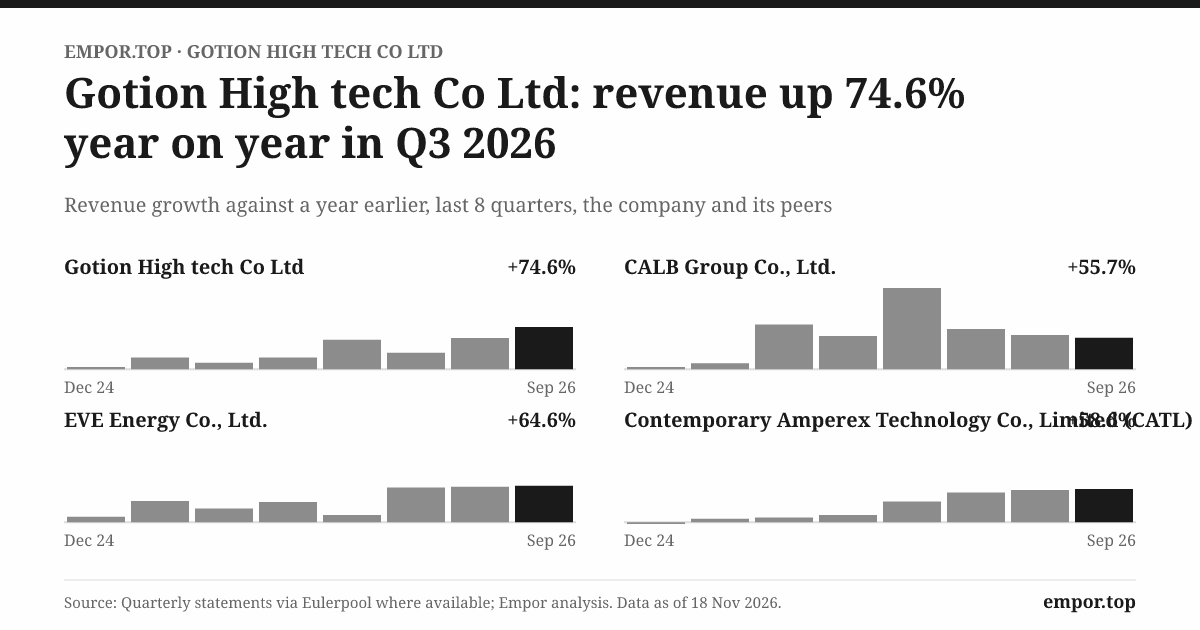
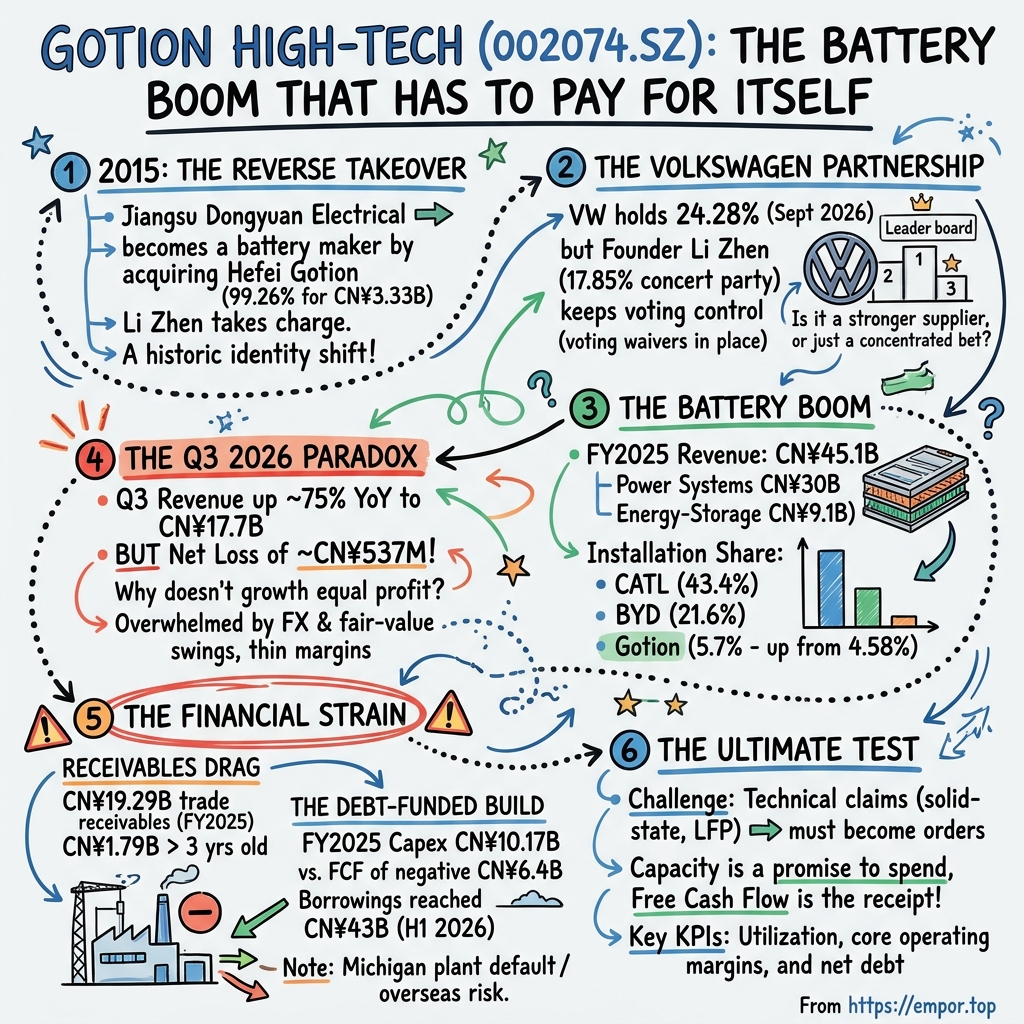
On the evening of October 29, 2026, a battery maker in Hefei, the capital of China's Anhui province, published a report that looked like two different companies had written it. The first line was a triumph. In the three months to September, 国轩高科股份有限公司 Gotion High-tech had sold about CN¥17.7 billion of batteries and related equipment, nearly 75% more than in the same quarter a year earlier.1 That is the kind of growth investors usually see from software start-ups, not from a company that makes heavy, low-margin industrial goods in enormous factories. The second line went the other way. Profit attributable to shareholders for the quarter was a loss of about CN¥537 million.1
The company gave a one-sentence explanation in a note under the table: the fall in profit came mainly from changes in the fair value of the shares it held and from exchange-rate movements.1 In plain English, Gotion owns a portfolio of listed stocks, and that portfolio did far less for it this year than last. It also borrows and sells in foreign currencies, and the currencies moved against it. Over the first nine months of 2026, gains from marking financial assets to market fell from about CN¥2.3 billion to about CN¥0.2 billion, while finance costs nearly doubled to roughly CN¥2.0 billion, which the company attributed to exchange rates.1 Charges for inventory that had lost value more than tripled, to about CN¥540 million.1
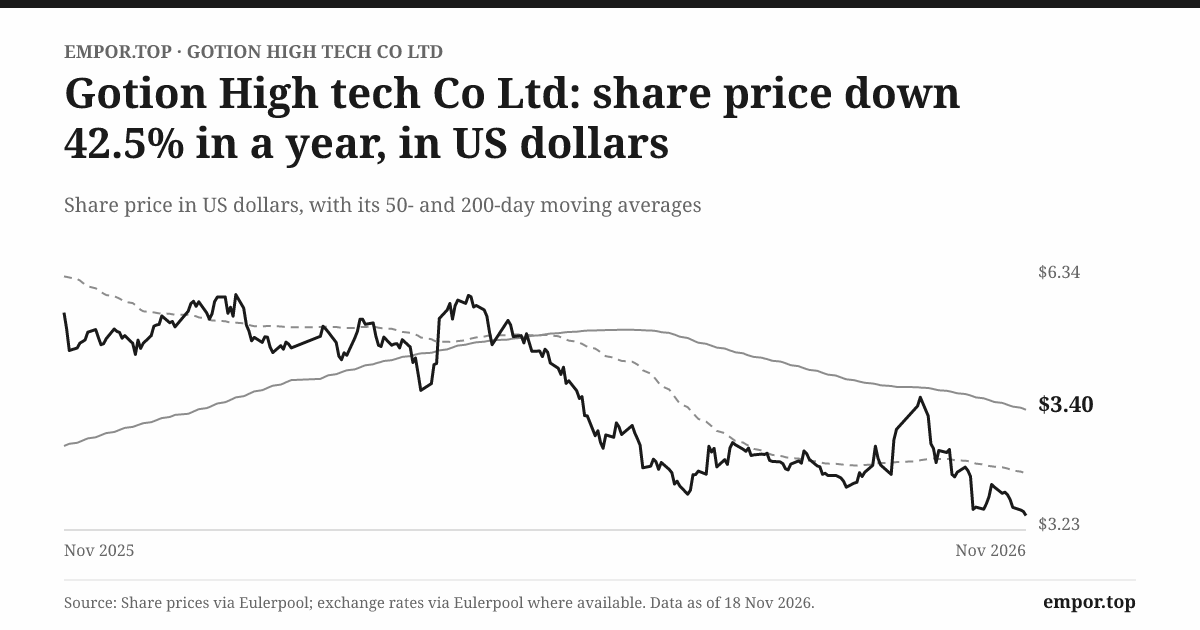
The market had already made its judgment before the quarter was even reported in full. By November 18, 2026, Gotion's shares traded at about CN¥22.67, roughly 46% below their 52-week high of about CN¥42.[^2] A company whose quarterly sales grew nearly 75% year on year, with its share price nearly halved: this is the puzzle at the heart of the story.
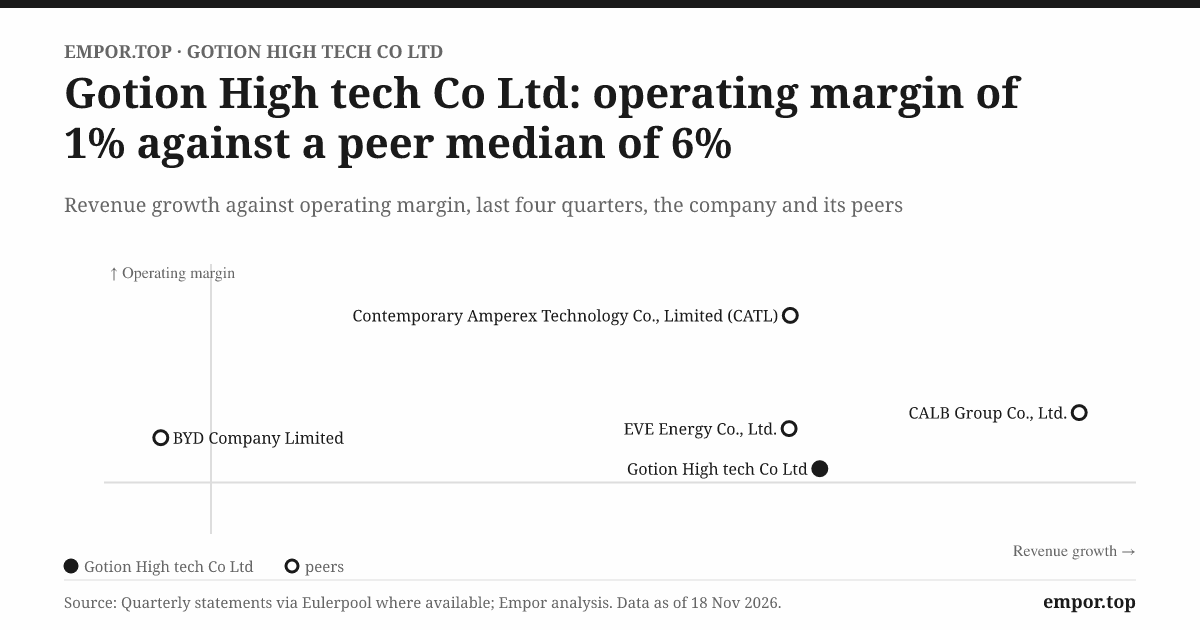
There is a cleaner way to read the quarter, and it does not flatter the bulls or the bears. Chinese companies report a second profit line, profit after stripping out items the company deems non-recurring, such as gains on investments and one-off subsidies. On that measure, Gotion earned about CN¥145 million in the third quarter, more than ten times what it had made on the same basis a year earlier.1 So the battery business itself did not fall apart. The trouble is the size of that number. CN¥145 million of recurring profit on CN¥17.7 billion of sales is a margin of less than one percent. For every CN¥100 of batteries Gotion shipped, the operations kept less than a single yuan, before the swings in its investment portfolio and its currency book decided whether shareholders saw a profit at all.
That framing sets the three questions this story has to answer. The first is whether Gotion can turn sales growth that is clearly real into operating profit that is dependable, rather than profit that rises or falls with the stock market. The second is whether the vast new factories it is building in China, Europe, North Africa and Southeast Asia will earn more than they cost to build and finance. The third is about its most famous shareholder. 大众汽车 Volkswagen owns roughly a quarter of the company, buys a growing share of its cells and is now its partner in new plants abroad. Does that make Gotion a stronger supplier, or a more concentrated bet on one carmaker's battery strategy?
The boundary of the story matters before it starts. The company under the microscope is the Shenzhen-listed issuer, stock code 002074, and the subsidiaries it consolidates. It is not Volkswagen's battery arm PowerCo, and Volkswagen's broader plans for European cell production belong in this story only where they flow through Gotion's own revenue, receivables or balance sheet. When this story speaks of "Gotion's" factories, customers and debts, it means the listed company's.
The annual numbers tell the same story as the quarter, only more quietly. In 2025 Gotion reported revenue of about CN¥45.1 billion, up 27%, and net profit of about CN¥2.38 billion, nearly double the year before.2 Strip out the non-recurring items, and profit was about CN¥432 million.2 The gap, almost CN¥2 billion, was largely the CN¥1.92 billion of fair-value gains the company booked that year.[^4] Put bluntly, about four-fifths of what Gotion reported as 2025 profit came from its investment portfolio, not from making batteries. Shipments that year reached roughly 100 gigawatt-hours across electric vehicles and energy storage, up 57%.2 A rough piece of arithmetic makes the point vivid: Gotion brought in something like CN¥450 of revenue for every kilowatt-hour it shipped, and kept perhaps CN¥4 of that as recurring profit.
None of this means the business is failing. It means the business is young in its economics even though it is old in its ambitions. Gotion has spent a decade becoming one of China's larger battery suppliers. It has not yet shown that scale, by itself, produces a margin that can carry the debt and capital spending required to keep growing. To understand why, the story has to start with what Gotion actually is, and that turns out to be less obvious than the name on the stock suggests, because the listed company did not begin life as a battery maker at all.
 Subscribe on LinkedIn
II. The Reverse Takeover That Changed the Company's Name—and Its Business
In September 2006, a maker of electrical switchgear and power-distribution equipment called 江苏东源电器集团股份有限公司 Jiangsu Dongyuan Electrical Group published the prospectus for its initial public offering on the Shenzhen Stock Exchange.3 It was a solid, unglamorous industrial company of the kind China was listing by the dozen in the mid-2000s, selling the boxes and breakers that sit between a power grid and the buildings it feeds. Its shares carried a face value of one yuan each.3 Nothing in that prospectus mentioned lithium, electric cars or energy storage.
That same year, in Hefei, 李缜 Li Zhen founded the business that would eventually take Dongyuan's place: 合肥国轩高科动力能源有限公司 Hefei Gotion High-tech Power Energy.4 Li Zhen was not a battery chemist by training. He came to the industry as an entrepreneur from Hefei's local business world, and he built Hefei Gotion around lithium iron phosphate, the battery chemistry that trades some energy density for lower cost, longer life and better safety. For years that choice looked like the unfashionable one. Lithium iron phosphate, usually shortened to LFP, made batteries that were heavier for the range they offered, and the industry's prestige sat with nickel-rich chemistries. Li Zhen's early customers were often buses and commercial vehicles, where weight mattered less than cost and durability.
By 2014 Hefei Gotion was a profitable, fast-growing private company that wanted access to public capital, and Dongyuan was a listed company with a modest business. The solution was a transaction Chinese markets know well. In 2015, Dongyuan issued new shares to the owners of Hefei Gotion to buy about 99% of the battery company, valuing that stake at about CN¥3.33 billion.4 Because the sellers were paid in shares, they ended up controlling the listed company that had technically bought them. That is the definition of a reverse takeover: the smaller listed shell acquires the larger private business, and the private owners walk out holding the keys. Alongside the deal, the listed company raised about CN¥820.8 million in a private placement to help fund the transaction.5 The renamed company became Gotion High-tech, and Li Zhen became its controlling shareholder and, from 2015, its chairman and general manager.
Was the price sensible? The filings allow a snapshot, not a verdict. Hefei Gotion reported net profit of roughly CN¥251 million in 2014, so the CN¥3.33 billion valuation for nearly the whole company works out to about thirteen times trailing earnings.4 The sellers also gave forecast-profit commitments for the years after the deal, the usual Chinese device for reassuring minority shareholders that a valuation was not plucked from the air.4 Thirteen times earnings for a fast-growing battery business in 2015 does not look extravagant. But that number cannot tell anyone whether Dongyuan's original public shareholders did well, because it does not capture how many new shares they absorbed, what price the market put on the combined company afterward, or what happened to their old switchgear business. A transaction multiple is a photograph of a moment. A shareholder return is a film, and nobody has published the film for this deal.
What the deal did leave behind is visible in today's accounts. Gotion still sells transmission and distribution equipment, the line of business that once was the whole of Dongyuan. In 2025 those products brought in only about CN¥423 million, under one percent of revenue.[^4] The old company survives as a sideline inside the new one, like the foundations of a farmhouse beneath a factory floor.
The more important legacy is a break in the historical record. The listed company's financial history runs back to its 2006 listing, but its operating identity begins in 2015. Any chart that shows revenue growing more than tenfold from 2014 to 2025 is measuring the battery business from its private-company days through its public adolescence, not the compounding of a single listed enterprise. The first few years after the deal also look nothing like today. In 2014 the battery business earned an operating margin above 25%, a figure that reflected the early, subsidy-rich years of Chinese electric buses.4 By 2019 that margin had fallen to around 1%, and it stayed in low single digits for the next several years.[^8] The company that Li Zhen brought into the public market was a high-margin niche supplier. The company he runs today is a high-volume, low-margin manufacturer competing against the largest battery makers in the world.
That transformation required capital on a scale the 2015 placement never imagined. It also required a kind of partner Li Zhen did not have in 2015: a global carmaker willing to put billions into a Chinese supplier. The way he found that partner, and the arrangements he negotiated to keep control while doing it, is the next chapter, and it explains why Gotion's largest shareholder is not the one in charge.
III. Volkswagen Bought a Stake; the Founder Kept the Votes
On the evening of May 28, 2020, in the first spring of the pandemic, Volkswagen's China arm signed agreements to become the largest shareholder in a Chinese battery maker most Western investors had never heard of.6 The plan was for 大众汽车(中国)投资有限公司 Volkswagen (China) Investment to spend about CN¥8.7 billion for roughly 26.47% of Gotion.6 It came in two pieces. Volkswagen would buy 5% from Li Zhen and his holding company for about CN¥1.4 billion, and it would subscribe at least CN¥6 billion in cash to a new private placement of shares.6
For Volkswagen, the logic was strategic. The world's second-largest carmaker was preparing to electrify its range, wanted a battery partner inside China with LFP expertise, and was building its own cell business in Europe. For Gotion, the money was transformative: equity capital on a scale its own earnings could not generate, plus the validation of a customer whose engineers are notoriously difficult to satisfy.
The most interesting part of the deal, though, was the part that kept it from becoming a takeover. Volkswagen agreed to irrevocably waive the voting rights attached to part of its shares so that its voting power stayed at least five percentage points below that of the founder's side.6 The waiver initially ran for at least 36 months.6 In 2024 it was extended to 72 months.7 Volkswagen therefore owns more of Gotion than anyone else, yet the company continues to name Li Zhen as its ultimate controller.
The September 2026 shareholder register shows how this looks today. Volkswagen China held about 24.28% of the shares.1 On the other side sat a group the company describes as acting in concert: Li Zhen personally with about 5.69%, his son 李晨 Li Chen with about 1.57%, and 南京国轩控股集团 Nanjing Gotion Holding, which Li Zhen controls, with about 10.59%.1 Together they held about 17.85%. Volkswagen's economic stake is larger. Li Zhen's bloc has more votes. In this company, ownership and control are deliberately two different things.
Then, in the autumn of 2026, the shareholder list started to move. On September 28, 2026, Volkswagen China agreed to transfer about 96.2 million shares, or 5.30% of the company, to 合肥市建设投资有限公司 Hefei Construction Investment, an investment company owned by the Hefei city government, for about CN¥2.32 billion.18 That works out to roughly CN¥24 a share, a little above where the stock traded in mid-November. If the transfer completes, Volkswagen's holding will fall to about 18.98%.7 As of November 6, 2026, the deal still needed approval from Hefei's state-asset regulator, a compliance confirmation from the Shenzhen Stock Exchange and registration of the transfer.18
It is tempting to read this as Volkswagen cooling on Gotion. The filings point the other way, at least on the operating side. On the same day the share transfer was signed, Gotion's board approved a plan to form three joint ventures with Volkswagen and its battery company PowerCo to build lithium-battery and cathode-material plants in Valencia in Spain, Šurany in Slovakia and Kenitra in Morocco, with total investment of about €3.2 billion, split almost evenly: about €1.6 billion from Gotion's side and about €1.6 billion from PowerCo's.1 A Gotion subsidiary in Spain also agreed engineering contracts worth about €1.09 billion with PowerCo's Spanish unit for a 29.1-gigawatt-hour battery project.1 Shareholders approved both on October 20, 2026.1 Volkswagen was selling a slice of its equity to a local government investor while deepening its industrial ties. The shareholder mix is changing; the commercial embrace is tightening.
What the transfer does to control is a question the filings have not yet answered. Volkswagen at 18.98% would still own slightly more than the founder's bloc at 17.85%, and the voting waiver is designed to keep its votes five points lower. A new state-owned shareholder with 5.30% will hold no waiver at all. Whether Hefei's investor votes with the founder, sits passively, or becomes a new centre of influence will only be clear once the transfer is registered and the company publishes updated voting disclosures. Until then, the honest reading is that Gotion remains a founder-controlled company with a strategically important shareholder, and that a third party is about to join the table.
Two further details complicate the founder's position. At the end of September 2026, Nanjing Gotion Holding had pledged 92 million of its shares and Li Zhen had pledged 12 million of his.1 Share pledges are common among Chinese founders, who borrow against their holdings rather than sell. They also create a known vulnerability: if the share price falls far enough, lenders can demand more collateral, and a founder with a pledged stake has less room to act. With the stock nearly halved from its peak, that is not an abstract consideration, though the pledged shares cover only a part of the bloc's holdings.
The deeper question is what Volkswagen's presence actually does for the business. It certainly opens doors. Gotion began formal deliveries of Volkswagen's "unified cell," a standardised battery cell format the carmaker plans to use across many models, at the end of 2025, supplying Volkswagen in Germany, Volkswagen China and PowerCo, across brands including the ID family and Škoda.2 In its May 2026 results briefing, the company named volume deliveries of those standard cells as its new breakthrough for the year.[^12] Related-party sales to Volkswagen-linked entities appear in the half-year accounts in hard numbers.
But a famous shareholder is not the same as a profitable customer. Volkswagen negotiates as a buyer, not as an owner, and its stake gives Gotion no protection against price pressure when cells are bought. The test of the relationship is not the press release or the shareholder register. It is the named orders, the delivered volumes, the margins on those cells and the speed at which the cash arrives. To judge those, the story has to open the battery box and see what Gotion actually sells, and to whom.
IV. What Is in the Battery Box—and Who Gets to Choose the Supplier?
Imagine a carmaker deciding which batteries go into a new electric model that will be built for five or six years. Years before the first car reaches a showroom, its engineers write a specification: how much energy the pack must store, how fast it must charge, how it must behave in a crash or a cold winter, and what it may cost. Several battery suppliers send samples. The engineers test them, abuse them, and audit the factories that would build them. One or two suppliers are "nominated," the industry's word for being chosen. Then the work really starts. The supplier builds cells, the basic electrochemical units; assembles them into modules; and, in many cases, delivers finished packs, the large flat boxes bolted under the car's floor. How much money it makes depends on how many cars the customer actually sells, the price negotiated per kilowatt-hour, the chemistry, how many cells come off the line without defects, and what lithium and other materials cost along the way.
Energy storage works on a different rhythm. A utility or a project developer building a grid battery, the kind that soaks up solar power at noon and releases it in the evening, runs a procurement process, chooses a supplier, and buys cells, battery cabinets or entire systems for a project with its own construction timetable. There is no five-year car platform. Each project is bought on its own terms.
Gotion lives in both worlds. In 2025, power-battery systems for vehicles brought in about CN¥30 billion, roughly two-thirds of revenue, and energy-storage battery systems about CN¥9.1 billion, around a fifth.[^4] The legacy grid equipment was a rounding error. This is overwhelmingly a battery company, with storage a meaningful and fast-growing second business. Storage accounted for about 28% of Gotion's shipments in 2025, which tells a listener something else: storage cells sell for less per kilowatt-hour than automotive packs, so they make up a larger share of volume than of revenue.2 Management described the structure as mainly selling integrated systems overseas and mainly selling cells at home.2
What the company does not publish is just as important. Gotion does not disclose typical contract length, minimum purchase commitments, a backlog with conversion terms, or pricing formulas per kilowatt-hour.[^4] Battery supply is not a subscription. A nomination is a licence to compete for volume over a model's life, not a promise of it. If a car sells poorly, the supplier's volumes fall with it, and if the carmaker decides to add a second supplier halfway through, the first supplier's share shrinks. At year-end 2025, the company reported no major sales contracts signed and outstanding of the size that would require separate disclosure.[^4]
The industry Gotion competes in is dominated by two giants. In 2025, 宁德时代 CATL accounted for about 43.4% of China's power-battery installations, and 比亚迪 BYD, which makes both cars and batteries, for about 21.6%.9 Together they installed nearly two of every three kilowatt-hours that went into Chinese vehicles. Behind them came a pack of challengers: 中创新航 CALB with about 7.0%, Gotion with about 5.7%, and 亿纬锂能 EVE Energy with about 4.1%, with 欣旺达 Sunwoda and others close behind.9 Gotion installed about 43.4 gigawatt-hours in China during 2025.9
That position is better than it was, and the improvement is the positive case in its most concrete form. Gotion's share of Chinese installations rose from about 4.6% in 2024 to about 5.7% in 2025, a gain of more than a percentage point in a market that itself grew rapidly.9 Over the same year, the two leaders each lost share: CATL by almost two points and BYD by about three.9 Globally, Gotion cited third-party data showing 53.5 gigawatt-hours of power-battery installations in 2025, up about 83%, the fastest growth among the world's top ten and enough to put it fifth with about 4.5% of the market.2 Management attributed the gains to a new generation of high-energy-density LFP cells, a push into more expensive mid-sized and larger passenger cars, and commercial-vehicle wins with 一汽解放 FAW Jiefang and 三一重卡 Sany Heavy Truck, where battery-swapping models helped drive volumes.2 Its passenger-car customers include 吉利 Geely, 奇瑞 Chery, 零跑 Leapmotor, 上汽通用五菱 SAIC-GM-Wuling and 长安 Changan, and the company has said it won a nomination from an overseas carmaker it did not name.[^12] Partners abroad include Tata and VinFast.[^12]
So Gotion can win business. The harder question is whether anything protects what it wins. This is the place to run the moat argument in full.
The case for a moat rests on three things: qualification, scale and technology. Qualification is real. Getting through a global carmaker's audit takes years, and a supplier that has shipped millions of cells without a recall has something a newcomer does not. Scale matters because battery manufacturing is a game of learning curves: every additional gigawatt-hour run through a line teaches engineers how to raise yields and cut waste. And technology matters because chemistries keep changing, and a supplier that is a generation behind is quickly priced out.
Each leg, tested against Gotion's own record, holds up less well than it first appears. Qualification is evidence of capability, not of lock-in. Carmakers deliberately qualify several suppliers to keep them competing, which is precisely why the Chinese market has a crowd of challengers rather than one or two incumbents. Gotion's own customer list proves the point: its five largest customers took about 41.6% of 2025 sales, and two of them each exceeded 10%.[^4] When a buyer is that large relative to the seller, the buyer sets the terms. Gotion names those customers only as "Customer One" and "Customer Two," so outside investors cannot tell which carmakers account for its concentration.[^4]
Scale is a real advantage, but on this measure Gotion is the one at a disadvantage. CATL installed nearly eight times as many kilowatt-hours in China in 2025.9 Whatever learning-curve benefits scale brings, the leader has more of them. And the margin record shows it. Thin margins suggest that customers capture most of the value of Gotion's manufacturing improvements.
Technology is the leg most often cited and least able to bear weight on its own. That early LFP bet looks prescient now that LFP accounts for the great majority of Chinese installations. But LFP is no longer a niche Gotion owns. CATL, BYD and every serious challenger make it. A chemistry that everyone has mastered is a requirement for entry, not a moat.
The verdict is that Gotion has a defensible position, not a protected one. It has the certifications, the factories and the customer relationships to keep winning nominations, and its share gains show that it is doing so. The evidence does not yet show durable switching costs, superior pricing power or a cost advantage over the leaders. That leaves the company exposed to the one force no amount of order-winning can neutralise: the price of the product and the price of what goes into it. In its April 2026 investor call, management acknowledged that upstream raw-material prices had risen broadly since late 2025 and that profitability would be under pressure in the short term, while saying that price-linkage mechanisms with customers should help margins recover in the second half.2 By the third quarter, inventory write-downs had more than tripled.1 A supplier can win the order and still lose the margin, if the customer's price adjusts more slowly than its costs.
There is one more place where the economics of a battery sale show up, and it is the place where the boom has been least visible on the income statement: the money customers still owe.
V. The Receivables Behind the Record Growth
Deep in Gotion's 2025 annual report, past the strategy pages and the photographs of production lines, sits a note on accounts receivable. It is the least glamorous page in the document, and one of the most revealing. It shows that at the end of 2025, customers owed Gotion about CN¥19.3 billion for goods already delivered.[^4] Against that, the company had set aside an allowance of about CN¥3.0 billion for amounts it did not expect to collect in full.[^4] About CN¥1.8 billion of the balance was more than three years old.[^4]
Put those numbers in human terms. The allowance alone is roughly seven times the recurring profit Gotion's operations earned in all of 2025. The more-than-three-year-old slice is money for batteries delivered before 2023, in some cases for vehicles that have long since been sold, driven and perhaps scrapped, and the cash had still not arrived.
How does a battery supplier end up owed so much? The mechanics are familiar to anyone who has sold to a large industrial buyer. Carmakers are powerful customers, and in China they have often paid suppliers slowly, sometimes with bank acceptance notes that defer payment by months. When a supplier's sales double, its receivables tend to double too, because each new shipment adds an invoice that will not be paid for some time. Scale with big customers brings big balances. In Gotion's early years the problem was much worse. Measured as days of revenue, receivables peaked at about 464 days in 2019, meaning the company was owed well over a year's worth of sales at the end of that year.[^8] That was the era when Gotion's customer base included many bus and commercial-vehicle makers in a market heavily shaped by government subsidies, and the cash cycle reflected it.
What changed is the good news in this chapter. As the customer base shifted toward large passenger-car makers and storage buyers, collection improved sharply. By 2022 debtor days had fallen to roughly a third of their peak. They rose again to about 193 in 2024 before falling to about 172 in 2025.10[^4] Collection speed is now less than half of what it was at the worst point. That is a genuine improvement, and it says something about the quality of the customers Gotion now sells to.
But the tail is not a footnote. Within the 2025 balance, about CN¥1.29 billion of receivables had been assessed individually as impaired, and the company had provided for about 75% of them.[^4] That is an accountant's way of saying these customers are unlikely to pay most of what they owe. The company wrote off only about CN¥17.8 million during the year, which meant most of the impaired balance remained on the books, provisioned but not abandoned.[^4] Whether that money is ever recovered will shape future profits: a collection would release provisions and flatter earnings, while a further deterioration would add charges.
The newest numbers suggest the balance is growing again with the boom. By September 30, 2026, net receivables had risen to about CN¥22.9 billion, up about 41% from the start of the year, which the company attributed to higher sales.1 Inventory grew even faster, up about 80% to roughly CN¥17.4 billion.1 Over the same nine months, revenue rose about 54%.1 Receivables growing a little slower than sales is consistent with steady collection terms. Inventory growing much faster than sales is a sign of a company stocking up for growth, and the jump in inventory write-downs shows that some of that stock lost value before it could be sold.
There is a mirror image to this story on the other side of the balance sheet, and it changed sharply in 2025. For years Gotion had financed itself partly by paying its own suppliers slowly. At the end of 2024, what it owed suppliers amounted to roughly 325 days of its cost of sales; a year later the figure was about 185 days.10[^4] Paying suppliers faster may reflect bargaining power shifting upstream as raw-material prices rose, or simply a change in how the company settles its bills, but its effect is unambiguous. The gap between when Gotion pays for materials and when its customers pay for batteries, which had been in its favour, swung the other way, from a cash cycle of about minus 43 days to about plus 81.[^4] In 2024, suppliers were effectively lending Gotion money. By 2025, Gotion was lending to its customers with less help from its suppliers. The company has since leaned harder on bank acceptance notes, the deferred-payment instruments common in Chinese industry: notes payable rose about 50% in the first nine months of 2026, to roughly CN¥18.9 billion.1 That buys time, but it is another form of short-term obligation that must be honoured when the notes fall due.
Who owes the money? Gotion does not say. Its five largest receivables accounted for about 21% of receivables plus contract assets, but the customers are identified only by number.[^4] An investor cannot match the oldest, most impaired balances to named carmakers or project developers, and so cannot judge whether the problem lies with a few failed customers from an earlier era or with any current customer.
Management's response, disclosed in the 2026 half-year report, is to favour creditworthy customers who pay on time and to tighten control over new receivables.7 That is the right instinct, and it is consistent with the improvement since 2019. It is also a statement of intent rather than an outcome. The settling evidence will come from the audited aging tables in future annual reports: whether the over-three-year balance shrinks because cash arrives, or merely because more of it is written off, and whether debtor days keep falling as volumes rise.
The verdict here is "improving, with a risky tail." Gotion collects far faster than it did, and its customers are stronger. But a company that is owed about CN¥19 billion, with a few billion provisioned and nearly CN¥2 billion more than three years old, cannot treat receivables as a solved problem. That matters because the cash Gotion does collect is not just paying for yesterday's batteries. It is supposed to help pay for tomorrow's factories, and those factories are expensive.
VI. The Factory Build Became a Financing Strategy
Look at Gotion's balance sheet in September 2026 and one line stands out like a construction crane on a skyline. "Construction in progress," the accounting term for factories and equipment that are being built but are not yet producing, reached about CN¥26.0 billion, more than double the CN¥12.7 billion at the start of the year.1 The company's explanation was simple: increased investment in production lines.1 In nine months, Gotion had added more half-built factory than it had held in total at the end of 2025.
This is a company in the middle of a building spree, and the money for it has to come from somewhere. In 2025, cash spent on property, equipment and other long-lived assets was about CN¥10.17 billion, roughly 22.6% of revenue.[^4] In 2024 it had been about CN¥9.07 billion, about a quarter of revenue.10 Research and development cost a further CN¥3.36 billion in 2025, up about 15%, of which 27.8% was capitalised, meaning it was recorded as an asset to be expensed over future years rather than charged against profit immediately.[^4] Capitalising part of R&D is a legitimate accounting choice, but it does flatter current profit, and in a company whose recurring profit is this thin, it is worth noticing.
The build shows up in the workforce, too. Employees rose from about 25,600 to about 33,100 during 2025, an increase of nearly 30%, slightly faster than revenue growth of 27%.[^4] Production rose about 52% and sales volumes about 56%, which the company attributed to strong demand and newly released capacity.[^4] Those numbers tell a consistent story: new factories are coming online, they are being staffed, and they are shipping product. What they do not yet show is a return on the money.
Here the record over a long span is the most useful evidence, and it cuts in two directions. Over the twelve years from 2014 through 2025, Gotion's operating cash flow exceeded its reported net profit by about CN¥2.6 billion in total.[^4] That is reassuring as far as it goes. It means the company's profits have, on the whole, been backed by cash, helped by large non-cash charges such as depreciation and impairment. In 2025 alone, credit-impairment losses of about CN¥1.02 billion and asset-impairment losses of about CN¥284 million reduced profit without consuming cash at the time they were booked.[^4]
The other direction is where the story turns. Over the same twelve years, free cash flow, operating cash minus capital spending, was negative by a cumulative CN¥48.7 billion or so. In only the first of those years did free cash flow come out clearly positive. Every year since, the factories have consumed more cash than the business has generated. Gotion has not harvested the plants it built in 2018 or 2021 to fund those it is building now. It has kept building, and borrowed and raised equity to do it.
The borrowing has grown with the build. Total borrowings were about CN¥36.7 billion at the end of 2025.[^4] By June 2026, short-term borrowings stood at about CN¥17.8 billion and long-term borrowings at about CN¥25.3 billion, roughly CN¥43 billion in all before lease liabilities.11 By September long-term borrowings alone had reached about CN¥26.8 billion.1 Over the first nine months of 2026, Gotion's investing activities consumed about CN¥11.1 billion of cash while operating activities generated only about CN¥0.56 billion; financing, mostly new borrowing, brought in about CN¥11.2 billion.1 The factory build has become, in effect, a financing strategy: the company borrows against expected future cash flows from plants that are not yet finished.
Why borrow so much when the company also held about CN¥19 billion of cash and short-term investments at the end of 2025?[^4] Part of the answer is that not all of that cash is free to use. About CN¥5.7 billion sat overseas, where it supports foreign plants and is not costlessly brought home, and about CN¥3.0 billion was classified as "other monetary funds," typically deposits pledged against bank notes and letters of credit.[^4] Another part is that a manufacturer with a fast-growing payroll, a large inventory and billions of yuan of notes coming due needs a sizeable cushion simply to operate. Gross cash, in other words, flatters the picture. The relevant figure is net debt, and it has been rising.
The interest bill makes the stakes concrete. In 2025 Gotion paid interest expense of about CN¥1.47 billion, against interest income of about CN¥0.33 billion.[^4] Its recurring profit that year was about CN¥432 million.2 Interest costs were more than three times the profit the operations generated after interest. In the first nine months of 2026, interest expense was about CN¥1.27 billion.1 Each new loan raises the bar that the new plants must clear.
The company has been diversifying its funding. It issued a CN¥600 million three-year green technology bond in November 2025 and a CN¥500 million green short-term note due in September 2026.[^4] Shareholders approved registration of up to CN¥7 billion of interbank-market debt instruments, and the National Association of Financial Market Institutional Investors accepted that registration in 2026.[^4]1 Gotion also had about CN¥2.48 billion of principal outstanding under sale-and-leaseback and direct leasing arrangements at the end of 2025, a form of equipment financing in which the company sells machinery to a lessor and leases it back.[^4] Minority shareholders in its subsidiaries are carrying part of the load as well: non-controlling interests on the balance sheet rose from about CN¥7.8 billion to about CN¥10.3 billion in the first nine months of 2026, a sign that partners are co-funding plants at the project level.1
One outside voice put the risk in writing. In May 2025, the rating agency 东方金诚 Dongfang Jincheng affirmed Gotion at AA+ with a stable outlook.12 Its rationale praised Gotion's integrated materials and battery capacity, its LFP position and its customer wins. It also flagged low battery prices, raw-material volatility, rising receivables and bad-debt allowances, and debt that was growing and concentrated at short maturities.12 It calculated that Gotion's debt was about eleven times its 2024 EBITDA, and that current assets covered only about 88% of current liabilities.12 That rationale expired on May 20, 2026, so it is a dated signal, not a current rating.12 But the concerns it raised have not been resolved by the subsequent filings; if anything, the debt has grown.
Then there is the cautionary tale from America. In 2023, Michigan gave Gotion nearly $24 million to buy land for a proposed factory in Green Charter Township, north of Big Rapids, as part of a larger incentive package.13 The project ran into fierce local opposition over Gotion's ties to China. Residents recalled five township officials who had supported it in late 2023, two others resigned, and their replacements refused to issue permits.13 Gotion sued the township in federal court in March 2024.13 In October 2025, Michigan declared Gotion in default, terminated the project and sought repayment of the land money.14 In February 2026, Gotion refused. Its lawyer wrote that the company had faced "an onslaught of attacks, threats, unfounded accusations, and anti-China sentiment," and that the land "has been rendered undevelopable and is useless to Gotion."13 The dispute over roughly $23.7 million was still unresolved at that point.13
The Michigan collapse does not prove that Gotion's other overseas plants will fail. Morocco, Slovakia, Spain and Vietnam are different places with different politics, and in Europe Gotion is now building alongside Volkswagen rather than alone. But it is direct evidence, from the same company and the same management, that overseas factories carry political and execution risks that a capital-spending budget does not capture. The new European joint ventures commit Gotion's side to roughly €1.6 billion of investment.1 That is money that will be spent before anyone knows how the next geopolitical turn will treat a Chinese battery maker abroad.
The central capital-allocation question, then, is not whether Gotion can build plants. It plainly can. It is what volumes, margins and cash returns would justify the next increment of capacity, and whether management has shown that it applies that test. That is a question about the person making the decisions.
VII. Li Zhen's Bet: More Cells, More Markets, More Customers
Li Zhen has run Gotion for more than a decade as both chairman and general manager, the Chinese equivalent of combining the roles of board chair and chief executive.[^4] He is the kind of founder who appears at industry conferences talking about the next generation of chemistry rather than last quarter's margin, and who has bet the company repeatedly on building ahead of demand. He chose LFP when the industry was moving to nickel. He took Volkswagen's money in 2020 while keeping the votes. He has committed to factories on four continents. Every one of those decisions was a wager that scale would eventually pay.
His incentives are mostly ownership, not pay. His reported pre-tax compensation in 2025 was about CN¥1.9 million, unchanged from 2024, even though reported net profit nearly doubled.[^4] Total pay for all directors and senior executives was about CN¥15 million.[^4] That is modest for a company with CN¥45 billion of revenue, and the annual report describes pay as following KPI and performance assessment, with no deferred pay or clawback.[^4] His real exposure is through the founder bloc's roughly 18% stake. A founder with that much of his wealth in the stock has every reason to care about long-term value. He also has reason to care about growth, prestige and control, which do not always align with returns on capital.
Put the plan next to the record. Gotion grew revenue about 27% in 2025.2 Its recurring profit was about one percent of sales.[^4]2 In the first quarter of 2026, revenue rose about 29% while net profit fell nearly 80% because of fair-value changes; recurring profit was only about CN¥41 million on CN¥11.7 billion of sales.2 By the third quarter, the company was still reporting a loss.1 Growth has been delivered. Profitable growth has not, at least not yet.
What did management promise for 2026? Less than one might think. In the April 30, 2026 investor call, handled by board secretary 汪泉 Wang Quan and finance chief 张一飞 Zhang Yifei, the company said only that it expected shipments to keep growing, helped by strong demand and Volkswagen's rising needs.2 It gave no shipment number, no capacity target and no margin guidance. On capital spending it said it was expanding high-quality capacity in both power and storage based on market judgment and "intended orders."2 On raw materials it said profitability would be under short-term pressure, with recovery expected in the second half as price-linkage mechanisms took effect.2 On overseas plants it said Morocco was being built on schedule, Slovakia was focused on European carmakers and Vietnam's second phase was under construction.2
The absence of numbers cuts both ways. A company that does not set targets cannot miss them, which protects credibility in a volatile industry. It also leaves investors unable to hold management to account. The one testable claim, that margins would recover in the second half of 2026, has produced mixed results so far: third-quarter recurring profit was far higher than a year earlier, but still less than one percent of sales, and inventory write-downs jumped.1 The May 18, 2026 online results briefing was even less revealing. Li Zhen was listed as a panelist, but questions addressed to him show no answer on the published record, and several investor questions, on storage profitability, market-share strategy and commercial vehicles, appear unanswered.[^12] The answers that were given were general: long-term supply agreements and price pass-through to protect gross margin, without any figures.[^12]
Credibility also has a regulatory history. In 2022, Gotion received a warning from its securities regulator over inaccurate financial disclosures for 2020 and late disclosure of related-party transactions and government grants.10 In 2023, it received another warning, and its executives were called in for regulatory interviews, over late disclosure of a major transaction.10 These were disclosure failures, not findings of fraud, and both are now several years old. On the other side of the ledger, the auditor issued an unmodified opinion on the 2025 accounts and a standard unqualified opinion on internal controls.15 Neither fact cancels the other. The warnings show that the company's disclosure discipline has lapsed in the past; the clean audit shows that its latest accounts passed independent review.
Minority shareholders, for their part, have not revolted. At the May 2026 annual meeting, even the most contested resolutions received more than 97.5% support from minority holders, and the rules on pay and assessment drew only about 2% opposition.[^20] Gotion's board includes four independent directors.[^4] There is no sign of an organised challenge to Li Zhen's leadership. There is also no sign that the board has pushed for return targets on the capacity build.
The contradiction Li Zhen must resolve is now plain. A founder with meaningful ownership is expanding aggressively, on borrowed money and partner money, in a business whose returns remain below what the investment burden demands. Return on invested capital over the last twelve months was below one percent.1 That might be the low point before new plants mature. It might also be what a challenger earns in an industry where the leaders set the price. The evidence so far supports testing the plan quarter by quarter, not assuming the founder has already earned the right to scale it. And in a business this competitive, one of the levers a founder reaches for is the next product, the one that might finally change the economics.
VIII. The New Products Have to Become Orders
Each year, Gotion stages a technology conference that looks more like a product launch in Silicon Valley than a meeting of industrial suppliers. In 2026, the stage held new generations of LFP cells promising more energy in the same space, manganese-rich chemistries designed to push LFP's limits, and solid-state batteries, the technology the whole industry treats as its next frontier.7 The applause is real, and so is the engineering. The question for an investor is a different one: how many of these products will become orders, and at what margin?
The money behind the stage is substantial. Gotion spent about CN¥3.36 billion on research and development in 2025, about 7.5% of revenue, down from about 8.8% in 2023 as sales grew faster than the R&D budget.[^4]10 That is a heavy commitment. It is also a necessary one. In batteries, a supplier that stops investing in chemistry is a supplier that will be priced out within a product cycle or two.
To understand what a new battery has to go through before it earns money, think of a ladder with five rungs. On the first rung, a cell performs well in a laboratory. On the second, it passes the safety and performance certifications regulators demand. On the third, a carmaker or storage buyer tests it and qualifies it for a specific product. On the fourth, the supplier builds a production line that can make it in volume with acceptable yields, which is often the hardest step, because a cell that works in the lab can fail one time in a hundred on a factory line. Only on the fifth rung do profitable shipments begin. Conferences celebrate the first rung. Investors are paid on the fifth.
Gotion's solid-state programme shows how far apart those rungs can be. Management says it runs two lines in parallel: a "hybrid solid-liquid" battery that has entered validation with several carmakers and will go into production according to customer demand, and an all-solid-state battery for which the production-line design has been completed.2 The company says it built first- and second-generation vehicle-grade all-solid-state prototypes under the name 金石电池 "Gemstone," and completed the design of a 2-gigawatt-hour production line, with the next step being to build mass-production capability "within a controllable cost range."2 That places the all-solid-state product on the threshold between the third and fourth rungs. A 2-gigawatt-hour line, if built, would be about 2% of the volume Gotion shipped in 2025.2 Even on management's own description, solid-state is an option, not a revenue line.
The more immediately relevant products are the new LFP cells, because they are already shipping. Management credited its new high-energy-density LFP cells with helping it move into more expensive cars and gain share in 2025.2 That is the right kind of evidence: a product tied to share gains, not just to a press release. What Gotion does not disclose is how much revenue the new products generate, whether they earn higher margins than older ones, or how many repeat orders they have attracted. Without product-level numbers, a listener cannot tell whether the new chemistries are lifting profitability or merely keeping Gotion in the race.
The clearest example of a product tied to a commercial model rather than a laboratory result comes from heavy trucks. The company says it launched a standardised battery box for heavy trucks, designed to cover the range of heavy-truck uses and to charge through four connectors at once, and management has linked it to the battery-swapping business models that helped it win commercial-vehicle customers.2 That is closer to the fifth rung than anything in solid-state: a product designed around how a customer earns money, sold into a segment where electrification is still early. Whether it becomes a meaningful revenue line depends on how fast China's heavy-truck fleet electrifies, and Gotion does not break out commercial-vehicle revenue.
That distinction matters because the whole industry is innovating at the same pace. CATL and BYD present their own new LFP generations, their own fast-charging cells and their own solid-state roadmaps. A technical lead in batteries tends to last a product cycle, not a decade. Gotion's new products give it a plausible role as a differentiated challenger in a crowded field. They do not, on present evidence, give it a moat. The proof that would change that verdict is specific: product-level shipments, repeat orders from named customers, production yields and margins on the new cells. Until those appear, the honest framing is that Gotion's laboratory is keeping it competitive, and its factories have yet to show that competitiveness pays.
IX. What the Price Assumes—and What Could Break the Case
On November 18, 2026, the stock market valued Gotion's equity at about CN¥42.5 billion.[^2] Add its debt and subtract its cash, and the enterprise value, the price of the whole business including what it owes, was about CN¥102 billion.[^2] That gap tells its own story: more than half of what an acquirer would have to pay for Gotion's business is debt and other claims that rank ahead of ordinary shareholders, not equity.
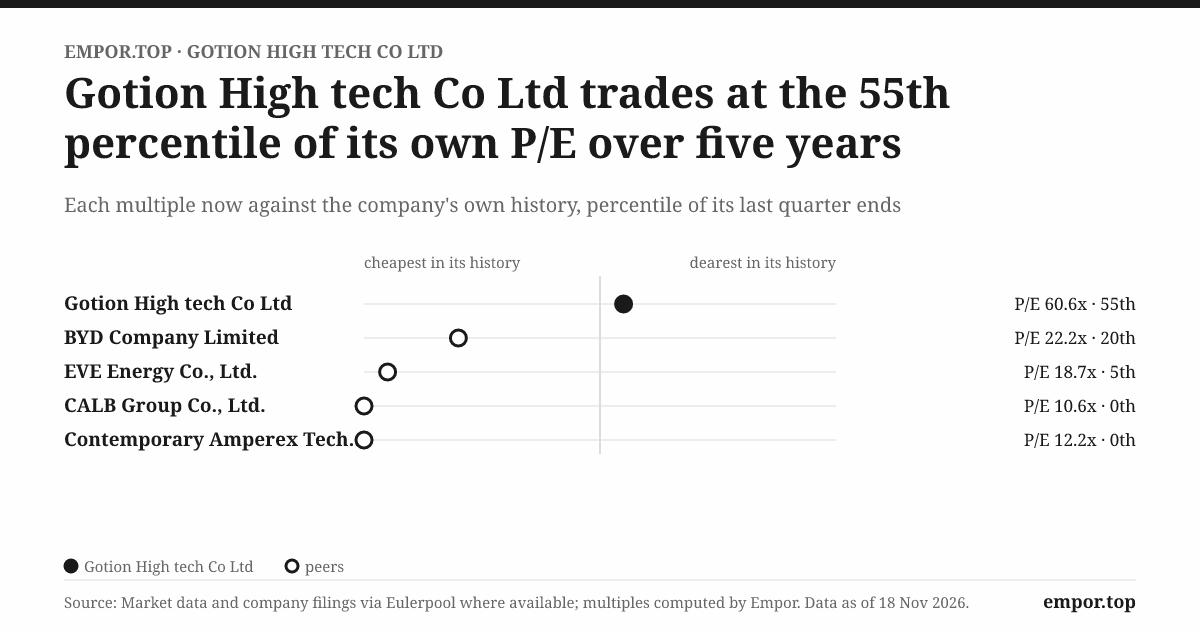
Against its trailing earnings, the shares traded at about 60.6 times, well above Gotion's own five-year median of about 42.5 times.[^2] The earnings yield, profit as a share of the stock price, was about 1.6%. Enterprise value was about 29.5 times EBITDA. The free-cash-flow yield was negative, at about minus 30%, meaning that over the last year the business consumed cash equal to almost a third of its market value.[^2] Return on invested capital was below one percent.[^2]
Compare that with the peers. On a next-day snapshot, CATL traded at about 12.4 times earnings and 2.8 times book value; EVE Energy at about 15.4 times earnings and 2.0 times book.1617 Gotion's price-to-book ratio, about 1.5 times, is lower than both.[^2] So which is it, expensive or cheap? Both, depending on which number one trusts. On earnings, Gotion looks four or five times as expensive as the market leader. On book value, it looks cheaper than either peer. The resolution is that Gotion's earnings are so thin, and so dominated by investment gains and losses, that its P/E is closer to noise than to signal. A single quarter's stock-portfolio swing can move the trailing multiple by tens of points. The price-to-book ratio is more stable, and it says the market values Gotion's equity at modestly more than what the accounts say has been invested, and at a discount to peers that earn far higher returns. Peer multiples alone do not settle fair value. What they show is that the market is paying for the expectation that Gotion's assets will eventually earn something like what its rivals' assets earn.
That is the bet, and it is worth stating each side fairly.
The bull case starts with growth. Gotion has been growing faster than the Chinese battery market, gaining share in 2025 while the two leaders lost it.9 It shipped about 100 gigawatt-hours in 2025, up 57%, and its third-quarter 2026 revenue rose nearly 75%.21 It has a deepening relationship with Volkswagen, standard-cell deliveries under way, three new European and North African joint ventures with PowerCo, a growing storage business, and a domestic customer list that spans most of China's mid-market carmakers.21[^12] Its recurring profit, small as it is, is rising: third-quarter recurring profit was more than ten times the year-earlier figure.1 If utilisation of the new plants rises and the price-linkage mechanisms work, operating leverage could turn a one-percent margin into something much larger, and the stock's current multiple would compress quickly.
The bear case is equally concrete. CATL is about eight times Gotion's size in China, BYD about four times.9 Customer concentration is high, with two customers each above 10% of sales, and the largest customers are not named.[^4] Related-party sales, to Volkswagen-linked entities and Gotion's own joint ventures, were about CN¥3.9 billion in the first half of 2026, around 14% of revenue: about CN¥1.29 billion to PowerCo, CN¥1.34 billion to Tata AutoComp Gotion, CN¥870 million to Škoda and CN¥395 million to Volkswagen Anhui Parts.18 The related-party schedule names the trades and the amounts but does not explain the pricing methodology in detail.18 At the end of 2025, Gotion had also lent about CN¥516 million at 5% interest to an associate, V_G High-tech Energy Solutions, for project construction and operations; the company said this was not a non-operating use of its funds.[^4] Receivables carry an aged, impaired tail. Debt is large, partly short-term, and growing. Reported earnings swing on stock marks and currency.
Each of those risks works through a specific mechanism. Lower battery prices compress margins immediately, because Gotion's costs are fixed in its factories while its prices are set by powerful buyers. Delays in receivables consume cash, which must be replaced by borrowing. Foreign-exchange moves hit both sides: exports are settled mainly in US dollars and some borrowings are in dollars too.18 In the first half of 2026, net foreign-exchange losses were about CN¥657 million, against a small gain a year earlier, and realised losses on the hedges themselves were a further CN¥255 million.18 The hedging programme did not stop a large reported loss. Short-maturity debt adds refinancing risk: every year, billions of yuan of loans must be rolled over, and the cost of the capacity race rises with interest rates.
The industry's structure explains why the bear case has teeth. Think of the five forces that shape any industry's profits. Buyer power is the strongest force here: carmakers are huge, multi-source deliberately and can play suppliers against one another, and Gotion's top-five concentration of about 42% shows how much of its revenue depends on a handful of them. Rivalry is intense, with two dominant players and at least four credible challengers all adding capacity. Supplier power is significant, because lithium and other material prices swing violently and, as Gotion's own management conceded, can squeeze margins before price-linkage clauses catch up.2 The threat of substitutes is modest in the near term, since there is no practical alternative to lithium batteries for electric cars, though new chemistries keep reshuffling which supplier is ahead. The threat of new entrants is lower than it once was, because qualification and scale are expensive, but Volkswagen's own PowerCo is, in a sense, a customer building its own capacity, with Gotion as its partner. When four of five forces lean against the supplier, thin margins are not an accident. They are the industry's equilibrium.
Hamilton Helmer's framework of seven durable powers asks a sharper question: what gives a company a persistent edge that competitors cannot copy? Scale economies, the first power, belong to CATL and BYD more than to Gotion. Network effects do not apply to battery cells. Counter-positioning, a business model incumbents cannot copy without hurting themselves, does not apply either: Gotion's model is the same as its rivals'. Switching costs exist but are weak, because carmakers qualify multiple suppliers precisely to avoid them. Branding has little consumer value in a component buried under a car floor. A cornered resource, such as unique technology or a patent wall, has not been demonstrated; LFP is widely shared. Process power, an embedded manufacturing edge that produces lower costs, would be the most plausible candidate, but if Gotion had it, its margins would show it. What Gotion has instead is a relationship asset: a strategic shareholder that is also a customer and a joint-venture partner. That relationship is valuable, but it is not one of Helmer's powers, because it rests on a buyer whose interests are to keep prices low.
The skeptic's question, then, is a simple one. If the plants are valuable, why does free cash flow remain deeply negative and return on invested capital sit below one percent? The bull's answer is timing: the plants are new, and returns will come as they fill. That answer may be right. But it has been available for every year of the last decade, and the cumulative free-cash-flow deficit of nearly CN¥49 billion is the price of believing it so far. An activist looking at Gotion would ask three things: why the company carries a large portfolio of listed equities whose swings now dominate reported profit; why it continues to commit capital overseas before demonstrating returns at home; and why the board has not set public return targets for new capacity. The first of those questions is not hypothetical. In 2025, gains from marking financial assets to market were about CN¥1.92 billion, while the company's recurring profit was about CN¥0.43 billion.[^4]2 The portfolio, which includes listed equities, produced more than four times as much profit as the battery business that year, and then, in the third quarter of 2026, helped tip the company into a loss.1 Cash parked with commercial banks is low-risk, as the company says; a book of listed shares is not.[^4] For a manufacturer that is borrowing heavily to build plants, holding equity risk on the side doubles the volatility shareholders are asked to bear. None of those questions has been answered in the company's published record.
Three numbers will decide which case wins. The first is shipment growth in power and storage batteries, along with market share; the latest readings are about 100 gigawatt-hours shipped in 2025, up 57%, and a Chinese installation share of about 5.65%, rising.29 The second is operating profit stripped of fair-value and currency noise, which the company's own recurring-profit line comes closest to; it was about CN¥145 million in the third quarter of 2026, under one percent of revenue but sharply higher than a year earlier.1 The third is free cash flow together with net debt; free cash flow remains deeply negative and borrowings are still rising.1 If the first keeps rising while the second widens and the third turns, the bulls will have been right. If the first rises while the other two stagnate, the market's half-price share will look like a reasonable judgment.
X. Lessons From a Battery Company Still Building Its Proof
Gotion's journey from a switchgear company's shell to one of the world's larger battery makers holds lessons that reach well beyond batteries. They are lessons about identity, partnership, capital and cash, and each belongs to a specific moment in this story.
The first lesson comes from the 2015 reverse takeover, when Dongyuan's listed business became Gotion. Investors looking at long-run growth charts need to know which business the old numbers describe. A new ticker story can be real, but anyone measuring compounding has to start the clock at the deal.
The second lesson comes from Volkswagen's investment and the standard-cell deliveries that followed. A marquee customer opens the door; repeat orders at a profit tell you whether you belong in the room. As both shareholder and customer, Volkswagen can deepen Gotion's ties while negotiating as a buyer.
The third lesson comes from the construction-in-progress line that doubled in nine months of 2026. Capacity is a promise to spend; free cash flow is the receipt. Gotion has yet to show that building, filling and harvesting a plant creates value. The receipt is what matters, and Gotion has yet to issue one.
The fourth lesson lives in the receivables note: a long-aged tail of unpaid invoices. A sale that takes years to collect is only half a sale. Revenue recognised is not revenue banked, and a battery maker that grows by extending generous credit to customers is lending money to those customers as well as selling them goods. Gotion's collection has improved since 2019, but the aged tail shows it is still paying for having learned this lesson late.
The thread running through all four is the distinction that defines Gotion today. Gotion has shown it can qualify and ship its cells. Whether that business earns an adequate return is still being written, in the margin on each kilowatt-hour and the cash that arrives for it.
XI. Epilogue
Tonight, Gotion stands at a strange moment. It is shipping more batteries than ever, while its shareholder structure and overseas expansion are shifting. Its share price remains far below its 52-week high, and its latest quarterly report paired strong revenue growth with a loss. The next several months will bring a sequence of events that will tell investors which way the story bends.
The first event is the completion, or not, of Volkswagen's 5.30% share transfer to Hefei Construction Investment. Once registered, the company will have to publish the new shareholder structure and, if anything has changed, an updated voting arrangement. If Li Zhen's bloc remains the disclosed controller and the new state-owned holder stays passive, little will change in governance. If the new holder signs a concerted-action agreement with either side, the balance of power at Gotion could shift. Either way, investors will learn whether the transfer was a portfolio adjustment by Volkswagen or the start of a new ownership chapter.
The second is the fourth-quarter results and the 2026 annual report, due in the spring of 2027. That report will give the first full-year accounting of the new plants that came online in 2026, a fresh receivables aging table and a new figure for recurring profit. If recurring profit for the year rises meaningfully above 2025's CN¥432 million, the "operating leverage" case will have its first real evidence.2 If the year ends with a loss on the reported line and another year of thin recurring profit, the bears will have their own.
The third is the trajectory of capital spending. If construction in progress begins converting into producing plants and capital spending moderates, free cash flow could finally approach zero. If the European joint ventures and the Morocco and Slovakia plants require another round of heavy spending before the current wave of capacity has filled, the cash gap will persist, and net debt will keep rising.
The fourth is the receivables tail: whether the aged, impaired balances are collected and debtor days keep falling as sales grow.
Each of these events maps onto one of the questions this story began with. Can growth become dependable operating profit? The recurring-profit line will tell. Can the new capacity earn more than it costs to build and finance? Free cash flow and net debt will tell. Does Volkswagen's ownership make Gotion a stronger supplier or a more concentrated bet? The share registration, the related-party schedule and the margin on standard cells will tell.
The tension remains alive. Gotion has won a place in the battery race. It has not yet shown that the place pays. Its factories are running, its customers are lining up, and its balance sheet is carrying the cost of both. The company now has to make those factories and relationships pay, and to do it before the cost of carrying them becomes the story.
XII. Outro
Picture the quarter one more time. On a production line in Hefei, cells move down a conveyor faster than ever, stacked into modules, sealed into packs, loaded onto trucks for carmakers in China and Europe. Revenue for those three months was up sharply. And somewhere in the accounts department, the same quarter ended with a loss.
That is Gotion in a single image: a factory running at speed, with the cash register still trying to keep up. Its growth is plain; its returns remain to be proved.
References
-
2026 Third Quarterly Report — Gotion High-Tech, 2026-10-29 ↩↩↩↩↩↩↩↩↩↩↩↩↩↩↩↩↩↩↩↩↩↩↩↩↩↩↩↩↩↩↩↩↩↩↩↩
-
2025 Results Investor Call Record (call held 2026-04-30) — Gotion High-Tech, 2026-05-06 ↩↩↩↩↩↩↩↩↩↩↩↩↩↩↩↩↩↩↩↩↩↩↩↩↩↩↩↩
-
2006 IPO Prospectus — Jiangsu Dongyuan Electrical Group, 2006-09-23 ↩↩
-
2015 Restructuring Report — Gotion High-Tech, 2015-04-23 ↩↩↩↩↩
-
2015 Rights Issue Statement — Gotion High-Tech via Sina Finance ↩
-
Volkswagen Share Transfer Progress — Gotion High-Tech, 2026-11-06 ↩↩
-
Top Battery Makers' Market Share in China in 2025 — CnEVPost, 2026-01-16 ↩↩↩↩↩↩↩↩↩
-
Credit Rating Rationale — Dongfang Jincheng, 2025-05-21 ↩↩↩↩
-
Chinese company says it won't pay back state grant after plans for battery plant fail — Michigan Public, 2026-02-13 ↩↩↩↩↩
-
Michigan Terminates Controversial EV Battery Plant and Seeks Incentive Repayment — Associated Press, 2025-10-23 ↩
-
2025 Annual Financial Report and Audit Opinion — Gotion High-Tech, 2026-04-29 ↩
-
2026 H1 Financial Report — Gotion High-Tech, 2026-08-25 ↩↩↩↩
 LinkedIn
 WhatsApp
 Reddit
 Hacker News
 Email
 Kindle
 RSS Feed
 Spotify
 Apple Podcasts
 Amazon Music
 Audible
 YouTube