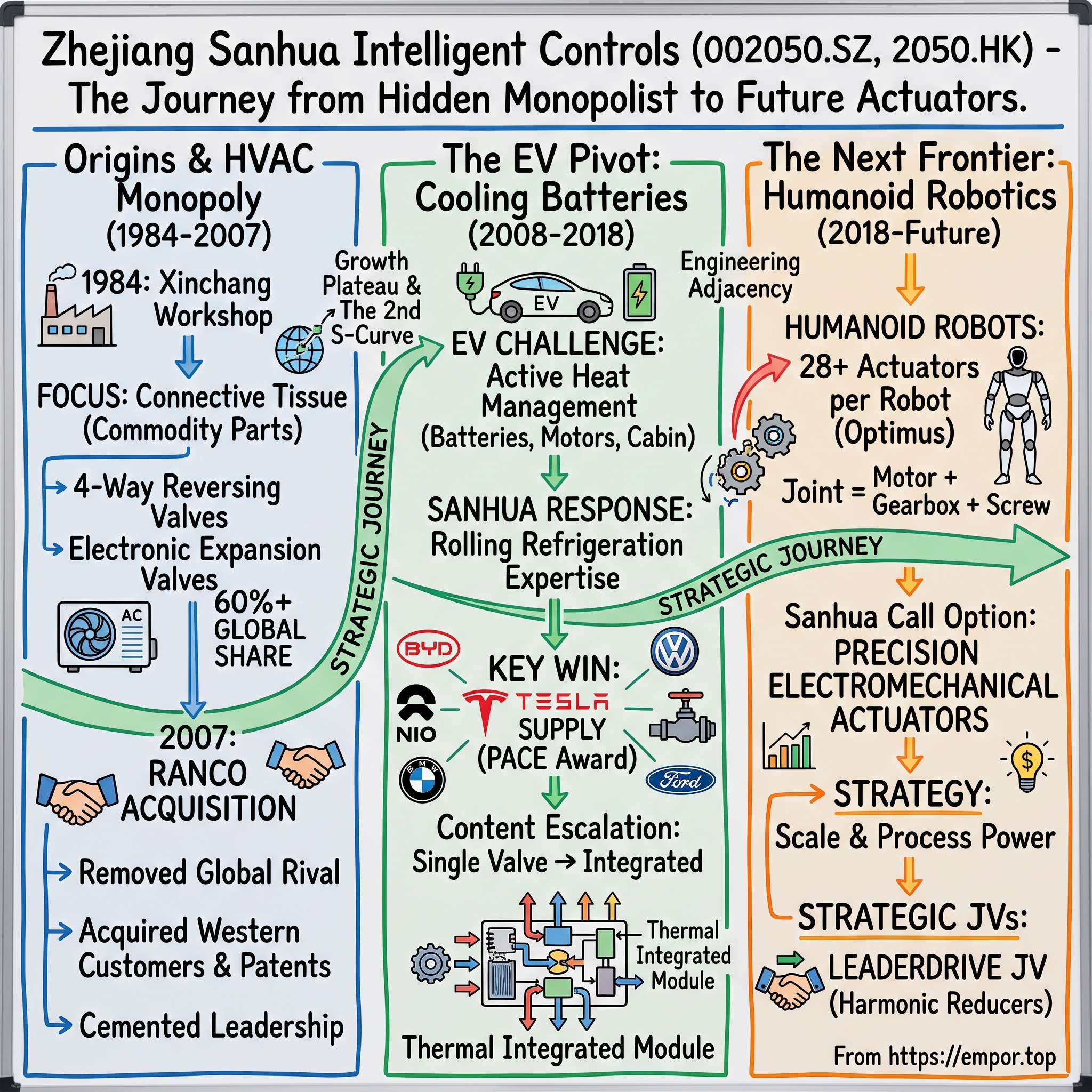
Zhejiang Sanhua Intelligent Controls: The Hidden Monopolist Inside Your AC, EV, and Future Humanoid Robot
I. Introduction & Episode Roadmap
Somewhere in the wall unit humming behind you on a hot afternoon, there is a small brass valve about the size of a thumb. Twice a year, when your air conditioner switches from cooling in summer to heating in winter, that valve silently flips the direction of refrigerant flow through the entire system. You will never see it, never name it, and never think about it. But there is roughly a two-in-three chance it was made by a company most Western investors have never heard of, in a former township workshop in the hills of eastern China.
That company is 浙江三花智能控制股份有限公司 Zhejiang Sanhua Intelligent Controls Co., Ltd., listed as 002050.SZ on the 深圳证券交易所 Shenzhen Stock Exchange and, since June 2025, also as 2050.HK on the 香港交易所 Hong Kong Stock Exchange. In 2025 it booked revenue of roughly RMB 31 billion and net profit of just over RMB 4 billion, and its shares at times carried a market capitalization north of RMB 200 billion.12 It controls an estimated 60%-plus of the world market for the humble four-way reversing valve and more than half of residential electronic expansion valves.3 It is, in the truest sense, a hidden monopolist.
Here is the core premise of this story. If you cool your home, if you drive an electric vehicle built by 特斯拉 Tesla or 比亚迪 BYD, and — perhaps — if you believe humanoid robots are coming, then your world quietly depends on Sanhua's mastery of one deceptively narrow discipline: moving fluids and heat through tiny, precisely machined metal parts that cannot leak, cannot stick, and cannot fail across a decade of use.
This is the kind of company Acquired episodes are made for precisely because it is invisible. There is no logo on the outside of the box, no brand a consumer chooses, no product anyone lines up to buy. Sanhua lives one or two layers up the supply chain from anything you can see, which is exactly why its economics are so durable and so poorly understood. Businesses that sell an essential, hard-to-make component to a handful of giant customers occupy a strange position: they are simultaneously indispensable and powerless, dominant in their niche yet perpetually squeezed by buyers far larger than themselves. Untangling that paradox — indispensable but squeezed — is the analytical spine of everything that follows.
We will use the Acquired framework throughout, but we will keep our hands on our wallets. The bullish reading is that Sanhua has two durable sources of advantage — scale economies in ultra-high-volume valve production, and process power accumulated over four decades of metallurgy and precision assembly — and that it has ridden, or is trying to ride, three successive secular waves: residential HVAC, electric-vehicle thermal management, and now humanoid-robot actuators. The skeptical reading is that each successive wave is lower-margin, more customer-concentrated, and more speculative than the last, and that the market has at times priced the third wave as if it had already arrived. Both readings deserve a fair hearing.
The roadmap for this episode: first, the Xinchang roots and the 2007 兰柯 Ranco acquisition that turned a domestic leader into a global one. Second, the high-stakes pivot into EV thermal management and the landing of Tesla. Third, the segment economics — the HVAC cash cow versus the automotive growth engine. Fourth, the robotics optionality, and how much of it is real. Fifth, governance, family succession, capital allocation, the competitive war-game, and the bull-versus-bear stress test. Let us start where every good industrial story starts: with almost nothing.
 Subscribe on LinkedIn
II. Xinchang Origins & The HVAC Valve Monopoly (1984–2007)
Xinchang is a county in the hills of Zhejiang, better known historically for tea and for a giant carved Buddha than for advanced manufacturing. In 1984, a local technician named 张道才 Zhang Daocai took charge of a small refrigeration-parts operation attached to a technical school and renamed it the Xinchang Refrigeration Components Factory — the seed of what would become the Sanhua group.45 There was no venture capital, no foreign joint-venture partner, no obvious path to a global market. There was a workshop, a lathe, and a bet on an unglamorous corner of the appliance supply chain.
The strategic instinct that would define Sanhua for the next forty years was visible from the beginning: go narrow, go deep, and pick the parts nobody else wanted to fight over. While the marquee names of the refrigeration world chased compressors — the expensive, high-status heart of any cooling system — Zhang aimed at the connective tissue. Four-way reversing valves. Service valves. Solenoid valves. Check valves. These are the components that route refrigerant to the right place at the right pressure. They are individually cheap, collectively essential, and brutally unforgiving to manufacture, because a valve that leaks or sticks turns an entire air conditioner into scrap.
To picture why this niche is defensible, consider what a four-way reversing valve actually does. An air conditioner and a heat pump are, mechanically, almost the same machine running in opposite directions — cooling pushes heat outside, heating pulls it inside. The reversing valve is the switch that flips the refrigerant's path so one box can do both jobs. It has to seal against high-pressure refrigerant, survive tens of thousands of switching cycles, and cost only a few dollars. That combination — trivial price, non-trivial reliability — is exactly the kind of problem where the low-cost, high-yield manufacturer wins and keeps winning, because customers will not risk a warranty disaster to save a few cents.
There is a discipline hidden in that choice that is easy to romanticize and worth stating plainly. Choosing the boring part is only an advantage if you can make it better and cheaper than anyone else, forever. A compressor is a system you can differentiate with features; a reversing valve is a commodity you win purely on cost and defect rate. Zhang's wager was that he could out-manufacture the world on the least glamorous item in the box — that he could turn the very commoditization that scared others away into a fortress, because in a true commodity the lowest-cost, highest-yield producer does not merely lead, it eventually owns the category. It is the same insight that built companies like the fastener and bearing giants of the industrial world, arrived at independently in a Chinese county town.
The early years were not a smooth ascent. China in the 1980s and 1990s was a place where a township enterprise had to solve everything itself — machine tools, raw-material supply, quality systems, export licenses — often without reliable electricity, let alone reliable capital. Sanhua's edge in this environment was relentless process improvement: reinvesting thin early profits into automation and metallurgy rather than into scale for its own sake, so that each generation of valve came off the line at higher yield and lower cost than the last. This is where the "process power" that shows up decades later in the analyst decks was actually forged — not in a lab, but on a shop floor iterating tens of millions of times.
Through the 1990s and early 2000s, Sanhua ground its way up the global share curve the hard way, one appliance customer at a time. By 2006 its four-way valve output had reached roughly 21 million units a year, about half of global supply — a striking figure for a company that had begun as a school workshop two decades earlier.3 The listed vehicle, 002050.SZ, reached the Shenzhen exchange in 2005, giving the group public currency and a balance sheet to act on.6 What it did with that currency is the hinge of the whole story.
There is a piece of corporate folklore that captures the moment perfectly. In 1998, executives from the American firm Ranco — then a storied name in HVAC controls — reportedly visited Xinchang scouting Sanhua's four-way valve line, the posture of a giant sizing up a minnow.3 Less than a decade later, the roles had reversed. In 2007, Sanhua acquired Ranco's global four-way reversing valve business, absorbing its brands, patents, manufacturing know-how, and Tier-1 customer relationships in Europe and North America.37
The acquisition was less a bet than a coup de grâce. Sanhua did not buy Ranco to enter the market; it already led the market. It bought Ranco to remove its most credible international competitor, to acquire a Western customer book and patent estate it would otherwise have spent years building, and to vault its global share past 60%.3 In one stroke, a domestic champion became the world's structural monopolist in a category that legacy Western industrial names like Danfoss 丹佛斯 and Parker Hannifin would never seriously contest again on cost.
It is worth sitting with the M&A logic, because it reveals how Sanhua thinks. A less disciplined acquirer buys a rival to add revenue; a strategic one buys a rival to change the industry's structure. By absorbing Ranco, Sanhua did not just get bigger — it removed the price umbrella under which a Western competitor could survive, took ownership of the qualification relationships that would otherwise take a decade to earn inside conservative appliance OEMs, and signaled to every remaining competitor that the cost floor now belonged to Xinchang. The deal was reportedly struck at a conservative valuation relative to where the assets would have traded at the top of the cycle, which is the acquirer's version of buying low.3 For a business whose entire moat is being the lowest-cost, highest-yield producer, consolidating the last credible source of pricing competition was worth far more than the revenue on Ranco's books.
There is also a subtler point about brand and geography. Owning the Ranco name and its Western manufacturing know-how gave Sanhua something a pure low-cost Chinese exporter usually lacks: legitimacy inside American and European supply chains that were, and remain, wary of single-sourcing a safety-critical part from one country. That legitimacy would matter enormously a decade later, when the automotive industry — far more paranoid about supplier risk than the appliance world — came calling.
The lesson an investor should take from the first act is not that Sanhua got lucky. It is that a low-cost manufacturer with a genuine yield and scale advantage, sitting on public-market currency, used a downturn in a rival's fortunes to convert a lead into dominance. That is a repeatable behavior — and, as we will see, Sanhua would try to repeat exactly this playbook in an entirely different industry. But first it had to notice that its home market was running out of room.
III. The Great EV Pivot: From Cooling Rooms to Cooling Batteries (2008–2018)
Every cash cow eventually stops growing. By the late 2000s, Sanhua's management could see the shape of its own ceiling. Air conditioning in China was booming, but penetration curves do not rise forever, and in developed markets the residential HVAC story was already mature. A company that owned 60% of a market growing at low single digits is a wonderful cash generator and a mediocre growth stock. The question that animated the next decade was blunt: where does the second S-curve come from?
The answer came from an unlikely direction — the physics of the electric car. To understand why EVs were such a gift to a thermal-controls company, you have to understand a quirk of the internal combustion engine. A gasoline engine is spectacularly inefficient; most of the energy in the fuel becomes waste heat. In winter, that "waste" is a feature — it heats the cabin for free, and simple mechanical valves manage the rest. An ICE car's thermal system is, thermally speaking, a solved and cheap problem.
An electric car is the opposite. Its motor and battery are efficient, which means they throw off relatively little heat, which means there is no free warmth to scavenge in winter. Worse, a lithium battery is a fussy patient: it wants to live in a narrow temperature band, it degrades if charged too hot or too cold, and it can catch fire if thermal management fails. So an EV must actively move heat in every direction at once — warming the cabin, cooling the battery during fast charging, keeping the motor and power electronics in range — using a reversible heat-pump loop that looks, conceptually, a great deal like an air conditioner turned into a circulatory system.
This is the punchline that reframed Sanhua's entire future: the EV heat pump is a rolling refrigeration system, and Sanhua had spent forty years mastering exactly the valves and controls it needs. The dollar content told the story. A conventional ICE car carried on the order of $50 of thermal parts; an EV's bidirectional heat-pump architecture pushed that figure toward several hundred dollars and, for fully integrated modules, higher still. The market Sanhua understood better than almost anyone had suddenly multiplied its value-per-vehicle several-fold — and it was attached to the fastest-growing product category on earth.
Consider the heat pump analogy one more level down, because it is the crux of why this pivot was natural rather than heroic. In a home, a heat pump is a fixed box moving heat between inside air and outside air. In an EV, the "rooms" are the cabin, the battery pack, the motor, and the power electronics, and the system must decide, second by second, which of them needs warming and which needs cooling, sometimes stealing waste heat from the motor to warm a cold battery on a winter morning. Orchestrating that dance requires many precisely controlled valves opening and closing on command — which is to say, it requires exactly the electronic expansion valve Sanhua had already learned to build for high-end air conditioners. The company did not have to invent a new competence; it had to repackage an existing one for a customer with far higher reliability standards and far deeper pockets.
The watershed customer was Tesla. Sanhua built the electronic expansion valve and the integrated thermal components tailored to Tesla's heat-pump design, and it entered Tesla's supply chain around 2016 as the electric-vehicle program scaled, later earning a PACE supplier award — the automotive industry's recognition for component innovation — for its expansion-valve technology.8 To appreciate why this mattered, remember what a Tesla design win signals to the rest of the industry. Tesla's validation is a stamp that says a supplier can hit automotive-grade reliability and volume. Every other automaker evaluating EV thermal suppliers now had Sanhua on the shortlist by default.
To build the automotive muscle behind that win, Sanhua also reorganized itself. It brought its microchannel heat-exchanger operation fully in-house in 2015 and consolidated its automotive components business shortly after, giving it ownership of both the valves and the heat exchangers that make up a thermal loop.8 This is the vertical-integration move that separates Sanhua from a pure component vendor: when a customer asks for a complete, pre-plumbed thermal module rather than a bag of parts, the supplier that already makes every piece inside it wins on both cost and coordination. Sanhua was deliberately assembling the ability to sell the whole subsystem, not just the cheapest valve inside it.
What let Sanhua win against entrenched automotive Tier-1s — Hanon Systems, Denso 电装, Valeo, Mahle — was not a single trick but a stack of advantages. It came at thermal management from the refrigeration side, where it already owned the hardest core component, the precision valve, rather than from the automotive side where those parts were bought in. It was vertically integrated, machining its own valves and, increasingly, its own heat exchangers. And it moved fast, in an industry where the legacy incumbents were structurally slow. That speed advantage is the seed of a counter-positioning argument we will test later: the incumbents were organized around ICE cooling loops and were reluctant to cannibalize that business, and Sanhua exploited the gap.
The direction of attack matters more than it first appears. The legacy Tier-1s were HVAC-and-engine-cooling businesses that had to learn valves; Sanhua was a valve business that had to learn automotive. In a heat-pump world where the electronic expansion valve is the single hardest, highest-value component, starting from the valve was starting from the mountaintop. The incumbents could assemble a thermal module, but they typically bought the precision valve inside it from someone else — often, eventually, from Sanhua. That is the quiet irony of the pivot: some of the very Tier-1s Sanhua "competed" with also became its customers, buying the one part they could not make as cheaply or as well. A supplier that sells to its own rivals is occupying a genuinely privileged rung of the value chain.
The China dimension amplified all of this. As Chinese EV makers — BYD above all, plus the new-energy brands 蔚来 NIO and 小鹏汽车 XPeng — went from curiosities to the largest EV cohort on earth, they wanted local, fast, cost-competitive thermal suppliers, and Sanhua was sitting right there with automotive-grade credibility already stamped by Tesla. The company effectively caught two waves at once: the global shift to EVs and the specific, explosive rise of the Chinese EV industry on its doorstep. Winning both the world's most demanding EV brand and its highest-volume domestic ones is how a component maker turns a design win into a franchise.
A note of caution belongs here, because it will echo through the rest of the story. Winning Tesla was a triumph, but it also planted the seed of Sanhua's central vulnerability: dependence on a handful of enormous, ferociously cost-driven customers. That tension — brilliant growth engine on one side, brutal buyer power on the other — is exactly what the segment economics reveal when you open the financials.
IV. Core Financial Breakdown & Segment-Level Economics
If you want to understand a company, ignore the slogans and follow the money. Sanhua's 2025 results tell a clean, two-part story. Group revenue came in at RMB 31.01 billion, up about 11% year on year, while net profit attributable to shareholders jumped roughly 31% to RMB 4.06 billion.12 The gap between those two growth rates is the first thing worth pausing on: profit grew nearly three times faster than sales. Profit outrunning revenue like that usually signals one of two things — operating leverage as fixed costs get spread over more volume, or a favorable shift in mix and input costs. For Sanhua in 2025, it appears to have been a bit of both, and management proposed a notably high dividend alongside the result.2 That is the behavior of a business generating more cash than it can immediately reinvest in its mature segment.
The revenue splits cleanly into two engines. The refrigeration and air-conditioning components business — the historic cash cow — accounted for roughly 63.9% of sales, while the automotive components business made up about 36.1%.1 Hold those two numbers in mind, because the whole investment debate lives in the tension between them.
The cash cow: refrigeration and air-conditioning components
The first engine is the one we have already met. This segment sells four-way reversing valves, residential and commercial electronic expansion valves, solenoid valves, and microchannel heat exchangers to the giants of the appliance world — 美的集团 Midea Group, 海尔智家 Haier Smart Home, Carrier, Daikin, Trane, Panasonic. Its economics are the quiet foundation of everything else: dominant global share, gross margins in the high-20s, and — crucially — predictability. Appliance demand is cyclical but not fragile, and Sanhua's share is so large that its volumes track the global HVAC market rather than any single customer's fortunes.
The analytical point is that this segment is valuable less for its growth than for its role as a funding source. A business with 60% share of a slow-growing category cannot compound revenue quickly, but it can throw off high-return, low-reinvestment cash year after year. That cash is what pays for the automotive R&D, the overseas factories, and the robotics experiments. In effect, the world's air conditioners are subsidizing Sanhua's bet on the future of motion. Whether that is disciplined capital allocation or empire-building is a question we will return to — but the cash itself is real.
There is a demand tailwind worth naming here that keeps this "cash cow" from being a euphemism for "stagnant." The global push toward heat pumps as a decarbonization tool — replacing gas furnaces with electric systems that both heat and cool — plays directly to Sanhua's strongest product. Every heat pump installed in place of a furnace is, in effect, a reversing valve and an expansion valve sold. So while residential air conditioning in mature markets is saturated, the electrification of heating gives the "boring" segment a genuine, policy-driven secular nudge that the market tends to overlook while it stares at robots. It is not a growth engine on the scale of automotive, but it is more than a runoff annuity.
The growth engine: automotive thermal management
The second engine is where the excitement — and the margin pressure — lives. Automotive components generated RMB 12.43 billion in 2025, up about 9.1%.1 The product line has climbed steadily up the value chain: from individual automotive expansion valves and electronic water pumps toward complete thermal-management integrated modules and battery cooling plates. This "content escalation" is the heart of the bull case for the segment. When Sanhua sells a single valve, it captures a few hundred renminbi of content per car; when it sells an integrated manifold that bundles valves, pumps, sensors, and plumbing into one qualified module, the content per vehicle can rise into the thousands. The customer list reads like a census of the EV era — Tesla, BYD, 吉利汽车 Geely, 蔚来 NIO, 小鹏汽车 XPeng, plus VW, BMW, GM, and Ford.
But notice what the margin structure reveals. Automotive gross margins run several points below the HVAC segment's. That is not an accident or a fixable inefficiency; it is the price of doing business with automakers, who extract annual cost reductions as a condition of the relationship. So the segment is a genuine growth engine and a structurally lower-margin one. As it grows from a third of revenue toward half, simple arithmetic says group gross margin faces a mix headwind unless the integrated-module strategy lifts automotive margins faster than the HVAC mix falls. That is the single most important operating tension in the business, and it is worth watching every quarter.
Here the automaker's price-down ritual deserves explanation, because it is unfamiliar to investors used to consumer or software businesses. In automotive Tier-1 supply, the customer typically negotiates a contractual annual price reduction — often in the low single digits of percent — baked into the life of a platform. The supplier is expected to "give back" a slice of price every year, on the theory that it should be getting more efficient as volumes ramp. For a supplier, this is a treadmill: you must cut your own costs by at least the give-back rate every year just to hold margin flat. Sanhua's answer is twofold — automate faster than the treadmill moves, and change the unit of sale from a cheap valve (easy to price-shop) to a complex integrated module (hard to price-shop, because the customer is buying qualification and integration, not just metal). Whether that answer wins is not a matter of faith; it is the automotive gross margin line, quarter after quarter.
Global nearshoring and the tariff chessboard
There is a third thread running through the financials that is really a geopolitical strategy. Sanhua has been building production hubs outside China — Ramos Arizpe in Mexico, plus Poland, Vietnam, and the United States — to sit inside its customers' trade blocs. A cooling plate for a Tesla built in Texas is worth more, and far less exposed to tariff risk, if it is made in Mexico under USMCA rules of origin than if it is shipped from Zhejiang. This is defensive capital spending: it protects existing revenue from the whims of trade policy rather than generating new revenue on its own. It also, conveniently, positions the Mexican footprint for the robotics story — but we are getting ahead of ourselves. The point for now is that a meaningful share of Sanhua's recent capex is best understood as an insurance premium against a fracturing global trade order.
Each node in that footprint maps to a customer geography and a trade regime: Mexico for North American OEMs under USMCA, Poland for the European auto cluster, Vietnam for tariff-diversified Asian supply, the United States for proximity to the customers most sensitive to "made in China" origin. This is the logic of following your customer to the factory gate — a strategy the Japanese and Korean auto suppliers pioneered decades ago when they built plants beside Toyota and Hyundai transplants abroad. Sanhua is running the same playbook a generation later, from a Chinese starting point, at a moment when the political penalty for a Chinese origin is higher than it has ever been. The bet is that local production converts a geopolitical liability into a local-supplier advantage. The risk, which we will return to, is that a Chinese-owned plant on foreign soil can itself become a target if trade politics harden further.
Which brings us to the part of the story where the financials stop being facts and start being hopes.
V. The Next Frontier: Humanoid Robotics & Electromechanical Actuators
Let us be precise about something the market often blurs. In 2025, humanoid-robot components contributed essentially nothing to Sanhua's revenue — call it zero.9 Any honest discussion of robotics here is a discussion of optionality, not of earnings. With that stake in the ground, the interesting question is why a serious thermal-controls company is included in nearly every "humanoid robot supply chain" list an investor encounters.
The answer is engineering adjacency. A humanoid robot's economic heart is its joints — the actuators that let it move. Each joint bundles a motor, a gearbox or reducer, a screw or linkage to convert rotation into force, sensors, and precise controls into a compact, reliable module. Tesla's Optimus design is widely described as using on the order of 28 actuators — roughly 14 rotary and 14 linear — per robot.10 Now compare that to what Sanhua already builds: electronic expansion valves are, at their core, tiny electromechanical actuators — a motor precisely positioning a metering element inside a sealed housing, mass-produced to micron tolerances at automotive reliability. The claim is that the discipline of making a hundred million precise little motion devices a year transfers, at least partly, to making robot joints.
That is a plausible claim, not a proven one. The transferable competence is real — precision motors, gear machining, high-volume automated assembly, quality control. But a robot joint also demands capabilities Sanhua has not historically owned at scale, most notably the roller screws and harmonic reducers that give a joint its strength and precision. This is where Sanhua's capital deployment gets specific and revealing.
Let us demystify those two parts, because they are where the money and the difficulty concentrate. A roller screw converts a motor's spin into a strong, precise push-and-pull — it is what lets a linear actuator in a robot's leg carry weight without slipping, and it is fiendishly hard to manufacture at low cost and high durability. A harmonic reducer (or harmonic drive) is a compact gearbox that turns a fast, weak motor spin into a slow, powerful, backlash-free rotation — it is what gives a robot's rotary joints their precision. Together, screws and reducers can account for a large share of the bill of materials of a humanoid, which is why the whole industry is scrambling to localize them at automotive-like cost. Sanhua's argument to investors is that its factories, tuned over decades to make precise metal parts by the tens of millions cheaply, are the natural home for this scale-up. The counter-argument is that "precise metal parts" is a broad category, and a valve is not a roller screw; the specific tolerances, materials, and failure modes are different enough that transfer is a hypothesis, not a guarantee.
On the reducer problem, Sanhua did what it did with Ranco decades earlier — it went to the specialist. In April 2023, it signed a framework agreement with 苏州绿的谐波传动科技股份有限公司 Suzhou Leaderdrive Harmonic Drive Co., Ltd. (绿的谐波 Leaderdrive), China's dominant maker of harmonic reducers, to form a joint venture inside Sanhua's Mexican industrial park to localize harmonic-drive production in North America.11 Read strategically, this is elegant: Sanhua contributes manufacturing scale and a bloc-compliant Mexican footprint; Leaderdrive contributes the one core component Sanhua lacks; and the JV is positioned precisely where a North American robot program would want its suppliers. Sanhua also committed capital to robotics R&D and pilot assembly capacity at home, signaling that this is a funded initiative rather than a press release.9
Then came the headline that lit up A-share message boards. In October 2025, media reports circulated that Tesla's Elon Musk had placed an actuator order with Sanhua worth about $685 million, with deliveries from Mexico beginning in 2026.12 It is a thrilling number — enough, by some estimates, to equip well over a hundred thousand Optimus units. It is also a number that Sanhua itself did not confirm; in a Hong Kong exchange filing, the company stated the report had not been verified by the company.12 An independent investor should hold both facts at once: the strategic positioning is genuine and well-funded, and the specific blockbuster order that drove the stock is, as of this writing, unconfirmed by the company.
Myth versus reality. The consensus retail narrative reads: "Sanhua is a locked-in Tesla Optimus supplier with a $685 million order in hand." The verifiable reality is narrower and more honest. What is documented is a funded strategic initiative — the Leaderdrive JV, the Mexican industrial park, the R&D commitment — plus wide industry reporting that Sanhua is a leading actuator-module candidate, and a company clarification that the headline order figure is unverified. Those are very different statements. One is a booked contract; the other is a credible position on a shortlist for a product still being finalized. The gap between them is where sentiment-driven volatility lives, and it is exactly the gap a careful investor should refuse to paper over. The bull is not wrong that Sanhua is well-placed; the bull is wrong if they treat "well-placed" as "already won."
So how should a sober investor size this? The retail narrative treats Sanhua as an "Optimus concept stock," where every Musk tweet moves the shares. The engineering reality is a three-to-five-year grind: designing joint modules, qualifying roller screws and reducers at yields that make money, and scaling production only if and when humanoid robots reach volumes that today exist mostly in slides. Robotics may become a real third S-curve. It may also stall for years. The correct posture is to value it as a call option with a wide range of outcomes and a strike price paid in R&D — not as a segment with a forecastable P&L. That distinction is where a lot of money will be made or lost, and it depends heavily on who is steering the capital.
It is also worth naming the specific way this option could disappoint even if humanoids succeed. Being on a supplier shortlist is not the same as owning a socket. Tesla and other robot developers are deliberately multi-sourcing actuator components across a wide field of Chinese and other suppliers precisely to avoid dependence and to drive cost down — the same buyer-power dynamic that pressures the automotive segment, now applied to a part that does not yet exist at volume. So even the bullish scenario, in which humanoids ship by the million, does not automatically translate into fat margins for Sanhua; it could just as easily reproduce the low-margin, price-clawback treadmill of the auto business, with more competition. The optionality is genuine, but its most likely realized form is "another competitive, capital-intensive components line," not "a high-margin monopoly like the reversing valve." Bulls should want the upside; realists should not assume the terms.
VI. Leadership, Governance, & Capital Allocation
Family businesses live or die on succession, and Sanhua's is instructive precisely because it has been so undramatic. Founder Zhang Daocai, the technician who renamed a school workshop in 1984 and spent four decades turning it into a global monopolist, has moved into the role of elder statesman — chairman of the parent 三花控股集团 Sanhua Holding Group Co., Ltd. and honorary figurehead of the listed company.45 Forbes has tracked him among China's wealthier industrialists, a fortune built entirely on parts most people cannot name.13
The founder himself is worth pausing on, because his temperament is stamped on the company. Zhang Daocai was a hands-on technician before he was a chairman — a man who came up through the shop floor of a refrigeration-parts workshop rather than through finance or trading. That engineering-first sensibility explains the entire strategic personality of Sanhua: the obsession with yield and process rather than with brand or deal-making, the patience to grind up a share curve over decades, and the willingness to spend on automation long before it was fashionable. Companies tend to reflect the instincts of the person who built them, and Sanhua's instinct — pick a hard physical problem and become the best in the world at it — is unmistakably an engineer's, not a marketer's.
Operational control has passed to the second generation, and it has passed cleanly. 张亚波 Zhang Yabo serves as vice chairman and president of the holding group and chairs the listed entity, while 张少波 Zhang Shaobo holds a director's seat.5 The absence of a public succession fight is itself a governance data point. In a Chinese private industrial group of this size, a smooth generational handover — with the founder stepping back rather than clinging on — is the exception, not the rule, and it lowers one of the classic risks investors attach to founder-led firms.
The second generation also inherited a harder job than the first. Zhang Daocai's task was to dominate one product in one industry; his successors must manage a company straddling three — appliances, autos, and robots — each with different customers, margins, and cultures, while defending a legacy monopoly and financing two speculative expansions at once. The clean succession removes the distraction of a family fight, but it does not guarantee the strategic judgment the next decade demands. That judgment is what investors are really underwriting when they buy into a founder-controlled industrial group: not the founder's past record, but the heirs' ability to allocate his cash wisely.
The ownership structure aligns incentives in the way long-term investors generally like: the Zhang family retains ultimate control through the holding group, giving management a very large personal stake in decisions made for the next decade rather than the next quarter. That alignment cuts both ways, of course. Concentrated family control also means minority shareholders are along for whatever ride the family chooses, with limited ability to object to, say, an ambitious robotics bet or a related-party transaction with the unlisted parent. The related-party surface between the listed company and the broader Sanhua group is exactly the sort of thing a skeptical investor should keep an eye on, even when nothing is currently amiss.
On capital allocation, the record is the strongest part of the bull case. Sanhua has historically compounded at high returns on equity — in the high-teens to low-20s percent range — while funding its expansion predominantly from operating cash flow rather than piling on debt.9 A business that can self-fund entry into a capital-hungry industry like automotive Tier-1 supply, and do it without diluting shareholders or levering the balance sheet, has earned some benefit of the doubt when it asks for capital for the next adventure.
The subtle test of capital discipline, though, is not whether a company earns high returns in its established business — it is what it does when a shiny new adventure appears. This is exactly where the robotics push, the Hong Kong raise, and the overseas build-out converge into a single question: is Sanhua reinvesting mature-business cash into genuine adjacencies, or diversifying away from what it does best? So far the honest verdict leans favorable. The company has funded automotive from cash flow and reached for external capital only when the ambition genuinely outgrew internal resources, and each new venture — heat exchangers, thermal modules, reducers — sits within one recognizable competence rather than sprawling into unrelated empires. But the discipline is now being tested harder than at any point in its history, because robotics is the first adjacency where Sanhua is spending real money ahead of any revenue at all. That is the definition of a call option, and also the definition of the moment when disciplined founders sometimes overreach.
That next adventure is what the 2025 Hong Kong listing was really about. Twenty years after its Shenzhen debut, Sanhua listed H-shares on the Hong Kong exchange in June 2025, raising roughly US$1.19 billion — one of the year's marquee billion-dollar offerings — to fund overseas factory expansion and, explicitly, robotics.1415 The market's reception was a useful cold shower: the shares priced at HK$22.53 and opened at HK$20.95, about 7% below the offer price, the first such debut stumble among that year's billion-dollar Hong Kong IPOs, even though the institutional book had been many times oversubscribed.16 The "A+H" dual-platform structure gives Sanhua access to international capital and a hedge against any single market's mood, but the soft debut was a reminder that even a great franchise can be priced for perfection.
The choice to raise external equity at all is itself worth a moment's scrutiny for a company that prides itself on self-funding. Reading it charitably, a Hong Kong listing does more than raise money: it gives a Chinese manufacturer a hard-currency war chest and an internationally visible listing precisely when its strategy hinges on building factories in Mexico, Poland, Vietnam, and the United States to serve global customers wary of China concentration. In that light, the H-share is as much a geopolitical instrument as a financing one. Read more skeptically, tapping equity markets to fund a robotics bet that generates no revenue is the kind of move that looks like vision in a bull market and like dilution in a bear one. Both readings will be judged by how the overseas capacity fills.
Governance stories are sharpest when a rival stumbles, and Sanhua's clearest recent one involves its domestic competitor. When the parent of 浙江盾安人工环境股份有限公司 Zhejiang DunAn Artificial Environment Co., Ltd. (盾安环境 DunAn Environment) hit liquidity trouble at the start of the decade, appliance giant 格力电器 Gree Electric, led by the formidable 董明珠 Dong Mingzhu, stepped in — acquiring roughly a 38.8% stake through share transfers and a private placement to become DunAn's controlling shareholder.17 The strategic logic for Gree was vertical integration: lock up a key valve supplier. But the second-order effect was to hand Sanhua a gift. Gree's fiercest appliance rivals — Midea and Haier — now had every reason to steer their high-end valve business away from a Gree-controlled competitor and toward the independent alternative. Sanhua did not need to fire a shot to consolidate its position with the two customers that mattered most. It simply had to remain neutral while its rival was absorbed into a customer's enemy. That is the kind of structural advantage you cannot buy — and it sets up the competitive war-game.
VII. Competitive Landscape, Industry Structure, & Hamilton Helmer's 7 Powers
Picture the industry as a fortress with a very long drawbridge. In both appliance and automotive supply chains, a new component supplier does not simply win an order; it endures a qualification process that can run two to three years, during which the customer tests, audits, and re-tests every claim about reliability and yield before a single part ships in volume. That qualification cycle is the moat and the wall at once — it keeps Sanhua out of nothing, because it is already inside, and it keeps everyone else out of the accounts Sanhua already holds.
The competitive map has two theaters. In HVAC components, the rivals are 盾安环境 DunAn Environment — now Gree-backed — along with Denmark's Danfoss 丹佛斯 and America's Parker Hannifin. In automotive thermal management, the field is the established Tier-1 order: Korea's Hanon Systems, Japan's Denso 电装, France's Valeo, and Germany's Mahle. Sanhua is unusual in fighting credibly on both fronts, because the underlying competence — precision fluid control — is shared across them.
The DunAn rivalry is the one to watch most closely, because it is the only competitor that attacks Sanhua on its home turf with a comparable cost structure. DunAn is a genuine number-two in Chinese HVAC valves, and in electronic expansion valves specifically it has been a persistent challenger rather than a distant follower. What changed the dynamic was less any product breakthrough than the ownership shift discussed earlier: once DunAn fell under Gree's control, it acquired a captive customer and a deep-pocketed parent, but it also acquired a conflict of interest that its parent's rivals could not ignore. The competitive lesson is that in a concentrated supply chain, neutrality can be a moat. Sanhua's independence — its willingness to sell to everyone and its lack of a downstream appliance business of its own — is precisely what makes it the safe choice for Midea and Haier. The moment a supplier is owned by a customer's enemy, its addressable market shrinks by the size of that enemy's rivals.
It is worth running Sanhua through Hamilton Helmer's 7 Powers, because the framework separates the durable advantages from the merely nice.
Scale Economies. This is Sanhua's foundational power. Producing valves at a volume no competitor matches — on the order of a hundred million-plus units a year in the core categories — spreads the fixed costs of tooling, automation development, and raw-material procurement across a base that structurally sits below any rival's cost floor.3 In a business where the customer's decision often comes down to cents per part at equal reliability, being the lowest-cost producer is not a marketing line; it is the whole game.
Switching Costs. In automotive, these are severe and underappreciated. Once an automaker validates a thermal loop around a specific integrated module, ripping that module out mid-vehicle-cycle means re-engineering and re-validating a safety-critical system. The customer is, in effect, locked in for the life of the platform. This is what makes the content-escalation strategy so powerful: every valve that becomes part of a qualified module deepens the lock-in.
Process Power. Four decades of proprietary knowledge — metallurgy, micro-channel brazing, zero-leakage sealing, high-speed automated assembly — is the hardest advantage to describe and the hardest to copy, because much of it is tacit, embedded in tooling and shop-floor practice rather than in patents. This is why a well-capitalized entrant cannot simply buy its way to Sanhua's yields; the knowledge took forty years to accumulate and does not transfer in a data room.
Counter-Positioning. This is the most interesting — and most contestable — power. The bull argument is that legacy automotive Tier-1s were anchored to ICE engine-cooling loops and were slow, even reluctant, to pivot to EV heat pumps, letting Sanhua capture the new architecture early. There is truth in it. But an investor should stress-test it, because counter-positioning erodes once incumbents wake up. Denso, Valeo, and Mahle are not asleep in 2026; they are pouring resources into EV thermal management. The question is whether Sanhua's head start converts into a permanent cost-and-relationship lead or merely a temporary one that normalizes as the incumbents catch up. The honest answer is: partly the former, but the advantage is narrowing, and the segment's below-average margins are the market already pricing that in.
Sanhua scores nothing on the remaining powers — it has no branding power (customers buy on cost and reliability, not logo), no network economies, and no cornered resource. That is fine. A business can be extraordinarily durable on scale and process alone.
Running Porter's Five Forces confirms the shape. Supplier power is moderate: Sanhua is exposed to copper and aluminum prices, but its scale and contractual pass-through pricing blunt the blow. Buyer power is high and is the real vulnerability — Tesla, BYD, and their peers wield enormous leverage and extract annual price cuts as routine. Threat of substitutes is essentially nil, because moving heat and metering refrigerant are physical necessities with no software workaround. Barriers to entry are extremely high, thanks to the qualification gauntlet and the global-footprint requirement. The overall picture is a business with a formidable moat on the supply and entry side and a genuine, structural squeeze on the demand side. That is precisely the tension the bull and bear cases fight over.
Rivalry among existing players — Porter's fifth force — deserves a final word, because it differs sharply by segment. In HVAC valves, rivalry is muted: Sanhua's scale is so dominant that competitors mostly compete for the share Sanhua does not want, and pricing is relatively stable. In automotive, rivalry is intense and getting more so as the deep-pocketed Tier-1s throw resources at EV thermal management and Chinese challengers emerge behind Sanhua. The strategic read is that Sanhua's profit pool is protected where it is entrenched and contested where it is growing — a comfortable structure for cash generation and an uncomfortable one for margin expansion. Any investor tempted to extrapolate the HVAC segment's serenity onto the automotive segment is making a category error the competitive map does not support.
VIII. The Investment Story Spine: Bull vs. Bear Case & Activist Stress Test
Every industrial monopolist eventually faces the same question from investors: is the moat a fortress or a memory? Let us make the spine explicit — why Sanhua wins from here, and what could break the case — and then subject it to the kind of stress test a skeptical long-short investor would apply.
The bull case
The bull case rests on four pillars, in descending order of certainty. First, the HVAC cash cow is genuinely unassailable in any near-term horizon; 60%-plus share of a category with no substitute, defended by scale and process power, throws off the cash that funds everything else. Second, EV content escalation gives the automotive segment a growth vector that does not depend on EV unit volumes accelerating — even in a flat EV market, moving from selling a valve to selling an integrated module multiplies Sanhua's revenue per car. Third, the overseas nearshoring footprint hedges the single biggest external threat, trade fragmentation, by putting production inside customers' tariff walls. Fourth, robotics is a real call option with asymmetric upside and a modest, self-funded cost of carry.
Notice that the certainty declines as you go down the list — and, unfortunately, the market's enthusiasm tends to run in the opposite direction, weighting the speculative fourth pillar most heavily. A disciplined investor inverts that ordering.
The strongest version of the bull case does not actually need the robots. It runs like this: Sanhua owns an irreplaceable, cash-generative HVAC franchise; it is winning structural share in a multi-decade EV thermal build-out where content per vehicle is still rising; and it is hedging the one macro threat — trade fragmentation — with a global footprint few Chinese peers can match. On those three pillars alone, it is a high-quality industrial compounder. Robotics is the free lottery ticket stapled to the back. If you find you can only justify the current price by assuming the lottery ticket pays, that is a signal about valuation, not about the business.
The bear case and the activist stress test
The bear case is not that Sanhua is a bad business; it is that a great business can be a poor investment at the wrong price or under deteriorating terms. Four challenges deserve real weight.
The first is customer concentration meeting buyer power. Sanhua's automotive fortunes are tied to a small set of enormous customers, above all Tesla and BYD, both famous for squeezing suppliers. An activist would press management on a simple question: as the automotive mix rises, can internal automation and modularization lift margins fast enough to offset relentless annual price clawbacks, or does group margin slowly bleed? The company's answer — process automation and higher-value integrated modules — is credible but unproven at the scale required, and it is the right thing to interrogate on every earnings call.
The second is EV demand itself. The content-escalation story cushions Sanhua against soft EV volumes, but it does not immunize it. A genuine stall in Western EV adoption would pressure segment utilization and hand customers even more pricing leverage. This is a cyclical risk layered on top of a structural one.
The third is geopolitics cutting the other way. The Mexican footprint is a tariff hedge today, but it is also a Chinese-owned manufacturing asset inside North America at a moment of acute US-China friction. A tightening of USMCA rules of origin, or outright measures targeting Chinese-owned plants, could turn a hedge into a liability. The insurance policy has its own counterparty risk.
The fourth is valuation and narrative. When a substantial slice of a stock's price reflects a robotics future that generates zero revenue today — and that rests partly on an order the company itself has not confirmed — any slippage in the humanoid timeline can compress the multiple violently. The 7% first-day dip in the Hong Kong debut, against a wildly oversubscribed book, was a small foretaste of how quickly sentiment and price can diverge.16
There is a fifth challenge a short-seller would raise that is really about the quality of the narrative itself. When a company becomes a "concept stock" — when its shares move on humanoid-robot headlines more than on valve volumes — the burden shifts to management to keep expectations tethered to reality. Sanhua's own decision to publicly state that a widely reported blockbuster robot order had not been confirmed by the company is, read one way, exactly the discipline you want: it declined to ride a rumor that was inflating its stock.12 Read another way, the very fact that such a rumor could move the shares at all reveals how much speculative air is embedded in the price. A skeptic's sharpest question is not "is the business good?" — it plainly is — but "how much of today's valuation is paying for valves I can count, versus robots I am imagining?"
An activist would also poke at governance: the concentrated family control, the related-party surface with the unlisted parent, and the reinvestment of mature-segment cash into an unproven adventure. None of these is a scandal. All of them are exactly the questions minority holders should keep asking, precisely because the family's alignment is strong enough that it will do what it believes is right whether or not minorities agree.
What the calls reveal
The live version of this debate plays out in the analyst Q&A, where the recurring pressure point is margin defense under OEM price pressure. Management's consistent framing — that internal automation and the shift to integrated modules protect gross margins even as customers demand annual cuts — is the thesis on which the entire automotive segment stands or falls. It is a testable claim, and the way to test it is not to accept the narrative but to watch the automotive gross margin line quarter after quarter and see whether the story survives contact with reality. Which is exactly what the KPIs are for.
IX. Financial Playbook, Risk Radar, & Key KPIs
If you were to track this company with three dials on your dashboard and ignore the noise, these are the three that matter.
The first and most important is automotive thermal-management gross margin. This single number is the referee for the central debate of the whole story. If Sanhua can hold automotive gross margin in roughly the low-20s percent range despite annual OEM price reductions, it proves that the integrated-module strategy and internal automation are real defenses rather than management hopes. If that margin erodes year after year, it means buyer power is winning and the growth engine is quietly a margin-dilution machine. Everything management claims about the automotive segment is verifiable, or falsifiable, in this line.
The second is market share in EV electronic expansion valves and integrated thermal modules. Sanhua's whole automotive thesis is that it can carry its HVAC dominance into EVs. Share is the scoreboard. As long as it holds a commanding position — well above 40% globally in the core EV thermal-expansion components — the counter-positioning story is intact and the incumbents have not caught up. A visible slide in share would be the early warning that Denso, Hanon, and Valeo are closing the gap the bull case assumes stays open.
The third is overseas revenue contribution and the ramp of the Mexican footprint. This is the tariff-hedge and robotics story made measurable. A rising share of revenue generated outside China, and evidence that the Ramos Arizpe complex is filling with real, profitable volume, would confirm that the nearshoring capex is paying off rather than sitting as expensive, underutilized insurance. If the overseas plants stay half-empty, the capital allocation case weakens.
Why only three? Because a good KPI is one that is decision-relevant, hard to fake, and directly tied to the thesis. Group revenue growth is too coarse — it blends the cash cow's steadiness with the growth engine's volatility and tells you nothing about the debate that matters. Reported net profit can be flattered by one-off items and dividends. The three dials above, by contrast, each interrogate a specific claim: automotive margin tests pricing power, EV valve share tests the durability of the moat against reviving incumbents, and overseas ramp tests whether the capital plan is working. Track those, and the robotics headlines become entertainment rather than analysis — you will see the third S-curve show up in real revenue and margin when it is real, and not before.
Around those three dials sits the risk radar, and here the discipline is to weigh only the risks whose mechanism actually touches this business. Geopolitical and trade risk is first-order: changes to US tariffs, Section 301 duties, or USMCA rules of origin bear directly on both the automotive and robotics footprints. Input-cost volatility in copper and aluminum is real but largely contractually hedged, a second-order concern. Customer concentration in the automotive top five is a persistent structural exposure rather than an event risk. And execution risk in robotics — the yields and validation timelines for roller screws and joint actuators the company has not mass-produced before — is the one that determines whether the third S-curve is a triumph or an expensive detour. Notice what is absent from this list: the generic macro fears that apply to every company. Sanhua's risks are specific, and that specificity is what makes them trackable.
X. Epilogue & Strategic Lessons
Step back from the valves and the actuators and the trade blocs, and Sanhua leaves a handful of durable lessons for anyone who studies businesses for a living.
The first is the quiet power of the micro-niche. There is a persistent bias among investors toward the visible and the glamorous — the consumer brand, the software platform, the thing you can hold up at a dinner party. Sanhua is a standing rebuke to that bias. It built one of the most defensible franchises in global manufacturing by owning a part most people cannot name, in a category no one else wanted to fight for, and it earned returns on equity that would flatter many a software company along the way.9 Mastery of the unsexy, compounded for forty years, turns out to be a formidable moat.
The second lesson is the art of surfing sequential S-curves. Sanhua took a single core competence — the precise control of fluids and heat — and rode it across three distinct macro eras: residential air conditioning in the 1990s and 2000s, electric vehicles in the 2010s and 2020s, and, perhaps, humanoid robotics from here. The discipline in that pattern is worth naming. The company did not abandon its cash cow to chase the new thing; it used the cow to fund the chase, entering each new wave from a position of genuine, transferable competence rather than blind diversification. The robotics bet will test whether that discipline holds or tips into over-reach — and an honest observer must admit we do not yet know which.
The third lesson is about generational capital discipline. The most consequential decisions in this story — the Ranco acquisition, the EV pivot, the overseas build-out, the robotics option — were all acts of reinvesting mature-business cash into inflection points, made by owner-operators with their own fortunes on the line and a time horizon measured in decades. That is the mechanism behind a great deal of durable industrial value creation, and it is exactly what a smooth family succession is meant to protect.
There is a fourth lesson, quieter than the others, about the strange virtue of being unglamorous. Sanhua's obscurity is not a marketing failure to be fixed; it is structural, and it is part of the moat. Because the company sells no consumer brand, it never has to spend on brand; because its product is a hidden necessity rather than a fashion, demand does not swing on taste; and because its customers are sophisticated engineers rather than fickle consumers, its competitive battles are fought on the honest ground of cost, yield, and reliability rather than hype. The flip side — the same obscurity that makes the business durable makes the stock prone to being either ignored or, in episodes like the robotics mania, wildly over-imagined. The investor's edge in a company like this comes precisely from doing the unglamorous work: counting valves, watching a margin line, and refusing to be moved by a headline the company itself would not confirm.
So what is Sanhua, in the end, for a long-term investor? It is neither the invincible compounder its A-share enthusiasts imagine nor the overhyped robot-concept stock its skeptics dismiss. It is a genuinely dominant, genuinely well-run industrial franchise, with an unassailable cash cow, a growth engine caught between real content expansion and real margin pressure, and a speculative option whose value the market keeps trying to book before the engineering has been done. The moat is a fortress on the supply side and a running battle on the demand side. Whether the next chapter is a third triumphant S-curve or an expensive lesson in the limits of adjacency will be written not in press releases but in one line of the income statement and one figure of market share — which is exactly where a serious investor should keep watching.
References
-
Sanhua released its 2025 annual performance, net profit RMB 4.063 billion, up 31.1% YoY — Futu News, 2026 ↩↩↩↩
-
Zhejiang Sanhua Intelligent Controls 2025 Profit Soars Over 30%; Steady Growth in Core Segments; High Dividend Proposed — BigGo Finance, 2026 ↩↩↩
-
Sanhua Intelligent Controls Hits 220 Billion Market Cap: How a Small-Town Factory Manager Became Shaoxing's Richest Person — Tiger Brokers ↩↩↩↩↩↩↩
-
Sanhua Holding Group Leadership Team — Sanhua Holding Group ↩↩↩
-
From Township Factory to Trillion-Yuan Giant: Is Robotics Sanhua Intelligent Controls' Next Destination? — Tiger Brokers ↩
-
Sanhua Intelligent Controls: From a Small Factory in Zhejiang to a Giant Worth Hundreds of Billions, the Secret Behind Three "Bold Gambles" — 36Kr ↩↩
-
Zhejiang Sanhua Intelligent Controls Co., Ltd. 2024 Annual Report — Sanhua Intelligent Controls, 2025 ↩↩↩↩
-
Tesla Optimus Robot's China Supply Chain Accounts for 70%, Yangtze River Delta Industrial Cluster Emerges as Biggest Winner — BigGo Finance, 2025 ↩
-
Elon Musk's Plan to Build One Million Robots: How Many Motors, Reducers, and Lead Screws Are Made in China? — 36Kr ↩
-
How Sanhua Became Tesla's Key Humanoid Robot Actuator Candidate: Inside the Optimus Supply Chain — RobotToday, 2025 ↩↩↩
-
Clifford Chance advises Sanhua Intelligent Controls on its US$1.19 billion IPO and listing in Hong Kong — Clifford Chance, 2025-06 ↩
-
Linklaters advises on Sanhua Intelligent's US$1.2bn HKEX debut — Linklaters, 2025-06 ↩
-
Sanhua shares fall in Hong Kong debut, first drop in 2025's club of billion-dollar IPOs — South China Morning Post, 2025-06-23 ↩↩
-
From "buy buy buy" to "sell sell sell": Gree Electric's shareholding moves and its DunAn Environment stake — Futu News ↩
 LinkedIn
 WhatsApp
 Reddit
 Hacker News
 Email
Email Kindle
 RSS Feed
 Spotify
 Apple Podcasts
 Amazon Music
 Audible
 YouTube