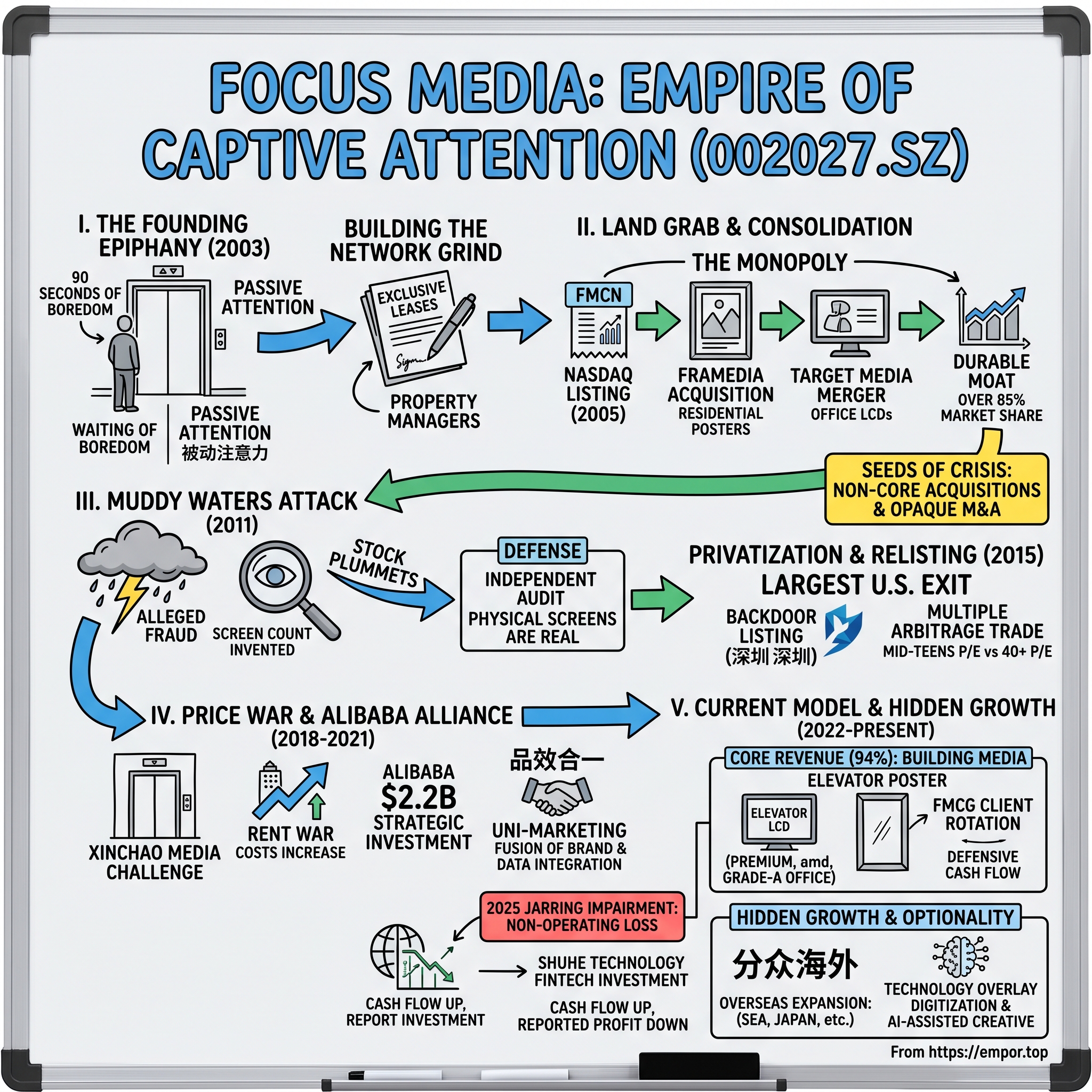
Focus Media: The Empire of Captive Attention
I. Introduction & Episode Roadmap
Picture the lobby of a Grade-A office tower in Shanghai's Lujiazui financial district at 8:52 on a Tuesday morning. Two dozen people in business attire stand in a loose cluster in front of a bank of elevators, watching the floor numbers tick down. Nobody speaks. Phones are out, but the signal in the shaft is weak and the wait is only ninety seconds—not long enough to load anything satisfying, too long to stare at the wall. So the eyes drift, almost involuntarily, to the one bright, moving, sound-emitting object in the room: a liquid-crystal screen mounted at eye level, looping a fifteen-second spot for a bottled tea, a luxury EV, or a snack brand you first heard of last week. You are not choosing to watch it. You simply have nowhere else to look.
That ninety seconds is the entire business model of 分众传媒 Focus Media Information Technology Co., Ltd. (002027.SZ). The company did not invent the elevator, the office tower, or the advertisement. What its founder understood in 2003 was subtler: that in a media world about to be blown apart by the internet, the scarcest asset of all would not be content but attention—and that the most reliably capturable attention in urban China sat, bored and idle, in the few square meters where the white-collar middle class waits to go up. The rest of the advertising industry was busy chasing eyeballs across an exploding number of channels. Focus Media went the other way. It found the one place people could not look away, and it bolted a screen to the wall.
Two decades later, that insight has hardened into physical infrastructure at genuinely national scale. Focus Media operates roughly 2.28 million self-run media points across more than 300 cities in China and a handful of overseas markets—on the order of 1.22 million 电梯电视 Elevator LCD screens in lobbies and around 1.06 million 电梯海报 Elevator Poster frames inside and beside the cabs—plus a cinema network of roughly 22,000 pre-film screens.12 In 2025 that footprint generated total revenue of RMB 12.76 billion, roughly USD 1.8 billion, up about 4% on the year.45 The economics underneath are what make investors lean in: operating margins on the core business north of 40%, a balance sheet carrying no net debt, operating cash flow of more than RMB 7 billion, and a habit of paying out the overwhelming majority of earnings as dividends.4 For years the stock has been treated in China less as an advertising cyclical and more as a bond-like cash machine with an option on the consumer economy attached.
But "cash machine" is the tidy version, and this is not a tidy company. The arc from here runs through some of the most dramatic set pieces in modern Chinese corporate history. There is the poet-turned-adman 江南春 Jason Jiang Nanchun, who built the network by knocking on the doors of property managers one tower at a time. There is the 2005 NASDAQ listing and the frenzied acquisition spree that followed, which stitched together a near-monopoly and, in the same motion, bloated the company with goodwill and self-dealing that would later prove radioactive. There is November 2011, when short-seller 浑水研究 Muddy Waters Research published a report accusing Focus Media of inventing tens of thousands of screens, and the stock lost more than half its value in days.[^7]7 There is the record USD 3.7 billion buyout that took the company private off the American market, and the audacious relisting in Shenzhen that nearly doubled the money in eighteen months—one of the great valuation-arbitrage trades in Asian finance.811 There is the price war launched by 新潮传媒 Xinchao Media, the USD 2.2 billion peace treaty signed with 阿里巴巴 Alibaba Group, and the long grind back to pricing power.1213
And there is the present-day puzzle at the center of any honest investment view: a business that throws off enormous, defensive cash, tethered to two exposures it cannot fully control—the health of China's consumer-brand advertising budgets, and the rent demanded by the landlords who own the walls. In 2025 the company delivered a jarring reminder that its reported earnings are not as clean as the cash flows suggest, when a single impairment knocked reported net profit down nearly 43% even as the core network kept humming.416 The tension in that one sentence—cash flow up, reported profit down—is, in miniature, the entire reason a serious investor has to look past the headline at this company. This is the story of how a bored ninety seconds became a ten-billion-yuan empire, how it survived a fraud allegation, a buyout, a valuation round-trip, and a rent war—and of what could still take it apart.
 Subscribe on LinkedIn
II. Founding Epiphany & The "Elevator Micro-Moment" (2003–2005)
The poet who found a wall
Before he was a media mogul, Jason Jiang was a poet. Born in Shanghai in 1973, he studied Chinese literature at East China Normal University, wrote verse, and by his own account was the kind of student who ran the drama society and chaired the campus poetry association. There is a temptation to treat that biography as color, but it is closer to the plot. Jiang's gift was never engineering or finance; it was language and persuasion—the ability to hold a room, to sell an idea, and, crucially, to see a familiar scene the way no one else was bothering to see it. He backed into advertising the way many talented arts graduates in early-1990s China did—because it paid, and because the industry was young enough that a clever twenty-something could run it. By the mid-1990s he had founded Shanghai Eastline Advertising (永怡传播), a creative agency that at its peak claimed a meaningful slice of Shanghai's IT-sector ad billings.
He was good at it. He was also, by 2002, bored and slightly trapped. Agency work is a service business: you live at the mercy of clients who can fire you and media owners who set the prices, and you capture none of the underlying asset value you help create. Jiang had built a respected shop and hit its ceiling. What he wanted was to own something—an asset that threw off cash whether or not any individual client stayed, a piece of the media pipe rather than a fee for filling it. He just did not yet know what that asset was.
The epiphany, and why it was more than a hunch
The story he has told many times is almost embarrassingly mundane. He was standing in a lobby waiting for an elevator, watching people around him do nothing, and he asked the obvious question that nobody in the advertising business had bothered to answer: what are all these people looking at right now? The answer was nothing. A blank wall, a mirror, the elevator doors. Here was a daily, repeatable, geographically concentrated pool of exactly the audience every premium advertiser wanted—urban professionals with disposable income—and they were being served zero commercial messages at the precise moment they were bored, stationary, and unusually receptive.
To understand why that observation was worth building a company on, you have to remember what was happening to Chinese media in 2003. For decades, national attention had flowed through one dominant funnel: 中央电视台 CCTV and the provincial state broadcasters. That world was starting to fracture. Broadband internet was arriving, audiences were splintering across websites and channels, and the old certainty that a single prime-time TV buy reached "everyone" was dissolving. Advertisers could feel the ground shifting but did not yet have a replacement for the mass reach they were losing. Jiang's structural bet was counterintuitive: that as digital attention became infinitely fragmented and increasingly evasive, physical attention would become more valuable precisely because human routines don't fragment. People still had to go to work, still had to ride the elevator, still had to wait. The internet could splinter what people watched; it could not splinter where their bodies had to be at 8:52 on a Tuesday.
Naming the superpower: 被动注意力
The concept the company later gave this idea was 被动注意力—"passive," or captive, attention. The pitch is best understood by contrast, and the contrast is what makes it durable. An online ad lives in a fundamentally hostile environment: the viewer can scroll past it, install a blocker, close the tab, skip after five seconds, or simply tune it out through the sheer fatigue of seeing a thousand of them a day. The entire medium is optimized to let the user escape the message. An elevator lobby is the mirror image. It is a small, enclosed, low-stimulation box where the advertisement is often the only thing moving and making noise, and where—especially inside the cab itself—cellular reception is poor enough that the phone stops being a competing screen. You are, for a minute or two, a genuinely captive audience.
The subtlety that sophisticated advertisers grasped is that Focus Media never needed you to like the ad, or even to consciously register it. It only needed you to be unable to avoid it, repeatedly, day after day, at the same moment in your routine. That is a nearly perfect mechanism for the specific job brand advertising does: not to make a sale in the moment, but to drill a name and a jingle into memory through frequency until, weeks later, standing in a supermarket aisle, your hand reaches for the brand you have unconsciously seen four hundred times. For launching a new consumer product—what the Chinese marketing world calls 爆品打造, building a "hit"—forced, high-frequency repetition to a captive urban audience is close to an ideal delivery system.
The unglamorous rollout and the real product
The early years were door-to-door grind, and the grind is where the moat was actually poured. Focus Media's real product in this period was not screens; it was contracts. Specifically, multi-year, exclusive leases with the property-management companies (物业公司) that controlled the lobbies of Grade-A office towers (写字楼) in Shanghai and Beijing. The unit economics were beautiful in their simplicity. Sign the landlord to an exclusive; bolt an inexpensive LCD to the wall; load it with a loop of high-frequency spots; sell those slots to premium brands hungry for that exact demographic. The hardware was cheap and the incremental cost of running one more building was low, so once a city was blanketed, additional advertising revenue dropped to the bottom line at very high margins.
The genius, though, was in the sequencing, and it is the reason the second act of this story is a story about acquisitions. Whoever locked up the best buildings first would own a resource that literally could not be duplicated: there is only one wall beside each elevator, and it can be leased to exactly one company at a time. This was not a market where a better product could win; it was a market where the first mover to sign the landlord simply took the location off the board for everyone else. Land grab first, monetize second, and pray you have more capital than the other people who have just realized the same thing. By 2005, Jiang had proven the model in a handful of cities and understood exactly what he needed next. He needed a great deal of money, and he needed it faster than any Chinese bank would give it to a two-year-old advertising startup. So he went to Wall Street.
III. The NASDAQ Listing & M&A Land Grab (2005–2008)
Wall Street funds a Chinese wall
In July 2005, Focus Media Holding listed on NASDAQ under the ticker FMCN, raising roughly USD 128.5 million and becoming the first Chinese media company on the exchange; it would eventually earn a place in the NASDAQ-100 index.10 For a five-city elevator-screen operator barely two years old, this was a spectacular result, and it is worth appreciating how unusual it was. In 2005, Chinese companies listing in New York were mostly commodity plays and a few internet names; a domestic advertising business with a physical footprint and a novel, hard-to-explain "captive attention" thesis was a genuine oddity. American investors bought the growth story, and the listing handed Jiang precisely the weapon the land grab required: a liquid, dollar-denominated currency he could spend buying up everyone else's walls before they woke up to what he was doing.
He spent it fast, and with a clear strategic map. Focus Media's own network was strong in one territory—the LCD screens in commercial office lobbies—but the broader elevator-advertising universe had two other rich seams that Jiang did not yet control. One was the static poster frames inside residential elevator cabs, a different physical product serving a different audience (families rather than office workers). The other was the office-LCD networks of direct competitors, who were signing their own landlords in a parallel land grab. Left alone, those rivals would either bid up lease prices in the buildings Focus Media wanted or build a competing national network. Jiang's answer was to buy them.
Two deals that built the monopoly
In 2005, Focus Media acquired 框架传媒 Framedia, the dominant operator of static elevator-cab poster frames (电梯海报), for a reported USD 183 million.10 Framedia extended Focus Media out of the commercial towers and into the enormous residential market in a single stroke, and it did so by buying the incumbent rather than fighting it building by building—far cheaper and faster than organic expansion in a first-mover-takes-all market.
The following year came the marquee deal, and the one that clinched dominance. After a bruising bidding war, Focus Media absorbed its principal rival in office-building LCD, 聚众传媒 Target Media, in a stock-and-cash transaction valued at roughly USD 325 million.10 Target had been the one competitor with the scale and ambition to build a genuinely national office network of its own; buying it removed the only serious threat to Focus Media's core franchise. With Target neutralized, Focus Media's share of commercial elevator digital media vaulted past 85%. The land grab, in its home territory, was effectively finished. Focus Media had won the thing it set out to win: a durable, near-monopoly grip on the most valuable captive-attention inventory in urban China.
Winning, and the seeds of the crisis
Here is where a triumphant story quietly turns. Flush with a soaring share price and a Wall Street mandate to grow into an ever-richer multiple, Jiang pushed the company well beyond the thing it actually understood. In 2007, Focus Media paid around USD 225 million for 聚胜万合 Allyes, an online advertising-agency and ad-network business—a bet that Focus Media could become a diversified digital-media conglomerate rather than a focused physical-network operator.10 It layered on a mobile-advertising arm, outdoor billboards, and a thicket of smaller acquisitions. Every one of these deals was defensible on its own slide; each promised "synergy" with the core, or exposure to a hot new channel. Together they transformed a clean, legible, cash-generative business into a sprawling entity carrying a mountain of goodwill and a dense web of inter-company and related-party transactions that few outsiders could untangle.
This is the pattern worth dwelling on, because it is the hinge of the entire story and a recurring theme in Focus Media's history right up to 2025. The elevator business was real, simple, and enormously profitable. The acquisition spree grafted onto it a set of businesses that were none of those three things—and, far more dangerously, created the appearance of a company that grew by serial M&A at market-peak prices, wrote down what it bought, and transacted with parties connected to insiders. Whether or not any individual deal was improper is almost beside the point. The aggregate silhouette—opaque, acquisitive, complex, dependent on the market taking management's numbers on faith—is exactly the profile that forensic short-sellers hunt for. Jiang had built a monopoly on captive attention and, in the very same motion, built the perfect target. It took four years for someone to pull the trigger. In November 2011, someone did.
IV. The Short-Seller Crisis, Muddy Waters, & The $3.7B Privatization (2011–2013)
The ambush
On November 21, 2011, Carson Block's Muddy Waters Research published an initiation report on Focus Media with a "Strong Sell" rating, and the market did not wait for the company to answer. Block had spent 2011 becoming the most feared name in China-focused short selling; his firm's work had helped detonate Sino-Forest earlier that year, wiping out billions and helping to bankrupt one of the most widely held Chinese names on the Toronto exchange. When Muddy Waters spoke, in that specific season, capital moved first and asked questions later.
The Focus Media report made two accusations, and both were aimed squarely at the credibility of everything the company reported. The first was physical and gloriously specific: Muddy Waters alleged that Focus Media had overstated the size of its LCD network by roughly 50%—claiming on the order of 178,000 display units when the true count, the report argued, was under 120,000, with the exaggeration concentrated in the high-value Tier-1 city inventory where advertising rates ran far richer.[^7] The second was financial and echoed the very concern raised in the last section: that the company had "significantly and deliberately" overpaid for acquisitions—Allyes prominently among them—and then written the assets down, a sequence the report framed as value destruction that masked insider self-dealing.[^7]7
Sixty percent, in a day
The reaction was violent. FMCN shares fell as much as 65% intraday and closed the first session down roughly 40%, erasing billions of dollars in market value in a matter of hours.7 It is hard to overstate how combustible the environment was. The 中国证券监督管理委员会 CSRC, the U.S. SEC, and a swarm of short-sellers were all circling the entire cohort of U.S.-listed Chinese reverse mergers and ADR filers, whose accounting and auditor arrangements had become a systemic crisis of confidence.718 Investors had been trained by Sino-Forest to shoot first. A "Strong Sell" from the most credible bear in the market, landing on a company whose own acquisition history looked exactly like the thing bears were warning about, was a lit match dropped into a dry field.
The rebuttal that mostly worked
To Jiang's credit, his counter-offensive was concrete rather than rhetorical, and it targeted the report's most falsifiable claim. The heart of the Muddy Waters attack was countable and physical—the screens do not exist—and that is precisely the kind of allegation you can rebut with a database, an audit, and a tape measure. Focus Media disclosed the findings of an independent audit-committee review, opened its screen-installation records, and effectively invited analysts and investors to verify the network city by city.7 Over the following weeks and months, the screen-count allegation largely failed to stick; the core physical network was demonstrably real and generating real cash.
The governance charges around the acquired digital businesses were harder to wave away, and management's posture there was more defensive—understandably, because that was the genuinely messy part of the company. The honest reading of the episode is that the bull and the bear were each half right. The elevator network was exactly as real, dominant, and cash-generative as Focus Media claimed. The diversified acquisitions were exactly the opaque, hard-to-defend, value-questionable appendage the bear described. The stock partially recovered as the fraud thesis unraveled, but something had broken that could not be repaired: the premise that a business this complex, operating physically in China, belonged on a market where its investors could never touch the assets and would always suspect the numbers.
The largest exit from America
Which set up the boldest structural move in the company's history. If American investors would never again pay full value for a business they viewed as un-auditable and faintly suspect, then the rational play was to take the company away from them entirely and sell it to buyers who would. In August 2012, Jiang and a private-equity consortium—anchored by 凯雷集团 Carlyle Group, 方源资本 FountainVest Partners, 中信资本 CITIC Capital, and additional partners—proposed to buy out Focus Media and delist it. In May 2013, shareholders approved a take-private valuing the company at roughly USD 3.7 billion.89 At the time it was the largest privatization of a U.S.-listed Chinese company ever completed, a leveraged buyout that closed the American chapter for good.910
But the sponsors had not written a USD 3.7 billion check to own a bond. They had bought a monopoly on captive attention at a price set by a market that had lost faith in it—a market suffering, in effect, a China discount so severe it was willing to sell a genuine franchise at a cyclical, distressed multiple. The consortium was betting that the discount was a feature of the venue, not the asset. And they already knew where they intended to sell it next, at a price that would make the buyout look like a steal.
V. The Valuation Arbitrage: Relisting on the A-Share Market (2015–2016)
The same cash flows, two different prices
The trade at the center of this chapter is one every investor should study, because it is a near-perfect illustration of how identical cash flows can be worth radically different amounts depending only on who is permitted to buy them. On NASDAQ, Focus Media had been priced like what its skeptics insisted it was: an opaque, cyclical, faintly disreputable advertising agency, worthy of a low-to-mid-teens earnings multiple and a permanent suspicion discount that the Muddy Waters saga had only deepened.
Onshore in China, the very same business read completely differently. To domestic A-share investors, Focus Media was not an ad agency at all. It was an irreplaceable, quasi-monopoly toll booth on the attention of the urban middle class—a scarce, understandable, unambiguously "China consumption" asset of exactly the kind mainland buyers were willing to pay 40 times earnings or more to own. Nothing about the company's screens, leases, or cash flows had changed between New York and Shenzhen. The only thing that changed was the identity, psychology, and regulatory cage of the buyer. That gap—between a mid-teens multiple and a 40-plus multiple on the same profit stream—was the entire opportunity, and the consortium had bought the company precisely to harvest it.
The backdoor, explained
Capturing the gap required getting Focus Media listed in Shenzhen, and the front-door route—a conventional IPO—was effectively closed. China's IPO approval queue ran years long and was periodically frozen outright by regulators managing market conditions; a company Focus Media's size could wait half a decade for a slot, if it ever came. So the consortium used the classic Chinese workaround, the 借壳上市 or backdoor listing. The mechanics are worth making concrete, because "backdoor listing" is often used as if it were sinister when it is really just a corporate-finance shortcut. Instead of taking Focus Media public directly, you find a company that is already public but nearly worthless as an operating business—a "shell"—and you inject your valuable private company into it, so that the private company's shareholders end up owning the listed entity.
The chosen shell was 七喜控股 Hedy Holding, a struggling Shenzhen-listed electronics maker whose own business had withered. Through a 2015 restructuring that cleared China's regulatory approvals, Hedy acquired Focus Media using a mix of cash, newly issued shares, and an asset swap, in a transaction that valued Focus Media at roughly RMB 45.7 billion—about USD 7 billion.11 When the paperwork settled, Hedy's old electronics operations had been swapped out, the shell had been filled with the elevator empire, and the whole thing traded under a new identity: 分众传媒 Focus Media, ticker 002027.SZ, on the 深圳证券交易所 Shenzhen Stock Exchange.211
One of Asia's great exits—and a warning
Run the arithmetic on the round trip and it is staggering. The consortium took the company private at roughly USD 3.7 billion in 2013. Barely two years later it re-emerged onto the Chinese market at an equity value of around USD 7 billion—very nearly double—without any transformational change to the underlying operations.811 The overwhelming majority of that gain was not operational. It was pure multiple arbitrage: the profit from physically relocating an identical asset out of a market that discounted it and into a market that prized it. For the private-equity sponsors it ranks among the most profitable large-cap exits in Asian corporate history, and for Jiang personally it converted his American liability into a liquid, richly valued domestic currency he could use to defend and extend the network.
The independent investor's lesson from this chapter is double-edged, and it should be carried through the rest of the story. On the one hand, the trade powerfully validated the durability of the underlying franchise. Sophisticated, patient capital paid a full price for the same asset twice; nobody does that for a mirage. The moat was real, and the smartest money in Asia effectively said so with billions of dollars. On the other hand, the episode is a permanent reminder that Focus Media's share price has always been as much a creature of prevailing sentiment and multiple as of operating performance. A market that will pay 40 times earnings for a "scarce consumption monopoly" in a bullish mood can, when that mood curdles, reprice the identical monopoly with brutal speed. That very dynamic was about to be tested from an unexpected direction—not by a re-rating of the multiple, but by a well-funded rival who decided the monopoly's margins were worth attacking directly.
VI. Price War 2.0: Xinchao Media & The Alibaba Strategic Alliance (2018–2021)
The challenger finds the soft flank
For roughly a decade after it consolidated the office towers, Focus Media enjoyed the quiet life of an unchallenged incumbent. Then came 新潮传媒 Xinchao Media, and the quiet ended. Xinchao's founder built the company on a shrewd reading of exactly where Focus Media was, and was not, strong. The fortress was nearly impregnable in commercial office buildings, where relationships, scale, and premium inventory all favored the incumbent. But Focus Media's grip on residential elevators—the apartment blocks where families ride up and down every day—was looser, more fragmented, and far more contestable. Any operator could bid for an apartment building's wall; there was no deep relationship moat to overcome. So that is where Xinchao attacked. Backed by a war chest from investors reported to include 百度 Baidu, 京东 JD.com, and 红杉中国 Sequoia Capital China, it launched a frontal assault on the residential segment around 2017–2018, and it fought on the single axis that hurts an incumbent most: rent.14
Why an elevator rent war is uniquely dangerous
The mechanics of an elevator-media price war deserve to be spelled out, because they explain why this business is simultaneously wonderful and fragile. Focus Media's costs are dominated not by hardware or salaries but by the fees it pays property managers for the exclusive right to a wall. Those fees are the raw material of the entire enterprise. When a hungry, venture-funded rival appears and offers a landlord two or three times the going rate to switch providers at the next renewal, the incumbent faces an ugly binary: either match the inflated bid, in which case its own lease costs balloon and margins compress, or walk away and lose the location outright. There is no clever third option, because the wall is physical and exclusive—you cannot share it.
Xinchao's entire strategy was to weaponize that binary across residential buildings: bid up landlord rents everywhere, force Focus Media to choose between margin compression and lost coverage, and burn investor capital doing it in the hope of reaching enough scale to become a permanent second national network. For a couple of years it bit. Focus Media's gross margins felt the squeeze as point-level rents climbed. Worse, the pain arrived at exactly the wrong moment on the demand side: many of Focus Media's largest advertisers in that era were cash-burning internet startups spending venture money to acquire users, and as that funding tightened in 2018, those very clients slashed their ad budgets. Rising costs, softening revenue, and a rival explicitly trying to bleed the company dry—this was the most dangerous stretch since Muddy Waters.
The USD 2.2 billion peace treaty
Into that moment stepped Alibaba. On July 18, 2018, Alibaba announced it would invest USD 2.2 billion for a 10.3% economic interest in Focus Media. The structure is telling: part of the money bought Focus Media shares directly, and part—around USD 504.7 million—bought roughly a 10% slice of the holding entity through which Jiang himself controlled the company.121314 Alibaba was not just buying a stake in the business; it was buying into the founder's control vehicle, aligning itself with Jiang at the top of the ownership pyramid.
The strategic logic ran deeper than a rescue infusion for a company under margin pressure, though the timing—arriving mid-war—made the balance-sheet support enormously valuable in its own right. Alibaba's obsession in that period was 品效合一, the fusion of brand-building ("品") with performance conversion ("效"). Focus Media offered something Alibaba's own screens and apps could not: mass, offline, brand-building exposure to hundreds of millions of consumers at a captive moment. Alibaba offered something Focus Media had never possessed: deep consumer data. The vision, articulated through Alibaba's Uni Marketing and Uni Desk data stack, was to make the dumb elevator screen smart—to know which buildings held which kinds of shoppers, to target ad placement accordingly, and to close the loop by retargeting elevator-exposed consumers later, online, on Alibaba's platforms.
That is a seductive story, and investors should treat it with real skepticism, because a decade on it is genuinely debatable how much of the promised online-offline data synergy was ever delivered at scale. Elevator screens remained, in practice, largely a broadcast medium sold on reach and frequency, not a precision-targeted, closed-loop machine. The tangible value of the Alibaba alliance was less the futuristic data integration and more the immediate, unambiguous signal it sent: at the precise moment a rival was trying to starve Focus Media of oxygen, China's most powerful internet company planted USD 2.2 billion as an anchor and told the market this franchise was worth backing.
Winning by refusing to fight everywhere
How the war actually resolved is more instructive than the truce that funded it, and it is the single clearest demonstration of where Focus Media's moat is real and where it is thin. Focus Media did not win by out-spending Xinchao in every building. It won by declining to fight everywhere. It doubled down on the high-yield, hard-to-replicate inventory—the Grade-A office towers (A类写字楼) locked under multi-year exclusive agreements, where its sales density and national-advertiser relationships delivered economics no challenger could match—and it deliberately let Xinchao pour capital into the lower-yield residential blocks that were cheaper to contest and less profitable to hold. It let the challenger buy market share in the worst part of the market at the highest possible cost.
Then patience did the rest. As the venture-funding tide went out across Chinese tech in 2019–2021, Xinchao's ability to subsidize inflated rents faded, the rent war cooled, and Focus Media reasserted pricing power in the inventory that actually mattered. The episode left a durable truth embedded in the investment case, one that maps directly onto the segment economics of the company today: the moat is not uniform. It is deep and genuinely defensible in premium commercial towers, and it is shallow and permanently more contestable in residential blocks. Any investor who models Focus Media as a single, seamless monopoly is mispricing exactly the seam a future challenger will aim for.
VII. Current Business Model, Segment Economics, & Hidden Growth (2022–Present)
One very large business wearing two small hats
Strip away the drama and the modern Focus Media is a strikingly concentrated machine. In 2025, of the RMB 12.76 billion in total revenue, 楼宇媒体 Building Media—the elevator LCD and poster networks together—generated RMB 12.03 billion, roughly 94% of the whole.416 Everything else is a rounding error by comparison. This is not a diversified media conglomerate, and treating it as one is the first analytical error to avoid. It is a single, very large, very profitable business with two small satellites bolted on, and the proportion—94%—should sit at the front of any assessment of where the company's fortunes actually come from.
Within Building Media, the two products play distinct and complementary roles. The 电梯电视 Elevator LCD screens—about 1.22 million of them, concentrated in the lobbies of office towers and higher-end residential complexes—are the premium tier: video-capable, sound-emitting, high-impact, and carrying the richest gross margins, broadly in the 60%-plus range. This is the inventory FMCG giants and luxury brands pay up for when they want motion, sound, and prestige placement in front of a high-income audience. The 电梯海报 Elevator Poster frames—roughly 1.06 million static and digital panels inside and beside the cabs—are the coverage-and-density layer: cheaper to install and maintain, blanketing far more buildings including residential ones, and especially valuable for saturating an entire city with a single message at high frequency. Video for impact, posters for ubiquity; together they are the physical expression of the captive-attention thesis at national scale.
The two satellites, and why size matters
The satellites are worth understanding precisely because they are small, since it is easy to be seduced into over-weighting them in a narrative. 影院媒体 Cinema Media—pre-film advertising across a network of roughly 22,000 screens in around 3,200 cinemas—contributed about RMB 639 million in 2025, only around 5% of revenue, and it actually fell about 7% on the year, a clean read-through to a soft Chinese box office.416 Cinema is a real business, but it is a leveraged bet on cinema attendance and the strength of the film slate: when the movies are good and theaters are full, it does well; when the box office sags, so does the ad inventory that sits in front of it. It amplifies the cycle rather than smoothing it.
The more strategically interesting satellite is 分众海外, the overseas network, which has been replicating the elevator playbook across markets including South Korea, Singapore, Indonesia, Thailand, Vietnam, Malaysia, and Japan, reportedly operating on the order of 200,000 screens abroad. Overseas still contributes only a low-single-digit share of total revenue, but management has repeatedly framed it as the company's principal organic growth vector, and it has been expanding at a materially faster clip than the mature domestic base. The disciplined way to hold this is as optionality rather than earnings: it is a genuine, potentially large long-term avenue to duplicate a proven model in high-density Asian cities that resemble the China of fifteen years ago, but it is far too small today to move consolidated results, and success is not guaranteed—each market has its own landlords, its own competitors, and its own advertising culture. If it works, it is the second act that keeps the company growing after China matures. If it stalls, almost nothing changes in this decade's numbers.
The client rotation that quietly upgraded the business
The most important slow-moving change of the past several years is not in the screens but in who buys them. Cast your mind back to the 2015–2018 era described earlier: Focus Media's revenue was dangerously levered to venture-funded internet apps spending investors' money to acquire users—exactly the client base that evaporated when funding tightened and helped make the Xinchao war so painful. Since then, the client mix has rotated decisively toward 快速消费品 FMCG—beverages, packaged foods, personal care—which management indicates now accounts for more than half of ad revenue, supplemented by automotive brands and, most recently, a wave of consumer-facing AI-application developers buying splashy brand launches.
This rotation is arguably the single most important improvement in the quality of the business since relisting, and the logic is worth stating plainly because it is the crux of the bull case. An FMCG conglomerate advertises to defend and grow brand share through good times and bad; a bottled-tea or shampoo maker does not stop building its brand because the economy softened. A venture-backed app, by contrast, advertises only for as long as the funding lasts, and cuts to zero the moment it doesn't. Trading fickle, funding-dependent tech budgets for staple-goods budgets makes the revenue base structurally more defensive and less cyclical—it is the closest thing this company has to an insurance policy against its own advertising cyclicality.
The one caveat sits in the cost structure, and it cuts hard in both directions. Property leases run on the order of 40–45% of revenue and are substantially fixed—negotiated for multiple years regardless of how much ad demand shows up in any given quarter. That fixed base is what produces the spectacular operating leverage on the way up: when ad revenue rises, most of the increment falls straight to profit. But leverage is symmetric. When ad demand softens, the leases still have to be paid, and profit falls faster than revenue. The defensive client mix mitigates this; it does not repeal it. Focus Media remains a high-fixed-cost bet on the health of Chinese consumer-brand spending, and no amount of FMCG rotation makes that go away.
The technology overlay: substance or set dressing?
No modern narrative about Focus Media is complete without the technology story management likes to tell, and the disciplined thing is to separate the operationally real from the aspirational. On the real side, the physical network has genuinely digitized over the past decade: a large and rising share of the frames are now internet-connected digital panels rather than static paper posters, which lets the company change creative remotely, rotate campaigns by building and daypart, and sell inventory with a flexibility that a printed poster never allowed. That is a concrete efficiency gain, and it lowers the cost and friction of running a national campaign. On the aspirational side sits the recurring promise—first packaged with the Alibaba alliance, now re-packaged around AI—of programmatic, data-targeted, closed-loop elevator advertising, plus AI tools that generate ad creative and optimize slot pricing. The prudent stance is to treat these as capabilities to be verified in disclosed results rather than as accomplished transformations. Elevator media remains, in practice, a reach-and-frequency broadcast medium sold to brand marketers, and the burden is on management to show that the AI layer measurably lifts occupancy, pricing, or advertiser return rather than simply modernizing the pitch deck. The KPI section below is designed precisely to hold that claim to account.
VIII. Strategic Moat: Hamilton Helmer's 7 Powers & Porter's 5 Forces
What actually protects the margins
So what, precisely, keeps those 40%-plus operating margins from being competed away? It is worth being disciplined here, because Focus Media is routinely described in shorthand as "a monopoly," and the reality is both more textured and more useful. The texture is exactly what determines how durable the cash flows really are, and it is where a careful investor earns an edge over the lazy consensus.
Hamilton Helmer's 7 Powers
Run the business through Helmer's framework and the dominant power is unmistakably Cornered Resource. There is one wall beside each elevator, and Focus Media has spent two decades and enormous capital locking up the best of them under multi-year exclusive leases, concentrated in the Grade-A commercial towers of Tier-1 and Tier-2 cities. Large developers and property-management companies tend to prefer dealing with the incumbent that reliably pays on time, operates professionally, and can transact at national scale rather than negotiating building by building with a patchwork of small operators. That is a genuine, hard-to-replicate resource. But its Achilles' heel must be named clearly, because it governs the whole risk profile: unlike a patent, a mineral deposit, or a spectrum license, these leases expire, and every renewal is a fresh negotiation in which the landlord—not Focus Media—holds the wall. The cornered resource is real, but it is rented. That single fact is why lease-cost inflation is the perennial, structural threat to the entire edifice, and why the Xinchao war was able to hurt at all.
The second clear power is Scale Economies. A fixed national footprint of 2.28 million points amortizes a single national sales force, one technology and ad-serving platform, and one maintenance operation across an audience no fragmented regional operator can assemble. This is what makes Focus Media the default "must-buy" for a Fortune 500 FMCG brand that needs to blanket 300 cities simultaneously for a product launch: no rival can offer comparable one-stop reach, and cobbling together hundreds of local providers to replicate it would be an operational nightmare of inconsistent quality and pricing. That national indispensability shades into a genuine switching cost / network-like advantage for advertisers—not a classic user-to-user network effect, but a real aggregation benefit that grows more valuable to big buyers the more complete the footprint becomes.
There is also a defensible strain of Counter-Positioning: the pitch that passive, unskippable, forced physical exposure is structurally immune to the ad-blocking, skipping, and app-fatigue that steadily erode the value of online advertising. This is a real and marketable differentiator, and it resonates with brand advertisers frustrated by digital fraud and viewability problems. But it should be held critically rather than worshipped. Elevator screens do not exist in a vacuum; they compete for finite brand budgets against a vast, sophisticated, data-rich digital-advertising complex that offers measurement and targeting Focus Media cannot match. "You can't skip it" is a genuine feature. It is not an impregnable wall, and it does not entitle the company to a permanently rising share of brand budgets.
Porter's Five Forces
Porter's framework sharpens the same picture into where the pressure physically comes from. Bargaining power of suppliers (the landlords) is the force that matters most and the one to watch hardest. It is not uniform: moderate-to-high in commoditized residential buildings, where any operator can bid for the wall and the landlord holds the leverage, and lower in Grade-A commercial towers, where long relationships, professional reliability, and switching friction favor the incumbent. Bargaining power of buyers (advertisers) is moderate—the largest FMCG conglomerates extract volume rebates and can shift budgets to digital, but Focus Media retains real pricing discipline on premium peak slots because those slots are genuinely scarce.
Threat of substitutes inside the elevator itself is low, protected by physical space constraints and poor connectivity that keep competing screens and the smartphone at bay. But the broader substitute—an advertiser simply reallocating the brand budget to television, digital, or influencer channels—is always live and always one budget meeting away. Threat of new entrants is low, and has been proven so at great expense: Xinchao demonstrated that even hundreds of millions in tech-giant funding buys a brutal war of attrition rather than easy entry, precisely because the incumbent already holds the best walls. And competitive rivalry settles into the asymmetric structure the rent war revealed: an effective monopoly in commercial towers, and a more contestable, roughly duopoly-like standoff with Xinchao in residential.
The synthesis an investor should carry
Put it together and the verdict is neither "invincible monopoly" nor "commodity ad seller." Focus Media's edge is real, concrete, and—unlike many moats asserted in investor decks—it has been stress-tested by an actual, well-funded assault and survived. That is meaningful evidence, not management rhetoric. But it is a moat with a specific, identifiable leak. Because the core resource is leased rather than owned, the company's margins are permanently hostage to the landlords on one side and to advertisers' willingness to fund brand-building on the other. It is a superb business, not an unbreakable one, and the entire analytical task is to keep watching the two hinges—lease costs and ad demand—on which the difference between those descriptions turns.
IX. Management Credibility, Governance, & Capital Allocation
Still, unmistakably, his company
Any assessment of Focus Media eventually returns to one man, because to an unusual degree it remains his company. Jason Jiang controls the business through direct and indirect holdings—via Media Management (Hong Kong) and concert-party entities—amounting to a stake reported in the low-to-mid-20s percent, the same control block Alibaba partly bought into in 2018.1314 Concentrated founder control is a double-edged attribute: it aligns the largest shareholder's fortune with the minority's and enables long-term thinking free of quarterly tyranny, but it also concentrates the company's fate in one person's judgment and makes truly independent board oversight harder to guarantee.
The relevant question is not whether Jiang is talented—the network he built, twice monetized, answers that emphatically. It is whether the aggressive dealmaker of 2007, whose acquisition spree helped invite the Muddy Waters attack, genuinely became the disciplined capital allocator he has claimed to be since relisting. On this the evidence, judged by behavior over time rather than by words, is mostly encouraging, with one glaring asterisk that the 2025 results forced into the open.
The encouraging half: a real dividend, not a slogan
On the encouraging side is the capital-return record, and it is substantive rather than cosmetic. For 2025 the board proposed a dividend of RMB 1.90 per 10 shares, a total payout on the order of RMB 2.7 billion, against a balance sheet carrying no net debt and billions in cash, bank deposits, and wealth-management products.4 Relative to the year's reported earnings that is an extremely high payout ratio—well above 80%—and the company has for years handed the great majority of its profits back to shareholders rather than hoarding cash or chasing splashy diversification.
Crucially, the dividend is not a static public-relations number engineered to look generous. It moves with earnings. The prior year's payout was RMB 2.30 per 10 shares, set against a much higher 2024 profit base; when profit fell in 2025, so did the distribution.415 A dividend that genuinely tracks earnings up and down is a healthier sign than a rigidly "maintained" one, because it signals that management is returning what the business actually earns rather than borrowing or depleting reserves to defend an optics-driven headline. Set against the conspicuous absence of large speculative tech acquisitions since 2015, the pattern reads as a team that internalized the lesson of its own near-death experience: the value lives in the boring, cash-generative core, and the right thing to do with the cash is to give most of it back.
The asterisk: a fintech stake that mauled the P&L
Then came the 2025 results, and they belong at the center of any credibility discussion rather than in a footnote. Reported net profit fell about 42.85%, to RMB 2.95 billion, even as revenue rose about 4% to RMB 12.76 billion.4 For a business whose core is marketed as a stable cash machine, a 43% earnings collapse is a jarring headline—and the explanation is the whole point. The decline was driven overwhelmingly by a single non-operating item: an impairment of roughly RMB 2.15 billion taken against a long-term equity investment in an affiliated consumer-finance company, 数禾科技 Shuhe Technology, whose carrying value the company was forced to write down as China's consumer-lending environment deteriorated.16
Strip that charge out and the core advertising business was broadly stable year on year. The clinching evidence sits in the cash-flow statement: operating cash flow actually rose about 8.5%, to roughly RMB 7.2 billion, even as accounting profit cratered.416 Cash generation running at more than double reported net profit is the signature of a large non-cash write-down, not a hole in the underlying operations. The elevator business did its job in 2025; a financial investment on the side did not.
Where an activist would press
That episode is exactly where a skeptical, activist-minded investor should lean in, and it deserves to be treated as an analytical fact about management rather than waved away as a one-off. Why does an elevator-advertising company hold a multi-billion-yuan equity stake in a consumer-credit fintech at all? It is a textbook piece of non-core "diworsification"—an off-strategy financial holding that added nothing whatsoever to the advertising moat, exposed shareholders to the wholly unrelated risks of China's troubled consumer-lending cycle, and ultimately vaporized more than RMB 2 billion of reported earnings in a single year. It rhymes uncomfortably with the pre-2011 acquisition sprawl: the same instinct to deploy the core's abundant cash into adjacent bets that outsiders cannot easily monitor.
Layer on the company's routine practice of parking large sums in wealth-management products, and the picture is of a pristine operating story wrapped inside a financial-investment overlay that is opaquer, riskier, and less predictable than the elevator business itself—and that, as 2025 proved, occasionally reaches out and mauls the income statement. The reassuring counterpoint is that management did take the write-down promptly and transparently rather than hiding it, and the dividend adjusted honestly alongside. But the standing question for the next several years is capital-allocation discipline on the balance sheet, not just the payout ratio.
Sitting behind all of this is the permanent regulatory backdrop of any Chinese consumer-facing media platform. Advertising-content rules can switch off entire client verticals with little warning, as the industry learned when the 双减 "double reduction" crackdown gutted the once-lucrative private-tutoring advertising category and gaming restrictions hit that vertical. Focus Media does not control which sectors are allowed to advertise heavily, and policy shifts have repeatedly reshaped its client mix. That is not a reason to dismiss the company; it is a reason to size the position with the political economy of Chinese consumption in mind.
X. Investment Spine: Bull vs. Bear Case & Key KPIs
The bull case, with the evidence attached
Line the two cases up honestly and neither is a caricature. The bull case rests on four legs, and each has real evidence behind it rather than hope. First, an unrivaled offline brand-building franchise: for a consumer company launching a product into China's top urban markets, Focus Media's network remains the closest thing to a mandatory buy, and the survival of that dominance through a funded, multi-year assault is proof rather than assertion. Second, FMCG budget resilience: the deliberate rotation of the client base toward staple-goods advertisers who spend through the cycle has meaningfully de-risked revenue relative to the app-funded fragility of the mid-2010s. Third, a high cash-yield floor: no net debt, operating cash flow above RMB 7 billion even in a weak profit year, and a payout ratio north of 80% give the equity a bond-like support that has historically cushioned the downside.4 Fourth, international optionality: 分众海外 offers a genuine, if still small, avenue to duplicate a proven model in high-density Asian markets, extending the growth runway beyond a maturing home base.
The bear case is a different animal, not a mirror
The bear case is not the simple negation of the bull case—it is a distinct set of mechanisms, and understanding the difference is where the real risk work happens. The dominant bear mechanism is cyclicality colliding with fixed costs. Focus Media is, at bottom, a leveraged bet on Chinese consumer-brand advertising budgets, and with roughly 40–45% of its cost base locked into fixed leases, any broad advertising slowdown flows straight through to profit with punishing operating leverage. Layered on top is a specifically Chinese real-estate exposure: the value of an office-tower screen depends on that office tower being occupied, and elevated commercial-property vacancy or developer distress erodes both the foot traffic that makes the inventory valuable and the landlord relationships the moat depends on.
Then there is the perennial lease-cost squeeze—the cornered resource is rented, so every renewal cycle is an opportunity for property managers to claw margin back toward themselves—kept permanently alive by the risk that a competitor secures fresh tech-giant funding and reopens the rent war on the contestable residential flank. And, as 2025 made vivid, there is a category of risk sitting entirely outside the operating business: non-core financial holdings that can and do impair, injecting volatility into reported earnings that has nothing to do with how many elevator ads the company sold. A skeptical investor would also flag the standing questions of concentrated founder control and the opacity of the investment portfolio as governance discounts worth demanding.
How it stacks up against the field
It helps to place Focus Media against the alternatives an advertiser and an investor actually weigh. Against its direct rival Xinchao, the comparison is favorable but narrower than the monopoly framing suggests: Focus Media dominates the premium commercial inventory outright, while the residential market is a genuine two-horse race in which Xinchao remains a funded, motivated competitor rather than a defeated one. Against the broader Chinese advertising complex—the digital giants selling search, feed, and short-video inventory with granular targeting and hard conversion metrics—Focus Media competes on a different value proposition entirely: unskippable brand-building reach versus measurable performance response. That distinction is why the two have coexisted rather than one killing the other, and why Focus Media's health tracks brand budgets specifically rather than total ad spend. And against the global out-of-home peers it is sometimes compared to, Focus Media is unusual in two respects that flatter its economics: a far more concentrated, captive audience than roadside billboards or transit ads, and margins that reflect a near-monopoly in its best inventory rather than the fragmented, competitively bid nature of most outdoor markets. The peer lens sharpens rather than softens the core conclusion: the franchise is strongest exactly where the audience is most captive and the inventory most scarce, and it is most exposed exactly where those two conditions weaken.
The "why it wins / why it breaks" spine
Framed as a single spine: Focus Media wins from here if China's consumer economy holds up enough to keep FMCG brand budgets flowing, if it continues to defend premium-tower pricing against both landlords and challengers, and if overseas scales into something material—returning most of its cash to shareholders along the way. It breaks if a prolonged consumer and advertising downturn meets its fixed-cost base head-on, if lease inflation or a renewed rent war compresses the margins that justify its multiple, or if the market simply decides to stop paying a premium valuation for a business whose reported earnings can be knocked sideways by financial write-downs it did not need to take. Both paths are genuinely live. The outcome is not knowable in advance, which is precisely why the debate exists and why the stock trades where it does rather than at either extreme.
The three KPIs that actually matter
For an investor who wants to track which way the story is breaking—rather than react to a headline profit number distorted by non-cash charges—three metrics cut through the noise, and only three are really necessary.
The first is the average rental cost per screen or frame (单屏租赁成本). This is the single cleanest read on whether the landlord relationship is working for shareholders or against them. Because leases are the dominant cost and the core structural vulnerability, rising point-level rent is the earliest and most reliable warning that margins are about to be squeezed—whether by a resurgent competitor or simply by landlords with renewal leverage.
The second is screen occupancy and average selling price (刊播率与刊例价)—the fill rate of the ad slots and the price they command. Together these reveal whether Focus Media still has genuine pricing power or is quietly discounting to hold volume. A network can look fully built while its economics hollow out if occupancy slips or rate cards are being cut; watching fill and price together catches that before it reaches the income statement.
The third is the FMCG share of ad revenue (快消品客户收入占比). This is the direct gauge of how defensive the revenue base really is. The higher and more stable that share, the more insulated the company is from the cyclical tech, automotive, and AI-app budgets that swing hardest in a downturn. If that share is climbing, the business is getting more resilient; if it is slipping back toward funding-dependent categories, the old fragility is creeping back in. Watch those three across the quarters and the bull and bear cases will resolve in real time, well before they show up in the reported bottom line.
XI. Primary Source & Call Analysis Guidance for Article Writers
Going to the tape
For readers who want to verify the story themselves, the source hierarchy is clear and worth following in order. The foundational documents are Focus Media's Shenzhen-listed disclosures under 002027.SZ: the 2025 Annual Report released in late April 2026, and the 2024 Annual Report, which between them contain the segment splits, the impairment detail, the cash-flow statement, and the dividend proposals that anchor any current analysis.256 Read the two side by side; the year-over-year comparison is where the 2025 profit distortion becomes legible as a non-operating event rather than a business collapse.
For the pre-2013 history—the NASDAQ era, the Muddy Waters fight, and the mechanics of the take-private—the primary record lives in the U.S. filings of Focus Media Holding Ltd (FMCN) on SEC EDGAR, including the 20-F annual filings and the Schedule 13E-3 privatization documents that lay out the buyout's terms and financing.10 And for the historical context of the short-seller episode specifically, the original Muddy Waters report of November 2011 remains the primary artifact, best read alongside the company's contemporaneous rebuttals and the independent audit-committee findings rather than in isolation—the point is to see how a countable, physical allegation was tested and largely refuted, and how a governance allegation was harder to dismiss.[^7]
What to listen for, and what to distrust
A few analytical cautions are worth carrying into those documents and into any management commentary. On lease costs, read the discussion of annual renewal negotiations with property managers (物业公司) closely, and weigh the tone against the actual reported cost of revenue rather than the reassurance—this is the number most prone to optimistic framing, and the one that most directly governs the margin. On the client base, track the quarter-to-quarter migration of budgets among FMCG, e-commerce, automotive, and the newer AI-application advertisers, because the mix shift is where the durability of revenue is genuinely decided, and management's characterization of it should be checked against the disclosed sector breakdown. On the much-touted technology narrative, treat claims about AI-assisted ad creation and programmatic screen-bidding built with Alibaba as promises to be tested against disclosed results, not as accomplished facts—the gap between the 2018 online-offline synergy vision and what was actually delivered is a useful reminder to discount futuristic framing.
Above all, the 2025 impairment is the cautionary lesson in miniature, and it should shape how every future report is read. The elevator business is legible and honest; the reported earnings that sit on top of it are filtered through a financial-investment portfolio that demands its own, separate scrutiny. Read the cash-flow statement before the profit headline. Ask what the non-core holdings are doing. And keep the three KPIs in view. Do that, and the real Focus Media—cash-rich, cyclically exposed, structurally dominant in its best inventory and permanently contestable in its worst, and only ever as clean as its balance-sheet discretion allows—comes clearly into focus.
References
-
Focus Media Corporate Official Website — Focus Media, 2026-07-23 ↩
-
Shenzhen Stock Exchange Company Profile: Focus Media (002027.SZ) — SZSE, 2026-04-29 ↩↩↩
-
Focus Media Information Technology (002027.SZ) Financial Profile — Bloomberg Markets, 2026-07-23 ↩
-
Focus Media: 2025 Net Profit RMB 2.946 Billion, Proposed Dividend of RMB 1.9 per 10 Shares — Eastmoney, 2026-04-29 ↩↩↩↩↩↩↩↩↩↩
-
Focus Media 2025 Annual Report Disclosure Announcement — Futu News, 2026-04-29 ↩↩
-
Focus Media Investor Relations Portal — Focus Media, 2026-04-29 ↩
-
Muddy Waters Targets Focus Media Alleging Fraud — Wall Street Journal, 2011-11-22 ↩↩↩↩↩
-
Focus Media Agrees to $3.7 Billion Go-Private Buyout Deal — Reuters, 2012-08-13 ↩↩↩
-
Focus Media $3.7bn Buyout Clears Final Shareholder Vote — Financial Times, 2013-05-22 ↩↩
-
SEC EDGAR Historical Filings: Focus Media Holding Ltd (FMCN) — SEC, 2013-05-22 ↩↩↩↩↩↩
-
China's Focus Media Wins Approval for Backdoor Listing on Shenzhen Exchange — Reuters, 2015-11-16 ↩↩↩↩
-
Alibaba Invests $2.2 Billion in Outdoor Advertising Giant Focus Media — Bloomberg, 2018-07-18 ↩↩
-
Alibaba Takes 10.3% Stake in Focus Media for $2.23 Billion — South China Morning Post, 2018-07-19 ↩↩↩
-
Alibaba Spends $2.2B, Looks To Connect With Shoppers In Elevators, Too — Forbes, 2018-07-19 ↩↩↩
-
Focus Media: 2024 Net Profit RMB 5.155 Billion, Up 6.8%, Proposed Dividend RMB 2.3 per 10 Shares — Sina Finance, 2025-05-02 ↩
-
Focus Media 2025: Revenue Up but Profit Down Nearly 43% on RMB 2.15 Billion Asset Impairment — Stockstar, 2026-04-29 ↩↩↩↩↩
-
Focus Media Information Technology Co Ltd Overview — Reuters Markets, 2026-07-23 ↩
-
China Securities Regulatory Commission Official Announcement Portal — CSRC, 2026-01-01 ↩
 LinkedIn
 WhatsApp
 Reddit
 Hacker News
 Email
Email Kindle
 RSS Feed
 Spotify
 Apple Podcasts
 Amazon Music
 Audible
 YouTube