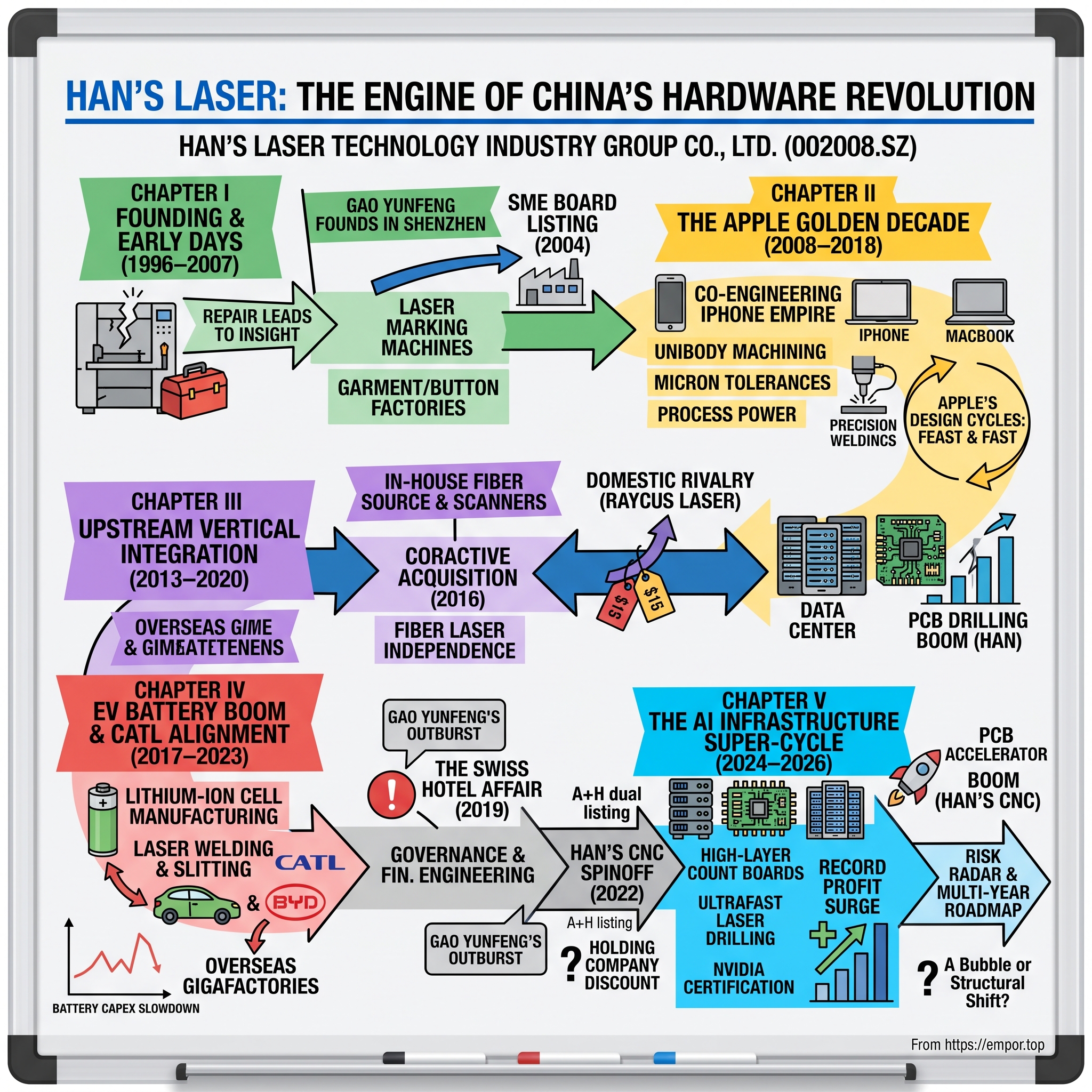
Han's Laser: The Engine of China's Hardware Revolution
I. Introduction & Episode Roadmap
Picture a factory floor in Shenzhen at three in the morning. The air is filtered to cleanroom spec, the light is that particular blue-white of industrial LED, and along a line that stretches the length of a football pitch, machines are doing something that looks like magic and is in fact physics: firing pulses of coherent light so precise they can carve a serial number into a smartphone chassis without scratching the metal a micron beyond the mark, or weld the tab of a lithium battery cell in a flash too fast for the human eye. Nobody in the consumer world knows the name of the company that built most of those machines. But if you have ever held an iPhone, driven past a Chinese-made electric car, or sent a query to an AI chatbot running in a data center, you have almost certainly touched the output of 大族激光 Han's Laser Technology Industry Group Co., Ltd.
This is a story about the man who built that company, and about a deceptively simple insight: in a gold rush, you can get rich selling picks and shovels. Except in this telling, the picks are focused beams of light, and the gold rushes have arrived in waves — first smartphones, then electric-vehicle batteries, and now the frantic global buildout of artificial-intelligence infrastructure.
The hook is almost too neat. In 1996, an engineering lecturer from Nanjing named 高云峰 Gao Yunfeng walked away from a stable academic post, took a modest sum of money he had earned repairing a foreign-made industrial machine, and rented a house in Shenzhen to start selling laser marking machines to button and zipper factories.1 Thirty years later, the company he founded reported annual revenue of RMB 18.76 billion — more than USD 2.6 billion — and its machines sit inside the cleanrooms of 苹果公司 Apple Inc., 宁德时代 CATL, and the server-board factories feeding the AI economy.2
The central thesis of this episode is that 大族激光 Han's Laser (002008.SZ, listed on the 深圳证券交易所 Shenzhen Stock Exchange) is the ultimate picks-and-shovels play on advanced manufacturing — a company that sits at the intersection of consumer electronics, printed circuit boards, electric vehicles, and industrial automation, and that has repeatedly reinvented which shovel it sells as the terrain shifts beneath it. But a thesis is not a verdict, and Empor is not Han's Laser's investor-relations department. The interesting questions are the hard ones. How durable is a business whose fortunes rise and fall with Apple's design cycles and China's capex booms? What do you make of a founder who spent RMB 1.1 billion on a European "R&D center" that a journalist found to be a ten-square-meter room, and who then told a state-television reporter, in effect, that it was none of their business? And is the current AI-server frenzy a structural multi-year shift, or the kind of over-built surge that leaves equipment makers holding the inventory when the music stops?
Here is the arc we will trace. We begin with buttons and garments — the unglamorous foundation. We move to the Apple golden decade, when Han's learned world-class micro-machining under the most demanding customer on earth. We watch the company try to de-risk its own supply chain by moving upstream into fiber-laser optics, buying a Canadian specialist called Coractive and building 大族光电 Han's Photonic. We sit through the EV battery boom and the CATL alignment. We stop, at length, at the corporate-governance friction of 2019 — the Swiss hotel affair — and the financial-engineering strategy of carving out subsidiaries onto separate exchanges, the "A-拆-A" playbook that produced 大族数控 Han's CNC (301200.SZ). And we finish in the present, in the middle of the AI-infrastructure super-cycle that has made 2025 and 2026 the best years in the company's history — while asking, throughout, what could break the story.
Before we begin, one framing device worth keeping in mind. There is an old venture-capital cliché about selling picks and shovels in a gold rush, and it is usually deployed as unqualified praise: the shovel-seller gets rich no matter who strikes gold. Han's Laser is one of the purest embodiments of that idea in the world — but its history is also a thirty-year field test of the cliché's limits. Because the truth an equipment maker learns, over and over, is that when the miners stop digging, the shovel orders don't slow; they stop. The picks-and-shovels business does not remove risk from a boom. It concentrates a specific kind of risk — the risk that the boom was ever real, and the risk of being the last one holding inventory when it ends. Watch, as the story unfolds, how many times Han's has ridden that wave up and been dashed by it on the way down, and how the company's entire strategic history can be read as a repeated attempt to build something more durable than a single customer's capital-spending cycle.
 Subscribe on LinkedIn
II. Founding & Early Days: Buttons, Garments, and the SME Pioneer (1996–2007)
Every founding myth needs an origin object, and Han's Laser's is a broken machine. The story, as it has been told and retold, is that 高云峰 Gao Yunfeng — a young lecturer at Nanjing University of Aeronautics and Astronautics who had already left academia to try his hand at business in the early 1990s — was asked by a friend to repair a foreign-made industrial laser device. Foreign firms at the time paid little attention to the Chinese market and were slow to service it, so the repair dragged on. Gao fixed it, was paid roughly RMB 400,000 for the work, and used that money to rent a house in Shenzhen in 1996 and start his own company.1 It is the kind of story that is partly true and wholly useful: the point is that Gao understood the machine well enough to fix what the foreigners couldn't, and he understood the economics well enough to see that Chinese factories were being underserved and overcharged.
The first product-market fit was almost comically humble. In the mid-1990s, the garment and accessory factories clustered in Wenzhou and across the Pearl River Delta marked their buttons, zippers, and metal fittings using chemical etching and mechanical stamping — slow, dirty, and inflexible. A laser marking machine could burn a permanent mark in a fraction of a second, change the design in software, and never wear out a die. The catch was price: imported machines were expensive. Gao's breakthrough was to develop what has been described as China's first commercially available laser marking machine and to sell it at roughly half the price of imported equipment, opening the garment-button market and completing his initial capital accumulation.1 This is the whole company in embryo. It is not an invention story; it is a localization-and-cost story. Take a technology the West has already proven, understand it deeply, build it cheaper and service it faster, and sell it to Chinese manufacturers who would otherwise pay a premium to foreigners who don't return their calls.
That last point — service — mattered more than the marketing brochures suggest. A laser machine on a factory floor is not a gadget; it is a bottleneck. When it stops, the line stops, and every hour of downtime is money bleeding out. Han's built a direct-sales network across the manufacturing hubs of Guangdong and Zhejiang and paired it with a service organization built around fast repair turnarounds. For a factory owner deciding between a cheaper foreign machine with a two-week service delay and a Han's machine with a technician who could be on-site the same day, the math was not close. This is the earliest version of a mechanism we will see mature into a genuine competitive advantage: switching costs and service integration. Once your production line is built around a vendor's machines and that vendor's technicians know your floor, you do not casually swap them out.
The financial structure of these early years was attractive in the way that good niche-industrial businesses often are. Gross margins ran high — in the neighborhood of forty percent — because Han's was selling a differentiated, semi-customized capital good rather than a commodity. The assembly model was modular and asset-light in the sense that mattered: Han's bought imported optics and laser sources from the likes of IPG Photonics and Trumpf, integrated them into its own machine designs and control software, and added value through customization for specific Chinese customers. That dependence on foreign optics would later become the company's most exposed nerve — the very bottleneck it spent the following decade trying to close — but in the early years it was a feature, not a bug. It let a young company punch above its weight without having to invent the hardest components from scratch.
It is worth pausing on how unusual this was in the China of the late 1990s and early 2000s. The prevailing script for a Chinese industrial company was to be a state-owned enterprise, or a joint venture partnered with a foreign firm that supplied the technology and kept the crown jewels. Han's was neither. It was a privately founded, engineer-led company competing directly against the foreign incumbents whose machines it had learned to fix — and winning on the twin axes of price and responsiveness. That positioning shaped the company's DNA in ways that still echo today: a bias toward doing hard engineering in-house, a comfort operating in the gap between what China's factories needed and what foreigners were willing to provide affordably, and a founder-centric culture in which Gao's technical judgment and appetite for risk were the organizing principle. The strengths and the pathologies of Han's Laser both flow from that same source — an owner-operator who built the company from a repaired machine and has run it, in effect, as his own ever since.
The early customer base also taught Han's a durable commercial truth about capital equipment: the sale is not the transaction, it is the relationship. A garment factory buying a marking machine was not making a one-time purchase; it was entering a multi-year dependence on Han's for consumables, calibration, spare parts, and the occasional emergency repair. That recurring, sticky relationship — invisible on any single invoice — is what let Han's build a national footprint and an installed base that would compound for decades. By the time the company scaled into far larger customers, this muscle memory of after-sales service as a competitive weapon was already deeply ingrained.
The milestone that turned Han's from a successful private company into a public one came on June 25, 2004, when Han's Laser listed on the newly created Small and Medium Enterprise Board of the 深圳证券交易所 Shenzhen Stock Exchange under the ticker 002008.SZ — one of the legendary inaugural batch of eight companies on that board.3 The SME Board was China's attempt to give private, entrepreneurial firms — as opposed to the state-owned giants that dominated the main boards — a place to raise equity. Being in the first eight was both a badge and a bet: it gave Han's capital and visibility at exactly the moment China's export-manufacturing complex was about to go vertical. By the time it listed, Gao had grown the company to thousands of employees over roughly its first decade.1 The button-marking machine had done its job. It had built the balance sheet, the sales network, and the engineering muscle that would let Han's answer the phone when a far larger customer came calling — a customer in Cupertino whose supply chain was about to remake global manufacturing, and Han's Laser along with it.
III. The Apple Golden Decade: Co-Engineering the iPhone Empire (2008–2018)
If the button factories made Han's Laser solvent, 苹果公司 Apple Inc. made it formidable. The transformation began around the turn of the 2010s, in the era of the unibody MacBook and the iPhone 4 — the moment Apple decided that the feel of a device in the hand was a strategic weapon, and that meant machining aluminum, glass, and eventually sapphire and stainless steel to tolerances that had previously belonged to aerospace, not consumer goods. You cannot mill and mark and cut hundreds of millions of chassis a year with hand tools. You need automated laser tooling, and lots of it, tuned to each new industrial design and re-tooled every time Cupertino changed its mind.
To understand why this was the making of Han's Laser, you have to understand what it is like to be a supplier inside Apple's hardware machine. Apple does not simply buy machines off a catalog. It co-engineers them, embedding its own manufacturing engineers alongside the vendor's, specifying yield and speed and precision targets that sit at the frontier of what is physically possible, and then demanding that the vendor hit them at a scale and on a timeline that would break most companies. Han's did this work not directly for Apple in most cases but through Apple's contract manufacturers — 富士康 Foxconn (the trading name of 鸿海精密 Hon Hai Precision), 立讯精密 Luxshare (002475.SZ), and Pegatron — inside whose cavernous assembly campuses Han's machines performed custom laser engraving, precision micro-welding, OLED display repair, and the cutting of glass and sapphire. It was a pressure cooker, and pressure cookers, applied to the right material, produce something hardened.
Here is the analytical point that matters more than any single contract: the discipline was the asset. Learning to hold micron tolerances at iPhone volumes, under Apple's yield audits, taught Han's an engineering rigor that no button factory ever could. That accumulated, hard-to-transfer manufacturing know-how — the tacit knowledge of how to make a finicky laser process reliable at scale — is what Hamilton Helmer would call Process Power, and it is genuinely difficult for a competitor to replicate because it lives in the heads and habits of engineers who spent years inside those cleanrooms. Han's did not just sell Apple machines; it earned, at Apple's expense, a capability it could later carry into batteries and PCBs.
It helps to make the technology concrete, because the phrase "laser processing" hides a zoo of very different operations. When you flip over an iPhone and see the tiny, impossibly crisp regulatory text and logo, that is laser marking — a beam altering the surface of the metal atom-deep, permanent and ink-free. When two pieces of a stainless-steel frame are joined so seamlessly you cannot find the join, that is laser micro-welding, fusing metal with a beam narrower than a human hair so the heat-affected zone is vanishingly small. When a cracked OLED panel is salvaged rather than scrapped, a laser is used to cut and separate layers with surgical control. And cutting cover glass or sapphire — materials that shatter if you look at them wrong — into precise shapes without chipping the edge is among the hardest jobs in the building. Each of these is a distinct discipline, and Apple's supply chain demanded excellence in all of them simultaneously, at volumes measured in the hundreds of millions of units. That breadth-under-pressure is what turned Han's from a competent marking-machine company into a full-spectrum precision-tooling house.
The economics of the Apple relationship, though, were a study in the two-sided nature of a great customer. On the upside, the iPhone super-cycle drove Han's consumer-electronics business to its peaks. In the redesign years — the tooling buildouts around the iPhone 6 and the iPhone X, when Apple overhauled form factors and manufacturing lines — cash flowed and margins and return on equity swelled, because a redesign means Apple and its assemblers buy waves of new equipment. On the downside came the digestion years. When Apple ran a design forward with only incremental changes, the equipment already installed kept working, new orders dried up, and Han's revenue sagged. The company's income statement, in other words, developed a heartbeat set by Cupertino's product calendar — feast in the redesign years, fast in the digestion years. For a shareholder, this meant the stock was, in part, a leveraged and lagged bet on the intensity of the next Apple hardware change.
And then there was the concentration trap. Building world-class micro-machining capability by serving the world's most demanding customer is a wonderful way to become excellent and a dangerous way to become dependent. Apple and its assemblers held enormous buyer power: they could negotiate prices aggressively, dictate warranty and delivery terms, and leave a supplier exposed to inventory it had built in anticipation of orders that could be trimmed or delayed. A supplier in that position lives at the pleasure of a customer who has other options and knows it. The strategic lesson Han's took from the golden decade — and the through-line of everything that follows — was that the same engineering excellence forged in Apple's cleanrooms had to be pointed at other industries before the concentration became a fatal flaw. The first place Han's looked was not sideways into a new customer, but downward into its own bill of materials — at the foreign optics it had depended on since the button days.
IV. Upstream Vertical Integration & Fiber Laser Independence (2013–2020)
Every hardware company eventually confronts the same uncomfortable audit: which of the parts I sell do I actually control, and which am I merely reselling with my logo on the box? For Han's Laser, the answer through the 2000s was awkward. The single most important, most expensive, most performance-defining component in a high-power laser system — the fiber laser source that actually generates the beam — came from abroad. IPG Photonics of the United States dominated the global market; Germany's Trumpf and America's Coherent were formidable. Galvo scanners, the precision mirrors that steer the beam, were likewise largely imported. Han's could design brilliant machines, but the heart of each one was bought from companies that were, in the higher-power tiers, potential competitors. That is a structural vulnerability: it caps your margins, exposes you to supply disruption, and means a foreign supplier can squeeze you at will.
The strategic response was vertical integration, pursued through both acquisition and in-house build. The signature deal closed on November 4, 2016, when Han's acquired Coractive High-Tech, a specialty optical-fiber and fiber-laser-module maker based in Québec City, Canada.4 It was, in the words of the trade press at the time, a "small but highly strategic" acquisition — the terms were never disclosed — and the strategic logic was precise: Coractive's expertise in double-clad optical fibers and specialty fiber gave Han's genuine intellectual property in the guts of a fiber laser, and made it the first laser company to manufacture its own fiber laser source and provide service in Canada.4 The point of buying Coractive was not to add revenue; it was to buy your way past a foreign chokehold and out of the reseller trap. Whether Han's paid a sensible price is impossible to verify without disclosed terms — a recurring frustration with this company, and one worth filing away — but the strategic direction was sound.
Alongside the acquisition, Han's built 大族光电 Han's Photonic to develop high-power fiber lasers, galvo scanners, and CNC control systems in-house. This is the classic make-versus-buy question of vertical integration, and Han's answered it selectively: build the components where control confers real advantage — the fiber source, the scanners, the control software — while continuing to buy the genuinely commoditized inputs. Bringing the beam source in-house did two things at once. It insulated Han's from foreign supply risk, and it opened a new, enormous market that Han's had previously been too dependent to attack aggressively: general high-power laser cutting for sheet metal, automotive body manufacturing, and heavy industry. A company that makes its own laser source can build a metal-cutting machine at a cost structure that a pure integrator, paying IPG's margin on every unit, cannot match.
But the industrial fiber-laser market Han's charged into was not a quiet pasture — it was a battlefield, and one increasingly crowded with domestic rivals racing down the same import-substitution path. The most important was 锐科激光 Raycus Laser (300747.SZ), which had emerged as China's homegrown fiber-laser-source champion, breaking IPG's grip on the domestic market and driving prices down with startling speed. Alongside Raycus came 创鑫激光 Maxphotonics and the state-linked system integrator 华工科技 HGTECH (000988.SZ). Together, these companies turned low- and mid-power laser cutting into something close to a commodity, with a multi-year price war that compressed margins across the industry. Here is the double edge of import substitution: the same domestic commoditization that liberated Han's from expensive foreign sources also armed a swarm of domestic competitors and turned Han's own general-cutting business into a low-margin volume grind.
To grasp why controlling the fiber source is such a big deal, it helps to know how a fiber laser actually works, in plain terms. A fiber laser generates its beam inside a length of specially doped glass fiber — the light bounces and amplifies within the fiber itself before exiting as an intensely concentrated beam. The performance of the whole machine hinges on the quality of that fiber and the diodes that pump energy into it. This is genuinely hard materials science; getting the doping, the geometry, and the manufacturing yields right took companies like IPG decades. For most of Han's history, buying that component from abroad meant that no matter how good Han's machine design was, a large slice of the value — and the pricing power — sat with a foreign supplier who could raise prices, prioritize other customers, or simply decline to sell its best products to a company it viewed as a downstream rival. Coractive's double-clad specialty fibers and Han's Photonic's in-house source development were the tools Han's used to pry that value loose. It is the difference between assembling someone else's technology and owning it.
So the scorecard on the vertical-integration decade is genuinely mixed, and it is worth stating plainly rather than cheering. Han's succeeded in de-risking its supply chain and acquiring real optics IP — a defensive win of lasting value. But the offensive expansion into general industrial cutting bought it a large revenue base at structurally thin margins, in a market where its cost advantage over Raycus, Maxphotonics, and a field of aggressive integrators is far from decisive. Vertical integration protected the company's independence; it did not, by itself, protect its profitability. For that, Han's needed to keep finding higher-margin frontiers — and the next one was already charging over the horizon in the form of the electric vehicle.
V. The EV Battery Boom & CATL Alignment (2017–2023)
Around 2017, a new sound started filling Chinese factories: not the whir of consumer-electronics assembly but the deeper hum of battery gigafactories rising from farmland. China had decided that the future of the automobile was electric, and the future of electric was the lithium-ion cell, and building those cells at the scale a nation of car buyers demanded required a staggering amount of new manufacturing equipment. A lithium battery cell is, in manufacturing terms, a stack of exquisitely thin layers that must be cut cleanly and joined perfectly, because a stray burr or a bad weld is not a cosmetic flaw — it is a short circuit, a fire risk, a recall. Cutting and welding with mechanical tools introduces contamination and wear. Cutting and welding with a laser is clean, fast, and non-contact. Han's Laser had spent two decades becoming exactly the kind of company that could do this well.
The pivot was a matter of pointing existing competencies at a new material. Han's adapted its precision laser welding and slitting tools for lithium-ion battery manufacturing — welding the tabs, top covers, and seal pins of prismatic cells, and joining the modules that make up a battery pack. And it anchored the business, as it had with Apple, by aligning with the giants of the industry. It secured multi-billion-RMB equipment relationships with the dominant battery makers, above all 宁德时代 CATL (300750.SZ), the world's largest, alongside 比亚迪 BYD (002594.SZ), Guoxuan High-Tech, and SVOLT. Being on the approved equipment list of CATL and BYD during the 2020–2022 buildout was like being a picks vendor with a standing order from the two largest mining companies in the middle of a gold rush.
The revenue arrived in a rush — but the economics of this segment deserve a sober read, because they are not the economics of the Apple business, and conflating the two is exactly the kind of promotional sloppiness Empor is here to avoid. During the peak buildout years, new-energy and battery equipment became a meaningful top-line contributor. But the gross margins on this equipment ran materially lower than on consumer-electronics tooling — in the rough range of the low-to-mid twenties rather than the richer margins of precision Apple work — because the machines were larger, more standardized, and sold into a market with several capable competitors. Worse, the working-capital cycle was longer: big industrial equipment for gigafactories ties up cash in receivables and inventory for extended periods, so a yuan of battery-equipment revenue was worth less, in both margin and cash terms, than a yuan of consumer-electronics revenue. High revenue, in this segment, is not the same as high profit, and an investor reading the top line without reading the margin line would badly misjudge the business.
There is also a subtler strategic reading of the battery push, one that matters for judging management's pattern of decision-making. The move into lithium-battery equipment was not a bolt-from-the-blue diversification; it was the same play Han's had run with Apple, transposed to a new material. Take a laser process the company had already mastered — precision welding — find an industry undergoing an explosive capacity build-out, and attach yourself to that industry's dominant customers before the boom peaks. Viewed this way, Han's has a genuine, repeatable meta-strategy: it hunts for the next capital-spending super-cycle in Chinese manufacturing and positions its existing laser competencies to sell the tooling that cycle requires. That is a real capability, and it is why the company has managed to be relevant across three completely different end-markets in fifteen years. The flip side, which the battery bust would soon expose, is that a company organized around chasing capex booms is, by construction, exposed to capex busts.
The competitive frame here was defined by 先导智能 Lead Intelligent (300450.SZ), the market leader in lithium battery equipment, whose whole-line focus on battery manufacturing gave it a scale and specialization in that vertical that Han's, as a diversified laser generalist, could not fully match. Han's competed on the specific laser processes — welding, cutting, cleaning — where its optics heritage gave it an edge, rather than trying to own the entire production line. That is a defensible niche strategy, but it is a niche, and it made Han's a participant in the EV boom rather than its equipment kingpin.
The working-capital point deserves a little more weight than it usually gets, because it is where the cyclicality bites hardest. When a picks-and-shovels vendor sells into a boom, it typically ramps production and inventory ahead of orders, and it extends generous payment terms to win business from customers who are themselves flush and expanding. That is fine while the boom lasts. But when the cycle turns, the vendor is left with inventory it built for orders that evaporated, and receivables owed by customers who are suddenly cash-strapped and slow to pay. The result is a double squeeze — falling revenue and deteriorating cash conversion at the same time — that can turn a merely disappointing quarter into a genuinely painful one. This is not a hypothetical for Han's; it is the mechanism through which the 2023 battery slowdown transmitted into the financials, and it is the single most important reason to treat the current AI-driven cash gusher with a measure of caution rather than extrapolation.
Then, in 2023, the music changed tempo. The frantic pace of Chinese battery capacity additions cooled as the industry digested a wave of over-investment and gigafactory utilization sagged. Battery-equipment orders paused, and Han's new-energy segment felt the chill — a vivid reminder that a picks-and-shovels vendor is only as steady as its customers' capex appetite, and that appetite is violently cyclical. What kept the story from turning sour was the beginning of a geographic shift: overseas gigafactory buildouts, as battery makers expanded into Europe, North America, and Southeast Asia, offered a new source of demand that could stabilize the segment even as the domestic Chinese cycle turned down. By 2025, in fact, Han's new-energy equipment revenue would rebound sharply — but that recovery belongs to a later chapter. First, we have to reckon with the years when the story was not about growth at all, but about a ten-square-meter room in the Swiss Alps and a founder who lost his temper on national television.
VI. Corporate Governance, The Swiss Hotel Affair, & "A-Share Spinoffs" (2019–2023)
In the summer of 2019, a financial-research outfit called Tiger Vision published a report that read less like equity analysis and more like a detective story. It concerned a project Han's Laser had first announced back in 2011: a European research-and-development center to be built in Switzerland. The budget had started at a modest RMB 50 million and then, over the years, ballooned to RMB 1.1 billion — roughly USD 159 million.5 That is an enormous sum for an R&D outpost. The report's explosive claim was that the registered address of this billion-yuan facility, in the alpine resort town of Engelberg, was in reality tied to the renovation of a luxury hotel — and that a visit to the site found not a bustling laboratory but a room of about ten square meters.5
The market's reaction was immediate and brutal. Han's shares plunged; on the day the exchange criticized the company's conduct, the stock fell 8.8% to close at RMB 26.08.6 Han's denied wrongdoing, insisting the European project was legitimate and that no funds had been misappropriated, and it moved to defend itself by hiring PricewaterhouseCoopers to audit the European unit. PwC subsequently confirmed that the money Han's had remitted was indeed spent on building an R&D center in Switzerland.7 On the narrow accounting question, in other words, the company was substantially cleared. But the affair had already done its damage, because of what happened next — and what happened next was a masterclass in how not to handle a governance crisis.
When a CCTV reporter phoned 高云峰 Gao Yunfeng to ask about the Swiss center, the founder-chairman did not reach for the reassuring language of transparency. Instead, in early August 2019, he questioned the reporter's qualifications and asserted that the company had the right to use its funds to make business decisions as it saw fit — an outburst that landed, on state television, as a wealthy founder telling the public that how he spent shareholders' money was none of their concern.[^8] Han's Laser was forced to issue a public statement apologizing for Gao's "inappropriate comments" and his demeanor toward the journalist, even as it defended the underlying business decisions, and the 深圳证券交易所 Shenzhen Stock Exchange publicly criticized his remarks.[^8] The lasting harm was not financial; PwC had handled the numbers. The lasting harm was to credibility. A founder who bristles at being asked how a billion yuan was spent, on a project whose registered address is a hotel and whose physical footprint is a small room, hands every skeptical investor a permanent question mark to hang over the entire enterprise.
This is the right place to conduct a broader governance stress test, because the Swiss affair was a symptom, not an isolated event. Han's is controlled by its founder: 高云峰 Gao Yunfeng directly holds roughly 9% of the shares and controls a further large block through the 大族控股集团 Han's Holding Group, giving him effective control in the mid-twenties percent — around 24–25% depending on the reference date.8 Concentrated founder control can be a virtue, aligning long-term vision with ownership, but it also means minority shareholders are, to a real degree, passengers. And the pattern of behavior around that control invites scrutiny. The parent holding company has carried a heavy load of pledged shares: as of early 2026, 大族控股集团 Han's Holding Group had pledged shares amounting to some two-thirds of its holdings, and Gao personally had pledged roughly 89% of his — a level of encumbrance that ties the controlling shareholder's finances to the share price and can force uncomfortable decisions in a downturn.910 A history of large, non-core capital allocations — the Swiss project being exhibit A — sharpens the worry that shareholder capital does not always flow to its highest-return use.
A fair-minded observer should hold two things in tension here rather than collapsing into either cheerleading or cynicism. On the one hand, Han's is not a fraud; PwC's audit substantially cleared the accounting, and the company has gone on to deliver real, verifiable operating results at scale — this is a genuine engineering enterprise, not a shell. On the other hand, credibility is a cumulative asset built through consistent behavior, and the Swiss affair combined with the founder's public conduct spent a large amount of that asset in a very short time. Governance is priced by the market not as a binary "clean or dirty" but as a probability distribution over how shareholder capital will be treated in the future. What the 2019 episode did was widen that distribution — it made the tail scenarios, in which capital is deployed opaquely into projects that benefit insiders more than minority holders, feel materially more plausible. That is why, years later and with the operating business firing on all cylinders, a governance discount persists. The market has a memory, and Han's gave it something to remember.
Which brings us to the more constructive chapter of the governance story: the "A-拆-A" spinoff strategy, an exercise in financial engineering that is genuinely interesting on its own terms. The idea is to carve a fast-growing division out of the parent and list it separately on a Chinese exchange, on the theory that the market will value a focused, high-growth pure-play far more richly than the same business buried inside a sprawling conglomerate. Han's executed this in 2022 by spinning off its PCB-equipment division as 大族数控 Han's CNC (301200.SZ) and listing it on the ChiNext board.11 The trade-offs here are exactly the ones that make holding-company analysis interesting. On one hand, the spinoff unlocked a dedicated valuation and gave the PCB unit's management its own equity currency and incentives — powerful for attracting and motivating talent. On the other, it created the classic holding-company discount: the parent 002008.SZ now owns a majority stake in a separately traded, faster-growing subsidiary, and the market has persistently valued that stake at a discount to what the subsidiary fetches on its own. Subsequent ambitions to spin off further units — a semiconductor laser division, other equipment businesses — have had to navigate a CSRC that grew warier of parent-and-subsidiary duplicate listings. The spinoff playbook can create value or merely reshuffle it; the honest verdict is that the jury is still out, and it hinges entirely on whether the cash and control the parent retains are deployed with a discipline that the Swiss affair gives one every reason to question. That tension — a genuinely excellent operating business wrapped in a governance structure that keeps raising eyebrows — is the defining investment puzzle of Han's Laser, and it becomes only more acute as the company enters the best fundamental stretch of its history.
VII. Current Strategy & Segment Economics: The AI Infrastructure Super-Cycle (2024–2026)
For a company whose stock had spent years shadowed by governance overhangs and the cyclical hangover of the battery bust, 2025 arrived like a change in the weather. Han's Laser reported record annual revenue of RMB 18.76 billion — up 27% year-on-year and its highest ever, equivalent to more than USD 2.67 billion.2 More telling than the top line was the quality of the profit beneath it. Net profit attributable to shareholders came in at RMB 1.19 billion, but the number that matters most to a skeptical analyst — net profit excluding non-recurring gains and losses, which strips out the government subsidies, asset sales, and investment gains that can flatter a Chinese industrial's headline earnings — surged 82% to RMB 810 million.2 That the "clean" core profit grew far faster than the headline figure tells you the recovery was operational, not cosmetic: the business was actually selling more high-value machines, not merely booking one-off gains.
What drove it was a single, unmistakable force: the frantic global buildout of AI infrastructure, and specifically the printed circuit boards that AI servers and high-speed switches are built on. This deserves a plain-English explanation, because it is the crux of the current story. An AI server is not a normal computer. Its processors move colossal amounts of data at extreme speeds, and that requires printed circuit boards with far more layers than an ordinary motherboard — high-layer-count boards, high-density interconnect (HDI) boards, and IC substrates — stacked and drilled with a precision that ordinary mechanical drilling cannot achieve. To connect the right layers without electrical interference, manufacturers use a technique called back-drilling and, increasingly, ultrafast laser drilling that can bore microscopic holes exactly where they are needed. The machines that do this drilling are made by 大族数控 Han's CNC.
And Han's CNC has been the standout. In 2025, the group's PCB-equipment revenue reached RMB 5.77 billion, up an eye-watering 72.7% year-on-year — the single largest and fastest-growing engine in the entire company.2 The momentum did not stop at year-end. Han's CNC reported that its profit rose between 242% and 280% in the first half of 2026, explicitly crediting booming demand for AI infrastructure,12 and the parent group's own first-quarter 2026 revenue more than doubled, up 104% year-on-year.13 The market has voted on this with real money: on February 6, 2026, Han's CNC completed a secondary listing on the main board of the Hong Kong Stock Exchange, raising HKD 4.83 billion (about USD 618 million) and becoming the first PCB-equipment company to achieve an "A+H" dual listing.14 The Hong Kong retail tranche was oversubscribed more than 446 times, and the shares jumped roughly 21% on debut — and notably, Han's CNC disclosed that the laser-drilling system in its flagship solution had received certification from 英伟达 NVIDIA, a tangible signal that its machines are qualified for the highest tier of AI-server board production.15
Zooming out to the full portfolio, the shape of the modern Han's Laser comes into focus across five engines. The largest is what the company calls its information-industry-equipment segment, at RMB 8.24 billion (up 50%), which houses both the RMB 5.77 billion PCB business and the roughly RMB 2.5 billion consumer-electronics-equipment business — the latter rebounding hard on AI-smartphone upgrades, wearables, vision headsets, and Apple's refresh cycles.2 General industrial laser equipment remained the volume base at RMB 6.11 billion, but grew a scant 2.4% — the price war grinding on exactly as the competitive theory predicts, with the higher-power sub-segment (up 30%) faring far better than commoditized low-power cutting.2 New-energy equipment rebounded to RMB 2.36 billion (up 53%), vindicating the overseas-gigafactory thesis, and — a genuine surprise relative to the conventional view of Han's as a bit player in chips — semiconductor equipment reached RMB 2.04 billion (up 15%), a far more material business than the "future optionality" framing usually assigns it.2 Underpinning all of it, R&D spending ran at RMB 2.08 billion, or 11.1% of revenue,2 the kind of sustained reinvestment rate that separates a genuine technology company from a mere assembler.
It is worth dwelling on why AI has been such a specific gift to the PCB-equipment business, as opposed to a generic "everything AI touches goes up" hand-wave. The reason is physical. Each new generation of AI accelerator moves more data, faster, than the last, and the circuit board that carries those signals must keep pace or become the bottleneck. That means more copper layers stacked into a single board — boards for top-end AI servers can run to dozens of layers where a laptop motherboard might have a handful — and it means denser, more precise interconnections between those layers. More layers and finer geometries mean more drilling, more exacting drilling, and drilling of a kind (blind and buried microvias, back-drilled stubs removed to prevent signal reflection) that mechanical drills struggle to do and laser drills do natively. In other words, the AI-server boom does not merely sell more of the same PCB machines; it shifts the mix toward the highest-value, highest-precision, hardest-to-build machines Han's makes — the ones with the fattest margins and the fewest credible competitors. That mix shift, more than raw unit volume, is what powered the 72.7% PCB revenue jump and the disproportionate surge in core profit.
The counterpart worth flagging is that this same dynamic makes the business acutely dependent on the technology roadmap holding. If AI-accelerator progress were to plateau, or if a rival board technology were to reduce the layer count and drilling intensity per server, the very complexity that is minting profits today would ease — and equipment demand would soften faster than the underlying server demand. Han's is not selling into AI compute; it is selling into the second derivative of AI-board complexity, which is a more thrilling and more fragile place to sit.
What does the evidence actually say about competitive advantage here? The strongest read is that Han's has, through the PCB business, stumbled into precisely the kind of high-barrier, high-margin frontier that the general-cutting business never offered — where the ability to drill AI-server boards to NVIDIA-grade spec is scarce and defensible, not commoditized. The weaker read, which an honest analyst must hold simultaneously, is that this is a supremely cyclical demand shock: AI-server capex is being set by a handful of hyperscalers in a capacity land-grab, and equipment demand is the most volatile, most whip-lashed link in that chain. The 2020–2022 battery boom and its 2023 bust are a recent, sobering template for exactly how this kind of super-cycle ends.
A myth worth puncturing here concerns Han's relationship to Apple. The consensus shorthand still describes Han's Laser as "the Apple laser supplier," a one-customer story whose fate rises and falls with the iPhone. That was largely accurate in the golden decade, but the 2025 numbers tell a different story: the single largest engine is now PCB equipment for AI servers, the fastest-recovering is a new-energy business tied to CATL and overseas gigafactories, and semiconductor equipment has quietly grown into a two-billion-yuan line. Consumer electronics, the old Apple-shaped core, is now one engine among five rather than the whole vehicle. The company has genuinely diversified its end-market exposure — which is the good news. The less comfortable news, and the reason the "diversification solves cyclicality" narrative is itself a bit of a myth, is that all five engines are still selling capital equipment into capex cycles. Han's has diversified the customers and industries it depends on, but not the fundamental character of its revenue, which remains equipment demand riding on someone else's investment decisions. Diversification has made the company more resilient to any one cycle turning; it has not made it a steady-state business.
On the human side, the company remains, unmistakably, 高云峰 Gao Yunfeng's. He is founder, chairman, and controlling shareholder, and the technical vision and entrepreneurial drive that built the company are inseparable from the governance scrutiny that shadows it — the same concentrated control that lets him bet boldly is the control that produced the Swiss affair. Alongside him, 张建群 Zhang Jianqun — a Tsinghua-trained computer scientist who joined Han's marketing leadership in 1997 and has long served as a vice chairman and senior executive overseeing operations and customer delivery — anchors the execution layer.16 The open question of management incentive alignment, especially across the growing constellation of separately listed sub-entities, is not a solved problem but a live one, and it feeds directly into the strategic and competitive analysis that follows.
VIII. Strategic Frameworks: 7 Powers & Porter's 5 Forces Analysis
Strip away the AI-server excitement and the founder drama, and the durable question underneath is simple: what, exactly, protects Han's Laser from the swarm of competitors who can see the same profits? Two frameworks help war-game the answer honestly.
Start with Hamilton Helmer's 7 Powers. Scale Economies are real and rank high: Han's operates the largest installed base of laser machinery in China, and that scale confers genuine purchasing leverage over optical components and structural steel, plus a fixed-cost base — R&D, service network — spread across more units than any domestic rival can match. This is a real advantage in the volume segments, though it is worth noting scale did not spare the general-cutting business from margin compression, which tells you scale economies are necessary but not sufficient. Process Power is, in this analysis, the crown jewel and also ranks high: the tacit, hard-won manufacturing know-how accumulated over fifteen-plus years of co-developing custom automated tooling inside the cleanrooms of Apple, Foxconn, and CATL. You cannot buy this on a shelf or reverse-engineer it from a brochure; it is embedded in engineers and refined through thousands of iterations. Switching Costs rank moderate-to-high: once Han's proprietary CNC control software, custom automation protocols, and field-service teams are woven into a high-throughput assembly or PCB line, ripping them out means re-validating an entire production process — expensive, slow, and risky, which is why incumbents in these accounts tend to stay incumbents. Counter-Positioning appears in a narrower but interesting form: in PCB drilling, Han's native integration of mechanical and ultrafast UV/CO2 laser drilling counter-positions legacy mechanical-drill specialists like Posalux and Schmoll, whose business models are anchored to an older technology they cannot fully abandon without cannibalizing themselves.
Now the adversarial view, via Porter's Five Forces, because a fair analysis dwells on the pressures, not just the powers. Bargaining power of buyers is high — arguably the single greatest structural constraint on the business. Concentrated anchor customers like 苹果公司 Apple Inc., 宁德时代 CATL, and Foxconn command formidable pricing leverage, impose strict warranty terms, and can extract volume discounts; a supplier whose fortunes depend on a handful of giants does not set its own prices. Bargaining power of suppliers, by contrast, has fallen to low-to-moderate, and this is the quiet good-news story: the domestic commoditization of fiber-laser sources by 锐科激光 Raycus Laser and 创鑫激光 Maxphotonics, combined with Han's own in-house source production, has gutted the pricing power that IPG and Trumpf once held over Han's input costs. Threat of new entrants is bifurcated: high capital and R&D barriers protect the precision frontiers — AI-server PCB drilling, semiconductor and display laser tools — while barriers in basic sheet-metal cutting are low enough that new entrants pile in and compete away the profits. Intensity of rivalry is intense across the board — 华工科技 HGTECH, Bodor, and HSG in general industrial equipment; 先导智能 Lead Intelligent in battery equipment; a field of specialists everywhere else.
It is instructive to compare Han's competitive position against the archetypes it faces. Against a pure component champion like 锐科激光 Raycus Laser, Han's is the systems integrator — it captures the value of turning a beam source into a machine that solves a customer's specific manufacturing problem, and it owns the customer relationship, but it competes in a world where the underlying component keeps getting cheaper for everyone. Against a vertically focused specialist like 先导智能 Lead Intelligent in batteries, Han's is the diversified generalist — broader and more resilient across cycles, but rarely the deepest player in any single vertical. Against foreign precision incumbents like Posalux or Schmoll in PCB drilling, Han's is the technology insurgent — cheaper, faster to iterate, and increasingly willing to lead on the newest laser-drilling techniques rather than follow. No single competitor beats Han's on every dimension, which is precisely the point: Han's advantage is portfolio breadth plus process depth, not dominance in any one arena. That is a genuine but qualified moat — wide and shallow in the commodity segments, narrow and deep in the precision ones.
Put the two frameworks together and a clear-eyed conclusion emerges. Han's competitive advantage is real but uneven — genuinely strong and defensible in the high-precision, high-know-how niches (advanced PCB, precision consumer-electronics tooling, specialty optics), and thin-to-absent in the commoditized volume segments (low-power cutting) where it competes largely on scale and price. The company is not a uniform fortress; it is a castle with a well-defended keep and some poorly defended outer walls. The investment case, then, depends heavily on whether the defensible keep — advanced PCB and precision electronics — grows fast enough and stays defensible long enough to define the whole company's economics. And that is precisely the terrain a skeptic would attack.
IX. Risk Radar & Activist / Skeptical Investor Stress Test
Imagine a sharp short-seller building the bear thesis on Han's Laser. Where would they aim? Not at the obvious — the numbers are, at the moment, undeniably good. They would aim at the durability and the trust.
The material risk radar starts with demand cyclicality, and it is not one cycle but two stacked on top of each other. Han's consumer-electronics business breathes with Apple's hardware-refresh calendar — feast in redesign years, famine in digestion years — and its newest and hottest engine, AI-server PCB equipment, rides a capex wave set by a small number of hyperscalers engaged in a capacity arms race. When two of your largest growth drivers are both capital-equipment demand — the most volatile, most cancelable, most inventory-prone link in any supply chain — you are, structurally, a highly cyclical business dressed in a growth-stock's clothing. Second is geopolitical and export-control risk: as US and European policymakers tighten the screws on advanced manufacturing, there is a live possibility of restrictions on high-end PCB or laser equipment, cutting both ways — limiting Han's access to some Western markets and components, while potentially accelerating the domestic import-substitution demand that benefits it. Third is parent-company financial health and governance: the heavy share pledges by 大族控股集团 Han's Holding Group and Gao personally mean a sharp share-price fall could trigger forced selling or margin pressure at the controlling shareholder, an overhang entirely separate from the operating business.910 Fourth is domestic price competition, the relentless margin erosion in general cutting that drags on consolidated gross margins even when the star segments shine.
Now the activist stress test proper — three challenges a skeptical long-or-short investor would press hardest. First, the holding-company discount. The parent 002008.SZ owns a majority of the fast-growing, separately listed 大族数控 Han's CNC (301200.SZ), yet the market persistently values that stake at less than its standalone worth. A skeptic asks: is management's spinoff strategy actually unlocking value for 002008.SZ shareholders, or merely transferring the exciting growth into a vehicle where minority parent-holders capture a discounted slice of it? Second, capital-allocation discipline. Cash recycled from subsidiary listings could fund high-return R&D or dividends — or it could be absorbed into the kind of non-core, hard-to-audit projects that the Swiss affair made infamous. Management's past behavior does not earn it the benefit of the doubt here; the burden of proof is on the company to demonstrate discipline, transaction by transaction, rather than assert it. Third, and most pointed: is the AI-server PCB cycle structural or a bubble? The 242–280% first-half profit surge at Han's CNC is spectacular,12 but spectacular is exactly what the late innings of a capex boom look like from the inside. A short-seller would argue that today's order book reflects a one-time build-out of AI capacity that, once satisfied, gives way to cancellations and inventory digestion — the battery-equipment story of 2020–2023, rerun with servers. The bull must answer this not with enthusiasm but with evidence about the multi-year depth of hyperscaler roadmaps and the ongoing complexity increase of each server generation. Which is precisely the debate the final section joins.
X. Playbook: Business & Investing Lessons
Step back from the specifics, and Han's Laser offers a set of transferable lessons that are worth naming because they generalize far beyond one Chinese laser company.
The picks-and-shovels playbook, and its hidden catch. Han's has captured enormous economic value across three successive technology waves — smartphones, then EV batteries, now AI infrastructure — without ever taking direct consumer-adoption risk. It never had to guess which phone would sell or which car brand would win; it sold the equipment that all of them needed. That is the seductive appeal of the arms-dealer business model. But Han's history also exposes the catch that the cheerful version omits: the picks-and-shovels vendor doesn't escape cyclicality, it inherits it in amplified form. Equipment demand is the derivative of its customers' capex, and a derivative swings harder than the underlying. The lesson is not "sell shovels and relax"; it is "sell shovels, and know that your revenue is the second derivative of a boom you don't control."
Managing customer-concentration risk by weaponizing it. The deepest lesson of the Apple decade is that the same brutal customer who threatens you with concentration risk also forges you into a world-class operator. Han's turned the discipline of serving Apple into a portable capability it carried into batteries and PCBs. But the corollary is iron: capabilities forged under one dominant customer must be pointed at new verticals before the dependence becomes fatal, and Han's has survived precisely because it kept finding the next industry. The playbook is co-engineer with the most demanding customer you can find, then diversify relentlessly on the strength of what they taught you.
Knowing the boundaries of vertical integration. Han's built the components where control conferred advantage — fiber sources via Coractive and 大族光电 Han's Photonic, galvo scanners, control software — while continuing to buy the genuinely commoditized inputs. The discipline is in the "not": a company that integrates everything drowns in capital intensity, while one that integrates nothing stays a hostage. The judgment of which parts to own is the whole game.
The compounding value of after-sales lock-in. A quieter lesson runs beneath the headline waves. Every machine Han's installs creates a small, durable annuity — service, spares, calibration, upgrades — and an incumbency that makes the next sale to that customer easier than the first. Across an installed base that is now the largest in China, those small annuities and incumbencies aggregate into something structurally powerful: a distribution and service moat that a new entrant cannot replicate by simply building a better machine, because the customer's switching cost is measured not in the price of the hardware but in the risk of disrupting a running production line. The lesson is that in capital equipment, the installed base is the real asset, and the machine sale is merely how you acquire it.
Navigating governance in emerging markets. This is the lesson Han's teaches in the negative. A genuinely excellent operating business can trade at a persistent discount to its worth because of governance friction — opaque non-core spending, a founder who resents scrutiny, heavy share pledges, a thicket of related listings. The reciprocal lesson for management is that transparency, independent oversight, and a legible capital-allocation framework are not compliance costs; they are the key that unlocks the equity multiple. Han's has the operating results. Whether it earns the multiple depends on whether it ever fully learns this last lesson.
XI. Bull vs. Bear Case & Key KPIs to Watch
So where does the "why win / why not" spine finally land? Lay the two cases side by side.
The bull case rests on the conviction that Han's has, at last, found a growth engine as good as the Apple business was in its prime — and possibly better, because it is less concentrated on a single customer. AI-server infrastructure demand triggers a genuinely multi-year capex upgrade cycle for high-precision PCB, HDI, and IC-substrate drilling through 大族数控 Han's CNC, whose NVIDIA-certified laser drills sit at a defensible technological frontier.15 Apple's own turn toward on-device AI features sparks a multi-year precision-equipment replacement cycle across the Foxconn and 立讯精密 Luxshare factory networks, reviving the consumer-electronics engine. Semiconductor wafer dicing and SiC laser annealing achieve real import-substitution breakthroughs in China's domestic chip supply chain — an area already larger, at RMB 2 billion, than most observers credit.2 And global manufacturing expansion into Southeast Asia, India, and Mexico opens higher-margin export channels. In this telling, the three waves Han's has ridden compound rather than merely succeed one another, and the market's governance discount becomes the opportunity.
The bear case is the mirror image, and it is not flimsy. The AI-server PCB build-out peaks prematurely — hyperscaler capacity gets ahead of demand, orders are cancelled, and Han's CNC swings from 250% profit growth to inventory digestion, exactly as the battery business did after 2022. The price war in general industrial cutting grinds on, capping consolidated margins no matter how well the star segments perform. And the parent's governance overhang — the share pledges, the holding-company complexity, the memory of the Swiss room — permanently caps the multiple the market is willing to pay, so that even good operating results fail to translate into shareholder returns. The Five Forces reinforce the caution: buyer power stays high, rivalry stays intense, and the defensible keep, however strong, is surrounded by those poorly defended outer walls.
The honest synthesis is that both cases are live, and the outcome turns on empirical questions that will resolve over the next several years, not on rhetoric available today. Which is why, rather than a verdict, the useful thing to carry away is a short list of the metrics that will actually adjudicate the debate. Three matter most.
First, Han's CNC's order backlog and high-value drill mix. The whole bull-versus-bear argument about the AI cycle reduces to whether high-precision back-drilling and laser-HDI machine orders for AI servers keep building or start to roll over. Backlog is the leading indicator; watch it before the revenue prints.
Second, the deducted non-recurring net-profit margin (扣除非经常性损益后的净利润率). This is the metric that separates real operating success from accounting flattery. Because Han's headline earnings can be padded by subsidies, asset sales, and investment gains, the "clean" core-profit margin — the one that grew 82% in 2025 — is the truest gauge of whether the business is actually converting the AI boom into durable profit.2
Third, overseas revenue contribution and export gross margins. The diversification thesis — away from domestic price wars and single-customer concentration, toward higher-margin international sales across Southeast Asia and Western Europe — lives or dies here. Rising overseas revenue at healthy margins would be hard evidence that Han's is finally escaping the structural buyer-power trap that has defined it since the button factories. Stagnant export margins would suggest it is simply exporting the same commoditized competition.
Watch those three, and the story of China's indispensable laser wizard will tell you, in numbers rather than narrative, whether the engine of the hardware revolution has finally built a moat worthy of its machines — or whether it remains, brilliant and cyclical, a hostage to the next wave it does not control.
References
-
Driven by Dual Engines of AI and New Energy, Han's Laser Revenue Topped USD 2.67 Billion with Nearly Doubled NPAT (excl. NRGL) — GlobeNewswire, 2026-04-22 ↩↩↩↩↩↩↩↩↩↩
-
Han's Laser Technology Industry Group Co., Ltd. — Baidu Baike (English) ↩
-
Han's Laser acquires specialty optical fiber maker CorActive — Laser Focus World, 2016-11 ↩↩
-
Han's Laser's USD159 Million Europe R&D Center Is a Room in Switzerland — Yicai Global, 2019 ↩↩
-
Han's Laser Plunges After Report Says Its Europe R&D Center Is Really a Luxury Hotel — Yicai Global, 2019 ↩
-
PwC Confirms Money Han's Laser Sent to Europe Went Into Building R&D Center — Yicai Global, 2019 ↩
-
Han Laser: shareholder Gao Yunfeng pledged 5.8 million shares — EqualOcean, 2021-08-04 ↩↩
-
Han's Laser shareholders adjust significant equity pledges — FilingReader, 2026-01-08 ↩↩
-
Firms guide on HKD4.83bn IPO of circuit board maker Han's CNC — Law.asia ↩
-
AI Infrastructure Boom Fuels 280% Profit Surge At PCB Equipment Maker Han's CNC — Sahm Capital, 2026-07-10 ↩↩
-
Han's CNC etches out triple-digit growth on AI infrastructure boom — Bamboo Works ↩
-
Clifford Chance advises Shenzhen Han's CNC Technology on its Hong Kong IPO and listing — Clifford Chance, 2026-02 ↩
-
IPO of Han's CNC: PCB Equipment Leader Han's CNC Technology to List in Hong Kong — uSMART ↩↩
 LinkedIn
 WhatsApp
 Reddit
 Hacker News
 Email
Email Kindle
 RSS Feed
 Spotify
 Apple Podcasts
 Amazon Music
 Audible
 YouTube