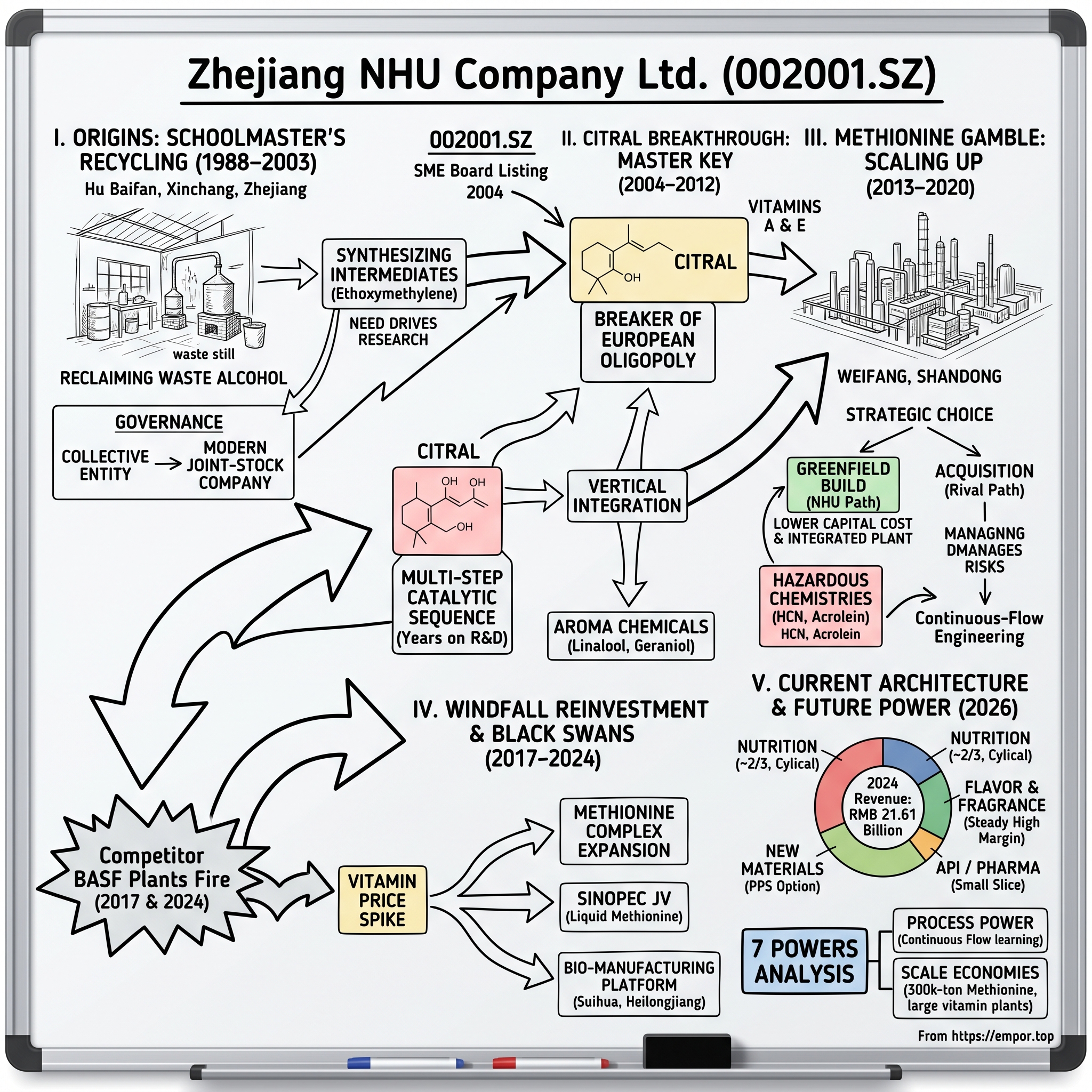
Zhejiang NHU: The Fine Chemical Titan and the Science of Scale
I. Introduction & Episode Roadmap
Picture a converted workshop on the edge of 新昌 Xinchang, a mountainous county in eastern 浙江 Zhejiang province, sometime in the late 1980s. The air smells of solvent. A chemistry teacher in his early thirties, still keeping his day job at a local vocational school, is bent over a still, trying to reclaim usable alcohol from the waste stream of a nearby pharmaceutical plant. He has borrowed roughly RMB 100,000 — a sum scraped together in part from fellow teachers — to bet that there is money and, more importantly, chemistry in other people's garbage.1 That teacher was 胡柏藩 Hu Baifan, and that workshop would, over the next four decades, grow into 浙江新和成 Zhejiang NHU Company Ltd. — one of the world's lowest-cost producers of Vitamin A, Vitamin E, and 蛋氨酸 DL-Methionine, generating more than RMB 21 billion in annual revenue and, in a good year, close to RMB 6 billion in net profit.2
This is a story that does not fit the usual template of Chinese industrial champions. There is no politically connected founder, no state subsidy origin myth, no consumer brand you would recognize. NHU makes molecules — the invisible ingredients that end up in your morning multivitamin, in the feed that fattens the chicken on your plate, in the perfume on a department-store counter, and increasingly in the plastic connectors inside an electric car. It is, in the truest sense, an unsung giant: listed on the 深圳证券交易所 Shenzhen Stock Exchange under the ticker 002001.SZ, a name that carries a small piece of Chinese capital-markets history we will come to shortly.
Here is the paradox that makes NHU worth three-plus hours of anyone's attention. Fine chemicals is a genuinely brutal business. It is cyclical, capital-hungry, and periodically wrecked by capacity gluts that turn premium products into commodities overnight. Raw-material costs swing violently. A single competitor's plant fire can multiply prices fivefold — or a wave of new capacity can collapse them just as fast. And yet, across most of its public life, NHU has posted gross margins in the 30–45% range and returns on equity that would make an asset-light software company blush.1 The obvious question — the one this episode will keep interrogating rather than assuming — is why. Is it a durable, engineered advantage in process chemistry? Or is it, at least in part, the flattering arithmetic of a commodity cycle that happens to be near its peak as we record this in mid-2026?
The roadmap: We begin with the schoolmaster's recycling shop and the philosophy — "need drives research" — that still runs through the company. We trace the 柠檬醛 Citral breakthrough that broke a European chemical oligopoly and unlocked vitamins. We follow the multi-billion-RMB greenfield gamble on methionine in Shandong, and contrast it with the debt-laden acquisition route rivals chose. We examine the windfalls that fell into NHU's lap when its Western competitors' plants caught fire, and what management did with the cash. Then we get analytical: segment economics, the powers that may or may not constitute a moat, the family that runs the company, and finally the honest bull-and-bear stress test that a long-term owner actually needs. Let us start in Xinchang.
 Subscribe on LinkedIn
II. Origins: The Schoolmaster's Recycling Factory (1988–2003)
The founding of NHU is one of those origin stories that sounds almost too neat, until you realize the neatness is the point. 胡柏藩 Hu Baifan was not a merchant or a Party cadre looking for an angle. He was a working chemist by training — a graduate of the class of 1982 who spent six years teaching chemistry at a remote school before he ever thought about running a factory.3 When he founded the enterprise in 1988 in Xinchang, it was as a small, school-affiliated workshop reclaiming waste alcohol from local pharmaceutical producers.1 The economics were humble: take the effluent nobody wanted, purify it, sell it back as usable solvent. It was recycling before recycling was a marketing word.
What separated Hu from a thousand other small-time solvent traders was that he treated the workshop as a laboratory. Reclaiming alcohol taught him the fundamentals of separation and purification. But the margins on cleaning up someone else's waste are thin and forever will be — there is no barrier to entry in running a still. So within a few years Hu pushed the operation up the value chain, from simple reclamation into actual organic synthesis. The pivotal early product was a compound the company rendered as 乙氧甲叉 ethoxymethylene — an intermediate used in the manufacture of pharmaceutical active ingredients. This was a step change in ambition. Reclaiming alcohol is janitorial chemistry; synthesizing an intermediate that a drug maker cannot easily make itself is value-added chemistry, and it carries pricing power that a solvent never will.
Out of these early years came the phrase that Hu has repeated for decades and that still functions as the company's operating theology: roughly translated, "need drives research, research drives production." It sounds like a slogan you would put on a factory wall — and it is — but there is a genuine strategic logic buried in it. NHU's model from the beginning was to find a downstream product where global demand was real and durable, then work backward to master the hardest step in making it, and only then build the plant. The company did not start with a commodity and hope to trade it well. It started with a bottleneck reaction and tried to own the chemistry. That sequencing — chemistry first, capacity second — is the through-line of everything that follows, and it is the single most important thing to understand about how NHU thinks.
There is also a governance subplot worth flagging, because it shapes the ownership picture that matters to investors today. The enterprise was born inside the peculiar institutional world of late-1980s and 1990s China, as a collective, school-run entity rather than a straightforwardly private company. Zhejiang — and Xinchang and neighboring 绍兴 Shaoxing in particular — was the beating heart of China's grassroots private economy, the region that produced an outsized share of the country's entrepreneurial manufacturers. Over the 1990s, Hu navigated the transformation from that ambiguous collective status into a modern joint-stock company, consolidating control while keeping local stakeholders aligned. By the time the business was ready for the public markets, it had been reorganized into the shareholding structure — a founding family holding company sitting atop the listed entity — that persists to this day.
What should a skeptical investor take from the origin story? Two things, held in tension. First, the technical DNA is real and unusually deep for a company of this vintage: this is a firm run by a chemist who built it reaction by reaction, not a conglomerate that bought its way into chemistry. That is a genuine, hard-to-replicate cultural asset. Second — and we will return to this — a founder-chemist with four decades of unquestioned control and a family holding company owning roughly half the equity is a double-edged sword. It has produced patient, engineering-led capital allocation. It also concentrates enormous power in one family and one man's judgment, with the governance risks that implies. The workshop that reclaimed waste alcohol was about to attempt something audacious: to take on the giants of European chemistry at their own game.
III. Capital Markets & The Citral Breakthrough (2004–2012)
On June 25, 2004, in Shenzhen, a new board opened for business. The 中小板 SME Board was China's attempt to give smaller, faster-growing private companies a home on the Shenzhen exchange, separate from the large state enterprises that dominated the main board. Eight companies listed that first day. The one that drew the stock code 002001.SZ — literally the first number on the new board — was Zhejiang NHU.4 It is the kind of trivia that a company puts in its corporate museum, and NHU does. But it is also a marker of the moment: a fine-chemicals firm from a mountain county became, quite literally, listing number one of the entire SME experiment. The IPO gave Hu Baifan something he had never had in quantity — outside capital — and he was about to spend it on the hardest chemistry problem in his industry.
To understand why the next act matters, you have to understand 柠檬醛 Citral. Citral is an unglamorous-sounding aldehyde, but it sits at the center of a startlingly valuable web. It is the essential building block for synthetic Vitamin A and Vitamin E. It is also the precursor for a whole family of aroma chemicals — 芳樟醇 linalool, 香叶醇 geraniol, menthol, the ingredients that make up a large share of the flavor-and-fragrance industry's raw palette. Whoever controls citral controls the economics of both the vitamin business and much of the fragrance business simultaneously. And in the early 2000s, citral at industrial scale was controlled by essentially two Western companies: Germany's BASF and the Dutch group DSM. They were the gatekeepers, and the gate was expensive.
The synthesis of citral is not one reaction; it is a punishing multi-step catalytic sequence starting from basic petrochemical derivatives, and getting each step to run at high yield, continuously, and safely is the sort of problem that separates a chemical company from a chemical also-ran. NHU spent years on it. When it succeeded, it became — by its own account and the industry's — the first company in China and only the third in the world capable of manufacturing citral at large scale.2 For a firm that a decade earlier had been purifying waste alcohol, this was a genuinely astonishing technical achievement, and it is the moment NHU stopped being a marginal Chinese supplier and became a global cost setter.
Here is why the citral breakthrough was worth more than any single product line it enabled. It was the master key to vertical integration. Once NHU could make its own citral, it no longer had to buy the critical input for Vitamin A and Vitamin E from the very competitors it was trying to undercut — a structurally absurd position that had capped every Chinese vitamin aspirant before it. Owning citral meant owning the whole chain, from petrochemical feedstock to finished vitamin, and it meant NHU could push its manufacturing cost below the Western incumbents' and still earn a healthy margin. The oligopoly's pricing power rested on controlling that intermediate; NHU picked the lock.
The same key opened a second door. The aroma chemicals that share citral chemistry — linalool, geraniol, and their derivatives — became a natural adjacent business, and NHU built its Flavor & Fragrance segment on exactly that shared upstream. This is the elegance of the NHU model at its best: one very hard piece of chemistry, amortized across two large end markets. It is also, we should note as neutral observers, the origin of a concentration risk. A great deal of NHU's franchise ultimately traces back to a handful of catalytic capabilities. When they work, the leverage is extraordinary. The question of how proprietary and how durable those capabilities really are — versus how much is now known industry-wide and merely executed better by NHU — is one we will press hard in the powers analysis. For now, the takeaway for investors is simpler: the citral win converted NHU from a price taker into a price maker in two industries at once, and it did so through R&D rather than acquisition. That pattern was about to repeat itself, one order of magnitude larger.
IV. The Megawatt Gamble: Scaling Methionine (2013–2020)
Somewhere around the turn of the last decade, NHU's leadership made a decision that, viewed from the outside, looked close to reckless. Having built a comfortable and highly profitable position in vitamins and aroma chemicals, they resolved to enter one of the most technically dangerous and competitively entrenched product categories in all of specialty chemicals: 蛋氨酸 DL-Methionine. It would consume years and billions of renminbi, and for a long stretch it produced losses rather than profits. It is the clearest test case of whether the NHU playbook scales — and, told honestly, of how much conviction the company was willing to put behind its own engineering.
Methionine is an essential amino acid. Animals — chickens and pigs especially — cannot synthesize enough of it, so it is added to feed to make protein growth efficient. It is, functionally, an input to the global meat supply, which means demand grows with the world's appetite for animal protein: a slow, durable, multi-decade tailwind. But it is a hard molecule to make. The synthesis involves a rogues' gallery of hazardous chemistries — hydrogen cyanide (HCN), methyl mercaptan, acrolein — substances that are toxic, flammable, and unforgiving of process error. For decades this technical and safety barrier meant methionine was a tight global oligopoly: Germany's Evonik, the French-origin Adisseo, South Korea's 씨제이제일제당 CJ CheilJedang, and America's Novus controlled the world's supply. Breaking in required mastering chemistry that could kill people and capital in equal measure.
NHU's most consequential choice was not whether to enter but how. The industry's incumbents were built through acquisition and legacy assets. The obvious path for a cash-rich Chinese challenger would have been to buy a seat at the table — and there was a live example of exactly that. 中国化工 ChemChina, the state-owned giant, had acquired Adisseo years earlier, paying a full enterprise multiple for an established but aging Western producer. NHU went the other way. It chose greenfield: to build its own methionine complex from bare ground, in 潍坊 Weifang, 山东 Shandong, near the raw-material and logistics base it needed.2 The company started with a pilot-scale facility on the order of tens of thousands of tons to prove the chemistry, and then committed to a far larger integrated build-out, ultimately targeting a 300,000-ton annual scale and spending, cumulatively, several billion renminbi.5
Why does the greenfield-versus-acquisition choice matter so much? Because it is the single decision that best reveals NHU's theory of its own advantage. Buying Adisseo would have delivered instant capacity, existing customers, and proven technology — but also legacy Western labor costs, aging plants, inherited environmental liabilities, and a purchase price set by an auction. Building in Shandong meant swallowing years of construction risk and startup losses, and betting that NHU's own process chemistry was good enough to make methionine as well as Evonik. In exchange, NHU got a modern, purpose-built, integrated plant at a dramatically lower capital cost per ton, staffed at Chinese labor rates, co-located with feedstock, and constructed at the speed that Chinese engineering-procurement-construction can deliver. The wager was that organic capex, executed by an engineering-first company, beats paying a premium for someone else's tired assets.
For a long time the wager looked uncertain. Methionine startups are notoriously difficult; ramping a hazardous, continuous process to full yield and safety takes patience and burns money. Skeptics could fairly point out that NHU was pouring capital into a commodity dominated by four experienced incumbents, at exactly the moment Chinese competitors were also eyeing the same market. But by the middle of this decade the plant had reached scale, and — as we will see when we get to the recent numbers — methionine flipped from being NHU's most expensive science project into one of its largest profit engines. The verdict a neutral observer should record is nuanced: the greenfield strategy was vindicated on cost and execution, but that same success is now attracting the domestic competition that forms the core of the bear case. NHU proved a challenger could build world-scale methionine from scratch. The problem with proving something is buildable is that others start building too.
V. Black Swans, Super-Cycles, & Windfall Reinvestment (2017–2024)
On the night of October 31, 2017, a fire broke out at BASF's vast 路德维希港 Ludwigshafen complex in Germany — the largest integrated chemical site in the world. The blaze and its aftermath disrupted BASF's citral production, and because citral is the chokepoint for Vitamin A and much of Vitamin E, the shock rippled through the entire global vitamin market almost overnight. Vitamin A spot prices, which had been languishing, spiked violently — at their peak rising several-fold from pre-fire levels. For a low-cost producer sitting on ample, already-paid-for capacity, this was the definition of a windfall: NHU's costs did not move, but the price of what it sold soared. The company harvested billions of renminbi in essentially free cash flow across 2017 and 2018.
If that were a one-off, it would be a lucky anecdote. What makes it analytically interesting is that it happened again. In July 2024, another fire at a BASF facility in Germany once more knocked out vitamin capacity and sent prices surging across the board.6 NHU rode the spike straight to the bottom line: its net profit in the third and fourth quarters of 2024 reached roughly RMB 1.79 billion and RMB 1.88 billion respectively — quarterly figures that a few years earlier would have been strong annual results.6 Twice in seven years, a competitor's misfortune handed NHU a cash bonanza. This is the recurring, uncomfortable truth of the NHU investment case: a meaningful chunk of its most spectacular earnings has come not from anything NHU did, but from things that happened to BASF. The cyclicality cuts both ways, and an honest investor has to treat these windfalls as episodic, not annuity-like.
The more revealing question is what management did with the money — because that is a choice, and choices reveal character. The empire-building temptation for a cash-flooded chemicals company is real and well documented across the industry: overpriced trophy acquisitions, sprawling conglomerate diversification, or fat one-time dividends that flatter a single year and leave nothing behind. NHU largely resisted. Instead, it plowed the super-cycle cash into three concrete, chemistry-adjacent build-outs. It completed and expanded the methionine complex, pushing toward the 300,000-ton solid-and-liquid scale that turned the segment profitable.5 It built out a 新材料 new-materials business anchored on high-performance polymers. And it established a 生物制造 bio-manufacturing and synthetic-biology platform, with a fermentation base in 黑龙江 Heilongjiang province at 绥化 Suihua, whose first-phase project has since commenced operation.7
The most significant of the capital-allocation moves — and the one that best illustrates NHU's discipline — was the liquid-methionine joint venture with 中国石化 Sinopec. Rather than fund an enormous new methionine expansion entirely on its own balance sheet, NHU partnered 50/50 with Sinopec's 镇海炼化 Zhenhai Refining & Chemical arm to build a plant producing the equivalent of 180,000 tons per year of liquid methionine, an investment on the order of RMB 3 billion.[^8] The logic is worth pausing on: Sinopec supplies core petrochemical feedstocks, so the venture co-locates NHU's chemistry with a captive, upstream raw-material source and shares the capital burden and risk. It is the greenfield playbook refined one more turn — build, but build with the feedstock owner as your partner. The plant entered trial production in this cycle.7
What should an investor conclude about management from the windfall years? The behavioral evidence is genuinely encouraging: faced with the classic curse of the cyclical — too much cash at the top of the cycle — NHU reinvested in adjacent, understandable chemistry rather than diversifying into things it did not understand, and it used partnerships to defray risk on its largest bets. That is disciplined, and it is consistent with the engineering-first ethos. The caveat a neutral analyst must add is that reinvesting windfalls into more capacity in cyclical products is not risk-free virtue; it is also how oligopolies eventually oversupply themselves. Whether NHU's new capacity compounds value or merely deepens the company's exposure to the next down-cycle depends entirely on demand keeping pace. Which brings us to what the company actually looks like today.
VI. Current Business Architecture & Segment Deep-Dive
Strip away the history and look at NHU as it stands in 2026, and you find a company whose profits rest overwhelmingly on one pillar, with three smaller structures leaning against it. In 2024, total revenue reached RMB 21.61 billion, up nearly 43% year on year, and net profit more than doubled to RMB 5.87 billion.56 The proportional shape is what matters: roughly two-thirds of that revenue comes from the Nutrition segment, with Flavor & Fragrance a distant second, New Materials a smaller third, and pharma-and-other a modest tail. Understanding the economics of each — and how correlated they are — is the whole game.
Core anchor: the Nutrition segment (营养品). This is NHU. In 2024 the nutrition business alone generated about RMB 15 billion in revenue, up more than 52% year on year, at a gross margin above 43%.6 It comprises the vitamins — Vitamin A, Vitamin E, Vitamin D3, biotin — and methionine in both solid and liquid form. NHU sits among the global top handful in Vitamin A and Vitamin E, and has become one of China's leading methionine producers. The economics here are all about scale and cost position: vitamins and methionine are, at bottom, commodities whose baseline demand is driven by the vast, slow-growing machine of global animal feed — the pigs and poultry that consume the overwhelming majority of the world's synthetic vitamins and amino acids. Barriers to entry are high because the plants are enormous, hazardous, and hard to permit. But the flip side, which the 43% gross margin in 2024 should not obscure, is that this figure is a cycle-peak number, inflated by the post-fire vitamin spike. In a trough year, nutrition margins compress sharply. This segment is simultaneously NHU's greatest strength and the source of nearly all its earnings volatility.
The high-margin cash engine: Flavor & Fragrance (香精香料). This segment — on the order of RMB 3–4 billion in revenue, in the high-teens as a share of the total — is in some ways the more attractive business, even though it is smaller. Its products are the aroma chemicals descended from NHU's citral chemistry: linalool, geraniol, menthol, 叶醇 cis-3-hexenol, and specialty molecules. Gross margins here run consistently in the 35–45% band and, crucially, are less violently cyclical than commodity vitamins, because NHU sells into the concentrated global flavors-and-fragrances houses — Givaudan, the merged DSM-Firmenich, IFF, Symrise — for whom ingredient quality and supply reliability matter more than shaving the last cent. The strategic beauty is the shared upstream: the same citral and intermediate chemistry that feeds the vitamin lines feeds fragrance, so incremental fragrance volume rides on capital already deployed. If nutrition is the segment that makes NHU's stock volatile, fragrance is the one that gives it a steadier spine.
Future growth optionality: New Materials (新材料). Here NHU is trying to write its next chapter, in high-performance polymers rather than vitamins. The flagship is 聚苯硫醚 PPS (polyphenylene sulfide), a specialty engineering plastic prized for surviving high temperatures and harsh chemicals — the sort of material used in electric-vehicle components, electronic connectors, and high-frequency circuit insulation for 5G and 6G equipment. NHU has described itself as the only domestic firm able to stably produce PPS across fiber, injection-molding, extrusion, and coating grades, and it is extending into high-temperature nylon (PPA) and polyketone (PKE).2 Strategically, the appeal is obvious: these materials carry high technical lock-in and years-long customer qualification cycles, and — this is the key point — their demand is tied to EVs and electronics, not to pig farming. If it works, New Materials is a second growth engine structurally uncorrelated with the feed cycle. The honest caveat is that it remains under a tenth of revenue; it is optionality, not yet a pillar, and specialty-polymer markets have their own gluts.
Specialty platform: API / Pharma & Other. The smallest slice — a mid-single-digit share of revenue — covers pharmaceutical intermediates and specialty nutritional ingredients such as coenzyme Q10 and Vitamin C derivatives. It leverages the same synthesis capabilities and, together with the nascent bio-manufacturing platform in Heilongjiang, represents NHU's attempt to seed longer-dated, higher-value options in fermentation and bio-based ingredients. For now it is a rounding error on profit, but it is where the company's synthetic-biology ambitions live.
Put the four together and the investor's mental model should be clear-eyed: NHU is a superb, low-cost commodity chemical operator with two-thirds of its revenue in cyclical nutrition, a genuinely good specialty fragrance business, and a promising-but-unproven materials call option. The diversification narrative management likes to tell is real in direction but modest in current magnitude. How NHU sustains its edge in that dominant nutrition franchise is the subject of the powers analysis — and it starts inside the reactor.
VII. The Playbook: Continuous Flow Engineering & Helmer's Powers
Walk an investor through a conventional specialty-chemicals plant and they will see rows of batch reactors — giant kettles in which ingredients are combined, cooked, emptied, cleaned, and refilled, one batch at a time. Now imagine instead a system where the reactants flow continuously through a series of engineered channels and catalysts, reacting as they move, never stopping, output emerging in a steady stream at the far end. That, in simplified terms, is continuous-flow chemistry, and it is the heart of what NHU claims as its edge. The analogy is the difference between cooking one pot of stew at a time versus running a pasteurization line that never shuts off. Continuous flow, done right, means higher yields, lower energy per ton, tighter quality control, and — vitally for chemistries involving HCN and acrolein — better safety, because you are handling small quantities of dangerous material in transit rather than storing vats of it. This is the mechanism underneath NHU's cost advantage, and it is worth testing against a proper framework.
Using Hamilton Helmer's 7 Powers, NHU's strongest claim is to Process Power — an advantage embedded in a company's operations that rivals cannot replicate quickly even if they know it exists, because it accrues through long, cumulative learning. NHU's decades of proprietary catalytic synthesis, micro-channel reaction technology, and continuous-flow engineering plausibly qualify: the company runs reactions at yields and safety tolerances that batch-reactor competitors struggle to match, and that know-how was built reaction by reaction over thirty-plus years. The neutral test of whether this is real Process Power or just competent operations is margins through a full cycle — if NHU consistently earns more than peers at the bottom, not just at the top, the power is real. The evidence so far is suggestive but incomplete, precisely because we have not yet observed NHU's newest, largest assets through a genuine trough.
The second power is Scale Economies, and here the case is more straightforward. Operating world-scale plants — 300,000 tons of methionine, tens of thousands of tons of vitamins — spreads fixed costs across enormous volume, driving down unit cost in a way sub-scale rivals simply cannot match.5 Scale in commodities is a genuine, durable advantage, but note its limitation: it is available to any competitor willing to build equally large, and China's chemical industry is nothing if not willing to build. Scale protects NHU against small players; it does not protect it against another disciplined giant matching its capacity. The third candidate, Cornered Resource, is the weakest of the three: NHU holds in-house catalytic patents and has locked in feedstock through the Sinopec relationship, but patents in mature chemistry expire and are worked around, and feedstock partnerships, while valuable, are not exclusive in the way a true cornered resource must be. An honest reading gives NHU strong Process Power and Scale Economies, and only a thin Cornered Resource.
Run the same picture through Porter's Five Forces and the structure comes into focus. Threat of new entrants is genuinely low: world-scale plants cost billions of renminbi, hazardous-materials permitting is arduous, and China's tightening environmental regime raises the bar every year — a would-be entrant needs capital, chemistry, and a decade. Buyer power is moderate: vitamin and methionine buyers are mostly fragmented feed mills, though the largest feed conglomerates exert real price discovery, and in fragrance the concentrated F&F houses have leverage. The force that should worry an owner most is rivalry: in commodity vitamins and methionine, competition is intense and periodically savage, moderated only by the global oligopoly structure — NHU, the merged DSM-Firmenich, BASF, and China's own 浙江医药 Zhejiang Medicine among them. Oligopoly discipline holds prices up until someone breaks ranks with new capacity, and then it does not. Substitutes and supplier power are secondary, though petrochemical feedstock volatility feeds directly into supplier dynamics.
The final piece of the playbook is capital allocation, which NHU treats as an extension of its engineering discipline. Management has kept R&D reinvestment at roughly 5–8% of revenue — high enough to sustain the process edge, disciplined enough not to bleed the P&L — and has consistently favored building over buying.2 The refusal to chase the Adisseo-style acquisition, the greenfield methionine bet, the Sinopec JV structure: these are of a piece. The framework verdict, stated neutrally, is that NHU possesses a real but partly cyclical moat — strongest in process and scale, thinnest in anything exclusive — and that its durability will be proven or disproven not in a boom but in the next glut. The people making those allocation calls are, unusually for a company this size, still the founding family.
VIII. Current Management, Incentives, & Credibility
For all its scale, NHU remains recognizably a family firm, run by the man who started it and his brother. 胡柏藩 Hu Baifan is still chairman, and the corporate persona he projects is that of the chemist he has always been: conservative in personal style, obsessive about technical detail, and increasingly given to framing the company's mission in terms of national manufacturing self-reliance. In April 2026 he published an essay in 浙江日报 Zhejiang Daily under the banner "innovation is never done behind closed doors" — a characteristically earnest piece of positioning that ties NHU's R&D story to China's broader industrial-upgrading narrative.3 Whatever one makes of the messaging, the substance is consistent: for nearly four decades Hu has told the same story about need-driven research, and the company's actions have broadly matched it.
Beside him is his younger brother, 胡柏山 Hu Baishan, who serves as vice chairman and, in the operating role, runs the company day to day — production engineering, safety, and supply-chain execution.3 The division of labor is the classic founder pairing: the chairman as technologist and public face, the brother as operator. It has the virtues of alignment and continuity, and the well-known risks of any family-controlled enterprise: succession is unresolved and rarely discussed publicly, minority shareholders depend heavily on the family's judgment and fairness, and independent board oversight of a founder with this much history is inevitably limited. None of that is a scandal; all of it is a governance fact a neutral investor should weight.
The ownership structure makes the point concrete. Control sits with 新和成控股集团有限公司 NHU Holding Group Co., Ltd., the family holding company, which owns on the order of half of the listed equity.8 This is tight insider alignment in the literal sense — the family's wealth rises and falls with the minority shareholders' — and it explains the long-term, through-cycle orientation of the capital allocation. It also means that on any contested question, the family's vote is effectively decisive. NHU has layered on recurring employee stock ownership plans tied to multi-year ROE and net-profit targets, which extends alignment below the founding family to key personnel and is a genuinely positive governance signal when the targets are demanding.
On capital returns, the record is that of a company trying to balance reinvestment with shareholder discipline. NHU has maintained a meaningful dividend, and for 2024 it distributed cash dividends totaling on the order of RMB 2.15 billion, including a special component reflecting the windfall year.8 It has also used buybacks opportunistically — in mid-2026 the controlling side proposed a repurchase of up to roughly RMB 600 million, the kind of move a management team makes to signal confidence when the share price lags the fundamentals.9 The pattern — steady dividend, special payout in a fat year, buyback when the stock is soft — is coherent and shareholder-aware without being profligate.
How credible is this management team, judged by behavior rather than words? The bull evidence is substantial: a multi-decade record of building what it said it would build, keeping R&D funded, avoiding the value-destroying trophy acquisition, and communicating with reasonable transparency about safety inspections, environmental compliance, and project timelines rather than hyping vitamin spot prices. Narrative consistency across filings and public statements is high. The bear counter is structural rather than behavioral: this is a founder-and-brother-controlled company with ~50% family ownership, unresolved succession, and limited independent check on the top. There is no evidence of the aggressive, promise-breaking behavior that should alarm an investor — but the concentration of power means the absence of a problem so far rests heavily on continued good judgment by two men in their sixties and beyond. Credibility earned; key-person and governance risk acknowledged. That risk is one input into the broader stress test.
IX. Investment Risk Radar & Bull vs. Bear Stress Test
Set aside the narrative for a moment and think like a short-seller sizing up NHU in mid-2026, with the stock having ridden a vitamin super-cycle to strong earnings. The most important risk is hiding in plain sight in that very sentence: vitamin price volatility. A large share of NHU's 2024–2025 profit surge came from Vitamin A and Vitamin E prices spiking after a competitor's fire — a windfall, not a run rate. When vitamin spot prices normalize, as they always eventually do, reported earnings can fall hard even if nothing about the business deteriorates. Anyone anchoring a valuation to peak-cycle net profit is making a classic cyclical error.
The second vector is feed-demand cyclicality. Because nutrition demand is ultimately driven by animal husbandry, NHU is exposed to the livestock cycle — most acutely to events like African swine fever, which periodically devastates China's enormous pig herd and, when it does, cuts feed consumption and with it demand for vitamins and methionine. The third is raw-material inflation: NHU's inputs are petrochemical derivatives, and when feedstock prices rise faster than product prices, the spread that is the company's entire margin compresses. The fourth is geopolitical and tariff risk: NHU is a Chinese exporter of chemicals to the United States and Europe, and in an era of trade barriers and supply-chain nationalism, tariffs or restrictions on Chinese chemical imports could impair access to its highest-value Western markets.
Now the bear case proper, made as strongly as an activist would make it. First, the cyclical trap: NHU's earnings are structurally tied to volatile commodity vitamin cycles, and its highest-profile profits have depended on external accidents; strip out the windfalls and the underlying business, while good, is more ordinary and more cyclical than the headline numbers suggest. Second, and most seriously, methionine overcapacity: NHU's own success in proving that a Chinese challenger can build world-scale methionine has invited exactly the domestic imitation that threatens to flood the market. Additional Chinese methionine capacity — including NHU's own expansions — risks eroding the very margins that justified the multi-billion-renminbi bet, in the primary segment management is counting on for growth. Third, capital intensity: high-barrier chemical plants demand relentless capex to build, maintain, and expand, which constrains free-cash-flow conversion, especially in down-cycles when the cash is needed most.
The long-term owner's rebuttal is equally concrete, and it rests on cost position rather than hope. The strongest bull argument is the European cost disadvantage: Europe's chemical incumbents face structurally high energy, carbon, and regulatory costs, and — as the repeated BASF disruptions and the broader rationalization of aging European capacity suggest — they are being pushed to retire capacity permanently, handing durable market share to low-cost producers like NHU. This is not a cyclical claim but a structural, multi-year shift in who makes the world's vitamins, and it favors NHU. The second bull point is the methionine scale multiplier: as the liquid-methionine capacity, including the Sinopec JV, ramps toward full utilization, NHU cements a position as a global top-tier low-cost methionine producer, and low-cost producers survive gluts that kill high-cost ones. The third is the second growth engine — PPS and new materials offering growth uncorrelated with the feed cycle — and the fourth is the bio-manufacturing option, where synthetic biology and fermentation could seed the next generation of bio-based aroma and nutritional ingredients.
Weighing the two sides, the neutral synthesis is this: NHU is a legitimately advantaged low-cost operator whose structural tailwind (Western capacity retreat) is real, but whose reported profitability is flattered by a cyclical and partly accidental vitamin spike, and whose central growth bet faces a self-inflicted oversupply threat. The bull case is about cost position and secular share gains; the bear case is about cyclicality and commoditization. Both are true at once, which is why the stock is a debate rather than a slam-dunk. For an investor trying to cut through it, only a handful of metrics actually matter. The first is Vitamin A and Vitamin E spot prices and their spreads over key feedstocks — the single largest swing factor in near-term earnings, and the fastest way to know whether you are looking at peak or trough conditions. The second is methionine capacity utilization and margin spread — the tonnage ramping and, critically, the price gap over propylene and raw inputs, which will reveal whether the greenfield bet keeps paying or gets competed away. The third is new-materials revenue growth as a share of the total — the clearest read on whether NHU's diversification out of the feed cycle is real or merely aspirational. Track those three and you understand NHU; track the quarterly noise and you will be whipsawed by the cycle.
X. Epilogue & Strategic Outlook
Step back from the reactors, the spot prices, and the segment tables, and NHU's four-decade arc delivers a few durable lessons for the kind of investor who thinks in decades rather than quarters. The first is about the nature of moats in heavy industry. NHU's edge was never a brand or a patent or a lucky asset; it was accumulated process knowledge — the unglamorous, compounding advantage of a company that spent thirty years learning how to run dangerous reactions continuously, at scale, at lower cost than anyone else. Continuous-flow engineering does not photograph well and it does not make headlines, but it is precisely the sort of tacit, cumulative capability that is genuinely hard to copy. If there is a single transferable insight, it is that in asset-heavy chemistry, the durable advantage lives in the how-to, not the what.
The second lesson is about capital allocation, and it is the one NHU embodies most cleanly. Faced repeatedly with the choice between buying growth and building it, NHU built — the citral chemistry, the Weifang methionine complex, the Sinopec-partnered liquid line, the PPS plants. It watched a state-owned rival pay full price for Adisseo and chose instead to absorb years of greenfield startup pain in exchange for a structurally lower cost base. The record suggests that in industries where the crucial variable is cost per ton, patient organic execution can beat flashy cross-border M&A — provided the company has the engineering to pull it off. NHU had it. That is not a universal law; it is a conditional one, and the condition is competence NHU happened to possess.
The honest closing assessment holds two ideas together without resolving them prematurely. NHU is one of the great engineering-driven compounding stories in Chinese industry — a rural schoolteacher's waste-alcohol workshop that became a global cost leader in molecules the world cannot do without, run by a family whose wealth and reputation are bound up in the enterprise's long-term health. And yet it is also a deeply cyclical commodity producer whose most spectacular recent profits owe as much to a competitor's fire as to its own excellence, facing the oversupply that its own success invites. The company aligns its ambitions with China's national push for advanced manufacturing and self-reliance under the banner of 共同富裕 common prosperity, which lends it policy tailwinds and a certain durability. But the questions that will decide the next decade are not about slogans. They are about whether the process moat holds through a real trough, whether methionine economics survive the coming Chinese capacity, and whether the new-materials engine grows large enough to matter. From a school workshop in Xinchang to the top of global fine chemistry is an extraordinary journey. Whether the next chapter is compounding or merely cyclical is the question a long-term owner must keep asking — and the outline above gives you the instruments to listen for the answer.
References
-
Zhejiang NHU Co., Ltd. — Company Overview & History, cnhu.com ↩↩↩
-
Zhejiang NHU Co., Ltd. — Investor & Corporate Portal, cnhu.com ↩↩↩↩↩
-
Chairman Hu Baifan Publishes in Zhejiang Daily: "Innovation Is Never Done Behind Closed Doors" — FinancialContent/ABNewswire, 2026-04-06 ↩↩↩
-
Zhejiang NHU Co., Ltd. listed as first company on the SME Board (002001), June 25, 2004 — Shenzhen Stock Exchange (SZSE) ↩
-
2024 Annual Report of Zhejiang NHU Co., Ltd. (English) — Cninfo / Shenzhen Stock Exchange ↩↩↩↩
-
NHU Achieves a 117.01% Year-on-Year Surge in 2024 Net Profits — EFFAMALL, 2025 ↩↩↩↩
-
2025 Semi-Annual Report of Zhejiang NHU Co., Ltd. — Cninfo / Shenzhen Stock Exchange, 2025-08-28 ↩↩
-
Zhejiang NHU Company Ltd. — Shareholders & Shareholding Structure, MarketScreener ↩↩
-
Zhejiang NHU's Actual Controller Proposes Share Buyback — TradingView / Reuters, 2026 ↩
 LinkedIn
 WhatsApp
 Reddit
 Hacker News
 Email
Email Kindle
 RSS Feed
 Spotify
 Apple Podcasts
 Amazon Music
 Audible
 YouTube