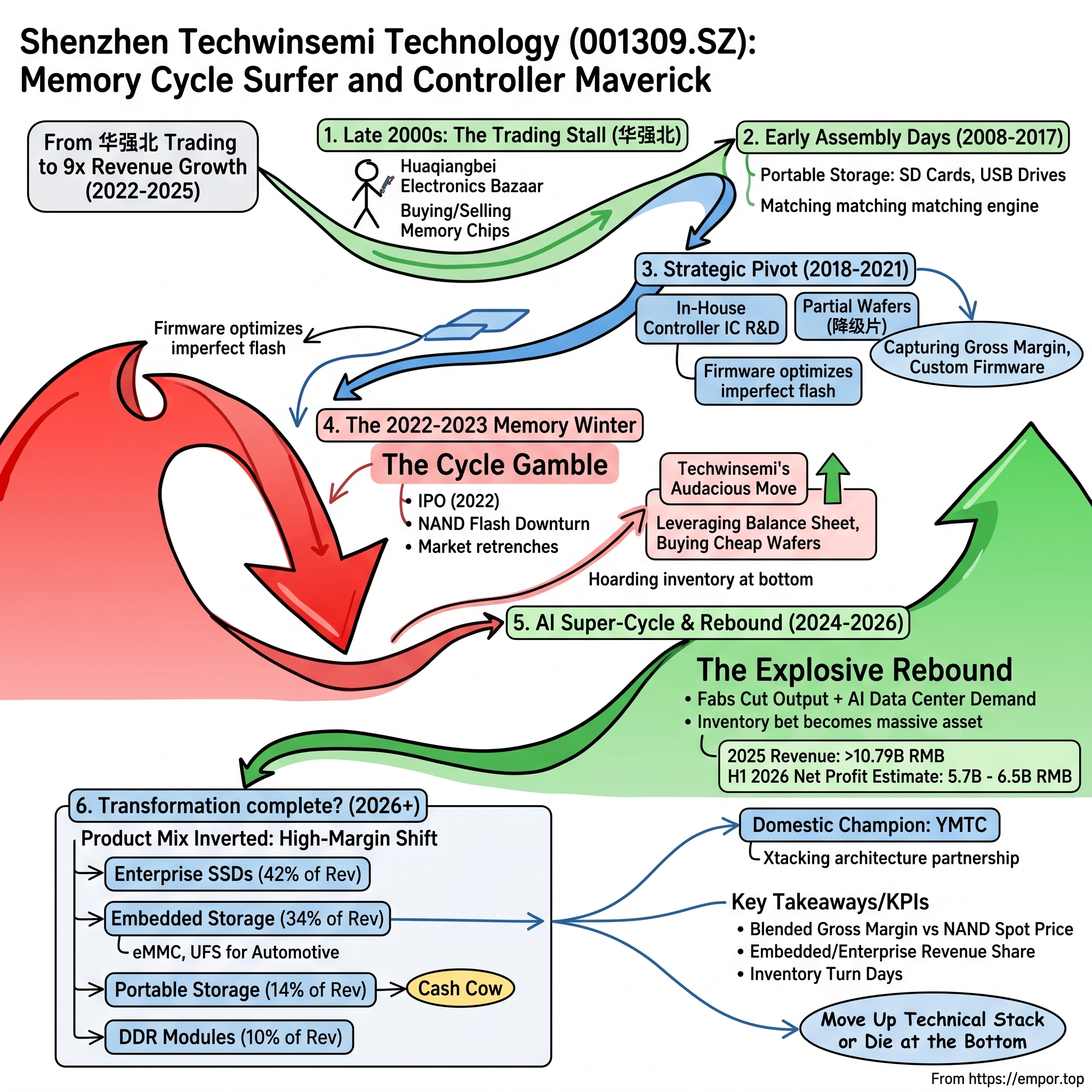
Shenzhen Techwinsemi Technology: The Memory Cycle Surfer and Controller Chip Maverick
I. Introduction & Episode Roadmap
Picture a trading stall in 华强北 Huaqiangbei, the sprawling electronics bazaar in the heart of Shenzhen, sometime in the late 2000s. The air smells of solder and instant noodles. Around you, thousands of vendors are buying and selling the guts of the global electronics supply chain — capacitors by the reel, USB controllers by the tray, and memory chips by the kilo. In this market, fortunes are made and lost on a single overnight swing in the spot price of NAND flash. Most of the people here are middlemen, and most of them will still be middlemen in a decade, if they survive at all.
One of them did not stay a middleman. The company that grew out of this world, 深圳市德明利科技股份有限公司 Shenzhen Techwinsemi Technology Co., Ltd. (001309.SZ) — a designer and seller of storage controller chips and modules trading under the Demingli, TWSC, and CUSU brands7 — scaled its revenue from roughly 1.19 billion RMB in 2022 to over 10.79 billion RMB in 2025 — a near-nine-fold expansion in three years.12 Then, in July 2026, it did something that stops even jaded China-tech observers: it told the market that its net profit for the first half of 2026 alone would land somewhere between 5.7 billion and 6.5 billion RMB — a swing from a loss of roughly 118 million RMB in the first half of 2023 into one of the most violent earnings turnarounds the Shenzhen main board has seen.34
Here is the core paradox we want to unpack. The NAND flash memory business is one of the most brutal, capital-intensive industries on earth. It is dominated by a handful of vertically integrated giants — 三星电子 Samsung Electronics, SK海力士 SK Hynix, and Micron Technology — who each pour tens of billions of dollars into fabrication plants and then wage periodic price wars designed to bleed weaker players dry. Techwinsemi owns no fab. It never has. So how does an asset-light, independent Chinese module maker not merely survive between these tectonic plates, but occasionally out-earn its own market capitalization from a few years prior?
The answer, as we will argue, rests on a dual-engine playbook that is equal parts engineering and gambling. The first engine is 自研主控芯片, self-developed storage controller ICs — the tiny brains that sit between a computer and the raw flash and decide how data is stored, corrected, and recovered. The second is 周期性存货开杠杆, a high-conviction habit of leveraging the balance sheet to hoard cheap NAND wafers at the bottom of the memory cycle and sell the finished product into the top. It is a strategy that looks like genius on the way up and like reckless speculation on the way down, and part of our job today is to figure out which it really is.
This is not a management brochure. Techwinsemi's own story, told by its own investor relations team, is a tale of vision and vindication. Our task is to hold that story up to the light — to separate what the company has proven from what it merely claims, and to ask what would have to be true, or false, for the bull case to hold. Here is the roadmap:
First, the macro architecture of the NAND flash value chain and China's memory-localization drive. Second, the founding story of how 李虎 Li Hu and 田华 Tian Hua turned a Huaqiangbei trading operation into a structured enterprise. Third, the pivotal decision to stop buying controller chips and start designing them. Fourth, the 2022–2023 memory winter, when Techwinsemi did the opposite of what its peers did. Fifth, the AI-driven super-cycle and the explosive enterprise-SSD transition. Sixth, a deep dive into segment economics and a benchmark against 慧荣科技 Silicon Motion, 群联电子 Phison Electronics, 江波龙 Longsys (301308.SZ), and 佰维存储 BIWIN Storage (688525.SH). Then the strategic frameworks, the management stress test, and the bull-versus-bear case that any serious long-term owner has to reason through. Let us begin where all memory stories begin — with the wafer.
 Subscribe on LinkedIn
II. The Global Memory Architecture & China's Storage Puzzle
To understand Techwinsemi, you first have to understand why the industry it lives in behaves less like technology and more like a commodity pit crossed with a nuclear arms race.
Start with the product. NAND flash is the non-volatile memory that holds your data when the power is off — the storage in your phone, your laptop's SSD, the data-center drives that hold the training sets for large AI models. Modern NAND is built in three dimensions: manufacturers stack memory cells vertically, layer upon layer, like adding floors to a skyscraper. The industry has marched from 128-layer designs toward 200-plus-layer architectures, and each new generation squeezes more bits into the same footprint. The catch is that building the fabrication plant to etch those skyscrapers costs on the order of ten billion dollars, and the marginal cost of producing one more wafer, once the plant exists, is comparatively tiny. That combination — enormous fixed cost, low marginal cost — is the recipe for the most vicious commodity cycle in all of hardware.
Here is the mechanism, in plain terms. When memory prices are high, everyone builds fabs. Those fabs come online two or three years later, all at once, just as demand cools. Prices then collapse below cash cost, because a fab that has already been paid for will keep running rather than idle — its owners would rather sell at a loss than stop. Inventories pile up across the chain, and what economists call the bullwhip effect kicks in: a small dip in end demand becomes a violent swing in orders as every layer of the supply chain slashes purchasing at once. Then producers finally cut output, supply tightens, and prices rocket back up. Rinse, repeat, roughly every three to four years. This is the ocean Techwinsemi has learned to surf.
A short digression is worth it here, because the AI boom has scrambled the memory picture in a way that matters for Techwinsemi. Memory splits into two great families: DRAM, the fast, volatile working memory that a processor uses in real time, and NAND flash, the slower, cheaper, non-volatile storage that keeps data permanently. The AI story that dominates headlines — the frenzy around high-bandwidth memory, or HBM — is largely a DRAM story, and it belongs to Samsung, SK Hynix, and Micron. But here is the crucial second-order effect: when those three giants redirect their capital and their best wafer capacity toward hyper-profitable HBM for AI accelerators, they starve the rest of the memory market, including NAND, of investment. Capacity that would have expanded flash supply gets diverted. The AI boom, in other words, tightens NAND not only by creating demand for storage but by cannibalizing the supply side's attention. A NAND-focused module maker sitting downstream feels both blades of that scissor. Techwinsemi, whose business is overwhelmingly NAND-based with a growing DRAM-module sideline, is positioned squarely in the crossfire — which is exactly why its fortunes have swung so violently.
Now the value chain. It splits into three layers. At the top sit the wafer fabs — Samsung, SK Hynix, Micron, 铠侠 Kioxia, and, crucially for our story, China's domestic champion, 长江存储 Yangtze Memory Technologies (YMTC). These are the only players who actually manufacture raw silicon flash. In the middle sit the controller IC designers, fabless firms that design the chip that manages the flash. And at the bottom sits module packaging and testing — the outsourced-assembly work of turning bare wafers into finished SSDs, memory cards, and embedded chips you can actually sell. Techwinsemi was born in that bottom layer and has spent fifteen years clawing upward into the middle one.
It is worth lingering on what that bottom layer actually does, because outsiders tend to dismiss it as mere "assembly," and that misunderstanding is precisely what Techwinsemi has exploited. A raw NAND wafer is not a product anyone can use. It has to be diced into individual dies, the dies stacked and wire-bonded or hybrid-bonded into packages, the packages married to a controller and a printed circuit board, and the whole assembly tested, graded, and burned in. This is the world of OSAT — outsourced semiconductor assembly and test — and the difference between a mediocre packager and an excellent one shows up directly in yield, reliability, and cost. A firm that packages badly throws away good silicon; a firm that packages and tests brilliantly can wring salable product out of material a competitor would scrap. The module layer, in other words, is not value-free plumbing. It is where a surprising amount of the economic value in cheap-flash storage is either captured or destroyed, and it is the ground on which Chinese module makers like Techwinsemi, Longsys, and BIWIN have chosen to fight.
Why claw upward at all? Because the bottom layer is a miserable place to make a living. Pure module assembly — buy wafer, package it, ship it — throws off operating margins in the low single digits, often just three to five percent in a normal year. You are, in effect, a toll booth that gets flattened every time the raw-material price moves against you. The strategic prize of owning the controller IC is twofold: you capture the gross margin that firms like Silicon Motion and Phison otherwise pocket, and, more subtly, you gain the ability to write custom firmware. And custom firmware is the key that unlocks the single most important economic lever in this entire story — the ability to make cheap, imperfect flash work.
That imperfect flash has a name in the trade: 降级片 / 白片, downgraded or "partial" wafers — silicon that failed to meet a fab's top-bin specification but is far from useless. We will return to it, because it sits at the center of Techwinsemi's claimed edge. For now, hold this thought: China consumes a staggering share of the world's memory but, until very recently, manufactured almost none of it domestically. That gap — the distance between how much NAND and DRAM China buys and how much it makes — is the tailwind, and the anxiety, behind everything the government and companies like Techwinsemi have been trying to do. To see how one small trading firm decided to plant a flag in that gap, we have to go back to 2008.
III. Founding & Early Assembly Days: 2008–2017
Every origin story needs a protagonist who understands the terrain better than the people who own it. In Techwinsemi's case, that person was 李虎 Li Hu.
Before he was a chairman, Li Hu was a salesman. From roughly 2000 to 2008 he worked in semiconductor sales, learning the unglamorous plumbing of the Chinese electronics trade — who extends credit to whom, which distributor is good for a payment and which is a week from insolvency, how a shipment of memory actually moves from a fab's allocation desk to a factory in Dongguan.12 This is not the résumé of a chip architect. It is the résumé of a trader, and that distinction will matter enormously. Li Hu did not fall in love with silicon; he fell in love with the flow of silicon, and with the friction points where a clever operator could extract margin.
To appreciate the world he came out of, you have to picture Huaqiangbei not as a shopping district but as a living, breathing supply-chain organism. Compressed into a few square kilometers of Shenzhen were tens of thousands of stalls, each specializing in some sliver of the electronics universe — one selling nothing but tantalum capacitors, another only USB connectors, a third dealing exclusively in salvaged and re-marked memory chips. Prices moved by the hour, quoted in cash, settled on relationships and reputation as much as contracts. It was chaotic, semi-legal at the margins, and staggeringly efficient — the place where a Shenzhen factory could prototype a new gadget on Monday and have it in mass production by Friday. In this ecosystem, information was the real currency: knowing before your rival that a fab had quietly cut allocation, or that a warehouse in Hong Kong was dumping a batch of last-generation flash, was the difference between a good month and a ruinous one. Li Hu grew up commercially inside this metabolism, and it wired him to think in terms of supply flows and price dislocations rather than product roadmaps.
In 2008, in the depths of a global financial crisis that was hammering the very electronics trade he lived in, Li Hu co-founded the company in Shenzhen alongside 田华 Tian Hua — who, we should note plainly, is his spouse, making the two of them joint controlling shareholders and the household at the center of the enterprise.9 The initial business was exactly what you would expect from Huaqiangbei: trading and assembling 移动存储, portable storage. SD cards, microSD cards, USB flash drives. The company bought raw memory, packaged it into finished cards and drives, and sold it into the sprawling ecosystem of Chinese consumer electronics — the dashcams, the toys, the low-end feature phones, the security cameras that were multiplying across the country.
Think about what this business actually was. Techwinsemi was a matching engine. On one side, upstream fabs with wafers to move; on the other, thousands of small manufacturers who needed a few thousand memory cards for their next production run. The company's value-add was flexibility, speed, and trust — knowing the market, holding a little inventory, and turning it fast. It was a real business, and in good years it made real money. But it had a hard ceiling, and Li Hu, the trader, could see the ceiling clearly.
Consider the mechanics of trade credit that governed this business, because they explain why the ceiling was so unforgiving. A middleman typically buys memory on short credit terms and sells on short credit terms, earning a spread on a thin sliver of margin over a large volume of turnover. The model works beautifully as long as prices are stable or rising and customers pay on time. But it is exquisitely fragile. A sudden price drop turns your inventory into a loss before you can move it; a customer who defaults wipes out the margin on a dozen good deals; a fab that tightens allocation leaves you unable to fill orders you have already promised. The trader lives permanently one bad week away from trouble, and no amount of hustle changes the underlying physics. You are, structurally, a shock absorber for other people's volatility, compensated for that service with a margin too thin to build anything lasting.
The ceiling was this: a pure middleman has no pricing power. None. When the fabs cut their wafer allocation, you are at the back of the line. When a hundred other Huaqiangbei operators are selling the identical microSD card, price falls to the cost of the memory plus a razor-thin markup. And when the memory cycle turns against you, the inventory you are holding — your entire livelihood — can lose a fifth of its value in a month. You do not have a business so much as a leveraged bet on a commodity you do not control. This is the commodity trap, and most firms in that market never escape it.
The consequential decision of Techwinsemi's early life was not a product launch or a big customer win. It was a choice about where to spend the cash. Rather than plowing early profits into more commercial expansion — more salespeople, more trading lines, a bigger book — management began steering money toward engineering talent. The bet was philosophical: that the only durable escape from the commodity trap was to own a piece of technology that competitors could not simply buy off a shelf. That instinct, forged by a decade of watching the trade from the inside, set up the single most important pivot in the company's history. If you cannot control the wafer, control the brain that runs it.
IV. The Strategic Pivot: In-House Controller IC R&D (2018–2021)
Here is a decision that, on paper, made no sense. Why would a mid-sized module assembler in Shenzhen spend years and a large share of its modest cash flow trying to design its own controller chips, when it could buy perfectly good ones from Silicon Motion or Phison for a few dollars apiece?
Almost every module company in the world buys its controllers. That is the entire point of the fabless controller industry — Silicon Motion and Phison exist precisely so that module makers do not have to design silicon. Designing a controller means assembling a team of IC engineers, licensing processor cores, paying enormous "tape-out" fees to a foundry to fabricate each new design, and then debugging firmware for years. For a company Techwinsemi's size, it looked like lighting money on fire. And yet, over roughly 2018 to 2021, that is exactly what Techwinsemi chose to do — developing proprietary controllers for SD and microSD cards, USB, and eventually SATA and PCIe SSDs.
To understand why, you have to understand the partial wafer. Let us build the analogy carefully, because it is the crux of the entire company. Imagine a fab produces a wafer of NAND flash the way a bakery produces a giant sheet of cookies. In a perfect sheet, every cookie is identical. In reality, some cookies at the edges are a little burnt, some are misshapen, some cells simply die. A top-bin wafer has few defects, spread evenly and predictably. A partial wafer has more defects, and — critically — those defects are distributed unevenly and unpredictably across the wafer. Fabs sell these downgraded wafers cheap, because most buyers cannot use them well.
Why can't they? Because an off-the-shelf controller from Silicon Motion runs generic firmware tuned for clean, uniform silicon. Its error-correction assumes bad blocks are rare and evenly spread. Feed it a lumpy, defect-heavy partial wafer and its yield collapses — it throws away too much of the flash trying to route around the damage, and the cost advantage of the cheap wafer evaporates. The partial wafer is cheap for a reason: you need a smarter brain to use it.
Let us make the role of the controller vivid, because everything downstream depends on grasping it. NAND flash cells wear out — each one can only be written and erased a finite number of times before it dies, and cells fail unpredictably. Raw flash, left to itself, would corrupt your data within weeks. The controller is the intelligent manager that hides all of this. It spreads writes evenly across cells so none wears out prematurely (wear leveling), remaps around cells that have died (bad-block management), and, above all, uses mathematics to detect and correct the errors that inevitably creep in (error correction). If NAND is a warehouse full of unreliable, aging shelves, the controller is the brilliant logistics manager who keeps track of which shelves are collapsing, routes goods around them, and reconstructs any package that gets damaged in transit — all invisibly, thousands of times a second. The better that manager, the more you can trust a warehouse full of cheap, rickety shelves.
Techwinsemi's engineering bet was to build exactly that brain. The company wrote its own error-correcting code (ECC) and low-density parity-check (LDPC) algorithms — the mathematical machinery that detects and repairs data errors — and tuned them specifically to recover usable capacity from these messy, low-grade wafers. In its own telling, this firmware unlocked raw-material cost savings on the order of fifteen to twenty-five percent versus using premium wafers.12[^15] If that figure holds up — and we will return to whether it does — it is the difference between a commodity assembler and a company with a genuine structural cost edge. The controller is not just a component here; it is the tool that turns other people's rejects into salable product.
There is a deeper economic logic to why this niche was defensible, and it is worth naming now because it recurs throughout the story. Designing a controller carries a large, lumpy fixed cost — the "tape-out," the one-time fee to a foundry to fabricate a new chip design, which for an advanced node runs into the millions of dollars, plus years of engineering salaries. That fixed cost is a barrier that deters casual entrants. But it only pays off if you can spread it across enough units, and if the resulting chip does something a cheaper off-the-shelf part cannot. Techwinsemi's answer to both tests was the partial-wafer specialization: the firmware gave its controllers a job the standard parts could not do, and its own module volume gave it a captive base to amortize the design cost against. The company has spoken of moving its controller designs onto modern process nodes and RISC-V processor cores — the open, license-free instruction set that has become popular in China precisely because it sidesteps Western IP licensing.12 Whether those designs are genuinely competitive at the leading edge is a separate question, but the strategic logic of owning the brain rather than renting it is internally consistent.
Armed with that capability, Techwinsemi widened its product matrix. It pushed from mobile storage into 固态硬盘 solid-state drives and 嵌入式存储 embedded storage — the eMMC and UFS chips soldered directly into phones, cars, and industrial gear. It launched a consumer brand, 酷兽 CUSU®, to build a direct retail presence rather than remain an anonymous supplier.12 And it built out the physical backbone this all requires: packaging and testing capacity in Shenzhen's Dalang district and a manufacturing expansion through its Huizhou subsidiary, 德明利(惠州)存储有限公司.12 By the end of this period, management reported that self-developed controllers powered the large majority of its mobile-storage products — a self-sufficiency rate above seventy percent in that category. Whether the rest of the portfolio could be pulled up to that bar remained an open question. But the strategic identity was now set, and it was about to be tested by the public markets and by the worst memory downturn in a decade — arriving, as it happened, at almost the same moment.
V. The IPO & The Great Memory Cycle Gamble: 2022–2023
On July 1, 2022, Techwinsemi's shares began trading on the main board of the Shenzhen Stock Exchange under the code 001309.6 It was, by the standards of Chinese semiconductor IPOs, a modest affair — a raise designed to fund controller-IC R&D and automated testing capacity rather than a headline-grabbing megadeal.6 Li Hu and Tian Hua retained their controlling stake as joint actual controllers, keeping the household firmly in charge. What almost nobody appreciated on listing day was that the company was walking onto the public stage at the precise top of a cliff.
Within months, the memory market fell off that cliff. The post-COVID hangover was brutal: PC and smartphone demand, bloated by two years of pandemic buying, collapsed just as fabs — which had expanded aggressively into the boom — flooded the market with supply. The result was the deepest NAND flash downturn in roughly a decade. Spot and contract prices cratered, in many cases below the cash cost of the major fabs. Across the industry, the reflex was uniform and rational: module makers shrank their inventory, booked impairment charges to write down the memory they were already holding, and froze new purchasing. When the price of your only raw material is in free fall, the textbook move is to hold as little of it as possible.
Techwinsemi did the opposite. This is the moment the whole story turns on, so it is worth stating precisely what management did and why it was audacious. Instead of retrenching, the company leaned on its balance sheet and bank credit lines to buy — accumulating low-cost NAND flash wafers while prices were on the floor.4 By the end of 2023, inventory carried a book value of roughly 1.93 billion RMB, a figure the company explicitly attributed to strategic stockpiling.4 Read that against the company's size at the time and it is astonishing: Techwinsemi was holding more than a year's worth of its former revenue in memory inventory, betting the enterprise on a cycle turn whose timing nobody could know.
Pause on how genuinely frightening this must have looked from inside the company. A newly public firm, with a public share price to defend and a base of retail shareholders watching every quarter, was pouring borrowed money into a commodity that was falling in price week after week, with no way to know when — or whether — the decline would end. Every month the memory market fell further, the value of that growing inventory pile fell with it, and the accounting rules would eventually force the company to mark it down. There was no analyst consensus, no oracle, telling management the cycle would turn in 2024 rather than 2025 or 2026. The company was, in the most literal sense, betting its balance sheet on Li Hu's read of a market that had humbled far larger and better-capitalized players. To do that in private is bold; to do it in the glare of a public listing, months after IPO, took a conviction that borders on the reckless — and the line between the two would only be drawn in hindsight.
Two things made the bet more than a naked gamble. First, deep domain knowledge: Li Hu had spent a career learning to read exactly this kind of price dislocation, and a trader's core skill is knowing when a commodity is cheap relative to its own history. Second, supply relationships. Techwinsemi had deepened its alliance with YMTC, holding status as a "gold-tier" ecosystem partner tied to YMTC's proprietary Xtacking 3D-NAND architecture — a designation the company had built up since around 2020.[^12] That relationship was the difference between a speculator buying spot memory and a strategic partner securing allocation from China's flagship domestic fab at the bottom of the cycle. In a country racing to localize its semiconductor supply chain, an all-domestic memory stack — YMTC wafer plus Techwinsemi controller — carried a value that went beyond price.
There is a subtlety in the YMTC relationship worth drawing out, because it is easy to overstate. Being a "gold-tier" ecosystem partner does not mean YMTC hands Techwinsemi silicon at a discount or guarantees supply in writing at all costs. What it means, in practice, is preferential standing — earlier access, closer technical collaboration on how a controller is tuned to YMTC's specific Xtacking wafers, and a place near the front of the queue when supply is scarce.[^12] In a normal market that is a nice-to-have. In a shortage, when everyone is scrambling for allocation, it can be the difference between filling orders and turning customers away. And there is a strategic dimension beyond commerce: an entirely domestic stack — a Chinese fab's wafer managed by a Chinese controller, packaged by a Chinese OSAT — is exactly the kind of supply chain Beijing has spent years and enormous sums trying to build. Techwinsemi's alignment with YMTC is therefore both a commercial hedge and a political tailwind, though investors should be careful not to treat a relationship as if it were a contract.
The near-term cost was real, and the market noticed. Buying inventory during a price collapse means bleeding operating cash and risking that the memory you just bought keeps falling in value. The first half of 2023 produced a net loss of roughly 118 million RMB, and for the full year, despite revenue rising about 49 percent to 1.78 billion RMB, net profit fell nearly 63 percent to a slender 25 million RMB.34 Retail investors were unnerved; the exchange sent inquiry letters (问询函) probing the strategy. From the outside, in early 2023, this did not look like genius. It looked like a small company that had made a large, dangerous bet and was already paying for it. The question of whether it would be vindicated had a hard deadline that only the memory cycle could set — and the cycle was about to turn.
VI. The AI Memory Super-Cycle & Explosive Rebound: 2024–2026
The turn, when it came, was not gentle, and it arrived with an accelerant nobody had fully priced in: artificial intelligence. By April 2024, financial reporting was already flagging the NAND flash rebound as a windfall for exactly the Chinese module makers that had held their nerve through the winter — a signal that the inventory bet was moving from liability to asset.14
The pivotal product proof point of this phase came in September 2024, when Techwinsemi rolled out its enterprise-grade PCIe SSD controller and associated products — its clearest attempt yet to plant a flag in the high-value data-center market rather than remain a consumer supplier.13 The strategic logic is straightforward: a consumer SSD controller and an enterprise one are different beasts, with the enterprise part demanding far higher reliability, sustained performance under heavy load, power-loss protection, and the endurance to survive years of relentless data-center writes. A firm that can credibly field an enterprise controller is playing a fundamentally higher-margin, higher-barrier game. But a launch is not a design win, and a design win is not qualified volume across major cloud customers. The 2024 controller launch proved intent and capability; it did not yet prove commercial traction, and that gap is precisely where the bull and bear cases diverge.
Late in 2023, the memory producers finally blinked. Facing prices below cash cost, Samsung, SK Hynix, Micron, and Kioxia slashed fab utilization — deliberately underproducing to force prices up. That alone would have driven a normal cyclical recovery. But it collided with something structural: the explosion of AI infrastructure. Every AI server rack, every hyperscale data center, every AI-enabled phone and laptop needed more high-density storage, and it needed it now. The result was not a recovery but a squeeze — severe shortages in high-density modules, eMMC and UFS, and enterprise PCIe SSDs, precisely the products Techwinsemi had spent years learning to build, and precisely the flash it had spent 2023 hoarding.
Watch the financials compound. Revenue moved from 1.78 billion RMB in 2023 to 4.77 billion RMB in 2024 — up nearly 169 percent — and net profit exploded from 25 million to 351 million RMB, a thirteen-fold jump.11 The mechanism was exactly the one management had bet on: the cheap 2023 inventory was now being sold into a rising price environment, and blended gross margin ticked up to 17.75 percent.11 The counter-cyclical gamble had paid off. Then 2025 pushed revenue past 10.79 billion RMB, up 126 percent, though — and this is a detail the triumphant version of the story tends to skip — net profit grew a more restrained 96 percent to 688 million RMB, because margins compressed as the company re-stocked at higher prices and a mid-cycle price wobble squeezed profitability.12
And then 2026 broke the model entirely. In late March, the company guided first-quarter net profit to between 3.15 billion and 3.65 billion RMB — more than four times its entire 2025 profit, in a single quarter — as storage prices surged.10 In July, in a formal performance forecast filed with the exchange, it guided first-half net profit to between 5.7 billion and 6.5 billion RMB.35 To put that in perspective: a company that lost money in the first half of 2023 was, three years later, forecasting half-year profits larger than most of the Shenzhen board's industrial champions earn in a year. This is the cycle-surfer's dream scenario — but a sober investor should note immediately that a profit stream this dependent on spot price can run in reverse just as fast.
It is worth being precise about what these 2026 numbers do and do not prove, because the temptation to extrapolate a straight line from them is exactly the trap cyclical investing sets. A half-year profit forecast of 5.7 to 6.5 billion RMB is not evidence that Techwinsemi has become nine times better at its business than it was in 2025. It is evidence that the spot price of NAND flash went vertical, and that a company holding a large, cheaply-acquired inventory into that spike captured an enormous, and inherently temporary, windfall. The same operating leverage that turns a modest revenue gain into an explosive profit gain on the way up will turn a modest revenue decline into an explosive profit collapse on the way down. The 2026 figures are real money and a genuine validation of the inventory strategy's timing. They are not a new, durable earnings base. A serious owner reads them as the crest of a wave, not the new sea level — and asks what the business earns in a normal year, a number the last four years of whiplash have made almost impossible to see.
Underneath the fireworks, the business had genuinely transformed. According to the annual reporting, the product mix inverted. Portable storage, once the company's core, fell from roughly 58 percent of revenue in 2023 to about 14 percent in 2025 — not because it shrank, but because everything around it grew.1 Client and enterprise SSDs rose to roughly 42 percent of revenue.1 Embedded storage, eMMC and UFS, surged from a rounding error near 2.6 percent in 2023 to roughly 34 percent, pushing into automotive electronics, IoT, and smartphone OEMs.111 And DDR memory modules, a business that did not exist a few years earlier, grew to nearly 10 percent of revenue.1 The Huaqiangbei card trader had become a diversified storage-solutions company.
The strategic significance of the mix shift deserves emphasis, because it is the part of the 2024–2026 story that could outlast the cycle. Portable storage — SD cards and USB drives — is a declining, low-value category in a world where phones ship with vast onboard storage and files live in the cloud. That Techwinsemi grew even as this legacy business shrank to a seventh of revenue tells you the growth came from genuinely new places. Embedded storage moving into cars and industrial systems matters most, because automotive qualification is slow, demanding, and sticky: a carmaker that has validated your UFS part through crash-tested reliability standards does not swap suppliers casually. Enterprise SSDs matter for a different reason — they are the doorway to the AI data-center spend that is reshaping the entire semiconductor economy. If even a modest share of Techwinsemi's revenue can be anchored in these stickier, higher-barrier segments, the company becomes less of a pure cycle-surfer and more of a diversified supplier. That "if" is doing a great deal of work, and we will test it directly in the segment deep-dive.
Management moved to fund the next leg. In late November 2025, the company announced a private placement (定增) to raise up to 3.2 billion RMB from as many as 35 investors, earmarked across an SSD capacity expansion (roughly 984 million RMB), a DRAM/memory expansion (about 664 million RMB), an intelligent-storage R&D headquarters base (about 652 million RMB), and working capital (about 900 million RMB).8 The direction is coherent: pour capital into the higher-value enterprise and AI-server end of the market. But the timing — raising equity near a cyclical and share-price peak — is exactly the kind of decision a skeptic should file away for the governance discussion to come.
VII. Segment Deep-Dive, Unit Economics, & Competitive Benchmark
Let us now open the hood and look at where the money actually comes from, and whether the claimed edge survives contact with the numbers.
Start with the four segments, ranked by how much they matter today. SSDs, at roughly 42 percent of revenue, are the growth engine and the strategic battleground. Gross margins here can run in the high teens to high twenties during an up-cycle, and the technical barriers are real: integrating a PCIe 4.0 or 5.0 controller, writing dual-mode enterprise firmware, securing YMTC Xtacking wafer supply, and — the hardest part — passing server-OEM qualification. Embedded storage, at roughly 34 percent, is arguably the highest-quality revenue in the business. Margins can reach the twenties to low thirties, and switching costs are genuinely high: once an automotive or industrial customer qualifies your eMMC or UFS part, complete with power-loss-protection firmware and tight packaging tolerances, they are locked in for years because re-qualifying is expensive and risky. Portable storage, down to roughly 14 percent, is now the cash cow — a mature segment where the company's above-70-percent self-developed controller ratio and partial-wafer recovery do the most visible margin work. And DDR modules, near 10 percent, are the lowest-margin newcomer, a scale-and-bundle play sold alongside SSDs to enterprise and cloud clients under the CUSU® brand.
There is a unit-economics story hiding inside that segment ranking, and it explains why management is so eager to shift the mix. In a commodity module, the value chain looks roughly like this: the wafer is the dominant cost, often the large majority of the bill of materials, and the assembler's margin is the thin residual left after paying the fab. Insert a self-developed controller and two things change. First, you stop paying an external controller vendor its 40-percent-plus margin, keeping that value in-house. Second — and this is the partial-wafer lever again — you can substitute cheaper, lower-grade flash for premium flash without the product falling over, directly attacking that dominant wafer cost. Stack the two effects and you can see how a company with genuine controller capability could run a few hundred basis points of gross margin ahead of a pure assembler on an otherwise identical product. The margin edge is not magic; it is arithmetic, and it is largest in the high-volume consumer categories where the controller and wafer choices repeat across millions of units.
Now the competitive war-game, which splits into two very different fights. Against the international controller houses — Silicon Motion and Phison — Techwinsemi is not really a competitor at all; it is a customer that decided to insource. Those firms earn premium gross margins, often north of 40 percent, on the controller silicon they sell to module makers.1718 Techwinsemi's entire controller strategy is a bet that it can capture that margin internally rather than pay it away. That is a coherent thesis, but note the asymmetry: Silicon Motion and Phison design controllers for a living, at global scale, across hundreds of customers. Techwinsemi designs them for itself. In leading-edge PCIe 5.0 enterprise controllers — the highest-value, hardest-to-build category — it is the challenger, not the incumbent, and its enterprise credentials are still young.17
Against the domestic module peers, the contrast is sharper and more instructive. 江波龙 Longsys, the largest of the Chinese module makers, built global reach by acquiring the Lexar brand and other assets — but it leans heavily on third-party controllers, meaning it pays the very margin Techwinsemi tries to keep.15 佰维存储 BIWIN Storage differentiated through advanced in-house packaging and testing (SiP) and embedded mobile memory.15 Techwinsemi's distinctive positioning, per third-party benchmarking, is the combination of the highest self-developed controller ratio in its core categories and the most aggressive inventory-cycle trading.15 Each of the three made a different bet: Longsys on brand and scale, BIWIN on packaging, Techwinsemi on controllers and cycle timing.
Before scoring the edge, it is worth puncturing a myth that the bullish retelling tends to encourage. The consensus shorthand — "Techwinsemi designs its own controllers, therefore it is a chip company" — overstates the reality. Self-sufficiency is high in the mature, lower-complexity categories: mobile storage and SATA SSDs, where the company reports powering the large majority of products with in-house silicon. It is far from complete at the leading edge, where the hardest and most valuable controllers — high-end PCIe enterprise parts — are the newest and least proven part of the portfolio. The accurate framing is not "a fabless chipmaker that happens to build modules" but "a module maker with a real and growing captive controller capability that is strongest exactly where the margins are thinnest and thinnest exactly where the margins are richest." That is a meaningfully different, and more sober, description than the one the stock's more enthusiastic backers tend to offer, and holding it in mind keeps the evidence test honest.
So does the claimed cost edge actually show up? Here we have to be disciplined about evidence. The bullish evidence is that in neutral parts of the cycle, Techwinsemi's consumer-storage gross margins have run measurably ahead of non-controller module peers — the kind of 300-to-500 basis-point gap you would expect if partial-wafer firmware were genuinely lowering the bill of materials.[^15]15 That is consistent with the story, and it is the single best piece of proof that the controller strategy is more than marketing. But the thin-evidence warning is equally important, and management's own investor Q&A points to it: the high-margin prize — qualifying enterprise AI-server SSDs with top-tier cloud service providers — remains early-stage, with long verification timelines that have yet to convert into the durable, cycle-independent revenue the bull case requires.16 The edge in consumer flash is demonstrated. The edge in enterprise silicon is, for now, a promise. Which brings us to the people making that promise.
VIII. Management, Governance, & Capital Allocation Discipline
Every cyclical-commodity company is, in the end, a bet on the judgment of the person deciding when to buy and when to sell. So it is worth looking hard at who that is.
李虎 Li Hu, chairman and co-founder, is the trader-turned-chipmaker at the center of everything. His edge is not engineering credentials but a distributor's feel for supply, credit, and price — the instinct that told him to buy inventory in 2023 when the textbook said sell. That same instinct is the company's greatest asset and its greatest single point of failure, because a strategy built on one person's cycle-reading does not obviously survive that person. 田华 Tian Hua, director and co-founder, is his spouse and joint controlling shareholder; together they form a family-controlled enterprise, with all the alignment and all the concentration-of-power questions that implies. Rounding out the team, 杜铁军 Du Tiejun as general manager owns operational execution — module manufacturing, OSAT integration, the R&D organization — while the CFO and board secretary manage the capital-markets machinery and investor communication.
A word on how to read management credibility here, because behavior over time is more revealing than any single statement. The most important test any management team faces is whether it does what it said it would do, and whether its story stays consistent as circumstances change. On that score, Techwinsemi's narrative has been unusually stable: from the IPO prospectus through successive annual reports and investor Q&A sessions, the company has told the same story — controllers plus counter-cyclical inventory plus a march up the value chain — and it then did exactly that, in full view of a skeptical exchange that demanded explanations.616 When the strategy produced ugly numbers in 2023, management did not hide behind vague excuses; it stated plainly that the losses were the cost of a deliberate inventory build, and the exchange inquiry letters forced that reasoning into the public record. Consistency of narrative under pressure, and a willingness to own an unpopular strategy rather than reframe it after the fact, are genuine credibility markers. They should be weighed against the concentration risk of a single household making the pivotal calls.
On capital allocation, the record cuts both ways, and an honest assessment has to hold both halves. The strength is obvious and genuine: the 2022–2023 cycle-bottom inventory build was, in hindsight, a brilliant piece of timing that created enormous value, and management funded growth through disciplined organic capex on testing capacity rather than splashy acquisitions. The contrast with Longsys is pointed — where Longsys spent heavily buying international legacy brands, Techwinsemi kept its capital focused on internal controller IP.15 That is real discipline, and it deserves credit.
But a neutral analyst has to press on the other half, and this is where an activist short-seller would concentrate fire. Three pressure points stand out. First, inventory accounting: a strategy that leverages the balance sheet to hoard NAND means net profit is extraordinarily sensitive to the spot price. The same mechanism that produced multi-billion-RMB profits in 2026 would, on a sharp price reversal, force rapid inventory impairment write-downs (存货跌价准备). This is not a hidden risk; it is the business model, and it works in both directions. Second, cash-flow divergence: during cycle peaks, reported net income can soar even as operating cash flow lags or turns negative, because receivables balloon and the company must restock at ever-higher prices. Profit and cash are not the same thing here, and the gap is where cyclical companies get into trouble. Third, and most concrete, is a governance flag an activist would seize on: as the shares ran up sharply in 2025, Li Hu and Tian Hua reduced their holdings for cash proceeds reported at roughly 497 million RMB, and the company then moved to raise fresh equity via the placement near the same peak.9 Insiders selling personally while the company sells stock to outsiders, both near a cyclical high, is precisely the pattern that invites scrutiny — not proof of anything improper, but a legitimate thing for owners to watch alongside the insider unlock schedules, equity-incentive targets, and, importantly, the transparency of partial-wafer sourcing ratios that underpin the margin story.
None of this makes management untrustworthy. The counter-cyclical call was correct, the narrative across filings has been broadly consistent, and the company has explained its strategy plainly to a skeptical exchange. But the honest verdict is that this is a team whose greatest triumph — betting the balance sheet on a cycle turn — is inseparable from its greatest vulnerability. To weigh that properly, we need the analytical frameworks.
IX. Strategic Frameworks: 7 Powers & Porter's 5 Forces
Let us run Techwinsemi through Hamilton Helmer's 7 Powers, because the framework forces a useful discipline: it separates durable advantage from temporary good fortune.
The strongest case is counter-positioning. Techwinsemi built its business optimizing firmware for lower-tier and partial wafers — a niche the tier-one controller makers historically avoided, because chasing it would have risked their premium relationships with top-bin wafer suppliers and cannibalized their high-margin core. That is a textbook counter-position: the incumbent cannot easily copy you without damaging its own business model. It is the most defensible thing about the company. Next, process power rates moderate-to-strong: the accumulated firmware-tuning algorithms and chip-level testing routines, refined across millions of units in Huizhou and Shenzhen, are hard to replicate quickly, though not impossible. Cornered resource is moderate: the YMTC gold-partner allocation is genuinely valuable during a shortage, but it is a relationship, not a contract carved in stone, and relationships can be renegotiated. Scale economies are still emerging — spreading the fixed cost of a controller tape-out (a 28nm or 12nm RISC-V design) across tens of millions of units only becomes a moat once the volume is truly massive and the design cadence relentless.
The weak spot is telling: switching costs, network effects, and brand are, in aggregate, weak to moderate. Consumer SSDs and SD cards have almost no switching costs — buyers choose on price and availability. The higher switching costs live only at the automotive-eMMC and enterprise-SSD end, where a 12-to-24-month qualification cycle locks customers in — and that is exactly the part of the business Techwinsemi has least established. In other words, the company's most durable powers protect its lowest-value business, and its highest-value business has the least protection. That is the strategic tension in a single sentence.
The counter-positioning power deserves one more turn of scrutiny, because it is the load-bearing wall of the entire bull thesis and it has a hidden fragility. A counter-position is durable only so long as the incumbent's reason for not copying you persists. Silicon Motion and Phison historically ignored the partial-wafer, lower-tier niche because serving it clashed with their premium positioning and their relationships with top-bin wafer suppliers. But incumbents change their calculus when a niche grows large enough or profitable enough to matter. If the low-grade-flash segment becomes a multi-billion-dollar opportunity — and a global memory shortage makes even marginal wafers valuable — the tier-one controller houses could decide the collateral damage is worth it and build competing firmware. Techwinsemi's protection, in other words, is partly the incumbents' disdain, and disdain is not a moat you control. The company's real defense is the accumulated, tacit process knowledge of tuning firmware to messy silicon at scale — the kind of know-how that lives in engineers' heads and testing databases and is genuinely slow to replicate. That is more durable than the counter-position alone, but it is also harder to verify from the outside, which is why the segment margin gap is such an important piece of evidence to watch.
Porter's 5 Forces sharpens the picture. Supplier power is very high: an oligopoly of fabs sets global wafer pricing and dictates node transitions, and Techwinsemi is a price-taker on its single most important input. Threat of substitutes is low: there is no near-term architectural replacement for NAND in mass non-volatile storage, so the industry itself is not going away. Buyer power is moderate-to-high: smartphone OEMs and hyperscalers negotiate ferociously, though customization and qualification lock-in offer some protection at the high end. Threat of new entrants is low-to-moderate: the tape-out costs and long verification cycles for advanced controllers deter casual assemblers, which is a modest protective barrier. And competitive rivalry is extreme — a permanent knife-fight against domestic and international module vendors on price.
Net it out and a clear-eyed picture emerges. Techwinsemi sits in a structurally hard industry — squeezed by powerful suppliers above and demanding buyers below, in a market defined by extreme rivalry. Its genuine edges are a clever counter-position and accumulated process know-how at the low-to-mid end, plus a valuable but not permanent domestic-supply relationship. What it does not yet have is a moat around the high-margin enterprise business it is betting its future on. That gap is the whole ballgame, and it defines the bull and bear cases.
X. The Investment Story Spine: Bull vs. Bear Case & Key KPIs
So why does Techwinsemi win from here — and what breaks the case? Let us make the spine explicit, because a cyclical stock at a cyclical peak is exactly where investors most often confuse a great year with a great business.
The bull case rests on three pillars. First, self-controller margin expansion: as the company raises its self-sufficiency in PCIe 4.0/5.0 SSD and UFS controllers, it converts low-margin module revenue into higher-margin proprietary-silicon sales, structurally lifting profitability above the module-assembler baseline. Second, the enterprise and AI-server pivot: if Techwinsemi genuinely qualifies with domestic server OEMs and cloud providers, it gains a growth vector that is far less dependent on the boom-bust of consumer PCs and phones — a way, at last, to partially step off the cycle's treadmill. Third, domestic substitution: as the flagship all-domestic storage stack paired with YMTC, Techwinsemi is positioned to ride China's multi-year drive to localize memory, a tailwind with political as well as commercial force.
The bear case is the mirror image, and it is not hypothetical — it is the same mechanism that produced every number in this story, running the other way. First, the NAND down-cycle whip: if AI-server demand decelerates or the fabs over-expand capacity, prices could fall sharply, and the leveraged-inventory model that generated multi-billion-RMB profits would generate impairments and margin collapse just as fast. The 2025 margin compression was a small preview. Second, the enterprise verification bottleneck: if qualification with top CSPs stalls, the company remains over-exposed to commoditized consumer storage, and the entire margin-expansion thesis fails to arrive. Third, geopolitical and foundry risk: U.S. export controls on advanced memory nodes or advanced packaging could disrupt the upstream wafer supply or the foundry access on which Techwinsemi's own controller fabrication depends. For a company whose competitive story is built on a domestic supply chain, the localization that is a tailwind is also a reminder of how exposed the whole ecosystem is to policy.
There is a valuation-behavior dimension the frameworks alone miss, and it belongs in any honest bull-bear discussion. Cyclical stocks are notorious for looking cheapest exactly when they are most dangerous — at the peak of the cycle, trailing earnings are enormous, the price-to-earnings ratio looks modest, and the stock appears to be a bargain, precisely when the earnings are about to roll over. The reverse is also true: at the trough, losses make the company look expensive or un-analyzable right when the next up-cycle is about to begin. Techwinsemi's shares have already demonstrated this brutality in miniature — the stock ran up enormously through 2025 and into 2026, and reporting around it has noted violent swings in market value even as profits surged, a reminder that the equity is arguably more volatile than the already-volatile business underneath it.1920 The point for a long-term owner is not to time these swings but to recognize that headline valuation multiples on a company like this are close to meaningless without a view on where in the cycle you stand — which no one can know with confidence.
Weighing the two, the intellectually honest position is that Techwinsemi has proven it can surf the cycle brilliantly and proven a real cost edge in consumer flash, but has not yet proven the enterprise-silicon franchise that would make it a structurally higher-quality business rather than a superbly-run cyclical trader. The bull case and bear case are not really in tension about the facts; they disagree about whether the enterprise pivot converts, and about where we are in the cycle.
An activist investor circling this story would frame the debate more bluntly than either the bull or the bear. The short thesis would go: this is a levered inventory trade dressed up as a technology company, its record profits are a one-time gift from a spot-price spike it did not create, insiders sold personally into the run while raising outside equity at the top, and the moment the NAND cycle rolls over the reported earnings and the balance-sheet inventory will unwind together, violently. The long-side rebuttal would concede every cyclical point and then argue that the market is pricing Techwinsemi as a pure trader while missing a genuine, compounding shift into stickier embedded and enterprise revenue — that beneath the commodity noise, a real controller franchise and real customer qualifications are quietly accumulating, and that the domestic-substitution tailwind gives it a structural buyer that Western-exposed peers lack. Both cases can be argued honestly from the same facts, which is the surest sign that the outcome hinges on things not yet settled: the durability of the enterprise pivot and the timing of the next cycle turn. That is not a comfortable place for an investor who wants certainty, and it should not be dressed up as one.
Which is why the KPIs that matter are few and specific. First, blended gross margin against the NAND spot-price curve — the single cleanest test of whether the controller strategy actually buffers raw-material swings, or whether the company is just a levered bet on the commodity. Second, the revenue share of embedded storage and enterprise SSD — the direct measure of whether the structural migration away from consumer mobile storage is real and accelerating. Third, inventory turn days and the provision for impairment — the early-warning system for management's balance-sheet timing across the cycle, and the first place trouble will show up if the bet ever goes wrong. Two of the bear-case risks deserve a final, concrete word because their mechanism is often waved away as generic macro. The geopolitical exposure is not abstract. Techwinsemi's controllers are fabricated at third-party foundries, and its entire domestic-stack story leans on YMTC, an entity that has itself been a target of U.S. export scrutiny. Should restrictions tighten on advanced memory nodes or on the foundry access that Chinese fabless designers depend on, the very domestic supply chain that is Techwinsemi's differentiator could become its chokepoint — the localization tailwind and the geopolitical risk are two faces of the same coin. And the inventory mechanism cuts deeper than a single write-down: because the company deliberately runs elevated stock to play the cycle, a sharp price reversal hits it twice — once on the falling value of what it holds, and again on the margin of what it sells — an amplification that is invisible in good times and unforgiving in bad ones. Neither risk is a reason to dismiss the company; both are reasons to size the position, and the confidence, to match a business whose earnings can move by billions on forces it does not control.
Track those three, and you are tracking the actual thesis rather than the headline profit.
XI. Epilogue & Playbook Lessons
Step back from the numbers, and Techwinsemi's fifteen-year arc offers a handful of durable lessons — the kind that outlast any single memory cycle.
Lesson one: in a commodity business, do not fight the cycle — master its leverage. The instinct of nearly every module maker in 2023 was to retreat, and it was the rational, textbook move. Techwinsemi's willingness to do the opposite, backed by a trader's read of the price and a strategic supply relationship, created enormous value. But the lesson comes with a warning label the company itself embodies: the same conviction that makes you a hero at the bottom can ruin you if you misjudge the top. Counter-cyclical courage and reckless speculation look identical until the cycle reveals which one you were.
Lesson two: move up the technical stack, or die at the bottom of it. Pure trading and assembly is a race to zero margin. By embedding self-developed controllers and firmware, Techwinsemi turned itself from a price-taking middleman into something with a defensible sliver of technology — the difference between renting a position in the value chain and owning one. The unfinished part of that lesson is that moving up the stack is a ladder, not a destination: the company has climbed from trading to consumer controllers, but the rungs above — enterprise and AI silicon — are the hardest and least secured.
Lesson three: pragmatism beats purity. There is nothing glamorous about writing firmware to rescue yield from other people's defective wafers. It will not win a chip-design award. But that unglamorous optimization delivered the exact cost delta the company needed to fund its next generation of R&D — proof that in the real economy, the boring, margin-hunting engineering problem is often worth more than the prestigious one.
The final reflection is about the ecosystem itself. Techwinsemi's evolution — from a stall in the Huaqiangbei electronics market to a main-board semiconductor company forecasting billions in half-year profit — is a compressed portrait of China's hardware ambitions: pragmatic, cycle-hardened, relentlessly focused on climbing the value chain, and inseparable from the national push toward supply-chain self-sufficiency. Whether the story from here is one of durable transformation or of a spectacular cyclical peak remembered fondly, the next turn of the NAND cycle — not the last one — will decide. And for a company that made its name by reading exactly that, it is a fitting test to leave it on.
References
-
Shenzhen Techwinsemi Technology Co., Ltd. 2025 Annual Report — CNINFO, 2026-02-28 ↩↩↩↩↩↩
-
Techwinsemi (001309) 2025 Annual Report Analysis: revenue and net profit both rose — Eastmoney, 2026-03-01 ↩↩
-
Techwinsemi expects H1 2026 net profit of 5.7bn–6.5bn RMB, swinging to profit — Securities Times (STCN), 2026-07-15 ↩↩↩
-
Rising revenue but falling profit: Techwinsemi 2023 net down over 60%, inventory surges — Securities Times (STCN), 2024-02 ↩↩↩↩
-
Techwinsemi H1 2026 Earnings Performance Forecast Announcement — CNINFO, 2026-07-10 ↩
-
Techwinsemi Initial Public Offering Prospectus (IPO) — CNINFO, 2022-06-20 ↩↩↩
-
Shenzhen Techwinsemi (001309.SZ) Financial Information & Stock Summary — Reuters Company Profile ↩
-
Techwinsemi plans up to 3.2bn RMB private placement to expand SSD and DRAM capacity — Securities Times (STCN), 2025-11 ↩
-
Techwinsemi plans 3.2bn RMB placement; shares up 250% in the year as Li Hu and spouse cash out 497m RMB — Sina Finance, 2025-11-27 ↩↩
-
Techwinsemi expects Q1 2026 net profit of 3.15bn–3.65bn RMB as storage prices keep rising — Sina Finance, 2026-03-31 ↩
-
Techwinsemi 2024 Annual Report analysis: revenue and net profit surge — Sina Finance, 2025-04-27 ↩↩↩
-
Shenzhen Techwinsemi Technology Co., Ltd. Company Introduction — TWSC Official Website ↩↩↩↩↩
-
Techwinsemi Enterprise PCIe 4.0 SSD Controller and Product Launch — China Flash Market, 2024-09-20 ↩
-
NAND Flash Memory Price Cycle Turning Point & Module Maker Inventory Strategy — Bloomberg News, 2024-04-12 ↩
-
Longsys (301308.SZ) vs BIWIN (688525.SH) vs Techwinsemi (001309.SZ) Storage Module Peer Benchmark — CLS News, 2025-10-28 ↩↩↩↩↩
-
Shenzhen Techwinsemi Technology Investor Presentation & Q&A Transcript — Eastmoney Choice IR, 2026-05-18 ↩↩
-
Silicon Motion Technology Corp (SIMO) Earnings Call Transcripts & Memory Controller Market Competition — Seeking Alpha, 2025-10-30 ↩↩
-
Phison Electronics (8299.TWO) Investor Day Presentation & NAND Controller Architecture Overview — Phison IR, 2025-11-15 ↩
-
A 100-billion storage giant's profit soars while market value evaporates over 45bn — Sina Finance, 2026-07-17 ↩
-
Techwinsemi shares up over 1,100% amid the storage boom: can a 215.7bn market cap hold? — Tencent News, 2026-06-26 ↩
 LinkedIn
 WhatsApp
 Reddit
 Hacker News
 Email
Email Kindle
 RSS Feed
 Spotify
 Apple Podcasts
 Amazon Music
 Audible
 YouTube