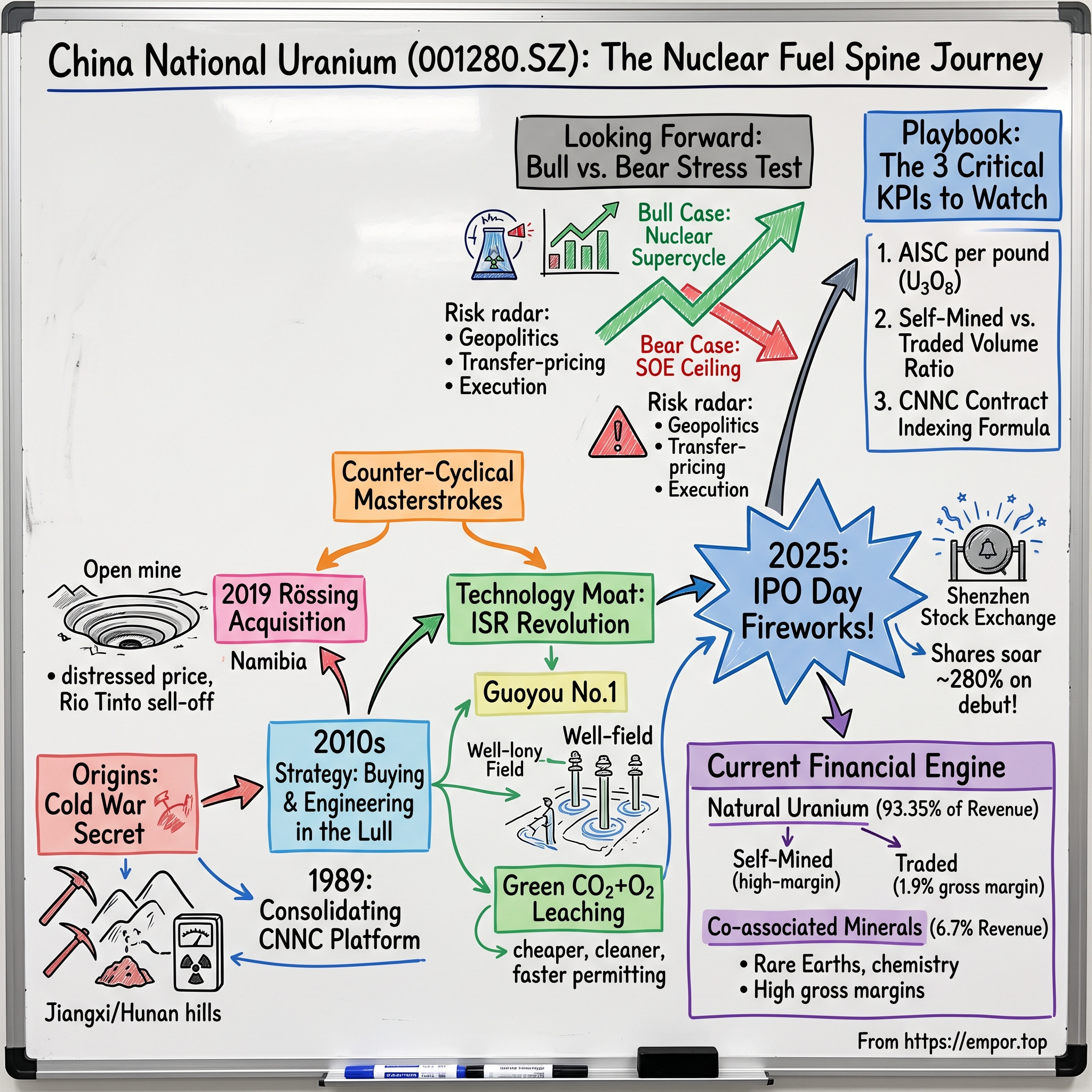
China National Uranium (001280.SZ): The Nuclear Fuel Spine of China's Energy Renaissance
I. Introduction & Episode Roadmap
On the morning of December 3, 2025, the opening bell at the 深圳证券交易所 Shenzhen Stock Exchange did something it almost never does for a state-owned enterprise: it produced fireworks. Shares of 中国铀业股份有限公司 China National Uranium Co., Ltd., trading under the ticker 001280, had been priced at a sober 17.89 yuan. By the time the session closed they stood at 67.99 yuan — a first-day gain of roughly 280%, the kind of move usually reserved for meme stocks and biotech lottery tickets, not for a company whose core product is a yellow-brown oxide powder that most retail investors have never seen.12
The math was staggering. A company that raised about 4 billion yuan (roughly US$570 million) by selling 248 million shares walked out of its first day of trading valued at approximately 141 billion yuan — nearly US$20 billion.2 In a single session, the market had decided that the last standalone, listed vehicle for owning China's natural uranium was worth roughly thirty-five times what it had just paid in.
What, exactly, had investors bought? On paper, they had bought "天然铀第一股" — the first pure-play natural uranium stock ever to trade on China's A-share market.1 In substance, they had bought the fuel-supply nervous system of the world's fastest-growing nuclear power program. Behind the ticker sits the entity China has designated to mine, refine, import, and trade the raw uranium that feeds the reactors of parent 中国核工业集团有限公司 China National Nuclear Corporation (CNNC) — the sprawling state conglomerate that builds and runs a large share of the country's nuclear fleet. If China's reactors are the furnace of its decarbonization ambition, China National Uranium is the coal-yard — or, in the more evocative Chinese phrasing that surrounds the company, the "核电粮仓," the grain elevator of nuclear power.
That is the thesis worth interrogating in this story, and interrogating is the right word. This is not a company that arrived at scale through the ordinary Darwinian grind of winning customers. It was assembled by the state, handed a mandate, and pointed at a mission. The interesting question for a long-term investor is not whether China National Uranium is important — it obviously is — but whether importance translates into the kind of durable, compounding profit that rewards a minority shareholder who bought at twenty billion dollars. Those are very different things, and much of what follows is an attempt to keep them apart.
The company's own arc is a genuinely good story. It began as a division of a secretive Cold War-era ministry, prospecting hard-rock uranium in the hills of Jiangxi and Hunan with pickaxes and Geiger counters. It survived the planned economy, the post-Fukushima collapse that nearly killed the entire Western uranium industry, and a technological reinvention that turned some of China's worst orebodies into some of its cheapest. Along the way it pulled off one of the more audacious counter-cyclical acquisitions in recent mining history — buying a majority of a famous Namibian mine from 力拓 Rio Tinto at the very bottom of the market for an upfront cash payment smaller than the price of a nice Manhattan apartment.34
It is worth pausing on why a listing like this happened at all, and why now. For decades, China's uranium supply chain was hidden inside the CNNC leviathan — a black box of mines, geology bureaus, and trading desks whose economics were never broken out for public consumption. Carving out the natural-uranium platform as a separately listed company is a deliberate act. It raises capital, yes, but the four billion yuan the IPO brought in is almost trivial against a twenty-billion-dollar market value and against the tens of billions of yuan the parent spends across the fuel cycle. The listing does something more interesting: it puts a public price on strategic uranium security, creates a currency for future consolidation, and signals to the world that China now treats domestic uranium supply as a showcase rather than a secret. When a state that historically buried this activity under layers of classification instead parades it on the Shenzhen main board, the signal is the point.
There is also a delicious irony in the timing. For fifteen years after Fukushima, uranium was a career-ending word on Wall Street — a commodity whose price chart looked like a ski slope and whose equity investors had been serially destroyed. The revival of the "nuclear renaissance" narrative, powered by decarbonization targets and, more recently, by the electricity hunger of AI data centers, arrived just in time for China to float the one asset that had quietly been accumulating reserves throughout the bear market. The company did not chase the theme; the theme came to it.
Here is the roadmap. First, the physics and geopolitics of yellowcake — how the nuclear fuel cycle actually works and why the global supply of natural uranium sits in the hands of a tiny oligopoly. Second, the legacy: from Soviet-era prospecting to the birth of a state monopoly. Third, the counter-cyclical masterstroke of the 2019 Rössing deal. Fourth, the technology story — the "国铀一号 Guoyou No.1" project and the green in-situ leaching revolution. Fifth, the financial engine, including the curious rare-earth co-product business hiding inside a uranium company. And finally, the governance, the strategic-power analysis, and the bull-versus-bear stress test, ending with the three metrics that will actually tell you whether the thesis is working. Let's begin with the atom.
 Subscribe on LinkedIn
II. The Physics & Market Structure of Natural Uranium
Start with a lump of rock. To turn it into electricity, you have to march it through one of the most unforgiving supply chains in industry — a sequence where every stage is specialized, capital-intensive, and nearly impossible to substitute. Understanding that chain is the whole game, because it explains why a modest-sounding "8-to-10 percent of controlled global volume" can be worth an enormous amount to whoever holds it.
The journey begins with mining and milling, which produces uranium oxide concentrate — U₃O₈, the famous "yellowcake." From there the material is converted into uranium hexafluoride (UF₆), a compound chosen because it conveniently turns to gas at low temperatures. That gas is fed into centrifuges for enrichment, the step that raises the concentration of the fissile isotope uranium-235 from its natural level of less than one percent to the three-to-five percent that a commercial reactor needs. Enrichment is measured in an esoteric unit called the Separative Work Unit, or SWU. Only after enrichment is the material fabricated into fuel pellets, stacked into rods, and bundled into the assemblies that finally go into a reactor core.7
The single most important economic fact about this chain is buried in that last step. For the utility running the power plant, the cost of the uranium itself is a small slice — well under a tenth — of the total cost of operating the reactor over its life. The plant is a multi-billion-dollar fixed asset; the fuel is almost an afterthought on the income statement. This produces one of the most beautiful demand curves in all of commodities: it is nearly vertical. A utility cannot switch its reactor to burn something cheaper when uranium prices rise — there is no substitute fuel for a light-water reactor, none, at any price. And because fuel is such a small share of costs, a doubling of the uranium price barely dents the economics of running the plant. So when supply tightens, utilities do not push back on price; they scramble to secure volume. Demand is inelastic in the way textbooks describe but real markets rarely deliver.
A quick word on the middle of that chain, because it is where a second, subtler kind of concentration hides. Conversion — turning yellowcake into UF₆ gas — and enrichment are performed at a tiny number of facilities worldwide, and Russia holds a disproportionate share of global enrichment capacity. That is why the Western nuclear industry spent 2022 onward in a cold sweat about weaning itself off Russian services, and why terms like HALEU — high-assay low-enriched uranium, the more concentrated fuel that next-generation reactors will need — entered the trade press. China National Uranium sits at the front of this chain, in mining and the raw material; the conversion and enrichment steps belong elsewhere in the CNNC group and its state peers. But the fragility of the midstream is part of why owning the upstream matters so much to Beijing. A reactor is useless if any single link in the mine-to-core chain is severed, and China has watched the West discover that lesson the hard way.
That inelastic demand meets a supply side that is astonishingly concentrated. In 2023, roughly four-fifths of the world's mined uranium came from just four countries — Kazakhstan at around 38%, Canada near 20%, Namibia about 13%, and Australia close to 9%.8 At the corporate level the concentration is tighter still. Kazakhstan's state champion, 哈萨克斯坦国家原子能工业公司 Kazatomprom, is the world's largest producer by a wide margin, exploiting some of the cheapest orebodies on Earth. Canada's Cameco supplied on the order of 16% of world production in 2023.9 France's Orano became the second-largest producer after absorbing Uranium One from Russia's Rosatom in 2024.10 Into that club steps China National Uranium, whose controlled volume — domestic mines plus its overseas equity uranium plus the material it trades — puts it firmly among the handful of entities that matter globally.
The word "controlled" is carrying weight there, and it deserves scrutiny rather than applause. There is a real difference between pounds a company mines from reserves it owns, pounds it lifts from a joint venture where it holds equity, and pounds it merely buys and resells through a trading desk. A skeptic looking at any claim that China National Uranium commands "eight-to-ten percent of global volume" should immediately ask how much of that is owned production versus traded throughput — because, as the financials will later reveal, those two things have wildly different economic value. The market-structure story is genuinely favorable to anyone who owns scarce, low-cost pounds. It is far less favorable to a middleman moving other people's uranium at a two-percent spread. Keep that distinction in your pocket; it recurs.
Then there is the structural hole in the middle of the market. For more than a decade after the 2011 Fukushima accident, uranium prices were so low that almost nobody built new mines; capital fled the sector and existing mines were mothballed. The result is a genuine deficit. Reactors worldwide consume something on the order of 180 million pounds of U₃O₈ a year, while the world's mines dig up only around 130 million.9 That gap — call it a quarter to a third of annual demand — has been papered over by drawing down inventories and recycling secondary supplies, a bridge that gets shorter every year that new production fails to appear.
For China the stakes are national, not merely commercial. The country has committed to a nuclear build-out with few historical parallels, adding reactors at a pace that positions it to lead the world in installed nuclear capacity, with ambitions that industry observers frame in the range of 150 gigawatts and beyond over the coming decade.7 A fleet that large has a voracious, non-negotiable appetite for fuel, and Beijing has watched other resources — oil, iron ore, semiconductors — become chokepoints in geopolitical arm-wrestling. The oil lesson in particular haunts Chinese energy planners: a country that imports the majority of its crude through the Strait of Malacca knows exactly how it feels to have your energy lifeline run through water someone else's navy controls. Uranium is a chance to not repeat that mistake — to lock down the fuel for a fleet of reactors before the fleet exists, rather than scrambling for imports after.
There is a further wrinkle that makes uranium security especially urgent: the lead times are brutal. A new mine can take a decade from discovery to first production; a reactor takes the better part of a decade to build; and the fuel for a reactor's first core has to be secured years before the plant switches on. So the demand China National Uranium is provisioning for is not this year's reactors — it is the reactors that will come online in the 2030s, whose fuel contracts are being negotiated now. This is why the company can be simultaneously modest in current profit and enormous in strategic value: it is building the supply spine for a nuclear fleet that has, for the most part, not yet been poured in concrete. Uranium security is therefore treated as a matter of state, which is precisely why the entity that controls it was never going to be an ordinary company. To understand how it came to hold that mandate, we have to go back to a very different China.
III. Origins: From Bureaucratic Prospecting to Corporate Restructuring (1955–2018)
Picture a team of geologists in the late 1950s, fanning out across the subtropical hills of Jiangxi and Hunan with primitive scintillation counters, hunting for the radioactive signature of uranium in hard granite. They worked under a veil of state secrecy so total that the operation was known mostly by numbers rather than names — the geological bureaus and prospecting brigades that would become the deep ancestry of today's China National Uranium. Their mission was not electricity. It was the bomb. China's early uranium effort was a weapons program, born of the Cold War imperative to join the nuclear club, and it carried all the hallmarks of that era: enormous manpower, little regard for cost, and results measured in strategic terms rather than returns on capital.
The orebodies they found and mined were, by the brutal standards of global economics, terrible. China's domestic uranium is largely locked in low-grade hard rock, the kind you have to blast, haul, crush, and chemically attack in bulk to liberate a thin scattering of metal. This is the most expensive way in the world to produce uranium. Where a Kazakh operator could dissolve uranium straight out of porous sandstone underground for a low double-digit dollar cost per pound, Chinese hard-rock mining ran at multiples of that — the sort of cost base that only makes sense when the alternative is not having a domestic supply at all. For decades that was exactly the calculus. Under the planned economy, the enterprise was a supply bureau, not a business; its job was to deliver material, and questions of margin were somebody else's department, or nobody's.
That legacy matters for how an investor reads the company today, because organizations carry their origins in their bones. An enterprise born to deliver a strategic material regardless of cost does not automatically become a profit-maximizing miner just because it acquires a stock ticker. The institutional habit of thinking in terms of tonnes delivered and mandates fulfilled, rather than returns on capital earned, is deep — and it is the same habit that, on the positive side, makes the company willing to invest through downturns that would break a return-obsessed public miner. The culture is a double-edged inheritance: it is why the company can do things no Western miner would dare, and why it may never optimize the way a Western miner's shareholders would demand. You cannot understand the modern company without seeing the ministry inside it.
The commercial thread that becomes today's listed company begins to thicken in 1989, with the establishment of the entity that would evolve into China National Uranium — organized to handle the materials, supply, and marketing side of the nuclear-industry apparatus, and later consolidated under CNNC as the group's designated natural-uranium platform.2 The year matters. By the late 1980s, China was midway through the reforms that would transform its economy, and even the most sensitive corners of the state — including the nuclear-industrial complex, which had been run for decades by the Ministry of Nuclear Industry — were being nudged toward something that at least resembled commercial logic. Creating a dedicated materials-supply corporation was an early, tentative step toward treating uranium as a product with a cost and a market, rather than purely as a strategic input to be produced at any price. Over the following decades the state gradually pulled the scattered pieces — the mines, the geological units, the trading arm — into a single vertically oriented uranium champion, and in March 2023 reorganized it into a joint-stock company, the corporate form that would eventually carry it to the Shenzhen exchange.5
Why did the domestic side of the business remain such a laggard for so long? Geology is destiny in mining, and China drew a poor hand. Its uranium is scattered, low-grade, and often locked in hard rock or awkward chemistry, nothing like the fat, porous sandstone bonanzas of Kazakhstan or the ultra-high-grade Athabasca deposits of Canada, where a single mine can be worth more than an entire country's output elsewhere. For most of the twentieth century, the only way to extract Chinese uranium was the brute-force way, and the brute-force way is expensive. That structural cost disadvantage — the sense that China would always be a high-cost domestic producer dependent on imports for the cheap pounds — was the problem the company spent the 2010s trying to engineer its way out of. Two things would eventually change the equation: buying cheap reserves abroad, and inventing a cheaper way to mine at home. Both were triggered by a disaster.
But the event that most shaped the modern strategy was not a domestic reorganization at all. It was a catastrophe on the coast of Japan. In March 2011, the Fukushima Daiichi meltdown detonated the global uranium market. Spot prices that had traded above seventy dollars a pound in the boom years cascaded down toward the high teens over the following years, and stayed depressed for the better part of a decade. Germany announced a nuclear exit. Japan idled its entire fleet. Western miners, facing prices below their cost of production, did the only rational thing: they slashed capital budgets and shut mines, including some of the best deposits on the planet.
Where the West saw a graveyard, Beijing saw a clearance sale. The strategic logic that emerged in this period is the intellectual DNA of everything China National Uranium did next. If the world was determined to under-invest in uranium for a decade, and if China's own reactor build-out guaranteed that demand would eventually come roaring back, then the smart move was to spend the winter accumulating — locking in foreign reserves at distressed prices, building strategic stockpiles, and using the lull to overhaul the domestic extraction technology that had always been the company's weakest link. It is a contrarian's playbook, and it required the one thing Western public miners conspicuously lacked during those bleak years: a shareholder patient enough to fund long-payback projects through a multi-year downturn. The Chinese state was that shareholder. The first great test of the strategy would come in the Namib desert.
IV. The Counter-Cyclical Masterstroke: The 2019 Rössing Acquisition
The Rössing mine is a gash in the Namibian desert big enough to see from space — an open pit gouged out of the Namib since 1976, one of the oldest and largest open-pit uranium operations ever built. For decades it belonged to Rio Tinto, a mining supermajor whose center of gravity had drifted decisively toward iron ore and copper. By 2018, uranium had become an embarrassment on Rio's books: a low-margin, politically fraught, aging asset in a commodity the company no longer wanted to be in. Rössing was expensive to run, its ore was getting harder to reach, and at the depressed uranium prices of the day it was bleeding cash and staring at closure. Rio Tinto wanted out.
There was also a geopolitical subtext that made the buyer set almost preordained. Rössing had a long and specific history with the Iranian state, which held a legacy minority stake dating back to the 1970s — a piece of Cold War trivia that made the mine radioactive in more than the literal sense for any Western financial buyer worried about sanctions optics. Namibia itself had cultivated deep ties with Beijing. And China had a standing appetite for exactly this kind of asset. When you assemble the picture — a motivated seller, a politically complicated asset, a depressed commodity, and one buyer with both the strategic desire and the balance-sheet patience to take it — the outcome starts to look less like a competitive auction and more like a negotiation with a single serious bidder. That, too, is a lesson in how counter-cyclical deals get done: the best prices are available precisely when the pool of willing buyers has shrunk to one.
What happened next is a case study in the value of showing up with cash when nobody else will. In November 2018, Rio Tinto agreed to sell its entire 68.62% controlling stake in Rössing Uranium Limited to China National Uranium.4 The headline structure was almost comically favorable to the buyer. The upfront cash payment was just US$6.5 million. The rest — up to US$100 million — was contingent, payable only if uranium prices and Rössing's net income recovered over the following seven years, bringing the maximum total consideration to US$106.5 million.4 The deal completed on July 16, 2019.3
Sit with those numbers, because they are the whole point. China National Uranium took control of a top-tier producing uranium mine — a genuinely globally significant asset — for an initial outlay smaller than a mid-market real-estate transaction, with the bulk of the price structured so that it only came due if the mine's fortunes actually improved. Rio Tinto, for its part, was rationally happy to be rid of a headache and to offload the decommissioning liability that comes attached to any uranium mine. This is the essence of counter-cyclical acquisition: the seller is pricing the asset on the misery of the present, while the buyer is pricing it on the recovery it believes is coming. When uranium prices later climbed off the floor, the economics of that contingent structure shifted meaningfully in the seller's favor too — but the buyer had secured control and, crucially, the offtake.
The contrast with how others were playing the same board is instructive. 中广核矿业 CGN Mining, the Hong Kong-listed uranium arm of China's other nuclear champion, pursued its foreign supply through equity stakes in Kazakh joint ventures — buying into low-cost sandstone production alongside Kazatomprom rather than taking operational control of a whole mine. It is a lower-risk, lower-control model: you get exposure to cheap pounds without inheriting the operational headaches and decommissioning liabilities of running an aging mine yourself. Western pure-play miners like Paladin Energy, meanwhile, spent the downturn wrestling with the debt on assets such as Langer Heinrich — another Namibian mine, just up the road from Rössing — forced into care-and-maintenance and dilutive refinancings that hammered their shareholders. The difference in outcomes is a study in balance sheets: the Western miner, funded by public equity and nervous lenders, had to shrink to survive the winter; the Chinese state champion, funded by patience, could go shopping in it.
China National Uranium, backed by a patient sovereign balance sheet, simply bought control of Rössing outright and pointed its output at home. It is worth being precise about the claimed valuation: the notion that this was "under 0.1x P/NAV" is an analytical framing, not a disclosed figure, and the true economics depend heavily on how much of that contingent consideration ultimately came due and on the cost of extending the mine's life. But the direction of the trade is not in dispute. The buyer acquired reserves cheaply because it was willing to own them through the dark. And here is the deeper lesson for how state capitalism competes: the durable edge was not superior deal-making genius or proprietary insight — the whole world knew uranium was cheap in 2018 — it was the willingness and ability to act on a long-term view while public-market participants were structurally forced to retreat. That is an advantage no amount of Western analytical brilliance can replicate, because it is not about seeing further; it is about being allowed to wait longer.
Turning the asset around was the second act, and it is the part of the story where an independent observer should apply the most skepticism, because turnarounds are where optimistic acquisition narratives go to die. Rössing is an old open-pit mine, and old open pits are unforgiving: as you dig deeper, the strip ratio — the tonnes of waste rock you must move to reach each tonne of ore — tends to worsen, and the ore grade often thins. A mine that was cash-flow negative for Rio Tinto did not become a gusher simply because its owner changed. What changed was the objective function. Rio Tinto needed Rössing to generate a return on capital that could compete with its iron-ore and copper divisions; it could not, so Rio wanted out. China National Uranium needed Rössing to produce secure pounds for the national reactor fleet, and against that yardstick a mine that merely covers its cash costs while delivering strategic supply is a success. The new owner set about extending Rössing's life of mine, optimizing its aging haul-truck fleet, and — most importantly — securing the mine's uranium as feedstock for China's expanding reactor fleet rather than selling it into a glutted spot market.
That vertical logic, mine-to-reactor, is what makes an overseas asset strategically valuable to a state buyer in a way it never could be to a financial owner. It also quietly reframes how you should judge the deal. If you evaluate Rössing as a standalone profit center, it may look mediocre — an aging, high-cost mine in a competitive commodity. If you evaluate it as a piece of national fuel security bought for pocket change and a decommissioning liability, it looks brilliant. Both framings are true at once, and the tension between them is a preview of the central question that hangs over the entire company: is this an enterprise optimized to earn returns for shareholders, or one optimized to deliver strategic supply for the state? Rössing became the flagship of a broader overseas footprint that the company describes in terms of controlled mines abroad, equity participations, and an international physical-trading desk — a three-pillar architecture of domestic mining, overseas controlled production, and global trading.2 The exact roster of smaller foreign interests beyond Rössing is not comprehensively disclosed in the listing materials, and an honest account should note that rather than inventing precision. What is disclosed, and what matters, is that the crown jewel abroad was bought at the bottom. The other half of the cost story, though, was being written at home — in the sandstone basins of Inner Mongolia, where the company was quietly rewriting the economics of its worst inheritance.
V. Technology Moat: "Guoyou No.1" & Green In-Situ Leaching
For most of its history, China National Uranium's domestic mines were its shame — the high-cost hard-rock operations that only survived because someone decided national security trumped economics. The technology story is how that liability began to turn into something closer to an advantage, and it hinges on a method that looks less like mining and more like a chemistry experiment conducted a thousand feet underground.
The technique is called in-situ recovery, or ISR — 地浸采铀 in Chinese, literally "ground-leaching uranium mining." Instead of digging a pit or sinking a shaft, you drill wells into a permeable, uranium-bearing sandstone layer. You inject a specially formulated liquid down one set of wells; the liquid seeps through the rock and dissolves the uranium in place; then you pump the now uranium-laden solution back up through recovery wells and strip the metal out at the surface. There is no pit, no giant heap of crushed rock, no towering tailings dam of radioactive slurry. The orebody is essentially rinsed while it stays where nature left it. For a certain kind of geology — porous, water-saturated sandstone — it is dramatically cheaper and cleaner than moving mountains.
The economics of why this matters are worth making concrete. In conventional hard-rock mining, the single biggest cost is moving and processing rock — blasting it loose, hauling it in enormous trucks, crushing it, and then chemically attacking the crushed ore to liberate a few pounds of uranium per tonne. You spend enormous energy and capital handling waste rock that contains no uranium at all. ISR skips almost all of that. You never lift the ore; you lift only a liquid already carrying the uranium. The capital footprint is a field of relatively cheap wells and a modest processing plant instead of a giant pit, a fleet of house-sized haul trucks, and a mill. The operating cost collapses accordingly. This is precisely why Kazakhstan, sitting on ideal ISR sandstone, can produce uranium at some of the lowest costs on Earth and has become the Saudi Arabia of the uranium world. If China could unlock ISR on its own deposits, it could in principle shed the high-cost-producer label that geology had stapled to it.
The twist that makes it work in China is chemistry. The classic ISR technique pioneered in Kazakhstan uses sulfuric acid as the leaching agent — cheap and effective, but harsh, and unsuitable where the surrounding rock contains a lot of carbonate that would neutralize the acid and consume it wastefully. Many Chinese sandstone deposits have exactly that problem. The company's answer was to develop and industrialize a CO₂-plus-O₂ leaching process — using carbon dioxide and oxygen to mobilize the uranium under near-neutral, weakly alkaline conditions rather than dousing the ore in acid.2 Think of it as the difference between dissolving a stain with a gentle, targeted solvent versus soaking the whole shirt in bleach. The gentler method suits China's geology, avoids the acid-consumption penalty, and produces far less environmental disturbance.
The showcase for all of this is the project the company markets as 国铀一号 Guoyou No.1 — "National Uranium No.1" — located in the Ordos region of Inner Mongolia, positioned as China's largest and most automated green uranium extraction base.1 Its most-cited proof point is speed: the project reportedly delivered its first uranium within about a year of construction beginning, a pace the company touts as a new benchmark for the industry.1 That is a genuine engineering claim worth respecting — but also worth watching, because a fast first-pour is not the same as sustained low-cost production at scale, and the ramp is what ultimately determines the economics.
Here honesty requires a clear line between the demonstrated and the asserted. The specific cost figures that circulate around Chinese ISR — claims of a 35-to-40% reduction in all-in sustaining costs, of landing in the competitive lower half of the global cost curve at something like twenty-five to thirty-five dollars a pound — are industry and management framings, not independently audited disclosures, and this story treats them as directional rather than precise. The mechanism is real and the direction is almost certainly right: ISR is structurally cheaper than hard-rock mining, and China's version avoids the acid penalty. Whether it drops domestic output all the way into Kazakh-competitive territory is the open question, and the honest answer is that the market will find out over the next several years as Guoyou No.1 and its successors ramp.
It is also worth resisting the temptation to treat "green" as pure marketing, because in this case the environmental profile has hard commercial consequences. ISR done well does not produce the two things that make conventional uranium mining an environmental and regulatory nightmare: giant tailings piles and radioactive dust. But it introduces its own specific hazard, which is groundwater. The whole method depends on injecting chemistry into an aquifer and pumping it back out; if the leaching solution migrates beyond the ore zone, it can contaminate water that people and agriculture depend on. So the real environmental test of Chinese ISR is not the absence of a tailings dam — it is the integrity of aquifer containment and the ability to restore groundwater after mining ends. The company's emphasis on zero above-ground radioactive discharge is meaningful, but the underground story is the one a careful observer should want more disclosure on over time.
The commercial payoff of the cleaner method, meanwhile, is speed. In a country where the 生态环境部 Ministry of Ecology and Environment can stall a project indefinitely, a method that is genuinely less disruptive is also a method that clears permitting faster — and permitting speed, not ore in the ground, is often the true bottleneck on how fast a uranium company can grow. Technology, in other words, is not just a cost lever here; it is a speed lever on the one constraint that governs how fast the company can add domestic supply. The reported one-year construction-to-first-pour at Guoyou No.1 is as much a permitting-and-execution story as an engineering one. That growth has to show up somewhere, and the place to look is the income statement.
VI. Business Segments, Financial Engine, & Hidden Value
Peel open the financials and you find a company that is really two very different businesses stapled together — a colossal, low-margin uranium machine, and a small, high-margin chemistry business hiding in its shadow. The uranium machine dominates the top line so completely that it almost defines the company. In 2024, the natural uranium business generated about 15.9 billion yuan of revenue, accounting for 93.35% of main operating revenue — up from roughly 13.2 billion yuan (91.92%) in 2023 and about 9.2 billion yuan (89.22%) in 2022; in the first half of 2025 it ran at about 8.7 billion yuan, or 92.08% of the total.6 The trend is clear: as the company scales, uranium is becoming a larger and larger share of what it does.
But revenue share is not profit, and this is where an investor has to slow down. The natural uranium segment is itself a blend of two very different activities: selling uranium the company mines itself, and trading uranium it buys from others and resells. Self-mined uranium — from domestic ISR and from Rössing — carries a real margin. The trading business does not. According to the prospectus disclosures, the natural uranium trading business ran at a gross margin of roughly 1.9% in 2024 — razor-thin, the kind of pass-through spread you would expect from a physical commodity broker moving volume rather than an owner of scarce reserves.6 This is the single most important structural fact about the income statement, and it cuts directly against the lazy version of the bull case. A large chunk of the headline revenue is low-value trading throughput. The high-quality earnings live in the smaller pool of self-mined pounds and, quietly, in the co-product business.
There is a strategic reason the company runs a large, barely profitable trading book anyway, and it is worth understanding rather than dismissing. A trading desk that is constantly buying and selling physical uranium around the world does two things beyond earning its thin spread. It keeps the company plugged into global supply relationships — with Kazakh producers, with utilities, with the secondary market — which is exactly the network you want if your job is to guarantee national fuel security through all weathers. And it gives the parent a flexible mechanism to source pounds when domestic and equity production fall short of the reactor fleet's needs. In other words, the trading business is partly a margin business and partly a strategic logistics function dressed up as one. For a state champion, that is a perfectly rational thing to run. For a minority shareholder hoping the headline revenue reflects high-margin mining, it is a trap to be aware of. The revenue line flatters; the profit line is the truth.
Bottom line, the company earned something in the neighborhood of 1.5 billion yuan of net profit in 2024 — roughly US$212 million — up about 16% from the prior year.2 On a company that traded out of its IPO at nearly US$20 billion, that is a demanding starting valuation on current earnings, and it tells you the market is paying overwhelmingly for the future — for the reactor build-out, for rising self-mined volumes, and for the optionality of higher uranium prices — rather than for the profits in hand today. Put crudely, at the first-day close the market valued the company at roughly a hundred times its trailing earnings. Even granting a generous view of where profits go over the next decade, that is a valuation that can only be justified by conviction in dramatic volume and margin growth — a conviction that lives or dies on the self-mined ramp and on how much of the uranium price the company is allowed to keep. It is a growth-stock multiple bolted onto a state-controlled commodity producer, which is an unusual and slightly uneasy hybrid.
Now the hidden business. Alongside uranium, the company runs a segment devoted to the comprehensive utilization of radioactive co-associated minerals — 放射性共伴生矿产资源综合利用 — which contributed the balance of revenue, on the order of 6.7% in 2024.6 Inside this modest line item sits some genuinely interesting chemistry. The feedstock is heavy mineral sands and ores that contain 独居石 monazite, a mineral that happens to carry both mild radioactivity (which is why a uranium company is licensed to handle it) and a valuable payload of rare earth elements. Processing it yields a suite of products: rare earth chlorides (氯化稀土), ammonium tetramolybdate (四钼酸铵), tantalum pentoxide, and niobium pentoxide.6 These are not trivial materials — rare earths and refractory metals sit at the heart of magnets, electronics, and specialty alloys, and China's dominance of that supply chain is itself a matter of global strategic tension.
The economic significance is disproportionate to the revenue. The company's disclosures indicate that the co-associated minerals business carries a substantially higher overall gross margin than the uranium trading business.6 The precise figure is not something to overstate — the outline's "greater than 45–50%" is a claim to treat as illustrative rather than audited — but the direction is disclosed and it matters: a small, high-margin chemistry segment can carry a meaningful share of the fixed overhead and profit, cushioning a uranium book whose trading portion earns almost nothing.
There is a genuinely elegant industrial logic here that is easy to miss. Monazite is a headache for most miners precisely because it is mildly radioactive — heavy mineral-sand operations around the world often have to figure out what to do with a radioactive by-product they are not licensed to process and cannot legally dump. A company that already holds the licenses, the handling expertise, and the regulatory relationships to manage radioactive material can take that headache off other people's hands and extract value from it. The radioactivity that makes monazite a liability for a titanium-sands miner makes it a natural fit for a uranium company. That is the kind of adjacency that looks like luck but is really a consequence of the regulatory moat: being the licensed handler of radioactive material creates business opportunities nobody without the license can touch.
It is also a piece of strategic optionality with a geopolitical charge. Rare earths and refractory metals like tantalum and niobium are exactly the materials at the center of the trade tensions between China and the West, and China's willingness to restrict rare-earth exports has already been used as a lever in those disputes. A segment that adds to China's critical-minerals output is therefore worth more to Beijing than its revenue line suggests — and potentially worth more to shareholders too, if rare-earth prices spike or if the segment scales. The question of who ultimately captures that value, though, runs straight into the governance of a state enterprise.
VII. Management, Governance, & Capital Allocation Record
Who runs this thing? The two names at the top are 袁旭 Yuan Xu, the chairman and legal representative, and 邢拥国 Xing Yongguo, the general manager.11 Neither is a household name, and that is itself the point. There is no charismatic founder here, no visionary who mortgaged his house to bet on uranium, none of the personal-stakes drama that animates the origin story of a private company. These are career nuclear-industry men, executives whose résumés run through CNNC's apparatus — the sprawling geology, mining, and fuel-cycle bureaucracy that has governed Chinese uranium for generations, including its geological arm. They rose by delivering on state mandates over decades, not by winning markets, and the skills that got them here are the skills of executing large, complex, politically sensitive projects on time and within the priorities set from above.
That is worth taking seriously rather than sneering at, because it is exactly the right skill set for the task at hand. Building Guoyou No.1 and pouring first uranium within about a year of breaking ground is a feat of industrial project management, and it is the kind of thing this managerial culture does genuinely well — the same institutional muscle that lets China build reactors and high-speed rail at a pace the West finds bewildering. What this culture does not do, by design, is optimize aggressively for the wealth of minority shareholders, because that was never its job. They are not founder-entrepreneurs with equity stakes and a personal fortune riding on the share price; they are appointed stewards of a strategic state asset, and their incentives are calibrated toward supply security, national objectives, and institutional advancement rather than toward the stock price. That distinction should color how an investor reads every capital-allocation decision the company makes. When management says it will deploy capital with discipline, the relevant question is not whether they are honest — they may well be — but whose definition of a good outcome the discipline serves.
On the evidence available, the capital-allocation story management wants to tell is one of discipline. The IPO raised a relatively modest 4 billion yuan, and management has framed the proceeds as targeted at concrete operational uses — expanding domestic sandstone ISR capacity and upgrading the co-product processing facilities — rather than at splashy overseas land-grabs.12 That is a credible and defensible use of capital, and it is consistent with the company's actual history: the Rössing deal was cheap and opportunistic, not a trophy purchase at the top of the cycle. If you are grading management on whether their stated strategy matches their revealed behavior, the counter-cyclical instinct earns real marks. This is an organization that has demonstrated, at least once and at meaningful scale, that it will buy when others are forced to sell.
But independence requires naming the other side of the ledger, and with a state enterprise the central issue is not competence — it is whose interests the company serves when they diverge from a minority shareholder's. The pros are obvious and genuine: sovereign backing that all but eliminates financing risk, and a captive, guaranteed customer in CNNC's reactor fleet, which removes the demand uncertainty that haunts ordinary commodity producers. There is essentially no risk that China National Uranium wakes up one morning unable to find buyers for its uranium. The cons live in the same fact. When your dominant customer is also your parent, the price at which you sell becomes a matter of internal policy rather than arm's-length negotiation — and that policy is set by people whose loyalties run to the group, not to the free float.
This is the transfer-pricing question, and it is the sharpest tool in a skeptic's kit. Suppose uranium enters a runaway bull market and the spot price triples. A Western pure-play miner would capture that windfall directly; its shareholders own the upside. Does China National Uranium? Or do its long-term supply contracts with parent CNNC contain fixed or formula-based pricing that caps the realized price well below spot, effectively transferring the windfall from the listed subsidiary to the unlisted parent and, ultimately, to the state's goal of cheap, stable nuclear power? The honest answer is that an outside investor cannot know without scrutinizing the related-party transaction (关联交易) disclosures in the annual reports with real care — and even then, the terms can be revised. This is not a hypothetical concern; it is the structural reason a state-controlled resource company can look cheap on assets and still disappoint on realized earnings. Any assessment of the strategic moat has to be read against it.
An activist investor — the kind who buys a stake and writes angry letters — would find plenty to circle here, at least in theory, even if in practice the state's control makes such a campaign nearly impossible. They would circle the concentration of sales into a single related party. They would circle the absence, at this early stage of public life, of a long track record of dividend policy or of returning capital to minority holders. They would circle the mixing of a strategic-logistics trading book into the same segment as high-value mining, which blurs the true profitability of the crown-jewel pounds. And they would circle the governance reality that the board answers to the state, not to the float, so that even a correct diagnosis carries no mechanism of redress. None of this makes the company a bad actor; state enterprises are simply built to serve a different master. But a serious investor should price the discount that this structure deserves rather than pretend it away, and should treat management's demonstrated discipline — real as it is — as necessary but not sufficient comfort. Behavior over time will be the only reliable test, and the public track record is, as of now, barely a chapter long. That short record is worth keeping front of mind as we turn to the strength of the competitive position, because a fortress is only as valuable as the willingness of its owner to share the spoils.
VIII. Strategic Position: Hamilton Helmer's 7 Powers & Porter's 5 Forces
War-game the competitive position and something unusual emerges: on the classic frameworks, China National Uranium looks almost overpowered — and yet the frameworks quietly assume away the one force that matters most, which is the state that grants the power in the first place. Run it through Hamilton Helmer's 7 Powers and the picture is worth examining honestly rather than triumphantly.
The dominant power is Cornered Resource. The company holds what amounts to an exclusive national mandate over natural uranium mining and processing inside China — a position underwritten by regulation, not merely by owning good rocks. Layered on top of physical control of 19 domestic mining licenses and 6 exploration permits across Xinjiang, Inner Mongolia, Guangdong, and Hunan, that mandate is about as clean a cornered resource as exists in any industry.2 No competitor can simply decide to enter; the resource and the right to exploit it are both spoken for. Second is Scale Economies: the company shares procurement, logistics, and trading infrastructure across CNNC's nationwide fuel chain, spreading fixed costs over enormous throughput. Third is Process Power — the accumulated, hard-to-copy know-how in CO₂+O₂ neutral-leach ISR tuned to China's awkward carbonate-rich sandstones, a capability built over years of field development that a new entrant could not replicate quickly even if permitted to try. Fourth, and most subtly, is Counter-Positioning: the ability, funded by a patient sovereign balance sheet, to keep investing through commodity winters that force publicly traded Western miners to cut and fold — the exact dynamic that delivered Rössing.
Porter's Five Forces tells a complementary story. The threat of new entrants is essentially zero: the regulatory, security, and environmental barriers to standing up a uranium business in China are insurmountable for anyone without a state mandate. The threat of substitutes is likewise zero — there is no alternative fuel for a light-water reactor, full stop. Supplier power is low, because the company's supply comes from its own reserves and long-term sovereign contracts rather than from merchants who could squeeze it. Competitive rivalry is muted and oligopolistic; globally, the major players cooperate as much as they compete, tied together by joint ventures and offtake agreements that dampen price wars. So far, so dominant.
It is worth naming the powers the company conspicuously lacks, because a serious analysis counts absences as well as strengths. There is no meaningful branding power — uranium is a fungible commodity molecule, and no utility pays a premium for a particular producer's yellowcake. There are no network economies of the kind that make software and marketplaces winner-take-all. And the vaunted switching costs that lock in a nuclear utility to a fuel supplier, while real, largely benefit the incumbent supply relationships within China rather than conferring pricing power on China National Uranium against its own parent. In other words, the company's strength is almost entirely of the cornered-resource and counter-positioning variety — powers granted by the state and by geology — not the customer-captivity powers that let a Western moat business quietly raise prices year after year. That is a crucial distinction, because cornered-resource power is only as valuable as your freedom to charge for the resource, and that freedom is precisely what the parent relationship constrains.
The catch sits in the fifth force — the bargaining power of buyers — and it is where the whole triumphant picture inverts. On paper, buyer power looks moderate and controlled: the customers are state nuclear operators buying on long-term indexed formulas. But the dominant buyer is the parent itself, and a monopoly seller facing a monopsony buyer who also happens to be its controlling shareholder does not get to exercise its pricing power freely. All those Helmer powers describe the company's strength against outsiders — new entrants, substitutes, merchant suppliers. None of them protects the minority shareholder against the entity on the other side of the related-party table. The powers are real, in other words, but the question of who harvests the rent they generate is not answered by the frameworks at all. It is answered by the transfer-pricing policy discussed above. That tension is exactly what the bull and bear cases fight over.
IX. Investment Case: The Bull vs. Bear Stress Test
Set the two cases against each other and let them fight, because the honest answer to "does this win from here?" is that it depends entirely on which of two structural facts dominates — the tailwind of a nuclear supercycle, or the ceiling of state ownership.
The bull case starts with the wind at the company's back. The world is, after a decade of neglect, rediscovering nuclear power. Net-zero pledges have made carbon-free baseload electricity suddenly fashionable; the prospect of small modular reactors and the electricity gluttony of AI data centers have added new sources of demand to the forecast; and China's own reactor build-out guarantees a rising, price-insensitive call on uranium for decades.7 Against that demand sits the structural supply deficit described earlier — mines producing far less than reactors consume, with the inventory bridge thinning each year.9 In that world, an owner of low-cost, self-mined pounds enjoys powerful operating leverage: because a mine's costs are largely fixed, every incremental rise in the realized uranium price drops almost straight to gross profit. Bolt onto that a sovereign guarantee of demand and priority dispatch, and the bull can argue for years of rising volumes at rising prices — the rare commodity producer that does not have to worry about selling what it digs.
Now the bear, and the bear's arguments are not soft. First, geopolitics and asset risk: the crown-jewel foreign mine sits in Namibia, and any meaningful foreign supply for a Chinese uranium champion travels through corridors — Central Asia, southern Africa — where resource nationalism, sanctions crossfire, or plain political instability could interrupt volumes the company is counting on. A mine you don't control the ground under is a mine you can lose. Second, and more corrosive, is the SOE valuation discount. Minority shareholders in a Chinese state enterprise sit at the back of the queue: dividend policy is not theirs to set, the board answers to the state, and capital-allocation priorities can be redirected toward national objectives that do not maximize per-share value. Third is the transfer-pricing cap already dissected — the live risk that internal contract formulas blunt precisely the spot-price upside that makes the bull case exciting, so that when uranium finally rips, the gains accrue to the parent and the state rather than to the float. The publicly traded pure-plays that a bull would compare this company to — Cameco, or the inventory-hoarding Sprott Physical Uranium Trust — offer their shareholders undiluted, direct exposure to the uranium price. China National Uranium, by construction, may not.
A fair risk radar rounds out the bear case with the hazards specific to this business rather than generic macro worries. Execution risk is real: the entire domestic growth thesis rests on ramping ISR projects that are still young, and a stumble on groundwater containment, well-field performance, or grade would hit both cost and permitting momentum at once. Commodity risk cuts both ways: uranium is famously cyclical, and a company being valued for a supercycle would re-rate hard if the spot price stalled or if the much-discussed supply deficit turned out to be bridged by inventories for longer than the bulls expect. Geopolitical risk is not only about Namibia and Central Asia; it also runs in reverse, since a Chinese state uranium champion is exactly the kind of entity that could find its overseas assets or trading relationships caught in the crossfire of Western sanctions or export controls as the technology cold war deepens. And there is the plain governance risk of a company barely months into public life, with a related-party sales structure and a control regime that leaves minority holders as passengers. None of these is disqualifying; all of them are reasons the near-hundred-times earnings starting valuation carries little margin for error.
So how does an independent observer hold both cases at once? The synthesis is that China National Uranium almost certainly wins as a business — its strategic position is close to unassailable, its volumes will grow, and its cost curve is improving. Whether it wins as a stock for a minority holder who paid a near-twenty-billion-dollar valuation on roughly two hundred million dollars of profit is a genuinely open question, and it turns not on the strength of the uranium market but on how much of that strength the company is permitted to keep for its outside owners. That is an unusual place to land, and it is why the specific things to monitor are not the usual macro headlines but a short list of company-specific dials.
X. Playbook & The 3 Critical KPIs to Watch
Strip the story down to its transferable lessons and two stand out, both of which this company demonstrated rather than merely preached. The first is that counter-cyclical acquisition, done with a patient balance sheet, can build a cost base competitors can never match — the Rössing purchase locked in a world-class reserve at the market's darkest hour, and no amount of later spending by a rival buying at the top can replicate that entry price. The second is that technology can resurrect dead assets: in-situ leaching, and specifically the CO₂+O₂ chemistry, took Chinese sandstone deposits that hard-rock economics had condemned and turned them into viable, cleaner, faster-permitting production. Both lessons share a theme — advantages built during downturns, when everyone else is retreating, tend to be the most durable, because they are the hardest to compete away.
Which brings us to what actually matters to track from here. Three metrics, and only three, will tell a long-term investor whether the thesis is compounding or quietly breaking — and none of them is the headline revenue number that so dominates the income statement.
The first is all-in sustaining cost per pound of U₃O₈ — the true delivered cost of the company's self-mined production at Guoyou No.1 and Rössing. This is where the entire technology story either proves out or doesn't. If ISR is really dragging China National Uranium down the global cost curve, it will show up as flat or falling AISC even as the company scales; if the ramp disappoints or cost inflation bites, it will show up here first, long before it reaches profits.
The second is the ratio of self-mined to traded volume. Recall that the trading book earns a gross margin near two percent while self-mined pounds earn a real one. The mix between them is the difference between a high-quality miner and a low-margin commodity broker wearing a miner's clothes. A rising self-mined share is the single cleanest signal that the company is becoming more valuable per unit of revenue; a falling one means it is padding the top line with throughput that does almost nothing for earnings.
The third is the CNNC contract indexing formula — the proportion of volume sold under fixed or capped long-term prices versus spot-linked market pricing. This is the transfer-pricing question rendered as a number, and it is the master key to the whole bull-versus-bear debate. The more volume that floats with the market, the more a minority shareholder actually owns the uranium upside; the more that is locked to fixed ceilings, the more that upside belongs to the parent. Buried in the related-party disclosures of each annual report, this ratio decides who gets rich if uranium runs.
A note on how to read these three together, because they interact. High self-mined share plus low AISC plus market-linked pricing would be the dream combination — a low-cost miner keeping the upside, a genuine analog to owning Cameco with a Chinese growth runway. High self-mined share plus low cost but fixed pricing would be the disappointment scenario — a superb operator whose economics are quietly harvested by its parent. And a stagnant self-mined ratio, whatever the pricing, would suggest the whole domestic-ISR growth story is stalling and the company is drifting toward being a low-margin trader with a trophy mine attached. The virtue of watching these three specifically is that they cut straight past the flattering revenue headline and the strategic-importance rhetoric to the only questions that determine per-share value: how much does it cost, how much of it is really ours, and how much of the price do we get to keep. Everything else is narrative.
XI. Outro
China National Uranium arrived on the public market as a paradox dressed up as a triumph — a company of undeniable strategic importance whose 280% opening-day surge said more about the scarcity of ways to own Chinese uranium than about the profits available to those who do.1 Its story is genuinely remarkable: a secretive weapons-era prospecting bureau that survived the planned economy, reinvented its worst assets with green leaching chemistry, and bought a world-class Namibian mine for pocket change at the bottom of the market. Along every axis that measures a business — cornered resource, cost trajectory, guaranteed demand, sovereign patience — it is formidable.
The unresolved question, the one this story has tried to hold open rather than answer, is whether that formidable business is also a good investment for someone who owns only the shares. The company sits at the precise intersection of three powerful forces — energy security, Chinese state capitalism, and global decarbonization — and each of those forces is a reason the enterprise will endure. But the same state that guarantees its survival also sets the price at which it sells to its parent, controls its dividend, and directs its capital. The uranium is real, the deficit is real, the technology is real. What a minority shareholder ultimately captures of all that reality is the one thing not yet disclosed — and it is the thing worth watching most closely of all.
References
-
China National Uranium soars 280% in debut on Shenzhen bourse — Global Times, 2025-12-03 ↩↩↩↩↩↩
-
China's Sole Uranium Miner Soars in Market Debut — Investing News Network, 2025-12-03 ↩↩↩↩↩↩↩↩
-
Rio Tinto completes sale of its stake in Rössing Uranium Limited — Rio Tinto, 2019-07-16 ↩↩
-
Rio Tinto agrees sale of its stake in Rössing Uranium Limited — Rio Tinto, 2018-11-26 ↩↩↩
-
CNNC's subsidiary listed on Shenzhen Stock Exchange as first natural uranium stock — CNNC, 2025-12-08 ↩
-
China National Uranium Co., Ltd. IPO Prospectus (招股说明书) — Shenzhen Stock Exchange, 2025-12-02 ↩↩↩↩↩
-
China Nuclear Fuel Cycle — World Nuclear Association, 2024-11-01 ↩↩↩
-
Uranium and Nuclear Power in Kazakhstan — World Nuclear Association ↩
-
Cameco, Kazatomprom release 2025 production figures — World Nuclear News ↩↩↩
-
China National Uranium Co., Ltd. 2025 Annual Report Summary (2025年年度报告摘要) — Sina Finance / SZSE ↩
 LinkedIn
 WhatsApp
 Reddit
 Hacker News
 Email
Email Kindle
 RSS Feed
 Spotify
 Apple Podcasts
 Amazon Music
 Audible
 YouTube