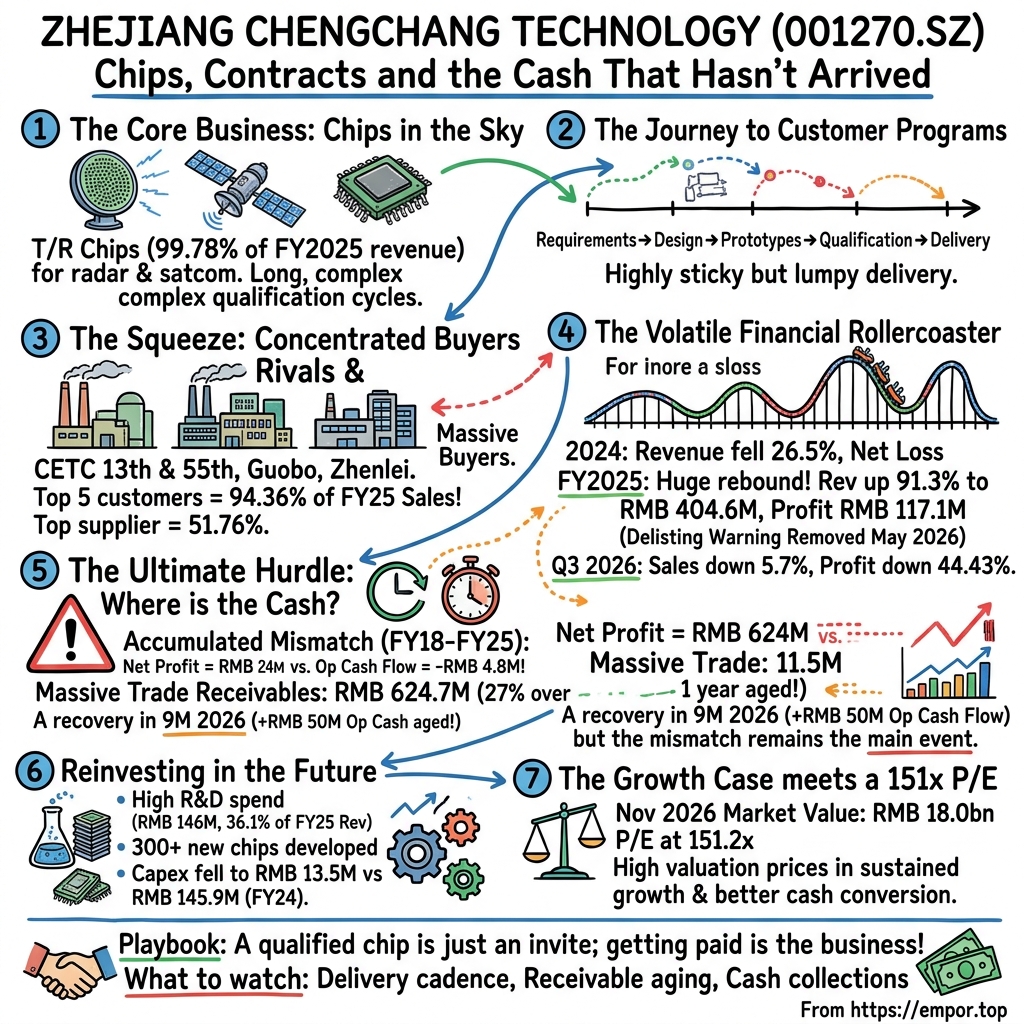
Zhejiang Chengchang Technology: Chips, Contracts and the Cash That Hasn’t Arrived
I. The Profit That Turned Back into a Receivable
In the spring of 2026, the people running 浙江铖昌科技 Zhejiang Chengchang Technology had something close to a perfect redemption story to tell. Twelve months earlier their company had been branded with a stock-exchange warning that it could be delisted. Then, in a single fiscal year, revenue nearly doubled, the loss became a large profit, and the auditors signed off on numbers good enough to have the warning lifted. For a small chip designer in Hangzhou, it was the kind of year that gets told and retold at investor meetings.
The numbers behind that year were striking. Chengchang reported revenue of about RMB 405 million for 2025, up roughly 91% on the year before, and net profit attributable to shareholders of about RMB 117 million.1 Only a year earlier, revenue had fallen by about a quarter and the company had lost money.2 A swing that violent is not what most people picture when they think of a semiconductor company with a catalogue of more than a thousand products. It looks more like a shipyard or a defence contractor, where one big order arriving or slipping by a few months can decide the whole year.
Then the autumn brought a less comfortable chapter. When Chengchang published its third-quarter report in October 2026, revenue for the first nine months was up only 2.9% on the same period of 2025.3 The third quarter on its own was worse: revenue fell 5.7% year on year, and net profit attributable to shareholders fell 44.4%.3 Operating margin, which had sat around a third of sales a year earlier, dropped below a fifth.3 The redemption arc had not reversed, but it had stopped climbing.
Here is the puzzle in one sentence. Chengchang can clearly design chips that serious customers qualify and buy, and it can clearly earn high margins when those chips ship in volume. What is much less clear is whether it has entered a steady delivery cycle, or whether 2025 was simply the catch-up from a trough created when its customers' programs slipped. And sitting behind that question is a second one that matters even more to a long-term owner: when Chengchang books a profit, how long does it take for the cash to come home?
Four questions will carry this story. The first is whether the delivery rebound can last, or whether it was a one-off wave of postponed shipments finally landing. The second is whether the long acceptance and payment cycles of Chengchang's customers quietly undermine the profits it reports, turning income statements into stacks of IOUs. The third is whether the company has a real advantage against powerful buyers and much larger established competitors, or whether it is a capable supplier in a market where others hold most of the cards. The fourth is whether the R&D it pours money into each year produces returns large enough to justify what investors are paying for the shares.
Before going further, it helps to draw a boundary. Chengchang is a listed company in its own right, trading on the 深圳证券交易所 Shenzhen Stock Exchange under the code 001270 since June 2022.4 Its controlling shareholder is 深圳和而泰智能控制 Shenzhen H&T Intelligent Control, a separate listed company best known for the control boards inside household appliances and power tools, which held about 47% of Chengchang at the end of September 2026.3 H&T's founder, 刘建伟 Liu Jianwei, is Chengchang's ultimate controller through that holding.1 But H&T's smart-controller business, its headcount and its customers are not Chengchang's. Everything in this story about revenue, margins, receivables and R&D refers to the chip company alone. Chengchang designs, produces and sells microwave and millimetre-wave transmit/receive chips for phased-array systems, sells them entirely within China, and reports itself as a single operating segment.1
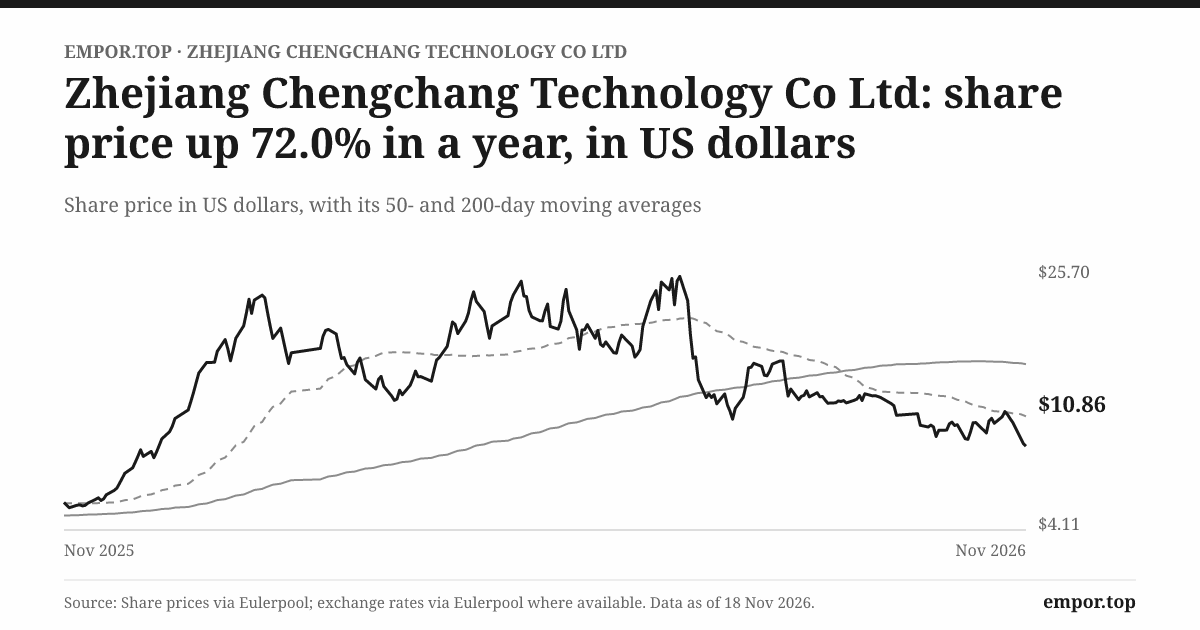
The stakes are set by the share price. On November 18, 2026, Chengchang's stock closed at about RMB 72, giving the company a market value of roughly RMB 18 billion. That price was 56.5% below the 52-week high of about RMB 166, which tells you how much air came out of the stock after an extraordinary run. Yet even after that fall, the shares traded at about 151 times trailing earnings and almost 44 times trailing sales. Those are multiples the market usually reserves for companies whose growth it considers both fast and reliable. Chengchang has shown that it can grow fast. Whether it can grow reliably, and whether that growth turns into cash, is the subject of everything that follows.
To understand why a business like this can look so dramatic on paper, the place to start is the chip itself, and the strange, slow path it takes from a design file to an invoice.
 Subscribe on LinkedIn
II. A Chip Between the Signal and the Sky
Picture a radar mounted on the nose of an aircraft, or on a satellite looking down at the Earth. The old way to point a radar beam was to swing a dish around mechanically, like a lighthouse turning its lamp. A phased-array radar does something cleverer. Its flat face is covered with hundreds or thousands of tiny antenna elements, and behind each element sits a small electronic circuit that sends out a pulse and listens for the echo. By adjusting the timing of each element's signal by fractions of a wavelength, the system can steer the combined beam electronically, flicking it from one direction to another in microseconds without moving a single part.
A useful way to imagine it is a stadium crowd doing the wave. No individual fan moves very far, but because each one stands up a fraction of a second after the person beside them, a ripple travels around the whole stadium. In a phased array, the "fans" are antenna elements, and the precise timing is controlled by transmit/receive circuitry: amplifiers that boost the outgoing signal, low-noise amplifiers that catch the faint returning echo, and amplitude and phase control circuits that decide exactly when and how strongly each element speaks. Those are the chips Chengchang designs. Its prospectus describes a product line built around power amplifiers, low-noise amplifiers, amplitude-phase control chips and related components for phased-array transmit/receive modules.4
Why does this need special chips at all, rather than the off-the-shelf silicon inside a phone? Because the job is brutal. A radar's transmit side has to push out a strong pulse at microwave or millimetre-wave frequencies without burning itself up, while its receive side has to hear an echo that may be billions of times fainter than what was sent, all within the same tiny footprint behind each antenna element. Multiply that by thousands of elements, add the vibration of an aircraft or the radiation and temperature swings of orbit, and the chip becomes the place where most of the system's performance, weight and power budget is decided. That is why customers care so much about who makes these parts, and why the qualification process is so exacting. In a phased array, the chip is not a commodity component bolted onto the side of the system; it is a meaningful share of what the system is.
It also explains the volume logic that excites investors. Because every antenna element needs its own transmit and receive channel, the number of chips in a system scales with the number of elements, not with the number of systems. A single large array can consume chips by the thousand. When an application moves from a handful of bespoke radars to many standardised terminals, the chip count can rise far faster than the system count. That is the dream behind the satellite-internet story. It is also why the dream is not yet a business line until the terminals ship in volume.
The same technology that steers a radar beam can steer a communications beam, which is why phased arrays have moved from military radar into satellite communications. A flat-panel satellite terminal that tracks a moving satellite without a motorised dish is, in essence, a phased array. Chengchang's filings describe its chips going into spaceborne, airborne and ground-based radar and into satellite communications, with newer work in areas such as weather and water-conservancy radar and low-altitude monitoring.1
The commercial focus is extreme. In 2025, transmit/receive chips made up 99.78% of Chengchang's revenue, with the sliver left over coming from project-specific technical services.1 A year earlier the chip share had been about 91%, because technical-service work had held up while chip deliveries collapsed.1 The company says it has developed more than 1,000 distinct product types.1 Yet all of those products feed into the same business.1 This is a specialist, not a conglomerate of semiconductor bets.
That focus shapes the economics, and the reason is the sales path. A Chengchang chip does not leave the building because a buyer saw it in a catalogue and clicked "order." The prospectus describes a long sequence: the customer specifies what its system needs, Chengchang designs a chip to meet those requirements, produces prototypes, and then the product goes through qualification, a lengthy process of testing and approval before it can be designed into the customer's program.4 Only after that does batch production and delivery begin, and the delivery timing follows the customer's program schedule, not Chengchang's sales targets.
Think of qualification as getting your part written into the recipe. Once a chip is specified in a radar or satellite program and the system has been tested with it, swapping it out means requalifying, which costs the customer time and money. That is the source of whatever stickiness Chengchang enjoys. But the analogy has a catch. Being written into a recipe tells you nothing about how many cakes will be baked, or when. A program can be delayed, resized or slowed by budget decisions far above the engineer who approved the chip. Qualification makes a product sticky within a program; it does not guarantee large orders, repeat orders or an even flow of orders.
Chengchang's customers make the timing even more pronounced. The company describes its buyers as research institutes and units under large state-owned groups, the organisations that integrate radar and communications systems in China.4 Such customers run on annual budgets, approval cycles, tender processes and formal acceptance procedures. When those processes move smoothly, deliveries flow. When a funding plan is revised or an approval takes longer than expected, deliveries pause, and a company that sells almost nothing else feels the pause across its entire income statement.
There are also things Chengchang does not tell investors, and they matter. Its filings do not disclose the length of its contracts, any minimum purchase commitments, the share of revenue that recurs from year to year, or a price per chip.1 Nor does the company break down revenue or profit by application, so an outsider cannot tell how much of 2025's surge came from satellites versus aircraft versus ground radar.1 That is not unusual for a supplier into sensitive programs, but it means the business has to be understood through its aggregate pattern rather than program by program.
The growth story deserves proportion. The newer applications, from weather radar to low-altitude airspace monitoring, are real directions for the technology and appear in the company's own descriptions. But in its 2026 half-year report, Chengchang described some of these newer fields in terms of technical progress and small-batch deliveries, not as material revenue lines.5 A first shipment in a new market is a door opening; it is not yet a room full of customers.
So the picture that emerges is a focused design-and-delivery house whose fortunes ride on a small number of program schedules. That design creates an obvious vulnerability: what happens when those schedules slip all at once? In 2024, Chengchang found out.
III. When the Programs Slipped
For most of its life as a public company, Chengchang's story was one of growth. Revenue rose each year from 2019 through 2022, while operating margins often sat above 50%.42 Those are extraordinary margins for any manufacturer and hint at what qualified, specialised chips can earn when they ship. The listing in June 2022 came at the top of that run.4 Then the tempo changed. In 2023 revenue grew less than 4%, and net profit fell by about 40%.2 It was a warning shot, though few outside the company would have guessed how loud the next one would be.
The 2024 annual report, published in April 2025, recorded the full force of it. Revenue fell about 26.5%, operating profit swung from a solid gain to a loss, and operating margin went from about 29% of sales to roughly minus 18%.2 The company lost money for the year. For a business that had just raised public equity on the strength of its growth, it was a sharp reversal.
Management's explanation focused on its customers' calendars rather than on a loss of competitiveness. In the 2024 report and in a later reply to the exchange's inquiries, Chengchang described customers delaying tenders, project approvals, deliveries and acceptance; it pointed to revisions in customers' funding plans and longer approval cycles that held up when products could be delivered and signed off.26 And then a second blow landed on top of the first. Customers' internal payment processes were lengthy, so the receivables the company already carried grew older, and as they aged the accounting rules required larger impairment charges against them.6 Slower deliveries cut revenue; slower payments added costs. Both arrived in the same year.
The consequences reached the company's listing status. Under Shenzhen's rules, a company that reports a loss and revenue below RMB 300 million is placed under a delisting-risk warning, and Chengchang's 2024 revenue of roughly RMB 211 million, combined with its loss, met that test.27 In April 2025 its shares were flagged accordingly, a public signal that the exchange considered the company at risk of losing its listing if conditions did not improve.7 For a chip company that sells to some of the most demanding customers in China, it was an awkward label to wear.
Then the cycle turned. Through 2025, quarter after quarter, revenue came in well above the depressed levels of 2024. Operating margin recovered to about 29%.1 The company attributed the recovery to recovering demand, accelerated delivery and normal batch delivery in its spaceborne programs, along with new satellite-communications products entering batch delivery.18 Once the audited 2025 accounts showed revenue comfortably above RMB 300 million and a profit, Chengchang applied to have the warning lifted, and the exchange approved its removal effective May 20, 2026.7
It is tempting to read the lifted warning as a verdict that the business has stabilised. It is not. The warning was a mechanical test triggered by a loss and a revenue threshold; passing it again shows that one audited year cleared the bar, not that the next year will. The removal was a change in regulatory status. The economic question, whether deliveries now repeat in a steady rhythm, is still open.
The evidence on that question is mixed, and the recent quarters show why. If 2025 were the start of a steady expansion, one would expect 2026 to build on it. Instead, the nine months to September 2026 delivered revenue only about 2.9% higher than the year before, while the third quarter alone slipped by about 5.7% and net profit for the quarter fell by about 44%.3 Part of that is simply the arithmetic of comparison: the third quarter of 2025 was itself a rebound quarter, with revenue several times the depressed level of 2024. But part of it is the business telling the same story it told in 2024 at a smaller volume. When a few programs pause, the whole quarter pauses.
So which reading is right: isolated delay, or structural lumpiness? The record supports a cyclical explanation for 2024. Management named a specific mechanism, the timing of customer approvals and acceptance, and revenue did come back strongly once that mechanism eased, which is what a timing problem rather than a competitive collapse would look like. But the size of the swings rejects the comfortable version of that explanation, the one that treats 2024 as a footnote. A business whose revenue can fall by a quarter in one year and then nearly double in the next, and whose quarterly profit can halve within twelve months of a record, is a business where program timing is an ongoing feature. Investors should treat lumpiness not as a past problem that has been fixed but as the shape of the asset.
It is worth being precise about what the 2024 episode did and did not reveal. It did not reveal a lost customer: the company identified no major customer exit, and the same concentrated group of buyers was back in force in 2025.16 It did not reveal a product failure, since the chips being delivered in 2025 were largely the ones qualified before. What it revealed was dependence. When a few large customers revised their funding plans at the same time, Chengchang had no other pool of demand to fall back on, and its high fixed costs, the engineers and the newly built facilities, turned a revenue decline into an operating loss. The same fixed costs that magnify profit on the way up magnify losses on the way down.
The test of that conclusion is simple to state. If Chengchang's revenue and operating margin hold up through 2027 without another sharp contraction, the cyclical reading strengthens and the case for a steadier cadence gains weight. If another year of customer delays produces another plunge, the market will have to price the company as what it has been: a high-margin supplier with highly irregular demand.
But lumpy demand raises a deeper question than timing. When a handful of large buyers can stall an entire year by moving their own calendars, who really holds the power in this relationship?
IV. The Moat Has to Survive the Customer’s Procurement Process
When Chengchang went public in 2022, its prospectus described its competitive arena with unusual candour. The principal competitors it named were not other small private chip startups but two research institutes belonging to 中国电子科技集团 China Electronics Technology Group (CETC), the 13th and 55th Research Institutes, which the prospectus said held most of the domestic market.4 Private firms such as Chengchang, by its own account, held smaller shares.4 Imagine a young company entering a chess tournament and discovering that the two players at the top board are related to the tournament organiser. That is roughly the position of a private T/R chip specialist in China: the incumbents are part of the same state industrial system that buys the finished radars.
Alongside those incumbents sit other private specialists that investors often compare with Chengchang, notably 臻镭科技 Zhenlei Technology and 国博电子 Guobo Electronics, both listed on Shanghai's STAR Market.910 The comparison is useful in spirit but imprecise in practice. Their product mixes, customers and earnings bases differ, and there is no reliable, like-for-like series of market shares that would let an outsider say whether Chengchang is gaining or losing ground year by year. Chengchang does not publish its own share, and its competitors do not publish theirs in a comparable way.
A war-game of the industry starts with the buyers, because they are the strongest force on the board. In 2025, Chengchang's five largest customers accounted for about 94% of its sales, up from about 81% a year earlier.12 Three customers each exceeded a tenth of revenue: the largest was about 37%, the second about 33% and the third about 12%.1 Chengchang does not name them in its annual report, listing them only as customers one through five.1 Put plainly, two anonymous buyers generated seven of every ten yuan Chengchang earned in its best year. When buyers are that concentrated and are themselves parts of large state groups that also own competing chip institutes, they hold considerable leverage over timing, specifications and terms.
The company's own defence of this concentration is worth hearing. Its annual report says such concentration is not unusual for a business of its kind, and in its reply to the exchange in 2026 it said that its customer structure and settlement arrangements had not changed.16 Its filings identify no major customer bankruptcy, contract exit or named customer loss.16 That is genuine reassurance on one point: the concentration reflects the structure of the market, not the departure of a key account. It does not reduce the leverage that structure confers.
The supply side is concentrated too. In 2025 Chengchang's five largest suppliers accounted for about 85% of its purchases, and the single largest supplier for about 52%.1 A chip-design company typically relies on outside foundries to fabricate its wafers, and when more than half of purchases flow to one supplier, continuity of supply and the terms on which that capacity is offered become strategic questions, especially as volumes scale. The company squeezed between concentrated buyers on one side and a concentrated supply base on the other has to be very good at what it does in the middle.
The other forces are friendlier. Barriers to entry are high: qualification takes years, the quality standards for spaceborne and airborne systems are exacting, and confidentiality requirements limit who can even bid. A new entrant cannot simply show up with a cheaper chip. Substitutes are more of a live threat than the word usually implies, because the most credible substitute for a Chengchang chip is a chip designed inside the customer's own group or bought from a state-linked institute. Rivalry, finally, is shaped less by price wars than by who gets designed into which program.
Measured against Hamilton Helmer's seven powers, the honest reading is narrow. There are no network effects here and no consumer brand. Scale economies exist in principle but are hard to claim when the incumbents are larger. The most plausible power is a form of switching cost combined with process power: a chip qualified into a program is costly to replace, and the accumulated know-how behind more than a thousand qualified products is hard to replicate quickly. What Chengchang does not appear to have is a cornered resource, meaning exclusive access to something competitors cannot get, or demonstrated pricing power over buyers who could, in principle, turn to in-house alternatives.
That distinction, between technical capability and commercial power, is the core of the moat question. A large catalogue and long relationships prove that Chengchang's engineers can meet demanding specifications. They do not prove that customers will keep awarding the company a growing share of programs, or that it can hold prices when buyers negotiate. The evidence that would establish a moat in the stronger sense is different: repeat awards across programs, retention of customers through downturns, realised prices that hold, market-share gains against the institutes, and margins that stay stable across the cycle. On most of those, Chengchang publishes little or nothing. On margins, the record actually argues the other way, since operating margin has ranged from above 70% to below zero within five years.21
There is a subtler point hidden in the competitive map. The buyers and the dominant competitors live in the same industrial ecosystem. Research institutes under large state groups integrate the radars and satellites; research institutes under CETC make most of the domestic T/R chips.4 A private supplier like Chengchang is therefore selling into a world where the customer usually has a credible in-house or in-group alternative. That changes the meaning of every design win. When a system integrator chooses Chengchang over an institute, it is making an active choice, presumably on performance, delivery or cost, and that choice is a genuine vote of confidence. But it is a choice that can be revisited on the next program, and the customer knows it. The private supplier's advantage has to be earned again and again, which is exactly why repeat awards, rather than first awards, are the evidence that matters.
The state-linked character of the customer base cuts both ways. Those cycles also delay cash, a cost. Yet large state programs are also among the few sources of demand in this market that can absorb high-value, highly specified chips in volume. A small number of buyers can therefore influence both the size and timing of Chengchang's business and the terms on which it is paid. What the filings do not reveal is how those buyers source: whether they routinely split programs across multiple vendors, how often tenders are re-run, or whether prices have been pressed down at renewal. Without that, the leverage can be inferred from concentration but not measured.
The verdict is a narrowed version of the bull case's claim. Chengchang plausibly has a qualification and product-know-how advantage, supported by its catalogue and by repeat program relationships, and that advantage is real enough to keep it in the game against far larger players. But the evidence does not support a claim of durable pricing power or of an entrenched position: incumbents dominate the disclosed market structure, buyers are concentrated and powerful, and the company does not disclose share, retention or win rates. The KPI that would move the verdict is visible concentration: if top-five customer share falls as new programs contribute material revenue while margins hold, the advantage would look broader than a few relationships.
If the moat rests on engineering know-how, the next question follows naturally: what is Chengchang doing with its money to keep that know-how ahead?
V. The Recovery Spent on Design, Not a Buying Spree
There are two ways a company like Chengchang can invest in its future. It can pour concrete, buying buildings, test equipment and production lines. Or it can hire engineers and pay them to design the next generation of chips. In 2024 and 2025, Chengchang did both, but in a revealing sequence: first a burst of physical spending, then a surge in design spending while the concrete dried.
The physical burst came in the bad year. In 2024, as revenue fell and the company lost money, Chengchang paid about RMB 146 million in cash for fixed assets, intangible assets and other long-term assets.1 That was roughly two-thirds of the year's revenue, an aggressive commitment to capacity at precisely the moment when demand had stalled. Property, plant and equipment on the balance sheet rose sharply as a result.1 In 2025 that spending collapsed to about RMB 13.5 million, a tenth of the prior year, and the annual report noted equipment still sitting in construction in progress, awaiting commissioning.1 Whatever one thinks of the timing, the big physical outlay is behind the company, and it has not been repeated.
The design spending moved the other way. R&D expense in 2025 was about RMB 146 million, up 66% on 2024 and equal to about 36% of revenue.1 In the first nine months of 2026, R&D rose another 30% year on year to about RMB 123 million.3 Put those figures in context: Chengchang spends more than a third of every yuan of sales on designing new products, a ratio that would be high even for a software company. In 2024 the ratio was even higher, above 41%, but only because revenue had fallen; the absolute amount was much smaller.6
There is one oddity in that surge. The company's R&D headcount fell, from 99 people at the end of 2024 to 92 at the end of 2025, while total employees fell from 237 to 221.1 Spending up two-thirds while the team shrank suggests the increase was driven by something other than hiring: more tape-outs and prototype wafers, more testing, larger bonuses after a year with none, or higher depreciation on the new equipment. Chengchang's explanation to the exchange addressed the increase in R&D expense, but outsiders should note that rising spending with a smaller team says nothing on its own about rising productivity.6
What did the money buy? Management's answer is concrete in volume terms. In 2026 the company said it had developed more than 300 new chips, with multiple products entering mass production.11 Those are claims about technical output. The test that matters to an owner is different: do the newer designs produce sustained revenue, gross profit and collected cash? On that test, the evidence is still thin, because the company does not break revenue down by product generation or application, and the recent quarters do not yet show an R&D-driven acceleration. Nine-month 2026 revenue was nearly flat while R&D grew by almost a third; in the short run, that is a recipe for falling margins, and the third quarter delivered exactly that.3
The newer applications deserve their place, but a small one. Low-altitude monitoring, weather and water-conservancy radar, and satellite internet terminals are fields where phased arrays could, in time, move from specialised programs into larger volumes. That is the strategic logic of the R&D budget: diversify the demand base away from a handful of program customers. But the company still described them as early-stage in its 2026 half-year report.5 The company has a long, successful record of converting technical work into revenue within its core radar and satellite programs. It has no comparable record yet in the newer fields, so those fields remain options, not engines.
One thing Chengchang has not done is buy growth. Its capital-allocation record since listing centres on R&D, facilities, cash and short-term investments, rather than acquisitions. Chengchang made no material acquisitions, so there is no purchase price to benchmark against industry multiples and no goodwill waiting to be written down.1 For a company that raised public equity and then hit a downturn, that restraint matters, because the most common way for a small listed chip company to destroy value is to chase a story through an expensive deal.
The money for all of this came largely from the 2022 listing. Chengchang issued about 28 million new A shares in its IPO, and the proceeds swelled the balance sheet at exactly the moment the business stopped producing operating cash.4 Over the following years the company also paid out cash dividends, about RMB 71 million in total, most of it in 2023 and 2024, including a dividend paid during the year that the downturn began.21 Paying shareholders while operations consumed cash was not reckless at that scale, since the IPO cushion was large, but it does show where the dividend really came from: the equity raised from investors, recycled back to them, rather than surplus cash earned by the business. Chengchang paid no dividend for 2025 and disclosed no share buyback for that year.1
The cash it did not spend sat on the balance sheet. At the end of 2025, Chengchang held about RMB 300 million in cash and cash equivalents.1 By September 2026, cash had fallen to about RMB 163 million, but the company had moved roughly RMB 130 million into trading financial assets such as bank wealth-management products, so the combined pool had changed less than the headline suggests.3 Other income, mostly government grants of about RMB 8 million, contributed about 7% of 2025 pretax profit, a helpful but not decisive cushion.1
There is a small but genuine supply relationship to mention. Chengchang buys wafers and outsourced processing from 浙江集迈科微电子 Zhejiang Jimaike Microelectronics, an affiliate in which Chengchang holds about 5% and in which H&T also has an interest.1 In 2025 those purchases were about RMB 10 million, roughly 7% of Chengchang's purchases and about 2.5% of revenue, priced at market rates according to the company, with about RMB 4.9 million payable at year-end.1 That is worth watching as volumes grow, but it is a supply link, not a channel through which related-party sales inflate revenue; Chengchang disclosed no related-party sales in 2025.1
The other financing story sits one level up. In September 2026, H&T proposed issuing an exchangeable bond of up to RMB 2.2 billion with a term of up to three years, secured by some of its Chengchang shares.12 This is a parent-company financing, not debt issued by Chengchang, whose own balance sheet carries no bank borrowings or bonds.123 But it is not irrelevant. If bondholders eventually exchange their notes for Chengchang shares, H&T's ownership would fall and Chengchang's free float would rise. The approval and final terms were still pending at the time of the announcement.12
So the reinvestment record is clear in direction, if not yet in payoff: Chengchang is spending heavily on design, it has stopped spending heavily on buildings and machines, and it has not tried to buy its way into new markets. All of that depends on one condition the company has not yet met over any sustained period: that the revenue those chips earn actually comes back as cash.
VI. The Receivables Became the Main Event
Here is the most uncomfortable number in Chengchang's story. Across the eight years from 2018 through 2025, the company reported cumulative net profit of about RMB 624 million. Over the same eight years, its cumulative cash flow from operations was slightly negative, roughly minus RMB 5 million.14 Eight years of profit, and almost none of it arrived in the bank account through the business itself. After capital spending, free cash flow over the period was about minus RMB 408 million.1 Meanwhile the company paid about RMB 71 million in dividends. Those dividends, and the investment, were funded largely by the money raised from shareholders, not by operations.
How can a company earn RMB 624 million and generate no operating cash? The answer is that it sold chips, recognised the revenue when customers accepted them, and then waited, sometimes for years, to be paid. The profit shows up as a growing pile of receivables on the balance sheet rather than as cash. In 2025 alone, Chengchang reported net profit of about RMB 117 million and an operating cash outflow of about RMB 47 million.1 Its best profit year was also a year in which the business consumed cash.
The mechanism, according to the company, is the same one that delayed deliveries in 2024. Customers' budget and acceptance procedures are long, payments tend to cluster toward the end of the year, and settlement often arrives not as cash but as commercial acceptance bills, essentially post-dated IOUs that mature months later.6 Chengchang also told the exchange that its own suppliers and its customers operate on different settlement cycles: the company has to pay for wafers and processing on one timetable while being paid on a much slower one.6 The result is a business that effectively finances its customers' programs.
The bills deserve a word of explanation, because they sit at the heart of the cash story. A commercial acceptance bill is a promise by the customer to pay a fixed sum on a future date, often six months or more away. For the customer it is a way to settle an invoice on paper without parting with cash; for the supplier it converts a vague receivable into a dated claim that can be held to maturity or, at a discount, passed on to a bank. In China's industrial supply chains such bills are common, but they shift the timing risk onto the supplier. When Chengchang's customers pay with bills, the income statement records a settled sale while the cash-flow statement waits for the maturity date. And because bills are only as good as the company that accepts them, Chengchang held a separate allowance against them, about RMB 22 million at the end of 2025, a reminder that paper promises carry credit risk too.1
A simple metric captures the scale. Debtor days, which measure how many days of revenue are sitting in receivables, stood at about 400 in 2018, peaked above 850 in 2024 and were still above 600 in 2025.12 More than 600 days means that, at the end of 2025, Chengchang was owed roughly a year and eight months of sales. Few businesses of any kind operate like that.
Receivables are only half of the working-capital burden. Chengchang also holds large inventories of wafers, chips in process and finished products, because it has to build ahead of programs whose timing it does not control. Inventory days, measured against the cost of goods sold, were close to 700 in 2025 and had peaked near 780 in 2024.12 Add the two together and subtract the brief credit the company gets from its own suppliers, and the cash conversion cycle, the time between paying for materials and collecting from customers, ran to well over three years in 2025.1
Picture a bakery that buys flour, bakes the bread, stores it for nearly two years, delivers it, and then waits nearly two more years to be paid. Even at very high margins, a business like that needs a large pool of capital simply to stand still, and every burst of growth consumes more of it. That is why the 2025 boom drained cash rather than producing it: more deliveries meant more inventory and more receivables before they meant more money.
The detail in the 2025 balance sheet makes the concern concrete. At year-end, gross trade receivables were about RMB 625 million, against which the company held an allowance of about RMB 59 million.1 It also held about RMB 139 million of bills receivable, with an allowance of roughly RMB 22 million against those.1 In its reply to the exchange, Chengchang disclosed the ageing of its receivables: about 72% were less than a year old, and about 28% were older than one year, including roughly a tenth between one and two years old, another tenth between two and three years, and a remainder older than three years.6 One anonymised customer still owed balances that stretched back four to five years.6
The company does have counterevidence, and it is worth giving in full. In 2025, collections of cash and bills totalled about RMB 336 million, a meaningful sum against a year's revenue of about RMB 405 million.6 Gross receivables grew about 25% in 2025, much slower than revenue's 91%, which means the company collected a larger share of what it billed than in prior years.1 And in the first nine months of 2026, operating cash flow turned positive at about RMB 50 million, which the company attributed chiefly to commercial bills maturing and turning into cash.3 That is exactly the pattern a bull would hope for: the IOUs of the boom year paying out in the year after.
But the audit lens keeps the question open. Zhongxinghua, Chengchang's auditor, named receivable impairment as one of two key audit matters in its 2025 report, the other being revenue recognition.13 The reason it flagged impairment is telling: the allowance rate fell from about 14.2% of gross receivables in 2024 to about 9.5% in 2025.131 Chengchang attributed the lower rate to improved collections and a better ageing mix.6 That explanation is plausible, since a flood of new 2025 receivables would naturally make the book look younger. But a lower provisioning rate also flatters profit, and in a business with balances older than three years, the judgement behind that rate deserves scrutiny. The auditor issued an unqualified opinion, and the company said its internal controls over financial reporting were effective.131
Then came the September 2026 balance sheet. Gross receivables had risen to about RMB 704 million, higher than at the end of 2025, even as the company reported positive operating cash flow.3 Credit-impairment charges were higher year on year.3 The two facts are not contradictory: bills maturing can produce cash while new trade receivables keep building. But together they show that the positive cash flow of 2026 came mostly from converting old paper into money, not from customers paying new invoices faster.
The cash recovery is real and encouraging. It does not erase eight years of profits that failed to convert, nor the slice of the book that is more than a year old. The question of earnings quality will stay open until investors can see the receivables created in 2025 and 2026 being collected in cash on a normal schedule. The resolving measure is specific: collections against the 2025 and 2026 receivable cohorts, with cash separated from bills, and with the older balances tracked on their own. If those cohorts pay, Chengchang's reported profits will be validated after the fact. If they age into the three-year-plus bucket, the 2025 recovery will look less like a profit and more like a loan to customers.
A situation like this puts unusual weight on the people running the company. They decide how aggressively to recognise revenue, how much to provision, and how hard to press customers who move on their own calendars. So who are they?
VII. The People Running the Rebound
Through the worst year in Chengchang's public life, the same two operating executives stayed at their desks. Wang Liping, the general manager, and Zhang Hongwei, the chief financial officer, have held their roles since 2020.1 They were in charge when the company listed in 2022, when demand stalled in 2024, when the shares were flagged by the exchange in April 2025, and when the business recovered. Above them sits Chairman Luo Shanshan, who has chaired the board since 2019.1 In an industry where a bad year often brings a new chief executive, continuity is itself a data point.
The company does not publish much about these executives' personal styles, and outsiders should resist filling the gap with myth. What can be assessed is their behaviour, and the most revealing behaviour came in response to the miss. When 2024 went wrong, management did not blame vague "market conditions" or announce a strategic pivot. It described a specific mechanism: customers delaying tenders, approvals, deliveries and acceptance, and paying slowly.26 The explanation was falsifiable, because if demand had collapsed for competitive reasons, revenue would not have come back. It did come back, which lends that account some credibility.
Pay followed performance in a visible way. Chengchang told the exchange that management and core staff received no annual bonus for 2024, the loss year.6 In 2025, as the company recovered, bonuses returned, and total compensation for key management rose to about RMB 6.8 million from about RMB 4.8 million.16 Wang Liping's 2025 remuneration was about RMB 1.26 million and Zhang Hongwei's about RMB 1.03 million.1 Those are modest sums relative to a RMB 18 billion market value, and the link to annual results is clear. What the bonus structure rewards, however, is reported profit, and reported profit at Chengchang is the measure most vulnerable to slow collections. A pay plan tied explicitly to operating cash flow or receivable collections would align management more tightly with the company's central weakness. The company does not disclose such a link.
Equity incentives add a second layer. Chengchang's 2024 restricted-stock plan included 390,000 reserved shares granted at about RMB 19.76 each, a price far below where the shares have traded since.1 Restricted stock can bind key engineers to a company, which matters in a business whose advantage is know-how. But such plans are also standard practice among Chinese listed technology firms, and their existence is not, by itself, proof that incentives are well designed.
Control rests with H&T, not with the executives. H&T's 46.63% stake, about 96 million shares, gives it decisive influence over the board and strategy, and that stake was unpledged in the September 2026 shareholder table.3 The second-largest holder, an equipment-focused fund, owned about 3%, and the rest of the top ten held less than 1% each, spread across a base of more than 49,000 shareholders.3 That stake has shrunk over time without H&T selling into the market in any dramatic way. Before the 2022 IPO, H&T owned 62.97% of Chengchang; the new shares issued at listing, and later changes in the share count through capitalisation and employee restricted stock, diluted it to 46.63% by the end of 2025, where it stayed through September 2026.413 The year-end 2025 share count was about 206 million.1 For minority investors, the controlling shareholder's large economic exposure is a form of alignment: H&T gains most when Chengchang's value rises. But it also means that decisions about the parent's financing can ripple into Chengchang's ownership.
The exchangeable bond is the live example: H&T's parent-level financing could reduce its stake if bondholders exchange, while Chengchang itself carries no bank borrowings or bonds.123 It is a reminder that the controller's interests and timetable are set at the parent level.
Governance changed in a routine way in 2026. In September the board was re-elected, with three of nine directors independent; the general manager and CFO stayed in place, and one director, Zheng Jun, left the board while continuing to work at the company.14 There were no director or senior-management departures in 2025.1 Shareholders, too, sent only a faint signal. At the 2025 annual meeting, the remuneration proposal passed, with about 0.42% of minority-held voting shares opposed.15 That is a small dissent, not a revolt, and suggests minority holders broadly accepted the bonus recovery.
The record, taken together, is mixed rather than poor. Management stayed, explained the miss with a specific and testable mechanism, accepted no bonus in the bad year, and oversaw a sharp recovery. Against that, quarterly results remain volatile, the third quarter of 2026 showed margins falling as R&D rose faster than revenue, and receivable quality, the issue on which this team's judgement matters most, has not yet been proved. The confidence the team has earned is the confidence of having survived a downturn. The confidence it has yet to earn is that of turning product work into collected cash.
Which brings the story to the market's own verdict, written in the share price, and the uncomfortable gap between what investors are paying and what the business has so far proven.
VIII. The Growth Case Meets a 151-Times-Earnings Price
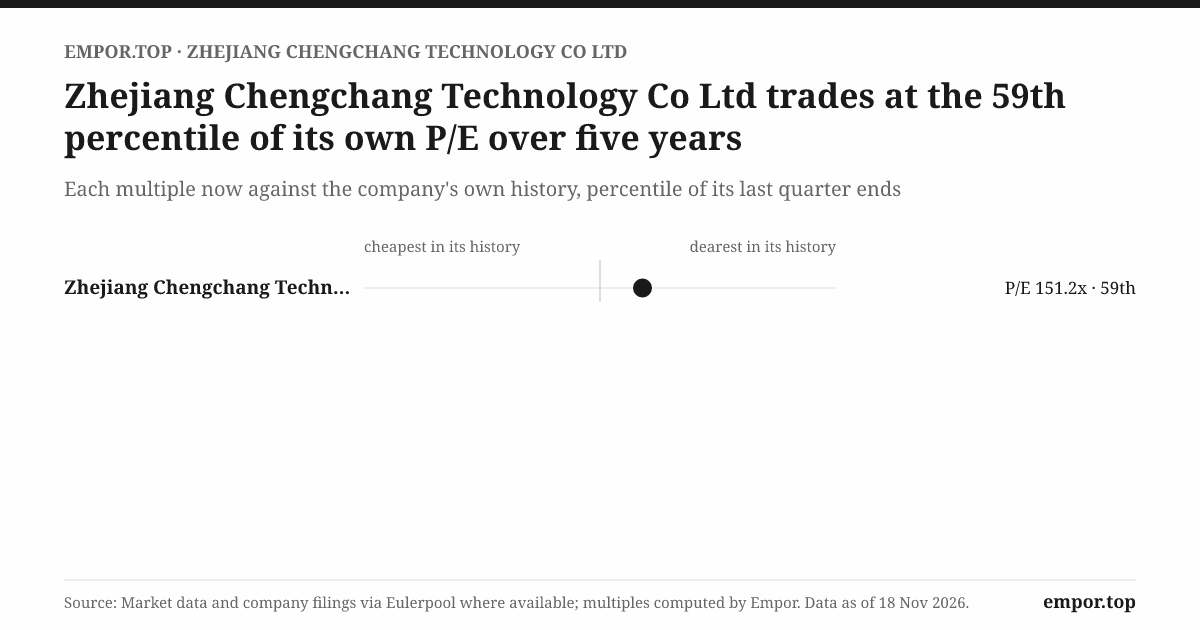
By the middle of 2026, the recovery had done everything a recovery is supposed to do. Profit was restored, the exchange's warning was gone, the auditors had signed, and the shares had soared to a 52-week high before falling back. On November 18, 2026, even after that retreat, the market valued Chengchang at about RMB 18 billion. That is roughly 151 times its earnings over the last four reported quarters, well above the company's own five-year median price-to-earnings ratio of about 106 times. It is about 11 times book value and implies a free-cash-flow yield of about half a percent. Return on equity over the same twelve months was about 7%.
Translate those numbers into a simple statement. If Chengchang's earnings stayed flat forever, an investor buying today would wait more than 150 years to earn back the price in profit. Nobody pays that price for flat earnings. The valuation assumes that profits will grow rapidly for many years, and, implicitly, that those profits will one day convert into cash at a far higher rate than they have so far. A 7% return on equity is respectable for a utility. For a company priced like this, it is a measure of how much the future has to outperform the present.
The bull case is not hard to tell, and it is not fanciful. Phased arrays are spreading from military radar into satellite communications, weather sensing and airspace monitoring, and every phased array needs many transmit/receive chips: one channel per antenna element, multiplied across thousands of elements. Chengchang has a large qualified catalogue, a record of being designed into demanding programs, and long relationships with the institutes that build those systems. The company reported that new satellite-communications products entered batch delivery in 2025.18 And 2025 itself proved the operating leverage: when deliveries resume, revenue can nearly double and margins can jump back near 30%, because most of the cost base, the engineers, the equipment and the R&D, is fixed.1 If China's satellite constellations and next-generation radar programs keep buying, the bull says, Chengchang is positioned to ride the wave, and today's multiple is a snapshot of a company at an early point in a long adoption curve.
The bear case is told with the same evidence, read in a different order. Buyers are highly concentrated, with two of them accounting for about seven-tenths of 2025 revenue. The largest supplier accounts for more than half of purchases. Quarterly results can reverse within months, as the third quarter of 2026 showed when net profit fell by about 44% year on year.3 The receivables book absorbs cash faster than the business produces it, and operating cash flow has barely broken even over the long run. The R&D bill keeps climbing at a pace revenue has not matched in 2026. In the bear's telling, the stock is priced for a structural growth company while the business behaves like a cyclical program supplier that finances its customers.
Peers offer context, though not a clean benchmark. On the same date, 国博电子 Guobo Electronics traded at roughly 92 times trailing earnings and about five times book value, and Zhenlei Technology at roughly 98 times earnings and about six times book.910 Chengchang's multiples were above both on each measure. Those comparisons should be held loosely: the three companies have different product mixes, different customers and different earnings bases, and Zhenlei itself trades under a special-treatment label on its exchange.10 But the direction is unambiguous. Even within a sector the market prices richly, Chengchang commands a premium, and that premium sits on top of a premium to its own history.
A skeptical investor, the kind of long-short analyst who reads the notes before the headline, would press on a few specific points. The first is the provisioning judgement: why should the allowance rate fall by about a third, to roughly 9.5%, in a year when balances older than three years still sat on the books? The second is the R&D trajectory: what revenue, by product generation, have the 300-plus new chips produced, and when will the company show it? The third is the cash-conversion record: if management believes the gap between profit and cash is purely a matter of timing, what level of collections should investors expect in 2027, and will the company report it in a way that separates cash from bills? None of those questions implies wrongdoing. Each asks the company to prove that its reported profits are as good as cash, which is the precondition for the valuation.
The question that sits under all of them is the moat. What evidence would distinguish a company with a durable advantage from a technically capable supplier in a concentrated, program-based market? The answers are observable. Customer concentration easing as new programs and applications contribute real revenue. Repeated product wins across different customers. Operating margins that stay stable through a slow year instead of collapsing. And cash collection that tracks reported profit over a full cycle. So far, Chengchang has shown the capability and the operating leverage. It has not shown the stability, the diversification or the cash.
Three measures matter most for tracking whether the price is justified. The first is revenue and operating margin through the delivery cycle: operating margin was about 29% for 2025 but only about 19% in the third quarter of 2026, down from about 34% a year earlier, so the latest direction is down.3 The second is operating cash flow against net profit: it was negative in 2025 and positive at about RMB 50 million for the first nine months of 2026, so the latest direction is improving.13 The third is receivable ageing and collections: gross receivables rose to about RMB 704 million by September 2026, so the latest direction is still upward.3 R&D intensity and the commercialisation of new products are supporting evidence, but these three measures will tell investors first whether the story is holding.
Over the past year the stock's volatility ran at about 70% annualised, and over five years its largest peak-to-trough fall was about 69%. That volatility, in the same year the company was lifted out of a delisting warning, belongs to a share whose holders are constantly re-pricing the delivery calendar. For a long-term owner, that volatility is not just noise. It reflects real uncertainty about which version of Chengchang, the 2024 version or the 2025 version, will show up next.
It is also worth noticing what the valuation does not rest on. Chengchang's enterprise value, about RMB 17.7 billion, is only slightly below its market value, because the company's cash and short-term investments are small relative to the price and it carries essentially no debt. There is no hidden asset, no stake in a valuable subsidiary and no large cash pile cushioning the multiple. Almost the entire value of the company is a bet on future earnings from its chip business, which is why the questions about delivery cadence and cash conversion carry so much weight.
The valuation, in other words, already contains the answer the market expects. The rest of the story is about whether Chengchang delivers it, and the lessons its record so far offers to anyone weighing a company like this.
IX. Playbook: Business & Investing Lessons
Go back to the moment a Chengchang chip passes qualification. Somewhere in a laboratory, a test engineer at a customer institute signs a form confirming that the chip meets the specification. For Chengchang's engineers, that is the finish line of years of work. For Chengchang's shareholders, it is the starting gun. Everything that follows, the program schedule, the batch orders, the delivery, the acceptance, the invoice and the payment, happens on someone else's calendar. The lessons from this story live in the gap between those two moments.
The first lesson is that approval is an invitation, not a revenue stream. Chengchang's 2024 downturn showed that qualification alone does not control delivery or payment timing. Investors in specialised suppliers often treat qualification as a moat in itself. Chengchang's record narrows that claim: qualification secures a seat at the table, while the size and timing of the meal are decided by the host. A qualified chip is an invitation to the program; the delivery and the collection are the business.
The second lesson is about who owns the calendar. Chengchang's concentrated customer base lets budget approvals and acceptance procedures turn a good product into a volatile business. For investors, the right model of such a business is less a technology company and more a contractor whose revenue follows its clients' programs.
The third lesson concerns R&D. Chengchang's spending and product count measure inputs and output, not return. The test is whether the new designs become repeat revenue, durable margin and collected cash. Founders love to count tape-outs and product launches because they are within the company's control; investors should count the revenue that those launches produce, because that is what pays for the next round. R&D earns its keep when new designs become repeat revenue, margin and cash, not when the product count rises.
The fourth lesson is the one the share price tested most directly. Chengchang's recovery year and subsequent pullback show how violently a rebound can be extrapolated and then unwound. A recovery year repairs a balance-sheet story; it does not by itself prove a new growth rate.
There is a fifth lesson that binds the others together, and it belongs to Chengchang more than to any other company in this sector. The gap between reported profit and operating cash is bridged by receivables, and it will only be resolved when those receivables are paid. At a company like this, a profit is a claim on cash, and the claim is only as good as the customer's calendar.
Those lessons define what to watch, and the next few reporting periods will begin to test every one of them.
X. Epilogue
Tonight, in November 2026, Chengchang stands in an in-between place. The warning label is gone. The profit is back. The cash is beginning to arrive, mostly in the form of bills that customers issued during the boom year and that have now matured. And yet the latest quarter showed revenue slipping and profit falling by almost half, while receivables kept rising and the R&D budget kept growing. The story has not turned back toward 2024, but it has not settled into a rhythm either.
It is a strange position for a company valued at about RMB 18 billion. Its engineers are designing more chips than ever, its customers are building the kinds of systems that need those chips, and its controlling shareholder has chosen to raise money against its stake through an exchangeable bond rather than sell shares outright. Yet the evidence that decides the investment case, the cadence of deliveries and the conversion of profit into cash, arrives only a few times a year, in reports that compress months of customer decisions into a handful of lines. Investors are left reading the calendar of someone else's programs through the narrow window of Chengchang's quarterly filings.
The next decisive moment arrives in the spring of 2027, when Chengchang publishes its 2026 annual report. The fourth quarter has historically mattered a great deal to this company, because customers' budget processes tend to push acceptance and payments toward year-end.6 That means the annual report will answer questions the third-quarter report could not. If the fourth quarter brings a strong batch of deliveries, full-year 2026 revenue could still show meaningful growth over 2025, and the weak third quarter will look like timing. If it does not, 2026 will be remembered as the year the rebound flattened, and the gap between the valuation and the operating record will widen.
The first thing that report needs to show is breadth. The question for 2027 is not just whether revenue grows but how: whether growth comes from multiple programs and applications, or from a single delivery wave that could recede as quickly as it came. Chengchang does not break out revenue by application, so the best available proxy is customer concentration. If top-five customers fall from about 94% of sales toward a lower share while total revenue rises, that would be the clearest evidence yet that newer programs and applications are contributing real money. If concentration stays near current levels, the business will remain hostage to a few customers' calendars.
The second thing is cash. The early 2026 cash flow came mostly from maturing bills. The next proof point is whether trade receivables created in 2025 and 2026 are collected on schedule, and whether the older balances, the slice more than one year old and the customer whose balances stretched back four to five years, shrink rather than age further. Watch, too, how the allowance rate moves: if collections improve, the lower provision of 2025 will look justified; if ageing worsens and the provision must rise again, the 2025 profit will look smaller in hindsight. An annual report in which operating cash flow comes close to net profit would do more for the credibility of the story than any new product announcement.
The third thing is margin. Operating margin fell to about 19% in the third quarter of 2026 because R&D kept rising while revenue did not.3 If the newer products begin generating sustained sales, margins should recover toward the levels of 2025 without any cut in R&D. If margins stay low, it will suggest that the R&D budget is running ahead of what the market is buying, and the company will face a choice between protecting profit and protecting its pipeline.
The fourth thing is the supply base and the parent. The top supplier's share of purchases, at more than half in 2025, will show whether Chengchang has diversified its fabrication and materials sources as volumes grow. And H&T's exchangeable bond, if it proceeds, will show whether the controlling shareholder's stake begins to shift, changing the ownership picture around a company whose strategy it has set since before the listing.12
Through all of this, the newer applications, low-altitude monitoring, weather radar and satellite internet among them, should be treated as optionality. They could matter a great deal. They will matter to the investment case only once reported revenue and collected cash show that they do.
The four questions this story began with remain open, but they are now narrower. The rebound is real; whether it repeats depends on the delivery calendar of 2027. The profits are reported; whether they become cash depends on the collection of the 2025 and 2026 cohorts. The technical capability is evident; whether it amounts to a moat depends on diversification and stable margins. And the R&D is substantial; whether it justifies the price depends on revenue that has yet to be shown. The next chapter depends on repeated deliveries and collected cash, not on the size of the opportunity investors can imagine.
XI. Outro
Picture the radar array one last time. A pulse leaves the antenna face, steered by thousands of tiny chips, and races outward toward the sky. It strikes something and returns, faint and fast. That part of Chengchang's business works with extraordinary precision.
Somewhere behind that signal, another journey is under way: payment for those chips, moving through a customer's acceptance process and perhaps still outstanding years on. Both journeys are part of the same sale. Only one of them arrives on schedule.
That is what makes Chengchang unlike most chip companies. Its engineering problem is solved with precision; its business problem only when the money comes back. At Chengchang, the hardest part of the signal may be getting the cash back.
References
-
2025 Annual Report — Zhejiang Chengchang Technology, 2026-04-17 ↩↩↩↩↩↩↩↩↩↩↩↩↩↩↩↩↩↩↩↩↩↩↩↩↩↩↩↩↩↩↩↩↩↩↩↩↩↩↩↩↩↩↩↩↩↩↩↩↩↩↩↩↩↩↩↩
-
2024 Annual Report — Zhejiang Chengchang Technology, 2025-04-23 ↩↩↩↩↩↩↩↩↩↩↩↩
-
2026 Third-Quarter Report — Zhejiang Chengchang Technology, 2026-10-24 ↩↩↩↩↩↩↩↩↩↩↩↩↩↩↩↩↩↩↩↩↩
-
IPO Prospectus — Zhejiang Chengchang Technology, 2022-05-16 ↩↩↩↩↩↩↩↩↩↩↩↩
-
2026 Half-Year Report — Zhejiang Chengchang Technology, 2026-08-11 ↩↩
-
2025 Annual-Report Inquiry Reply — Zhejiang Chengchang Technology, 2026 ↩↩↩↩↩↩↩↩↩↩↩↩↩↩↩↩↩
-
2026 Delisting-Risk Warning Removal Notice — Shenzhen Stock Exchange filing, 2026-05-19 ↩↩↩
-
2026 April Investor Relations Meeting Record — Zhejiang Chengchang Technology, 2026-04-21 ↩↩
-
2026 Annual-Results Online Q&A Record — Zhejiang Chengchang Technology, 2026-05-07 ↩
-
Controlling Shareholder's Proposed Exchangeable Bond — Zhejiang Chengchang Technology, 2026-09-30 ↩↩↩↩↩
-
2026 September Board Transition Notice — Zhejiang Chengchang Technology, 2026-09-24 ↩
-
2025 Annual Shareholders' Meeting Results — Zhejiang Chengchang Technology, 2026-05-08 ↩
 LinkedIn
 WhatsApp
 Reddit
 Hacker News
 Email
 Kindle
 RSS Feed
 Spotify
 Apple Podcasts
 Amazon Music
 Audible
 YouTube