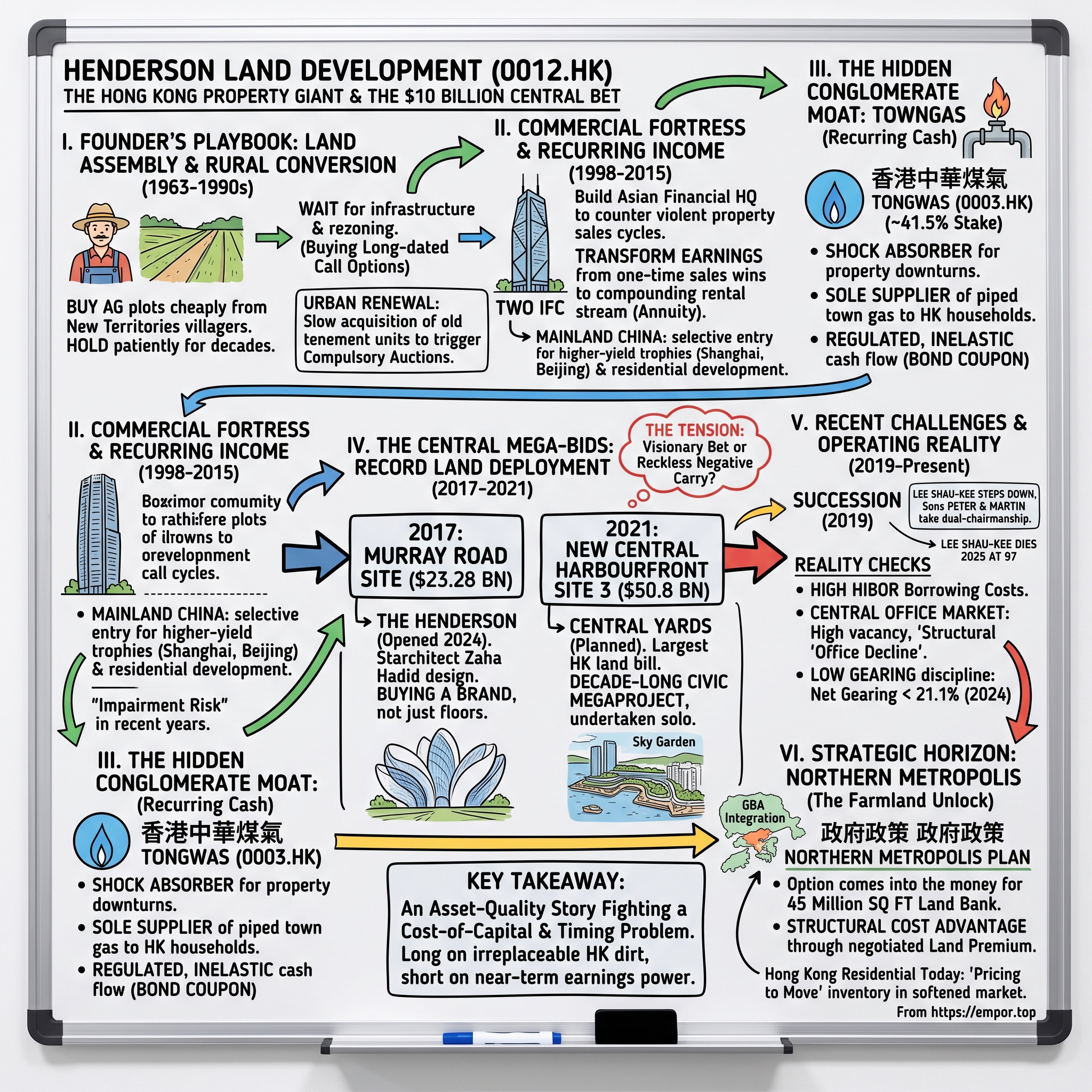
Henderson Land Development: The Hong Kong Property Giant & The $10 Billion Central Bet
I. Introduction & Episode Roadmap
Stand on the elevated walkway that threads out of Hong Kong's Central MTR station, look north toward the harbour, and you are standing inside one family's balance sheet. To your left rises the International Finance Centre, whose second tower for two decades set the record for the most expensive office rents in Asia. A short walk east, a building shaped like a Bauhinia flower in mid-bloom — all glass, no straight lines — catches the light off Victoria Harbour; that is 美利道 The Henderson, opened in 2024 on what was, at the moment of purchase, the most expensive piece of land ever sold anywhere on Earth per square foot. And directly ahead, hard against the waterfront where the old General Post Office once stood, a construction crane forest marks the single largest land bill in Hong Kong history: a HK$50.8 billion grant for a site smaller than eight football pitches.
All three carry the fingerprints of 恒基兆業地產有限公司 Henderson Land Development Company Limited (0012.HK), one of Hong Kong's premier property developers and a sprawling investment-holding conglomerate that sits on more than HK$400 billion in total assets.1 It is a company most Western investors have never heard of, run by one of the most consequential family dynasties in Asian capitalism, and it is currently in the middle of a bet so large it will define the enterprise for a generation.
Here is the central question of this story. How did a developer built on the unglamorous work of buying muddy agricultural plots from New Territories villagers — one field at a time, sometimes waiting decades — transform itself into the single most aggressive landlord-investor in Central, placing the two most expensive land bids Hong Kong has ever seen? Henderson paid HK$23.28 billion for the former Murray Road car park site in 2017,[^2] then HK$50.8 billion for New Central Harbourfront Site 3 in 2021[^3] — and it committed that second sum, more than US$6.5 billion for the dirt alone, at almost the exact peak of a near-zero interest rate era, months before the U.S. Federal Reserve began the fastest rate-hiking cycle in forty years and before the phrase "structural office decline" entered every real-estate analyst's vocabulary.
That tension — irreplaceable trophy assets bought at the top of the cycle, financed into a rate storm — is the spine of everything that follows. To understand whether it was visionary or reckless, we need to understand four things.
First, the origin story of founder 李兆基 Lee Shau-kee, universally known in Hong Kong as "Uncle Four" (四叔), and the patient land-assembly playbook that made him, at his peak, the richest person in Asia. Second, the structural moat hiding in plain sight inside the group: a roughly 41.5% stake in the piped-gas monopoly 香港中華煤氣有限公司 The Hong Kong and China Gas Company Limited (Towngas) (0003.HK),2 a utility that throws off dividends whether the property market is booming or bleeding. Third, the 2019 succession, when a 91-year-old Lee handed control to his two sons, co-chairmen 李家傑 Peter Lee Ka-kit and 李家誠 Martin Lee Ka-shing. And fourth, the modern reality check: high HIBOR borrowing costs, a Central office market drowning in vacancy, Mainland China impairments, and the multi-decade wildcard of the 北部都會區 Northern Metropolis, where Henderson's ancient farmland bank suddenly sits at the centre of government planning.
One more framing before we begin, because it separates Henderson from the Silicon Valley growth stories investors are trained to admire. This is not a business that compounds through reinvestment at high returns on capital, or scales a product to a billion users at near-zero marginal cost. It is an asset-accumulation machine — a vehicle for owning irreplaceable physical things in a place where they cannot be manufactured more of. Its returns come from scarcity and from the leverage of time, not from the flywheel of a network. That makes it slow, cyclical, and interest-rate-sensitive in ways a software company never is, and it means the right yardstick is not revenue growth but the quality and cost basis of what it owns, the discount at which the market prices those assets, and the discipline with which the family stewards them across cycles. Keep that lens on throughout.
This is a story about time — about a company whose fundamental skill is waiting longer than anyone else, and which has just made a bet that dares the clock to move against it. Let's start where it started: in the rice paddies.
 Subscribe on LinkedIn
II. The Founder's Playbook: Land Assembly & Rural Agricultural Conversion (1963–1990s)
In 1948, a twenty-year-old from Shunde in Guangdong province arrived in Hong Kong with, by his own later telling, about HK$1,000 in his pocket and a trader's education absorbed at his father's gold and money-changing shops on the Mainland. Lee Shau-kee had learned the two lessons that would govern his entire career before he ever touched a brick: that leverage cuts both ways and will kill you if you are careless, and that the fortune is made not in the buying or the selling but in the patient interval between them. He would spend the next seven decades acting on both.
Lee did not build Hong Kong's most patient property empire alone or at once. The Guangdong he left had taught him hard lessons in a hurry: as a teenager working in his father's currency and gold shops in Shunde, he watched inflation and wartime disorder wipe out the value of paper money and vindicate anyone who held real, tangible assets. That formative experience — that hard assets endure while paper burns — never left him, and it is not a stretch to say it echoes half a century later in a company that would rather own physical land it cannot easily sell than hold cash. In the 1950s Lee moved through currency trading and small property deals in Hong Kong; in 1958 he co-founded a modest venture, Eternal Enterprises. But the pivotal moment came in 1963, when Lee joined forces with two other self-made hustlers — 郭得勝 Kwok Tak-seng, a former grocery and zipper wholesaler, and 馮景禧 Fung King-hey, a stockbroker — to found 新鴻基地產 Sun Hung Kai Properties (0016.HK). Hong Kong newspapers would later romanticise the trio as the "Three Musketeers." What they actually shared was an insight ahead of its time: that post-war Hong Kong's exploding population, swollen by waves of refugees from the Mainland, would need housing faster than the colonial government could supply land, and that the money was in mass-producing apartments for a rising middle class rather than trophies for the rich. Sun Hung Kai's early strategy of buying land in bulk and building large numbers of small, affordable flats was, in miniature, the template Lee would spend the rest of his life refining.
By 1976, Lee was ready to run his own shop. He spun out his interests and founded Henderson Land Development, taking a differentiated bet on where the next cheap land would come from.[^4] While the other tycoons bloodied each other in the government's public land auctions — bidding up prices in full public view, competing head-to-head for the same premium urban parcels — Lee went the other direction entirely. He went to the farmers.
The agricultural land play: buying options on the future
Here is the mechanic that made Henderson different, and it is worth slowing down because everything the company does today rhymes with it. In Hong Kong's New Territories — the vast rural hinterland leased by Britain from China in 1898 — thousands of small agricultural plots were owned by village families, often fragmented across generations of inheritance. On paper they were worth very little: you cannot build an apartment tower on land zoned for growing vegetables, and the villagers frequently needed cash. Henderson's field agents fanned out and bought these plots quietly, cheaply, one parcel at a time, paying prices per square foot that were a rounding error against what the same land would fetch if it were ever rezoned for development.
Then Henderson did the hardest thing in capitalism: nothing. It held. For years, sometimes decades, at almost zero carrying cost — farmland barely generates property tax, and Henderson wasn't borrowing against it. The company assembled, over time, the largest private agricultural land bank in Hong Kong, on the order of 45 million square feet.1 The right way to understand this bank is not as inventory but as a portfolio of long-dated call options on Hong Kong government urbanisation policy. Each plot cost almost nothing to own and would pay off enormously if — and only if — the government eventually extended infrastructure, rezoned the district, and let a developer convert farmland into housing by paying a negotiated 補地價 land premium. Henderson was buying the right, not the obligation, to develop the New Territories on the government's schedule rather than its own.
The strategy required a temperament almost nobody in a quarterly-reporting business possesses. A rival chasing this quarter's launch could not tie up capital in mud for twenty years. Lee could, because he was the controlling owner and answered to no one, and because he genuinely thought in decades. That patience is the cornered resource, more than any single building — an inventory engine acquired at a cost basis no competitor starting today could ever replicate, because the villagers of the 1970s and 1980s are gone and the plots are already spoken for.
Urban renewal: the compulsory-auction game
Henderson ran a mirror-image version of the same patience game inside the city. In the aging tenement districts of Kowloon and Hong Kong Island stood thousands of decrepit walk-up buildings — cheap to buy flat by flat, valuable only if you could demolish the whole block and build something new. Under Hong Kong law, an owner who assembles a high enough ownership threshold in an old building — the bar has sat at 80% or 90% depending on the building's age — can force the remaining holdout owners to sell at a court-assessed price, triggering a compulsory sale so the site can be redeveloped.
So Henderson's teams played a slow, grinding game of acquisition: buying units one at a time, negotiating with elderly owners, waiting out holdouts, and stitching together the ownership needed to trigger the auction. It was unglamorous, litigation-prone, and enormously profitable, because it delivered prime urban development sites at a meaningful discount to what the same land would cost in a public government auction. During property upcycles, that discounted land basis translated directly into fatter gross margins than a developer buying at market tender prices could ever achieve.
A telling detail about the man behind the strategy: Lee was famous for a frugality that bordered on the eccentric for someone of his wealth, and for a genuine fluency with numbers that let him hold the economics of hundreds of scattered plots in his head. Colleagues described a dealmaker who negotiated patiently and rarely showed his hand, who preferred to be underestimated, and who treated a good land bargain as its own reward. He was also, in his later years, an unusually visible philanthropist and a canny stock-market investor whose personal punting in Hong Kong and Mainland equities earned him the affectionate nickname "the Warren Buffett of Hong Kong" — a comparison he cultivated. That blend of tangible-asset conservatism and opportunistic risk-taking is the personality stamped into Henderson's DNA: a company that will sit on farmland for thirty years and then, without warning, bet fifty billion dollars on a single site.
Both engines — rural assembly and urban renewal — share one DNA: buy the raw right cheaply, then supply the two things nobody else will, which are time and administrative persistence, and let the government's own development plans mint the value. It made Lee Shau-kee, for a stretch in the mid-2000s, the richest man in Asia. But an empire built on selling completed flats has a flaw Lee understood keenly: property sales are violently cyclical. When the market froze — as it did in 1997, and 2003, and would again — the development engine simply stopped throwing off cash. To smooth that, Henderson needed to become something other than a developer. It needed to become a landlord. And for that, it needed a tower in the middle of the world's most expensive office district.
III. Building the Commercial Fortress: IFC & Recurring Income Transformation (1998–2015)
Picture the Central waterfront in the late 1990s. The Asian Financial Crisis had detonated across the region; Hong Kong property prices were in free-fall, eventually shedding roughly two-thirds of their value from the 1997 peak. It was, in other words, exactly the kind of moment when a developer dependent on selling apartments discovers how fragile its earnings really are — units don't sell, deposits evaporate, and the cash-flow statement turns hostile overnight. For a company as leverage-aware as Henderson, the lesson landed hard: sales income is a feast-or-famine crop, and you cannot pay steady dividends or service corporate debt on a harvest that fails every few years.
The answer was recurring rental income — the boring, beautiful cash flow of a great building fully leased to tenants who sign multi-year contracts and pay every month regardless of where the sales market sits in its cycle. And the opportunity to build the greatest such asset in Asia arrived reclaimed straight out of Victoria Harbour.
The crown jewel: Two IFC
On newly reclaimed land directly atop the Central MTR and Airport Express station, a consortium set out to build what would become the 國際金融中心 International Finance Centre (IFC) complex. Henderson took its stake alongside its old sibling 新鴻基地產 Sun Hung Kai Properties and 香港小輪(集團)有限公司 Hong Kong Ferry (Holdings) Company Limited (0050.HK), among other partners. The centrepiece, the 88-storey Two IFC, topped out above 410 metres in 2003 as the tallest building in Hong Kong at the time — a silver obelisk that instantly became the visual shorthand for the city's skyline and the physical headquarters of Asian finance.
Two IFC did something for Henderson that no amount of apartment-flipping could. It became the single most prestigious office address in Asia, home to the Hong Kong Monetary Authority and a roster of global banks, commanding office rents that at their peak ran into the range of HK$150 to HK$200-plus per square foot per month — numbers that were, for years, simply the highest in the region. More importantly for a landlord, those tenants stayed, and they paid through crises. IFC transformed a chunk of Henderson's earnings from lumpy sales proceeds into an annuity: billions in steady rental cash flow that could underwrite dividends and debt service across the property cycle.
There is a subtlety worth pausing on, because it shapes how you read Henderson's accounts to this day. Investment properties like IFC and The Henderson are carried on the balance sheet at fair value and marked to market every reporting period. In a rising market those revaluations flood reported profit with paper gains that never touched the bank account; in a falling market they gouge reported profit with paper losses that are equally cashless. This is why sophisticated investors watch Henderson's "underlying profit" — which strips the revaluation noise out — rather than the headline number, and why a year of large fair-value writedowns can look catastrophic on paper while the rent cheques keep clearing. Hold that distinction; it becomes essential when we reach the recent results, where reported and underlying profit tell almost opposite stories.
The strategic logic here is worth naming plainly, because it recurs through the rest of the story. A development business is a series of one-time wins; an investment-property portfolio is a compounding stream. The tycoons who survived Hong Kong's brutal cycles were, almost without exception, the ones who used development profits from the good years to buy or build irreplaceable income-producing assets in the best locations — assets whose scarcity gave them pricing power over tenants. IFC was Henderson's proof of concept that it could play at the very top of that game. Everything it would later do in Central, including the two record land bids, is an attempt to buy more of that same annuity.
Mainland China: the higher-yield, higher-risk frontier
As Hong Kong matured, Henderson followed the obvious growth vector north across the border. Through the 2000s and 2010s it entered Mainland China selectively — office and mixed-use trophies in the tier-one cities (developments in Shanghai and Beijing under the Henderson banner, plus projects in Guangzhou and Shenzhen), balanced against higher-margin but riskier residential developments in a range of cities.
The Mainland was, in theory, the same playbook on a bigger canvas: buy land, build, sell or lease. In practice it exposed Henderson to a different and less forgiving system — one where land supply, financing, and buyer sentiment all move at the whim of Beijing policy. When the central government imposed its "three red lines" deleveraging campaign on property developers in 2020 and the Mainland housing market subsequently seized up — dragging once-mighty developers like Evergrande and Country Garden into default — the entire sector's land and inventory values had to be repriced downward. Henderson, more conservative and far less leveraged than the collapsed Mainland giants, was insulated from existential danger, but not from the arithmetic: assets bought in a boom and carried on the books had to be marked down as comparable transactions dried up, and that impairment risk still shadows the Mainland segment today. For now, hold the thought that Mainland real estate became the part of the portfolio most likely to require impairment; we return to it when we stress-test the balance sheet. The point of this era is that by the mid-2010s Henderson had successfully rebuilt itself around a barbell — cyclical Hong Kong and Mainland development on one end, and a fortress of Hong Kong recurring rental income on the other. What made that barbell unusually stable, though, wasn't the property at all. It was a gas company.
IV. The Hidden Conglomerate Moat: Towngas & Subsidiary Safety Nets
Every Henderson investor eventually has the same realization, and it usually arrives with a jolt: you thought you were buying a property developer, but a very large share of what you own is a 163-year-old utility that pipes cooking gas into millions of Hong Kong kitchens. To understand Henderson Land, you have to understand that it is not one company but a nested set of them, and that some of the most valuable pieces have almost nothing to do with building towers.
The shape of the octopus
Henderson's economic value comes from four broad buckets. There is Hong Kong property investment — the rental fortress anchored by IFC and now The Henderson, which supplies the steady, high-margin cash flow. There is Hong Kong property development — the cyclical business of building and selling flats, fed by the land bank. There is Mainland China real estate, higher-yielding and higher-risk. And there is a portfolio of strategic listed associates and subsidiaries whose dividends and earnings flow up into the parent. It is that last bucket that hides the group's most underappreciated moat.
Towngas: the annuity that outshines the property
The jewel of the associates is Henderson's roughly 41.5% stake in 香港中華煤氣有限公司 The Hong Kong and China Gas Company Limited (Towngas) (0003.HK).2 Founded in 1862, Towngas is the sole supplier of piped town gas to Hong Kong — a genuine utility monopoly serving the overwhelming majority of the city's households.14 Its economics are the near-opposite of property development, and that is precisely the point.
Think about what a gas utility sells: a product households buy in roughly the same quantity every month regardless of the economy, at regulated prices, delivered through an infrastructure network that no rival could economically duplicate. That is textbook price inelasticity — nobody stops cooking because the stock market fell — married to a distribution network with enormous switching costs baked into a century and a half of buried pipe. The result is remarkably stable earnings and a long, consistent dividend record. For decades Towngas was also famous for rewarding shareholders with regular bonus shares, effectively compounding the holding.
For Henderson, Towngas is the shock absorber. When the property cycle turns vicious and development profits evaporate — as they did in 1998, 2003, and again in the 2020s downturn — the Towngas dividend keeps flowing into the parent, cushioning group earnings and helping fund the dividend Henderson pays its own shareholders. It is the closest thing in the Henderson structure to a bond coupon: a piece of inelastic, monopolistic cash flow that lets the property arm take big, lumpy, cyclical swings without threatening the group's solvency. When we later weigh whether Henderson can survive years of negative carry on its Central mega-bets, the Towngas dividend is a central reason the answer might be yes. It is worth stressing the independent point, though: Towngas's own growth has increasingly leaned on Mainland China city-gas and renewable-energy ventures, which carry more cyclicality and policy risk than the sleepy Hong Kong monopoly image suggests.
Right-sizing the satellites
The other listed holdings matter, but far less, and it is important not to inflate them. Henderson controls roughly 50% of 美麗華酒店企業有限公司 Miramar Hotel and Investment Company, Limited (0071.HK),216 which runs hotel operations and the Miramar Shopping Centre in the tourist heart of Tsim Sha Tsui — a play on Hong Kong's visitor economy that swings with tourism flows. It holds about a third of 香港小輪(集團)有限公司 Hong Kong Ferry (0050.HK),2 which despite the name is as much a property developer and holder of a valuable Hung Hom shipyard site as it is a ferry operator. And it owns roughly 69% of 恒基兆業發展有限公司 Henderson Investment Limited (0097.HK),2 a modest vehicle whose retail operations (department stores under the 千色Citistore and related banners) make it a small satellite rather than any kind of core earnings driver.
One tension is worth flagging for anyone modelling the group: because these are separately listed entities with their own minority shareholders, the earnings that flow up to Henderson Land are only its proportional share, and value can leak or be trapped at the subsidiary level in ways a single consolidated company would not suffer. A dividend Towngas pays is split among all Towngas holders; Henderson receives only its ~41.5%. The structure also invites related-party scrutiny — when the same family controls the developer, the utility, the hotelier, and the ferry-and-property company, transactions among them are never fully at arm's length in the eyes of a skeptic. None of this is evidence of wrongdoing, but it is exactly the kind of complexity that makes the market demand a discount before it will own the shares.
The reason to size these carefully is that Henderson's critics — and there are many — point to exactly this sprawl as a governance problem. A holding company that controls half a dozen separately listed entities, cross-holding and cross-dealing among them, is harder to value, easier to run for the controlling family's benefit, and structurally prone to trading at a discount. We will return to that discount, which is large. For now, the takeaway is that the conglomerate is not decoration: Towngas in particular is a load-bearing wall. And it was that financial fortress — the annuity from IFC plus the coupon from Towngas — that gave Henderson the confidence, and the borrowing capacity, to do something in Central that no rational cash-flow model on its own could justify.
V. The Central Mega-Bids: Record Land Purchases & Capital Deployment (2017–2021)
On the morning of May 16, 2017, the results of a Hong Kong government land tender crossed the wires and the property world briefly stopped breathing. The site was almost comically small — the former Murray Road multi-storey car park, a nondescript concrete stack tucked into Central. Henderson had won it for HK$23.28 billion.[^2] Run the math on the buildable area and the figure worked out to roughly HK$50,000 per square foot of accommodation value — a world record, the most expensive commercial land ever sold, anywhere. Rival bidders and analysts openly wondered whether Henderson had lost its mind.
The Henderson: buying a landmark
What Henderson did next signalled that this was not a spreadsheet decision but a statement. It hired Zaha Hadid Architects — the late starchitect's firm, famous for buildings that refuse to contain a single straight line — to design a 36-storey, roughly 190-metre tower whose form was inspired by a Bauhinia bud opening into bloom, the flower on Hong Kong's own flag.[^7]4 The building, named The Henderson, opened in Central in 2024.[^7] It was conceived not as a commodity office block but as an ultra-prime trophy, the kind of address that commands a rent premium precisely because there is exactly one of it.
Why hire the most expensive architectural firm on Earth for a 36-storey building? Because Henderson was not really buying floors; it was buying a brand. In the ultra-prime office segment, where a global bank or a private-equity fund will pay a premium simply to occupy an address that signals status, scarcity and distinctiveness are the product. Zaha Hadid's curved, column-free glass form — engineered so that its floor plates have no internal structural columns, giving tenants rare unobstructed floors with panoramic views — was a deliberate attempt to make The Henderson not merely another Grade-A tower but the tower, the one a chief executive points to from a boardroom window. It is the same instinct that built IFC, translated into the language of 2020s design.
The logic of paying a world-record price starts to make sense only if you accept Henderson's core belief: that truly irreplaceable Central land is a cornered resource whose scarcity value compounds over decades, and that in a district where nothing new gets built, owning the newest, most distinctive tower is a durable pricing advantage over the aging stock around it. Whether that belief survives contact with a soft leasing market is the open question — and by the time The Henderson opened, the market had turned. As of early 2025 the tower was reported to be around 80% leased, having landed marquee anchors including the auction house Christie's, which took roughly 50,000 square feet across four floors as the flagship's first anchor tenant, alongside names such as the Canadian pension manager CPP Investment Board, watchmaker Audemars Piguet, and private-equity firm Carlyle.5 Filling a trophy tower to 80% in one of the worst Central leasing environments in memory is a real achievement; the harder question is at what rent, and whether the yield on HK$23 billion of land ever justifies the outlay.
The mega-bet: Central Site 3
If Murray Road raised eyebrows, what came next dropped jaws. In November 2021 — with the pandemic still disrupting the world, Hong Kong sealed behind strict quarantine, and interest rates pinned near zero — Henderson won the government tender for 中環新海濱3號用地 New Central Harbourfront Site 3 with a bid of HK$50.8 billion, more than US$6.5 billion.[^3]15 It was, by a wide margin, the largest land bill in Hong Kong history: a single 50-year land grant for a waterfront plot of roughly 516,000 square feet sitting immediately north of the old General Post Office and next door to IFC — arguably the last great undeveloped parcel in the heart of Central.[^3]
What made the bid so audacious was the field it beat. The tender had drawn interest from essentially every heavyweight in Hong Kong real estate, including consortiums involving the other tycoon houses, and Henderson chose to win it alone rather than share the risk through a joint venture — a striking decision given that IFC, the last great Central waterfront prize, had been built by a consortium precisely to spread a bet of that magnitude. Going solo on Site 3 meant Henderson would capture all of the upside if the project soared, and absorb all of the pain if it did not. It was, in the most literal sense, the family putting its own balance sheet where its conviction was.
The ambition matched the price. The project — unveiled under the name Central Yards in June 2025 — is planned as roughly 1.6 million square feet of gross floor area stretching along about 400 metres of prime harbourfront, with a design featuring an elevated sky garden hundreds of metres long and a Broadway-style theatre, wrapped into a mixed-use commercial destination.6 The vision is not merely to build offices but to create a public destination — a piece of city — that draws foot traffic, retail, and cultural life to the waterfront, on the theory that placemaking of that scale generates a rent premium and a durability that a plain office block cannot. Whether Hong Kong needs, and will pay for, another premium Central destination in a decade of office oversupply is precisely the wager. Total project capital expenditure, land plus construction plus everything else, has been discussed in the range of well over HK$100 billion across its multi-year build. Phase one is targeted to open in 2027, phase two in 2032.6 This is not a building; it is a decade-long civic megaproject that Henderson chose to shoulder largely on its own balance sheet.
Did Henderson overpay? The negative-carry problem
Now we arrive at the uncomfortable arithmetic. Henderson committed to Site 3 when Central office cap rates — the yield a buyer earns on a fully leased building — were compressed into the low single digits, roughly 2.5% to 3.2%. That math only works in a world where borrowing is nearly free, because you are betting that rents and capital values will rise enough over time to reward you for accepting a thin initial yield. Then the world changed. Beginning in 2022, the U.S. Federal Reserve embarked on its sharpest tightening in four decades, and because the Hong Kong dollar is pegged to the U.S. dollar, Hong Kong's interbank borrowing rate — HIBOR — was dragged up in lockstep, at times into the 4.5% to 5.5%-plus range.12
Sit with that gap. Henderson is financing a multi-year, hundred-billion-dollar-plus capital outlay at borrowing costs that, for stretches, ran higher than the rental yield the finished buildings could realistically earn. That is negative carry: every year the project is under construction, the interest meter runs faster than any income it can generate, and it generates nothing at all until tenants move in. To make the abstraction concrete: a cap rate of 3% means a fully leased building throws off HK$3 of net rent for every HK$100 of value; if the debt funding it costs 5%, the owner is HK$2 underwater on every HK$100 every year, before the building has even opened. Multiply that across tens of billions of committed capital over half a decade of construction and you begin to see the size of the hole Henderson is choosing to dig through, betting that the far side — completed, leased, and refinanced at lower rates — is worth the crossing. Layer on the structural weakness in Hong Kong's office market — corporate tenants shrinking their footprints in a hybrid-work world, Central vacancy climbing to levels unseen in decades, and a wave of new supply in East Kowloon competing for the same shrinking pool of tenants — and the bear case writes itself. Henderson made the two largest land commitments in the city's history at what looks, in hindsight, like the precise top of a 40-year interest-rate cycle.
The bull rebuttal is not that the numbers were conservative — they were not — but that Henderson is not underwriting the next five years. It is underwriting the next fifty, on land that will never come to market again, funded by a group with a Towngas coupon and among the lowest gearing of any major Hong Kong developer. Which of those framings is right depends entirely on execution and on where rates settle — and, increasingly, on who is running the company. Because in the middle of all this, the founder finally let go.
VI. Leadership Succession & Modern Operating Reality (2019–Present)
On May 28, 2019, at a shareholders' meeting in Hong Kong, a 91-year-old Lee Shau-kee formally stepped down as chairman of the company he had founded 43 years earlier.[^4] It was one of the most closely watched successions in Asian business, not because it was a surprise — Lee had been signalling it for years — but because of how much wealth and how much of Hong Kong's physical fabric hung on getting it right. Uncle Four handed the enterprise to his two sons, who became joint chairmen: Peter Lee Ka-kit and Martin Lee Ka-shing.
The founder himself would live nearly six more years, a semi-retired eminence, before dying peacefully on the evening of March 17, 2025, at the age of 97, still ranked among the two wealthiest people in Hong Kong with a fortune variously estimated at more than US$20 billion.3 His death closed the founding chapter of Hong Kong's post-war property era; of the original tycoon generation that built the modern skyline, almost none remained.
The family's grip
Any analysis of Henderson has to start with control. The Lee family, through trust structures, holds a dominant equity stake in Henderson Land — on the order of 70%-plus. That concentration is the double-edged sword at the heart of the investment case. On one hand, it aligns management with the very long term in a way public-market executives rarely are: the family is not managing to next quarter's bonus but to the multi-generational survival of the enterprise, which is exactly the temperament that makes a fifty-year land bet and a decade-long megaproject thinkable. On the other hand, minority shareholders are along for the ride on someone else's terms, with limited ability to force asset sales, buybacks, or a simplification of the conglomerate — a governance reality that is a major driver of the persistent discount to net asset value we examine later.
Two chairmen, two worlds
The brothers divided the empire along clean lines, which is itself a revealing piece of governance design. Peter Lee Ka-kit, the elder, took the Mainland China operations, along with technology and clean-energy investments and the strategic relationship with Towngas — the outward-facing, growth-and-Beijing portfolio. Peter had long cultivated relationships on the Mainland and served in national political advisory roles, positioning him as the family's bridge to Beijing, a not-insignificant asset for a company whose fortunes are increasingly tied to Greater Bay Area integration. Martin Lee Ka-shing, the younger brother, took the Hong Kong core: property development, commercial leasing, the retail malls, and hospitality — the operational heart of the business and the arena where the Central mega-bids and residential launches are executed. In effect, the family managed succession risk not by naming a single heir and creating a loser, but by carving the business into two geographic and functional spheres, each with its own chairman. It is an elegant solution to the classic problem of dynastic succession, though it carries its own latent risk — dual leadership can blur accountability, and a company with two chairmen has no single throat to choke when a strategy goes wrong.
Capital allocation: discipline meets ambition
The real test of any management is what it does with cash, and here the modern Henderson record is genuinely mixed — which is to say, honest. On the disciplined side, the group moved to preserve capital as the downturn bit: the long-cherished tradition of issuing 1-for-10 bonus shares, a hallmark of the Lee era's shareholder generosity, was halted around 2021–2022 to conserve cash rather than dilute the balance sheet for optics. And crucially, despite the two record land bids, Henderson has kept its leverage strikingly low for the sums involved. Net gearing — net debt to equity — stood at 21.1% at the end of 2024 and fell further to 18.7% by the end of 2025, among the most conservative readings of any major Hong Kong developer and comfortably inside the group's own sub-30% comfort zone.910
On the ambitious — critics would say reckless — side sits the sheer scale of the commitments: Site 3, The Henderson, and a heavy Kai Tak residential pipeline, all funded into a high-rate environment. The financial results of that squeeze are now visible. For 2024, Henderson's underlying profit — the measure that strips out property revaluation swings — edged up about 1% to roughly HK$9.77 billion, but reported profit fell by nearly a third, dragged down by fair-value losses on the group's investment properties as the market repriced Hong Kong commercial real estate downward.9 The pressure continued into 2025: first-half underlying profit dropped sharply, by around 44% to roughly HK$3.05 billion, largely because the prior year had been flattered by one-time gains from government land resumptions and disposals that did not repeat.10
A word on the dividend, because it is central to why many investors hold this stock at all. Henderson has maintained a remarkably steady cash dividend through the downturn, leaning on the recurring rental income and the Towngas coupon to sustain a payout even as development profits sagged and reported earnings whipsawed on revaluations. For a controlled company trading at a deep discount to asset value, that reliable dividend is the tangible return shareholders can actually bank while they wait for the Central bets and the land bank to pay off — and any threat to it would strike at the heart of the ownership case. Management's willingness to protect the cash dividend while halting the non-cash bonus-share issuances tells you something about its priorities: preserve the real payout, trim the symbolic one.
The honest read is that Henderson entered the storm with a fortress balance sheet and is using it exactly as intended — absorbing negative carry and revaluation pain while keeping gearing low — but that earnings will stay under pressure until the Central projects lease up and rates ease. Management's credibility rests on whether it can hold that low-gearing discipline through the peak spending years on Central Yards. And the single largest source of future value that could vindicate the whole strategy sits not in Central at all, but back where the story began — in the farmland.
VII. The Strategic Horizon: Northern Metropolis & Urban Conversion Engine
For half a century, Henderson's agricultural land bank was a slow-motion asset: valuable in theory, illiquid in practice, waiting on a government that might rezone it in ten years or thirty. Then, in his October 2021 policy address, Hong Kong's leadership unveiled the 北部都會區 Northern Metropolis — a generational plan to transform 300-plus square kilometres of the northern New Territories, hard against the Shenzhen border, into a new urban region for hundreds of thousands of residents and an innovation-and-technology hub meant to knit Hong Kong into the Greater Bay Area.13 For the company that spent fifty years quietly buying exactly that farmland, the plan was less a policy announcement than a starting gun.
When the option comes into the money
Recall the framing from the founding era: each agricultural plot was a long-dated call option on government urbanisation. The Northern Metropolis is the event that could bring a large slice of that ~45-million-square-foot bank into the money at once.1 Henderson holds substantial farmland in exactly the districts the plan targets — the Fanling North and Kwu Tung North new development areas among them — and has been an active participant in the government's mechanisms for unlocking such land, including the 土地共享先導計劃 Land Sharing Pilot Scheme and direct land exchanges.
The unit economics here are the crux of the bull case. To convert farmland into buildable residential density, a developer must pay the government a 補地價 land premium — a negotiated payment capturing the uplift in value from agricultural to developable use. The critical point is comparative: if Henderson can convert land it acquired decades ago for a pittance by paying a premium that lands below what the same buildable land would cost at open government tender, then every converted acre carries a built-in cost advantage — a gross-margin cushion that persists even if Hong Kong home prices drift sideways or fall. That is the entire economic rationale for having hoarded farmland for two generations: it is not just land, it is land with a structurally lower cost basis than anything a rival can buy today.
There is a second, subtler benefit to conversion that management rarely spells out but investors should note: it lets Henderson add developable land to its pipeline without competing in a public auction against cash-rich rivals, avoiding exactly the bidding-war dynamic that produced the eye-watering prices at Murray Road and Site 3. In other words, the farmland bank is not just cheap land — it is a channel that sidesteps the market's most expensive procurement method entirely. For a company that has shown it will pay world-record prices when it must, having a private back door to new supply is strategically valuable.
But — and this is where independent analysis has to push back on the glossy version — the premium is negotiated, not fixed, and the government sits on the other side of the table with every incentive to capture as much of the uplift as it can. Supplier power over land in Hong Kong is effectively absolute; the government controls both supply and the premium. Conversion timelines stretch across years of negotiation and depend on the government actually delivering the roads, rail, and drainage that make the land developable. And Henderson is doing this in a housing market softened by the same high rates squeezing everything else. The land bank is a real and rare asset, but turning it into cash is a slow, government-paced grind with a price tag set by the counterparty — optionality, not a guarantee.
Executing on the ground: Hong Kong residential today
While the Northern Metropolis plays out over decades, Henderson still has to sell flats today, and the near-term catalyst arrived from an unexpected quarter: the government blinked. On February 28, 2024, facing a slumping market, Hong Kong abolished all of the so-called "spicy measures" — the Special Stamp Duty, Buyer's Stamp Duty, and New Residential Stamp Duty that had been layered on since 2010 to cool speculation.11 Overnight, the extra transaction taxes that had frozen out non-permanent-resident buyers and short-term sellers vanished.
For developers sitting on inventory, this was a genuine demand unlock, and Henderson leaned into it, pushing sales velocity across a slate of Hong Kong residential launches — projects such as Belgravia Place, the One Innovale series, and The Henley and Henley Park in the redeveloped Kai Tak district. The strategy in a post-stamp-duty market is pragmatic and, frankly, a bit humbling for a company that prizes premium positioning: price to move, prioritise turning inventory into cash over holding out for peak margins, and use the improved liquidity to fund the Central commitments. Watching how aggressively Henderson prices its launches is one of the clearest real-time reads on whether management is prioritising cash flow discipline over ego — which brings us to the durable lessons this whole saga teaches.
VIII. Playbook: Business & Capital Allocation Lessons
Step back from the individual deals and Henderson's history resolves into a small number of transferable principles — some of which have compounded fortunes, and at least one of which is being stress-tested in real time right now.
1. Land banking as an option contract
The foundational lesson is the one we have traced from the rice paddies forward: treat land assembly as the purchase of long-dated, low-cost call options on government policy, not as inventory to be developed quickly. Henderson's genius was recognising that in a city where the government controls land supply, the scarce skill is not construction — anyone can hire a contractor — but the patience and capital structure to own cheap optionality for decades until policy converts it into value. The Northern Metropolis is this option finally approaching its strike price. The catch, visible only across a full cycle, is that options have a cost: capital tied up in undeveloped land earns nothing while it waits, and the payoff depends entirely on a counterparty — the government — choosing to act.
2. Conglomerate cross-subsidisation and utility anchors
The second lesson is structural: pair a violently cyclical business with an inelastic cash-flow anchor, and you can take bigger swings in the cyclical arm without diluting shareholders or risking insolvency. Towngas is the archetype — a monopoly utility whose dividend keeps flowing when property freezes, effectively cross-subsidising the capital-intensive development cycle. The strategy lets Henderson self-fund through downturns instead of issuing equity at the bottom, which is precisely when equity is cheapest and most destructive to sell. The trade-off is the conglomerate discount: the market pays less for a pile of cross-held stakes than for the sum of their clean parts, and minority holders bear that penalty.
3. The danger of top-of-cycle mega-bids
The third lesson is a live warning, not a triumph. Henderson's record land bids demonstrate the peril of committing enormous, illiquid capital at the top of a cycle — when cap rates are compressed and money is free — only to have the macro regime flip underneath you. A near-zero-rate underwriting assumption became a 5%-plus reality, turning a thin-yield trophy into a negative-carry burden for years. The lesson is not "never buy trophy assets"; it is that the timing and financing of a megaproject can matter as much as the quality of the asset, and that even a patient, well-capitalised operator can misjudge the cycle. Whether this becomes a cautionary tale or a vindicated long bet is genuinely unresolved.
4. Dual-chairman governance dynamics
The fourth lesson concerns the perennial problem of family-business succession: how to pass a dynastic enterprise to the next generation without a destructive fight. Henderson's answer — split the empire into geographic and business-line spheres, one chairman each — is an instructive template for aligning heirs' incentives while keeping the family's controlling grip intact. It preserves long-termism and avoids a winner-take-all succession war. But it also concentrates the enterprise's fate in one family's judgment and leaves outside shareholders dependent on that family's continued competence and goodwill, which is the governance risk any minority investor in a controlled company must underwrite. Those tensions come to a head when we run the full bull-and-bear war-game.
IX. Strategic Analysis, Stress Test, & Bull vs. Bear Case
To weigh Henderson properly, we need to move past the narrative and interrogate the business the way a skeptical long/short investor would — with frameworks, competitive context, and an honest tally of what could break the thesis.
Helmer's 7 Powers: where the moat is real
Hamilton Helmer's framework asks which durable powers actually insulate a business from competition. For Henderson, two stand out as genuine, and it is important to be precise about them.
The clearest is a Cornered Resource. Henderson controls assets that cannot be replicated at any price: the largest private agricultural land bank in Hong Kong, assembled over fifty years at a cost basis no new entrant could match, and a handful of the last irreplaceable prime Central sites — The Henderson and the Central Yards parcel among them.1 In a city where the government meters out land and Central almost never sees a new large plot, ownership of the scarce parcels is a textbook cornered resource. The nuance a skeptic would add: a cornered resource is only valuable if you can monetise it at a good return, and both farmland conversion and Central leasing currently face real friction.
The second is Switching Costs / a network-style moat, but note that this power lives mostly in Towngas rather than in the property business. Towngas's century-and-a-half-old buried pipe network across Hong Kong is a distribution asset with enormous switching costs — households cannot realistically choose another piped-gas supplier — which is why the utility earns monopoly-grade stability. The property portfolio itself has weaker structural powers: office tenants can and do move, and a trophy tower's pricing advantage is really a form of scale-and-scarcity economics, not a lock-in.
What Henderson largely lacks are the powers that protect the best modern businesses — there is no meaningful network effect in owning buildings, no counter-positioning that rivals can't copy, and limited process power. The moat is real but old-fashioned: it is made of land and pipe, not of software or brand lock-in.
Porter's 5 Forces: the competitive terrain
Run Michael Porter's forces over Henderson's world and the picture sharpens. Supplier power is extreme, and the supplier is the Hong Kong SAR government, which controls both land supply and the land-premium negotiations that govern conversion — a counterparty with total leverage over the single most important input. Buyer power is moderate to high, especially in the office market, where corporate tenants in a soft, oversupplied environment demand rent concessions, flexibility, and flight-to-quality terms, tilting the balance toward the lessee. Competitive rivalry is intense: Henderson fights for land and tenants against the other Hong Kong dynasties — 新鴻基地產 Sun Hung Kai Properties, the market-leader sibling from which Lee originally sprang; 長江實業 CK Asset Holdings, the property arm of Li Ka-shing's empire, which notably has pursued a more asset-light, globally diversified strategy and been far more willing to sell trophy Hong Kong assets than Henderson; 信和置業 Sino Land; and the Jardine-controlled 香港置地 Hongkong Land, the incumbent Central landlord whose portfolio Henderson's new towers directly challenge. That contrast with CK Asset is analytically sharp: where the Li family has repeatedly monetised Hong Kong property at good prices and redeployed into overseas infrastructure and utilities, the Lee family has doubled down on owning ever more Hong Kong dirt. Two of the city's great property houses have made opposite bets on the same market, and the next decade will grade them. The threat of new entrants is low — the capital and land-access barriers are prohibitive — and substitutes such as co-working, remote work, and decentralised office districts like Kowloon East are a slow but real structural pressure on the Central office premium that underpins Henderson's most expensive assets.
The current risk radar
Three risks are material enough to name specifically, because they attack the core of the thesis. First, Hong Kong commercial office vacancy: Central and East Kowloon are working through an oversupply that compresses spot rents and yields at exactly the moment The Henderson is leasing up and Central Yards is being built — the demand side of the mega-bet is soft precisely when Henderson needs it firm. Second, refinancing and cost of capital: with billions of construction spending ahead and HIBOR having spent long stretches elevated, net interest expense is a live drag on earnings, and the whole Central bet is a wager that rates normalise faster than the negative carry accumulates.12 Third, Mainland China impairments: Henderson's Mainland residential and commercial inventory sits inside an industry that has been writing down asset values for years, and further impairments remain a risk to reported book value.
The activist stress test
Here is where a skeptic gets loud, and the criticism is not frivolous. Henderson trades at a steep discount to its net asset value — the kind of 50%-plus gap to book that is common across Hong Kong's family-controlled developers but no less real for being common. An activist would argue the discount is self-inflicted: a sprawling web of cross-held listed subsidiaries and associates that obscures value and invites related-party concerns; enormous, long-dated capex commitments (Central Yards) that lock up capital at low near-term returns; and a controlling family whose 70%-plus grip makes it nearly impossible for outsiders to force the obvious value-unlocking moves — asset sales, aggressive buybacks at the discount, dividend prioritisation, or a structural simplification. The counter, which management would press, is that the discount is the price of exactly the long-term, family-controlled patience that built the empire, and that low gearing plus the Towngas coupon means the group can afford to be illiquid where others cannot. Both things can be true: the assets are cheap relative to stated value, and there is no visible catalyst to close the gap on a timetable an outside investor can count on.
Bull vs. bear, stated plainly
The bull case: Henderson owns irreplaceable Central trophy assets whose scarcity value compounds over decades; the Northern Metropolis can unlock a farmland bank carried at a fraction of its developable worth; the Towngas dividend buffers the property cycle; gearing is among the lowest of any major HK developer; and the shares trade at a deep discount to asset value, offering a margin of safety if any of these catalysts fire. The bear case: prolonged high rates squeeze net interest margins and keep the Central projects in negative carry; Hong Kong office demand is in structural, not merely cyclical, decline; landmark developments lease up slowly and at disappointing rents; Mainland exposure bleeds impairments; and the conglomerate discount never closes because the family has neither the need nor the incentive to close it. The truthful synthesis is that Henderson is an asset-quality story fighting a cost-of-capital-and-timing problem — long on irreplaceable dirt, short on near-term earnings power — and which force wins is not yet decided.
The KPIs that actually matter
Cut through everything and three metrics tell you whether the thesis is working. First, net gearing — the sub-30% discipline is the whole margin of safety; if it holds through the peak Central Yards spend, management's credibility is intact, and if it breaks, the bear case is winning.910 Second, leasing absorption and spot rents at The Henderson and Central Yards — this is the direct scoreboard on whether the record land bids pay off; committed occupancy and, crucially, the actual rent per square foot achieved are the numbers that convert trophy land into cash flow. Third, agricultural-land conversion in the Northern Metropolis — the pace of land-premium agreements and government land exchanges is the real-time meter on whether the fifty-year option is finally being exercised. Track those three and you are tracking the entire investment case.
X. Epilogue & Future Outlook
There is a poetic symmetry to where Henderson Land finds itself in 2026. The company began with a young immigrant buying scraps of farmland that no one else wanted, betting that patience and a rising city would eventually make them priceless. Fifty years on, that same farmland sits at the centre of the largest urban-development plan in Hong Kong's history, while the company's name is bolted onto a Zaha Hadid tower on the most expensive land ever sold. Lee Shau-kee did not quite live to see the harvest of either bet — he died in March 2025, the last of the great post-war tycoons to go3 — but he built the enterprise precisely so that his sons, and their sons, would.
What lies ahead is a test of that multi-generational thesis under conditions the founder never faced. The near-term future is concrete and scheduled: Central Yards phase one is due to open in 2027, phase two in 2032, and the leasing of both — already off to a striking start with Jane Street's HK$1.83 billion, roughly 223,000-square-foot anchor lease signing in June 2025, the largest single Central office deal in decades and a commitment covering more than 70% of phase one's premises before the building is even finished — will play out over the back half of this decade.78 The longer horizon is the slow integration of Hong Kong into the Greater Bay Area and the decades-long conversion of the Northern Metropolis land bank, a process measured in government negotiations, not quarters.
The final takeaway for a long-term investor is that Henderson Land is the purest expression of a very particular kind of bet: an asset-rich, family-controlled holding company whose value is anchored in the physical scarcity of Hong Kong land and the inelastic cash flow of a gas monopoly, and whose fate turns on two variables largely outside its control — the level of interest rates and the future of the office. The land is real, rare, and cheaply carried. The moat is genuine but old. And the great open question, the one this entire story circles back to, is whether a company whose core competence is waiting can wait out a cost-of-capital regime that has finally, after forty years, turned against the patient. The answer will be written in leasing statements, land-premium agreements, and the gearing ratio — one year at a time.
XI. Primary Evidence & Earnings Call Guide for Writers
For readers and future writers who want to pressure-test this story against the primary record, the following materials are where the real evidence lives.
The core financial narrative should be traced through Henderson Land's FY2023 and FY2024 annual results announcements and reports, and the FY2025 results, read together to watch the trend rather than a single snapshot. The disclosures that matter most are net gearing (the 21.1% at end-2024 falling to 18.7% at end-2025 is the discipline signal), the group's average borrowing cost, land-premium payments in the Northern Metropolis districts, and the underlying-versus-reported profit gap that reveals how much of the pain is revaluation rather than operating.910 The 1H2024 and 1H2025 interim results are where the leasing story at The Henderson and the early tenant commitments at Central Yards surface first, and where the sharp first-half 2025 underlying-profit decline was explained as the absence of prior-year one-off gains — a reminder to separate recurring earnings from disposals.10
In the prepared remarks versus analyst Q&A, three tensions are worth listening for specifically. On office yields versus financing cost, watch for analyst pushback on the cap-rate assumptions management uses to value Central assets against the spot yields actually being achieved on newly completed space — the gap between the two is the crux of the mega-bid debate. On Northern Metropolis timelines, track how concrete management is about land-premium negotiations and government infrastructure delivery, versus vague reassurance; specificity is a credibility signal, evasiveness a warning. And on Mainland portfolio exposure, test whether management's narrative about de-risking and debt reduction stays consistent from call to call, or shifts to explain away fresh impairments. The most useful discipline is comparative: read each new call against the last two, and judge management not by what it promises but by whether it did what it previously said it would.
References
-
Corporate Profile — Henderson Land Development Company Limited ↩↩↩↩
-
Group Structure — Henderson Land Development Company Limited ↩↩↩↩↩
-
Hong Kong Real Estate Billionaire Lee Shau Kee, Once Asia's Richest Person, Dies At 97 — Forbes, 2025-03-17 ↩↩
-
Zaha Hadid Architects skyscraper The Henderson nears completion — Dezeen, 2024-01-08 ↩
-
Henderson Land Welcomes Christie's as First Anchor Tenant for Its New Flagship Development, The Henderson — Henderson Land Development Company Limited ↩
-
Henderson unveils Central Yards, Hong Kong developer's US$8 billion harbourfront project — South China Morning Post, 2025-06-12 ↩↩
-
Jane Street to pay US$3.9m a month for Hong Kong seafront offices in record-setting lease — South China Morning Post, 2025-06-13 ↩
-
Henderson Land Sets Record for Central's Largest Single Office Lease — Henderson Land Development Company Limited, 2025-06-17 ↩
-
Henderson Land Development Co Reports 2024 Earnings — TipRanks, 2025-03 ↩↩↩↩
-
Henderson Land Development FY25 Underlying Profit Declines — Nasdaq ↩↩↩↩↩
-
Abolition of demand-side management measures for residential properties — Government of the Hong Kong SAR, 2024-02-28 ↩
-
Hong Kong Property Developers Face Higher Borrowing Costs Amid Rates Surge — Reuters, 2023-09-22 ↩↩
-
Northern Metropolis Development — Government of the Hong Kong SAR ↩
-
The Hong Kong and China Gas Company Limited (Towngas) — Investor Relations ↩
-
Henderson pays record US$6.5 billion for Central harbourfront land — South China Morning Post, 2021-11-03 ↩
 LinkedIn
 WhatsApp
 Reddit
 Hacker News
 Email
Email Kindle
 RSS Feed
 Spotify
 Apple Podcasts
 Amazon Music
 Audible
 YouTube