Yuan Longping High-Tech: Can the Seed Giant Make Its Harvest Pay?
I. A Record Harvest, and a Troubling Quarter
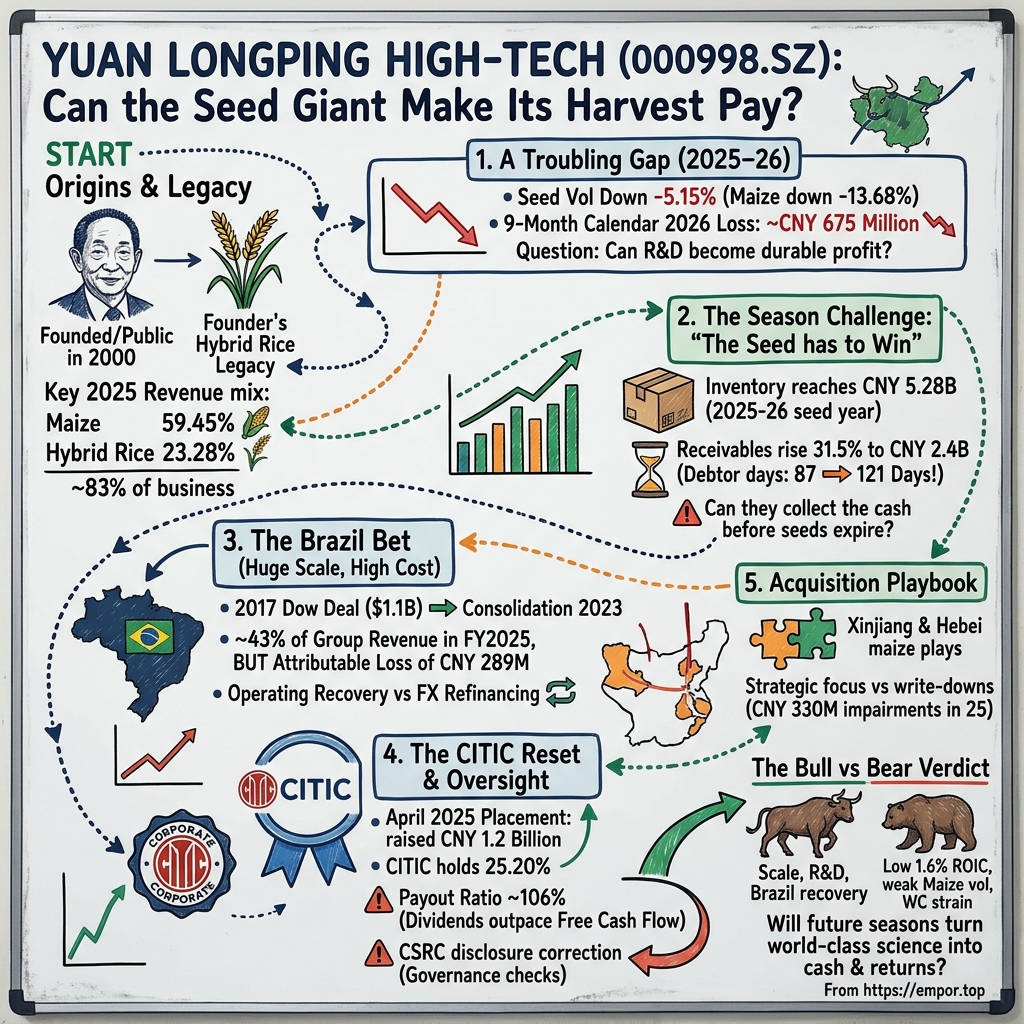
In early November 2026, the people who run China's best-known seed company closed the books on a season. In the seed trade a year does not end in December. It ends when the last bag of seed for the planting cycle has been shipped, returned or written into inventory, so the business year runs on the crop's clock rather than the calendar's. The report published for the 2025–26 business year by 袁隆平农业高科技股份有限公司 Yuan Longping High-tech Agriculture, known in China simply as 隆平高科 Longping High-Tech, read like a harvest ledger. It listed crops, kilograms and money, and the kilograms were going the wrong way. Total seed sales volume fell about 5% to about 288.7 million kilograms.1 Maize, the company's largest crop, fared worse: sales revenue fell about 6% and volume fell about 14%.1
Ten days earlier a second document had arrived on a different clock. The calendar-year third-quarter report covered January to September 2026, and its headline looked worse still. Revenue for the nine months was down 13%, and the company reported a net loss attributable to shareholders of roughly CNY675 million.2
A listener hearing those two numbers back to back could be forgiven for thinking the company was in crisis. The truth is more complicated, and the complication is the business itself. Longping makes most of its money in the last quarter of the calendar year, when distributors take delivery of seed for the next planting season and revenue is recognised. In the three December quarters before this one, the company swung to operating profit while the September quarters ran losses.3 The same nine months of 2025 also ended in a loss of similar size.2 So the nine-month loss is not in itself a signal of collapse. It is mostly the shape of a seed company's calendar: costs are paid all year, and the harvest of revenue arrives at the end.
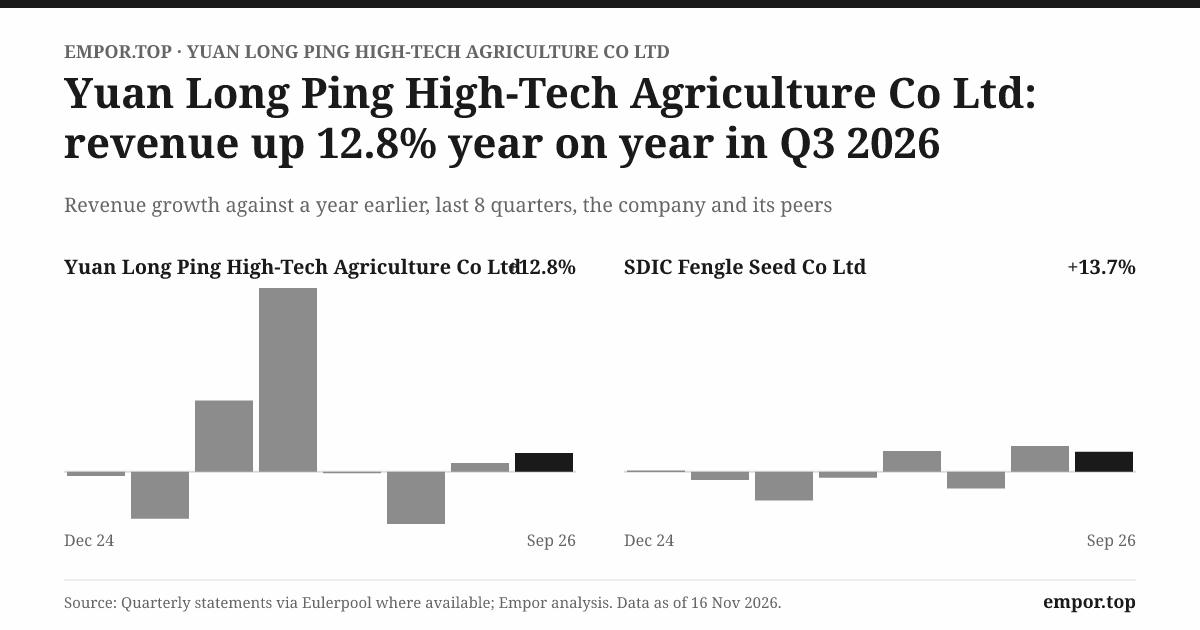
The September quarter, read on its own, was even a little better than the year before. Revenue in the three months rose by about 13% against the same quarter of 2025, and the operating loss narrowed.2 The nine-month revenue decline came mostly from a weak first quarter, when revenue fell by more than a third.2 Quarterly numbers in a seed company swing on when distributors take delivery and when returns are booked, so a single quarter proves little in either direction. That is precisely why the business-year report, which follows a whole crop cycle, carries more information than the calendar quarter that grabbed the headlines.
That framing protects Longping from a lazy bear case. It does not protect it from a sharper one. Seasonality explains why a September quarter loses money. It does not explain why the company sold fewer kilograms of maize seed in the business year that just ended, nor why, as that report also showed, the seed inventory on the books kept growing while sales volume fell.1 Those facts belong to the season, not to the calendar, and they raise the question this story is built around. Can a company built to improve the harvest turn its size, science and global reach into dependable returns for the people who own it?
The question matters because Longping is not a small or obscure company. It carries the name of the most celebrated agricultural scientist in modern China. It reported CNY8.5 billion of revenue in 2025,3 runs one of the largest seed businesses in the country, and owns, through a subsidiary, a major corn-seed operation in Brazil. Its controlling shareholder is 中信集团 CITIC Group, one of China's largest state-owned conglomerates.3 On paper it has almost everything a seed company could want: germplasm, scientists, brands, distribution, a powerful owner and a national food-security mission at its back.
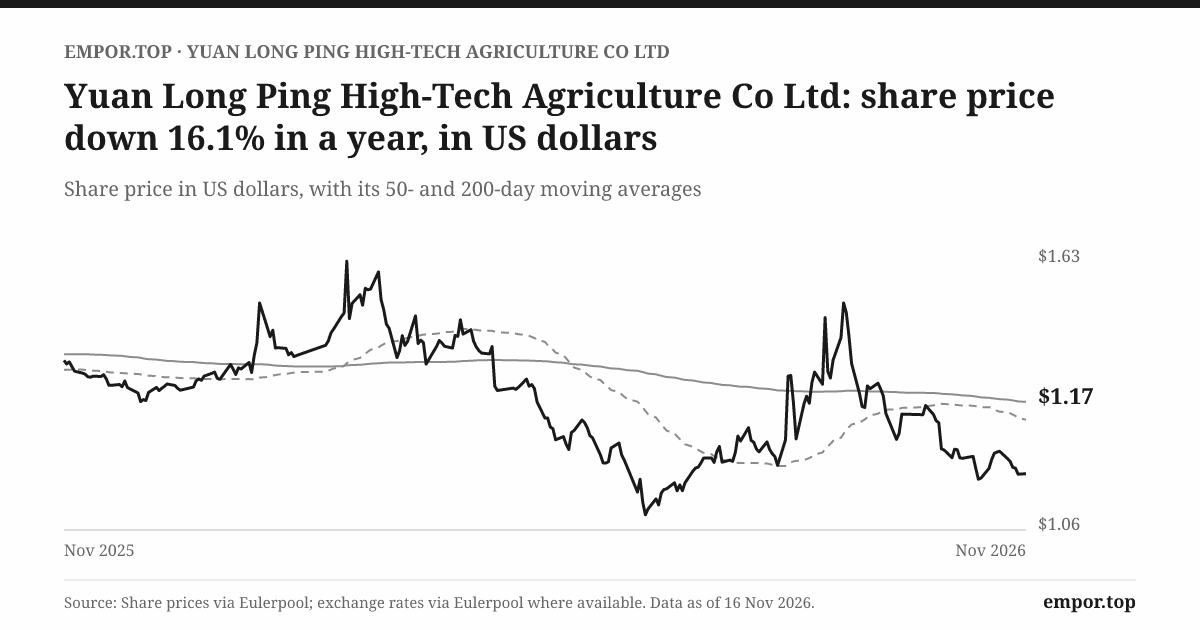
What it has not had, for most of the last decade, is a return on capital that matches that résumé. On the trailing twelve months to September 2026, return on invested capital was about 1.6%.2 Investors in the shares have lived through a fall of about 70% from peak to trough over five years, and in mid-November 2026 the stock sat almost 30% below its 52-week high.4
Four questions drive the story that follows. The first is whether research and development, which consumes almost a tenth of revenue, can become durable profit rather than a stream of approved varieties. The second is whether the build-up of receivables and inventory is a seasonal swing or an early warning that seed is not moving through the channel to farmers as planned. The third is whether Brazil, which now supplies a large share of the group's revenue, can recover through its own operations rather than through currency gains and cheaper refinancing. The fourth is whether CITIC's ownership strengthens the company while protecting the minority shareholders who own most of it.
One boundary needs setting before the story begins. This is the story of the listed company and its consolidated subsidiaries, not of CITIC Group's broader agricultural portfolio. Where CITIC made a move above the listed company, as it did in Brazil, the story will say so. And because Longping reports on three calendars, the seed business year, the calendar fiscal year and the calendar quarters, figures from each will be labelled as they appear. Confusing them is the easiest way to misread this company.
The central test, it will turn out, is commercial rather than scientific. Nobody seriously disputes that Longping can breed good seed. The open question is whether it can sell the right varieties in the right quantities, collect the money on time and earn a return across the crop cycle. To see why that test is so hard for this particular company, the story has to start with the man whose name is on the door.
 Subscribe on LinkedIn
II. A Name That Became a Business
As a young agricultural student during the 大跃进 Great Leap Forward, 袁隆平 Yuan Longping watched communities eat grass to survive. He later said he resolved to study rice so that more people would have enough to eat.5 Born in Beijing in 1930, he spent most of his working life in Hunan, and the hybrid rice his work made possible helped people in China and across the developing world feed themselves despite rapid population growth.5 He never really stopped. At 90 he was still overseeing a test site in Guangdong for another fast-growing rice strain.5 When he died in Changsha in May 2021, more than 100,000 people reportedly gathered in the rain outside the funeral home, even though he had asked for a private, low-profile farewell.5
Few companies anywhere carry a name with that kind of moral weight. In China, Yuan Longping was more than a scientist. He stood for the idea that the country would never again go hungry. Putting his name on a listed company was a statement that the science of hybrid rice could be organised, scaled and sold. The company's shares began trading on the Shenzhen Stock Exchange on 11 December 2000.3 The research institution most closely tied to hybrid rice, 湖南杂交水稻研究中心 Hunan Hybrid Rice Research Center, remained one of its largest named shareholders, with 4.55% at the end of 2025.3
The commercial problem the young company faced was the one every seed company faces. A breakthrough in a test plot is not a business. To turn a variety into money, a seed company has to multiply the parent lines, contract growers to produce the hybrid seed, process and store it, sell it through distributors to millions of farmers it never meets, and persuade those farmers to plant it rather than a rival's. Hybrid seed has one commercial virtue that makes this worth doing: the second generation does not breed true, so a farmer who wants the hybrid's yield has to buy fresh seed every season. That is the repeat purchase at the heart of the industry. It is also why the industry is so competitive, because every season the farmer is free to choose again.
Longping's answer was to grow, and grow broadly. It added maize, vegetables, wheat, cotton and other crops, bought regional seed businesses and built distribution well beyond Hunan. Over the decade from 2015 to 2025, revenue grew at about 15.4% a year.36 In 2015 the company reported revenue of about CNY2.03 billion and attributable profit of about CNY491 million.6 By 2025 revenue had grown to CNY8.48 billion, roughly four times larger.3
Here is the first reveal of the story. Profit did not follow. Attributable profit in 2025 was CNY166 million, about a third of what the much smaller company earned a decade earlier.3 Over the same ten years, net profit shrank at about 10% a year. The company got four times bigger and one third as profitable. Somewhere between the test plot and the income statement, the economics of the seed got lost, and finding where is the work of the rest of this story.
The founder's crop is no longer the centre of gravity. Hybrid rice seed contributed CNY1.97 billion of 2025 revenue, about 23%.3 Maize seed contributed about 59%.3 And a large part of that maize revenue now comes not from Hunan or the North China Plain but from Brazil. The name on the door says rice. The economics say maize and Brazil, and they shape the investment case at least as much as the founder's legacy does.
The other turning point in the company's history was a change of owner. In 2015 Longping launched a private placement that brought CITIC in as controlling shareholder.6 The consequences are visible in the balance sheet: shareholders' equity more than doubled during 2016, from about $375 million to about $849 million.3 A credit-rating agency that reviewed the company's bonds in 2016 noted the stronger capital base and debt capacity that followed the placement and raised its outlook to positive.7 That same review named the risks that would later matter most: an intensely competitive, fragmented seed industry, heavy inventories and working capital, impairment risk, and uncertain returns on research and international expansion.7 It was a remarkably accurate list of the decade ahead.
The point for an investor is that the company's long history and its current ownership regime are not the same record. The Yuan Longping name runs back to the founding. The CITIC era runs back only to the mid-2010s, and the current management team, with its rotating presidents and its Brazilian subsidiary, has a shorter record still. When this story judges how management has performed, it judges the people and structure that have run the company in that CITIC era, not the founder's legend.
The founder's name opened doors that few seed companies could open. It brought political goodwill, brand recognition among farmers and a claim to scientific seriousness. What it could not do was change the commercial rules of a seasonal seed business, where every variety has to win again each year. Whether scientific prestige can survive that test is the question that follows the name, and it begins where every seed sale begins: with a distributor signing for a season.
III. The Seed Has to Win a Season
Picture a seed distributor in a county town somewhere in China's maize belt, signing an agreement with Longping for the coming business year. The contract authorises sales of specified varieties in a specified region.6 It is not a ten-year supply deal or a subscription. It covers one season. Over the following months, the distributor will take seed into a warehouse, sell it on to retailers and farmers, extend credit where it has to, and, if a variety does not move, try to send some of it back. At the far end of that chain, a farmer standing in a shop will decide which bag to buy. That decision depends on last year's yield, a neighbour's recommendation, the price of grain, the weather, and whatever the retailer is pushing that week.
This is the "company–distributor–farmer" model, and it is the operating heart of Longping's business.6 It explains almost everything that follows in this story. Agreements are usually signed once per business year.6 Sales are seasonal. Returns and unsold inventory matter enormously, because a seed variety that misses its season does not keep its value like a bar of gold. It can lose germination quality, fall out of fashion with farmers, or be overtaken by a newer variety. So every season resets the contest. The company does not own the farmer. It earns the farmer, one planting at a time.
What winning looks like
Longping's scale is real. The company describes itself as among the largest seed businesses in China, and its 2025 annual report places it among the top three maize seed companies by commercial seed sales, alongside the Swiss-headquartered giant Syngenta and 山东登海种业 Shandong Denghai Seeds.3 That is a meaningful position in one of the world's largest maize markets. The filing does not, however, rank the three against one another or give a market share that would let anyone claim Longping leads. The honest version of the claim is narrower: Longping is one of the handful of companies with national scale in Chinese maize seed, in a market where most competitors are much smaller.
The mix tells you where the economics sit. In 2025, maize seed made up about 59% of revenue and hybrid rice about 23%, so together the two crops account for roughly 83% of the company.3 Everything else, vegetables, wheat, cotton, sunflowers, millet and other specialty crops, is a collection of smaller businesses. Some are good businesses, but none is large enough to change the group's fate on its own. Rice is the founder's crop and still the company's second engine, but it is a different kind of business from maize. Hybrid rice seed is sold mainly into southern China, where Longping's name carries the most weight and where its breeding pipeline is deepest. That is the part of the portfolio where brand and heritage are most likely to translate into a farmer's choice. It is also a mature market, shaped by government food-security priorities, in which the total area under hybrid rice is not growing fast. A strong position in rice is therefore a source of stability rather than of growth, and the company's growth story has had to come from elsewhere.
Within maize there are really two stories. Domestic maize is a core Chinese seed business fighting in a crowded market. Brazilian maize is large in revenue but tells a very different profit story.
What gives a seed company the right to win? In the simplest terms, a seed has to do better in the farmer's field than the alternatives, and it has to be available, at the right price, in the right shop, when the farmer is deciding. Variety performance comes first: yield, disease resistance, tolerance to drought or lodging, and adaptation to a local climate. After that come brand, agronomic service, distributor relationships and the logistics of getting seed to the right place in time. Longping has invested in all of these.
Its research spending is substantial. In 2025, research and development expense was about CNY665 million, and total R&D investment, including capitalised development, was about CNY763 million, roughly 9% of revenue.3 The company employed 744 people in R&D, about 18% of its workforce of 4,220.3 In rice, it reported 43 nationally approved varieties during 2025.3 For context, a company spending 9% of sales on research sits closer to a pharmaceutical company than to a typical agricultural business, which reflects how central breeding is to the product.
Here is where the story has to be careful. Those figures show investment and technical output. They do not show that the output earns money. A national variety approval is a licence to sell, roughly the agricultural equivalent of a drug approval. It says a variety met the testing standard. It says nothing about whether farmers will pick it over the dozens of other approved varieties competing for the same field, or whether Longping can sell it at a price that pays back the breeding cost. Approval is the start of the commercial test, not the end of it.
The limits of the moat
The structure of the industry makes that test harder. China's seed market is fragmented. The 2016 credit review described the industry as intensely competitive with low concentration, and nothing in Longping's recent record suggests that has fundamentally changed.7 Fragmentation means buyers have alternatives. A distributor that is unhappy with Longping's terms or variety performance can carry a competitor's line next season. A farmer who had a disappointing yield can switch with no cost beyond a different bag at the shop.
That is the crux of the switching-cost question. In some agricultural businesses, a farmer is locked in by a system: a herbicide-tolerant trait paired with a matching herbicide, or a machine that only works with certain inputs. Conventional hybrid seed creates no such lock-in. The repeat purchase is forced by biology, since hybrid seed must be bought fresh each year, but the choice of supplier is not. Annual contracts and annual planting decisions mean the evidence for loyalty has to be found in repeat sales, not assumed from the agreements.
Customer data supports that reading in an unusual way. Longping's five largest customers accounted for only about 7.5% of 2025 sales, and no single customer exceeded about 2%.3 That dispersion is good for collection risk, because no single distributor's failure can sink the company. It also means the company is selling into a broad, competitive channel in which it has no anchor customer whose loyalty can be observed. Related-party sales among those top customers were about 1% of revenue, so the business is not propped up by sales to its own shareholders.3
The most recent evidence on whether Longping's varieties are winning comes from maize, and it is not encouraging. In the 2025–26 business year, maize sales volume fell almost 14% and revenue fell almost 6%.1 The gap between those two numbers is itself a clue. If revenue fell less than volume, then the average revenue per kilogram rose, which could mean a richer mix of premium varieties or firmer pricing on what was sold. That is the more charitable reading. The less charitable one is that the company held price and accepted lower volume, which works only if the volume returns.
Management offered its own explanation in August 2026. At an investor session following its half-year results, it said China's maize seed market remained in a destocking phase for the 2026–27 planting season.8 Destocking means distributors and retailers are working down excess seed already sitting in the channel before ordering more. That is a plausible, industry-wide explanation for lower volumes. It is also exactly the kind of explanation a company would offer whether the problem was the market or its own products. If the whole industry is destocking, Longping's volumes should recover as the channel clears. If Longping's share is slipping, they will not.
The test separates those two stories. The figures that matter most are crop-level sales volume and revenue, gross margin by crop, and inventory ageing and write-downs. If new varieties are taking share and holding price, volumes should recover and margins should hold or rise. If they are merely winning approval, the company will keep reporting approvals while volume drifts and inventories age.
So far, the evidence supports a narrower claim than the company's scale might suggest. Longping has the breadth of products, breeding capacity and national distribution to compete with anyone in Chinese seed. It does not yet have proof of durable pricing power or farmer lock-in. Its edge is renewed or lost every season, and the latest maize season did not go its way. That uncertainty is sharpest in the business that grew fastest and costs the most to carry: the bet in Brazil.
IV. The Brazil Bet Was Made Above the Listed Company
In late October 2017, a Chinese agriculture investment fund linked to CITIC agreed to buy the Brazilian corn-seed business of Dow AgroSciences. The deal included established brands, germplasm rights and a Brazilian operating platform that could breed, produce and sell hybrid corn in one of the world's most important corn markets.9 Longping High-Tech announced its own participation in the investment at the same time.9 The timing mattered. Dow was then in the middle of its merger with DuPont, a moment when the world's largest agricultural companies were reshaping their portfolios. For a Chinese buyer that wanted global germplasm and a foothold in South America, a mature business coming to market from a global major was a rare opportunity.
The price was large. The transaction was reported at about US$1.1 billion.9 The disclosed figures for the target showed 2016 revenue of about US$296 million and earnings before interest and tax of about US$73.9 million.9 Set against the price, that is roughly 3.7 times sales and about 15 times operating profit, before considering how the deal was structured or what was invested afterwards. Those target figures were unaudited carve-out numbers, so they were estimates of a business that had never stood on its own.9
Was that too much? The honest answer is that the record does not allow a confident verdict. Fifteen times operating profit is a demanding multiple for a seed business in a cyclical, competitive market. It implies the buyer expected profits to grow substantially or believed the germplasm had strategic value beyond current earnings. Comparable transaction multiples for Brazilian seed assets of that period are not readily available from public filings, so there is no clean peer benchmark that would justify calling the deal an overpayment. What can be said is simpler: the price set a high earnings hurdle, and the business has not yet cleared it.
Who paid, and who owns the result
The ownership chronology matters, because it is easy to tell this story wrongly. The 2017 purchase was made by CITIC's agriculture fund, with the listed company participating.9 It was not a straight acquisition by Longping High-Tech using its own balance sheet. The listed company's accounts show the effect of its participation: its investments rose from about $72 million at the end of 2016 to about $452 million at the end of 2017, and cash from investing activities was a large outflow that year.3 But the whole US$1.1 billion was not listed-company capital.
The listed company's exposure deepened over the following years. By a 2023 equity transaction, the Brazilian operating company, Longping Development, was a subsidiary whose results ran through Longping High-Tech's consolidated accounts.10 The step changes are visible in the numbers. Group revenue more than doubled in 2022, and total assets jumped from about $2.2 billion to about $3.9 billion in 2023.3 That consolidation changed where Brazil's economics appeared. It turned a fund investment above the listed company into the single largest swing factor inside it.
How large? In 2025 Brazil generated about CNY3.66 billion of revenue, around 43% of the group total.3 It represented about 76% of the company's net assets.3 And it lost money: the listed group's Brazilian business reported an attributable loss of about CNY289 million in 2025.3 Put plainly, the business that consumes three-quarters of the shareholders' equity and supplies over two-fifths of revenue was losing money in a year when the whole group earned only CNY166 million. Without Brazil's loss, the rest of the group would have earned well over twice as much.
A strong position that has not yet paid
None of that means the Brazilian business is weak competitively. The company and CITIC have reported that Longping's Brazilian corn-seed operation holds a top-three position in Brazil, with a market share above 21%.3 Brazil's corn market is huge, technologically advanced, and dominated by global players. Holding a fifth of it is a real achievement. The germplasm that came with Dow's business remains valuable, and it gives Longping something no purely domestic Chinese seed company has: a breeding and sales platform in the Southern Hemisphere, with crops that mature on the opposite calendar to China's.
But market position and value creation are different things, and Brazil shows the gap better than any part of this story. A business can have a fifth of a big market and still lose money if it carries too much debt, pays too much for financing, or sells into a market where price competition and credit risk are intense. Brazilian agriculture runs on credit. Farmers often pay after harvest, distributors carry inventory, and interest rates in Brazilian reais have historically been far higher than in China.
That is where the 2025 improvement came from, and why it should be read carefully. In 2025 the group's finance costs fell from about CNY856 million to about CNY103 million.3 Management attributed the drop to lower interest after refinancing and a large increase in foreign-exchange gains following new currency-risk controls.3 Longping Development replaced higher-rate Brazilian real loans with a syndicated renminbi loan, which cut interest costs.3 Interest expense fell from about CNY528 million to about CNY443 million.3 Most of the rest of the swing in finance costs came from currency gains rather than lower interest.
Those are genuine financial improvements, but they are not operating improvements. Swapping real-denominated debt for renminbi debt reduces the interest bill. It also changes the currency risk: the Brazilian business now earns reais and owes renminbi, so a weaker real would make the debt heavier. Currency gains in one year can become losses the next. Translation differences in other comprehensive income show the scale of the swings: positive about CNY306 million in 2025 after negative about CNY823 million in 2024.3
The contrary evidence therefore sits in the same breath as the recovery story. Brazil's losses narrowed through cost controls, refinancing and favourable currency effects. The longer-run proof still needs operating profit and cash generation before any help from currency. Until the Brazilian business shows it can earn money from selling seed, rather than from reorganising its debts, the recovery remains a financial repair rather than a business turnaround.
Management's August 2026 framing was cautious. It said the Brazilian selling season was approaching and emphasised cost control and market expansion.8 That is a reasonable plan, but it is a plan rather than a result. The next full Brazilian crop cycle, the summer crop planted in the Southern Hemisphere's spring and the second crop that follows it, will test whether cost discipline and market share translate into operating profit.
One overhang did lift during 2026. The Brazilian tax authority had pursued an assessment and penalty tied to a 2017 transaction. In September 2026 the company announced that the matter had been finally overturned in its favour, with no payment due.11 That removed a contingent liability that had hung over the Brazilian investment. It does not change the operating question. A tax bill avoided is not a profit earned.
So the verdict on Brazil is a split one. Strategically, the business is valuable. It gives Longping global germplasm, a top-three position in a major market and a counter-seasonal platform. Financially, it has not yet demonstrated adequate returns, and the improvements of 2025 came more from the treasury than from the field. The bet was made above the listed company, but the listed company's shareholders now carry the result. And Brazil is not the only place where seed sold on credit has to be turned back into cash.
V. The New Varieties Meet the Old Inventory Problem
Every seed company has a warehouse, and every warehouse tells a story about last season. When the 2025–26 business year closed, Longping's seed inventory balance stood at about CNY5.3 billion.1 Nine months earlier, at the end of calendar 2025, it had been about CNY4.3 billion.3 In the same business year, the company sold about 5% fewer kilograms of seed than the year before.1 Fewer kilograms out, more value in stock. That combination is the puzzle at the centre of this part of the story.
To understand why it matters, walk through the seed cycle. A seed company must decide many months in advance how much of each variety to produce. It contracts growers to multiply the seed, pays them, processes and stores the output, and only then sells it to distributors for the next planting season. Production and inventory always come before sales. So some build-up of inventory before the selling season is normal, and comparing a business-year-end balance with a calendar-year-end balance mixes two different points in the cycle.
The risk sits in what happens next. Distributors and farmers pay on different schedules. Distributors may take seed on credit and pay as they sell it on. If a variety does not sell, it can come back to the company or sit unsold in the channel. And seed ages. A bag that misses one planting season may still be usable in the next, but its germination rate can decline, a newer variety can make it less attractive, and the company may have to sell it at a discount or write it down. In seed, inventory is not just stock. It is a bet on next season's demand.
The receivables clue
The receivables tell the same story from the other side. At the end of 2025, trade receivables rose about 31.5% to roughly CNY2.40 billion.3 Measured as days of revenue, debtor days rose from 87 in 2024 to 121 in 2025.3 In plain terms, the average customer was taking about a month longer to pay. The company recorded about CNY63.7 million of credit-impairment losses in 2025, mainly provisions against receivables it feared it would not fully collect.3
There is a historical precedent worth remembering here. The last time debtor days climbed this way, in 2018 and 2019, they peaked at 184 days in 2019, and inventory days stretched to more than 550.3 That was also the year the company swung to a net loss as revenue fell about 13%.3 The working-capital build in that earlier cycle was not merely seasonal timing. It preceded a period of losses and write-downs. That does not prove the current build will end the same way, but it means investors should not take the seasonal explanation on trust.
What the cash says
The cash record looks better at first glance. Over the twelve years from 2014 to 2025, Longping generated about CNY7.7 billion of operating cash flow against only about CNY2.4 billion of attributable profit.3 On the surface, that is a company whose cash far exceeds its reported earnings. Part of the gap reflects real non-cash charges, such as depreciation, amortisation and impairments, which reduce profit without draining cash. Part of it reflects the timing of seed-season working capital, including customer advances that arrive before revenue is recognised. The company does not publish a single bridge assigning the full twelve-year gap to each driver, so the precise split is unknown.
The 2025 year illustrates the risk of reading too much into the headline. Operating cash flow was about CNY752 million against attributable profit of about CNY166 million.3 That looks like strong cash conversion. But management attributed the improvement mainly to lower cash paid for goods and services, which fell more than cash receipts.3 In other words, the company spent less on seed production rather than collecting more from customers. Paying suppliers less is a legitimate source of cash in one year. It is not proof that collections are strengthening, and it cannot be repeated forever without shrinking the business.
The auditor's view supports the caution. 天健会计师事务所 Tianjian, the company's auditor, issued an unqualified opinion on the 2025 accounts, meaning it found no material misstatement.12 But it flagged three key audit matters: revenue recognition, the net realisable value of inventory, and goodwill impairment.12 Key audit matters are not red flags in themselves. They identify where the auditor judged that management's estimates carried the most risk. Revenue recognition matters because seed sales involve returns and timing questions around the season's cut-off. Inventory net realisable value matters because ageing seed can lose value. Goodwill impairment matters because a history of acquisitions leaves assets on the balance sheet that may not earn their cost. The auditor tested sales documents, cut-off, returns and receivable confirmations.12 It is the right list of places to look.
The aggregate inventory figure, by itself, does not settle whether stock is obsolete. A larger balance could reflect a deliberate build for an expected recovery, higher production costs per kilogram, or a shift towards more valuable varieties. The audit notes on inventory ageing, write-downs and subsequent sales are where that question is answered, and the next audited set of accounts, covering calendar 2026, will show whether write-downs rise.
The broader 2025 impairment figure is a warning signal in its own right. Impairment losses across the group totalled about CNY330 million in 2025, roughly twice the year's attributable profit.3 Some of that sits in inventory and some in goodwill and other long-lived assets. Either way, it is evidence that the balance sheet has been carrying assets worth less than their book value.
The income statement has a softer layer of its own. In 2025, other gains of about CNY157 million, mostly government grants, made up more than half of reported profit before tax, and the company itself described them as non-recurring.3 Grants are a natural feature of a business tied to national food security, and they may well continue in some form. But they are not earned in the seed shop. Strip them out and the profit that came from selling seed in 2025 was thinner still, which makes the working-capital build harder to wave away. A company earning so little from its core trade has little margin for a season of write-downs.
The verdict is a balanced one. Seasonality is real, and part of the inventory build is timing. But seasonality does not explain away the combination of slower maize sell-through, higher receivables, longer collection times and a larger inventory balance, all in the same period. That combination is what a channel under strain looks like. The next audited collection, ageing and write-down data should decide whether this is timing or deteriorating quality.
There is a broader lesson here about how seed companies fail. A variety can be technically superior and still fail economically if the channel absorbs too much of it, if distributors take it on credit and cannot sell it, or if it must be marked down when the next season arrives. In that case, the science wins and the shareholder loses. Longping's research budget can produce better varieties. Only its working capital can show whether those varieties are being turned into cash. And because cash is short, the question of who supplies it, and on what terms, leads straight to the company's controlling shareholder.
VI. The CITIC Reset: More Capital, More Accountability
In April 2025, 中信农业科技 CITIC Agriculture Technology subscribed for about 152.5 million new Longping shares at CNY7.87 each.3 The placement raised about CNY1.2 billion of fresh equity and lifted CITIC Agriculture's stake to 25.2%.3 The new shares were listed in May. In mid-November 2026, Longping's share price was about CNY7.82, almost exactly what CITIC paid eighteen months earlier.4 For the controlling shareholder, the investment has gone sideways. For minority shareholders who held through the dilution, the placement has not yet been rewarded either.
The placement did what it was designed to do for the balance sheet. Debt to equity, which had climbed to almost 2.0 at the end of 2024, fell to about 1.16 at the end of 2025.3 That reduction came partly from the new equity and partly from translation gains and profit. A company with heavy borrowings, seasonal cash needs and a loss-making Brazilian subsidiary was given more room to breathe. That is the strongest argument for CITIC's ownership: a deep-pocketed state-linked owner can provide capital when the business needs it, at a price that does not require a rescue discount.
Control is concentrated but not overwhelming. At the end of 2025, CITIC Agriculture held 25.2% and 中信兴业投资 CITIC Xingye Investment held 0.7%; the two are reported as acting in concert under common CITIC control.3 CITIC Group is the ultimate controller.3 The next largest named holders were the Hunan Hybrid Rice Research Center with about 4.6% and Beidahuang Zhongken (Shenzhen) Investment with about 4.5%.3 Hong Kong Securities Clearing, which represents foreign investors trading through the Stock Connect link, held about 1.2% after reducing its position during 2025.3 The company had about 136,000 shareholders at the end of the year.3 No pledge of CITIC Agriculture's shares was reported.3
That structure means CITIC controls the company with about a quarter of the shares, while roughly three-quarters belong to other investors. In practice, a 26% bloc in a widely held company gives effective control over the board. It also creates the classic governance question: does the controlling shareholder use its position to benefit all shareholders, or to serve its own wider interests?
The related-party record is more nuanced than a headline would suggest. On the sales side, the risk is small. Related-party sales among the top five customers were about 1% of revenue, and the 2025 annual report stated that there were no related-party transactions in ordinary daily operations.3 There is no evidence of CITIC charging royalties, brand fees or management fees to the listed company.3
Financing is a different and more material relationship. The company has borrowed from CITIC Agriculture and a CITIC-linked agriculture fund.13 The company says the terms were no more favourable to the lender than rates offered by third parties to borrowers of the same credit standing.13 That is the right principle. But a minority shareholder would want the itemised balances and rates, and those sit in notices and notes rather than in a single summary that would let investors judge the scale of the dependence. CITIC is both the controlling shareholder and a creditor. That dual role can be helpful in a crisis. It can also blur the line between support and leverage.
The dividend that outran the cash
The sharpest capital-allocation question concerns the dividend. In 2025, the company paid about CNY506 million in dividends, against attributable profit of about CNY166 million, a payout of about 331% of earnings.3 That was not a one-year anomaly. Over the dozen years from 2013 to 2025, the median payout ratio was about 106%, meaning the company typically paid out more than it earned.3 In 2024, the payout reached about 542%.3
The cash-flow record makes the point more starkly. Over 2014 to 2025, free cash flow, meaning operating cash flow minus capital spending, totalled about CNY924 million. Dividends paid totalled about CNY4.3 billion.3 The company paid out almost five times as much cash as its operations generated after investment. The gap was filled by borrowing and by equity raised from shareholders, including the CITIC placement.
To be fair, cash and short-term investments did rise over the period, from about CNY590 million at the end of 2013 to about CNY3.5 billion at the end of 2025.3 The company held about CNY2.92 billion of cash and equivalents at the end of 2025.3 But that cash sits alongside short-term loans of about CNY3.44 billion, long-term loans of about CNY4.22 billion and current maturities of non-current debt of about CNY2.17 billion.3 A company that borrows heavily, raises equity and pays dividends above its free cash flow is effectively recycling capital rather than distributing surplus. That may suit a controlling shareholder that wants a steady cash stream. It does not make the payout sustainable from earnings.
The shape of the debt adds a refinancing question. During 2025 short-term loans fell from about CNY4.84 billion, but the slice of long-term debt falling due within a year rose from about CNY1.49 billion to about CNY2.17 billion.3 Interest expense, at about CNY443 million in 2025, was more than two and a half times the year's attributable profit.3 The company reported no covenant breaches.3 Still, a business that must roll several billion yuan of borrowings every year, in a seasonal trade where cash arrives late, depends on its lenders' continued confidence, and CITIC's presence is part of what sustains that confidence. Litigation, by contrast, is a small matter: other lawsuits carried about CNY156.5 million of claims at the end of 2025, the largest being an CNY80 million plant-variety dispute in which subsidiary Sanrui was the claimant, and provisions were only about CNY8 million.3
The regulator's letter
Then there is the disclosure question. In November 2025, the Hunan bureau of 中国证监会 the China Securities Regulatory Commission issued a decision ordering correction and requiring regulatory interviews.14 The finding was that the company had failed to disclose performance commitments related to two equity-transfer agreements in its annual reports from 2021 through 2024.14 Performance commitments are promises, typically made by the sellers of an acquired business, that the business will hit certain profit targets, often with compensation if it does not. They are exactly the information an investor needs to judge whether an acquisition is working. Leaving them out of four consecutive annual reports is not a technicality. It is a direct credibility issue for the board and management.
The 2025 audit opinion remained unqualified, and the company has since been required to correct its disclosure.1214 But the episode sits uncomfortably beside the company's plans for further acquisitions. A company that wants investors to trust its deal-making must first show it reports the terms of its existing deals completely and on time.
Management is best judged by behaviour rather than titles. Longping uses a rotating-president system, in which senior executives take turns leading the operating business. The new board elected in 2026 retained that structure and appointed Zhang Lin and Yin Xianwen as rotating presidents.2 The 2026 interim report noted no change in the board or senior management during the first half.15 The annual report describes performance-based executive pay and a revised compensation policy for senior management, but it does not provide a comparable multi-year pay series for the chair, the rotating presidents or the chief financial officer.3 That makes it hard to test whether pay has tracked the poor returns.
Employee ownership has faded rather than grown. The first employee share plan, which covered 694 employees, sold its remaining shares by December 2025, after reducing its holding by about 23 million shares between 2023 and 2025.3 Share-based compensation expense in 2025 was only about CNY7.7 million.3 The employees who were given a stake in the company's future chose, over time, to sell it.
The August 2026 investor session gave the most recent window into management's thinking. Its answers focused on three things: maize destocking, the Brazilian recovery, and the rationale for planned acquisitions.8 The commitments were directional rather than numeric. Management did not set public targets for maize volume, Brazilian operating profit or receivable days that investors could later hold it to.
Put yourself in the shoes of a skeptical investor. After a placement, weak returns, payouts far above free cash flow and a regulatory finding on disclosure, where should the next yuan go? The case for discipline is strong: pay down expensive debt, collect receivables, clear inventory and prove that existing assets, especially Brazil, can earn their cost. The case for continued dividends and new acquisitions is weaker until those basics improve. CITIC's support is real. The credibility test is whether its oversight produces better returns, timely disclosure and disciplined distributions. And the first test of that new discipline is already on the table, in the form of the company's next acquisitions.
VII. The Next Acquisition Is a Test of the New Playbook
At the August 2026 investor session, management laid out where future deals would go. Acquisitions, it said, should support gains in maize market share and in selected specialty crops.8 It described one combination in particular: the breeding resources of Xinjiang Jinghua, paired with the commercial promotion capability and overseas channels of Xinjiang Huimin.8 During 2026 the company also disclosed moves involving Xinjiang Jinghua and Hebei Xuntian.158 The pitch was coherent. Buy germplasm where the company needs it, pair it with the channels to sell it, and concentrate on the crops where scale matters.
Coherent is not the same as proven. Longping has done this before, and the record of past deals is the right place to start.
The ledger of past bets
The Brazil purchase set a high earnings hurdle that remains uncleared. The decade's expansion did not translate into stronger profit. The 2025 impairment charge reinforced the concern that some assets have not earned their book value.3 Goodwill impairment remains among the auditor's key audit matters.12
The regulator-flagged deals belong in this ledger too: investors were not told what had been promised for two acquired businesses.14
The Brazil purchase was a CITIC fund transaction in which the listed company participated; the Xinjiang and Hebei moves are listed-company decisions under the current management regime. Judging them requires the actual deal notices: the price, the form of consideration, the stake acquired, and the profit commitments or other expected economics. Without those, a strategic rationale is only a story.
The research-accounting tension
A quieter change in the accounts deserves attention, not because it suggests misconduct but because it shifts how the business looks. In 2025, the company capitalised about CNY175 million of its R&D spending, or about 23% of total R&D investment, up from about 16% in 2024.3 Capitalising R&D means treating part of the spending as an asset to be amortised over future years rather than as an immediate expense. That raises reported profit in the year of spending.
Management attributed the rise to purchased transgenic-trait assets and the development of transgenic research capability.3 That explanation is plausible. If genetically modified corn becomes a large commercial market in China, companies with approved traits and the capacity to put them into commercial varieties could gain an important edge. Buying trait assets and building that capacity is a sensible strategic move, and under accounting rules such development costs can qualify for capitalisation when commercial success is probable.
But capitalised R&D is a promise of future revenue, and it should be tested like one. If transgenic corn varieties carrying Longping's traits win farmers and earn premiums, the capitalised costs will look like prudent investment. If they do not, the asset will eventually be impaired, and today's higher profits will have been borrowed from tomorrow. Given that 2025 impairments were already roughly twice the year's profit, investors have reason to treat new intangible assets with some caution.
The broader portfolio deserves proportion. Specialty seeds such as vegetables, sunflowers and millet, along with biotechnology and digital agriculture, could reinforce the core business. Some carry higher margins, and transgenic traits could matter a great deal. But today they are not large enough to change the economics of a company in which maize and rice make up about 83% of revenue and Brazil drives most of the profit swings.3 Artificial intelligence may speed breeding and selection, as it is beginning to across the industry, but the company does not quantify AI's contribution to its revenue or costs. These are possibilities to watch, not reasons to ignore the core.
The falsification test for the new playbook is straightforward. If the acquisitions work, acquired varieties and channels should show rising sales, gross profit and cash contribution within a few seasons, while goodwill and inventory impairments decline. If they do not, the pattern of the past decade will repeat: revenue grows, the balance sheet expands, and the returns do not follow. The stated focus on crop genetics, channels and maize scale is strategically sensible. The record calls for a high proof bar. Commercialisation and returns must follow the deal, not just capability or strategic fit.
That high bar is not unique to Longping. It is the lesson any company that turns science into a business eventually learns, and Longping's history makes it unusually easy to see.
VIII. Playbook: Business & Investing Lessons
Somewhere in a Chinese county seed shop, there is a bag of Longping seed with a famous name printed on it, a variety that won its national approval, and a distributor's invoice attached. The variety earned public recognition. The bag still has to be sold. The company's whole history lives in the gap between those two facts, and it yields a handful of lessons that belong to Longping and no other company.
The first lesson is that a variety is a promise, and a farmer's next order is the proof. Longping reported 43 nationally approved rice varieties in a single year and spends about 9% of its revenue on research.3 Yet in the latest maize season it sold almost 14% fewer kilograms.1 Approvals are the beginning of a variety's commercial life, not the end. For founders building science-based companies, the lesson is to measure the business by repeat purchases and price realisation, not by the count of technical milestones. For investors, it is to ask which approved products are actually gaining share and holding price.
The second lesson is that in seeds, the season is the balance sheet. A distributor's annual contract looks like revenue, but the true outcome of the season shows up months later in receivables, returns and inventory ageing. Longping's debtor days stretching by about a month in a single year, while its seed inventory kept growing as volume fell, is the signal that matters more than the income statement. Any company that sells a perishable or seasonal product through a credit-extending channel faces the same trap. Revenue booked is not cash collected, and stock in the warehouse is a bet on next season.
The third lesson is that a famous name can open the field, but it cannot harvest the margin. Yuan Longping gave the company prestige, political goodwill and brand recognition that no rival could buy. It did not prevent profit from falling by about two-thirds over a decade in which revenue quadrupled. Brands built on a founder's scientific reputation are powerful at opening doors. They do not by themselves create pricing power in a market where farmers choose again every season.
The fourth lesson is that capital support buys time, not returns. CITIC's CNY1.2 billion placement repaired the balance sheet.3 But it arrived alongside a loss-making Brazilian business, dividends far above free cash flow and a regulator's finding on disclosure. A strong controlling shareholder is a cushion against failure. It is not a substitute for a business that earns more than its cost of capital, and it introduces its own questions about whose interests the next yuan serves.
The fifth lesson is that a global footprint is only diversification if it earns. Brazil supplies about 43% of revenue3 and gives Longping a counter-seasonal platform and germplasm no domestic rival can match. Yet in 2025 it lost money, and its improvement came largely from refinancing and currency gains. A company that diversifies across continents takes on new currencies, new credit markets and new competitors. That diversification only reduces risk once each new market stands on its own operating cash.
Together these lessons point to a single conclusion. Scientific capability creates an opportunity, not an economic moat by itself. The moat must be renewed in the field every season, and proven in cash every year. Over the twelve years to 2025, Longping paid out in dividends more than four and a half times the free cash flow it generated. Whatever its science earned, the cash record says the business around it has not yet kept pace. Whether it can is the question the market is now pricing.
IX. Analysis & Bear vs. Bull Case
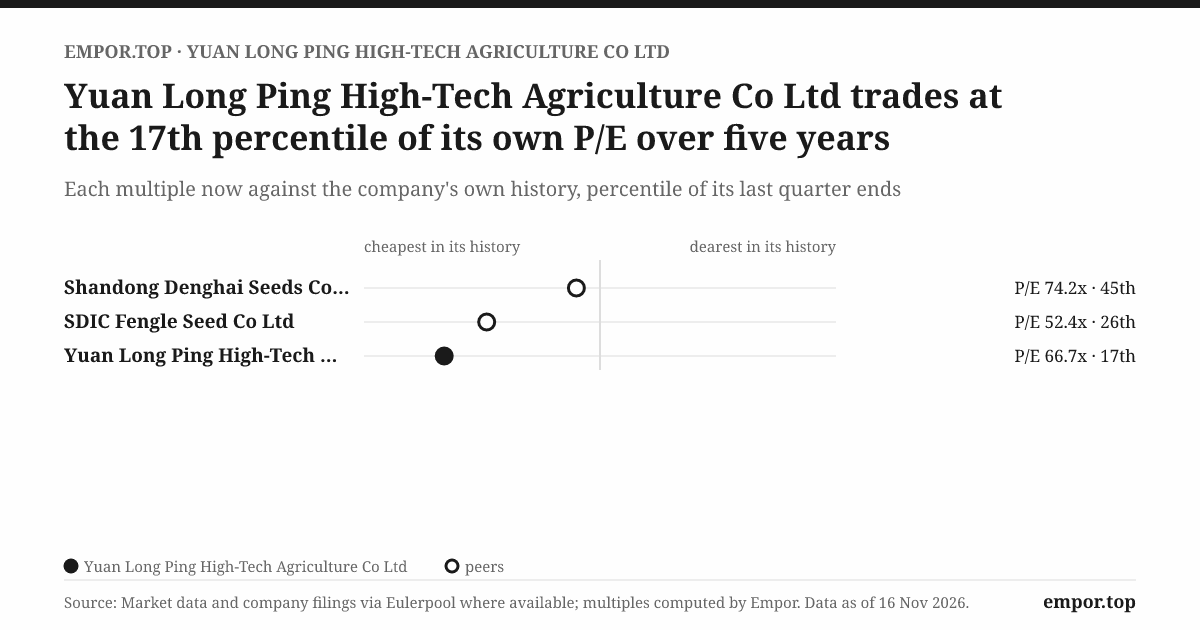
At the close on 16 November 2026, Longping's shares traded at about CNY7.82, roughly 29% below their 52-week high of about CNY11.04.4 The market valued the equity at about CNY10.4 billion and the whole enterprise, including net debt, at about CNY17.4 billion.4 On trailing earnings, the shares traded at about 67 times, against a five-year median of about 132 times.4 At first glance that looks like a stock trading at half its usual multiple. Look closer and it is a stock whose earnings have been so low and so volatile that the multiple says more about the denominator than about the price.
Other measures make the point. The enterprise value was about 25.5 times EBITDA and about 40 times operating profit.4 The free-cash-flow yield was about 0.3%.4 Return on invested capital over the trailing twelve months was about 1.6%, and return on equity about 2.5%.42 Price to book was about 1.7 times.4 Those are not the numbers of a cheap stock. They are the numbers of a stock whose price assumes earnings will recover substantially from current levels. Whether that assumption is reasonable depends on the competitive question this story has been circling.
The forces on the field
Start with the structure of the industry. Rivalry among Chinese seed companies is intense. A decade-old credit review noted the industry's low concentration, and Longping's top-three position still sits within a crowded field.37 Rivalry therefore pushes against pricing power.
Buyer power is moderate rather than high. Longping's customer base is diffuse,3 but collectively, distributors and farmers hold the stronger hand, because they can switch suppliers each season with little cost. That is a quieter, more diffuse form of buyer power than a single dominant customer, but it is real, and it shows up in returns, credit terms and the need to keep varieties competitive.
Supplier power is limited but not trivial. Longping's five largest suppliers, mainly seed-production growers and input providers, account for about 17% of purchases.3 Growers who multiply seed can be replaced, but production capacity in the right climate zones is not infinitely elastic.
The threat of substitutes is low in the obvious sense, since there is no substitute for seed, but meaningful in the sense that matters: one variety substitutes for another. New genetically modified varieties from rivals, including global companies with deep trait portfolios, are the most significant substitution risk.
The threat of new entrants is limited by the time and cost of building germplasm, gaining approvals and assembling distribution. Variety approvals and germplasm matter. But annual selling cycles mean even established positions must be defended every season, and policy, disease, weather and regulation can change demand and product performance quickly.
The powers that would make a moat
Hamilton Helmer's framework asks what durable power, if any, the company has. Scale economies exist in breeding, since R&D costs are spread over more sales, and Longping's research budget is large by Chinese standards. But the low and falling returns suggest scale has not yet produced cost or pricing advantages large enough to show in profit. Switching costs are weak, for the reasons the annual distributor contract makes clear. Network effects do not apply. Brand is real: the Yuan Longping name carries trust among Chinese farmers, but the profit record shows it has not translated into a price premium strong enough to lift returns. Cornered resource is the most interesting candidate. Germplasm, the genetic library of breeding lines, including what came from Dow in Brazil, is hard to replicate and could be the company's most durable asset. Counter-positioning and process power are not clearly evident.
The moat conclusion follows. Longping has real breeding, brand and channel assets. The evidence supports a competitive position more clearly than a durable, high-return moat. It is a company that can compete with anyone in Chinese seed, and has a meaningful position in Brazil, but has not shown it can earn high returns on the capital those positions require.
The affirmative case is real and deserves its full weight. Longping has meaningful businesses in both rice and maize, the two largest seed crops in China. It invests heavily in research and has a deep germplasm library, including global genetics from Brazil.3 It has recognised products and a brand with unmatched public goodwill. Its Brazilian business holds a top-three position in one of the world's largest corn markets.3 Refinancing lowered its financing costs, and its controlling shareholder has injected equity when needed.3 If China's maize seed market emerges from destocking, if transgenic corn becomes a significant market in which Longping has a strong position, and if Brazil reaches sustained operating profitability, current earnings could prove to be a cyclical trough rather than a new normal. On that view, the high multiples reflect depressed earnings and would compress quickly as profits recover.
The skeptical case sits right beside it. Chinese seed markets remain fragmented and competitive. The latest maize sales volume fell by almost 14%.1 Brazil generates a large share of revenue but lost money in 2025.3 Receivables and inventories grew as sales volume fell. Returns on invested capital have been low for most of the CITIC era. Dividends have far exceeded free cash flow, funded in part by borrowing and new equity. The company has recorded significant impairments and was found by the regulator to have omitted acquisition performance commitments from four annual reports.14 On that view, the current earnings are not a trough but the normal return of a capital-intensive, competitive business, and the multiples assume a recovery that history has not delivered.
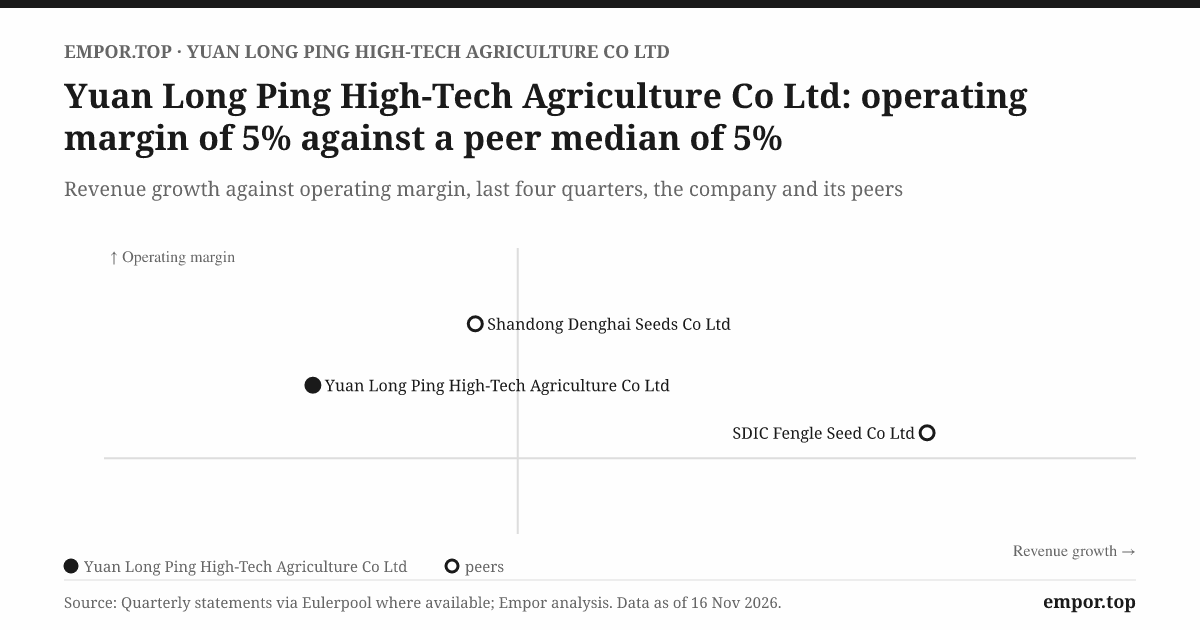
The company's own record is the best test of the trough argument, and it cuts against the bull. Between 2015 and 2018, operating margins ran between roughly 21% and 30%.3 Since 2019, they have ranged from small losses to about 8%, with net losses in both 2019 and 2022.3 A trough that has lasted seven years, through a change of strategy, a Brazilian consolidation, a refinancing and a fresh equity injection, is hard to describe as cyclical. The history does not reject the bull case outright, because maize destocking, Brazilian refinancing and transgenic traits are genuinely new ingredients. It narrows it. The realistic bull case is not a return to the margins of the mid-2010s but a recovery from about 4% towards the high single digits, earned through the field rather than the treasury. That smaller claim stays unproven until Brazilian operating profit and domestic maize volumes both turn.
Each side has a falsification test. The bull case is confirmed if crop-level volume and margins recover, collections improve, inventory write-downs fall, and Brazil generates operating cash before currency gains. The bear case is confirmed if maize volumes keep contracting, debtor days keep rising, Brazil stays loss-making, or new acquisitions add impairments.
Valuation is a consequence of that earnings question, not an independent answer to it. A P/E below the five-year median can simply reflect depressed earnings. The high EV/EBITDA and low free-cash-flow yield still demand evidence of improvement. The market is not pricing Longping as a distressed company. It is pricing it as a company whose earnings will recover. The question is whether the next seasons will justify that faith.
X. Epilogue
As 2026 draws to a close, Longping stands at a familiar point in the seed calendar. The business year has ended. Seed for the next planting is in the warehouse, much of it already in distributors' hands, and the most important quarter of the calendar year, the one in which most revenue is recognised, is underway. The company carries a large seed inventory into that quarter, a fresh set of maize and Brazilian ambitions, and a market that has priced in recovery.
Three measures will decide the story's central questions. The first is crop-level volume and revenue, above all in domestic maize, where volume fell almost 14% in the latest business year.1 The second is the pair of working-capital signals, debtor days, which stood at 121 at the end of 2025, and inventory write-downs.3 The third is Brazilian operating profit and cash generation before currency gains.
The next maize planting cycle is the first test. Management said in August that the Chinese maize market remained in destocking for the 2026–27 season.8 If that is right, the channel should clear and volumes should stabilise in the business year that follows. If volumes keep falling after the channel has cleared, the problem is not the market but the products.
The second test arrives with the audited 2026 accounts. They will show whether the receivables that ballooned in 2025 were converted to cash, and whether the inventory that grew to about CNY5.28 billion was sold or written down.1 A rise in write-downs or in debtor days would turn the seasonal explanation into a quality problem.
The third test is Brazil. One full local selling season, in which cost control and market expansion must show up in operating profit rather than in refinancing savings and currency gains, will reveal whether the business can stand on its own. With the tax dispute resolved, there is no longer a contingent liability to blame.11
And over all of these hangs the governance test. Investors will watch whether new acquisitions disclose clear prices, targets and performance commitments, and whether prior commitments are reported on time. After the regulator's 2025 order, the bar for disclosure is no longer a matter of best practice. It is a matter of credibility.14
The story turns on sell-through and cash conversion, not on variety counts or acquisition announcements. Each outcome would rewrite the story in a different direction. If maize volumes stabilise, collections improve and Brazil earns an operating profit without help from the currency, the past decade will start to look like an expensive apprenticeship, with the scale, germplasm and Brazilian platform finally paying for themselves. If maize volumes stabilise but Brazil keeps losing money, the company becomes a solid Chinese seed business carrying an overseas subsidiary that consumes most of its equity, and the pressure to rethink that structure will grow. If neither turns, and the inventory built in 2026 has to be written down, the dividend paid above free cash flow will become very hard to justify, and the controlling shareholder may again be asked for capital.
Longping can keep breeding better seeds. The tension that remains is whether it can make the business around those seeds earn its keep.
XI. Outro
Go back to the county seed shop, and the farmer deciding what to plant. Behind one bag of Longping seed sit a scientist who watched people eat grass and vowed they would never go hungry again, a national food-security mission, a Brazilian corn business bought on another continent, a state-owned conglomerate, and a listed company with tens of thousands of shareholders. The farmer knows none of that. The farmer cares only whether the seed will yield.
That is what makes Longping unusual. Its science has changed the world's harvest. Investors are still waiting to see the harvest in cash.
References
-
2025–2026 Business-Year Operating Report — Yuan Longping High-Tech Agriculture Co., Ltd., 2026-11-07 ↩↩↩↩↩↩↩↩↩↩
-
2026 Third-Quarter Report — Yuan Longping High-Tech Agriculture Co., Ltd., 2026-10-29 ↩↩↩↩↩↩↩
-
2025 Annual Report — Yuan Longping High-Tech Agriculture Co., Ltd., 2026-04-18 ↩↩↩↩↩↩↩↩↩↩↩↩↩↩↩↩↩↩↩↩↩↩↩↩↩↩↩↩↩↩↩↩↩↩↩↩↩↩↩↩↩↩↩↩↩↩↩↩↩↩↩↩↩↩↩↩↩↩↩↩↩↩↩↩↩↩↩↩↩↩↩↩↩↩↩↩↩↩↩↩↩↩
-
Company Announcements and Investor Materials, 000998 — Shenzhen Stock Exchange ↩↩↩↩↩↩↩↩↩
-
Yuan Longping, China’s father of hybrid rice, dies aged 90 — The China Project, 2021-05-24 ↩↩↩↩
-
2015 Annual Report — Yuan Longping High-Tech Agriculture Co., Ltd., 2016 ↩↩↩↩↩↩
-
2016 Tracking Credit Rating Report for the 2012 Corporate Bond — Pengyuan, 2016-06-06 ↩↩↩↩
-
Investor Relations Activity Record: 2026 Half-Year Results Q&A — Yuan Longping High-Tech Agriculture Co., Ltd., 2026-08-26 ↩↩↩↩↩↩↩
-
Investment in Dow AgroSciences’ Brazilian Seed Business — Yuan Longping High-Tech Agriculture Co., Ltd., 2017-10-31 ↩↩↩↩↩↩
-
Brazil Subsidiary Equity Transaction — Yuan Longping High-Tech Agriculture Co., Ltd., 2023-08-25 ↩
-
Brazil Tax Assessment and Penalty Matter Concluded — Yuan Longping High-Tech Agriculture Co., Ltd., 2026-09-30 ↩↩
-
2025 Audit Report and Financial Statement Notes — Tianjian, 2026-04-17 ↩↩↩↩↩
-
Related-Party Financing Notice for 2025 — Yuan Longping High-Tech Agriculture Co., Ltd., 2025 ↩↩
-
Decision Ordering Correction and Regulatory Interviews — Hunan CSRC Bureau, 2025-11-28 ↩↩↩↩↩↩
-
2026 Interim Report — Yuan Longping High-Tech Agriculture Co., Ltd., 2026-08-21 ↩↩
 LinkedIn
 WhatsApp
 Reddit
 Hacker News
 Email
 Kindle
 RSS Feed
 Spotify
 Apple Podcasts
 Amazon Music
 Audible
 YouTube