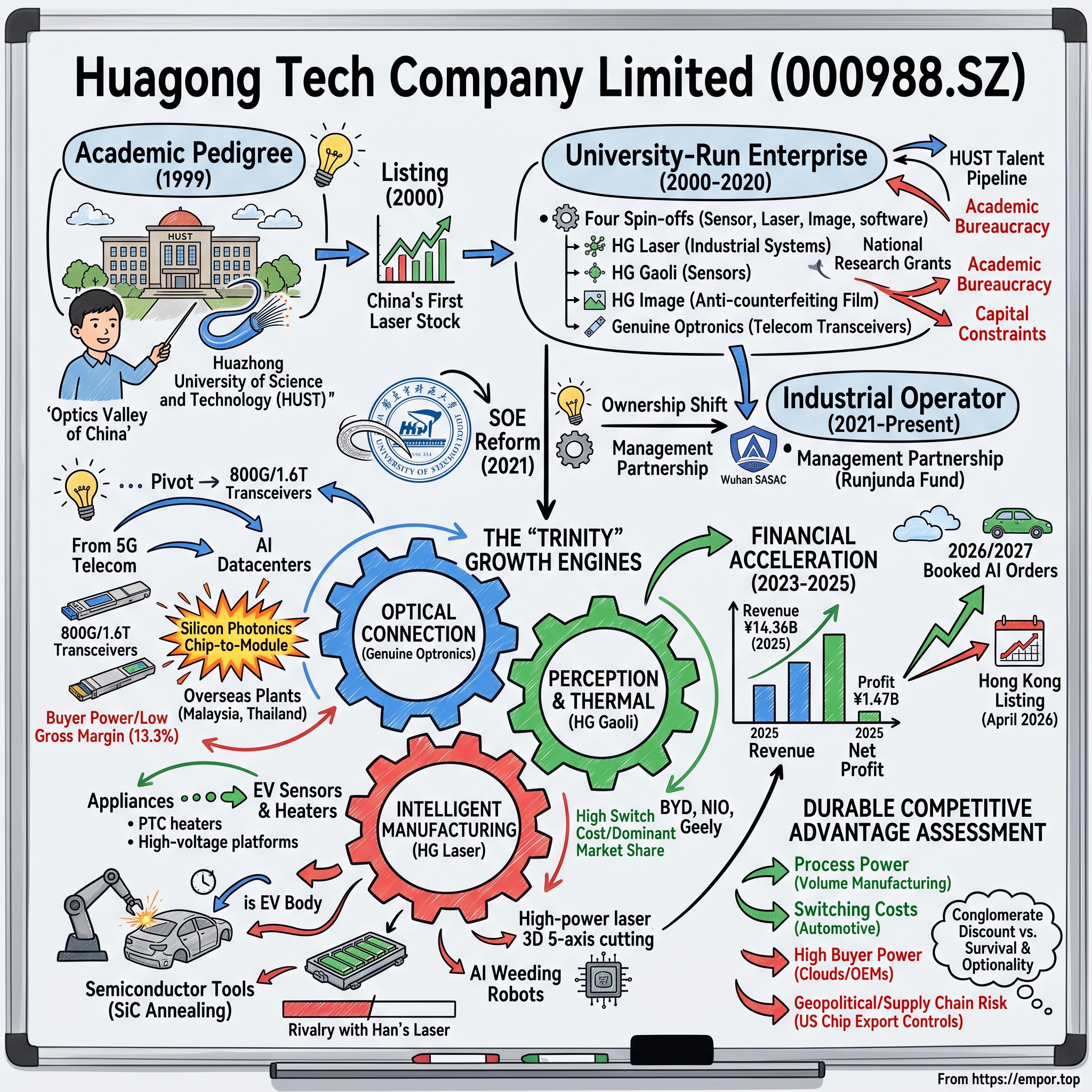
Huagong Tech: The Optoelectronic Conglomerate Powering AI Datacenters and China's EVs
I. Introduction: The Academic Powerhouse That Pivoted to AI Datacenters and EVs
Start with a number that seems to contradict itself. In the first quarter of 2026, a company most Western investors have never heard of reported that its optical-module exports had grown by 122% year over year, that its order book for 800G and 1.6T AI transceivers was fully booked into the following year, and that its chairman was telling China's national legislature that artificial intelligence was "the greatest opportunity of this era, one whose effects will last more than thirty years."1 The same company earned a gross margin on those glamorous AI optical modules of just 13.3% — while two pure-play rivals down the road in the same industry earned 42.6% and 47.8% on theirs.2
That is the puzzle of 华工科技产业股份有限公司 Huagong Tech Company Limited (000988.SZ), and it is a more interesting puzzle than either the bulls or the bears usually admit. Here is a firm that ships silicon-photonics modules to the datacenters training the world's largest AI models, that makes roughly seventy percent of the world's temperature sensors, that builds the laser robots welding electric-car bodies in forty-three seconds — and yet trades at a persistent discount to companies that do only one of those things. To understand why is to understand something deep about conglomerates, about state capitalism with Chinese characteristics, and about the difference between being early to a technology and being the best at monetizing it.
Huagong Tech was born in 1999 as a spin-off of 华中科技大学 Huazhong University of Science and Technology (HUST), the engineering powerhouse at the heart of Wuhan's 中国光谷 Optics Valley of China. It listed on the 深圳证券交易所 Shenzhen Stock Exchange in June 2000 as, in the company's own recurring self-description, 中国激光第一股 "China's first laser stock" — and among the first university-restructured enterprises in central China to go public.5 For its first two decades it was, quite literally, a university's commercial arm — with all the talent and all the bureaucratic sludge that implies. Then, between 2020 and 2021, control passed from the university to the 武汉市国资委 Wuhan State-owned Assets Supervision and Administration Commission (SASAC), and the company set about proving it could compete not as an academic curiosity but as an industrial operator.
In 2025 it did the numbers that finally made global investors look up. Revenue reached ¥14.36 billion RMB, up 22.6%, and net profit attributable to shareholders reached ¥1.47 billion, up 20.5%.3 The business runs on three engines that management calls its 三位一体 "trinity": Optical Connection (华工正源 Genuine Optronics), Perception and Thermal Systems (华工高理 HG Gaoli), and Smart Manufacturing (华工激光 HG Laser). By the summer of 2026 its market capitalization had crossed ¥185.6 billion (roughly $27.4 billion) — though on a volatile, AI-sentiment-driven trajectory that saw the stock swing double digits within single sessions — and management had filed to raise fresh capital through a secondary listing in Hong Kong.24
To feel the acceleration, watch the three-year staircase rather than any single figure. Revenue climbed from ¥10.3 billion in 2023 to ¥11.7 billion in 2024 to ¥14.36 billion in 2025, while net profit stepped from ¥1.0 billion to ¥1.2 billion to ¥1.47 billion — a compounding that quietly gathered pace as the optical business went from a supporting player to the lead act.3 The momentum carried into 2026: first-quarter revenue rose 27% to ¥4.27 billion and net profit jumped 56% to ¥638 million, the fingerprints of an AI order book running hot.2 Numbers like these are why the promoters call Huagong an "AI stock." The rest of this article is an argument for why that label is both true and dangerously incomplete.
This article traces the whole arc, and it does so with a skeptic's eye rather than a shareholder's. Three questions organize everything that follows. First, the governance question: how does a firm move from university control to a state-owned holding company and still act like a market competitor — and does the evidence show that it does? Second, the structure question: is being a three-engine industrial conglomerate a genuine advantage against hyper-focused rivals like 中际旭创 Innolight and 新易盛 Eoptolink in optics and 大族激光 Han's Laser in lasers, or is it a discount waiting to happen? And third, the frontier question: silicon photonics, co-packaged optics, high-voltage EV heaters — is Huagong Tech leading these transitions or merely running to keep up? Let us begin where the company did, in a university lab.
 Subscribe on LinkedIn
II. Origins & Academic Pedigree: HUST and the Birth of Optics Valley (1999–2010)
To understand Huagong Tech you have to understand Wuhan, and to understand Wuhan's tech identity you have to go back to a decision made in a fiber-optics lab in the 1970s. This is the city where a HUST-affiliated researcher, Zhao Zisen — the man later called "the father of Chinese optical fiber" — drew China's first practical optical fiber. That lineage turned a sprawling industrial city on the Yangtze into the country's optoelectronics cradle, the place the government would eventually brand 中国光谷, the Optics Valley of China. HUST, an engineering university with one of China's premier optoelectronics research centers, sat at its intellectual center. When people describe Huagong Tech's "academic pedigree," this is what they mean: not a marketing slogan but a physical proximity to the labs, the talent, and the state research money that made lasers and optical fiber a regional specialty.
Why does that geography matter so much to an investor a quarter-century later? Because industrial clusters are self-reinforcing in a way that is hard to build from scratch and hard to compete against from outside. Optics Valley concentrated the universities, the state research money, the specialized suppliers, and — crucially — a deep local labor pool of optoelectronics engineers into a few square kilometers of Wuhan. A company sitting inside that cluster hires more easily, sources components faster, and absorbs new science sooner than a rival trying to replicate the ecosystem elsewhere. Much of what looks, in Huagong Tech's financials, like durable technical capability is really the compounding dividend of being planted in the right soil at the right time. It is also a reminder that some of the company's edge is inherited from a place and a policy, not created by management — a distinction worth holding onto when weighing how defensible that edge really is.
The company itself was assembled on July 28, 1999, when Huazhong University of Science and Technology bundled four of its already-successful spin-off enterprises — a sensor maker, a laser-holography and imaging firm, an industrial-software house, and a laser-equipment company — into a single vehicle called Huagong Tech.5 The logic was straightforwardly commercial: the university had research assets that were making money, the state wanted its universities to industrialize their science, and the capital markets were opening. A young laser engineer named 马新强 Ma Xinqiang, then in his mid-thirties, was made the first president.[^6]
Less than a year later, in June 2000, Huagong Tech sold roughly 30 million A-shares on the Shenzhen Stock Exchange under the code 000988.5 Its debut was a spectacle — the stock set records for opening price, closing price, and first-day gain, earning it the nickname "the hottest high-tech stock of 2000." The label that stuck was 中国激光第一股, China's first laser stock, and the deeper significance was structural: as one of central China's first university-restructured listings, it was a template the state hoped other academic institutions would follow.
What did the university ownership actually buy the company? On the asset side, quite a lot. Huagong Tech had an unrivaled pipeline of engineering graduates flowing directly from HUST's labs, privileged access to national research grants, and the technical credibility that came from being able to say its founders had literally invented the underlying science. Over the following decade the group built out the subsidiary structure that still defines it. 华工激光 HG Laser commercialized laser cutting, welding, and marking machines for Chinese manufacturers. 华工高理 HG Gaoli refined 负温度系数 negative temperature coefficient (NTC) thermistors and ceramic sensors. 华工图像 HG Image made laser holographic anti-counterfeiting film — the shimmering security foil on banknotes, certificates, and cigarette packs. And, most consequentially for the story to come, the group nurtured an optical-components arm, 华工正源, whose English name is Genuine Optronics, to package and sell optical transceivers.
Consider what each of those subsidiaries actually was, because the seeds of everything Huagong Tech became were planted here. HG Laser inherited the university's genuine crown jewel — HUST was the first Chinese university to offer a degree in laser technology, and that pedagogical head start translated into a company that could build industrial laser systems when almost no domestic rival could.[^6] HG Gaoli, the sensor unit, was already a quiet volume manufacturer of thermistors, the kind of unglamorous component business that throws off steady cash. HG Image made the holographic security film that governments and brand owners use to fight counterfeiting — a niche but profitable specialty. And the optical arm, small at first, sat closest to the fiber-optic science that had made Wuhan famous. The through-line is that each business was a commercialization of a specific piece of university research, and each would later be re-pointed at a market its founders never imagined.
The early years were not a smooth ascent. Being a listed company owned by a university meant living with two masters whose interests only sometimes aligned. The stock's spectacular debut faded into years of unremarkable performance, and for long stretches Huagong Tech was regarded by the market less as a growth story than as a grab-bag of decent industrial businesses trapped inside an awkward ownership structure. The company itself would later describe the arrangement as the source of the "pain points and bottlenecks that constrained twenty-two years of development."6 The businesses were good; the container was wrong.
But university ownership was also a cage. This is the part the company's own reform documents are unusually candid about. As a school-run enterprise, Huagong Tech suffered from lengthy, consensus-bound decision-making; it missed development windows because approvals crawled through an academic bureaucracy that was never designed to move at market speed.6 Capital allocation was dispersed and politically constrained, equity incentives that could retain star engineers were effectively impossible under university rules, and there was a permanent low-grade tension between academic priorities — publish, research, train — and the brutal unit-economics discipline a commercial manufacturer needs. A university optimizes for knowledge; a fabless optical-module maker optimizes for yield and cost-down. Those are not the same objective function, and for twenty years Huagong Tech tried to serve both. That unresolved tension is the reason the next chapter had to happen — and why, when it finally did, it took a policy directive from Beijing to force it.
III. The Great Governance Pivot: SOE Reform & Detachment from HUST (2018–2021)
Every so often a company's most important strategic decision is made not in its boardroom but in a government ministry. For Huagong Tech, that moment came in 2018, when the State Council and the Ministry of Education issued the mandate that would sever it from its parent. The policy was called 校企体制改革, university-enterprise structural reform, codified in a 2018 State Council guidance document, and its premise was blunt: China's universities had drifted into running sprawling commercial empires — property companies, pharmaceutical firms, semiconductor makers — and Beijing had decided this was a distraction from their core mission and a governance hazard. Universities were to divest their operating businesses; the businesses, in turn, were to be handed to owners who would run them on market terms. Tsinghua, Peking University, and HUST all had "university-enterprise systems" that had to be unwound.
The timing was not incidental. The mandate arrived just as the most notorious of the university conglomerates, Tsinghua Unigroup, was careening toward a debt crisis that would end in default and restructuring — a vivid, contemporaneous lesson in what happened when an academic institution let a leveraged commercial empire run unchecked. Against that backdrop, "separation" was not merely tidy administrative policy; it was risk management for the state. For a company like Huagong Tech, which was solvent, profitable, and technologically valuable, the reform was less a rescue than an emancipation — a chance to finally get an owner whose only job was to make the business grow.
For Huagong Tech, the unwinding was executed with a precision that reveals how these things actually work in China. The controlling shareholder — Wuhan HUST Industrial Group, the university's holding vehicle, which held 23.91% — put its stake up for public solicitation, and on December 24, 2020, signed an agreement to transfer 191,045,514 shares, or 19.00% of the company, to a state investment fund called Wuhan Guoheng Technology Investment Fund, for a total of about ¥4.29 billion.719 The buyer's ultimate backer was the Wuhan municipal SASAC; the transfer completed its registration in March 2021, and the actual controller of Huagong Tech changed from a university to a city government's asset-management arm, with the industrial group retaining a residual stake of roughly 4.9%.819
It is worth being precise about what this did and did not change, because the neutral reading matters. It did not turn Huagong Tech into a privately controlled company; it swapped one form of state-adjacent ownership (a public university) for another (a municipal SASAC). What it changed was the incentive architecture. A university industrial group answers to academic administrators and education-ministry rules. A municipal SASAC answers to a local government whose scorecard is industrial output, tax revenue, employment, and the prestige of hosting a national champion. Wuhan had every reason to want Huagong Tech to grow aggressively and to compete — and, crucially, the SASAC framework permitted market-based management autonomy and employee equity incentives that university ownership had forbidden. The reform's real product was not a new owner but a new permission structure.
Sitting at the center of both the old world and the new was Ma Xinqiang. His story is, in miniature, the story of Chinese technological self-strengthening. Born in May 1965 in rural Fufeng County, Shaanxi, he tested into HUST's optics department to study lasers in 1984 — a farm-country kid who rode the reopening of China's universities into the discipline that would define his life.[^6] A Communist Party member and career laser engineer, Ma had been with the company since its founding and had personally led the development of the automotive white-body laser welding equipment that broke a foreign monopoly on that technology — he still serves as deputy director of HUST's national laser-processing engineering research center.[^6] He has framed the company's ambition in the same terms since day one: at its founding, he said, Huagong Tech set the goal of "representing national competitiveness, and possessing international competitiveness, in laser technology and its applications" — the kind of mission statement that reads as boilerplate until you notice the company has actually organized itself around it for a quarter-century.6 He was, in other words, both an authentic technologist and a company man, someone who had lived the frustrations of university ownership and had the credibility with Wuhan's officials to shepherd the transition. In April 2025 he was named a National Model Worker, a state honor that signals political blessing as much as personal achievement.[^6] For investors trying to read management, that dual identity cuts both ways: it means deep technical judgment and continuity, but it also means a chairman whose incentives are entangled with the state's, not solely with minority shareholders'.
The reform's most telling feature was not the change of owner but who sat on the buy side. Ma Xinqiang and thirty-nine core managers and employees formed their own partnership, Wuhan Runjunda, and put roughly ¥150 million of their own capital into the Guoheng buyout fund as co-investors — with Ma himself as general partner.19 Their payoff was tied to an earn-out: hit a compounded roughly 15% annual net-profit growth target over 2021–2023, and the management partnership would receive up to ¥980 million of fund shares at par. That target was met, and the earn-out was honored in June 2025.19 This is the kind of alignment mechanism that university ownership had forbidden, and it is genuine evidence — not mere rhetoric — that the reform put management's own money behind the numbers. The internal 创客中心 "Maker Center" mechanism, piloted earlier to give engineering teams virtual equity in the ventures they built, pointed the same direction. Whether these tools fully overcome the reality of state control is a question a skeptical investor should keep testing against outcomes; but the pace of the optical pivot that followed, and the willingness to build overseas and file for a Hong Kong listing, suggests the reform was more than cosmetic.
The delicate balancing act in all of this was to change the ownership and the incentives without severing the umbilical cord to HUST's research base that made the company valuable in the first place. Huagong Tech's answer has been to keep the technical ties to the university's laboratories while overhauling the commercial machinery around them — rewarding business-unit profit-and-loss, return on equity, and speed of commercialization rather than academic output. In principle that is exactly the right redesign: keep the science, fix the incentives. In practice, a state-controlled enterprise can only travel so far down the road of pure market discipline before it meets the limits of its ownership, and the honest verdict is that Huagong Tech is somewhere on that road rather than at its end. The proof of the reform is not in the org chart but in the businesses it unleashed — and the largest of those is the one now riding the biggest technology wave of the decade. That pivot, and the business it transformed, is where the money is, so that is where we go next.
IV. Deep Dive Segment 1: Optical Connection — From 5G Telecom to 800G/1.6T AI Datacenters
Picture the inside of an AI datacenter as a city, and the GPUs as its buildings. The buildings are extraordinary — Nvidia's chips are the most valuable silicon ever made — but a city is nothing without roads, and the roads here are made of light. Every time two GPUs need to exchange data, that data travels as laser pulses down a fiber, and at each end sits a small device, an optical module or transceiver, that converts electrons into photons and back again. As AI clusters have swollen from thousands of chips to hundreds of thousands, the demand for these light-roads has exploded. This is the business that has turned 华工正源 Genuine Optronics from a sleepy telecom-parts maker into Huagong Tech's primary growth engine, contributing over 42% of group revenue in 2025.4
Why does the number of these modules grow so violently? Here is the mechanism in plain terms, because it is the engine under the entire bull case. Training a large AI model is not one chip working hard; it is tens of thousands of chips working in lockstep, constantly shuffling enormous volumes of intermediate data between one another. To keep them all fed, the network connecting them has to be dense — every GPU wired to many others through layers of switches — so the count of optical connections scales faster than the count of chips itself. Worse (for the datacenter operator) and better (for the module maker), each new GPU generation moves more data and demands a faster module: 400G gives way to 800G gives way to 1.6T. So the industry gets a double tailwind — more links per chip, and a forced upgrade to pricier links every couple of years. That is why a component most people have never heard of became one of the most fought-over products in the AI supply chain, and why a Wuhan company's fortunes suddenly hinged on the capital-expenditure plans of a handful of American clouds.
The unit did not start here. Its formative decade was spent in telecom, making the 25G and 100G optical modules that plug into wireless base stations. The proof point that mattered came in 2018, when Genuine Optronics developed China's first 25G optical module to pass 华为 Huawei's certification — a genuinely hard engineering credential, since Huawei's qualification bar was among the most demanding in the industry — and became one of Huawei's first suppliers of 5G base-station optics, with small-batch supply beginning in October 2018 and volume ramping through 2019.9 Wireless products came to make up more than 30% of what it sold Huawei, and 中兴通讯 ZTE, Nokia, and Ericsson sat on the customer list too.9 Supplying the telecom giants during China's frantic 5G buildout was both lucrative and, in hindsight, a trap. When the 5G capex wave crested and rolled over, every optical vendor tied to telecom faced the same cliff: the base stations had been built, and the orders evaporated.
That cliff is the reason the datacom pivot was existential rather than opportunistic. A company that had spent years perfecting the exacting art of building modules for the most demanding telecom customer on earth suddenly had a factory, a supply chain, and an engineering team pointed at a market that was flattening. The choice was to defend a shrinking base or to redeploy that hard-won capability toward the datacenter — and Genuine Optronics chose the latter early, before the AI boom had made the decision obvious.
Management's response to that cliff is the most important strategic decision in the company's recent history. Rather than defend a shrinking telecom franchise, Genuine Optronics redirected its R&D toward the datacenter — betting, before it was obvious, that cloud and then AI compute would dwarf telecom as a consumer of optics. The bet has paid off in raw growth terms that are hard to overstate: optical-interconnect revenue rose from ¥3.21 billion in 2023 to ¥3.98 billion in 2024 to ¥6.10 billion in 2025, nearly doubling in two years, with the segment's share of company revenue climbing from 31% to 42%.2
The silicon-photonics wager
The technology at the heart of the bet is silicon photonics, and it is worth explaining plainly because it is where the bull case lives. A traditional optical module is assembled from many discrete parts — separate lasers, modulators, and detectors, each placed and aligned by hand or machine, like building a watch from individually machined gears. Silicon photonics instead prints many of those optical functions onto a single silicon chip using the same kind of fabrication used for computer processors. The promise is lower cost at scale, lower power draw, and the ability to integrate more channels into a smaller package. Huagong claims to have built full in-house capability "from silicon-photonics chip to module," including an in-house single-wave 200G silicon-photonics chip — the building block that lets it construct a 1.6T module from eight parallel 200G channels.1011
At the OFC 2024 industry conference, Genuine Optronics unveiled a 1.6T module built on that 200G-per-lane silicon-photonics architecture, drawing less than 11 watts across eight channels running at 212.5 gigabits each.1011 By 2025, management said silicon photonics already accounted for more than 70% of its 800G shipments and would exceed 90% in 2026.12 In plain terms: the company is not merely assembling modules from others' chips; it is trying to own the chip.
Two further technology bets are worth understanding, because they define where the industry is heading and whether Huagong is ahead of it or chasing it. The first is LPO Linear-drive Pluggable Optics, which rips out the power-hungry digital signal-processor (DSP) that normally sits inside a transceiver cleaning up the signal, and instead drives the optics directly — trading a little signal margin for roughly 40% lower power in the right conditions.12 In a datacenter where power and cooling are the binding constraint, that matters enormously; Genuine Optronics said it began delivering 800G LPO from its overseas factory in October 2024 and had secured major orders in the U.S. market.12 The second bet is 共封装光学 Co-Packaged Optics (CPO), the more radical architecture in which the optics are moved off the pluggable faceplate and packaged right next to the switch or GPU chip itself, shortening the electrical path to almost nothing. Huagong has shown a 3.2T CPO engine built from a 16-channel 200G silicon-photonics design.12 The strategic significance of pursuing CPO is subtle but important: pluggable transceivers are Huagong's core product, and CPO is the technology most likely to replace them. By building CPO itself, the company is hedging against its own obsolescence — a rational move, though one that also concedes the pluggable franchise has a shelf life.
Alongside these it has pushed into coherent optics for longer-reach datacenter interconnect — its 800G ZR/ZR+ modules reached volume shipment — rounding out a product matrix that now spans 400G through 3.2T.17 This is the concrete evidence behind the "generational leap" claim: not one hero product but a full ladder, refreshed at a cadence few rivals match.
That distinction is the crux of the entire investment debate, so hold the enthusiasm and look at the scoreboard. Despite the technology leadership, Huagong's optical-interconnect gross margin in 2025 was only 13.3% — against 42.6% at Innolight and 47.8% at Eoptolink.2 The company's global share of the optical-interconnect market was 3.8%, ranking it roughly sixth worldwide, while Innolight held 23.1% and Eoptolink 15%.2 Read that carefully. Being early to silicon photonics has not, so far, translated into pure-play economics. The most likely explanations are mix and integration overhead — a legacy tail of low-margin telecom and access products, plus the cost of running in-house packaging rather than the leaner fabless-assembly model the pure-plays use. The bull thesis is that in-house silicon photonics eventually closes that gap as it scales; the bear observation is that the gap is enormous today and the closing of it is a management promise, not yet a demonstrated fact.
Building outside China
The other pillar of the optical strategy is geographic, and it is the clearest evidence that management treats geopolitics as an engineering constraint rather than a talking point. To serve North American hyperscalers who increasingly demand supply outside mainland China — for reasons of tariff exposure, export-control hedging, and simple customer insistence — Genuine Optronics built its first overseas module plant in Penang, Malaysia, in 2022, starting with lower-speed access products and posting engineers to build the capability from scratch.13 It then brought a Thailand factory into production in November 2024, focused specifically on 800G and 1.6T output, with planned monthly capacity scalable from 100,000 toward 200,000 units.13 The logic is that a module physically assembled in Southeast Asia, from a supply chain deliberately diversified away from single-country dependence, is far easier for a risk-averse American cloud buyer to qualify. The overseas high-speed base grew explosively — management cited roughly 500% year-over-year growth for the overseas high-speed module operation in 2025 — and by early 2026 optical interconnect had become the dominant share of the company's overseas exports, up 122% year over year.1122 Chairman Ma told China's National People's Congress in March 2026 that 800G and 1.6T modules were in "severe shortage," that plants had run at full capacity straight through the Chinese New Year holiday, and that management targeted shipping 13–15 million AI optical modules in 2026.14
How big is the prize management is chasing? Ma has pointed to industry forecaster LightCounting's roughly 22% compound annual growth for the optical market through 2029, and at various moments has floated eye-watering figures — that North American 1.6T demand alone could exceed $20 billion in 2026, and that Huagong's optical business could someday contribute cumulative revenue in the hundreds of billions of renminbi.112 These are the numbers of a chairman selling a vision, and a neutral reader should treat the grandest of them as aspiration, not guidance — the figures are not always internally consistent across his public appearances, and a total-addressable-market number is not a market-share promise. What is verifiable is narrower and still striking: orders booked into 2027, overseas exports up triple digits, and a 500%-plus jump in the overseas high-speed module operation during 2025.212
Here the neutral reading demands caution. Full order books and 122% export growth are genuine evidence of demand and execution. But they are also exactly the conditions under which optical suppliers have historically over-earned and then been whipsawed — AI datacenter capex is concentrated among a handful of buyers, transceiver pricing falls hard once capacity catches demand, and a 13.3% margin leaves little cushion for the ASP compression that a supply glut would bring. The optical business is Huagong's most exciting engine and its most cyclical one. For ballast, the company relies on a very different business — one that sells not to four hyperscalers but to every carmaker in China.
V. Deep Dive Segment 2: Perception & Thermal — Dominating NEV Sensors & PTC Heaters
Drive an electric car in a Chinese winter and you are, without knowing it, probably relying on Huagong Tech. Somewhere in the vehicle sits a ceramic heating element that warms the cabin and keeps the battery in its operating temperature window, and a cluster of tiny temperature sensors monitoring the motor, the battery pack, and the charging port. The company that makes an outsized share of both is 华工高理 HG Gaoli, a subsidiary that has spent the better part of two decades in the industrial city of Xiaogan, Hubei, quietly becoming what the Chinese press calls a 隐形冠军 "hidden champion."14
The scale of that quiet dominance is striking. HG Gaoli's lines produce roughly 3.5 million temperature sensors every day, and the company supplies close to 70% of the global temperature-sensor market — its number of production lines grew from three to fourteen to keep up, and its temperature sensor won a Ministry of Industry "manufacturing single champion" designation.1415 Seventy percent global share of anything is a genuinely rare position, and it did not come from the car industry at all. It came from home appliances — the company likes to note that seven of every ten appliances made worldwide use a temperature sensor from its Xiaogan base.14
From air conditioners to electric cars
HG Gaoli's origins are in the humble NTC thermistor — the cheap, reliable temperature sensor inside an air conditioner or refrigerator. Selling ceramic sensors by the billion to Chinese appliance giants like Midea and Gree taught the company something valuable: how to manufacture a precision ceramic component at enormous volume, at very low unit cost, with consistent quality. That is a manufacturing muscle, and around 2013 the company decided to point it at a new market. Drawing on nearly three decades of PTC positive temperature coefficient ceramic expertise, HG Gaoli became the first company in China to build a PTC electric heater for a new-energy vehicle.14
The insight was that electric cars have a heating problem gasoline cars do not. A combustion engine throws off waste heat that warms the cabin for free; an EV has no such furnace, so it must spend precious battery energy to heat both the passengers and, critically, the battery itself in cold weather — a cold battery charges slowly and delivers less range, so thermal management is not a comfort feature but a performance one. A PTC heater — essentially a self-regulating ceramic element that gets hot when current flows through it and, conveniently, throttles its own output as it warms, making it inherently safe — is the workhorse solution, and as high-voltage EV platforms arrived, the heaters had to follow. HG Gaoli developed high-voltage PTC chips rated to 1,800 volts and heater assemblies for 800-volt vehicle platforms, capable of operating down to –40°C and supporting the fast-charging that a warmed battery permits.[^22] This is the crucial point about the pivot: it was not a repackaging of the old appliance sensor but a genuine step up in voltage, power, and safety engineering — the difference between warming a refrigerator and managing the thermal envelope of a 500-volt battery pack.
HG Gaoli rode that wave to roughly 60% of China's domestic NEV PTC heater market, with annual capacity above 11 million units, ranking first in the world by capacity.14 Its customers read like a census of the global auto industry's electric ambitions: 比亚迪 BYD, Nissan, General Motors, 吉利 Geely, 奇瑞 Chery, 长安 Changan, 上汽 SAIC, and 理想 Li Auto among them.14[^23] The relationship with 蔚来 NIO is a good illustration of how deep these design-ins go: a 2022 strategic-cooperation agreement had HG Gaoli supplying PTC air and water heaters plus temperature sensors across essentially NIO's entire model line, from the ES8 SUV to the ET5 sedan — the kind of platform-wide penetration that is very hard for a rival to dislodge model by model.[^24]
Why the moat here is realer than in optics
The interesting analytical point is that this less-glamorous business may have a sturdier competitive position than the AI-optics one. Automotive thermal components are safety-relevant parts that must be qualified into a vehicle platform, a process governed by the IATF 16949 quality standard and running two to three years from design-in to production. Once a sensor or heater is designed into a platform, ripping it out mid-cycle is expensive and risky for the automaker, which creates real switching costs and multi-year revenue visibility — the opposite of the annually re-priced, winner-take-most dynamic in optical modules. And the segment's economics show it: smart-sensing gross margin ran around 24.5% in 2025, well above the optical unit's 13.3%.2
The bear case here is equally concrete, and it is one word: China's EV price war. The country's automakers have been locked in brutal, government-noticed price competition, and they push that pressure straight down onto suppliers, demanding annual cost reductions that grind at component margins. HG Gaoli's counter has been to climb the value chain — moving from selling standalone sensors toward selling integrated thermal-management modules that bundle heaters, sensors, and controls into a higher-value assembly, while automating its own lines to defend margin. This is the same "sell the system, not the commodity" playbook that runs through the laser business, and it is the single most important thing to watch in this segment: whether content-per-vehicle rises fast enough to outrun per-part price deflation.
Two forward options extend the story. The first is geographic: the segment's overseas revenue is small today, but as Chinese EV makers export in volume and global legacy automakers electrify, a supplier with 60% domestic heater share and multi-year design-ins is unusually well placed to travel with them — the proof point to watch is whether HG Gaoli can convert its home dominance into design wins on non-Chinese platforms. The second is technological: the Hong Kong listing earmarks proceeds partly for commercializing MEMS sensors, a move up-market from ceramic thermistors into the miniaturized silicon sensors that modern vehicles and electronics consume by the dozen.4 Neither is proven, and a neutral reader should file both as optionality rather than as base case. The segment that neither races hyperscalers nor fights carmakers on price is the one that started it all: lasers.
VI. Deep Dive Segment 3: Intelligent Manufacturing — High-Power Lasers, 3D 5-Axis Cutting & Next-Gen Frontiers
There is a video that circulates in Chinese manufacturing circles of a robotic cell in an auto plant: a laser head on an articulated arm swoops around a car's body-in-white, and in forty-three seconds the welds are done. The machine doing it is a three-dimensional, five-axis laser system from 华工激光 HG Laser, and it is a good emblem for what this segment is and is not.16 HG Laser is the company's founding brand — the original business, the steady industrial cash generator — and in 2025 it contributed roughly a quarter of group revenue, at ¥3.64 billion.17
HG Laser sells the picks and shovels of advanced manufacturing: high-power laser cutting machines, precision scribing and drilling tools for consumer electronics, the 3D five-axis systems that cut and weld the hot-formed steel and aluminum of car bodies, and laser welding systems for EV battery trays and motors. Its automotive franchise alone counts more than thirty carmaker partners and over 150 vehicle models in production, and its battery-tray welding lines hold aluminum-part deformation to within a millimeter while running above 99% weld yield — the kind of tolerance that separates a production-grade tool from a laboratory demo.16 Its differentiation is deliberately not the commodity end of the market. Rather than compete on price for standardized sheet-metal cutters — a race to the bottom populated by dozens of vendors — HG Laser has focused on custom automated production lines and industry-specific solutions for automotive, aerospace, and shipbuilding, where the engineering content is higher and the margins better. Smart-manufacturing gross margin was about 29.4% in 2025, the healthiest of the three segments.2
The strategic logic here mirrors the sensor business: sell the system, not the commodity. A generic fiber-laser cutter is a price-taker's product, interchangeable and margin-thin. A bespoke, sensor-instrumented production line that welds a specific automaker's battery pack to that automaker's exact specification is a designed-in capital asset with a service relationship attached. Whether HG Laser can keep migrating up that ladder faster than the commodity tide rises beneath it is the segment's central operating question.
The Han's Laser problem
No honest account of this business can skip the elephant: 大族激光 Han's Laser. Han's is China's laser-equipment leader by a wide margin, and the gap is instructive. In 2023, Han's Laser generated revenue of roughly ¥14.1 billion to Huagong Tech's ¥10.3 billion at the group level, but in laser equipment specifically Han's is far larger — industry share estimates put Han's around 14% and Huagong's laser business near 7%, a clear number-two.18 Han's has particular strength in battery welding, where it claims yields around 99.5% and counts 宁德时代 CATL and BYD as customers.18 It is worth separating two layers of the laser stack, because Huagong sits differently in each: in finished laser equipment Han's leads and Huagong follows, but in the fiber-laser sources that power these machines, the domestic champion is neither — it is 锐科激光 Raycus, which overtook America's IPG Photonics to become China's largest fiber-laser maker.18 The Chinese laser-equipment market is fragmented, and being the number-two generalist in a fragmented market is a materially weaker position than the near-monopoly HG Gaoli enjoys in sensors or even the top-six global standing Genuine Optronics holds in optics. Against global leaders like IPG Photonics and Germany's Trumpf in high-end sources and systems, Huagong is a domestic challenger, not a price-setter. This is the honest weak link in the "three strong engines" story — a real, cash-generating business, but not one with a durable moat.
Optionality at the edges
Where the laser segment earns its keep in the story is optionality — a cluster of small, fast-growing frontier applications that reuse the same core competencies. The most strategically interesting is semiconductors. HG Laser has built automated wafer laser-annealing equipment aimed at third-generation compound semiconductors such as silicon carbide (SiC) — the material powering the power electronics inside electric cars — processing more than fifteen six-inch wafers an hour with better than 95% beam uniformity.21 Laser annealing is a precise, localized heat treatment that activates the electrical properties of a chip without cooking the whole wafer; being able to build that tool domestically matters in a China racing to localize its semiconductor supply chain, and it is a natural adjacency for a company that already understands how to aim a laser with micron precision.
The other frontier bets are more speculative but reveal the same reuse instinct. HG Laser has built an AI-vision laser weeding robot for agriculture that identifies weeds with claimed 99% accuracy and kills them by rupturing the growth point with a laser pulse — no chemicals, around the clock.22 It has pushed toward the "low-altitude economy" and aerospace, doing specialized laser processing of the lightweight composites that go into drones and aircraft. None of these is yet financially material, and a neutral reader should treat them as call options rather than earnings — interesting if they hit, immaterial if they do not. The honest framing is the one management itself implies: lasers provide stable cash flow and cross-disciplinary R&D synergies, but their cyclical, capital-goods nature drags consolidated margins relative to a pure semiconductor or software business. What the segment really contributes to the group is not a moat but a laboratory — a place where the core optoelectronic competencies get exercised on new problems, some of which will matter and most of which will not. With all three engines now on the table, we can step back and assess the whole machine through two analytical lenses.
VII. Strategic Frameworks: Porter's 5 Forces & Hamilton Helmer's 7 Powers
Having walked the three businesses, the natural question is whether Huagong Tech possesses any durable competitive advantage — or whether it is simply a well-run assembler riding good end markets. Two frameworks help discipline the answer, and used honestly they cut against easy conclusions in both directions.
Hamilton Helmer's 7 Powers
Start with what is genuinely strong. Process Power is the most defensible claim in the Huagong portfolio — decades of accumulated, hard-to-copy manufacturing know-how in high-precision optical packaging, silicon-photonics chip coupling, and high-volume ceramic PTC sintering. The evidence is the 70% global temperature-sensor share and the 3.5-million-a-day line rate, which are not the kind of positions a new entrant replicates quickly.14 Scale Economies are real in sensors and heaters, where volume across Wuhan, Xiaogan, and now Southeast Asia lowers unit fixed costs, though notably they have not yet delivered scale economics in optical modules, where the margin gap to smaller pure-plays proves that scale alone is not the binding constraint.
The middle-strength powers deserve honesty. Cornered Resource — the privileged talent and research pipeline from HUST's optoelectronics labs — is a genuine edge, but it is a shared and softening one, since rivals recruit from the same universities and the university's formal control is now gone. Switching Costs are strong in automotive thermal systems, thanks to multi-year IATF 16949 platform qualification, but only moderate in pluggable optics, where a hyperscaler can and does dual-source and re-price annually. And the weakest link is Branding / Counter-Positioning: as a multi-segment industrial conglomerate, Huagong lacks the pure-play narrative premium that Western cloud buyers and equity investors attach to a focused vendor like Innolight. That absence is not cosmetic — it is a plausible part of why the stock trades where it does.
Porter's Five Forces
The five-forces read is sobering, and it explains the margins better than any bull narrative. Buyer power is high and rising on both flanks: cloud hyperscalers (Microsoft, Meta, Google, Amazon) and EV OEMs (BYD, Tesla) are concentrated, sophisticated buyers who demand annual price cuts — and the 13.3% optical margin is the visible fingerprint of that power. Supplier power is also high, because the highest-performance optical DSP and driver chips come from a short list of Western suppliers, chiefly Broadcom and Marvell, over whom Huagong has no leverage and, increasingly, uncertain access. Rivalry is fierce, against Innolight and Eoptolink in optics and Han's Laser in equipment, competing on speed-to-market and price. The threat of substitutes is moderate-to-high over the long run — co-packaged optics and direct-drive architectures could eventually reduce demand for the pluggable transceivers that are Huagong's bread and butter, which is precisely why the company is investing in CPO itself, hedging its own product line. Only in the threat of new entrants does Huagong sit comfortably, and only at the high end: the capital and know-how needed for 1.6T silicon photonics are formidable barriers, even as basic thermistors face low ones.
Myth versus reality: is this an "AI optics" company?
The consensus narrative that has driven the stock is simple: Huagong Tech is a Chinese AI-datacenter play, a way to own the optical picks-and-shovels of the compute boom. That narrative is half right, and the half that is wrong is the more important half. Reality check one: the optical business, for all its growth, still throws off the lowest margin of the three segments, so the AI story is a revenue story more than a profit story — at least for now. Reality check two: the company's genuinely world-leading position is in temperature sensors and PTC heaters, businesses with almost nothing to do with AI and everything to do with electric cars and appliances. Reality check three: when Innolight and Eoptolink — the pure-plays the market prefers — earn roughly three to four times Huagong's optical gross margin on similar products, the honest conclusion is that Huagong is, today, a volume follower in AI optics rather than a value leader.2 The bull case is not that this is false but that it is changing, as in-house silicon photonics scales; the bear case is that the gap has persisted through the boom's best years and may be structural.
The war-game framing sharpens it. Innolight and Eoptolink win by focus: a lean fabless-and-assembly model, deep single-minded relationships with the biggest Western hyperscalers, and no distracting industrial divisions to dilute the story or the margin. Huagong wins, when it wins, by breadth and vertical integration: it makes its own optical chips, it can lean on laser-processing and materials know-how from sister divisions, and it has the balance-sheet stability of a diversified state-backed group behind risky capacity bets. Neither model is strictly superior — focus maximizes margin and multiple in the good times; breadth maximizes survival and optionality across cycles. The investor's real question is which model they are being asked to pay for, and at what price.
Put the two frameworks together and a balanced verdict emerges. Huagong's most powerful moats sit in its least glamorous business — sensors and heaters, where process power, scale, and switching costs genuinely compound. Its most exciting business — AI optics — is also its least-defended, a scale player wedged between more-focused rivals and more-powerful buyers and suppliers, competing on execution rather than on any structural advantage. That is an unusual and important inversion, and it should frame how an investor weighs the capital the company is now deploying.
VIII. Capital Allocation, M&A & Management Credibility
How a management team spends money reveals what it actually believes, and Huagong Tech's spending pattern is, on the evidence, disciplined rather than empire-building. In 2025 the company put ¥1.09 billion, about 7.6% of revenue, into R&D, concentrated in the three areas that map to its growth theses — silicon photonics, high-voltage automotive sensing, and intelligent laser automation.3 The generational cadence backs the spending up: management has compressed the optical roadmap from 400G to 1.6T and toward 3.2T inside a two-year window, which is a real, checkable output of the R&D dollars rather than a slogan.17 It is worth putting the group's profitability in one place: 2025 revenue of ¥14.36 billion carried an overall gross margin of about 21%, a return on equity near 14%, and operating cash flow that jumped roughly two-thirds year over year — the marks of a business converting growth into cash rather than merely booking it.320
On capex and M&A, the pattern is measured. The overseas expansion into Malaysia and Thailand was built out in stages tied to booked demand rather than as a speculative land grab, and the company has favored small, targeted bolt-on technology acquisitions over large, dilutive deals. That restraint is a point in management's favor, especially for a state-controlled enterprise where the temptation to pursue politically favored but economically marginal projects is always present. The clearest recent capital-markets move — the April 2026 filing for an H-share listing in Hong Kong, to fund manufacturing capacity, MEMS-sensor commercialization, and working capital — is a rational way to raise growth capital in hard currency and closer to international customers, though it will dilute existing holders and invites the question of whether internal cash generation should not already cover an ostensibly high-return optics build-out.4
The conglomerate discount, examined
This brings us to the central skeptical question, the one an activist would press hardest: why does Huagong Tech trade at a lower multiple than pure-play optical peers like Innolight and Eoptolink? The lazy answer is "conglomerate discount," and it is partly right — public markets systematically discount multi-segment industrial holding structures because they are harder to value, because capital can be allocated across segments in ways minority investors cannot control, and because the AI-optics growth story is diluted by slower-growing lasers and sensors. But the discount is not purely a market inefficiency to be arbitraged away. It reflects a real fact visible in the numbers: the segment driving the excitement earns a 13.3% gross margin, a fraction of the pure-plays', so a lower blended multiple is in part just accurate pricing of lower blended profitability.2
The counter-argument, which deserves a fair hearing, is that the conglomerate structure provides genuine downside protection and internal synergy. When the AI-datacenter cycle eventually turns — and optical cycles always turn — the sensor and laser businesses, with their multi-year automotive contracts and industrial cash flows, should cushion the group in a way a pure optical-module maker cannot be cushioned. And there are real technical adjacencies: laser processing feeds optical packaging, ceramic and materials expertise feeds both sensors and components. Whether those synergies are worth more than the discount they incur is, ultimately, the whole investment question, and reasonable investors will disagree.
What would a short-seller or activist actually attack here? Four things, and it is worth naming them plainly. First, disclosure and segment margins: the company's headline is "AI optics," yet the thin margin on that business is not something management dwells on, and a skeptic would press for cleaner segment-margin disclosure and a candid explanation of why the gap to peers is so wide. Second, the receivables build: revenue that races ahead while accounts receivable swell is the classic early signature of channel-stuffing or of a customer base that is winning terms at the supplier's expense — benign here on current evidence, but exactly what a short would probe. Third, portfolio complexity: an activist's instinct would be to argue that the sum-of-the-parts is worth more broken up — that a pure-play optical spin-out could command Innolight-like multiples while the sensor and laser businesses are freed to be valued on their own merits. Fourth, related-party and state-alignment risk: a Wuhan-SASAC-controlled company will sometimes be asked to serve local industrial policy, and minority holders have limited recourse if those objectives diverge from shareholder returns.
On management credibility specifically, the behavioral record is reasonably strong, and it is best judged by behavior rather than words. Ma Xinqiang and his team put their own capital behind a hard net-profit target during the buyout, hit it, and were paid out — a rare, checkable instance of skin in the game actually settling in shareholders' favor rather than being quietly waived. He has executed a genuinely difficult university-to-state separation, steered a timely and expensive 5G-to-AI pivot, and — on the evidence of fully booked order books and delivered generational upgrades — largely done what he said he would. The caution flags are structural rather than personal: this is a state-controlled enterprise whose chairman is a decorated state figure, which means minority-shareholder interests and state or municipal objectives will not always coincide, and the analyst should weight management's grander revenue visions accordingly rather than take them at face value. With the machine and its stewards assessed, the final task is to line up the ways this wins against the ways it breaks.
IX. Bull vs. Bear Case & Risk Radar
Every investment case worth the name can be stated as a fight between a specific bull thesis and a specific bear thesis, tested against evidence rather than asserted. Here is Huagong Tech's.
The bull case rests on three legs. First, AI compute acceleration: if 800G and 1.6T demand keeps compounding and Huagong's in-house silicon photonics lets it both take share and, eventually, close the margin gap toward its pure-play peers, the optical business alone could re-rate the whole company — and management has floated optical as a business that could one day contribute hundreds of billions of renminbi in cumulative revenue, a deliberately grand framing to be treated as ambition, not forecast.1 Second, global EV expansion: as Chinese automakers push overseas and legacy global OEMs electrify, HG Gaoli's PTC and thermal-management franchise has room to grow beyond China, carrying its sturdier margins with it. Third, margin mix: as high-value silicon-photonics chips and advanced semiconductor laser tools grow, consolidated margins could drift upward from today's depressed optical blend.
The bear case is equally concrete. First and most acute is geopolitics: Huagong depends on Western DSP and driver chips from Broadcom and Marvell, and any tightening of US export controls — or any move to restrict Chinese optical vendors from Western datacenters — hits both its supply and its demand simultaneously. This is not a tail risk; it is the central structural vulnerability of a Chinese optical exporter, and it is why the Southeast Asian manufacturing base exists in the first place. Second is ASP compression: fierce three-way rivalry with Innolight and Eoptolink could crush 800G/1.6T pricing faster than volume grows, and a 13.3% margin has little room to absorb it. Third is the EV price-war spillover, which could keep grinding sensor and heater margins even as volumes rise.
Stated as a single spine, the "why win / why not" comes down to this. Huagong wins from here if — and it is a real if — its vertical integration in silicon photonics converts its volume position into pure-play-like margins before the AI capex cycle rolls over, while its fortress sensor business quietly compounds through the global EV build-out and cushions the group across the inevitable optical downturn. It fails to win if the optical margin gap proves structural rather than transitional, if US-China friction severs either its chip supply or its Western-datacenter demand, or if the EV price war grinds its one high-quality moat down to commodity economics. Notably, the same geopolitical fact cuts both ways: export controls that lock Western optical incumbents out of China have handed Chinese buyers to Chinese suppliers, and a forced march toward domestic DSP and laser-diode substitution — painful in the near term — could, if it succeeds, turn today's supplier-power vulnerability into tomorrow's vertically integrated strength. That is the genuine two-sidedness a neutral reader should hold in mind rather than resolving prematurely.
The risks that actually matter
Strip away the generic macro worries and three mechanisms deserve genuine attention. The supply-chain/geopolitical risk is first-order for the reasons above. The demand-concentration and cyclicality risk is real: AI optical demand sits with a handful of hyperscalers whose capex plans can shift abruptly, and optical is a historically cyclical, over-and-under-build industry. And a quieter, second-layer flag worth naming: the analyst commentary around the 2025 results pointed to rising accounts receivable as revenue scaled fast, the ordinary but worth-watching working-capital strain of a manufacturer growing into a demand boom — the kind of thing that is benign until a downturn makes it not.
The KPIs that matter
An investor cannot track everything, so track the three things that would actually change the thesis. First, the datacom optical margin and silicon-photonics mix — not just revenue growth, but whether that 13.3% gross margin climbs toward the pure-plays as silicon photonics scales, because that single number decides whether the optical business is a genuine value creator or a low-margin volume game. Second, overseas revenue and ASP in the sensor/heater business — the proof of whether the sturdier franchise can travel beyond a price-warring home market. Third, consolidated net margin against R&D intensity — the efficiency with which the company's heavy reinvestment converts into actual profit. Watch those three, and the story tells itself. Which leaves the question of what the whole saga teaches.
X. Epilogue & Playbook Lessons
Step back from the transceivers and thermistors, and Huagong Tech resolves into a case study about three durable ideas, each of which generalizes well beyond one Chinese optoelectronics firm.
The first lesson is about reforming state and university enterprises. Huagong Tech is, so far, a working example of how to move a research-born company out from under an institution that could not run it commercially and into a structure that can — without hemorrhaging the technical talent that was the whole point. The mechanism mattered: not privatization, which China was never going to permit, but a swap into a municipal owner whose incentives favored growth, paired with equity mechanisms that a university could not offer. It is a template other Chinese "university stocks" are following, and its ultimate verdict will be written in whether the market-alignment tools prove real or cosmetic over the next decade.
The second lesson is multi-engine technical re-use — the practice of taking a core competence and pointing it, in sequence, at whatever secular wave is cresting. Huagong took laser diodes, ceramic sensors, and precision optical assembly and rode them from telecom into AI datacenters and into electric vehicles. That is genuinely clever industrial strategy, and it is also the source of the conglomerate discount; the same structure that provides ballast dilutes focus. The honest conclusion is that this is a trade-off, not a free lunch, and the market is right to price both sides of it.
The third lesson is supply-chain geopolitics as design, not afterthought. Building redundant production in Malaysia and Thailand before it was forced, to preserve access to North American customers, is exactly the kind of pre-positioning that separates companies that survive a decoupling from companies that are surprised by one. Whether it proves sufficient depends on decisions made in Washington and Beijing, not in Wuhan.
There is a fourth lesson, quieter than the others but perhaps the most useful for an investor. It is that being early to a technology is not the same as capturing its economics. Huagong Tech was, by most accounts, among the earliest to build in-house silicon photonics, to develop 5G optics, to create a domestic NEV heater — and yet it earns a low margin in optics, a middling position in lasers, and its richest profits in the humble business of sensing temperature. Technological leadership is necessary but not sufficient; what converts it into durable value is pricing power, and pricing power comes from switching costs, brand, scale, or a cornered resource, not from a lab result. The company's own portfolio is the proof, business by business, of exactly that distinction. An investor who internalizes it will read Huagong's future results — and every "we got there first" press release — with the right kind of skepticism.
What Huagong Tech finally represents is neither the unambiguous AI winner its promoters imply nor the hopeless conglomerate its detractors dismiss. It is a genuinely capable industrial operator with a fortress in its least-glamorous business, a fast-growing but structurally thin position in its most-glamorous one, and a governance story that is still being tested in real time. For the long-term investor, the interesting work is not deciding whether the company is good — it plainly makes real products the world wants — but weighing whether the market's discount is a mispricing or an accurate reading of a low-margin, geopolitically exposed, state-adjacent conglomerate. The three numbers to watch will answer that question long before management's speeches do. That is the honest place to leave it: a defining specimen of China's high-tech industrial transformation, with its most important chapter still unwritten.
References
-
马新强代表:全面拥抱AI,800G和1.6T光模块供不应求 — Sina Finance, 2026-03-02 ↩↩↩↩↩
-
Behind the $27.4 Billion Market Cap: Huagong Tech's Optical Module Global Share Is Just 3.8%, Gross Margin Far Trails Top Rivals — BigGo Finance, 2026 ↩↩↩↩↩↩↩↩↩↩↩↩
-
华工科技2025年营收143.55亿元同比增22.59%,归母净利润14.71亿元同比增20.48% — 上海证券报/中国证券网, 2026-03-26 ↩↩↩↩
-
Huagong Tech eyes Hong Kong listing amid AI infrastructure boom — China Daily, 2026-05-11 ↩↩↩↩↩
-
华科系校企改革再迎实质性进展 华工科技实控人将变更为武汉市国资委 — 腾讯新闻/Sina Finance, 2021-01-07 ↩↩↩
-
华工科技产业股份有限公司公告 2020-59 (控股股东股份转让) — 巨潮资讯网 CNINFO, 2020-12-25 ↩
-
华工正源 OFC2024 正式发布 1.6T-200G/λ硅光高速光模块 — Huagong Tech, 2024 ↩↩
-
采访华工正源:单通道200G硅光1.6T光模块 开启高速光通信新纪元 — 光纤在线 C-FOL, 2024-09-25 ↩↩
-
华工科技:硅光已占800G出货主体,3.2T CPO与LPO进展 — 证券时报 Securities Times (stcn.com) ↩↩↩↩↩↩↩
-
华工高理扎根湖北孝感17年 悄然已成全球传感器市场"隐形冠军" — 新华网 Xinhua (Hubei), 2025-10-31 ↩↩↩↩↩↩↩
-
1000亿,武汉国资赚翻了|华工科技 (校企改革与管理团队国恒基金参与) — Sina Finance, 2026-04-04 ↩↩↩↩
-
华工科技产业股份有限公司2025年年度报告摘要 (公告2026-10) — 深圳证券交易所 SZSE, 2026-03-26 ↩
 LinkedIn
 WhatsApp
 Reddit
 Hacker News
 Email
Email Kindle
 RSS Feed
 Spotify
 Apple Podcasts
 Amazon Music
 Audible
 YouTube