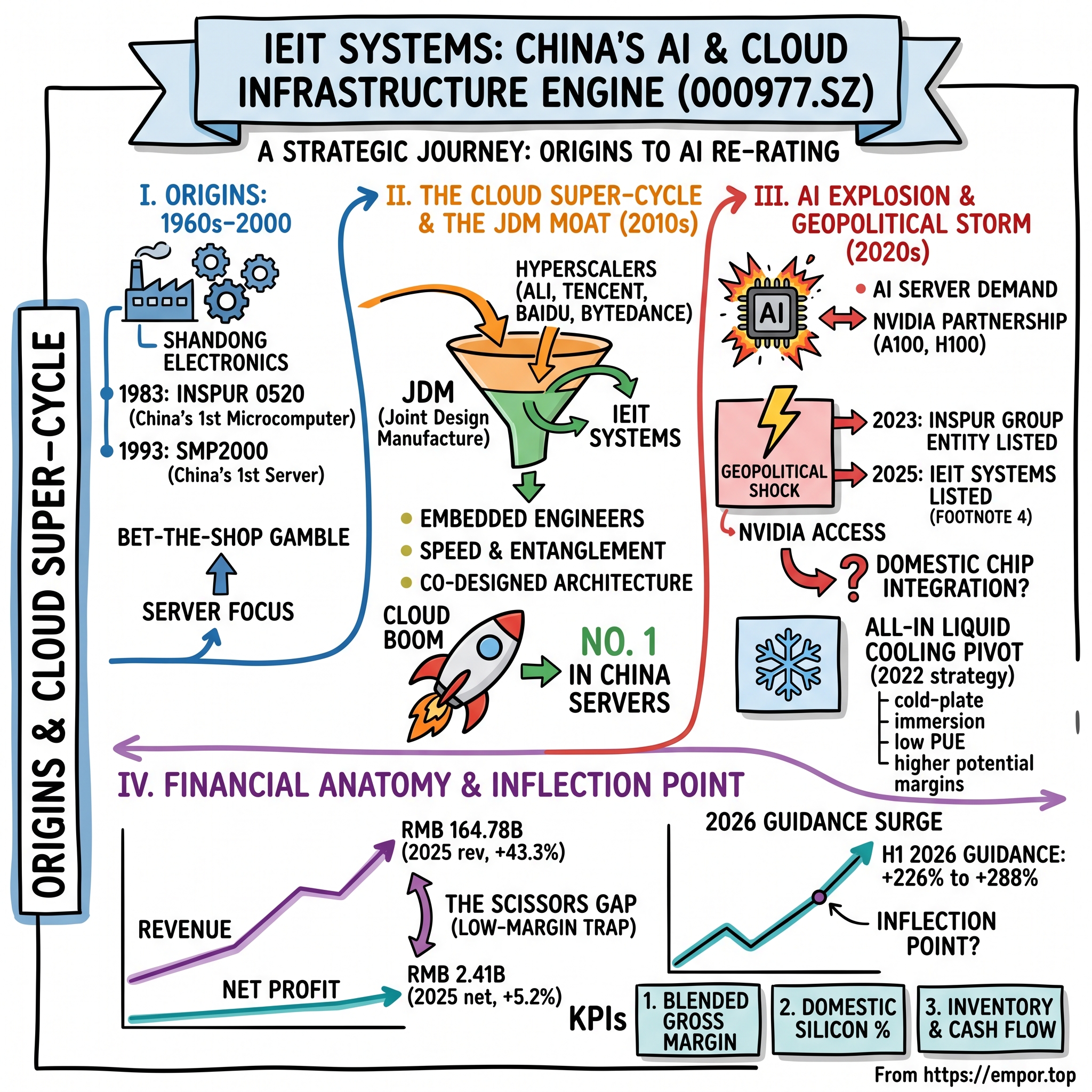
IEIT Systems: The Engine of China's AI and Hyperscale Cloud Infrastructure
I. Introduction & Episode Roadmap
Somewhere in a data hall outside Hangzhou or Guiyang, in the pre-dawn dark of a Chinese summer, a wall of servers is running an artificial-intelligence training job that will not pause for eighteen months. The racks are packed so densely, and the accelerators inside them run so hot, that if you cut the cooling for ninety seconds the silicon would begin to throttle and, not long after, to die. A clear fluid — not air — is being pumped through cold plates bolted directly onto the chips, carrying the heat away at a rate no fan could match. The company that designed those racks, integrated those accelerators, wrote the firmware that keeps the whole apparatus alive, and delivered it to the customer's floor in a matter of days is not Dell, not Hewlett Packard Enterprise, not Nvidia. It is a state-affiliated computer maker from Shandong province that most Western investors could not name.
That company is 浪潮信息 IEIT SYSTEMS Co., Ltd. — formally 浪潮电子信息产业股份有限公司, historically known to the world as Inspur — traded on the 深圳证券交易所 Shenzhen Stock Exchange under the ticker 000977.SZ. It is, by unit volume, the number-one server manufacturer in China and one of the two or three largest suppliers of AI servers on the planet.[^12]12 When 阿里巴巴 Alibaba, 字节跳动 ByteDance, 腾讯 Tencent, and China's national supercomputing grids needed machines to run the models that now define the country's technology ambitions, an enormous share of those machines came, in one form or another, from this firm.
Here is the paradox that makes IEIT Systems one of the most interesting — and most uncomfortable — businesses to analyze in all of Chinese technology. In 2025 the company booked revenue of RMB 164.78 billion, roughly twenty-three billion US dollars, a staggering 43.25% jump over the prior year, powered by an AI-server demand curve that bent almost vertical.1 And yet the net profit attributable to shareholders on that ocean of revenue was just RMB 2.41 billion — a rise of only 5.2%.13 Revenue exploded; profit barely moved. That gap, the scissors between a soaring top line and an almost flat bottom line, is the central financial fact of this company and the thread we will pull on throughout this story.
The second fact is geopolitical. IEIT Systems sits directly on the fault line of the US–China technology conflict. Its parent, 浪潮集团 Inspur Group, was placed on the US Bureau of Industry and Security (BIS) Entity List in March 2023; two years later, in March 2025, the listed operating company itself and five of its subsidiaries were added, several under the punishing "Footnote 4" Foreign Direct Product Rule, which extends US export jurisdiction to foreign-made goods built with American technology and imposes a presumption of denial.768 A company whose entire business is integrating the world's most advanced chips into machines was formally cut off, on paper, from those chips.
To feel the scale of what that revenue represents, consider that IEIT Systems books more sales in a year than most entire national technology industries, and it does so selling a product — the server — that the general public never sees and rarely thinks about. Every time someone in China searches, streams, pays, hails a ride, or asks a chatbot a question, there is a meaningful chance the request is being served, somewhere in the chain, by hardware this company built. It is infrastructure in the most literal sense: essential, ubiquitous, and almost entirely invisible, the plumbing beneath the digital economy rather than the fixtures people notice. That invisibility is part of why the company is so poorly understood by Western investors, and part of why the contradiction at its center — enormous strategic weight, almost no margin — has gone so underexamined.
So the core dilemma of this episode is stark. Can an infrastructure titan survive at the epicenter of a technology cold war, while simultaneously escaping the gravity of a low-margin, commodity-assembly business model in which the real economic rent flows to the chip designers above it and the cloud giants below it? Management's answer — that IEIT Systems is not a passive box-stacker but a system-level thermal and interconnect architect whose liquid cooling and integration make advanced compute usable at scale — is a claim we will test rather than accept.
Our roadmap runs in six movements. First, the origin arc from a Shandong state electronics factory to China's first domestic server, under the engineer the Chinese press dubbed the father of the country's server industry. Second, the invention of a co-development manufacturing model that welded the company to China's hyperscalers. Third, the AI compute explosion and the all-in bet on liquid cooling. Fourth, the sanctions shock of 2023 through 2025 and the forced pivot toward domestic silicon. Fifth, a financial dissection of the low-margin trap and the working-capital cycle. And sixth, the strategic frameworks, the management record, and the bull-versus-bear stress test that a long-term investor actually has to weigh. It begins, as these stories often do, with a factory and a stubborn engineer.
 Subscribe on LinkedIn
II. Origins: From Shandong Vacuum Tubes to China's First Server (1960s–2000)
Jinan, the capital of Shandong province, is not the kind of place that features in glossy histories of the computer age. It is an industrial city of coal, steel, and heavy machinery, and it was there, in the state-planned economy of the 1960s, that the lineage of IEIT Systems begins — in a workshop called the Shandong Electronic Equipment Factory, turning out transistors, radio components, and the humble electronics that a young People's Republic needed and could not import.10 There was no venture capital, no equity, no market in any Western sense. There was a state plan, a quota, and a mandate to build what the country lacked.
The pivotal human character enters in the early 1980s. 孙丕恕 Sun Pishu, a young engineer trained at Shandong University, joined the factory and threw himself at a problem that Beijing's Zhongguancun district was also chasing: could China build its own microcomputer? In 1983, Sun and a small team produced the Inspur 0520, one of China's first domestically built microcomputers, assembled around an imported Intel 8088 processor.11 It was derivative, it was fragile, and it mattered enormously — because it put a Shandong factory, improbably, at the frontier of Chinese computing alongside the Beijing establishment.
The decision that made the company, though, came a decade later, and it was a genuine bet-the-shop gamble. By the early 1990s IBM, Compaq, and Hewlett-Packard were pouring into China's newly commercializing corporate market, and the obvious move for a domestic firm was to fight for scraps in the personal-computer business. Sun Pishu argued the opposite. Microcomputers, he reasoned, were becoming commodities — cheap, undifferentiated, a race to the bottom. The value, and the strategic high ground, lay in servers: the powerful, expensive machines that would sit at the center of every bank, telecom carrier, and government ministry as China computerized. In 1993 his team delivered the SMP2000, described as China's first domestically developed symmetric multiprocessing server, and the achievement earned Sun the enduring epithet in the Chinese technology press: 中国服务器之父, the father of Chinese servers.11
Pause on why that call was so consequential. A symmetric multiprocessing server is, in plain terms, a machine that yokes several processors to a shared pool of memory so they can work on the same problem at once — the architectural DNA of every serious enterprise computer that followed. Betting on servers in 1993 meant betting that China would need an industrial-strength computing backbone of its own, and that the country would eventually be uneasy depending on American machines to run its most sensitive systems. It was, three decades early, the same instinct — technological self-reliance — that now defines the company's entire predicament.
It is worth dwelling on how lonely and unlikely that bet looked at the time. In the mid-1990s a Chinese-branded server was, to the average procurement officer at a bank or a ministry, a distinctly second-best option next to an IBM or an HP machine with a global service network behind it. The foreign brands owned the high end on reputation, and a domestic vendor had to win the way an underdog wins — on price, on responsiveness, on a willingness to send an engineer to a provincial data center at midnight when a Western vendor would have opened a support ticket. For most of the decade after the SMP2000, IEIT's server business was exactly that kind of scrappy challenger: respectable, improving, but nowhere near dominant. What it was quietly accumulating in those years was not market share so much as institutional knowledge of how Chinese customers actually ran their machines — knowledge that would become the raw material for the model that eventually broke the business wide open.
The corporate structure caught up with the ambition at the end of the 1990s. On October 28, 1998, the operating company was incorporated in Jinan as 浪潮电子信息产业股份有限公司, carved out of the broader Inspur enterprise, and on June 8, 2000, it listed on the Shenzhen Stock Exchange under 000977.SZ.10 Ownership, then as now, ran back to the state: the listed company sits beneath 浪潮集团 Inspur Group, which in turn is ultimately controlled by the 山东省国有资产监督管理委员会 Shandong SASAC, the provincial state-asset regulator, through a chain of holding vehicles.16 This is the essential governance fact to hold in mind. IEIT Systems is not a founder-owned Silicon Valley story; it is a provincially controlled state enterprise that happens to behave, in its markets, like an aggressive commercial OEM. Whether those two identities are complementary or in tension is a question the sanctions era would answer in ways no one in 2000 could have imagined.
For the first decade of its public life, the company grew with China's telecom rollouts and the digitization of state enterprises — steady, unglamorous, a reliable domestic vendor in a market still dominated at the high end by foreign brands. The transformation from that respectable also-ran into the number-one server maker in China required a different kind of customer entirely, and a business model that had not yet been invented. Both were about to arrive with the Chinese internet.
III. The Cloud Super-Cycle & The JDM Moat (2010–2018)
To understand what happened next, picture the operational nightmare that a company like Alibaba faced around 2010. Its business was doubling and redoubling; every Singles' Day shopping festival threw a load at its data centers that would have flattened a Western retailer's IT. And the servers it could buy — off-the-shelf boxes from Dell or HP, designed in Texas or California for a generic global enterprise — were the wrong tool. They were built to a compromise: too many features nobody in a hyperscale data center wanted, the wrong power envelope, the wrong physical dimensions for a custom rack, and a product-development cadence measured in years when the internet moved in weeks.
The Western OEM model assumed a slow, catalog-driven world: design a server, sell it for eighteen months, refresh it. China's internet giants — Alibaba, 腾讯 Tencent, 百度 Baidu, and later 字节跳动 ByteDance — had outgrown that world. They knew exactly what they wanted their machines to do because they were writing the software that ran on them. What they needed was a manufacturer willing to co-design the hardware around their software, at their speed, and then build it by the tens of thousands on demand. This was the opening, and IEIT Systems drove a truck through it.
To picture the problem in human terms, imagine an Alibaba data-center architect in 2012 who knows precisely the shape of the machine she needs — this many cores, this power envelope, this exact chassis depth to fit her custom rack, this firmware behavior to match her orchestration software — and who is told by a Western OEM that the nearest catalog product ships in a year, costs more than it should because it carries features she will never use, and cannot be meaningfully altered without a global product-planning cycle. Now imagine a domestic vendor that instead sends its own engineers to sit beside her, sketches the machine she actually wants, and promises to have thousands of them on her floor before the foreign competitor has even scheduled a design review. The choice makes itself. Multiply that scene across every hyperscaler in China and you have the demand that JDM was built to capture.
The company's answer was a model it branded 联合研发制造 JDM, Joint Design Manufacture — and it is the single most important strategic innovation in this company's history, so it is worth being precise about what it actually was. In the traditional supply chain, a customer picks from a vendor's catalog (call it OEM) or asks the vendor to build to a rough spec (ODM). JDM went further up the stack. IEIT Systems embedded its own hardware engineers inside the internet giants' data-center design teams, co-authoring the architecture from the silicon and board layout up, synchronizing on power, cooling, form factor, and firmware, and folding the customer's demand forecasts directly into its own component procurement and factory scheduling.13 The vendor and the customer stopped being buyer and seller and became, functionally, one product team.
The payoff was speed, and speed in this business is a moat. Where a conventional new-server program might take eighteen months, JDM compressed the development cycle to roughly nine, delivered working prototypes in about three months, and — because the factory was already holding the right components against a shared forecast — collapsed volume delivery from order to dock into a matter of days rather than the industry's customary weeks.13 For a hyperscaler racing to stand up capacity ahead of a product launch, that difference was not a convenience; it was the difference between capturing a demand spike and missing it.
Here is the analytical point, and it is subtle. JDM did not create a classic switching cost in the sense of a contract or a proprietary lock-in. What it created was organizational entanglement. Once IEIT's engineers were sitting inside your data-center team, once your rack specifications and your firmware and your deployment pipeline had been co-evolved with theirs, ripping them out meant rebuilding an entire collaborative apparatus — and risking a stumble in the one system you cannot afford to have stumble. That is a real, if soft, form of stickiness, and it is the closest thing to a durable advantage this company has ever built. We will return, in the frameworks section, to how strong that moat truly is when the customer is a sophisticated giant with its own engineering army.
There is a second, less obvious advantage buried in JDM that shows up on the balance sheet rather than the org chart: inventory risk-sharing. Because IEIT co-owned the customer's demand forecast, it could pre-position components and pre-build rack designs with far more confidence than a vendor guessing at a catalog order. In a business where the components are expensive and their prices move fast, forecasting accuracy is not a soft skill — it is the difference between a profitable quarter and a warehouse full of stranded, depreciating parts. JDM turned the customer relationship into a shared information channel, and information is the scarcest input in high-velocity hardware. That is the same mechanism, incidentally, that would later cut the other way when export controls scrambled the component supply and no amount of forecasting could conjure chips that simply could not be bought.
The results spoke. On the back of JDM and the cloud super-cycle, IEIT Systems climbed from a second-tier domestic vendor to the number-one server manufacturer in China, and one of the largest in the world by shipments.12 It planted its flag in the open-hardware movement, participating in China's 开放数据中心委员会 Open Data Center Committee (ODCC) and the global Open Compute Project, the industry forums where hyperscalers standardize the very rack designs that JDM was built to exploit. Standard-setting is an underrated form of power: when the reference designs that the whole industry converges on are ones you helped author and are already tooled to build, you start every product cycle a step ahead of rivals who must adapt. By the middle of the decade the company had a commanding position in Chinese cloud infrastructure — and then a new workload arrived that would dwarf everything the cloud era had produced, and that would test whether a master of high-volume, low-margin assembly could climb into something more valuable.
IV. The AI Server Explosion & "All in Liquid Cooling" Pivot (2018–2022)
The shift from cloud servers to AI servers looks incremental on an org chart and is anything but on a factory floor. A conventional cloud server is mostly CPU and memory — a workhorse that handles millions of small, independent tasks. An AI server is a fundamentally different animal: a chassis crammed with eight or more graphics processing units — GPUs — wired together with exotic high-speed interconnects so they can act as a single brain chewing through the linear algebra of a neural network. It draws multiples of the power, throws off multiples of the heat, and costs an order of magnitude more, because the accelerators inside it are the most expensive silicon in the industry.
The hard part is not bolting eight GPUs into a chassis; it is making them behave like one machine. Modern AI accelerators are lashed together with dedicated high-speed interconnects — Nvidia's NVLink and NVSwitch fabric being the canonical example — that let the chips shovel data to one another at bandwidths that dwarf a normal network, because a training job is constantly shuffling intermediate results across every GPU in the box and any bottleneck in that plumbing wastes the most expensive silicon in the building. Getting the board layout, the signal integrity, the power delivery, and the thermal design right so that a dense cluster runs at full tilt without throttling or falling over is a genuine systems-engineering discipline. This is precisely the "system-level architect" competence management points to when it insists IEIT is more than a box-stacker — and, on the engineering merits, that claim has real substance even if the economics have not yet rewarded it.
IEIT Systems saw this coming earlier than most. It built dedicated AI training and inference chassis — the NF5488 and NF5468 families among them — engineered to pack Nvidia's top accelerators, the A100 and later H100 generations, into dense multi-GPU topologies with the cooling and power delivery those chips demanded. That engineering, and the JDM muscle behind it, made the company one of Nvidia's most significant server-integration partners globally, in the same conversation as Supermicro and the Taiwanese ODMs, and it vaulted IEIT to the front of the AI-server market. IDC ranked the company number one in the worldwide AI server market for 2021, and the firm held a commanding share of China's AI infrastructure buildout.[^12]22 For a stretch, IEIT Systems was quite literally the hands that assembled a large fraction of the world's AI training capacity.
But volume in AI servers brought a physics problem that threatened the entire model, and it is the hinge of this section. Cram eight or sixteen 700-watt GPUs into a rack and the heat density climbs past the point where blowing air across heat sinks can keep the silicon alive. Air cooling hits a wall. At exactly the same moment, Chinese policy was tightening the screws from the other direction: Beijing's 双碳 dual carbon goals and increasingly strict data-center efficiency mandates — measured by a metric called Power Usage Effectiveness, or PUE, where a lower number means less energy wasted on cooling — were pushing new facilities toward PUE targets that legacy air-cooled halls simply could not hit. The thermal wall and the regulatory wall arrived together.
IEIT's response, formalized as corporate strategy in 2022, was a slogan and a factory: 全栈液冷 All in Liquid Cooling.17 The idea was to move liquid cooling from a boutique option to the default across the company's entire product line — principally cold-plate cooling, in which coolant runs through metal plates pressed onto the hot components, and, at the extreme, immersion cooling, in which whole boards are submerged in a non-conductive fluid. To back the slogan with capacity, the company built what it describes as Asia's largest liquid-cooling research and manufacturing base, the 天池 Tianchi industrial park near Jinan, with a claimed annual output on the order of a hundred thousand units and a portfolio of hundreds of liquid-cooling patents.18
It helps to make the two cooling approaches concrete, because they carry very different economics. Cold-plate cooling is evolutionary: metal blocks with coolant channels are clamped onto the hottest chips while the rest of the server looks conventional, so it slots into existing data-center designs and is the workhorse of most deployments today. Immersion cooling is radical: entire boards are lowered into tanks of an engineered, electrically non-conductive fluid, dispensing with fans altogether and achieving the lowest PUE figures, but demanding that the whole facility be rebuilt around tanks rather than racks. The lower a data center drives its PUE — the ratio of total facility power to the power actually reaching the computers, where a perfect score of 1.0 means every watt goes to compute and nothing to cooling — the more of its energy budget, and its operating cost, goes to useful work rather than to fighting heat. In a country where regulators increasingly cap PUE and where power for AI is both scarce and politically sensitive, a vendor that can credibly deliver sub-1.2 facilities is selling not just hardware but regulatory compliance. That is a genuinely differentiated product, and it is the strongest evidence for management's claim to be climbing above commodity assembly.
Why does an investor care about plumbing? Because this is management's chosen escape route from the low-margin trap. A commodity air-cooled server is a box of other people's expensive chips with thin value added on top. A liquid-cooled rack, by contrast, embeds IEIT's own engineering — the cold plates, the coolant distribution units, the leak-proof quick-connects, the thermal design that lets a customer safely run denser and cheaper per unit of compute. That engineering is proprietary, it raises the bill-of-materials value the company controls rather than passes through, and it therefore carries the potential for structurally higher margins than bare assembly. That is the thesis. Whether the numbers have actually delivered it is a separate question, and the answer, as we will see, has so far been only partial. It is telling that even after years of the liquid-cooling push, blended gross margin has kept falling rather than rising — a reminder that a higher-margin product line can be entirely swamped by a surge in low-margin, chip-heavy AI-server volume flowing through the same income statement. The liquid-cooling premium is real at the product level; the question is whether it is large enough, and growing fast enough as a share of the mix, to move a company-wide margin that the raw pass-through cost of GPUs otherwise dominates. That is not a slogan a strategy deck can settle. It is an arithmetic race between two trends, and only the reported numbers, quarter by quarter, can call the winner. First, though, the ground shifted under the entire enterprise.
V. The Sanctions Storm: US Export Controls & The Entity List Crisis (2023–2025)
On March 2, 2023, the US Department of Commerce's Bureau of Industry and Security published a notice that landed on IEIT Systems like a thunderclap from a clear sky. 浪潮集团 Inspur Group, the state parent at the top of the ownership chain, was added to the Entity List, Washington's roster of organizations deemed to act against US national-security or foreign-policy interests — in this case over concerns that the group's technology was feeding China's military supercomputing programs.7 The practical effect was immediate and severe: US suppliers now needed a license, presumed to be denied, to ship to Inspur. American technology firms that had spent years selling into and buying from the Inspur ecosystem — chipmakers, networking vendors, software houses — scrambled to work out what they could and could not do with a company suddenly branded radioactive.9
For a moment, there was a technical escape hatch. The 2023 action named Inspur Group, the parent, not the individually listed operating company. Legal teams parsed whether the publicly traded entity and its server business could continue transacting on the theory that they were distinct. That ambiguity is precisely what Washington closed two years later. In March 2025 — the Federal Register notice was published March 28 — BIS added the listed company itself, Inspur Electronic Information Industry Co., Ltd., together with five affiliated entities spanning Beijing, Hong Kong, and its software and Taiwan units, several of them designated under "Footnote 4."68 That footnote is the sharp instrument: it applies the Foreign Direct Product Rule, extending US jurisdiction to products made anywhere in the world if they are the direct product of certain US technology or software. In effect it reaches beyond American-made chips to foreign-made goods built with American tools, and pairs the reach with a presumption of denial.
Around this whipsaw, the company leaned harder into the IEIT SYSTEMS branding it had been cultivating internationally, a corporate identity distinct from the freighted "Inspur" name — a move that reads, in the neutral light, as an attempt to preserve international service relationships and operational continuity rather than as any change in ownership or control.14 Rebranding does not remove an entity from a US list, and investors should not mistake the new name for a new legal status.
To grasp why Footnote 4 is such a heavy instrument, it helps to see the escalation as a closing net. An ordinary Entity List addition restricts US-origin items — chips designed or made in America. The Foreign Direct Product Rule reaches further, capturing goods manufactured anywhere on earth if they are the direct product of specified US technology or software; because virtually every advanced logic chip in the world is designed with American electronic-design-automation tools or fabricated on equipment containing US technology, that reach is close to global. Footnote 4 attaches that expansive rule to a named entity and layers on a presumption of denial, so the default answer to any license request becomes no. For a company whose product is the integration of the world's best chips, being placed inside that net is about as targeted a blow as the export-control system can deliver.
The operational shockwave hit hardest at the one thing IEIT's whole AI business depended on: access to Nvidia's accelerators. The controls had already been throttling the flow of top-tier chips — the A100 and H100, then the China-specific H800 and later the H20 as Washington repeatedly redrew the line — and the Entity List actions turned a throttle into a presumptive shutoff.23 The company's response was the one available to any manufacturer staring at a supply cliff: buy everything you can while you still can. That reflex is visible in the financials as swollen inventories and strained cash flow, the working-capital signature of a firm stockpiling scarce, expensive components against an uncertain future — a dynamic we will quantify in the next section.
The behavioral signature of that scramble is itself worth reading as evidence. A company that responds to a supply threat by hoarding inventory is telling you something: that it believes demand is durable enough to justify parking billions of RMB in components that could fall in price, and that it fears the supply interruption more than the carrying cost. Both beliefs turned out to be defensible — AI demand did not crack, and access did tighten — but the strategy is only as sound as those judgments, and a wrong call in either direction on a thin-margin balance sheet is expensive. The swing from a badly strained cash position during the worst of the stockpiling to the strong operating cash flow the company reported for 2025 is the visible arc of that gamble being resolved, for now, in management's favor.
The strategic response was more consequential, and it is the pivot on which the bull case now rests. Cut off, at the margin, from American silicon, IEIT Systems has been forced to deepen its integration with China's domestic AI-chip designers — the outline names 华为昇腾 Huawei Ascend, 海光信息 Hygon, and 寒武纪 Cambricon as the leading candidates, and IEIT does build systems around multiple domestic accelerators, though the company has not publicly detailed the precise commercial terms of each partnership, and investors should treat specific chip-by-chip claims with appropriate caution. In parallel, the company pushed up the value chain into software, open-sourcing its 源2.0 Yuan 2.0 foundation large language model on November 27, 2023, and wrapping its hardware in a fuller AI stack rather than selling bare metal.19 The strategic logic of open-sourcing its own large model is worth unpacking, because it is not about the model earning revenue directly — it almost certainly does not. It is about seeding an ecosystem. If developers build on IEIT's model and its accompanying software tools, they are more likely to buy IEIT's integrated hardware to run them, and the company inches toward the faint network-effect flywheel that pure hardware can never generate on its own. It is the same playbook a chipmaker runs when it gives away a software framework to sell more silicon — an attempt to make the commodity underneath stickier by wrapping it in something that is not a commodity. Whether a server integrator can credibly own a slice of the AI-software layer against far better-resourced model labs is an open and skeptical question, but the direction of travel — away from bare metal, toward a solutions stack — is unmistakable and strategically correct given the margin math.
The logic of the whole pivot is elegant on paper: turn an export restriction into a domestic moat by becoming the indispensable integrator of Chinese chips into Chinese AI factories. The risk is equally clear: domestic accelerators still trail the global frontier in raw performance and, critically, in access to the advanced high-bandwidth memory and fabrication tools that themselves sit under export control. The pivot substitutes one dependency for another that is less severe but not yet resolved. To see how all of this actually landed on the income statement, we have to open the books.
VI. Financial Anatomy, Segment Economics, & The Low-Margin Trap
Start with the shape of the business, because it explains everything else. IEIT Systems is, to a first approximation, a one-product company: server and component sales account for well over 95% of the RMB 164.78 billion in 2025 revenue, with IT services, storage, and the nascent AI-software and Yuan platform together making up the thin remainder.12 Storage and software matter strategically, as the higher-margin seeds of a different future, but they are not yet material to the numbers. When you buy this company, you are buying a server business, full stop.
Now the number that defines it. In 2025 the server-and-parts segment earned a gross margin of only around 4.5%, with the blended company gross margin in the mid-single digits — down from an already-thin 6.76% on servers and roughly 7.6% overall in 2024.2120 Read that again: on machines that can cost a hundred thousand dollars each, IEIT Systems keeps only a few cents of gross profit on every dollar of revenue, and that sliver has been shrinking. This is the low-margin trap in one statistic, and its cause is structural, not managerial. The GPUs and CPUs inside an AI server can represent 60% to 80% of the machine's cost, and that value is a pure pass-through: IEIT buys chips from a supplier with enormous pricing power and sells finished boxes to cloud buyers with enormous purchasing power. Squeezed between a concentrated supplier above and a concentrated customer below, the assembler in the middle captures very little.
This is why the headline growth of 2025 is so treacherous to read. Revenue rose 43.25%, a number that would have any casual observer cheering — but net profit attributable to shareholders rose just 5.2%, to RMB 2.41 billion, for a net margin of roughly 1.5%.13 The extra RMB 50 billion of revenue was almost entirely the pass-through cost of more and pricier chips flowing through the company; very little of it stuck to the bottom line. The scissors gap between the two growth rates is the whole story of a commodity integrator riding a demand boom: the volume is real, the strategic position is real, but the economics leave almost no buffer. A single adverse move — a sudden drop in GPU prices that strands high-cost inventory, a write-down, a customer squeeze — could wipe out a year's slim profit. High volume compensates for thin margins right up until the moment it doesn't.
To put IEIT's margin in industry context, this is not a company-specific failing but the shared fate of the pure-play server integrators. The Taiwanese ODMs that assemble machines for the world's hyperscalers live on similar mid-single-digit gross margins; the value in the AI hardware chain has always pooled at the two ends — with Nvidia, whose data-center gross margins run in the seventies, and with the cloud operators who monetize the compute — not in the middle where the boxes are built. What distinguishes IEIT is less its margin, which is typical of its role, than the sheer scale at which it runs that thin model and the geopolitical box it must run it inside. Scale can be a virtue in a thin-margin business — it is the reason IEIT can undercut smaller white-box assemblers on component cost — but scale multiplies both the profit and the peril, and in a commodity role it does not, by itself, manufacture pricing power.
The balance sheet carries the same tension. Selling to a handful of giants — 阿里巴巴 Alibaba, 字节跳动 ByteDance, 中国移动 China Mobile — means enormous accounts receivable owed by a concentrated set of powerful customers who dictate terms. Procuring scarce chips, meanwhile, often demands cash up front. The result is a cash-conversion cycle acutely vulnerable to inventory spikes, exactly the kind that the export-control scramble of 2023–2025 produced. Think about the mechanics of that cycle concretely, because it is where a thin-margin integrator can quietly get into trouble. To fulfill a large AI order, IEIT must often pay chip suppliers early — advance payments are the price of allocation when silicon is scarce — while its cloud-giant customers, holding the whip hand, pay on their own comfortable terms weeks or months later. In between sits a mountain of the most valuable inventory in technology, financed by the company. When demand is accelerating, that gap has to be funded out of cash or borrowing, and it grows with the business; a firm can be booking record revenue and simultaneously bleeding cash if the cycle runs against it. This is why, for a business like this, the cash-flow statement is more revealing than the income statement, and why the working-capital swing during the sanctions scramble mattered as much as any headline.
One striking data point cuts the other way, though, and deserves weight: operating cash flow in 2025 surged to RMB 5.45 billion, a dramatic recovery from a depressed prior-year base, suggesting the company managed to unwind some of the working-capital bulge and convert its boom into actual cash rather than just receivables.3 For a thin-margin business, cash generation is arguably a more honest scorecard than accounting profit, and on that measure 2025 was genuinely strong — though a single strong year does not prove the cycle is tamed, and a renewed supply scramble could swing it hard the other way again.
Then came the signal that lit up the tape. On July 7, 2026, IEIT Systems guided first-half 2026 net profit to a range of RMB 2.6 billion to 3.1 billion, a year-on-year surge of 226% to 288% — meaning that in six months the company expected to earn more than it had in all of 2025.4524 Management attributed the leap to a favorable shift in product mix toward high-density, liquid-cooled AI racks and higher-value domestic AI-cluster deployments. If that guidance holds, it would be the first hard, quantitative evidence that the liquid-cooling-and-integration thesis is finally reaching the bottom line rather than living only in strategy decks. The appropriate posture is watchful, not celebratory: a single half-year of guidance, off a very low base, driven partly by mix and possibly by one-time cluster deliveries, is a data point, not yet a trend. The KPI that matters — whether blended gross margin structurally re-rates above the high single digits — is exactly what the coming quarters will reveal, and it is the number an investor should track above all others.
VII. Management, Governance, & Capital Allocation Record
The person to understand first is no longer at the company. 孙丕恕 Sun Pishu — the engineer who built the 0520 and the SMP2000, the father of Chinese servers — stepped down from the leadership of Inspur Group at the end of December 2020, closing out a career of some thirty-six years and moving into a provincial government role.15 His departure severed the founder-engineer link that had defined the enterprise for a generation and handed the AI-and-sanctions era to a new bench of operators.
That bench was formally reset in the spring of 2026. Following a board reshuffle completed on May 8, 2026, 彭震 Peng Zhen — the veteran executive who had steered the company's JDM and AI transformation — became Chairman, while 胡雷钧 Hu Leijun, a long-serving technologist, was named President and General Manager as well as Vice Chairman.14 The distinction matters for anyone reading older profiles that still describe Peng as chief executive: as of mid-2026 the chairman and the president/GM roles sit with two different people, and the operating leadership runs through Hu. Both are insiders and engineers rather than outside financiers, which fits the company's self-image as a technology-execution shop rather than a deal machine.
On governance, the honest assessment is a study in tension. On one hand, IEIT Systems is ultimately controlled by 山东省国资委 Shandong SASAC, with 浪潮集团 Inspur Group holding roughly a third of the shares, and it must align with national computing directives — most notably 东数西算 Eastern Data, Western Computing, Beijing's grand scheme to route data processing from the crowded, expensive east to renewable-powered mega-clusters in the west.16 On the other hand, the company has for years behaved far more like a commercial OEM than a typical sleepy state enterprise: aggressive in the market, fast on product, disciplined on operations. That operational autonomy is a genuine asset. But an investor cannot wave away the reality that state control is precisely what put the company on the Entity List in the first place — the "military end-use" concerns attach to the state ecosystem it belongs to. Here the SOE identity is not a governance footnote; it is the direct source of the company's single largest existential risk. The autonomy that helps it compete and the state affiliation that gets it sanctioned are two faces of the same coin.
Judged on execution rather than rhetoric, the current management bench has a real track record to point to. They navigated the AI-server transition without ceding the number-one domestic position, they stood up the Tianchi liquid-cooling base and pushed liquid cooling from niche to default across the product line, and — most tellingly — they kept the company operating and growing through a two-year sanctions gauntlet that could plausibly have crippled it. That is not the record of a passive state bureaucracy; it is the record of an operating team that has been tested under genuine external stress and has, so far, kept the machine running. The fair caveat is that surviving a supply shock and building a factory are execution feats, not proof of the one thing the equity story still needs: durable pricing power. A team can be excellent at operations and still be trapped in a structurally low-margin position, and distinguishing the two is exactly the analytical work an investor owes this name.
On capital allocation, the record reads as conservative and, by the standards of high-flying tech, refreshingly unglamorous. Research and development has run in the mid-single digits as a share of revenue — real money in absolute terms, on the order of several billion RMB a year — and it has been directed at exactly the areas the strategy requires: liquid cooling and thermal design, system-level firmware, and the adaptation work needed to make domestic accelerators usable, rather than at speculative moonshots.2 The company has largely avoided the goodwill-laden acquisition sprees that have sunk other Chinese tech names; growth has come mostly organically through capacity expansion and co-engineering labs. There is little evidence here of the "diworsification" that plagues empire-building managements.
The alignment with national policy deserves a clear-eyed read rather than a reflexive discount. 东数西算 Eastern Data, Western Computing — the state program to build vast computing clusters in the renewable-rich, land-cheap western provinces and route the east's data processing to them — is, from IEIT's seat, close to a demand subsidy: it commits public capital to exactly the kind of large-scale, energy-efficient, liquid-cooled infrastructure the company is best equipped to build. A cynic would call the company a policy taker whose fortunes rise and fall with Beijing's spending priorities; a fair reading is that IEIT has genuine commercial demand from private hyperscalers and a policy tailwind on top of it, and that the two are mutually reinforcing so long as national and commercial computing ambitions point the same direction. The risk in that arrangement is not visible in good years — it is that a company so woven into state industrial policy has less freedom to walk away from low-return work, or to resist directives, than a purely commercial firm would.
The tell of management credibility, though, is in the tone of the disclosures, and here the picture is mixed in an instructive way. The company's communications emphasize supply-chain resilience, component inventory turnover, and liquid-cooling adoption rates — operational, controllable metrics — rather than grand promises about long-run margins. That restraint is to their credit; a management team that had over-promised on margins would look foolish given the 1.5% net margin the model actually produces. But restraint born of a structurally thin business is not the same as demonstrated pricing power, and the sharpest test of this team's credibility is now directly in front of them: the H1 2026 guidance implies a margin inflection they have long hinted at but never sustained. If the second half confirms it, the narrative consistency across years of "we are moving up the value chain" talk will finally be vindicated by numbers. If it fades, it will look like mix-driven noise dressed as transformation. Either way, the frameworks below make explicit why the odds are genuinely uncertain.
VIII. Strategic Frameworks: 7 Powers & Porter's 5 Forces Analysis
Strip away the geopolitics for a moment and ask the coldest possible question: does IEIT Systems have a durable competitive advantage, or is it a high-volume commodity assembler enjoying a cyclical demand boom? Hamilton Helmer's 7 Powers framework is a useful scalpel here, because it forces a rating of each source of advantage on its merits.
The strongest of the seven is Process Power. The JDM model is not a slogan; it is a set of hard-won, deeply embedded operational workflows connecting IEIT's automated factories to hyperscalers' software and deployment pipelines, refined over more than a decade and difficult to replicate quickly. Close behind sits Scale Economies, moderate-to-strong: as the largest server maker in China, IEIT buys components in volumes that a white-box assembler cannot match, and spreads its engineering across a vast unit base. Switching Costs are real but moderate — the organizational friction of swapping out co-designed firmware, management software, and liquid-cooling rack specifications across clusters of thousands of nodes is meaningful, but it is friction, not a lock, and a determined giant can overcome it. Cornered Resource rates moderate and is essentially political: the company's privileged position in national computing infrastructure and state and SOE procurement is a genuine advantage, but it is granted by the state and could, in principle, be redirected by the state. Counter-Positioning was strong historically — JDM's direct co-engineering model displaced the slow Western distributor networks — but that battle is largely won and no longer a live source of new advantage. Network Effects are weak in hardware, with only a faint flywheel emerging around the Yuan developer ecosystem. And Branding is weak by design: this is a business-to-business infrastructure market where purchases turn on total cost of ownership, delivery speed, and thermal efficiency, not on logos. The honest verdict: one strong power, a couple of moderate ones, and several weak ones — a real but narrow moat, heavily dependent on process and scale, and vulnerable exactly where the value is richest.
Porter's Five Forces sharpens the discomfort. Supplier power is extreme. Nvidia, Intel, AMD, and even the domestic chipmakers hold the whip hand on pricing and, more painfully, on allocation — when chips are scarce, the chipmaker decides who eats. This is the primary reason the middle of the value chain is so thin. Buyer power is high. The hyperscalers — 阿里巴巴 Alibaba, 字节跳动 ByteDance, 腾讯 Tencent — are sophisticated, concentrated, and relentless on price; they know exactly what a server costs to build and they extract volume discounts accordingly. Caught between an extreme-power supplier and a high-power buyer, the assembler's structural margin is precisely the low single digits the financials show. That is not a management failing; it is the physics of the position.
A head-to-head look at the rivals sharpens where IEIT actually stands. 华为 Huawei is the most complex competitor precisely because it is not only a competitor: with its Ascend accelerators it is simultaneously one of IEIT's would-be chip suppliers, a partner in domestic-silicon integration, and a vertically integrated rival that can build the whole stack from chip to server to cloud. That vertical reach is a structural threat — Huawei can, in principle, capture the integration margin IEIT lives on — but Huawei's own sanctions burden and its need to husband scarce Ascend supply for its own systems leave room for an independent integrator with deeper hyperscaler relationships. 联想集团 Lenovo Group, by contrast, competes on global scale and its own ODM heritage but has historically been less entrenched in the Chinese hyperscaler co-design game that JDM dominates. 中科曙光 Sugon, itself an Entity-List name, fights hardest in the government and supercomputing niches, while 紫光股份 New H3C presses on the enterprise and networking flank. IEIT's edge across this field is not technological uniqueness — any of these firms can build a competent GPU server — but the accumulated process advantage of a decade inside the internet giants' data centers. That edge is real, and it is also the thing a determined, well-capitalized Huawei is best positioned to erode.
The remaining forces are more favorable, which is what keeps the business defensible even if not lucrative. Threat of new entrants is low: the capital intensity, the supply-chain access, and the complexity of running liquid-cooling manufacturing lines at scale are formidable barriers, and a new player cannot simply appear. Threat of substitutes is moderate-to-high and is the one to watch — the live danger is hyperscaler disintermediation, in which cloud giants design their own hardware and place orders directly with Taiwanese ODMs like Foxconn, Quanta, and Wistron, or lean on internal ASIC teams, cutting the integrator out. And competitive rivalry is fierce: inside China, IEIT fights 联想集团 Lenovo Group, 紫光股份 New H3C, 中科曙光 Sugon, and, formidably, 华为 Huawei, whose Ascend silicon makes it simultaneously a supplier, a partner, and a rival. The competitive picture, in sum, explains both why IEIT can hold its leadership — the entry and substitute barriers are high enough to keep the club small — and why that leadership converts into so little profit. Which sets up the only question that ultimately matters to an owner: from here, does it get better or worse?
IX. Bull vs. Bear Case & Key Performance Indicators (KPIs)
The bull case is a bet that IEIT Systems is about to transform from a high-volume assembler into a higher-value compute architect, and it has three legs. First, demand: China is pouring state and enterprise capital into AI compute through programs like Eastern Data, Western Computing, and IEIT is the indispensable system-integration backbone of that buildout — the company that turns racks of chips into working AI factories. Second, margin mix: the shift from air-cooled commodity boxes toward liquid-cooled AI infrastructure genuinely embeds more of the company's own engineering, and the H1 2026 guidance is the first real evidence that this can lift blended profitability rather than merely revenue.4 Third, and most elegant, the sanctions jujitsu: by becoming the leading integrator of domestic accelerators, IEIT can turn the US export restrictions that threatened it into a protective moat around a captive domestic market that foreign vendors cannot serve. In the bull view, the thing that looked like an existential threat becomes the thing that locks in the franchise.
It is worth naming what has to be true for the bull case to pay off, because that is where analysis earns its keep. The thesis is not merely "China builds a lot of AI compute" — that is almost certainly true and yet, on its own, produces the very low-margin outcome the last few years have shown. The thesis requires the stronger claim that IEIT captures a rising share of the value of that buildout, not just the volume: that liquid cooling, domestic-chip integration, and software let it keep more of each rack's economics for itself. The H1 2026 guidance is the first data point consistent with that stronger claim. One data point is not a trend, and mix shifts and lumpy cluster deliveries can flatter a half-year, so the honest bull holds the position as a hypothesis awaiting confirmation rather than a settled fact.
The bear case attacks each leg. On supply, the risk is silicon starvation: a further tightening of controls that cuts off not just leading-edge GPUs but the advanced high-bandwidth memory and fabrication tools that even domestic accelerators depend on, stranding product lines regardless of how clever the integration is. The company's pivot to domestic chips reduces but does not eliminate its exposure to the American technology stack. On economics, the bear points at the 1.5% net margin and the extreme supplier/buyer squeeze and argues that scale in a commodity is a treadmill — that IEIT could double revenue again and still not earn a durable return, while thin margins leave no cushion for an inventory write-down or a chip-price crash. And on competitive position, the sharpest thrust is disintermediation: nothing structurally prevents a hyperscaler from taking its volume straight to a white-box ODM or its own ASIC team once the design is stable, and the very sophistication of IEIT's customers is what makes them capable of doing so.
A few second-layer diligence points sharpen the risk radar without needing a spreadsheet. The first is the memory chokepoint: advanced AI accelerators depend on high-bandwidth memory (HBM), the stacked, ultra-fast DRAM that feeds the GPU, and HBM supply is concentrated in a tiny group of manufacturers and is itself increasingly subject to export scrutiny. A restriction that reaches HBM would bite domestic and foreign accelerators alike, which is why the "pivot to domestic chips" is a partial hedge, not a full one — the vulnerability moves down the stack rather than disappearing. The second is disclosure opacity around exactly the metrics that matter most: the company does not break out clean, audited figures for liquid-cooled versus air-cooled mix or for domestic-versus-foreign accelerator shipments, so investors are left inferring the transformation from blended numbers and guidance tone rather than measuring it directly. The third is the ownership overhang: with 浪潮集团 Inspur Group and the state controlling roughly a third of the shares and directing strategy through national computing policy, minority public shareholders ride alongside a controller whose objectives — industrial self-reliance, regional employment, national security — are not always identical to per-share value maximization. None of these is disqualifying, but each is a reason the stock carries risks that a purely commercial competitor would not.
This is where the activist's needle finds the vein. The skeptic's question is blunt: why own an assembler earning single-digit gross margins when every dollar of economic rent in the AI value chain is captured by the chip designer above it or the cloud operator below it? Management's answer — that IEIT is not a passive assembler but a system-level thermal and interconnect architect, without whose liquid cooling, rack-density management, and orchestration software advanced GPUs cannot run at scale — is genuinely plausible, and the liquid-cooling engineering gives it real substance. But "plausible" is not "proven," and the honest reconciliation is that the bull and bear cases are not two views of a settled fact; they are two forecasts of an unresolved one. The company sits at a genuine fork, and the evidence that will decide which path it is on is measurable and close at hand.
Which brings us to the KPIs. An investor does not need to track a dozen metrics on this company; three carry almost all the signal. First and most important, blended gross margin. This is the single number that adjudicates the entire bull/bear debate — if liquid cooling and software durably pull the blend up out of the high single digits, the transformation is real; if it stays pinned near commodity levels, the low-margin trap has won. Second, the domestic-silicon share of shipments — the percentage of servers powered by non-US accelerators like Huawei Ascend, Hygon, and Cambricon — which measures both the company's insulation from further sanctions and the maturity of the domestic-moat thesis. Third, inventory turnover days alongside operating cash flow, the joint gauge of whether the company is managing its dangerous working-capital cycle through the geopolitical stockpiling era, or drowning in high-cost chips it cannot convert to cash. Watch those three, and the story tells itself quarter by quarter.
X. Epilogue & Playbook Lessons
Step back from the ticker and IEIT Systems resolves into a case study with lessons that reach well beyond one Shandong server maker. The first is the co-development moat: the JDM model shows how deeply standardizing customer integration — embedding your engineers inside your customer's design process — can protect a hardware manufacturer from pure price commoditization, buying it years of leadership. The lesson generalizes far beyond servers. Any supplier facing powerful buyers can raise its own switching costs not by locking customers in contractually — sophisticated buyers resist that — but by becoming so operationally entangled in how the customer works that removal is painful and risky. It is a softer, more durable form of stickiness than a contract, and it is available to businesses that would otherwise be pure commodities. But the same case study marks the boundary of that tactic: entanglement buys you the order and the incumbency; it does not, by itself, buy you the price. The buyer still knows what the box costs to build, and process intimacy does not repeal the arithmetic of a component that is 70% of the bill of materials and bought from a supplier with a near-monopoly. But the same story shows the limit of that protection, which is the second lesson: the hardware margin ceiling. Scale and even a real process advantage do not confer pricing power when you are wedged between a supplier cartel that controls the critical component and a handful of buyers big enough to dictate terms. IEIT can be the best in its class at what it does and still keep only pennies on the dollar, because the structure of its industry, not the quality of its execution, sets the margin.
There is a subtler lesson threaded through all of this about the relationship between strategic importance and shareholder returns, and it is one the AI era keeps teaching. A company can be genuinely indispensable — to its customers, to its industry, to its nation's ambitions — and still be a mediocre place for capital to compound, because indispensability and pricing power are not the same thing. IEIT Systems is arguably more important to China's technological future than many far more profitable firms, yet it converts that importance into a net margin a supermarket would find familiar. The gap between how essential a business is and how much of the value it captures is one of the most reliably mispriced ideas in investing, and it cuts in both directions: it is why beloved infrastructure companies can disappoint, and, occasionally, why a business that finally learns to capture more of the value it creates can re-rate sharply. Which of those two stories IEIT is telling is the entire question.
The third lesson is about surviving a geopolitical chokepoint. IEIT's response to the Entity List — dual-sourcing its silicon platforms across foreign and domestic accelerators, climbing into software, and hitching itself to national green-computing and PUE mandates — is a live experiment in whether a company at the center of a technology cold war can engineer its way to continuity. It is too early to score that experiment. What can be said is that the company has been forced, by external pressure, to attempt exactly the move up the value chain that its economics always demanded — a reminder that constraint sometimes accomplishes what strategy decks cannot.
So where does that leave a long-term investor in the summer of 2026? Holding a company of genuine national importance and formidable operational skill, riding one of the largest demand waves in the history of computing, and yet earning a net margin thinner than a discount grocer's — a company whose entire investment case reduces to a single unresolved question. Can liquid cooling, domestic-silicon integration, and software elevate IEIT Systems from a high-volume assembler of other people's chips into a high-value architect of compute? The first fragile evidence, in the form of a first-half 2026 profit surge, has just arrived. Whether it hardens into a trend or dissolves into mix-driven noise will determine which of these two very different companies the ticker 000977.SZ actually represents. The engine of China's AI infrastructure is running flat out. The market has yet to learn how much it is truly worth.
References
-
浪潮信息2025年报深度解析:1647亿营收狂飙背后的利润蹒跚 — Sina Finance, 2026-04-10 ↩↩↩↩
-
浪潮信息披露2026年上半年业绩预告 预计归母净利润同比增长226%至288% — 央广网 CNR, 2026-07-07 ↩↩
-
浪潮信息:预计上半年净利润26亿元-31亿元 同比增长226%-288% — 财联社 CLS, 2026-07-07 ↩
-
Additions to the Entity List (Doc. 2025-05427) — U.S. Federal Register / Bureau of Industry and Security, 2025-03-28 ↩↩
-
Addition of Entities to the Entity List — U.S. Federal Register / Bureau of Industry and Security, 2023-03-06 ↩↩
-
Dozens of banned Chinese offshoots added to US entity list — The Register, 2025-03-26 ↩↩
-
US tech firms grapple with latest curbs on China's Inspur — Al Jazeera, 2023-03-07 ↩
-
Inspur Information Remains 2nd Largest Server Vendor in Q3 2021 — Business Wire, 2021-12-17 ↩↩
-
践行碳中和 浪潮信息发布全栈液冷产品 — 科技日报 Science & Technology Daily, 2022-06-23 ↩
-
Inspur Information Introduces Three AI Servers, Among First to Support NVIDIA A30 and A10 GPUs — Business Wire, 2021-04-12 ↩
-
US government blacklists China's largest server maker Inspur — DatacenterDynamics, 2023-03 ↩
 LinkedIn
 WhatsApp
 Reddit
 Hacker News
 Email
Email Kindle
 RSS Feed
 Spotify
 Apple Podcasts
 Amazon Music
 Audible
 YouTube