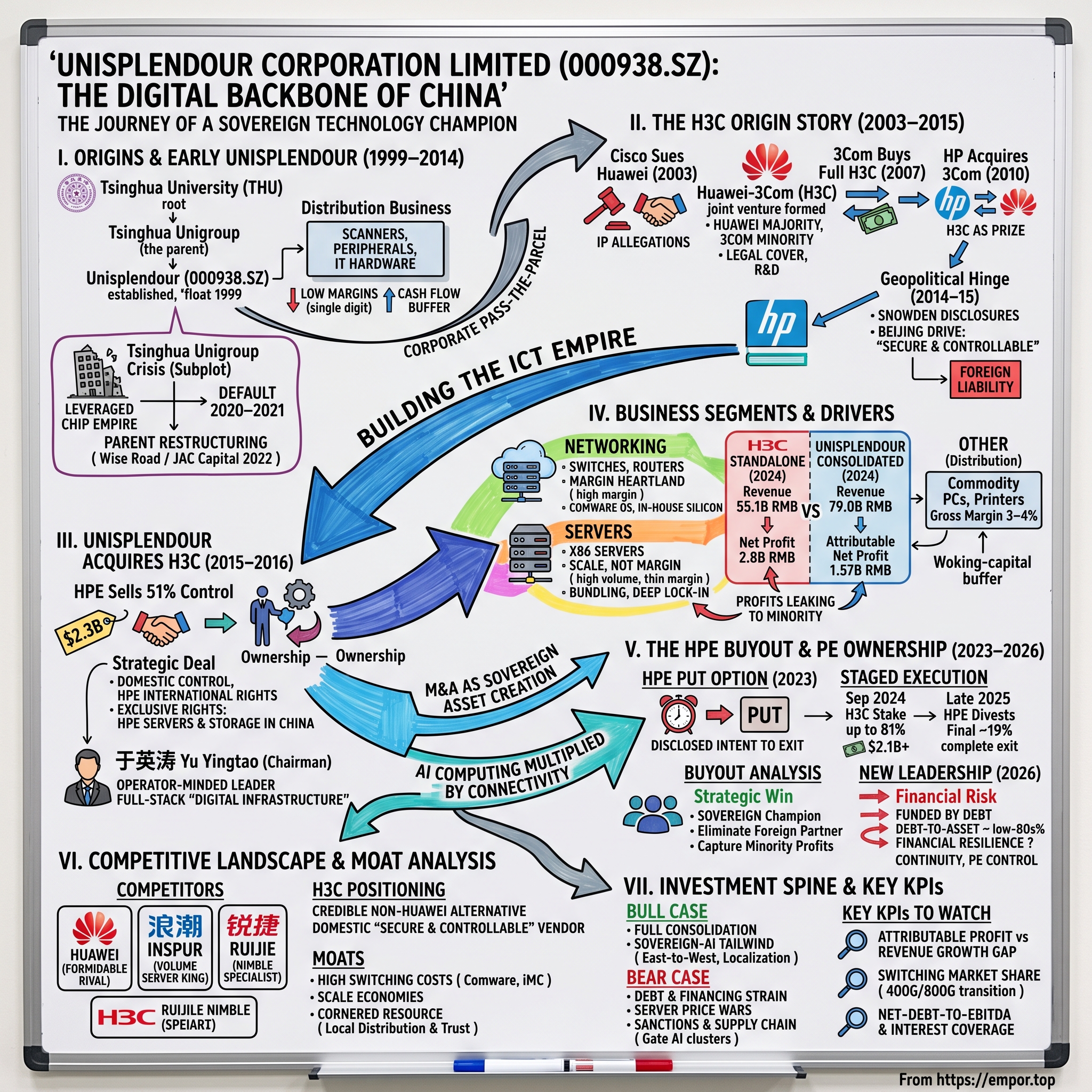
Unisplendour Corporation Limited (000938.SZ): The Digital Backbone of China
I. Introduction & Episode Roadmap
Picture a conference room in Palo Alto in the spring of 2015. Hewlett-Packard, the company that helped invent Silicon Valley, is quietly negotiating to hand majority control of its Chinese networking crown jewel to a company most Americans have never heard of — an obscure Shenzhen-listed entity spun out of a Beijing university, whose earliest products included desktop scanners. On paper, it looks like a retreat. In hindsight, it was the moment a sovereign technology champion was born.
That company is 紫光股份有限公司 Unisplendour Corporation Limited, ticker 000938 on the 深圳证券交易所 Shenzhen Stock Exchange.[^22] And the asset changing hands was 新华三集团 H3C Technologies — today the runaway market-share leader in Chinese enterprise network switches and data-center switches, and one of the top players in domestic X86 servers.11 If you have logged into a Chinese bank, filed taxes with a provincial government, or streamed video that routed through a state-owned telecom backbone, there is a meaningful chance your packets passed through an H3C switch running an operating system called Comware.
Here is the pitch. Unisplendour is not really a story about scanners, or even about switches. It is a story about how a piece of American networking IP — born out of a lawsuit, passed like a parcel between Cisco's arch-rival, a fading US networking pioneer, and two different incarnations of Hewlett-Packard — ended up as the connective tissue of the Chinese state's digital infrastructure. It is a twenty-year corporate soap opera that touches 华为技术有限公司 Huawei Technologies, 3Com, Hewlett Packard Enterprise, a $30-billion-plus bankruptcy, private-equity restructurers, and the geopolitics of computing sovereignty that China calls 信创 Xinchuang — "IT application innovation," the polite phrase for replacing foreign technology with home-grown equivalents.
The catalyst that makes this the right moment to tell the story: between 2024 and the end of 2025, Unisplendour completed its long-telegraphed buyout of HPE's remaining minority stake in H3C, a multi-stage transaction worth well over $3 billion that took H3C from a 51%-owned joint venture to an all-but-wholly-owned Chinese subsidiary.[^4]18 And in mid-2026, the executive who steered that entire journey — 于英涛 Yu Yingtao — stepped down, handing the chairmanship to 李涛 Li Tao and the H3C chief executive role to 王竑弢 Wang Hongtao.13 A founder-era chapter closed exactly as the ownership structure was finally simplified.
Three themes run through everything that follows. First, M&A as sovereign asset creation — how a globally-owned networking business was localized into a national champion through a decade of pass-the-parcel dealmaking. Second, the balance-sheet crucible — how Unisplendour funded a multi-billion-dollar buyout while its own parent, 清华紫光集团 Tsinghua Unigroup, was collapsing into insolvency, and what that leverage costs today. Third, computing multiplied by connectivity — whether H3C can win the AI-era transition to 800G optical switching and liquid-cooled server clusters against Huawei, 浪潮信息 Inspur Information, and 锐捷网络 Ruijie Networks. Throughout, the posture here is neutral: where management says it will win, we will ask what evidence supports the claim and what could break it. Let's start at the beginning, in the Beijing of the late 1990s.
 Subscribe on LinkedIn
II. University Roots & The Tsinghua Conglomerate Boom (1999–2014)
In 1990s China, the country's elite universities were told, in effect, to go make money. Reform-era policy encouraged institutions like 清华大学 Tsinghua University — the "MIT of China" — to commercialize their laboratory research through university-owned enterprises. The idea was that state-funded science should spill over into industry, and that professors and their spin-offs could seed a domestic technology base. Out of that push came Tsinghua Unigroup, the university's flagship commercialization conglomerate, and its listed arm, Unisplendour Corporation, which incorporated in March 1999 and floated on the Shenzhen Stock Exchange that November under the code 000938.[^22]
The early Unisplendour was not glamorous. It sold scanners and desktop peripherals, distributed third-party IT hardware, and did software system integration — the digital equivalent of a wholesaler. Distribution is a genuine business; China was electrifying its offices and factories, and someone had to move the notebooks, printers, and components. But it is a business with a structural problem: you are a middleman marking up other people's products, and your gross margins live in the low single digits. There is cash flow, but no moat. Anyone with a warehouse and a credit line can do it, and the manufacturers whose goods you carry can cut you out whenever they choose. For a company that wanted to matter, distribution was a floor to stand on, not a mountain to climb.
The 2000s and early 2010s in the Tsinghua orbit belonged to a very different kind of operator: 赵伟国 Zhao Weiguo, the ambitious executive who took the reins of Tsinghua Unigroup and turned it into one of China's most aggressive acquirers. Zhao's thesis was grand and national: China imported more value in semiconductors than in crude oil, and someone with enough leverage and political backing could build a domestic chip empire to close that gap. He bought mobile-chip designers Spreadtrum and RDA Microelectronics, folding them into what became 紫光展锐 UNISOC, and pushed into memory through the venture that grew into 长江存储 YMTC. The tool was debt — bond issuances and bank facilities stacked on top of one another to fund a buying spree that would eventually be measured in the tens of billions of dollars.
Zhao's chip ambitions are a subplot here, not the main line, but they matter for two reasons. First, they set the culture of the parent group: growth through leverage, scale over discipline, national mission as the justification for balance-sheet risk. Second, they created the crisis that would later test whether Unisplendour's crown jewel could survive its own family. For now, hold the thought that the parent was becoming dangerously indebted.
Meanwhile, the listed Unisplendour faced a quieter strategic dilemma. A distributor throwing off cash but starved of proprietary technology is a company in search of a soul. Management understood that the durable value in information technology sits with those who own the intellectual property — the silicon, the operating system, the protocols — not those who ship the boxes. The question was how a mid-sized Chinese distributor could ever acquire a real technology moat. The answer, improbably, was already sitting inside a joint venture that Huawei and an American company had built a decade earlier to fight a lawsuit. To understand how Unisplendour got its moat, we have to rewind to a courtroom in Texas.
III. The H3C Origin Story: A Corporate Pass-the-Parcel (2003–2015)
In January 2003, Cisco Systems — then the undisputed emperor of networking — sued Huawei in a Texas federal court, alleging that the Chinese upstart had copied its router software, command-line interface, and even portions of its manuals. It was the first time a Chinese technology company had been hauled into a US court on that scale, and it carried an implicit threat: Huawei's ambition to sell enterprise networking gear internationally could be strangled by American IP law before it began.
Huawei's response was a masterstroke of corporate judo. Rather than fight alone, it found an American partner with impeccable networking pedigree and a grudge against Cisco: 3Com, the Silicon Valley pioneer that had co-invented Ethernet and once been a household name. In 2003 the two formed a joint venture, Huawei-3Com — H3C — combining Huawei's low-cost engineering and manufacturing with 3Com's global distribution and, crucially, its credibility as a US company. Huawei held the majority and 3Com the minority. The venture gave Huawei legal cover, an international sales channel, and a firewall between its risky enterprise ambitions and its core carrier business. 3Com got access to world-class, low-cost R&D. The Cisco suit was settled in 2004, its sting largely drawn.
Act II — the parcel starts moving. By the mid-2000s, the partnership had served its purpose for Huawei, which wanted out. 3Com bought Huawei's remaining stake in the venture for $882 million in a deal agreed in late 2006 and closed in 2007, taking full ownership of H3C.7 For a few years, H3C was the engine that kept a fading 3Com relevant. Then, in November 2009, Hewlett-Packard agreed to acquire 3Com outright for roughly $2.7 billion, a deal that closed in April 2010.8 HP's prize was not 3Com's tired American brand — it was H3C, the fast-growing Chinese networking business that gave HP a credible weapon against Cisco inside China and across Asia. Overnight, an asset that began as a Huawei workaround became the Asia-Pacific networking spearhead of one of America's largest technology companies.
Act III — the geopolitical hinge. The world of 2014–2015 was not the world of 2010. Edward Snowden's disclosures had made every government suspicious of foreign-controlled network equipment, and Beijing accelerated its drive for "secure and controllable" technology — hardware and software that the state could trust because it was domestically owned. For HP, now splitting itself into Hewlett Packard Enterprise, a wholly foreign-owned networking champion in China had become a liability: locked out of the very government and state-owned-enterprise tenders where the growth was. The logical move was to find a Chinese partner who could carry H3C through the door that foreignness had closed.
That partner was Unisplendour. In May 2015, HP announced it would sell a 51% controlling stake in a new combined H3C entity to Unisplendour for about $2.3 billion, an enterprise value of roughly $4.5 billion.12 The deal, which closed in May 2016, was elegant.3 HPE kept 49% and the rights to sell H3C-made gear internationally; Unisplendour got domestic majority control, the keys to the government and SOE market, and — a detail that quietly mattered for years — the exclusive right to sell HPE's own servers and storage inside China. A distributor of other people's boxes had, in one stroke, become the majority owner of China's leading enterprise-networking IP. The soul it had been searching for had a name, and it was Comware. But Unisplendour bought that soul on borrowed time and, increasingly, borrowed money — because the family that owned it was heading for the rocks.
IV. Building the ICT Empire & Parent Restructuring (2016–2022)
To run its new prize, Unisplendour reached for an outsider. 于英涛 Yu Yingtao was not a lab-coat engineer or a Tsinghua insider; he was a career telecom operator executive, most recently a senior figure at China Unicom, who understood the buyer's side of the table — the procurement psychology of state-owned enterprises, telecom carriers, and government IT departments. That was exactly the muscle H3C needed. An operator-minded leader knew that in Chinese enterprise IT, the sale is won on relationships, service coverage, and the ability to promise a nervous government CIO that the vendor will still be there, on-site, in five years. Yu set about transforming H3C from a networking-hardware supplier into a full-stack "digital infrastructure" company spanning switches, routers, X86 servers, storage, enterprise Wi-Fi, cloud platforms, and security.
The strategy had a clear logical spine. Networking switches were the profit engine — high-margin gear where H3C's proprietary Comware operating system and in-house silicon design created genuine differentiation and stickiness. Servers were the volume and scale play — lower margin, because so much of the bill of materials is bought-in Intel and later Nvidia silicon, but essential for landing whole data-center bundles and for keeping the sales force in front of the customer. Around both, H3C wrapped cloud and security software to raise switching costs. By the late 2010s, H3C had become the default non-Huawei choice for enterprises that wanted a credible domestic vendor but were wary of putting all their eggs in Huawei's basket — a positioning that turned out to be worth a fortune.
But while the subsidiary flourished, the parent burned. Tsinghua Unigroup's leveraged chip empire, built on Zhao Weiguo's national-mission borrowing, finally buckled. Beginning in late 2020, Unigroup defaulted on a cascade of onshore and offshore bonds, and by 2021 it had entered court-supervised bankruptcy reorganization, facing liabilities that ran well past $30 billion. It was one of the largest corporate debt failures in modern Chinese history, and it sat directly above the entity that owned Unisplendour's stock.
Here is the crucial investor lesson, and it is a structural one. A high-performing asset can survive the bankruptcy of its parent if it is properly ring-fenced. H3C was a separately-financed, cash-generative operating company; its customers, contracts, and Comware IP did not evaporate because a grandparent holding company could not pay its bondholders. The creditors of Tsinghua Unigroup had claims on Unigroup's assets — including its shares in Unisplendour — but not on H3C's operating cash directly. So while the headlines screamed insolvency, provincial governments kept buying H3C switches. The corporate structure, not the operating business, was what needed fixing.
Fixing it fell to private equity. In July 2022, Tsinghua Unigroup completed its restructuring under a new holding company, 北京智广芯控股有限公司 Beijing Zhiguangxin Holding, formed by a consortium led by 智路资本 Wise Road Capital and 建广资产 JAC Capital, which injected roughly 60 billion RMB of fresh capital to take control of the group.910[^13] Zhao Weiguo was removed and later became the subject of a corruption investigation; in his place, Wise Road's 李滨 Li Bin emerged as the disciplining hand at the top of the structure. The change of ownership mattered less for H3C's day-to-day than for its trajectory: the chaotic, debt-fueled university-conglomerate era was over, and a private-equity owner with a semiconductor portfolio and a taste for financial order now sat above the crown jewel. That owner's first big strategic decision would be whether to double down — by buying out the American minority partner entirely.
V. The HPE Buyout & Capital Deployment Analysis (2023–2026)
The 2016 deal had a time bomb built into it, and everyone knew it. HPE's 49% stake came with a put option — a contractual right to force Unisplendour to buy it out later. For years the question was not whether HPE would sell, but when, at what price, and whether Unisplendour could afford it. The clock started ringing in January 2023, when HPE disclosed it intended to exercise its put and offload its remaining H3C stake, with the price mechanism tied to a multiple of H3C's trailing after-tax profit.5 A definitive Put Share Purchase Agreement followed in May 2023, and the market began doing the arithmetic on a deal that could top $3.5 billion.6[^8]
The execution came in stages, and the staging tells you something about onshore liquidity. In September 2024, HPE completed the sale of a 30% slice of H3C's share capital, taking about $2.1 billion in pre-tax proceeds; Unisplendour put its own price at roughly $2.143 billion, and the transaction lifted its ownership from 51% to 81%.[^4]4 Then, in late 2025, HPE moved to exit the rest — divesting its final roughly 19% in two tranches, including a roughly 9% block for about $643 million disclosed around December 2025, completing a full exit from the venture it had inherited fifteen years earlier through 3Com.18 The parcel that started at a Texas courthouse in 2003 had finally come fully to rest in Chinese hands.
What did Unisplendour actually pay for, and was it a good price? Stitch the tranches together and the implied valuation of H3C lands in the neighborhood of $7 billion, transacted at a mid-single-digit-to-low-double-digit multiple of H3C's after-tax earnings — the roughly 15-times-trailing-profit formula baked into the original put mechanism, applied to a growing profit base.5 That is not a fire-sale price, but neither is it the kind of multiple that global networking peers command. For context on the spread: Arista Networks, the US data-center switching darling, has traded at double-digit multiples of sales and around forty times earnings; Cisco, mature and cash-generative, at low-single-digit sales multiples and mid-teens earnings multiples. H3C was acquired closer to Cisco's earnings multiple than Arista's, on roughly one times sales — a reasonable, non-dilutive price for a domestic market leader, paid to a motivated seller that had run out of strategic reasons to stay.
The analytical verdict is nuanced. On price and strategic logic, the buyout is defensible: consolidating a business you already control, eliminating a foreign partner whose ownership was itself a commercial handicap in the 信创 era, and capturing the minority's share of a growing profit stream. The cost sits on the balance sheet. Funding several billion dollars of stake purchases during a period of tight onshore liquidity meant bank-loan syndication, equity placements, and a meaningful step-up in leverage. By the time the group was contemplating a Hong Kong "A+H" listing to broaden its capital base, its debt-to-asset ratio had climbed toward the low-80s percent — a figure that turns the buyout's elegance into a genuine open question about financial resilience.17 The bull sees full consolidation of a market leader's profits; the bear sees a company that borrowed heavily to buy out a partner at the top of an AI-capex cycle. Both are looking at the same transaction. What resolves the debate is what H3C actually earns — which sends us into the machinery of the business itself.
VI. Business Segments & Economic Drivers
Strip away the corporate saga and Unisplendour is, at its core, two very different businesses stapled together — and understanding why they coexist is the key to reading the financials. One is a high-margin technology company; the other is a low-margin logistics operation. They share a stock ticker but almost nothing else about their economics.
The engine is H3C, the ICT infrastructure and digital-solutions business, which generates the large majority of group operating profit even though it is not the whole of group revenue. In FY2024, H3C on a standalone basis produced revenue of about 55.1 billion RMB and net profit of roughly 2.8 billion RMB; the parent Unisplendour, whose consolidated revenue of 79.0 billion RMB also sweeps in the low-margin distribution arm, reported attributable net profit of just 1.57 billion RMB — a figure dragged down 25% that year partly by the mechanics of minority interest and financing costs.1415 The gap between H3C's 2.8 billion RMB and the parent's 1.57 billion RMB is the story of why the buyout matters: profits were leaking out to the HPE minority before consolidation.
Networking — the margin heartland. H3C's switches and routers are where the real economics live. The company commands roughly 36% of China's enterprise/campus switch market and a comparable share of data-center switches, share it has held at or near the top for years.1112 The reason margins here run structurally higher than in servers is that a switch is not a commodity box — it is silicon and software co-designed together. H3C writes its own network operating system, Comware, and does its own ASIC firmware work, so a customer buying an H3C switch is really buying into a software and management stack, not a slab of merchant silicon. That co-design is what lets networking gross margins sit well above the group average.
Servers — scale, not margin. H3C is one of the top players in Chinese X86 servers, with share around 12–13%, jostling for the number-two and number-three positions behind the volume leader Inspur.14 Server economics are the mirror image of switching: much of the cost is bought-in Intel and Nvidia silicon passed straight through to the customer, so gross margins are thin. The strategic point of servers is not their own profit — it is that selling the compute lets H3C sell the network, the storage, the cloud layer, and the security around it, bundling the customer into an architecture that is painful to unpick. Around these sit cloud platforms, hyper-converged infrastructure, and security appliances that deepen the lock-in.
The other company — distribution. Roughly a fifth to a quarter of consolidated revenue comes from commodity IT distribution: notebooks, commercial PCs, printers, and components moved at gross margins of 3–4%. This is the descendant of the 1999 scanner business, and it contributes almost nothing to profit. It is best understood not as a moat but as a working-capital and cash-cycle buffer — a low-return utility bolted to a high-return franchise.
Two emerging lines deserve mention, sized to their real economic weight today, which is small but potentially strategic. First, AI computing clusters and high-density optical switching — 800G and co-packaged-optics (CPO) switches for AI training fabrics, and liquid-cooled server racks. In plain terms, training a large AI model requires thousands of accelerators wired together so tightly that the network becomes the bottleneck; CPO fuses the optical components directly onto the switch chip to move more data with less power and latency. It is a genuine growth vector, but one gated by China's constrained access to top-tier AI accelerators. Second, international expansion in ASEAN, the Middle East, and Europe under the H3C brand, decoupling from the legacy HPE channel — a nascent effort now growing fast off a small base. FY2025 showed both themes catching fire, and that acceleration is where the competitive war is now being fought.
VII. Competitive Landscape & Moat Analysis
Every war game in Chinese enterprise IT starts with the same giant on the other side of the board: 华为技术有限公司 Huawei. Huawei is the dominant force across carrier and enterprise networking, and in a head-to-head on raw technology and scale it is formidable. H3C's entire competitive identity is built on a single, powerful piece of positioning: it is the credible non-Huawei alternative. For a Chinese enterprise or government buyer who wants a domestic, "secure and controllable" vendor but is wary of concentrating everything with Huawei — for reasons of pricing leverage, vendor diversification, or simple institutional caution — H3C is the natural second source. That "not-Huawei but still domestic" slot is a genuinely valuable piece of real estate, and much of H3C's share leadership in switching flows from occupying it.
The rest of the board: 浪潮信息 Inspur Information is the volume king in X86 and AI servers, winning on hardware scale and price, but it lacks H3C's integrated switch-plus-server-plus-cloud stack. 锐捷网络 Ruijie Networks is the nimble specialist, strong in campus networking and increasingly in data-center switches for internet hyperscalers like 字节跳动 ByteDance and 腾讯 Tencent. 中兴通讯 ZTE Corporation competes hardest in the telecom-operator domain, where it bids for carrier IT, server, and switching tenders. Each rival is dangerous in its lane; none combines networking leadership, a proprietary NOS, server scale, and government-channel depth the way H3C does.
Run H3C through Hamilton Helmer's 7 Powers and the picture sharpens. The primary power is high switching costs. Once a bank or a provincial government builds its architecture on Comware switches managed by H3C's iMC management software, ripping it out means re-architecting, re-certifying, retraining staff, and risking downtime across mission-critical systems. The gear is embedded in the customer's operational muscle memory. That is why enterprise networking, once won, tends to stay won. The secondary power is scale economies: H3C spreads fixed R&D — silicon design, optical engineering, cloud software — across a revenue base that now exceeds 75 billion RMB, a base most domestic rivals cannot match.16 The third is a cornered resource in distribution: an army of channel partners and a service footprint reaching from tier-one cities down to tier-four and tier-five towns, the kind of on-the-ground coverage that no foreign multinational could replicate and that took two decades to build.
Porter's Five Forces exposes where the moat is thinner. Bargaining power of buyers is bifurcated: government and SOE customers are relatively price-insensitive and value trust and service, which is where H3C thrives; but internet hyperscalers are ferocious negotiators who buy near-white-box switches at brutal prices and can design around any single vendor, which is where margins compress. Threat of new entrants is low — the R&D scale, telecom certifications, and protocol complexity form a real barrier. Threat of substitutes is medium and rising: as workloads migrate to public cloud, some on-premise enterprise hardware demand simply disappears into a hyperscaler's data center, and hyperscalers increasingly design their own gear. The honest read is that H3C's moat is deepest exactly where China's IT sovereignty push is strongest — the state and enterprise core — and shallowest in the price-war zones of hyperscale and commodity servers. That mix is what management now has to steward through a leadership handover.
VIII. Current Management, Governance & Culture
For a decade, the face of this company was 于英涛 Yu Yingtao. The former China Unicom operator-executive did not just integrate H3C — he became synonymous with it, personally embodying the pitch to state customers that here was a leader who understood their world. He steered H3C through the HPE integration, through the parent's bankruptcy, and through the first tranches of the minority buyout. So when the announcement came in mid-2026 that Yu was resigning "for personal reasons," effective late June 2026, and stepping down as Unisplendour chairman and director, it marked the end of the founder-operator era of the H3C franchise.13
The succession was a clean two-part handoff. 李涛 Li Tao was elected chairman of Unisplendour's new board, while 王竑弢 Wang Hongtao took over as president and chief executive of H3C, also becoming the listed company's legal representative.13 Both are inside operators rather than celebrity outsiders — a signal that the owners want continuity of execution over reinvention. But a leadership transition is always a governance risk to watch, precisely because so much of H3C's edge has rested on relationships and institutional trust that a decade of Yu's tenure accumulated. Whether Li and Wang can preserve that in front of nervous government CIOs, while simultaneously scaling an international business and an AI-infrastructure push, is an open execution question, not a settled fact.
Above the operators sits the real locus of control. The ultimate controlling shareholder chain runs through Tsinghua Unigroup up to Beijing Zhiguangxin, the Wise Road–led vehicle, giving 李滨 Li Bin's private-equity organization the decisive voice.[^13] This is a meaningfully different governance regime from the university-conglomerate chaos it replaced: PE owners bring capital discipline, a focus on core operations, and potential synergies with a broader semiconductor and packaging portfolio. But it also introduces its own tensions. Private-equity control can mean pressure for financial engineering, dividend extraction to service the structure above, and an eventual exit that may not align with minority public shareholders' horizons. The proposed Hong Kong A+H listing, floated as the group carried a debt-to-asset ratio in the low-80s, reads as much as a capital-raising necessity after the leveraged buyout as a vote of strategic confidence.17
On management credibility, the record is mixed and worth stating plainly. The positives: a genuinely disciplined focus on core ICT infrastructure, an avoidance of the diworsification that doomed the old Unigroup, and consistent top-line delivery — FY2025 revenue growth of 22% and H3C revenue growth of 38% are not the numbers of a stalling franchise.16 The caution flags: attributable profit fell in FY2024 even as revenue held, exposing how financing and minority mechanics can swamp operating gains; and the leverage taken on to fund the buyout was incurred by a group whose parent's last leadership generation destroyed itself with debt. The new team's most important credibility test will not be a growth number — it will be whether they deleverage on schedule while keeping R&D intact. That test frames the entire bull-versus-bear debate.
IX. Investment Spine: Bear vs. Bull Case & Risk Radar
Let's make the "why win / why not" spine explicit, and test it rather than assume it.
The bull case rests on three legs. First, full consolidation. Moving from 51% to effectively full ownership of H3C stops the leakage of profit to the former HPE minority — the very gap that made FY2024's attributable profit look so thin against H3C's standalone earnings.1415 Every yuan H3C earns now flows toward Unisplendour shareholders rather than being shared. Second, the sovereign-AI infrastructure tailwind. China's 信创 localization drive and its 东数西算 East-to-West Computing program — which routes AI and cloud workloads to new western data-center hubs — create sustained, policy-backed demand for exactly what H3C sells: high-speed switches, liquid-cooled servers, and enterprise clouds. FY2025's numbers gave this leg real evidence: consolidated revenue reached 96.7 billion RMB, up 22%, with government-enterprise revenue up nearly 49% and overseas revenue up 58%.16 Third, ecosystem synergy with the Wise Road semiconductor and packaging portfolio, a potential edge in an era of constrained chip supply — though this remains more promise than proven contribution.
The bear case is equally concrete. First, debt and financing strain. The $3.5-billion-plus outlay for HPE's stake pushed group leverage toward the low-80s debt-to-asset ratio, and servicing that during a tight-liquidity, AI-capex-heavy period could suppress return on equity and free cash flow for years.17 Second, server price wars. Intense competition from Inspur and Huawei in X86 and AI servers keeps that segment's already-thin margins under pressure, and if AI-server volume grows faster than high-margin switching, group gross margin could actually dilute even as revenue soars. Third, sanctions and supply chains. US export controls on advanced AI accelerators directly constrain H3C's ability to build top-tier training clusters, and the post-HPE decoupling means the international expansion has to be built channel-by-channel without the old partner's global reach. The FY2025 profit growth of 12% — healthy, but well below the 22% revenue growth — hints that margin and financing pressures are already real.16
Layer the frameworks back on and the synthesis is this: H3C has durable switching-cost and scale powers in its state-and-enterprise core, faces the fiercest of the five forces (buyer power and substitution) in the hyperscale and server segments, and carries a balance sheet that converts a strategic win into a financial risk. An activist-minded skeptic would zero in on exactly three things: the leverage taken on right before an AI-capex peak; the governance complexity of a PE-controlled group contemplating an A+H raise; and the gap between roaring revenue and more modest profit conversion.
The current risk radar, kept to what is material: supply-chain risk in AI accelerators and high-bandwidth memory, which directly gates the AI-cluster growth story; customer concentration in Chinese telecom operators like 中国移动 China Mobile and 中国电信 China Telecom and in government IT budgets, which ties the top line to state spending cycles; and execution risk in the leadership transition under Li Tao and Wang Hongtao just as the company scales internationally. None of these is fatal on its own. Together they define the boundary conditions of the bull case — which is why the KPIs that track them matter more than any single quarter's headline.
X. Essential Investor Frameworks & Key KPIs
If you were to watch only a handful of numbers to know whether the Unisplendour thesis is playing out, three stand above the rest. Resist the temptation to track everything; these are the dials that actually move the story.
First, attributable net profit growth versus revenue growth at H3C. The entire logic of the buyout was to convert top-line strength into bottom-line profit that reaches Unisplendour shareholders. FY2025 showed 22% group revenue growth translating into 12% attributable profit growth — a gap that tells you financing costs and margin mix are currently taxing the model.16 The question to watch is whether, as the acquisition debt is digested and the minority interest is fully eliminated, that gap narrows and attributable profit growth catches up to revenue growth. If revenue keeps climbing while attributable profit lags, the market is effectively paying for the HPE buyout twice.
Second, switching market share, split between enterprise/campus and data-center, in the 400G/800G transition. H3C's roughly one-third-plus share of Chinese switching is the load-bearing wall of the whole franchise, because that is where the high margins and switching costs live.1112 The AI era is re-contesting this ground: every hyperscaler and enterprise building AI fabric is choosing its 400G and 800G optical switch vendor now, and Huawei and Ruijie are pushing hard. Holding or growing data-center switch share through that transition is the single clearest proof point that the moat is intact. Losing it would be the first real crack.
Third, net-debt-to-EBITDA and interest coverage. This is the bear case made measurable. After financing several billion dollars of stake purchases, the pace of deleveraging is the number that separates "strategic masterstroke" from "over-leveraged at the wrong moment."17 Watch whether leverage ratios fall on the trajectory management guides to, and whether interest coverage stays comfortable, especially if an A+H equity raise arrives to relieve the balance sheet.
Two enduring lessons sit underneath these dials. The first is that corporate structure is destiny: a high-performing, properly ring-fenced asset survived the outright bankruptcy of its parent, a reminder that where the cash and the IP legally sit matters as much as how good the business is. The second is that in enterprise networking, local distribution and trust are a moat in their own right — the switch has to be excellent, but the deal is won on the service footprint, the channel relationships, and the credibility to still be standing beside the customer years later. Neither lesson shows up cleanly in a valuation multiple, which is exactly why they are worth holding onto.
XI. Epilogue & Conclusion
The arc is almost too neat to be true. A university spin-off that began by selling scanners and reselling other companies' hardware ended up owning the connective tissue of the Chinese state's digital nervous system — and it got there not by inventing that technology, but by being the last player standing in a twenty-year game of corporate pass-the-parcel that started with a Cisco lawsuit and a Huawei workaround. H3C was built by Huawei, monetized by 3Com, scaled by Hewlett-Packard, and finally nationalized, tranche by tranche, by a Shenzhen distributor whose own parent went bankrupt in the middle of the deal. It is a masterclass in strategic patience, in the value of a properly ring-fenced asset, and in how national technology policy can turn a foreign-owned business into a sovereign champion.
What comes next will be written in two languages. One is the language of the balance sheet: whether Li Tao and Wang Hongtao can deleverage the buyout debt while keeping R&D and switching leadership intact, and whether the contemplated Hong Kong listing relieves the strain or simply confirms it. The other is the language of the fabric — the 800G optical switches, the CPO silicon, the liquid-cooled AI clusters, and the international channels in ASEAN and the Middle East that must now be built without HPE's old global reach. The FY2025 numbers proved the demand is real and accelerating; they also proved that revenue growth and profit conversion have, for now, diverged.
The neutral verdict is that Unisplendour has won the asset it spent a decade pursuing, at a defensible price, at a moment of maximum policy tailwind — and paid for it with leverage that turns the story's ending into a genuine open question. The moat in the state-and-enterprise core is real and evidenced; the price wars in servers and the financing strain on the balance sheet are equally real. What to watch next is not a slogan but a set of numbers: whether profit catches revenue, whether switching share survives the AI-era transition, and whether the debt comes down on schedule. The digital backbone of China now belongs, at last, to China. The bill for it is still being paid.
References
-
HP Partners With Tsinghua to Create a Chinese Technology Powerhouse — HP Inc. Investor Relations, 2015-05-21 ↩
-
HP Says Tsinghua Holdings to Buy Control of Chinese Asset — Bloomberg, 2015-05-21 ↩
-
Hewlett Packard Enterprise Closes Transaction With Tsinghua Holdings — GlobeNewswire/HPE, 2016-05-04 ↩
-
Unisplendour Completes Settlement to Raise H3C Stake to 81% — H3C, 2024-10-09 ↩
-
HPE to Sell Its Remaining Share of H3C — The Register, 2023-01-03 ↩↩
-
HPE to Sell 49% Stake in H3C, Its Distributor of Servers and Storage in China — StorageNewsletter, 2023-05-30 ↩
-
3Com to Buy Huawei Stake in Joint Venture for $882M — CIO, 2006-11 ↩
-
HP Completes Acquisition of 3Com Corporation — HP Inc. Investor Relations, 2010-04-12 ↩
-
Chinese Chipmaker Tsinghua Unigroup Completes Bankruptcy Reorganization — Caixin Global, 2022-07-12 ↩
-
China's Tsinghua Unigroup Completes Debt Restructuring and Ownership Change — South China Morning Post, 2022-07 ↩
-
H3C Ranks First in China Enterprise Network and Data Center Switch Markets (IDC) — H3C, 2022-10 ↩↩↩
-
H3C Leads China Data Center Switch Market H1 2023 (IDC) — H3C, 2023-09 ↩↩
-
Unisplendour Leadership Change: Yu Yingtao Resigns, Li Tao and Wang Hongtao Appointed — EET-China, 2026-06-30 ↩↩↩
-
Unisplendour Corporation 2024 Annual Report — CNINFO / Shenzhen Stock Exchange, 2025-04-29 ↩↩↩
-
Unisplendour Corporation Releases 2025 Annual Report: Record Growth, Rising Profitability and Strong Overseas Performance — H3C, 2026-04-15 ↩↩↩↩↩
-
Unisplendour Corporation Aims for 'A+H' Listing: Debt Ratio Surges to 81.6% — Futu/Moomoo News, 2026 ↩↩↩↩
-
HPE Announces Sale of Its Remaining H3C Stake for $643 Million — Yahoo Finance / Finviz, 2025-12 ↩↩
 LinkedIn
 WhatsApp
 Reddit
 Hacker News
 Email
Email Kindle
 RSS Feed
 Spotify
 Apple Podcasts
 Amazon Music
 Audible
 YouTube