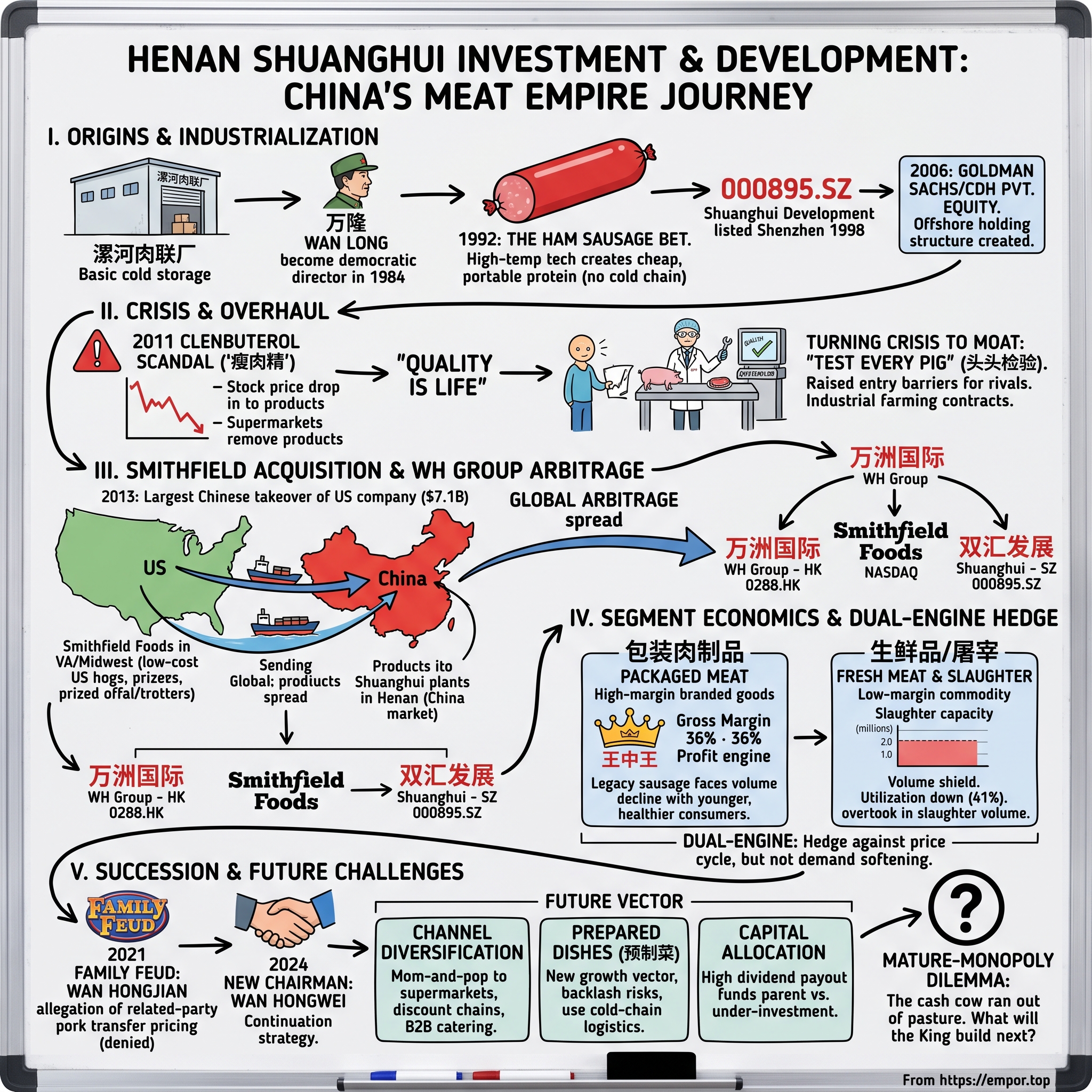
Henan Shuanghui Investment & Development: The King of China's Meat Empire
I. Introduction & Episode Roadmap
Start with the paradox, because it is the whole story in miniature. Shuanghui dominates its market. In packaged meat, it is roughly twice the scale of its nearest branded competitor.8 Its brand is a household reflex. Its cash generation is enormous, and it hands the overwhelming majority of profits back to shareholders as dividends. By every classic measure it is a fortress.
And yet, in 2025, its revenue was essentially flat — RMB 59.5 billion, down a whisker year on year — and net profit inched up just 2.3% to RMB 5.11 billion.9 The core product, the high-temperature ham sausage that built the empire, is in structural volume decline. Younger Chinese consumers, richer and more health-conscious than their parents, increasingly read the sodium content on the label and reach for fresh chicken breast, chilled salmon, or a delivery app instead. This is the mature-monopoly dilemma in its purest form: a cash cow that has run out of pasture, trying to teach itself to graze somewhere new.
The corporate architecture matters here, and it is worth slowing down for, because almost every governance question in this story flows from it. Picture three boxes stacked vertically. At the bottom, closest to the Chinese dinner table, sits 000895.SZ — Shuanghui Development, the Shenzhen-listed company that slaughters hogs and makes sausages inside China. It is controlled from the middle box: 万洲国际 WH Group Limited (0288.HK), listed in Hong Kong, the holding company that Wan Long built to own the whole thing. And WH Group, in turn, owns the top-of-mind trophy in the top box: Smithfield Foods, the Virginia-based American pork giant, which WH Group re-floated on NASDAQ in early 2025 as a separately listed entity.1 Three listings, three regulators, three sets of minority shareholders — and a constant, unavoidable flow of pigs, pork, and money between them.
That structure is the engine of the company's most celebrated strategy and the source of its deepest governance suspicion. When cheap American pork moves from a Smithfield plant in North Carolina to a Shuanghui processing line in Henan, is Shuanghui's Shenzhen minority shareholder getting a fair price — or is margin being quietly routed to the Hong Kong parent? That question, which most companies would keep safely theoretical, was thrown onto the public record in 2021 by the founder's own eldest son. We will get there.
The themes of this episode: first, the industrialization of protein — how China's backyard pig slaughter became a cold-chain duopoly. Second, the global arbitrage — the audacious logic of buying Smithfield. Third, crisis and rebirth — how a lean-meat-powder scandal rewrote China's meat rules. Fourth, the patriarch and the succession — a family drama with real financial stakes. And fifth, the playbook and the thesis — segment economics, the 7 Powers, and the honest bull and bear case. Let us begin where all of it begins: with a failing icehouse and an army veteran nobody expected to matter.
 Subscribe on LinkedIn
II. Origins & Industrialization: The Luohe Enterprise Reform (1958–2005)
The icehouse that couldn't sell meat
In 1958, in the flat wheat country of central Henan, the state built a cold-storage facility in the county seat of Luohe and called it the Luohe Cold Storage.1 It was a warehouse, not a company — a link in the planned economy's meat chain, where hogs were procured at fixed prices, slaughtered at municipal abattoirs, and distributed by ration. In 1969 it was renamed the Luohe Meat Processing Plant, the 漯河肉联厂.1 For most of the next two decades it did what such enterprises did: it lost money, quietly and reliably. Refrigeration was scarce, the equipment was old, and the incentives — the deepest problem of all — pointed nowhere. Nobody in a fixed-price, fixed-quota system had any reason to make the meat better or the plant leaner.
Into this walked 万隆 Wan Long. Born in September 1940 in Luohe itself, he had enlisted in the railway corps in 1960 before even finishing high school, and spent his formative years in the disciplined, hierarchical world of the People's Liberation Army.2 Demobilized, he was assigned to the meat plant in 1968 as an ordinary clerk and ground his way up through the office ranks over sixteen years.2 Then, in 1984 — the early, experimental years of Deng Xiaoping's reforms, when a handful of state enterprises were allowed to elect their own managers — the workers of the Luohe plant voted. Wan Long, then 44, became the first democratically elected factory director in the plant's history.2 He would run it, in one form or another, for the next four decades.
His instincts were formed by scarcity and by the army: cost discipline verging on the fanatical, a suspicion of comfort, and a willingness to bet the whole institution on a single conviction. His first move as director was simply to sell meat at market prices the moment the state loosened its grip — a small act of commercial common sense that in 1984 counted as radical.
The ham-sausage bet
The defining decision came in 1992. Wan Long had seen, at an international exhibition, the high-temperature sterilization sausage lines that Japanese and European processors used — technology that cooked and sealed emulsified meat so thoroughly it could sit on a shelf at room temperature for months. In a Western supermarket, with refrigeration everywhere, this was unremarkable. In China in 1992, it was transformative, because the cold chain did not exist. A product that needed no refrigeration could be shipped anywhere, stored anywhere, and sold in a village shop with no freezer.
Wan Long imported ten production lines from Japan and France, spending, by the company's own account, tens of millions of yuan — a staggering sum for a provincial plant, and by legend a bet that put the factory's entire capital at risk.2 In February 1992 the first 双汇 Shuanghui ham sausage rolled off the line.2 It worked because it solved a real, physical constraint of Chinese life: it delivered affordable, safe, shelf-stable animal protein into a distribution system that could not keep anything cold. The red tube became a national staple not through marketing genius but through infrastructure arbitrage — Shuanghui had bought its way around the missing cold chain.
The brand followed the product. The "Shuanghui" trademark had been registered in 1989; the group was formally constituted in 1994; and in 1998 the operating entity listed 50 million A-shares on the Shenzhen Stock Exchange, giving the empire its public face as 000895.SZ.1 In 2000 Wan Long pushed in the other direction too, importing China's first chilled fresh-meat production line from Europe — an early bet that the country would eventually build the cold chain, and that Shuanghui should own the branded fresh pork when it did.1
Wall Street buys the pig factory
By the mid-2000s the awkward truth was that a globally ambitious enterprise was still, on paper, owned by the Luohe municipal government. In March 2006 the state-owned equity in Shuanghui was put up for transfer on the Beijing property-rights exchange, and the winning bidder was a foreign consortium — a vehicle named Rotary Vortex, formed by Goldman Sachs and the Chinese private-equity firm 鼎晖投资 CDH Investments.2 The buyers paid roughly US$256 million for control of a struggling meat producer, in one of the first deals of its kind in China — and it was controversial, with critics charging that a national champion was being sold to foreigners too cheaply.3 Goldman would later halve its stake at roughly five times its money, a tidy signal of how underpriced the asset had been.3
For Wan Long, the private-equity ownership did something more important than raise cash: it created the offshore holding architecture — later the entity 双汇国际 Shuanghui International, eventually rebranded 万洲国际 WH Group — and it aligned management, through a buyout structure, with the capital that would soon be deployed on a scale nobody in Chinese food had ever attempted. The provincial icehouse now had a Wall Street cap table, a listed subsidiary, and a patriarch who had learned that the way to protect the factory was to make it too big to fail. What he did not yet have was a crisis. That arrived, on national television, in the spring of 2011.
III. The 2011 Clenbuterol Crisis & Industrial Overhaul
Fifteen minutes on the fifteenth of March
Every year on March 15 — World Consumer Rights Day — China Central Television airs a prime-time exposé called the 3·15 gala, and every year corporate China holds its breath. In 2011, the target was Shuanghui. CCTV reported that pigs fed with 瘦肉精 clenbuterol — an illegal β-agonist "lean-meat powder" that boosts muscle and burns fat, and that is toxic to humans — had entered the slaughter chain at a Shuanghui subsidiary in Jiyuan, Henan. Farmers, traders, and slaughterhouse staff had colluded to pass "bodybuilder pigs" through the system.
The reaction was instant and brutal. Shuanghui Development's shares fell the maximum 10% daily limit to RMB 77.94 on March 16 before trading was suspended at 9:30 a.m. pending clarification.4 Nationwide, supermarkets pulled Shuanghui products from shelves; sales across the group's core lines effectively stopped. The company itself later tallied the direct damage at the Jiyuan unit in the tens of millions of yuan, but the reputational hit — for a brand whose entire promise was safe protein — was measured in the billions. The group issued a public apology on its website on March 16, halted the Jiyuan subsidiary's operations, dispatched a deputy general manager to run remediation, and ordered every subsidiary to tighten procurement and manufacturing oversight.4 Wan Long's public framing, endlessly repeated afterward, was blunt: quality is life; food safety comes first.
Turning a scandal into a barrier
Here is where the story turns from crisis to strategy, and it is the most important structural move in the company's modern history. A weaker management would have fired the Jiyuan staff, apologized, and moved on. Wan Long instead used the panic to force a change that permanently raised the cost of competing with Shuanghui.
The company mandated 头头检验 — "test every single head" — putting each pig through clenbuterol screening rather than sampling a batch, and committing to spend on the order of hundreds of millions of yuan a year on test kits alone. It accelerated a shift away from buying live hogs piecemeal from thousands of backyard farmers — the very channel that had let tainted pigs slip in — toward direct contracts with large industrial farms and toward its own proprietary slaughterhouses.
Think about what "test every pig" does to the industry's economics. For Shuanghui, with millions of hogs of throughput, per-animal testing is a bearable cost spread across enormous volume. For a small regional slaughterhouse running on thin margins, the same testing regime — plus the cold-chain and compliance investment that regulators now demanded across the sector — is ruinous. The scandal, in other words, handed the largest, best-capitalized player a mechanism to raise the entry price for everyone else. Weak competitors without the capital to test and refrigerate at scale were squeezed out. The near-death experience became a moat: higher fixed costs of compliance that Shuanghui could absorb and its smaller rivals could not.
That is the honest, non-promotional reading of 2011. It is not that Shuanghui was uniquely virtuous — a subsidiary of the country's biggest meat company had, after all, been caught with poisoned pork. It is that Shuanghui had the balance sheet to turn regulation into a competitive weapon, and the strategic clarity to do it. Having secured its home flank, Wan Long looked across the Pacific — to a country where feed was cheap, hogs were plentiful, and an American icon was for sale.
IV. The $7.1 Billion Smithfield Acquisition & WH Group Arbitrage
The deal that stunned Wall Street
On May 29, 2013, Shuanghui International announced it would acquire Smithfield Foods — the largest pork producer in the United States, owner of the Smithfield ham brand and vast hog operations across Virginia, North Carolina, and the Midwest — for US$34.00 a share in cash.3 That equity check was about US$4.7 billion; add Smithfield's assumed debt and the total enterprise value reached roughly US$7.1 billion.3 The price was a 31% premium to Smithfield's last unaffected close, and — this is the part that made headlines from Washington to Beijing — it was the largest acquisition of an American company by a Chinese buyer in history.3
Set the scene of what this meant politically. A Chinese company, five years after a domestic food-safety scandal, was proposing to buy the food that ended up on American breakfast tables. The deal drew a national-security review by the Committee on Foreign Investment in the United States (CFIUS), and on July 10, 2013, eleven U.S. senators aired their anxieties at a Senate Agriculture Committee hearing — about food safety, about pork supply, about handing a strategic protein source to a geopolitical rival. In the end, the objections were political theater more than substance: CFIUS cleared the transaction, Smithfield's shareholders approved it, and the deal closed on September 26, 2013.2
Was it overpriced? The honest answer
The bull case on price was strategic, not arithmetic. On the numbers alone, roughly 15 times trailing earnings and around 7.5 times EBITDA was a full price for a mature, cyclical, low-margin pork processor — a premium to U.S. comparables like Tyson Foods and Pilgrim's Pride. Wan Long was not paying for Smithfield's American earnings. He was paying for an option: the right to connect the cheapest large-scale hog production system in the world to the most pork-hungry consumer market in the world, and to keep the spread.
The financing told you how much of a stretch it was. Shuanghui leaned on a syndicated bank loan to fund the cash, loading the combined group with debt — and that debt is why the Hong Kong IPO of the newly rebranded WH Group became not a vanity exercise but a financial necessity. The group first tried to list in April 2014, seeking as much as US$5.3 billion; the deal was cut to about US$1.9 billion and then pulled outright as markets balked and bankers grumbled that 29 underwriters had made it a circus.[^5]5 WH Group relaunched a stripped-down offering in August 2014, raising roughly US$2 billion, most of it earmarked to pay down the Smithfield acquisition loan.5 The trophy had been bought on credit, and the public markets footed the refinancing.
How the arbitrage actually works
The mechanics are elegant, and worth explaining plainly because they are the intellectual core of the whole edifice. American hogs are cheap to raise: corn and soybean feed is abundant and inexpensive, and industrial feedlots achieve enormous scale. So the cost per kilogram of American pork is structurally low. Chinese pork, by contrast, is expensive — domestic prices run high, and Chinese consumers will pay for cuts that Americans barely value. In the United States, pig heads, trotters, offal, and ears are low-value byproducts, often rendered or discarded. In China, they are prized ingredients. Braised trotters, pig-ear salad, offal hotpot — these carry real willingness to pay.
So the trade is this: raise the hog cheaply in Iowa, ship the cheap cutouts and the "undervalued" bits — the offal and extremities — across the Pacific, and sell them into a market that treasures exactly what the American market throws away. Shuanghui's Chinese processing plants get lower-cost raw material; the whole animal gets monetized closer to its maximum value. It is one of the cleaner cross-border arbitrages in global food.
Friction: when geopolitics taxes the trade
The theory worked beautifully until the politics changed. From 2018 onward, the U.S.–China trade war layered reciprocal tariffs onto exactly these pork flows, and the elegant spread narrowed. African swine fever, which devastated China's domestic herd starting in 2018, briefly sent Chinese pork prices to the moon and made imports wildly profitable — then the herd rebuilt, prices collapsed, and the arbitrage swung the other way. WH Group spent the years since managing a business whose two halves — American farming assets, Chinese processing channels — are now permanently exposed to the political weather between Washington and Beijing. The 2025 NASDAQ relisting of Smithfield, carving the U.S. business back out as a separately traded entity, can be read partly as a way to insulate and independently value those American assets amid that friction.1 The arbitrage is real; it is simply no longer free of tariffs and politics. Which brings us back home, to where the profits actually come from — the segments.
V. Segment Economics & The Core Business Architecture
Two businesses wearing one logo
If you remember one thing about how Shuanghui makes money, make it this: the company runs two fundamentally different businesses under one brand, and they have almost nothing in common except the pig. One is a branded, high-margin consumer-goods business. The other is a low-margin industrial commodity business. Understanding the difference is the whole game.
Segment one is packaged meat products — 包装肉制品 — the engine of profit. These are the branded sausages and deli meats: the high-temperature ham sausages like 王中王 King of Kings that need no refrigeration, and the growing range of low-temperature Western-style products — ham, bacon, chilled deli meats — that do. In 2024 this segment was about 42% of company revenue, but it earned a gross margin of roughly 36% — up four points year on year — versus low single digits for slaughtering.8 Because those margins are so much fatter, packaged meat generates the overwhelming majority of Shuanghui's operating profit despite being the smaller revenue line.8 This is a branded fast-moving-consumer-goods business dressed in a meat company's clothing: it has real pricing power, and when raw hog costs spike, Shuanghui can raise sausage prices to protect its spread.
The analytical point beneath the numbers: a 36% gross margin on a snack food is not what a commodity processor earns — it is what a brand earns. That margin is the cash quantification of decades of household trust and 300,000-plus points of sale. It is also, crucially, the part of the business under the most pressure, because the highest-margin sub-category — the legacy high-temperature sausage — is precisely the one younger consumers are walking away from. Packaged-meat volume fell about 6% in 2024.8 The cash cow is intact, but it is aging.
Segment two is fresh meat and slaughtering — 生鲜品/屠宰 — the volume shield. This is the industrial business: buying live hogs, slaughtering them, and selling chilled and frozen pork. It is roughly half of revenue but earns wafer-thin margins — a slaughtering gross margin under 5%.8 Why bother with a business that barely makes money? Because it does three things the profitable segment needs. It secures raw-material supply for the packaged-meat plants. It gives Shuanghui a national footprint in fresh pork distribution. And it provides sheer scale — the company had annual hog-slaughter capacity above 25 million head in 2024, across dozens of modern plants.8
But here the story has taken an uncomfortable turn that a neutral analyst must state plainly. Utilization has collapsed. In 2024 Shuanghui slaughtered just 10.28 million hogs — down more than 19% year on year — against capacity of 25.21 million, a utilization rate of only about 41%.8 More strikingly, Shuanghui was overtaken in slaughter volume by the upstream hog-farming giant 牧原股份 Muyuan Foods, which processed 12.52 million head — the second straight year the challenger has out-slaughtered the incumbent.8 The "volume shield" is, at the moment, running at less than half capacity and losing the volume race. That is not a footnote; it is a live competitive threat, and we will return to it.
The hidden optionality: poultry and prepared dishes
Two smaller businesses carry more strategic weight than their revenue suggests. The first is poultry integration — 禽业一体化 — upstream chicken farming and processing, which hedges pork raw-material costs and lets Shuanghui offer dual-protein products. The second, and the one management talks about most, is prepared dishes — 预制菜 yuzhicai — ready-to-cook and ready-to-eat meals sold into restaurants, canteens, and home kitchens.
The logic for prepared dishes is sound: as the traditional ham sausage fades, Shuanghui needs a new use for its greatest hidden asset — a nationwide cold-chain logistics network that few rivals can match — and prepared dishes ride exactly that infrastructure into the fast-growing B2B foodservice channel. But sobriety is warranted. 预制菜 has become a culturally contested category in China, where a vocal consumer backlash has erupted over restaurants secretly serving reheated factory meals rather than fresh-cooked food. That backlash is a genuine demand risk for the very growth vector management is counting on. Prepared dishes are a credible option, not a proven engine — and the burden of proof sits with future disclosure, not with the pitch.
The dual-engine hedge — and its limits
Management's favorite framing is the "dual engine": when hog prices fall, slaughtering and fresh-meat margins improve while packaged meat enjoys cheaper inputs; when hog prices surge, packaged meat's pricing power offsets the squeeze on fresh pork. There is truth in it — the two segments do partially offset across the 猪周期 pig cycle. But 2024–2025 exposed the limit of the hedge: when consumption itself softens across the board, both engines can idle at once, which is exactly why flat revenue and barely-growing profit is the current reality rather than the smooth counter-cyclical machine the framing implies. A hedge against price is not a hedge against demand. And demand, ultimately, is set at the level of the household — and of the family that controls the company. To that family we now turn.
VI. Current Management, Succession, & Governance Stress Test
The patriarch
万隆 Wan Long is the rarest kind of Chinese corporate figure: a founder-operator who took a state icehouse to the Fortune Global 500 and held the reins into his eighties. His reputation inside the industry is for iron cost discipline — the army habit never left him — and for a strategic nerve that produced both the 1992 ham-sausage bet and the 2013 Smithfield gamble. By the mid-2020s he had become honorary chairman and elder statesman, the master strategist stepping back from daily command. The question that hangs over any such figure is the one that hangs over all founder empires: what happens when he lets go?
The 2021 feud: a family drama with a balance-sheet subtext
In June 2021 the answer arrived in the ugliest possible form. During an argument over who should fill a senior management post, Wan Long's eldest son, 万宏建 Wan Hongjian — then vice chairman and a director of WH Group — reportedly grew agitated, and his father's bodyguards physically restrained him. On June 17, 2021, the company relieved Wan Hongjian of all his posts, citing "aggressive behavior" toward company property.
What could have stayed a private family rupture became a public governance event because the ousted son fought back with documents and allegations, published via WeChat in August 2021.6 His charges were specific and, for investors, uncomfortable. He alleged that his father had received a 5% stake in Henan Shuanghui from CDH in 2007, then sold it to a Hong Kong company for US$200 million without proper disclosure or tax.6 And — most relevant to the whole thesis of this company — he alleged that in February 2021 the group had imported nearly 100,000 tonnes of U.S. pork at inflated prices, causing losses exceeding RMB 800 million.6 In plain English: he accused the family of using the very cross-Pacific pork flow we admired in the last section to route margin away from the Shenzhen-listed minority shareholders of 000895.SZ and toward the parent.
That is the precise, live version of related-party risk — not a theoretical worry drawn from an org chart, but an insider naming a number. WH Group rejected the allegations on August 18 and again, in detail, on August 24, 2021, calling them untrue and misleading; CDH and Wan Long denied the 2007 stake transaction, and the company said the imported-pork prices reflected then-prevailing market rates.6 Investors did not wait for adjudication. Around the same window, Wan Long had stepped down as WH Group CEO on August 12, handing the role to CFO 郭丽军 Guo Lijun, and when the allegations hit, WH Group's Hong Kong shares fell about 11% in a session, wiping roughly HK$11 billion of value.6
The point for a neutral platform is not to decide who was right — the claims were denied and never adjudicated in the son's favor. The point is that the accusations came from inside the family, they targeted exactly the mechanism that makes the three-tier structure powerful, and no external body ever fully dispelled them. That is a permanent governance discount, and honest analysis carries it forward rather than filing it away.
The new order (2024–present)
The succession resolved, quietly, in favor of the second son. On August 30, 2024, 万宏伟 Wan Hongwei, then 51, was appointed chairman of Shuanghui Development, replacing his 85-year-old father, who stepped back to a non-independent director's seat.7 Wan Hongwei was not a surprise pick — he had been a director since 2018 and vice chairman before his elevation — and his stated posture was continuity, not reinvention: he would extend the existing operating strategy and stay focused on the meat business.7 Day-to-day operating execution — product innovation, channel expansion, domestic sales — has run through veteran managers of the 马相杰 Ma Xiangjie generation of operators rather than through the family alone.
On capital allocation, the family's record is genuinely shareholder-friendly in one dimension that matters enormously to income investors: Shuanghui distributes the large majority of its earnings as dividends, routinely paying out most of annual profit and returning tens of billions of yuan over the years to A-share holders. For a business generating strong operating cash flow with limited need for growth capex, a high payout is rational — it is what you do with a cash cow. But the skeptical reading is worth holding alongside the friendly one: heavy dividends also move cash up the structure toward the controlling parent, and a company facing a genuine growth problem is choosing to distribute rather than reinvest aggressively into the very prepared-foods and fresh-pork transitions it says are its future. Both readings are true at once. That tension — cash-cow discipline versus under-investment in the pivot — is the central management-credibility question, and it is best judged not by what the family says but by what the numbers show over the next several years.
VII. Competitive Dynamics & Strategic Frameworks
War-gaming the moat: Helmer's 7 Powers
Strip away the narrative and ask the cold question a competitor's strategist would ask: what actually stops someone from taking Shuanghui's business? Hamilton Helmer's 7 Powers framework gives us a disciplined way to test it, and Shuanghui scores on several — but not all, and not evenly.
Scale economies are the primary power, and they are real. A national network of dozens of slaughtering plants and cold-storage hubs gives Shuanghui procurement leverage over hog suppliers and logistics providers that a regional player cannot match, and it spreads the fixed cost of that "test every pig" compliance regime across enormous volume. Process power is the second: decades of proprietary recipes, high-speed automated packaging, and carcass-yield optimization that are hard to replicate quickly. Branding is the third and most durable — 双汇 is an inescapable household name in Chinese processed pork, and that brand is what converts a commodity (emulsified meat) into a 36%-gross-margin product. That premium is the single cleanest piece of evidence that the brand power is real and not rhetorical.
Counter-positioning is where it gets interesting — and where the moat shows a crack. The traditional argument is that pure hog farmers like Muyuan and 温氏股份 Wens Foodstuff cannot easily move downstream into branded packaged meats, because they lack the retail distribution and cold-chain FMCG expertise that Shuanghui spent forty years building. That is largely true for branded sausages. But it is visibly not true for slaughtering — Muyuan has already out-slaughtered Shuanghui two years running.8 The counter-positioning protects the crown jewel (branded packaged meat) far better than it protects the commodity middle (slaughter and fresh pork). A rigorous investor keeps those two verdicts separate.
Porter's five forces
Run the same discipline through Porter's lens. Threat of new entrants: low — nationwide cold chain, slaughter licensing, and food-safety compliance are capital walls, exactly the walls 2011 raised higher. Supplier power: moderate — Shuanghui is a price-taker on the 猪周期, but its scale, imports, and internal slaughter blunt the sharpest edges. Buyer power: low to moderate — with 300,000-plus retail points of sale, no single grocery buyer has leverage over the branded goods, though bulk fresh-pork buyers have more. Threat of substitutes: high, and rising — this is the genuinely worrying force. Younger, wealthier consumers are shifting toward fresh poultry, seafood, chilled pork, and lower-sodium diets, away from the high-sodium processed sausage that is Shuanghui's most profitable legacy product. Competitive rivalry: high — Shuanghui fights 金锣 Jinluo and 雨润 Yurun in processing, 中粮家佳康 COFCO Joycome across the chain, and the upstream giants pressing downstream.
The five-forces picture is therefore not a uniform fortress. The branded-packaged-meat castle is well defended on four of five walls; the fifth — substitution by changing diets — is being scaled from within. And the commodity slaughter business is exposed on multiple fronts at once.
The named rivals, sized honestly
Against the branded processors, Shuanghui remains roughly twice the scale of its nearest packaged-meat competitor — a commanding lead in the segment that matters most for profit.8 Against the upstream breeders, the picture inverts: Muyuan dominates hog farming outright and is now the larger slaughterer, while Shuanghui dominates midstream processing and downstream branded meat.8 The two companies are converging on each other's turf from opposite directions — Muyuan pushing down from the farm, Shuanghui defending up from the brand. Which one wins the middle — slaughter and fresh pork — is one of the defining contests in Chinese protein, and right now the momentum in raw slaughter volume belongs to the newcomer. What management says about that contest, and how analysts press them on it, is where we look next.
VIII. Recent Transcripts, Call Evidence, & Primary Signals
What the filings and calls actually reveal
Shuanghui's primary disclosure runs through the Shenzhen exchange, the 巨潮资讯网 Cninfo designated-disclosure platform, and the SZSE investor-interaction platform 互动易, alongside WH Group's Hong Kong reporting.1011 Read across the 2023–2025 annual reports and interim results, three management preoccupations recur, and each is worth testing against evidence rather than accepting at face value.
The first is pig-cycle management. Management's consistent line is that it flexes domestic slaughter volume with the cycle — slaughtering and freezing more when hogs are cheap, drawing down inventory when they are dear. The 2024–2025 numbers give this claim texture: with slaughter volume down sharply and utilization near 41%, management was clearly not chasing volume into a weak, low-price market — a defensible, margin-protecting choice, but also one that ceded the volume crown to Muyuan.8 The behavior is consistent with the stated strategy; whether it is the right long-run trade-off for competitive position is the open question.
The second is channel diversification. The traditional 传统渠道 mom-and-pop and wholesale channels that carried the red ham sausage for thirty years are shrinking, and management has openly acknowledged declining processed-meat sales through those legacy channels.8 The stated fix is to push into modern supermarkets, the booming snack-discount chains like 零食很忙 (Snack Is Busy) and its peers, and B2B catering. The candor here is a modest positive credibility signal — management is naming the channel decline rather than hiding it — but the pivot is still being proven quarter by quarter.
The third is prepared dishes. On the guidance around 预制菜, the tone in investor materials has been ambitious on the opportunity and vaguer on the hard metrics — revenue contribution, distribution wins, and margin targets are discussed more qualitatively than an investor would like. When management is specific about the cash cow and general about the growth vector, that asymmetry is itself information.
Prepared remarks versus the Q&A
The most useful signal in any disclosure cycle is the gap between the scripted optimism and what analysts choose to grill. The recurring pressure points from the analyst side are exactly the uncomfortable ones this article has flagged: raw-material transfer pricing with the WH Group/Smithfield parent, the sustainability of the high dividend during a period of soft growth and needed transition capex, and stagnation in the legacy high-temperature sausage. Management's defense has been consistent across cycles — emphasize dividend stability, capacity-utilization and cost control, and margin defense through product-mix upgrades toward higher-value low-temperature and prepared products. Consistency of message is, in itself, neither good nor bad; what matters is whether the mix-upgrade and channel pivot eventually show up as growth in the consolidated line. So far, they have shown up as margin defense — 2025 profit rose on cost control while revenue stayed flat — rather than as reacceleration.9 That is a real distinction, and it frames the entire investment debate.
IX. Investment Thesis: Risk Radar & Bull vs. Bear Case
The material risks, ranked by how much they actually matter
Not all risks deserve equal airtime, so weight them by mechanism. The most immediate is the pig cycle 猪周期 itself — prolonged low pork prices squeeze slaughter margins and fresh-meat profitability, as 2024–2025 demonstrated, while sudden price spikes lift raw-material costs for the packaged-meat plants. Closely related is biological and epidemic risk: African swine fever 非洲猪瘟 remains an ever-present threat to domestic hog supply and price stability, capable of whipsawing the entire cost base overnight. Third, geopolitical and trade friction taxes the trans-Pacific arbitrage that once looked like free money; tariffs and export politics between Washington and Beijing now sit permanently on the Smithfield-to-China pork flow.
Fourth — and arguably the most structural — is the consumer demographic shift: the slow, grinding move of younger Chinese away from high-sodium processed sausage toward fresh, chilled, and healthier proteins. This is not a cyclical dip; it is a change in taste, and it attacks the highest-margin product in the portfolio. Fifth is the governance and related-party overhang — the transfer-pricing conflict potential between the Hong Kong parent, the U.S. Smithfield business, and the Shenzhen-listed subsidiary that the 2021 feud dragged into daylight and that no external ruling ever fully closed.
The bull case
The bull case is a quality-and-yield case, not a growth story, and it is respectable on its own terms. Shuanghui owns unrivaled scale and cold-chain infrastructure in Chinese meat, a genuine brand moat evidenced by that 36% packaged-meat gross margin, and a cash-generative model that funds one of the more dependable dividend streams in Chinese consumer staples. For an investor who wants a defensive, high-payout equity that behaves a little like a bond with a pork-price wobble, the packaged-meat cash cow throws off enough cash to keep paying while the company works on its next act. And if prepared dishes and modern-channel expansion eventually convert the cold-chain network into a real second growth engine, there is optionality on top of the yield.
The bear case
The bear case is that the fortress is quietly eroding from within. The legacy ham-sausage category has reached structural saturation and is in volume decline; the fix — prepared dishes — is culturally contested and unproven at scale, and management is notably less specific about it than about the dividend. The commodity slaughter business is being out-competed by an upstream giant, Muyuan, that is integrating downstream faster than counter-positioning theory predicted, with utilization already down near 41%.8 And the governance discount is permanent: a family-controlled structure with three listed layers, a public and unresolved insider allegation of margin-shifting, and a dividend policy that conveniently moves cash toward the controlling parent. A skeptical long/short investor would frame it sharply: you are buying a superb, cash-rich, structurally declining core with a related-party question mark, priced as a stable compounder.
The three KPIs that actually tell the story
An investor does not need to track twenty metrics here — three will reveal whether the bull or bear case is winning. First, packaged-meat operating margin and tonnage volume: this is the profit engine, and the tension between defended margin and declining volume is the whole debate in one line. Second, slaughter capacity-utilization rate and fresh-pork gross margin: this measures whether the commodity middle is stabilizing or continuing to lose ground to Muyuan. Third, dividend payout ratio and free-cash-flow yield: this is the bond-like return the bull case rests on, and the early-warning signal if cash generation weakens or if capital is redirected. Watch those three, and the rest is noise.
X. Epilogue & Playbook Lessons
Stand back from the red plastic tube and the four decades of empire-building, and Shuanghui offers a set of business lessons that outlast any single year's pork price.
The first is infrastructure as moat. Wan Long's two defining wins — the 1992 sausage bet and the post-2011 testing regime — were both, at heart, decisions to build expensive physical and compliance infrastructure that competitors could not afford to match. The ham sausage arbitraged a missing cold chain; the "test every pig" mandate turned a food-safety catastrophe into a fixed cost that only the largest player could bear. Moats, in this business, are poured in concrete and cold storage, not conjured from software.
The second is the reality of cross-border arbitrage. Merging developed-market agricultural efficiency with emerging-market consumer demand — cheap Iowa hogs, prized Chinese offal — is one of the most elegant trades in global food, and it worked brilliantly. Until it didn't. Tariffs, swine fever, and geopolitics taught the lesson that arbitrages built on the assumption of open borders carry a hidden political option that can be called at any time.
The third is the FMCG cash cow versus the commodity mill. The single most important number in this company is the gap between a 36% branded gross margin and a sub-5% slaughter margin — the difference between owning a brand and owning a machine. When the commodity mill suffers, the branded products protect the capital. But the corollary is the warning: when the branded products themselves stop growing, there is no third engine to hide behind, which is exactly the pivot Shuanghui is now being forced to attempt.
And the fourth is that governance transparency is priced. A company can generate magnificent operating cash flow and still trade at a discount if a controlling family, a three-tier cross-border structure, and an unresolved insider allegation leave minority shareholders unsure whose interests come first. The market does not forget the son's letters. Shuanghui's next chapter — Wan Hongwei's chapter — will be judged not on whether it can keep the dividend flowing, which it almost certainly can, but on whether it can prove that the pivot is real, that the arbitrage still pays, and that the family's cash cow is being run for everyone who owns a piece of it. That is the test. The red tube built the empire. Whether the empire can build something after the red tube is the question that remains open.
References
-
Henan Shuanghui Investment & Development Co., Ltd. — company history (Baidu Baike, English) ↩↩↩↩↩↩
-
Wan Long, founder of Shuanghui Group and chairman of WH Group — biography (Baidu Baike, English) ↩↩↩↩↩↩↩
-
China's Shuanghui International to Buy Smithfield Foods for $4.7 Billion — Reuters, 2013-05-29 ↩↩↩↩↩
-
Shuanghui apologizes over additive scandal — China Daily, 2011-03-16 ↩↩
-
Pork giant WH Group slashes Hong Kong IPO by two-thirds — Global Times, 2014-04 ↩↩
-
Family Feud at Pork Giant Intensifies as Claims of Founder's Ousted Son Rejected — Caixin Global, 2021-08-24 ↩↩↩↩↩
-
World's Largest Pork Producer Shuanghui Names Founder's Second Son as Chairman — Yicai Global, 2024-08-30 ↩↩
-
Slaughter Race: Shuanghui Slips Further Behind Muyuan as Pork Market Cools — AgriPost.CN, 2025-03-25 ↩↩↩↩↩↩↩↩↩↩↩↩↩↩
-
WH Group's Shuanghui Unit Lifts 2025 Profit Despite Flat Revenue — The Globe and Mail / TipRanks, 2026 ↩↩
-
Cninfo (巨潮资讯网) — Official Designated Disclosure for Shuanghui Development (000895) ↩
 LinkedIn
 WhatsApp
 Reddit
 Hacker News
 Email
Email Kindle
 RSS Feed
 Spotify
 Apple Podcasts
 Amazon Music
 Audible
 YouTube