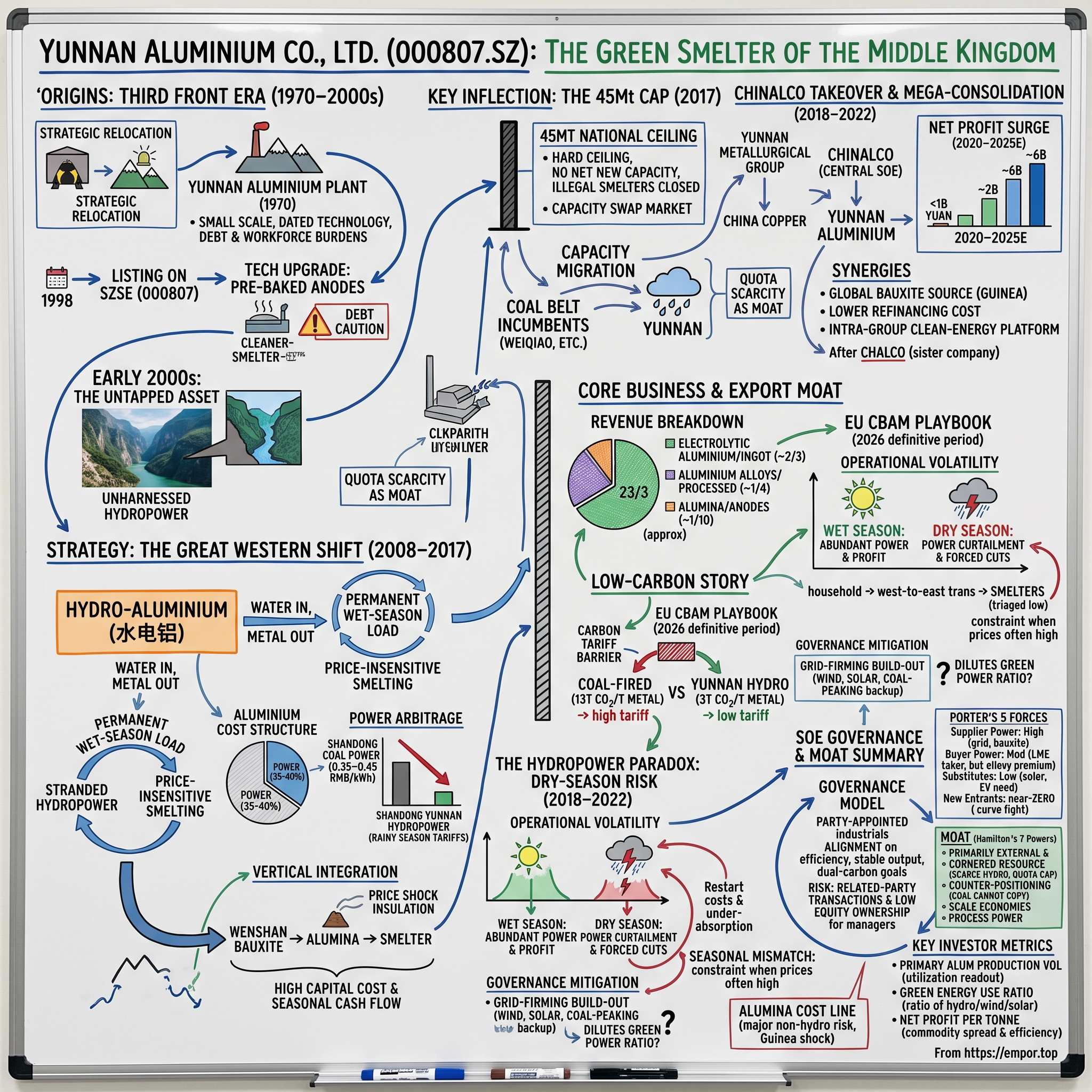
Yunnan Aluminium: The Green Smelter of the Middle Kingdom
I. Introduction & Episode Roadmap
Picture a river in flood. Every summer, the monsoon sweeps up from the Bay of Bengal and dumps itself across the mountains of southwest China, and the Lancang — the river the rest of the world calls the Mekong — swells brown and violent through the gorges of Yunnan Province. Behind a wall of dams, that water spins turbines and produces something China spent two decades not knowing what to do with: an ocean of electricity, generated in the wet months, in a province with too few factories to consume it. The power had nowhere to go. It was, in the language of engineers, "stranded."
Now picture the other end of the wire. Roughly 950 degrees Celsius, a shed the length of several football fields, rows of steel pots glowing with molten metal, each one drinking current like a small town. This is a 电解铝 electrolytic aluminium smelter, and it is one of the most electricity-hungry machines humanity has ever built. It takes around 13,500 kilowatt-hours to turn alumina powder into a single tonne of aluminium — enough to run an average home for more than a year. Aluminium is not so much a metal as it is congealed electricity.
The story of 云南铝业股份有限公司 Yunnan Aluminium Co., Ltd. (000807.SZ) is the story of marrying those two pictures — the stranded river and the thirsty pot — into one of the largest low-carbon aluminium businesses on earth. Today the company operates roughly three million tonnes per annum of primary aluminium capacity, the great majority of it powered by water rather than coal, which makes it the crown jewel in the green-metals ambitions of its state parent, 中国铝业集团有限公司 Chinalco.1
Here is the paradox that makes the story worth telling. China built more than half the planet's aluminium capacity, and it built almost all of it on coal — vast captive power plants in Shandong, Xinjiang, and Inner Mongolia burning lignite around the clock to feed the pots. Coal is dirty, but coal is reliable: it burns the same in January as in July. Yunnan Aluminium bet the opposite way. It bet on water, which is clean and cheap and — in a drought — simply not there. That single trade-off, green versus firm, is the axis on which everything in this business turns.
Why does this matter beyond China? Because aluminium is one of the load-bearing metals of the energy transition, and China is where most of it is made. The country produces well over half the world's primary aluminium, and the industry's carbon footprint is enormous — smelting alone is responsible for a meaningful slice of global industrial emissions, most of it not from the chemistry but from the electricity that drives it. If the world wants "green" aluminium at scale, the uncomfortable truth is that a large part of the answer has to run through Chinese smelters, and the cleanest of those, almost by definition, sit in the hydro provinces of the southwest. Yunnan Aluminium is not a curiosity; it is a test case for whether the dirtiest link in the clean-energy supply chain can be decarbonized at all.
A word on posture before we begin, because it matters for how you should read everything that follows. Empor tells the stories of top companies, and this is a genuinely great story — but a great story is not the same as a great stock, and management's telling is not the same as the truth. The company describes itself as the low-carbon champion of Chinese aluminium, and much of that is verifiably true. But a state-owned enterprise inside a strategic industry answers to more masters than its minority shareholders, and a business whose earnings turn on rainfall and Beijing's carbon policy carries risks that no annual report will foreground. Throughout, the job here is to separate what the company is from what it claims, and to keep asking the two questions that discipline every investment: why does this win from here, and what would break it?
Four themes will run through the episode. The first is the great geographic migration — how 供给侧结构性改革 Supply-Side Structural Reform and a hard national cap on aluminium capacity forced heavy industry to pick up and move from the coal belt to the hydro basins of the southwest. The second is the M&A consolidation — the late-2010s reshuffle in which the central-government aluminium champion swallowed a provincial one, redrawing China's state-owned enterprise hierarchy. The third is the hydropower paradox — how the same rivers that make this metal green also make it dangerously seasonal. And the fourth is the export moat — the wager that as Europe's 碳边境调节机制 Carbon Border Adjustment Mechanism (CBAM) phases in, water-powered aluminium will walk past a carbon tariff that clubs its coal-fired rivals.
From a Maoist-era plant tucked into the interior mountains for strategic safety, to a multi-billion-dollar green-metals company whose profits now swing on rainfall charts and Brussels regulations — this is a business whose moat was carved not by a founder-genius but by geography, policy, and the heavy hand of the Chinese state. The financial arc is worth carrying in mind as we go: net profit attributable to shareholders that scraped under one billion yuan in the pandemic trough of 2020 climbed to a record of roughly six billion yuan by 2025, on revenue that pushed toward sixty billion yuan.19 Those are the numbers of a company that has ridden a real transformation — but also of a cyclical producer near the top of a favorable run, which is exactly the kind of chart that flatters and misleads in equal measure. Let's get into it.
 Subscribe on LinkedIn
II. Origins & Early State Enterprise Era (1970–2000s)
To understand why there is an aluminium giant in Kunming at all, you have to understand a fear that gripped Beijing in the 1960s. Mao Zedong looked at a map and saw threats on every border — the Soviet Union to the north, the Americans in Vietnam to the south — and concluded that China's industry, clustered on the vulnerable coast, could be knocked out in a single war. His answer was the 三线建设 Third Front: a colossal, secretive relocation of strategic factories into the rugged interior, into provinces like Yunnan and Sichuan and Guizhou, where mountains would serve as bomb shelters and distance as defense.
It was into this world, in 1970, that the 云南铝厂 Yunnan Aluminum Plant was born — a state enterprise built not because Yunnan was a sensible place to make aluminium, but because it was a defensible one.2 The early plant was everything you would expect from Third Front industrialization: small in scale, technologically dated, and geographically marooned. It ran on self-baking anode technology — an older, dirtier smelting method — and it sat hundreds of kilometers from the ports and markets that might want its metal. Transport costs alone were a tax on every tonne that left the province. The logic that placed it there was military, not commercial, and for its first two decades the plant lived the consequences.
Then the world it was built for dissolved. The Cold War thawed, Deng Xiaoping's reforms turned China toward markets and exports, and a plant designed to survive a Soviet invasion suddenly had to survive a balance sheet. The pivotal moment came in 1998, when the enterprise was restructured into a joint-stock company, 云南铝业股份有限公司 Yunnan Aluminium Co., Ltd., and listed its shares on the Shenzhen Stock Exchange under the ticker 000807.3 The listing was not glamorous, but it was oxygen. Public capital gave the company the means to begin ripping out obsolete self-baking potlines and replacing them with modern pre-baked anode technology — a generational upgrade in efficiency and pollution control.
It is worth pausing on how brutal the intervening decades actually were, because the modern company's caution about debt was forged in them. A smelter built for strategic security rather than commercial logic spends a long time subsidizing its own existence. Through the 1980s and into the 1990s, the plant carried the classic burdens of a Third Front enterprise: a large workforce it was politically obligated to keep employed, a technology base a generation behind the coastal plants, and a cost structure inflated by every kilometer of mountain road between it and a customer. The 1990s reform era, which forced thousands of Chinese SOEs to sink or swim, could easily have been the end of it. That it survived at all owed less to brilliance than to a simple bet by the provincial government that Yunnan's future lay in monetizing its two great endowments — minerals and water — and that an aluminium plant sat at the intersection of both.
The 1998 listing should therefore be read not as a triumph but as a lifeline extended on condition of reform. Chinese A-share listings in that era were rationed privileges handed to enterprises the state wanted to modernize, and the capital came with an implicit demand: fix the technology, or waste the shareholders' money. The pre-baked anode conversion that followed was the visible proof of intent — a shift from a smelting method that belched fumes and consumed more energy to one that was cleaner and more efficient — but it was expensive, and it planted the seed of the debt habit that would shadow the company for the next two decades.
And somewhere in the early 2000s, management noticed something that had been sitting in front of them the whole time. The very isolation that had cursed the plant — those mountains, those gorges, those rivers — was also the province's greatest untapped asset. Yunnan sat on some of the richest undeveloped hydroelectric potential in all of China, on the Lancang and the Jinsha (the upper Yangtze). Beijing was already planning a cascade of mega-dams to harness it. The problem was symmetry: the province could generate staggering amounts of power in the rainy season, but it had almost no heavy industry to consume that seasonal peak. The electricity would be generated and, for want of a customer, wasted.
An aluminium smelter, it turns out, is the perfect customer — a machine that does nothing but convert electricity into a storable, shippable solid. The question that would define the next twenty years was whether Yunnan Aluminium could turn that geographic accident into a durable business, or whether the seasonality of the rivers would turn it into a trap. That question takes us into the strategy that made the modern company.
III. The Hydro-Aluminum Strategy & The Great Western Shift (2008–2017)
Every great industrial strategy has a slogan, and Yunnan's was 水电铝 hydro-aluminium — literally "water-electricity-aluminium." The idea, championed under the umbrella of the 云南省国资委 Yunnan Provincial SASAC, the provincial arm of the state that owned the company, was elegant to the point of being obvious once you saw it: take the monsoon hydropower that would otherwise spill uselessly over the dams, and lock it into metal. Water in, ingots out. The province gets an industry and a customer for its dams; the company gets electricity at a price no coal-fired rival could match. On paper, it was a machine for printing green money.
To see why the electricity price mattered so much, you have to understand the economics of primary smelting, and here is the single most important fact in this entire business: power is not a cost, it is the cost. Electricity typically runs 35 to 40 percent of the cash cost of making a tonne of primary aluminium. Everything else — the alumina, the carbon anodes, the labor — is real, but nothing else moves the needle like the power bill. Two smelters with identical equipment and identical labor can sit at opposite ends of the global cost curve purely on what they pay per kilowatt-hour.
That was the arbitrage. Thermal smelters in the Shandong coal belt paid something like 0.35 to 0.45 RMB per kilowatt-hour for their captive coal power. Yunnan, desperate to soak up its wet-season surplus, could offer promotional hydro tariffs that undercut coal — especially in the rainy months when the dams were overflowing and the marginal cost of an extra kilowatt-hour approached zero. If you could run your pots hard from May to October on nearly free water-power, you could earn a whole year's profit in a single flood season.
But cheap power alone does not make a smelter; you also need the raw material. Aluminium comes from alumina, and alumina comes from bauxite ore, and every tonne of finished metal swallows roughly two tonnes of alumina along the way. Buying all of that on the open market leaves you naked to price spikes. So the company made a strategic bet upstream, developing 文山铝业 Wenshan Aluminium, a bauxite-to-alumina refining hub in Yunnan's Wenshan prefecture, eventually building toward around 1.4 million tonnes of alumina capacity plus its own hydro-powered smelting.4 It was vertical integration as insurance — a way to self-supply a slice of its alumina and blunt the volatility of the raw-material market, even if the rest still had to be purchased.
There is a deeper logic to why the province wanted an aluminium industry so badly, and it repays understanding because it explains the durability of the tariff advantage. Hydropower has an awkward economic property: you cannot easily store it, and you cannot cheaply move it very far. A dam in a remote Yunnan gorge generates its biggest surplus exactly when demand is lowest and transmission lines to the industrial coast are most congested. The province could either let that energy spill unused over the dam — an outright loss — or find a local buyer willing to take it at a discount. Aluminium smelting is that buyer: a permanent, round-the-clock, price-insensitive load that turns otherwise-worthless wet-season electrons into an inventory of solid metal that can be stored and shipped. In effect, the smelter is a battery that stores stranded hydropower in the form of ingots. That is the real elegance of 水电铝 hydro-aluminium, and it is why the province had every incentive to keep the tariffs attractive.
The strategy worked, but it came with a personality defect that has never fully gone away. Building dams and potlines and refineries is fantastically capital-intensive, and the company financed that build-out with heavy debt. Worse, the cash flows were violently seasonal: the business gushed money in the summer rains and then watched its margins get squeezed in the winter, when the rivers ran low and it had to lean on more expensive backup power. The 水电铝 hydro-aluminium model was a summer athlete forced to compete year-round. For a long stretch this looked like a manageable quirk — a bit of seasonal wobble around a rising trend. Then Beijing changed the rules of the entire industry, and everything about Yunnan's position was revalued overnight.
IV. Supply-Side Reform & The 45Mt Cap: China's Industrial Bottleneck
For most of the 2000s and early 2010s, the Chinese aluminium industry had one defining feature: it could not stop building. Local governments, hungry for GDP and jobs, waved through smelter after smelter. Capacity ballooned far past demand, prices sagged, the air over the coal-fired plants turned gray, and the whole sector became a poster child for the two diseases Beijing had decided to cure — overcapacity and pollution. The metal was, in a phrase Chinese policymakers used constantly, a source of "blind expansion."
The cure arrived in 2017, and it was radical. Beijing imposed a hard national ceiling on primary aluminium capacity — a line in the sand at roughly 45 million tonnes — and declared that the country would build no net new smelting capacity beyond it.5 Read that again, because it is the most important sentence for any investor in this sector. In an industry where the default setting had always been more, the central government legislated no more, forever. Existing capacity quotas instantly went from an accounting entry to something close to a mining claim in a gold rush — a finite, government-guaranteed license to produce.
The mechanism that enforced this was the 产能置换 capacity swap. Under it, a company could not simply erect a new potline. To build a tonne of new capacity, it had to acquire and permanently shutter a tonne of existing — often illegal or obsolete — capacity somewhere else in China, and retire the quota that came with it. Capacity became a tradable, one-for-one currency. And crucially, it became portable: if you held a quota in the coal belt, you could, in principle, extinguish it there and rebuild it somewhere the power was cleaner and cheaper.
To grasp why the cap was such a watershed, contrast it with how almost every other Chinese heavy industry was governed. In steel, in cement, in solar panels, the state's instinct had long been to encourage capacity and then wrestle, usually unsuccessfully, with the gluts that followed. Aluminium got the opposite treatment: a genuine, enforced ceiling, backed by environmental inspectors and the closure of illegal potlines that had been running off the books. Some three to four million tonnes of unauthorized capacity were forced shut in the 2017 campaign alone. The message to the survivors was unambiguous — the quota you hold is the quota you will ever hold, so its value is no longer about how much metal you can build, but about how cheaply and cleanly you can run what you already have.
That portability triggered one of the great industrial migrations of modern China. The private titans of the coal belt — above all 中国宏桥集团 China Hongqiao Group and its parent 山东魏桥创业集团 Shandong Weiqiao Pioneering Group, the largest aluminium producer on the planet — began physically relocating millions of tonnes of potline capacity out of Shandong and into Yunnan, chasing the same promise of cheap hydropower that had defined Yunnan Aluminium's strategy all along.6 Over roughly 6.5 million tonnes of capacity — around 15 percent of all of China's — would eventually be earmarked to move southwest.7 The coal belt's giants were, in effect, conceding that the future of the metal ran on water.
And here is where Yunnan Aluminium's decades of unglamorous positioning paid off in a way no one could have fully planned. When the music stopped and the cap slammed down, the company was already inside Yunnan, already holding approved, operational capacity quotas, already running the hydro-aluminium model that everyone else was now scrambling to copy. It had not needed to buy and cancel quotas to earn its place; it had built that place brick by brick since the 1970s. A regional SOE that the market had long treated as a cyclical also-ran was revealed, almost overnight, to be a privileged holder of scarce quota in a permanently supply-capped national market. That transformation did not go unnoticed at the very top of China's state-industrial pyramid — and it set the stage for the takeover that would redefine who owned the company.
V. The Chinalco Takeover & Mega-Consolidation (2018–2022)
By 2018, two things were true at once. Yunnan Aluminium had become strategically valuable, sitting on scarce green quota in the country's most coveted smelting province. And its parent, 云南冶金集团 Yunnan Metallurgical Group, was a debt-laden provincial conglomerate that the Yunnan government was increasingly willing to hand off to someone with a deeper balance sheet. Enter the central government's designated aluminium champion.
The courtship began in mid-2018, when 中国铝业集团有限公司 Chinalco — the central 央企 central SOE that sits atop China's aluminium industry — signed a sweeping strategic cooperation framework with the Yunnan provincial government, a deal reported to be worth on the order of 100 billion yuan across the province's metals assets.8 The mechanism was characteristically Chinese and characteristically indirect: rather than a cash takeover, the Yunnan SASAC transferred a controlling 51 percent stake in Yunnan Metallurgical Group to China Copper — a vehicle majority-owned by Chinalco — pulling Yunnan Aluminium up into the central SOE umbrella. This is why the deal is often dated to the December 2018–January 2019 window, when the equity transfer was finalized rather than merely announced.
Did Chinalco overpay? The honest answer is that it is hard to imagine a better-timed entry. The group acquired control of a distressed provincial SOE at depressed, book-value-adjacent multiples in 2018 — right before the 2021–2023 global commodity boom sent aluminium prices and smelter profits soaring. Buying a cyclical asset near the bottom of its cycle, at state-directed prices, from a motivated seller, is about as favorable a setup as central-SOE M&A offers. The subsequent surge in Yunnan Aluminium's earnings — net profit attributable to shareholders climbed from roughly 0.9 billion yuan in the trough year of 2020 to well over 4 billion yuan by 2022 — validated the timing handsomely.9
Step back and the takeover reveals something important about how value gets created and captured in China's state sector — and it is not always in the minority shareholder's favor. From Beijing's vantage point, the logic was industrial consolidation: gather the country's scattered aluminium assets under one central champion, eliminate wasteful duplication, and present a unified front in global bauxite negotiations and green-metal standard-setting. From the Yunnan government's vantage point, it was a chance to offload a debt-heavy conglomerate onto a stronger balance sheet while keeping the jobs and the tax base at home. Both of those objectives can be served without any particular regard for what a minority holder of 000807.SZ earns — a tension that never disappears in an SOE and that a careful investor prices in rather than wishes away.
The synergies were real, if unglamorous. Under Chinalco, Yunnan Aluminium gained access to the group's global bauxite sourcing — including the enormous Simandou-region and Boffa bauxite interests in Guinea — its centralized ingot trading arms, and, perhaps most valuable of all, the rock-solid credit standing of a central SOE, which lowered the cost of refinancing that heavy hydro-aluminium debt load. Fitch and other agencies have consistently treated Yunnan Aluminium's creditworthiness as bolstered by the strength and strategic importance of its Chinalco parentage.10
There was one loose end: 中国铝业股份有限公司 Chalco, the group's Hong Kong- and Shanghai-listed flagship, and Yunnan Aluminium were now sister companies under the same parent, both making primary aluminium — the classic SOE problem of 同业竞争 intra-group competition. The tidy-up came in 2022, when Chalco agreed to acquire a 19 percent stake in Yunnan Aluminium from Yunnan Metallurgical Group at 10.11 yuan per share, a deal worth about 6.66 billion yuan that lifted Chalco to roughly a 29 percent holding and made it the largest single shareholder.11 Chalco stated the purpose plainly: to "solve the problem of horizontal competition," cut related-party transactions, and harness Yunnan Aluminium's clean-energy advantage as the group's dedicated platform for green primary aluminium and downstream alloys in the southwest. The consolidation was complete — and it clarified exactly what kind of company Yunnan Aluminium was meant to be. To see whether the underlying business earns its billing, we need to open the hood.
VI. Core Business Deep Dive: Operations, Cost Structure & Segment Economics
Walk the length of a modern potline and the scale is hard to hold in your head. Hundreds of reduction cells, each a steel box lined with carbon, each passing hundreds of thousands of amps through a bath of molten cryolite in which alumina dissolves and splits into oxygen and pure aluminium. The metal, denser than the bath, pools at the bottom and is siphoned off every day or two, tapped glowing into crucibles and cast into ingots, billets, or slabs. It is relentless, continuous, unforgiving chemistry — and it is the beating heart of what Yunnan Aluminium sells.
The revenue splits into three buckets. The largest, at roughly two-thirds of the top line, is primary electrolytic aluminium and ingot — the commodity metal itself, and the main swing factor in profits. A second, growing bucket of around a quarter of revenue is aluminium alloys and processed products — flat-rolled sheet, wire rod, and the aluminium frames that hold up solar panels — which carry meaningfully fatter gross margins (think low-teens percentages) than raw ingot (high-single-digits). The remainder, roughly a tenth of external revenue, is alumina and carbon anodes, most of which is really an internal supply chain feeding the smelters rather than a merchant business. The strategic direction is clear from the mix: push metal down the value chain into products where a low-carbon story can command a premium, rather than selling undifferentiated ingot into a global commodity price. But it is worth being sober about how far that push has actually gone. Even at a quarter of revenue, the processed-products segment is still dominated by relatively simple alloys and shapes rather than the exotic, high-specification materials that earn true pricing power. The gap between "we make aluminium alloys" and "we make battery foil that a cell manufacturer cannot easily source elsewhere" is enormous, and Yunnan Aluminium is closer to the former than the latter. The mix is shifting in the right direction, but an investor should treat the downstream story as an ambition with early proof points, not an accomplished transformation.
There is also a quieter strategic point buried in the segment structure. Because the alumina and anode operations exist mainly to feed the smelters, the external revenue they generate understates their importance: their real job is to convert a chunk of the company's biggest cost lines from market-priced purchases into internally-controlled supply. When alumina prices spiked in 2024, that internal supply was worth far more than its modest external sales line suggested — a reminder that in a vertically integrated commodity business, the most valuable assets are sometimes the ones that never show up as a profit center on their own.
Now the cost curve, which is where this business lives or dies. Strip a tonne of primary aluminium down to its cash cost and you find four ingredients. Alumina — remember, about two tonnes of it per tonne of metal — is the single biggest line, on the order of 38 percent, which is why Wenshan self-supply matters as a partial hedge even though the balance still has to be bought from Chalco or the open market. Electricity is close behind at roughly 36 percent, governed by the tariff Yunnan Aluminium negotiates with the 云南电网 Yunnan Power Grid. Carbon anodes — the consumable carbon blocks that are literally eaten by the reaction, around 0.45 of a tonne per tonne of aluminium — run about 15 percent. And labor, depreciation, and overhead make up the last tenth or so. The lesson for an investor: watch alumina and power prices, because two line items decide most of the margin.
A useful way to feel the leverage in this business is to run the arithmetic in your head, without drowning in it. Aluminium is a spread business: you buy alumina, power, and anodes, you convert them, and you sell metal at whatever the exchange says that day. When the Shanghai price is high and your input costs are low, the spread is wide and the profit per tonne is spectacular; when metal sags or alumina spikes, the same fixed cost base turns a fat margin thin in a single quarter. That is why a company can post record revenue and merely decent profit, or flat revenue and surging profit, depending entirely on where two or three input prices sit. The investor's eye should always travel past the revenue line — which mostly reflects the metal price and volume — to the spread underneath it, which is where management skill and cost position actually show up.
The competitive picture is best understood as a race along that cost curve, and Yunnan Aluminium occupies a distinctive spot on it. 中国宏桥集团 China Hongqiao Group is roughly twice its size at around 6.4 million tonnes of capacity, with deeper vertical integration into its own alumina and bauxite, and historically a lower average alumina cost — but a power mix still heavily weighted toward coal even after its Yunnan migration. Yunnan Aluminium is smaller, at around three million tonnes, but its power mix is more than 80 percent hydro and other renewables, giving it the lowest operational carbon footprint of any major Chinese smelter.12 Against captive-coal players like 新疆天山铝业 Tianshan Aluminum and 河南神火 Shenhuo, the trade is even starker: they buy dramatically cheaper thermal power — coal-fired electricity in Xinjiang can run around 0.22 RMB/kWh — but at the price of a carbon intensity Yunnan can undercut by design.
So the honest summary is this. Yunnan Aluminium does not have the cheapest electrons in China; the Xinjiang coal smelters do. What it has is the cleanest electrons among the giants, at a cost that is competitive in a normal water year. That is a genuine edge, but it is a conditional one — conditional on the phrase "normal water year." And that condition is exactly where the story gets dangerous.
VII. The Hydropower Paradox: Droughts, Power Curtailments & Operational Volatility
Here is a fact about aluminium smelting that turns a weather report into an existential threat. A reduction pot runs at around 950 degrees Celsius, and it has to run there continuously. Cut the power for more than a few hours and the molten bath begins to freeze solid inside the cell. A frozen pot is not a machine you can simply switch back on; it is a wrecked machine, and rebuilding one — chipping out the solidified mass and relining the cell — costs millions of RMB and weeks of downtime per pot. Smelters do not idle gracefully. They either run, or they die expensively. This is why power reliability is not a convenience for this industry; it is survival.
Now overlay that on a hydropower grid, and you see the trap the whole "great western shift" walked into. Between 2021 and 2023, the Lancang-Mekong basin suffered a run of historic droughts. Reservoir levels fell, and the same dams that had lured millions of tonnes of capacity into Yunnan on a promise of cheap water simply could not deliver the electricity. The provincial government faced a brutal triage: keep the lights on for households, honor its 西电东送 West-to-East Power Transmission commitments shipping power to Guangdong's factories, or feed the aluminium pots. The pots lost.
Beginning in the dry season of late 2021 and recurring savagely through 2022 and into 2023, Yunnan ordered its aluminium smelters to slash power consumption. In February 2023, with drought persisting, the province asked smelters to cut usage yet again, deepening curtailments across the sector.13 Estimates at the depths of the 2023 cuts had roughly a fifth of the province's aluminium capacity — on the order of two million tonnes, in a province that accounts for around 12 percent of all Chinese capacity — sitting idle.14 Individual smelters reported forced production cuts ranging from 10 to 40 percent. For Yunnan Aluminium specifically, this meant hundreds of thousands of tonnes of its operating capacity going dark during the dry months.
There is a cruel elegance to how this risk stacks against the business. The dry season in Yunnan — roughly November through April — coincides with the months when the northern-hemisphere metal market is often at its most active and prices firm. So the company tends to be power-constrained precisely when the revenue opportunity is richest, and awash in cheap power in the summer when demand and prices may be softer. It is the inverse of what a producer would design if it could. A coal smelter in Xinjiang runs the same every month and can lean into every price rally; Yunnan Aluminium must watch some rallies from the sidelines with its pots turned down, unable to convert a favorable market into tonnes. This seasonal mismatch is not a rounding error — in a bad water year it can swing hundreds of millions of yuan of foregone profit.
The financial damage came in two forms, and both are worth understanding. First, the obvious one: idled pots make no metal, so revenue and volumes fell in the very quarters when the company should have been banking on high aluminium prices. Second, the subtle one: when the rains returned and the pots restarted — as they did from around June 2023, when improving hydropower let smelters ramp back up15 — there were lump-sum restart costs (roughly 1,000 to 1,500 RMB per tonne of capacity brought back), plus the punishing math of fixed-cost under-absorption, where a plant running at 70 percent still carries close to 100 percent of its depreciation and overhead. Curtailment does not just defer profit; it destroys some of it outright.
The 2021–2023 episode also exposed a governance quirk that pure private-sector analysis would miss. When a provincial government decides who gets power in a shortage, an aluminium smelter is not a customer negotiating a contract — it is one claimant among many, and not the most politically protected. Households vote; export commitments to Guangdong carry the weight of inter-provincial politics; the smelter, however important to Yunnan's tax base, sits lower in the triage. This means Yunnan Aluminium's single largest operational risk is not really weather; it is allocation — the administrative decision, made under drought stress, about whose load gets curtailed. A company can hedge a commodity price. It cannot easily hedge a provincial power bureau's dry-season priorities, and that residual exposure is structural to the hydro-aluminium model.
Management's answer has been to attack the reliability problem at the grid level. The province and the company have leaned into building out utility-scale solar and wind — the distributed PV projects across Yunnan Aluminium's industrial parks are one strand — plus thermal peaking plants to firm up winter supply, so that a dry year need not mean a dark pot. Whether that "firming" build-out actually tames the seasonality, or merely dilutes the very green-power story that is the company's entire pitch, is the central tension an investor has to sit with. It also explains why the company has raced to move downstream, into products where the green premium is real enough to be worth protecting.
VIII. Downstream Expansion, Value-Add Alloys & The EU CBAM Playbook
Hold a sheet of battery foil up to the light and you can almost see through it — a ribbon of aluminium rolled to a handful of microns, thinner than a human hair, wound onto reels for the cathode side of a lithium-ion cell. It is the same element as the ingot leaving the smelter, but the resemblance ends there. One is a commodity sold by the tonne on an exchange; the other is a precision-engineered material sold by the roll to a qualified list of cell makers who cannot casually switch suppliers. That distance — between the anonymous and the specified — is the entire logic of moving downstream, and it is the distance Yunnan Aluminium is trying to travel.
Commodity ingot is a brutal business. You are a price-taker, your output is indistinguishable from a rival's, and the market clears on cost. The escape route — the one every smelter dreams of and few execute — is to move downstream, to turn anonymous metal into engineered products that customers will pay extra for. Yunnan Aluminium's version of that escape has three legs, and each is tied to a Chinese growth story.
The first is solar. China manufactures the overwhelming majority of the world's photovoltaic modules, and every one of those modules needs an aluminium frame and an aluminium mounting structure to hold it to a roof or a field. A green-aluminium producer sitting inside the world's solar workshop, selling PV frames, is selling low-carbon metal into a low-carbon industry — a natural fit. The second is automotive lightweighting: extrusions and sheet for the domestic electric-vehicle boom, where every kilogram of aluminium that replaces steel extends range, feeding OEMs like 比亚迪 BYD and 蔚来 NIO. The third, and highest-margin, is ultra-pure aluminium and battery foil stock — the wafer-thin aluminium that serves as the current collector on the cathode side of a lithium-ion cell, a niche, technically demanding product that commands premium pricing.
But the most interesting part of the downstream story is not a product; it is a policy in Brussels, and it may be the single most important structural tailwind in the whole thesis. Consider the carbon math. A tonne of aluminium smelted on coal-fired power carries an embedded carbon footprint of roughly 12.5 to 13.5 tonnes of CO2. A tonne of Yunnan Aluminium's hydro-based metal carries something closer to 2.8 to 3.2 tonnes — an 80 percent reduction, most of it coming from the power source rather than the process.16 For decades that difference was a talking point with no price attached. Nobody paid extra for clean metal.
That changed with the EU's 碳边境调节机制 Carbon Border Adjustment Mechanism. After a transitional reporting phase from October 2023, CBAM entered its definitive period on 1 January 2026, and aluminium is squarely inside its scope.17 Under the mechanism, importers of covered goods must buy and surrender certificates matching the embedded carbon of what they bring into the EU, priced off the EU's own carbon market — with the first certificate surrender due by 30 September 2027 for 2026 imports.18 The practical effect is a carbon tariff that scales with dirtiness. A coal-fired tonne carrying ~13 tonnes of CO2 faces a punishing charge; a hydro tonne carrying ~3 tonnes faces a fraction of it. For the first time, the carbon gap becomes a cash gap — and Yunnan Aluminium's low-carbon certification (绿铝认证) turns from marketing into a structural pricing advantage in European and global supply chains.
It is worth being precise about what CBAM does and does not reward, because the marketing tends to blur it. CBAM prices the embedded carbon of the metal, which for aluminium is dominated by the electricity used to smelt it. That is exactly the axis on which Yunnan Aluminium beats a coal smelter, so the mechanism is genuinely aimed at its strength. But there are three catches an honest analyst names out loud. First, the benefit only accrues on metal that actually crosses into the EU, and China ships comparatively little primary aluminium directly to Europe — much of its metal is consumed at home or embedded in exported finished goods that CBAM's initial scope treats differently. Second, the carbon accounting has to accept that a smelter drawing grid power in a province with any coal on the margin can claim the full hydro footprint — a methodological question that is still being fought over. Third, the whole advantage scales with the EU carbon price, which is itself volatile. The premium is real, but it is a premium with conditions attached, not a switch that flips to "win."
The independent investor should hold two thoughts at once here. The tailwind is genuine and, unusually, it is legislated rather than hoped-for. But its magnitude depends on carbon prices staying high, on the certification regime accepting Chinese hydro-power claims, and on how much of Yunnan's metal actually reaches Europe versus feeding domestic demand — and China exports relatively little primary aluminium directly, partly because Beijing removed export rebates years ago. CBAM is a real edge; it is not yet a proven windfall. Which raises the question of whether the people running the company are the kind who can convert an edge into durable value.
IX. Modern Management, SOE Governance & Capital Allocation
There is no charismatic founder in this story, no garage, no visionary staking a personal fortune. Yunnan Aluminium is run the way central SOEs are run: by Party-appointed industrial veterans, rotated through the Chinalco system, whose mandate is to execute the state's industrial strategy competently rather than to swing for the fences. For an investor accustomed to founder-led equities, this requires a mental adjustment. The "CEO" here is less an entrepreneur than a steward inside a hierarchy whose ultimate principal is the Chinese state.
That governance model shapes incentives in ways that cut both directions. On the positive side, management is measured on the metrics that actually matter operationally — energy efficiency per tonne, output stability through the drought cycle, unit processing costs, and safety and environmental benchmarks — rather than on a stock price they cannot control. On the negative side, there is essentially no meaningful management equity ownership to align insiders with outside minority shareholders. The people running the company do not get rich if the shares double; they get promoted if they hit state targets. Minority investors are, in effect, co-investing alongside a controlling owner whose objectives — energy security, employment, industrial policy, 双碳 dual-carbon goals — do not always rank shareholder returns first.
Where the post-2018 management story earns genuine credit is capital allocation discipline. This is a company that spent the 2010s addicted to debt-financed expansion, and the temptation, once the commodity boom hit, would have been to blow the windfall on yet more capacity. Instead — constrained, admittedly, by the 45-million-tonne cap that made new capacity nearly impossible anyway — the reinvestment went into quality rather than quantity: upgrading potlines to high-amperage 500kA-plus technology that squeezes more metal from each kilowatt-hour, environmental scrubbing, and downstream alloy-finishing lines. Growth by getting better, not just bigger, is precisely what you want to see from a mature industrial in a capped market.
An activist looking for governance red flags would find a familiar SOE checklist, and it is worth walking through honestly rather than waving away. Related-party transactions are structural here: Yunnan Aluminium buys alumina from its parent's system and sells through group trading channels, which means the terms of a material chunk of its business are set inside the family rather than at arm's length. The 2022 stake consolidation was explicitly justified as reducing horizontal competition and related-party dealings, which is a tacit admission of how entangled the group had become. Capital return, likewise, must serve a controlling owner that may value a steady dividend up to the parent as much as, or more than, reinvestment or buybacks for minorities. None of this is scandalous — it is simply the texture of owning a slice of a central SOE — but an investor who ignores it is mispricing the governance.
The most tangible evidence of the new discipline is on the balance sheet. Riding the wave of strong commodity cash flows, the company took net leverage down dramatically from its post-2018 peak — from a stretched position north of 5x net-debt-to-EBITDA toward something comfortably below 2x — transforming a fragile balance sheet into a resilient one. The dividend told the same story: a payout ratio maintained in the rough range of 30 to 40 percent of earnings, high enough to return real cash to shareholders (and to the parent) but restrained enough to keep funding the potline upgrades. On the FY2025 results — revenue of about 59.9 billion yuan and net profit attributable to shareholders of roughly 6.05 billion yuan, or 1.75 yuan per share, both records — that discipline had clearly paid off.19
Testing that discipline against the record is where management earns or loses credibility, and here the behavior over time is reassuring in a specific, checkable way. The story has not shifted opportunistically with the cycle. In the drought-hit years, management did not blame the weather and move on; it laid out a concrete grid-firming and efficiency response and then executed against it, and the recovery in output as hydropower returned in 2023 followed the script. When alumina costs squeezed margins in 2024, the framing was again mechanical — this input rose, here is the self-supply offset — rather than promotional. The FY2025 record results were presented as the payoff of that patience, not as evidence of some new secular re-rating. A management team whose explanation of a good year sounds like its explanation of a bad year, only inverted, is a team telling a consistent story — and consistency across the cycle is one of the few governance signals a minority holder in an SOE can actually verify from the outside.
Read across the filings and the through-line is consistent: a management team that under-promises on capacity, over-delivers on deleveraging, and frames the business around energy efficiency and green certification rather than commodity heroics. That consistency is itself a credibility signal. The harder question — the one the frameworks are built to answer — is whether the resulting moat is durable or merely a lucky alignment of geography and policy.
X. Strategic Playbook, Hamilton Helmer's 7 Powers & Porter's 5 Forces
Strip away the narrative and ask the cold question: what, exactly, stops someone from competing this profit away? Hamilton Helmer's 7 Powers framework is a useful scalpel here, and Yunnan Aluminium turns out to have a real but unusually external set of powers — advantages that derive less from anything management invented than from resources and rules the company happens to sit on top of.
The primary power is cornered resource. Yunnan Aluminium controls two genuinely scarce things: privileged access to Yunnan's finite, low-cost hydropower allocation, and grandfathered primary-aluminium capacity quota under a national cap that forbids new supply. Neither can be replicated by a competitor with a checkbook, because you cannot legally build the capacity and you cannot manufacture more rivers. That is as close to a structural moat as a commodity producer gets. Layered on top is scale economies — a concentrated ~3-million-tonne footprint delivers procurement, logistics, and smelting efficiencies — and process power, the accumulated operational skill of keeping pots thermally stable and ramping load up and down as the grid demands, a genuinely hard-won competence in a hydro-variable system.
The most intellectually interesting power is counter-positioning. The coal-fired incumbents cannot simply copy the green model, because doing so would mean stranding the billions of dollars they have sunk into captive coal-power plants. Their sunk cost is Yunnan's shield: a legacy Shandong smelter that writes off its coal station to chase Yunnan hydro is destroying its own asset base to neutralize a rival's advantage — exactly the trap counter-positioning describes. What Yunnan Aluminium conspicuously lacks are the powers that protect consumer franchises: no branding power (a tonne of aluminium is a tonne of aluminium), no network economies, no switching costs. Its moat is upstream and physical, not customer-facing.
Run it through Porter's Five Forces and the same shape emerges. Supplier power is high: the Yunnan Power Grid effectively sets the tariff on the company's single biggest lever, and global bauxite supply is hostage to Guinea's and Australia's politics. Buyer power is moderate — commodity prices are dictated by the 上海期货交易所 Shanghai Futures Exchange and the LME, leaving Yunnan a price-taker on the bulk of its metal, though low-carbon alloy buyers do pay a premium. Threat of substitutes is low, since aluminium's role in EV bodies and solar structures has few cost-effective replacements, and threat of new entrants is near zero by regulatory fiat — the 45-million-tonne cap is a legislated barrier to entry most industries can only dream of. The live pressure is competitive rivalry, an intense, unending fight along the cost curve against 中国宏桥 China Hongqiao, 天山铝业 Tianshan Aluminum, and the rest.
One power the frameworks tend to undersell in commodity businesses deserves a closer look: the durability of a policy-granted moat versus a market-earned one. A cornered resource that exists because the state drew a line on a map is only as permanent as the state's willingness to keep the line drawn. The 45-million-tonne cap is enormously valuable to incumbents today, but it is a policy, not a law of physics, and policies bend to circumstance — a severe enough aluminium shortage, or a shift in industrial priorities, could see the cap quietly loosened, or the definition of "green" capacity redrawn in ways that admit new entrants. Similarly, the hydropower allocation that anchors Yunnan's cost advantage is set by a provincial grid balancing competing claims from households, exporters, and other industries. The moat is real, but its deed is held by the government, and that is a different and more contingent kind of ownership than, say, a patent or a brand.
The synthesis is honest but not flattering-by-default: Yunnan Aluminium's edge is real, structurally defended by policy and geography, and largely beyond the reach of competitors — but it is also conditional (on rainfall), external (granted by the state, not built by management), and offers no protection against the commodity cycle itself. It is a very good hand of cards dealt by regulation and geology. Whether it is a winning hand from today's valuation is the question the bulls and bears actually fight over.
XI. Investor Stress Test, Financial Benchmarking & Bull vs. Bear Case
Put a skeptical long-short investor in the room and the first jab lands immediately. "Isn't this just a levered price-taker? You don't set the aluminium price, you don't set the power tariff, you don't even set your own utilization — the weather does. Why should I pay for a commodity smelter dressed up in a green story?" It is a fair hit, and the honest response concedes the premise while contesting the conclusion. Yes, Yunnan Aluminium is a price-taker on metal. But its hydro-anchored cost position plants it in the bottom quartile of the global carbon-adjusted cost curve, and in a world that is slowly attaching a price to carbon, cost-curve position on a carbon-adjusted basis is exactly what determines who survives and who earns the marginal premium.
The second jab goes at the jugular of the whole model. "What happens in a multi-year megadrought? Your entire thesis is a bet on rainfall, and the climate is getting less predictable, not more." Here the honest answer is that the operational risk is real and cannot be fully hedged — the 2021–2023 curtailments proved it in cash. The mitigant is the provincial firming build-out of wind, solar, and coal-peaking backup, which should dampen the depth of future dry-season cuts. But note the irony the bears press hard: every megawatt of coal-peaking added to firm the grid chips at the green-power ratio that justifies the premium. The company is, to some degree, trading its ESG purity for its operational reliability.
A third line of attack targets the valuation and the cycle rather than the business. "You are showing me record 2025 profits and calling it a structural story, but this is a commodity producer at what may be a cyclical peak — high metal prices, a recovered water year, and an alumina cost that happened to ease. What does this look like at mid-cycle?" This is the sharpest challenge, because it is true that extrapolating peak-margin economics is how investors get hurt in cyclicals. The counter is not to deny the cycle but to argue that the floor has risen: the supply cap limits the downside from oversupply that historically crushed aluminium prices, and the carbon-adjusted cost position means that when prices do fall, higher-cost coal smelters bleed first. A cyclical business with a structurally lower cost floor and a capped-supply backdrop is still cyclical — but its troughs should be shallower than the industry's. That is a claim to test against the next downturn, not to accept on faith.
The bull case assembles cleanly. Aluminium demand grows structurally at perhaps 3 to 5 percent a year, pulled by the EV and solar build-outs that are non-negotiable parts of the global energy transition. Chinese supply is frozen by the 45-million-tonne cap, so incremental demand meets a fixed domestic ceiling — a recipe for firm prices and high utilization. CBAM and rising global carbon pricing widen the margin gap between hydro metal and coal metal into something structural. And a central-SOE parent guarantees bauxite supply and balance-sheet backstopping. Stack those and you have a low-cost, low-carbon, supply-capped producer levered to the two biggest secular demand stories of the decade. The earnings trajectory — net profit compounding from under 1 billion yuan in 2020 to roughly 6 billion in 2025 — is the bull case made manifest.20
The bear case is equally coherent, and an honest investor holds it in the same hand. Recurring severe droughts could turn curtailment from an episode into a chronic condition, permanently elevating unit costs and capping utilization. A spike in alumina — from a Guinea supply shock or domestic environmental curbs on refining — squeezes the smelting margin from the raw-material side, exactly as it did when alumina prices ran hot in 2024. And the demand pillar has a crack: China's prolonged property and construction slump has been a genuine drag on aluminium demand, since construction, not EVs, is still the largest single end-use of the metal. There is a subtler bear point that neither the drought nor the property slump captures, and it concerns the value of scarcity itself. The bull case leans heavily on the permanence of the 45-million-tonne cap. But the more valuable that scarce quota becomes, the greater the incentive — for other provinces, other producers, even other arms of the state — to lobby for exceptions, reclassifications, and "green" carve-outs that would let new low-carbon capacity in without technically breaking the cap. Inner Mongolia's push to attract smelters on cheap wind and solar is exactly this kind of pressure: clean-power capacity that could, over time, dilute the specialness of Yunnan's hydro position. Moats granted by policy face a peculiar erosion risk — they are most vulnerable precisely when they are most profitable, because that is when the rent they generate attracts the political effort to redistribute it.
The green-and-growing narrative can be entirely true and still lose money in a year when the rivers run dry, alumina runs expensive, and the property sector runs cold. That is the trifecta the bears are waiting for — and it tells you precisely which few numbers to watch.
XII. Epilogue & Essential Investment Metrics
If you strip this entire business down to what an investor should actually monitor quarter after quarter, three numbers carry almost all the signal, and everything else is noise around them.
The first is primary aluminium production volume — the tonnes actually poured. Because capacity is capped and the plant runs flat-out when it can, the only real variable on the volume line is curtailment, which means this single metric is a direct, real-time readout of the hydropower situation. When production volumes sag in a dry-season quarter, the rivers are low; when they recover, the rains have returned. It is the drought story expressed as an operating number.
The second is the green-energy usage ratio — the share of the company's power drawn from hydro, wind, and solar, a figure management has targeted above the mid-80s percent. This is the number that underwrites the entire CBAM and premium-pricing thesis. Watch it in two directions: if it climbs, the low-carbon moat is deepening; if it falls — because the province is firming the grid with coal-peaking to fight curtailment — then reliability is being bought at the expense of the very green credentials that justify the story. It is the cleanest single gauge of whether the "green smelter" identity is strengthening or quietly eroding.
The third is net profit per tonne of primary aluminium — the spread between the Shanghai Futures Exchange aluminium price and the company's all-in unit cash cost of power, alumina, and anodes. This is the profitability of the core machine, distilled. It captures, in one figure, whether the cost-curve advantage is actually converting into earnings or being eaten by input inflation. On the FY2025 numbers, with roughly 6 billion yuan of attributable profit against around three million tonnes of metal, that spread was running healthily — but it is a spread, and spreads compress.
A fourth number is worth keeping in peripheral vision even if it does not make the core three: the alumina cost line, or more precisely the smelter's processing margin net of alumina. Because alumina is the single largest input, a supply shock in Guinea or a domestic refining curb can compress margins even in a good water year with strong metal prices — as the 2024 alumina spike demonstrated. It is the one major cost that can move violently for reasons entirely outside the company's control or the hydropower story, and it is where a strong headline metal price can quietly fail to reach the bottom line.
Step back, and Yunnan Aluminium stands as perhaps the cleanest available case study of China's industrial energy transition: a business whose moat was carved not by a founder or a technology but by natural geography, a national policy cap, and a state-led reorganization of an entire industry. It is green by location, scarce by regulation, and cyclical by nature — three facts that will never fully reconcile, and whose tension is precisely what makes it worth watching.
XIII. Outro & Links
The deepest primary sources on this company are, appropriately, the least glamorous. Yunnan Aluminium's periodic filings on the CNINFO disclosure portal remain the ground truth for its financials, segment mix, and capacity.21 The corporate histories of Chinalco and Chalco document the consolidation that reshaped its ownership. For the industry backdrop, the International Aluminium Institute's global production and greenhouse-gas datasets frame where hydro metal sits in the world's carbon picture, and the European Commission's CBAM portal is the authoritative text on the carbon-tariff regime that may define the company's next decade.22 Read alongside the drought reporting from 2023, they tell a single story — of a metal that is really congealed electricity, and a company betting that the world will soon pay more for the clean kind.
For the investor, the discipline is to hold that bet at arm's length. Yunnan Aluminium is genuinely advantaged — low-carbon by geography, scarce by regulation, backstopped by a central-SOE parent — and those advantages are unusually concrete for a commodity producer. But every one of them is conditional: on the rain, on Beijing keeping the cap in place, on Brussels honoring the carbon math, on a controlling owner whose interests only partly overlap with a minority holder's. The story wins if the water flows, the cap holds, and the carbon premium arrives; it breaks if drought turns chronic, the cap loosens, or alumina and the property cycle conspire against the spread. Watch the tonnes poured, the green-power ratio, and the profit per tonne, and the rest of the narrative will largely take care of itself.
References
-
Yunnan Aluminium (000807) Stock Profile & Green Aluminium Position — Futubull ↩
-
Yunnan Aluminium — History, Ownership, Mission & How It Works — DCFmodeling.com ↩
-
Yunnan Aluminium Co., Ltd. (000807.SZ) Company Profile — Reuters ↩
-
China Aluminium's Green Transition Hinges on Yunnan Hydropower — S&P Global Commodity Insights, 2024-03-29 ↩
-
Series of Power Cuts Disrupt Aluminum Production in Yunnan — OilPrice.com ↩
-
China's Yunnan Aluminium Smelters Resume Production as Hydropower Improves — Reuters, 2023-06-21 ↩
-
Quick Take: Chinalco Closes $15 Billion Aluminum Deal With Yunnan Government — Caixin Global, 2018-05-29 ↩
-
Yunnan Aluminium Co., Ltd. (000807.SZ) Periodic Filings — CNINFO Disclosure Portal ↩
-
Credit Rating Action & Group Synergy Analysis on Aluminum Corporation of China — Fitch Ratings, 2023-11-15 ↩
-
Chalco Acquires 19% Stake in Yunnan Aluminium for 6.6 Billion Yuan — SMM/Metal.com, 2022-07-24 ↩
-
The Chinese Aluminium Sector: Challenges and Opportunities for Decarbonisation — Transition Asia, 2025 ↩
-
China's Yunnan Asks Aluminium Smelters to Cut Power Use as Drought Persists — Reuters, 2023-02-20 ↩
-
Price of Aluminum in Question — China's Yunnan Production Cuts — AG Metal Miner, 2023-04-26 ↩
-
China's Yunnan Aluminium Smelters Resume Production as Hydropower Improves — Reuters, 2023-06-21 ↩
-
China Aluminium's Green Transition Hinges on Yunnan Hydropower — S&P Global Commodity Insights, 2024-03-29 ↩
-
Carbon Border Adjustment Mechanism (CBAM) — European Commission Taxation and Customs ↩
-
Start of the Definitive Period of the CBAM in the EU — European Commission Access2Markets ↩
-
Yunnan Aluminium Co., Ltd. (000807.SZ) Periodic Filings — CNINFO Disclosure Portal ↩↩
-
Yunnan Aluminium Co., Ltd. — Net Profit Growth — SMM/Metal.com ↩
-
Yunnan Aluminium Co., Ltd. (000807.SZ) Periodic Filings — CNINFO Disclosure Portal ↩
-
Global Primary Aluminium Production & Greenhouse Gas Statistics — International Aluminium Institute ↩
 LinkedIn
 WhatsApp
 Reddit
 Hacker News
 Email
Email Kindle
 RSS Feed
 Spotify
 Apple Podcasts
 Amazon Music
 Audible
 YouTube