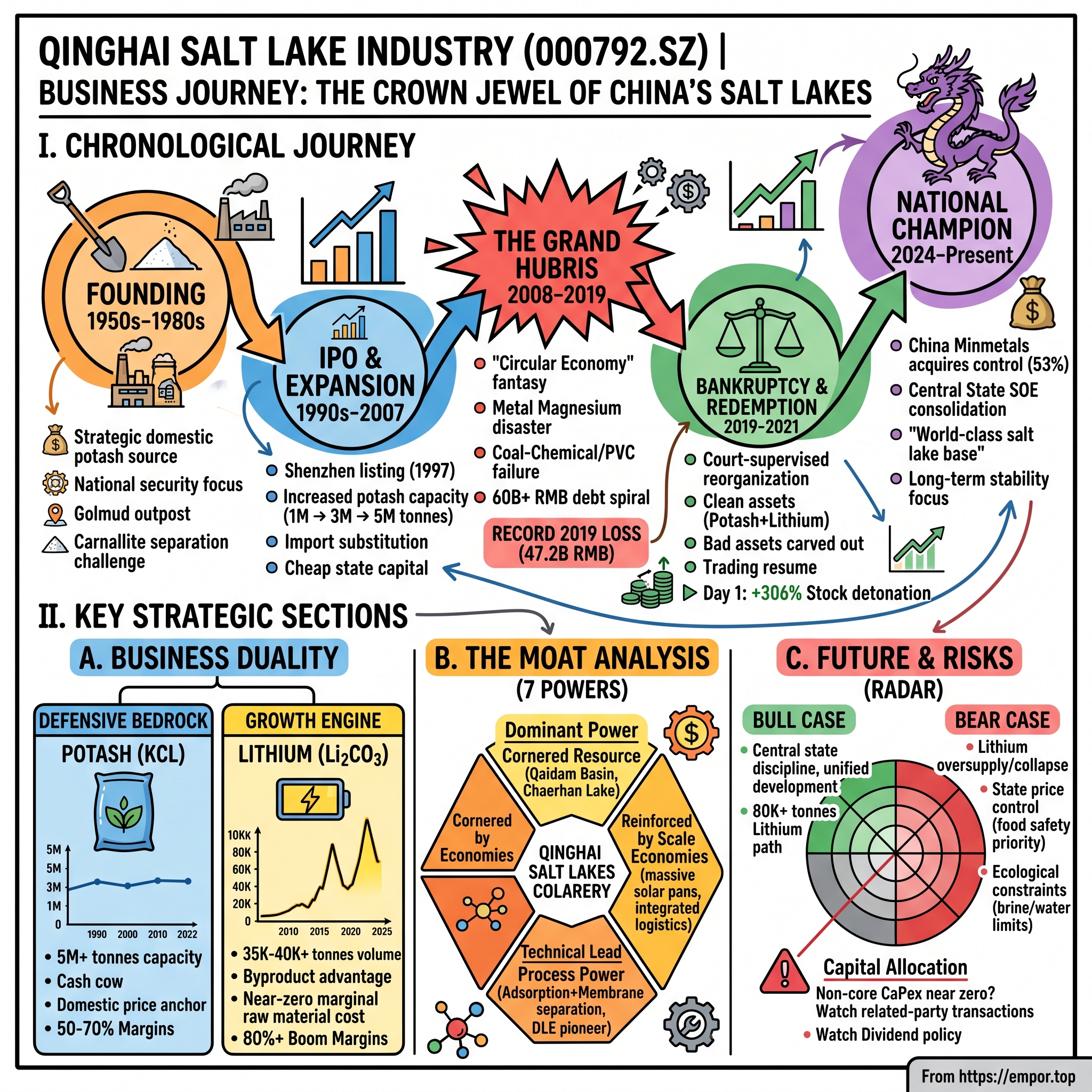
Qinghai Salt Lake Industry: The Crown Jewel of China's Salt Lakes
I. Introduction & Episode Roadmap
Picture a place where the ground itself is worth more than almost anything built on top of it. Drive west out of 格尔木 Golmud in Qinghai Province, up onto the roof of the world at roughly 2,700 meters, and the asphalt eventually gives way to something surreal: a road paved not with stone but with salt, a 32-kilometer causeway called the "Ten Thousand Zhang Salt Bridge" that runs straight across the crust of a dried-up inland sea. The crust is 15 to 18 meters thick, hard enough to carry the Qinghai-Tibet Railway.9 Beneath it lies 察尔汗盐湖 Chaerhan Salt Lake, 5,856 square kilometers of brine and mineral salts sitting in the high-altitude 柴达木盆地 Qaidam Basin.9 This is the deposit on top of which 青海盐湖工业股份有限公司 Qinghai Salt Lake Industry Co., Ltd. (000792.SZ, listed on the 深圳证券交易所 Shenzhen Stock Exchange) was built.
The elevator pitch is deceptively simple. Qinghai Salt Lake Industry turned a remote Mao-era fertilizer outpost into China's single most important domestic producer of 氯化钾 potassium chloride (potash), the fertilizer that keeps a country of 1.4 billion people fed, and, almost by accident, into one of the lowest-cost producers of 碳酸锂 lithium carbonate on the planet. It extracts that lithium not from a fresh orebody but from the waste brine its own potash plants would otherwise throw away.
But this is not a smooth compounding story. It is one of the great boom-bust-redemption arcs in Chinese corporate history. This is a company that torched more than 60 billion RMB on an industrial fantasy, posted what was at the time the largest single-year net loss in the history of China's A-share market, was declared bankrupt, entered court-supervised reorganization, and then came back from the dead — its stock quadrupling on the day it resumed trading.1[^4] Then, in 2024, the central state stepped in and folded it under 中国五矿集团 China Minmetals Corporation.5
Our central thesis, stated plainly so we can spend the rest of the article stress-testing it: Qinghai Salt Lake Industry sits on a genuine Cornered Resource in potash that underpins China's 粮食安全 food security, and it bolts onto that a lithium business with a cost structure hard-rock miners cannot match. That is a powerful combination. It is also a combination that history shows can be squandered by bad capital allocation, throttled by state price control, and diluted by minority-shareholder-unfriendly ownership structures. The interesting question is not whether the assets are good — they are — but who captures the value they throw off, and whether the people now running the company have learned the lesson the last generation of managers taught so expensively.
There is a temptation, with a company like this, to fall into one of two lazy narratives. The first is the promotional one: a debt-free monopoly on an irreplaceable resource, with a free lithium option on top and a central-government sponsor — what could possibly go wrong? The second is the cynical one: just another opaque Chinese SOE where minority shareholders are along for the ride and the state takes what it wants. The truth is more interesting than either, and it lives in the tension between them. The assets genuinely are extraordinary. The governance genuinely is complicated. And the history proves that both the upside and the downside of this particular business are larger than a casual observer would guess — this is a company that has, within a single decade, produced both a record-shattering loss and a fortune-making windfall from the very same salt flat.
Three questions frame everything that follows. First: how does a business with world-class core economics burn tens of billions on a single project and end up in bankruptcy court? Second: what exactly is the chemical trick that lets this company pull lithium out of brine that everyone else considered too contaminated to bother with? And third: now that a central-government champion owns control, does the capital-allocation playbook — and the dividend — actually change for the ordinary shareholder? Let's start where the story has to start: with the geology.
 Subscribe on LinkedIn
II. Geological Context & The Discovery of Chaerhan (1950s–1980s)
Every great resource company begins with an accident of geography, and Chaerhan's is spectacular. Millions of years ago the Qaidam Basin was an inland sea. As the Tibetan Plateau rose and the climate dried, the water evaporated and left behind an immense, layered deposit of soluble salts — sodium, potassium, magnesium, and, in trace concentrations, lithium — locked into a brine-soaked crust stretching to the horizon. Locals have a saying that the salt reserves could last a thousand years, and for once the folk exaggeration undersells it: Chaerhan is China's largest salt lake and ranks first in the country for potassium, magnesium, and lithium resources combined.910
The discovery itself was a happy byproduct of nation-building. In the mid-1950s, survey teams from the Qinghai highway bureau were pushing a road through the Qaidam Basin when they cut across the salt flat and found that the crust contained potassium chloride.10 The timing could not have been more loaded. This was the height of Cold War industrial self-reliance, and China had a specific, painful agricultural problem: its soils were chronically deficient in potassium. Without potash, crop yields stayed vulnerable, and the only alternative was importing fertilizer from a world that was not especially friendly to the young People's Republic. A domestic potash source in the far west was not a commercial opportunity so much as a strategic necessity.
So in 1958, in one of the least hospitable environments imaginable, the state founded what would become the Qinghai potash operation.10 The early production drama reads like industrial folklore. Workers built solar evaporation pans directly onto the salt crust, letting the fierce high-altitude sun do the work of concentrating the brine. They developed rudimentary flotation techniques to separate potassium chloride from carnallite — the stubborn double salt of potassium and magnesium chloride that makes Chaerhan's ore so much harder to process than a clean deposit.11 The first batch, produced near the salt lake, amounted to under a thousand tonnes.10 Everything was manual, everything was improvised, and everything happened at an altitude where the air holds a third less oxygen than at sea level and winter temperatures collapse well below freezing.
It is worth dwelling on that carnallite problem, because it is the technical thread that runs through the entire company, from potash to the lithium boom sixty years later. A clean potash deposit is a chemist's gift: you dissolve it, evaporate it, and crystallize nearly pure potassium chloride. Chaerhan gives you no such courtesy. Its potassium comes bound up with magnesium in carnallite, and magnesium is the villain of this whole saga — chemically clingy, hard to shed, and present in enormous excess. The flotation process the early engineers cobbled together was, in essence, a way to coax potassium chloride crystals to the surface of a slurry while leaving the magnesium behind, using surfactant chemistry to make the target mineral water-repellent enough to ride up on air bubbles.11 Decades of refining that separation gave the company a hard-won institutional competence in wrestling potassium away from magnesium — precisely the skill that would later make its lithium business possible. In a very real sense, the workers freezing on the salt flat in 1958 were laying the intellectual foundations for a battery-materials company nobody could yet imagine.
There was also a human cost embedded in the geography that the corporate history tends to gloss over. Golmud in the late 1950s was barely a town — a supply stop on the road to Tibet, hundreds of kilometers from anywhere. The people sent to build a fertilizer industry here were doing frontier labor in a place where a mistake with the weather could be fatal, where equipment had to be hauled in over primitive roads, and where the payoff was measured not in dividends but in whether the state could feed itself without a foreign supplier's permission. That founding ethos — resource development as an act of national security rather than commercial enterprise — never fully left the company's DNA, and it explains a great deal about the decisions, good and catastrophic, that came later.
The romance of the founding, though, should not obscure the structural weakness that defined these first decades. Remote logistics, no rail connection, primitive recovery rates, and a tiny output meant the operation was a proof of concept, not a pillar of national supply. For a long time China remained heavily dependent on the global potash oligopoly — the Canadian marketing arm Canpotex and Belarus's Belaruskali chief among them — that set world prices and could, in principle, squeeze a buyer as large as China. The deposit was a miracle; monetizing it at national scale was a different challenge entirely, and it would take the reform era, corporate restructuring, and a stock-market listing to unlock it. That is the next act.
III. Scaling China's Potash Titan & The Industrial Imperative (1990s–2007)
If the founding was about survival, the reform era was about scale — and about learning to speak the language of capital markets. In 1997, the potash operation was reorganized into a joint-stock company and listed on the newly energized Shenzhen Stock Exchange under the ticker 000792.SZ.15 For a state fertilizer plant in the remote west, an IPO was more than a financing event; it was an invitation to grow up, to answer to outside shareholders, and to fund the kind of expansion that decades of state budgets had never quite delivered.
The timing sat inside a broader national experiment. The late 1990s were the years when China was converting sprawling state industrial assets into listed joint-stock companies, using the young Shanghai and Shenzhen exchanges as instruments of reform as much as of finance. Listing a strategic resource operation like the Qinghai potash works served two masters at once: it raised outside capital to accelerate a project the state wanted built, and it imposed at least the form of market discipline — disclosure, a share price, minority owners — on an enterprise that had answered only to planners. That dual nature, half commercial vehicle and half instrument of state policy, was baked into the company's identity from the moment it rang the bell, and every chapter that follows is in some sense a working-out of the tension between those two roles.
And expand it did. The company marched its annual potash capacity up the ladder — past one million tonnes, then toward three million, and eventually beyond five million metric tonnes a year.7 What made this possible was not a single heroic factory but a system: hundreds of square kilometers of solar evaporation fields spread across the salt flat, automated dredges pumping brine through slurry pipelines, and dedicated rail spurs stitching Golmud into the agricultural heartland thousands of kilometers to the east. It was, in effect, a giant open-air chemical plant powered substantially by sunlight and gravity.
The macro backdrop turbocharged the effort. Through the 2000s, China's agricultural sector was industrializing fast, and potassium — the "K" in NPK fertilizer, essential for root strength, drought resistance, and yield — was the nutrient China could least produce for itself. Every tonne the company could ship domestically was a tonne the country did not have to buy from the Canadian and Belarusian marketing cartels that dominated the seaborne trade. This gave the expansion a strategic tailwind that a purely commercial fertilizer producer would never have enjoyed: cheap state-backed capital, priority rail allocation, and a customer base that included the state's own food-security apparatus. The company was not just building a business; it was building an import-substitution weapon, and Beijing wanted it to succeed.
Here is where the economics start to look genuinely special, and it's worth slowing down to understand why, because this cost advantage is the load-bearing wall of the entire investment case. Consider what it costs to mine potash the conventional way in Saskatchewan or Belarus: you sink shafts a kilometer underground, run continuous mining machines through hard rock, hoist the ore, and crush and refine it — enormous fixed capital and continuous energy and labor. Chaerhan skips almost all of that. There is no shaft, because the resource is dissolved in brine you can pump from the surface. There is little fuel cost for concentration, because the sun evaporates the brine for free. Labor per tonne is minimal because the process is largely physical and automated. The result was a cost position that let gross margins on potash swing between roughly 50% and 70% during global agricultural booms.10
Layered on top of the cost advantage was market position. At its scale, Qinghai Salt Lake Industry came to account for the majority of China's domestic potash production. The exact share depends on how you count: some measures put it near 60% of domestic output, while others — measuring against total national supply including imports — put it closer to a third, since China still imports well over half the potash it consumes.7 Either way, the company became the domestic price anchor. It couldn't dictate world prices, but it set the floor and the reference point that importers like 中化 Sinochem and Sinofert negotiated against when they sat across from Nutrien and Canpotex. That is real, durable power.
The mechanism of that power is worth making explicit, because it is subtle and it recurs. China runs an annual "potash import benchmark" negotiation, in which the country's large importers bargain as a bloc with the global majors over the contract price for seaborne potash. The existence of a big, low-cost domestic producer changes the balance of that negotiation entirely. If the foreign cartel pushes too hard, China can simply lean harder on domestic supply; the mere availability of Chaerhan's tonnage caps how much the sellers can extract. Qinghai Salt Lake Industry is therefore worth more to the Chinese state than its own profit-and-loss suggests, because it functions as a permanent bargaining chip that holds down the price of every imported tonne as well. That strategic value is also, as we will see, a double edge: an asset this useful to national policy is an asset the state will never fully let the market price, and never fully hand over to minority shareholders.
Tell the reader what this pattern actually meant, because it is the crux of the whole company. A commodity producer with a genuine low-cost position and majority domestic share is a rare and beautiful thing: it earns high margins in good times and, crucially, survives the bad times that bankrupt its higher-cost rivals. That combination should compound wealth almost automatically. The dark irony of Qinghai Salt Lake Industry is that it possessed exactly this kind of franchise and still nearly went bankrupt — not because the potash economics failed, but because management could not leave a good thing alone.
So by 2007, the picture was of a cash-generating, high-margin, strategically essential potash monopoly-in-effect. Which raises the obvious and, in hindsight, ominous question that every cash-rich commodity company eventually faces: what do you do with all that cash? The answer management chose nearly destroyed the company.
IV. The Grand Hubris: The Metal Magnesium Disaster & The 60-Billion-Yuan Debt Spiral (2008–2019)
Every commodity fortune eventually meets its temptation, and for Qinghai Salt Lake Industry the temptation wore the seductive costume of the "circular economy." To understand how a profitable potash business talked itself into near-oblivion, you have to start with a genuine engineering problem sitting in plain sight on the salt flat.
For every tonne of potassium chloride the plants produced, they generated something like eight to ten tonnes of magnesium-chloride-rich waste brine — the 老卤 "old brine" — which was pumped back out onto the lakebed.10 Over years, this raised a real concern: "magnesium pollution," the gradual buildup of magnesium that could dilute and degrade the very brine the potash business depended on. Management looked at this waste stream and saw not a disposal cost but a resource. Magnesium metal is valuable — it's the lightweight structural metal that automakers and aerospace engineers covet. Why not turn the poison into gold?
Thus was born, over 2008 to 2016, the mega-scale "Salt Lake Resource Comprehensive Utilization Project," anchored by the 金属镁一体化项目 Metal Magnesium Integration Project and married to coal-chemical and PVC plants under the 盐湖海纳化工 Salt Lake Haina Chemical banner.12 The pitch to government planners was intoxicatingly clean: take the waste magnesium brine, use cheap local coal to power its conversion into magnesium metal, produce PVC from the salt, capture every molecule, waste nothing. On a PowerPoint slide, it was an infinite loop of value creation — a textbook circular economy that no state planner could resist blessing.
There is a seductive logic to a pitch like this, and it is important to be fair about why smart people backed it. Waste disposal really was a cost; magnesium metal really is valuable; local coal really was cheap; and the Chinese state genuinely prizes projects that maximize resource utilization. Every individual premise was defensible. What the pitch quietly assumed away was execution risk — the possibility that turning a slide deck's clean loops into working metallurgy would prove far harder, slower, and more expensive than anyone modeled. In commodities, the graveyard is full of "integrated" mega-projects that made perfect sense on paper and could not survive contact with physics. Qinghai Salt Lake Industry was about to add a marquee headstone.
Reality was a corrosion nightmare. Producing magnesium metal from molten magnesium chloride is brutally difficult chemistry, and doing it at commercial scale, at altitude, with unproven process engineering, turned out to be a machine for destroying capital. The molten salts ate through equipment. Downtime was chronic. Costs overran budgets by margins that would make any project-finance banker weep. And as all this was happening, the coal-chemical and PVC economics that were supposed to subsidize the effort collapsed with commodity prices. The magnesium project became a sinkhole that swallowed the cash flows thrown off by the excellent potash business, and then reached for the debt markets. Over the build-out, the group piled up tens of billions of RMB in bank debt, with the broader misadventure ultimately consuming more than 60 billion RMB.1
The financial deterioration was not a single dramatic cliff but a slow bleed that turned into a hemorrhage. The company slid into losses starting in 2017, and across the three years from 2017 through 2019 it bled billions, the wound widening each year as more of the magnesium and chemical investment had to be recognized as impaired rather than productive.[^4] This is the pattern of a classic capital-allocation disaster: the core business keeps generating cash, but that cash is continuously fed into a project that never reaches the promised economics, while the debt taken on to build it compounds regardless. For a while, a profitable potash franchise can mask the drain. Then the auditors arrive.
The reckoning arrived in 2019, and it was biblical. When the auditors forced the company to confront the impaired value of its chemical and magnesium assets, the writedowns hit like a tsunami. Qinghai Salt Lake Industry warned that its 2019 net loss would land somewhere between roughly 43.2 billion and 47.2 billion RMB — on the order of $6.5 billion — one of the single largest annual losses ever recorded by a listed Chinese company, and largely driven by the writeoff of that package of loss-making assets.123 It was the third straight year of losses.[^4] In May 2020 the shares were suspended from trading, the company faced delisting risk, and it had defaulted on its obligations.[^4]
The lesson here is not subtle, but it is worth stating without flinching because it is the moral spine of the whole story: a truly world-class core asset does not immunize a company against management's ambition. The potash business was one of the best commodity franchises on earth. It was very nearly killed by the belief that its cash flows entitled management to build an industrial empire in a business they did not understand. What saved it was not a better strategy. It was a courtroom.
V. Bankruptcy Reorganization, Asset Stripping, & The Phoenix Relisting (2019–2021)
Bankruptcy, in the right hands, is a scalpel. The genius of what happened to Qinghai Salt Lake Industry between 2019 and 2021 was that the court-supervised reorganization did something management never could bring itself to do voluntarily: it cut the company in two and threw the bad half away.
The process ran under the supervision of the Qinghai courts, with state banking creditors at the table, and the logic was clinical.3 Separate the "good" assets — the potash mining rights and the brine lithium business — from the "toxic" assets, the magnesium and coal-chemical operations dragging tens of billions in debt. The good assets would stay with the listed company; the bad assets would be carved out and dumped into a state-backed vehicle created precisely to absorb distressed liabilities, 青海汇信资产管理 Qinghai Huixin Asset Management.
The mechanics were harsh, as they had to be. In April 2020, an agreement was struck to transfer the money-losing magnesium and Haina chemical subsidiaries to Huixin for roughly 3 billion RMB — a nominal figure against tens of billions in embedded debt.12 Someone had to absorb that gap, and the "someone" was creditors and equity holders, who swallowed enormous haircuts. Financial institutions that had lent billions were pushed into debt-to-equity conversions, turning their soured loans into shares of the cleaned-up parent. This is the unglamorous truth beneath every triumphant "phoenix rising" narrative: the phoenix rises because the people who financed the fire are forced to eat the ashes. For a neutral observer, that matters — it tells you that the spectacular post-restructuring returns were partly a transfer of value from old creditors to new shareholders, not pure operational magic.
It is worth pausing on why Chinese bankruptcy reorganization could accomplish here what shareholder pressure never would have. In a Western context, a board might have been forced to write down the magnesium project years earlier, or an activist might have agitated to sever it. In the Chinese state system, none of those pressure valves existed; the project had political sponsorship, and provincial pride was invested in it. Only a court-supervised process, backed by creditor banks that were themselves state-owned and finally unwilling to keep funding the losses, had the authority to override that inertia and force the amputation. The restructuring, in other words, was less a triumph of the market than a case of one arm of the state overruling another once the arithmetic became undeniable. That is a distinctively Chinese path to redemption, and it colors how much credit management — as opposed to circumstance — deserves for the recovery.
The reorganization also reset the shareholder register in ways that still matter. Through the debt-to-equity conversions and the broader restructuring, the ownership was reshuffled; the provincial state investment vehicle that had been the dominant owner saw its stake diluted to around 14% even as it remained the largest single shareholder heading into the relisting.[^4] A company that emerged from bankruptcy with its controlling owner holding only a modest stake was, in effect, structurally primed for the later central-government consolidation — there was no entrenched majority owner to resist it.
But operational magic there also was, because what remained after the surgery was genuinely pristine: a debt-light company holding a cornered potash resource and a fast-growing, ultra-low-cost lithium business, at the exact moment the electric-vehicle boom was about to send lithium prices vertical. The market understood this immediately.
On August 10, 2021, after a 15-month suspension, 000792.SZ resumed trading on the Shenzhen exchange — and because it was returning from suspension, it did so without the usual daily price limit.[^4]16 The stock did not rise. It detonated, closing up roughly 306% at 35.90 RMB, a near four-fold gain in a single session.[^4] Investors were suddenly bidding for something that had not existed a year earlier: a recapitalized, essentially debt-free potash monopoly with a lithium call option attached, at a time when the company had already swung back to a modest profit of around 2 billion RMB in 2020.[^4] The market capitalization vaulted past 200 billion RMB.
Why did the market react with such violence to the upside? Part of it was mechanical — a stock returning from a long suspension with no daily price limit can reprice all at once rather than in the usual small daily increments — but most of it was a genuine repricing of what the company had become. Before the suspension, investors owned a debt-laden fertilizer maker dragging a metallurgical albatross. After it, they owned something categorically different: a clean, cash-rich resource company arriving at the dawn of the electric-vehicle era with a low-cost lithium business attached. The 306% move was the market compressing that entire transformation into a single trading session.
It was one of the most dramatic restructuring outcomes in the history of the A-share market. And yet the single most valuable thing to survive the fire was not the potash business investors thought they were buying. It was the small, technically formidable lithium subsidiary that most of the market had barely noticed. That is the story of the next act.
VI. The Lithium Revolution: How Lanke Lithium Turns Waste Brine into White Gold
For years, the most valuable technology in the entire company was being developed almost as a science project inside a subsidiary most investors couldn't name: 青海盐湖蓝科锂业股份有限公司 Qinghai Salt Lake Lanke Lithium Co., Ltd. — Lanke Lithium. To appreciate why it matters, you have to understand why everyone assumed Chaerhan's lithium was worthless.
Here is the chemistry problem, in plain terms. The best lithium brines on earth — the salars of Atacama in Chile, Hombre Muerto in Argentina — have a low ratio of magnesium to lithium, often under 8-to-1. That matters because magnesium and lithium are chemically similar and stubbornly hard to separate; the less magnesium you have to fight, the easier the extraction. Those South American brines are so clean that you can concentrate lithium simply by letting the sun evaporate pond after pond. Chaerhan is the opposite. Its magnesium-to-lithium ratio is extraordinarily hostile — on the order of 30-to-1 up to 60-to-1 — and its lithium is present at punishingly low concentrations, roughly 0.2 to 0.3 grams per liter. For decades this made Chaerhan lithium a textbook example of a resource that existed on paper but could not be economically extracted.
The breakthrough was a two-step technology that reads like industrial alchemy: 吸附法+膜法 adsorption plus membrane separation.13 Think of it as a molecular fishing operation. First, engineers developed specialized aluminum-based adsorption resins — materials designed to selectively grab lithium ions out of the brine while ignoring the overwhelming flood of magnesium around them, like a magnet that attracts only one metal in a bin full of scrap. Then nanofiltration membranes further separate and concentrate what the resin captured. Crucially, this process works directly on the dilute old brine, without the pre-evaporation step the South Americans rely on. Lanke had been chasing this since around 2011, made a key leap around 2014 by adapting second-generation adsorption technology, and turned it into a commercial process over the following years.13
This is the family of technologies the industry now calls direct lithium extraction, or DLE, and it is genuinely one of the frontier processes in battery materials — the same broad approach that companies from Nevada to Argentina have spent billions trying to commercialize. What makes Lanke's version notable is not that the underlying idea is unique but that the company was forced by Chaerhan's brutal chemistry to make it work at scale earlier and against worse odds than almost anyone else. When your ore is the hardest in the world, necessity does the R&D. The proof of concept was not a pilot plant but a full commercial operation feeding a real market, and by 2021 the broader Qinghai salt-lake lithium complex — Lanke plus peers on the same flat — had pushed combined annual lithium-carbonate capacity past 90,000 tonnes, with Chaerhan holding proven lithium chloride reserves on the order of 12 million tonnes.8 A resource the textbooks had written off as uneconomic had become one of the country's most important domestic lithium sources.
Now here is why the whole thing is so beautiful, and it comes down to a single word: byproduct. The raw material for Lanke's lithium — the old brine — has already been pumped, processed, and paid for by the potash division. The lithium business inherits it at essentially zero marginal raw-material cost. That is the source of a cash cost position that competitors simply cannot replicate. Where an Australian hard-rock converter, digging spodumene and roasting it into lithium, might carry cash costs on the order of $12,000 to $18,000 per tonne, Lanke's operating cash cost for battery-grade lithium carbonate has run in the neighborhood of $4,000 to $5,000 per tonne — roughly 30,000 to 35,000 RMB, consistent with industry estimates of Qinghai salt-lake production costs in the 30,000-to-60,000-RMB range.8 In a commodity, the low-cost producer is the last one standing when prices crash, and Lanke sits at the very bottom of the global cost curve.
Who buys all this lithium carbonate matters to the durability of the story. China is home to the world's dominant battery ecosystem — 宁德时代 CATL and 比亚迪 BYD anchor a supply chain that consumes an enormous share of global lithium — and a domestically produced, low-cost, battery-grade carbonate feeds directly into Beijing's ambition to control that chain end to end. That gives Lanke's output a strategic pull beyond its own economics: it is not just cheap lithium, it is Chinese cheap lithium, insulated from the geopolitics of imported spodumene and salar concentrate. In a world where lithium supply has become a matter of national industrial policy, being the low-cost domestic source is a position with value that a simple cost-curve chart understates.
Then the EV super-cycle arrived and turned this quiet cost advantage into an earnings explosion. Lanke scaled capacity from around 10,000 tonnes toward 30,000 and then 40,000 tonnes a year, part of a Qinghai salt-lake lithium complex whose combined capacity pushed past 90,000 tonnes.8 When lithium carbonate prices spiked toward an almost unimaginable 600,000 RMB per tonne in late 2022, a producer with a sub-35,000-RMB cost was earning net margins that beggar belief — well north of 80% on that output. The financial result at the parent level was staggering: for full-year 2022, Qinghai Salt Lake Industry reported net profit of about 19.7 billion RMB, up roughly 277%, on revenue of 30.7 billion RMB, with net profit attributable to shareholders around 15.5 billion RMB once you strip out the large minority interest in Lanke.4 The cash this threw off didn't just improve the balance sheet; it sanitized it completely. The company that had been bankrupt three years earlier now had one of the cleanest balance sheets in Chinese materials, with a liability-to-asset ratio around 32%.4
Then came the test that separates a real cost advantage from a lucky one: the crash. Lithium carbonate prices, having touched their absurd late-2022 peak, collapsed through 2023 and 2024 as a wave of new global supply met cooling EV-subsidy enthusiasm. For most of the industry this was carnage; high-cost spodumene converters saw their margins vanish and some mothballed capacity. For Qinghai Salt Lake Industry, the crash was painful but survivable — exactly the asymmetry the bull case predicts. Net profit fell hard in 2023, roughly halving from the 2022 peak, and revenue kept sliding into 2024 as both lithium and potash prices normalized off their highs. But the company stayed decisively profitable and cash-generative throughout, because when your lithium cash cost sits near the bottom of the global curve, a price crash compresses your enormous margin rather than pushing you into the red. This is the single most important thing the down-cycle proved: the byproduct economics are not a fair-weather story. They are what lets the company keep printing cash while competitors bleed — and, in a commodity, outlasting the competition through the trough is how the low-cost producer wins the next up-cycle. The 2023–2024 slump did not break the thesis; it stress-tested and largely validated it, while also making clear just how violently the reported earnings will swing from year to year.
An asset this valuable, in a sector Beijing has declared strategic, was never going to be left in provincial hands. Which brings us to the central state.
VII. The National Champion Era: China Minmetals & State Capital Consolidation (2024–Present)
By 2024, the calculus around Qinghai's salt lakes had changed at the highest levels of the Chinese state. Lithium was no longer a niche industrial chemical; it was the strategic material at the heart of the electric-vehicle and energy-storage supply chains that Beijing intended to dominate globally. And the country's single best salt-lake lithium asset was controlled at the provincial level, sitting alongside other fragmented Qaidam Basin concessions under separate owners. To a central planner, that fragmentation was a problem to be solved.
The solution was announced in September 2024. The 青海国资委 Qinghai SASAC and the central state-owned giant 中国五矿集团 China Minmetals Corporation agreed to establish a new holding entity, 中国盐湖工业集团 China Salt Lake Industry Group Co., Ltd., with registered capital of 10 billion RMB.56 The ownership was carefully calibrated: China Minmetals would hold 53% and thus control, the Qinghai state-asset regulator 18.73%, and the regulator's investment arm the remainder.5 Through this new parent, control of the listed Qinghai Salt Lake Industry passed from the province to a central SOE — a transaction valued at roughly $1.9 billion, and one that had been telegraphed in a restructuring plan unveiled earlier, in May 2024.57 The new group brought together Qinghai Salt Lake Industry, Qinghai Huixin, and Minmetals' own salt-lake operations, with the explicit ambition of building a "world-class salt lake industry base."714
Who is China Minmetals, and why does its arrival matter? It is one of the largest central state-owned enterprises in the metals and minerals space, a globe-spanning miner and trader that already controls significant positions across China's strategic-materials supply chains. Handing it the salt lakes is Beijing's way of treating lithium and potash the way it treats rare earths or copper — as national assets to be managed by a central champion rather than a patchwork of provincial and private operators. The deal was structured deliberately to consolidate the whole Qaidam neighborhood: it merged Qinghai Salt Lake Industry with Minmetals' own salt-lake operations and the Huixin distressed-asset vehicle, and it aligned with a 2021 Qinghai provincial goal of building the salt-lake sector into a roughly 120-billion-RMB industry by 2035.7
The strategic rationale is coherent, and it's worth taking seriously rather than dismissing as mere empire-building. Consolidating Chaerhan, the Yiliping salt lake previously under Minmetals, and surrounding brine concessions under one national operator allows for coordinated development, shared technology standards, and a unified approach to the ecological limits of the basin. It also fits a broader Beijing pattern of pulling strategic resources under central, disciplined management — and, not incidentally, of preventing the kind of freelancing provincial mega-project that produced the magnesium disaster in the first place. Seen through that lens, the Minmetals takeover is partly an institutional answer to the governance failure that Section IV described: a structural guarantee that no future provincial chairman can bet the company on another circular-economy fantasy without central sign-off.
On the question of management credibility, the record demands a split verdict. The team that steered the company through the post-2021 relisting deserves genuine credit: it delivered the operational recovery, ramped Lanke through the boom, kept the balance sheet clean, and — critically — resisted the temptation to re-diversify when the 2022 cash flood arrived. That restraint, after the institutional memory of the magnesium disaster, was the single most important capital-allocation decision of the era, and it was made correctly. But investors should also note that the narrative of "focus on core brine assets" has been enforced as much by circumstance and creditor supervision as by pure managerial conviction, and that leadership itself has turned over as central control arrived, with the chairman who oversaw the recovery departing as China Salt Lake Group installed its own slate.17 The right way to hold this is with cautious optimism rather than trust: the behavior since 2021 has been disciplined, but the disciplined era is young, the leadership is new, and the true test of capital allocation — what a central SOE does with a mountain of potash cash when the next shiny adjacent project appears — has not yet been run.
For minority shareholders, the arrival of China Minmetals cuts two ways, and an honest assessment has to hold both. On the encouraging side: central-SOE governance brings capital discipline, an implicit sovereign backstop, and — one hopes — an explicit mandate against the non-core chemical adventurism that nearly killed the company. Governance was visibly in flux, with leadership turnover including the departure of the chairman who had steered the company through its post-restructuring recovery as the new controlling shareholder installed its own slate.17 On the cautionary side sits the central tension of any Chinese SOE minority position: when the controlling shareholder is the state, and the assets are declared essential to national food and energy security, whose interests come first when they conflict? Beijing may at times want cheap fertilizer for farmers or abundant lithium for battery makers more than it wants a fat dividend for public float holders. The controlling shareholder retaining a stake above 50% provides stability and sovereign backing, but it also means the minority is, permanently, a passenger.
As of mid-2026, the picture is of a company still in the early innings of its central-champion era. The listed entity continues to operate the Chaerhan potash and lithium businesses much as before, but now under a controlling structure whose priorities — world-class basin integration, technological standardization, disciplined capital allocation — are set at a level above the province. The reorganization that placed China Salt Lake Group at the top, with Minmetals holding 53% of that group, remains the defining fact of the ownership story, and the market is still learning what kind of steward the new owner will be.5 The most honest thing that can be said is that the assets have never been in better shape and the governance has never been more centralized — and that whether those two facts add up to a good outcome for the ordinary shareholder is a question the next several years, not the past several, will answer. Holding that tension in mind, let's open up the actual business and see how the money is really made.
VIII. Business Breakdown & Segment Financial Economics
Strip away the drama and Qinghai Salt Lake Industry resolves into a strikingly simple structure: two products pulled from one brine, plus some odds and ends. Understanding the company means understanding how differently those two products behave.
Segment 1: Potash — the defensive bedrock. This is the ballast. The company produces on the order of 5.0 to 5.5 million tonnes of potassium chloride a year, and its capacity of roughly 5 million tonnes makes it the anchor of Chinese domestic potash supply.47 In a normalized year, potash contributes the majority of revenue, and its economics are stable in a way lithium never is: gross margins in the 50%-to-65% band, realized prices tethered to a mix of domestic agricultural policy and the annual import benchmark that Chinese buyers negotiate with the global majors. The key analytical point is that potash is not where the excitement lives — it is where the survival lives. It is the segment that kept the lights on during the lithium collapse and that makes the company structurally cash-generative across the cycle. Its ceiling is capped by Beijing's desire to keep fertilizer affordable for farmers; its floor is protected by import-parity pricing and its own rock-bottom cost position.
Segment 2: Lithium — the high-beta growth engine. Here is the volatility, and the optionality. Volumes have scaled to roughly 35,000 to 40,000-plus tonnes a year, with an integrated basic-lithium-salt project pushing toward the completion of another 40,000-tonne block and longer-run ambitions toward 80,000-plus tonnes.7 Because lithium prices can swing by an order of magnitude, this segment's contribution to profit lurches from modest to dominant and back. The crucial insight — and it is the whole reason to own the lithium exposure rather than a pure-play miner — is asymmetry. Thanks to the byproduct cost structure explained earlier, Lanke stays cash-positive even at cyclical lithium lows that force high-cost spodumene converters to shut down. So the lithium segment functions like a perpetual, low-cost call option on long-term battery demand: enormous upside in a boom, and a downside that is bounded by a cost floor rather than by bankruptcy risk. That is a rare shape in a commodity business.
There is a further wrinkle in the lithium segment that shapes how much of its profit actually reaches a shareholder of 000792: Lanke Lithium is not wholly owned. A meaningful minority stake sits with outside holders, which is why, in a blockbuster year like 2022, the gap between the group's total net profit of roughly 19.7 billion RMB and the net profit attributable to Salt Lake's own shareholders of about 15.5 billion RMB is so large — several billion RMB of the lithium windfall flows straight through to Lanke's minority partners.4 For the parent-company investor, the lithium exposure is therefore powerful but partial, and any model of the company has to haircut Lanke's headline earnings accordingly. It is a reminder that in Chinese resource conglomerates, the corporate structure between the asset and the shareholder can quietly claim a large slice of the economics.
Segment 3: Legacy salts and byproducts. Rounding out the portfolio is a modest collection of industrial sodium chloride and chemical feedstocks, plus early-stage research into trace elements like rubidium and cesium in the brine. Financially this is a rounding error — call it around 5% of revenue — and management's discipline in keeping it small is, after the magnesium saga, itself a reassuring signal. The optionality here is real but should not be overweighted: rubidium and cesium are genuinely valuable per kilogram and the brine contains them, but extracting them economically at scale is an unproven proposition, and the company has earned the right to be judged skeptically on any claim of turning trace elements into a business. The correct posture is to treat these as free call options embedded in the resource, worth something only if the chemistry and the markets both cooperate, and worth precisely nothing in a base case.
The physical logic ties it together in one clean cascade. Raw brine comes out of Chaerhan; the potash plants take their cut through flotation and crystallization, producing the fertilizer cash cow; the depleted "old brine" then flows to Lanke, which fishes out the lithium at near-zero incremental raw-material cost before the residue returns to the lake. One resource, extracted twice, monetized in two completely different markets. It is an elegant machine — which is exactly why the strategic frameworks are worth applying rigorously rather than taking the elegance on faith.
One under-appreciated feature of this cascade deserves a flag, because it is both a strength and a hidden vulnerability: the two businesses are physically coupled. Lanke's lithium feedstock exists only because the potash division is running and generating old brine. In the good case, that coupling is pure synergy — the lithium business genuinely does inherit free raw material. But it also means the lithium output is, over the long run, tethered to the pace of potash extraction and to the evolving chemistry of the lake itself. If potash volumes were ever constrained, or if the brine's composition shifted with decades of drawdown, the lithium business would feel it upstream. The machine is elegant precisely because the two products come from one flow; that same singularity is why the health of the underlying resource — its concentration, its magnesium balance, its water — is not a footnote but the foundation everything rests on.
IX. The Strategy & Economics Playbook
So how durable is this, really? Let's run the company through two lenses investors trust — Hamilton Helmer's 7 Powers and Porter's Five Forces — and be honest about where the moat is deep and where it is shallower than the bull case admits.
Start with Helmer, because the standout power is obvious. The dominant one is Cornered Resource: Qinghai Salt Lake Industry controls extraction rights over the richest mineral brine deposit in China, an irreplaceable geological asset that cannot be built, bought, or engineered elsewhere within the country's borders.910 This is the real thing — the closest a commodity company gets to an unassailable position, because the moat is literally the ground. Reinforcing it is Scale Economies: hundreds of square kilometers of evaporation pans, integrated pipelines, and dedicated rail drive per-tonne processing and logistics costs below any domestic rival, and scale advantages in a fixed-geography operation compound over time. The third and subtler power is Process Power — the adsorption-and-membrane know-how at Lanke, refined over more than a decade against the specific chemistry of high-magnesium brine. Unlike the resource, this one is contestable: peers like 藏格矿业 Zangge Mining operate on the same salt flat and are climbing the same learning curve, and direct-lithium-extraction technology is advancing globally. Process Power here is real but not permanent, and a careful investor should treat it as a lead to defend, not a fortress.
Now Porter, which sharpens where the pressure comes from. Threat of new entrants: essentially zero. Mineral rights in Qinghai are controlled by the state, and ecological caps on brine and freshwater extraction foreclose new commercial entrants regardless of capital. Supplier power: essentially zero, because the key input is self-extracted brine from sovereign concessions — there is no supplier to hold you up. Buyer power: moderate, and asymmetric between the two products. Potash buyers are diffuse, but the real "buyer" that matters is the state, which caps potash pricing at the top to protect 粮食安全 food security while import parity buffers the bottom; lithium buyers are cyclical battery and cathode makers whose leverage swings entirely with the lithium price. Threat of substitutes: low for potash — potassium is an irreplaceable plant macronutrient with no substitute a farmer can use — and low-to-moderate for lithium, where sodium-ion batteries genuinely threaten the low-end stationary-storage market even as lithium remains dominant for the energy density EVs demand. Competitive rivalry: low domestically, with Qinghai Salt Lake dwarfing Zangge in scale, though in lithium the company competes globally against a flood of Australian, African, and South American supply it cannot control.
It helps to place the company against its global reference points, because the comparison sharpens exactly what is and isn't defensible. Set the potash business beside Nutrien or the Saskatchewan majors and Belarus's Belaruskali, and Qinghai Salt Lake Industry's edge is structural and local: it will never match their sheer export scale, but within China its brine-and-solar cost base and its policy-anchored home market make it effectively unassailable on its own turf. Set the lithium business beside the Australian spodumene complex — the Pilbara hard-rock miners and their Chinese converter partners — and the picture flips: here Salt Lake is a small player by volume but a giant on cost, sitting far below them on the curve. And set it beside the South American brine majors, and the humbling truth emerges: those producers enjoy both low cost and clean chemistry, whereas Salt Lake had to invent its way around the worst brine chemistry in the business just to reach a comparable cost position. The company is, in short, a top-tier cost operator that earned its place the hard way, in two commodities where it holds very different competitive positions.
The synthesis a neutral investor should carry forward — the explicit "why win / why not" spine — is this. It wins from here if two things hold: the potash cornered resource keeps throwing off cash that the state allows it to earn, and the lithium cost advantage survives the expansion to 80,000-plus tonnes without cost creep. The case breaks if either leg fails: if Beijing caps potash to fight food inflation, or if lithium stays depressed long enough and the cost edge erodes as the company reaches for lower-grade brine. The potash moat is about as strong as commodity moats get, anchored in geography and reinforced by state policy. The lithium moat is narrower — a genuine and valuable cost advantage, but one that lives inside a brutally cyclical global market where the company is a price-taker. The bull case rests on those two very different kinds of edge; the bear case is mostly about the second one buckling, or about the state quietly capturing the spoils of both. Let's test all of it.
X. Analysis, Risk Radar, & Bull vs. Bear Case
If you were to distract a skeptical analyst from everything else and force them to watch just a few numbers, these are the ones that actually matter for tracking this company — and notably, none of them is the headline net-profit figure that grabs the news.
KPI one: potash realized price and production volume. This is the baseline profitability engine — tonnes shipped multiplied by net realized RMB per tonne — and because potash is the stable segment, it tells you how the floor of the business is holding. KPI two: Lanke Lithium's cash operating cost and capacity utilization. The entire lithium thesis rests on cost, so the question to monitor is whether unit cash costs stay anchored below roughly 35,000 RMB per tonne even as the company expands into new, potentially less-favorable ore and adds fixed capacity. If costs creep up as capacity grows, the moat is eroding in real time. KPI three: non-core capital expenditure. After the magnesium catastrophe, the single most important governance metric is negative space — how much capital is going anywhere other than core brine operations. It should be near zero. Any drift toward "diversification" is the alarm bell history taught this company to fear.
Two technology-disruption risks deserve their own mention, because they cut at the lithium leg specifically. The first is sodium-ion batteries: as the chemistry matures, it threatens to take over the low-value end of the market — grid storage, cheap short-range vehicles — where energy density matters less than cost. That would not dethrone lithium for premium EVs, but it could shave the top off long-run lithium demand growth and therefore off the price. The second is the proliferation of direct lithium extraction itself. Lanke's process is formidable today partly because DLE is hard and few have made it work at scale; if the technology becomes cheaper and more widely deployable across the world's many marginal brine and even oilfield resources, some of the scarcity value of being one of the few who cracked it will erode. Neither risk is imminent, but both are reasons to treat the lithium moat as a cost advantage to be defended rather than a permanent entitlement.
The risk radar has three genuine hazards, and it's worth separating them from macro noise. First, lithium oversupply: a prolonged global glut that holds prices below roughly $10,000 per tonne would compress the earnings that made this stock a phenomenon — though, crucially, the low cost position means the company stays cash-positive while higher-cost rivals bleed and close, so this is an earnings risk, not a survival risk. Second, agricultural price intervention: Beijing can cap domestic potash prices to shield farmers during inflationary periods, directly transferring value from the company to agriculture — a policy risk with no market hedge. Third, ecological and water constraints: the Qaidam Basin is fragile, and restrictions on total brine drawdown or on the freshwater needed for membrane washing could physically cap output. These are the mechanisms that could actually impair the business; generic macro fears are largely irrelevant to a low-cost domestic resource operator.
Now the activist's stress test, integrated rather than tacked on, because it targets the real soft spot: governance and capital allocation under state control. A skeptical long/short investor would ask two pointed questions. Will China Minmetals actually return the torrent of cash a potash-plus-lithium monopoly generates to minority holders through dividends and buybacks — or will national industrial policy, subsidized fertilizer, and strategic lithium supply come first? And will the cash flows from Chaerhan be quietly diverted to prop up weaker state mining assets elsewhere in the Minmetals empire, a risk endemic to SOE conglomerates? These are not paranoid questions. They are the precise mechanisms by which good assets deliver mediocre shareholder outcomes, and the honest answer today is that the post-2024 dividend and capital-return track record under central ownership is still being written.57
A second-layer diligence note belongs here, because it is where the real money is won or lost for a minority holder in a business like this. Watch three things beyond the income statement. First, the dividend policy under the new owner: after 2024, the company sat on large accumulated distributable reserves rebuilt from the boom years, and the pace and generosity with which those are actually paid out will be the single clearest signal of whether Minmetals intends to treat public shareholders as partners or as passengers. Second, related-party transactions: as part of a larger central-SOE group with its own salt-lake and mining assets, the potential for cash to move toward affiliates on non-arm's-length terms is a structural risk that disclosure quality will either allay or confirm. Third, capital-expenditure mix in the filings: the promised discipline is only as good as the actual capex lines, and the moment non-core spending reappears is the moment the market should re-underwrite the whole story. None of these is a red flag today; all three are the specific places a skeptical investor should keep the flashlight pointed.
Which frames the bull and bear cases cleanly. The bull case: China Minmetals brings discipline and integration, optimizes Qaidam Basin operations across a unified base, drives Lanke toward 80,000 tonnes at a bottom-of-the-cost-curve structure, and — backed by a debt-free balance sheet and essential-national-asset status — settles into a durable dividend payer. In this version, the restructuring cleansed not just the balance sheet but the strategy, and the cornered resource finally compounds for shareholders. The bear case: lithium prices stay depressed for years, eviscerating the growth engine's earnings; Beijing caps potash to fight food inflation, capping the cash cow; and ecological or brine-dilution problems slowly impair evaporation yields — all while state priorities siphon returns away from the float. Neither case is fantasy; the truth over the next cycle depends heavily on the lithium price and on how the new central owner treats the people who don't hold the controlling stake.
XI. Epilogue & Key Takeaways
Stand back from the whipsaw of losses and windfalls, and a few lessons crystallize that outlast any single year's lithium price.
The first is a warning every cash-rich company should tattoo somewhere visible: beware the circular-economy siren song. Qinghai Salt Lake Industry did not fail because its core business was weak. It nearly died because a spectacular core asset convinced management it could conquer an adjacent business it did not understand, and the magnesium dream burned 60 billion RMB proving otherwise. Great economics in one activity are not a license to underwrite unproven mega-projects in another; if anything, the abundance of cash is the danger.
The second lesson is the flip side, and it is the thing that makes this company genuinely special: in commodities, cost-curve position is everything, and a zero-cost byproduct is the ultimate cost advantage. Lanke Lithium did not win by finding better lithium; it won by extracting lithium from waste its sister division had already paid to produce. That single structural fact turned a resource everyone else wrote off as too contaminated into one of the lowest-cost lithium operations on earth. When you find a business whose raw material is genuinely free, pay attention.
The third is about restructuring itself. When a court reorganization successfully severs toxic debt and bad assets from a cornered resource, the equity upside on the far side can be extraordinary — a 306% single-day gain is the receipt.[^4] But the neutral investor never forgets who paid for that upside: the creditors and old shareholders forced into haircuts and debt-for-equity swaps. Redemption stories are real, but they are also, always, transfers.
There is a fourth lesson, quieter than the others, that this company teaches about the Chinese state-capitalist model itself. The very features that make Qinghai Salt Lake Industry frustrating to a minority shareholder — state control, policy-driven pricing, national-security framing — are inseparable from the features that make it safe. It was the state that funded the founding when no market would; it was the state banking system that absorbed the losses when the magnesium dream failed; and it is the state that guarantees the resource can never be competed away. An investor in this company is not buying a normal business. They are buying a slice of a strategic national asset whose upside is capped by policy and whose downside is cushioned by it. Whether that is a good trade depends entirely on price and on the dividend — the two things this analysis deliberately does not opine on — but understanding the shape of the bargain is the whole point.
Qinghai Salt Lake Industry stands today as a monument to China's industrial geography — a company that survived a self-inflicted, tens-of-billions mistake to emerge as an indispensable steward of the country's fertilizer and battery supply chains. The assets are among the best in the world. The open question, now that a central champion holds the keys, is whether their owners have finally learned to let a great business simply be great — and to share the proceeds with everyone whose name is on the register. The next few years, and the next lithium cycle, will tell. What is already certain is that the salt flat itself does not care about any of it — the brine will keep seeping up through the crust, the sun will keep evaporating it, and the potassium and lithium will keep separating out as they have for millennia. The only variable that has ever really mattered is the human one: what the people entrusted with this extraordinary deposit choose to do with the wealth it hands them. Twice now, that choice has produced history — once catastrophic, once triumphant. The register of shareholders is, in the end, a bet on which of those two the next chapter resembles.
References
-
China State Firm's $6 Billion Loss Is Among Nation's Worst Ever — Bloomberg, 2020-01-13 ↩↩↩
-
Qinghai Salt, China's largest potash maker, set to post country's biggest ever annual loss of US$6.8 billion — South China Morning Post, 2020-01-13 ↩
-
Qinghai Salt Lake Potash Co forecasts third consecutive annual loss — World Fertilizer, 2020-01-14 ↩↩
-
Qinghai Salt Lake Industry Co.,Ltd.'s Net Profit Rose 276.9% in 2022 — Caixin Global, 2023-04-04 ↩↩↩↩
-
New State-Run Lithium Giant to Take Control of Qinghai Salt Lake Industry — Caixin Global, 2024-09-09 ↩↩↩↩↩↩
-
China sets up Beijing-backed lithium group to tap salt lakes — Energy Connects, 2024-09-09 ↩
-
Salt Lake Mining Giant Unveils Revamp to Create Leading Lithium Player — Caixin Global, 2024-05-10 ↩↩↩↩↩↩↩↩
-
Solving technical problems in lithium extraction from Salt Lake: Qinghai salt lake lithium carbonate annual production capacity exceeds 90,000 tons — EqualOcean, 2021-08-12 ↩↩↩
-
Salt lake industry thrives in NW China's Qinghai — People's Daily Online, 2025-07-10 ↩↩↩↩↩↩↩
-
Potash flotation practice for carnallite resources in the Qinghai Province, PRC — Minerals Engineering / ScienceDirect, 2014 ↩↩
-
Qinghai Huixin Asset Management to acquire Qinghai Salt Lake Magnesium Industry and Haina Chemical for CNY3 billion — MarketScreener, 2020 ↩↩
-
Decryption of China's four major salt lakes: five major refining technical routes for lithium extraction — Shanghai Metals Market (SMM) ↩↩
-
China sets up Beijing-backed lithium group to tap salt lakes — Mining.com, 2024-09-09 ↩
-
CNINFO Disclosure Portal (000792.SZ Announcements & Periodic Reports) — Shenzhen Stock Exchange / CNINFO ↩
-
Qinghai Salt Lake Industry Resumes Trading in Shenzhen After Restructuring — Reuters, 2021-08-10 ↩
-
After leading Qinghai Salt Lake Industry for 5 years, Ren Hongwei resigns as Chairman — Futu News, 2024 ↩↩
 LinkedIn
 WhatsApp
 Reddit
 Hacker News
 Email
Email Kindle
 RSS Feed
 Spotify
 Apple Podcasts
 Amazon Music
 Audible
 YouTube