GF Securities: From Regional Pioneer to China's Wealth Management Powerhouse
I. Introduction & Episode Roadmap
Picture a securities firm that once looked like a rounding error inside a provincial bank in Guangzhou, and then imagine it three decades later: a balance sheet of more than RMB 800 billion, a nationwide network of over 350 branches, and — this is the part that matters most — quiet, controlling positions in two of the largest mutual fund managers on the Chinese mainland.1112 That is the arc of 广发证券 GF Securities Co., Ltd., and it is a stranger, more instructive story than its size alone suggests.
Because GF Securities did not glide there. It listed through one of the most improbable backdoor mergers in Chinese capital-market history. It rode the 2015 mania to a blockbuster Hong Kong offering at almost the exact top of the bubble. And then, in 2020, it walked straight into a regulatory buzzsaw: the 中国证券监督管理委员会 China Securities Regulatory Commission (CSRC) suspended its core underwriting franchise after the firm failed to catch an RMB-scale accounting fraud at a client that would become a national scandal.1[^2] For a company whose brand was built on dealmaking, that was close to an extinction event.
What came next is the reason this firm is worth an episode. Rather than rebuild the deal machine and hope, GF Securities reached into its own asset-management subsidiary, pulled out the executive who had spent seventeen years building it, and made him chairman. The bet was explicit and slightly heretical for a Chinese broker: that the real, durable value of the franchise was not investment banking at all, but the fee streams thrown off by fund management and wealth advisory.
Company snapshot. 广发证券 GF Securities trades as 000776.SZ on the 深圳证券交易所 Shenzhen Stock Exchange and as 1776.HK on the 香港交易所 Hong Kong Stock Exchange (HKEX).1215 For the full year 2024 it reported total revenue and other income of RMB 37.3 billion and net profit attributable to shareholders of RMB 9.6 billion; total assets stood near RMB 760 billion at year-end and RMB 815 billion by the end of the first quarter of 2025.1112 Note that the firm's economics do not sit neatly in the revenue line — a meaningful slice of profit arrives as equity-method income from funds it does not fully consolidate.
The core thesis, stated neutrally. Management's argument, and the bull case built on top of it, is that GF Securities is really an asset- and wealth-management business wearing a broker's uniform — anchored by a roughly 54.5% controlling stake in 广发基金 GF Fund Management Co., Ltd. and a roughly 22.65% stake in 易方达基金 E Fund Management Co., Ltd., together overseeing trillions of renminbi.11 That is a genuine structural asset. But it is also a claim to be tested, not accepted: fund fees are being cut by regulators, brokerage profits swing violently with the A-share market, and the same firm that owns these crown jewels is the one that missed the Kangmei fraud. The interesting question is not whether the funds are valuable — they are — but whether GF's own execution and governance let shareholders actually capture that value.
There is a useful way to frame the whole company, and it is a paradox. GF Securities is at once one of the most cyclical and one of the most defensive businesses in Chinese finance — cyclical because its brokerage, margin, and trading lines heave with the A-share market, defensive because its fund stakes throw off recurring fees that care little about any single quarter's volume. Most brokers are simply cyclical. GF is a cyclical business with a defensive heart bolted inside it, and almost every argument about the stock — bull or bear — is really an argument about which of those two hearts is beating louder at a given moment. Hold that paradox in mind; it is the key that unlocks the segment economics later.
It is also worth being precise about what this firm is not. It is not a Chinese Goldman Sachs; its investment bank is a fraction of the group. It is not a pure asset manager; it does not fully control its most valuable fund stake. And it is not, despite the marketing, a business that has escaped the tyranny of the market cycle — its 2025 profit surge was driven substantially by trading gains, not by the placid fee annuities the strategy promises. The gap between the story management tells and the earnings the market actually reports is, for a serious investor, the single most productive place to dig. This piece digs there.
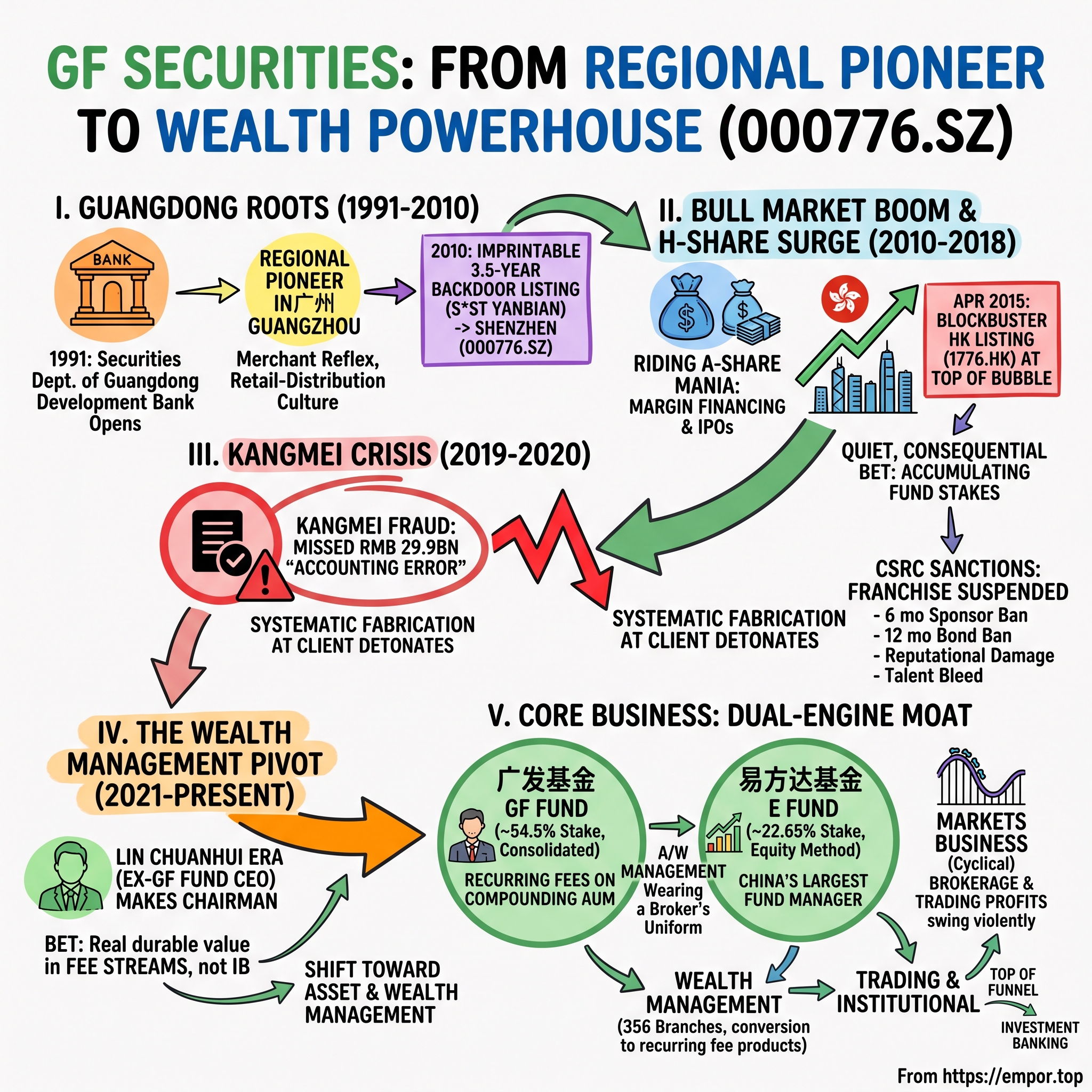
How the story unfolds. Phase one is the southern roots and the 3.5-year backdoor listing (1991–2010). Phase two is the bull-market build-out and the H-share surge (2010–2018). Phase three is the Kangmei crisis and the regulatory paralysis (2019–2020). Phase four is the 林传辉 Lin Chuanhui era and the pivot toward asset and wealth management (2021–present). And phase five is the playbook, the powers, and the bull-versus-bear case. Let's start where it began — not in Beijing, but in the humid commercial heat of Guangdong.
 Subscribe on LinkedIn
II. Guangdong Roots & The Backdoor Listing (1991–2010)
In April 1991, China barely had a stock market. The Shenzhen and Shanghai exchanges were months old, the word "shareholder" still carried a faint whiff of ideological danger, and most of the country's savings sat in bank passbooks. It was into this half-formed landscape that, on April 9, 1991, the securities department of 广东发展银行 Guangdong Development Bank — today 广发银行 China Guangfa Bank — opened for business in Guangzhou.1415 That department was the seed of GF Securities.
Geography did much of the early work. Guangdong in the early 1990s was the beating heart of 改革开放 reform and opening: Hong Kong money flooding across the border, township enterprises multiplying, private entrepreneurs improvising a market economy faster than Beijing could write rules for it. A brokerage born in that environment absorbed a different metabolism than the state-heavy institutions headquartered in the capital. Where a Beijing house instinctively looked upward — toward ministries, mandates, and policy — a Guangzhou house looked outward, toward customers, commissions, and the next deal. That merchant reflex, more than any single strategy document, is the closest thing GF Securities has to an origin myth, and it shows up decades later in the firm's unusually strong retail-distribution culture.
To appreciate how improvised those years were, remember what a "securities department" of a Chinese bank actually did in 1991. It ran a handful of trading counters where retail punters queued to buy the newly issued shares of state enterprises, often paying in cash, often with no clear idea what a share certificate legally entitled them to. Price limits, settlement systems, and disclosure rules were being invented in real time, sometimes after the abuses they were meant to prevent had already happened. The firms that survived this era were not the ones with the grandest strategy; they were the ones that could manage operational chaos, keep customers, and avoid blowing up when a speculative wave broke. GF's Guangdong grounding — close to Hong Kong's more mature market, staffed by people comfortable with commerce — was a quiet advantage in exactly that survival test.
The 1990s Chinese brokerage industry was also brutally fragmented and repeatedly purged. Waves of consolidation followed each market bust, and the regulator periodically forced weak or insolvent brokers into mergers or closure. GF grew partly by absorbing pieces of that wreckage, building scale through the down-cycles when rivals were retrenching — an early instance of a pattern that recurs in this story: GF tends to make its most consequential moves when others are frightened. That counter-cyclical instinct is admirable in a survivor, but note the flip side that Kangmei later exposed — a firm comfortable taking risk when others won't is also a firm that must be unusually disciplined about which risks, and that discipline was not always present.
The firm spun out as an independent securities company in September 1991 and, after a decade of consolidation across China's chaotic early brokerage industry, formally adopted the 广发证券 GF Securities brand in July 2001.15 For most of that first decade it was one of dozens of regional brokers — respectable, profitable in bull years, invisible in bear ones. What it lacked was permanent capital and a public currency. In an industry where balance sheet is destiny — you cannot make margin loans, warehouse bonds, or take principal risk without equity — staying private was a ceiling.
The backdoor saga. Here the story turns almost novelistic. In the mid-2000s the CSRC's IPO queue was jammed, and a straightforward listing could take years with no guarantee at the end. So GF Securities chose the side door: a reverse merger into a listed shell. The chosen vehicle was 延边公路 Yanbian Road Construction Co., Ltd. — a sleepy, far-northern highway company trading under the distressed ticker S*ST YANBIAN, about as far, geographically and spiritually, from Guangzhou as a Chinese listing could be. GF would inject itself into the shell, the shell would become GF, and the highway company would effectively vanish.10
It should have been quick. It took roughly three and a half years. The delay was not bureaucratic tedium — it was scandal. The reverse-merger plan leaked, and the resulting spike in Yanbian's shares triggered an insider-trading investigation that eventually implicated officials connected to the deal. Regulatory approval froze while the market watched skeptically, unsure whether the transaction would survive at all. For a firm whose whole thesis was "we need permanent capital to grow," watching that capital hang in limbo for years was an early, bruising lesson in how tightly Chinese finance is bound to its regulators — a lesson the firm would relearn, far more painfully, a decade later.
It is worth dwelling on why GF wanted a listing badly enough to endure that ordeal, because the reason is the whole logic of a modern securities firm. A broker is not just an agent collecting commissions; the profitable modern businesses — margin lending, bond warehousing, market making, principal investment — all consume capital. Every yuan a firm lends a margin client, every bond it holds on its book, every stake it takes, has to be funded by equity and debt. A private, unlisted broker can only grow those businesses as fast as it can retain earnings, which in a cyclical industry means barely at all through the lean years. A public listing changes the physics: it gives the firm a permanent equity base, a currency to raise more when opportunities appear, and — crucially in China — the regulatory standing that comes with being a scrutinized public company. GF was not chasing prestige. It was chasing the raw material of every future business line it wanted to build.
The choice of a backdoor over a conventional IPO also tells you something about the firm's character and about the era. In the mid-2000s the CSRC repeatedly halted or slowed new IPOs to manage market conditions, so the front door was not reliably open. A reverse merger into a listed shell was the pragmatic South China answer — unglamorous, legally intricate, and faster in theory. That it instead became a multi-year saga was an accident of the insider-trading leak, but the decision to attempt it at all fits the pattern: GF reaching for a structural prize through a side route that a more conservative, Beijing-minded institution might never have tried.
The victory finally came on February 12, 2010, when GF Securities began trading on the Shenzhen Stock Exchange under 000776.SZ.10 The timing was, in hindsight, a gift. GF now had a listed equity currency and a permanent capital base precisely as China's post-financial-crisis stimulus flooded the system with liquidity and set the stage for a multi-year expansion in credit and trading. For investors, the takeaway from this chapter is less about the mechanics of a shell merger and more about temperament: GF Securities has repeatedly shown a willingness to take an unconventional, slower, riskier path to a structural prize. Sometimes — as here — that patience paid off spectacularly. Sometimes, as we'll see, the same appetite for the ambitious deal blew up in its face.
III. The Bull Market Boom & Dual-Listing Surge (2010–2018)
If the 2010 listing gave GF Securities a tank of fuel, the 2014–2015 A-share mania was the open road. Retail investors — students, retirees, taxi drivers, entire WeChat groups — poured into the market with borrowed money and boundless conviction. Margin balances across the industry exploded. And GF, with its dense southern branch network and its salesman's instinct, was built almost perfectly for the moment.
The mechanics of that boom are worth explaining plainly, because they still drive the firm's earnings today. A brokerage in this environment makes money three ways at once. First, plain commissions on the frenzy of buying and selling. Second, and more lucratively, 融资融券 margin financing and securities lending — lending clients cash to buy more stock, or stock to sell short, and earning a spread on that credit. Third, sponsoring the wave of small- and mid-cap IPOs that a hot market makes possible. GF leaned into all three. Years later, even after the frenzy cooled, the franchise these years built remained visible: by 2024 the firm still ran a margin-financing book of roughly RMB 103.7 billion, good for a 5.56% market share, and its brokerage advisory team of over 4,600 people ranked first in the industry by headcount.11
Margin financing deserves a plain-English aside, because it is where retail brokers make outsized money and take outsized risk. When a client borrows from GF to buy more stock than their cash allows, the client posts collateral — usually the shares themselves — and pays interest on the loan, which in China runs several percentage points above the firm's own cost of funds. In a rising market this is close to a perfect business: the collateral appreciates, the borrower stays current, and the spread rolls in month after month. In a falling market it inverts violently. As prices drop, collateral values shrink, margin calls go out, and forced selling by leveraged clients pushes prices down further, threatening the very collateral backing the loans. That reflexive loop — leverage feeding a rally, then feeding a crash — is precisely what turned China's 2015 boom into a rout, and it is the single clearest reason a Chinese broker's earnings cannot be treated as a smooth annuity. GF's margin book is a profit engine and a risk concentration in the same breath.
For a sense of the scale the market itself reached, GF's stock-and-fund turnover handled on the two mainland exchanges ran to RMB 23.95 trillion on a bilateral basis in 2024 — a figure that grew nearly 29% year over year and, even in a merely decent market, dwarfs the firm's own balance sheet.11 The point of citing it is not the number but what it reveals: a broker's fortunes are geared to aggregate market activity it does not create and cannot control. When Chinese households feel wealthy and confident, they trade, they borrow, they buy funds, and every one of GF's fee lines lights up at once. When they retreat, the same lines dim together. This is correlated cyclicality, and it is the structural condition the entire post-Kangmei strategy has tried, with only partial success, to escape.
The Hong Kong moment. The single most vivid scene of this era came in April 2015. With the mainland market near its euphoric peak, GF Securities listed H-shares in Hong Kong, raising HK$27.9 billion — about US$3.6 billion — at HK$18.85 per share, the very top of the indicative range, in what was that year's largest Hong Kong IPO.78 Shares began trading on April 10, 2015.79 The deal was ferociously oversubscribed, a snapshot of a market that believed the good times were structural rather than cyclical.
They were cyclical. Within roughly ten weeks the A-share bubble burst, wiping out trillions in value and dragging Chinese brokerage stocks — GF among them — down with it. The authorities responded with an extraordinary intervention: state-backed funds bought shares to prop up prices, short selling was curtailed, IPOs were frozen, and brokers themselves were conscripted into a collective "national team" rescue, pledging capital to stabilize the market. For a firm that had just raised billions selling equity to the public, being asked months later to help catch a falling market was a vivid lesson in the dual identity of a Chinese broker — part profit-seeking enterprise, part instrument of state financial policy. That duality never fully goes away, and it is a standing feature of the investment case: GF answers to shareholders and to Beijing, and when those masters disagree, shareholders do not always win.
Here is the honest read for investors: GF's Hong Kong listing was, financially, brilliantly timed for the seller. The firm banked a mountain of permanent capital at a peak valuation. But the episode also crystallized the central discomfort of owning any Chinese broker — these are, at their core, leveraged bets on market sentiment, and sentiment in China's retail-dominated market is extraordinarily volatile. GF's later strategic pivot is best understood as an attempt to bolt a steadier, fee-based engine onto a business that would otherwise lurch with every cycle.
The quiet, consequential bet. Amid the noise of the bull market, GF was making a far more important and much less glamorous move: accumulating and defending its fund-management stakes. It held control of 广发基金 GF Fund and a cornerstone position in 易方达基金 E Fund.11 The strategic insight embedded in those holdings — whether by design or good fortune, and management would insist it was design — was that transaction commissions were structurally doomed. Competition and, eventually, regulation would grind trading fees toward zero. Recurring fees on managed assets, by contrast, compound quietly through cycles. Whether GF saw this earlier or more clearly than giants like 中信证券 CITIC Securities or 国泰君安 Guotai Junan Securities is debatable — plenty of Chinese brokers own fund stakes. What is not debatable is that GF ended up with unusually large positions in two unusually good franchises, and that this accident-or-foresight became the spine of its post-crisis identity.
A word on why the fund stakes matter more than any single year's trading profit, because this is the hinge of the entire story. 广发基金 GF Fund was launched in 2003 — and it was Lin Chuanhui who ran it almost from the start, a detail that becomes pivotal two sections from now. 易方达基金 E Fund, founded in 2001, grew into the largest public fund manager in the country. GF's decision to hold a controlling position in one and a large minority in the other meant that, buried beneath the volatile brokerage, the firm was quietly accumulating exposure to the single best long-term trend in Chinese finance: the professionalization and growth of household asset management. Fund management fees compound with AUM, and AUM in China has grown for two decades through booms and busts alike. Whether GF's leadership fully grasped this at the time or simply got lucky with two good bets, the structural consequence is the same, and it is the reason the firm had something to pivot toward when its investment bank collapsed.
Through this period the firm also expanded its balance-sheet businesses — fixed income, currencies and commodities (FICC), equity derivatives, and principal investment — while keeping a leaner cost base than its Beijing and Shanghai rivals. FICC and derivatives are the plumbing of institutional finance: making markets in bonds, structuring hedges, writing options for clients who want to manage risk. Done well, these are client-service businesses that earn a spread with limited directional exposure; done greedily, they become a proprietary casino. GF built the capability in the 2010s and has spent the years since insisting the emphasis is on the former. The 2025 results, with their enormous swing in trading gains, suggest the casino is still open for business. It was, by the late 2010s, a top-tier national broker with a distinctive southern flavor and a hidden asset-management jewel box. And then it made a mistake that nearly cost it everything.
IV. The Kangmei Crisis: Sanctions & Existential Reckoning (2019–2020)
Every financial firm has a client it wishes it had never met. For GF Securities, that client was 康美药业 Kangmei Pharmaceutical — a traditional Chinese medicine champion from, fittingly, Guangdong, for which GF had served as IPO sponsor back in 2001 and as a long-running underwriter and adviser across a string of bond and equity issues.1 For years Kangmei was a poster child of the sector, a growth story analysts loved. It was also, it turned out, a fiction.
In April 2019 Kangmei admitted to "accounting errors" that had overstated its cash by roughly RMB 29.9 billion.1 Pause on that figure for a second, because it is almost comically large: the company claimed to have miscounted nearly thirty billion yuan of cash — not inventory, not receivables, but cash, the one balance a competent auditor is supposed to confirm directly with the bank. A discrepancy of that size is not a rounding error or a timing difference; it is the kind of hole that only appears when someone has been fabricating bank statements. "Accounting error" is a generous phrase for what regulators concluded: a systematic fabrication. By the time the CSRC finished, it had described inflated revenues, fabricated bank deposits, and financial-statement overstatements running to roughly RMB 88.6 billion — about US$12.6 billion — over 2016 to 2018.1[^2] It was one of the largest listed-company frauds in the history of China's capital markets, and it detonated directly under GF's investment bank.
The Kangmei affair landed at a politically charged moment. China was, at exactly this time, overhauling its capital markets around a 注册制 registration-based IPO system — a shift from the old regime, where regulators effectively vetted the merit of each listing, toward a disclosure-based model where the market judges and intermediaries are trusted to police quality. That trust is the whole premise of the reform. An underwriter, an auditor, a law firm — each is supposed to be a 看门人 gatekeeper, standing between fraudulent issuers and the investing public. Kangmei was, in effect, a test case of whether the gatekeepers were doing their jobs, and the answer was humiliating. The CSRC's ferocity toward GF was not only about one drugmaker; it was a signal to every intermediary in the country that the era of rubber-stamping was over. GF had the misfortune of being the object lesson.
The penalty hammer. On July 11, 2020, the CSRC brought down its sanction. It suspended GF Securities from sponsoring securities issuance for six months and from underwriting corporate bonds for a full twelve months — a targeted strike at the two franchises that generate underwriting fees.1[^3] The regulator went further, moving to bar eight GF bankers from investment-banking roles for ten to twenty years and imposing public condemnation or other measures on six more, with individuals ordered to disgorge compensation beyond basic salary.1 For a firm whose brand equity was concentrated in dealmaking, the reputational damage exceeded the mechanical revenue loss.
And the mechanical loss was severe enough. With its sponsor license frozen, GF's IPO pipeline simply stopped: by early September 2020, eighteen IPO applications on which GF was the sponsor had been halted or thrown into limbo, and issuers began quietly migrating to rivals.23 Corporate clients do not wait for a banned bank; they defect to 中信证券 CITIC Securities, 华泰证券 Huatai Securities, and 中信建投 CSC Financial. A year's absence from the league tables in a fast-growing registration-based IPO market is not a year lost — it is relationships lost, and relationships are the whole business.
The deeper damage is worth spelling out for anyone who has not worked inside a capital-markets franchise. Investment banking is a business of trust and momentum. A company choosing an underwriter for its IPO is making a multi-year bet on a firm's competence and standing; it wants a bank whose name on the prospectus reassures investors, and it wants a team it will still be working with when it issues bonds or does a follow-on three years later. When a regulator publicly declares a bank unfit to sponsor deals — and moves to bar its senior bankers for up to two decades — every prospective client reads that as a flashing warning sign, and every talented banker inside the firm updates their résumé. The franchise bleeds from both ends at once: clients leave and the people who could win them back leave too. Rebuilding is not a matter of flipping the license back on after twelve months; it is a matter of re-earning trust one mandate at a time, against rivals who spent the intervening period stealing your accounts. That is why, years later, GF's domestic equity-underwriting volumes remained modest even as its bond business recovered.
The governance reckoning. Layered on top were joint-liability lawsuits from Kangmei bondholders and investors, creating a genuine balance-sheet overhang and forcing the question no board wants to ask: how did a firm this large, with this many compliance officers, miss a fraud this enormous, for this long? The unflattering answer — the one an activist investor would press — is that the incentives of a deal-driven culture had outrun the firm's risk controls. Bankers are paid to close transactions; if the machinery rewarding closings is stronger than the machinery questioning them, a Kangmei becomes not an accident but a probability.
There was also a live financial overhang that an investor at the time could not easily size. Kangmei became a landmark in Chinese securities law: it was the first case prosecuted under the country's newly created special-representative (class-action-style) litigation mechanism, and in late 2021 a court ordered Kangmei and a set of responsible parties to compensate investors billions of yuan — a watershed that put every intermediary in the frame for joint liability on flawed deals. For GF, the precise, ultimate cost of Kangmei-related claims was, for a long stretch, simply not knowable, which is its own kind of poison for a balance sheet: markets can price a large loss, but they struggle to price an uncertain one. Provisioning against contingent legal liability is a judgment call, and judgment calls are exactly where a chastened firm has every incentive to be conservative and every temptation to be optimistic.
The general manager had already resigned in April 2020 as the scandal metastasized.4 In August the firm installed a new Party chief, a signal in the Chinese context that the fix would be structural and top-down, not cosmetic.6 The board reached an uncomfortable but correct conclusion: an aggressive investment bank without an equally aggressive risk-and-compliance function was a liability that could vaporize decades of brand equity in a single regulatory cycle. What the firm needed was not a better dealmaker. It needed someone whose entire career had been built on the opposite instinct — patience, process, and recurring fees. It happened to have exactly that person, and he was running the fund company.
V. The Lin Chuanhui Era & The Wealth Management Turnaround (2021–Present)
The most telling decision GF Securities made after Kangmei was who it chose to lead the recovery. Not a rainmaker. Not a balance-sheet trader. It chose 林传辉 Lin Chuanhui, the man who had spent seventeen years building 广发基金 GF Fund from a small subsidiary into one of China's premier asset managers — serving as its general manager from August 2003 to December 2020 and as vice chairman from 2008.5 In December 2020 he was named general manager of the parent, GF Securities; he joined the board as an executive director in January 2021, and by July 2021 he had become chairman, replacing Sun Shuming.512
The symbolism was unmissable. In an industry where the top job almost always goes to a banker or a markets veteran, GF handed the wheel to a fund manager. Lin's professional formation was the antithesis of the culture that produced Kangmei. An asset-management chief lives and dies by long-term, risk-adjusted returns and by not blowing up client capital; his instincts run toward process, compliance, and the slow compounding of sticky fees rather than the adrenaline of the next mandate. Installing him was the board's way of saying that the firm's center of gravity would shift from the deal desk to the fee engine.
Consider what Lin had actually built before he was handed the parent. When he took over 广发基金 GF Fund in 2003, it was a fledgling subsidiary in an industry China had barely invented — public mutual funds had only been permitted a few years earlier. Over seventeen years he grew it into a top-three player by non-money-market assets, an institution respected for its research depth and product breadth rather than for any single star manager or gimmick.511 That is a particular kind of executive achievement: not a burst of dealmaking genius, but the patient construction of a franchise that outlasts individual bull markets. It is precisely the temperament a firm reaches for when it has just been burned by the opposite one. A board that chooses a builder over a closer is telling you what lesson it thinks it learned.
The skeptic's counterpoint deserves airing, though. Elevating an insider — however capable, and however clean his personal record — is not the same as importing an outside reformer with no ties to the culture that failed. Lin came up inside the GF group, not from a rival or a regulator. Whether that is a strength (he knows the institution intimately) or a limitation (he is of the same house that missed Kangmei) is a genuine open question, and the honest answer is that it depends on execution you can only judge over years, not on the elegance of the appointment.
What the pivot actually meant. The strategy that followed can be summarized as "asset and wealth management first, investment banking second." It had a few concrete pillars. Rebuild investment banking slowly and cleanly after the ban lapsed, prioritizing absolute compliance safety over volume — accepting a smaller, less lucrative deal book in exchange for never repeating 2020. Redeploy attention and capital toward the recurring-fee businesses: distributing funds and wealth products through the branch network, and harvesting the economics of the GF Fund and E Fund stakes. And, throughout, sell the regulator on the idea that GF had internalized its 看门人责任 gatekeeper responsibility — the duty of an underwriter to protect investors rather than merely serve issuers.
Did it work? Partially, and the evidence is mixed in an instructive way. On the rebuild, the numbers show a franchise clawing back: in 2024 GF's bond underwriting rebounded to RMB 296.3 billion across 665 tranches, up nearly 60% in tranche count year over year, and the firm completed 14 Hong Kong IPOs plus a U.S. listing — a deliberately international, less politically exposed deal mix.11 But A-share equity underwriting stayed modest at RMB 8.7 billion, a reminder that domestic sponsor relationships, once lost, come back slowly and that the whole industry's IPO pipeline tightened as regulators throttled new listings.11 Investment banking today sits well below 5% of the group's economic weight — partly by design, partly because the market has not fully rewarded the rebuild.
The international tilt of the rebuilt bank is itself a strategic tell. Choosing to complete fourteen Hong Kong IPOs and a U.S. listing in a single year, while domestic A-share sponsorship stayed small, is not just where the deals happened to be — it reflects a firm steering toward mandates that are less exposed to the domestic regulatory relationship it had just damaged, and that play to its Greater Bay Area proximity to Hong Kong's capital markets.11 It is a sensible way to rebuild league-table presence without betting the recovery on winning back the exact domestic sponsor relationships that Kangmei cost it. It is also, read less charitably, evidence of how hard the domestic rebuild has been — you lean on the offshore channel partly because the onshore one is still closed to you.
On credibility, Lin's tenure offers something rarer than a good quarter: consistency. The firm has, across successive reports, kept telling the same story — de-risk, lean on asset management, grow fee income — rather than lurching between strategies to chase whatever is hot. For a management team judged by behavior over time, narrative discipline is a point in its favor. The fair skeptical counter is that much of the recent earnings surge owes less to strategic brilliance than to a cyclical A-share recovery: in the first three quarters of 2025, net profit jumped about 62% year over year, but the drivers were a rebound in brokerage fees and a 343% surge in mark-to-market gains on the firm's own trading book — precisely the volatile, market-dependent lines the pivot was supposed to de-emphasize.13 There is an uncomfortable irony there worth naming plainly: the clearest evidence of GF's recent "success" is a windfall from exactly the kind of volatile, capital-intensive trading the wealth-management strategy was meant to make less central. A cynic would say the pivot is a story management tells in the good years and the trading book is what actually pays the bills. The generous reading is that both are true at once — GF is de-risking at the margin while still riding the cycle — and only a genuine bear market will reveal which reading is closer to the truth. The wealth-management thesis is real, but it has not yet freed GF from the cycle. That tension runs straight into the segment economics.
VI. Core Business & Segment Economics: Wealth, Funds, & Markets
To understand where GF Securities actually makes its money, ignore the org chart for a moment and follow the profit. The revealing feature of this firm is that its single most valuable engine barely touches the revenue line, because it arrives as investment income from companies GF influences but does not fully consolidate. Start there.
Segment 1 — 投资管理 Investment Management, the core value engine. GF's roughly 54.5% stake in 广发基金 GF Fund and roughly 22.65% stake in 易方达基金 E Fund are the crown jewels.11 The economics are elegant precisely because they are capital-light. A mutual fund manager earns a recurring management fee on assets under management; it requires very little of the parent's own balance sheet, unlike proprietary trading or margin lending, which tie up billions in equity for every point of return. As of end-2024, E Fund ranked first in China and GF Fund ranked third by non-money-market public-fund AUM, with the two together part of a public-fund complex exceeding RMB 3.5 trillion in the firm's disclosures.11 The layman's version: GF owns pieces of the two biggest toll booths on China's mutual-fund highway, and toll booths throw off cash whether or not GF's own traders had a good day.
The catch — and it is a real one — is control and capture. Here the accounting matters more than it usually does, so it is worth making concrete. Because GF owns a majority of GF Fund, it consolidates that subsidiary: GF Fund's revenues and costs flow line-by-line into GF's income statement, and GF's management directs its strategy and dividends. E Fund is different. At roughly 22.65%, GF holds a large minority, so it accounts for E Fund by the equity method — meaning GF books its share of E Fund's net profit as a single investment-income line, and receives cash only when E Fund declares a dividend. GF sits on E Fund's shareholder register, not in its driver's seat; it cannot unilaterally set E Fund's fees, force a payout, or redirect its strategy. So the "dual-engine" moat is genuine as an asset, but shareholders' ability to monetize it depends on fund fee levels, fund flows, and payout decisions that GF only partly controls. When management points to these stakes as the reason the stock is undervalued, the honest response is: yes, and also, value you cannot fully direct is worth a discount to value you can.
There is a second, subtler complication. Because E Fund's contribution arrives as investment income rather than operating revenue, it makes GF's headline numbers harder to read and easier to misjudge in both directions. In a strong year for E Fund, GF's profit is flattered by a line that has nothing to do with its own brokers or bankers; in a weak year, that cushion thins. An analyst who models GF as a straightforward broker will systematically misprice it, and an analyst who takes management's sum-of-the-parts framing at face value will overlook how contingent the fund cash flows actually are. The truth sits in between, and finding it requires disaggregating a business that does not disaggregate cleanly — which is itself part of why the market applies a conglomerate discount.
Segment 2 — 财富管理 Wealth Management, the cash cow. This is the southern branch network doing what it has always done, upgraded. GF ran 356 branches across 31 provinces at end-2024, heavily weighted toward the wealthy Pearl River Delta.11 The strategic project of the past few years has been to convert transaction-driven retail traders — who generate a fee only when they trade — into fee-paying holders of funds and wealth products, who generate a recurring cut of assets they simply hold. The proof point management likes to cite: the balance of financial products sold on a commission basis topped RMB 260 billion by end-2024, up about 22% in a year.11 Alongside sits the margin-financing book described earlier, a genuinely profitable spread business anchored by high-net-worth clients. The mechanism is real, but note the dependency — wealth-product sales and margin appetite both rise and fall with market sentiment, so this "cash cow" is more cyclical than the label suggests.
Why is the transaction-to-recurring conversion such a prize? Because the two revenue models have completely different quality. A commission-driven client is only worth something when they are active, which means the broker's revenue evaporates in exactly the bear markets when it most needs stability; worse, price competition in China has ground trading commissions toward a razor-thin fraction of a percent, so even active clients pay less each year. A client who instead holds a portfolio of funds pays a recurring share of assets whether or not they trade, and stays put because moving a portfolio is a hassle — the closest thing a broker gets to a subscription business. GF's advantage in attempting this shift is the sheer quality and density of its client base: high-net-worth entrepreneurs in one of the wealthiest regions on earth are precisely the customers most worth converting, because they hold more assets and churn less. The unresolved question — the one no annual report yet answers cleanly — is how much of the RMB 260 billion in product balances represents genuinely sticky, advice-led relationships versus performance-chasing money that will redeem at the first drawdown. Until a real bear market tests it, the "recurring" label is a hypothesis, not a proven fact.
Segment 3 — 交易及机构服务 Trading & Institutional Services. Fixed-income market making, equity derivatives, OTC options, and quantitative trading. Management's framing is that this is increasingly client-driven — hedging and yield-enhancement flow rather than naked directional bets. The 2025 results complicate that framing: the outsized swing in fair-value gains shows the book still carries meaningful market exposure.13 Lower directional risk than some tier-two peers, perhaps, but not the placid client-service utility the label implies.
Segment 4 — 投资银行业务 Investment Banking. Post-restructuring, this generates a low-single-digit share of group revenue.11 Its role has been quietly redefined: less a profit center, more the "top of funnel." An IPO or bond mandate is how GF first meets a founder or a company treasury — relationships it then hopes to monetize through wealth management, private-fund solutions, and corporate cash products. Whether that funnel logic truly pays off, or is a rationalization for a franchise that has not fully recovered, is one of the open questions a careful investor should keep watching.
The bond business is the quiet bright spot inside this segment, and it complicates the simple "IB is dead" narrative. GF's bond lead-underwriting volume reached RMB 296.3 billion across 665 tranches in 2024, with tranche count up nearly 60% year over year — a genuine rebuild in the debt-capital-markets franchise even as equity underwriting stayed subdued.11 The asymmetry is telling. Equity sponsorship is the business where reputation and trust matter most, so it recovers slowest after a reputational hit; bond underwriting is more commoditized and relationship-driven, so it came back faster. The recovery is real, but it recovered first in the place where recovery is easiest, which is a more sober read than "the investment bank is back." The rebuilt franchise that emerges is smaller, more debt-weighted, more international, and deliberately more cautious than the swashbuckling deal machine of the Kangmei era — which is either prudence or diminishment depending on how you weigh safety against ambition.
Which raises the broader question: how durable is any of this? For that, the frameworks.
VII. Helmer's 7 Powers & Porter's 5 Forces Analysis
Strip away the narrative and ask the cold question a competitor's strategist would ask: what, exactly, stops someone from taking GF's profits? Two lenses help — Hamilton Helmer's 7 Powers, which asks where durable advantage actually lives, and Porter's 5 Forces, which maps the pressure on margins.
Cornered resource — the strongest claim. GF's most defensible edge is its combined ownership in 易方达基金 E Fund and 广发基金 GF Fund. A competitor cannot simply go buy equivalent stakes in the number-one and number-three non-money-market fund managers in China; those positions were assembled over two decades and are not for sale.11 This is a textbook cornered resource — a valuable asset held on terms rivals cannot replicate. The honest caveat repeats from the last section: it is a cornered resource GF only partly controls, and its cash yield is exposed to the industry-wide 基金降费 mutual fund fee reform, which is compressing the very fees that make fund AUM valuable.
Scale economies and process power — real but regional. GF's density across the 粤港澳大湾区 Guangdong-Hong Kong-Macao Greater Bay Area lowers its client-acquisition cost and raises the velocity at which it can push wealth products through the network — a local scale advantage. And three decades of building an investment-research and product-creation machine constitutes genuine process power. But both are regional and contestable. The national mega-brokers have their own scale, and digital platforms are dissolving the moat of physical branch density everywhere.
Counter-positioning — aspirational. The bull framing is that while rivals tie up capital in low-margin debt underwriting, GF concentrates on capital-light fee acceleration. That is a strategy, not yet a moat: counter-positioning only counts when incumbents can't copy you without damaging their existing business, and nothing stops CITIC or Huatai from leaning harder into wealth management too. Indeed, they are.
Porter's five forces, briskly. Buyer power is high and rising — retail investors and institutions alike are demanding lower commissions and lower fund fees, and regulators are helping them. The threat of new entrants is low: securities and fund licenses are tightly rationed by the CSRC, a regulatory barrier that protects every incumbent including GF. The threat of substitutes is medium and growing — bank wealth-management arms and fintech platforms like 蚂蚁财富 Ant Fortune and 东方财富 East Money compete directly for the household savings GF wants to manage, and East Money in particular has built a formidable low-cost online brokerage and fund-distribution machine. And rivalry is intense: 中信证券 CITIC Securities, 华泰证券 Huatai Securities, and 中金公司 CICC are all larger or more prestigious in one dimension or another, and all want the same Greater Bay Area wealth.
Two rivalries deserve a closer look because they define GF's competitive future. The first is 东方财富 East Money, and it is the most interesting threat precisely because it attacks from a different direction. East Money grew out of a financial-information website into a low-cost online brokerage and, crucially, the dominant third-party fund-distribution platform in China. Where GF's wealth model rests on branches, relationships, and high-net-worth density, East Money's rests on software, scale, and near-zero marginal cost of serving one more account. In the mass-market, self-directed segment, East Money can undercut a branch-based broker on price all day, because it never had the branch cost in the first place. GF's defense is to move upmarket — toward advice-led, higher-touch relationships that a website struggles to replicate — but that is a defense, not an advance, and it concedes the low end.
The second is the pure scale of 中信证券 CITIC Securities and 华泰证券 Huatai Securities. CITIC is simply larger across almost every line — the closest thing China has to a full-service bulge-bracket investment bank — and larger balance sheets win capital-intensive institutional business. Huatai, meanwhile, built one of the most successful digital brokerage platforms in the country, blunting the branch advantage that firms like GF once enjoyed. GF is a strong number-two-tier national player, but it is not the biggest, not the most digital, and no longer the most trusted in underwriting after 2020. Its distinctive claim rests almost entirely on the fund stakes and its southern wealth franchise, which is a real but narrow base from which to fight three different kinds of larger competitor at once.
The force that hangs over all of them is 基金降费 mutual fund fee reform — the regulator-led campaign to cut what fund managers charge ordinary savers. It is worth understanding the mechanism because it strikes GF at its strongest point. Fund management fees are charged as a percentage of assets; cut that percentage, and every fund manager's revenue falls even if AUM is flat, and falls further if the cuts push investors toward the cheapest passive products where fees are thinnest of all. This is unambiguously good for Chinese households and unambiguously bad for the fee pools at E Fund and GF Fund — the very engines the GF bull case celebrates. A moat built on fund fees is a moat the regulator is actively draining. That does not make it worthless; scale and market leadership still matter, and larger AUM partly offsets lower rates. But any honest valuation of GF's fund stakes has to assume the toll per car keeps falling even as traffic grows.
Net assessment: GF has one genuinely strong, hard-to-copy asset (the fund stakes) wrapped in a business that is otherwise fiercely competitive, cyclical, and buffeted by fee compression. The moat is narrower than the marketing, but it is not imaginary. Which is exactly the tension the investing lessons turn on.
VIII. Playbook: Business & Investing Lessons
Step back from the specifics, and GF Securities offers four transferable lessons — the kind that outlast any single quarter.
1. Culture is risk management, and it is priced only in the crisis. The Kangmei episode is the cleanest case study you will find of an intangible — compliance culture — converting into a very tangible loss.1 For years, GF's aggressive dealmaking looked like a strength; the absence of an equally strong internal check was invisible right up until it cost the firm its underwriting license and a year of relationships. The lesson for investors is uncomfortable because it is hard to underwrite in advance: the quality of a financial firm's risk function is nearly impossible to see in good times and decisive in bad ones. The best you can do is watch behavior — does management reward the people who say no?
2. Asset management is the ultimate brokerage moat — but only if you can bank the fees. Transaction commissions decay; sticky AUM in top-tier funds throws off annuity-like cash through cycles. GF's fund stakes are the embodiment of that idea.11 The refinement GF's own structure teaches is that owning the moat and capturing its cash are different things. An equity-method stake in a fund you don't control, in a market where regulators are actively cutting fees, is a wonderful asset with a real leash on it.
3. Geography can be a structural edge in finance. Being rooted in Guangdong's private-enterprise economy gave GF a wealthier, more entrepreneurial, more market-comfortable client base than a broker anchored in a state-heavy northern province.15 That is a durable, hard-to-relocate advantage in the wealth business, where client quality compounds. It is also a concentration risk — GF's fortunes are unusually tied to the health of one region's private economy and property market.
4. Turnaround credibility is earned through consistency, not slogans. 林传辉 Lin Chuanhui's value to shareholders is not a single dramatic move but the refusal to lurch — the same de-risking, fee-focused story told across successive reports.12 Against that, the fair critique is that the strategy has not yet been stress-tested by a real bear market on Lin's watch; the recent profit surge rode a cyclical rebound, not a structural one.13 Turnarounds should be judged when the tide goes out, and the tide has mostly been in.
5. Beware the sum-of-the-parts that cannot be summed. GF is a live case study in the limits of the SOTP argument that value investors love. On paper, adding a controlling fund stake plus a large minority in the country's biggest fund manager plus a national brokerage should yield a number well above the market's. In practice, the market persistently discounts such structures — and often for good reasons: the parts cannot be sold separately, the minority stake's cash flows are not controlled, the whole is exposed to fee cuts and cycles, and the state has a claim on strategy. The lesson is not that SOTP is useless, but that "hidden value" only rewards shareholders if some catalyst can actually surface it. Absent a spin-off, a listing of the fund units, or a change in payout policy, hidden value can stay hidden for a very long time, and patience is not the same as a plan. Which is the perfect setup for weighing the two cases.
IX. Bull vs. Bear Case & Key KPIs
The bull case. Start with the sum-of-the-parts argument, because it is the crux. The claim is that GF's market capitalization does not fully credit the intrinsic value of its combined holdings in 易方达基金 E Fund and 广发基金 GF Fund — that a shareholder buying GF is, in effect, buying a controlling fund business and a large minority stake in China's biggest fund manager, plus a national brokerage, at a conglomerate discount.11 There is real substance here: capital-light fund economics deserve a higher multiple than cyclical trading income, and a broker's blended valuation tends to bury that.
Layered on top are two secular tailwinds. First, the long migration of Chinese household wealth out of property and into capital-market products — a shift regulators actively encourage and one that structurally favors whoever manages and distributes funds. This is the single most important macro bet embedded in GF's stock. For a generation, the Chinese middle class stored its wealth in apartments; as the property market has cooled and policymakers have discouraged speculation, trillions of yuan of household savings must find a new home, and mutual funds are the most natural destination. If even a modest fraction of that reallocation occurs, the addressable fee pool for fund managers and distributors grows for years — and GF sits astride both roles. Second, the 粤港澳大湾区跨境理财通 Greater Bay Area Cross-boundary Wealth Management Connect, a cross-border pilot that lets GF distribute offshore products to mainland savers through its Hong Kong presence, playing directly to its geographic strength. If household allocation shifts even modestly toward funds, the firm with two of the largest fund engines and the densest southern branch network is unusually well placed to benefit.
The bull case, then, is not a fantasy — it rests on a real structural asset and a real demographic wave. Its weakness is timing and capture, not premise: the household-savings migration is measured in decades, the fee cuts are happening now, and the value is trapped inside a structure the market does not reward. A patient owner who believes in the wave and can tolerate the cycle has a coherent thesis. An owner who needs the value surfaced on a timetable does not.
The bear case. Now the other side, and it is not weak. The single biggest structural threat is 基金降费 mutual fund fee reform: the same regulator-driven fee cuts that help retail investors directly shrink the top line at E Fund and GF Fund, eroding the value of the very stakes the bull case is built on. You cannot simultaneously celebrate the fund moat and wave away fee compression — they are the same coin. Second, cyclicality: prolonged periods of thin A-share 成交量 trading volume or a falling market drag down brokerage commissions, wealth-product sales, and proprietary income at once, as the violent swings in GF's own 2024–2025 results demonstrate in both directions.1113 This is still, unavoidably, a leveraged bet on Chinese equity sentiment. Third, residual and future litigation risk — the Kangmei-era investor claims are a reminder that underwriting liabilities have long tails, and that a single bad mandate can resurface years later.2
An activist would press three more points. Governance: the firm that missed Kangmei has rebuilt, but the burden of proof on its risk culture is permanent, not discharged — one more high-profile underwriting failure would not just cost fees, it would shatter the entire "reformed, compliance-first" narrative on which the equity story now rests. Complexity: the equity-method stakes make the reported financials harder to read and the value harder to unlock — is there a cleaner structure, and if the fund businesses are truly the crown jewels, why are they buried inside a cyclical broker rather than surfaced where the market can value them directly? And capital allocation: after promising discipline, is GF deploying its balance sheet into higher-ROE fee businesses, or drifting back toward the trading book that generated 2025's mark-to-market windfall? A skeptic would also scrutinize the dividend — the outline's premise of a roughly 30–40%+ payout ratio, if sustained, is a point in management's favor, since returning cash is harder to fake than a strategy slide; but payout discipline is only credible if it holds through a down year, and GF has not yet faced one under Lin.
It is also fair to ask the reflexive question a long-only owner should ask about any Chinese financial: what is the state's claim on this business? GF answers to the CSRC as both regulator and, in effect, arbiter of its strategic latitude; it can be conscripted into market-stabilization duties, steered toward policy priorities like Greater Bay Area integration, and constrained on fees in the name of household welfare. None of that is hidden or unusual, but it caps the degree to which GF can behave as a pure profit-maximizer, and it belongs in any sober assessment of the upside. The bull case is real; it is simply subject to a set of masters that a Western broker's shareholders never have to think about.
The KPIs that actually matter. Cut through everything and watch three things. First, the combined AUM and net-profit contribution of 广发基金 GF Fund and 易方达基金 E Fund — the single best gauge of whether the core thesis is compounding or being eaten by fee cuts. Second, the balance of wealth-management financial products sold and total client assets — the direct measure of the transaction-to-recurring-fee conversion the whole strategy depends on. Third, return on equity relative to the tier-one peer group of 中信证券 CITIC Securities and 华泰证券 Huatai Securities — because the pivot's entire promise is higher, steadier returns on capital, and ROE is where that promise is either kept or exposed. Track those and you are tracking GF's real story, not its headline swings.
X. Epilogue & Transcript Guidance for Researchers
For anyone doing the primary-source work behind this story, a few pointers on where the signal lives.
Start with the crisis-era record. The 2020 CSRC sanction announcements and GF's own responses are the baseline against which every subsequent claim of reform should be measured; read them alongside the Caixin and South China Morning Post reporting from July 2020 that established the fraud's scale and the penalty's terms.1[^2][^3] Then read forward: the 2024 annual results and the 2025 quarterly reports show a firm whose profits swing hard with the market even as management insists the center of gravity has moved to fees.111213 The most useful exercise is comparative — put the defensive, compliance-heavy language of 2020–2021 next to the more confident asset-management framing of 2024–2026 and judge whether the strategy genuinely changed or merely the tone.
In earnings materials, weigh prepared remarks against analyst Q&A separately. Prepared remarks will emphasize the wealth and fund narrative; the Q&A is where analysts push on the parts that don't fit — the dependence on proprietary trading gains, the pace of investment-banking recovery, the drag from fund fee reform, and dividend-payout discipline. Where management gives concrete, numerical answers on those pressure points, take the strategy more seriously; where the answers turn vague, note it.
A few specific things are worth listening for across successive calls. When asked about the profit contribution of the fund stakes, does management disclose E Fund's and GF Fund's actual AUM, fee trajectory, and net-profit contribution, or does it retreat to generalities about "leading positions"? When asked about the trading book, does it frame the mark-to-market swings as client-driven and hedged, or does it acknowledge the directional risk that the 2025 numbers imply? When asked about the pace of fund fee cuts, does it quantify the revenue drag or wave it away? And when asked about capital returns, does it commit to a payout framework, or keep the answer soft? The pattern of answers over several quarters — concrete and consistent, or shifting and evasive — is a better guide to management quality than any single upbeat headline. The most valuable exercise a researcher can do is to read the 2020–2021 crisis-era commentary and the 2024–2026 commentary side by side and ask whether the same institution is speaking, and whether it has kept the promises it made when it was frightened.
The final thought is the one the whole arc supports. GF Securities is the quintessential Chinese story of a regulatory near-death experience turned into a strategic identity — a firm that, having been punished for the hubris of dealmaking, staked its future on the patience of asset management. Whether that trade ultimately rewards shareholders depends on forces GF only partly controls: the direction of fund fees, the mood of the A-share market, and the discipline of a management team whose reformed culture has not yet been tested by a real downturn. The transformation is real. Its payoff is still being written.
References
-
GF Securities Penalized for Role in Kangmei's $12.6 Billion Fraud — Caixin Global, 2020-07-11 ↩↩↩↩↩↩↩↩
-
Tainted by Kangmei Fraud, GF Securities' Underwriting Ban Starts to Hurt — Caixin Global, 2020-07-14 ↩↩
-
Eighteen IPO Applications Halted in Wake of GF Securities' Sponsoring Ban — Caixin Global, 2020-09-02 ↩
-
GF Securities General Manager Resigns Following Fraud Scandal — Caixin Global, 2020-04-24 ↩
-
The General Manager of GF Securities Is Lin Chuanhui, General Manager of GF Fund — EqualOcean, 2020-12-11 ↩↩↩
-
Exclusive: GF Securities Picks New Party Chief in Wake of Client's $12.6 Billion Fraud — Caixin Global, 2020-08-13 ↩
-
Clifford Chance Advises on GF Securities' IPO, the Largest Hong Kong Offering This Year — Clifford Chance, 2015-04 ↩
-
GF Securities Begins Roadshow to Raise Up to US$3.6 Billion in Hong Kong Share Sale — South China Morning Post, 2015-03 ↩
-
GF Securities Co., Limited — GF Group / GF Financial Markets ↩↩
-
GF Securities Announces its 2024 Annual Results — ACN Newswire / FinancialContent, 2025-03-31 ↩↩↩↩↩↩↩↩↩↩↩↩↩↩↩↩↩↩↩↩↩
-
GF Securities Co., Ltd. 2025 First Quarterly Report (Stock Code: 1776) — GF Securities Investor Relations, 2025-04-29 ↩↩↩↩↩↩
-
GF Securities: Net Profit in the First Three Quarters of 2025 Increased by 61.64% Year-on-Year — Futu News, 2025 ↩↩↩↩↩
-
CNINFO Official Announcement Disclosure Platform for GF Securities (000776.SZ) — Shenzhen Stock Exchange / CNINFO ↩↩↩↩
 LinkedIn
 WhatsApp
 Reddit
 Hacker News
 Email
Email Kindle
 RSS Feed
 Spotify
 Apple Podcasts
 Amazon Music
 Audible
 YouTube