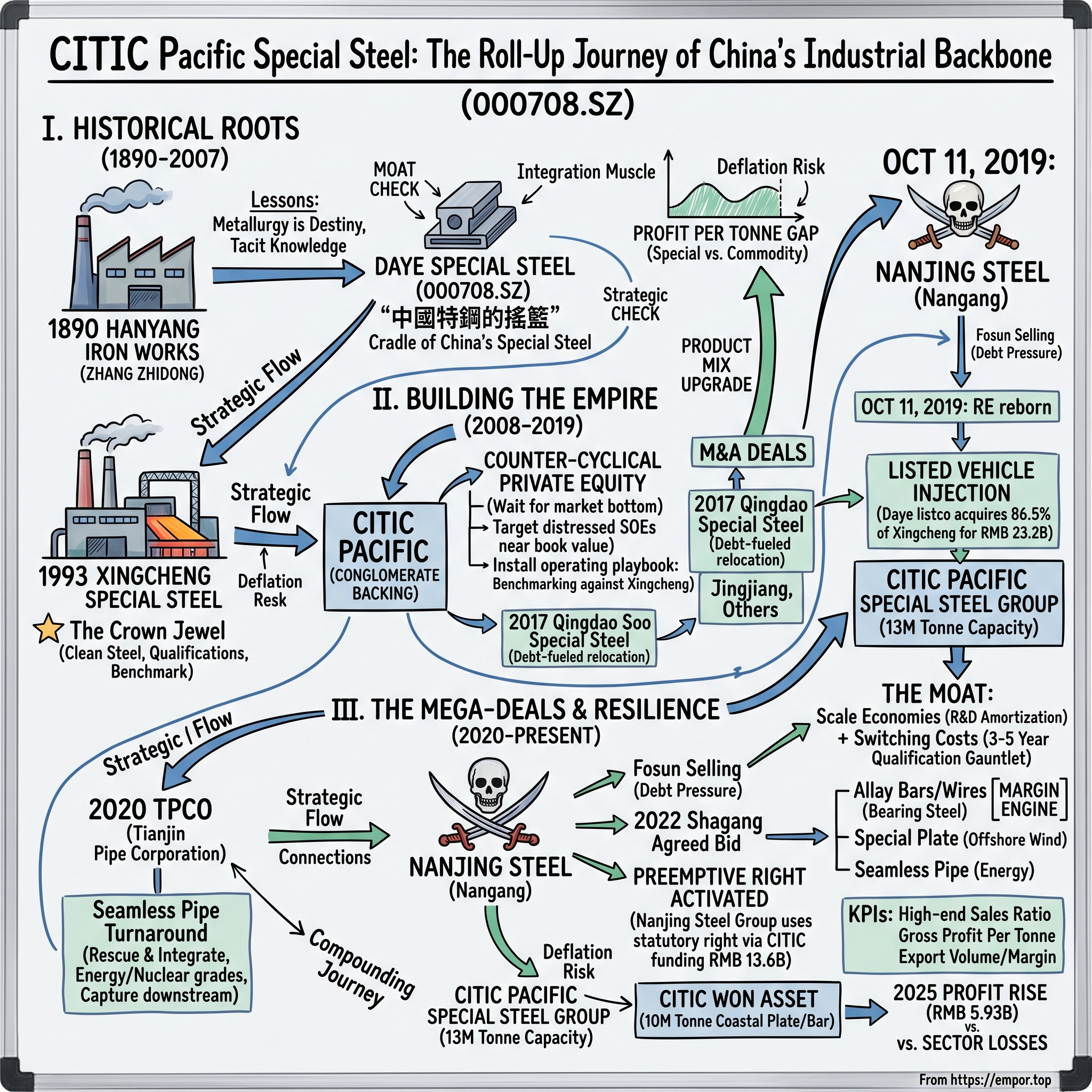
CITIC Pacific Special Steel: The Roll-Up of China's Industrial Backbone
I. Introduction & Episode Roadmap
Picture the trading floor of the Shenzhen Stock Exchange on the morning of October 11, 2019. A stock that had traded for two decades under the drowsy name "Daye Special Steel" was about to be reborn. By the closing bell it carried a new short name—CITIC Special Steel—and a new identity as the consolidated listing vehicle for every special-steel asset in one of China's most powerful conglomerates.[^2] The code never changed. But the company behind it had just quadrupled in scale.
That renaming is the hinge of our story, and it captures the central tension worth holding in mind. Chinese steel, as a category, is one of the least attractive businesses on the planet: a fragmented, politically managed, chronically over-supplied industry now staring down a structural, property-driven downcycle that may last a decade. China produces roughly half the world's steel and consumes most of it domestically, and the collapse of the residential-construction boom has hollowed out demand for the commodity grades—rebar, plate, coil—that make up the bulk of national output.
CITIC Special Steel's argument is that it does not really compete in that business at all. Its products are custom alloy formulations sold under multi-year contracts to manufacturers who spend three to five years qualifying a supplier and then dread ever having to switch. In 2025 the company turned over RMB 107.4 billion in revenue and, despite a slight top-line decline, grew net profit by roughly 16% to RMB 5.93 billion—a rebound from 2024, when profit had itself fallen about 10% to RMB 5.13 billion, and a striking result while the commodity steel sector bled.389 The question this article exists to test is whether that resilience reflects a genuine, durable moat or merely a well-timed position in a cycle that has not yet turned against it.
Consider what "world's largest dedicated special-steel producer" actually means, because the phrase is easy to skate past. The truly gigantic steelmakers—China's own Baowu, ArcelorMittal, Nippon Steel—are conglomerates whose special-steel arms are a sideline to oceans of commodity plate and coil. CITIC is the inversion: a company whose entire identity, capital base, and management culture are organized around the hard-to-make grades, at a scale of roughly 20 million tonnes a year that no pure-play peer approaches. Sweden's Ovako, Japan's Sanyo and Daido—the specialists the West thinks of first—are one-tenth to one-fifth its size. That is the fact that makes the company strategically interesting: it has taken the economics of a niche, high-margin business and married them to the economics of overwhelming scale, a combination that in most industries does not coexist because niche products don't sell in bulk. Special steel is the rare exception, because the "niche" is the entire drivetrain of the industrial economy.
We will get there in ten movements. First, the deep history: how a mill founded in the Qing Dynasty's desperate scramble to industrialize became "the cradle of China's special steel," and how a Hong Kong-listed conglomerate quietly bought its way in. Then the roll-up playbook—the counter-cyclical M&A machine that bought distressed mills at the bottom and re-engineered them. Then the metallurgy itself, because to understand the moat you have to understand why special steel is closer to a technology business than a commodity one. From there: a segment-by-segment tour of where the money is actually made, the two mega-deals that defined the last five years, a hard look at management and capital allocation, a formal moat analysis, an activist-style stress test, and finally the handful of numbers that actually matter for anyone tracking this company from here.
A word on posture before we start. This is not a company brochure, and the goal is not to decide whether CITIC is "good." It is to separate what the business has actually proven—in customer wins, in margins held through downturns, in deals executed—from what remains management assertion or cyclical luck. Chinese state-linked champions attract both uncritical boosters and reflexive skeptics; the useful stance is neither. Let us begin where the metal was first poured.
 Subscribe on LinkedIn
II. Historical Roots: From Qing Dynasty Metallurgy to CITIC's Industrial Entry (1890–2007)
In the summer of 1890, a Qing official named 张之洞 Zhang Zhidong—one of the last great mandarins of a dying empire—broke ground on a project that most of his court thought was madness. China had just been humiliated by foreign gunboats and lopsided treaties, and Zhang belonged to the faction that believed the only answer was to build heavy industry from scratch: the 自强运动 Self-Strengthening Movement. His instrument was the 汉阳铁厂 Hanyang Iron Works, erected on the banks of the Yangtze in Hubei and, when it fired up, the largest integrated iron-and-steel complex in Asia.2 To feed it, Zhang opened the great iron mine at Daye and coal pits nearby; in 1908 these were fused into the Hanyeping Coal and Iron Company, briefly the largest steel enterprise in the Far East.2
Hanyang was, by almost any commercial measure, a fiasco. Zhang had ordered his furnaces from Britain before he knew the chemistry of his own ore, and the Daye iron turned out to be high in phosphorus—wrong for the acid-lined Bessemer converters he had bought, which produced brittle, cracking rail. He hemorrhaged silver, leaned on foreign loans, and eventually had to hand the enterprise into the semi-private Hanyeping structure to keep it alive. It was a monument to how brutally hard industrialization is when you are inventing an industrial base, a supply chain, and a modern state all at once, against the clock of foreign encroachment. The lesson buried in that failure is one the modern company would eventually invert: in steel, metallurgy is destiny, and the mill that masters the chemistry of its inputs wins. Zhang lost precisely because he could not.
But the Daye lineage survived war, revolution, and central planning to become 大冶特殊钢 Daye Special Steel, the mill Chinese metallurgists came to call 中国特钢的摇篮—"the cradle of China's special steel." Under Mao-era planning, when China was cut off from Western technology and later split from the Soviet Union, Daye was one of the handful of works entrusted with the alloy bars and specialty grades that went into artillery barrels, aircraft, submarines, and the heavy machinery of a country trying to arm and industrialize simultaneously with almost no outside help. Special steel under that system was not a profit centre—it was a strategic necessity, made regardless of cost because the alternative was importing metal the country could not be sure of getting. That origin matters less as trivia than as DNA: Daye's institutional knowledge was in hard-to-make, defense-grade metal, not in bulk tonnage. It was a special-steel house before "special steel" was a category anyone paid a market premium for—which is exactly why, decades later, it was worth acquiring rather than building from scratch. You cannot buy a hundred years of metallurgical tacit knowledge at any price; you can only inherit it.
The modern chapter opens a century later and 700 kilometres downriver, on the coast. In 1993, 中信泰富 CITIC Pacific—the Hong Kong-listed flagship of the sprawling state conglomerate 中国中信集团 CITIC Group—acquired a controlling interest in a modest Jiangsu mill called 江阴兴澄特种钢铁 Jiangyin Xingcheng Special Steel.[^10] On paper it was an unremarkable regional producer. In practice it became the single most important asset in this entire story.
Why Xingcheng mattered is a lesson in the difference between geography and destiny. Sitting on the Yangtze near deep-water access, run by managers who chased Western quality certifications with something close to obsession, Xingcheng became CITIC's laboratory for clean-steel metallurgy—the art of stripping oxygen, sulphur, and microscopic inclusions out of molten steel until it is pure enough that a bearing spinning millions of times will not crack from a flaw invisible to the eye. Over the following decades Xingcheng would win qualification after qualification from the world's most demanding buyers, and become the internal benchmark—the "crown jewel"—against which every later acquisition was measured.[^10]
It is worth pausing on who CITIC Group was, because it explains why a Hong Kong-listed entity was buying interior Chinese steel mills at all. CITIC—the China International Trust and Investment Corporation—was founded in 1979 by 荣毅仁 Rong Yiren, the "red capitalist," as Deng Xiaoping's chosen vehicle for pulling foreign capital and commercial know-how into a reforming China. It grew into a sprawling state conglomerate spanning banking, securities, resources, and heavy industry, with its Hong Kong-listed arm, CITIC Pacific, acting as an internationally-facing investment platform. When that platform decided in the 1990s that special steel was a structurally attractive place to put capital—high barriers, defense relevance, room for quality-led import substitution—it had both the balance sheet and the political standing to act on the conviction. Special steel was not a random diversification; it fit CITIC's mandate of building industrial capability the country would otherwise have to import.
That conviction got its first real listed expression between 2004 and 2007, when CITIC Pacific took full control of Daye Special Steel and used it as a shell for a backdoor listing on the Shenzhen exchange, giving the group its 000708.SZ ticker.[^10] The cultural contrast could not have been sharper. Xingcheng was coastal, modern, export-oriented, and run like a company that expected to be audited by German engineers. Daye was an interior legacy SOE with a proud century-old history, a bloated payroll, a sprawling social burden of the kind Chinese state mills carried, and a product mix drifting toward whatever sold. The playbook CITIC ran on Daye—import Xingcheng's operating discipline, benchmark every process against the crown jewel, kill low-margin products, and push the mix relentlessly toward alloy grades—would become the template for everything that followed. This is the crucial insight of the early history: by 2007 CITIC had not merely assembled two mills, it had discovered a repeatable method for turning a tired state producer into a special-steel earner. It had found not just an asset but a machine for making more of them. The only question left was how many broken mills China's coming steel crisis would throw onto the market.
That method was about to be scaled into an empire.
III. The Master Roll-Up Playbook: Building the Special Steel Empire (2008–2019)
Every great roll-up needs an ugly market to feed on, and Chinese steel obliged spectacularly. Beijing's response to the 2008 crisis and the overcapacity that followed was a decade of consolidation policy—the 钢铁产业调整和振兴规划, the official plan to shrink the number of producers and force weak mills to merge or die. China had built more steelmaking capacity than the world had ever seen, much of it during the stimulus-fueled boom, and by the mid-2010s hundreds of millions of tonnes of it were unprofitable. The state's answer was not to let a free market clear the excess through bankruptcy—that would have meant mass layoffs in politically sensitive provinces—but to orchestrate mergers, cap new capacity, and push weak assets into stronger hands. For most participants this meant grinding losses, forced restructurings, and the slow humiliation of being absorbed. For a well-capitalized acquirer with a parent group's balance sheet and the state's blessing behind it, it meant something else entirely: a buyer's market in distressed metallurgical assets, with a motivated seller (usually a local government desperate to offload a failing mill's debts and social obligations) on the other side of the table.
CITIC's strategy through these years is best understood not as steelmaking but as counter-cyclical private equity applied to blast furnaces. The pattern repeated: wait for a mill to break under debt or a botched relocation, negotiate control at or near book value rather than paying a strategic premium, absorb the debt with the group's balance sheet, and then install the operating template that turned tonnage into margin. The genius of the approach was that it inverted the normal steel-industry curse. Most steelmakers expand at the top of the cycle, when assets are dear and optimism is high, and then choke on the debt when demand rolls over. CITIC did the opposite—it bought when others were forced to sell, which is the only time truly good industrial assets change hands cheaply. The discipline required to sit out the good times and strike in the bad is rarer than it sounds, and it is the single most important thing to understand about how this company created value.
The Qingdao Special Steel restructuring of 2017 is the cleanest illustration. 青岛特殊钢铁 Qingdao Special Steel had done what Chinese cities routinely forced on their mills—physically relocated its entire works away from valuable urban land—and had emerged from the move buried in debt.[^10] A relocated mill is a brutal thing to own: you have paid for a new plant but not yet earned back a yuan of the productivity it promises. CITIC stepped in, took operational control, and did what it always did—redirected Qingdao's output away from low-margin wire rod toward higher-value automotive spring steel and tire-cord wire, grades where clean metallurgy commands a premium. The strategic logic is worth stating plainly: CITIC was not buying steel capacity, it was buying a customer-qualification channel and then re-pointing it at products only a handful of mills could make.
The financial mechanics of the Qingdao turnaround are worth making concrete, because "shifted the product mix" can sound like an accounting abstraction. A tonne of low-margin wire rod might earn a mill almost nothing after costs in a bad year; a tonne of automotive spring steel or tire-cord wire—grades that require clean metallurgy and carry qualification barriers—can earn a meaningful premium. Take a relocated mill's existing furnaces, feed them a better recipe, run them for a customer base that pays for quality rather than price, and the same physical plant that was losing money can turn a profit within a year, not because volumes rose but because the mix did. That is the whole trick, and it works only if the acquirer actually possesses the metallurgical know-how and the customer relationships to make and sell the better grades. Capital alone cannot do it; a private-equity firm with a checkbook but no clean-steel expertise would have bought Qingdao and watched it keep bleeding. CITIC could do it because it had Xingcheng's playbook and Xingcheng's customer list.
By this point CITIC operated a cluster of mills—Xingcheng, Daye, Qingdao, and Jingjiang, the latter picked up from Hunan's Valin Group—but they sat in an awkward and value-destroying corporate structure. The crown-jewel Xingcheng was held privately under CITIC Pacific in Hong Kong, generating the bulk of the group's special-steel profit but invisible to mainland equity investors. The listed Shenzhen vehicle was still the smaller, lower-quality Daye. The best asset was on the wrong side of the wall, its earnings power trapped where the public market could neither see it nor pay for it. For a group that wanted to use its listed platform as an M&A and fund-raising currency, that structure was intolerable—you cannot issue shares in your best business if your best business isn't in the listed company.
The 2019 reorganization tore that wall down. In a deal signed at the start of the year, the listed Daye Special Steel agreed to acquire an 86.5% stake in Jiangyin Xingcheng Special Steel—the very asset that had been the group's operating heart for a quarter-century—for roughly RMB 23.2 billion, paid overwhelmingly in newly issued shares.17 Daye issued some 2.32 billion shares to CITIC and the other sellers, folded the crown jewel into the listed entity, and on October 11, 2019 renamed itself 中信泰富特钢集团 CITIC Pacific Special Steel Group.[^2] Overnight, 000708.SZ stopped being a mid-tier interior mill and became the consolidated home of China's largest dedicated special-steel producer, with combined annual capacity of roughly 13 million tonnes across four works.[^2]
For public shareholders the mechanics mattered enormously. This was a backdoor injection of the group's best asset into the listed company, and because the consideration was mostly equity, the deal's fairness turned entirely on the price at which Xingcheng was valued. Independent, contemporaneous valuation multiples for the injection were not publicly disclosed in the sources reviewed here, and that is itself worth flagging: minority investors in a parent-to-listco asset injection are structurally exposed to the risk that the controlling shareholder sets the price. The bull reading is that CITIC handed its crown jewel to the public vehicle at a defensible valuation and instantly lifted earnings per share; the skeptic's reading is that any related-party injection deserves scrutiny precisely because the buyer and seller share a controlling parent.
What the consolidated platform unlocked was optionality. With the crown jewel now inside a mainland-listed company, CITIC had a currency—publicly traded shares and access to domestic capital markets—that it could deploy for the next round of acquisitions, and a clean corporate story to tell investors: this is the pure-play special-steel champion, all of it in one place, all of it public. The 2019 restructuring was therefore less an end point than a starting gun. It converted a scattered collection of mills held across an opaque group structure into a single, fundable, acquisitive vehicle at the precise moment two of the largest special-steel assets in China—Tianjin's pipe champion and Nanjing's coastal producer—were about to come into play. Timing in M&A is often mistaken for luck; here it looks more like a company that spent fifteen years building the machine, and then switched it on just as the market handed it the two biggest targets of the decade.
Either way, the platform now existed. The next act would be to point that platform's balance sheet at those targets—but first, we need to understand why any of this metallurgy is worth a premium at all.
IV. Industry Structure & Metallurgy Economics: Commodity Steel vs. Special Steel
Here is a thought experiment that explains the whole business. Two steel bars sit side by side. One is rebar—普钢, commodity carbon steel—destined to be cast into a concrete pillar. The other is 轴承钢, bearing steel, destined for the raceway of a bearing that will spin inside a high-speed rail axle at 300 kilometres an hour for years without failing. They may cost roughly the same in raw iron and energy. Yet one is priced off a spot market that gyrates with property starts, and the other is sold under a contract negotiated years in advance to a customer who cannot easily replace you. Understanding why is understanding the entire investment case.
Commodity steel is sold on price and availability. Rebar, hot-rolled coil, and standard beams are interchangeable; a builder buys whatever is cheapest that meets a minimum spec, and margins are compressed to the marginal producer's cost. Because the product is undifferentiated, the industry is a textbook case of ruinous competition—hundreds of producers, no pricing power, profits that vanish the moment demand softens. This is the business that China's property collapse has turned into a graveyard.
Special steel—alloy bars, bearing steel, seamless pressure pipe, forged superalloys—is sold on trust. The customer is not buying tonnes; they are buying the certainty that the metal will behave identically, batch after batch, part after part, under enormous cyclic stress for years. That certainty comes from metallurgy the layperson never sees. Here is the analogy that makes it concrete: think of ordinary steel as tap water and bearing steel as pharmaceutical-grade injectable saline. Chemically they are mostly the same thing. But one is judged on being roughly right and cheap, and the other is judged on the near-total absence of contaminants, because a single impurity in the wrong place is catastrophic. In steel, those contaminants are microscopic non-metallic inclusions—specks of oxide and sulphide, invisible to the eye, that are the birthplace of fatigue cracks. A bearing spinning millions of times fails at its single dirtiest point. So the entire art of "clean steel" is removing those specks: vacuum degassing the molten metal, controlling the slag chemistry, refining until the count of inclusions per cubic millimetre drops to a level competitors cannot reliably hit. "Clean steel" is not a marketing phrase—it is literally the product, and it is why two bars of near-identical chemistry can sell at wildly different prices.
Heat treatment adds the second layer of the moat. The same alloy can be made hard and brittle or tough and ductile depending on precisely how it is heated and cooled, and matching that treatment to a customer's exact application—a gear that must resist wear, a spring that must flex millions of times, a shaft that must not snap under shock load—is proprietary craft accumulated over decades. None of this shows up in a spot price. All of it shows up in whether a Toyota gearbox lasts 300,000 kilometres.
This is where the real moat lives, and it has a name buyers use: qualification. When a tier-one manufacturer—an automotive supplier like Bosch or Continental, a bearing giant like SKF, Schaeffler, NSK, or Timken—decides to source a critical steel, it does not run a price auction. It runs a gauntlet. Sample metallurgy is tested, then fatigue-stress tested, then run through pilot batches, then the supplier's factory is audited, and only then is full production certified. The whole process routinely takes three to five years. Once a mill is designed into a safety-critical part, switching suppliers means re-running that gauntlet and re-validating the end product—so buyers don't, unless something goes badly wrong. The result is a business with the churn profile of enterprise software hiding inside an industry with the reputation of a scrapyard. Xingcheng's own claim to have held the number-one position in China's high-end bearing market for over two decades, and number one globally for more than a decade, is the visible output of that switching-cost machine.[^4]
Who else can play this game? Domestically, the competition is real but narrow, and it is instructive to know the rivals by name because two of them will reappear in the drama of the mega-deals. 沙钢 Shagang, China's largest private steelmaker, runs a famously lean, aggressive, low-cost operation and controls 东北特钢 Dongbei Special Steel, a restructured legacy state producer from the northeast rust belt. Shagang's edge is cost and commercial ruthlessness; its weakness, relative to CITIC, is a shorter pedigree in the very highest grades. 宝武 Baowu, the state megaconglomerate that is by volume the world's largest steelmaker, has its own special-steel and aerospace-alloy arms and is the one domestic player with the resources to genuinely challenge CITIC at the top of the market—particularly in aerospace superalloys, where Baowu's specialist units are strong. The domestic special-steel market, in other words, is an oligopoly of a few serious players sitting atop a vast commodity base, which is precisely why pricing in the niche is more rational than in rebar.
Globally, the dedicated special-steel names are smaller and increasingly consolidating under Japanese ownership: Daido Steel and Sanyo Special Steel of Japan, and Ovako of Sweden, the latter two now inside Nippon Steel's orbit. These are formidable technical competitors—Japanese and Swedish bearing steel set the historical global benchmark, and any claim that CITIC has "caught up" should be read as caught up in volume and in many grades, not necessarily surpassed in the most exacting aerospace and ultra-precision applications. CITIC's structural advantage over all of them is scale. Its capacity of roughly 20 million tonnes dwarfs any single dedicated special-steel peer several times over, and in a business where R&D, process development, and continuous-caster capex are largely fixed costs, that scale lets it amortize the cost of staying at the frontier across a far larger volume base. Scale in a differentiated product is a fundamentally different animal from scale in a commodity: in rebar, being bigger just means owning more of a money-losing business; in special steel, being bigger funds the laboratory, the metallurgists, and the qualification campaigns that widen the moat. That is the theory of the whole enterprise. The next section tests it against where the profit actually comes from.
V. Core Segment Deep-Dive: Revenues, Margins, & Growth Engines
If you could walk the length of one of CITIC's works, you would pass four very different businesses wearing the same corporate logo, and they earn their keep in very different ways. The company reports its output across special steel product families rather than tidy segment P&Ls, so precise per-segment margins are not fully disclosed; what follows blends the company's own product framing with what can be independently observed about each business.[^16]
The heart of the company is alloy steel bars and wires (合金钢棒线材), the largest slice of revenue and the true margin engine. This is the world of automotive gears, crankshafts, drive shafts, high-strength fasteners, and the main-shaft bearings inside wind turbines. And within it sits the single most valuable product in the entire group: high-end bearing steel. This is the grade where "clean steel" is everything, where CITIC supplies the global bearing majors, and where Xingcheng's decades-long qualification lead translates into pricing power that the commodity grades can only envy.[^4] When investors ask where CITIC's economic moat physically resides, the honest answer is: in a few hundred thousand tonnes of bearing and gear steel a year that a handful of customers cannot easily buy anywhere else.
The demand story beneath this business is more nuanced than a simple "China grows, gears grow" narrative, and it is where the bull and bear cases first diverge. On the bullish side, some of the fastest-growing end-markets on earth are bearing-steel-intensive in ways that have nothing to do with Chinese property: every wind turbine needs a massive, ultra-clean main-shaft bearing; every high-speed train needs axle and bearing steel qualified to safety standards that take years to clear; every robot, machine tool, and industrial motor rides on precision bearings. As China exports more of these machines, the alloy content travels with them. On the cautious side, the automotive transition cuts the other way for part of the franchise, a tension we will return to. The point for now is that the bearing-steel core is not one monolithic demand curve but a portfolio of them, some structurally rising and one structurally challenged.
The second business is special medium and thick plate (特种中厚板), a steadier cash generator. These are the ultra-thick, fatigue-resistant alloy plates that go into offshore wind-turbine foundations, naval and merchant shipbuilding, pressure vessels, and heavy mining equipment. The growth story here is tied directly to China's offshore-wind build-out: every jacket and monopile planted in the seabed needs plate that can survive decades of salt-water fatigue loading, and that is a structural demand tailwind independent of the property cycle. It is lower-margin than bearing steel but higher-volume and less cyclical—the ballast in the portfolio.
The third business is special seamless steel pipe (特种无缝钢管), and it is the turnaround engine. These are the pipes threaded into deep-sea oil and gas wells, nuclear heat exchangers, and high-pressure boiler tubes—products where a single failure is catastrophic and specifications are punishing. The pipe business was transformed by the integration of 天津钢管 Tianjin Pipe Corporation (TPCO), a story we will come to, which made CITIC the largest seamless-pipe producer in the world.[^8]
The fourth business is the smallest and, strategically, the most interesting: forged steel and aerospace superalloys (特冶锻材). This is metal for commercial aviation—landing gear and structural forgings for programs like the 商飞 COMAC C919—for defense, and for high-speed-rail axles. It is a rounding error on today's revenue, but it carries gross margins far above the group average, and it is a call option on China's long, uncertain push to build a domestic aerospace supply chain. The right way to size it is exactly as the outline does: tiny today, potentially strategic tomorrow, and worth watching precisely because its economics are so different from the rest of the company. What an investor should not do is capitalize that optionality as if it were already a business—aerospace qualification cycles are measured in decades, and domestic commercial aviation volumes remain small.
Underlying all four is a piece of financial architecture that explains the group's stubborn resilience: pricing that passes raw-material cost through to the customer. Special-steel contracts with major OEMs are typically structured so that swings in iron ore and scrap prices are largely passed along, which is why CITIC's gross margins have historically held in a mid-teens range even as commodity steel margins collapsed—the company sells a spread over its input costs, not a fixed price exposed to input volatility. That pass-through is the mechanism behind the headline that CITIC grew profit in 2025 while much of Chinese steel lost money.3 It is also, worth noting, not absolute: pass-through lags, and in a sharp raw-material spike the margin compresses before contracts reset. The moat narrows the volatility; it does not abolish it.
The right way for an investor to think about the unit economics is per tonne, not in aggregate, because the aggregate revenue figure blends genuinely differentiated steel with more ordinary grades that CITIC also produces. A commodity mill might make a razor-thin margin on a tonne of coil in a good year and lose money on it in a bad one. CITIC's differentiated grades carry a structural gross-margin premium per tonne—the reward for clean metallurgy and qualification lock-in—that persists through the cycle. The company's whole strategic project is to keep pushing the volume mix toward those premium tonnes and away from the commodity ones, which is why the single most important operating question is not "how much steel did they sell?" but "how much of it was the good kind?" We will make that the first of our tracked KPIs. For now, hold onto the mechanism: this is a business whose margins are defended by contract structure and product mix, not by the direction of the steel price—which is exactly what lets it look so different from its peers in a downturn.
To see how CITIC built the pipe and plate scale behind those numbers, we have to go back to the deals.
VI. The M&A Mega-Deals: TPCO and the Nanjing Steel Bidding War (2020–2024)
Roll-ups are usually won quietly. Two of CITIC's were not. The first was a rescue; the second was a street fight that pulled in China's largest private steelmaker, a debt-strapped conglomerate, a set of statutory legal rights, and a lawsuit.
Start with the rescue. 天津钢管 Tianjin Pipe Corporation was China's premier seamless-pipe maker—six mills, world-class capacity of roughly five million tonnes—and a genuine point of national industrial pride, having been built in the late 1980s and 1990s to end China's dependence on imported oil-country tubular goods. By the late 2010s it was drowning, carrying tens of billions of yuan in liabilities after years of debt-funded over-investment collided with a downturn in oil and gas capital spending. A seamless-pipe mill is enormously capital-intensive and its fortunes swing with the energy cycle; TPCO had expanded into the teeth of a cyclical trough and could not service what it owed. In 2020 CITIC's Xingcheng subsidiary won the bid for a 60% stake in the holding company that controlled TPCO, taking operational command of the world's largest seamless-pipe platform and, in the process, pushing CITIC's total steel capacity above 20 million tonnes.[^8] The deal template was identical to Qingdao a few years earlier: acquire a distressed but strategically valuable asset near the bottom, absorb a competitor rather than fight it on price, and apply the operating playbook to drag it back toward profitability.
The strategic logic ran deeper than the tonnage. Seamless pipe for deep-sea drilling and nuclear power is one of the hardest special-steel products to make—it must hold pressure and resist corrosion in environments where failure means an oil blowout or a reactor incident—and it sits squarely in CITIC's clean-steel wheelhouse. By absorbing TPCO, CITIC did three things at once: it removed an independent rival, it gained a commanding position in a high-barrier energy-and-nuclear niche that will matter as long as the world drills for hydrocarbons and builds reactors, and it acquired a captive customer for its own upstream steel. The skeptic's note is that seamless pipe is more cyclical and energy-price-sensitive than bearing steel, so the acquisition, like Nangang later, added scale and strategic breadth at the cost of adding cyclicality. The turnaround itself—restoring an over-indebted mill to positive cash generation—is the kind of operational work that does not make headlines but is where CITIC's integration muscle is actually tested.
Then came Nanjing, and the gloves came off. The setup: 复星国际 Fosun International, the acquisitive conglomerate that had spent the 2010s buying trophies from Club Med to Wolverhampton Wanderers, was by 2022 under real balance-sheet pressure and needed to sell assets. One of its crown jewels was a 60% controlling stake in 南京钢铁 Nanjing Iron & Steel United (Nangang), a large, well-located coastal producer of high-grade plate and bar. In October 2022 Fosun agreed to sell that stake to 沙钢 Shagang—the private-sector giant and CITIC's fiercest domestic rival—for around RMB 13.6 billion.4 On paper, Shagang had won.
What Shagang had reckoned without was a piece of paper buried in the Nangang joint-venture agreement: a 优先购买权, a statutory preemptive right held by the local state partner, Nanjing Steel Group, to match any third-party offer for the stake. In the spring of 2023 that right was activated. CITIC injected RMB 13.6 billion into Nanjing Steel Group, aligning with the local state shareholder, and on April 2, 2023 Nanjing Steel Group announced it would exercise the preemptive right and buy the 60% stake itself—snatching the asset out from under Shagang at the last moment.45 The maneuver was legal, it was ruthless, and it was extraordinarily well-engineered: rather than outbid Shagang, CITIC used the target's own governance structure as a weapon.
Shagang did not go quietly. It sued Fosun over the collapse of its deal, and the affair became one of the most closely watched M&A brawls in recent Chinese industrial history—private capital versus state-aligned capital, fighting over the same trophy, with the legal system as the arena.10 Shagang ultimately withdrew, reportedly with compensation for its trouble, and CITIC-aligned interests consolidated control of Nangang. The prize was roughly ten million tonnes of coastal high-grade plate and bar capacity, located in the prosperous Yangtze delta near CITIC's existing mills, adding a meaningful profit contribution to the group.
There is a larger lesson in the Nangang episode about the nature of CITIC's advantage, and it cuts in a direction that should make even a bull thoughtful. The company did not win Nangang by being the better operator or the higher bidder in an open market—it won by mobilizing a statutory right through a state-aligned local partner, backed by the willingness and ability to write a RMB 13.6 billion cheque on short notice. That is a real and repeatable edge in the Chinese context: access to capital, political standing, and the procedural levers that come with being part of the state's industrial apparatus. But it is an edge rooted in China's particular institutional environment, not in metallurgy, and a foreign investor should be honest that it is precisely the kind of advantage that does not travel and that can, in a different political season, be turned against minority shareholders as easily as it was turned against Shagang. When the state's toolkit is what wins you the deal, the state's priorities are what you are ultimately serving.
Did CITIC overpay? The honest answer is that the deal's true multiple depends on Nangang's normalized earnings through a steel downcycle, which are not cleanly disclosed. What can be said is that the headline price—about RMB 13.6 billion for the 60% stake—was set by a genuine competitive process against a tough private bidder, which is a reasonable check against wild overpayment, and that the asset's coastal location and product mix are strategically complementary rather than duplicative. The skeptic's counter is equally fair: buying a large plate-and-bar producer at the top of a policy-supported push into steel, just as Chinese construction demand entered a structural decline, concentrates the group's exposure to exactly the cyclical, property-adjacent grades its premium narrative claims to have transcended. Nangang is not bearing steel. It is a bet that scale and location beat the cycle.
Both deals share a signature, and it tells you something about how this company thinks. CITIC does not buy healthy assets at auction premiums; it buys broken or contested ones and fixes or captures them. Which raises the obvious question: who, exactly, is running this machine?
VII. Current Management, Governance, & Capital Allocation
Chinese state-linked conglomerates are not usually known for cults of personality, and CITIC Special Steel is no exception—but the man at the top is unusually well-suited to the job, in a way that reveals what the company values. 钱刚 Qian Gang, chairman since April 2020, is not a financier parachuted in from headquarters. Born in February 1966, holding a doctorate and the rank of professor-level senior engineer, he is a career metallurgist who climbed the operating ladder inside the very mills he now oversees—running Daye Special Steel, then serving as Party secretary and general manager of Hubei Xinye Steel and of Jiangyin Xingcheng itself before taking the group chair.6 In other words, the CEO of the world's largest special-steel maker spent his formative decades on the shop floor of its crown jewel, obsessing over yield, cleanliness, and cost. For a business whose entire moat rests on metallurgical process discipline, having a process obsessive in charge is a feature, not an accident.
Qian's public profile is that of a technocrat, not a showman—he sits as a member of the national political advisory body, the CPPCC, a marker of the standing senior state-enterprise executives carry in China, but he is known internally for an operator's obsessions: yield, energy consumption per tonne, defect rates, R&D discipline.6 For a moat built on process, that temperament is the point. The risk in it is the mirror image: a lifelong insider who rose through one company's culture may be superbly equipped to optimize the existing machine and less inclined to question whether the strategy of ever-larger acquisitions is still creating value at the margin.
Alongside him, following the board and management reshuffle completed in 2025–2026, sits president 罗元东 Luo Yuandong, who was also elected vice chairman—a leadership pairing of a metallurgist-chairman with an operating president that keeps continuity in the executive suite.11 The bench beneath them is drawn overwhelmingly from within the group's mills rather than from external hires, which is the double-edged reality of promote-from-within cultures: deep operating knowledge and integration muscle, at the cost of the outside perspective that sometimes catches a strategy drifting. A skeptic auditing governance would also note the routine executive reshuffling among group entities that Chinese state conglomerates practice—managers rotate between the listed company and parent affiliates in ways that can blur the line between serving 000708.SZ's shareholders and serving the broader CITIC system.
The governance structure is where a neutral investor should keep both eyes open. 000708.SZ sits at the bottom of a control chain that runs up through CITIC Pacific to 中国中信集团 CITIC Group, the central state conglomerate. That parentage is a genuine asset—it brings a balance sheet, procurement heft, and the political standing that made maneuvers like the Nangang preemptive right possible. It is also the single largest structural risk to minority holders, for the ordinary reason that a controlling parent's interests and a minority shareholder's interests are not identical. The 2019 asset injection, the parent-aligned Nangang financing, and the general pattern of the listco absorbing group assets are all worth watching through that lens—not as evidence of wrongdoing, but as the standing question every minority owner of a controlled SOE has to keep asking: is capital flowing to build the business, or to serve the parent?
On the evidence so far, capital allocation has been more disciplined than the sector norm, and this is the strongest single argument for taking management's competence seriously. The M&A record is strikingly consistent: every major deal—Qingdao, Jingjiang, TPCO, Nangang—has been a distressed or contested special-steel asset bought counter-cyclically and integrated into the existing platform. There are no glamour acquisitions, no diversification into unrelated industries, no overseas trophy-hunting of the kind that humbled Fosun and other Chinese conglomerates who mistook empire-building for value creation. A company that says "we buy broken special-steel mills cheap and fix them" and then, deal after deal for over a decade, does exactly and only that, has earned a degree of credibility that no investor presentation can manufacture. Consistency between stated strategy and actual behavior is the rarest thing in capital allocation, and CITIC has it.
The counter-discipline is dividends. Rather than hoarding cash to fund an ever-expanding acquisition war chest—the classic trap of the serial acquirer, who eventually overpays because the money is burning a hole in the balance sheet—the company has distributed a meaningful share of profit to shareholders, including a semi-annual payout introduced to sharpen returns, even while funding its deals.[^16]12 That is the right instinct for a controlled company: returning capital forces a certain honesty, because money paid out cannot be squandered on a marginal acquisition. The precise payout ratio and R&D intensity fluctuate year to year and are best tracked directly in the annual report rather than assumed; the outline's figures of a roughly 40–50% payout and R&D near 3.5–4% of revenue are plausible orders of magnitude but should be verified in each year's filing rather than treated as fixed policy. What is observable and material is the shape of the record: a company that funded a decade of large acquisitions without blowing out its balance sheet, keeping leverage at levels the business can service through a downturn, while still paying shareholders. That is a genuinely creditable performance, and it is the factual backbone of the bull case on management.
The real test of management, though, is not the deals they announce but the moat they defend. So let us put the business through the frameworks.
VIII. Moats & Strategic Frameworks: 7 Powers & Porter's 5 Forces
Strip away the narrative and ask the cold question an analyst should ask: which of CITIC's advantages are structural, and which are just the residue of a favorable moment? Hamilton Helmer's 7 Powers framework is a useful scalpel, because it forces you to distinguish a real barrier from a nice-to-have.
Two of the seven powers clearly apply. The first is scale economies. In special steel, the largest cost bucket that scales with size is not the furnace—it is the fixed cost of metallurgical R&D, process development, and the continuous-caster and refining capex that clean steel demands. Spread those fixed costs across roughly 20 million tonnes and the per-tonne cost of staying at the technological frontier is a fraction of what a two-million-tonne rival bears. Scale also translates into raw-material bargaining power against the iron-ore oligopoly of BHP, Rio Tinto, and Vale. The second, and stronger, power is switching costs, already described: the three-to-five-year qualification gauntlet that locks in tier-one automotive, wind, and aerospace customers and gives the bearing-steel franchise its durability.
A third, process power, is plausible but harder to verify from outside. Decades of proprietary metallurgical recipes, slag chemistry, and inclusion control are real know-how, and Xingcheng's recognition by the World Economic Forum as the special-steel industry's first "lighthouse factory"—an elite designation for advanced digital manufacturing—is the kind of third-party validation that is hard to fake.[^16] The caveat a skeptic would raise is that process advantages in metallurgy erode: Japanese and Korean specialists have deep know-how too, and Chinese state peers are pouring capital into closing the gap. Process power here is a lead, not a lock. A fourth candidate, a cornered resource in the form of CITIC Group's logistics, port, and procurement network, is genuinely useful but is better described as a corporate advantage than a defensible economic moat—another well-capitalized state group could replicate much of it.
Notably absent are network effects and branding power in any consumer sense. This is a B2B franchise whose customers are engineers, and its defensibility rests almost entirely on switching costs plus scale-funded process leadership. That is a narrower moat than, say, a consumer platform's—but in heavy industry it is about as good as it gets.
The acid test of any claimed moat is the counterfactual: if a rival raised unlimited capital tomorrow, could it replicate the position? For most of CITIC's business the honest answer is "not quickly, and not entirely." Capital can build a modern mill in a few years, but it cannot compress a five-year qualification cycle with a dozen tier-one OEMs, cannot buy the decades of accumulated metallurgical tacit knowledge that separates a 99.9%-clean heat from a 99.99%-clean one, and cannot instantly acquire the reference list of blue-chip customers whose sign-off is itself a barrier. The evidence that this moat is economically real, rather than merely asserted, is that CITIC has sustained returns on equity well above the steel-industry norm across the cycle and has kept margins in the mid-teens while commodity peers swung between thin profits and outright losses. Durable excess returns in a brutal industry are the footprint of a genuine competitive advantage; you do not earn them for a decade by accident. The caveat that keeps the analysis honest is that a good chunk of CITIC's tonnage—the plate and pipe and lower grades acquired through the roll-up—is more contestable than the bearing-steel jewel, so the blended moat is real but shallower than the headline market-share statistics suggest.
Porter's Five Forces sharpen the same picture. The threat of new entrants is low: a modern special-steel mill costs many billions of yuan, environmental permitting under China's 双碳 dual-carbon policy caps new capacity, and even a fully built rival still faces the multi-year OEM qualification wall. Supplier power is medium-to-high, because the seaborne iron-ore market is a three-company oligopoly, partly offset by long-term contracts and group logistics. Buyer power is low-to-medium: OEMs push hard on price during auto and machinery downturns, but they cannot credibly threaten to leave a qualified clean-steel supplier at scale. The threat of substitutes is low in CITIC's core—aluminium and carbon-fibre composites do displace steel in lightweight body applications, but bearings, gears, wind main-shafts, and high-pressure tubing rely on steel's specific fatigue behavior, which nothing cheaper matches. And competitive rivalry is the most nuanced: in commodity steel it is savage, but the special-steel niche is far more concentrated, with a handful of serious domestic players, which supports more rational pricing—until, as Nangang shows, two of them decide they want the same asset.
The forces analysis lands on a balanced verdict. CITIC's moat is real, it is concentrated in bearing and alloy steel, and it is narrower than the "20-million-tonne titan" framing implies—much of the group's tonnage is in plate and pipe grades that are differentiated but not fortress-protected. Which is the perfect setup for the bear case.
IX. Financial Stress Test, Risk Radar, & Bear vs. Bull Case
Before handing the floor to the skeptic, it is worth clearing away three consensus narratives that get repeated about this company, because two of them are half-myths.
Myth one: "It's a steel company, so it lives and dies with Chinese property." Reality: partly true of its acquired commodity-adjacent tonnage, but false of the core. The bearing- and alloy-steel franchise is levered to global manufacturing and machinery, not to apartment starts, which is why the company earned rising profits in 2025 while property-exposed mills lost money.3 The nuance the bulls miss is that recent acquisitions have added back some construction exposure the original franchise had escaped.
Myth two: "CITIC has caught up with and surpassed the Japanese and Swedish specialists." Reality: it has caught up decisively in scale and in many grades, and it genuinely leads the world in the volume of high-end bearing steel.[^4] But in the most exacting aerospace superalloys and ultra-precision applications, the incumbents' lead is not obviously closed, and CITIC's own aerospace business is still tiny. "Largest" and "best at everything" are different claims; only the first is proven.
Myth three: "State ownership means the numbers can't be trusted." Reality: the more useful framing is not fraud but alignment. The financials are audited and the operating record is real; the genuine risk is not fabricated earnings but a controlling parent whose interests may diverge from minority holders' at moments like asset injections. That is a governance discount to weigh, not a reason to dismiss the business.
With the myths sorted, imagine a skeptical long/short investor sitting across the table from CITIC's management, and give them the floor. Their job is not to be fair; it is to find where the story breaks.
Their first thrust is property contagion. China's real-estate collapse has vaporized commodity-steel demand—so how can a steelmaker be insulated? Management's answer, and it is a reasonable one, is that direct exposure to property construction is modest, on the order of well under a tenth of revenue, with the overwhelming majority coming from manufacturing end-markets: autos, machinery, energy, defense, and exports. The 2025 results, in which profit rose while the broader sector struggled—and the first-half 2025 numbers, where net profit edged up even as revenue softened—are the strongest single pieces of evidence for that claim.312 But the skeptic has a rejoinder worth taking seriously: manufacturing is not immune to a consumer slowdown, and the Nangang acquisition deliberately added plate-and-bar capacity that is more property- and construction-adjacent than the bearing-steel core. CITIC is less exposed to property than a rebar mill—but it is not unexposed, and it just voluntarily increased that exposure.
The second thrust is the margin squeeze. What happens when iron ore is expensive and finished-steel prices are falling at once? The company's defense is the cost-pass-through pricing described earlier, and the historical record of mid-teens gross margins holding through prior downcycles supports it. The honest qualification is that pass-through lags and never perfectly protects a single quarter; the moat dampens volatility rather than eliminating it.
The third, and sharpest, thrust is parent siphon risk: is 000708.SZ a cash cow milked to service the wider CITIC empire's debts? Here the evidence is reassuring but not conclusive. The company pays a healthy dividend while retaining enough cash to self-fund growth, and net leverage has been kept at manageable levels through a heavy M&A decade.[^16] But related-party asset injections and parent-aligned financings are a permanent feature of this structure, and the appropriate posture is continued vigilance rather than either alarm or trust.
Beyond the stress test, the current risk radar holds three material items. First, trade friction: the EU's Carbon Border Adjustment Mechanism and rising steel tariffs across Western markets threaten the roughly 2.3 million tonnes CITIC exports, and indirectly threaten the Chinese manufacturers who embed its steel in exported cars and machines.3 Second, the EV transition: battery-electric powertrains use far fewer machined gears than internal-combustion drivetrains, structurally shrinking a slice of traditional gear-steel demand—partly, but only partly, offset by EV demand for lightweight suspension springs and motor bearings. This is a genuine long-term headwind to one of the core franchises and deserves more attention than management tends to give it. Third, integration risk: absorbing culturally distinct, formerly distressed mills like TPCO and Nangang is exactly where roll-ups most often stumble, and the group is digesting two very large ones at once.
One more item belongs on the radar that the stress test tends to underweight: the sheer gravity of Chinese industrial deflation. Even a company insulated from property directly is not insulated from a general grinding-down of manufacturing prices when the whole economy runs below capacity. Deflation erodes the pricing power that pass-through contracts are supposed to protect, because when every industrial buyer is squeezed, they push back on the terms at renewal. CITIC's mid-teens margins have held so far, but "so far" covers a period in which the special-steel niche stayed tighter than the commodity glut. A prolonged, broad-based deflation that finally reaches the premium grades is the macro scenario that would test the moat most severely, and it is not a tail risk—it is arguably the base case for the Chinese industrial economy over the next several years.
Weigh it all and the debate crystallizes. The bull case is that CITIC is the structural winner of China's industrial upgrading: as the country exports more EVs, wind turbines, robots, and heavy machinery, the highest-margin alloy and bearing volumes flow to the one producer with the scale, qualifications, and process lead to serve them—and the counter-cyclical M&A engine keeps compounding by buying broken mills cheap while paying a steady dividend along the way. The bear case is that prolonged Chinese industrial deflation caps volume and pricing across the board, Western protectionism and carbon-border levies wall off the most profitable export channels and force excess tonnage back into a brutal home market, and the Nangang-and-TPCO expansion has quietly re-cyclicalized a company that sold itself as having escaped the cycle—leaving it larger, more indebted, and more exposed to construction and energy swings than the "clean bearing steel" story implies.
What would falsify each case is worth stating, because it turns the debate into something testable rather than a matter of temperament. The bull case breaks if the high-end mix stalls, if per-tonne margins compress through a downturn, or if a major integration—Nangang, TPCO—turns out to be a value trap that never earns its cost of capital. The bear case breaks if CITIC keeps growing the premium share of volume, holds its margin spread through the current deflation, and demonstrates that the acquired plate and pipe assets can be steadily upgraded toward the specialty end, as Qingdao and Daye were before them. Both cases are live, and honest people can hold either. The tiebreaker is not rhetoric; it is a small set of numbers that will reveal, quarter by quarter and year by year, which story the business is actually living.
X. Key Investment KPIs & Playbook Lessons
Most of what is written about a steelmaker—quarterly tonnage, headline revenue, the iron-ore price—is noise for a long-term owner of this particular company. Three metrics actually carry the thesis, and they are worth tracking with discipline over years, not quarters.
The first is the high-end special-steel sales ratio—the share of total volume in the customized, hard-to-qualify grades like bearing steel, spring steel, and high-pressure alloy pipe. This single number is the cleanest proxy for whether CITIC is drifting toward or away from the commodity gravity well. As long as the premium mix holds and grows, the moat narrative is intact; if it stalls or slips—say, because absorbing Nangang's plate and bar dilutes it—that is the earliest warning that the story is quietly becoming an ordinary steel company with better marketing.
The second is gross profit per tonne (吨钢毛利). This is the direct readout of pricing power over raw-material cost—the spread the whole business is built to defend. Because it strips out volume and input-price swings, it isolates the one thing that makes CITIC different from a commodity mill: the ability to charge for metallurgy. A durable per-tonne spread through a downcycle is the hardest evidence that the moat is real; a compressing one, even amid rising revenue, would be the tell that competition or mix is eroding the edge.
The third is export volume and its realized margin. Growth in tonnage sold into demanding tier-one overseas markets is both a growth vector and, more importantly, an independent audit of product quality—foreign OEMs qualify to the same punishing standards regardless of Chinese industrial policy, so an SKF or a Schaeffler buying more CITIC steel is a vote that no domestic subsidy can buy. Rising export volumes at healthy margins would validate the quality claim; exports growing only by dumping low-margin tonnage abroad, or shrinking under CBAM and tariffs, would undercut it. In 2025 exports of about 2.3 million tonnes grew modestly, a data point the bulls will cite and the bears will watch for signs of protectionist erosion.3 The subtlety worth tracking is not just the volume but the mix and margin of exports: two million tonnes of premium bearing and gear steel sold to Western tier-ones tells a very different story than two million tonnes of ordinary bar dumped at distressed prices, and only the annual report's detail separates the two.
A note on what deliberately did not make this list. Headline revenue, total steel output, the iron-ore price, and even reported net profit in any single quarter are all noisier and less revealing than the three above, because each is dominated by factors—commodity prices, one-off items, the acquired commodity tonnage—that obscure the one thing an owner of this specific company should care about: is the differentiated, moat-protected core getting bigger, more profitable per tonne, and more validated by the world's most demanding buyers? Track those three and you are measuring the thesis. Track the headlines and you are measuring the weather.
Step back from the numbers and CITIC Special Steel leaves two durable lessons for investors in heavy industry. The first is that even a brutal commodity sector can hide a differentiated business: proprietary process power plus multi-year customer switching costs can carve a defensible, higher-return niche out of an industry famous for destroying capital—provided you can tell the special-steel bar from the rebar, and price them differently. The second is the power, and the peril, of the counter-cyclical roll-up: buying good assets in bad times and re-engineering them with a proven operating template is one of the most reliable value-creation playbooks in metals, but it works only as long as the acquirer stays disciplined about price and integration, and only as long as the "good assets" it buys really are the differentiated kind rather than cyclical tonnage dressed up as strategy.
Whether CITIC Special Steel remains the former or slowly becomes the latter is the question its next decade will answer. The metal, at least, will keep spinning silently inside the machines that move the world—and a surprising amount of it will still trace back to an iron mine a Qing official opened in a bid to save an empire that could not be saved. The empire is long gone. The mill, improbably, endures.
References
-
Why a US$3.3 billion merger between Citic's specialist units adds steel to China's self-sufficiency ambitions — South China Morning Post, 2019 ↩
-
1890年张之洞创办亚洲最早最大钢铁厂 (Zhang Zhidong founds Asia's earliest and largest steel works in 1890) — 中新网 Chinanews, 2015-05-19 ↩↩
-
CITIC Pacific Special Steel sees 15.67 percent rise in net profit in 2025 — SteelOrbis, 2026 ↩↩↩↩↩↩
-
Citic Pacific Special Steel Becomes Ultimate Controller of Nanjing Iron & Steel United as Shagang-Fosun Deal Collapses — Yicai Global, 2023 ↩↩
-
Fosun Group Sells Nangang Stake to CITIC Unit for $2 Billion — Bloomberg, 2023-04-02 ↩
-
Daye Special Steel signs agreement to acquire 86.5% of Jiangyin Xingcheng Special Steel — MarketScreener, 2018-12-23 ↩
-
Citic Pacific Special Steel Group 2024 Profit Falls 10% — Cbonds, 2025 ↩
-
China's Shagang Sues Fosun in Dispute Over Deal for Nanjing Iron & Steel United — Yicai Global, 2023 ↩
-
中信特钢董事会及管理层换届 (CITIC Special Steel board and management reshuffle) — 中国钢铁新闻网 China Steel News, 2026-05-07 ↩
-
Citic Pacific Special Steel Group H1 2025 Earnings Review — Tiger Brokers, 2025 ↩↩
 LinkedIn
 WhatsApp
 Reddit
 Hacker News
 Email
Email Kindle
 RSS Feed
 Spotify
 Apple Podcasts
 Amazon Music
 Audible
 YouTube