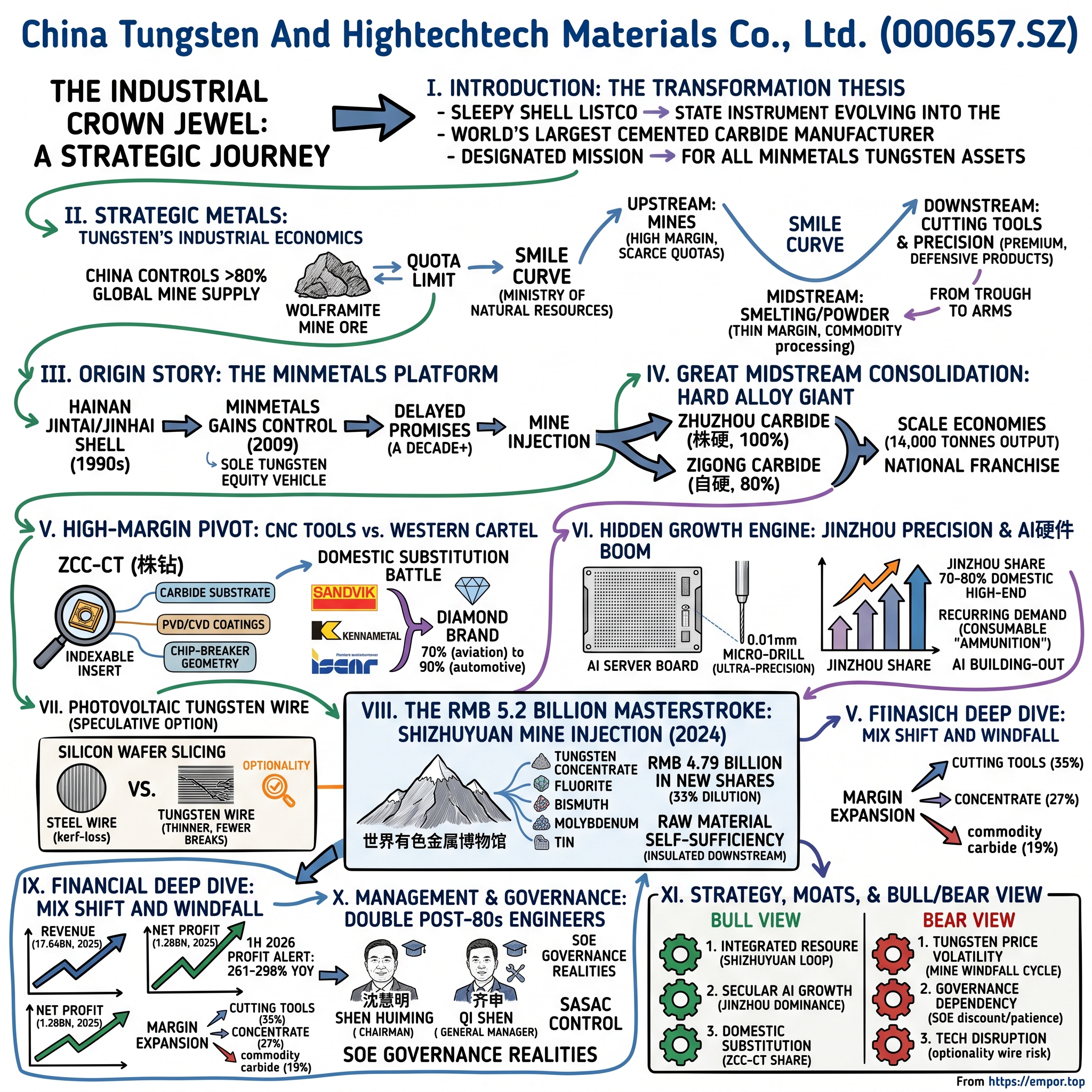
China Tungsten And Hightech Materials (000657.SZ): The Industrial Crown Jewel of Strategic Metals
I. Introduction & Episode Roadmap
Picture a machine shop floor somewhere in the industrial belt of Guangdong at three in the morning. A five-axis milling center is carving a titanium turbine blade for a jet engine, its spindle screaming at tens of thousands of revolutions per minute. The part is worth more than the machinist's annual salary. Everything in that scene — the tolerances, the surface finish, whether the blade passes inspection or becomes scrap — comes down to a thumbnail-sized chip of gray metal clamped at the cutting edge. That chip is cemented carbide: tungsten carbide grains glued together with cobalt, harder than almost anything else on Earth that isn't a diamond. And there is a better-than-even chance it was pressed, sintered, and coated in a factory owned by a company that most global investors have never heard of, trading under an unglamorous ticker on the Shenzhen Stock Exchange: 中钨高新 China Tungsten And Hightech Materials Co., Ltd. (000657.SZ).
This is the story of how a fragmented, near-forgotten Chinese listed shell from the 1990s became the world's largest cemented carbide manufacturer and the designated capital-markets vehicle for all the tungsten ambitions of 中国五矿集团 China Minmetals Corporation, the country's largest metals-and-minerals state enterprise. It is a story about a metal the industry nicknames the "teeth of modern industry" — a metal where China controls roughly four-fifths of global mine supply — and about a decade-long, deliberate campaign by Beijing to stop selling that metal cheap and start selling it as finished precision tools.
The core thesis worth interrogating here is a transformation thesis. For most of its listed life, 000657.SZ was a low-margin metallurgical processor: it bought tungsten, turned it into intermediate chemicals and alloy bars, and watched Western tool giants capture the profitable end of the chain. Management's stated ambition — and the reason the stock re-rated violently in 2025 and 2026 — is that the company has been inverting that dynamic: climbing from commodity smelting into high-margin cutting tools and micro-drills, and, in a capstone move in late 2024, spending roughly RMB 5.2 billion to absorb the 湖南柿竹园有色金属 Hunan Shizhuyuan Nonferrous Metals mine to lock up its own raw material. If it works, the company owns the entire chain from ore to finished tool. The job of this piece is not to cheer that ambition but to test it: where is the evidence real, where is it management narrative, and what could break the case.
Several threads run through the episode. There is the SOE consolidation playbook — how China Minmetals used a sleepy listco as a warehouse for injecting state assets, and what that cost minority shareholders in patience. There is the 国产替代 domestic substitution battle, in which China's champion tries to pry the high-end tooling market away from Sweden's 山特维克 Sandvik, America's 肯纳金属 Kennametal, and Berkshire-owned 伊斯卡 Iscar. And there is the genuinely surprising subplot buried inside the portfolio: 深圳市金洲精工科技 Shenzhen Jinzhou Precision Technology, a maker of PCB micro-drills thinner than a human hair, whose fortunes are suddenly tied to the AI server boom.
One framing is worth setting up front, because it governs how to read everything that follows. The re-rating of this stock in 2025 and 2026 was violent — the company's market value multiplied several times over in roughly two years, and its earnings multiple expanded from the low-20s to the mid-40s as the mine consolidated and tungsten prices ran.10 A large part of that move was not a verdict on management's precision-tooling strategy at all; it was a bet on the tungsten price and on the scarcity value of owning the ore. Separating those two things — the durable, strategy-driven improvement in the business versus the cyclical windfall from a metal that tripled — is the single most useful discipline an investor can bring to this name. It is easy to mistake a commodity updraft for operational genius, and this story contains both.
We will move from the geopolitics of the raw material, through the historical restructuring, into the midstream consolidation, up into the tool and micro-drill breakthroughs, then to the mine acquisition, the financials, the people, and finally a hard-nosed weighing of moats, bear and bull. Let us start where all of it starts — with the metal itself.
 Subscribe on LinkedIn
II. Strategic Metals & The Imperial Monopoly: Tungsten's Industry Economics
If you have never held a tungsten object, the closest sensation is picking up something that feels wrong — too heavy for its size, as though a trick has been played on your hand. Tungsten is nearly twice as dense as lead. It also has the highest melting point of any metal, 3,422 degrees Celsius, hot enough that for most of the twentieth century its defining use was the glowing filament inside a light bulb. But density and heat resistance are not what made tungsten strategically indispensable. That distinction belongs to what happens when you combine tungsten with carbon to make tungsten carbide, and then cement those hard grains together with cobalt. The result is a material that keeps its edge at red heat, resists abrasion better than hardened steel by an order of magnitude, and can machine metals that would instantly blunt anything softer. Roughly 60% of tungsten consumed in a developed economy ends up in exactly this form — cemented carbide for cutting and wear-resistant parts.1 Without it, there is no mass production of engine blocks, no cheap drilling of oil wells, no affordable machining of the aluminum and titanium that fill a modern aircraft or an electric car.
Here is the geopolitical punchline. Tungsten is not evenly distributed, and its supply chain is one of the most concentrated of any industrial input on the planet. In 2024, the U.S. Geological Survey estimated world mine production at about 81,000 tonnes of contained tungsten — of which China produced roughly 67,000 tonnes, around 83%. China also holds the largest reserves, on the order of 2.4 million tonnes against a world total above 4.6 million.1 Supply outside China has hovered near a fifth of the total for years, and the USGS bluntly describes global supply as "dominated by Chinese production and exports."1 The West spent decades treating this as a curiosity. It is now treated as a vulnerability, which is precisely the backdrop against which 000657.SZ should be understood.
What makes the Chinese position a genuine chokepoint rather than a mere market share statistic is that Beijing actively manages it. Every year the 自然资源部 Ministry of Natural Resources issues mining quotas — hard ceilings on how much tungsten ore may legally be extracted. The first batch for 2025 was set at 58,000 tonnes measured at 65% tungsten trioxide content, issued on April 3, 2025, and it was cut by about 6.45% versus the prior year's first batch, with the lion's share allocated to Jiangxi and Hunan provinces.2 Read that again: the dominant global supplier is deliberately restricting its own output. This is not an accident of geology alone; it is industrial policy. China spent the 1990s and 2000s as the world's cheap tungsten raw-material exporter, shipping out 仲钨酸铵 ammonium paratungstate (APT) and powder for others to finish. The policy pivot since has been to cap the upstream, choke exports of raw and intermediate forms, and force value creation downstream, at home.
To see the policy in motion, follow a single tonne of tungsten. It begins as 黑钨精矿 wolframite or 白钨精矿 scheelite concentrate dug from a quota-limited mine. It is dissolved and purified into ammonium paratungstate, the APT that is the industry's benchmark traded chemical. APT is calcined into tungsten oxide, reduced to tungsten metal powder, then carburized into tungsten carbide powder, blended with cobalt, pressed, and sintered into cemented carbide — and only then ground, coated, and shaped into a finished tool. At every step value is added, and at every step China now hosts the dominant share of capacity. The prices along that path tell you where the scarcity bites. In 2025, tungsten concentrate averaged about RMB 211,000 per tonne, up nearly 55% year-on-year, while APT averaged about RMB 308,500 per tonne, up more than half; both metrics touched extraordinary peaks — concentrate above RMB 450,000 and APT above RMB 660,000 — before easing.3 By early 2026, scheelite spot quotes briefly spiked toward the astonishing level of RMB 1 million per tonne before retreating.12 When a raw material triples in eighteen months, everyone who merely processes it without owning it is squeezed, and everyone who owns the ore is enriched — a distinction that will matter enormously when we reach the mine.
The West, belatedly, has noticed the chokepoint and begun to defend against it, which only sharpens the strategic frame. Washington raised Section 301 tariffs by 25% on Chinese tungsten carbides, concentrates, oxides, and powders in 2024, and Beijing in turn tightened licensing on tungsten exports — moves that turn a commodity into an instrument of statecraft in both directions.1 For a company that sits inside the Chinese supply fortress and sells overwhelmingly to domestic customers, this cross-fire is mostly a tailwind: it accelerates the domestic-substitution demand that underpins the tooling business while insulating the company from the export dependence that exposes its Western rivals. That is the strategic weather. Now the internal economics.
The economics of the chain explain why. Think of tungsten's value chain as a smile curve. At the upstream corner sit mines and concentrates — high margin, because the resource is scarce and quota-protected. At the bottom of the smile sits the midstream: APT and tungsten powder, a commodity-processing grind where margins are thin and you are a price-taker on volatile metal input. At the downstream corner sit cemented carbide, CNC cutting tools, micro-drills, and photovoltaic tungsten wire — the highest-margin, stickiest, most defensible products, where a coating recipe or a grain-refinement trick can be worth a fortune. For most of its history the Chinese tungsten complex lived in the unhappy trough of that smile, selling cheap intermediates and buying back expensive finished Sandvik tools. 中钨高新 China Tungsten High-tech was engineered, quite explicitly, to walk the company up both arms of the smile at once — to own the scarce upstream and to capture the premium downstream, leaving the low-margin middle as a means rather than an end.
That is the elegant theory. The messy reality is that the company had to be assembled, piece by contested piece, out of the wreckage of a 1990s shell company and the sprawling asset base of a state conglomerate. To understand whether the integrated machine actually works, you have to understand how it was bolted together — and how long that took.
III. Origin Story & SOE Restructuring: From Hainan Shell to Minmetals Flagship
Every empire has an unglamorous founding, and this one's is a tropical-island industrial company that had almost nothing to do with tungsten. The listed entity that is now 000657.SZ traces to a firm established on Hainan island in 1993, and it made its debut on the Shenzhen Stock Exchange on December 5, 1996, at an IPO price of 4.85 yuan.4 Even its original name is a small historical puzzle: some corporate records render it as 海南金泰 Hainan Jintai, others as 海南金海 Hainan Jinhai, a discrepancy that tells you how little anyone cared to remember this company in its first life.4 What is not in dispute is that in June 2000 it was renamed to 中钨高新材料 China Tungsten & Hightech Materials, and that for the better part of the next decade it remained a fragmented, undistinguished small-cap buffeted by regional economic shifts, state-enterprise reform, and the ordinary volatility of commodity processing.
The transformation began not with a product but with an owner. In December 2009, 中国五矿 China Minmetals — through its control of Hunan Nonferrous Metals Holding Group, which had held the listco since 2006 — became the ultimate controller of the company.4 For a central state-owned enterprise, gaining control of a listed shell is not the endgame; it is the acquisition of a tool. And Beijing's mandate for this particular tool was specific and public: 000657.SZ was designated as the sole listed equity platform for China Minmetals' tungsten business. Every tungsten asset the group owned or would acquire was, in principle, destined to flow into this one publicly traded vehicle. That designation is the single most important fact about the company, because it converts an obscure processor into something closer to a state instrument — the equity where an entire national strategy for a critical metal is meant to be housed.
The problem with being a warehouse for state assets is that the assets arrive on the state's schedule, not yours. On December 26, 2012, the controlling shareholder formally committed to building out a complete tungsten industry chain — mining, smelting, powder, carbide, deep processing — and to do it, the language suggested, within a few years. A further, more explicit commitment to inject tungsten mining and smelting assets into the listed company followed on May 11, 2017.5 Here is where the SOE story turns from triumphant to sobering. That 2017 promise to inject mines was not actually fulfilled until the Shizhuyuan deal closed in late 2024 — roughly seven years later, and more than a decade after the original industry-chain pledge.5
For minority shareholders, this pacing was the central grievance of the 2010s. The stock carried what could fairly be called an "SOE discount": a persistent gap between the sum-of-the-parts logic that management dangled — someday you will own the mines — and a share price that refused to pay for promises repeatedly deferred. Mining-license restructurings, regulatory friction, and macro downturns each supplied a reason for delay, and each delay tied up outside capital in a story whose payoff kept receding. It is worth naming this plainly as an analytical fact rather than glossing it: a company that takes twelve years to honor a non-compete-driven asset-injection promise is telling you something durable about how it weighs the interests of the state parent against the patience of public minorities.
The counterpoint an experienced observer of Chinese SOEs would offer is that the delay was not simply neglect. Injecting a producing mine into a listed company is not a wire transfer; it requires the state asset regulator's blessing, an independent valuation both sides can defend, resolution of tangled mining licenses, and a market window in which the parent is willing to accept payment in equity rather than cash. Through the mid-2010s, tungsten prices were depressed and the listed company's shares were weak, which meant any asset-for-shares deal would have diluted minorities at a low price to buy an asset at a low valuation — arguably worse for outside holders than waiting. Whether by design or by drift, the deal that finally happened came when tungsten was turning, which changed the arithmetic entirely. That does not excuse a decade of dangled promises, but it complicates the lazy reading that the parent simply sat on its hands. That tension between state patience and minority patience never fully disappears from this story; it merely changes shape. Before the mines finally arrived, Minmetals had already used the same warehouse to assemble something formidable in the middle of the chain.
IV. The Great Midstream Consolidation: Building the Hard Alloy Giant
If the mine injection was the decade-late finale, the midstream consolidation was the opening act that actually gave the company an operating business worth caring about. In a major restructuring completed in December 2013, the listed company issued a little over 304 million new A-shares to its parent to absorb two of China's most storied cemented-carbide producers: 100% of 株洲硬质合金集团 Zhuzhou Cemented Carbide Group — known in the trade as 株硬 Zhuhying — and 80% of 自贡硬质合金 Zigong Cemented Carbide, or 自硬 Zihying.4 These were not startups. Zhuzhou's carbide works, founded in the 1950s, was effectively the cradle of the Chinese cemented-carbide industry, the place where the country first learned to make the stuff. Folding it and its Sichuan counterpart into 000657.SZ in a single stroke created the undisputed national leader in hard alloys.
Scale here is not a vanity metric; it is the whole game in a commodity-adjacent business. By the mid-2020s the company's annual cemented-carbide output had reached roughly 14,000 tonnes, a level that management describes — credibly, given the fragmentation of the rest of the field — as the largest in the world.6 When you press, sinter, and grind that much carbide, you buy tungsten powder in quantities no rival can match, you amortize furnace and R&D costs across an enormous base, and you can afford to run standardized powder-metallurgy lines at a unit energy cost that smaller players cannot touch. This is the classic scale-economies advantage, and in the low-and-middle reaches of the tungsten chain it is close to the only durable one available, because the products themselves — alloy rods, strips, blanks — are near-commodities that compete on cost.
But inheriting Chinese state manufacturing bases from the 1950s meant inheriting their pathologies too, and this is where independent skepticism earns its keep. These were overstaffed operations skewed toward low-end, low-margin commodity output — tungsten rod, tungsten strip, undifferentiated blanks — carrying the balance-sheet and headcount baggage typical of legacy SOEs. Minmetals injected them at conservative, book-value-oriented multiples, which gave shareholders downside protection but also signaled the truth: these were mature, cyclical, capital-heavy assets that needed years of operational surgery, not crown jewels. The work of the following decade was unglamorous — rationalizing the least profitable rod and strip capacity, consolidating raw-material purchasing across sites, standardizing powder production, and redirecting the freed-up capital toward higher-purity powder metallurgy and, crucially, toward the downstream tools where real margin lived.
There is a subtler point about the M&A structure that rewards attention. Because Minmetals injected these plants at conservative, book-value-anchored valuations rather than at frothy market multiples, the transaction looked unexciting on the day it closed — no headline-grabbing premium, no instant accretion. But that conservatism is exactly what gave the deal its downside protection: the listco was not overpaying for goodwill it would later have to write down. The flip side is that a cheap purchase of a mediocre-margin business is still a mediocre-margin business. The value, if it was going to appear, had to be manufactured operationally over years — through the unglamorous grind of consolidating procurement, shuttering the weakest lines, and pushing product mix upward. That is a management-execution bet, not a financial-engineering one, and it is the kind of bet that is easy to announce and hard to win.
The strategic logic of the swaps, then, was defensible but double-edged. Minmetals handed the listco genuine scale and a national franchise; it also handed it a turnaround problem and a structural exposure to the thin-margin middle of the smile curve. The gross margin on that "other cemented carbide" segment still sits below 20%, a reminder that scale in commodities buys you survival and market share, not fat profits.10 The profits had to come from somewhere else — from climbing the downstream arm of the smile into products where a Chinese company had never seriously competed against the West. That climb began inside the very Zhuzhou complex the company had just absorbed, in a subsidiary built to make the one thing the imported tool catalogs had always done better.
V. High-Margin Pivot: CNC Cutting Tools (ZCC-CT) vs. The Western Cartel
For decades, walking into the tooling crib of a serious Chinese factory was a quiet lesson in national industrial dependence. The boxes on the shelves read Sandvik, Kennametal, Kyocera, Mitsubishi, Iscar. When a German or Japanese machine tool cut a critical part, it cut with a foreign insert, because the domestic alternatives chipped, wore, or simply could not hold tolerance on a hardened aerospace alloy. The high-value tip of the entire tungsten chain — the indexable insert and the solid carbide endmill — was almost entirely an import. As late as the second half of the 2010s, China's overall dependence on imported cutting tools ran around a third, and in the genuinely high-end segment the foreign share was far higher, with domestic substitution stuck near 30%.14 Those small carbide chips were where the money and the metallurgy converged, and China did not own them.
The company built to change that is 株洲钻石切削工具 Zhuzhou Diamond Cutting Tools, universally abbreviated 株钻 ZCC-CT, spun up as the dedicated high-end tooling unit inside the Zhuzhou complex. Making a world-class insert is a genuinely hard problem that sits at the intersection of chemistry and geometry. You need an ultra-fine, uniform carbide substrate; you need proprietary PVD and CVD coatings — layers of titanium aluminum nitride and aluminum oxide only microns thick, deposited so they bond to the substrate and survive the thermal shock of cutting; and you need complex chip-breaker geometries, the tiny sculpted valleys on the insert face that curl and snap the metal chip away so it doesn't weld itself back onto your workpiece. Each of these is a distinct discipline, and ZCC-CT had to master all of them at once to be taken seriously.
The evidence that it has made real progress is concrete rather than rhetorical. ZCC-CT's annual output of indexable inserts surpassed 100 million pieces in 2021, and the unit's revenue climbed from around RMB 57 million in its early years to nearly RMB 2 billion two decades later — the trajectory of a business that found genuine market demand, not a subsidized also-ran.13 The commercial pitch that opened doors is a cost-performance arbitrage familiar from every successful Chinese industrial insurgency: deliver most of the durability of a premium Western tool at roughly half to two-thirds of the price. When a domestic automotive plant can raise the share of Diamond-brand tools it uses from single digits to a third within a few years, as the company reports happening at major customers, the switching math becomes hard to argue with — especially once a second motive enters the picture.13
That second motive is supply security, and it is where geopolitics turns into purchase orders. After the trade tensions that began in 2018, Chinese automotive and, above all, defense manufacturers began actively de-risking their tooling supply, unwilling to let a critical production line be hostage to an export-control decision made in Stockholm or Washington. Buying domestic became not just cheaper but strategically prudent. The financial consequence for 000657.SZ is the single most important reason to care about this segment: cutting tools and precision tools carry gross margins around 35%, against sub-20% for the commodity carbide next door.10 Every yuan of revenue that shifts from bars to inserts is a yuan earning roughly double the margin. That is the mechanical engine of the company's margin-mix story, and it is real.
The honest caveat is where the substitution has and has not happened. According to the company's own account, tool localization at its major customers now exceeds 70% in aviation applications and 90% in automotive — impressive figures that, taken at face value, would suggest the domestic-substitution war is largely won.13 But self-reported localization rates at hand-picked reference accounts are exactly the kind of claim a neutral analyst should treat as directional rather than definitive. The broader, less flattering market data tell you the high-end segment as a whole remained roughly 70% import-reliant even after years of substitution progress.14 The reconciliation is that "high-end" is not one market but a ladder: ZCC-CT has climbed convincingly onto the lower and middle rungs — standard automotive machining, general engineering, EV drive-motor components — while the top rung of ultra-critical aerospace and defense parts, where a tool failure is a safety event and requalification takes years, remains a Sandvik-and-Iscar preserve.
This matters for how you underwrite the growth. The easy share — displacing imports in cost-sensitive, high-volume machining — is the share ZCC-CT is taking now, and it is real and margin-accretive. The hard share — the aerospace and defense applications where the Western incumbents' process depth and installed qualification base form the deepest moat — is the share that will determine whether domestic substitution has a ceiling. A skeptic would argue the low-hanging fruit gets picked first and the growth rate decelerates as the company runs into that qualification wall; a bull would counter that China's own aerospace and defense build-out gives domestic suppliers a captive runway that Western firms cannot access for national-security reasons. Both are partly right, which is why this is a segment to watch rather than to assume. Holding that nuance in mind, we can turn to the part of the portfolio where a Chinese subsidiary genuinely does sit near the top of the world — and where the customer is not a car plant but the AI data center.
VI. The Hidden Growth Engine: Jinzhou Precision & The AI Hardware Boom
Consider the physical absurdity of the task. Take a printed circuit board destined for an AI accelerator — a slab of glass-fiber and copper the size of a dinner plate but built up in dozens of stacked layers. To connect those layers, you must drill tens of thousands of holes through it, some narrower than a tenth of a millimeter, without wandering off position, without leaving a burr, and without shattering the drill. The tool that does this is a tungsten-carbide micro-drill, and to cut cleanly it must spin at speeds approaching 150,000 to 300,000 revolutions per minute — an angular velocity at which the tip is under enormous stress and the slightest metallurgical flaw means a snapped drill and a scrapped board. Building a drill that thin that does not break is one of the quiet manufacturing marvels of the electronics age, and the company that does it best inside China is a 000657.SZ subsidiary most investors have never heard of: 深圳市金洲精工科技 Shenzhen Jinzhou Precision Technology.
Here the outline's celebratory framing needs a correction, and getting it right actually makes the story more interesting rather than less. Jinzhou is not the undisputed world number one across all PCB micro-drills. By overall market share it is the clear number two, at roughly 21% of the global market, sitting behind China's own 鼎泰高科 Dingtai High-Tech at around 29%.15 The company is owned 75% by 000657.SZ through Zhuzhou Cemented Carbide, with 中金岭南 Zhongjin Lingnan holding the remaining quarter.15 So why does it matter so much? Because the interesting share number is not the aggregate — it is the high end. In the specific niche that the AI boom is exploding — the ultra-fine, ultra-precise drills used for AI-server-grade boards — Jinzhou commands something on the order of 70% to 80% of the domestic market. It is the sole global mass-producer of drills with a 50-times aspect ratio, and the only domestic firm mass-producing the 0.01-millimeter ultra-micro drills used on IC substrates.15 Its total drill capacity had scaled to roughly 1.4 billion units per month by early 2026 — a figure that dwarfs the older "600 million a year" numbers still floating around in secondary write-ups.15
The reason this niche is suddenly a growth engine rather than a steady consumable business is worth explaining slowly, because it is the crux of the bull case for the segment. An AI server built around Nvidia's HGX or DGX architectures does not use an ordinary motherboard. It uses high-density interconnect (HDI) boards with very high layer counts and enormous numbers of micro-vias — the tiny drilled-and-plated holes that route signals between layers. More layers and finer geometries mean more holes per board, drilled to tighter tolerances. And here is the consumable kicker: the finer and harder the drilling job, the faster the drill wears out. A micro-drill is not a durable good; it is ammunition. Higher board complexity therefore drives not a one-time equipment sale but a rising, recurring stream of drill consumption that scales with AI hardware shipments. That is a genuinely attractive demand structure — the razor-and-blades economics of the picks-and-shovels layer of the AI build-out.
Why can Jinzhou command that high-end niche when it trails Dingtai in the aggregate? The answer is a genuine process-power story. Making a drill that is essentially a needle of tungsten carbide, thinner than a hair and spinning tens of thousands of times a second, is an exercise in metallurgical perfection: a single microscopic void or an uneven carbide grain becomes a stress concentrator, and at those RPMs the drill simply disintegrates. Producing the very finest drills — down to 0.01 millimeter for IC substrates — at industrial volume and consistent yield is a capability that took years to build and that few competitors anywhere possess. Being the sole domestic mass-producer of those ultra-micro drills and of the high-aspect-ratio drills that AI boards demand is not a marketing line; it is a manufacturing barrier that shows up directly in who can and cannot supply the leading Chinese PCB makers ramping AI-server production.15
The financial fingerprint bears this out. In 2025 the Jinzhou business generated roughly RMB 1.4 billion of revenue and about RMB 360 million of profit, with revenue and profit growing at double- and triple-digit rates as AI-server demand surged.23 At gross margins in the 40%-plus range, this is the highest-quality earnings stream in the group, and it offers something the cyclical carbide business does not: a secular growth vector partly decoupled from the industrial cycle.10 What makes the demand especially attractive is its consumable nature — because each drill wears out and must be replaced, revenue scales with the volume of boards actually manufactured, not merely with one-time equipment purchases, giving the business the recurring quality of selling blades rather than razors. There is even genuine optionality beyond PCBs — the same micro-machining competence extends toward medical drills, semiconductor test probes, and other precision applications. The appropriate investor posture is enthusiasm tempered by two facts: Jinzhou is a challenger to Dingtai even at home, and its fortunes are now levered to the notoriously boom-bust capital cycle of electronics. It is a wonderful business riding a wonderful wave; waves recede. That same "attach a tungsten product to a hot end-market" logic animates the next, more speculative, bet.
VII. Photovoltaic Tungsten Wire: High-Optionality Speculative Edge
Every so often an old material finds an unexpected second act, and photovoltaic tungsten wire is one of those. To turn a cylindrical silicon ingot into the wafers that become solar cells, you slice it — hundreds of times — with a moving wire coated in diamond grit, like a cheese cutter working through a block. For years that wire was high-carbon steel. The catch is physics: every micron of wire thickness plus grit becomes kerf, silicon turned to useless dust with each cut. Thinner wire means thinner kerf, more wafers per ingot, and less wasted silicon — and in a solar industry obsessed with shaving cost per watt, that arithmetic is worth a great deal. Steel wire, however, hit a floor around 33 microns; go thinner and it snaps under tension.
Enter fine tungsten wire. Tungsten's superior tensile strength — on the order of 15% stronger than carbon steel at equal diameter — lets producers pull the wire down to roughly 30 to 32 microns in mass production, with the finest batches near 28, while breaking less often at high slicing speeds.1617 Fewer breaks means less downtime and fewer ruined ingots; thinner kerf means more saleable wafers from the same silicon. As N-type wafers grew thinner and more fragile, the case for switching strengthened, and the industry's tungsten-wire penetration climbed from a rounding error toward a meaningful share of the slicing market in just a few years.16
中钨高新 China Tungsten High-tech moved into this business and scaled it quickly, completing a first-phase line with capacity measured in the billions of meters and running it at full order book.16 But here the outline oversells the company's position, and honesty about that matters. The clear leader in photovoltaic tungsten wire is not 000657.SZ — it is 厦门钨业 Xiamen Tungsten, the same cross-town rival that competes with it up and down the tungsten chain. Xiamen has been the global number one in this product, with fine-wire sales in the tens of billions of meters growing at triple-digit rates, and it has announced capacity expansions that dwarf the current field.16 China Tungsten is a fast-scaling challenger here, not the incumbent.
There is a deeper reason to hold this business at arm's length in the valuation. Photovoltaic tungsten wire is a classic Chinese growth-industry setup: a genuine technological improvement, a land-grab for market share, and then — almost inevitably — a flood of capacity that turns an attractive margin into a commodity one. The same competitive intensity that drove down the cost of solar modules, batteries, and polysilicon has a way of visiting every profitable niche in the Chinese clean-energy supply chain, and there is little reason to think fine tungsten wire will be spared once enough players build lines. Add the possibility that wafer-slicing technology itself moves again — toward even finer processes, or toward approaches that need less wire — and the terminal economics of this business are genuinely hard to forecast. It is growing fast today; that is not the same as being durably profitable tomorrow.
For an investor, the correct weighting is the one the outline itself flags: this is optionality, not thesis. Tungsten wire is a real, fast-growing revenue line riding the solar build-out, but it is a small contributor next to the carbide, tooling, and now mining earnings base, and it faces two live risks — brutal price competition as multiple players flood in capacity, and the ever-present possibility that the underlying wafer-slicing technology shifts again. It is a call option worth having in the portfolio, not the reason to own the stock. The reason management would point you to, and the move that genuinely reshaped the company's economics, was upstream — the mine.
VIII. The RMB 5.2 Billion Masterstroke: Upstream Mine Injection (Shizhuyuan)
In Chenzhou, in southern Hunan, sits one of the most extraordinary orebodies on Earth, a mountain so mineralogically rich that Chinese geologists nicknamed it the 世界有色金属博物馆 — the "World Nonferrous Metals Museum" — because it contains scores of different mineral species in one deposit.7 This is 湖南柿竹园有色金属 Hunan Shizhuyuan Nonferrous Metals, and for more than a decade it was the asset minority shareholders of 000657.SZ were promised but did not have. In late 2024, at last, they got it. The listed company agreed to acquire 100% of Shizhuyuan from its parent's 五矿钨业 Minmetals Tungsten Group for RMB 5,194,524,100 — call it RMB 5.195 billion.7
The structure of the deal is where a skeptical investor should linger, because it is here that the outline's premises need the most correction. The consideration was not primarily cash: RMB 400 million was paid in cash and the remaining roughly RMB 4.79 billion was paid in newly issued shares, priced at 7.05 yuan, with about 692.85 million new shares issued to the sellers.7 That share issuance amounted to roughly 33% of the enlarged share capital — a full third, not the "18%" sometimes cited, a figure that appears to conflate the dilution with the separate RMB 1.8 billion supporting private placement raised alongside the deal from no more than 35 investors.79 After the transaction, Minmetals Tungsten alone held about 32% of the listed company.7 This is real, material dilution of existing holders, and it is the single most important cost side of the ledger when judging whether the deal created value.
Against that cost sits the asset. Shizhuyuan currently produces on the order of 7,000 to 7,800 tonnes of tungsten concentrate a year, with a technical-upgrade project intended to lift capacity toward 10,000 tonnes later in the decade — so the widely quoted "10,000 tonnes" is a target, not today's output.5 The mine is also a major source of fluorite, at more than 300,000 tonnes a year, and of bismuth, molybdenum, and tin as co-products.5 On bismuth in particular, care is warranted: the deposit's bismuth reserves are genuinely world-scale — on the order of 42% of global proven reserves by some accounts — but the frequently repeated claim that Shizhuyuan is "Asia's largest bismuth producer" is not something the primary disclosures actually establish, and it should be treated as an unverified boast rather than a fact.5
The reason Beijing prizes this particular mountain is the sheer breadth of what is in it. Beyond tungsten, Shizhuyuan hosts world-scale reserves of bismuth — a niche metal used in everything from low-melting-point alloys to pharmaceuticals and, increasingly, as a non-toxic substitute for lead — along with substantial molybdenum and tin, and it produces fluorite, the feedstock for hydrofluoric acid and the fluorochemical supply chain, at more than 300,000 tonnes a year.5 A polymetallic deposit like this is strategically valuable precisely because its economics do not rise and fall on a single metal; when tungsten is weak, bismuth or fluorite may carry the load, and several of these co-products are themselves on various countries' critical-minerals lists. That breadth is the deeper logic behind paying up for one mine: the company was not just buying tungsten self-sufficiency, it was buying a diversified basket of strategic metals under one mining license.
Did the company overpay? The parent attached a performance guarantee to the mining rights, committing that Shizhuyuan would deliver net profits of roughly RMB 359.6 million in 2024, RMB 282.5 million in 2025, and RMB 156.2 million in 2026 — a declining schedule that, tellingly, assumed tungsten prices would soften.7 The valuation implied a premium of nearly 300% over the mine's roughly RMB 1.3 billion book net assets, which sounds aggressive until you set it against what tungsten prices actually did next.8 Rather than soften, tungsten concentrate averaged about RMB 211,000 per tonne in 2025, up more than half year-on-year, and spiked to a peak above RMB 450,000.3 Against that price reality, a mine bought on a conservative, declining profit forecast looks accretive — the guarantee became a floor the market blew past.
But the deal deserves a harder governance look precisely because of who sat on both sides of the table. This was a related-party transaction: the parent's tungsten arm was selling its own mine to the listed company it controls, setting a price that the parent — as majority owner — had every incentive to push high, while the minorities being diluted had every incentive to push it low. The procedural safeguards were in place: an independent valuation, state-asset-regulator approval, and a shareholder vote from which the parent and its concerted parties were required to recuse themselves.22 Yet the near-300% premium over book, paid substantially in freshly issued shares at a fixed 7.05 yuan, is exactly the structure an activist would interrogate — because if the parent believed tungsten prices were about to run (and who would know better than the country's largest tungsten operator?), then selling the mine for a large slug of the listco's equity, right before the metal tripled, transferred a great deal of future upside from the diluted minorities to the parent. The counter-argument is that minorities got the mine's upside too, in proportion to their shrunken stake, and that they had no route to a tungsten asset of this quality on the open market at any price. Reasonable people can weigh those against each other differently; the point is that "highly accretive" and "structured in the parent's favor" can both be true at once, and a neutral reading holds both. The strategic prize is the deeper point: the acquisition closes the loop from mine to smelter to carbide to finished tool, resolves the long-running horizontal-competition problem between parent and listco, and raises the group's raw-material self-sufficiency from a low base toward a level that meaningfully insulates its downstream margins from spot-metal inflation. Whether all of that translates into durable per-share value, net of the one-third dilution, is a question the financials can begin to answer.
IX. Financial Deep Dive & Segment Performance
Numbers tell the transformation story more honestly than any strategy slide, so start with the shape of the last four years. Revenue rose from about RMB 13.1 billion in 2022 to RMB 13.7 billion in 2023, then RMB 14.74 billion in 2024, and RMB 17.64 billion in 2025 — the last a 19% jump.10 Net profit attributable to shareholders tells a steeper story: roughly RMB 535 million in 2022, RMB 800 million in 2023, RMB 939 million in 2024 (up about 17%), and RMB 1.28 billion in 2025 (up about 29%).10 Gross margin expanded across the stretch, from around 21% in 2023 to nearly 24% in 2025 — visible proof that the mix shift toward tools and, latterly, high-margin mine output is doing what it was supposed to.10
But the most revealing single figure in the 2025 report is not headline profit — it is that the non-recurring, "扣非" net profit surged nearly sixfold to about RMB 1.11 billion.10 That tells you the prior year's earnings had been flattered by one-off items and that the underlying operating business stepped up dramatically once Shizhuyuan's high-margin concentrate began flowing through the income statement at 2025's elevated tungsten prices. The segment table makes the sources concrete. In 2025 the largest revenue line was "concentrate and powder" at about RMB 5.57 billion, roughly 32% of revenue, at a healthy 27% gross margin — this is where the mine now lives.10 "Other cemented carbide" contributed about RMB 4.52 billion, 26% of revenue, but at a thin 19% margin — the commodity workhorse.10 "Cutting tools and tools," the ZCC-CT-plus-Jinzhou basket, brought in about RMB 3.61 billion, 20% of revenue, at the group's best product margin around 35%.10 Refractory metals added another RMB 2.71 billion at a low-teens margin.10 In plain terms: two segments — mine output and precision tools — now supply the bulk of the profit, exactly the two arms of the smile curve the strategy targeted.
The forward signal is louder still. On July 13, 2026, the company issued a profit alert projecting first-half 2026 net profit of RMB 1.97 to 2.17 billion — a year-on-year jump of roughly 261% to 298%, and a number that would exceed the entire full-year profit of 2025 in a single half.11 Management attributed the surge to sustained high tungsten-concentrate prices flowing straight through Shizhuyuan's economics, plus booming orders for micro-drills and high-end tools and the cost advantage of the now-integrated chain.1112 If the actual results land in that range when reported, they will confirm that the mine injection transformed the company's earnings power — though they will also underline how much of that power is now a leveraged bet on the tungsten price.
Two cautions belong in any sober reading of these accounts. First, the earnings quality is increasingly commodity-driven: a business whose profit can triple in a half-year on metal prices can also halve on them, and the reported earnings now carry more cyclical beta than the "precision tools" narrative alone would suggest. The very feature that made 2025 and the first half of 2026 spectacular — mine profit levered directly to the tungsten spot price — is the feature that will make a down-cycle painful, and no amount of downstream tooling revenue fully offsets a mine whose margin can swing from above 50% to something far thinner if the metal reverses.
Second, cash generation lagged badly in 2025 — operating cash flow fell about 60% even as profit rose — because surging tungsten prices inflated the value of inventory and receivables, stretching the cash conversion cycle toward roughly half a year.10 This is the hidden cost of a commodity boom that few headline readers notice: when your raw material triples, you must fund a much larger pile of working capital just to run the same physical volume of business, and that funding comes out of operating cash flow. It is not necessarily a red flag — rising receivables and inventory in a price boom are mechanical, not fraudulent — but it does mean reported profit and cash generation have diverged, and profit that does not convert to cash is profit to watch carefully. The balance sheet, at least, gives the company room to absorb this: net debt sits at a conservative level relative to earnings, leaving the working-capital build a manageable strain rather than a solvency question.10 Capital discipline, for its part, looks reasonable rather than heroic: leverage is modest, R&D ran about RMB 765 million (4.3% of revenue), and the 2025 dividend of RMB 2.30 per 10 shares implied a payout near 40% of earnings — a step up that suggests some genuine intent to share the windfall, balanced against SOE debt-service and reinvestment claims.10 One structural consequence of the deal deserves a final note: the share issuances pushed the weighted-average share count from about 1.4 billion in 2023 to over 2.2 billion in 2025, which is why earnings per share actually fell from RMB 0.57 in 2023 to RMB 0.45 in 2024 before recovering to RMB 0.58 in 2025.10 Per-share progress has been real but far more modest than headline profit growth — the price of buying the mine with paper. The people making these capital-allocation choices deserve their own scrutiny.
X. Management, SOE Governance, & Credibility Assessment
In June 2026, 000657.SZ got a new face at the top — two of them, in fact, and both unusually young for a central SOE. On June 5, 2026, the board elected 沈慧明 Shen Huiming, born in 1980, as chairman and legal representative, and appointed 齐申 Qi Shen, also born in 1980, as general manager, prompting Chinese financial media to dub it a 双80后 "double post-80s" leadership team.181920 Both are technically credentialed lifers of the 中国五矿 China Minmetals tungsten system rather than outside hires. Shen holds mining-engineering degrees from Central South University and a doctorate from the University of Science and Technology Beijing, and rose through the group running 香炉山钨业 Xianglushan Tungsten and the company's mine-coordination functions before becoming general manager and then chairman.24 Qi carries a metallurgical-engineering doctorate and came up through Minmetals' tungsten raw-materials and operations functions.20 This is a management bench built for a mine-to-tool industrial company — engineers who know the metal — not financiers.
The man they replaced is instructive too. 李仲泽 Li Zhongze, born 1969, chaired the company from June 2016 and presided over the long-promised, long-delayed Shizhuyuan injection before moving up within the state system. Notably, he did not move to the Minmetals group holding company but to 中国中冶 MCC (China Metallurgical Group), a separate Minmetals-affiliated listed enterprise, where he became chairman in 2026 — a lateral within the state apparatus that is worth stating precisely, since it is easy to misread as a promotion into the parent.21 The pattern of leaders rotating among sibling SOEs is itself a governance signal: careers here are managed by the state's cadre system, not by the stock price.
On the credibility ledger, the honest verdict is mixed. On the positive side, this management ultimately delivered the asset injection it had promised, executed a genuine and measurable shift from low-margin trading toward high-value tooling, and disclosed its segment economics with more granularity than many peers. Those are real marks of competence. On the other side sit the governance realities that no amount of operational skill erases. The controlling structure runs from the 国务院国资委 SASAC down through China Minmetals, which together with its concerted parties — Minmetals Corp directly and Minmetals Tungsten — controls roughly two-thirds of the equity after the deal.22 Management's incentives are driven overwhelmingly by the central SOE's political and operational KPIs, including the national-self-reliance mandate for strategic metals, rather than by equity ownership; executives hold minimal direct stock, so their interests are only loosely aligned with a minority shareholder's per-share outcome. The company issued formal commitments to avoid horizontal competition and to regulate related-party transactions as part of the restructuring, which is the correct procedural response — but the very need for those letters flags the standing tension of an entity whose parent is simultaneously its supplier, its counterparty, and its controller.22
The sharpest thing a skeptical long/short investor would press on is pacing and dependency. Taking twelve years to honor the mine-injection promise tied up minority capital across a full cycle, and the company remains structurally dependent on the parent for raw-material allocation, financing, and strategic direction — a dependency that both de-risks the business and caps its independence. And there is a genuine, if less discussed, margin vulnerability: when tungsten concentrate prices spike, the non-integrated portions of the midstream processing chain can suffer a lag before they pass higher input costs through to industrial customers, squeezing margins exactly when the mine is minting money. That internal tension between the newly acquired upstream and the legacy midstream is not hypothetical; it is the flip side of the integration story management sells. With the people and their incentives understood, we can weigh the durability of the whole edifice.
XI. Strategy, Moats, & 7 Powers Analysis
Strip away the narrative and ask the question that matters: why should this company earn above-average returns from here, and what would break that case? Hamilton Helmer's 7 Powers framework is a useful scalpel. The strongest power on offer is Cornered Resource. Through Shizhuyuan and the broader Minmetals system, the company now owns quota-protected access to some of the best tungsten deposits on the planet, in a country that controls roughly four-fifths of world supply and actively restricts it.12 This is about as literal a cornered resource as public markets offer — and, crucially, it is protected not only by geology but by the Chinese state's export and quota policy, a moat no competitor can dig around. The caveat is that the resource is cornered by the parent as much as by the listco; the minority shareholder rents this moat from Minmetals rather than owning it outright.
Scale Economies are the second real power. As the world's largest cemented-carbide producer at roughly 14,000 tonnes, the company spreads fixed R&D and purchasing costs across a volume no rival matches, which is precisely what lets it compete on cost in commodity carbide and fund the coating and metallurgy research that feeds the tool business.6 Process Power is the third and most interesting, because it is the one the company has had to build rather than inherit: decades of accumulated know-how in powder-metallurgy formulation, grain refinement, PVD/CVD coating, and the near-magical ability to make a 0.01-millimeter drill that survives 300,000 RPM.15 Process power is hard-won and hard to copy, but it is also the power most exposed to a determined competitor with capital and time — Dingtai's lead in overall micro-drills is a live reminder that Jinzhou's edge is contested. Switching Costs round out the picture at moderate-to-high strength: qualifying a cutting tool onto an automotive, aerospace, or defense machining line is a costly, months-long process, and once a tool is validated, the risk of production downtime makes customers reluctant to swap — a stickiness that grows with the criticality of the application.
It is worth being explicit about which of these powers is durable and which is rented, because that distinction is the crux of the long-term case. The cornered resource is genuinely powerful but it is a shared asset: the listco operates the mine, yet the ultimate control, the quota allocations, and the strategic direction sit with the state parent, which means the minority shareholder's claim on that moat is contingent on the parent's continued goodwill and on national policy staying favorable to integrated domestic champions. Scale economies are the most defensible and fully owned — no rival is going to out-scale the world's largest carbide producer in a hurry, and that advantage compounds quietly year after year. Process power is real but the most contestable: it is precisely the power that a well-capitalized competitor, foreign or domestic, can erode with enough time, talent, and R&D, as Dingtai's lead in aggregate micro-drills already demonstrates. A clear-eyed reading, then, is that the company's edge is strongest exactly where it depends most on the state (resource, scale) and weakest exactly where it must win on merit in open competition (high-end tooling, top-tier micro-drills) — an uncomfortable profile for anyone hoping the moat is purely a matter of engineering excellence.
Run it through Porter's Five Forces and the same asymmetry appears. Supplier power, historically the company's great vulnerability, has collapsed for the integrated portion of the business post-Shizhuyuan even as it remains high for non-integrated peers who must buy tungsten at spot. Buyer power is moderate in commodity hard alloys, where customers have alternatives, but low in specialized PCB micro-drills and qualified high-end tools, where Jinzhou and ZCC-CT hold genuine positioning. The threat of substitutes is extremely low: no known industrial material economically matches tungsten carbide's blend of hardness, density, and heat resistance, which is why the entire edifice rests on secure tungsten rather than on any single product. Competitive rivalry is the force to respect — intense domestically in standard hard alloys against 厦门钨业 Xiamen Tungsten and 章源钨业 Zhangyuan Tungsten, and ferocious globally in high-end tooling against 山特维克 Sandvik, 肯纳金属 Kennametal, 伊斯卡 Iscar, and 三菱综合材料 Mitsubishi Materials, incumbents whose brand, qualification base, and process depth in the most critical applications remain formidable. The net picture is a company with an exceptionally strong resource-and-scale foundation and a genuine but still-contested position in the high-value products that determine whether it earns commodity returns or premium ones.
XII. Investment Thesis, Risk Radar, and Bear vs. Bull View
Every integrated resource story is a leveraged bet on a price, and this one is no exception. The material risks cluster around four fault lines. First, industrial demand: cutting tools and micro-drills are consumables whose demand tracks global manufacturing activity, so a slowdown in automotive, construction machinery, or general capex directly slows tool wear and thus revenue. Second, geopolitics: the same export-control regime that protects Chinese tungsten supply could invite reciprocal restrictions on strategic metals or machinery, and the company's small export base cuts both ways. Third, technology disruption in the optionality lines — if wafer slicing shifts to a kerf-less process, the photovoltaic tungsten-wire growth stalls. Fourth, and most important, tungsten price volatility itself: high prices now supercharge Shizhuyuan's profit, but a sharp reversal would impair mine earnings, while an extreme spike squeezes the un-integrated midstream — the price is both the engine and the risk.
The bear case is coherent and should not be dismissed. This remains a central SOE whose controlling owner prioritizes national supply security over peak shareholder returns, whose management is incentivized by state KPIs rather than the share price, and whose minorities were just diluted by a third to buy an asset from that same parent. High-end tool substitution may hit a ceiling against Western giants in the most critical aerospace and defense applications, where qualification moats have held for decades. Integration synergies could disappoint or arrive slowly. And the recent earnings surge is substantially a tungsten-price windfall dressed in the language of strategic transformation — cyclical profit that a mean-reverting metal price could unwind, exposing how much of the 2025–2026 re-rating rested on a spot price rather than a durable competitive gain.
An activist or engaged long/short investor would sharpen the bear case into a handful of pointed challenges. Why should minorities be comfortable that the mine was bought at a fair price from the controlling owner, in equity, just before the metal ran? Why does a company generating record profit convert so little of it to cash, and when will the working-capital build reverse? How much of the celebrated 2026 profit surge is repeatable operating power versus a tungsten-price spike that mean-reverts? And what is the actual, disclosed plan if the AI-PCB cycle rolls over and Jinzhou's order book — running at full capacity today — normalizes? None of these questions has a fatal answer, but a management team that answers them concretely, with specifics on cash conversion and capital allocation, is more trustworthy than one that retreats to the language of national strategic importance. The disclosure so far has been better than the SOE average, which is a modest point in the company's favor.
The bull case is equally coherent and rests on mechanisms, not hopes. The Shizhuyuan injection genuinely closed the mine-to-tool loop, and at anything like current tungsten prices the upstream is a cash machine that also protects downstream margins — a structural improvement, not just a cyclical one. The AI-driven micro-drill demand is a real secular growth vector attached to the fastest-growing end market in technology, and Jinzhou's dominance of the high-end domestic niche gives it a privileged seat. And domestic substitution across China's vast EV and machinery sectors still has room to run, handing ZCC-CT share to take from incumbents in the mid-to-high tier even if the very top stays contested. If those three play out, the company compounds from a fundamentally stronger, more integrated base than it has ever had.
Which brings us to what actually to watch, because this is a story that will be settled by a handful of measurable variables rather than by narrative. Three KPIs matter most. First, the high-end tooling revenue share — whether the cutting-tools-and-tools segment climbs as a proportion of the whole, the truest gauge of the climb up the smile curve and away from commodity cyclicality. Second, PCB micro-drill volume and margin at Jinzhou — whether the AI-server demand sustains that 40%-plus gross margin or whether competition and the electronics cycle erode it. Third, the tungsten self-sufficiency ratio — how much of the group's own midstream consumption Shizhuyuan's mined output covers, the single number that determines how insulated the company really is from the metal price that now drives its fortunes. Notice what those three metrics have in common: each isolates the part of the story that is genuinely within the company's control and durable, and strips away the part that is merely the tungsten price doing the work. The tooling revenue share measures whether the climb up the smile curve is real; the micro-drill margin measures whether the process-power moat is holding against competition; the self-sufficiency ratio measures how much the integration actually insulates the business rather than simply exposing it to the metal. A skeptic and a believer can watch the same three numbers and update honestly. Track them, and the difference between a genuine strategic-metals champion and a well-timed commodity bet will reveal itself in the numbers, year by year — which is exactly how a story this leveraged to a single volatile metal ought to be judged.
References
-
Tungsten — Mineral Commodity Summaries 2025 — U.S. Geological Survey, 2025-01 ↩↩↩↩↩
-
2025 First-Batch Tungsten Mining Total Control Quota Notice — China Tungsten Industry Association (中国钨业协会), 2025-04 ↩↩
-
2025 Tungsten Price Review (2025年钨价高位狂飙) — Minmetals Industrial Finance Research Institute, 2025-12-31 ↩↩
-
China Tungsten & Hightech Materials Company Profile (000657) — Sohu Finance ↩↩↩↩
-
China Tungsten & Hightech to Acquire Shizhuyuan, Fulfilling Asset-Injection Commitment — Securities Times (证券时报网/STCN), 2024 ↩↩↩↩↩↩
-
China Tungsten & Hightech: Cemented Carbide Output ~14,000 Tonnes, World's Largest — 21st Century Business Herald (21世纪经济报道), 2024-12-27 ↩↩
-
Shizhuyuan Acquisition Report Summary (收购报告书摘要, revised) — CNINFO, 2024-12-27 ↩↩↩↩↩↩
-
China Tungsten & Hightech Restructuring to Acquire Shizhuyuan — Xinhua, 2024-11-08 ↩
-
China Tungsten & Hightech Share-Issuance Asset Purchase Details — Sina Finance, 2024-12-04 ↩
-
China Tungsten & Hightech Materials 2025 Annual Report — Shenzhen Stock Exchange (SZSE), 2026-04-27 ↩↩↩↩↩↩↩↩↩↩↩↩↩↩↩↩
-
China Tungsten & Hightech H1 2026 Profit Alert (net profit ¥1.97–2.17bn) — Eastmoney CaiFuHao, 2026-07-13 ↩↩
-
Tungsten Prices and China Tungsten & Hightech H1 2026 Forecast — Sina Finance, 2026-07-15 ↩↩
-
ZCC-CT: From ¥57 Million to ¥1.989 Billion, Indexable Insert Output Past 100 Million — China Nonferrous Metals News (中国有色金属报), 2022 ↩↩↩
-
China's High-End Cutting Tool Market and Import Dependence — MMS Online (国际金属加工网), 2019 ↩↩
-
Jinzhou Precision: #2 Global PCB Micro-Drill Share, Leader in AI-Server Drills — Eastmoney CaiFuHao, 2026-06-26 ↩↩↩↩↩↩
-
Photovoltaic Tungsten Wire: China Tungsten & Hightech and Xiamen Tungsten Capacity — SMM (上海有色网), 2023 ↩↩↩↩
-
Fine Tungsten Wire Replacing Carbon Steel in Wafer Slicing — The Paper (澎湃新闻), 2023 ↩
-
China Tungsten & Hightech Elects Shen Huiming as Chairman — Cailianshe (财联社), 2026-06-05 ↩
-
China Tungsten & Hightech Welcomes "Double Post-80s" Management Team — Sina Finance, 2026-06-06 ↩
-
China Tungsten & Hightech Appoints Qi Shen as General Manager — National Business Daily (每日经济新闻), 2026-06-05 ↩↩
-
MCC (China Metallurgical Group) Elects Li Zhongze as Chairman — Sina Finance, 2026-05-08 ↩
-
China Tungsten & Hightech Acquisition Report Summary (control chain, 87.54% and non-compete commitments) — CNINFO, 2024-06-18 ↩↩↩
-
China Tungsten & Hightech 2025 Annual and Q1 2026 Review (Jinzhou revenue, capex) — Sina Finance Research Reports, 2026 ↩
-
China Tungsten & Hightech Executive Profile: Shen Huiming — AskCi (askci.com) ↩
 LinkedIn
 WhatsApp
 Reddit
 Hacker News
 Email
Email Kindle
 RSS Feed
 Spotify
 Apple Podcasts
 Amazon Music
 Audible
 YouTube