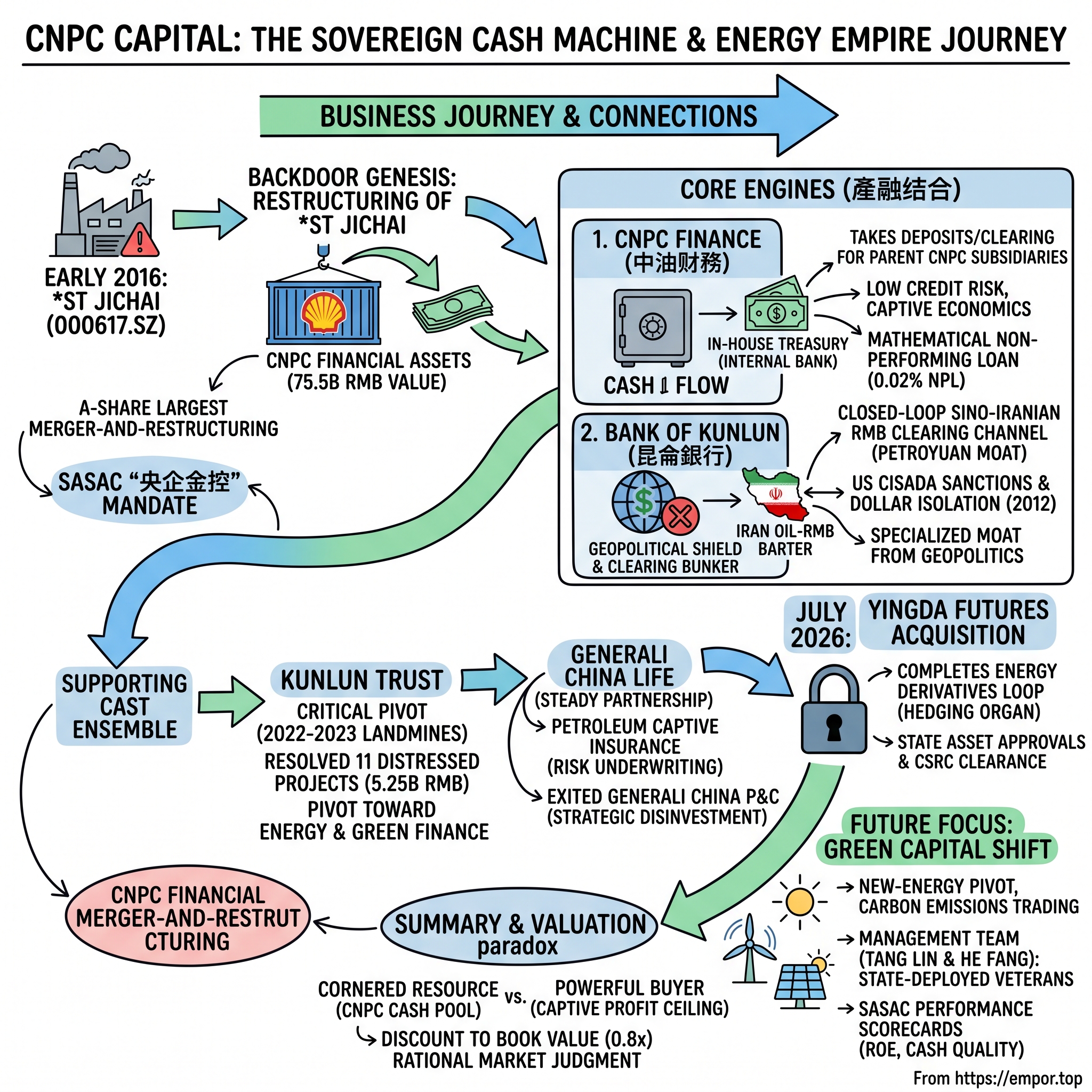
CNPC Capital: The Sovereign Cash Machine of China's Energy Empire
I. Introduction & The Trillion-Yuan Energy Vault
Picture a diesel engine factory in the industrial belt of Jinan, Shandong province, sometime in early 2016. The assembly lines are quieter than they used to be. The order book is thin. On the stock ticker, the company's name carries a scarlet warning label — two asterisks and the letters "ST," Shenzhen's public brand of shame for a listed firm bleeding money and staring down delisting. For decades this factory had built the heavy compression-ignition engines that powered ships and generators across China. Now it was a corpse waiting for a certificate of death.
And then, almost overnight, that corpse became one of the largest financial holding companies in the People's Republic of China — custodian of a balance sheet that would swell past a trillion renminbi, controller of a commercial bank, a finance company, a trust, insurance ventures, and leasing arms, and the quiet operator of one of the most geopolitically sensitive money-clearing channels on earth.
This is the strange, very Chinese story of 中国石油集团资本股份有限公司 CNPC Capital Company Limited, ticker 000617.SZ, listed on the 深圳证券交易所 Shenzhen Stock Exchange. It is a company that most Western investors have never heard of, and that even many Chinese retail traders struggle to describe in a sentence. That obscurity is itself part of the story. CNPC Capital is not designed to be understood by the market. It is designed to serve a single customer — its parent, 中国石油天然气集团有限公司 China National Petroleum Corporation (CNPC), the state-owned colossus that sits atop China's oil and gas industry.
Consider the paradox at the heart of it. Here is an entity whose total assets reached roughly 1.13 trillion RMB — a figure with twelve digits before the decimal point — generating tens of billions in revenue, sitting on a captive deposit pool fed by one of the largest energy companies on the planet, and quietly running a renminbi clearing channel that has kept Iranian oil flowing east for more than a decade.26 And yet, for years, the market has priced its shares at a persistent discount to the accounting value of the equity on its own books — trading recently at roughly 0.8 times book. The market, in other words, looks at this trillion-yuan vault and says: we'll take it at a fifth off.
To appreciate how unusual that is, run the comparison a Western investor would instinctively reach for. When a bank or an insurer trades below book value, it usually means the market suspects the book is a lie — that hidden losses lurk in the loan portfolio, that the stated equity will be marked down. That is sometimes the market's worry here too. But the deeper reason for CNPC Capital's discount is not fear of a hidden hole; it is a cold judgment about the ceiling. This is a company whose returns are structurally capped by design, whose profits are, in a sense, the deliberate residue left over after its parent takes what it wants. You are not buying a machine built to compound your capital. You are buying a claim on a machine built to serve a state. The discount is the price of that distinction, and much of this story is an attempt to decide whether that price is fair.
Why? Because CNPC Capital is not really a business in the Western sense of the word — a thing that competes, prices, and fights for customers. It is an instrument of the state. Its job is not to maximize returns; it is to be indispensable to national energy security while never embarrassing anyone. Understanding that distinction — between a company optimized for shareholders and a company optimized for the sovereign — is the key that unlocks everything else.
Over the next several sections, we will trace the full arc. We will start with the backdoor restructuring that turned a dying engine maker into a financial fortress. We will pull apart the two engines that drive nearly all the value: 中油财务有限责任公司 CNPC Finance, the in-house treasury, and 昆仑银行 Bank of Kunlun, the geopolitical clearing bunker. We will walk through the supporting cast of insurance and trust businesses — including a trust arm that stepped on landmines and nearly detonated. We will examine the July 2026 acquisition of 英大期货 Yingda Futures that closes a strategic loop. And we will interrogate the whole edifice through the lenses of Porter and Helmer, and lay out — without cheerleading — why an investor might believe in this thing, and why they might not.
The recurring themes to hold in mind: the doctrine of 产融结合 — the deliberate fusion of industry and finance; the peculiar economics of a captive treasury that earns money simply by standing between a giant and its own cash; and the way that being cut off from the global financial system can, in the right hands, become a moat rather than a wound. Let us begin where the modern company began — not with a founding, but with a resurrection.
 Subscribe on LinkedIn
II. The Backdoor Genesis: The Restructuring of *ST Jichai
Every good origin story needs a body, and this one had 济南柴油机股份有限公司 Jinan Diesel Engine Co., Ltd. — known on the market by its warning-labeled ticker name, *ST济柴 *ST Jichai. Jichai was an old-line manufacturer of large-bore diesel and gas engines, the kind of Communist-era industrial asset that had once been a point of local pride and had since become a slow-motion accident. By the mid-2010s it was posting severe losses, and under Shenzhen's listing rules those losses had earned it the "ST" special-treatment designation. Another bad year or two and it would be delisted — its shell, that precious listed-company status, extinguished.
That shell was the whole point. In China, a listing is not merely a source of capital; it is a scarce, licensed, quota-controlled privilege. Regulators approve new IPOs slowly and grudgingly, and for years the queue of companies waiting to go public ran into the hundreds, with waits measured in years, not months. So a listed shell — even an ugly one attached to a failing engine plant — has enormous value to anyone who wants public-market status without the wait. This is the "backdoor listing," or 借壳上市 — literally "borrowing a shell to go public." Instead of applying for an IPO, you find a listed husk, reverse your assets into it, and inherit its ticker. The engine plant's tragedy was, for CNPC, a convenience. And in 2016, CNPC wanted exactly that convenience.
The parent had a problem that only a wealthy giant can have: it owned a sprawling, unruly collection of financial businesses — a finance company, a bank, a trust, leasing operations, insurance stakes, securities holdings — scattered across the empire with no unified home. 国务院国有资产监督管理委员会 SASAC, the powerful body that supervises China's central state-owned enterprises, had for years been pushing the giants to securitize their assets, to move them onto public markets where they could be valued, disciplined, and made liquid. The strategic logic was to gather these financial scraps into one platform, list it, and create a professionally managed 央企金控 — a central-SOE financial holding company.
Jichai became the empty vessel. In what Chinese financial media at the time called the largest merger-and-restructuring in the history of the A-share market, CNPC engineered an asset swap of staggering scale: it valued the injected financial assets — the entire CNPC Capital package — at roughly 75.5 billion RMB, swapped out Jichai's old engine business (worth a rounding-error 462 million RMB by comparison), and made up the enormous difference by having the listed company issue some 6.98 billion new shares plus about 6 billion RMB in cash.12 The engines were gone; in their place sat 28% of CNPC Finance, 77.09% of Bank of Kunlun, controlling stakes in Kunlun Trust and Kunlun Financial Leasing, insurance joint ventures, securities and fund holdings — an entire financial ecosystem, now publicly traded.2
This restructuring did not happen in a vacuum. It rode a wave. Beginning around 2013–2015, the Chinese leadership had launched a sweeping campaign of 国企改革 state-enterprise reform, with two watchwords: mixed-ownership reform, to bring outside capital and market discipline into the giants, and asset securitization, to move state assets onto public markets where they could be priced and monitored. SASAC wanted the sprawling, off-balance-sheet financial arms of the industrial giants pulled into the daylight. CNPC's peers were doing versions of the same thing — the metals giant and the grain giant would each end up with their own listed financial-holding vehicles. CNPC's move was simply the largest and most audacious expression of the trend, using the biggest reverse-merger the A-share market had ever seen to do it. Alongside the asset swap, the deal was structured with a supporting capital-raise to fund the cash portion and shore up the balance sheet — the financial engineering that made a transaction of this magnitude digestible.2
The mechanics matter because they reveal the philosophy. This was not a company built by entrepreneurs assembling a business brick by brick. It was a state conglomerate performing financial origami — folding a pre-existing empire into a listed wrapper because a regulator wanted it liquid and visible. The independent financial advisor's report on the transaction, filed through investment bank 中国国际金融股份有限公司 CICC, ran to hundreds of pages of asset appraisals and related-party disclosures, a monument to the bureaucratic care with which China moves state assets around.34 Every stake, every appraisal, every related-party thread had to be documented — because when the buyer, the seller, and the assets all belong to the same ultimate owner, the disclosure regime is the only thing standing between an orderly securitization and a self-dealing scandal.
When the dust settled, *ST济柴 was reborn. The scarlet asterisks came off. A manufacturer of heavy machinery had, in a single transaction, been transformed into a full-license central state-owned financial holding company — one of a small handful of listed 央企金控 platforms in the entire country. For SASAC, it was a template: proof that a giant's financial arm could be cleanly securitized and handed to public markets. For CNPC, it was a permanent, liquid vault. For investors, it was something stranger — a chance to own a slice of the financial plumbing of China's oil industry, with all the captive economics and all the state-directed constraints that implied.
The obvious question, then and now: what exactly did investors get? To answer that, you have to open the machine and look at the two engines inside. The first, and the most quietly profitable, is a company almost no outsider ever transacts with — because you have to be part of the oil empire to bank there.
III. Core Engine 1: CNPC Finance — The Sovereign In-House Treasury
Imagine you run a company with operations on six continents — oilfields in Central Asia, refineries along the Chinese coast, retail forecourts by the tens of thousands, drilling contracts from Iraq to Latin America. Cash sloshes through this system in staggering volumes: revenues pooling in one subsidiary while another is desperate for working capital, foreign currency piling up in one jurisdiction while another needs to fund a project. In a normal multinational, you would hand this treasury function to a syndicate of commercial banks — HSBC, Citi, a domestic megabank — and pay them fees and spreads for the privilege of moving your own money around.
CNPC does not do that. CNPC owns its bank.
中油财务有限责任公司 CNPC Finance is what the Chinese system calls a 财务公司 — a "finance company," a peculiar regulatory creature licensed to act as the internal bank for a single industrial group and nobody else. It takes deposits from the parent's subsidiaries, clears their payments, and lends their pooled cash back out to other parts of the same family. It is, in effect, the central bank of the CNPC empire — a closed-loop treasury that internalizes the entire spread that a commercial bank would otherwise capture.
These enterprise finance companies are a distinctive feature of the Chinese industrial landscape. There are only a couple of hundred of them nationwide, each tethered to a specific conglomerate — the auto groups, the power giants, the steel majors all have one — and each supervised by China's financial regulator (the functions once split between the central bank and the banking watchdog, now consolidated under the National Financial Regulatory Administration). The regulatory bargain is simple: a group finance company gets the valuable right to run an internal bank, but in exchange it is fenced in — barred from taking deposits from the general public or straying far outside its own corporate family. For most industrial groups this is a useful but modest utility. For an empire the size of CNPC, with its planetary cash flows, it is a profit center of serious scale. Think of it as the difference between a family running a shared checking account and a family whose "household" happens to be one of the largest energy companies on earth: the same mechanism, wildly different stakes.
CNPC Capital holds a 28% stake in this machine, with CNPC Group holding 40% and listed flagship 中国石油 PetroChina holding 32% — a three-way ownership that keeps the finance company firmly inside the family.5 The economics of that machine are extraordinary precisely because they are boring. In 2024, CNPC Finance generated net profit of roughly 6.04 billion RMB.6 It did so not by taking risk in the marketplace but by sitting in the middle of its parent's cash flows: gathering deposits from hundreds of subsidiaries at minimal cost, and lending them internally to counterparties whose creditworthiness is, effectively, the creditworthiness of CNPC itself. The reported non-performing loan ratio on its book was a rounding error — around 0.02% — while its loan scale grew more than 20% year over year.7
Sit with that NPL figure for a moment, because it tells you what kind of business this really is. A normal bank's non-performing loans measure how badly it misjudged strangers. CNPC Finance barely lends to strangers. Almost every loan is to a sibling inside the same state conglomerate, backstopped by the same sovereign parent. Credit risk, in the Western sense, is nearly absent. What looks on paper like heroic underwriting is really the mathematical consequence of never leaving the family.
This is the purest expression of 产融结合 — the fusion of industry and finance. And it is where Hamilton Helmer's 7 Powers framework earns its keep. Of Helmer's seven sources of durable advantage, the one that fits CNPC Finance like a glove is Cornered Resource: preferential access to a coveted asset that others simply cannot obtain. The coveted asset here is CNPC's own internal cash pool. No commercial bank on earth — however large, however clever — has the legislative right and the parent mandate to monopolize the deposits and payments of the CNPC empire. That right was granted by regulation and reinforced by ownership. It cannot be competed away, out-priced, or out-innovated, because it was never for sale in the first place.
But a cornered resource cuts both ways, and here is where the neutral investor must resist the company's own framing. The very captivity that guarantees CNPC Finance's profits also caps them. Its "customers" are its owners. The deposit rates it pays and the lending spreads it earns are set inside the family, structurally, to serve the group's interests — not the minority shareholder's. When China's benchmark loan prime rate falls and net interest margins across the banking system compress, CNPC Finance cannot reprice aggressively or chase higher-yielding outside business; it is bolted to the metabolism of its parent. The moat is real, but it is also a fence. It keeps competitors out and keeps returns in a narrow, policy-bounded corridor.
There is a subtler risk buried in the model, too, and it is one an outside analyst should not gloss over: concentration. A normal bank diversifies its credit across thousands of unrelated borrowers precisely so that no single failure sinks it. CNPC Finance does the opposite — nearly all its exposure points back at one entity, the CNPC group, whose fortunes rise and fall with the price of a barrel of oil. In good times this looks like flawless underwriting. But the 0.02% non-performing ratio is not evidence of superior risk management; it is evidence of a single, enormous, undiversified bet on the health of the parent. As long as CNPC is money-good — and, backed by the Chinese state, it is about as money-good as any borrower in China can be — the model prints reliable profit. The day the parent is genuinely stressed, the finance company would be stressed in the same instant, with nowhere to hide. The certainty and the fragility are the same coin.
That corridor — high certainty, low ceiling, concentrated fate — is the signature of everything CNPC Capital owns. But the second engine is a different animal entirely. It carries the same captive DNA, yet it operates at the razor's edge of global geopolitics, and its 2024 results were anything but boring.
IV. Core Engine 2: Kunlun Bank — Geopolitical Shield & The Credit Impairment Clean-up
In the far west of China, in the oil-soaked desert region of 新疆 Xinjiang, sits the city of Karamay — a place whose name in the local Uyghur language means "black oil," born from the petroleum fields discovered there in the 1950s. It was here, not in Beijing or Shanghai, that the second engine of CNPC Capital began its life: as a small municipal commercial bank serving an oil town. In 2009, CNPC acquired it, recapitalized it, and rechristened it 昆仑银行 Bank of Kunlun, named for the great mountain range that walls off China's western frontier. CNPC Capital today holds a 77.09% controlling stake.5
For a while, Kunlun was an unremarkable regional lender bolted onto the oil business. Then geopolitics handed it a monopoly that no strategy consultant could have designed.
Here is the mechanism, explained plainly, because it is the single most important thing about Kunlun Bank. When China buys crude oil from Iran, it needs a way to pay for it — but Iran has been progressively locked out of the U.S.-dollar financial system by American sanctions, and no major international bank will touch the transaction for fear of losing its access to New York. So a workaround was built. China pays Iran in 人民币 renminbi, and those payments are cleared inside a closed loop at Bank of Kunlun. The renminbi never leaves the Chinese system; instead, Iran spends it right back — buying Chinese machinery, steel, electronics, and consumer goods. Oil flows east, manufactured goods flow west, and the whole exchange nets out inside a single insulated channel that never touches a U.S. dollar or a U.S. bank. Kunlun became, in effect, the settlement house for the Sino-Iranian barter.
Then came the hammer. In July 2012, under the U.S. Comprehensive Iran Sanctions, Accountability, and Divestment Act (CISADA), the U.S. Treasury sanctioned Bank of Kunlun directly, accusing it of knowingly providing significant financial services to Iranian banks that Washington had designated over terrorism and proliferation concerns — including, Treasury said, moving hundreds of payments totaling roughly $100 million for a designated Iranian bank in early 2012 alone. The penalty barred U.S. financial institutions from maintaining correspondent accounts for Kunlun, effectively severing its direct line to the American financial system.8
But the moat has a hostage inside it, and 2018 proved the point. When the Trump administration abandoned the Iran nuclear deal and reimposed "maximum pressure" sanctions, Bank of Kunlun — the conduit through which nearly all China-Iran oil payments flowed — quietly told clients it would stop accepting yuan-denominated payments from Iran into China from November 1, 2018, having already suspended euro-denominated flows months earlier.25 The insulated channel, in other words, was not immune to Washington's escalation; it flinched. Iranian trade counterparties found their payment plumbing seizing up precisely when they needed it most. The episode is a permanent reminder that a franchise built on geopolitics lives and dies by geopolitics — the same force that granted Kunlun its role can throttle it, and has. Over the following years the mechanics adapted and flows found their channels again, but the lesson stuck: this is a moat that answers to policy, not to the market.
Now, here is the counterintuitive part, and it is worth dwelling on because it inverts ordinary intuition about sanctions. Being cut off from the dollar system did not cripple Bank of Kunlun as a business. It specialized it. Once Kunlun had no U.S. correspondent relationships left to lose, it had nothing left to fear from secondary sanctions on that particular front. It became the designated, insulated, sovereign channel — the bank you route through precisely because it is already outside the Western perimeter. Other Chinese banks, desperate to protect their global dollar access, steered clear of sanctioned Iranian flows; Kunlun, already exiled, could absorb them. The regulatory lock-out cemented a role that a normal bank would never have wanted and could never have held. That is a moat carved not from efficiency but from indispensability to a national-security function.
And yet — and this is the discipline the neutral analyst must keep — a moat around a strategic function is not the same thing as a moat around profits. Kunlun's 2024 results made that painfully clear. On the top line, the bank grew: revenue rose to around 8.4 billion RMB. But net profit collapsed, falling roughly a third to about 1.705 billion RMB.97 The story of that collapse is not sanctions or Iran at all. It is the same story troubling banks all across China: bad domestic debt.
The culprit was a massive surge in credit impairment provisions — the money a bank sets aside to cover loans it expects to sour. Kunlun's provisions jumped by roughly 85% year over year, to around 3 billion RMB, as management aggressively wrote down exposures to two of the most feared categories in the Chinese economy: private property developers and local-government financing vehicles.9 These are the "landmines" — the over-leveraged real-estate projects and the debt-laden regional infrastructure entities whose defaults have rippled through the country's financial system since the property downturn began. Kunlun, for all its geopolitical exoticism, had lent into these ordinary domestic pits like everyone else.
This is the part of the Kunlun story that gets lost in the geopolitical drama, and it is arguably the more important part for an investor. Strip away the Iran headlines and what remains is a mid-sized Chinese regional bank, rooted in one of the country's most economically and politically sensitive provinces, carrying a loan book exposed to the same property-and-local-debt malaise weighing on lenders from Shandong to Sichuan. The exotic franchise generates a slice of fee and settlement income and a great deal of strategic prestige; the ordinary balance sheet generates most of the actual earnings — and most of the actual risk. When Chinese commentators noted that Kunlun's net-profit growth had fallen far below the banking-industry average even as its assets kept expanding, they were pointing at exactly this: the bank is growing its book faster than it is growing its profit, because the marginal lending is being eaten by provisions.7 Growth without profitability is a warning light in any bank, sovereign parent or not.
The way to read that decision matters. Management pushed the provision coverage ratio — reserves held against every yuan of bad loans — up to a highly conservative level, in the region of 275%.9 You can interpret this two ways, and an honest analysis holds both. The charitable reading: this was a deliberate, prudent "kitchen-sinking," front-loading pain to build a thick buffer against future shocks, sacrificing one year's earnings for a fortress balance sheet. The skeptical reading: a one-third earnings collapse is a one-third earnings collapse, it signals real deterioration in the loan book, and heavy provisioning is only "conservative" if the losses it anticipates don't turn out to be worse. The rating agencies tracking Kunlun flagged the impairment drag on profitability explicitly.9 Both readings can be true at once: the bank is likely well-reserved and genuinely exposed to a weak domestic credit cycle.
So Kunlun embodies the central tension of the whole company in miniature — a fortress on the geopolitical dimension, an ordinary and cyclically vulnerable Chinese bank on the credit dimension. The supporting businesses that surround these two engines carry the same duality, and one of them very nearly blew a hole in the ship.
V. The Supporting Ensemble: Captive Insurance, Private Disinvestment, & The Trust Crisis
If CNPC Finance and Kunlun Bank are the two engines, the rest of CNPC Capital is the ensemble cast — smaller businesses, each with a distinct role, and each revealing something about how a state conglomerate manages its financial portfolio. Start with the one that actually makes serious money and asks little in return.
中意人寿 Generali China Life is a 50/50 life-insurance joint venture between CNPC and the Italian insurance group Generali, one of Europe's oldest and largest insurers, founded in Trieste in 1831. The partnership dates back to 2002 and was, in its early years, a landmark — one of the first major Sino-foreign life-insurance JVs, and reportedly the vehicle through which one of the largest single group life-insurance policies in the world was written, covering CNPC's own vast workforce. That last detail is the tell: even the crown-jewel insurance asset draws strength from the captive relationship, insuring the millions of employees and retirees of the oil empire. It has been a quietly reliable performer, reporting premium income of roughly 42.5 billion RMB and net profit of about 15.95 billion RMB in 2025 — and, notably, sixteen consecutive years of profitability.10 For a minority financial holding, a stable, cash-generative life insurer partnered with a credible foreign operator is close to an ideal asset: it diversifies away from the oil-linked credit cycle and throws off equity earnings without demanding constant capital or attention. The one caveat a careful reader should note is that life-insurance profits in China have come under pressure from falling investment yields and regulatory scrutiny of sales practices industry-wide — so even this steady performer is not immune to the sector's headwinds.
The contrast with its property-and-casualty sibling is instructive. In 2024, CNPC Capital did something a champion of empire-building rarely does: it shrank. It exited 中意财产保险有限公司 Generali China Insurance, selling its 51% stake back to Generali for about 774 million RMB — roughly 99 million euros — and turning the venture into a wholly foreign-owned insurer.11 Why walk away? Because sub-scale property-casualty insurance in China is a brutal, low-margin, competitive slog, and CNPC Capital had no captive advantage there — no reason to underwrite ordinary motor and commercial risks against dozens of hungrier rivals. Selling reflected a genuinely useful discipline: shed the business where you have no edge, keep the businesses where you do. That is the opposite of diworsification, and it earns management a mark of credit on capital allocation.
Where CNPC Capital does have an edge in insurance is the exotic stuff nobody else will touch. 中国石油专属财产保险股份有限公司 China Petroleum Captive Insurance, in which it holds a 40% stake, was China's first captive insurer — a company built to underwrite the parent's own hair-raising risks: offshore drilling rigs, sprawling refinery complexes, cross-border pipelines and tanker routes. These are precisely the volatile, concentrated exposures that standard commercial insurers price punitively or refuse outright. By self-insuring inside the group, CNPC keeps the premiums in the family and retains control over how its most dangerous assets are covered. It is 产融结合 applied to risk itself.
And then there is the part of the ensemble that nearly became a tragedy. 昆仑信托 Kunlun Trust, 87.18%-owned through an intermediate holding company, is a trust — in the Chinese sense, a lightly regulated shadow-banking vehicle that channels investor money into loans and projects that ordinary banks might not fund.5 In the boom years, trusts poured capital into two places that later became infernos: private real-estate developers and local-government debt. When the property market cracked, Kunlun Trust "stepped on landmines" — 踩雷, the vivid Chinese market idiom for blowing up on a bad bet. It posted back-to-back net losses of roughly 4.04 billion RMB and 7.86 billion RMB across 2022 and 2023, a combined bleed of nearly 12 billion RMB that single-handedly dragged on the entire holding company's results.12
To be fair to Kunlun Trust, it was hardly alone. The entire Chinese trust industry — a multi-trillion-yuan corner of the shadow-banking system — walked onto the same minefield in 2022 and 2023, as the property developers they had financed defaulted in a cascade and local-government financing vehicles wobbled. Several trusts far larger than Kunlun blew up spectacularly, some triggering public protests from retail investors who had bought their products believing them safe. Against that backdrop, Kunlun's losses were painful but survivable, cushioned by the deep pockets of its ultimate owner.
The recovery is where management's behavior becomes legible. Rather than double down, Kunlun Trust shut off the high-risk property pipeline, worked through a slate of distressed projects — resolving eleven risky positions totaling around 5.25 billion RMB — and pivoted the book toward energy and green-finance trusts aligned with the parent's core business. By 2025 it had clawed back to profitability, with the trust and related businesses returning to positive net income and momentum building through the year.12 It is a genuine turnaround, and the discipline of retreating to what it understands — energy, the parent's own ecosystem — echoes the same logic as the insurance exit. But the neutral reading is that it was a turnaround from a self-inflicted wound — a reminder that when this company reaches outside its captive comfort zone for yield, it gets burned like anyone else. The moat protects the treasury functions; it does not protect the discretionary bets. For an investor, the trust is the part of the portfolio to watch with the most suspicion, because it is the part most tempted to chase return where the company has no structural edge.
That lesson — stick to what is strategically core, retreat from what is not — is exactly the logic driving the most consequential recent move in the company's story, one that finally closed a gap in its financial arsenal.
VI. The July 2026 Breakthrough: Completing the Energy Derivatives Loop
For all its sprawl — a bank, a treasury, a trust, insurers, leasing arms — CNPC Capital had, until the summer of 2026, a conspicuous hole in its toolkit. It could take deposits, clear payments, insure rigs, and fund projects. What it could not do, in-house, was trade futures. And for a company sitting inside one of the world's largest oil, gas, and petrochemical enterprises, that was a strange and growing weakness.
That gap closed on July 20, 2026, when the transaction to acquire 英大期货 Yingda Futures reached its decisive milestone. 国网英大 State Grid Yingda — the financial arm of China's giant State Grid power company — agreed to transfer 100% of Yingda Futures to CNPC Capital's parent-side holding structure for approximately 1.129 billion RMB in cash, a price representing a premium of about 8.31% to the futures brokerage's book value.1314 The deal had wound through the full gauntlet of Chinese state-asset approvals: sign-off from SASAC earlier in 2026, and finally the crucial regulatory clearance from the 中国证券监督管理委员会 CSRC, which approved the change in Yingda Futures' equity ownership and its ultimate controller — now CNPC.1516
Why does a futures license matter enough to buy a whole company for it? Because futures are how a physical-commodity giant tames the violence of prices. Think of the mechanism in everyday terms. CNPC produces, refines, ships, and sells crude oil, natural gas, and a long list of petrochemicals — and every one of those has a price that can swing wildly between the day a cargo is bought and the day it is sold. A futures contract lets the group lock in a price in advance, converting a nerve-wracking gamble on the market into a known, hedged position. Owning the brokerage that executes those hedges keeps the capability — and the fees, and the trading data — inside the empire, rather than renting it from an outside broker who sees your positions.
There is a forward-looking dimension too. China has been building carbon-emissions trading markets as part of its 双碳 dual-carbon goals — the pledge to peak carbon emissions before 2030 and reach carbon neutrality by 2060. As those markets mature, the right to emit carbon becomes a tradable commodity with a fluctuating price, and a company that both emits carbon at industrial scale and wants to profit from the transition needs the machinery to trade it. A captive futures and derivatives capability positions CNPC Capital to participate in carbon pricing, green-commodity hedging, and the new financial instruments that a decarbonizing energy economy will spin off. Yingda Futures itself came with a respectable regulatory pedigree, having been upgraded in the CSRC's broker classification rankings, and it brought expertise serving power-grid and industrial-chain clients on exactly this kind of hedging.16 The acquisition is less about the modest profits of one mid-sized futures shop and more about completing the loop — giving the energy empire an internal hedging and trading organ to match its internal bank and internal insurer.
A skeptic, though, would file a note of caution here. "Closing the loop" and "strategic synergy" are exactly the phrases that precede a great deal of value-destroying M&A the world over, and the price paid — an 8.31% premium to book for a small futures broker — is not itself proof of a bargain. The genuine test will be whether CNPC actually routes meaningful hedging volume and trading revenue through the new subsidiary, or whether Yingda Futures simply becomes another modest line item in an already-complex portfolio. The strategic rationale is coherent; the execution remains to be demonstrated, and an investor should hold the enthusiasm at arm's length until the volumes show up in the numbers.
It also fits a directive coming down hard from above. SASAC has been pressing central SOEs to concentrate on their core businesses and shed non-specialized financial side-bets — the same logic that drove the exit from Generali China Insurance. For State Grid, offloading a futures brokerage that sat awkwardly outside its core electricity mission made sense; for CNPC, absorbing a futures capability that plugs directly into its commodity operations made equal sense. Two state giants rationalizing their portfolios in opposite directions, each moving toward its own center of gravity. It is industrial policy expressed as an M&A transaction.
The deal says something about the people now steering CNPC Capital, too — a leadership team installed only a year earlier, whose composition hints at where the company believes its future lies.
VII. Management, SOE Incentives, & The Green Capital Shift
In April 2025, CNPC Capital's boardroom underwent an abrupt and near-total reshuffle. Four senior executives — including the sitting chairman and the vice-chairman who doubled as general manager — resigned on the same day, an unusually clean sweep even by the standards of Chinese SOE personnel churn.17 The outgoing chairman, it emerged, was being rotated out to become chief accountant of rival state-oil giant Sinopec's parent group — a reminder that at the top of China's SOEs, executives are not so much hired and fired as deployed, shuffled across the state's chessboard by organizational departments whose logic is political and developmental rather than shareholder-driven.17 Into the two top seats stepped a pair of career CNPC men whose résumés reveal the strategic message the parent was sending.
汤林 Tang Lin was named chairman and Party secretary, appointments confirmed by the board in April 2025 and reaffirmed through 2026.18 Tang is a seasoned production-side veteran of the oil empire — but the telling line on his CV is his prior role running 中国石油集团昆仑资本有限公司 Kunlun Capital, CNPC's green-focused venture-capital and new-energy investment vehicle.19 Putting a green-investment specialist in the chairman's office of the group's financial holding company is not an accident. It signals that CNPC intends to steer its financial firepower toward carbon-emissions trading, green-asset leasing, new-energy financing, and the broader energy transition — the same theme visible in Kunlun Trust's pivot and the Yingda Futures logic. Financial-industry commentary tracking the company explicitly framed this as a push toward 金控化 — deepening its financial-holding identity — with a new-energy tilt.12
Alongside Tang, 何放 He Fang was appointed vice-chairman and general manager, taking the operational reins.18 He Fang is the financial technician to Tang's strategist — a specialist who rose through CNPC Finance and worked on Bank of Kunlun's international settlement operations, meaning he knows both the captive-treasury engine and the geopolitical clearing engine from the inside. The pairing is deliberate: a chairman who points the company toward the green future, and a general manager who understands the plumbing that generates the cash to get there. It is a sensible division of labor, and the choice of two internal veterans rather than outside financiers signals continuity over disruption — the parent was not looking for a turnaround artist to shake the company up, but for safe hands to keep it on course while nudging it greener.
For an investor assessing management credibility, though, the more revealing evidence is behavioral, and it is mostly reassuring on discipline if unexciting on ambition. Across recent filings and results, the leadership's story has been consistent: preserve capital, clean up the trust and the bank's bad loans, exit the sub-scale insurance business, deepen the financial-holding structure, tilt toward new energy. There is no history here of overpromising and underdelivering, no grandiose growth targets quietly abandoned, no unexplained strategy lurches. When the businesses stumbled — the trust in 2022–2023, the bank's provisioning in 2024 — management named the problem and produced a concrete remediation plan rather than obfuscating. That is the good news. The less good news is that a management team optimized never to embarrass anyone is also a management team unlikely to ever surprise on the upside. Credibility, yes; dynamism, no. For a captive financial utility, that trade may be exactly right — but the investor should not mistake steady hands for a growth engine.
Here, though, is the governance fact that a Western investor must internalize, because it shapes everything about how this company behaves. Neither Tang Lin nor He Fang owns any meaningful equity in CNPC Capital. There are no founder shares, no stock options, no performance equity of the kind that aligns a Silicon Valley or Wall Street executive with the share price. They are, in effect, senior civil servants, rotated into these roles by the state and compensated under SASAC's tightly capped salary structures. Their incentive is not to make the stock go up; it is to execute state policy without a misstep and to hit the operating targets their supervisors set.
And those targets are specific. SASAC grades central-SOE management under evolving performance frameworks with slogan-like names: the 一利五率 "One Profit, Five Ratios" system and its successor emphasis on 一增一稳四提升 — "One Increase, One Stable, Four Improvements." These are not marketing fluff; they are the actual scorecards against which the state measures its enterprise managers, revised periodically as Beijing's priorities shift. In the earlier "Two Profits, Four Ratios" era, the emphasis was on raw profit growth. The evolution toward the current framework deliberately swapped a headline profit target for return on equity and cash-collection quality — a signal that Beijing had grown wary of SOEs juicing profit figures with debt-fuelled expansion and wanted returns and cash discipline instead. Strip away the sloganeering and the substance is a push toward better return on equity, improved cash-collection rates (营业收现率, the share of revenue that actually arrives as cash rather than sitting as a receivable), stable debt leverage, and steadier quality of earnings. These are sensible corporate-finance metrics, and in fairness they push in a direction — higher ROE, less leverage — that a minority shareholder would also applaud. But notice what is absent: nothing in the framework rewards aggressive growth, market-share conquest, or shareholder-value maximization in the way equity compensation would. The manager who satisfies SASAC has satisfied their real boss; the share price is, at most, a secondary consideration.
This produces what we might call the SOE alignment paradox. The absence of equity incentives is, from a minority shareholder's view, double-edged. On one hand, it means management will never bet the balance sheet on an empire-building spree to juice a share price they don't own — the conservative, capital-preserving posture is baked in, which for a systemically important financial institution is arguably a feature. On the other hand, it means there is no one at the top whose personal wealth depends on closing the discount to book value, sweating the assets harder, or fighting for the outside shareholder. Management's true principal is the state, and the state's objectives — energy security, financial stability, policy execution — are only loosely correlated with the stock chart. An activist investor would circle this exact point, and we will return to it.
For now, the leadership picture is coherent: a state-appointed, non-owner team, graded on stability and cash quality, tilting a captive financial empire toward the energy transition. Whether that adds up to a durable competitive advantage — or merely a durable position — is the question the moat frameworks were built to answer.
VIII. Strategic Moat Analysis: 7 Powers vs. Porter's Five Forces
Strip a company down to its strategic skeleton and you can see what actually holds it up. For CNPC Capital, two analytical frameworks — Hamilton Helmer's 7 Powers and Michael Porter's Five Forces — are unusually revealing, because they expose a company whose defenses are almost entirely structural rather than competitive. This is not a firm that wins by being better. It wins by being placed where no one else is allowed to stand.
Begin with Helmer. The dominant power, established earlier, is Cornered Resource — but it is worth seeing that CNPC Capital possesses two distinct cornered resources stacked on top of each other. The first is preferential access to CNPC's trillion-yuan internal treasury pool through CNPC Finance: a captive deposit and lending base that no outside bank can legally contest. The second is the federally protected renminbi clearing role held by Bank of Kunlun — a sovereign-sanctioned channel for trade with entities the rest of the world's banks won't touch. Both were granted by the state and reinforced by regulation; neither can be bid away.
The second Helmer power in play is Switching Costs, though here we should be careful not to overstate what the company itself might claim. The genuine version is that CNPC Capital's payment rails, supply-chain financing, and insurance platforms are natively wired into the operating systems of thousands of CNPC subsidiaries, drilling partners, and suppliers. When your bank is also your parent, and your parent's ERP and settlement systems assume you bank there, moving your treasury elsewhere is not a procurement decision — it is a structural impossibility. The switching cost is effectively infinite, but only because the "customer" is not free to leave in the first place. That is less a competitive moat than a captive relationship, and the distinction matters for how much value it actually creates.
A third advantage is best described as a conglomerate or scope advantage over listed peers. Compare CNPC Capital to its natural comparables — 五矿资本 Minmetals Capital (600390.SH), the financial arm of the metals-and-minerals giant, and 中粮资本 COFCO Capital (002423.SZ), the financial arm of the agricultural conglomerate. All three are 产融结合 platforms bolted onto a state industrial parent, and all three exist because the same SASAC securitization drive pushed each giant to list its financial arm. But CNPC Capital is distinctive in possessing a full-scale, controlled commercial bank in Bank of Kunlun, giving it a breadth of licenses — banking, finance company, trust, leasing, insurance, and now futures — that the peers cannot fully match. Chinese analysis of the sector has pegged CNPC Capital as roughly fourth in the group by revenue but first by net profit, while carrying a higher debt-to-asset ratio than the peer average — a profile consistent with a bank-heavy, spread-driven, leverage-intensive model.20
That "first in net profit" ranking deserves a skeptic's asterisk, though. Leading a small peer group of captive SOE financial arms in absolute profit is not the same as being a good business; it largely reflects being bolted onto the biggest and most cash-rich parent. The relevant comparison for a shareholder is not "does CNPC Capital out-earn COFCO Capital" but "does it earn an attractive return on the capital tied up in it" — and on that measure, as the bear case will show, the answer is far less flattering. Scale conferred by a giant parent is a fact; efficiency is a separate question, and the two should never be conflated.
Now run Porter's Five Forces, and the picture sharpens into something almost paradoxical.
Threat of new entrants: extremely low. Financial-holding licenses in China are rationed at the highest level, gated by the 中国人民银行 People's Bank of China and the securities and banking regulators. You cannot simply decide to build a rival to CNPC Capital; the licenses that constitute it are effectively unobtainable. This is the strongest force in the company's favor.
Bargaining power of buyers: extremely high — and this is the killer. In most Porter analyses, powerful buyers are an external threat. Here the most powerful "buyers" are CNPC and PetroChina themselves — the parent and its flagship, who are simultaneously the owners, the largest depositors, and the largest borrowers. They set the deposit rates CNPC Finance pays and the transaction terms it charges. The captive customer, in other words, holds all the pricing power, and it uses that power to keep the financial arm's margins structurally thin. The same relationship that eliminates competition also caps profitability. This single force explains the persistent discount to book better than any other: the market understands that a company whose customers are its owners will never be allowed to earn like a free-market financial institution.
Bargaining power of suppliers: low. The thousands of small oilfield-service firms and suppliers that rely on Kunlun Bank's supply-chain financing programs have little leverage; they need the credit more than the bank needs any one of them.
Put the two frameworks together and the synthesis is clear. CNPC Capital has a near-impregnable position — cornered resources, prohibitive entry barriers, captive integration — and a structurally constrained profitability — because the same parent that grants the moat also harvests the margin. It is a fortress that pays rent to its landlord. That duality is exactly what the bull and bear cases must weigh.
IX. The Investment Spine: Bull vs. Bear Case
So where does this leave a long-term investor trying to decide what CNPC Capital actually is? The honest answer is that the bull and bear cases are not really in conflict — they are describing the same set of facts from opposite ends, and the whole question is which end you weight more heavily.
Before laying them out, it is worth puncturing a few myths that cling to a story this exotic. Myth one: this is fundamentally a "petroyuan play." In reality, the geopolitical clearing franchise, however fascinating, is a modest contributor to earnings; the overwhelming majority of the group's profit comes from the prosaic mechanics of the in-house treasury and an ordinary Chinese bank's net interest margin. Buy the stock as a bet on de-dollarization and you have badly misunderstood where the money comes from. Myth two: state backing makes the earnings safe. State backing makes default unlikely; it does nothing to protect returns, which are being ground down by the same falling-rate, weak-credit cycle squeezing every lender in China. Solvency and profitability are different questions, and the stock's discount is about the second, not the first. Myth three: the trillion-yuan balance sheet means trillion-yuan value. Assets are not equity, and a big, low-returning balance sheet can be worth less than its book, not more — which is precisely what the market is telling us. With those cleared away, the real cases come into focus.
The bull case begins with the capital return. CNPC Capital operates under a stated policy of distributing at least 30% of net profit, and it has paid steadily, splitting distributions into semi-annual payments. For the 2025 financial year, it declared total cash dividends of roughly 1.289 billion RMB — split between a mid-year interim payout and a year-end distribution — amounting to about 30% of profit attributable to shareholders.2122 The board has also been authorized to lift interim payouts substantially — toward the upper bound of mid-year distributable profit — if cash reserves stay strong.21 For an income-oriented investor, the appeal is a dividend stream underwritten, ultimately, by the sovereign credit standing of the Chinese state and its flagship oil empire.
The second bull pillar is asset protection through valuation. With the stock trading at a discount to book — recently around 0.8 times — a buyer is acquiring a trillion-yuan financial balance sheet for less than its stated equity value, with the implicit backstop that the parent and the state are unlikely to let a systemically embedded financial holding fail. In the language of value investing, there is a "margin of safety" in paying eighty cents for a dollar of state-backed equity. The third pillar is optionality: CNPC Capital is a genuine strategic instrument in the long-run internationalization of the renminbi and the construction of energy-trade settlement outside the dollar system — the much-discussed "petroyuan." If that agenda advances, Kunlun Bank's peculiar, sanctioned, insulated franchise becomes a call option on a multipolar financial world, an asset whose strategic value could far exceed its accounting value. This is a call option that costs the shareholder nothing extra to hold, because it is already sitting inside the discounted book.
The bear case takes those same three facts and turns them over. Start with the return on equity, which is the number that ultimately governs whether book value compounds. CNPC Capital's ROE has been structurally low — in the low-to-mid single digits, roughly the 4% range — and the reasons are not temporary. They are the captive economics we have traced throughout: a huge, slow-turning capital base; margins capped by a parent that sets its own prices; and a Chinese interest-rate environment of falling loan prime rates and compressing net interest margins that squeezes every lender in the country. A dividend is only as safe as the earnings behind it, and 2025 was a down year — group revenue and net profit both fell, and the 2025 dividend of 1.289 billion RMB was reportedly the lowest since the 2017 backdoor listing.2123 Profit at the core financial subsidiaries — Kunlun Bank, CNPC Finance — weakened across the year.24 The discount to book, on this reading, is not a mispricing to be arbitraged; it is the market's rational verdict on a permanently capped return.
The second bear pillar is the tail risk hiding inside the geopolitical franchise. Kunlun Bank's insulation cuts both ways: it is a shield in normal times, but any sharp escalation of U.S. secondary sanctions — reaching beyond Kunlun itself toward the broader group or its counterparties — represents a discontinuous risk that is nearly impossible to hedge or price. The moat is built on a fault line.
The third is governance — the activist's line of attack. A skeptical long/short investor would zero in on exactly the features the company presents as strengths: a management team with zero equity and no personal stake in closing the discount; a portfolio whose complexity — bank, finance company, trust, insurers, leasing, and now futures — invites the classic conglomerate-discount critique and obscures where value is created and destroyed; related-party dynamics so pervasive that the largest customers, the largest depositors, and the controlling owners are the same handful of state entities; and a capital-allocation history that includes a nearly 8-billion-RMB trust blow-up over two years. The rebuttal — that management's conservatism and the Generali-insurance exit show real discipline — is fair, but the activist's core point stands: nobody at the top is paid to make minority shareholders richer, and there is no mechanism by which an outside shareholder can force the discount to close.
Here the activist runs into the wall that makes CNPC Capital almost un-activist-able: with the parent controlling the overwhelming majority of the shares, an outside investor has no realistic path to pressure the board, force a break-up of the conglomerate, demand a special dividend, or replace management. The very state control that guarantees the moat also guarantees the shareholder's powerlessness. An activist campaign that might work on a Western financial holding — "spin off the trust, return the excess capital, tie pay to the share price" — is a non-starter here, because the decision-maker is not a fragmented shareholder base that can be organized but a sovereign owner pursuing sovereign goals. You are, in the end, a passenger, not a driver. That is not necessarily a reason to avoid the stock — passengers on a well-fuelled, state-backed vehicle can still reach their destination — but it should be priced in honestly, and it largely already is.
The 2025 results and the early-2026 turn illustrate the whole dynamic in one arc. Full-year 2025 was a genuine down year — group revenue and net profit both fell by double digits and high-single digits respectively, the core subsidiaries weakened in unison, and the resulting dividend was the smallest since the 2017 listing.2124 For a company sold to investors on stability and yield, cutting the payout to its lowest level ever is a meaningful crack in the thesis, and no amount of sovereign backing changes the arithmetic that lower profit means less cash to distribute. Yet by the first quarter of 2026, group net profit had rebounded sharply, reportedly up more than 22% year over year, as provisioning pressure eased and the businesses stabilized.23 The honest interpretation is neither triumphant nor damning: this is a cyclically exposed financial holding whose earnings breathe with China's credit cycle and interest-rate environment, capable of a bad year and a bounce-back, wrapped inside a structure too well-backed to fail but too constrained to soar. An investor who expects a smooth line is buying the wrong asset; an investor who expects a volatile-but-durable one is reading it correctly.
Weighing it holistically through the frameworks already laid out: this is a business with an extraordinary Porter position and a structurally throttled Porter profitability, a Helmer cornered resource that is also a Helmer cage. It will not compound like a growth compounder, and it will not be allowed to. What it offers instead is durability, yield, sovereign backing, and a geopolitical option — in exchange for a low and capped return and a set of risks that are political rather than commercial. Where you land on it depends less on the facts, which are reasonably clear, than on what role you want the asset to play in a portfolio.
For an investor actually tracking this company quarter to quarter, the noise can be filtered down to a small number of signals that genuinely move the story:
-
Bank of Kunlun's net interest margin and credit-impairment charges. This is the swing factor in group earnings. Whether provisions normalize after the 2024 kitchen-sinking, or whether fresh property and local-government losses keep coming, will largely determine the trajectory.
-
The scale of carbon-finance and green-asset leasing. This is the test of whether Tang Lin's strategic tilt is real substance or merely thematic packaging — the concrete measure of the new-energy pivot.
-
The twice-yearly dividend payout ratios. Because return of capital, not growth, is the core of the equity case, the interim and final payout ratios are the cleanest read on management's confidence and the group's cash health — especially after a down year like 2025 and an early-2026 rebound, with first-quarter net profit reportedly up sharply year over year.23
Track those three, and you are tracking the actual company rather than the narrative around it.
X. Epilogue & Lessons
Return, at the end, to that dying diesel-engine factory in Jinan — the empty vessel into which an empire poured its financial soul. The transformation from *ST济柴 to CNPC Capital was not a business being built; it was a state deciding to make its energy finances visible, liquid, and permanent. Everything peculiar about the company flows from that origin. It was never meant to compete. It was meant to endure and to serve.
What CNPC Capital ultimately is, then, is a hybrid that has no clean Western analogue. It is part sovereign cash vault — the captive treasury that earns a certain, modest spread simply by standing between the world's energy giant and its own oceans of cash. And it is part geopolitical shield — the insulated clearing bunker that keeps a sanctioned oil trade flowing and quietly advances the long project of a renminbi world. Neither half is optimized for the shareholder. Both are optimized for the sovereign.
There is a second, quieter lesson in how the businesses behaved when they strayed. Every part of CNPC Capital that stuck to its captive lane — the in-house treasury, the group life insurer, the captive property cover for the rigs and refineries — performed with metronomic reliability. Every part that reached beyond it for market-rate yield — the trust chasing property developers, the bank lending into local-government debt — got hurt. The pattern is almost a natural experiment, and it carries a warning that applies far beyond China: an advantage that exists only inside a protected relationship does not travel. The moment this company competes on the open field, it is just another mid-tier financial firm with no special edge, exposed to the same cycles and the same landmines as everyone else. Its genius and its ceiling are the same thing.
And that yields the real investing lesson, the one that travels beyond this single ticker. In the textbook version of capitalism, the deepest moats are dug by competitive excellence — better products, lower costs, network effects, brands people love. But in a state-directed economy, some of the most unassailable moats are of an entirely different kind. They are not earned in the marketplace; they are conferred by the state and cemented by indispensability to national purpose. CNPC Capital's advantages — its cornered treasury, its sanctioned clearing monopoly, its unobtainable license stack — were not won from competitors. They were granted, and then locked in by the very forces, including U.S. sanctions, that were meant to constrain them.
The catch, which the discount to book states in plain numbers, is that a moat conferred by the state is also governed by the state. The same hand that grants indispensability sets the prices, caps the returns, appoints the managers, and defines the mission. An investor in CNPC Capital is not buying a machine that maximizes profit; they are buying a claim on a machine that maximizes stability and national utility, and paying — or being paid, via the discount — for that difference. Whether that is a bargain or a trap depends entirely on what you came for: the certainty of a sovereign-backed vault, or the growth of a business free to chase its own returns. CNPC Capital was only ever built to be the former.
References
-
中国国际金融股份有限公司关于中国石油集团资本股份有限公司重大资产置换并发行股份及支付现金购买资产并募集配套资金暨关联交易之独立财务顾问报告 — CNPC Capital 官网, 2017 ↩
-
Fact Sheet: Sanctions Related to Iran (Bank of Kunlun CISADA action) — The White House, 2012-07-31 ↩
-
中油资本:收购英大期货100%股权事项获国务院国资委批准 — 新浪财经 Sina Finance, 2026-05-13 ↩↩
-
中国石油集团资本股份有限公司第十届董事会第十六次会议决议公告(2025-016)— 深圳证券交易所 SZSE, 2025-04-30 ↩↩
-
Key Chinese bank to halt transactions with Iran ahead of US sanctions — The Hill, 2018-10-23 ↩
-
中国石油集团资本股份有限公司2024年度报告摘要(公告编号2025-007)— 同花顺/SZSE 披露, 2025-04 ↩
 LinkedIn
 WhatsApp
 Reddit
 Hacker News
 Email
Email Kindle
 RSS Feed
 Spotify
 Apple Podcasts
 Amazon Music
 Audible
 YouTube