Yunnan Baiyao: The White Powder, the Toothpaste Empire, and the Stock Market Casino
I. Introduction & Episode Roadmap
Picture a Chinese soldier in the spring of 1938, pinned down in the rubble of a small railway town in Shandong. Shrapnel has torn open his side. In the chaos of the Battle of Taierzhuang 台儿庄战役, there is no field hospital worth the name, no antibiotics, no surgeon within miles. What he has instead is a small glass vial of fine white powder tucked into his tunic, and inside it, one tiny crimson pill. He tips the powder into the wound, swallows the pill, and — according to the legend that would outlive him, his regiment, and the war itself — the bleeding stops. He lives.
That powder was 云南白药 Yunnan Baiyao — literally "Yunnan white medicine." More than a century later, its direct corporate descendant, 云南白药集团股份有限公司 Yunnan Baiyao Group Co., Ltd. (000538.SZ, listed on the 深圳证券交易所 Shenzhen Stock Exchange), is not primarily a maker of battlefield hemostatics. It is the company behind China's best-selling premium toothpaste, a roughly RMB 40 billion-a-year revenue enterprise, and — for one strange and instructive stretch of years — one of the most aggressive stock-market speculators in corporate China.1
That is the tension this story turns on. How does a 1902 military miracle powder, protected as a permanent state secret, become the active ingredient in a daily bathroom habit that defeated Colgate and Procter & Gamble on their own consumer turf? And how does that same company, flush with the cash from that habit, wander into the secondary equity market, earn the mocking nickname "God of Stocks" (股神), lose nearly two billion renminbi in a single year, and end up at the center of a state-level anti-corruption purge that swept out both its long-serving general manager and the billionaire who had spent six years suing the state to get in?7[^9]
Yunnan Baiyao is a near-perfect specimen of the modern Chinese economy, because almost every force acting on that economy runs straight through its income statement. There is the deep well of traditional Chinese medicine (TCM) heritage and the legal monopoly the state built around it. There is the ruthless FMCG marketing that turned that heritage into shelf space. There is 混合所有制改革 mixed-ownership reform, the delicate experiment of bolting private capital onto a state-owned enterprise. And there is the hard limit of that experiment — the moment the state decides a private partner has gone too far and quietly takes the wheel back.
This article traces four themes across that arc. The first is the FMCG transmutation: how you port the intellectual property of a shrinking, niche medical product into a high-frequency daily purchase. The second is the conglomerate seduction: what happens when an industrial cash machine generates more money than it can reinvest in its own trade, and starts to gamble. The third is the mixed-ownership drama: the dangerous pas de deux between state controllers and aggressive private billionaires. And the fourth is the attempted rehabilitation: the current effort, under a state-appointed chairman and a former Huawei executive, to rebuild the company as a disciplined, digitized healthcare champion.
Throughout, the posture here is neutral. Yunnan Baiyao's own filings tell a triumphant story of heritage and reform; the job of this piece is to separate what the company has proven from what management asserts, and to ask, at each turn, what evidence supports the claim and what would falsify it. Let us start where the legend starts — with a healer, a formula, and a war.
 Subscribe on LinkedIn
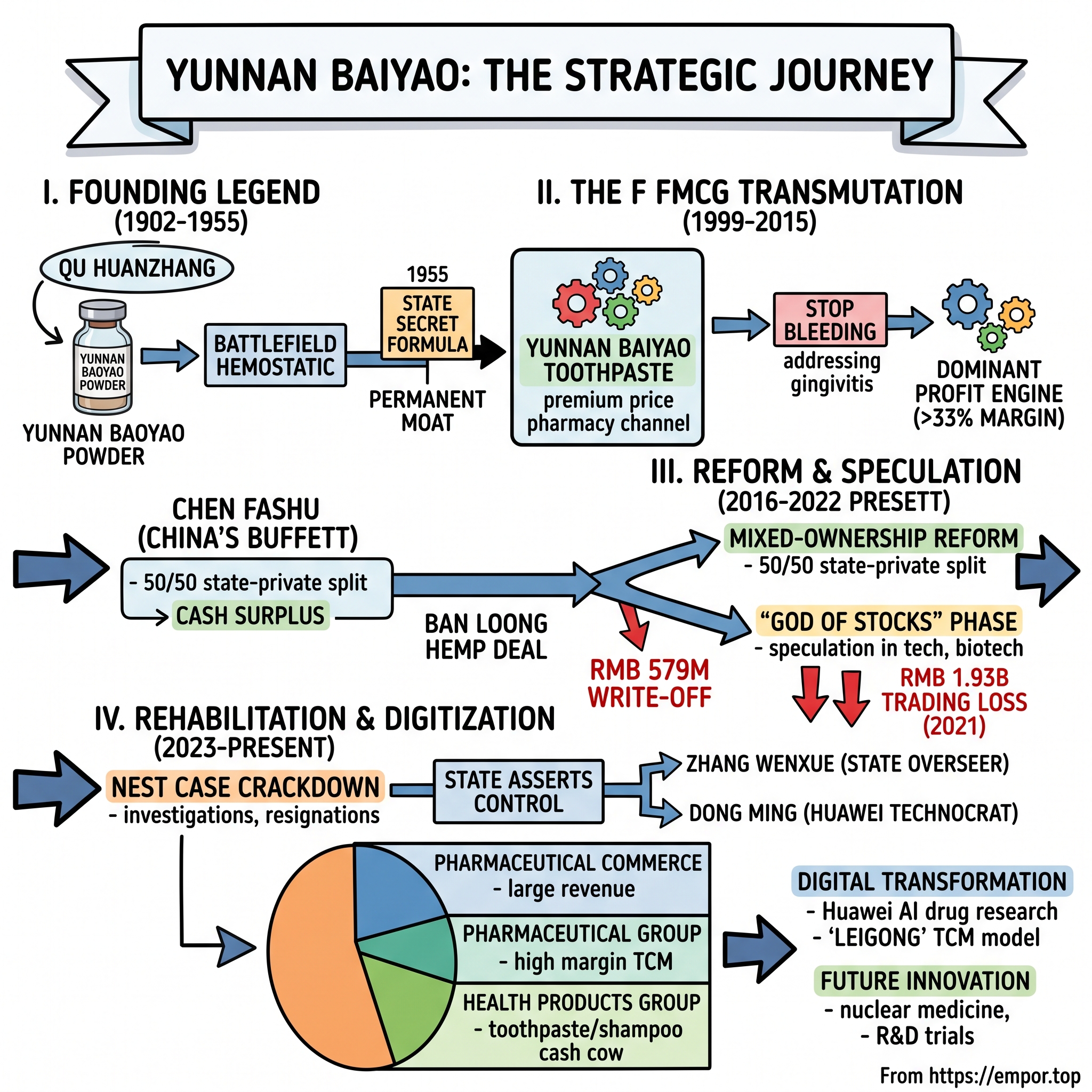
II. The Legend of Qu Huanzhang & The Sovereign Moat (1902–1955)
The founder of the myth was not a soldier but a country doctor. 曲焕章 Qu Huanzhang was a self-taught TCM practitioner in Yunnan, the mountainous, biodiverse province in China's far southwest that has long been the country's richest natural pharmacy. Sometime around 1902, working with the local herbs he knew intimately, Qu formulated a powder he first called Baibaodan — a preparation that, applied to a wound, appeared to stop bleeding, reduce swelling, and dull pain with a speed that seemed to border on the supernatural.2 In a region and an era where a deep cut could mean death by hemorrhage or infection, this was not a lifestyle product. It was the difference between living and dying.
What turned a regional folk remedy into a national legend was war. Across the warlord conflicts of the 1920s, the War of Resistance Against Japanese Aggression, and later the Chinese Civil War, Yunnan Baiyao traveled in soldiers' pockets. The standard-issue vial famously came with a single 保险子 — an "emergency insurance pill," the small red tablet reserved for the most catastrophic trauma. The product's reputation was built not in a laboratory but on battlefields like Taierzhuang, where its mythology as the powder that let men survive un-survivable wounds became part of the national memory. Whether every legend was literally true matters less, for our purposes, than what the legend did: it welded the Yunnan Baiyao name to an idea of near-miraculous, clinically serious efficacy. That association is the single most valuable asset the company owns, and it was created for free, by history.
It is worth pausing on Qu Huanzhang himself, because the man is inseparable from the brand. He was, by the standards of his time and place, an entrepreneur as much as a healer. Having refined his powder, he did not keep it a private charity; he built a small commercial operation around it in Kunming, packaged it under his own name, and turned it into a product that traveled. The composition was his life's secret, guarded within the family — and that secrecy was not a marketing gimmick but the entire business model, since a hemostatic anyone could copy was worth nothing, while one only he could make was worth a fortune to a soldier. The genius of what came later was to recognize that this instinct — protect the recipe absolutely — could be industrialized and given the force of law. Qu died in 1938, in the very year the powder's battlefield legend was being forged, and the recipe passed to his family along with the burden of protecting it.
The formula's transformation from family secret to state asset came after the revolution. In 1955, amid the sweeping consolidation of private enterprise into the new socialist economy, Qu's widow, 缪兰瑛 Miao Lanying, handed the secret formula to the Chinese government.2 Whether this was an act of patriotic donation, as the official history frames it, or a pragmatic accommodation to a state that was nationalizing private assets across the board, the effect was the same. The recipe became public property, and the state did something with it that would shape the company's economics for the next seventy years: it classified the recipe as a 国家保密配方 National Secret Formula, placing it under the highest tier of state protection.
Understand what this designation actually does, because it is the load-bearing wall of the entire investment case. In most of the world, a pharmaceutical company protects a product with a patent — a monopoly that is powerful but temporary, and that requires you to publish your formula in exchange. The National Secret Formula is the opposite bargain. The recipe is never published, and the protection never expires. Yunnan Baiyao is legally exempt from disclosing its full ingredient list on domestic labels — a carve-out from ordinary consumer-protection rules that would be unthinkable for almost any other product. Only a tiny handful of TCM preparations share this status; among the tens of thousands of Chinese medicines, only a couple are classified at this super-confidential tier, the most famous peer being 漳州片仔癀药业股份有限公司 Zhangzhou Pien Tze Huang Pharmaceutical Co., Ltd., guardian of the other great state-secret formula.23 A competitor cannot legally reverse-engineer and market the exact composition, because the composition is a state secret. This is not a moat that erodes with time. It is, in Hamilton Helmer's language, a cornered resource handed down by the government itself — and we will return to what it is and is not worth.
There is a second, subtler benefit to the secrecy designation that is easy to miss and central to the brand's mystique. Because the ingredients are a state secret, Yunnan Baiyao has cultivated for over a century an aura of the unknowable — a product whose efficacy consumers must take partly on faith and reputation, precisely because they cannot inspect what is inside. In most consumer categories, opacity is a liability. In TCM, wrapped in the authority of the state and the weight of history, it became an asset. The consumer does not know exactly what is in the powder; the consumer knows that the government thinks it important enough to hide, that soldiers carried it into battle, and that it has been trusted for a hundred years. That is a form of credibility no ordinary product can manufacture, and it would later travel, intact, into a tube of toothpaste.
And yet, for decades, this priceless asset sat inside a sleepy state-run factory doing almost nothing. Through the 1970s, 1980s, and into the 1990s, the enterprise operated as a classic SOE: stable, unhurried, and strategically adrift, with soft incentives and little pressure to grow. Management was administrative rather than commercial; the goal was to fulfill plans and preserve the institution, not to build a franchise. Here was the paradox that would define the coming pivot. In a modernizing, urbanizing, peaceful China, ordinary people simply did not suffer battlefield trauma. The core product was a hemostatic for a country that had largely stopped bleeding. By the late 1990s the company held one of the most trusted brand names in China attached to a shrinking addressable market — a priceless key to a door fewer and fewer people needed to open. Solving that paradox required someone willing to ask a heretical question: what if the most valuable thing about Yunnan Baiyao was not the powder at all, but the name on the bottle?
III. The SOE Bottleneck & The Toothpaste Miracle (1999–2015)
王明辉 Wang Minghui arrived as general manager in 1999 and quickly diagnosed the disease. Yunnan Baiyao, he concluded, was not dying of bad products; it was dying of "brand aging."2 It owned a name that Chinese consumers associated with serious, effective medicine, and it was pouring that equity into plasters and powders that fewer people bought each year. The brand was a Formula One engine bolted into a farm tractor. Wang's insight, developed over the following years, was that the engine could be dropped into an entirely different vehicle — one that people used not once a decade in an emergency, but twice a day, forever.
Before the toothpaste, Wang served an apprenticeship in the logic of brand extension with lower-stakes products. The company had already begun stretching the Yunnan Baiyao name into adjacent formats — most notably an adhesive bandage, the Baiyao Band-Aid, that competed directly with the category 强生 Johnson & Johnson had defined. The bandage was a natural fit: a wound-care brand selling a wound-care product. It sold respectably, and it taught the organization two things. First, that consumers would indeed pay up for the Yunnan Baiyao name on an everyday product. Second, and more sobering, that a natural adjacency alone was not enough to move the needle for a company this size — a bandage market is finite, and even winning it would not transform the income statement. The lesson Wang seems to have internalized was that the prize lay not in products related to wounds, but in products consumed with the frequency of a daily ritual. Toothpaste was used twice a day by more than a billion people. That was the market worth the risk of the crown jewel.
The specific idea arrived from a mundane observation. Many Chinese consumers, when they brushed their teeth, saw blood in the sink — the everyday, low-grade gum bleeding of gingivitis. The dominant toothpastes of the early 2000s, from multinational giants and domestic players alike, competed on freshness, whitening, and cavity protection. None of them squarely addressed bleeding gums with a claim of clinical, medicinal authority. But bleeding was precisely the thing Yunnan Baiyao's brand had spent a century promising to stop. The company possessed the one asset that could credibly own the "stop the bleeding" position in oral care, and no competitor could copy the formula behind it. Around 2004, Wang made the gamble that defined his career: he put the sacred National Secret Formula into a tube of toothpaste and called it 云南白药牙膏 Yunnan Baiyao Toothpaste.2
The gamble was not the product. The gamble was the price. Foreign brands like Crest and Colgate sold for a couple of renminbi per tube. Yunnan Baiyao launched at more than RMB 20 — roughly ten times the going rate, an almost absurd premium for a category consumers treated as a commodity.2 The logic was psychological and it was deliberate. By pricing the toothpaste alongside pharmaceuticals rather than household consumables, the company signaled that this was not a cosmetic but a treatment. A cheap tube says "cleans your teeth." A tube that costs as much as a box of medicine says "this actually does something to your body." The price was not a barrier to the value proposition; the price was the value proposition.
The distribution strategy was just as unorthodox, and it reveals how well Wang understood that he could not beat the multinationals at their own game. Colgate and P&G won supermarket shelves by paying enormous slotting fees and outspending everyone on advertising — a war of attrition Yunnan Baiyao could not win head-on. So it refused to fight there first. It leaned on the pharmaceutical distribution channels it already owned, seeding the toothpaste into drugstores and pharmacy shelves. Appearing next to the medicine cemented the medical positioning far more persuasively than any television spot, and it let the brand build credibility and margin before it ever confronted the giants in the mass grocery aisle. This is the whole playbook in miniature: use the medical heritage the competitors lack to enter through a door they were not guarding.
The competitive backdrop makes the achievement more remarkable. In the early 2000s, China's toothpaste market was, to a first approximation, a foreign colony. Colgate and Crest — the latter P&G's flagship — dominated the modern-trade shelves, backed by advertising budgets and shelf-fee war chests that no domestic brand could match, and they had spent years training Chinese consumers to associate their names with dental science. Local heroes had been bought out or beaten back; the venerable 中华 Zhonghua brand was itself operated under a foreign licensor. To attack this market head-on with a domestic product would have been suicidal. Yunnan Baiyao did not attack it head-on. It changed the axis of competition from "which toothpaste cleans best" — a game the incumbents had already won — to "which toothpaste treats a medical problem," a game the incumbents were not even playing. The multinationals could out-spend Yunnan Baiyao on advertising, but they could not out-claim it on medical authority, because they had no National Secret Formula and no century of battlefield trust. They were fighting on the wrong map.
It worked to a degree that reshaped the entire company. Over the following two decades, Yunnan Baiyao ground its way up the Chinese oral-care rankings, past domestic copycats and foreign incumbents, until it sat at or near the top of the market with a share that reached roughly a quarter of the category.2 The rise was not linear or costless — it demanded sustained investment in advertising, celebrity endorsement, and eventually the same modern-trade shelf presence the company had initially bypassed. But by leading with the pharmacy channel and the medical claim, Yunnan Baiyao had established a price and a positioning that the mass-market entrants could not easily undercut, because undercutting on price would have contradicted the entire premise that this was medicine, not soap. More important than the share was the economics underneath it. The health-products business built around toothpaste would come to run operating margins north of 33% — extraordinary for a consumer staple — and would quietly become the profit engine funding everything else the company did.1 A niche hemostatic had been transmuted into one of the most profitable branded consumer franchises in China.
The strategic lesson here is worth stating plainly, because the rest of the story is in some sense a series of attempts to repeat it or misapply it. Yunnan Baiyao did not extend its brand into a random adjacency. It extended into a daily-use product where its specific, century-old promise — stopping bleeding — mapped onto a real, physical, recurring consumer pain point. The efficacy claim was not decoration; it was the reason to pay the premium. That is a narrow and demanding condition for success, and holding on to that discipline would prove far harder than discovering it. Because the very success of the toothpaste created a new and more dangerous problem: it generated cash faster than the business could sensibly spend it. And into that vacuum of surplus capital walked a Fujian billionaire with a taste for grand bets.
IV. The Mixed-Ownership Reform & "China's Buffett" (2016–2019)
陈发树 Chen Fashu did not come from medicine. He came from retail and mining, a self-made Fujian entrepreneur who built the 新华都实业集团 Newhuadu Industrial Group conglomerate out of supermarkets, department stores, and a lucrative gold-mining stake, and who was frequently, and flatteringly, described in the Chinese press as "China's Warren Buffett."4 Sometime around 2009, Chen fixed his attention on Yunnan Baiyao with something close to obsession. He saw what the market saw — a legally protected monopoly attached to a fast-growing consumer franchise — and he set out to own a meaningful piece of it, selling down other assets to fund the pursuit.
The "China's Warren Buffett" label is worth interrogating, because it flattered a reputation that the later record complicates. Chen had earned genuine credibility as an investor, most famously through well-timed stakes in blue-chip Chinese names during the 2000s that made him, at his peak, one of the country's richest men.4 But the Buffett comparison obscured a crucial difference in temperament. Buffett's reputation rests on buying wonderful businesses and doing nothing; Chen's style, as it played out at Yunnan Baiyao, ran toward activity — restructurings, cross-holdings, and eventually a taste for the very kind of secondary-market trading that Buffett's own company is famous for avoiding at the operating level. It is one of the quiet ironies of this story that a man nicknamed for a buy-and-hold sage helped steer a cash-rich industrial company into a trading desk. The nickname described the wealth; it did not describe the method.
The problem was that Yunnan Baiyao was a state asset, and the state does not sell such things easily. In September 2009, Chen signed an equity-transfer agreement with 红塔集团 Hongta Group, the state-owned tobacco conglomerate that held a large block of Yunnan Baiyao shares, agreeing to pay roughly RMB 2.2 billion for the stake.6 It should have made him the company's second-largest shareholder. Instead, two years passed and the shares never arrived. Higher-level state regulators balked, citing the cardinal sin of SOE governance: the "loss of state-owned assets," the fear that a state entity had sold a national treasure too cheaply to a private buyer.6
What Chen did next was remarkable for its sheer audacity in the Chinese context: he sued the state. He filed a civil complaint to force the transfer, launching a legal battle that ground on for years and became a national test case for whether a private investor could hold a state-owned counterparty to a signed contract.6 In 2014, the Supreme People's Court effectively split the difference in a way that told Chen everything about the limits of his position. It ruled that the transaction had not been completed — he would not get the shares — but that Hongta had to return his RMB 2.2 billion plus interest.5 Chen got his money back. He did not get his monopoly. The lesson, learned at the cost of six years, was that in a contest between a private billionaire and the preservation of state assets, the state assets win.
And then, in one of those reversals that make Chinese corporate history so hard to predict from the outside, the policy wind changed and Chen got what litigation could not deliver. Beijing had begun pushing 混合所有制改革 mixed-ownership reform — a deliberate program to inject private capital, incentives, and management discipline into torpid state enterprises without fully privatizing them. Yunnan Baiyao became a marquee showcase. In a restructuring negotiated across 2016 to 2019, Newhuadu and the Yunnan Provincial 国有资产监督管理委员会 State-owned Assets Supervision and Administration Commission (SASAC) merged their interests into a consolidated Yunnan Baiyao Group, with the private and state sides ending up as co-equal owners.4
The governance structure that emerged was the striking part — and, in hindsight, the source of everything that went wrong. Yunnan SASAC and Newhuadu each held an equal 25.14% stake, a deliberate 50/50 balance of power at the top.4 The board was split between the two camps, and Chen Fashu was installed as co-chairman.4 In spirit, the sleepy SOE had been set free: released from the most rigid bureaucratic constraints, run with private-sector ambition, and — crucially — sitting on a mountain of cash from both the reform capital and the toothpaste machine.
On paper this was the dream of mixed-ownership reform: state stability married to private drive. In practice, a 50/50 split with no clear tie-breaker is a governance structure with a hole in the middle. When the two owners agreed, the company could move fast. When they disagreed — or when one side's appetite for risk outran the other's — there was no obvious mechanism to say no. The question that would define the next chapter was simple: with all that cash and all that freedom and a private co-chairman famous for bold bets, what exactly was Yunnan Baiyao going to do with the money? The answer, it turned out, was to take it to the stock market.
V. The "Stock God" Phase & The Ban Loong M&A Disaster (2019–2022)
Every great capital-misallocation story begins with a good problem. Yunnan Baiyao's good problem was that it generated far more cash than its own industry could absorb. A protected TCM franchise and a dominant toothpaste brand throw off enormous free cash flow, but they do not offer an obvious way to reinvest billions at attractive returns. You cannot invent a second National Secret Formula. You cannot double toothpaste consumption by building more factories. The company had a cornered resource and a cash cow, and no large, high-return reinvestment runway inside its circle of competence. That is precisely the condition under which management teams, especially ones led by financially ambitious personalities, start looking for returns elsewhere.
Where they looked was the secondary market. Rather than plow the surplus into the slow, uncertain grind of pharmaceutical R&D, the board — shaped by Chen Fashu's private-equity instincts — turned Yunnan Baiyao into something that looked increasingly like an investment fund with a toothpaste business attached. It built large equity positions in the marquee names of the Chinese tech and healthcare boom: 腾讯控股 Tencent, 小米集团 Xiaomi, 美团 Meituan, the liquor giant 伊利 Yili, the drugmaker 恒瑞医药 Hengrui, and a rotating cast of biotech firms.7 A national medicine company had quietly become a leveraged bet on the momentum of China's internet platforms.
There is a specific psychology to how good businesses talk themselves into this. The board did not wake up one morning and decide to become day traders. The drift happened in defensible-sounding steps: park idle cash in liquid securities rather than let it sit in low-yielding deposits; take a "strategic" position in a partner or a promising sector; add to a winner because the thesis is working; report the gains as a legitimate contribution to profit. Each step is individually rationalizable. Only in aggregate does it become clear that the company has quietly redefined itself, that the treasurer's function has swelled into a proprietary trading desk, and that a growing share of reported earnings now depends on the moods of the equity market rather than on selling more toothpaste. The presence of a co-chairman whose entire fortune had been built on bold, concentrated bets did nothing to apply the brakes; if anything, it supplied the accelerator and the vocabulary of confidence.
For one glorious year, it looked like genius. In 2020, the Chinese tech bull market ran hard, and Yunnan Baiyao's portfolio ran with it. Gains on the fair value of its securities holdings contributed on the order of RMB 2.24 billion to pre-tax profit — roughly a third of the entire year's total profit came not from medicine or toothpaste but from marking up its stock book.7 The Chinese financial press, half in admiration and half in mockery, crowned the traditional-medicine company the "God of Stocks." Here was a 120-year-old maker of battlefield hemostatics apparently beating professional fund managers at their own game. In the moment, it was intoxicating. In retrospect, it was the top.
Because markets that giveth also taketh away, and in 2021 they took. Beijing launched a sweeping regulatory crackdown on its internet platforms — antitrust actions, the shelving of Ant Group's IPO, new rules on data and gaming — and the very stocks at the heart of Yunnan Baiyao's portfolio cratered. Tencent, Xiaomi, and Meituan all fell hard. The company's securities and fund holdings swung from a source of bragging rights to a source of pain: in 2021, changes in the fair value of those positions produced a loss of roughly RMB 1.93 billion, with the Xiaomi stake alone accounting for a substantial chunk of the damage in the first half of the year.7 For the first time in nearly two decades, the "God of Stocks" dragged its own net profit down; full-year net profit attributable to shareholders fell by roughly half, to around RMB 2.8 billion.7 The lesson that the outline's later playbook will draw out was written in red ink here: reinvesting inside your circle of competence, or simply returning capital to shareholders, beats gambling in a market you do not control.
If the stock losses were a symptom of hubris, the deal the company struck in November 2021 was its purest expression. Yunnan Baiyao moved to take control of a Hong Kong-listed shell called 万隆控股集团有限公司 Ban Loong Holdings Limited, with the stated ambition of entering "industrial hemp" and building a global trading platform; the arrangement, structured around a joint venture, gave the Hong Kong side the leading role and reportedly involved sums in the range of HKD 1.3 billion.8 The strategic rationale was thin and the outcome was worse. By 2022 the company was forced to write off roughly RMB 579 million in goodwill impairment tied to the misadventure — an admission, in accounting form, that it had overpaid for something that was never worth it.8 Internally, the deal became a lightning rod, sparking accusations of reckless governance and the destruction of shareholder — and state — capital.
Step back and the pattern is clear. A company with a genuine, defensible core business had, in the space of a few years, become a speculator that lost nearly two billion renminbi in stocks and hundreds of millions more on a hemp shell in Hong Kong. That is not a run of bad luck; it is a capital-allocation philosophy, and it was the philosophy of the people running the company. In China, when the destruction of state-owned value becomes visible enough, it does not stay a matter for shareholders. It becomes a matter for the state's disciplinary machinery — and that machinery was about to turn on Yunnan Baiyao's leadership.
VI. The Nest Case Crackdown & The Resignation Wave (2023–2024)
The public mood curdled first. It is one thing for a private hedge fund to lose money in the market; it is quite another for a 120-year-old national medicine treasure, part-owned by the people of Yunnan, to neglect its drug pipeline while dropping nearly two billion renminbi on tech stocks and industrial hemp. Shareholders and state regulators began asking the obvious, uncomfortable questions: why was a company sitting on one of the world's most protected medical formulas behaving like a momentum trader? And where, exactly, had the money gone?
The architects of the era began to disappear from the stage. In early 2023, Wang Minghui — the man who had run Yunnan Baiyao for nearly a quarter-century and invented the toothpaste that made it rich — abruptly resigned as chairman, only months after being elected to the role, citing "personal reasons."[^9] For an executive so identified with the company that the local press called it the "Wang Minghui era," the suddenness was conspicuous. In early 2024, Chen Fashu and his son Chen Yanhui stepped down from the board, ending the Newhuadu family's active presence at the top of the company they had spent fifteen years fighting to control.[^10]
Then the reason surfaced. Reports from outlets including Yicai and Caixin revealed that the departures were not ordinary succession but the visible edge of a sweeping state-level anti-corruption probe. Wang Minghui, several former senior executives, and eventually Chen Fashu himself were reported to be under investigation, with former operating chief and senior vice president Yin Pinyao among those named as detained across 2023 and 2024.[^9][^10] The reporting tied the probe's core to exactly the deals that had drawn public anger — the speculative acquisitions, the Ban Loong misadventure, and the broader suspicion that state-owned value had leaked out through private-capital dealmaking.[^9][^10] In the specific vocabulary of Chinese SOE governance, this was the "loss of state-owned assets" charge — the same principle that had blocked Chen Fashu's original 2009 purchase, now turned against the men who had finally gotten inside.
The Chinese term for what unfolded is 窝案 wō'àn — a "nest case," the idiom for a scandal that does not claim one official but hollows out an entire cluster of colleagues at once, and it fit here almost too neatly. Reporting identified five former senior figures pulled in by provincial disciplinary and supervisory authorities in connection with the same web of matters: Wang Minghui as former chairman; former chief sales officer Wang Jin; former chief operating officer Yin Pinyao; former chief human-resources officer Yu Juan; and former director Yang Changhong, with the successive "personal reasons" resignations across 2023 and into 2024 lining up, in retrospect, against a timeline of investigations handled across several Yunnan jurisdictions.12 Tellingly, the scrutiny reportedly reached beyond the exotic Ban Loong deal to touch even a mundane star product — the Yunnan Baiyao adhesive bandage, 创可贴 — a reminder that where the disciplinary apparatus suspects value has leaked, it follows the money into the most ordinary corners of the business, not merely the headline-grabbing ones.12 It is worth being precise about the epistemics: as of mid-2026 the specific charges and any judicial outcomes had not been fully disclosed, and the company itself stated it had not received official information on aspects of the matter.12 What is not in dispute is the pattern — an entire top layer of a listed national champion removed under corruption investigation within roughly a year.
There is a grim symmetry here worth dwelling on. Chen Fashu spent six years suing the state because officials feared a private buyer would siphon value out of a state treasure. He won his way in through mixed-ownership reform. And then the very outcome the original regulators feared — value flowing out of the national asset through opaque, aggressive, privately driven deals — is precisely what the anti-corruption apparatus later alleged had happened. Whether every allegation is ultimately proven is, as of mid-2026, not fully resolved in public; investigations of this kind unfold slowly and disclose little. But the direction of travel is unambiguous. The experiment in private-led control was over.
It helps to place the episode in its wider context, because Yunnan Baiyao's reckoning was not an isolated scandal but part of a broader tightening. Across 2023 and 2024, China ran a sweeping anti-corruption campaign through its healthcare and pharmaceutical sector, sweeping up hospital administrators, drug distributors, and executives at state-linked medical enterprises. A cash-rich, part-state-owned national champion that had spent years neglecting its drug pipeline to trade stocks and buy a Hong Kong hemp shell was, in that climate, an almost inevitable target. The euphemism of "personal reasons" attached to Wang Minghui's exit — a phrase that in the Chinese corporate context often signals the opposite of a personal decision — read to seasoned observers as a warning flare well before the formal reporting confirmed the probe.[^9]12 For a company that trades partly on the trust of its brand, the reputational spillover of watching its most celebrated executive and its billionaire co-chairman fall under investigation is a cost that does not show up in any single line of the income statement, but is real all the same.
The state moved to reassert itself on two fronts. On governance, Yunnan SASAC re-established firm control of the company's direction, ending the 50/50 balance-of-power era in everything but the formal cap table. On strategy, the company did the thing that critics had demanded for years: in early 2024 it announced that it would exit secondary-market securities investment altogether, winding down the volatile stock portfolio that had made it famous and then infamous, and redirecting its focus to its core healthcare business.[^14] The casino was, at least by declaration, being closed.
For investors, the significance is less about assigning blame than about what the episode reveals. Yunnan Baiyao's governance had been tested by the classic hazard of a cash-rich company with weak internal checks, and it had failed the test expensively before the state intervened. The rehabilitation that followed would be judged not on press releases but on whether the new management could keep capital allocated to the boring, high-return core — and whether the numbers underneath the story held up. So it is worth turning to those numbers, and to the two men now charged with rebuilding the company.
VII. The Huawei Era: Operations, Segments, & Digital Transformation (2024–Present)
Walk into the top of Yunnan Baiyao today and you meet a deliberately chosen pairing: a state overseer and a technocrat. The chairman is Zhang Wenxue (张文学), elected to lead the board in early 2024, a figure whose prior post — chairman of the state-owned chemical giant 云天化集团 Yuntianhua Group — signals exactly what he was brought in to represent.9 He is the discipline, the political alignment, the cleanup. His presence says the state is back in the chair, and that the era of freewheeling private speculation is not returning.
The operator beside him is Dong Ming (董明), appointed president and chief executive in 2021, and his résumé is the more interesting tell. Dong came from 华为 Huawei, where he had served as a vice president of the China business and held senior party and knowledge-management roles.10 Bringing in a Huawei executive to run a traditional-medicine company is a statement of intent: Huawei is China's totem of process rigor, engineering discipline, and relentless operational execution. Dong's mandate is to import that culture — digitized supply chains, professional brand architecture, an R&D orientation — into a company that had spent recent years distracted by its stock book. The company has leaned publicly into this tech turn, including a 2022 cooperation agreement with Huawei on AI-assisted drug research.11 Whether that partnership produces real pipeline value or is mostly signaling is, as of 2026, still unproven — a claim to watch, not a result to bank.
The most concrete artifact of that turn is the 雷公大模型 Leigong model, an industry-specific large language model for traditional Chinese medicine that Yunnan Baiyao and Huawei Cloud began building under a strategic cooperation deepened in early 2024.11 Named for the mythic patron of Chinese herbal pharmacy, it is aimed at four uses: organizing the vast, unstructured corpus of TCM knowledge, supporting clinical decisions, accelerating research, and powering digital marketing. On paper it is exactly the kind of capability a heritage medicine company should want — a way to turn centuries of scattered empirical knowledge into something searchable and testable — and it has collected national recognition as a showcase AI application. But the honest investor's posture here is interested skepticism rather than applause. A flagship AI model is also precisely the sort of initiative a company reaches for when it needs to look transformed, and it will be years before anyone can point to a single new drug, a measurable margin gain, or a defensible new product that the Leigong model actually produced. Novel technology is a genuine option on the future; it is not yet a line on the income statement, and the distinction is one this particular company, of all companies, has earned the right to be reminded of.
Now the business itself, using the audited 2024 figures. Total revenue was RMB 40.033 billion, up 2.36% year over year, and net profit attributable to shareholders was RMB 4.749 billion, up 16.02%.1 Notice the gap between those two growth rates: revenue barely moved while profit grew sharply. That divergence is the single most important thing to understand about how this company actually makes money, and it comes into focus only when you break the RMB 40 billion into its three very different pieces.
The health-products group — toothpaste, plus adjacent personal care — generated roughly RMB 6.526 billion of revenue, about 16% of the total, and an operating profit around RMB 2.19 billion.1 Sit with the implication: a segment that is one-sixth of the top line throws off close to half of the company's total profit, at an operating margin north of 33%.1 This is the cash cow, unchanged from the franchise Wang Minghui built. Bolted onto it is the company's most watched growth experiment, the anti-hair-loss shampoo brand 养元青 Yangyuanqing, which reached roughly RMB 422 million in revenue in 2024, up about 30.3%.1 It is small — barely 1% of company revenue — but it is the clearest proof that the brand-extension logic behind the toothpaste can be repeated in a second functional-consumer-health niche. It is a proof point, not yet a profit engine.
The pharmaceutical group — the TCM core — brought in roughly RMB 6.9 billion.1 Its flagship is the 云南白药气雾剂 Yunnan Baiyao Aerosol, the spray-on descendant of the original powder, aimed at the sprains and bruises of everyday life and growing at a healthy clip, alongside the classic plasters; these are high-margin industrial products, with gross margins that reach into the 65% range.1 This is the segment where the National Secret Formula does its real economic work: legally protected, hard to copy, and genuinely profitable per unit.
The pharmaceutical commerce and distribution business is where the optical illusion lives. This wholesale operation — moving other companies' drugs through provincial supply chains — accounts for roughly two-thirds of the company's headline revenue, on the order of RMB 26 billion.1 But its gross margin is paper-thin, in the neighborhood of 6%.1 It inflates the top line spectacularly and contributes almost nothing to profit. Anyone who reads Yunnan Baiyao as a "RMB 40 billion revenue company" and stops there has been fooled by the distribution business. The economic company — the one that generates the profit and holds the moat — is really the toothpaste plus the aerosol, a business a fraction of that size.
The divergence between flat revenue and rising profit in 2024 tells its own quiet story about the current management's priorities. When a company grows profit far faster than revenue, it is usually doing one of two things: improving the mix toward higher-margin products, or squeezing cost out of operations. Yunnan Baiyao appears to be doing both — leaning into the high-margin health and pharmaceutical franchises while imposing discipline on the sprawling, low-margin distribution machine and, crucially, no longer taking large swings on its securities book. That is exactly the profile one would expect from a leadership team whose mandate is rehabilitation rather than expansion. It is a more boring company than the "God of Stocks" of 2020, and boring is the point. The open question is whether disciplined margin management can coexist with the genuine top-line growth the equity story ultimately needs, or whether the two are in tension — a company that only cuts and optimizes eventually runs out of things to cut.
One more asset sits off to the side and matters enormously: Yunnan Baiyao holds a stake of roughly 18% in 上海医药集团股份有限公司 Shanghai Pharmaceuticals Holding Co., Ltd., built through a strategic investment of about RMB 10.9 billion in 2022.1 Unlike the doomed stock-market bets, this is a strategic industrial holding: it delivers dividend income and, in theory, opens doors into nationwide hospital distribution and a broader R&D pipeline. Whether "in theory" becomes "in practice" — whether the synergies are real or the placement is simply a very large minority stake dressed in strategic language — is one of the open questions of the current chapter. What the segment picture makes clear overall is that this is a company with a small, superb core wrapped in a large, mediocre distribution layer, now trying to prove it can grow the core without repeating the sins that surrounded it.
The "digital transformation" in this era's title is more than a slogan, and it is where Dong Ming's Huawei pedigree shows up most concretely. The clearest example is the proprietary digital platform Yunnan Baiyao has built around 三七 Sanqi in Wenshan — a system that tracks the notoginseng root across its entire lifecycle, from seed breeding and planting through initial processing, extraction, manufacturing, and finished-product distribution, with end-to-end traceability.1 The strategic point is not the technology for its own sake; it is control of the supply chain for the single most important raw material the company depends on, plus a data asset that links what farmers grow upstream to what consumers buy downstream. In parallel, the company has publicly worked with Huawei on cloud and smart-manufacturing systems to modernize its industrial operations.13 For a company whose recent history was defined by a failure of internal control, the investment in systems that make operations legible and traceable is at least thematically consistent with the rehabilitation story — though, as always, the proof will be in sustained margins and clean disclosure, not in the existence of a platform.
The harder question hanging over the current era is what fills the pipeline once the toothpaste matures. Management's answer, articulated across 2025, is a long-dated bet on innovative pharmaceuticals — most notably nuclear medicine, framed as a potential "second growth curve." The company's lead diagnostic radiopharmaceutical, INR101, entered Phase III clinical trials during 2025, and a companion therapeutic candidate, INR102, secured clearance to begin early-stage human trials.14 These are genuine, long-horizon R&D efforts rather than stock trades, which is the point — but they are also years and considerable risk away from generating revenue, and drug development fails far more often than it succeeds. The most revealing figure in the recent accounts is not the pipeline but the imbalance around it: in the first half of 2025, sales and marketing expense ran to roughly RMB 5.6 billion against R&D spending of only about RMB 423 million — more than a tenfold gap.14 That ratio is the honest signature of what Yunnan Baiyao still is: a marketing-and-brand company that sells trusted consumer health products, not, yet, a research-driven drug innovator. Full-year 2025 results extended the recent pattern — revenue of roughly RMB 41.2 billion and net profit of about RMB 5.15 billion, up around 2.9% and 8.5% respectively — profit again outpacing a nearly flat top line, the arithmetic of a company optimizing a mature core rather than discovering a new one.14
VIII. Playbook: The 7 Powers of Yunnan Baiyao
Strip away the drama and ask the analyst's question: what, precisely, protects Yunnan Baiyao's profits from competition? Hamilton Helmer's 7 Powers framework gives us the vocabulary, and Yunnan Baiyao offers an unusually clean illustration of three of them.
The first and deepest is the cornered resource — the National Secret Formula. This is as close to an ideal cornered resource as exists in public markets: a productive asset, available to one firm on preferential terms, that materially boosts value and that rivals cannot obtain. Competitors cannot replicate the exact composition, and they cannot even legally analyze and publish it, because the state classifies it as a secret. Most moats erode; patents expire, trade secrets leak. This one is renewed by the coercive power of the state and has no expiry date. The honest caveat is that the power protects the formula, not every product built on it — nothing stops a rival from selling a perfectly good herbal toothpaste, only from selling this one — but as a foundation for premium pricing and brand authority, it is extraordinarily durable.
The second is brand. A century of battlefield mythology and a generation of medical positioning let Yunnan Baiyao charge, at launch, roughly ten times the price of commodity toothpaste and still win share.2 Brand power here is not vague goodwill; it is specific, measurable pricing power attached to a specific promise — stop the bleeding — that consumers believe. The evidence is in the margins: a consumer-staples business does not sustain 33%-plus operating margins without a brand that lets it price above the category.1 The limit of brand power is the flip side of its strength: it is credible only where the medical claim is credible. Push the name into pure cosmetics with no functional story and the premium evaporates — a risk we will return to in the bear case.
The third, and weaker, is scale economies in raw-material sourcing. The company's key botanical input is 三七 Sanqi (Panax notoginseng), the notoginseng root grown in Wenshan, Yunnan, that underpins both the powder and the toothpaste. Yunnan Baiyao has vertically integrated and digitized its sourcing to stabilize supply and cost and to squeeze out smaller TCM rivals who lack the scale to lock up supply.1 This is a real but medium-strength power: it lowers cost and reduces volatility, but it does not confer the near-absolute protection that the secret formula does, and it remains exposed to agricultural and climate shocks in a way a legal monopoly is not.
It helps to locate Yunnan Baiyao against its natural peers, because the comparison exposes both what is special and what is ordinary about it. The obvious cousin is 漳州片仔癀 Zhangzhou Pien Tze Huang, guardian of the other great state-secret formula, whose economics look eerily similar: a legally protected, secret-recipe hero product throwing off luxurious margins, wrapped in a broader and less glamorous business. The difference is in what each did with the surplus — Pien Tze Huang leaned into the scarcity and pricing power of its core lozenge and a cosmetics line, while Yunnan Baiyao chose the FMCG land-grab of toothpaste and, disastrously, the stock market. A second peer, the centuries-old Beijing house 同仁堂 Tong Ren Tang, shows the alternative failure mode: an even deeper heritage brand that never found a single, giant, daily-use consumer product to monetize it, and that has grown more slowly as a result. Read together, the three make the point that a protected TCM formula is a necessary but not sufficient condition for greatness. The formula is the raw ore; the value is created — or destroyed — by what management decides to smelt from it. Yunnan Baiyao has, at different times, done both more brilliantly and more recklessly than either peer.
Run the same business through Porter's Five Forces and the picture sharpens further. The threat of new entrants into the protected core is close to zero: you cannot enter a market whose defining product is a state secret you are forbidden to reproduce. The bargaining power of buyers in consumer health is low, because a household spends a trivial share of its budget on a functional toothpaste it trusts and will not haggle over a few renminbi for a product it believes protects its gums.
The other three forces are where the vulnerability lives, and an honest analysis leans into them. The bargaining power of suppliers is low-to-medium — Yunnan Baiyao has consolidated Sanqi sourcing, but it remains a buyer of an agricultural commodity subject to weather and disease. The threat of substitutes is genuinely medium: nothing in the secret formula stops 舒适达 Sensodyne, P&G, or a domestic upstart from attacking the same bleeding-gums and sensitivity pain points with modern, chemistry-based functional toothpastes that make no TCM claim at all. The formula protects Yunnan Baiyao's recipe; it does not protect the job to be done from being done differently. And competitive rivalry in personal care is high and permanent — the multinationals and domestic brands never stop spending. The net read is a company with a bulletproof core and contested edges: the profit sanctuary is secure, but the growth frontier is a battlefield. That distinction is the hinge of the bull and bear cases.
A war-game against the two most relevant sets of rivals makes the point concrete. Against its closest structural peer, Pien Tze Huang — the other keeper of a national-secret TCM formula — Yunnan Baiyao looks like the more consumer-diversified of the two, having successfully carried its formula into a daily FMCG habit, whereas Pien Tze Huang's fortunes remain more tightly bound to a single high-priced hepatobiliary medicine. That diversification is a genuine strength, but it is double-edged: it exposes Yunnan Baiyao to the marketing wars of the toothpaste aisle in a way a pure prescription-medicine peer never faces. Against the consumer-health multinationals — Colgate, P&G, Sensodyne's owner Haleon — the calculus is the mirror image. The multinationals bring vastly deeper marketing budgets, global R&D in dental science, and decades of category management; what they cannot bring is a state-protected medicinal claim or a century of Chinese battlefield heritage. The competitive equilibrium that has held for two decades is therefore not an accident: each side owns a weapon the other cannot copy, and neither has been able to dislodge the other from its stronghold. The risk to that equilibrium is not a frontal assault but a flanking one — a modern, chemistry-based functional toothpaste that neutralizes the "stop the bleeding" claim on scientific rather than heritage grounds, sold by a rival with the budget to educate consumers away from the TCM frame.
IX. Investment Case: Bull vs. Bear & Key KPIs
So why does Yunnan Baiyao win from here, and what would break the case? Set the two stories side by side and test each against the evidence rather than the rhetoric.
The bull case rests on four pillars. First, the cash engine: the toothpaste-and-aerosol core generates large, stable free cash flow protected by the powers described above, and it does not require heavy reinvestment to keep running.1 Second, governance rehabilitation: the exit of the speculators, the return of state oversight under Zhang Wenxue, and the operational rigor Dong Ming is meant to import from Huawei together promise a company that stops setting fire to its own capital.910 Third, the Shanghai Pharma holding as strategic optionality — a RMB 10.9 billion foothold that could open hospital distribution and pipeline access if the synergies are real.1 Fourth, growth optionality in adjacent niches, with Yangyuanqing's ~30% growth demonstrating that the brand-extension playbook still has room to run.1 The bull case, in short: a protected cash machine, now with adult supervision, and a couple of small call options on future growth.
The bear case is not the mirror image; it is a set of specific, evidence-based worries. Start with saturation. At roughly a quarter of the toothpaste market, Yunnan Baiyao has already captured most of the consumers who will ever pay a large premium for a medicinal toothpaste.2 From here, incremental share must be bought with heavier marketing or won by shaving price — either of which pressures the very 33% margins that make the segment special. Growth in the crown jewel is structurally flattening, and no amount of narrative changes the arithmetic of a mature category.
The second bear worry is brand-dilution risk, and it is the direct danger of chasing growth. Every extension into masks, skincare, or general beauty carries the temptation to lend the Yunnan Baiyao name to products with no genuine "stop the bleeding" story. The brand's power, as established, is conditional on medical credibility; spend that credibility on generic cosmetics and you can hollow out the asset while appearing to grow. Yangyuanqing works precisely because hair loss is a functional, physical problem the brand can plausibly address; a lipstick line would not be. The discipline that made the toothpaste is the discipline the company must not lose.
Third is the raw-material and margin risk in the TCM core: high-grade Sanqi is an agricultural product, and long-run climate and supply pressure on notoginseng could squeeze pharmaceutical-segment margins in a way vertical integration only partly offsets. Fourth, and most qualitative, is the governance hangover. The 2023–2024 investigations did reputational and organizational damage that lingers; an investor should treat management credibility here as something to be re-earned through years of disciplined behavior, not something restored by a single announcement.[^9][^10] An activist skeptic would press exactly here — on the RMB 26 billion low-margin distribution business that flatters revenue while adding little value, on the true strategic logic (versus financial-engineering logic) of the Shanghai Pharma stake, and on whether the promised exit from speculation is permanent or merely convenient.1[^14]
On the current risk radar, two items are genuinely material to the mechanism of this business rather than generic macro noise. One is regulatory: China has been tightening the rules on "functional" and "medical" claims in consumer cosmetics and oral care, and Yunnan Baiyao's entire premium rests on the credibility of such claims — a stricter advertising regime would strike directly at the pricing power. The other is political: as a national healthcare champion, the company must operate within the state's 共同富裕 common prosperity framework, which frowns on both excessive luxury pricing of health staples and speculative financial games — the latter a lesson already learned the hard way.
Which leaves the question of what to actually watch. Three KPIs carry most of the signal. First, the health-products group's operating margin — the truest measure of whether the toothpaste's pricing power is holding as marketing and distribution costs rise; erosion here is the canary. Second, Yangyuanqing's revenue growth and scale — whether the anti-hair-loss brand can push past the RMB 1 billion mark and become a genuine second profit engine, validating that the brand-extension edge is repeatable rather than a one-time miracle. Third, non-operating financial income and loss — the honesty check on the reform, confirming that the company has truly emptied the casino and is keeping capital in cash or core operating assets rather than quietly drifting back to the market. Track those three and you are tracking the whole thesis.
X. Epilogue & Outro
Summary of Lessons
Lesson one: the brand-extension trap has a narrow golden path. Yunnan Baiyao's toothpaste succeeded not because a trusted brand can sell anything, but because it extended a medical promise into a daily product where that exact promise solved a real, recurring physical problem. Bleeding gums were, quite literally, the same pain point the powder had always addressed. The generalizable rule is that a heritage medical brand can travel into consumer health where efficacy is the reason to buy — toothpaste for bleeding gums, shampoo for hair loss — but it cannot travel into pure vanity categories where the medical story is decoration. The path is real, but it is a footpath, not a highway, and most of the ground on either side is a cliff.
Lesson two: beware "capital overflow" in a niche monopoly. The most dangerous moment for a wonderful business is not when it is struggling but when it is generating more cash than it can reinvest in what it does well. A protected, high-margin franchise with no large reinvestment runway is the textbook setup for the "Stock God" disease — the drift from operating excellence into financial speculation, dressed up as diversification. Yunnan Baiyao's nearly RMB 2 billion of trading losses and its RMB 579 million hemp write-off are the price of that drift.78 The disciplined alternatives are unglamorous and correct: reinvest inside your circle of competence, or return the surplus to owners. Excess cash is not a trophy; it is a temptation.
Lesson three: mixed-ownership control eventually defaults to the state. The Yunnan Baiyao experiment tested whether private-sector speed and state-sector stability could be balanced 50/50, and it delivered a hard answer. A structure with no tie-breaker is stable only while the partners agree; when private ambition threatens the integrity of what the state regards as a national treasure, real control snaps back to the state — through governance, through personnel, and, if necessary, through the disciplinary apparatus. For any investor evaluating a Chinese mixed-ownership enterprise, the ownership percentages are less important than the answer to a single question: whose asset does the state ultimately believe this is? At Yunnan Baiyao, the events of 2023 and 2024 answered it plainly.
Final Reflections
The through-line of Yunnan Baiyao is a story about what a name is worth, and how easily its guardians can forget. A country doctor's white powder became a battlefield legend; a legend became a monopoly the state chose to protect forever; a protected monopoly became, through one contrarian pricing bet, the most profitable toothpaste in China. That transmutation — from niche hemostatic to daily habit — is one of the great feats of Chinese branding, and it remains the beating heart of the company.
The detour into the stock market casino was the shadow of that success: too much cash, too little discipline, and a governance structure that could not say no. It ended the way such stories tend to in China — with resignations, investigations, and the quiet return of the state to the head of the table. As of mid-2026, the casino is, by the company's own account, closed, and the task in front of Zhang Wenxue and Dong Ming is the least dramatic and most important one a business can face: to guard a 120-year-old secret, grow a superb consumer franchise without diluting it, and keep the cash where it belongs. Whether they succeed is not yet written. But the standard by which they should be judged is clear, and it is not the standard of a stock trader. It is the standard of a steward.
References
-
Yunnan Baiyao Group Co., Ltd. Annual Report 2024 — CNINFO / Shenzhen Stock Exchange, 2025-04-23 ↩↩↩↩↩↩↩↩↩↩↩↩↩↩↩↩↩↩
-
How One Company Brought Traditional Chinese Medicine To The Modern World And Made Billions — Forbes (Michael Schuman), 2017-08-23 ↩↩↩↩↩↩↩↩↩
-
Yunnan Baiyao: An Oriental Mystery in the Limelight — EqualOcean, 2020-05-19 ↩
-
Chinese Billionaire Chen Fashu to Chair Medicine Conglomerate Baiyao Holdings — Yicai Global ↩↩↩↩↩
-
Court Rules Against Chinese Billionaire In $355 Mln Pharma Stock Dispute — Forbes (Russell Flannery), 2014-07-28 ↩
-
Trial against Hongta starts in Yunnan — Global Times, 2012 ↩↩↩
-
Yunnan Baiyao reports massive investment losses — Global Times, 2021-10 ↩↩↩↩↩↩
-
Yunnan Baiyao, Ban Loong to Set Up Industrial Hemp JV — Yicai Global, 2021 ↩↩↩
-
Yunnan Baiyao elects Zhang Wenxue as chairman — MarketScreener, 2024 ↩↩
-
Yunnan Baiyao Group Co., Ltd. Appoints Dong Ming as Chief Executive Officer — MarketScreener, 2021 ↩↩
-
Yunnan Baiyao Group Cooperates With Huawei for AI Drug Development — Pandaily, 2022 ↩↩
-
Yunnan Baiyao Nest Case Erupts: Former Chairman Wang Minghui and Five Former Executives Under Investigation (云南白药爆发窝案 原董事长王明辉等5位前高管被调查) — Economic Observer (经济观察网), 2024-05-08 ↩↩↩↩
-
Yunnan Baiyao Group Co., Ltd. 2025 Annual Report Summary (2025年年度报告摘要) — Shenzhen Stock Exchange, 2026-04-01 ↩
-
Yunnan Baiyao's 2025 Net Profit Rises Over 8%, Bets on Nuclear Medicine for Second Growth Curve — BigGo Finance, 2026 ↩↩↩
 LinkedIn
 WhatsApp
 Reddit
 Hacker News
 Email
Email Kindle
 RSS Feed
 Spotify
 Apple Podcasts
 Amazon Music
 Audible
 YouTube