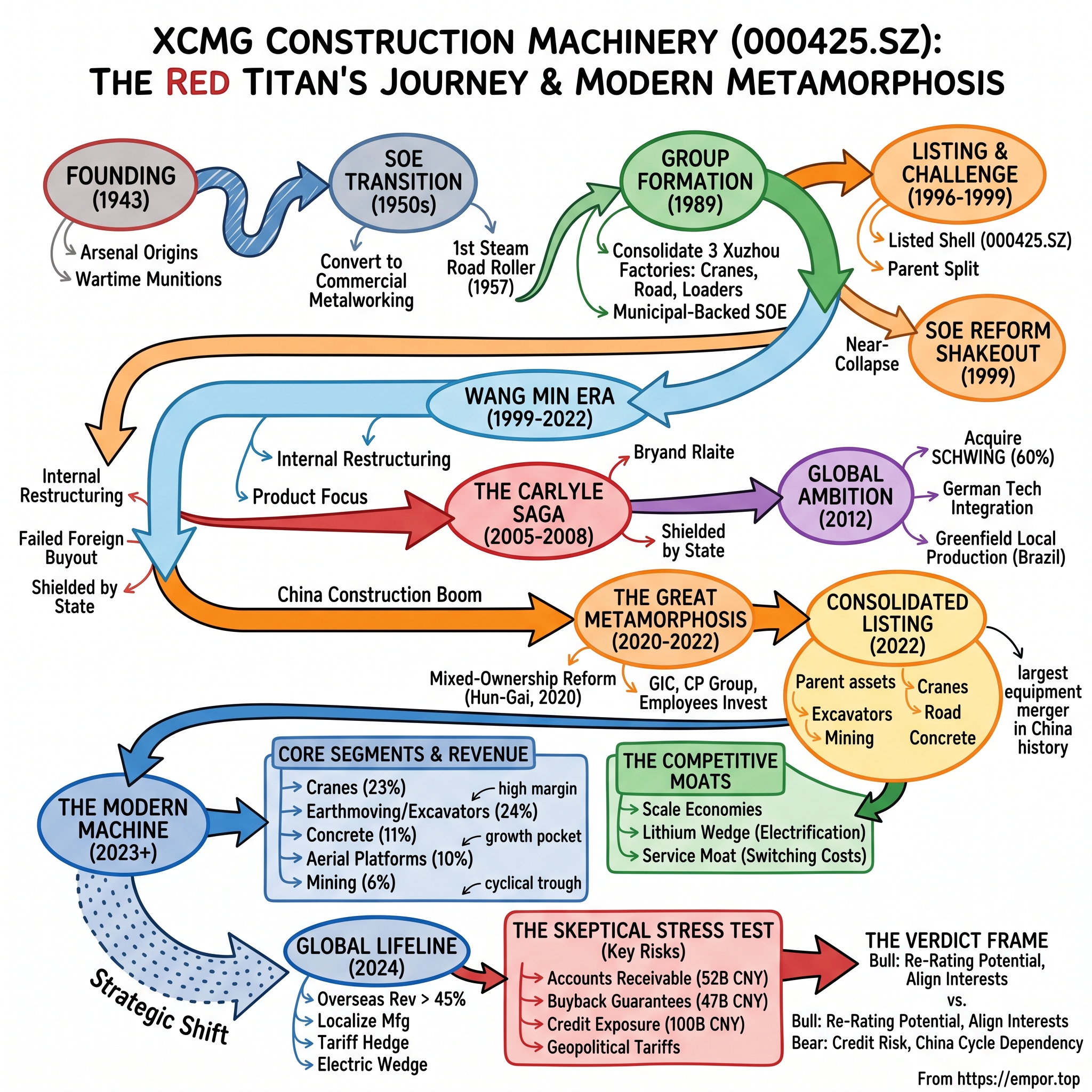
XCMG Construction Machinery: The Red Titan's Modern Metamorphosis
I. Introduction & Episode Roadmap
Picture a factory floor in Xuzhou, a gritty coal-and-steel city in China's Jiangsu province, sometime in the spring of 2022. Gantry cranes crawl overhead. Rows of half-finished machines — the color of school buses and highway signs — stretch toward a vanishing point. And somewhere in a corporate boardroom nearby, a set of signatures completes one of the quietest revolutions in the history of global heavy industry.
For decades, the company that stamped its yellow paint on cranes across the developing world had been running with one arm tied behind its back. The publicly listed vehicle, 徐工机械 XCMG Machinery — formally 徐工集团工程机械股份有限公司 XCMG Construction Machinery Co., Ltd., trading in Shenzhen as 000425.SZ — owned the mobile cranes and road rollers. But the crown jewels, the fast-growing excavators and the ultra-heavy mining trucks, sat inside the unlisted parent, 徐工有限 XCMG Limited. In 2022, the listed company swallowed its own parent whole, in an absorption merger valued at roughly 38.7 billion CNY — the largest such deal in the history of China's equipment-manufacturing industry.6 Overnight, billions of dollars of higher-margin assets landed inside the public ticker.
Today, that combined entity stands as China's largest and the world's third-largest construction machinery maker, generating over 91 billion CNY in annual revenue.8 It is a giant. But this is not a victory lap.
Here is the paradox we are chasing. How does a company that began life in 1943 as an ammunition arsenal — literally forging shell casings to fight the Japanese occupation — end up eighty years later owning a legendary German concrete-pump brand and elbowing 卡特彼勒 Caterpillar and 小松 Komatsu out of job sites in Brazil and Indonesia? And how do you reconcile the sheer scale of the thing with the uncomfortable economics underneath the paint?
Because underneath the gleaming yellow metal, the engine runs hot and thin. Net margins hover in the mid-single digits — around 6.5% on a good year in 2024, and thinner before that.8 For a company this large and this capital-intensive, that is a razor's edge; a modest swing in steel costs, pricing, or bad debts is the difference between a decent year and a lost one. The balance sheet carries a mountain of 应收账款 accounts receivable — tens of billions of CNY in invoices customers have not yet paid. And lurking off to the side, invisible on the face of the balance sheet, sits a form of shadow credit — buyback guarantees on customer financing that, at their peak, stretched toward 50 billion CNY of contingent exposure.9 This is a company that sells a great deal of iron, but a real question hangs over how much of that iron it is genuinely getting paid for, and what it would be on the hook for if its customers stopped paying all at once.
That tension — global scale wrapped around fragile unit economics — is the reason XCMG is such a fascinating study. It is simultaneously a genuine national champion and a cautionary tale about what happens when a company optimizes for size and strategic importance rather than for return on capital. Both things are true, and the entire investment debate lives in the space between them.
So this is a story about metamorphosis — and about the limits of metamorphosis. Here is the road we will travel:
- The Arsenal Origins: the 1943 founding and the long state-run apprenticeship.
- The Wang Min Era: restructuring, near-collapse, survival, and the foreign-takeover drama that made XCMG a protected national champion.
- The Great Metamorphosis: the 2020
混合所有制改革 mixed-ownership reform(混改 hun-gai) and the 2022 consolidated listing. - The Core Engine: the segment-by-segment economics — earthmoving, cranes, concrete, aerial platforms, and the high-margin mining option.
- The Playbook & Powers: scale, the lithium-battery wedge, and the service moat.
- The Stress Test: the receivables, the guarantees, and the bull-versus-bear fight over what this company is really worth.
Let's start where all of it started — in a war.
 Subscribe on LinkedIn
II. The State-Owned Heritage: From Arsenal to Heavy Metal (1943–1999)
The founding myth of XCMG is not a garage. It is a war zone.
In 1943, in the contested countryside of the Lu-Yi military district during the War of Resistance against Japan, a workshop called Huaxing Iron Works came together to make weapons — later reorganized as the Eighth Arsenal of the district.1 There were no CNC machines and no export catalog. There were lathes, coal fires, and a mandate to keep soldiers supplied. This origin matters more than it might seem, because it stamped two things permanently onto the company's DNA: heavy metalworking as a core competence, and the state as the ultimate shareholder and customer. XCMG did not evolve out of a market. It was conjured by a government for a purpose.
When the People's Republic was founded and the guns fell silent, the arsenal did what many Chinese defense plants did — it converted. It moved to Xuzhou, a rail junction in northern Jiangsu ringed by coal mines, and turned its metalworking muscle toward the machines a rebuilding nation needed. In 1957 the company rolled out China's first domestically produced steam road roller, a genuinely symbolic act: the same hands that had made munitions were now making the machines that pave roads.1 From destruction to construction, quite literally.
For the next three decades, the story is the story of Chinese state industry generally — planned output, guaranteed procurement, little competition, and little urgency. Machines were allocated, not sold; managers answered to production quotas handed down from planning bureaus, not to customers who could walk away. It bred deep engineering competence and almost no commercial instinct, and that imbalance — brilliant at making the thing, hopeless at pricing and financing it — would take the company half a century to unlearn. In some corners of the balance sheet, as we will see, it never fully has.
The pivotal structural moment came in 1989, when Xuzhou's municipal government consolidated three separate local factories — a crane plant, a road-roller plant, and a loader plant — into a single group: 徐工集团 XCMG Group.1 This is the ancestor of everything that follows. It bundled the three product families that, to this day, define XCMG's identity: lifting, road-building, and loading. It is worth noticing what that founding act tells you about the company's very nature. XCMG was not assembled by an entrepreneur chasing a market opportunity; it was stitched together by a city government rationalizing its industrial base. The logic was administrative, not commercial — and the fingerprints of that origin are all over the company today, from its geographic rootedness in a single city to the municipal officials who still sit, in effect, at the top of its ownership chain.
In 1996, a piece of that empire went public. The listed vehicle, 徐工机械 XCMG Machinery, debuted on the 深圳证券交易所 Shenzhen Stock Exchange.3 But — and this becomes the central plot device of the entire episode — only a slice of the group's assets went into the listed company. The state kept the rest upstairs in the unlisted parent. That split, born of convenience in the 1990s, would haunt XCMG's valuation for a quarter of a century.
Then came the near-death experience. As the 1990s closed, XCMG hit the wall that hit nearly every legacy Chinese state-owned enterprise during the brutal 国企改革 state-owned enterprise reform shakeout. This was the era when Premier 朱镕基 Zhu Rongji forced China's bloated state sector through a wrenching restructuring — "grasp the large, let go of the small," in the slogan of the day — and tens of millions of state workers were laid off nationwide. Cyclical demand cratered. The workforce was bloated, the product lines were sprawling and unprofitable, and the overhead of guaranteed lifetime employment — the "iron rice bowl" of cradle-to-grave state employment — sat like ballast on a sinking hull. Loss-making was structural, not accidental.
The company that had survived a world war was, by 1999, being kept alive largely by the willingness of the local state to not let it die. And here is the uncomfortable thing an investor must sit with: that dependency has never fully been severed. The specific losses of the late 1990s were fixed, but the underlying arrangement — a company whose ultimate backstop is a government that will not let it fail, and whose obligations therefore run beyond the purely commercial — is the same arrangement that lets XCMG carry credit risks today that a purely private firm might never dare. The safety net and the moral hazard are woven from the same thread.
That is the crucial investor takeaway from the early chapters: XCMG's survival has never been purely commercial. It has always been partly political. The same state hand that would later shield it from a foreign takeover was, in these years, the only thing standing between it and liquidation. Into that wreckage, in 1999, walked the man who would spend the next twenty-three years rebuilding it.
III. The Wang Min Era & The Great Construction Boom (2000–2011)
王民 Wang Min did not look like a revolutionary. He looked like what he was: a lifelong company man, an engineer who had come up through the ranks of the Xuzhou machinery world, appointed chairman in 1999 with a mandate that could be summarized in three words — reform or die.1
What Wang understood, and what makes him the pivotal human in this story, was that the boom about to hit China was going to be the largest infrastructure buildout in human history — and that XCMG would either be organized to catch it or would be crushed by it. So he did the unglamorous work first. He attacked the bloat, rationalized product lines, and dragged the company's governance toward something resembling a modern corporation. He aligned engineers and technical talent around the products that could actually win. None of this makes for a thrilling scene, but it is the reason there was a company left standing when the wave arrived.
Wang's leadership style is worth dwelling on, because it stamped a temperament on XCMG that persists in every decision it makes today. He was not a showman. Where Sany's founders would become celebrity billionaires who courted the press, Wang remained a disciplined, engineering-minded state manager who talked in terms of quality, technology, and national industrial dignity. His recurring theme in speeches was that Chinese machinery had to stop being cheap-and-cheerful and start being genuinely world-class — "high-end, high-quality" long before those became corporate buzzwords. That instinct produced XCMG's real strengths: superb heavy engineering, patience, and durability. It also produced its characteristic weakness: a conservatism that consistently prioritized building an impressive machine over building an impressive margin. When you understand Wang, you understand why XCMG, decades later, is still the company that makes the biggest crane in the world and earns the smallest profit among its peers.
And what a wave. Through the 2000s, China poured concrete and laid asphalt at a pace that beggars belief. Consider the raw arithmetic of the era: China went from a few thousand kilometers of expressway in the late 1990s to the largest highway network on the planet within two decades, and by some estimates poured more cement in a handful of years than the United States used across the entire twentieth century. The 西部大开发 "Go West" campaign pushed roads, rail, and dams deep into the underdeveloped interior. A real-estate boom turned provincial skylines into forests of tower cranes almost overnight. Every kilometer of highway needed rollers, graders, and pavers. Every skyscraper needed a crane. Every new town needed loaders and excavators. Demand was not a marketing problem; it was a manufacturing problem. Could you build the machines fast enough?
XCMG, sitting on its metalworking heritage and its dominant position in cranes and road machinery, rode the supercycle straight up. But — and this is the part that separates XCMG's boom from Sany's — the very structure of the wave rewarded exactly the products XCMG was weakest in. The single most demanded machine of the Chinese construction era was the excavator, the versatile digging workhorse that goes on almost every job site. And the excavator business, thanks to the parent-subsidiary split we keep circling back to, was largely lodged inside the unlisted parent, not the public company — and its most profitable, technology-intensive corners were long dominated by foreign makers and by the nimble Sany. XCMG grew enormously in the boom. It simply grew fastest in the lower-margin muscle of the market, a pattern that would define its profitability for the next twenty years.
But the most revealing episode of this era was not about growth. It was about ownership — and it nearly changed everything.
The Carlyle Saga
In 2005, the American private-equity firm 凯雷投资集团 The Carlyle Group agreed to acquire an 85% controlling stake in XCMG's core machinery business for roughly $375 million.[^12] Read that again. A foreign buyout firm was going to take control of one of China's flagship state industrial assets. Nothing quite like it had been attempted.
What followed was three years of slow-motion collapse. The deal ran straight into a rising tide of economic nationalism. The timing was fatal: the mid-2000s were exactly when Beijing was growing anxious about foreign capital acquiring control of "strategic" and "backbone" industrial enterprises, and a deal to hand majority control of a flagship machinery maker to an American private-equity firm became a lightning rod. Domestic competitors — most vocally the private-sector upstart 三一重工 Sany Heavy Industry, whose executive 向文波 Xiang Wenbo waged a very public blog campaign against handing a strategic asset to foreigners — helped turn it into a national debate about who should own the commanding heights of Chinese manufacturing.[^12] It was an early, vivid example of a phenomenon that would recur for two decades: economic policy being argued out in public and settled by political sentiment. Regulators, sensing the winds, tightened their stance on foreign control of strategic assets. Carlyle renegotiated the terms down repeatedly, from 85% to a minority position, and then, quietly and without a dramatic announcement, the whole thing was abandoned.
The lesson cut in two directions, and both matter for an investor today. On one hand, the failed deal permanently crowned XCMG as a protected national champion, owned and shielded by 徐州市国资委 Xuzhou SASAC, the local state-asset regulator. No hostile acquirer would ever get near it again. On the other hand — and this is the part the bulls tend to skip — that same protection is a cage. A company that cannot be bought is a company whose managers face no market for corporate control, no activist threat, no ultimate disciplining force except the political priorities of a municipal government. The Carlyle saga is the origin of both XCMG's safety and its inefficiency.
By the end of this period, the shape of the Chinese heavy-machinery industry had crystallized into a three-way rivalry that persists today — and, in a detail worthy of a novelist, two of the three giants share the same hometown. Both XCMG and 三一重工 Sany are rooted in the machinery cluster around Hunan and Jiangsu's industrial heartland, and all three grew up competing for the same customers, the same engineers, and the same government attention. Privately controlled Sany won on aggressive sales culture and excavators. Fellow SOE 中联重科 Zoomlion won on concrete and tower cranes. And XCMG dominated its ancestral turf — mobile cranes and road machinery. Three giants, one industry, three very different owners. That structural tension — private hustle versus state heft — is the throughline of everything that comes next: it explains the margin gap, the different M&A styles, and the different ways each company would eventually globalize. And the next move was to take the fight overseas.
IV. The Global Ambition & The Schwing Acquisition (2012–2019)
In 2012, the global financial crisis had left Europe's storied industrial families exhausted and cash-starved — and China's machinery giants went shopping.
It was a remarkable moment of synchronized ambition. Three Chinese companies, within roughly a year of each other, went to Europe to buy the one thing decades of domestic growth could not manufacture: brand heritage and top-tier hydraulic engineering. 三一重工 Sany bought Putzmeister, the German "elephant" of concrete pumps, for a reported figure around €360 million.[^12] 中联重科 Zoomlion had already taken control of Italy's CIFA. And 徐工机械 XCMG set its sights on 施维英 Schwing Group GmbH, the German concrete-pump pioneer — a firm whose booms had poured the foundations of the postwar West.4
To feel the weight of these deals, you have to understand what these German and Italian firms represented. Putzmeister and Schwing were not merely manufacturers; they were the twin high priests of concrete-pumping technology, the companies whose truck-mounted booms could push liquid concrete hundreds of meters into the air to build the world's tallest structures. Putzmeister's pumps had helped build the Burj Khalifa and had famously been flown to Japan to help cool the stricken Fukushima reactor. For a Chinese buyer, acquiring one of these houses was like a rising sushi chain buying a three-Michelin-star kitchen: you were not just buying equipment, you were buying a century of accumulated craft and a name that opened doors on every continent.
XCMG's approach to Schwing tells you a great deal about its temperament. Where Sany paid a full premium to plant its flag, XCMG negotiated a value-priced deal, taking a 60% majority stake in 2012 and reportedly arranging a loan of around $210 million to structure it.4 It did not overpay for the trophy. But the same conservatism that produced the disciplined price also produced a slower payoff. XCMG deliberately preserved Schwing's German management and ran the operation at arm's length, prizing stability over the messy, aggressive integration that might have extracted synergies faster. It took until 2022 for XCMG to raise its ownership to 93%.5 Ten years to move from control to near-full ownership is not the behavior of a company in a hurry; it is the behavior of a company that treats acquisitions the way it treats its balance sheet — cautiously. There is a genuine debate to be had about which approach won. Sany's fast, aggressive integration of Putzmeister arguably built a stronger global concrete franchise faster; XCMG's patient, hands-off model avoided the culture clashes and write-downs that so often wreck cross-border deals, but left its concrete business a solid also-ran rather than a world-beater.
Was that the right call? It depends on what you think an acquisition is for. If the goal was to absorb Schwing's technology and quietly upgrade XCMG's own concrete-machinery line without blowing up a respected European brand, patience was rational. If the goal was to rapidly globalize and dominate, the arm's-length approach left value on the table. The honest answer is that XCMG bought insurance and a technology library, not a growth rocket — and priced it accordingly.
Meanwhile, the more consequential globalization was happening not through European boardrooms but through greenfield concrete and steel. XCMG built out 徐工巴西 XCMG Brazil, investing on the order of $500 million in local manufacturing to leap over Brazil's punishing import tariffs and sell machines as a local producer rather than a foreign exporter.2 Brazil was a shrewd choice of first beachhead: a vast, resource-hungry economy with high tariff walls that punished importers but rewarded anyone willing to build inside them, and a mining and agriculture sector desperate for affordable heavy equipment. Assembly and localization efforts followed in India, North America, and Europe. This was the seed of the strategy that would later become XCMG's single most important growth story: don't just ship machines abroad, build them abroad. It was also, quietly, a hedge against a future that had not yet arrived — a world in which Chinese exports would face rising political hostility, and in which having a factory with local jobs inside a foreign country would be worth far more than the cheapest possible container off a ship.
But hovering over all of it was the structural flaw we flagged at the very start — the split personality of the company itself. Public-market investors could see it plainly, and it was why 三一重工 Sany commanded a premium valuation while XCMG traded at a persistent discount. The listed vehicle, 000425.SZ, held the slower-growth mobile cranes and road rollers. The unlisted parent, 徐工有限 XCMG Limited, held the fast-growing, higher-margin excavators and mining machines. Related-party transactions flowed constantly between the two, capital allocation was tangled, and minority shareholders in the listed company were, in effect, holding the less attractive half of a great business. Fixing that split was the obvious value-unlock. It took a decade of preparation — and a genuinely radical restructuring — to pull off.
V. The Great Metamorphosis: Mixed-Ownership Reform & Consolidated Listing (2020–2022)
By 2020, the plan that would redefine XCMG was finally set in motion — and it started not with the listed company, but with the parent.
To make a clean consolidation possible, the state first had to reshape the ownership of 徐工有限 XCMG Limited itself. In 2020, the parent underwent a 混改 mixed-ownership reform — a roughly 21 billion CNY capital injection that brought outside money and outside logic into a formerly pure state entity.[^13] The state-owned 徐工集团 XCMG Group deliberately diluted itself, cutting its stake in the operating parent to roughly 34.1% and inviting strategic private and institutional investors to the table, including names associated with 正大集团 CP Group, CDH Investments, and Singapore's sovereign fund GIC.[^13]
Why bring in outsiders at all? The state was solving a specific problem. A mixed-ownership reform, in the Chinese policy lexicon, is the attempt to graft the discipline and capital of private markets onto the scale and strategic reach of a state enterprise — to keep the state in control while forcing the enterprise to answer, at least partly, to investors who care about returns. Introducing a name associated with Thailand's 正大集团 CP Group, a sophisticated financial sponsor in CDH Investments, and a returns-obsessed sovereign wealth fund in GIC was itself a signal: these are not passive well-wishers. They came for a re-rating, and they would only get one if XCMG's tangled structure was finally cleaned up and its profitability improved. Their presence on the register created a constituency, inside the ownership tent, that actually wanted the changes the next two years would bring.
The most interesting piece of the reform was the smallest in dollar terms. XCMG created an employee stock-ownership platform, 徐工金帆 XCMG Jinfan, through which several hundred key managers and technical staff invested 868 million CNY for around 2.7% of the equity.[^13] In a company owned for eighty years by the state, this was a quietly profound shift: for the first time, a meaningful cohort of the people running XCMG had personal money riding on whether the enterprise created value. Whether 2.7% is enough to change behavior at a company this size is a fair debate — a skeptic would note that a couple of percent, pooled across hundreds of people, hardly turns a state manager into an owner-operator with a Sany founder's hunger. But the direction was unmistakable, and for a company whose managers had spent their entire careers being paid regardless of the share price, even a small ownership stake was a genuine break with eighty years of habit.
The 2022 Consolidation
With the parent reformed, the endgame arrived. In 2022, the listed shell 000425.SZ issued new shares to absorb 徐工有限 XCMG Limited in a reverse-merger-style overall listing valued at roughly 38.7 billion CNY — again, the largest deal China's equipment-manufacturing sector had ever seen.6 The China Securities Regulatory Commission approved the transaction in July 2022.6
The point was never financial engineering for its own sake. The point was the assets that finally came into the light. Into the public company flowed the excavator business — domestically second in market share only to 三一重工 Sany — the concrete machinery integrated with Schwing, and the ultra-heavy mining machinery.6 For the first time in the company's history, a public shareholder buying 000425.SZ owned the whole of XCMG's core machinery empire, not a curated slice of it. The decades-old parent-subsidiary discount had its central justification removed.
It is worth appreciating just how elegant, and how self-interested, this maneuver was. For years, minority shareholders in the listed company had watched the good assets grow upstairs, out of reach, while the related-party transactions between parent and listed sub raised perennial questions about whether value was leaking from the public shareholders to the state parent. The overall listing did not just add revenue; it dissolved an entire category of governance suspicion in one stroke. A bull would call it the cleanest possible value-unlock. A skeptic would note the timing — the consolidation happened as the domestic machinery cycle was rolling over, meaning public investors absorbed the previously hidden excavator and mining assets right as their end-markets were about to enter a multi-year slump. Both readings are true, and holding them at once is the whole art of analyzing this company.
The Guard Changes
The metamorphosis was corporate, but it was also personal. In 2022, having steered XCMG from the brink of collapse to global scale over twenty-three years, 王民 Wang Min reached the mandatory retirement age for state executives and stepped down.1 It is worth pausing on that: unlike Sany's founders, who built personal fortunes measured in billions, Wang exited as a salaried state manager. He had run a company larger than most nations' entire heavy-industry sectors, and he left without an ownership empire.
His successors are cut from the same institutional cloth. 杨东升 Yang Dongsheng became Chairman and Party Secretary, and 陆川 Lu Chuan, who had served as President since 2017, continued to run operations.8 Both are internal lifers who spent their careers climbing XCMG's own divisions. And here is the fact that should shape how an investor reads every strategic promise these men make: they own virtually no direct equity outside their collective, pooled stake in the 徐工金帆 XCMG Jinfan partnership. Their incentives are a blend of commercial targets, return-on-equity metrics installed after the reform, and political alignment under provincial Jiangsu SASAC. This is not a founder-led company where the boss's net worth rises and falls with the stock. It is a professionally managed state asset, and its management thinks — and is paid — accordingly. That distinction will echo through the competitive and financial analysis to come.
VI. The Modern Machine: Core Segments & Current Competitive Landscape
If you want to understand XCMG as a business rather than a symbol, you have to open the machine up and look at the parts. So let's break down the roughly 92.8 billion CNY of revenue the company recorded in its 2023 accounts, segment by segment, because each one has a different personality — and a different margin.[^15]
Start with the biggest: 土方机械 Earthmoving Machinery — excavators and loaders — at 22.56 billion CNY, about a quarter of revenue.[^15] This is the volume engine, the muscle. It is also, right now, the most painful place to compete. China's excavator market has been in a deep cyclical trough as the property boom that once absorbed endless machines has deflated. Everyone is fighting for share in a shrinking domestic pie, and price is the weapon. Big revenue, thin reward.
Next, the historical crown jewel: 起重机械 Hoisting / Crane Machinery at 21.19 billion CNY, roughly 22.8% of the total.[^15] This is XCMG's birthright, the business it traces straight back to that 1989 consolidation. In the world of super-tonnage crawler cranes and mobile cranes — the giants that erect wind turbines and lift bridge sections — XCMG is a genuine global leader, not a follower. When the product is hard enough to make, XCMG's engineering heritage shows.
Then 混凝土机械 Concrete Machinery, including Schwing, at 10.43 billion CNY, about 11.2%.[^15] Stabilized, technologically credible thanks to the German integration, but under persistent margin pressure in a commoditizing market.
Now the part of the catalog that deserves more attention than its size suggests. 高空作业机械 Aerial Work Platforms — the scissor lifts and boom lifts that hoist workers rather than materials — came in at 8.88 billion CNY, roughly 9.6% of revenue.[^15] This is the hidden gem, and it deserves a second look precisely because it breaks XCMG's usual pattern. Aerial platforms are relatively standardized, rental-driven products with attractive margins and structural tailwinds — the global push toward safer, mechanized work-at-height instead of ladders and scaffolding. XCMG entered late but scaled fast, and this is one of the few segments where it is genuinely growing into higher-quality earnings rather than defending low-margin volume. It is a useful reminder that the company is not monolithic; buried inside the commodity giant are pockets of genuinely good economics.
And then the segment that carries the most asymmetry relative to its size: 矿业机械 Mining Machinery — giant dump trucks and mammoth excavators — at 5.86 billion CNY, about 6.3%.[^15] Small today, but this is the high-barrier, high-margin frontier where XCMG competes most directly with 卡特彼勒 Caterpillar. Mining equipment is a different game from construction iron: the machines are enormous, the technology and reliability barriers are steep, downtime costs a mine operator a fortune per hour, and customers are large, sophisticated, and sticky. That combination makes it hard to enter but lucrative once you are in — the opposite of the domestic excavator knife-fight. The rest of the empire — spare parts, road machinery, and piling equipment — makes up the remaining roughly 24 billion CNY, a long tail of the low-margin commodity iron that is both XCMG's heritage and its profitability problem.[^15]
The Margin Reality Check
Here is where an honest analyst has to stop admiring the scale and start asking a hard question. In 2023, 三一重工 Sany earned a gross margin around 28% and a net margin near 6.2%. 中联重科 Zoomlion came in similarly, roughly 28% gross and 7.0% net. XCMG? Around 23% gross and 5.7% net.7 That is a persistent 500-basis-point gap in gross margin against its closest peers — five cents on every revenue dollar, gone before you even count overhead.
Why does the largest player earn the lowest margin? Two structural reasons, and neither is easily fixed. First, product mix: Sany concentrates on high-margin excavators, while XCMG carries a vast, sprawling catalog that includes plenty of low-margin commodity iron — loaders, simple road rollers, basic equipment where differentiation is nearly impossible.7 Second, the SOE overhead we met back in the 1990s never fully went away. A state enterprise with municipal stakeholders carries heavier social, employment, and legacy manufacturing costs than a lean private rival that can hire, fire, and relocate at will.7 Scale, it turns out, is not the same thing as efficiency. XCMG is bigger than Sany and less profitable than Sany, and that sentence is the single most important fact about the business.
The Domestic Trough and the International Lifeline
To understand why the overseas story matters so much, you have to grasp the depth of the hole at home. China's construction-machinery market did not gently cool after 2021; it fell off a cliff. The property developers who had absorbed so much equipment stopped building as the sector's debt crisis unfolded, and local governments, groaning under their own debt loads, throttled back the infrastructure spending that had been the industry's second engine. Excavator sales in China dropped for years running from their 2020–2021 peak. For a company with XCMG's domestic exposure, this was not a soft patch; it was a structural reset in its home market that no amount of operational tightening could offset.
And yet XCMG's total revenue barely moved — it held around 91–92 billion CNY through the trough.8 That stability is not evidence that nothing happened; it is evidence of a violent internal rotation. As the domestic market slumped, XCMG's international revenue climbed to 41.69 billion CNY in 2024 — over 45% of the company's total, up 12% year over year even as China stagnated.8 The rotation only accelerated into 2025: in the first half of the year, overseas revenue reached 25.55 billion CNY, up 16.6% year over year, lifting the international share to 46.6% of the total — nearly half the company, versus just 29% as recently as 2022.10 The overseas business is not a rounding error anymore. It is nearly half the company, and it has been the buffer absorbing the shock of China's property bust. One market collapsed and another rose almost exactly fast enough to catch the company as it fell. That is either extraordinary strategic foresight or extraordinary luck — probably some of both — but the dependency it creates is now absolute: XCMG's entire investment case has quietly become a bet on international expansion. Which raises the question every bull and every bear is really arguing about: is that international engine a durable competitive advantage, or just a cheaper-for-now export push? To answer that, we need to look at the moats.
VII. The Playbook: Strategic Moats & Hamilton Helmer's 7 Powers
Strip away the national-champion romance and ask the cold question a long-term investor has to ask: what, exactly, stops a customer in São Paulo or Jakarta from buying the other guy's machine? Let's test XCMG's moats one by one, using Hamilton Helmer's 7 Powers as the frame, and be willing to say when a "moat" is really just a temporary edge.
Scale economies — the real one. This is XCMG's most defensible advantage, and it is genuinely powerful. The company's enormous production volume, concentrated in its Xuzhou megabase, gives it purchasing leverage over Chinese steel mills and component suppliers that no Western maker can match. Fold in the structurally lower cost of Chinese labor and inputs, and XCMG can land a comparable machine on a job site at a 15–30% discount to 卡特彼勒 Caterpillar or 小松 Komatsu while still turning a profit.2 For a contractor whose economics live and die on capital cost, a third off the sticker price is not a marketing nicety — it is the whole decision. This is a durable power, because it is rooted in China's entire industrial ecosystem, not in any single factory XCMG could lose.
Cornered resource — the lithium wedge. Here is the most interesting and most contested moat. First, the layman's version of why this matters. Electrifying a passenger car is hard; electrifying a 100-ton mining truck or a construction loader is a different order of difficulty, because these machines do backbreaking physical work all day and need staggering amounts of stored energy to do it. The battery pack for a single large electric mining truck can be bigger than the packs in a dozen electric cars. That means the economics live or die on one variable: the cost of the battery. Whoever can source huge, rugged battery packs cheapest can build an electric heavy machine that actually pencils out for a customer, while everyone else builds an expensive science project.
China dominates that variable. 宁德时代 CATL and 比亚迪 BYD between them anchor the world's cheapest, most scaled production of lithium cells. XCMG sits inside that ecosystem, and it has used the proximity to push hard into electric construction machinery: battery loaders, electric port equipment, light electric cranes.8 In 2024, new-energy products were among its fastest-growing lines.8 Western competitors are years behind in electrifying heavy equipment at costs that actually work on a job site. Is this a "cornered resource" in Helmer's strict sense? Not exactly — XCMG does not own the batteries, it merely buys them cheaply and early, and so do Sany and Zoomlion sitting in the same ecosystem. Call it a national supply-chain adjacency rather than a firm-specific corner. But relative to 卡特彼勒 Caterpillar and 小松 Komatsu, it is a real, current head start, and in markets with tightening emissions rules it could become a genuine door-opener that price alone never provided.
Switching costs — the service moat. The third pillar is stickiness. Once a contractor trains operators on XCMG's control systems and builds a working relationship with a local 24/7 parts-and-service center, migrating a fleet to another brand becomes a genuine hassle — retraining, new spare-parts inventory, downtime risk.2 It is real, but it is the weakest of the three, and honesty demands admitting why: for a small contractor, these switching costs are modest next to a big enough price gap, and XCMG's own aggressive financing (which we will get to) exists precisely because the product alone is not sticky enough to close every sale.
Porter's Five Forces on Chinese Heavy Machinery
Zoom out to the whole industry and the picture sharpens. Buyer power is the killer variable. Inside China, XCMG's customers — often state-linked construction firms — wield enormous leverage, dictating long payment cycles that shove risk back onto the manufacturer. Overseas, selling through dealer networks, XCMG holds more of the whip hand. Supplier power is low and getting lower, precisely because XCMG has spent years localizing hydraulics and engines to replace expensive foreign components from the likes of Cummins and Bosch Rexroth — turning former dependencies into commodity inputs. Rivalry is the brutal part: the domestic three-way war with 三一重工 Sany and 中联重科 Zoomlion is a knife fight on price, which is exactly why gross margins are compressed and why overseas markets — where the rivalry is a notch less savage — matter so much to the profit story.
There is one more force worth war-gaming, because it defines XCMG's ceiling: the threat from the incumbents it is trying to displace. 卡特彼勒 Caterpillar and 小松 Komatsu are not standing still. Their moats are the ones XCMG's cost advantage cannot easily erode: brand trust built over a century, dealer-and-financing networks of extraordinary depth, and the highest resale values in the industry — a Cat machine holds its price on the used market in a way that lowers the true cost of ownership even when the sticker is higher. For a large, sophisticated Western contractor, that resale premium and dealer reliability can quietly outweigh XCMG's 20–30% discount. This is why XCMG wins most decisively in price-sensitive emerging markets and struggles most in the mature markets where it needs to win to earn premium margins. The cost advantage gets you in the door in Jakarta; it does not, by itself, get you into a blue-chip fleet in Texas.
So what does the moat analysis actually tell an investor? That XCMG's edge is real but lopsided. It wins decisively on cost and scale, plausibly on electrification for now, and only weakly on lock-in. That profile can build a very large, globally competitive business — which it has. What it cannot easily do is generate premium margins, because a cost-and-price advantage, by its nature, competes profits away. Which brings us to the part of the story the yellow paint is designed to distract you from: the balance sheet.
VIII. The Skeptical Stress Test: Balance Sheet Landmines & Hidden Guarantees
Every great industrial story eventually meets its balance sheet, and this is where XCMG's gets genuinely uncomfortable. So let's do what a short-seller would do — turn the machine over and look at the underside.
Start with the number that stops you cold. As of mid-2025, XCMG carried over 52 billion CNY in 应收账款 accounts receivable — money owed by customers for machines already delivered.9 Set that against the company's annual revenue and the scale becomes vivid: well over half a year's worth of sales is sitting not in the bank but in unpaid invoices. Against cash reserves in the low-20s of billions, the receivables tower over the till. This is not, on its own, evidence of fraud or failure — heavy equipment has always been sold on credit. But it is a measure of how much of XCMG's reported prosperity is a promise rather than a payment, and in a downturn, promises from small contractors are exactly what stop being kept.
The Shadow Liability
Now for the part that does not even appear as a liability on the face of the balance sheet — the 融资租赁回购义务 finance-lease repurchase obligation.
Here is the mechanism, in plain terms. To keep machines moving during domestic slumps, XCMG leans on financing structures. A bank or leasing company puts up the money so a customer can buy the machine. On paper, the customer owes the bank, not XCMG. But to make the bank comfortable lending to a small contractor with a thin balance sheet, XCMG quietly provides a buyback guarantee: if the customer defaults, XCMG steps in, repays the financier, and takes back the used, depreciating machine. The sale looks clean. The risk never actually left the building.
The scale of this is the part that should focus the mind. By mid-2025, XCMG's contingent liabilities for customer mortgage-loan guarantees stood at roughly 9.28 billion CNY, and its finance-lease buyback obligations reached a staggering 47.28 billion CNY.9 Add the receivables and the guarantees together and the company's total credit exposure to its own customers pushes toward 100 billion CNY — a figure larger than a full year of revenue.
Why does this matter so much more than an ordinary receivable? Because of correlation. These guarantees are not spread across independent, unrelated buyers. They are concentrated among the small and mid-sized contractors whose livelihoods rise and fall with Chinese infrastructure and property cycles — the same cycles, driven by the same municipal budgets and property developers. If a wave of local-government debt stress or a developer collapse bankrupts those contractors all at once, XCMG does not face scattered, manageable defaults. It faces a synchronized cascade: obligated to buy back a flood of repossessed machines it must then re-sell into a market that is already glutted, precisely when those machines are worth least. The credit risk and the demand risk are the same risk, arriving on the same day.
There is a further wrinkle that any short-seller would press, and it concerns the quality of the reported earnings themselves. When a manufacturer will finance almost anyone to move a machine, it becomes very hard to distinguish genuine end-demand from what is effectively lending dressed up as revenue. A machine "sold" to a marginal contractor on a full buyback guarantee is booked as a sale today, but the economic reality is closer to XCMG parking its own inventory on a customer's balance sheet while retaining the downside. This is not unique to XCMG — the entire Chinese machinery industry, Sany and Zoomlion included, runs on aggressive financing, and Western makers use financing arms too. But the sheer scale of XCMG's off-balance-sheet buyback book relative to its thin net profit means the margin for error is small. A few points of unexpected default rate on a 47 billion CNY guarantee book is a number that rhymes uncomfortably with a full year of net income. That is the accounting judgment an investor has to form a view on, because the auditors' "controllable" is doing a lot of quiet work.
Reading Management's Tone
This is where earnings calls become more revealing than annual reports. In recent communications, management leans on reassuring language — "strict contract control," "receivable-reduction programs," risk described as being in a "controllable state."9 The phrasing has been notably consistent across reporting periods, which cuts both ways: consistency can signal a genuine, stable framework for managing the risk, or it can signal a well-rehearsed talking point that deflects the same question every quarter. Analysts, for their part, keep pushing on the aging of the receivables book: the growing pile of accounts overdue past three years, the rising provisions for credit losses, the write-offs. The most useful test an investor can apply is not what management says but what the numbers do underneath the language — whether the individually-provisioned receivables and the buyback obligations are trending down while the reassurance stays the same, or whether the reassuring words are quietly papering over a book that keeps aging. The gap between "controllable" and "we are provisioning more each period" is exactly the gap a careful investor should watch. It is not that management is lying; it is that management is describing the same elephant from the comfortable end. The company's operating cash flow did improve markedly in 2024, up over 60% year over year — a genuine positive that suggests the collection engine is working harder.8 But cash flow can look healthy right up until a correlated default event tests every guarantee at once. The stress test is not whether XCMG can collect in good times. It is whether it can survive collecting in bad ones.
IX. The Future Investment Case: Electrification & Global Expansion
Turn away from the landmines for a moment and look at where management is actually placing its bets, because the forward story rests on two wagers: going global as a local, and going electric as a leader.
The first wager reframes what "international" even means for XCMG. The old model was export: build a crane in Xuzhou, ship it to Brazil, pay the tariff, book the sale. The new model is localization: build the crane in Brazil. Expanding 徐工巴西 XCMG Brazil and pushing manufacturing bases in the United States and elsewhere is not primarily about logistics — it is about political insulation.2 As Western protectionism hardens and anti-dumping scrutiny of Chinese machinery intensifies, a machine assembled locally, employing local workers, is far harder for a government to tariff into oblivion than a container off a ship from China. In 2024, that international business was already 45% of revenue and still growing while the home market stalled.8 The strategic logic is sound. The open question is whether XCMG can run genuinely profitable factories in high-cost countries, or whether localization trades its core cost advantage for political safety.
That question is not academic, and it cuts to the heart of the bull thesis. XCMG's entire overseas advantage rests on cost, and cost is precisely what you surrender when you move production from a hyper-efficient Xuzhou megabase to a plant in Brazil or the United States with local wages, local suppliers, and local regulation. If localized factories can hold most of the cost edge, XCMG has a durable, tariff-proof growth engine. If they cannot — if a machine built in the US ends up costing nearly what a Caterpillar costs — then the localization strategy defends the revenue but quietly euthanizes the margin that made the revenue worth having. This is the single most important unknown in the forward story, and it is one management's reassuring commentary tends to glide over. An investor should watch overseas gross margin like a hawk, because that one line will reveal, over the next several years, whether globalization is compounding value or merely relocating it.
The second wager is electrification as a wedge into markets that price alone can't crack. XCMG's electric loaders and electric mining haul trucks are not green window-dressing; for the customer, they can cut fuel costs by half or more, which in a fuel-hungry business is a hard financial argument, not a soft ESG one.8 And in mature European and North American markets bound by tightening emissions mandates, an electric machine is sometimes the only machine a buyer is allowed to run. If XCMG's early lead in cheap, scaled electrification holds, it becomes the key that opens the high-margin Western door that a discount diesel excavator never could. If Western incumbents catch up on battery cost — and they are trying — the wedge dulls.
Then there is the mining option, the smallest segment with arguably the largest asymmetry. At under 6 billion CNY today, 矿业机械 mining machinery is a rounding error against the whole.[^15] But it is a long-cycle, high-barrier, high-margin business, and it is the one arena where XCMG competes head-to-head with 卡特彼勒 Caterpillar on something closer to equal technical footing. If XCMG lands durable supply contracts with major miners in South America, Africa, and Australia, this one segment could meaningfully re-rate the whole company's margin profile — a small tail that could, over years, wag a very large dog. That is optionality, not a forecast, and it should be held as such: winning a spot in a global miner's fleet requires years of field-proven reliability, and the incumbents guard those relationships fiercely. The prize is real, but so is the difficulty, and an investor should price the mining story as a call option that may or may not come into the money — not as a base case already earned.
Underlying both wagers is a single strategic truth that management is, to its credit, executing on rather than merely describing: XCMG's future value is being built outside China, in higher-margin products and higher-standard markets, precisely because its home market can no longer be the growth engine. The question is never whether that pivot is happening — it plainly is — but whether it can be made to pay. And that returns us, one last time, to the argument between the optimists and the skeptics.
X. Analysis & Bull vs. Bear
So we arrive at the trading floor, where every thread of this story gets priced into a single question: is XCMG cheap because it deserves to be, or cheap because the market has not caught up to the metamorphosis? Let's war-game both sides honestly.
Myth vs. Reality
Before the cases, it is worth clearing away three comfortable narratives that surround this stock. Myth one: "XCMG is the world's third-largest machinery maker, so it must be a dominant business." Reality: size and dominance are not the same thing. XCMG is enormous largely because it makes an enormous volume of relatively low-margin equipment, and it earns a lower margin than the two domestic rivals it is bigger than. Scale is a fact; profitability is the question. Myth two: "The 2022 consolidation fixed XCMG's discount problem." Reality: the consolidation removed the structural justification for the discount, but it did nothing to close the operating-margin gap with Sany or to de-risk the balance sheet — and it delivered the newly injected cyclical assets straight into a downturn. The re-rating case is real but unproven. Myth three: "Chinese machinery is unbeatable on price, so global share gains are inevitable." Reality: price wins emerging markets, but the mature markets where the real margins live are defended by brand, resale value, dealer networks, and now tariffs — none of which a discount alone can breach. Keep those three corrections in mind, and the bull and bear cases below read very differently.
The Bull Case
The bull starts with valuation. XCMG has traded for years at a deep discount to global peers — often at single-digit forward earnings multiples — a discount originally justified by the parent-subsidiary split that no longer exists.7 The core argument is that the market is still pricing the old, hobbled XCMG while owning the new, consolidated one with its premium excavator, concrete, and mining assets finally inside the ticker.
The bull's second pillar is incentive alignment. For the first time, through 徐工金帆 XCMG Jinfan, the people running the company have skin in the game, and the post-reform focus on return on equity and margins — rather than raw volume — could slowly close that 500-basis-point gap with Sany.[^13] There is early evidence the discipline is real, not just rhetorical: net profit rose 12% in 2024 even on flat revenue, non-recurring net profit jumped over 28%, and operating cash flow surged more than 60% — exactly the signature of a company squeezing more genuine cash out of the same top line rather than chasing empty volume.8 The momentum carried into the first half of 2025, when net profit climbed roughly 17% and core net profit — stripping out one-offs — jumped over 35%, both to record highs, while gross margin ticked up toward 22% and operating cash flow more than doubled.10 Third is the global-replacement thesis: the price-to-quality ratio of Chinese machinery has become genuinely hard to beat, and XCMG's overseas expansion is both higher-margin and more resilient than its battered home market.8 If international keeps compounding and margins converge even halfway to peers, the earnings power sitting inside today's single-digit multiple is materially understated. The bull is not asking XCMG to become Caterpillar; the bull is asking XCMG to become slightly less like its old self, and arguing you are paid handsomely to wait for even that.
The Bear Case
The bear points straight at Section VIII. The real credit exposure — receivables plus guarantees — approaches 100 billion CNY, and it is correlated to a single fragile system: Chinese local-government and property finance.9 If infrastructure spending hits a genuine wall, the bear argues, bad-debt provisions and buyback obligations could vaporize years of the thin earnings this company works so hard to generate. This is not a margin worry; it is a solvency-of-the-cycle worry.
The bear's second front is geopolitics, and the mechanism is specific. The very Western markets XCMG needs for high-margin growth are the ones erecting tariff walls and launching anti-dumping probes against Chinese machinery. A tariff does not just tax a machine; it erases the exact 20–30% price advantage that is XCMG's entire reason for being chosen, neutralizing the moat at the border. Localization mitigates the risk but, as we saw, may do so by surrendering the cost edge it is meant to protect — a trap either way. And there is a sharper version of this fear: as a Chinese state-owned enterprise, XCMG is exposed to the possibility of outright exclusion from sensitive Western infrastructure and defense-adjacent projects on national-security grounds, a door that no amount of price or quality can reopen.
Third is the structural ceiling: as a state-owned enterprise answerable to municipal and provincial stakeholders, XCMG may simply be unable to match 三一重工 Sany's lean agility. The margin gap, in this reading, is not a fixable inefficiency — it is a permanent feature of the ownership model. A company that cannot be taken over is a company that never has to become maximally efficient. The bear's summary is blunt: you are being asked to underwrite a thin-margin, credit-heavy industrial cyclical, tied to the fortunes of Chinese construction and increasingly walled out of the rich markets, and the low valuation is not an opportunity but an accurate price for those risks.
The Verdict Frame — 7 Powers and Five Forces, Netted Out
Put the frameworks together and a balanced picture emerges. XCMG has genuine scale-economy power and a real, if time-limited, electrification edge, wrapped in weak switching costs and squeezed by ferocious domestic rivalry and enormous buyer power. That combination is capable of producing a globally significant, cost-advantaged industrial champion — which is precisely what XCMG is. It is much less obviously capable of producing durable premium profitability, which is precisely what XCMG lacks. The bull and bear are not really arguing about the facts; they are arguing about whether the discount already pays you for the risks.
There is also a governance dimension a skeptical investor should weigh explicitly, because it colors everything. XCMG's controlling shareholder is, ultimately, the state, acting through Jiangsu and Xuzhou's asset regulators. That has real consequences for minority shareholders that no operating metric captures. Capital allocation may at times serve regional employment or industrial-policy goals rather than pure return on capital; dividends, buybacks, and M&A are decided by managers whose careers depend on political as much as commercial performance; and the buyback-guarantee machine that props up domestic sales exists partly because a national champion is expected to keep the wheels of local construction turning even when a purely profit-driven firm would pull back. None of this makes XCMG uninvestable — many state enterprises reward shareholders handsomely. But it means the incentives of the people running the company are not perfectly aligned with the person buying the shares, and that gap is a permanent, structural feature of the case, not a temporary blemish.
The KPIs That Actually Matter
An investor cannot track everything, so watch three things and let the rest be noise:
- Overseas revenue growth and margin trend. The single most important gauge. International is the engine offsetting domestic decline; if its growth stalls or its margins compress under tariffs and localization costs, the entire bull case loses its foundation.
- Accounts-receivable aging and bad-debt write-offs. Not the headline receivable number, but its quality — the balance overdue past three years and the trajectory of credit-loss provisions. This is the early-warning system for systemic customer distress.
- Finance-lease guarantee outstandings. The ultimate measure of hidden balance-sheet risk. A steady rise means XCMG is buying today's sales with tomorrow's contingent liabilities; a sustained decline would be the strongest possible signal that the metamorphosis is real.
Track those three, and you are watching the actual load-bearing walls of the investment case rather than the paint.
XI. Epilogue & Surprises
The biggest surprise in this whole story is not financial. It is what happens when eighty years of heavy-metal heritage collides with China's consumer-technology supply chain.
Consider the trajectory. A company that began by hand-forging shell casings in 1943 is now, in the 2020s, wiring its machines with the same building blocks that power China's electric-vehicle and autonomous-driving industries — battery packs, LiDAR, driving chips.8 The endpoint of that convergence is genuinely radical: fleets of autonomous, unmanned, electric mining trucks working a pit with no cab, no driver, and no shift change. A machine descended from an ammunition arsenal, driving itself around a mine on Chinese EV batteries. If it scales, it doesn't just cut costs — it changes what a mine workforce even is. Whether XCMG leads that shift or merely participates in it is one of the most interesting open questions in the entire heavy-equipment industry.
But the durable lessons for an investor are older and simpler than the robots.
The first is the double edge of state ownership. The Carlyle saga showed how state protection can be a shield — it saved XCMG from a foreign takeover and cemented it as a national champion. The very same protection, we saw, is also a constraint, capping the operational efficiency and capital discipline that its private rival extracts as a matter of course. You cannot separate the safety from the cost; they are the same feature viewed from two sides. Any investor buying an SOE is buying both at once.
The second lesson is about the mechanics of cyclical turnarounds in heavy assets. XCMG's greatest act of value creation was not a product or an acquisition. It was a restructuring — consolidating the parent into the listed company, aligning incentives, and doing it during a downturn when the assets could be moved without the frenzy of a boom. Restructuring at the trough, when everyone else is paralyzed, is the quiet, unglamorous, deeply powerful way that value gets unlocked in capital-intensive industries.
The third lesson is the subtlest, and it is the one that generalizes far beyond one Chinese machinery maker. A cost advantage is the most common competitive edge in the world and, paradoxically, one of the least profitable to own. Being the low-cost producer wins you enormous volume and market share — it made XCMG the third-largest player on earth — but because your edge is price, and price is the one thing competitors and customers can always attack, the advantage tends to convert into scale rather than into margin. Caterpillar's brand and dealer network let it keep the profit; XCMG's cost edge lets it keep the volume. An investor who understands that distinction understands why the biggest player in an industry is so often not the most profitable one, and why "we are cheaper" is a business model that builds giants but rarely builds fortresses.
Which leaves us where we began, on that factory floor in Xuzhou, with the rows of yellow machines stretching toward the horizon. The metal gleams. The scale is real. The metamorphosis — from arsenal to national champion to consolidated global player — genuinely happened. The only thing still unproven is whether all that transformation can finally be made to pay a margin worthy of its size, or whether the Red Titan is destined to remain exactly what it is today: the biggest machine in the yard, and not quite the most profitable one.
References
-
XCMG Acquires German Concrete Pump Manufacturer Schwing — Engineering News-Record, 2012-07-02 ↩↩
-
XCMG Increases Ownership in German Unit Schwing to 93 Percent — Construction Briefing, 2022-09-14 ↩
-
XCMG Machinery's Absorptive Merger and Listing of Core Assets — Eastmoney News, 2021-04-21 ↩↩↩↩
-
Comparing Sany, Zoomlion, and XCMG's Margins and Valuation Multiples — Eastmoney Securities Research, 2024-05-10 ↩↩↩↩
-
Empowering New Industrialization, XCMG Machinery's 2024 Annual Report Highlights High-Quality Development — PR Newswire, 2025-05-13 ↩↩↩↩↩↩↩↩↩↩↩↩↩
-
XCMG Machinery (000425.SZ) Disclosure Filings & Reports, incl. 2025 Half-Year Report — CNINFO ↩↩↩↩↩
-
XCMG Reports Record-Breaking Half-Year Results, Driving Innovation and Global Expansion — PR Newswire, 2025-09-02 ↩↩
 LinkedIn
 WhatsApp
 Reddit
 Hacker News
 Email
Email Kindle
 RSS Feed
 Spotify
 Apple Podcasts
 Amazon Music
 Audible
 YouTube