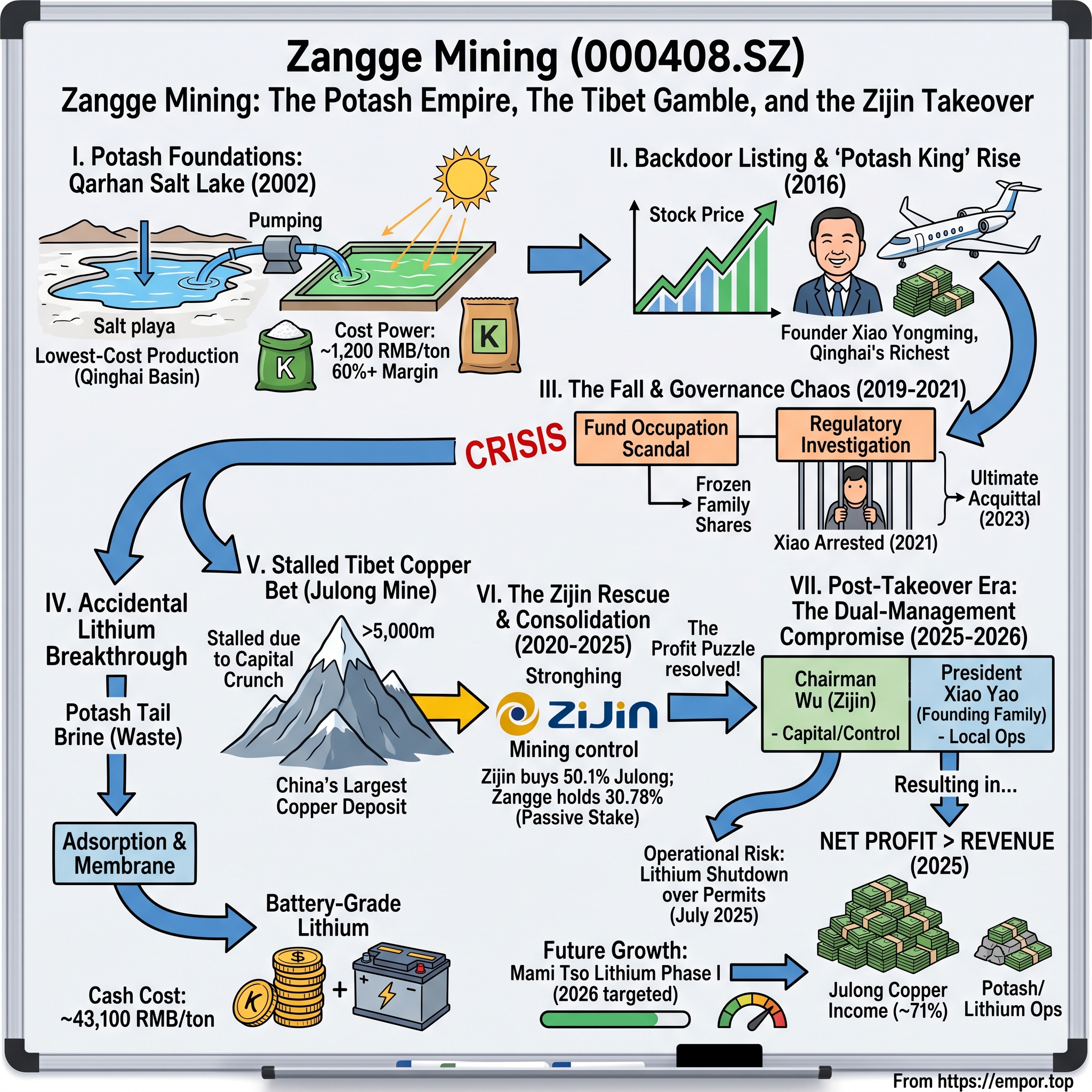
Zangge Mining: The Potash Empire, The Tibet Gamble, and the Zijin Takeover
I. Introduction & Episode Roadmap
Start with a number that shouldn't be possible.
In its 2025 fiscal year, 藏格矿业 Zangge Mining Company Limited (000408.SZ) reported consolidated revenue of roughly 3.577 billion RMB — call it half a billion US dollars, a rounding error next to the Chinese resource majors. And yet the company booked a net profit of about 3.852 billion RMB, up nearly 50% year over year.6 Read that again. The bottom line was larger than the top line. A company that sold less than four billion RMB of stuff somehow kept more than four billion RMB of profit.
If you have ever cracked open an income statement, your instinct is correct: this is not how businesses normally work. Net profit is supposed to be what's left after you subtract costs from revenue, so by construction it should be smaller than revenue — often dramatically smaller. When profit exceeds sales, it almost always means the reported "sales" capture only a sliver of where the money is actually coming from. The rest is arriving through a side door that never touches the revenue line at all.
That side door is the whole story. Zangge does not consolidate the single most valuable asset it owns. Instead, it holds a large minority stake in one of the best copper mines on the planet, and every year that mine ships a fat check of "equity investment income" straight down to Zangge's net profit — bypassing revenue entirely. In 2025 that one passive stake generated more profit than everything Zangge actually operates. The company you can see is a mid-sized fertilizer and lithium producer in a bleak corner of Qinghai. The company that matters is a holding vehicle sitting on top of a Tibetan copper colossus.
How Zangge ended up in that peculiar position is a genuinely wild business story — one that runs through a hyper-arid salt lake at the roof of the world, a private-jet-flying entrepreneur who became the richest man in his province and then lost nearly everything, an accidental discovery that turned industrial waste into battery-grade lithium, a bet-the-company gamble on copper that stalled at the edge of bankruptcy, and finally a rescue and takeover by 紫金矿业 Zijin Mining, the most ruthlessly efficient mining operator China has produced.
Here is the road map for how we get there:
- The origins of potash mining at the desolate 察尔汗盐湖 Qarhan Salt Lake, and why a fertilizer nobody thinks about became strategically precious to Beijing.
- The rise and fall of founder 肖永明 Xiao Yongming — once Qinghai's richest man, later arrested, and (in a twist the usual telling gets wrong) ultimately acquitted.
- The accidental breakthrough that let Zangge pull lithium out of what used to be waste brine, at a cost that embarrasses most of the industry.
- The high-stakes Tibet copper gamble: the stalled 巨龙铜业 Julong Copper mine and the 2020 rescue by Zijin.
- The 2025 endgame: Zijin's 13.7 billion RMB buyout, the governance clean-up, and the awkward dual-management compromise that came with it.
- And the future: the 麻米错 Mami Tso lithium project, and the harder question of what an investor is actually buying when they buy a holding company wrapped around world-class assets they don't control.
A warning before we begin. This is a story with a hero — Zijin — and it is tempting to narrate it as a triumphant rescue that ended happily. We will resist that. The most interesting questions about Zangge in 2026 are precisely the ones the triumphant version skips: What do minority shareholders actually own now that Zijin runs everything? How durable is that jaw-dropping profit number when it depends on a copper cycle and an equity stake Zangge doesn't operate? And why, even after the governance clean-up, did the company's own lithium plant get ordered to stop production in the middle of 2025? Let's start where the money starts — in the salt.
 Subscribe on LinkedIn
II. The Potash Foundations: Golmud and the Qarhan Salt Lake
Drive west out of Golmud, a frontier city plopped in the middle of the 柴达木盆地 Qaidam Basin, and the land simply gives up. The Qaidam sits in a rain shadow so complete that it is one of the driest places in China; the sky is enormous, the wind is constant, and the ground turns to a cracked white crust that stretches to the horizon. This is Qarhan Salt Lake — not a lake you'd recognize, but a vast playa of solid salt, in places firm enough that engineers laid a railway and a highway directly across it. Underneath the crust sits brine: mineral-saturated water holding, by the ton-count, staggering quantities of potassium, magnesium, and — as everyone would later realize — lithium. It is the largest salt lake in China.
Nature spent a few million years concentrating this stuff, and that matters — because the substance everyone came for, potassium chloride, or potash, is one of the three macronutrients modern agriculture cannot live without. Potash is the "K" in the N-P-K on every fertilizer bag; it regulates a plant's water use and disease resistance, and there is no synthetic substitute. Here is the geopolitical rub: the world's economic potash reserves are concentrated in a handful of geological accidents — Canada, Russia, Belarus — and China, which has to feed a fifth of humanity, sits on comparatively little of it. For decades China has been a massive net importer, which turns domestic potash from a boring commodity into something Beijing treats as strategic. Whoever can pull potassium out of Chinese soil is doing something the state actively wants done.
Into this landscape, in 2002, stepped Xiao Yongming, founding what would become Golmud Zangge Potash. The commanding heights of Qarhan already belonged to a state-owned behemoth, 青海盐湖工业 Qinghai Salt Lake Industry (000792.SZ), which held the crown jewel of the deposit. Xiao's move was the classic scrappy-consolidator play: rather than fight the giant head-on, he stitched together the smaller, fragmented mining rights around the edges of the lake into a coherent operation. Over the following years Zangge became the clear number-two producer in the basin — not the king, but the crown prince, in an industry with room for exactly two serious players.
What makes Qarhan special isn't just its size; it's the physics of how you get the potash out, and therefore the cost. Most potash on Earth is mined the hard way — sinking shafts a kilometer down and hauling solid ore to the surface, an expensive, capital-heavy business. Qarhan operators do something closer to farming. They pump the liquid brine out of the subsurface into enormous shallow evaporation ponds and let the Qaidam's relentless sun and wind do the work, driving off water until potassium salts crystallize out, ready to be harvested and refined. The single largest input — energy — is free and falls out of the sky. That is why costs here sit near the very bottom of the global cost curve. In 2025 Zangge's potash carried a gross margin north of 60%, with production costs running in the rough neighborhood of 1,000 to 1,200 RMB per ton — call it $140 to $160 — for a product that sells for multiples of that.612
The strategic point for an investor is not "high margins are nice." It's what kind of margins these are. A 60%-plus gross margin on a bulk agricultural commodity, sustained across price cycles, is the signature of a genuine cost advantage rooted in geology rather than in branding, technology, or a fleeting supply squeeze. Zangge does not have pricing power — it takes the market price for potash like everyone else — but it has cost power, and against a price it cannot control, being one of the lowest-cost producers on the continent is the only durable edge that exists. Zangge scaled this business to a steady 1.0–1.1 million tons a year, producing roughly 1.03 million tons of potassium chloride in 2025, and, crucially, held it there rather than chasing volume off a cliff.6 It ran a defensive, cash-spinning annuity in the middle of a desert.
The problem with a cash-spinning annuity is that it generates capital faster than a fertilizer business can reinvest it. And by the mid-2010s, Xiao Yongming had a plan for that capital — starting with getting his company onto a stock exchange without the delay of a conventional IPO. In 2016 Zangge Potash executed a backdoor listing, reverse-merging into 金谷源 Jingu Yuan, a listed shell on the 深圳证券交易所 Shenzhen Stock Exchange, with Xiao's holding vehicle becoming the controlling shareholder and Xiao himself the actual controller.6 Renamed Zangge Holdings, the stock did what backdoor-listed resource stories tend to do in a Chinese bull market: it soared, and the paper wealth it minted vaulted the Xiao family into the national billionaire ranks, with Xiao topping the Qinghai rich list. Public-market money, it turned out, is intoxicating. The next chapter is what a man does when he drinks too much of it.
III. The Gilded Cage: The Rise and Fall of the "Potash King"
The image that fixed Xiao Yongming in the public imagination was an airplane.
Newly minted as a listed-company billionaire, the man dubbed the "钾肥大王," the Potash King, reportedly acquired a Gulfstream business jet for a sum quoted around 400 million RMB, and flew it home. Not to Beijing or Shanghai, but back toward the modest rural roots he came from. In a country where displays of raw new-money wealth are watched with a mix of fascination and suspicion, the story went viral. It was the kind of gesture that reads as triumph to the man making it and as a flare shot straight up at regulators to everyone watching. Extreme visible wealth in China invites a specific question from the authorities: where, exactly, did all of this come from, and is any of it leaving the public company on its way into your private pocket?
For Xiao, that question turned out to be nearly fatal — because for a period, the answer was yes.
Understand the structure that made it possible. Xiao controlled the listed company (Zangge Holdings) through a web of private vehicles — 西藏藏格创业投资集团 Zangge Ventures and Yonghong Industrial among them. The listed company threw off torrents of potash cash. The private empire, meanwhile, went on a debt-fueled diversification spree far outside the desert-brine competency that had made the family rich: real estate, financial companies, coal. This is the oldest trap in emerging-market capitalism — the founder who conflates the company he runs with the money he owns, and starts treating the public balance sheet as a personal line of credit to fund ambitions the state-owned conglomerates make him envious of.
One of those ambitions was coal, and it detonated. Xiao took exposure to the 木里煤田 Muli Coalfield, an open-pit coal district high in the ecologically fragile alpine grasslands near the 祁连山 Qilian Mountains — headwaters country, some of the most environmentally sensitive land in western China. When Beijing launched a ferocious crackdown on illegal open-cast mining in the region, Xiao was swept up in it. The timing collided with a second, more damaging problem: to keep the over-leveraged private empire from collapsing, cash had been improperly moved out of the listed company through related-party dealings — non-operating fund occupation, in the dry language of the regulator.
The regulatory hammer fell. Around 2019 the CSRC exposed the fund-occupation and disclosure violations, penalties followed, and the affair blew a hole in the company's credibility just as its salt-lake operations were as profitable as ever. Then came the criminal phase. In early 2021 Xiao was placed under coercive measures, and in June 2022 a first-instance court convicted him of illegal mining, handing down three years' imprisonment suspended for four years plus a 2 million RMB fine, and noting he had already disgorged 294 million RMB of proceeds.132
Here is where the standard telling of the Zangge saga quietly goes wrong, and where an independent account has to part company with the tidy "founder went to prison" arc. Xiao appealed. The Xining Intermediate Court found the original judgment rested on unclear facts and insufficient evidence, vacated it, and sent it back. On retrial, in August 2023, the Chengxi District Court in Xining ruled that neither Xiao nor the corporate entity had committed the crime of illegal mining, and acquitted him. No appeal or prosecutorial protest followed, and the not-guilty verdict took effect.2 The reasoning tracked a broader principle Chinese courts had begun applying to the messy transition period from exploration rights to mining rights: where no substantial damage to mineral resources occurred, the mere absence of a permit during that window should not, by itself, be treated as a crime.
Two things can be true at once, and for an investor both matter. Xiao was ultimately cleared in the criminal case — that is the fact, and any account that leaves him in a prison cell is simply wrong. And the corporate-governance damage from the fund-occupation scandal, the frozen family shares, and years of instability was entirely real and did not un-happen because of the acquittal. Courts froze the Xiao family's stakes in the listed company; the ownership structure sat under a cloud; and the market slapped a persistent "trust discount" on the stock — a valuation haircut that had nothing to do with the quality of the salt lake and everything to do with whether the people at the top could be relied upon not to raid it. You can own the best brine in Asia and still trade cheap if investors don't trust the person holding the keys. That discount — the gap between what the assets were worth and what the market would pay while the founder's mess remained unresolved — is the single most important thing to hold in your head, because closing it is what the entire 2025 endgame was ultimately about.
But before the endgame, two assets quietly grew inside this troubled company that would change everything. One came out of the waste stream. The other came out of Tibet.
IV. The Accidental Lithium Cash Cow
Some of the best businesses in the world start as garbage.
Roll back to around 2017. The electric-vehicle boom was going from theory to gold rush, and the price of lithium — the irreplaceable element at the heart of every EV battery — was beginning its violent ascent. Somewhere in Zangge's potash operation, engineers were looking at a problem they'd always regarded as merely a disposal question. After the brine was pumped up and stripped of its potassium, what was left behind was "tail brine" — the spent liquid, the residue, the stuff you discard. Except this residue wasn't inert. It carried a low concentration of lithium chloride: too dilute to have ever been worth chasing on its own, but no longer negligible now that lithium was becoming one of the most valuable industrial materials on Earth.
To see why this was such a gift, you have to understand where the cost lives in salt-lake lithium. The romantic image of lithium production is the turquoise evaporation ponds of the South American salars, where brine bakes under the sun for a year to eighteen months before it's concentrated enough to process. But the expensive, slow, capital-hungry part of that whole enterprise is the pumping and the concentrating — getting the raw brine out of the ground and up to a usable strength. For Zangge, that entire front half of the cost stack was already paid for. The company had pumped and processed the brine anyway, to make potash. The lithium was riding along for free in a waste stream Zangge was going to produce regardless. In accounting terms, the most brutal input cost in the industry had already been absorbed by another product line.
That left only the back half — extracting dilute lithium from a large volume of water — and here Zangge did something genuinely clever, born partly of necessity. Qaidam brine has an ugly chemistry: a punishingly high ratio of magnesium to lithium, and magnesium and lithium are chemical near-twins that are notoriously hard to separate. Solar evaporation, the salar method, doesn't work well on it. So Zangge leaned on a different playbook: a continuous adsorption process — think of a specialized material that acts like a molecular sponge, selectively grabbing lithium ions out of the flowing brine while ignoring the magnesium — paired with membrane filtration to concentrate and purify what the sponge released. Instead of waiting a year for the sun, the process could turn brine into battery-grade lithium carbonate on a timescale measured in roughly a day, at a nameplate capacity that scaled to around 10,000 tons a year.12
The technology matters, but the economics are the headline. Because the upstream brine cost sat on the potash division's books, Zangge's cash cost to produce a ton of lithium carbonate in 2025 ran to roughly 43,100 RMB per ton — on the order of $6,000.612 Sit with that figure, because it is the whole point. Between 2022 and 2025 the lithium market did something few commodities ever do: it fell off a cliff, collapsing from a manic peak of around 500,000 RMB per ton toward the 70,000-RMB range as a wave of new supply crashed into cooling demand growth. That kind of 85%-plus price implosion is an extinction event for high-cost producers; the marginal hard-rock converters in the industry were bleeding cash. Zangge, sitting near the very bottom of the cost curve, stayed profitable. Even in the depths of the bear market its lithium line held a gross margin in the low 30s and still contributed on the order of 120 million RMB of profit in 2025.6
The lesson an investor should extract here is about the difference between a good price and a good position. Anyone can make money selling lithium at 500,000 RMB a ton — that's a market gift, not a skill. Making money at 70,000 RMB a ton, when half your competitors are underwater, is a structural fact about your cost base, and it is the only kind of advantage worth paying for in a commodity. Being on the low-cost end doesn't just protect the downside; it means you're among the last standing to enjoy the upside when the cycle inevitably turns.
But there is a wrinkle in this happy story, and it's a fresh one — a reminder that in Chinese resource extraction the binding constraint is often not geology or chemistry but paperwork. On July 16, 2025, the local Haixi authorities — the natural resources bureau and the salt-lake management bureau — ordered Zangge's lithium subsidiary to immediately halt lithium extraction, on the grounds that its mining-permit documentation for the lithium resource was not in order.3 The subtlety is almost philosophical: because the tail-brine lithium is technically a byproduct of the potash operation and sits below the grade at which it would be classified as its own mineable deposit, its exact legal standing as a separately extractable resource was ambiguous — and the regulator decided the company had to formalize that standing before it could keep going. Production stopped, pending compliant permits and approval. Management downplayed the earnings hit — lithium was a small slice of first-half profit, and the affected volume was on the order of 1,000-plus tons a month — and full-year 2025 lithium output landed near 8,800 tons, below the plant's roughly 10,000-ton capability, precisely because of the stoppage.36
That episode is worth more than its financial size. Even after everything that happened at the top of this company, a core operating asset was found running ahead of its permits. Governance risk at Zangge did not evaporate; it changed shape. And yet neither lithium nor potash is the reason the profit line defies arithmetic. For that, we have to leave the salt lakes of Qinghai and climb — literally — to the roof of the world.
V. The Tibet Gamble: The Stalled Julong Mine & The Zijin Rescuer
Every empire-builder makes one bet that looks either visionary or insane, and won't reveal which until it's too late to reverse. For Xiao Yongming, that bet was copper, at 5,000 meters, in Tibet.
In 2018, before the walls closed in, Xiao moved to take a controlling position in 西藏巨龙铜业 Tibet Julong Copper, the vehicle holding the rights to the Qulong and Rongmucuo porphyry copper deposits in Tibet's Gangdese belt. On paper it was the single most audacious thing anyone associated with Zangge ever did. Julong isn't a good copper deposit; it is a generational one — the largest copper resource in China, later tallied at more than 25 million tons of contained metal.1 In a country that, like with potash, is chronically short of the copper its electrical grid, construction, and green-energy build-out devour, controlling a resource of that scale is the mining equivalent of owning beachfront on a continent that's running out of coastline.
There was one catch, and it was the size of a mountain — because it was a mountain. Julong sits above 5,000 meters on the Tibetan Plateau, in a place where the air holds barely half the oxygen of sea level, where machinery and human beings both operate at the edge of their tolerances, and where winter shuts the door for months. Building a mega-scale mine there demands world-class high-altitude engineering, a power grid dragged across some of the most forbidding terrain on Earth, and tens of billions of RMB of patient capital deployed years before the first ton of copper is sold. It is precisely the kind of project that separates real miners from speculators.
Xiao was, by this point, a speculator with an empty tank. His private vehicles were drowning in the debt from the coal-and-real-estate diversification, the scandal was breaking, and there was simply no way for a leveraged, distressed family holding company to fund a project of Julong's magnitude. Construction stalled. The greatest copper deposit in China sat half-built and starved of capital, the whole thing tilting toward bankruptcy. Xiao had bought the winning lottery ticket and couldn't afford the bus fare to go collect.
Enter Zijin Mining.
To understand why Zijin's arrival changes the entire story, you have to understand what Zijin is. Headquartered in 上杭 Shanghang County in Fujian, Zijin grew from a single small gold mine into China's premier globally-diversified miner — gold, copper, lithium, zinc — with a corporate culture obsessive about two things: cost and execution speed. Zijin's specialty is buying distressed or "un-buildable" assets that others have given up on, then building them faster and cheaper than anyone thought possible. High-altitude, technically brutal projects are not a deterrent for Zijin; they are the moat, because the company has done them before and its competitors mostly can't.
In 2020, Zijin bought a controlling 50.1% stake in Julong out of the distressed Xiao situation, in a deal valued around 3.88 billion RMB, and left Zangge holding a 30.78% minority stake. Note what just happened to Zangge's original position: the founder's bet was salvaged, but Zangge was demoted from would-be controller to passive minority partner in the very asset that would define its future. Zijin then did the thing Zijin does. It brought its high-altitude construction machine to bear, drove the half-finished project to the finish line, and started commercial production in December 2021 — a genuinely remarkable timetable for a mine of that scale in that environment.
The financial results validated the whole thesis, brutally and quickly. Julong's Phase I ramped to a full run-rate of roughly 150,000–160,000 tons of copper a year, and as copper prices stayed firm through 2024 and 2025 the mine became a money fountain. In 2025 Julong Copper produced a net profit on the order of 9.1 billion RMB.6 And because Zangge still owned 30.78% of it, Zangge's income statement received its share not as revenue — Zangge doesn't sell the copper, Zijin does — but as "equity investment income," a line that flows almost straight to the bottom. Through the first three quarters of 2025 alone that stake delivered Zangge about 1.95 billion RMB of investment income, roughly 71% of the company's entire net profit attributable to shareholders; for the full year the contribution ran to something like 2.78 billion RMB.6
Now the opening riddle resolves itself. A passive 30.78% slice of a copper mine Zangge does not operate contributed more than seventy percent of the profit of the entire enterprise. Zangge's own operations — the potash annuity, the low-cost lithium — are real and valuable, but they are the minority of the earnings. The majority arrives from Tibet, through a stake, through a line item that never touches revenue. That is why net profit can exceed sales. Zangge, functionally, is a copper royalty wearing a fertilizer company's clothes.
And that royalty is about to get bigger. Zijin pushed Julong's Phase II expansion hard, and trial operations gave way to commissioning in January 2026, lifting the mine toward a combined 300,000–350,000 tons of copper a year and cementing its status as one of the largest copper operations in Asia.101 For Zangge's minority holders, that means the single largest driver of their company's earnings is set to roughly double in output — a powerful tailwind, and also a stark statement of dependence. Which raises the obvious strategic question: if Julong is the prize, and Zijin already controls it, why would Zijin tolerate a situation where 30.78% of that prize leaks out to the minority shareholders of a separate, awkwardly-governed listed company in Shenzhen? It wouldn't. And in 2025, it moved to fix that.
VI. The 2025 Endgame: Zijin's 13.7 Billion RMB Masterstroke
By late 2024, Zangge was a paradox that couldn't hold. Here was a company gushing billions of RMB in profit, sitting on a strategic copper stake and a lithium growth pipeline — and yet paralyzed. The founder's shares were frozen by the courts. Capital piled up that the company couldn't confidently redeploy. And hanging over everything was the threat of court-ordered auctions of the Xiao family's stakes, which could have thrown control to an opportunistic buyer or dragged the business through years of further instability. The trust discount wasn't going away on its own; something had to break the logjam.
Zijin was the natural party to break it, because Zijin was the one player for whom the numbers were irresistible. On January 16, 2025, Zijin — through its subsidiary Zijin International Holdings — announced a definitive agreement to acquire 24.82% of Zangge Mining from Zangge Ventures, Sichuan Yonghong Industrial, and other holders, at 35 RMB per share, for a total of about 13.73 billion RMB in cash.1[^9] The deal, combined with governance arrangements handing Zijin more than half the votes on Zangge's board, gave Zijin control and the right to consolidate Zangge into its own accounts. Zijin completed the control transfer through 2025.19
Run the valuation and you see why Zijin was smiling. The price implied an enterprise value for Zangge in the neighborhood of 55 billion RMB — roughly $7.6 billion — and against 2025 net profit of about 3.85 billion RMB, that works out to a purchase multiple in the low-to-mid teens on earnings.61 For a business whose profits are anchored by a world-class copper mine ramping into a doubling, a stable low-cost potash annuity, and a lithium option, paying a mid-teens multiple is not expensive — and it looks positively cheap if you believe copper and lithium volumes are heading up. But the multiple undersells the real prize. What Zijin was actually buying was math on Julong.
Here's the chess move. Zijin already owned 50.1% of Julong directly. Zangge owned another 30.78% of Julong. By taking control of Zangge, Zijin didn't just get potash and lithium — it captured Zangge's Julong stake, lifting Zijin's effective economic interest in the Julong cash machine from 50.1% toward roughly 58%.1 In other words, a meaningful chunk of the 13.7 billion RMB check was really Zijin buying more of the copper mine it already ran, wrapped in a listed vehicle that happened to also come with a fertilizer business and a lithium project attached. Consolidate the accounts, tighten the intercompany plumbing, and the whole structure gets cleaner and more valuable in Zijin's hands than it ever was in Xiao's.
The governance overhaul was the part that, in theory, made everyone better off. Zijin took board control and installed 吴健辉 Wu Jianhui — a Zijin vice president and veteran mining engineer who had run Julong itself — as chairman of Zangge. Overnight, the company went from a founder-controlled vehicle under a legal cloud to a professionally managed subsidiary of a state-linked mining major; Zijin's own ultimate control traces up to the 上杭县财政局 Finance Bureau of Shanghang County. In principle, that swap is exactly what erases a trust discount: replace the person investors don't trust with an institution they do.
But Zijin didn't clean house entirely, and the compromise it struck is worth pausing on. It kept the founder's son, 肖瑶 Xiao Yao — born in 1990, who had come up through Zangge Potash — as president, running day-to-day operations.6 The rationale is pragmatic: navigating Qinghai's provincial relationships, the Haixi mining and salt-lake bureaucracies, and the delicate business of operating at the local level benefits from continuity and relationships that a parachuted-in Fujian executive doesn't have. Chairman from Zijin for capital allocation and control; president from the founding family for local operational continuity. It's a sensible arrangement — and it is also, an independent observer should note, a slightly uncomfortable one. The July 2025 lithium-permit shutdown happened under this new structure, which suggests the local-operations side of the house still had unfinished compliance business even after the governance upgrade. Installing a trusted chairman removes the risk that the parent raids the company; it does not automatically fix every operational corner the previous regime left ragged.
For minority shareholders in Zangge, the takeover is genuinely double-edged, and the honest framing holds both edges at once. On one side, the governance overhang that suppressed the stock for years is gone, and the company is now run by arguably the best mine operator in the country. On the other, Zangge is now a controlled subsidiary of Zijin, and the interests of a controlling parent and its minority holders are not always identical — related-party transactions, transfer pricing on shared assets, and the allocation of future opportunities between parent and subsidiary become the governance questions that matter now. The founder-raiding-the-till risk has been replaced by the classic controlled-company risk. Different risk, not no risk. Which makes the next question — what growth actually accrues to Zangge rather than to Zijin — the one that determines whether this is a good asset to own from here.
VII. The Growth Pipeline: Mami Tso and the Next 100,000 Tons of Lithium
If Julong is the engine and Qarhan is the annuity, then the growth story management most wants investors to look at lives in one of the emptiest, highest, hardest-to-reach corners of the Tibetan Plateau: the 麻米错 Mami Tso salt lake, in the remote 阿里 Ngari prefecture of far-western Tibet.
Mami Tso is Zangge's swing at doing lithium properly — not as a byproduct scavenged from potash tailings, but as a primary resource. And on the metric that matters, resource quality, it is a better asset than Qarhan. Its brine chemistry is more favorable — a friendlier lithium-to-magnesium profile than the punishing Qaidam ratios — which is why it ranks among the highest-grade lithium brine deposits in China, and why the projected production cost is estimated even lower than Qarhan's, in the neighborhood of 31,000 RMB per ton, roughly $4,300.12 Cheaper brine and cleaner chemistry mean that if Mami Tso reaches scale, it would extend Zangge's position at the low-cost end of the lithium curve — the one place a commodity producer actually wants to be.
The reason Mami Tso is a story about 2026 and not a story about 2016 is the same reason Julong stalled: remoteness and permitting. Ngari is among the least-accessible inhabited places on the planet — thin air, brutal winters, minimal infrastructure, and hundreds of kilometers of hard logistics between the project and anything resembling a supply chain. Under the Xiao regime, the project languished, stuck behind environmental permitting, bureaucratic approvals, and the sheer difficulty of building anything out there. The environmental-impact approval for Phase I came through the Tibet Autonomous Region's ecology and environment department around May 2024 — a reminder that on the plateau, the environmental gate is not a formality but a genuine, binding constraint.[^17]
This is precisely the kind of situation where Zijin's involvement is supposed to matter most, and where the bull case leans hardest on the "Zijin Midas touch." The argument runs: the same high-altitude logistics muscle, political capital, and deep balance sheet that dragged Julong across the finish line can unblock Mami Tso. It's a reasonable argument — Zijin has an unusually strong track record of executing exactly this class of un-buildable plateau project — but an independent read has to label it what it is: a thesis about future execution, not a fact yet in evidence. The way to hold it is as a testable claim. If Zijin's involvement is the difference-maker, Mami Tso's construction milestones should now start hitting on schedule in a way they never did before.
So here is the schedule to hold management to. Phase I is designed for 50,000 tons a year of battery-grade lithium carbonate, and by late 2025 it had moved into advanced equipment installation.611 Commissioning is targeted for the third quarter of 2026 — which, as of this writing in July 2026, is the window we are now entering — with a projected first-year output in the range of 20,000 to 25,000 tons. If that lands, it would roughly double Zangge's lithium volume in one move. Phase II is slated to add another 50,000 tons, taking the total design capacity toward 100,000 tons a year, a scale that would put Zangge among the larger lithium producers globally.611
Two cautions belong right next to that ramp schedule, because the clean numbers hide real uncertainty. First, timelines on the plateau slip — that is the base rate, not the exception, and the whole history of both Julong and Mami Tso is a history of delay until Zijin forced the issue; "targeted for Q3 2026" is a plan, and plans at 4,500 meters have a way of meeting winter. Second, and more subtly, this capacity is arriving into a lithium market that is still working off a supply glut and depressed prices. Doubling your volume of a product whose price has collapsed is only unambiguously good if you're the low-cost producer who profits while others don't — which, to be fair, is exactly Zangge's claim, and the one part of the bull case that rests on demonstrated cost structure rather than hope. The question is whether the world needs another 100,000 tons of Chinese brine lithium at a price that rewards building it. Volume growth and value growth are not the same thing, and in a glutted commodity they can point in opposite directions.
Which brings us to the part of the story where we stop narrating and start stress-testing: what, precisely, protects this collection of assets, and what could break them?
VIII. Playbook: Hamilton Helmer's 7 Powers & Porter's 5 Forces
Let's put Zangge on the operating table and cut, using two frameworks investors use to separate durable advantage from a good run in a good cycle. The honest verdict up front: Zangge has real, geologically-rooted power on the cost side, and almost none on the demand side — and both facts flow from the same source, which is that it sells undifferentiated commodities out of extraordinary orebodies.
Hamilton Helmer's 7 Powers.
Cornered Resource — strong, and the heart of the whole case. This is the one power Zangge unambiguously has. The company holds long-life leases on Qarhan (potash and lithium), a 30.78% stake in Julong (the largest copper resource in China), and rights over Mami Tso.16 In today's China, obtaining new mining concessions of this scale is close to impossible — environmental bans, plateau-protection policy, and permitting have effectively slammed the door on new supply. When the resource itself is irreplaceable and the state won't let anyone create a rival, ownership of the orebody is the moat. The critical caveat: for Julong — the asset that drives most of the profit — Zangge holds the resource as a passive minority, not as an operator. It owns the cash flows; Zijin owns the control. That's a genuine cornered resource, but one Zangge experiences as a dividend, not as a business it steers.
Scale Economies — real, and specific to the geology. Spreading fixed infrastructure — brine-pumping fields, evaporation ponds, power, and plateau logistics — across a million tons of potash and hundreds of thousands of tons of copper drives per-unit costs to a level a sub-scale entrant simply cannot match. But be precise about the mechanism: this isn't the scale economy of a software company where each new user is nearly free. It's the old-economy version, where enormous sunk infrastructure over huge volume yields a cost-per-ton advantage. It's durable, but it's the same kind of advantage every large low-cost miner has; it doesn't uniquely wall off Zangge from the other giants like Zijin or Qinghai Salt Lake.
Process Power — modest, and the one most at risk of being overstated. The adsorption-plus-membrane know-how for pulling lithium from ugly, high-magnesium, low-grade brine is a genuinely refined capability that took a decade to optimize, and it's not trivially copied. But "process power" in Helmer's sense requires an advantage that improves with time and resists imitation, and brine-lithium technology is an area of furious, well-funded competition across China. Zangge is good at it; it is not obviously and permanently better at it than a determined rival with capital. Call this a real skill, a possible edge, but not a fortress.
The powers Zangge conspicuously lacks are as telling as the ones it has. There is no Branding power (nobody pays up for Zangge potash versus anyone else's), no Network Economies, no Switching Costs, and no Counter-Positioning. It is a price-taker selling fungible molecules. Its entire competitive identity rests on being a low-cost owner of irreplaceable rock — a strong position, but a narrow one.
Porter's Five Forces.
Threat of new entrants — very low. This is Zangge's best force. Government-controlled permitting plus the astronomical capital and engineering required to build at Qarhan's scale or on the Tibetan plateau means no new domestic competitor is walking in. The barrier is regulatory and geological at once.
Bargaining power of buyers — low, for now. Potash feeds a country that is a structural net importer and treats food security as national security; domestic buyers absorb every ton produced. Copper and lithium sell into deep global markets. No single buyer can squeeze Zangge. The asterisk is that "low buyer power" describes the volume being taken, not the price — the market sets the price, and in a glut the buyers effectively win through the spot market without needing to negotiate a thing.
Bargaining power of suppliers — low. Zangge owns its principal raw material — the brine — and its mining rights. Its biggest "supplier" is arguably energy (the sun, for potash) and the state (for permits), and neither behaves like a supplier extracting rents. The permit regulator, though, has just demonstrated it can shut a plant down, which is a form of supplier-side power that doesn't show up in the classic framework.
Threat of substitutes — low. There is no substitute for potassium in agriculture, none for copper in electrification, and lithium remains the dominant battery chemistry despite sodium-ion nibbling at the low end. Demand for what Zangge digs up is secular.
Competitive rivalry — moderate, and cyclical. Domestic potash is a stable duopoly between Qinghai Salt Lake Industry and Zangge — rational, not cutthroat. But copper and lithium sell into fiercely competitive global commodity markets where "rivalry" expresses itself as price cycles rather than share wars, and a supply glut is simply rivalry by another name. The lithium bear market of 2024–25 was competitive rivalry doing its brutal work.
Net-net: the frameworks agree on the same conclusion. Zangge's edge is a cost edge built on cornered resources, and it is real. What it is not is a business with pricing power, brand, or lock-in. It wins by being cheap to run, which protects it in downturns and lets it survive when higher-cost rivals can't — but it lives and dies by commodity prices it cannot influence, and by a copper stake it does not control. That is the exact tension the bull and bear cases have to resolve.
IX. The Investor's Dilemma: Bull vs. Bear & Risk Radar
Every commodity holding company forces the same argument between two reasonable investors staring at the same facts. Let's give each of them the floor, then look hard at what could actually go wrong.
The bull case — why Zangge wins from here.
The bull's argument is structural, not promotional, which is what makes it worth taking seriously. Start with the governance repair. For years the stock carried a discount that had nothing to do with the assets and everything to do with the founder's legal and financial mess. Zijin's takeover and the installation of a professional chairman removed that overhang at a stroke — the company is now run by the country's most capable mine operator, and the founder-raiding-the-company risk is gone.1 A discount that closes is, mechanically, a re-rating.
Then there's the shape of the earnings, which the bull describes as symmetrical: a defensive floor plus an asymmetric top. On the floor sits the potash annuity, throwing off 60%-plus gross margins across cycles, and a lithium cost base so low it stays profitable at prices that bankrupt competitors. On the upside sits Julong Phase II roughly doubling copper output, and Mami Tso launching a new lithium leg — two independent volume catalysts arriving in 2026. Downside protected by cost, upside driven by volume: that is a genuinely attractive combination if both halves deliver. And the deepest part of the bull case is the one grounded in demonstrated fact rather than forecast — the cost position. Lithium cash costs around $6,000 a ton and potash margins above 60% are not projections; they showed up in the numbers through the worst of the down-cycle. That's the load-bearing evidence.
The bear case — and the activist's needle.
The bear starts by refusing to be dazzled by the profit number. Strip out the equity income from a copper mine Zangge doesn't operate, and the "company" you're left with is a mid-sized potash-and-lithium producer, good but not extraordinary. More than 70% of the profit is a passive check from Julong.6 So what an investor in Zangge is really buying is a leveraged, indirect, minority claim on one Zijin-run copper mine, bundled with some fertilizer and a troubled lithium unit — and paying for it inside a controlled subsidiary where Zijin, the parent, sits on both sides of every important decision. A skeptical activist would ask the uncomfortable questions directly: why hold a Julong stake indirectly through a separately-listed vehicle at all, rather than have Zijin own it cleanly? Whose interest governs the intercompany arrangements between parent and subsidiary? And is the minority shareholder of Zangge a partner, or an exit-liquidity provider? These aren't accusations — Zijin's stewardship so far has been value-creating — but they are the structural questions that controlled-company minority holders ignore at their peril.
The bear's second line is simpler and harder to argue with: this is a commodity story dressed as a growth story. A prolonged global slowdown that drags copper meaningfully lower, or an extended lithium glut that keeps prices in the cellar, would compress the very margins the bull is counting on, and no amount of governance repair changes the price of copper. The cost advantage protects Zangge relative to peers, but "we lose less money than the other guys" is a survival story, not a growth story, when prices are bad.
The risk radar — only what's material.
Three risks are genuinely load-bearing, and the rest is noise. Commodity price risk is the big one, addressed above — the earnings are a geared bet on copper and lithium prices. Environmental and permitting risk on the plateau is not theoretical: the Central Environmental Protection Inspectorate (中央生态环境保护督察) scrutinizes water use, tail-brine reinjection, and emissions on the Tibetan Plateau intensely, and — as the July 2025 lithium shutdown proved in real time — a regulator can halt a working plant over documentation with little notice.3 For a company whose growth assets all sit in the most environmentally sensitive terrain in China, this is a recurring, structural exposure, not a one-off. Execution risk is the third: Mami Tso and Julong Phase II are high-altitude megaprojects, and the base rate for such projects is delay. The counterweight is that the operator is now Zijin, whose entire brand is finishing exactly these projects — but a bet on execution is still a bet.
What is not on the radar: the founder's criminal case (resolved by acquittal) and any dramatic AI or technology disruption — you cannot disrupt the demand for potassium in a wheat field or copper in a power line. Keep the risk list to the mechanisms that actually move this business.
The KPIs that actually matter. Ignore the noise and watch three things. First, Julong Copper's production volume and the quarterly equity-income it distributes to Zangge — this is the single largest earnings driver, so the Phase II ramp is the number-one signal. Second, Mami Tso's construction milestones into its targeted Q3 2026 commissioning — the test of whether Zijin can repeat the Julong magic and whether the growth leg is real. Third, the realized lithium carbonate sales price against unit cash cost — the spread between those two is what tells you whether the vaunted cost advantage is translating into profit as new volume floods a soft market. Track those three and you understand this company; everything else is commentary.
X. Epilogue & Outro
There is a strange justice in how this story ends, and it's worth sitting with, because it inverts the usual morality tale of the overreaching founder.
Xiao Yongming did almost everything a cautionary tale warns against. He confused his company's cash with his own, piled leverage onto a sprawling diversification into coal and real estate that had nothing to do with his core competence, flew a private jet home in a gesture that all but dared the regulators to look closer, and ultimately lost control of the empire he built. The governance failures were real and they cost shareholders years of a depressed, distrusted stock. That is the lesson every founder should take: creative capital allocation can build enormous value, but excessive private leverage and contempt for the boundary between the public company and the private pocket will, eventually, take the whole thing away from you.
And yet. The single most reckless-looking thing Xiao ever did — buying into a half-buildable copper deposit at 5,000 meters in Tibet in 2018, with money he didn't really have — is precisely the decision that saved his company's legacy. Julong is the reason Zangge's profit line defies arithmetic, the reason Zijin came knocking, and the reason the assets survived the founder's fall intact. The catch, and it's the whole point, is that he had to lose control to realize the reward. The bet only paid off once it passed into hands capable of building it. Vision without execution is just an expensive option that expires worthless; it took Zijin to turn Xiao's ticket into cash.
For the investor, the durable lesson is the one that shows up again and again in distressed situations: world-class assets are frequently trapped inside troubled companies, and the market's discount for the trouble can vastly overshoot the damage to the assets themselves. The discipline is to look past the governance headlines and the founder drama to the left side of the cost curve — to ask what it actually costs this company to pull a ton of copper, potash, or lithium out of the ground, and whether that cost survives a brutal price cycle. At Zangge, it did.
Zangge Mining enters the back half of 2026 as a fundamentally different animal than the one Xiao Yongming built. It is cleaner, professionally run, consolidated into the accounts of the most efficient miner in China, and pointed at two major volume catalysts in copper and lithium. It is also, stripped of its narrative gloss, a controlled subsidiary whose profits ride mostly on a copper stake it doesn't operate and a set of commodity prices it can't influence, with a fresh reminder — that mid-2025 permit shutdown — that even under new management the plateau extracts its compliance toll. The founder-era risks have been swapped for parent-company risks; the story has traded a gambler's volatility for an operator's discipline. Whether that trade produces durable value for a minority shareholder, rather than mainly for Zijin, is the question the next few quarters of Julong tonnes and Mami Tso milestones will answer. The salt lake will keep making money either way. The rest is a question of who, exactly, gets to keep it.
References
-
Zijin to Gain Controlling Stake in Chinese Miner Zangge for RMB 13.7 Billion — Zijin Mining Group Co., Ltd., 2025-01-16 ↩↩↩↩↩↩↩↩
-
"Potash King" Xiao Yongming Acquitted on Retrial — Securities Times (STCN), 2023 ↩↩
-
Zangge Mining Subsidiary Halts Lithium Production Over Mining-Permit Compliance — Sina Finance, 2025-07-23 ↩↩↩
-
Zangge Mining (000408.SZ) Stock Page — Shenzhen Stock Exchange ↩
-
Zangge Mining Annual Report 2025 (Chinese) — CNINFO, 2026-03-30 ↩↩↩↩↩↩↩↩↩↩↩↩↩↩↩
-
Reuters Company Profile: Zangge Mining Co Ltd (000408.SZ) — Reuters ↩
-
Bloomberg Quote: Zangge Mining Co Ltd (000408:CH) — Bloomberg ↩
-
Zijin Mining Announces Completion of Zangge Mining Control Transfer — Zijin Mining Group Co., Ltd., 2025-04-30 ↩
-
Tibet Julong Copper Phase II Expansion Project Status — Zijin Mining Group Co., Ltd., 2025-11-15 ↩
-
Zangge Mining Investor Relations Activity Record (No. 2026-02) — CNINFO, 2026-04-12 ↩↩
-
Qarhan Salt Lake Potash and Lithium Extraction Unit Economics — Shanghai Metals Market (SMM), 2025-08-20 ↩↩↩↩
-
Former 'Potash King' Xiao Yongming Sentenced to Three Years in Prison — Caixin Global, 2022-07-02 ↩
 LinkedIn
 WhatsApp
 Reddit
 Hacker News
 Email
Email Kindle
 RSS Feed
 Spotify
 Apple Podcasts
 Amazon Music
 Audible
 YouTube