Jiangsu Eastern Shenghong: The High-Beta Alchemist of China's Private Petrochemical Giants
I. Introduction & Episode Roadmap: The 1,000x Cyclical Comeback
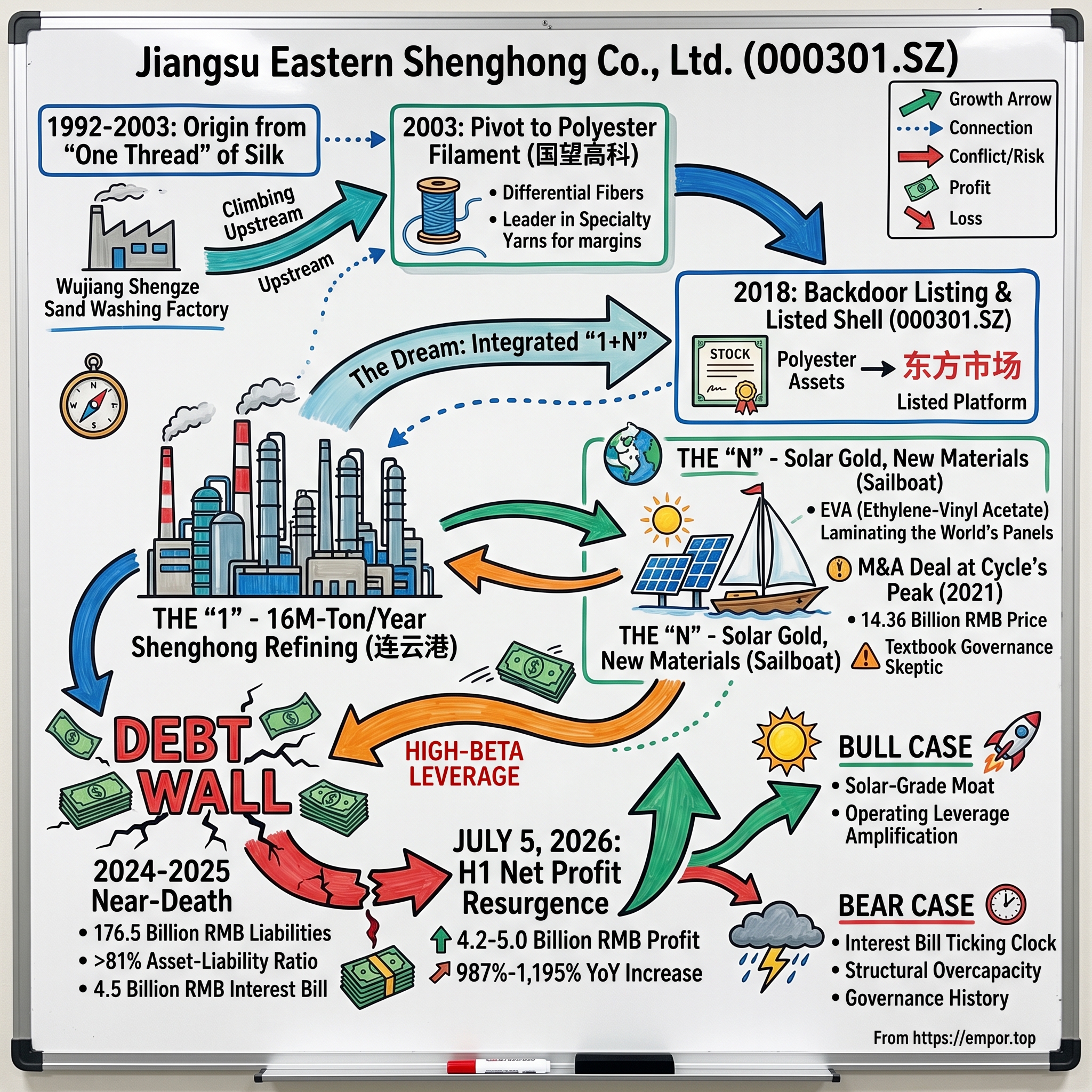
On the evening of July 5, 2026, a short filing landed on the Shenzhen Stock Exchange disclosure server that read less like a corporate earnings preview and more like a resurrection notice. 江苏东方盛虹股份有限公司 Jiangsu Eastern Shenghong Co., Ltd. — ticker 000301.SZ, a company that eighteen months earlier had looked one bad quarter away from a genuine liquidity scare — told investors it expected to report a net profit of 4.2 to 5.0 billion RMB for the first half of 2026, a year-over-year increase of roughly 987% to 1,195%.1 The second quarter alone was projected to grow more than sixtyfold.2 The non-recurring, "clean" version of that profit was pegged even higher, at 4.0 to 4.8 billion RMB.1
To appreciate how strange that number is, rewind the tape. In 2024, this same company posted a net loss of roughly 2.29 billion RMB.3 In all of 2025, after clawing its way back to breakeven, it managed a net profit of just 134 million RMB — a rounding error against a revenue base of 125.6 billion RMB.4 And it did all of this while carrying a debt load that had swollen past 170 billion RMB, with an asset-to-liability ratio pinned above 81%.35
So the big question that animates this entire story: how does a company bordering on financial distress under that kind of debt wall suddenly print, in a single six-month stretch, more profit than it had earned in the previous three years combined? Is this the vindication of a brilliant, patient, deeply contrarian industrial bet — or is it simply what happens when you build one of the most leveraged, most cyclically-exposed machines in Chinese industry and the cycle finally, briefly, turns your way?
The answer runs through a strategy the company calls "1+N." The "1" is the foundational engine: 盛虹炼化(连云港)有限公司 Shenghong Refining & Chemical (Lianyungang) Co., Ltd. (盛虹炼化 Shenghong Refining), a single-site, 16-million-ton-per-year crude oil refining and petrochemical complex on the Yellow Sea coast — one of the largest single-unit refineries ever built in China.[^6] The "N" is the portfolio of high-value downstream new materials perched on top of that refinery, above all the solar-grade EVA (ethylene-vinyl acetate) and POE (polyolefin elastomer) encapsulant polymers made by 江苏斯尔邦石化有限公司 Jiangsu Sailboat Petrochemical Co., Ltd. (斯尔邦石化 Sailboat Petrochemical) — the materials that laminate the world's solar panels.6
This is a story that begins not with oil, but with silk. It runs from a sub-hundred-person township sand-washing workshop in the canals of Suzhou to a vertically integrated, oil-to-solar-polymer titan spanning the entire chain "from a drop of oil to a thread of fiber."7 It is a story about survival, about the seductive and merciless mathematics of leverage, about the difference between building a great asset and timing it well — and about a founder who kept betting the entire company, again and again, on the next rung up the value chain. Let's start at the bottom.
 Subscribe on LinkedIn
II. The Shengze Origins: From "One Thread" of Silk to Polyester
If you want to understand 东方盛虹 Eastern Shenghong, you have to stand in 盛泽镇 Shengze, a town in Wujiang, on the southern edge of Jiangsu province. For centuries, Shengze was one of imperial China's great silk capitals — a place where the clatter of looms was the ambient sound of the local economy, and where "a town of ten thousand looms" was not marketing copy but census reality. When people in Shengze talk about being "born from one thread," they mean it literally. The thread came first; everything else was downstream.
Into this world, in 1965, was born 缪汉根 Miao Hangen. He was, by every account, an ordinary local — a farm boy who came up through the village-and-township enterprise system that powered so much of Jiangsu's early reform-era growth. In 1992, at the age of twenty-seven, Miao took over a struggling, sub-hundred-person village-run sand-washing factory in Shengze — the humble 吴江盛泽砂洗厂 Wujiang Shengze Sand Washing Factory. That workshop, whose entire business was chemically softening and finishing fabric, was the seed from which the entire empire grew.8
What separated Miao from the thousands of other township-enterprise bosses of that era was an appetite for risk that bordered on recklessness — and a very specific instinct about which direction to move. He and his wife, 朱红梅 Zhu Hongmei, who would remain his partner in both marriage and corporate control for the next three decades, pushed relentlessly into adjacent, higher-value steps of the textile chain: printing, dyeing, weaving. The playbook was always the same — when a crisis hit and weaker rivals wobbled, Miao leaned in. During the 1997–98 Asian financial crisis, rather than hunkering down, he reportedly mortgaged essentially everything he had to absorb neighboring dyeing and printing mills at distressed prices.8 Out of that consolidation, 盛虹控股集团有限公司 Shenghong Holding Group Co., Ltd. (盛虹集团 Shenghong Group) took shape as the family holding vehicle.
But Miao had already grasped the central, uncomfortable truth of the textile business: printing and dyeing are low-barrier, brutally competitive, and structurally low-margin. Anyone with a shed and some working capital can dye cloth. The only durable escape was to climb upstream, toward the raw material — toward the chemistry itself. In 2003, Shenghong pivoted hard into polyester filament, building a 200,000-ton melt-direct-spinning project and establishing 江苏国望高科纤维有限公司 Jiangsu Guowang High-Fibre Co., Ltd. (国望高科 Guowang High-Fibre).8
Here Miao made a choice that revealed his real strategic mind. He did not try to win the polyester game the obvious way — by making the most standard fiber the cheapest. That was a race to the bottom already crowded with giants. Instead, Guowang specialized in "differential fibers" — ultra-fine filaments, sea-island fibers, recycled and specialty DTY/FDY/POY yarns — the higher-spec, higher-margin end of what is otherwise a commodity. The company leaned into a reputation as a leader in ultrafine fiber, and that specialization did something crucial: it built a margin cushion that generated the cash — and, just as important, the credibility with banks — that would later fund far grander ambitions.7
That is the pattern to hold onto as we climb. Each time Miao reached a ceiling in one business, he did not defend it; he used it as a launchpad to climb one rung higher, toward the raw material, toward the bottleneck. Fiber was rung one. But fiber depends on feedstocks Miao did not control — and that dependence was about to send him all the way to the source.
III. The Backdoor Listing & The Grand "1+N" Petrochemical Dream
Here is the bottleneck that kept Miao Hangen awake. Polyester fiber is spun from two petrochemical feedstocks — PTA (purified terephthalic acid) and, further upstream, PX (paraxylene). And whoever controls PTA and PX controls the fiber-maker's margin. In the 2000s and 2010s, those feedstocks were dominated by state-owned oil majors and global refiners. A "differential fiber" specialist could add all the value it wanted at the far end of the chain, but its cost base was always hostage to a molecule it had to buy from someone bigger. To truly own its destiny, Shenghong would have to go all the way to the source: crude oil refining itself.
That is an audacious leap for a fiber company. Refineries are among the most capital-intensive assets on earth, and in China they had historically been the near-exclusive preserve of the state majors. But a policy window had opened — Beijing was, cautiously, allowing a handful of private "民营大炼化" (private mega-refining) players to build integrated refining-to-chemicals complexes. Miao intended to be one of them.
First, he needed a public listing to serve as a financing platform. In 2018, Shenghong Group executed a backdoor listing, injecting the Guowang High-Fibre polyester assets into a listed shell — 东方市场 Jiangsu Oriental Market, itself a company with roots in the Shengze silk-market economy. The shell issued 2.811 billion new shares to acquire 100% of Guowang for roughly 12.7 billion RMB, and the combined entity was renamed 江苏东方盛虹 Jiangsu Eastern Shenghong under ticker 000301.SZ.8 The fiber business now had a currency — publicly traded stock — with which to dream bigger.
And Miao dreamed enormous. Rather than expanding refining capacity incrementally, the way a cautious operator might, he staked the entire empire on a single, colossal project: the Shenghong Refining & Chemical Integration Project in the Xuwei petrochemical park in Lianyungang, on the Jiangsu coast. The specifications were staggering. A 16-million-ton-per-year crude processing capacity built around what was, at the time, the largest single-train atmospheric distillation unit in China; a 2.8-million-ton-per-year paraxylene complex — configured as one of the world's largest single-series PX units — and a 1.1-million-ton-per-year ethylene cracker.[^6] This was not a refinery that fed a fiber business; it was a refinery that could anchor an entire chemical ecosystem, with fiber as just one of many outlets.
The price tag was the part that made bankers sweat: roughly 67.7 billion RMB — on the order of $10 billion — for a single project.[^6] To put that in perspective, this was a capital commitment larger than Eastern Shenghong's entire market capitalization at the time. A mid-tier fiber company was proposing to build one of the most expensive industrial facilities in the country.
How do you finance something that dwarfs your own company? The answer was extreme financial engineering: enormous bank-syndicate loans, local-government-backed funding partners eager for a marquee industrial anchor in Lianyungang, and layer upon layer of corporate debt. The asset-to-liability ratio climbed toward and past 80%.3 In effect, Miao converted Eastern Shenghong into a hyper-leveraged call option on the refining and chemical cycle. If the complex ran well and margins cooperated, the equity would compound spectacularly. If margins turned against him, the fixed interest bill would grind relentlessly against a thin, volatile operating profit.
The complex reached full production in December 2022, and — in a piece of choreography that captured the company's self-image — Eastern Shenghong simultaneously listed Global Depositary Receipts overseas the very same day, planting a flag for international capital.6 The "1" of "1+N" was now real, humming, and enormous. But a refinery this size produces vast streams of ethylene and propylene that need profitable downstream homes. Which brings us to the most controversial deal in the company's history — and the one that would nearly break it.
IV. The Sailboat M&A: Overpaying for Solar Gold at the Cycle's Peak
Every mega-refinery faces the same question the morning after it starts up: now what do we do with all this ethylene? Basic plastics are a commodity; the real money is in specialty derivatives. And in 2021, one specialty derivative was on fire above all others — solar-grade EVA.
Here it helps to slow down and explain the chemistry in plain terms, because it is the crux of the whole investment case. A solar panel is a sandwich. The silicon cells that actually convert sunlight to electricity are fragile and must be sealed against moisture and UV for a 25-year outdoor life. The transparent, glue-like film that laminates them in place is the encapsulant — and the workhorse encapsulant polymer is EVA, ethylene-vinyl acetate. Not just any EVA: "photovoltaic-grade" EVA requires a high vinyl-acetate content and exacting purity, and only a handful of plants worldwide could make it reliably. It is, in effect, the mortar of the global solar build-out.
In 2021, global solar installations exploded, and solar-grade EVA became one of the most profitable molecules in chemistry. Prices that had sat around 10,000 RMB per ton rocketed past 30,000 RMB per ton. Any plant that could make it was, for a window of time, a money-printing machine. And Shenghong Group — the parent — happened to own exactly such a machine: 斯尔邦石化 Sailboat Petrochemical, a large methanol-to-olefins (MTO) operator that had become one of China's dominant producers of photovoltaic-grade EVA, alongside acrylonitrile and other high-value chemicals.
The strategic logic of pulling Sailboat into the listed company was clean: it gave the refinery's molecules a high-margin downstream destination and completed the "1+N" matrix. Miao had, in fact, tried to list Sailboat once before — via a proposed backdoor into 丹化科技 Danhua Technology in 2019 — but that deal collapsed.9 So in 2021 he did it directly. In December 2021, Eastern Shenghong agreed to acquire 100% of Sailboat Petrochemical for 14.36 billion RMB, buying the asset out of the parent Shenghong Group in a heavily scrutinized related-party transaction.1011
Now, the uncomfortable questions. Did they overpay? On a pure trailing-multiple basis, and against standalone solar-materials peers such as 联泓新科 Levima Advanced Materials, the price could be made to look defensible — Sailboat's near-term earnings power in 2021 was gigantic, and against that peak the multiple looked almost modest. That is precisely the trap. The deal was struck at, or very near, the absolute zenith of the solar-EVA cycle. You were paying a reasonable multiple on a wildly inflated, unsustainable level of earnings.
The sellers — Miao and associated entities — did make a profit commitment to reassure minority holders, guaranteeing a cumulative non-recurring net profit of roughly 5.13 billion RMB across the 2022–2024 window (with staged annual floors).10 On paper, that looks like alignment. In practice, a profit commitment is only as good as the years it spans, and this one spanned exactly the years the cycle was rolling over.
Because the rest of the industry saw the same 30,000-RMB EVA that Miao saw — and everyone built. Massive new capacity came online across China, including from 浙江石油化工有限公司 Zhejiang Petroleum & Chemical Co., Ltd. (ZPC), the giant refinery controlled by rival 荣盛石化 Rongsheng Petrochemical. As supply flooded in, the price of solar-grade EVA collapsed — back toward roughly 11,000 RMB per ton by 2024, surrendering nearly the entire premium that had justified the deal. Sailboat technically cleared the letter of its profit commitment, but the moment the commitment window closed, the asset's earnings fell off a cliff. What had been the group's cash machine became a drag, and it helped pull the entire listed company into a deep loss in 2024.3
This is the single most important governance episode in the Eastern Shenghong story, and it deserves to be named plainly: a controlling family sold a peak-cycle asset from its private holding company into the public company it controls, locked in a valuation anchored to unrepeatable earnings, and public minority shareholders absorbed the mean-reversion. Whether or not every box was legally ticked, that is a textbook pattern for a skeptic to flag — and it sets up the balance-sheet reckoning that followed.
V. The Near-Death Debt Wall: 167 Billion RMB of High-Beta Leverage
To understand what nearly happened to Eastern Shenghong in 2024 and 2025, put the income statement aside for a moment and stare at the balance sheet, because that is where the real drama lived. Two mega-projects financed almost entirely with borrowed money — the 67.7-billion-RMB Lianyungang refinery and the 14.36-billion-RMB Sailboat acquisition — had left the company sitting under a debt mountain.
By the first quarter of 2025, total liabilities had climbed to roughly 176.5 billion RMB, with the asset-to-liability ratio around 82%.5 Across 2024 and into 2025 that ratio hovered persistently in the low-80s — 81.66% at the end of 2024.3 These are not the ratios of a comfortable industrial company; they are the ratios of a leveraged fund that happens to own refineries. And the composition made it worse: a large share of the debt was short-term, which meant the company was perpetually rolling over near-term obligations rather than sitting on long, patient project finance.12
The most quietly terrifying line was the interest bill. The company's annual financial expenses ran on the order of 4.5 billion RMB — the pure cost of servicing the debt, before a single molecule was sold at a profit, and a figure that had jumped nearly 40% in 2024 alone as rates and borrowings peaked.13 Look at what that does to the arithmetic of 2025: the company generated 125.6 billion RMB of revenue, ground its way to a positive operating result, and after that enormous interest charge was left with 134 million RMB of net profit.4 The interest expense was, in effect, consuming almost the entirety of the year's earning power. The equity holder was, quite literally, working for the lenders.
This is what "high beta" really means in an industrial context. When you have tens of billions of fixed interest cost sitting beneath a volatile, cyclical operating margin, tiny swings in that margin whipsaw the bottom line. A modest improvement in refining or chemical spreads flows almost entirely to the equity; a modest deterioration wipes the equity out. The 2024 loss and the razor-thin 2025 profit were two readings of the same over-levered machine at slightly different points on the dial. Meanwhile the stock told the story bluntly, falling on the order of 80% from its cycle-peak highs, and the paper wealth of Miao and Zhu Hongmei reportedly contracted by well over 13 billion RMB.12[^15]
How did management navigate the maturity wall? Behaviorally — and this matters for judging credibility — through extend-and-pretend blocking and tackling: negotiating extensions on bank credit lines, rolling over short-term commercial paper, and leaning on the deep relationships that come from being a strategic industrial anchor for local government. In late 2024 and through 2025, institutional analysts pressed hard, questioning the capital-expenditure run rate, cash preservation, and refinancing risk. Management's answers leaned repeatedly on external framing — "macroeconomic factors," a "temporary" solar supply-chain adjustment, a high-interest-rate environment — language that explained the pain without quite committing to a hard deleveraging plan. For an investor, that vagueness is itself a data point: when the story is always about the weather and rarely about the specific plan, credibility is being spent.
Notably, the company did keep operating cash flow positive and even growing through the trough — operating cash flow rose about 25% in 2024 and another 53% in 2025 — evidence that the physical assets were running well even as the financial structure strained.34 That distinction — good plant, dangerous balance sheet — is the whole ballgame. To judge whether the assets can eventually outrun the debt, we need to open the hood on the segments.
VI. Under the Hood: Core Segments & Competitive Dynamics
Strip Eastern Shenghong down to its moving parts and you find three businesses bolted together, each with a completely different economic personality — a fact that gets lost when people look only at the consolidated number.
Petrochemical refining (盛虹炼化 Shenghong Refining) is the giant — roughly three-quarters of total revenue.12 Think of it as a colossal, high-throughput conversion machine. It takes in crude oil at whatever the world charges and sells out fuels and petrochemical intermediates at whatever the market bears. Its profit is not really a "margin" in the branded-product sense; it is a spread — the crack spread and product spreads between the crude it buys and the diesel, gasoline, PX, and ethylene it sells. High volume, low and volatile unit margin, and almost no pricing power. When Brent moves and Chinese product markets move, this segment's profit swings violently. It is the ballast and the volatility all at once.
Polyester filament (国望高科 Guowang High-Fibre) is the mature original business — on the order of 15% of revenue.12 This is a stable, high-volume, intensely competitive commodity textile business with razor-thin margins. It rarely makes or loses spectacular money; it hums. Its role in the portfolio today is less as a growth engine and more as steady volume that consumes the refinery's PX and PTA internally — the vertical-integration loop that was the whole original point.
New energy and new materials (斯尔邦石化 Sailboat) is the smallest by revenue — around 10% — but historically the alpha engine, capable of contributing a wildly outsized share of operating profit in an upcycle.12 This is the EVA, POE, and acrylonitrile business. When solar-grade encapsulant spreads are wide, this small revenue slice can swing the entire company's profitability; when they collapse, so does the group. Sailboat is simultaneously the reason to own the stock and the reason it nearly sank.
Zoom out, and Eastern Shenghong sits inside a distinctive club: the private refining "Big Five" (民营石化五巨头). It is worth war-gaming its position against them, because relative competitive standing is the real question.
荣盛石化 Rongsheng Petrochemical is the scale leader, controlling the ZPC complex with refining capacity on the order of 40 million tons — and, critically, fortified in 2023 when Saudi Aramco completed a $3.4 billion purchase of a 10% stake paired with a long-term crude supply agreement, buying ZPC both feedstock security and a blue-chip validator.14 恒力石化 Hengli Petrochemical is the efficiency benchmark, its Changxing Island complex renowned for tightly integrated, premium downstream chemical yields. 桐昆集团 Tongkun Group and 新凤鸣 Xinfengming Group are the polyester cost-leaders, dominating the commodity filament layer where scale and cash cost are everything.
And Eastern Shenghong? It is the highest-beta player of the group — the most exposed to solar-polymer margins through Sailboat, carrying the heaviest relative debt load, and therefore the most sensitive to macro price shocks in either direction.12 Where Rongsheng bought stability through Aramco and sheer scale, and Hengli bought it through operational excellence, Eastern Shenghong bought optionality — a smaller refinery than Rongsheng's monster, but bolted to the most volatile, most upside-skewed downstream in the industry. In the third quarter of 2025 it ranked roughly fifth in the peer group by revenue and sixth by net profit — respectable, but a reminder that scale-wise it is not the leader.15 Whether that optionality is a moat or merely a leveraged bet is the question the frameworks help answer.
VII. The Hamilton Helmer 7 Powers & Porter's 5 Forces Teardown
Strip away the narrative energy and run Eastern Shenghong through two cold, structured lenses — Hamilton Helmer's 7 Powers and Michael Porter's 5 Forces — and a sobering picture emerges: this is a company with real operational heft but a thin roster of durable competitive advantages.
Start with Scale Economies, and the verdict is moderate. The 16-million-ton Lianyungang complex genuinely delivers unit-cost efficiencies in basic cracking and refining that a smaller plant cannot match — the largest single trains in China throw off real fixed-cost leverage.[^6] But scale is a relative game, and here Eastern Shenghong is out-scaled by ZPC's roughly 40-million-ton behemoth. Being big is not the same as being the biggest, and in a commodity where the marginal ton sets the price, the lowest-cost producer usually wins the endurance contest.
Switching Costs are where the one genuinely interesting power lives — and it is bifurcated. For commodity polyester, switching costs are essentially zero; a fabric mill buys on price and spec. But for photovoltaic-grade EVA and especially POE, they are high. A solar-module maker cannot casually swap encapsulant suppliers: the film is bonded into a product warranted to survive 25 years outdoors, and qualifying a new encapsulant means long certification cycles and reliability testing that module makers are loath to repeat. Once you are designed into a Tier-1 module maker's bill of materials, you are sticky. This is the closest thing Eastern Shenghong has to a moat — and it is confined to a slice of the smallest segment.
Counter-Positioning is weak. The company's pivot into "new energy materials" was genuinely clever timing, but it was not a business model rivals were structurally unable to copy. They copied it — enthusiastically. ZPC and others poured capacity into EVA precisely because there was nothing stopping them, which is exactly why the 2021 super-margin evaporated. A strategy that competitors can duplicate at will is a head start, not a power.
Cornered Resource is weak. Access to Lianyungang's deepwater port and industrial land is a genuine advantage — but not an exclusive one, and it is granted, not owned. More fundamentally, Eastern Shenghong owns no crude reserves whatsoever. It is 100% dependent on imported oil. It has cornered no scarce input; it has merely secured a good location to process someone else's.
The remaining Helmer powers — Network Economies, Process Power, and Branding — are essentially not applicable to a bulk petrochemical producer. Which tells you something: on the 7 Powers scorecard, this is a business leaning on moderate scale and one narrow pocket of switching costs, with little else beneath it.
Porter's 5 Forces sharpen the same edges. Supplier power is extreme — the company is a pure price-taker on international crude, with the added modern wrinkle that it lacks the Aramco-style equity-linked supply deal that cushions Rongsheng. The threat of substitutes is high and, ironically, technological — the solar industry's rapid migration from P-type to N-type cells is shifting encapsulant demand from traditional EVA toward POE, which performs better in the newer architecture. Eastern Shenghong's defense is to build its own POE capability, moving from an 800-ton-per-year pilot line toward commercial-scale plants so that the substitution happens inside its own product line rather than at a competitor's.1617 And rivalry is brutal: structural Chinese overcapacity in refining and basic chemicals turns the core business into a war of attrition where survival, not fat margins, is the prize. The forces converge on a single uncomfortable conclusion — Eastern Shenghong's edge is real but shallow and cyclical, which is exactly the kind of edge that produces spectacular booms and stomach-churning busts.
VIII. Playbook: Business, Strategy, & Investing Lessons
Step back from the specifics, and Eastern Shenghong offers a compact set of transferable lessons — the kind that generalize far beyond Chinese petrochemicals.
Lesson one: in heavy-asset, highly-levered industries, timing beats operations. Miao Hangen built, by most technical accounts, a genuinely world-class refinery and one of the world's most capable solar-encapsulant franchises. The plant runs; the cash flow from operations kept growing even through the trough.4 And it almost didn't matter, because he brought that capacity online into the teeth of a refining and solar oversupply cycle. In businesses like this, your fate is set less by how well you run the asset day to day than by when in the cycle you commit the capital. Great execution on badly-timed CAPEX still produces a near-death experience. The single most important decision a heavy-industry management team makes is not operational excellence — it is the phasing of the capex clock.
Lesson two: beware the related-party peak appraisal. The Sailboat acquisition is a case study that belongs in a governance textbook. Buying a high-flying asset from your own parent group at the top of its cycle — at a valuation that looked defensible only because it was anchored to unrepeatable earnings — is a classic red flag. Even when a profit commitment is attached and technically honored, the structure quietly transfers cyclical risk from the controlling family to public minority shareholders, who then eat the mean-reversion. Public markets are slow, but they eventually price that pattern in — here, via a collapsing share price and a deeply skeptical analyst base.
Lesson three: the illusion of integration. The romantic story Eastern Shenghong tells about itself — "from a drop of oil to a thread of fiber," the fully integrated chain — is real, but integration is not the same as insulation. Vertical integration only shields you from margin volatility if you control the actual bottleneck. Eastern Shenghong controls the refining and the fiber and the polymers, but it does not control the one thing that sets its cost floor: the crude itself. It has no wells. So integration here does not eliminate margin pressure; it merely relocates it. When crude spikes or product spreads compress, the pain simply shows up at a different link in the same chain. Owning more of the chain feels like control, but without the upstream bottleneck it is mostly the accumulation of more places for the cycle to hurt you.
The throughline of all three: this is a company that made bold, coherent strategic moves and got the sequence right — climb toward the raw material, secure downstream outlets, chase the highest-value molecule — while getting the timing catastrophically wrong. Which sets up the only question that matters now: with H1 2026 suddenly gushing profit, is the timing finally turning in Miao's favor?
IX. The Investment Case: Bull vs. Bear
So let's return to that startling July 2026 number — 4.2 to 5.0 billion RMB of first-half profit — and ask the disciplined question: what actually produced it, and is it durable?
The turnaround mechanism. By the company's own account, the surge came from a broad improvement in the petrochemical operating environment: firmer and more stable oil-price benchmarks (partly on geopolitical tension), a recovery in refining and chemical product spreads, and rising prices across its main product slate — all of which widened margins on an unchanged, enormous volume base.1 Layer on top the ramp-up of new downstream capacity — a large EVA expansion that pushed Sailboat's photovoltaic-grade EVA capacity toward roughly one million tons per year by the end of 2025, plus the early build-out of POE.616 Because the company operates at such extreme operating and financial leverage, a relatively modest widening of spreads does not lift profit modestly — it multiplies it. That is the same high-beta mathematics that produced the 2024 loss, simply running in reverse. The number is real; whether it is repeatable depends entirely on spreads that Eastern Shenghong does not control.
The bull case rests on three pillars. First, a leading global position in solar-grade encapsulant materials — EVA and increasingly POE — precisely the inputs the world's still-growing solar build-out cannot do without, protected by that one genuine pocket of switching-cost stickiness. Second, ferocious operating leverage: once the fixed interest and depreciation are covered, incremental spread flows almost entirely to equity, so any sustained upcycle compounds fast. Third, and most importantly for the balance sheet, the CAPEX supercycle is largely behind the company — the refinery is built, the acquisition is done — which means growing operating cash flow can finally be redirected from construction toward paying down the debt wall.4
The bear case is the mirror image, and it is equally coherent. The interest bill is a ticking clock: with roughly 4.5 billion RMB of annual financial expense sitting beneath a volatile margin, any macro shock — an oil spike the company can't pass through, a renewed EVA glut, a spread compression — instantly erases the bottom line, exactly as it did in 2024.13 The refining overcapacity in China is not a passing storm but a structural condition. And the governance overhang has not disappeared: concentrated family control by Miao and Zhu, a history of high-priced related-party dealing, and an analyst-facing communication style that has leaned on macro excuses rather than specific commitments. A skeptical long/short investor would press hardest here — on whether the deleveraging actually happens or whether the first flush of upcycle cash gets redeployed into the next ambitious project instead, and on whether disclosure around segment economics and refinancing is as crisp as the leverage demands.
Which frame is right depends on your read of the cycle — and that is why the honest answer is not a verdict but a watch-list. Three KPIs will tell the story as it unfolds, and an investor should track them rather than the headline EPS:
- The refinery crack spread (
裂解价差) — the margin between crude cost and the domestic prices of diesel, PX, and ethylene. This is the pulse of the "1," the base engine, and it sets the floor. - The solar EVA/POE premium — the spread of photovoltaic-grade polymers over ordinary industrial-grade chemicals. This is the pulse of the "N," the alpha engine, and it is what swings the whole company.
- The interest coverage ratio (EBIT ÷ interest expense) — the single best gauge of survival. With the debt wall fixed and the interest bill roughly fixed, this ratio is a direct readout of how much cushion sits between the company and another 2024. Watch it climb, and the deleveraging story is real; watch it stall, and the high-beta trap is still armed.
X. Epilogue & Outro
The story of 东方盛虹 Eastern Shenghong is, in the end, a story about the price of ambition. A farm boy from a silk town took over a hundred-person sand-washing workshop and, over three decades of relentlessly climbing toward the raw material, built a genuine oil-to-solar-polymer colossus on the Yellow Sea. Each rung — dyeing to fiber, fiber to refining, refining to solar materials — was reached the same way: by leaning into risk when others pulled back, and by financing the next dream against the assets of the last one.
That same appetite is what nearly ended the company. The Lianyungang refinery and the Sailboat acquisition were strategically coherent and, arguably, visionary — and they were timed into the worst of the refining and solar oversupply cycles, leaving Eastern Shenghong pinned beneath a debt wall the size of a small national budget, its equity working almost entirely to service its lenders. The spectacular first-half 2026 rebound is real, but it is the upside face of the very same leverage that produced the 2024 loss; the machine amplifies whatever the cycle hands it, in both directions.
The final lesson is the one Miao Hangen learned the expensive way. In the world of commodities and solar materials, scale is necessary but never sufficient. What actually keeps you alive — through the gluts, the spread collapses, and the interest-rate shocks — is not the size of your plant but the discipline of your timing and the strength of your balance sheet. Eastern Shenghong has proven it can build. Whether it has learned to deleverage — to convert this upcycle's cash into a permanently safer company rather than the seed of the next over-levered bet — is the question that will define its next decade.
 LinkedIn
 WhatsApp
 Reddit
 Hacker News
 Email
Email Kindle
 RSS Feed
 Spotify
 Apple Podcasts
 Amazon Music
 Audible
 YouTube