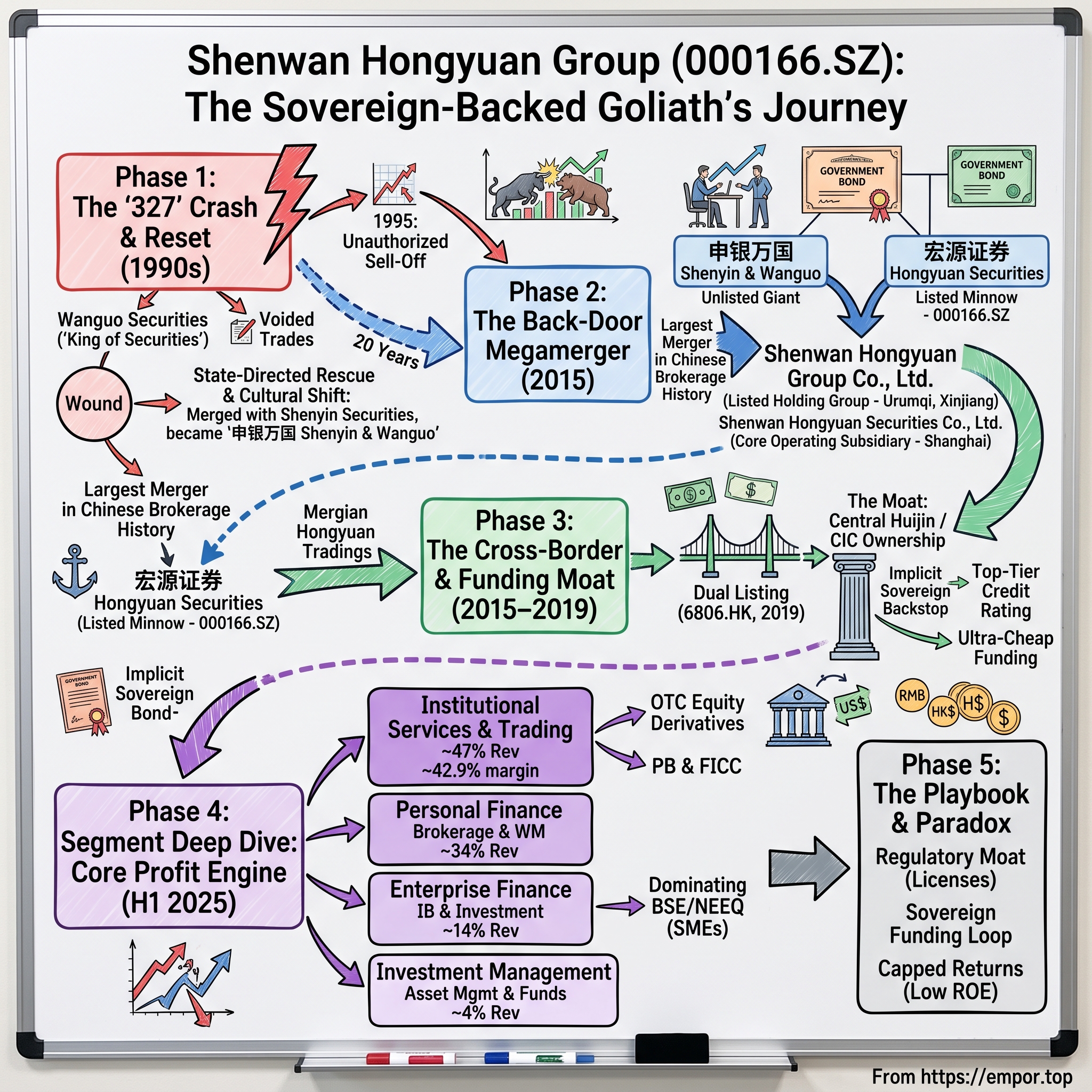
Shenwan Hongyuan Group: The Sovereign-Backed Goliath of Chinese Capital Markets
I. Episode Roadmap & The Sovereign Setup
On the afternoon of February 23, 1995, a trader on the floor of the Shanghai Stock Exchange watched the price of a single government-bond futures contract detonate in real time. In the space of a few minutes, one of China's largest and most admired brokerages effectively bankrupted itself — not through a slow bleed, but through a deliberate, panicked, unauthorized flood of sell orders in the final eight minutes of the trading day. The firm was 万国证券 Wanguo Securities, the man who authorized the trade was its celebrated founder, and the contract was the 327国债期货合约 327 government bond futures contract. By nightfall, the exchange had voided the last eight minutes of trading and China's first great derivatives blow-up — the 327国债期货事件 327 government bond futures incident — had begun to reshape the entire architecture of the country's capital markets.[^1]
Out of that wreckage, through three decades of forced mergers, state rescues, and one of the largest brokerage combinations in Chinese history, rose the company this article is about: 申万宏源集团股份有限公司 Shenwan Hongyuan Group Co., Ltd., dual-listed as 000166.SZ in Shenzhen and 6806.HK in Hong Kong. It is a financial giant whose ultimate controlling shareholder is not a family, a founder, or a private fund, but 中央汇金投资有限责任公司 Central Huijin Investment Ltd. — the domestic investment arm of China's sovereign wealth fund, 中国投资有限责任公司 China Investment Corporation (CIC).1
That lineage is the whole story in miniature. A firm born from the single most reckless speculative episode in modern Chinese finance became, by design, one of the most conservative, state-anchored institutions in the system. The DNA was rewritten deliberately.
The paradigm shift. The Shenwan Hongyuan of 2026 no longer makes its money the way brokerages did in the 1990s — clipping commissions from retail investors buying and selling stocks. Commission rates in China have been compressed toward zero, and the retail-brokerage business that once defined the industry has become a low-margin utility. Instead, the profit engine has migrated to capital-intensive, balance-sheet-heavy institutional activity: over-the-counter (OTC) equity derivatives, prime brokerage, fixed-income market-making, and principal investment. That migration — from agency broker to principal-risk intermediary — is the single most important thing to understand about how this company earns its returns today.
Episode roadmap. This is a story in five movements:
- The rise and violent collapse of the self-styled "King of Securities" in 1995, and how the state stitched the survivors back together.
- The 2015 megamerger of
申银万国证券 Shenyin & Wanguo Securitiesand宏源证券 Hongyuan Securities— the largest brokerage combination in Chinese history at the time, and a back-door listing that skipped the notoriously backlogged IPO queue. - The unusual "investment-holding group plus securities-operating subsidiary" corporate architecture, and why the parent moved its registered headquarters to
乌鲁木齐 Urumqiin新疆 Xinjiang. - A deep dive into the two engines that now matter most: Institutional Services & Trading (the OTC-derivatives franchise) and Enterprise Finance's dominance of the small-cap
北京证券交易所 Beijing Stock Exchange. - The playbook — sovereign credit advantages, license-based moats, and the real constraints of running a state-owned financial powerhouse where returns are capped as deliberately as risks are.
The through-line is a single tension: everything that makes Shenwan Hongyuan safe also makes it hard for it to earn a high return on equity. To understand why, we have to go back to the man who nearly broke Chinese finance trying to do exactly the opposite.
 Subscribe on LinkedIn
II. The Legend of the "King of Securities" & The "327" Crisis (1990s)
Picture Shanghai in the early 1990s: a city rediscovering capitalism after four decades of central planning, its brand-new stock exchange (reopened in December 1990) crackling with a speculative energy that had nowhere else to go. Into that vacuum stepped 管金生 Guan Jinsheng, a Jiangxi-born intellectual with a law degree, fluency in French, and a conviction that China needed real securities markets. In 1988 he founded Wanguo Securities, and within a few years it commanded a dominant share of stock and bond trading in Shanghai. The financial press crowned him the "King of Securities," and for a moment the title fit.[^1]
To understand what went wrong, you have to understand the instrument at the center of the disaster — and it is worth slowing down here, because the mechanics are the entire drama.
What the "327" contract actually was. In the early 1990s China experimented with treasury-bond futures as a way to build a functioning bond market. The "327" was the market's shorthand for a futures contract on a specific three-year government bond issued in 1992 and maturing in June 1995. Here is the twist that made it a speculator's dream and a risk manager's nightmare: because inflation in China was raging — running well into the double digits — the Ministry of Finance had promised bondholders an inflation subsidy on top of the stated coupon. Crucially, the exact size of that subsidy was not fixed in advance. It would be set later, by the government. In other words, the final payout of the bond was a moving target set by policy, not by the market. Trading the 327 contract was therefore less a bet on interest rates than a bet on what a government ministry would decide to do.
The clash of titans. Guan Jinsheng took the short side. His thesis was that inflation would cool, that the fiscal authorities could not afford a large subsidy top-up, and that the payout — and therefore the bond's price — would stay low. On the other side of the trade sat the long players, most consequentially 中国经济开发信托投资公司 China Economic Development Trust & Investment Co., a firm operating under the Ministry of Finance itself. The longs were betting the subsidy would be raised. In a market where the counterparty on the other side of your trade answers to the same ministry that sets the payout, "information asymmetry" is too gentle a phrase.
Black Thursday. On February 23, 1995, the Ministry of Finance confirmed the market's worst fear for the shorts: the subsidy would be lifted, sharply raising the bond's effective value. The 327 contract's price leapt upward. For Wanguo, sitting on an enormous short position, every tick was a hemorrhage — the losses quickly threatened to exceed the firm's entire capital base.
What Guan did next is why the episode is still taught in Chinese business schools. In the last eight minutes of trading, Wanguo unleashed a torrent of new sell orders — reportedly on the order of RMB 140 billion in notional value, a sum that exceeded the total amount of the underlying bond ever actually issued. The point was not to hedge; it was to bludgeon the price back down by brute force and rescue the firm's existing short position. It worked, briefly: the price collapsed in the final minutes. Then, that night, the Shanghai Stock Exchange ruled that the closing minutes had been driven by manipulation and voided the trades.[^1]
The reckoning. With the manipulative trades erased, Wanguo was left facing catastrophic, unrecoverable losses. Guan Jinsheng was removed, arrested, and ultimately sentenced to 17 years in prison on charges related to corruption and the affair. China's experiment with treasury-bond futures was shut down within months and would not be revived for roughly 18 years. The "King of Securities" had, in a single afternoon, demonstrated exactly why an immature market with policy-driven payouts and no meaningful position limits could not be trusted with leverage.[^1]
The forced marriage. A collapse of Wanguo threatened systemic contagion, so the state did what it would do repeatedly in the decades that followed: it arranged a rescue by combination. In 1996, the wounded Wanguo was folded into the more conservative, state-backed 申银证券 Shenyin Securities, creating Shenyin & Wanguo Securities. The aggressive, entrepreneurial risk culture that Guan embodied was not merely disciplined — it was surgically removed and replaced with the priorities of a state institution: compliance, capital preservation, and survival.
So what for investors. The 327 incident is not trivia; it is the origin of the company's operating philosophy. The lesson that Chinese regulators and the surviving firm both internalized was that unbridled principal risk-taking in this market ends in state cleanup, and that the privilege of operating a large brokerage comes bundled with an obligation to protect the system. That trade — freedom of risk-taking exchanged for state support and state constraint — is the exact bargain Shenwan Hongyuan still lives inside today. The open question, which we will keep returning to, is whether that bargain produces adequate returns for outside shareholders, or merely adequate safety for the state. To see how the modern firm took shape, we jump forward two decades to a very different kind of deal.
III. The Back-Door Goliath: The 2015 Megamerger
By the early 2010s, Shenyin & Wanguo had rehabilitated itself into something Guan Jinsheng would barely have recognized: a blue-chip, buttoned-down institutional brokerage with a reputation for research quality and risk discipline, sitting under the ownership umbrella of Central Huijin. But it carried one structural handicap that had become genuinely painful — it was not publicly listed.
The bottleneck. In a capital-markets business, being unlisted is not a matter of prestige; it is a matter of oxygen. The most profitable modern brokerage activities — margin lending, derivatives market-making, principal trading — are balance-sheet businesses. They consume capital, and capital-adequacy rules cap how much of them a firm can do relative to its equity. A listed firm can issue new shares to grow that equity base; an unlisted one is starved. Shenyin & Wanguo could see the industry shifting toward capital-heavy institutional trading and knew it needed a much larger, publicly tradable equity base to compete. Yet China's IPO queue was, and remains, notoriously slow and politically throttled — firms routinely waited years for approval.
The match. The elegant solution was already sitting inside the same corporate family. 宏源证券 Hongyuan Securities held a rare distinction: it was among the very first securities firms to list on a mainland exchange, trading in Shenzhen since 1994. And Hongyuan was controlled by 中国建银投资有限责任公司 China Jianyin Investment Ltd., which was itself owned by Central Huijin.1 In other words, the unlisted giant and the listed minnow shared the same ultimate owner. A combination would not be a hostile courtship between strangers; it would be an internal reorganization of assets the state already controlled.
The masterstroke. In January 2015, Shenyin & Wanguo absorbed Hongyuan Securities through a share swap valued at roughly RMB 40 billion — at the time the largest merger in the history of the Chinese brokerage industry.1 The genius of the structure was in what it avoided. Because the deal was executed as a share-for-share absorption of an already-listed company rather than a fresh IPO, the combined entity vaulted directly onto the Shenzhen Stock Exchange as 000166.SZ without ever standing in the IPO line. The unlisted giant had, in effect, put on the listed minnow's clothing and walked straight into the public market.
The timing deserves a skeptical footnote. The merger closed just as the historic 2015 A-share bubble was inflating toward its summer peak. Hongyuan's shares were absorbed at a rich premium to book value — a fine outcome for Hongyuan's minority holders, but a reminder that the "instantaneous listing" was purchased at a frothy price. A neutral observer should note that back-door listings executed at cycle tops tend to look expensive in hindsight; the strategic logic of getting listed was sound, but the entry valuation was a product of a mania that broke within months.
The dual-layer innovation. Rather than simply merge into one operating company, the group did something structurally unusual, and it is the second thing you must understand about this business. It reorganized into two stacked layers:
- The listed holding group — Shenwan Hongyuan Group Co., Ltd. — which does not itself hold securities licenses. It registered its corporate headquarters in Urumqi, Xinjiang, to capture the preferential tax incentives the central government offers for enterprises anchored in the western development zones. Its job is capital allocation: long-term equity investments, private equity, and steering money across the group.
- The operating subsidiary —
申万宏源证券有限公司 Shenwan Hongyuan Securities Co., Ltd.— wholly owned by the group, headquartered in Shanghai, which inherited all the regulated activities: brokerage, proprietary trading, investment banking, and asset management.
Why bother? The structure walls off the regulated securities subsidiary's balance sheet — with its strict net-capital rules — from the parent, which is then free to allocate capital into higher-beta, non-regulated industrial and private-equity bets that a pure brokerage could not legally hold on its books. It is a capital filter: steady regulated cash flows are generated below, and discretionary risk capital is deployed above. Whether that flexibility actually creates value for shareholders, or simply adds complexity and a holding-company discount, is a question we will stress-test later.
The ownership and operating structure looks like this:
graph TD
    classDef sovereign fill:#1a365d,stroke:#3182ce,stroke-width:2px,color:#fff;
    classDef listed fill:#2d3748,stroke:#4a5568,stroke-width:2px,color:#fff;
    classDef operating fill:#2c5282,stroke:#4299e1,stroke-width:2px,color:#fff;

    CIC["China Investment Corporation (Sovereign Wealth Fund)"] ::: sovereign
    Huijin["Central Huijin Investment Ltd. (State-Owned Investment Co.)"] ::: sovereign
    Jianyin["China Jianyin Investment Ltd."] ::: sovereign

    Group["Shenwan Hongyuan Group Co., Ltd. (Listed Holding - 000166.SZ / 6806.HK - HQ: Xinjiang)"] ::: listed
    Securities["Shenwan Hongyuan Securities Co., Ltd. (Unlisted Core Operating Subsidiary - HQ: Shanghai)"] ::: operating

    CIC -->|100%| Huijin
    Huijin -->|Direct & Indirect control| Group
    Jianyin -->|Wholly Owned Subsidiary of Huijin| Group
    Group -->|100%| Securities

    subgraph Core Operating Units
        Securities --> IB["Enterprise Finance (Investment Banking / Principal Investment)"]
        Securities --> WM["Personal Finance (Wealth Management / Brokerage)"]
        Securities --> Derivatives["Institutional Services & Trading (OTC Derivatives & PB)"]
        Securities --> AM["Investment Management (Asset Management & Funds)"]
    end
So what for investors. The 2015 deal gave Shenwan Hongyuan the one thing it lacked — a large, tradable equity base — and it did so through financial engineering that sidestepped a broken IPO market. That is a genuine display of the advantage of belonging to the state's investment family: you can reorganize assets you already own faster than outsiders can assemble them. But it also introduced a two-tier structure whose benefits are theoretical until proven and whose costs — opacity and a potential conglomerate discount — are real from day one. Four years later, the group would use its new listed status to reach for something the domestic market alone could not give it: hard-currency capital.
IV. The Dual-Listing Bridge & The "National Team" Moat (2015–2019)
If the 2015 listing solved the problem of onshore equity, a second problem remained: China's ambition for its brokers to build genuine cross-border franchises — prime brokerage for global funds, FICC (Fixed Income, Currency, and Commodities) trading, offshore financing — runs on foreign currency, and a Shenzhen listing raises renminbi. To play offshore, Shenwan Hongyuan needed an offshore listing.
Offshore expansion. On April 26, 2019, the group completed its dual-listing, floating H-shares on the Hong Kong Stock Exchange under the ticker 6806.HK and raising roughly HK$9.1 billion (about US$1.16 billion) — the largest equity offering in the Asia-Pacific region that year to that point.45 It was a landmark by size, but the market's verdict on the day was cold: the shares opened flat at HK$3.63 and slid as much as 15% intraday before closing down about 12% at HK$3.20.4 For a company selling itself as a blue-chip, sovereign-anchored bedrock, a double-digit first-day drop was a blunt reminder that "safe" and "attractively priced" are not the same thing — international investors were unconvinced that a low-return, state-constrained broker deserved a premium multiple. That skepticism, expressed on day one, is worth holding onto through the bull case later.
The Central Huijin cost-of-capital advantage. The heart of the "National Team" thesis is not the equity valuation; it is the debt. Central Huijin — directly and through China Jianyin Investment and other state vehicles — controls a commanding stake in the group; by 2025, with the China Securities Regulatory Commission formally confirming Central Huijin as the actual controller of eight financial institutions, its combined direct and indirect economic interest in Shenwan Hongyuan sat near the high-40s-percent range.7 Because Central Huijin is an arm of the Chinese state, the market treats Shenwan Hongyuan's obligations as carrying an implicit sovereign backstop.
Here is why that matters in plain terms. A brokerage that lives on balance-sheet businesses is, functionally, a spread machine: it borrows money and puts it to work in trading books, margin loans, and market-making inventory, earning the difference between its funding cost and its return on assets. Shave a brokerage's borrowing cost by even half a percentage point across tens of billions of renminbi in liabilities, and you have materially widened every spread it earns. Shenwan Hongyuan's top-tier domestic credit ratings — anchored by the perception of state support — let it issue corporate bonds and short-term commercial paper at rates approaching those of policy banks. That ultra-cheap funding is the literal fuel of the institutional-trading engine we will dissect in Section V. It is, arguably, the single most durable competitive advantage the company possesses, precisely because a private competitor cannot replicate a sovereign parent.
Comparing the giants. It is important to size Shenwan Hongyuan honestly against its peers, because it is not the market leader. 中信证券 CITIC Securities is the undisputed scale champion of the Chinese brokerage industry, and 中国国际金融 China International Capital Corporation (CICC) owns the high-end, cross-border investment-banking franchise. Shenwan Hongyuan does not out-muscle either. Instead, it positions itself as the balance-sheet-efficient, systemically-safe member of the peer set — the conservative bedrock of Central Huijin's financial portfolio rather than the aggressive front-runner. In a consolidating industry, that positioning cuts both ways: it makes the firm a natural survivor and a plausible consolidator, but it also means it rarely sets the pace on fee-based, talent-driven businesses where scale and star bankers win.
So what for investors. The Hong Kong listing built the plumbing for cross-border ambitions and, more importantly, confirmed the funding moat that underpins everything else. But the market's tepid reception in 2019 planted a flag that still stands: investors will lend to this company at near-sovereign rates, yet they are reluctant to own its equity at a premium. That gap between how the debt market and the equity market price the same sovereign backing is the central puzzle of the stock. To resolve it, we have to look at where the money is actually made.
V. Segment Deep Dive: The Core Profit Engine
Strip away the history and the corporate architecture, and a brokerage is ultimately a collection of licenses pointed at a collection of clients. Shenwan Hongyuan organizes its into four reporting segments, and the shape of the profit pool tells you exactly where the company has chosen to fight.
The segment map (H1 2025). In the first half of 2025 — a strong period in which group net profit roughly doubled year-on-year to about RMB 4.28 billion on revenue of roughly RMB 16.5 billion10 — the four segments contributed as follows, based on the interim-results disclosure:[^4]
- Institutional Services and Trading generated approximately RMB 8.04 billion of segment revenue, the largest single contributor at close to 47% of the total, and it did so at a pre-tax margin of roughly 42.9% — comfortably the fattest margin in the group.
- Personal Finance (retail brokerage and wealth management) contributed roughly RMB 5.75 billion, about 34% of revenue, at a pre-tax margin near 26.8%.
- Enterprise Finance (investment banking plus principal investment) added roughly RMB 2.37 billion, about 14% of revenue, at a pre-tax margin near 33.6%.
- Investment Management (asset management and funds) contributed roughly RMB 724 million, about 4% of revenue, at a pre-tax margin near 26.8%.
Read those numbers not as a scoreboard but as a strategy statement. Nearly half the revenue and a disproportionate share of the profit now come from institutional trading, a business that barely existed in its modern form when the firm listed. The retail franchise that once was the company is now the second act, and a lower-margin one. That migration — from agency commissions to principal-risk intermediation — is the defining structural shift in the entire Chinese brokerage industry, and Shenwan Hongyuan has leaned into it harder than most.
1. Institutional Services & Trading: The OTC Derivatives Moat
The industry shift. For decades, a Chinese broker made money the simple way: an investor bought or sold stock, and the broker clipped a commission. That model has been gutted. Two decades of competition drove retail commission rates toward a few thousandths of a percent — effectively zero — turning the once-lucrative brokerage counter into a commoditized utility. Survival forced the top tier to reinvent themselves as capital intermediaries: instead of merely matching a buyer and a seller and taking a toll, they now put their own balance sheet in the middle of the trade and get paid for warehousing risk.
What OTC equity derivatives actually are — in plain language. Imagine an insurance company or a private fund that owns a large basket of Chinese stocks and wants protection if the market falls, or wants a customized payoff tied to a specific index. It does not want a standardized, exchange-traded option; it wants a bespoke contract sized and shaped to its exact exposure. It calls a broker like Shenwan Hongyuan, which writes that custom contract — a single-name option, a swap, or a structured note — directly, "over the counter." The broker then hedges its own resulting exposure in the open market. The client gets tailored protection or a tailored bet; the broker earns a spread for manufacturing and risk-managing the product. The most notorious example in the Chinese market has been the 雪球 "Snowball" structured product — an autocallable note that pays an attractive coupon as long as an index stays within a range, but exposes the buyer to sharp losses if it breaks below a barrier. Snowballs were sold heavily to wealthy individuals and institutions, and they are exactly the kind of high-margin, balance-sheet-intensive product this segment manufactures.
The primary-dealer oligopoly. The reason this is a moat and not just a business line is regulatory. The ability to trade these bespoke OTC equity derivatives at the top tier is gated by a 一级交易商 Tier-One (primary) dealer license, and only a small handful of brokers — on the order of eight — hold it.2 That license is not something a nimble fintech can code its way around; it is granted by regulators to firms with the capital, risk systems, and, frankly, the state trust to hold large derivative books. Combine that license with the near-sovereign funding cost from Section IV, and you can see the flywheel: cheap capital plus a scarce license lets Shenwan Hongyuan manufacture customized risk for asset managers, insurers, and private funds at a spread few competitors can match. The roughly 42.9% pre-tax margin in this segment is the financial fingerprint of that licensed oligopoly — margins like that do not survive in businesses with free entry.
How they win, and against whom. The competition at the top is real: CITIC Securities brings greater scale and 华泰证券 Huatai Securities brings a formidable technology and client platform. Shenwan Hongyuan's edge is not size; it is the willingness and ability to price equity-linked structured risk aggressively on the back of its sovereign-supported balance sheet. That is a genuine advantage — but note the double edge. A business that earns its fattest margins by warehousing customized market risk is, by definition, the business most exposed to a regulatory clampdown or a volatility shock. The very concentration that makes this segment the profit engine also makes it the single largest source of fragility, a point the risk section will press hard.
2. Enterprise Finance: Sponsoring the "Specialized and Innovative"
A different kind of chess move. In investment banking, Shenwan Hongyuan made a deliberate decision not to fight CITIC and CICC head-on for the marquee mandates — the giant state-owned-enterprise IPOs and blockbuster cross-border deals where those two dominate. Instead, it went where the giants were not paying full attention: down-market, into the small and innovative end of the Chinese corporate spectrum.
The Beijing Stock Exchange bet. In 2021, China launched the 北京证券交易所 Beijing Stock Exchange (BSE), purpose-built to give financing access to smaller innovative companies under the national policy of cultivating 专精特新 "specialized, refined, differentiated, and innovative" enterprises — the small and mid-sized firms Beijing wants to climb the manufacturing and technology value chain.3 The BSE was, in effect, a policy-driven new venue, and most of the industry's prestige bankers regarded it as too small to bother with. Shenwan Hongyuan saw it differently and had, in fact, spent years building the relationships that fed it — through the 全国中小企业股份转让系统 National Equities Exchange and Quotations (NEEQ), the over-the-counter "New Third Board" that serves as the feeder pool from which BSE listings are drawn.
The evidence. This is not a story the company merely tells about itself; the league tables support it. Across the NEEQ and BSE, Shenwan Hongyuan has consistently ranked at or near the top of the industry on the metrics that matter for a small-cap franchise — number one in cumulative recommended NEEQ listings, and a leading sponsor of BSE IPOs, having ranked first in the industry in BSE IPO underwriting count in 2022 with roughly a dozen approved offerings.9 The model is genuinely differentiated: the firm acts as a full-lifecycle partner to these small companies — investing early through its principal-investment arm, shepherding them onto the NEEQ and then the BSE, and providing market-making liquidity once they trade.
The honest caveat is scale. The "specialized and innovative" franchise is a leadership position in a small pond. BSE and NEEQ deal sizes are a fraction of a Shanghai main-board SOE IPO, which is precisely why Enterprise Finance is only about 14% of group revenue despite the firm's dominance there. Being number one in small-cap underwriting is a real and defensible edge — it builds durable relationships and repeat mandates that CITIC cannot easily poach — but it is not, by itself, a needle-mover for a company this size. It is best understood as a strategically smart niche and a source of optionality if the BSE grows into a major venue, rather than as a current profit pillar.
So what for investors. The segment picture reveals a company that has correctly read where brokerage economics are heading and repositioned toward the two places margins still live: licensed OTC derivatives and a differentiated small-cap banking niche. The strategy is coherent and the execution is real. The catch is that the profit concentration in institutional trading is both the strength and the vulnerability, and the well-executed banking niche is too small to carry the whole enterprise. With the "how they make money" established, we can now abstract the durable lessons — and the durable limits — of the model.
VI. The Playbook: Business & Investing Lessons
Every business story yields transferable principles. Shenwan Hongyuan's are unusually clean, because the firm is almost a laboratory specimen of state-directed capital-markets capitalism. Three lessons stand out.
Lesson 1: The Regulatory Moat (Hamilton Helmer's "Cornered Resource")
In a mature Western market, an investor hunting for durable advantage looks for brands, network effects, or proprietary technology. In an emerging capital market like China's, the most valuable and defensible asset is frequently something more prosaic and more powerful: a government-granted license. Shenwan Hongyuan's Tier-One OTC-derivatives dealer license and its market-making status on the Beijing Stock Exchange function as what Hamilton Helmer's 7 Powers framework would call cornered resources — scarce, state-conferred rights that a better app or a lower price cannot compete away. No amount of fintech ingenuity lets a challenger legally write the same bespoke derivative book. The moat is real. But a licensed moat has an owner other than the shareholder: the regulator who granted it can narrow it, tax it, or freeze it. A cornered resource conferred by the state is only as durable as the state's continued willingness to confer it — which is a fundamentally different, and more political, kind of risk than a brand or a patent.
Lesson 2: The Conglomerate Capital Loop (The Dual-Layer Advantage)
The "holding group plus operating subsidiary" structure is, in theory, an elegant capital machine. The regulated brokerage below throws off steady, rule-bound cash flows. The parent above can pull that capital upward and redeploy it into higher-growth, non-regulated private equity and early-stage industrial technology — capturing upside a pure-play broker is legally barred from touching. It is the conglomerate's classic promise: internal capital allocated to its highest-returning use. The neutral counterpoint, well known to anyone who has watched diversified holding companies trade at persistent discounts, is that this promise is frequently unfulfilled. Internal capital markets can just as easily fund mediocre bets that a disciplined external market would have starved, and the added complexity invites a conglomerate discount rather than a premium. The structure is an option on superior capital allocation, not a guarantee of it. Whether Shenwan Hongyuan's parent has actually earned excess returns on the capital it pulls upstairs — versus simply adding a layer — is something an investor should demand evidence for, not assume.
Lesson 3: The Sovereign Cost-of-Capital Paradox
Being an arm of Central Huijin is the definition of a double-edged sword, and the two edges are inseparable.
- The upside is everything Section IV described: near-sovereign funding costs, top-tier credit ratings, and an implicit backstop that lets the firm run balance-sheet businesses cheaply and survive shocks that would sink a private rival.
- The downside is that the same state ownership caps the firm's ambition and its returns by design. Executive compensation is constrained under state-owned-enterprise pay guidelines, which makes it structurally difficult to retain the star derivatives traders and rainmaker bankers who can earn several times more at a private hedge fund, a foreign joint venture, or a boutique. And the capital-adequacy discipline that protects the state's asset also prevents the firm from levering up to the returns a Wall Street bank might chase.
The paradox is that the very sovereign backing that lowers the cost of capital also lowers the return on capital — the state does not want a high-octane, high-ROE, high-risk champion; it wants a safe, systemically-stable one. For an equity holder, cheap funding is worth little if the institution is administratively forbidden from earning an outsized spread on it.
So what for investors. The playbook explains both why Shenwan Hongyuan is hard to kill and why it is hard to love. Its advantages are real but state-owned; its structure is clever but unproven as a value creator; its funding is cheap but its returns are capped. These are not accidents — they flow directly from who controls the company, which brings us to the people the state has put in charge.
VII. Management, Incentives, & Sovereign Stewardship
To understand how a company behaves, look at who runs it and what they are actually rewarded for. At Shenwan Hongyuan, the answer to both questions points away from the boardroom and toward Beijing.
The leadership team. The chairman, 刘健 Liu Jian, took the helm in 2022, becoming Party Secretary in July of that year and formally assuming the chairmanship in the second half of 2022.6 His résumé reads less like a dealmaker's and more like a regulator's: born in January 1973, he built his career across the 中国人民银行 People's Bank of China, the China Securities Regulatory Commission, Central Huijin itself, and the Ministry of Finance, with senior banking experience along the way.6 That is not the pedigree of a growth-at-all-costs empire builder; it is the pedigree of a steward sent to protect a state asset. His appointment was a clear signal of the priority set: risk control and alignment with national policy come first. Alongside him, president 薛军 Xue Jun manages the day-to-day operations — balance-sheet allocation, segment integration, and the mechanics of running the operating subsidiary.
The analytically important point is what this leadership profile tells you about decision-making. When the chairman's formative institutions are the central bank and the finance ministry, the firm's instinct in any close call will be to protect capital and stay onside with regulators, not to maximize the return on a marginal trade. That is reassuring for a bondholder and constraining for an equity holder.
Shareholding and incentives. Here is the fact that separates Shenwan Hongyuan most sharply from the founder-led champions that dominate global business narratives: senior management holds virtually no meaningful equity in the listed company. There is no founder with skin in the game, no executive whose personal wealth rises and falls with the share price. Their incentives are administrative and political rather than financial. They are evaluated on risk control, on advancing national industrial goals such as financing the "specialized and innovative" SMEs, and on delivering a stable — not a maximized — return on equity. This is the mechanism behind everything the playbook described. You cannot expect a management team to run the balance sheet for aggressive shareholder returns when the team is neither paid in shares nor mandated to chase them.
The capital-allocation record. To its credit — and this is a genuine positive when assessed neutrally — the record shows discipline rather than empire-building. Management has resisted the temptation, indulged by some peers over the years, of splashy and value-destroying cross-border acquisitions. Capital has stayed largely pointed at domestic institutional trading and lower-risk fixed-income market-making, businesses it understands and can risk-manage. An activist looking for reckless M&A or obvious diworsification would come away with thin material here. The critique is not that management wastes capital; it is that management is structurally prevented from deploying capital ambitiously enough to earn a high return on it. That is a subtler problem, and it is the one the risk radar now confronts directly.
VIII. The Risk Radar & Activist Stress Test
A neutral analyst's job is to try to break the story. For Shenwan Hongyuan, the fault lines run along exactly the seams that make the business profitable — the risks are the mirror image of the moats.
Risk 1: Regulatory tightening on derivatives (high materiality). The single largest concentration risk is that the most profitable segment sits at the mercy of policy. Chinese regulators have repeatedly moved to cool leveraged and complex structured products when they threaten market stability — the "Snowball" autocallables that proliferated across the industry drew scrutiny precisely because they could concentrate losses on retail-adjacent buyers when indices broke their barriers. Because Institutional Services and Trading contributes close to half of revenue at the fattest margin, a policy shift that restricts OTC-derivatives issuance, tightens position limits, or raises capital charges would land directly on the firm's profit center.2 This is not a tail risk; it is a recurring feature of the Chinese regulatory cycle, and it is the risk an investor should weight most heavily.
Risk 2: Asset impairment and credit risk. A balance-sheet-heavy broker is also a lender and a principal investor, and that means credit exposure. Through stock-backed lending (loans collateralized by shares, which can fall faster than the loan can be called) and its principal-investment book, the firm carries exposure to the stressed corners of the Chinese economy — distressed property developers and highly leveraged 地方政府融资平台 Local Government Financing Vehicles (LGFVs). The mechanism of harm is straightforward: when a borrower wobbles or collateral value drops, accounting rules force impairment write-downs that flow straight through net income. In an economy still working through a property downturn and local-government debt strains, even modest default clusters can meaningfully dent earnings in a given period.
Risk 3: Talent brain drain. The compensation cap discussed earlier is not a theoretical constraint; it is an active leak. Top derivatives structurers and senior bankers are mobile, and the pay differential between a salary-capped SOE and a private hedge fund or international bank can be several-fold. Every departure of a key structuring or trading talent chips at the very franchise — bespoke derivatives — that generates the firm's best margins. This is the quiet, cumulative risk that does not show up in a single quarter but erodes competitiveness over years.
The skeptical stress test. Now strip away the comfort of the sovereign rating and ask the activist's question: absent the state backstop, does this business actually earn its cost of capital? The uncomfortable answer, on the historical record, is "barely." The firm's return on equity has tended to sit in the mid-single digits — broadly in a 5–8% range across recent cycles — which is low by the standard of global investment banks and unremarkable even against domestic peers.1 That number is the whole bear thesis in one statistic. It says that despite the cheap funding, the licensed moat, and the clever structure, the company operates under capital limits and a risk mandate that prioritize state-asset protection over equity-holder return. A high ROE would require leverage and risk-taking the state will not authorize. The advantages are real; they are simply not permitted to be fully monetized for shareholders.
Governance and complexity — the activist lens. An activist would also press on the two-tier holding structure and the Urumqi domicile as sources of opacity and potential discount, and on the near-total absence of management equity as a governance flag that interests are aligned with the state rather than with minority holders. There is no smoking gun of value destruction here — but there is a persistent, structural reason the equity might deserve to trade at a discount to book, and that reason is embedded in the ownership model itself.
So what for investors. The risk radar and the return profile converge on a single conclusion: this is a low-volatility, low-return, policy-sensitive institution whose greatest strength (state backing) and greatest weakness (state constraint) are the same fact viewed from two sides. That framing sets up the genuine debate over the stock.
IX. Valuation & The Bull vs. Bear Case
Rather than reach for a price or a verdict — which would be inappropriate here — the useful exercise is to lay out the opposing cases honestly and identify the handful of metrics that will actually adjudicate between them over time.
The KPIs that matter. For a business this specific, three indicators cut through the noise:
- OTC-derivatives notional (nominal) volume. This is the truest gauge of the high-margin institutional engine. Rising bespoke-derivatives notionals signal the profit center is expanding; a stall or a regulator-driven contraction is the earliest warning that the fattest margins are under pressure.
- Beijing Stock Exchange / NEEQ underwriting market share. The clearest read on whether the small-cap banking niche is holding its differentiated lead or being encroached upon — and the best proxy for the optionality if the BSE grows into a major venue.
- Net capital and leverage ratio. Because the whole story is capital-constrained, watching how close the firm runs to its regulatory balance-sheet limits reveals how much room it has left to grow the balance-sheet businesses at all — and how much cushion it has before a shock forces retrenchment.
These are the dials a long-term holder should track; the point is to watch them, not to forecast a single number.
The Bull Case
- The consolidation winner. China's regulators have made it explicit that they want to build a handful of "national champion" investment banks capable of competing globally, and consolidation is the chosen path — a policy under which Central Huijin was confirmed in 2025 as the actual controller of eight financial institutions, concentrating brokerage assets under one roof.[^5]7 As a well-capitalized, state-controlled platform, Shenwan Hongyuan is a natural vehicle to absorb smaller provincial state-owned brokers, gaining scale it could never build organically. Consolidation is where the firm's sovereign parentage turns from a return-cap into an accretion opportunity.
- The derivatives secular tailwind. As China's asset-management and insurance industries mature, institutional demand for customized hedging and structured payoffs should grow structurally, and the primary-dealer oligopoly is positioned to capture it. If OTC volumes compound, the licensed franchise compounds with them.
- The funding advantage in stress. In any credit-stressed or high-rate environment, the firm's near-sovereign cost of funding widens its relative advantage over privately-funded competitors precisely when their funding gets expensive. The moat is counter-cyclical.
The Bear Case
- The structural ROE ceiling. State constraints prevent the leverage and risk appetite that produce Wall Street returns; a mid-single-digit to high-single-digit ROE looks less like a phase and more like a design specification.1 For an equity investor, a business that structurally struggles to earn a high return on equity is hard to justify at a premium multiple regardless of how safe it is.
- Regulatory volatility. Chinese financial policy is cyclical and can move fast; a segment that is highly profitable this year can be curtailed by a rule change the next. Concentration in derivatives magnifies this.
- Brokerage compression. Retail commissions are effectively zero, and if the pivot to wealth management fails to convert the retail network into a genuine fee franchise, that network becomes a fixed-cost drag rather than a profit source.
The Porter and 7 Powers overlay. Run the model through Porter's five forces and the picture sharpens. Threat of entry is low — licenses and capital requirements are formidable barriers, the firm's strongest structural protection. Supplier power (talent and capital) is a genuine weakness: capital is cheap thanks to the state, but human capital is expensive and mobile, and the pay cap hands leverage to the star employees the firm cannot fully pay. Buyer power is high and rising in retail brokerage, where commission compression reflects customers' near-total price sensitivity, but lower in bespoke institutional derivatives where the product is customized and the dealer set is small. Substitutes — passive products, direct-indexing, fintech platforms — nibble at the retail edges. Rivalry is intense among the top brokers, with CITIC and Huatai contesting the same institutional clients. Through the 7 Powers lens, the durable powers are the cornered resource (licenses) and, arguably, a scale-economies element in trading; what the firm conspicuously lacks are the demand-side powers — brand pricing power, network effects, switching costs — that let founder-led franchises command premium returns. The competitive position is defensible but not dominant, secure but not lucrative.
So what for investors. The bull and bear cases do not actually contradict each other; they describe the same animal. Bulls emphasize safety, consolidation optionality, and cheap funding; bears emphasize the return ceiling those same features impose. The evidence — a low but stable ROE, a real but state-owned moat, a cheap-to-fund but hard-to-monetize balance sheet — supports both simultaneously. Which case dominates depends entirely on whether an investor is buying safety and optionality or buying returns. That ambiguity is the fitting note on which to close the story.
X. Epilogue & Surprises
The biggest surprise. Sit with the arc for a moment. The institution at the center of this story was born from the single most spectacular act of speculative recklessness in modern Chinese finance — a founder so determined to win a leveraged bet that he flooded the market with more futures than the underlying bond had ever issued, and lost everything in eight minutes.[^1] Three decades later, the firm that grew from those ashes is the opposite of that man: risk-averse to the point of accepting a permanently capped return, funded at near-sovereign rates, run by regulators rather than dealmakers, and held up as one of the systemically stable pillars of Chinese institutional trading. The transformation from the "King of Securities" and his catastrophe into a low-risk arm of the sovereign wealth fund is one of the most complete cultural reversals in the history of the industry — and it was not accidental. It was engineered, merger by merger, by a state that had learned exactly what it did not want.
Closing thoughts. Shenwan Hongyuan is best understood not as a company that happens to be state-owned, but as a purpose-built instrument of Chinese state capitalism: market-facing and technically sophisticated at the level of its trading desks, yet ultimately governed by state-directed risk parameters and the imperative of capital stewardship. It possesses genuine competitive advantages — scarce licenses, sovereign funding, a well-chosen small-cap niche — and it possesses a genuine and structural limitation, which is that those advantages are calibrated to protect the state's capital rather than to compound the outside shareholder's. For the long-term investor, the enduring question is not whether the moats are real. They are. It is whether a moat owned by the sovereign, and operated for the sovereign's priorities, will ever be permitted to pay the equity holder what a moat that size might otherwise be worth. On that question, the firm's own history — and its mid-single-digit returns on equity — offers a sober, if not a final, answer.
References
-
Shenwan Hongyuan Group 2024 Annual Report — HKEXnews, 2025-04-16 ↩↩↩↩↩
-
China's New Futures and Derivatives Law Spurs OTC Optimism — Risk.net, 2022-08-05 ↩↩
-
Shenwan Hongyuan falls flat on its Hong Kong trading debut — South China Morning Post, 2019-04-26 ↩↩
-
Chinese brokerage giant seeks to raise US$1.25 billion in Hong Kong's largest IPO this year — South China Morning Post, 2019-04 ↩
-
Shenwan Hongyuan Securities chairman change: 49-year-old Liu Jian succeeds Chu Xiaoming — The Paper (Pengpai), 2022-09-16 ↩↩
-
CSRC approves Central Huijin as actual controller of 8 financial institutions — Sina Finance, 2025-06-06 ↩↩
-
Shenwan Hongyuan Group Co., Ltd. — Official Holding Group Website ↩
-
Shenwan Hongyuan Group Announces 2022 Annual Results — PR Newswire, 2023-03 ↩
-
Shenwan Hongyuan Group Reports Earnings Results for the Half Year Ended June 30, 2025 — MarketScreener, 2025-08-28 ↩
 LinkedIn
 WhatsApp
 Reddit
 Hacker News
 Email
Email Kindle
 RSS Feed
 Spotify
 Apple Podcasts
 Amazon Music
 Audible
 YouTube