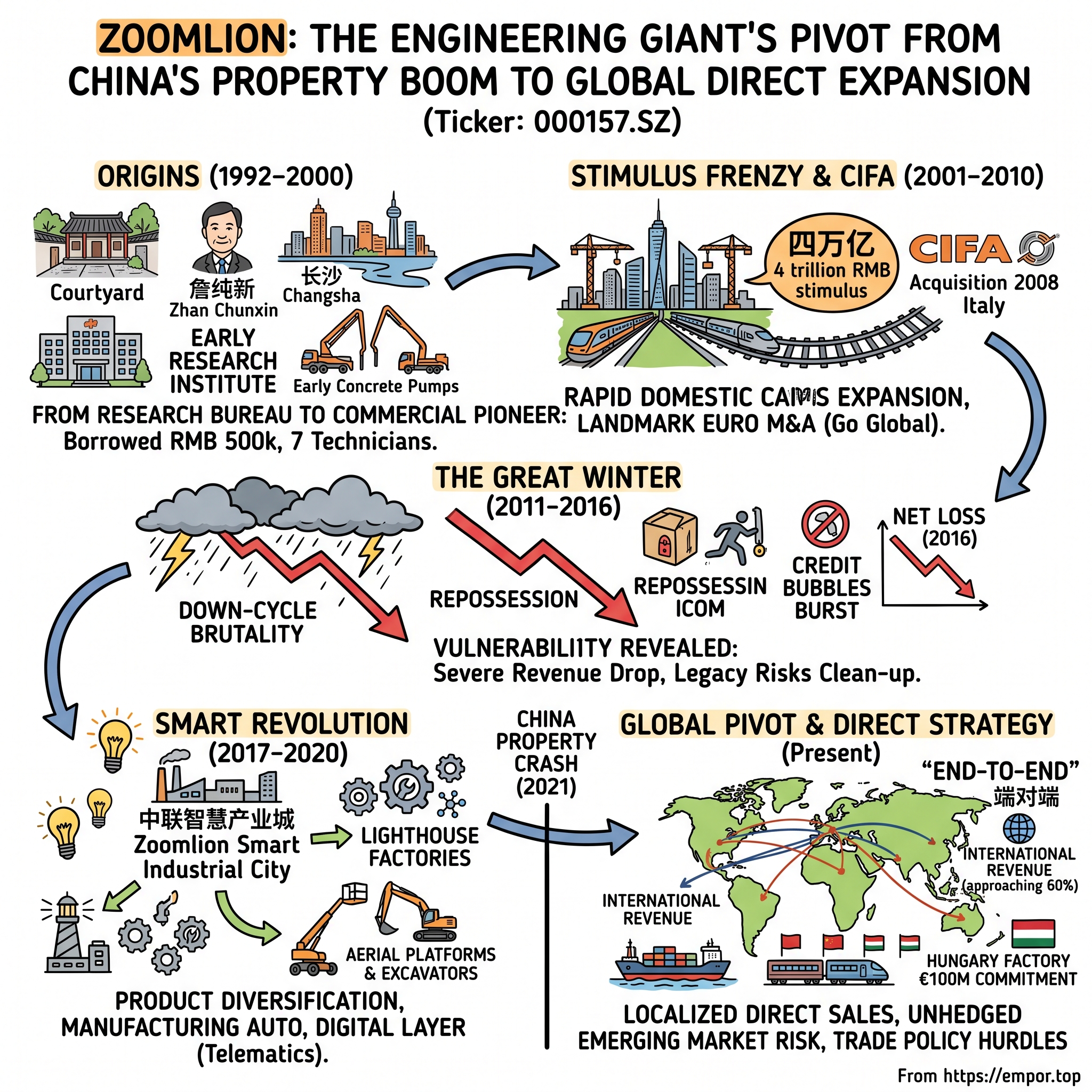
Zoomlion: The Engineering Giant's Pivot from China's Property Boom to Direct Global Expansion
I. Introduction & Episode Roadmap (10 min)
In the autumn of 1992, in a courtyard compound in 长沙 Changsha, the capital of Hunan province, a 37-year-old deputy head of a state research institute made a decision that struck many of his colleagues as reckless. 詹纯新 Zhan Chunxin had spent his career inside the 长沙建设机械研究院 Changsha Construction Machinery Research Institute, an organ of China's Ministry of Construction responsible for setting national heavy-equipment standards rather than selling machinery. He borrowed RMB 500,000, recruited seven technicians, and founded a company to build the machines the institute had previously designed only on paper.1
Thirty-four years later, for the 2025 financial year, that company reported revenue of RMB 52.11 billion, up 14.58% year on year, with net profit attributable to shareholders of RMB 4.86 billion, up 38.01%.2 While those are solid figures for a Chinese capital-goods maker operating in the sixth year of a severe real estate downturn, they do not represent the most telling metric on its balance sheet.
The defining figure is 58.56%. That was the share of total revenue that 中联重科 Zoomlion Heavy Industry Science and Technology Co., Ltd. generated outside mainland China in 2025, totaling RMB 30.52 billion—a 30.52% increase from the prior year.2 In 2020, foreign markets accounted for less than 6% of sales.3 In five years, an enterprise whose core identity was tied to pouring concrete for domestic high-rises pivoted into an exporter that now earns most of its revenue overseas.
This transformation was not a visionary maneuver, but a forced march. Zoomlion did not diversify geographically out of foresight; it expanded abroad because its home market collapsed. Group revenue plunged 37.98% in a single year, from RMB 67.13 billion in 2021 to RMB 41.63 billion in 2022, as domestic sales of concrete machinery and cranes were both cut in half.4 The overseas expansion was a survival strategy executed with notable speed and heavy capital commitment. The central analytical question for investors is whether this pivot has built a durable competitive moat or simply shifted a highly cyclical business into different geographic cycles.
The financial shape of the company today. Zoomlion operates six principal product divisions. 起重机械 Crane Machinery remains its largest segment, generating RMB 16.64 billion in 2025, up 12.52% year on year. 混凝土机械 Concrete Machinery contributed RMB 10.06 billion, a 25.50% increase. 土方机械 Earthmoving Machinery—covering excavators and loaders, a segment Zoomlion barely contested a decade ago—reached RMB 9.67 billion, growing 44.99%. 高空作业机械 Aerial Machinery, which produces scissor and boom lifts for facility maintenance and construction, dropped 12.63% to RMB 5.97 billion. 农业机械 Agricultural Machinery declined 23.84% to RMB 3.54 billion. Meanwhile, mining machinery, one of its newest divisions, saw international revenue expand more than threefold.52 Back home, domestic revenue contracted 2.29% to RMB 21.59 billion.5 Every RMB of top-line expansion came from overseas operations.
What this episode covers. First, Zoomlion's origins as a state research bureau, a history that shaped both its engineering culture and its hybrid ownership structure. Second, the expansion during the 2000s boom, the 四万亿 4 trillion RMB stimulus, and the 2008 acquisition of Italy's CIFA S.p.A., which served as a blueprint for Chinese cross-border M&A. Third, the severe downturn of 2012–2016, when the company recorded its first annual loss post-IPO and was forced to clean up a balance sheet burdened by aggressive customer financing. Fourth, its structural overhaul: building a RMB 100 billion smart-manufacturing industrial park, entering new product categories, and digitizing core operations. Fifth, the post-2021 property crash and the deployment of an "End-to-End" (端对端) direct-sales strategy that replaced traditional overseas distributors with in-house sales teams. Finally, an investment evaluation examining management's capital allocation track record, competitive moats, mounting foreign trade policy risks, and key operational metrics.
Start where the company started — inside the state.
 Subscribe on LinkedIn
II. The Technical Genesis: From Research Bureau to Commercial Pioneer (1956–2000) (12 min)
To understand Zoomlion requires understanding the role of a Chinese research institute during the planned-economy era. It was neither a university laboratory nor a enterprise. The 长沙建设机械研究院 traced its origins to 1956, functioning as the national brain trust for construction machinery: setting technical standards, writing specifications, maintaining blueprints, and assigning designs to state-owned factories for production. It possessed prestige, patents, and engineering expertise, but lacked a commercial customer base.
By the early 1990s, that model presented an existential challenge. Market reforms were dismantling guaranteed state budgets, and 詹纯新 Zhan Chunxin—a Party member and senior researcher with a master's degree who pursued doctoral studies in microeconomics—saw an organization rich in technical specifications running out of operating funds.1 His solution was the RMB 500,000 loan and seven technicians that launched the business. The entity they established, 中联建设机械产业公司, operated as a hybrid of science, industry, and trade designed to turn the institute's technical drawings into commercial products.1
The concept proved viable almost immediately. In 1993, the venture produced what Chinese industry accounts describe as the first generation of concrete delivery pumps built with fully domestic intellectual property, turning a profit in its first full year of sales—roughly RMB 2.3 million by its second year.1 Though modest relative to the company's modern scale, the result demonstrated that the institute's engineering held immediate commercial value.
The DNA question. This institutional origin set Zoomlion apart from its two primary domestic rivals in ways that remain visible on its balance sheet today. 三一重工 Sany Heavy Industry, also based in Changsha, was built from scratch by private entrepreneurs who started in welding materials and fought for market share from the outside. 徐工机械 XCMG emerged from a municipal state-owned enterprise in Xuzhou with extensive manufacturing capacity but a traditional bureaucratic structure. Zoomlion possessed neither private entrepreneurial origins nor initial factory scale; instead, it began with intellectual property and institutional connectivity—holding access to national blueprints, regulatory certification pathways, and direct ties to China's state-owned construction contractors.
That inheritance provided a powerful advantage during the 1990s, but created long-term operational vulnerabilities. A firm established with privileged access to demand rarely develops early capabilities in open-market commercial competition. As later credit-driven expansion cycles would reveal, Zoomlion initially lacked the market-tested risk controls and sales discipline of competitors forced to compete strictly on commercial terms.
The listing. On October 12, 2000, Zoomlion listed 50 million A-shares on the Shenzhen Stock Exchange under ticker 000157, raising RMB 614 million against a total post-issue share count of 150 million.6 State-linked entities retained control of just under half the share register from the outset.6 While RMB 614 million was modest compared to subsequent capital raises, the initial public offering converted a research spin-off into a publicly traded corporation equipped with equity currency, audited financial accounts, and a structural imperative for growth.
That imperative coincided with a fundamental shift in China's economic environment. In December 2001, China joined the World Trade Organization, launching an unprecedented nationwide construction boom.
III. The Stimulus Frenzy & The Landmark CIFA Acquisition (2001–2010) (18 min)
A single image captures Chinese heavy machinery in the 2000s: a skyline of tower cranes rising over unfamiliar cities. Between WTO accession and the end of the decade, China poured more concrete than the United States did in the entire twentieth century, built a nationwide high-speed rail network from scratch, and urbanized at a pace that rendered economic forecasts obsolete within eighteen months. For a company manufacturing concrete pumps and tower cranes, demand was no longer a variable to manage—it was weather.
Three manufacturers captured the bulk of this expansion. Zoomlion and Sany were headquartered in the same Changsha industrial district, close enough that their engineers frequented the same restaurants and their corporate rivalry turned into a high-stakes business feud marked by lawsuits, public accusations, and dueling press conferences. XCMG competed from Jiangsu Province with broader exposure across earthmoving equipment. All three expanded at rates that would appear extraordinary in any mature economy.
The deal that changed the perception of Chinese industry. In June 2008, Zoomlion executed a transaction unprecedented for a Chinese machinery maker: it acquired a European category leader outright. CIFA S.p.A. was an Italian concrete-equipment manufacturer possessing advanced technology—most notably carbon-fiber boom structures, which allowed pump trucks to extend further without adding weight, providing a genuine engineering advantage rather than a superficial selling point.
The deal structure revealed more about Zoomlion than the headline transaction value. Zoomlion did not purchase CIFA alone; it led an investment consortium. Zoomlion acquired a 60% stake for roughly €163 million, while Hony Capital, Goldman Sachs, and Mandarin Capital Partners took the remaining 40%, bringing the total equity contribution to about €271 million.7 Zoomlion funded its equity portion with just €31.9 million of its own cash alongside €127.5 million in loans from Barclays, bringing the total transaction value—including assumed debt—to roughly €511 million.7 Reuters and the Wall Street Journal both highlighted the transaction as a landmark event in China's outbound "go global" policy.89
Three key operational insights emerge from this transaction structure.
First, the company leveraged external balance sheets. Partnering with three financial sponsors allowed Zoomlion to secure operational control of a major European manufacturer while committing less than €35 million of its own equity. This reflected sophisticated financial engineering for a Chinese industrial firm in 2008, driven in part by Hony Capital, which was already an equity investor in Zoomlion and remains one today.
Second, the market timing was accidental rather than predictive. Announced in June 2008, the deal closed just weeks before the collapse of Lehman Brothers and the subsequent evaporation of European construction demand. The assertion that Zoomlion "bought at the bottom of the crisis" is historically inaccurate—the company bought immediately before the crash, after which CIFA's primary European markets contracted severely. What preserved the transaction's economics was that Zoomlion was acquiring CIFA's engineering capabilities rather than its European revenue stream, and specialized technical assets retained value even as Italian construction spending fell.
Third, unwinding the consortium structure required years. Zoomlion did not move to buy out the remaining stakes held by its financial partners until late 2012.10 Maintaining a four-year holding period alongside private-equity co-investors created operational friction, demonstrating that long-term asset integration proceeded far more slowly than initial press coverage suggested.
The comparison that matters. The CIFA acquisition is frequently benchmarked against two 2012 transactions: Sany's purchase of Germany's Putzmeister, a leading global brand in concrete pumping, and XCMG's acquisition of Schwing. Both later deals were executed at headline valuations comparable to CIFA, but four years later—after international sellers had recognized Chinese buying interest and raised prices accordingly. Zoomlion moved early, entering a market that had not yet priced in Chinese demand for European industrial assets. While this represented a genuine first-mover advantage, it stood as a single instance of fortunate timing rather than proof of repeatable M&A skill.
The stimulus. In November 2008, Beijing announced the 四万亿 4 trillion RMB stimulus, an infrastructure spending program of unprecedented scale. For Zoomlion, the commercial impact was immediate and transformative. Rail lines, highways, and regional airports required cranes and concrete pumps, shifting the operational bottleneck from sales generation to manufacturing capacity and customer credit quality.
Capitalizing on this surge, Zoomlion completed a secondary listing of H-shares on the Hong Kong Stock Exchange in December 2010 under ticker 1157, raising roughly US$1.7 billion in one of the year's largest public offerings.11 Although management designated the proceeds for international expansion and plant automation, the capital primarily funded aggressive domestic market-share expansion—and the risky financing terms required to secure it.
Underneath the historic growth figures, structural vulnerabilities were accumulating in how Chinese heavy equipment was financed and sold.
IV. The Great Winter: Credit Bubbles, Downcycle Brutality, & Restructuring (2011–2016) (20 min)
Here is how a concrete pump truck was sold in China in 2010. A contractor without a substantial balance sheet walked into a dealership needing no down payment. He signed a financial lease, took delivery of a machine worth several million renminbi, and drove away. The manufacturer recognized the revenue immediately and guaranteed the underlying financing. As long as construction activity expanded, customer cash flows covered the lease payments and the system functioned smoothly.
Industry executives called it competition. In financial reality, it operated as a manufacturer-funded subprime lending arrangement backed by steel collateral.
Zoomlion, Sany, and XCMG all adopted these aggressive credit terms to defend market share. Once a major competitor offered zero down payments, refusing to match meant surrendering volume. Financial statements hid the mounting risk because sales were recorded upon delivery, while credit exposure sat off the balance sheet in guarantees and accounts receivable that received little scrutiny.
Then the music stopped. Chinese infrastructure spending decelerated after 2011, and property construction slowed. Contractors servicing lease payments out of new project cash flows suddenly faced a market without new projects, leading to widespread defaults. Repossessed machines returned damaged and worth far less than their outstanding lease balances, leaving manufacturers exposed to customers who could no longer pay.
The resulting financial contraction was severe. Zoomlion's revenue peaked at RMB 48.07 billion in 2012 with net profit of RMB 7.33 billion. By 2013, revenue fell to RMB 38.54 billion with net profit of RMB 3.84 billion.12 By 2015, revenue reached RMB 20.75 billion while net profit collapsed to RMB 83 million—statistically near zero.13 In 2016, Zoomlion reported a net loss of RMB 934 million on revenue of RMB 20.02 billion, marking its first annual loss since its 2000 listing.14 Management attributed the loss to working through legacy risks in construction machinery, severance expenses from headcount reductions, and investments in its transformation strategy.14
From peak to trough, revenue dropped 58% and net profit swung downward by RMB 8.3 billion—illustrating the vulnerability of an unhedged capital-goods maker financing its own demand.
The guarantee number. Off-balance-sheet disclosures revealed the true magnitude of the exposure. Zoomlion's mortgage guarantees issued on behalf of customers reached RMB 15.04 billion in 2013, representing customer loan guarantees equal to roughly 39% of that year's revenue. By 2017, the company had reduced those guarantees to RMB 2.20 billion.15 Accounts receivable followed a similar pattern: only in 2018, when receivables of RMB 22.94 billion declined to 84.72% of sales, did the ratio drop below 100% for the first time since 2014.15 For four consecutive years, Zoomlion was owed more money by its customers than it generated in annual sales.
The capital-allocation misstep. In August 2014, with revenue declining for a second consecutive year, Zoomlion attempted to diversify into agricultural equipment. It acquired a 60% stake in 奇瑞重工 Chery Heavy Industry for RMB 2.088 billion, while Hony Capital took a 20% stake for RMB 696 million, valuing Chery Heavy at roughly RMB 3.48 billion.16 At the time, it marked the largest agricultural-machinery acquisition in China.[^17]17 Zhan Chunxin planned to strip out Chery Heavy's excavator and forklift lines, inject Zoomlion's existing agricultural assets, and refocus the entity entirely on farm equipment.16
The strategic rationale appeared reasonable: agricultural machinery operated on a different demand cycle from construction, benefited from government subsidies, and shared core hydraulic and powertrain engineering with heavy equipment. However, execution stumbled. Industry accounts noted that Chery Heavy's rapid top-line growth had failed to generate sustainable profits, and the transaction occurred just as Zoomlion's core earnings were collapsing.16 The agricultural division required years to gain scale—with revenue rising slowly from RMB 1.48 billion in 2018 to RMB 2.91 billion in 2021—and remained one of the weaker segments in the portfolio a decade later.16
The transaction stood in stark contrast to the CIFA acquisition six years earlier. CIFA provided proprietary technology from a European market leader before Chinese buyers established a recognized presence in overseas M&A. Chery Heavy, by contrast, represented an attempt to buy market position in a category where Zoomlion held no technological advantage, executed during a cyclical downturn in its core business when managerial focus was already strained.
The other side of the ledger. Following the downturn, management executed a swift restructuring. Zero-down-payment sales were eliminated, credit terms tightened, and strict down payments enforced. Group headcount was reduced by roughly 4,000 workers in a single year.14 In May 2017, Zoomlion sold an 80% stake in its environmental-sanitation-equipment subsidiary for RMB 11.6 billion, implying a valuation of RMB 14.5 billion for the entity—a 369.3% premium over its audited pro-forma net assets of RMB 3.09 billion at year-end 2016.1819
While the transaction generated crucial liquidity, it carried strategic trade-offs. The environmental division had generated RMB 5.6 billion in revenue and RMB 755 million in profit in 2016, providing positive earnings during a year when the broader group suffered a loss.18 Selling a profitable, counter-cyclical business at a high valuation bolstered the balance sheet, but it also stripped out the single division sheltered from construction cycles right before a decade defined by real estate volatility.
Governance. Restructuring also accelerated the deepening of 混合所有制改革 mixed-ownership reform. Rather than relying on a single state parent, Zoomlion's ownership register evolved into a hybrid structure comprising state capital through Hunan's provincial asset platform, private equity via Hony Capital, and an employee and management shareholding vehicle. Section VII examines what this ownership model achieved in practice. By 2017, Zoomlion had repaired its balance sheet, restructured its product portfolio, and restored credit discipline, positioning the company for the domestic market recovery that followed.
V. The Smart Revolution & Product Diversification (2017–2020) (18 min)
Drive southwest out of Changsha and the landscape yields to something that resembles an industrial district rather than a single factory. Announced in January 2019, 中联智慧产业城 Zoomlion Smart Industrial City spans more than 10,000 mu—over 660 hectares—with a planned total investment of roughly RMB 100 billion, targeting annual output of about RMB 100 billion, RMB 6.9 billion in annual taxes, and more than 30,000 jobs.[^21]
The headline figures are striking, but understanding the campus requires examining what was actually built and how it functions.
What "smart manufacturing" means when you strip out the marketing. Heavy machinery manufacturing is fundamentally about welding massive steel structures to tight tolerances, then integrating hydraulics and drivetrains. Traditionally, this required skilled manual labor: a welder laid a bead on a crane boom, and the quality of that bead determined structural integrity under load. Manual welding presents bottlenecks in speed, cost, and consistency, exacerbated by demographic shifts in China's industrial workforce.
Zoomlion's response was to automate structural fabrication end-to-end. The campus was designed around more than 300 intelligent production lines, over 20 "dark lines"—automated lines that operate without lighting because no workers are present on the floor—and eight facilities the company designates as "lighthouse factories."20 The four primary production parks, covering concrete machinery, construction cranes, aerial work platforms, and excavators, were fully operational by September 2024, when the crane park opened.[^23]
Management claimed this automation created a structural cost advantage through shorter lead times, lower defect rates, and reduced labor requirements per unit. Financial disclosures provide partial support for this thesis. Zoomlion's gross margin reached 28.17% in 2024, up 1.04 percentage points year on year, and held at 28.04% in 2025.2122 Maintaining a gross margin near 28% during a severe domestic real estate downturn suggests unit manufacturing costs declined relative to historical benchmarks.
However, attribution remains complex. Gross margins also benefited from a revenue mix shift toward higher-margin overseas sales and away from discounted domestic transactions. Public financial disclosures do not isolate factory cost reductions from foreign market pricing power, and Zoomlion does not publish a detailed unit-cost breakdown. The automation program is consistent with margin resilience, even if it cannot be isolated as the sole driver.
Two new businesses from a standing start. The central operational development of this period was product diversification. In 2018, Zoomlion entered the aerial work platform market—producing scissor lifts and telescopic booms for construction sites and logistics facilities. Starting with no presence in the category, the company became a top-tier domestic producer within four years by repurposing core assets: established hydraulic engineering capabilities, existing component supply chains, and sales relationships with equipment rental firms that already bought its cranes. By 2025, 高空作业机械 Aerial Machinery generated RMB 5.97 billion.5
Expanding into excavators proved more challenging. Excavators represent the largest single category in global construction equipment, long dominated by Caterpillar and コマツ Komatsu, particularly in medium- and heavy-tonnage classes where continuous operational reliability commands premium pricing. Zoomlion targeted these higher-tonnage classes rather than competing exclusively in low-margin mini-excavators. The strategy established the company's fastest-growing segment: 土方机械 Earthmoving Machinery generated RMB 9.67 billion in 2025, an increase of nearly 45%.5
The strategic rationale was cyclical hedging. Zoomlion's legacy product lines—concrete equipment and tower cranes—were directly exposed to real estate construction cycles. Excavators and aerial platforms served a broader range of end markets, including mining, public infrastructure, energy development, and industrial facility maintenance. Entering these categories before the real estate downturn reduced the firm's exposure to residential construction cycles.
The digital layer. Parallel to physical capital expenditure, Zoomlion invested more than RMB 10 billion in software, hardware, and digital engineering from 2014 onward.23 New machinery was equipped with embedded telematics systems, enabling the company to monitor machine locations, operating hours, and diagnostic fault codes in real time. Given Zoomlion's earlier exposure to customer credit defaults during the 2012–2016 downcycle, telematics served dual functions: an operational maintenance tool for customers and a risk-management control allowing the company to track collateral performance on financed equipment.
The peak. These manufacturing and product initiatives coincided with a sharp domestic upcycle driven by mandatory national emission-standard upgrades that accelerated fleet replacements, alongside post-pandemic government infrastructure spending. In 2020, Zoomlion recorded peak financial results: group revenue reached RMB 65.11 billion, up 50.34% year on year, while net profit rose 66.55% to RMB 7.28 billion.3 International sales accounted for less than 6% of total revenue at the time.23
Zoomlion reached peak profitability while remaining almost entirely dependent on a Chinese construction market on the eve of a structural downturn. That reliance set the stage for its subsequent international expansion.
VI. The Great Property Crash & The "End-to-End" Direct Global Expansion (2021–Present) (22 min)
The Chinese property developer liquidity crisis that began in 2021 affected heavy equipment manufacturers not as a sudden collapse, but as an abrupt evaporation of project activity. New construction stalled, tower cranes were dismantled without replacement, and concrete pumps sat idle in storage yards.
The financial impact followed quickly. Group revenue held up initially in 2021 at RMB 67.13 billion, up 3.11%, though net profit fell 13.88% to RMB 6.27 billion.4 In 2022, revenue plunged 37.98% to RMB 41.63 billion, while net profit dropped 63.22% to RMB 2.31 billion.4 The company's two core divisions suffered steep declines: concrete machinery revenue fell from RMB 16.38 billion to RMB 8.46 billion, and crane machinery revenue contracted from RMB 36.49 billion to RMB 18.98 billion—each dropping by roughly half within twelve months.4 Zoomlion also recorded an interim loss, its first in over a decade, as domestic excavator demand collapsed alongside provisions for legacy equipment.24 Faced with a severe domestic contraction, Zoomlion pivoted aggressively toward international sales.
Why the traditional export model proved insufficient. Chinese equipment manufacturers had exported through independent distributors for years. That dealer model offered a capital-light, low-risk structure: manufacturers shipped equipment, local distributors managed sales and service, and manufacturers collected payment. However, the model harbored three structural disadvantages in the heavy equipment sector.
First, because distributors controlled customer relationships, manufacturers gained limited insight into end-market preferences. Second, distributor margins either inflated end-user prices or compressed manufacturer profitability. Third—and most critically—heavy machinery is fundamentally a service business built around capital assets. A contractor in Riyadh or São Paulo purchasing a crane relies on operational availability—the certainty that if a machine breaks down mid-week, qualified technicians will arrive promptly with replacement parts. Independent distributors offering a second-tier Chinese brand alongside established global manufacturers rarely maintained comprehensive spare parts inventories or invested in specialist technical training.
Consequently, Chinese machinery manufacturers historically competed in foreign markets primarily on price rather than service capabilities.
The "airport and ground forces" model. Zoomlion's solution—which management dates to 2020 as its "overseas year one"—was to transition away from independent distributors and establish a direct, in-house commercial and service network.23 The company framed this strategy around an aviation metaphor: regional "airports" function as tier-one hubs housing spare parts inventories and engineering support; "ground forces" consist of locally recruited sales and service personnel fluent in local languages and embedded in target markets; and "flight crews" are specialized technical and commercial teams dispatched from Changsha headquarters to support complex negotiations. Chairman Zhan Chunxin required senior executives to spend at least one week per month overseas, arguing that operational leadership belonged in the field.25
This direct sales infrastructure expanded rapidly. By year-end 2025, Zoomlion operated more than 430 international outlets, over 220 service and spare parts warehouses, more than 30 tier-one hubs, and over ten overseas manufacturing bases across more than 170 countries, supported by over 9,000 international employees, including roughly 6,000 local hires.2 Two years earlier, the company employed approximately 4,400 local staff overseas and operated slightly over 210 parts warehouses, illustrating the speed and scale of capital deployment.25
Evaluating performance. Assessing this expansion requires distinguishing the strategy's operational mechanism from its financial outcome.
The top-line outcome is clear. Foreign markets generated 5.89% of total revenue in 2020, rising to 8.6% in 2021, approximately 24% in 2022, 51.41% in 2024 (RMB 23.38 billion), and 58.56% in 2025.2321 Management reported a four-year international compound annual growth rate of roughly 52%.2 Multi-year revenue expansion across diverse geographic regions indicates a broad structural shift rather than isolated contract wins.
The driving mechanism, however, remains subject to debate. While Zoomlion attributes this expansion primarily to its direct-sales model, three macro factors provided significant tailwinds: a severe domestic downturn that freed up manufacturing capacity and compelled Chinese equipment makers to seek foreign sales; a depreciated renminbi that enhanced export competitiveness; and infrastructure demand across the Middle East, Central Asia, Southeast Asia, and Latin America. Domestic competitors Sany and XCMG expanded their overseas sales over the same period. While Zoomlion's direct model offers operational differentiation, the industry-wide export surge makes it difficult to verify whether Zoomlion gained market share from domestic peers or simply participated in a sector-wide export boom. Contemporary reporting from Reuters, Bloomberg, and Caixin characterized the international expansion across Chinese machinery makers as a collective response to domestic property market weakness rather than a proprietary strategy.2627[^31]
Segment growth dynamics. Segment performance in 2025 highlights the uneven nature of this growth. Legacy divisions recorded steady expansion: crane machinery revenue rose 12.52% and concrete machinery increased 25.50%, with combined export sales across concrete, mobile cranes, and construction hoisting growing by more than 20%.25 Earthmoving machinery expanded nearly 45%, while mining machinery tripled its international revenue.2 Conversely, agricultural machinery revenue contracted 23.84% overall despite international sales expanding over 20%, while aerial work platforms declined 12.63% as overseas gains were offset by intense domestic price competition among equipment rental firms.25
The overall pattern reflects clear divergence: international sales expanded across product categories while domestic revenue contracted, with newer divisions outperforming legacy segments overseas. While this trajectory demonstrates successful geographic and product diversification, it also underscores the scale of the domestic drop: group revenue of RMB 52.11 billion in 2025 remained 22% below the 2021 peak of RMB 67.13 billion.
The Hungary manufacturing investment. In February 2025, Zoomlion committed €100 million to build an aerial work platform manufacturing facility in Tatabánya, Hungary, securing a 55,000-square-meter site leased from CTP with plans for 800 local jobs.28 Phase one opened in March 2026 as the European hub for Zoomlion Access, encompassing manufacturing, research and development, spare parts distribution, and customer support.2930 By July 2026, the company's European service network spanned over 30 cities across more than 20 countries, supported by nearly ten training centers—including a concrete machinery training facility in Poland—and a target four-hour on-site response time.31
Establishing manufacturing capacity inside the European Union was driven less by labor cost optimization than by trade strategy. Operating within the EU mitigates rising tariff and trade policy risks, a dynamic analyzed further in Section IX.
Currency exposure and first-quarter 2026 results. First-quarter financial results for 2026 illustrated both the momentum and the emerging vulnerabilities of Zoomlion's international model. Revenue rose 6.89% year on year to RMB 12.95 billion, driven by a 12.52% gain in overseas sales to RMB 7.39 billion, representing 57.06% of group revenue.3233 However, net profit attributable to shareholders declined 37.30% to RMB 884 million.32 The profit drop reflected non-operational factors: unrealized foreign-currency accounting losses stemming from renminbi appreciation, alongside a high comparison base in the prior-year period that featured a one-time gain on land disposal. Excluding foreign exchange adjustments and non-recurring items, management estimated underlying net profit growth at 54.90%.3233
While adjusted metrics indicate solid underlying demand, the quarter highlighted an important structural shift. With nearly 58% of total sales generated outside mainland China, Zoomlion's net earnings have become sensitive to foreign exchange fluctuations. By diversifying away from the Chinese real estate sector, Zoomlion effectively exchanged domestic property cyclicality for foreign currency and cross-border trade risks.
The governance structures and executive leadership steering this global transition are examined next.
VII. Management, Governance, & Capital Allocation Audit (15 min)
Zhan Chunxin has run Zoomlion for thirty-four years. He founded the business at age 37 and, at roughly 71, still serves as chairman and chief executive.1 In an industry where the median Chinese founder-CEO tenure is measured in single digits, and in a country where state-linked enterprises routinely rotate leadership on political schedules, that executive continuity is a defining governance factor.
The case for. Zhan's record contains at least three pivotal strategic calls executed successfully. First, he commercialized a state research institute when doing so was neither obvious nor financially secure. Second, he structured the CIFA acquisition through an investment consortium that secured control of a European category leader for under €35 million of Zoomlion's own equity. Third, he ordered the direct overseas expansion in 2020—at the peak of domestic profitability, when internal incentives favored harvesting the Chinese market. Committing capital to international hubs and direct hiring during a record domestic year was a counter-consensus decision, standing as strong evidence of strategic foresight.
He has also stated management targets plainly. Following 2024 results, Zhan noted twice that Zoomlion was "no longer a cyclical enterprise," citing international revenue exceeding 51% of group sales and CFO Du Yigang's estimate that real estate-correlated business had fallen to roughly 13% of the total.2325 He subsequently set targets of US$10 billion in overseas revenue within three years and an international workforce exceeding 10,000 employees.23
The case for scepticism. "We are no longer a cyclical enterprise" is an extraordinary assertion for a heavy machinery manufacturer. Zoomlion has diversified its geographic and end-market exposure; it has not eliminated cyclical risk. Construction in the Gulf, mining in Latin America, and infrastructure across Central Asia are all cyclical markets that do not currently align with Chinese housing starts. If a global interest rate shock or commodity downturn hits those regions simultaneously, cyclical sensitivity would quickly reemerge. Framing geographic diversification as structural de-cyclicalization represents narrative compression, particularly given that the claim followed two consecutive years of strong international tailwinds.
Disclosures also reveal a notable gap between reported and recurring earnings. In 2025, net profit attributable to shareholders reached RMB 4.86 billion, whereas net profit excluding non-recurring items stood at RMB 3.37 billion, up 31.93%.22 Non-recurring items contributed roughly RMB 1.49 billion—about 31% of headline net profit. The prior year showed a similar gap. While headline figures featured prominently in company releases, recurring operations reflect a lower underlying earnings base.
Ownership: the hybrid, examined. Zoomlion maintains a hybrid shareholding structure. The Hunan provincial state asset system is the largest shareholder, holding approximately 16.77% through its investment platform. Hong Kong Securities Clearing—representing foreign and southbound investors—holds around 16.48%. Private equity firm Hony Capital holds roughly 10.96%. Management and employee incentive vehicles hold about 8.50%, with the remaining roughly 47% widely held.3435
Because no single shareholder holds a controlling stake, this structure yields three practical operational effects. First, a visible state anchor provides financing access and credit rating support critical for issuing performance bonds and extending customer credit in emerging markets. Second, the absence of a single controlling state parent preserves commercial operational flexibility. Third, a substantial employee equity stake aligns management incentives with corporate performance.
The offsetting risk is governance concentration. With dispersed ownership and a 34-year incumbent chairman, the board's independent oversight capacity remains untested under challenge. Zoomlion has never experienced a contested leadership transition. Zhan's direct equity holding is small—public data services put it around 0.13%—though his economic exposure runs primarily through employee holding vehicles.36 Executive succession remains the primary unaddressed governance issue, with no public succession plan disclosed.
Capital allocation, scored. Three financial tests evaluate capital discipline:
Capex. Post-2016 investments focused on Smart Industrial City automation and overseas direct sales hubs rather than debt-financed capacity in legacy franchises. Investing cash outflows reached RMB 5.64 billion in 2025, up 93.09% year on year, reflecting ongoing facility build-out.22 While rapid growth in earthmoving machinery and resilient gross margins support this capital deployment, declining performance in aerial work platforms demonstrates uneven returns.
Cash conversion. Operating cash flow reached RMB 4.87 billion in 2025, up 127.53%.22 For a company that suffered severe credit defaults a decade ago, expanding operating cash flow faster than revenue represents a meaningful operational improvement. However, period-end accounts receivable reached approximately RMB 39.5 billion against RMB 52.11 billion in revenue, while inventory stood at about RMB 20.5 billion following working capital reductions.37 Accounts receivable equal to three-quarters of annual revenue reflect extended payment terms common in Chinese heavy equipment, but represent a metric requiring close monitoring as international sales expand.
Shareholder returns. Zoomlion paid an interim dividend of RMB 0.20 per share for the first half of 2025, totaling RMB 1.73 billion, and proposed a final dividend of RMB 0.20 per share, bringing the full-year total to RMB 0.40 per share.3839 This represented a payout ratio above 71% of 2025 net profit—substantially higher than its historical average payout ratio of roughly 47% across 28 dividends since listing, which have cumulatively distributed about RMB 30.6 billion.40 H-shareholders received a final dividend of HK$0.2268 per share on July 22, 2026.41
Distributing over 70% of earnings while funding international factory expansion and automation is a deliberate capital signal. It indicates strong cash generation, but also reflects dividend requirements from state shareholders and share price support goals. Investors should note that a 71% payout ratio on a cyclical earnings base reflects favorable annual conditions rather than a permanent dividend floor.
Line-item cost trends further illustrate operational priorities: financial expenses rose 259.19% to RMB 203 million in 2025, administrative expenses fell 8.23%, and selling expenses grew 21.94%—the cost signature of an organization shifting resources from central headquarters overhead into field sales and technical support.22
The remaining question is whether this expanded global footprint provides a defensible competitive moat.
VIII. Competitive Moats & Strategic Frameworks (15 min)
Evaluating Zoomlion's competitive position requires examining a Chinese manufacturer selling heavy equipment into markets where Caterpillar and Komatsu have operated for half a century, while competing against two domestic rivals with similar technology and cost structures. The core analytical question is where Zoomlion possesses a defensible advantage—and how durable that advantage truly is.
Hamilton Helmer's 7 Powers.
Scale economies — real, but shared. Zoomlion maintains some of the world's largest production capacity in tower cranes and concrete equipment, spreading annual research and development spending of roughly RMB 2.9 billion—about 5.6% of revenue—across its global sales volume.22 However, domestic competitors Sany and XCMG operate at similar or greater scale. While scale gives Chinese manufacturers a collective cost advantage over European and Japanese competitors, it does not distinguish Zoomlion from its primary domestic peers. Scale represents a sector-wide advantage rather than a firm-specific moat.
Process power — credible, but unverified. The automated assembly lines, unlit "dark lines," and lighthouse factories across Smart Industrial City represent a substantial manufacturing upgrade, backed by physical infrastructure rather than corporate projections.20[^23] Yet Sany and XCMG have deployed similar automation programs across their own facilities, suggesting any manufacturing edge is a matter of degree. Because Zoomlion does not disclose detailed unit-cost figures, process power remains probable but unverified on a standalone basis.
Counter-positioning — the strongest structural argument. Counter-positioning provides Zoomlion's most compelling structural advantage against Western incumbents. Caterpillar's global dealer network represents a capital-intensive ecosystem of independent businesses built over decades. Caterpillar cannot bypass those dealers to establish direct sales networks in markets like Saudi Arabia or Brazil without undermining the distributor relationships that anchor its global business. Unburdened by legacy dealer networks, Zoomlion can build a direct "end-to-end" distribution model without cannibalizing existing channels—a classic instance of counter-positioning where established leaders recognize the strategy but rationally decline to replicate it.
However, this moat operates in one direction. While counter-positioning protects Zoomlion against Caterpillar and Komatsu, it offers no protection against Sany and XCMG, which enjoy the same distribution flexibility and are pursuing similar localized models overseas.
Switching costs — moderate and growing. Embedded telematics, fleet management software, spare parts availability, and technician familiarity create customer retention friction. An equipment rental firm operating a fleet of 300 Zoomlion aerial work platforms with trained maintenance staff faces real costs when switching brands. Nonetheless, heavy equipment switching costs remain modest compared to enterprise software or specialized medical devices, as machinery functions as standardized physical collateral with active resale markets.
Branding, network economies, cornered resource — absent. Zoomlion commands no significant brand premium outside mainland China, competing primarily on total cost of ownership. The business exhibits no network effects, nor does it hold cornered resources, as core hydraulic components and engines are sourced from a mature domestic supply chain accessible to its competitors.23
Porter's Five Forces.
New entrants: very low threat. High capital intensity, strict international safety certification standards, and the substantial service infrastructure required to support heavy equipment make greenfield market entry extremely difficult. Potential entrants are largely limited to adjacent Chinese industrial firms, which face identical barriers in establishing overseas service networks.
Supplier power: low. China maintains a deep, highly competitive supply chain across hydraulic systems, castings, electronics, and structural steel. Zoomlion procures components from a domestic supplier base with multiple qualified sources and reports no critical bottleneck exposure.23 This provides a structural cost advantage over Western manufacturers that have contended with component shortages and supply chain reshoring expenses.
Substitute threat: low. Heavy construction requires dedicated machinery: high-rise construction depends on concrete pumps and tower cranes regardless of design. While modular and prefabricated construction techniques alter where machinery is deployed on a job site, they do not eliminate the underlying need for heavy equipment.
Buyer power: moderate to high, and rising. Major equipment rental fleets and general contractors purchase in volume, conduct competitive tenders, and possess precise pricing transparency for Chinese equipment. In the domestic aerial work platform sector, strong buyer power contributed to a 12.63% revenue decline in 2025 as rental operators squeezed rental rates and passed margin pressure back to equipment manufacturers.5
Rivalry: very high. China's three major machinery manufacturers compete intensely on price, features, and financing terms, both domestically and across overseas export markets. When competing against Caterpillar and Komatsu, Zoomlion relies on competitive pricing and rapid service response to offset Western incumbents' superior equipment resale values and long-standing customer relationships. Industry rivalry remains the primary factor limiting long-term capital returns across the sector.
The market-share claim, tested. Zoomlion and Chinese trade publications frequently describe the company as the global market leader in tower cranes. However, independent market research presents a nuanced picture: a 2025 global tower crane industry study ranked Manitowoc first with over 12% market share, followed by Zoomlion, Liebherr, Sany, and Comansa in a top five that collectively held roughly 36% of the market.42 Market-share calculations in fragmented capital-goods sectors differ significantly based on research methodology—whether measuring unit volume versus monetary value, geographic scope, or domestic Chinese demand. Rather than validating a single ranking, these discrepancies indicate that Zoomlion's claim to global market leadership in tower cranes remains contested.
The competitive scorecard. In summary, Zoomlion possesses one clear structural advantage—counter-positioning against Western incumbents through direct overseas distribution—alongside a probable manufacturing cost edge and a reliable domestic supply chain. Against domestic peers Sany and XCMG, however, Zoomlion relies primarily on operational execution rather than structural barriers. In a capital-goods sector marked by intense rivalry and growing buyer power, economic returns must be continuously earned through operational performance rather than protected by enduring competitive moats.
IX. Skeptical Investor Stress Test & Material Risk Radar (12 min)
Evaluating Zoomlion's long-term investment case requires testing management's narrative against the operational, financial, and geopolitical headwinds facing the business. An activist investor examining the company's balance sheet would likely highlight three primary structural challenges.
Challenge one: swapping domestic real estate risk for emerging-market credit risk without sufficient disclosure. More than 58% of total revenue now originates outside mainland China, with much of that growth concentrated in Belt and Road markets across the Middle East, Central Asia, Southeast Asia, Africa, and Latin America. These regions feature sovereign credit volatility, foreign exchange instability, and payment terms far looser than those typical of Western equipment rental markets. For a company whose severe financial distress in 2012–2016 stemmed from extending unhedged customer credit during a downcycle, building a direct sales infrastructure in higher-risk jurisdictions introduces familiar balance-sheet exposure.
What the evidence shows. Group receivables of roughly RMB 39.5 billion against RMB 52.11 billion in revenue remain well below the severe levels of 2014–2017, when receivables exceeded annual sales.3715 Operating cash flow more than doubling in 2025 indicates that overseas revenue is converting into cash rather than sitting as balance-sheet entries.22 Zoomlion mitigates default exposure using export credit insurance through 中国信保 Sinosure, letter-of-credit payment structures, and its localized collections network. The direct sales model itself provides risk control: operating over 220 parts warehouses and employing roughly 6,000 local staff allows the company to monitor equipment locations and recover collateral efficiently.
What remains open. Zoomlion does not disclose geographic aging schedules for receivables or detailed country-level revenue concentration tables in its financial reports. Consequently, investors cannot independently verify regional credit concentration or payment delays—making receivables quality a critical metric for ongoing quarterly monitoring.
Challenge two: agricultural machinery remains a decade-old drag on capital efficiency. Segment revenue fell 23.84% in 2025 to RMB 3.54 billion, and the division has failed to generate returns that justify its 2014 acquisition price.5 The unit faces intense competition, squeezed between advanced technology from global leaders John Deere, AGCO, and CNH Industrial, and aggressive price cutting from fragmented domestic manufacturers. Management responded by refocusing on smart harvesters and high-horsepower tractors, highlighting that international agricultural sales grew over 20%, and establishing a new agricultural machinery subsidiary capitalized at RMB 500 million in May 2026.2 At the 2025 annual general meeting, executives expressed optimism regarding long-term market opportunities in both agricultural and mining machinery.43
The skeptic's rejoinder. Optimism about market potential does not equal return on invested capital. Twelve years after its acquisition, the agricultural division remains smaller than earthmoving machinery, continues to shrink, and consumes management bandwidth. The burden of proof rests on executive leadership to demonstrate standalone profitability rather than long-term strategic promise.
Challenge three: escalating trade protectionism threatens overseas access. Cross-border trade barriers represent the most immediate structural threat to Zoomlion's international expansion, operating as enforceable policy rather than speculative risk.
The European Union imposed provisional anti-dumping duties on Chinese mobile access equipment—specifically self-propelled aerial work platforms with working heights above six meters—following an investigation opened in November 2023 after a complaint by the Coalition to Restore a Level Playing Field in the EU Mobile Access Equipment Sector.4445 Zoomlion was categorized among "cooperating but unsampled" exporters, subjecting it to duties between 30% and 32%, compared to 56.1% for non-cooperating companies.44 The European Commission subsequently acted against unfairly subsidized imports of the same equipment, layering countervailing duties of 7.3% to 14.2% on top of anti-dumping tariffs applied from January 2025, bringing total combined duties to a range between 20.6% and 66.7%.4647
Tariffs of this magnitude eliminate export margins entirely rather than absorbing them. Establishing a €100 million manufacturing facility in Hungary represents Zoomlion's direct response to these trade barriers, allowing the company to produce equipment within the European customs union within a month of final tariff determinations.28 However, whether the Hungarian plant can achieve competitive unit costs under European labor rates and supply chain costs remains unverified.
In the United States, trade barriers present an even steeper hurdle. Section 301 tariffs, subsequent policy escalations, and widespread trade restrictions have largely closed the US market—the world's most lucrative construction equipment sector—to Chinese-branded machinery, with additional 100% tariffs imposed on certain China-linked cargo-handling and port equipment categories starting in late 2025.48 While Zoomlion appears on US import manifests for select products, the US market offers little near-term expansion potential under current trade policy.49
The broader risk matrix.
Currency exposure. Currency sensitivity surfaced clearly in early 2026. Renminbi appreciation contributed directly to a 37.30% year-on-year drop in net profit during the first quarter of 2026 through currency translation and transaction losses.32 With nearly 58% of total sales denominated in foreign currencies against a domestic renminbi cost structure, persistent renminbi strengthening compresses profit margins regardless of underlying volume growth.
Domestic market stagnation. Chinese residential construction remains depressed, causing domestic revenue to contract further in 2025.5 While management estimates that real estate-correlated operations have fallen to roughly 13% of group revenue, domestic weakness continues to weigh on performance.23 The primary risk stems less from top-line drag than from domestic price wars, as excess capacity forces Chinese manufacturers to discount aggressively both at home and in shared export markets.
Operating overhead and execution. Managing direct sales networks across more than 170 countries with 9,000 international employees creates substantial overhead. Selling expenses rose 21.94% in 2025 against top-line revenue growth of 14.58%, demonstrating negative operating leverage across sales and administrative lines as direct global infrastructure expands.22 If overseas revenue decelerates while fixed international operating costs remain elevated, profit margins will compress rapidly.
Capital allocation and robotics. Zoomlion has developed six robotic products across three categories—wheeled humanoids, bipedal humanoids, and quadrupeds—deploying dozens of units across its own factories for pre-assembly, sorting, materials feeding, and quality inspection, while constructing a small-batch manufacturing facility.50 A deputy chief engineer publicly suggested that robotics could eventually "recreate another Zoomlion."25 Deploying automation within proprietary manufacturing plants builds logically on core engineering capabilities; however, expanding into commercial humanoid robotics during a period of market enthusiasm represents speculative capital allocation. At present, robotics generates no meaningful commercial revenue.25
Balancing these operational, financial, and geopolitical risks against Zoomlion's international growth momentum defines the central investment debate surrounding the company.
X. The Investment Story Spine: Bull vs. Bear Case & Key KPIs (12 min)
Why Zoomlion wins from here.
The bull case rests on a structural asymmetry: Zoomlion is building direct distribution and service networks in markets where Western incumbents charge a price premium for that capability, operating at a cost base that allows it to undercut established brands while generating viable operating margins. If a contractor in Colombia can take delivery of a Zoomlion excavator, receive service within hours from a local technician, and rely on a regional parts warehouse—all at a materially lower purchase price than a Caterpillar equivalent—the historical justification for paying an incumbent premium diminishes. This represents less a price-war strategy than a deliberate effort to narrow the service gap that previously justified higher competitor prices.
Evidence for this operational transition extends beyond group revenue to the composition of individual orders. In February 2026, Zoomlion dispatched more than 15,000 units valued at approximately US$1.2 billion in a single global delivery event across more than 40 international markets—including Germany, Australia, the United Arab Emirates, Italy, Hungary, Singapore, Turkey, Saudi Arabia, Colombia, Tanzania, Côte d'Ivoire, and Morocco. Overseas orders accounted for over 80% of total order value, led by more than 3,700 earthmoving and mining units and over 4,000 aerial work platforms.51 By comparison, the equivalent delivery event a year earlier involved over 10,000 units valued at US$782 million.52 The expanding mix across product lines and geographies reflects a functioning direct sales network rather than isolated contract wins.
The second pillar of the bull case is manufacturing cost structure. Zoomlion operates from an integrated domestic supply chain and an automated manufacturing base, competing against Western original equipment manufacturers carrying higher labor costs, costlier components, and nearshoring expenses. That structural cost differential cannot be closed quickly by established competitors.
The third pillar involves segment headroom. Earthmoving machinery generated RMB 9.67 billion in 2025—a small fraction of the global excavator market—while mining equipment remains early in its expansion. If those divisions continue compounding near recent growth rates, group revenue could surpass its 2021 peak of RMB 67.13 billion even if China's domestic real estate market shows no near-term recovery.
Why it may not.
The bear case does not rest on operational failure, but on the premise that Zoomlion's competitive advantages are narrower than management's strategic narrative suggests.
The tariff ceiling. If European and North American markets remain restricted to Chinese-branded machinery except via localized manufacturing, Zoomlion's addressable overseas expansion will depend heavily on price-sensitive developing economies. These markets typically feature lower gross margins, elevated credit risk, and intense competition from domestic peers. Localized European manufacturing—such as the Tatabánya plant in Hungary—provides a regulatory workaround, but converts a capital-light export model into a multi-plant operation with unproven European unit economics.
The compatriot problem. Nothing in Zoomlion's competitive moat isolates it from domestic rivals Sany and XCMG. Three major Chinese manufacturers targeting identical emerging markets with comparable supply chain costs and direct sales models creates structural pressure that could drive export margins down toward domestic levels over time.
Cash quality. Roughly 31% of 2025 net profit stemmed from non-recurring items, accounts receivable equaled nearly three-quarters of annual revenue, and a dividend payout ratio above 71% leaves little cushion if earnings contract.223740 While no single metric indicates immediate distress, collectively they demonstrate that headline net profit exaggerates recurring earnings quality, leaving a narrow margin for operational error.
The cyclicality that was never eliminated. Management's assertion that Zoomlion is no longer a cyclical enterprise represents its most vulnerable claim. A synchronized downturn across Gulf infrastructure, Latin American mining, and Southeast Asian construction would demonstrate that geographic diversification dampens local volatility rather than eliminating underlying cyclical exposure.
A note on the frameworks. Viewing the strategic analysis in Sections VIII and IX together reveals a clear picture: Zoomlion's position under Porter's Five Forces remains challenging due to intense rivalry and rising buyer power, while its position under Hamilton Helmer's 7 Powers rests primarily on counter-positioning against Western incumbents. That combination often characterizes a business capable of expanding top-line revenue while generating returns only modestly above its cost of capital. The central investment question is not whether a moat exists, but how long the counter-positioning window remains open before Sany, XCMG, and localized Western competitors close it.
The three KPIs that actually matter.
One: international revenue growth and its rate of change. Overseas revenue share rises automatically whenever domestic sales contract. What matters for the thesis is absolute international growth. Foreign revenue grew over 30% in both 2024 and 2025, but decelerated to 12.52% in the first quarter of 2026.21232 While one quarter does not establish a trend, consecutive quarters of decelerating growth would signal that the direct expansion is maturing. This metric serves as the primary gauge for the international thesis.
Two: operating cash flow relative to net profit and accounts receivable trends. Operating cash flow performance provided an early warning before the 2012 downcycle. In 2025, operating cash flow more than doubled to RMB 4.87 billion, yet accounts receivable remained high at RMB 39.5 billion.2237 If cash conversion deteriorates while international revenue expands, it would indicate that Zoomlion is funding overseas market share through aggressive credit terms—replicating the primary balance-sheet vulnerability of the previous downturn.
Three: earthmoving machinery revenue and its international mix. Excavators represent the largest and most competitive segment in heavy equipment, where Caterpillar and Komatsu hold their strongest market positions. Sustained growth in Zoomlion's earthmoving exports would confirm genuine product competitiveness rather than temporary market capture. Conversely, if earthmoving growth decelerates while aerial platforms and agricultural machinery remain sluggish, Zoomlion's transformation reduces primarily to exporting cranes and concrete equipment—a healthier business than domestic dependence, but a narrower achievement than management's strategic narrative suggests.
XI. Playbook: Business & Investing Lessons (8 min)
One: In cyclical capital goods, the balance sheet fails before the income statement does. Zoomlion's 2012–2016 downturn was not caused by falling demand alone. Shrinking demand was merely the trigger. The primary cause was four years of recognizing revenue against customer credit that the company guaranteed itself—peaking at RMB 15.04 billion in customer loan guarantees in 2013, alongside accounts receivable that exceeded total annual sales for four consecutive years.15 The warning signs were fully disclosed in financial filings but largely overlooked because top-line income appeared strong. In any industry where a manufacturer finances its own buyers, receivables and guarantee commitments serve as leading indicators, while reported revenue is a lagging one.
Two: Distribution can be a moat, but only against incumbents structurally unable to copy it. Zoomlion's direct sales model operates effectively against Caterpillar because Caterpillar's independent dealer network is too valuable to disintermediate. The strategy offers no structural advantage against Sany, however, because Sany faces no such network constraint. Before attributing counter-positioning power to a strategy, analysts must identify precisely which competitor is unable to respond—and evaluate whether the unconstrained rivals who can match the strategy present the more immediate threat.
Three: Acquisition quality depends on what capability is acquired, not just the transaction price. The 2008 CIFA transaction acquired transferable engineering assets—including carbon-fiber boom technology and hydraulic designs that could be scaled across Chinese factories—executed before Chinese buying interest inflated market valuations, and structured through a consortium that limited Zoomlion's direct equity risk.7 By contrast, the 2014 purchase of Chery Heavy Industry bought market position in a category where Zoomlion held no technological advantage, executed during a cyclical collapse in its core construction business.16 Over a decade later, CIFA's engineering remains core to Zoomlion's premium product lines, while agricultural machinery remains its weakest division. Long-term M&A success hinges on whether technical capabilities transfer, rather than whether near-term revenue consolidates.
Four: Commercializing institutional intellectual property requires aligning equity incentives, not merely updating organizational charts. Zoomlion succeeded where scores of state research institute spin-offs stalled because the engineers who created the technology secured a direct stake in its commercial outcome. The combined management and employee equity holding of roughly 8.5% is not an incidental detail; it provided the structural mechanism that converted a state standards bureau into a market-driven corporation.34
Five: Exercise caution when executive narratives outpace cyclical realities. Chairman Zhan Chunxin's assertion that Zoomlion is "no longer a cyclical enterprise" represents a compelling public headline, but one that warrants skepticism. Management delivered that assessment following two strong years of international growth for a manufacturer whose core business remains capital equipment. Geographically diversifying cyclical exposure is a meaningful operational milestone; framing it as the complete elimination of cyclicality conflates strategic progress with narrative optimism. When regional or global construction cycles eventually turn, ungrounded narratives are what markets reprice first.
XII. Outro & Primary Source Guidance (2 min)
For investors tracking Zoomlion, three sets of primary materials carry most of the analytical weight.
The 2024 and 2025 annual reports, filed with the Shenzhen Stock Exchange under ticker 000157 and the Hong Kong Stock Exchange under ticker 01157, contain the segment and geographic disaggregation, receivables aging, gross margins by product line, and detailed cash flows that preliminary earnings releases compress.2122 While Zoomlion's results announcements emphasize headline net profit, evaluating recurring earnings and geographic margin splits requires examining the full annual filings.
The annual results briefings and shareholder meetings provide a benchmark to test management's narrative over time. The March 2025 briefing introduced the "blossoming at multiple points" characterization of overseas expansion; the June 2025 shareholder meeting outlined ambitions in agricultural machinery, mining equipment, and robotics; and the April 2026 annual results presentation provided updated metrics on the international direct-sales network.432 Reviewing these disclosures in sequence reveals whether management's strategic narrative has remained consistent or shifted after the fact.
The 2008 CIFA transaction disclosures and the 2012 buyout of the consortium's residual stake offer the clearest primary record of how Zoomlion structures major cross-border acquisitions, including debt packages and co-investment terms with Hony Capital and Goldman Sachs—insights directly relevant as the company expands proprietary manufacturing capacity in Europe to navigate trade barriers.710
References
-
Zoomlion Reports 2025 Results With International Revenue Approaching 60% of Total — PR Newswire APAC, 2026-04-02 ↩↩↩↩↩↩↩↩↩↩↩
-
财报里的真相 | 中联重科去年业绩大滑坡:混凝土机、起重机销售几近腰斩 — 每日经济新闻, 2023-03-30 ↩↩↩↩
-
中联重科2025年归母净利润同比增长38.01% 境外收入占比近六成 — 新浪财经, 2026-03-31 ↩↩↩↩↩↩↩↩↩
-
Zoomlion Buying Italy's CIFA with Goldman, Hony Capital — Reuters, 2008-06-25 ↩
-
Zoomlion Leads Acquisition of Italy's CIFA — The Wall Street Journal, 2008-06-25 ↩
-
Zoomlion Offers to Buy Remaining CIFA Stake From Goldman, Funds — Bloomberg, 2012-12-28 ↩↩
-
Zoomlion raises HK$1.68 billion from Hong Kong share sale — FinanceAsia, 2010 ↩
-
Zoomlion Acquires Chery Heavy Industry to Enter Agricultural Machinery — Reuters, 2014-08-21 ↩
-
中联重科2025年报解读:经营现金流增127.53% 财务费用增259.19% — 新浪财经, 2026-03-30 ↩↩↩↩↩↩↩↩↩↩↩
-
Chinese Digger Makers Dig In Overseas as Domestic Construction Slows — Reuters, 2023-09-05 ↩
-
Chinese Heavy Equipment Makers Surge in Overseas Markets — Bloomberg, 2023-04-18 ↩
-
Zoomlion to Build Smart Factory for Aerial Work Platforms in Hungary — PR Newswire, 2025-02-21 ↩↩
-
Zoomlion Strengthens Localized Manufacturing and Service Capabilities as Hungary MEWP Factory Begins Operations — PR Newswire UK, 2026 ↩
-
Zoomlion Heavy Industry Science and Technology Co., Ltd. Leadership & Management Team Analysis — Simply Wall St ↩
-
中联重科(000157)2025年报点评:公司经营业绩增长稳健 海外市场表现亮眼 — 中财网研报, 2026-04-08 ↩↩↩↩
-
Zoomlion Heavy Industry Science & Technology Co., Ltd. (HKEX: 1157) final dividend of HK$0.2268 per share — moomoo, 2026-07 ↩
-
Tower Crane Market Global Industry Size, Share, Trends, Opportunity, and Forecasts to 2031 — GlobeNewswire, 2025-08-04 ↩
-
EU anti-dumping investigation into Chinese platform manufacturers — Vertikal.net ↩
-
Commission acts against unfairly subsidised imports of mobile access equipment from China — European Commission, 2025-04-28 ↩
-
MEWP anti-subsidy tariffs announced by EU — International Rental News, 2025 ↩
-
USTR issues final Section 301 actions in China shipbuilding investigation — White & Case LLP, 2025 ↩
-
Commission Implementing Regulation (EU) 2024/1915 of 11 July 2024 — EUR-Lex, 2024-07-11 ↩
-
Zoomlion Opens 2026 With US$1.2 Billion in Global Equipment Shipments — Yahoo Finance, 2026-02-27 ↩
-
Onward and Upward, Zoomlion Kicks Off 2025 with Delivery of Over 10,000 Units, Valued at US$782 Million — PR Newswire APAC, 2025 ↩
 LinkedIn
 WhatsApp
 Reddit
 Hacker News
 Email
Email Kindle
 RSS Feed
 Spotify
 Apple Podcasts
 Amazon Music
 Audible
 YouTube