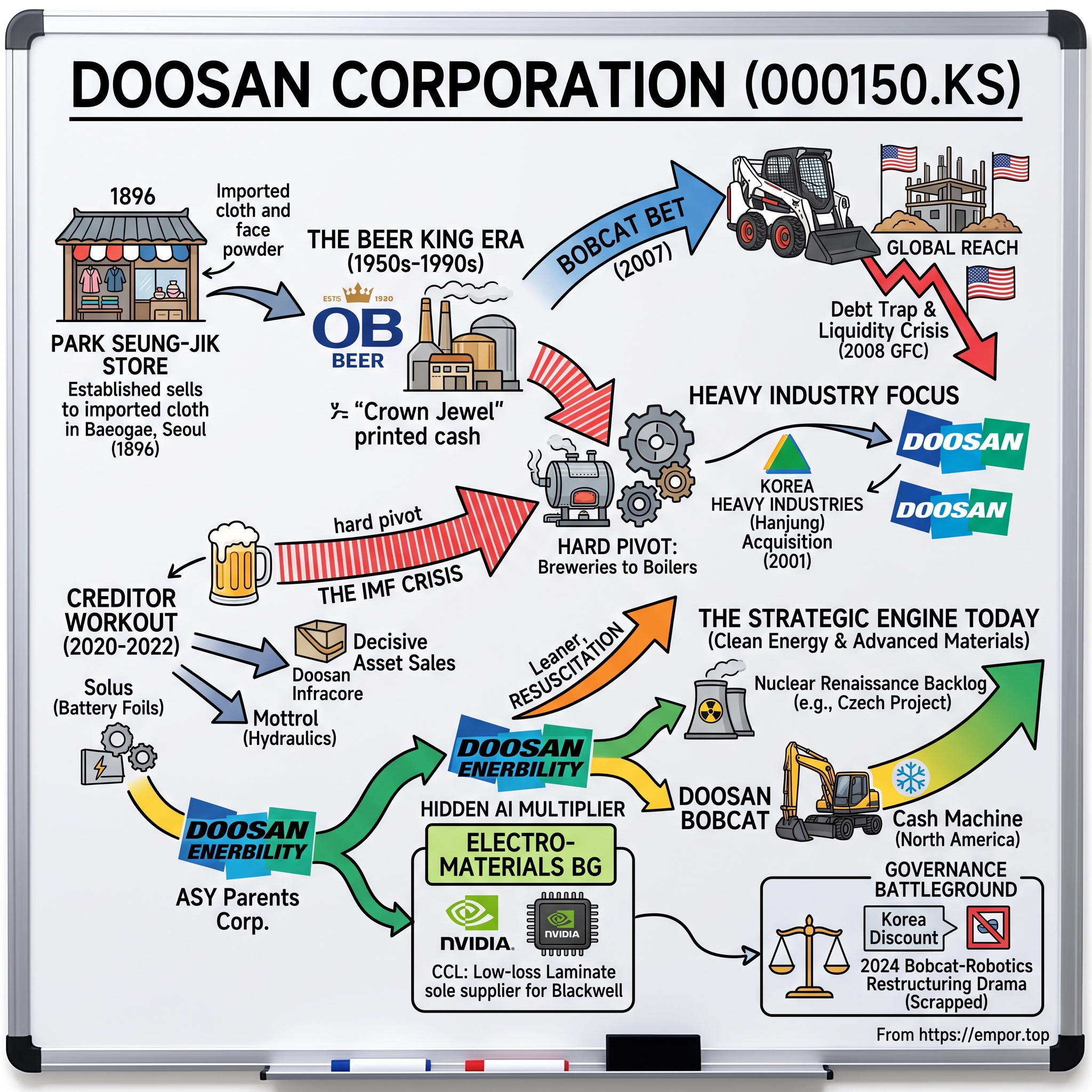
Doosan Corporation: From 19th-Century General Store to AI-Era Powerhouse
I. Introduction & Episode Roadmap
Picture a narrow lane in Baeogae, a merchant quarter of late-Joseon Seoul, in the year 1896. Korea has no stock exchange, no limited-liability companies, barely a modern bank. The country is a fragile kingdom being pried open by foreign powers, three years from the Japanese annexation clock beginning to tick in earnest. And in that lane, a young trader named 박승직 Park Seung-jik opens a small shop selling bolts of imported cloth and boxes of face powder to the women of the neighborhood.1 It is, by most accounts, the first modern permanent retail store the Korean peninsula had ever seen.
Now fast-forward one hundred and thirty years. That same lineage of business — reorganized, renamed, nearly bankrupted, and reborn more times than almost any company on earth — is today a holding company trading in Seoul as 두산 Doosan Corporation, ticker 000150.KS on the KSC exchange. It no longer sells cloth or powder. Instead, it forges the 500-ton steel pressure vessels that sit at the heart of nuclear reactors being built in the Czech Republic. It owns, several layers down, the Bobcat skid-steer loaders that dot construction sites across rural America. And in a quiet business unit inside the holding company itself, it manufactures the copper-clad laminate — a slab of resin and foil most investors have never heard of — that goes into the circuit boards inside 엔비디아 NVIDIA's most advanced artificial-intelligence accelerators.
How does a 19th-century dry-goods store become, in turn, the nation's premier beer brewer, then the industrial backbone of Korea's nuclear-export ambitions, and then an accidental beneficiary of the AI boom? That is the improbable arc of this story.
But there is a paradox sitting at the center of it, and it is the paradox every investor in Doosan Corporation must confront. Doosan is not really one company. It is a holding company whose market value is a claim on a chain of other companies: 두산에너빌리티 Doosan Enerbility, the heavy-energy and nuclear builder; 두산밥캣 Doosan Bobcat, the compact-machinery cash machine; 두산로보틱스 Doosan Robotics, a speculative, barely-profitable maker of collaborative robots trading at a dreamer's valuation; plus that high-margin semiconductor-materials business run in-house. The parent controls these through a cascade of partial stakes, cross-holdings, and inter-subsidiary ownership that would make a forensic accountant reach for a fresh legal pad. That structure is the source of both Doosan's resilience and its persistent stock-market discount.
Here is the roadmap for how we get there:
- The Origins: From a late-Joseon retail shop to the "OB Beer" conglomerate — Korea's beer king for four decades.
- The Hard Pivots: Survival during the 1997 Asian Financial Crisis, the wrenching decision to sell the profitable beer business, and the leap into heavy industry.
- The Debt-Laden Expansion: The 2007 Bobcat acquisition, the liquidity trap that followed, and the near-death experience of 2020.
- The Strategic Engine Today: The segment-level economics of Enerbility and Bobcat, and how the pieces actually make money.
- The Hidden AI Multiplier: Doosan's Electro-Materials business and its dependence on the NVIDIA supply chain.
- The Governance Battleground: The 2024 Bobcat-Robotics restructuring drama, the regulator who blew it up, and the systemic "Korea Discount."
Throughout, the posture here is neutral. Doosan's management tells an inspiring story of a century-old survivor reinventing itself for the AI age. Parts of that story are demonstrably true. Other parts are management hope dressed as strategy, and at least one chapter — the events of 2024 — is a cautionary tale about how a controlling family's interests can collide head-on with those of ordinary shareholders. Let's separate the two.
 Subscribe on LinkedIn
II. Korea's Oldest Modern Business & The Beer King Era (1896–1996)
The origin story begins with an unglamorous but telling detail: Park Seung-jik's shop in Jongno started as a fabric-and-sundries trader, but its breakout was cosmetics. Doosan's own history credits the store with developing some of the first modern cosmetic products in Korea — face powder chief among them — the kind of branded consumer good that built loyal repeat customers long before the group ever touched a turbine.12 It is worth pausing on this, because it tells you something about the DNA of the company. Doosan did not begin as engineers or industrialists. It began as merchants — people who understood distribution, branding, and the daily wants of ordinary customers. That merchant instinct, the willingness to sell whatever the market wanted and abandon whatever it didn't, would later become the group's defining survival trait.
The name most readers know arrived with the second generation. After liberation from Japanese rule and the end of the Second World War, the founder's son, 박두병 Park Too-pyung, formally took the helm of the family enterprise in 1946 and consolidated its identity under the name "Doosan."3 The etymology is almost too on-the-nose for a business meant to compound across generations. In Doosan's own telling, the name combines 두 doo, an old measuring unit for grains, with 산 san, mountain — "little grains of sand that together make a mountain."1 Slow, patient, generational accumulation. A family that thought in decades, not quarters. (A small historical wrinkle worth flagging for the pedantic: Doosan's official timeline dates a "Doosan Store" naming to 1925, while press histories emphasize the 1946 formalization under Park Too-pyung. Both are defensible; the point is that the modern Doosan identity crystallized in the mid-20th century, not at the 1896 founding.)23
Then came beer — and the making of a dynasty. In 1952, in the rubble-strewn aftermath of the Korean War, Doosan took over a brewery whose roots traced to Showa Kirin, a 1933 venture seeded with Japanese Kirin capital that the founding Park family had been involved with from the start. Renamed 동양맥주 Oriental Brewery, it began producing 오비맥주 OB Beer.4 For the next four decades, this was Doosan's crown jewel. As South Korea industrialized and urbanized through the boom decades, OB became a household staple, and Doosan became synonymous not with turbines or excavators but with beer, food, and consumer convenience. In 1978, the group formally rebranded the sprawling OB Group as the Doosan Group, stamping a single corporate identity onto what had become a classic family-run 재벌 chaebol.2
It is worth dwelling on what "beer king" meant, because it shaped the group's self-image for two generations. In a country industrializing at breakneck speed, a national beer brand was not a sleepy consumer business — it was a license to print cash. Beer is a product with fierce brand loyalty, repeat daily consumption, entrenched distribution, and pricing power that compounds as incomes rise. OB was, for decades, exactly the kind of wide-moat consumer franchise that Warren Buffett built a fortune buying. Doosan's leadership grew up inside that comfort: predictable margins, a beloved brand, a dominant position defended by distribution and habit. Around the core brewery, the group accreted the usual chaebol sprawl — food, packaging, trading, construction, machinery — but beer was the identity and the engine. This is precisely what makes the events of 1997 so remarkable in retrospect. Doosan did not sell a struggling business under duress in the ordinary sense; it sold the very thing that defined it.
Sit with the counterfactual for a moment. For nearly its entire modern history up to the mid-1990s, Doosan was a beverages-and-consumer-goods conglomerate. If you had described the Doosan of today — nuclear pressure vessels, AI substrates, American skid-steers — to a Doosan executive in 1990, they would have assumed you were talking about a different company entirely. Almost nothing about the group's present franchise was visible in its past. That is the first and most important fact about this business: its continuity is one of ownership and culture, not of product. The Parks have run this enterprise for four generations — from founder Park Seung-jik, to Park Too-pyung, to the third-generation cousins who made the fateful IMF-era decisions, to the current fourth-generation leadership under Park Jeong-won — but the enterprise itself has been demolished and rebuilt around them at least twice. What passes down through the family is not a product line but a temperament: unsentimental, willing to gut the business to save it, and comfortable making enormous bets that take a decade to prove out. That temperament is the closest thing Doosan has to a permanent asset, and it cuts both ways.
Which raises the obvious question. What forces the demolition of a franchise as comfortable and profitable as being the beer king of a fast-growing nation? The answer arrived in the winter of 1997, and it nearly took the entire chaebol system down with it.
III. The IMF Pivot: From Breweries to Boilers (1997–2001)
In late 1997, the Asian Financial Crisis broke over South Korea like a tidal wave. Foreign capital fled, the won collapsed, and the country was forced into a humiliating bailout by the International Monetary Fund — an episode Koreans still refer to bitterly as "the IMF Crisis," as though the lender itself were the disaster. The crisis exposed the rot inside the chaebol model: decades of debt-fueled expansion, cross-guarantees between affiliates, and empire-building financed with borrowed money. Marquee names — Daewoo, Hanbo, Kia — buckled and, in some cases, disappeared. The government's message to the survivors was blunt: deleverage or die.
Here Doosan made a decision that, in hindsight, looks like the single most important capital-allocation move in its history — and it ran exactly opposite to human nature. Rather than cling to its most profitable business and sell the strugglers, Doosan sold the crown jewel. In 1998, facing a liquidity squeeze, it transferred a 50% stake in OB Beer to Belgium's Interbrew, the brewing giant that would later become part of AB InBev; over the following years it sold down the rest, exiting the beer business it had built over half a century.4 The exact dollar figures for those tranches were never cleanly disclosed in primary filings and are best treated as unconfirmed, but the strategic logic needs no precise number. Doosan cashed out its darling while that darling still commanded a premium price, and used the proceeds to survive and re-tool.
This is the merchant instinct again, expressed at the scale of an entire conglomerate. A company run by engineers might have defended the beer franchise on sentiment — it was the group's identity, its heritage, the business that made the family. Doosan's management treated it as inventory. When the market offered a good price and the balance sheet needed cash, they sold. It is easy to romanticize this in retrospect, and management certainly does. The neutral read is that Doosan was cornered, and it chose the least-bad option available to a desperately over-levered group: monetize the one asset a foreign buyer actually wanted.
The more consequential — and more debatable — half of the pivot was what Doosan did with the cash. Instead of simply paying down debt and shrinking into a quiet consumer company, it went shopping in an entirely unfamiliar aisle. In 2001, Doosan acquired 한국중공업 Korea Heavy Industries & Construction — universally known as Hanjung — a state-owned maker of power-plant equipment, turbines, and nuclear components that the government was privatizing.25 It was renamed 두산중공업 Doosan Heavy Industries & Construction, and it would be rebranded again in 2022 as 두산에너빌리티 Doosan Enerbility — a portmanteau of "energy" and "sustainability" adopted by board resolution on March 8, 2022 and ratified at the shareholders' meeting later that month.67
Think about the whiplash. In the space of a few years, Doosan pivoted from selling beer and consumer goods — short-cycle, low-barrier, brand-driven businesses where success is measured in quarters — to fabricating power-plant boilers and reactor vessels, the longest-cycle, highest-barrier capital goods on earth, where a single project can take a decade and success is measured in engineering tolerances. The strategic rationale management offered was that long-cycle, high-barrier industries were more defensible than consumer products a rival could undercut on price. That thesis has merit. But it also loaded the group with fixed assets, working-capital intensity, and cyclicality that would nearly destroy it twice in the next twenty years. Doosan traded the volatility of consumer taste for the volatility of the global capital-expenditure cycle — and the capex cycle, as we'll see, can stay brutal for a very long time.
The pivot to heavy industry set the stage. But it was a second, far bolder bet — this time an ocean away, in the American Upper Midwest — that would define the next chapter and very nearly end the story.
IV. The Bobcat Bet: A $4.9 Billion Sovereign Gamble (2007–2010s)
By the mid-2000s, Doosan had a construction-equipment arm, Doosan Infracore, and an appetite for scale. What it wanted was a globally recognized brand and a foothold in the world's richest equipment market. In July 2007, it found both. Doosan agreed to buy the Bobcat, Utility Equipment, and Attachments businesses from the American industrial group Ingersoll-Rand for approximately $4.9 billion in cash.8 The deal closed that November.8 Forbes, reporting the announcement, called it plainly "the largest international acquisition yet by a South Korean company."9
To understand why this mattered, you have to understand what Bobcat was — and is. Bobcat effectively invented the compact skid-steer loader, the nimble four-wheeled workhorse you see on every small construction and landscaping site in North America. The company's roots run to North Dakota in the late 1950s, where a self-taught mechanic built a lightweight three-wheeled loader nimble enough to muck out a turkey barn — an origin story as far from Seoul as it is possible to get. Over the following half-century Bobcat turned that farm-implement ingenuity into a category. It dominated its niche the way a category-defining brand does: contractors didn't ask for a skid-steer, they asked for a Bobcat, the same way you ask for a Kleenex or Google something. That brand equity, and the dense dealer network beneath it, were the crown of the asset. For a Korean industrial group with global ambitions, buying Bobcat was buying instant credibility and an entrenched position in the American heartland — a shortcut that would have taken decades and billions to build organically, if it could be built at all.
There was also a strategic industrial logic beneath the ambition. Doosan Infracore already made larger construction equipment — excavators and heavy machinery — where it competed against Caterpillar, Komatsu, and the Japanese and Chinese majors. Bobcat gave it the compact end of the range, a different customer, a different price point, and, critically, exposure to the North American aftermarket where machines are bought, serviced, and replaced on a predictable cadence. On paper, it was the classic bolt-on that transforms a regional player into a global one. The logic was sound. The price and the timing were the gamble.
Was it worth $4.9 billion? Critics said no. The bear argument, then and now, was that Doosan paid a rich multiple — the businesses had generated roughly $2.6 billion of revenue in 2006 — for a fundamentally cyclical machinery business, at the top of a construction cycle, while larger and more diversified competitors like Caterpillar and Deere & Company traded at more sober valuations.8 (You will see an "11-12x EBITDA" multiple quoted in secondary commentary; it does not appear in any primary source we could verify, so treat it as folklore rather than fact.) The bull argument, which was management's, was that Bobcat's category dominance was a genuinely scarce asset — the kind you rarely get to buy, and never cheaply. Both sides had a point. The problem was timing, and timing is where the story turns from ambitious to catastrophic.
Doosan funded the acquisition with roughly $3.9 billion of borrowed money, much of it dollar-denominated.10 Within months of the ink drying, the 2008 Global Financial Crisis arrived. The U.S. housing market — the single largest driver of demand for compact construction equipment — imploded. Bobcat's end markets fell off a cliff, and the acquired business bled: Korea Times later reported cumulative operating losses of roughly 2.5 trillion won across the crisis years.10 Doosan now owned a distressed cyclical asset at the bottom of a cycle, financed with hard-currency debt, in the middle of a global credit freeze. It was, in the coldest terms, the worst-timed large acquisition in modern Korean corporate history.
And yet — and this is the redemption arc management loves to tell — Bobcat survived. Through years of refinancing, restructuring, cost-cutting, and the slow grind of the U.S. construction recovery, Bobcat clawed its way back and ultimately became the single most reliable cash-generating engine in the entire group. The lesson management drew was one of vindication: patience and a great brand won out. The more honest lesson is subtler. Doosan survived Bobcat not because the acquisition was well-timed — it was ruinously timed — but because the underlying asset was genuinely excellent and the group was able, barely, to refinance long enough to let the cycle turn. That is survival by quality of asset plus access to capital, not survival by strategic brilliance. It is a distinction that matters, because the group's luck with access to capital was about to run out.
V. The 2020 Brink of Collapse & Creditor Resuscitation (2020–2022)
By 2019, the crisis had migrated from the American machinery arm back to the industrial heart of the group — Doosan Heavy Industries. And this time the wound was partly self-inflicted by policy, and partly structural.
Two forces converged. Domestically, the administration of President 문재인 Moon Jae-in had adopted an explicit nuclear phase-out policy, freezing new domestic reactor construction and gutting the order pipeline for exactly the ultra-heavy nuclear components Doosan Heavy was built to make.11 Globally, the world was walking away from coal-fired power, and coal boilers had been a massive share of Doosan Heavy's business — by some estimates around 80% of its revenue was tied to coal power.12 A company engineered to build the two things the world was actively trying to stop building suddenly had a backlog problem, a cash-flow problem, and then an existential problem. It offered early retirement to hundreds of staff and stared down debt it could no longer service.11
In the spring of 2020 — with COVID-19 layered on top — the Korean state stepped in to prevent a systemic collapse. State-run creditors led by the 한국산업은행 Korea Development Bank and the 한국수출입은행 Export-Import Bank of Korea committed a rescue package of 3.6 trillion won, roughly $3.2 billion, beginning with an emergency loan of 1 trillion won and expanding into a full workout program.[^14] It is worth being precise, because the numbers get muddled in retellings: 3.6 trillion won was the committed credit line from the two state banks; the group ultimately drew around 3 trillion won and, crucially, pledged to raise a comparable sum by selling assets.[^14] This was not a gift. It was a state-supervised deleveraging, and the price of admission was that Doosan had to dismantle large parts of itself under the watchful eye of its creditors.
What followed, under fourth-generation Chairman 박정원 Park Jeong-won — who had taken the chairmanship in 2016 — was one of the fastest and most aggressive asset-shedding programs in recent Korean corporate history. In a matter of months in late 2020, Doosan sold, in effect, its own limbs:
- Doosan Solus, its advanced copper-foil and battery-materials business, went to the private-equity firm SkyLake Investment for roughly 700 billion won.[^15]
- Doosan Mottrol, its hydraulics unit, was sold to a private-equity consortium for around 453 billion won.[^16]
- Doosan Tower, the group's iconic headquarters skyscraper in the Dongdaemun district of Seoul, was sold to Mastern Investment Management for roughly 800 billion won.13 Selling your own head office is the corporate equivalent of pawning the family home — a signal of exactly how tight the noose had become.
- And most significant of all, Doosan Infracore — the construction-equipment arm that had bought Bobcat in the first place — was sold to rival
현대중공업 Hyundai Heavy Industries(HD Hyundai). Hyundai Heavy was named preferred bidder in December 2020, in a deal valued at roughly 850 billion won, and completed the acquisition in 2021.[^18]14
There is a bitter irony worth naming here. To save the group, Doosan sold Infracore — the very company through which it had acquired Bobcat in 2007 — but it kept Bobcat itself, which by now sat under Doosan Heavy. The overpriced, badly-timed 2007 gamble had matured into the one asset worth protecting, and the group jettisoned the acquirer to keep the acquisition.
A word on what a Korean "workout" actually is, because it is not the same as a Chapter 11 bankruptcy. It is a creditor-led, out-of-court restructuring in which the main lenders — here, the state banks — extend emergency liquidity in exchange for control over the borrower's strategy: which assets to sell, how fast, and where the proceeds go. The company keeps operating, but management effectively serves at the creditors' pleasure until the debt is repaid. It is a gilded cage. Every asset sale in the list above was negotiated under that supervision, on the creditors' timetable rather than the family's, which is why the prices were what a distressed seller gets rather than what a patient one commands. That is the hidden cost of the 2020 rescue: not just the assets given up, but the value forgone by selling them all at once, in public, with a gun to the group's head.
The workout ended almost as suddenly as it began. In early February 2022, roughly 23 months after entering, Doosan repaid its emergency creditor loans and exited the program — unusually fast for a Korean conglomerate restructuring, and something management and creditors alike pointed to with pride.15[^21] Credit for the speed belongs partly to Park Jeong-won and his team, who did not litigate or stall but sold decisively; and partly to timing, as the post-pandemic recovery lifted Bobcat's cash flows and equity markets reopened just as Doosan needed them. The group that emerged was leaner, lighter, and re-pointed toward clean energy and advanced materials rather than coal boilers and beer.
But a graduation certificate is not the same as a clean bill of health. Doosan had survived by selling assets under duress and leaning on state banks — the same pattern as 1997 and, in a sense, 2008. Three near-death experiences in twenty-five years is not a coincidence; it is a feature of the business model. The question every investor should carry into the modern era is whether the post-workout Doosan has genuinely broken that cycle, or merely reset the clock. To answer it, we have to look at what the group actually owns today, and how those pieces make money.
VI. The Core Engine Today: Enerbility & Bobcat Segment Analysis
Start with the shape of the thing, because the shape explains everything about the stock. Doosan Corporation, the entity you buy when you buy ticker 000150, is a holding company. For fiscal 2025 it reported consolidated revenue of roughly 19.8 trillion won and, per its own year-end earnings release, consolidated operating profit on the order of 1.06 trillion won — a low single-digit consolidated margin that reflects how much of the group's revenue is heavy, capital-intensive, and thin-margined.3335 But that consolidated figure is almost misleading, because the value sits in two separately-listed subsidiaries that the parent controls through a chain of partial stakes.
The chain matters, so trace it once. Doosan Corporation owns roughly 30% of Doosan Enerbility.34 Doosan Enerbility, in turn, owns about 46% of Doosan Bobcat.17 So the parent's economic claim on Bobcat's profits — the group's best asset — is diluted twice over before it reaches the holding-company shareholder. This is the structural essence of the "Korea Discount" as it applies to Doosan: you are buying the top of a pyramid, and every layer between you and the cash is a layer where minority interests, cross-holdings, and management incentives can leak value. Hold that thought; it becomes the whole drama of Section VIII.
Now the two engines themselves.
Doosan Bobcat: the cash machine, cooling. For years, Bobcat has been the reliable profit generator underwriting the whole edifice. But 2025 was a step down, and honestly so. Bobcat reported full-year 2025 revenue of about $6.18 billion, down 1.4% from the prior year, with operating profit falling roughly a quarter to about $482 million and operating margin compressing to 7.8% — from $6.27 billion of revenue and a 10.2% margin in 2024.[^23][^24] North American revenue fell about 3% on what the company described as demand uncertainty, while other regions were mixed.[^23] The culprits were a cyclical downturn in U.S. construction and agriculture and, increasingly, the drag of American tariffs on imported equipment — a headwind that hit compact-equipment makers broadly in 2025.31
Why does Bobcat win at all, and is the moat holding? The bull case rests on two mechanisms. The first is a genuinely dense North American dealer and distribution network — the physical footprint that lets a contractor get parts, service, and a replacement machine fast, which is what actually drives repeat purchases in equipment. (Doosan and third-party trackers describe a network numbering in the many hundreds to over a thousand North American locations; the precise count depends on how you count, so treat "very dense" as the durable fact rather than any single number.)[^23] The second is brand: Bobcat is the category's default name, and default names command pricing power and loyalty that a Chinese new entrant cannot buy without spending billions over decades. Evidence that the moat still bites: in December 2025 Bobcat was aggressive enough about its intellectual property to file an ITC complaint against Caterpillar, the industry's giant — the behavior of an incumbent defending turf, not one losing it.32 The bear case is simpler: none of that brand strength changes the fact that this is a cyclical machinery business whose margins just fell by a quarter, and cyclicals are worth less when the cycle turns down. Both are true at once.
Doosan Enerbility: the volume engine, filling its backlog. If Bobcat is the cash today, Enerbility is the order book for tomorrow. And the order book is genuinely inflecting. For fiscal 2025, Enerbility reported new order intake of 14.7 trillion won — more than double the prior year — lifting its backlog to around 23 trillion won, roughly three times its annual revenue, on reported revenue of about 17.1 trillion won and operating profit of about 763 billion won.16 The orders came from three places: nuclear, North American gas turbines, and combined-cycle power EPC work.16 After a decade in which policy and coal's decline gutted its pipeline, Enerbility is being pulled back to life by two macro tailwinds it did not create — the global nuclear renaissance and the electricity hunger of AI data centers.
The landmark proof point is the Czech Republic. In June 2025, the Korean nuclear team led by 한국수력원자력 Korea Hydro & Nuclear Power (KHNP) signed the contract to build the Dukovany nuclear project — two APR-1000 reactors, a deal valued at around CZK 407 billion, roughly $18.6 billion, with construction targeted to begin around 2029.18 Doosan Enerbility is the primary equipment manufacturer inside "Team Korea," the entity that actually forges and builds the heavy hardware, and its turbine arm, Doosan Škoda Power, picked up a further sub-contract worth several hundred billion won for the steam turbines and generators.19 This is the first concrete European reactor win for the Korean nuclear complex, and it is the single most important validation of the entire "nuclear renaissance" thesis for Enerbility.
Which brings us to the tax on that thesis — and it is a real one. In January 2025, Westinghouse, the American nuclear-technology owner, reached a global settlement with KEPCO and KHNP resolving a long-running dispute over the intellectual property underneath the Korean APR reactor designs, which trace to a 1990s Westinghouse license.2021 Here neutrality demands care: the actual financial and geographic terms of that settlement are confidential and were never officially disclosed.20 Korean media, led by Seoul Economic Daily, have reported that the deal requires something like a $175 million technology-licensing fee plus a roughly $650 million goods-and-services purchase per exported reactor, and bars the Korean team from independently bidding in North America, most of Western Europe (the Czech project being carved out), the UK, and a handful of other markets, while leaving Southeast Asia, the Middle East, and other regions open.[^30]22 Those figures are widely repeated but remain reported, not confirmed. If they are even roughly accurate, they act as a structural cap on the profitability of every Korean reactor exported — a levy paid to an American rival on every future win. The competitive field Enerbility must navigate — Westinghouse in the U.S., Framatome in France, Russia's Rosatom, China's Shanghai Electric — is one where Korea's cost-competitive fabrication is a real edge, but where its freedom to sell is now legally fenced.
A myth-versus-reality check is warranted here, because "nuclear renaissance" is one of the most breathlessly marketed narratives in the market, and Doosan is often sold as a pure-play on it. The reality is more textured. It is true that global appetite for new nuclear has genuinely turned after a decade of retreat, driven by decarbonization targets and the sudden, enormous power demand of AI data centers — a demand that intermittent renewables alone cannot satisfy. It is also true that Enerbility possesses rare fabrication capability. But a signed order is not delivered revenue, and nuclear projects are notorious for delays, cost overruns, and political reversal; the Czech units are not scheduled to begin construction until the end of the decade, and the profit will accrue over many years, not in a single blockbuster quarter. Further, as the Westinghouse settlement makes plain, Korea's ability to convert global demand into Korean orders is legally fenced. The honest framing is that Enerbility is a real, cost-competitive supplier to a genuinely reviving market, whose upside is both substantial and slow, and whose export economics are capped in ways the headline narrative rarely mentions.
There is a third mechanism worth understanding, because it explains why Enerbility's revival has legs beyond a single Czech contract: the gas turbine. For decades, high-efficiency gas turbines — the multi-hundred-megawatt machines at the heart of combined-cycle power plants — were a technology monopolized by a handful of Western giants: General Electric, Germany's Siemens Energy, and Japan's 三菱重工業 Mitsubishi Heavy Industries. A country that wanted to build a modern gas plant had to import the turbine. Doosan Enerbility spent years and enormous sums developing an indigenous large-frame gas turbine so that Korea would no longer have to. That capability, hard-won and slow to commercialize, is now paying off precisely as AI data centers drive a surge in electricity demand and utilities scramble for dispatchable power that can be built faster than a reactor. North American gas-turbine and combined-cycle EPC orders were an explicit driver of the 2025 order haul.16 It is the same playbook as nuclear — become the domestic, cost-competitive alternative to an entrenched Western oligopoly — applied to a second product line.
So what should an investor take from the core engine? Two listed engines pointing in opposite directions: Bobcat generating cash but cooling cyclically, Enerbility burning through a decade of drought with a backlog that promises years of revenue but at margins now taxed by the Westinghouse settlement. The early evidence that the mix is shifting favorably showed up in the first quarter of 2026, when Doosan Corporation reported operating profit up roughly 72% year-over-year on revenue of about 5.06 trillion won, driven explicitly by the high-end materials business rather than the legacy heavy units.36 That is a meaningful tell: the marginal profit dollar at the holding company is increasingly coming from a source that did not exist at scale two years ago. Neither Bobcat nor Enerbility, on its own, explains why anyone would get excited about Doosan Corporation the holding company. For that, you have to look inside the parent itself — at a business unit that barely rated a mention two years ago.
VII. The Hidden AI Multiplier: Electro-Materials BG & The NVIDIA Connection
Here is where the century-old survivor collides with the defining technology story of the decade, and it happens in a place almost no one was looking: not in a listed subsidiary, but inside Doosan Corporation's own income statement. The holding company is not purely a holding company. It runs an in-house operating unit, the Electro-Materials Business Group, and that unit makes something called copper-clad laminate, or CCL.
Let's demystify CCL, because the whole thesis rests on understanding it. A printed circuit board — the green board inside every electronic device — is built up from layers. The foundational layer is copper-clad laminate: a sheet of insulating resin with copper foil bonded to one or both faces.23 The copper carries the electrical signals; the resin holds everything together and, critically, determines how much of the signal is lost as it travels. Think of it like plumbing for electricity. In a cheap garden hose, some water pressure leaks away through the walls and the flow gets sloppy; that is fine for watering plants. But if you are trying to push an enormous, precisely-timed volume of water through at high speed, you need engineered pipe that loses almost nothing. In an AI server, the "water" is data moving between GPUs and memory at extreme frequencies, and every bit of signal lost to a mediocre resin turns into heat, errors, and slower performance. So the chemistry of that insulating layer stops being a commodity and becomes a precision problem. Get the resin formulation right and the board runs cool and clean at high speed; get it wrong and the signal degrades. Doosan's edge is exactly that formulation: a low-loss, high-frequency laminate that its engineers tune for AI boards.23
It helps to know that CCL comes in tiers, because Doosan's position is strongest at the top. Ordinary laminate for consumer electronics is a low-margin, high-volume commodity contested by dozens of manufacturers. The high-end material used in AI accelerators — the network boards that route signals between chips and the package substrates that sit directly beneath the GPU — is a different product, made by a short list of qualified suppliers, sold at prices and margins the commodity tier can only dream of. This is where the money is, and it is the specific tier where Doosan out-executed its Taiwanese rival on NVIDIA's Blackwell generation.23 The barrier to entry is not a patent you can license; it is years of accumulated process knowledge — how to formulate, cure, and bond the material at scale with the consistency a chipmaker demands. That is why NVIDIA cannot simply flip to a new supplier overnight, and it is also why a supplier that stumbles on a qualification test, as EMC reportedly did, can lose a generation's worth of business.
And the customer at the end of that supply chain is NVIDIA. Doosan's Electro-Materials group began mass-producing CCL for NVIDIA's Blackwell generation of AI accelerators and, according to industry reporting, was selected as a sole supplier for the relevant high-end material — a striking position given that Taiwan's EMC leads the overall CCL market with something like a 60% share.23 Doosan sits second globally in CCL, but in the specific high-end AI niche it out-executed EMC on Blackwell.23 The prize ahead is bigger still: reporting suggests that after EMC stumbled on a quality-verification test for a next-generation product, Doosan is positioned to become the exclusive CCL supplier for NVIDIA's forthcoming Rubin architecture, potentially from the second half of 2026.24 That is the difference between being a supplier and being the supplier — and it is, at this stage, a projection rather than a booked fact.
The financial materiality is where independent scrutiny matters most, because the headline numbers deserve care. The exciting version of the story — that this business roughly doubled in a year — is directionally supported but the precise figures floated in some summaries are forecasts, not audited disclosures. What is actually on the record is striking enough. Doosan's Electro-Materials group posted first-quarter 2026 revenue of about 617 billion won, up 53% year-over-year, a record, as high-end AI product surged.25 Brokerage analysis quoted in Korean business press has traced the NVIDIA-specific CCL revenue climbing from roughly 100 billion won in late 2024 toward several hundred billion in 2025 and past a trillion won in 2026, at operating margins in the mid-to-high twenties percent — dramatically richer than anything in Bobcat or Enerbility.24 The honest framing: this is a small-but-explosive, unusually high-margin business riding a single ferocious demand wave, with the growth trajectory partly booked and partly still projected.
To feed that demand, Doosan is building capacity outside Korea for the first time in this line. In 2026 it announced roughly a 180 billion won investment to construct a new CCL plant at the Araya Industrial Park in Samut Prakan, Thailand, on a site of about 73,000 square meters, with construction starting in 2026 and mass production targeted for the second half of 2028.26 The strategic logic is to scale high-margin capacity closer to global supply chains and away from geographic concentration in Korea.
Now, the sober counterweight, because a neutral platform has to state it plainly. This is a business whose fortunes are tethered to a single end customer's product roadmap and to one relentless spending cycle. "Sole supplier for Blackwell" is a wonderful position until NVIDIA qualifies a second source, or until EMC passes the test it just failed, or until the AI capital-expenditure boom cools the way every capital-expenditure boom eventually does. The Rubin exclusivity that underpins much of the bull case is, as of this writing, an expectation contingent on a competitor's failure — a fragile foundation for a permanent moat. The engineering edge in low-loss laminate chemistry is real and hard to replicate quickly; the durability of the customer relationship and the pricing that comes with it is the open question. For a holding company long defined by heavy, cyclical, thin-margin industry, this unit is a genuine and welcome new profit pool. Whether it is a structural advantage or a spectacular moment remains, at this point, unproven.
The AI multiplier is the reason Doosan's stock has anything resembling a growth narrative. But in 2024, that narrative ran headlong into a governance scandal that showed exactly how the group's Byzantine structure can be turned against its own minority shareholders — and how, this time, they fought back.
VIII. The 2024 Restructuring Drama & The "Korea Discount" Battle
In July 2024, Doosan Group unveiled what it framed as a clean, logical simplification of its tangled structure. The group would realign around three pillars: Clean Energy, Smart Machines, and Advanced Materials.[^36]27 To a management consultant, it was tidy. To Bobcat's minority shareholders, it was a heist in progress.
Here is the maneuver at the center of the storm. Doosan proposed to pull Bobcat — the profitable cash machine — out from under Doosan Enerbility and place it under Doosan Robotics, the group's collaborative-robot business.[^36] Pause on the mismatch. Bobcat threw off well over a trillion won of operating profit a year. Robotics was a speculative, loss-making company that commanded a sky-high valuation multiple precisely because it had a thrilling story and almost no earnings. Under the plan, Bobcat shareholders would have their shares swapped into Robotics shares at a ratio of roughly 0.6 Robotics shares per Bobcat share — a ratio calculated, per Korea's Capital Market Act, on prevailing market stock prices rather than on the two companies' underlying earnings or book value.2829
That methodology was the whole scandal. Because Robotics traded at a dreamer's valuation and Bobcat at a cyclical's, using market prices meant Bobcat's owners were being asked to trade shares in a highly profitable, cash-generating, defensive business for shares in a lightly-profitable, richly-priced speculation — and to do it at a ratio that captured none of Bobcat's superior fundamentals.28 To many shareholders, and to a growing chorus of activist investors including Align Partners, it looked like a textbook chaebol maneuver: shuffle a crown-jewel asset up the ownership chain to tighten the controlling family's grip and cross-subsidize a pet growth story, without paying minority holders a fair premium for what was being taken from them.28[^48] Doosan's defense was legalistic — the ratio was "set based on the market price as stipulated by the current Capital Market Act" — which was true, and which was exactly the problem the ensuing reform push would target.28
Then something happened that had rarely happened before in a Korea-Discount drama: the referee stepped onto the field. The 금융감독원 Financial Supervisory Service, the country's financial watchdog, under its combative Governor 이복현 Lee Bok-hyun, rejected Doosan's securities registration statement in July 2024 and issued a second correction demand in August, objecting that a swap ratio that funneled a profitable business into a loss-making one did not reflect real value.2830 Lee's warning was unusually pointed: "If there is even the slightest deficiency, we will demand corrections without limiting the number of times."28 For a regulator historically deferential to the chaebols, this was a genuine shift — the FSS using its disclosure-review power as a live weapon against a controlling family's restructuring.
Those appraisal rights deserve a plain-English explanation, because they turned out to be the mechanism that actually killed the deal. Under Korean law, when a company pushes through a merger that dissenting shareholders oppose, those shareholders can demand that the company buy their shares back at a pre-agreed price. It is a safety valve: if you hate the deal, you can cash out rather than be dragged along. But it is also a financial time bomb for the acquirer, because if the stock price falls below the guaranteed buyback price, rational shareholders exercise their right en masse and force the company to spend cash it may not have. That is exactly the trap Doosan walked into.
The plan died in December 2024. Doosan revised the terms once — nudging a related Enerbility split-and-merger ratio from 1:0.031 to a slightly more generous 1:0.043 — but the combination of relentless regulatory friction, a collapsing share price, and a spike in shareholder appraisal-right demands proved fatal.[^40] The timing was almost operatic: markets were convulsing after President 윤석열 Yoon Suk Yeol's short-lived martial-law declaration crushed Korean equities, and Doosan's own shares fell below the buyback prices it had guaranteed to dissenting holders. Enerbility warned that the cost of buying back shares from investors exercising their appraisal rights could blow through its roughly 600 billion won cap.[^40] On December 10, 2024, Doosan officially scrapped the Bobcat-Robotics merger.[^40] Bobcat remained under Enerbility, where it sits today.17
The aftershocks reshaped the conversation. Doosan Bobcat, chastened, rolled out its own "value-up" package to placate the shareholders it had nearly steamrolled — a higher total-shareholder-return target of around 40%, more frequent dividends, and a 200 billion won share buyback-and-cancellation.[^41] More broadly, the episode became the poster child for the 코리아 디스카운트 Korea Discount — the persistent valuation gap between Korean companies and global peers, rooted in exactly this kind of governance where controlling families extract value at minorities' expense. And it became fuel for the government's 밸류업 프로그램 Corporate Value-up Program, Seoul's campaign to reform shareholder protections and close that discount. Doosan, having tried the old playbook and been publicly stopped, became the case study for why the old playbook may no longer work.
For investors, the 2024 drama is not ancient history to be filed away. It is the single most important piece of evidence about how this controlling family behaves when its interests and minority shareholders' interests diverge — and the answer, on this occasion, was that it tried to move value toward itself until a regulator and a shareholder revolt forced a retreat. That behavioral fact sits underneath every valuation of the holding company.
IX. Strategic Moats: Porter's 5 Forces & Hamilton Helmer's 7 Powers
Strip away the drama and the century of history, and the investment question reduces to something simple: where, if anywhere, does Doosan possess a durable advantage that competitors cannot easily erode? Two analytical frameworks help war-game it — Hamilton Helmer's 7 Powers, which asks what specific, persistent edge a business holds, and Michael Porter's Five Forces, which maps the competitive pressures on it.
Through Helmer's lens, Doosan holds three candidate powers, of very different quality.
The first, and strongest, is a cornered resource in heavy nuclear fabrication. The ability to cast and forge single-piece ultra-heavy nuclear components — reactor pressure vessels and steam generators weighing hundreds of tons, made to tolerances where failure is catastrophic — exists at only a handful of facilities on the planet. Enerbility's Changwon works is one of them. This is not a moat a well-funded rival can dig in five years; it requires decades of accumulated metallurgical know-how, capital equipment, and regulatory qualification. It is the realest of Doosan's advantages. Its limitation, as we've seen, is that the freedom to deploy it in export markets is now legally constrained by the Westinghouse settlement — a cornered resource whose output is taxed and geographically fenced.
The second is scale economies and switching costs at Bobcat, expressed through its North American dealer density and brand default. A contractor who owns Bobcat machines, buys Bobcat parts, and relies on a nearby Bobcat dealer faces real friction in switching — and a new entrant, especially a Chinese manufacturer, would have to replicate that physical service network at enormous cost before it could compete on anything but price. This is a genuine but ordinary moat: strong enough to defend share and pricing, not strong enough to prevent the cyclical margin compression Bobcat just experienced.
The third is the process power in Electro-Materials CCL — the low-loss laminate chemistry that is hard for a standard PCB maker to replicate. It is real, and it is why Doosan won the Blackwell slot. But process powers erode when competitors catch up, and here the competitor set is one determined, well-capitalized rival (EMC) plus a customer (NVIDIA) with every incentive to cultivate second sources. This is the least durable of the three.
Through Porter's Five Forces, the picture is a study in contrasts:
- Threat of new entrants: Extremely low in reactor fabrication and high-end AI substrates, where capital, know-how, and qualification are prohibitive; meaningfully higher in robotics and general automation, where Robotics competes against deep-pocketed global players.
- Bargaining power of suppliers: Moderate for the metals and chemicals Doosan buys, but conspicuously high in one place — nuclear IP, where Westinghouse's settlement operates as a structural cap on Korean reactor-export margins. When one supplier can levy a fee on every future sale, that is supplier power in its purest form.
- Bargaining power of buyers: High in Enerbility's world. Its customers are sovereign governments and state-run utilities — sophisticated, price-sensitive, politically-motivated buyers who run multi-year competitive tenders and hold most of the cards.
- Threat of substitutes: Low for the specific role nuclear plays. For carbon-free, always-on baseload power at the scale AI data centers demand, there is no easy substitute — which is precisely why the nuclear renaissance has legs.
- Competitive rivalry: High across the board — Caterpillar, Deere,
Kubota, and Komatsu in compact machinery; Westinghouse, Framatome, Rosatom, and Shanghai Electric in nuclear; EMC in substrates. Doosan is nowhere the unchallenged leader; it is a strong contender in several tough arenas.
The synthesis: Doosan's most durable edge (nuclear fabrication) sits in its most buyer-dominated, IP-taxed market, while its most exciting edge (AI substrates) is its least durable. There is no single fortress here. There is a portfolio of decent-to-strong positions, held together by a holding-company structure that the market discounts. That is not a knock — it is simply what the business is, and pricing it correctly means resisting the temptation to extrapolate any one bright spot into a permanent franchise.
X. Playbook & Investing Lessons
Step back from the specifics, and Doosan offers a set of transferable lessons that are unusually clear precisely because the company has lived through so many cycles.
Sell the darling before the cliff. The defining lesson of 1997 is that Doosan survived where more sentimental peers died because it was willing to sell OB Beer — its identity, its most profitable business — while it still commanded a premium. The instinct to hold a beloved, cash-generating asset "just a little longer" is exactly what bankrupts over-levered companies in a downturn. Doosan's merchant DNA, its willingness to treat even its crown jewel as inventory, is the single trait most responsible for its longevity. The uncomfortable corollary is that the same instinct, applied to Bobcat in 2024, was what nearly triggered a shareholder revolt — proving that "reshuffle the darling" is a tool that can be used for survival or for extraction, and the market can tell the difference.
Conglomerate structuring is a double-edged sword. Shuffling a profitable asset to cross-subsidize a speculative one — moving Bobcat's cash toward Robotics' story — can look elegant on an org chart and destroy market confidence in practice. Modern public markets increasingly demand pure-play exposure and penalize the kind of opaque, multi-layered inter-subsidiary ownership that lets value leak between the controlling family and outside shareholders. The complexity that once signaled a mighty chaebol now reads to investors as a discount waiting to be applied.
Regulatory defiance has a rising cost. For decades, the chaebol playbook assumed that capital allocation could be dictated by the controlling family, and regulators would defer. The 2024 episode showed that in a reform-minded climate — with an activist FSS and a government staking political capital on closing the Korea Discount — that assumption can fail publicly and expensively. Maintaining regulatory and public-market credibility is no longer a soft nicety; it is a hard economic asset, and squandering it carries a real price in appraisal-right liabilities, aborted deals, and a lower multiple.
The through-line is that Doosan's greatest strength and its greatest vulnerability are the same thing: a controlling family with the conviction to make brutal, contrarian capital-allocation moves. That conviction saved the group in 1997 and rebuilt it after 2020. It also produced the 2024 debacle. Investors are, in the end, making a bet on how that family will wield its control next.
XI. Analysis & Bear vs. Bull Case
So where does that leave the "why win / why not" spine? Let's make both sides explicit, and test them rather than assert them.
The bull case rests on three legs. First, the AI accelerator windfall: the Electro-Materials unit is a high-margin business growing at breakneck speed, embedded — for now — as a sole or leading supplier in NVIDIA's most advanced hardware, with a new Thailand plant to scale it.2526 Second, the nuclear backlog: Enerbility has converted a decade of drought into a 23-trillion-won order book, anchored by the first European reactor win at Dukovany and with the option value of further projects in Poland, the Middle East, and small modular reactors.1618 Third, cyclical resilience: even in a down year, Bobcat generated hundreds of millions of dollars of operating profit, giving the holding company a cash foundation.[^23] The bull's summary: three engines — AI materials, nuclear, and machinery — where two years ago there was one struggling conglomerate.
The bear case rests on three counter-legs, and each has teeth. First, the governance tax: the 2024 fiasco is hard evidence that the controlling family will, given the chance, move value toward itself, and that risk justifies a permanent discount on the holding-company stock — you are buying diluted claims through a structure that has already tried to disadvantage minorities once.[^40] Second, the export tax on nuclear: if the reported Westinghouse settlement terms are even roughly accurate, every exported Korean reactor carries a heavy licensing and purchase burden and a fenced map of where it can be sold, capping the margin on the very backlog the bulls celebrate.22 Third, cyclicality and concentration: Bobcat's margins just fell by a quarter on tariffs and soft construction demand, and the AI materials business — the whole growth narrative — is dangerously dependent on a single customer's roadmap and one capital-spending cycle that will not last forever.[^23]31
There is a fourth bear consideration that sits underneath all three and rarely gets its due: the balance sheet and the memory of it. A group that required a state bailout in 2020, and that has now committed to heavy capital spending — the Thailand CCL plant, the multi-year nuclear build-out, Bobcat's own capacity plans — is a group whose appetite for capital is rising again just as one of its cash engines (Bobcat) is cooling. None of this signals imminent distress; the workout is over and the growth businesses are throwing off cash. But an investor who lived through Doosan's three near-death experiences is right to keep one eye on how the group funds its ambitions, and whether capital discipline — promised repeatedly during the workout — survives contact with the temptation of an AI boom. Aggressive capital allocation after promises of restraint is exactly the pattern that the 2024 restructuring embodied, and it is worth watching for its return in a different guise.
Weighing them through the frameworks already laid out: the bull case is strongest where the moat is most durable and weakest where it is most fragile, and the bear case is the mirror image. The nuclear franchise is real but buyer-dominated and IP-taxed. The AI franchise is thrilling but unproven in durability. The machinery franchise is defensible but cyclical and currently cooling. And wrapped around all of it is a holding-company structure and a governance track record that the market has explicit, recent reason to distrust. A skeptical activist would press on exactly these points: why should minority holders pay full value for assets they own only through a twice-diluted chain, run by a family that tried to restructure that chain to their disadvantage in living memory? That is the crux of the Korea Discount as it applies here, and no amount of NVIDIA-adjacent excitement fully answers it.
None of this yields a verdict, and it shouldn't. It yields a lens: Doosan is a collection of real but qualified advantages, priced through a structure the market distrusts, run by a management whose behavior is the central variable. The interesting question is not whether Doosan is "good" or "bad" but which of these tensions resolves first — and that is precisely what the metrics below are designed to track.
XII. Epilogue & KPIs to Watch
Zoom all the way out, and the through-line of this 130-year story is not any single product — cloth, cosmetics, beer, boilers, skid-steers, or laminate. It is adaptive survival. Doosan has been demolished and rebuilt around the same controlling family at least twice, and has stared into the abyss three times in twenty-five years. It is, at once, one of the most resilient corporate organisms in Asia and one of the most complex and governance-challenged. Both things are true, and holding them together is the whole discipline of analyzing this company.
For an investor who wants to track whether the bull or bear thesis is winning, three key performance indicators cut through the noise. There is no need to compute them here; the point is to watch them over time.
First, Electro-Materials revenue and margin. This is the growth story in a single line. Watch whether the segment keeps compounding — whether Doosan converts its Blackwell position into the Rubin exclusivity that reporting anticipates, whether the Thailand plant comes online on schedule in 2028, and above all whether the extraordinary operating margins hold as capacity expands and NVIDIA inevitably seeks second sources. If this line stalls or its margin compresses, the growth narrative deflates with it.
Second, Doosan Enerbility's order backlog and export margins. The backlog tells you the top line for years to come; the margin tells you what it's worth. Track progress on the Dukovany build, the conversion of the pipeline into further nuclear and gas-turbine wins, and — critically — any hard disclosure that lets you gauge the real economic burden of the Westinghouse settlement on export profitability. A growing backlog earned at a shrinking margin is a very different investment than the headline suggests.
Third, governance and value-up follow-through. This is the one that determines whether the holding-company discount narrows or persists. Watch for concrete, shareholder-friendly capital allocation from Doosan Corporation and its subsidiaries — buybacks that are actually cancelled, rising dividends, and above all a demonstrated unwillingness to repeat the 2024 maneuver. Credibility here is not rebuilt with press releases; it is rebuilt with a multi-year track record of putting minority shareholders on equal footing. The market damaged in 2024 will believe it when it sees it.
Watch those three lines, and you are watching the real Doosan — not the origin myth of grains piling into a mountain, but the live, unresolved contest between a genuine industrial and technological revival and the structural, self-inflicted discount that has shadowed this company for a decade.
References
-
Business Highlights / Company History Timeline — Doosan Corporation (official) ↩↩↩↩
-
Doosan Group, a living witness to Korea's modern business history — The Korea Herald ↩↩
-
History of Oriental Brewery / OB Beer and the Doosan connection — TopDaily ↩↩
-
Company history — Korea Heavy Industries & Construction (Hanjung) privatization and 2001 rename to Doosan Heavy — Doosan Enerbility (official) ↩
-
Doosan Heavy Industries & Construction renamed Doosan Enerbility — Doosan Corporation press release, 2022 ↩
-
Doosan Enerbility company history — Doosan Enerbility (official) ↩
-
Ingersoll-Rand to Sell its Bobcat, Utility Equipment and Attachments Business Units for $4.9 Billion — Ingersoll-Rand/Trane Technologies press release, 2007 ↩↩↩
-
Doosan's Bobcat acquisition, debt and post-crisis losses — The Korea Times, 2014 ↩↩
-
Questions arise over unclear nuclear phase-out policy and impact on Doosan Heavy — The Korea Times, 2020-05-01 ↩↩
-
South Korea backs Doosan Heavy coal-power bailout despite green pledge — Mongabay, 2020-04 ↩
-
Doosan Tower headquarters sold to Mastern Investment Management — The Korea Herald, 2020 ↩
-
Hyundai Heavy completes Doosan Infracore acquisition — The Korea Herald, 2021 ↩
-
Doosan graduates from creditor management system in February 2022 — TopDaily ↩
-
Doosan Enerbility FY2025 orders, backlog and results — Asia Business Daily (Asiae), 2026-02-12 ↩↩↩↩
-
Doosan Enerbility sells 5% of Bobcat, stake to ~46% — Rural Lifestyle Dealer ↩↩
-
KHNP sets out plans for USD 18.6bn Czech nuclear project (Dukovany) — World Nuclear News, 2025 ↩↩
-
Doosan Škoda Power steam-turbine sub-contract for Czech nuclear units — Businesskorea ↩
-
Westinghouse Announces Global Settlement Agreement with KEPCO and KHNP — Westinghouse Electric Company, 2025-01-16 ↩↩
-
Westinghouse reaches agreement on IP with Korean companies — World Nuclear News, 2025-01-17 ↩
-
KHNP withdraws from Polish nuclear project; reported settlement terms — Nuclear Engineering International ↩↩
-
Doosan mass-produces high-end CCL for NVIDIA Blackwell; world #2 in CCL — Businesskorea ↩↩↩↩↩
-
Doosan positioned as exclusive CCL supplier for NVIDIA Rubin; CCL revenue projections — Businesskorea ↩↩
-
Doosan on track for growth as portfolio aligns with AI industry (Q1 2026 Electro-Materials results) — The Korea Times, 2026-06-19 ↩↩
-
Doosan Corporation to establish CCL production base in Thailand — Doosan Corporation press release, 2026 ↩↩
-
Doosan Group unveils three-pillar restructuring — The Korea Herald, 2024-07-11 ↩
-
FSS rejects Doosan filings; swap-ratio controversy and Lee Bok-hyun remarks — Businesskorea ↩↩↩↩↩↩
-
Bobcat-to-Robotics share swap ratio detail — The Korea Herald ↩
-
South Korean financial watchdog puts brakes on Doosan Bobcat-Robotics merger — The Korea Times, 2024-07-24 ↩
-
How US tariffs impacted construction-equipment OEMs in 2025 — Equipment World ↩↩
-
Doosan Bobcat files ITC complaint against Caterpillar (Dec 2025; investigation instituted 2026) — Engineering News-Record ↩
-
Doosan Corporation is Doosan Enerbility's largest shareholder (~30%) — Simply Wall St via Webull, 2025-08-17 ↩
-
Doosan Corporation FY2025 operating income (~1.1 trillion won) — AlphaSpread ↩
-
Doosan Q1 operating profit jumps 71.7% on high-end CCL strength — Seoul Economic Daily, 2026-04-29 ↩
 LinkedIn
 WhatsApp
 Reddit
 Hacker News
 Email
Email Kindle
 RSS Feed
 Spotify
 Apple Podcasts
 Amazon Music
 Audible
 YouTube